Antifragile Philosophy in R&D Projects: Applying Q Methodology and the Possibility of Open Innovation


Abstract
:1. Introduction
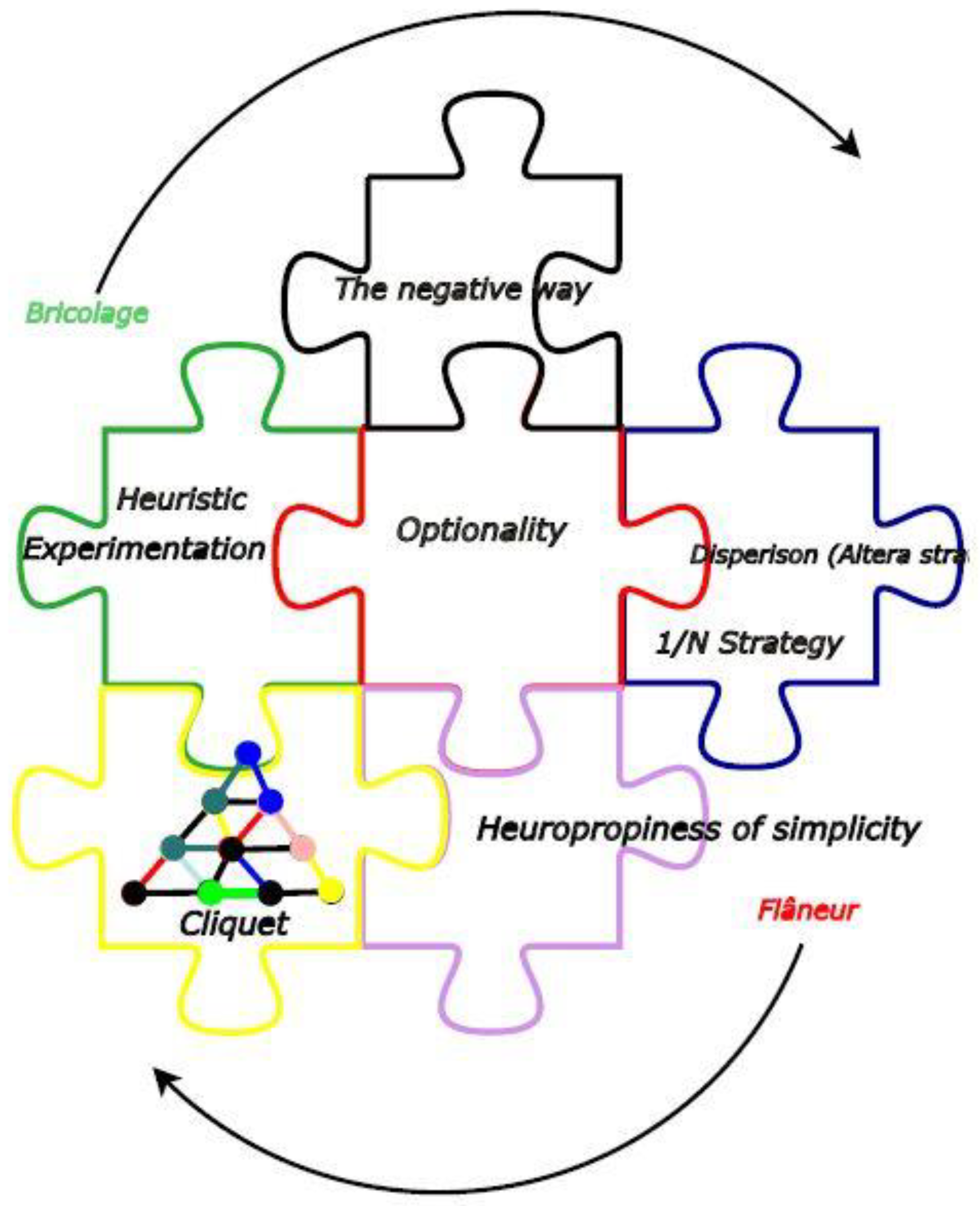
- Optionality: Successful projects, especially in innovation, require investing in people and ideas and in a timely manner, switching between the different options created on purpose. The introduction of optionality in any project planning is related with risk management contingency actions/corrective measures and renders the surveillance of probable future events unnecessary, eliminating the errors of deterministic cause-effect models. Optionality must not be confused with flexibility. It is not so much a plan and the narrative that goes with it but the network of knowledge and experience that supports it. Among the refences cited above, this concept is presented in [4,5,6] and more specifically developed in [7] where the history of the complex adaptative systems is reviewed:
- Dispersion (Altera strategy): This is known as “1/N strategy”. As a consequence of the uncertainty, the deployment of innovation and research must be approached through multiple experiments or trials. This multiplicity of attempts is related to the “optionality” mentioned above, but “dispersion” refers to how the resources are shared among the designed options. Antifragile projects should divide the efforts between each option and its complement choice, balancing the higher risk options with the lower ones. This is implemented by distributing potential project investments in the total number of options and their complements N; hence, the name “1/N strategy” is conferred. This concept is grounded in [4,5] and enriched in [6] with non-deterministic methodologies.
- Cliquet (serial opportunities): This is an approach to activity planning by focusing in the short term, with flexibility for correcting the original plan depending on the most recent outcomes of the project. It allows plans taking advantage of the possible new options that are continuously presented during R&D activity. Rigid medium-term to long-term plans invariably present a scenario that, in the event of failure, does not offer opportunities for readjusting the plans in search of new options. In practice, applying “Cliquet” thinking consists of designing adaptable plans, with frequent exits. These plans should be for the short-term but are always aligned with the long-term objectives. This concept is extended in [9] when considering the sequence of learning in an innovative organization.
- Heuristic experimentation: Theories are born from experimentation and not vice versa. Innovation, as well as success in it, has its origin in experimentation. In the history of science and technology, there is more evidence of achievement by random experimentation than by a predetermined deterministic plan (except perhaps in sciences such as physics and mathematics). This property is closely related to the concept of serendipity [11] or unforeseen positives. Antifragile project management must be prone to take advantage of unexpected results even if their probability to happen is small.
- Heuropropiness of simplicity (less is more): Pragmatism is incompatible with complexity. The simplest solutions and technologies are often ignored in R&D despite the view that they can be the most proper choices. This property is related to the “Ockahm’s razor” or “principle of parsimony”, which is a problem solving principle originally formulated as “pluralitas non est ponenda sine necessitate” which means “complexity should not be assumed if it is not necessary”. Learning from failure (“The negative way”): This characteristic is related to failure as a source of learning. Innovation and research based on “trial and error” are a major source of knowledge. Every trial that ends in error teaches, at least, what does not work. Successful failure, by promoting it, fosters collective learning [8] and is a reflection of good research practice. In addition, it allows attention to be paid to the alternative forms that serendipity can show.
- Interaction between all the properties: “bricolage” and spirit “Flâneur”. The term “bricolage” refers to the fact that antifragile management must properly combine the characteristics above into a plan that accounts for all the applicable research lines, equilibrating resource distribution among them while allowing strategies to shift between options if necessary, which involves leaving room for randomness, choosing the simplest alternatives available and learning from failure. One property does not exclude the others, nor do they all necessarily exist. The “flâneur spirit” refers to being attentive to the opportunities that arise during project development and is the behavior that allows evaluation of the options that are detected or intuited and to take advantage of them. This interaction is related with learning from chaos [10] and the benefits of being open to the unexpected.
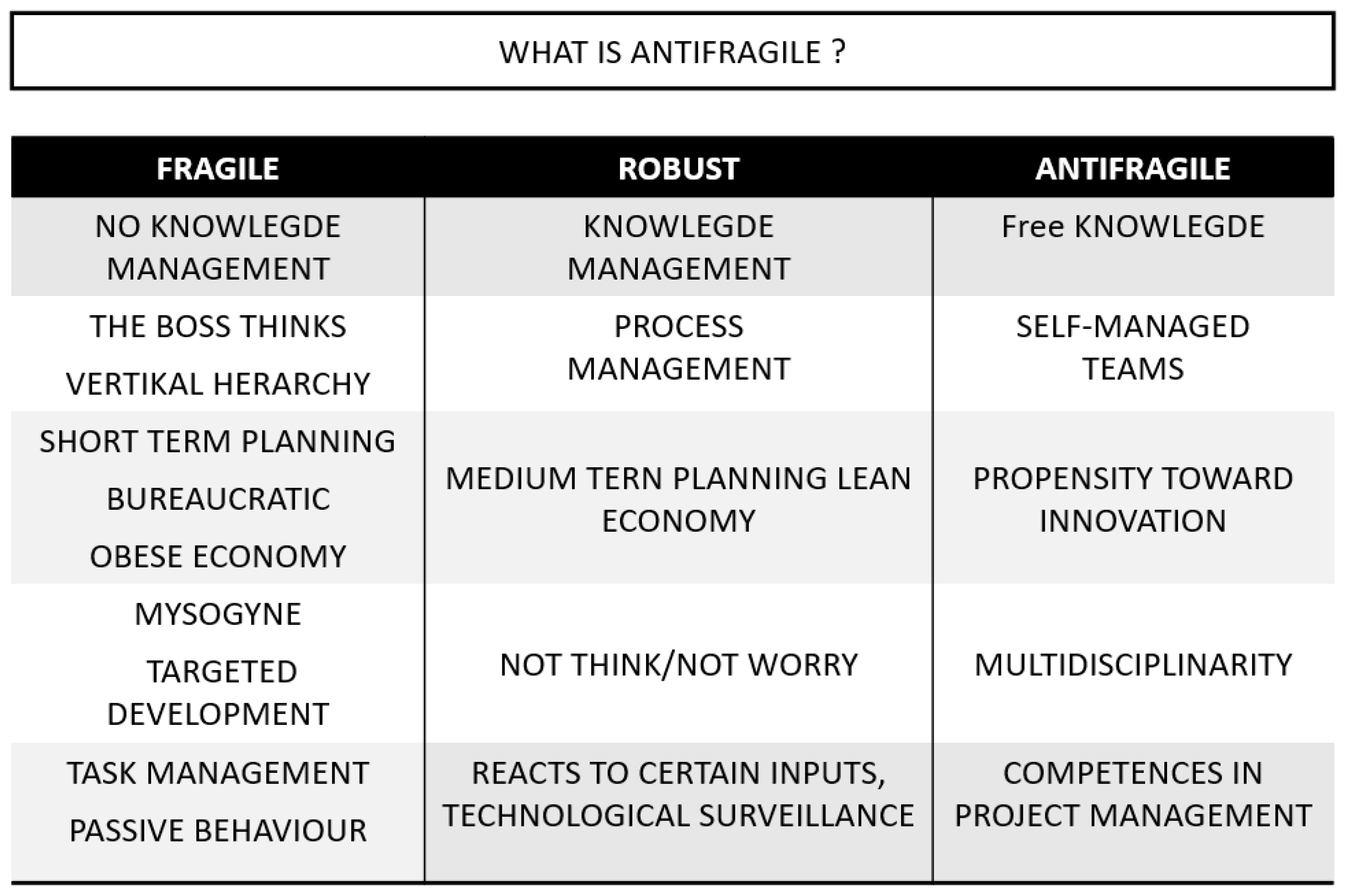
- Free knowledge (FK): This behavior is mainly characterized by heuristic experimentation and flaneur spirit. Cliquet, failure as a source of learning, simplicity and dispersion are four characteristics also present in organizations that foster free knowledge, but their role is less relevant than the former two.
- Self-managed teams (SMT): This behavior is built on the philosophy characteristics of cliquet, failure as a source of learning, simplicity and the flaneur spirit. Optionality, dispersion and heuristic experimentation are also considered but with less intensity.
- Propensity towards innovation (PI): The main characteristics involved are dispersion, failure as a source of learning and optionality. Those that are second in importance include dispersion, cliquet, heuristics and simplicity.
- Multidisciplinarity (M): The singularities of this behavior are optionality and simplicity. The second level involves dispersion, cliquet, heuristic experimentation, failure as a source of learning and the flaneur spirit.
- Competence in project management (PM): Antifragile philosophy is developed on the basis of multiple projects for which specific management capabilities are required [12]. The main characteristics of this behavior are optionality, dispersion and cliquet. The secondary characteristics are heuristics, simplicity, failure as a source of learning and the flaneur spirit.
2. Experimental Method
2.1. Q Methodology
2.2. Research Design
2.3. Data Collection
3. Results
4. Discussion
4.1. Perspectives
4.2. Applicability of Q Research Method to Open Innovation Research
5. Conclusions
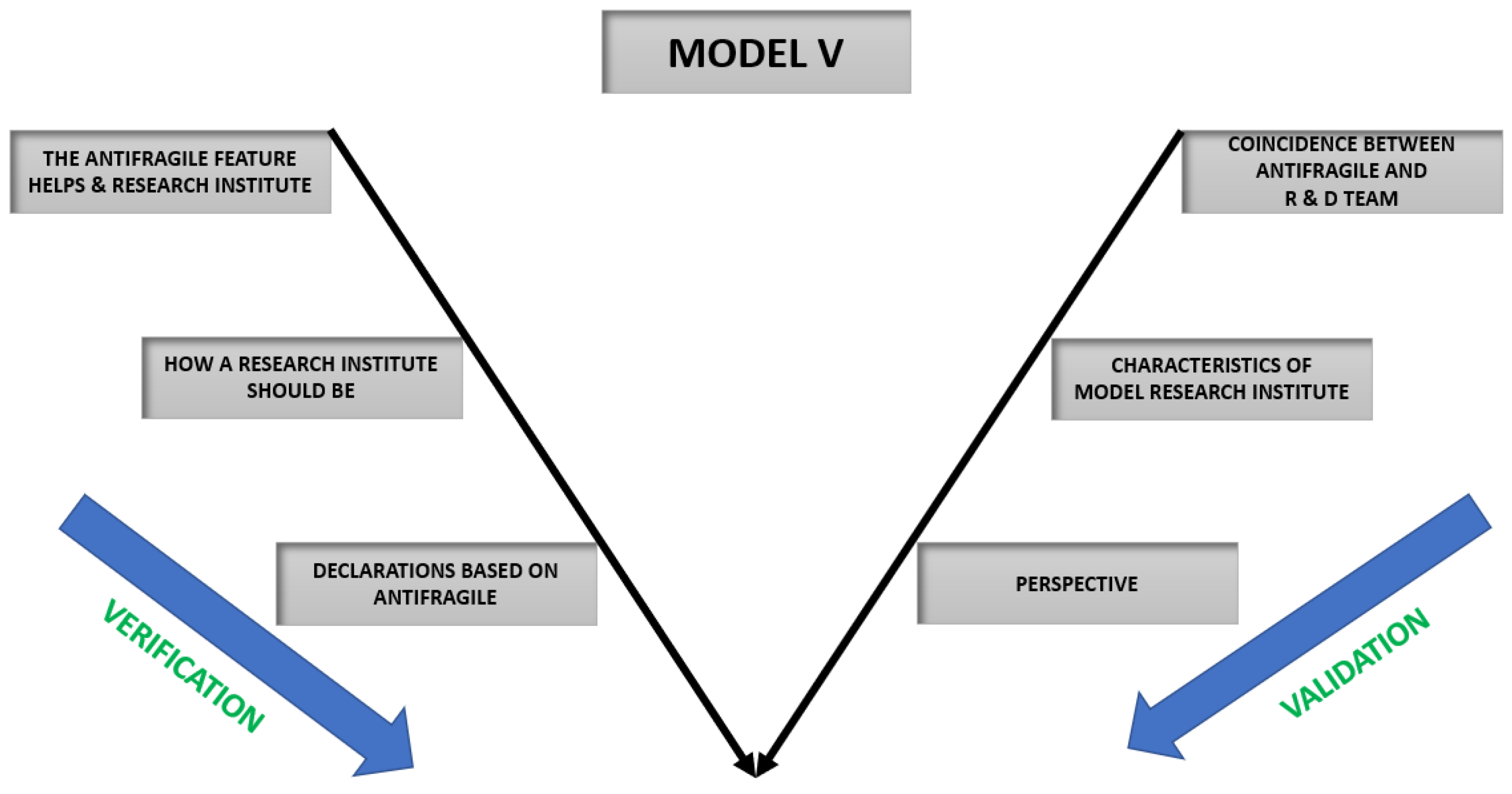
- Within this work, the applicability of antifragile philosophy to the management of research institutes has been analyzed. To this end, the five behaviors that group together the antifragile characteristics defined by Taleb have been defined. Experts in innovation management have been consulted on their vision of the ideal profile of a technology center management system, and ideal profiles were compared with antifragile behaviors. The results indicate that antifragile philosophy shows similar behaviors to those that can be expected from research institutes in the Basque Country.
- From the analysis of the results, it is concluded that the idealization of research institute management systems must allow the existence of multidisciplinary and autonomous teams with the capacity to observe the opportunities that appear abroad. This possibility of knowing the outside will allow them to react in an agile manner, either in emulating the environment or taking advantage of ideas from other environments. The interviewed people gave less importance to sharing of their knowledge towards the outside and to the planning. It can be concluded that ideal systems share most of the characteristics of antifragile systems.
- This study has the limitation of having interviewed experts in innovation management exclusively from a single profile of an innovation region (strong innovator according to the 2021 European Regional Innovation Scoreboard); in this case, cultural differences between regions of the same category and of different categories cannot be assessed. Furthermore, research institute clientele and stakeholders (contractors, sponsoring companies, public institutions and so on) were not interviewed. It is very possible that these would show profiles more oriented towards the planning of activities.
Author Contributions
Funding
Institutional Review Board Statement
Informed Consent Statement
Data Availability Statement
Acknowledgments
Conflicts of Interest
Appendix A

| Perspective 1 | Perspective 2 | Perspective 3 | Perspective 4 | Perspective 5 |
|---|---|---|---|---|
| (12) The first step towards innovation is to create ecosystems where all the necessary agents interact (PI) | (11) Team members must have the ability to adapt capabilities to the needs of the environment (SMT) | (7) The challenge of the present is to engage with new things that we do not know exist and that we must learn to perform (FK) | (33) Creativity is fostering the unreasonable: observing cross-cutting opportunities where they arise (FK) | (23) Randomness and uncertainty are essential components in today’s problem solving (PI) |
| (29) Best results are achieved by fostering diversity of culture, race and gender (M) | (39) There is external collaboration (centres, companies, universities…) that allows the development of knowledge (PM) | (29) Best results are achieved by fostering diversity of culture, race and gender (M) | (41) The integration of knowledge between different disciplines and other actors requires generosity (FK) | (33) Creativity is fostering the unreasonable: observing cross-cutting opportunities where they arise (FK) |
| (35) Failure is a source of knowledge and learning: successful failure (FK) | (20) Self-managed teams learn from their mistakes and are not penalized for them (SMT) | (2) The best results in innovation come from the work of self-managed teams (PM) | (8) The self-managed team is free to create its own tools if necessary (SMT) | (3) The presence of women in self-managed teams is normalized (M) |
| (31) Solving problems is making imperfect decisions and opting for good enough solutions (PM) | (3) The presence of women in self-managed teams is normalized (M) | (30) The team must be attentive to exploiting positive unexpected events: serendipity (SMT) | (16) The organization allows the team to react quickly and freely to opportunities (SMT) | (5) In innovation, the concept “the bigger the better” is headed for failure (PI) |
| (39) There is external collaboration (centres, companies, universities…) that allows the development of knowledge (PM) | (12) The first step towards innovation is to create ecosystems where all the necessary agents interact (PI) | (35) Failure is a source of knowledge and learning: successful failure (FK) | (12) The first step towards innovation is to create ecosystems where all the necessary agents interact (PI) | (9) Intuition is a knowledge management tool that allows you to compete in today’s world (PM) |
| (30) The team must be attentive to exploiting positive unexpected events: serendipity (SMT) | (27) The hirings carried out have the same conditions regardless of gender (M) | (1) The best results in innovation come from experimentation and practice (PI) | (7) The challenge of the present is to engage with new things that we do not know exist and that we must learn to perform (FK) | (11) Team members must have the ability to adapt capabilities to the needs of the environment (SMT) |
| (10) Existence of conciliation plans improves team performance (M) | (13) Creativity, communication and learning increase with positive affinity among team members (PM) | (4) Senior management teams have women in relevant positions (M) | (36) Talent is empowered and managed (FK) | (29) Best results are achieved by fostering diversity of culture, race and gender (M) |
| (11) Team members must have the ability to adapt capabilities to the needs of the environment (SMT) | (15) Strategy concepts are open to all (PM) | (6) Strategic planning is mainly performed in the short term but with long-term objectives (PM) | (11) Team members must have the ability to adapt capabilities to the needs of the environment (SMT) | (31) Solving problems is making imperfect decisions and opting for good enough solutions (PM) |
| (36) Talent is empowered and managed (FK) | (16) The organization allows the team to react quickly and freely to opportunities (SMT) | (16) The organization allows the team to react quickly and freely to opportunities (PM) | (27) The hirings carried out have the same conditions regardless of gender (M) | (32) The defined strategy is of intelligent specialization (interaction with the environment) (PI) |
| (7) The challenge of the present is to engage with new things that we do not know exist and that we must learn to perform (FK) | (10) Existence of conciliation plans improves team performance (M) | (22) The organization has equality plans (M) | (4) Senior management teams have women in relevant positions (M) | (36) Talent is empowered and managed (FK) |
| Perspective 1 | Perspective 2 | Perspective 3 | Perspective 4 | Perspective 5 |
|---|---|---|---|---|
| (21) Paternity/maternity leave has a negative impact on the professional career (M) | (6) Strategic planning is mainly performed in the short term but with long-term objectives (PM) | (28) There is a unique quality manual, and it is within everyone’s reach (PM) | (19) The best results in innovation come from intuition and team improvisation (PI) | (7) The challenge of the present is to engage with new things that we do not know exist and that we must learn to perform (FK) |
| (24) Redundancy of knowledge is reflected in plans for renewal of skills (FK) | (21) Paternity/maternity leave has a negative impact on the professional career (M) | (42) There are formal “organisational” knowledge management tools supported by senior management (FK) | (26) Less is more: practice is not very friendly to complicated solutions (PI) | (26) Less is more: practice is not very friendly to complicated solutions (PI) |
| (9) Intuition is a knowledge management tool that allows you to compete in today’s world (PM) | (37) Redundancy of people = not dying of indigestion allows the team to concentrate (SMT) | (25) There are internal communication plans in place that are agile in any direction (PM) | (24) Redundancy of knowledge is reflected in plans for renewal of skills (FK) | (15) Strategy concepts are open to all (PI) |
| (26) Less is more: practice is not very friendly to complicated solutions (PI) | (14) The self-managed team freely makes its own short-term plans (SMT) | (39) There is external collaboration (centres, companies, universities…) that allows the development of knowledge (PM) | (29) Best results are achieved by fostering diversity of culture, race and gender (M) | (17) Obsession with the budget and dates kills ideas before they take off (PM) |
| (15) Strategy concepts are open to all (PI) | (23) Randomness and uncertainty are essential components in today’s problem solving (PI) | (41) The integration of knowledge between different disciplines and other actors requires generosity (FK) | (28) There is a unique quality manual, and it is within everyone’s reach (PM) | (21) Paternity/maternity leave has a negative impact on the professional career (M) |
| (28) There is a unique quality manual and it is within everyone’s reach (PM) | (5) In innovation, the concept “the bigger the better” is headed for failure (PI) | (11) Team members must have the ability to adapt capabilities to the needs of the environment (SMT) | (31) Solving problems is making imperfect decisions and opting for good enough solutions (PM) | (6) Strategic planning is mainly performed in the short term but with long-term objectives (PM) |
| (19) The best results in innovation come from intuition and team improvisation (PI) | (18) Improvisation is considered a positive problem-solving skill (SMT) | (17) Obsession with the budget and dates kills ideas before they take off (PM) | (6) Strategic planning is mainly performed in the short term but with long-term objectives (PM) | (16) The organization allows the team to react quickly and freely to opportunities (SMT) |
| (17) Obsession with the budget and dates kills ideas before they take off (PM) | (31) Solving problems is making imperfect decisions and opting for good enough solutions (PM) | (32) The defined strategy is of intelligent specialization (interaction with the environment) (PI) | (40) There is a philosophy of patenting and later plans to exploit these patents (PM) | (37) Redundancy of people = not dying of indigestion allows the team to concentrate (SMT) |
| (23) Randomness and uncertainty are essential components in today’s problem solving (PI) | (32) The defined strategy is of intelligent specialization (interaction with the environment) (PI) | (33) Creativity is fostering the unreasonable: observing cross-cutting opportunities where they arise (FK) | (32) The defined strategy is of intelligent specialization (interaction with the environment) (PI) | (38) DIY: the use of the best combination of formal or non-formal tools to solve a problem (PM) |
| (20) Self-managed teams learn from their mistakes and are not penalized for them (SMT) | (40) There is a philosophy of patenting and later plans to exploit these patents (PM) | (36) Talent is empowered and managed (FK) | (38) DIY: the use of the best combination of formal or non-formal tools to solve a problem (PM) | (41) The integration of knowledge between different disciplines and other actors requires generosity (FK) |
Appendix B
| Distinguishing and Consensus Statements: | ||||||
|---|---|---|---|---|---|---|
| Dist.and.cons | f1_f2 sig_f1_f2 | f1_f3 sig_f1_f3 | f1_f4 sig_f1_f4 | f1_f5 sig_f1_f5 | f2_f3 sig_f2_f3 | |
| 1 | Consensus | 0.2889 | 0.8432 | 0.133 | 0.355 | 0.554 |
| 2 | Distinguishes f3 only | 0.0018 | 1.5973 ** | 0.432 | 0.133 | 1.599 ** |
| 3 | Distinguishes f1 | 1.9954 ** | 1.0375 * | 1.114 ** | 2.014 ** | 0.958 |
| 4 | 0.4982 | 1.1596* | 0.895 * | 0.183 | 0.661 | |
| 5 | Distinguishes f5 | 0.7605 * | 0.1398 | 0.348 | 1.813 ** | 0.621 |
| 6 | Distinguishes f2 | 2.9357 ** | 0.2134 | 1.893 ** | 1.739 ** | 3.149 ** |
| 7 | Distinguishes f2 Distinguishes f5 | 1.5322 ** | 1.0568 * | 0.087 | 2.849 ** | 2.589 ** |
| 8 | 1.2817 ** | 0.8147 | 0.733 | 1.303 * | 0.467 | |
| 9 | Distinguishes f5 | 1.2572 ** | 1.1398 | 0.769 | 3.093 ** | 0.117 |
| 10 | 0.4378 | 1.0965 * | 0.385 | 1.096 * | 0.659 | |
| 11 | Distinguishes f3 | 0.9218* | 1.9406 ** | 0.128 | 0.012 | 2.862 ** |
| 12 | 0.5986 | 1.7465 ** | 0.493 | 1.258 * | 1.148 * | |
| 13 | 0.5661 | 0.9352 | 0.029 | 0.935 | 1.501 ** | |
| 14 | Distinguishes f2 only | 2.2100 ** | 0.0617 | 0.527 | 0.062 | 2.148 ** |
| 15 | 2.0524 ** | 1.1808 * | 1.328 ** | 0.284 | 0.872 | |
| 16 | Distinguishes f5 | 0.5329 | 0.7436 | 1.315 ** | 1.289 * | 0.211 |
| 17 | 0.4616 | 0.0299 | 1.194 ** | 0.518 | 0.491 | |
| 18 | 0.5478 | 0.7222 | 0.478 | 0.254 | 1.270 * | |
| 19 | Distinguishes f4 only | 0.5651 | 0.9648 | 1.148 ** | 0.477 | 0.400 |
| 20 | Distinguishes f2 | 2.4753 ** | 0.2757 | 1.352 ** | 0.276 | 2.200 ** |
| 21 | 0.2794 | 2.7657 ** | 2.107 ** | 0.813 | 2.486 ** | |
| 22 | 0.5043 | 0.7935 | 0.059 | 0.183 | 1.298 * | |
| 23 | Distinguishes f2 Distinguishes f5 | 0.7664 * | 1.3199 ** | 0.561 | 2.785 ** | 2.086 ** |
| 24 | 2.0554 ** | 2.0441 ** | 0.644 | 2.044 ** | 0.011 | |
| 25 | Distinguishes f3 only | 0.3805 | 1.3319 ** | 0.551 | 0.133 | 1.712 ** |
| 26 | 1.4379 ** | 1.1075 * | 0.370 | 0.357 | 0.3380 | |
| 27 | Consensus | 0.5776 | 0.0602 | 0.287 | 0.060 | 0.638 |
| 28 | 1.3850 ** | 0.9557 | 0.280 | 0.997 * | 2.341 ** | |
| 29 | Distinguishes f4 | 0.9742 ** | 0.4891 | 2.864 ** | 0.487 | 1.463 ** |
| 30 | Consensus | 0.6450 | 0.2339 | 0.790 | 0.743 | 0.879 |
| 31 | 2.3134 ** | 1.9346 ** | 2.700 ** | 0.470 | 0.379 | |
| 32 | 1.2512 ** | 1.5573 ** | 1.564 ** | 0.396 | 0.306 | |
| 33 | 0.3783 | 0.3785 | 2.416 ** | 2.551 ** | 0.757 | |
| 34 | 0.7375 * | 0.1729 | 0.250 | 0.315 | 0.910 | |
| 35 | 1.3605 ** | 0.0022 | 1.168 ** | 0.974 | 1.363 ** | |
| 36 | Distinguishes f3 only | 0.3058 | 1.9244 ** | 0.035 | 0.029 | 1.619 ** |
| 37 | 1.2233 ** | 0.9539 | 0.489 | 0.511 | 2.177 ** | |
| 38 | 0.2436 | 0.2324 | 0.750 | 0.744 | 0.011 | |
| 39 | Distinguishes f3 | 0.4668 | 2.8784 ** | 0.826 * | 0.925 | 3.345 ** |
| 40 | 0.3713 | 0.2828 | 0.847 * | 0.205 | 0.654 | |
| 41 | Distinguishes f2 Distinguishes f4 | 0.8439 * | 0.9647 | 2.318 ** | 0.476 | 1.809 ** |
| 42 | Distinguishes f3 only | 0.3793 | 2.2363 ** | 0.430 | 0.772 | 1.857 ** |
| Distinguishing and Consensus Statements: | ||||||
|---|---|---|---|---|---|---|
| Dist.and.cons | f2_f4 sig_f2_f4 | f2_f5 sig_f2_f5 | f3_f4 sig_f3_f4 | f3_f5 sig_f3_f5 | f4_f5 sig_f4_f5 | |
| 1 | Consensus | 0.422 | 0.066 | 0.9765 | 4.9 × 10⁻¹ | 0.4882 |
| 2 | Distinguishes f3 only | 0.431 | 0.134 | 2.0296 ** | 1.5 × 100 * | 0.5649 * |
| 3 | Distinguishes f1 | 0.881 * | 0.019 | 0.0767 | 9.8 × 10⁻¹ | 0.8998 |
| 4 | 0.397 | 0.315 | 0.2645 | 9.8 × 10⁻¹ | 0.7119 | |
| 5 | Distinguishes f5 | 1.109 * | 2.574 ** | 0.4882 | 2.0 × 100 ** | 1.4647 ** |
| 6 | Distinguishes f2 | 1.043 * | 1.196 * | 2.1062 ** | 2.0 × 100 ** | 0.1533 |
| 7 | Distinguishes f2 Distinguishes f5 | 1.619 ** | 1.317 * | 0.9702 | 3.9 × 100 ** | 2.9357 ** |
| 8 | 2.015 ** | 0.021 | 1.5476 ** | 4.9 × 10⁻¹ | 2.0359 ** | |
| 9 | Distinguishes f5 | 0.488 | 1.836 ** | 0.3707 | 2.0 × 100 ** | 2.3237 ** |
| 10 | 0.053 | 0.659 | 0.7119 | 0.0 × 100 | 0.7119 | |
| 11 | Distinguishes f3 | 1.050 * | 0.989 | 1.8122 ** | 2.0 × 100 ** | 0.1408 |
| 12 | 0.106 | 0.660 | 1.2536 * | 4.9 × 10⁻¹ | 0.7653 | |
| 13 | 0.595 | 1.501 ** | 0.9061 | 5.6 × 10⁻¹⁷ | 0.9061 | |
| 14 | Distinguishes f2 only | 1.683 ** | 2.148 ** | 0.4650 | 5.6 × 10⁻¹⁷ | 0.4650 |
| 15 | 0.725 | 2.336 ** | 0.1470 | 1.5 × 100 * | 1.6117 ** | |
| 16 | Distinguishes f5 | 0.782 | 1.742 ** | 0.5712 | 2.0 × 100 ** | 2.5241 ** |
| 17 | 0.733 | 0.980 | 1.2240 * | 4.9 × 10⁻¹ | 1.7123 ** | |
| 18 | 0.070 | 0.293 | 1.2002 * | 9.8 × 10⁻¹ | 0.2237 | |
| 19 | Distinguishes f4 only | 1.713 ** | 0.089 | 2.1125 ** | 4.9 × 10⁻¹ | 1.6243 ** |
| 20 | Distinguishes f2 | 1.123 ** | 2.200 ** | 1.0764 | 5.6 × 10⁻¹⁷ | 1.0764 |
| 21 | 1.828 ** | 0.533 | 0.6586 | 2.0 × 100 ** | 1.2944 * | |
| 22 | 0.445 | 0.321 | 0.8527 | 9.8 × 10⁻¹ | 0.1238 | |
| 23 | Distinguishes f2 Distinguishes f5 | 1.327 ** | 3.551 ** | 0.7591 | 1.5 × 100 * | 2.2238 ** |
| 24 | 1.412 ** | 0.011 | 1.4006 * | 0.0 × 100 | 1.4006 * | |
| 25 | Distinguishes f3 only | 0.170 | 0.248 | 1.8826 ** | 1.5 × 100 * | 0.4179 |
| 26 | 1.808 ** | 1.795 ** | 1.4773 ** | 1.5 × 100 * | 0.0126 | |
| 27 | Consensus | 0.290 | 0.638 | 0.3475 | 5.6 × 10⁻¹⁷ | 0.3475 |
| 28 | 1.665 ** | 0.388 | 0.6761 | 2.0 × 100 ** | 1.2768 * | |
| 29 | Distinguishes f4 | 1.890 ** | 0.487 | 3.3535 ** | 9.8 × 10⁻¹ | 2.3771** |
| 30 | Consensus | 0.145 | 0.098 | 1.0236 | 9.8 × 10⁻¹ | 0.0471 |
| 31 | 0.387 | 1.844 ** | 0.7653 | 1.5 × 100 * | 2.2300 ** | |
| 32 | 0.312 | 1.647 ** | 0.0063 | 2.0 × 100 ** | 1.9592 ** | |
| 33 | 2.038 ** | 2.173 ** | 2.7949 ** | 2.9 × 100 ** | 0.1345 | |
| 34 | 0.987 * | 0.422 | 0.0767 | 4.9 × 10⁻¹ | 0.5649 | |
| 35 | 0.192 | 0.386 | 1.1706 * | 9.8 × 10⁻¹ | 0.1942 | |
| 36 | Distinguishes f3 only | 0.341 | 0.334 | 1.9592 ** | 2.0 × 100 ** | 0.0063 |
| 37 | 1.712 ** | 0.712 | 0.4650 | 1.5 × 100 * | 0.9997 | |
| 38 | 0.994 * | 0.988 | 0.9827 | 9.8 × 10⁻¹ | 0.0063 | |
| 39 | Distinguishes f3 | 1.292 ** | 1.392 ** | 2.0528 ** | 2.0 × 100 ** | 0.0999 |
| 40 | 0.476 | 0.166 | 1.1298 * | 4.9 × 10⁻¹ | 0.6415 | |
| 41 | Distinguishes f2 Distinguishes f4 | 1.475 ** | 1.320* | 3.2832 ** | 4.9 × 10⁻¹ | 2.7949 ** |
| 42 | Distinguishes f3 only | 0.051 ** | 0.392 | 1.8059 ** | 1.5 × 100 * | 0.3412 |
References
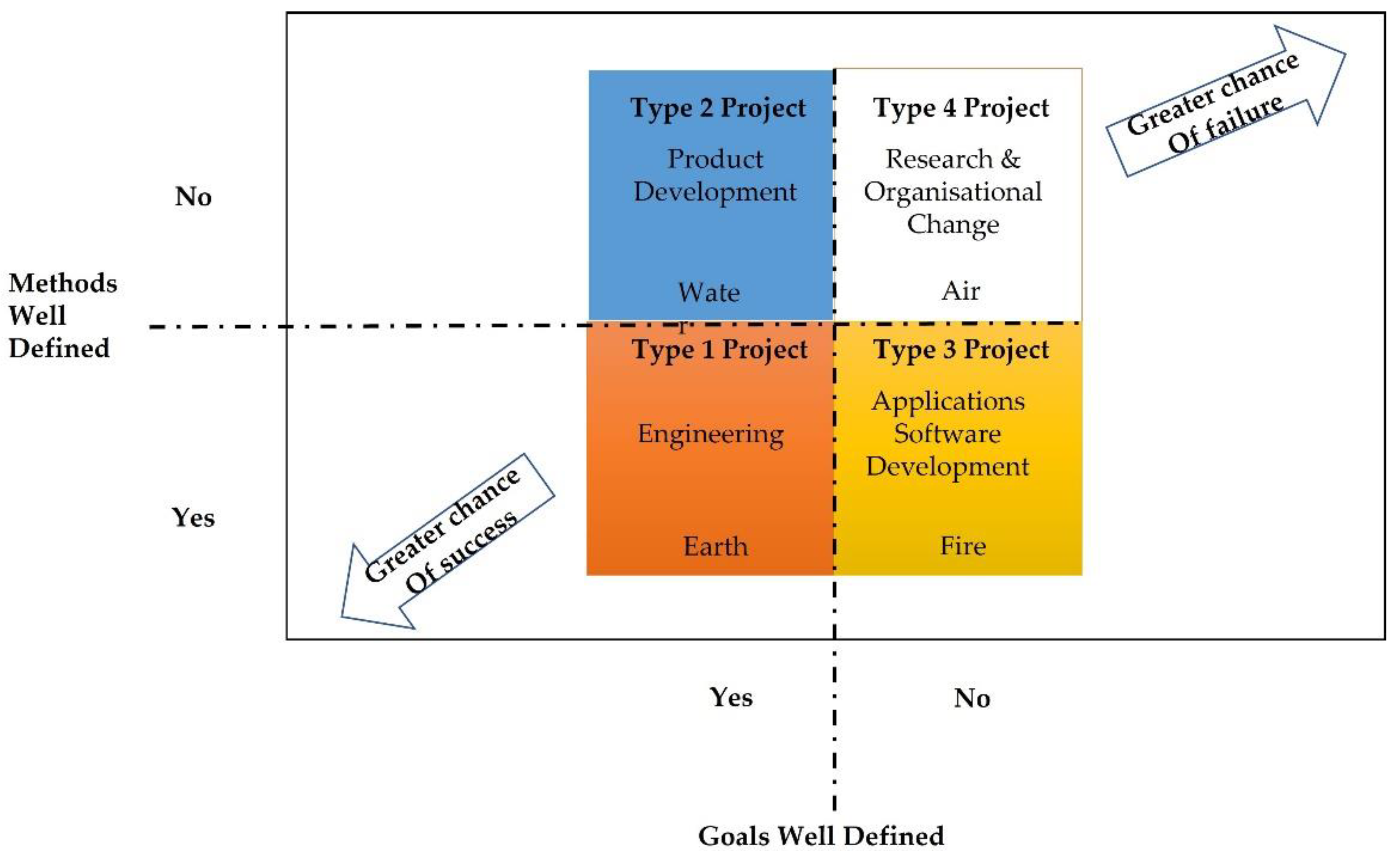
- Turner, J.R.; Cochrane, R. Goals-and-methods matrix: Coping with projects with ill defined goals and/or methods of achieving them. Int. J. Proj. Manag. 1993, 11, 93–102. [Google Scholar] [CrossRef]
- Chesbrough, H.W. Open Innovation: The New Imperative for Creating and Profiting from Technology; Harvard Business School Press: Boston, MA, USA, 2003. [Google Scholar]
- Ayestaran, S.; Gómez, O. Equipos de Innovación, Motores de Transformación Social y Económica en las Organizaciones; Innobasque: Zamudio, Spain, 2010; Available online: https://www.innobasque.eus/uploads/documentos/Biblioteca/Transformaci%C3%B3n%20Empresarial/00E74F008DA939DC641D40778CBD2FECF50C6C08.pdf (accessed on 26 August 2021).
- Taleb, N. Antifrágil: Las Cosas Que se Benefician del Desorden; Ramdon House: New York, NY, USA, 2013. [Google Scholar]
- Taleb, N. Undestanding Is a Poor Substitute for Convexity. The Edge Foundation (Edge.org). Available online: http://edge.org/conversation/understanding-is-a-poor-substitute-for-convexity-antifragility (accessed on 26 August 2021).
- Derbyshire, J.; Wright, G. Preparing for the future: Development of an “antifragile” methodology that complements scenario planning by omitting causation. Technol. Forescast. Soc. 2014, 82, 215–225. [Google Scholar] [CrossRef] [Green Version]
- Tolk, A.; Jhonson, J., IV. Impelementing Antifragile: System That Get Better under Charge. In Proceedings of the International Annual Conference on American Society for Engineering Managament, Minneapolis, MN, USA, 3–5 October 2013. [Google Scholar]
- Clark, M.; Thompson, R. Successful failure: Good for the self and science. J. Adv. Nurs. 2013. [Google Scholar] [CrossRef] [PubMed]
- Swenson, K.D. Designing for an Innovatie Learning Organization. In Proceedings of the 17th IEEE International Enterprise Distributed Object Computing Conference (EDOC 2013), Vancouver, Canada, 9–13 September 2013. [Google Scholar]
- Jaaron, A.; Backhouse, C. Learning from chaos: The adevent of antigragility in service organizations. In Proceedings of the 2014 POMS International Conference, Singapore, 21–23 July 2014. [Google Scholar]
- Velasco, E. La Gestión de la Innovación: Elementos Integrantes y su Aplicación en Empresas Innovadoras del País Vasco. Ph.D. Thesis, UPV-EHU, Bilbao, Spain, 2008. [Google Scholar]
- International Project Management Association. Individual Competence Baseline; International Project Management Association: Amsterdam, The Netherlands, 2016. [Google Scholar]
- McKeown, D.; Thomas, B. Q-Methodology; Sage: London, UK, 2013. [Google Scholar]
- Rastogi, A.; Hickey, G.; Badola, R.; Hussain, S. Diverging viewpoints on tiger conservation: A Q-method study and survey of conservation professionals in India. Biol. Conserv. 2013, 161, 182–192. [Google Scholar] [CrossRef]
- Hagan, K.; Williams, S. Oceans of discoruses: Utilizing Q methodology for analyzing perceptions on marine biodiversity conservation in the Kogelberg Biosphere Reserve. S. Afr. Front. Mar. Sci. 2016, 3, 188. [Google Scholar]
- Kamal, S.; Kocór, M.; Grodzinska-Jurczak, M. Quantifying human subjectivity using Q method: When quality meets quantity. Qual. Sociol. 2014, 10, 60–79. [Google Scholar]
- Zabala, A.; Sandbrook, C.; Mukherjee, N. When and how to use Q methodology to understand perspectives in conservation research. Conserv. Biol. 2018, 32, 1185–1194. [Google Scholar] [CrossRef] [PubMed] [Green Version]
- Watts, S.; Stenner, P. Doing Q methodological research. In Theory, Methods and Interpretation; Sage: London, UK, 2012. [Google Scholar]
- Ansar, A.; Flyvbjerg, B.; Budzier, A.; Lunn, D. Big Is Fragile: An Attempt at Theorizing Scale; Flyvbjerg, B., Ed.; The Oxford Handbook of Megaproject Management Oxford University Press: Oxford, UK, 2016. [Google Scholar]
- Ramos, S. Ecosistemas de Innovación. DYNA 2016, XXXI-6, 29–31. [Google Scholar]
- Dayan, M.; Di Benedetto, C. Team intuition as a continuum construct and new product creativity: The role of environmental turbulence, team experience, and stress. Res. Policy 2010, 40, 276–286. [Google Scholar] [CrossRef]
- Clot, N. Antifragile, ou les bienfaits du désorden en bibliothéque. Conduire le Changemente en Bibilothéque: Vers des Organisation Apprenantes; Presses de Lénssib. 2015. Available online: https://hal.archives-ouvertes.fr/hal-01283618 (accessed on 26 August 2021).
- Aven, T. The Concept of Antifragility and its Implications for the Practice of Risk Analysis. Risk Anal. 2015, 35, 3. [Google Scholar] [CrossRef]
- Emich, K.J. Who’s bringing the donuts: The role of affective patterns in group decision making. Organ. Behav. Hum. Decis. Process. 2014, 124, 122–132. [Google Scholar] [CrossRef]
- AEN/CTN66. UNE EN ISO 9001: 2015 Sistemas de Gestión de la Calidad; AENOR: Madrid, Spain.
- EJ-GV. PCTI EUSKADI 2020 Una Estrategia de Especialización Inteligente; Servicio Central de Publicaciones del Gobierno Vasco: Basque, Spain, 2014. [Google Scholar]
- Martinez Tola, E.; Goñi Mendizabal, I.; Guenaga Garai, G. Beneficios de la Incorporación de las Mujeres en los Puestos de Gestión y Dirección de Empresas del Sector Privado: Una Revisión Bibliográfica; Defensoría: Basque, Spain, 2006. [Google Scholar]
- Lareina, Y. Fostering Women Leaders: A Fitness Test for Your Top Team. Mckinsey Quarterly. 2015. Available online: https://www.empowerwomen.org/en/resources/documents/2015/2/fostering-women-leaders-a-fitness-test-for-your-top-team?lang=en (accessed on 26 August 2021).
- Correl, S.J. Minimizing the motherhood penalty: What works, what doesn’t and Why? In Gender and Work: Challenging Conventional Wisdom; Ely, R.J., Cuddy, A.J.C., Eds.; Harvard Business School: Boston, MA, USA, 2013. [Google Scholar]
- Ministerio de Ciencia e Inovación. El género en la Investigación; Ministerio de Ciencia e Innovación: Madrid, Spain, 2011. [Google Scholar]
- Pinto, J.; Patanakul, P.; Pinto, M. “The aura of capability”: Gender bias in selection for a project manager job. Int. J. Proj. Manag. 2017, 35, 420–431. [Google Scholar] [CrossRef]
- Xiang, W. Working with wicked problems in socio-ecological systems: Awareness, acceptance, and adaptation. Landsc. Urban Plan. 2013, 110, 1–4. [Google Scholar] [CrossRef]
- Leybourne, S.; Sadler-Smith, E. The role of intuition and improvisation in project management. Int. J. Proj. Manag. 2006, 24, 483–492. [Google Scholar] [CrossRef]
- Jones, K. Engineering Antifragiles Systems: A Cahnge In Design Philosophy. Procedia Comput. Sci. 2014, 32, 870–875. [Google Scholar] [CrossRef] [Green Version]
- Moreno Toledano, D. Complejidad, diseño e indisciplina: Nuevas miradas en la práctica y el saber. La Investig. 2014, 20, 15–16. [Google Scholar]
- AEN/GET12. UNE 412001 IN Guía Práctica de Gestión del Conocimiento; AENOR: Madrid, Spain, 2008.
- Brown, S. Political Subjectivity: Applications of A Methodology in Political Science; Yale University Press: New Haven, CT, USA, 1980. [Google Scholar]
- Zabala, A.; Pascual, U. Bootstrapping Q Methodology to Improve the Understanding of Human Perspective. PLoS ONE 2016, 11, e0148087. [Google Scholar] [CrossRef] [PubMed]
- Oerlemans, L.A.G.; Knoben, J. Configurations of knowledge transfer relations: An empirically based taxonomy and its determinants. J. Eng. Tech. Manag. 2010, 27, 33–51. [Google Scholar] [CrossRef] [Green Version]
- Leiponen, A.; Helfat, C.E. Innovation objectives, knowledge sources, and the benefits of breadth. Strateg. Manag. J. 2010, 31, 224–236. [Google Scholar] [CrossRef] [Green Version]
- Al-Belushi, K.I.; Stead, S.M.; Gray, T.; Burgess, J.G. Measurement of open innovation in the marine biotechnology sector in Oman. Mar. Policy 2018, 98, 164–173. [Google Scholar] [CrossRef]
- Miotti, L.; Sachwald, F. Co-operative R&D: Why and with whom? An integrated framework of analysis. Res. Policy 2003, 32, 1481–1499. [Google Scholar] [CrossRef]
- Vinichenko, M.; Rybakova, M.; Chulanova, O.; Barkov, S.; Makushkin, S.; Karacsony, P. Views on Working with Information in a Semi-Digital Society: Its Possibility to Develop as Open Innovation Culture. J. Open Innov. Technol. Mark. Complex. 2021, 7, 160. [Google Scholar] [CrossRef]
- Naz, S.; Li, C.; Zaman, U.; Rafiq, M. Linking Proactive Personality and Entrepreneurial Intentions: A Serial Mediation Model Involving Broader and Specific Self-Efficacy. J. Open Innov. Technol. Mark. Complex. 2020, 6, 166. [Google Scholar] [CrossRef]
- Zaman, U.; Jabbar, Z.; Nawaz, S.; Abbas, M. Understanding the soft side of software projects: An empirical study on the interactive effects of social skills and political skills on complexity—Performance relationship. Int. J. Proj. Manag. 2019, 37, 444–460. [Google Scholar] [CrossRef]
- Skordoulis, M.; Ntanos, S.; Kyriakopoulos, G.L.; Arabatzis, G.; Galatsidas, S.; Chalikias, M. Environmental Innovation, Open Innovation Dynamics and Competitive Advantage of Medium and Large-Sized Firms. J. Open Innov. Technol. Mark. Complex. 2020, 6, 195. [Google Scholar] [CrossRef]
- Zhang, Z.; Yan, H.; Qi, J. What Do Chinese Entrepreneurs Think about Entrepreneurship: A Case Study of Popular Essays on Zhisland. J. Open Innov. Technol. Mark. Complex. 2020, 6, 86. [Google Scholar] [CrossRef]
- Tereshko, E.; Romanovich, M.; Rudskaya, I. Readiness of Regions for Digitalization of the Construction Complex. J. Open Innov. Technol. Mark. Complex. 2020, 7, 2. [Google Scholar] [CrossRef]



| Code | Statements | Source |
|---|---|---|
| PI | The best results in innovation come from experimentation and practice. | [4] |
| PI | In innovation, the concept “the bigger the better” is headed for failure. | [19] |
| PI | The first step towards innovation is to create ecosystems where all the necessary agents interact. | [20] |
| PI | Strategy concepts are open to all. | [3] |
| PI | The best results in innovation come from intuition and team improvisation. | [21] |
| PI | Randomness and uncertainty are essential components in today’s problem solving. | [3] |
| PI | Less is more: practice is not very friendly relative to complicated solutions. | [22] |
| PI | The defined strategy is of intelligent specialization (interaction with the environment). | [3] |
| PI | The concepts of resilience and learning must evolve to adapt to current reality. | [23] |
| PM | The best results in innovation come from the work of self-managed teams. | [10] |
| PM | Strategic planning is mainly performed in the short term but with long-term objectives. | [3] |
| PM | Intuition is a knowledge management tool that allows you to compete in today’s world. | [9] |
| PM | Creativity, communication and learning increase with positive affinity among team members. | [24] |
| PM | Obsession with the budget and dates kills ideas before they take off. | [4] |
| PM | There are internal communication plans in place that are agile in any direction. | [3] |
| PM | There is a unique quality manual, and it is within everyone’s reach. | [25] |
| PM | Solving problems is making imperfect decisions and opting for good enough solutions. | [22] |
| PM | DIY: the use of the best combination of formal or non-formal tools to solve a problem. | [4] |
| PM | There is external collaboration (centres, companies, universities…) that allows the development of knowledge. | [3] |
| PM | There is a philosophy of patenting and later plans to exploit these patents. | [26] |
| M | The presence of women in self-managed teams is normalized. | [27] |
| M | Senior management teams have women in relevant positions. | [28] |
| M | Existence of conciliation plans improves team performance. | [29] |
| M | Paternity/maternity leave has a negative impact on the professional career. | [29] |
| M | The organization has equality plans. | [30] |
| M | The hirings carried out have the same conditions regardless of gender. | [31] |
| M | Best results are achieved by fostering diversity of culture, race and gender. | [3,32] |
| SMT | The self-managed team is free to create its own tools if necessary. | [3] |
| SMT | Team members must have the ability to adapt capabilities to the needs of the environment. | [10] |
| SMT | The self-managed team freely makes its own short-term plans. | [3] |
| SMT | The organization allows the team to react quickly and freely to opportunities. | [3] |
| SMT | Improvisation is considered a positive problem-solving skill. | [33] |
| SMT | Self-managed teams learn from their mistakes and are not penalized for them. | [23] |
| SMT | The team must be attentive to exploiting positive unexpected events: serendipity. | [11] |
| SMT | Redundancy of people = not dying of indigestion, which allows the team to concentrate. | [4] |
| FK | The challenge of the present is to engage with new things that we do not know exist and that we must learn to perform. | [34] |
| FK | Redundancy of knowledge is reflected in plans for renewal of skills. | [3] |
| FK | Creativity is fostering the unreasonable: observing cross-cutting opportunities where they arise. | [3] |
| FK | Failure is a source of knowledge and learning: successful failure. | [8] |
| FK | Talent is empowered and managed. | [3] |
| FK | The integration of knowledge between different disciplines and other actors requires generosity. | [35] |
| FK | There are formal “organisational” knowledge management tools supported by senior management. | [36] |
| Field of Work | Number of Respondents | Respondant # |
|---|---|---|
| Engineering | 8 | 1,2,3,7,8,10,11,14 |
| Project Managament | 3 | 4,5,6 |
| Lawyer | 2 | 12,15 |
| Communication Manager | 1 | 9 |
| Education Management | 1 | 13 |
| Original data | 42 Statements, 15 Q-sorts | |||||
| Number of factors | 5 | |||||
| Rotation | Varimax | |||||
| Flagging | Automatic | |||||
| Correlating coefficient | Pearson | |||||
| General factor characteristics | ||||||
| av_rel_coef | nload | eigenvals | expl_var | reliability | se_fscores | |
| factor F1 | 0.8 | 4 | 2.67 | 17.79 | 0.94 | 0.24 |
| factor F2 | 0.8 | 3 | 2.67 | 17.77 | 0.92 | 0.28 |
| factor F3 | 0.8 | 1 | 1.67 | 11.13 | 0.8 | 0.45 |
| factor F4 | 0.8 | 2 | 1.63 | 10.88 | 0.89 | 0.33 |
| factor F5 | 0.8 | 1 | 1.47 | 9.79 | 0.8 | 0.45 |
| Total explained variance: 67.37 | ||||||
| Correlation between factor z-scores | ||||||
| factor F1 | factor F2 | factor F3 | factor F4 | factor F5 | ||
| factor F1 | 1 | 0.26 | 0.21 | 0.32 | 0.26 | |
| factor F2 | 0.26 | 1 | −0.21 | 0.37 | 0.15 | |
| factor F3 | 0.21 | −0.21 | 1 | −0.04 | −0.08 | |
| factor F4 | 0.32 | 0.37 | −0.04 | 1 | 0.09 | |
| factor F5 | 0.26 | 0.15 | −0.08 | 0.09 | 1 | |
| Factor | Numb. Statements | Category | Description |
|---|---|---|---|
| F1 | 3 | M | The presence of the women in self-managed teams. |
| F2 | 6 | PM | Strategic planning is mainly performed in the short term but with long-term objectives. |
| 14 | SMT | The self-managed team freely makes its own short-term plans. | |
| 20 | SMT | Self-managed teams learn from their mistakes and are not penalized for them. | |
| F3 | 2 | PM | The best results in innovation come from the work of self-managed teams. |
| 11 | SMT | Team members must have the ability to adapt capabilities to the needs of the environment. | |
| 25 | PM | There are internal communication plans in place that are agile in any direction. | |
| 36 | FK | Talent is empowered and managed. | |
| 39 | PM | There is external collaboration that allow the development of knowledge. | |
| 42 | FK | There are formal organisational knowledge management tools supported by senior management. | |
| F4 | 19 | PI | The best results in innovation come from intuition and team improvisation. |
| 29 | M | Best results are achieved by fostering diversity of culture, race and gender. | |
| F5 | 5 | PI | In innovation, the concept “the bigger the better” is headed for failure. |
| 9 | PM | Intuition is a knowledge and management tool that allows you to compete in today’s world. | |
| 16 | SMT | The organization allows the team to react quickly and freely to opportunities. |
| Perspective 1 | Perspective 2 | Perspective 3 | Perspective 4 | Perspective 5 | Field of Work | |
|---|---|---|---|---|---|---|
| Respondent 1 | −0.074 | −0.17 | 0.524 | 0.518 | 0.333 | Engineering |
| Respondent 2 | 0.208 | −0.14 | 0.797 | −0.041 | −0.132 | Engineering |
| Respondent 3 | 0.138 | 0.61 | 0.121 | 0.418 | 0.176 | Engineering |
| Respondent 4 | 0.118 | 0.17 | −0.212 | 0.808 | −0.118 | Project management |
| Respondent 5 | 0.615 | −0.47 | 0.22 | −0.032 | −0.061 | Project management |
| Respondent 6 | 0.371 | 0.19 | 0.187 | 0.561 | 0.161 | Project management |
| Respondent 7 | 0.098 | 0.7 | −0.203 | 0.057 | −0.173 | Engineering |
| Respondent 8 | 0.697 | 0.26 | 0.229 | 0.201 | 0.097 | Engineering |
| Respondent 9 | 0.549 | 0.57 | 0.431 | 0.02 | 0.228 | Communication Manager |
| Respondent 10 | 0.095 | 0.7 | −0.097 | 0.037 | 0.08 | Engineering |
| Respondent 11 | 0.207 | 0.6 | −0.498 | 0.253 | 0.215 | Engineering |
| Respondent 12 | 0.698 | 0.23 | −0.055 | −0.026 | 0.436 | Lawyer |
| Respondent 13 | 0.48 | 0.4 | 0.185 | 0.106 | 0.294 | Education Management |
| Respondent 14 | 0.698 | 0.11 | −0.19 | 0.312 | −0.096 | Engineering |
| Respondent 15 | 0.131 | 0.05 | −0.092 | 0.037 | 0.914 | Lawyer |
Publisher’s Note: MDPI stays neutral with regard to jurisdictional claims in published maps and institutional affiliations. |
© 2021 by the authors. Licensee MDPI, Basel, Switzerland. This article is an open access article distributed under the terms and conditions of the Creative Commons Attribution (CC BY) license (https://creativecommons.org/licenses/by/4.0/).
Share and Cite
Mardaras, E.; Artola, G.; Duarte, S.; Otegi-Olaso, J.R. Antifragile Philosophy in R&D Projects: Applying Q Methodology and the Possibility of Open Innovation. J. Open Innov. Technol. Mark. Complex. 2021, 7, 209. https://doi.org/10.3390/joitmc7040209
Mardaras E, Artola G, Duarte S, Otegi-Olaso JR. Antifragile Philosophy in R&D Projects: Applying Q Methodology and the Possibility of Open Innovation. Journal of Open Innovation: Technology, Market, and Complexity. 2021; 7(4):209. https://doi.org/10.3390/joitmc7040209
Chicago/Turabian StyleMardaras, Enara, Garikoitz Artola, Sebastian Duarte, and José Ramón Otegi-Olaso. 2021. "Antifragile Philosophy in R&D Projects: Applying Q Methodology and the Possibility of Open Innovation" Journal of Open Innovation: Technology, Market, and Complexity 7, no. 4: 209. https://doi.org/10.3390/joitmc7040209
APA StyleMardaras, E., Artola, G., Duarte, S., & Otegi-Olaso, J. R. (2021). Antifragile Philosophy in R&D Projects: Applying Q Methodology and the Possibility of Open Innovation. Journal of Open Innovation: Technology, Market, and Complexity, 7(4), 209. https://doi.org/10.3390/joitmc7040209