
Reversible Causes of Transitory Motor Evoked Potential Decrease During Posterior Spine Fusion in Rapidly Progressive Scoliosis Treatment: A Case Report

 , , , , , ,
  , and
, and
Abstract
1. Introduction
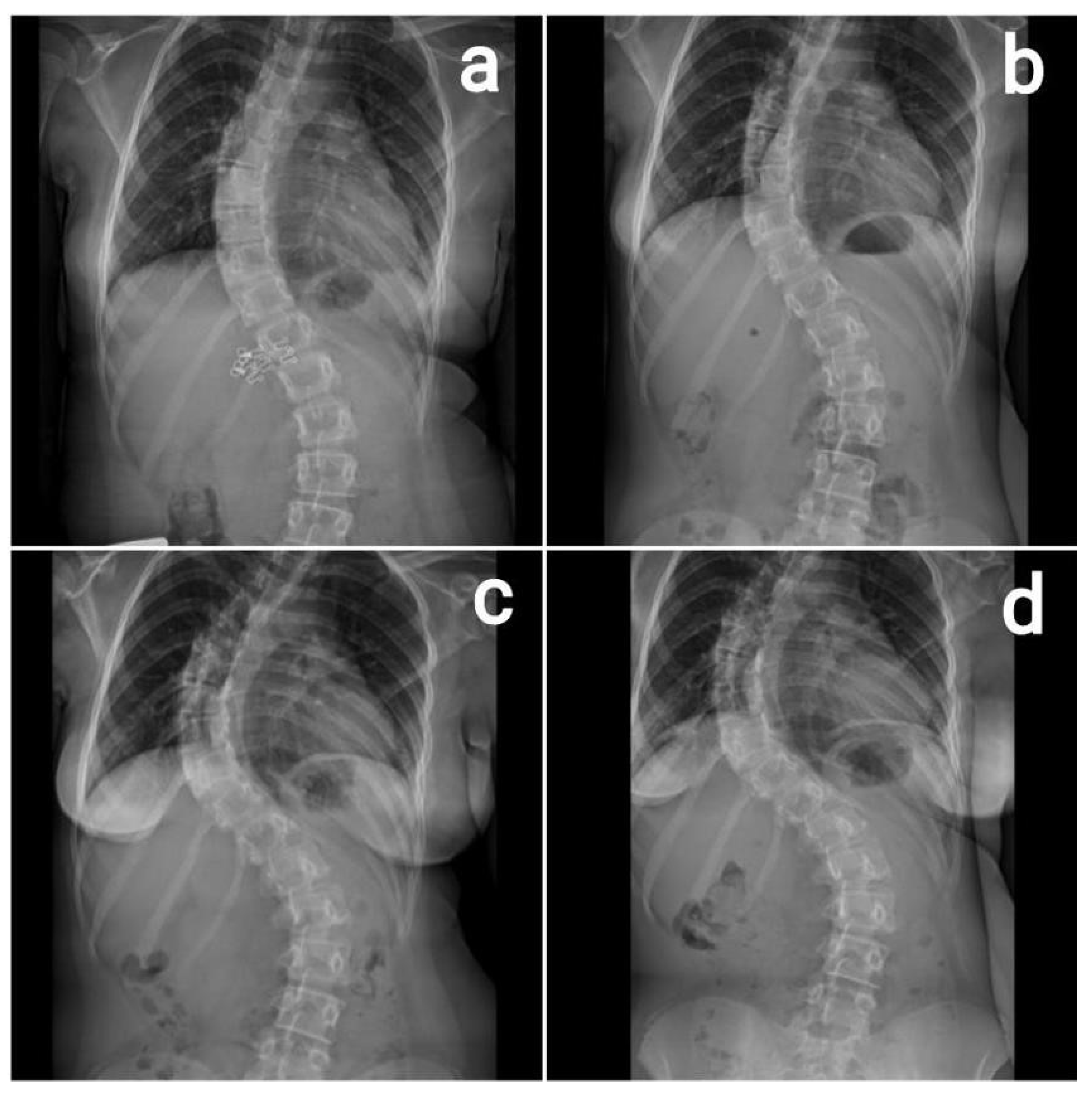
2. Case Report
2.1. Anesthesia Protocol
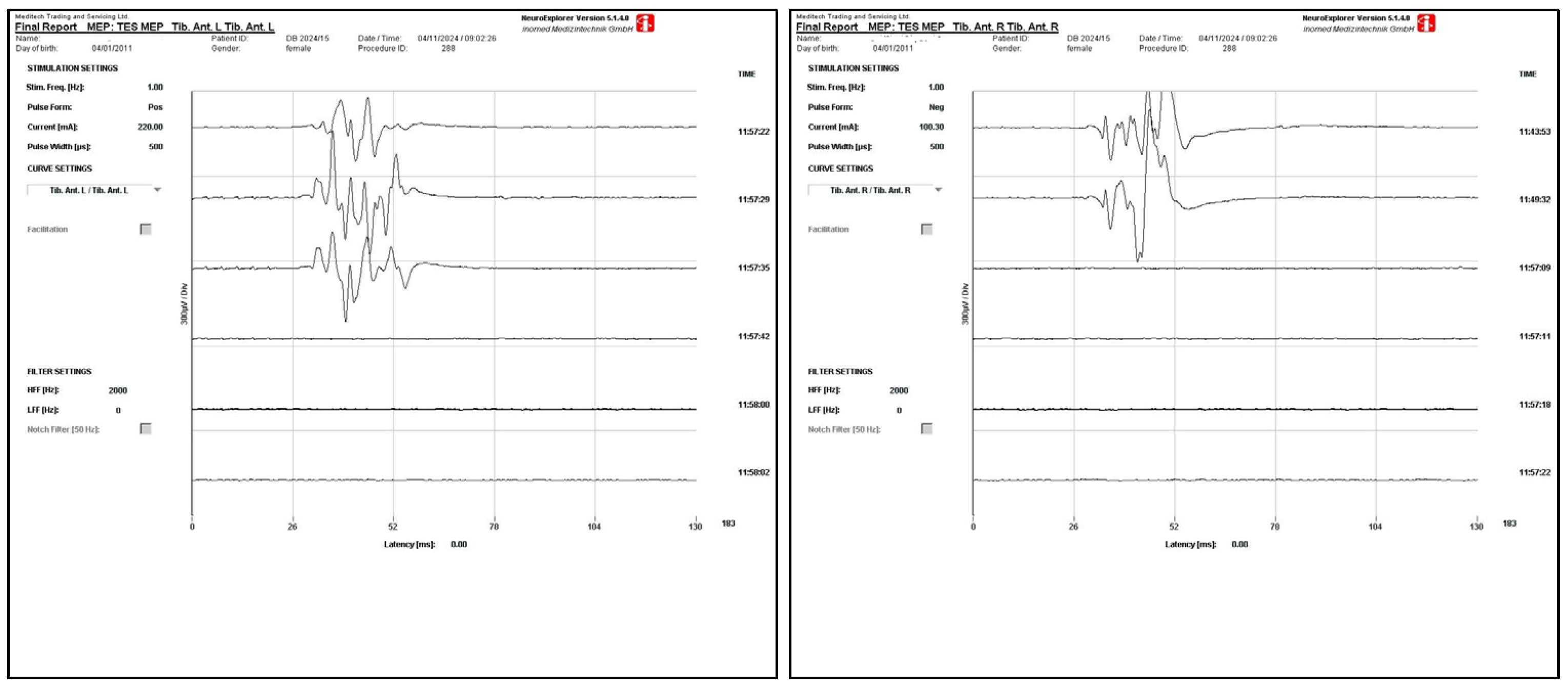
2.2. IONM Protocol
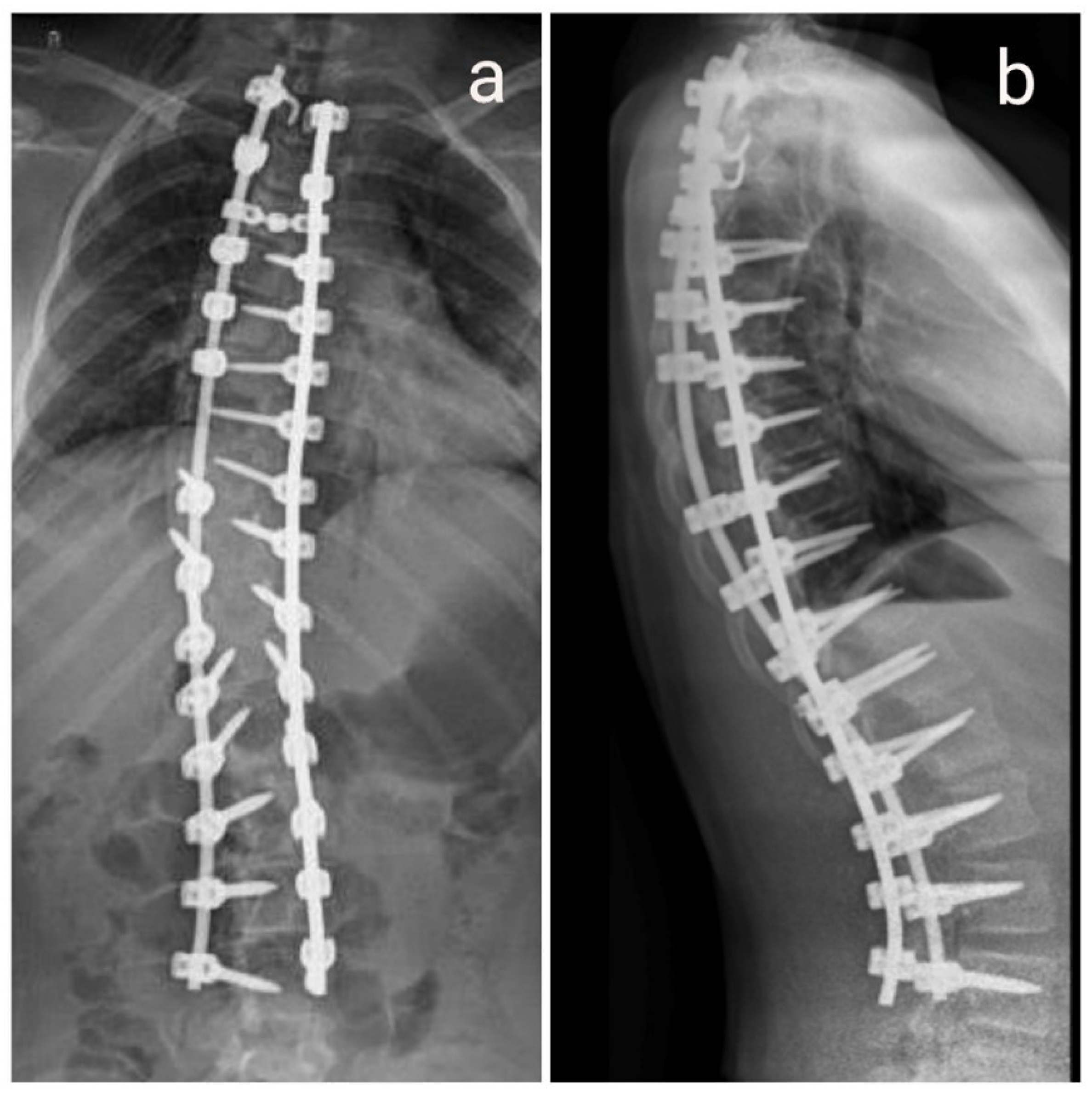
2.3. Operating Procedure
3. Discussion
4. Conclusions
Author Contributions
Funding
Institutional Review Board Statement
Informed Consent Statement
Data Availability Statement
Conflicts of Interest
Abbreviations
| IJS | idiopathic juvenile scoliosis |
| IONM | intraoperative neurophysiological monitoring |
| MEP | motor evoked potentials |
| SSEP | somatosensory evoked potentials |
| sEMG | spontaneous electromyography |
| tEMG | triggered electromyography |
| ECG | electrocardiography |
| IV | intravenous |
| TIVA | total intravenous anesthesia |
| BIS | bispectral index |
| MAC | mean alveolar concentration |
| MAP | mean arterial pressure |
References
- Murphy, R.F.; Mooney, J.F., 3rd. Complications following spine fusion for adolescent idiopathic scoliosis. Curr. Rev. Musculoskelet. Med. 2016, 9, 462–469. [Google Scholar] [CrossRef]
- Fung, A.C.H.; Wong, P.C.P. Anaesthesia for scoliosis surgery. Anaesth. Intensive Care Med. 2023, 24, 744–750. [Google Scholar] [CrossRef]
- Shirasawa, E.; Saito, W.; Miyagi, M.; Imura, T.; Nakazawa, T.; Mimura, Y.; Yokozeki, Y.; Kuroda, A.; Kawakubo, A.; Uchida, K.; et al. Intraoperative blood loss at different surgical-procedure stages during posterior spinal fusion for idiopathic scoliosis. Medicina 2023, 59, 387. [Google Scholar] [CrossRef]
- Hudec, J.; Prokopová, T.; Kosinová, M.; Gál, R. Anesthesia and perioperative management for surgical correction of neuromuscular scoliosis in children: A narrative review. J. Clin. Med. 2023, 12, 3651. [Google Scholar] [CrossRef]
- Paunikar, S.; Paul, A.; Wanjari, D.; Alaspurkar, N.R. Neuromuscular monitoring and wake-up test during scoliosis surgery. Cureus 2023, 24, e44046. [Google Scholar] [CrossRef]
- Janusz, P.; Kotwicka, M.; Andrusiewicz, M.; Czaprowski, D.; Czubak, J.; Kotwicki, T. Estrogen receptors genes polymorphisms and age at menarche in idiopathic scoliosis. BMC Musculoskelet. Disord. 2014, 19, 383. [Google Scholar] [CrossRef]
- Spitzer, A.B.; Patel, R.; Hasan, S.; Blas, D.; Floccari, L.; Glotzbecker, M.; Murphy, J.S.; Fletcher, N.D.; Gomez, J.A.; POSNA QSVI Committee; et al. Absent baseline intraoperative neuromonitoring signals part I: Adolescent idiopathic scoliosis: Current concept review. J. Pediatr. Orthop. Soc. N. Am. 2022, 4, 380. [Google Scholar] [CrossRef]
- Wi, S.M.; Lee, H.J.; Kang, T.; Chang, S.Y.; Kim, S.M.; Chang, B.S.; Lee, C.-K.; Kim, H. Clinical significance of improved intraoperative neurophysiological monitoring signal during spine surgery: A retrospective study of a single-institution prospective cohort. Asian Spine J. 2020, 14, 79–87. [Google Scholar] [CrossRef]
- Tamkus, A.A.; Rice, K.S.; Kim, H.L. Differential rates of false-positive findings in transcranial electric motor evoked potential monitoring when using inhalational anesthesia versus total intravenous anesthesia during spine surgeries. Spine J. 2014, 14, 1440–1446. [Google Scholar] [CrossRef]
- Ma, R.; Qiao, R.; Xu, M.; Li, R.; Hu, Y. Application of controlled hypotension during surgery for spinal metastasis. Technol. Cancer Res. Treat. 2022, 21, 15330338221105718. [Google Scholar] [CrossRef]
- Dutton, R.P. Controlled hypotension for spinal surgery. Eur. Spine J. 2004, 13, S66–S71. [Google Scholar] [CrossRef]
- Nikhar, S.A.; Patro, A.; Iyengar, R.; Gopinath, R. The relevance of the wake-up test in scoliosis surgery: A narrative review. Indian. Anaesth. Forum. 2023, 24, 4–10. [Google Scholar] [CrossRef]
- Laratta, J.L.; Ha, A.; Shillingford, J.N.; Makhni, M.C.; Lombardi, J.M.; Thuet, E.; Lehman, R.A.; Lenke, L.G. Neuromonitoring in spinal deformity surgery: A multimodality approach. Glob. Spine J. 2018, 8, 68–77. [Google Scholar] [CrossRef]
- Teng, W.N.; Tsou, M.Y.; Chen, P.T.; Liou, J.Y.; Yu, L.; Westenskow, D.R.; Ting, C.-K. A desflurane and fentanyl dosing regimen for wake-up testing during scoliosis surgery: Implications for the time-course of emergence from anesthesia. J. Formos. Med. Assoc. 2017, 116, 606–612. [Google Scholar] [CrossRef]
- Imani, F.; Jafarian, A.; Hassani, V.; Khan, Z.H. Propofol–alfentanil vs propofol–remifentanil for posterior spinal fusion including wake-up test. Br. J. Anaesth. 2006, 96, 583–586. [Google Scholar] [CrossRef]
- Young, C.D.; McLuckie, D.; Spencer, A.O. Anaesthetic care for surgical management of adolescent idiopathic scoliosis. BJA Educ. 2019, 19, 232–237. [Google Scholar] [CrossRef]
- Singh, M.; Kulkarni, D.; Gopinath, R. Bispectral index monitoring may not enhance performance of the “wake-up” test during scoliosis surgery. J. Anaesth. Clin. Pharmacol. 2009, 25, 179–182. [Google Scholar]
- Rehberg, S.; Weber, T.P.; Van Aken, H.; Theisen, M.; Ertmer, C.; Bröking, K.; Schulte, T.; Osada, N.; Asemann, D.; Bullmann, V. Sleep disturbances after posterior scoliosis surgery with an intraoperative wake-up test using remifentanil. Anesthesiology 2008, 109, 629–641. [Google Scholar] [CrossRef]
- Shepherd, J.; Jones, J.; Frampton, G.K.; Bryant, J.; Baxter, L.; Cooper, K. Clinical effectiveness and cost-effectiveness of depth of anaesthesia monitoring (E-Entropy, Bispectral Index and Narcotrend): A systematic review and economic evaluation. Health Technol. Assess. 2013, 17, 1–264. [Google Scholar] [CrossRef]
- Li, A.W.; Chang, A.; Murphy, J.S.; Li, Y.; Roye, B.; Hardesty, C.K.; Glotzbecker, M.P.; The Pediatric Spine Study Group. Current practices in MRI screening in early onset scoliosis. Spine Deform. 2025, 13, 961966. [Google Scholar] [CrossRef]
- Çiftdemir, M.; Kaya, M.; Selçuk, E.; Yalniz, E. Tumors of the spine. World J. Orthop. 2016, 7, 109–116. [Google Scholar] [CrossRef]
- Nair, A.P.; Kumar, R.; Srivastav, A.K.; Sahu, R.N.; Kumar, B. Outcome of dorsolumbar vertebral hemangiomas presenting with neuraxial compression. Indian J. Orthop. 2012, 46, 536541. [Google Scholar] [CrossRef]
- George, A.; Hayashi, H.; Bebawy, J.F.; Koht, A. Somatosensory evoked potential loss due to intraoperative pulse lavage during spine surgery: Case report and review of signal change management. J. Clin. Monit. Comput. 2019, 34, 117–124. [Google Scholar] [CrossRef] [PubMed]


Disclaimer/Publisher’s Note: The statements, opinions and data contained in all publications are solely those of the individual author(s) and contributor(s) and not of MDPI and/or the editor(s). MDPI and/or the editor(s) disclaim responsibility for any injury to people or property resulting from any ideas, methods, instructions or products referred to in the content. |
© 2026 by the authors. Licensee MDPI, Basel, Switzerland. This article is an open access article distributed under the terms and conditions of the Creative Commons Attribution (CC BY) license.
Share and Cite
Djan, V.; Galić, V.; Galetić, N.; Krasnik, R.; Bodonji, S.; Fratrić, I.; Uram Benka, A.; Fabri Galamboš, I.; Bošković, N.; Mačar Novaković, J. Reversible Causes of Transitory Motor Evoked Potential Decrease During Posterior Spine Fusion in Rapidly Progressive Scoliosis Treatment: A Case Report. Diseases 2026, 14, 86. https://doi.org/10.3390/diseases14030086
Djan V, Galić V, Galetić N, Krasnik R, Bodonji S, Fratrić I, Uram Benka A, Fabri Galamboš I, Bošković N, Mačar Novaković J. Reversible Causes of Transitory Motor Evoked Potential Decrease During Posterior Spine Fusion in Rapidly Progressive Scoliosis Treatment: A Case Report. Diseases. 2026; 14(3):86. https://doi.org/10.3390/diseases14030086
Chicago/Turabian StyleDjan, Vladimir, Vladimir Galić, Nemanja Galetić, Rastislava Krasnik, Stanislava Bodonji, Ivana Fratrić, Anna Uram Benka, Izabela Fabri Galamboš, Nikola Bošković, and Jelena Mačar Novaković. 2026. "Reversible Causes of Transitory Motor Evoked Potential Decrease During Posterior Spine Fusion in Rapidly Progressive Scoliosis Treatment: A Case Report" Diseases 14, no. 3: 86. https://doi.org/10.3390/diseases14030086
APA StyleDjan, V., Galić, V., Galetić, N., Krasnik, R., Bodonji, S., Fratrić, I., Uram Benka, A., Fabri Galamboš, I., Bošković, N., & Mačar Novaković, J. (2026). Reversible Causes of Transitory Motor Evoked Potential Decrease During Posterior Spine Fusion in Rapidly Progressive Scoliosis Treatment: A Case Report. Diseases, 14(3), 86. https://doi.org/10.3390/diseases14030086