

Evaluation of Prognostic Factors in Myxoid Liposarcoma Treated with Combined Neoadjuvant Radiotherapy and Surgical Excision: Systematic Review

 , , , ,
Abstract
1. Introduction
2. Materials and Methods
2.1. Search Strategy
2.2. Inclusion Criteria
2.3. Data Collection
3. Results
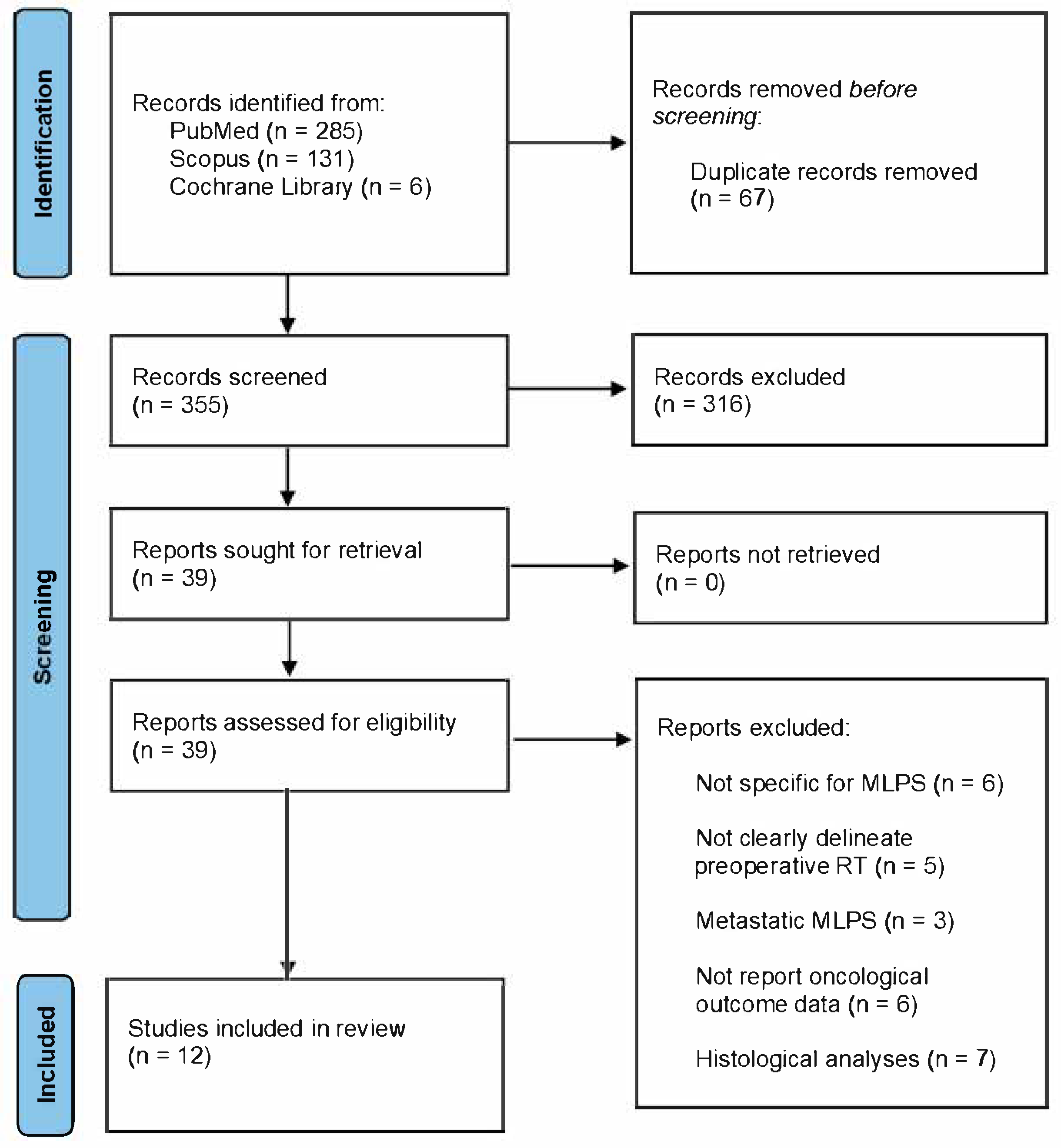
3.1. Search Results
3.2. Demographic Data
3.3. Tumor Characteristics
3.4. Radiotherapy and Chemotherapy Treatment
3.5. Local Recurrence and Metastasis
3.6. Survival Rates
3.7. Prognostic Factors
3.7.1. Round Cells
3.7.2. Tumor Grade
3.7.3. Tumor Depth
3.7.4. Tumor Size
3.7.5. Marginal Status
4. Discussion
5. Conclusions
Author Contributions
Funding
Conflicts of Interest
Abbreviations
| MLPS | Myxoid Liposarcoma |
| RT | Radiotherapy |
| LR | Local Recurrence |
| RCs | Round Cells |
References
- Muratori, F.; Bettini, L.; Frenos, F.; Mondanelli, N.; Greto, D.; Livi, L.; Franchi, A.; Roselli, G.; Scorianz, M.; Capanna, R.; et al. Myxoid Liposarcoma: Prognostic Factors and Metastatic Pattern in a Series of 148 Patients Treated at a Single Institution. Int. J. Surg. Oncol. 2018, 2018, 8928706. [Google Scholar] [CrossRef]
- Hou, X.; Shi, W.; Luo, W.; Luo, Y.; Huang, X.; Li, J.; Ji, N.; Chen, Q. FUS::DDIT3 Fusion Protein in the Development of Myxoid Liposarcoma and Possible Implications for Therapy. Biomolecules 2024, 14, 1297. [Google Scholar] [CrossRef] [PubMed]
- Lee, A.T.J.; Thway, K.; Huang, P.H.; Jones, R.L. Clinical and Molecular Spectrum of Liposarcoma. J. Clin. Oncol. 2018, 36, 151–159. [Google Scholar] [CrossRef] [PubMed]
- Lemeur, M.; Mattei, J.-C.; Souteyrand, P.; Chagnaud, C.; Curvale, G.; Rochwerger, A. Prognostic Factors for the Recurrence of Myxoid Liposarcoma: 20 Cases with up to 8 Years Follow-Up. Orthop. Traumatol. Surg. Res. 2015, 101, 103–107. [Google Scholar] [CrossRef]
- Le Grange, F.; Cassoni, A.M.; Seddon, B.M. Tumour Volume Changes Following Pre-Operative Radiotherapy in Borderline Resectable Limb and Trunk Soft Tissue Sarcoma. Eur. J. Surg. Oncol. (EJSO) 2014, 40, 394–401. [Google Scholar] [CrossRef]
- Qu, G.; Zhang, C.; Tian, Z.; Yao, W. Diagnosis and Treatment of Myxoid Liposarcoma. Curr. Treat. Options Oncol. 2024, 25, 1289–1296. [Google Scholar] [CrossRef] [PubMed]
- Pitson, G.; Robinson, P.; Wilke, D.; Kandel, R.A.; White, L.; Griffin, A.M.; Bell, R.S.; Catton, C.N.; Wunder, J.S.; O’Sullivan, B. Radiation Response: An Additional Unique Signature of Myxoid Liposarcoma. Int. J. Radiat. Oncol. Biol. Phys. 2004, 60, 522–526. [Google Scholar] [CrossRef]
- Simoens, C.; Korst, A.E.C.; De Pooter, C.M.J.; Lambrechts, H.A.J.; Pattyn, G.G.O.; Faircloth, G.T.; Lardon, F.; Vermorken, J.B. In Vitro Interaction between Ecteinascidin 743 (ET-743) and Radiation, in Relation to Its Cell Cycle Effects. Br. J. Cancer 2003, 89, 2305–2311. [Google Scholar] [CrossRef]
- Romero, J.; Zapata, I.; Córdoba, S.; Jimeno, J.M.; López-Martín, J.A.; Tercero, J.C.; La Torre, A.D.; Vargas, J.A.; Molerón, R.; Sánchez-Prieto, R. In Vitro Radiosensitisation by Trabectedin in Human Cancer Cell Lines. Eur. J. Cancer 2008, 44, 1726–1733. [Google Scholar] [CrossRef]
- Chung, P.W.M.; Deheshi, B.M.; Ferguson, P.C.; Wunder, J.S.; Griffin, A.M.; Catton, C.N.; Bell, R.S.; White, L.M.; Kandel, R.A.; O’Sullivan, B. Radiosensitivity Translates into Excellent Local Control in Extremity Myxoid Liposarcoma: A Comparison with Other Soft Tissue Sarcomas. Cancer 2009, 115, 3254–3261. [Google Scholar] [CrossRef]
- Alaggio, R.; Coffin, C.M.; Weiss, S.W.; Bridge, J.A.; Issakov, J.; Oliveira, A.M.; Folpe, A.L. Liposarcomas in Young Patients: A Study of 82 Cases Occurring in Patients Younger Than 22 Years of Age. Am. J. Surg. Pathol. 2009, 33, 645–658. [Google Scholar] [CrossRef] [PubMed]
- Tuzzato, G.; Laranga, R.; Ostetto, F.; Bubbico, E.; Vara, G.; Bianchi, G. Primary High-Grade Myxoid Liposarcoma of the Extremities: Prognostic Factors and Metastatic Pattern. Cancers 2022, 14, 2657. [Google Scholar] [CrossRef]
- Lebas, A.; Le Fèvre, C.; Waissi, W.; Chambrelant, I.; Brinkert, D.; Noël, G. Prognostic Factors in Extremity Soft Tissue Sarcomas Treated with Radiotherapy: Systematic Review of the Literature. Cancers 2023, 15, 4486. [Google Scholar] [CrossRef]
- Shinoda, Y.; Kobayashi, E.; Kobayashi, H.; Mori, T.; Asano, N.; Nakayama, R.; Morioka, H.; Iwata, S.; Yonemoto, T.; Ishii, T.; et al. Prognostic Factors of Metastatic Myxoid Liposarcoma. BMC Cancer 2020, 20, 883. [Google Scholar] [CrossRef]
- Dürr, H.R.; Rauh, J.; Baur-Melnyk, A.; Knösel, T.; Lindner, L.; Roeder, F.; Jansson, V.; Klein, A. Myxoid Liposarcoma: Local Relapse and Metastatic Pattern in 43 Patients. BMC Cancer 2018, 18, 304. [Google Scholar] [CrossRef] [PubMed]
- Stevenson, J.D.; Watson, J.J.; Cool, P.; Cribb, G.L.; Jenkins, J.P.R.; Leahy, M.; Gregory, J.J. Whole-Body Magnetic Resonance Imaging in Myxoid Liposarcoma: A Useful Adjunct for the Detection of Extra-Pulmonary Metastatic Disease. Eur. J. Surg. Oncol. (EJSO) 2016, 42, 574–580. [Google Scholar] [CrossRef]
- Büyükceran, İ.; Erdoğan, F.; Karadeniz, S.; Sina Coşkun, H.; Dabak, N. Evaluation of Prognostic Factors and Oncological Outcomes in Patients with Limb-Localized Myxoid Liposarcoma. Jt. Dis. Relat. Surg. 2022, 33, 616–623. [Google Scholar] [CrossRef] [PubMed]
- Gronchi, A.; Hindi, N.; Cruz, J.; Blay, J.-Y.; Lopez-Pousa, A.; Italiano, A.; Alvarez, R.; Gutierrez, A.; Rincón, I.; Sangalli, C.; et al. Trabectedin and RAdiotherapy in Soft Tissue Sarcoma (TRASTS): Results of a Phase I Study in Myxoid Liposarcoma from Spanish (GEIS), Italian (ISG), French (FSG) Sarcoma Groups. EClinicalMedicine 2019, 9, 35–43. [Google Scholar] [CrossRef]
- Guadagnolo, B.A.; Zagars, G.K.; Ballo, M.T.; Patel, S.R.; Lewis, V.O.; Benjamin, R.S.; Pollock, R.E. Excellent Local Control Rates and Distinctive Patterns of Failure in Myxoid Liposarcoma Treated With Conservation Surgery and Radiotherapy. Int. J. Radiat. Oncol. Biol. Phys. 2008, 70, 760–765. [Google Scholar] [CrossRef]
- Hoffman, A.; Ghadimi, M.P.H.; Demicco, E.G.; Creighton, C.J.; Torres, K.; Colombo, C.; Peng, T.; Lusby, K.; Ingram, D.; Hornick, J.L.; et al. Localized and Metastatic Myxoid/Round Cell Liposarcoma: Clinical and Molecular Observations. Cancer 2013, 119, 1868–1877. [Google Scholar] [CrossRef]
- Lee, L.H.; Tepper, S.; Owen, G.; Wang, D.; Lopez-Hisijos, N.; Colman, M.W.; Gitelis, S.; Blank, A.T. Radiotherapy, Volume Reduction, and Short-Term Surgical Outcomes in the Treatment of Large Myxoid Liposarcomas. Radiat. Oncol. J 2022, 40, 172–179. [Google Scholar] [CrossRef] [PubMed]
- Houdek, M.T.; Mallett, K.E.; Heidenreich, M.J.; Ahmed, S.K.; Wenger, D.E.; Smith, J.H.; Siontis, B.L.; Robinson, S.I.; Folpe, A.L.; Petersen, I.A.; et al. Lack of Radiosensitivity Predicts Poor Disease Specific Survival in Myxoid Liposarcoma. J. Surg. Oncol. 2023, 127, 848–854. [Google Scholar] [CrossRef]
- Moreau, L.-C.; Turcotte, R.; Ferguson, P.; Wunder, J.; Clarkson, P.; Masri, B.; Isler, M.; Dion, N.; Werier, J.; Ghert, M.; et al. Myxoid\Round Cell Liposarcoma (MRCLS) Revisited: An Analysis of 418 Primarily Managed Cases. Ann. Surg. Oncol. 2012, 19, 1081–1088. [Google Scholar] [CrossRef]
- Perera, J.R.; AlFaraidy, M.; Ibe, I.; Aoude, A.; Acem, I.; Van De Sande, M.A.J.; Dessureault, M.; Turcotte, R.E.; Mottard, S.; Basile, G.; et al. Intermuscular Extremity Myxoid Liposarcoma Can Be Managed by Marginal Resection Following Neoadjuvant Radiotherapy. Eur. J. Surg. Oncol. 2023, 49, 362–367. [Google Scholar] [CrossRef] [PubMed]
- Salduz, A.; Alpan, B.; Valiyev, N.; Özmen, E.; İribaş, A.; Ağaoğlu, F.; Bayram, A.; Bilgiç, B.; Özger, H. Neoadjuvant Radiotherapy for Myxoid Liposarcomas: Oncologic Outcomes and Histopathologic Correlations. Acta Orthop. Traumatol. Turc. 2017, 51, 355–361. [Google Scholar] [CrossRef] [PubMed]
- Masunaga, T.; Tsukamoto, S.; Honoki, K.; Fujii, H.; Kido, A.; Akahane, M.; Tanaka, Y.; Mavrogenis, A.F.; Errani, C.; Kawai, A. Comparison of Pre-Operative and Post-Operative Radiotherapy in Patients with Localized Myxoid Liposarcoma. Jpn. J. Clin. Oncol. 2023, 53, 1153–1161. [Google Scholar] [CrossRef]
- Lansu, J.; Bovée, J.V.M.G.; Braam, P.; Van Boven, H.; Flucke, U.; Bonenkamp, J.J.; Miah, A.B.; Zaidi, S.H.; Thway, K.; Bruland, Ø.S.; et al. Dose Reduction of Preoperative Radiotherapy in Myxoid Liposarcoma: A Nonrandomized Controlled Trial. JAMA Oncol 2021, 7, e205865. [Google Scholar] [CrossRef]
- Mujtaba, B.; Wang, F.; Taher, A.; Aslam, R.; Madewell, J.E.; Nassar, S. Myxoid Liposarcoma With Skeletal Metastases: Pathophysiology and Imaging Characteristics. Curr. Probl. Diagn. Radiol. 2021, 50, 66–73. [Google Scholar] [CrossRef]
- Morán, L.M.; Vega, J.; Gómez-León, N.; Royuela, A. Myxomas and Myxoid Liposarcomas of the Extremities: Our Preliminary Findings in Conventional, Perfusion, and Diffusion Magnetic Resonance. Acta Radiol. Open 2022, 11, 205846012211314. [Google Scholar] [CrossRef]
- Mentzel, T.; Brown, L.F.; Dvorak, H.F.; Kuhnen, C.; Stiller, K.J.; Katenkamp, D.; Fletcher, C.D.M. The Association between Tumour Progression and Vascularity in Myxofibrosarcoma and Myxoid/Round Cell Liposarcoma. Virchows Arch. 2001, 438, 13–22. [Google Scholar] [CrossRef]
- Tfayli, Y.; Baydoun, A.; Naja, A.; Saghieh, S. Management of Myxoid Liposarcoma of the Extremity (Review). Oncol. Lett. 2021, 22, 596. [Google Scholar] [CrossRef] [PubMed]
- Sambri, A.; Caldari, E.; Fiore, M.; Zucchini, R.; Giannini, C.; Pirini, M.G.; Spinnato, P.; Cappelli, A.; Donati, D.M.; De Paolis, M. Margin Assessment in Soft Tissue Sarcomas: Review of the Literature. Cancers 2021, 13, 1687. [Google Scholar] [CrossRef]
- Roohani, S.; Wiltink, L.M.; Kaul, D.; Spałek, M.J.; Haas, R.L. Update on Dosing and Fractionation for Neoadjuvant Radiotherapy for Localized Soft Tissue Sarcoma. Curr. Treat. Options Oncol. 2024, 25, 543–555. [Google Scholar] [CrossRef]
- Lansu, J.; Braam, P.M.; Van Werkhoven, E.; Scholten, A.N.; Schrage, Y.; Van Houdt, W.J.; Van Langevelde, K.; Haas, R.L. A Moderate Dose of Preoperative Radiotherapy May Improve Resectability in Myxoid Liposarcoma. Eur. J. Surg. Oncol. 2021, 47, 2633–2639. [Google Scholar] [CrossRef]
- Roeder, F. Radiation Therapy in Adult Soft Tissue Sarcoma—Current Knowledge and Future Directions: A Review and Expert Opinion. Cancers 2020, 12, 3242. [Google Scholar] [CrossRef] [PubMed]
- Chowdhry, V.; Goldberg, S.; DeLaney, T.F.; Cote, G.M.; Chebib, I.; Kim, J.; Lozano-Calderón, S.A.; De Amorim Bernstein, K. Myxoid Liposarcoma: Treatment Outcomes from Chemotherapy and Radiation Therapy. Sarcoma 2018, 2018, 8029157. [Google Scholar] [CrossRef] [PubMed]
- Haniball, J.; Sumathi, V.P.; Kindblom, L.-G.; Abudu, A.; Carter, S.R.; Tillman, R.M.; Jeys, L.; Spooner, D.; Peake, D.; Grimer, R.J. Prognostic Factors and Metastatic Patterns in Primary Myxoid/Round-Cell Liposarcoma. Sarcoma 2011, 2011, 538085. [Google Scholar] [CrossRef]
- Lansu, J.; Van Houdt, W.J.; Schaapveld, M.; Walraven, I.; Van De Sande, M.A.J.; Ho, V.K.Y.; Haas, R.L. Time Trends and Prognostic Factors for Overall Survival in Myxoid Liposarcomas: A Population-Based Study. Sarcoma 2020, 2020, 2437850. [Google Scholar] [CrossRef]


| Author (Year) | Type of Study | LOE | N | Age | Sex | Site | Tumor Size | Grade | Tumor Depth | % Round Cell |
|---|---|---|---|---|---|---|---|---|---|---|
| Buyukceran et al. (2022) [17] | ROS | III | 43 | 56.3 | 32.5% F, 67.5% M | Upper limb (23.2%), Lower limb (76.7%) | 0–5 cm (18.6%) | Low (37.2%), High (62.7%) | N.R. | 0 (18.6%), 0–5 (53.5%) |
| Chung et al. (2009) [10] | ROS | III | 88 | 48 | 41% F, 59% M | \ | \ | Grade 2 (93.2%), Grade 3 (6.8%) | Superficial (15%), Deep (85%) | \ |
| Gronchi et al. (2019) [18] | POS | II | 14 | 36 | 50% F, 50% M | Tigh (71%), Leg (21%), Buttock (7%) | >10 cm (100%) | \ | Deep (100%) | \ |
| Guadagnolo et al. (2008) [19] | ROS | III | 127 | 41 | 43% F, 57% M | Head and neck (2%), Superficial trunk (10%), Deep trunk (2%), Upper limb (3%), Lower limb (83%) | ≤5 (15%), >5 (85%), ≤10 (57%), >10 (43%) | \ | \ | \ |
| Hoffman et al. (2013) [20] | ROS | III | 207 | 41 | 42.5% F, 57.5% M | Extremities (74%), Other (26%) | \ | \ | Deep (76%), Superficial (24%) | \ |
| Lee et al. (2022) [21] | ROS | III | 24 | 39.9 | 75% F, 25% M | Thigh (91.7%), Calf (8.3%) | \ | \ | \ | Present (16.7%), Not present (75%), Unknown (8.3%) |
| Houdek et al. (2023) [22] | ROS | III | 62 | 47 ± 14 | 45% F, 55% M | Lower extremity (97%), Upper extremity (3%) | \ | Low (81%), High (19%) | Deep (100%) | 0 (81%), 0–5 (16.1%), ≥5 (2.9%) |
| Moreau et al. (2012) [23] | ROS | III | 418 | 45 | 41% F, 59% M | Lower limb (90%), Upper limb (7%), Chest wall (1%), Paraspinal (1%) | <5 cm (13.15%), 5–10 cm (33.25%), >10 cm (53.6%) | Grade 1 (33%), Grade 2 (49%), Grade 3 (14%), Unknown (4%) | Deep (81%), Superficial (18%) | Pure myxoid (74%), Round cell (26%) |
| Perera et al. (2023) [24] | ROS | III | 198 | 46 | 34% F, 66% M | Lower extremity (97%), Upper extremity (3%) | \ | Grade 1 (16%), Grade 2 (62%), Grade 3 (19%) | \ | <5% (73%), ≥5% (15%) |
| Salduz et al. (2017) [25] | ROS | III | 23 | 43 | 30.4% F, 69.6% M | Lower extremities (95.6%), Upper extremities (4.3%) | \ | \ | \ | Round cell (21.7%) |
| Masunaga et al. (2023) [26] | ROS | III | 200 | <40 years (25%), 40–65 years (59%), >65 years (16%) | 38.5% F, 61.5% M | Lower limb (78%), Upper limb (5.5%), Trunk (16.5%) | <5 cm (4.5%), 5–10 cm (38%), 10–15 cm (30.5%), ≥15 cm (27%) | High (67%), Low (33%) | Deep (94%), Superficial (6%) | \ |
| Lansu et al. (2021) [27] | POS | 79 | 45 | 44% F, 56% M | Lower extremity proximal (78%), Lower extremity distal (13%), Upper extremity (3%), Trunk (6%) | \ | \ | \ | <5% (77%), >5% (19%), Unknown (4%) |
| Author (Year) | Tumor Dimension Pre- and Post-RT | RT Gy | RT | Chemotherapy | CT Protocols | Margins (%) |
|---|---|---|---|---|---|---|
| Buyukceran et al. (2022) [17] | \ | 45–50 Gy pre | Neo (32.5%) | 9.3% | doxorubicin + ifosfamide | R0 (41.9%) R1 (39.5%) R2 (18.6%) |
| 60 Gy post | Adj (67.4%) | |||||
| Chung et al. (2009) [10] | \ | 50 Gy pre | Neo (47%), | \ | \ | R0 (81%) R1 (19%) |
| 60–66 Gy post | Adj (43%), Neo + boost postop (10%) | |||||
| Gronchi et al. (2019) [18] | Size pre-RT: 12.5 cm | 45 Gy pre | Neo (100%) | 100% | trabectedin (median dose 2.6 mg per cycles) | R0 (58%) R1 (42%) |
| 16 Gy post (if R1) | ||||||
| Guadagnolo et al. (2008) [19] | \ | 50 Gy pre | Neo (54%) | 28% | doxorubicin based + cyclophosphamide or vincristine or dacarbazine or ifosfamide | R0 (72%) R1-R2 (9%) Unknown (20%) |
| 60 Gy post | Adj (46%) | |||||
| Hoffman et al. (2013) [20] | Size pre-RT: 10 ± 6.7 cm | \ | Neo 57%, Adj 42%, No surgery 1% | Neo (77%), Adj (17%) | doxorubicin + ifosfamide | R0 (83%), R1 (13%), R2 (4%) |
| Lee et al. (2022) [21] | Size pre-RT: 12.4 cm; Volume pre-RT: 298.9 cm3; Size post-RT: 8.7 cm; Volume post-RT: 106.9 cm3 | 50 Gy pre | Neo (16.7%) | doxorubicin + ifosfamide | \ | |
| Houdek et al. (2023) [22] | Size pre-RT 15 ± 6 cm; Volume pre-RT: 629 ± 631 cm3; Size post-RT: 12 ± 5 cm; Volume post-RT: 304 ± 387 cm3 | 50.4 Gy pre | Neo (55%), Neo + Boost intraop (34%), Neo + boost postop (11%) | 21% | doxorubicin + ifosfamide + mitomycin C and cisplatin | R0 (87%), R1 (3.2%), R2 (9.7%) |
| Moreau et al. (2012) [23] | Size pre-RT 10 cm; Volume pre-RT 325 cm3 | 50 Gy pre | Neo (40.7%) | 6% | \ | R0 (73.9%) R1 (22%) R2 (3.3%) |
| 65 Gy post | Adj (28.2%) | |||||
| 66 Gy | Neo + Adj (5%) | |||||
| Perera et al. (2023) [24] | Volume pre-RT: 240.6 cm3; post-RT volume change: 60.1% | 50 Gy pre | Neo (100%) | Micro positive (11%) <1 mm (15%) ≥1 mm (72%) | ||
| Salduz et al. (2017) [25] | Size pre-RT: 13.7 cm | 28 Gy pre | Neo (100%) | Neo (34.8%) | adriamycin + ifosfamide (2 Cycles) | Wide (82.6%) Marginal (17.4%) |
| Masunaga et al. (2023) [26] | \ | 30–56 Gy pre | Neo (50%) | 33.5%: Neo (31.4%), Adj (40.3%), Neo + Adj (28.3%) | anthracycline + ifosfamide; anthracycline | R0 (71.5%) R1 (24.5%) R2 (4%) |
| 45–70 Gy post | Adj (50%) | |||||
| Lansu et al. (2021) [27] | Size pre-RT: 9.9 cm | 36 Gy pre | Neo (99%) | \ | \ | R0 (94%) R1 (6%) |
| 30 Gy post | Neo + Adj (1%) |
| Author (Year) | Complications (%) | Follow-Up (m) | % LR | Time to LR (m) | LR-Free Survival | % METS | Time to METS (m) | METS-Free Survival | Disease-Free Survival | DSS | Overall Survival |
|---|---|---|---|---|---|---|---|---|---|---|---|
| Buyukceran et al. (2022) [17] | Wound necrosis (14%) | 106.8 | 27.9 | 22.8 | \ | 9.3 | \ | \ | \ | \ | 2 Y (93%) 5 Y (81.2%) 10 Y (72.7%) |
| Chung et al. (2009) [10] | \ | 86 | 2.27 | \ | 5 Y (97.7%) | 13.6 | \ | 5 Y (89.1%) | \ | \ | 5 Y (93.9%) |
| Gronchi et al. (2019) [18] | Sepsis (1%) | 26 | 7.14 | \ | 3 Y (92%) | 7.14 | 15 | \ | 3 Y (86%) | \ | 3 Y (93%) |
| Guadagnolo et al. (2008) [19] | Edema (4%), Cellulitis (1%), Fibrosis (1.57%), Stress fracture (2.4%) | 109.2 | 3 | 14 | \ | 21 | 27 | 5 Y (85%) 10 Y (76%) | 5 Y (81%) 10 Y (73%) 15 Y (71%) | 5 Y (89%) 10 Y (83%) 15 Y (78%) | 5 Y (87%) 10 Y (79%) 15 Y (71%) |
| Hoffman et al. (2013) [20] | \ | 68 | 7.4 | 31 | \ | 13 | 34 | \ | \ | 1 Y (99%) 5 Y (93%) 10 Y (87%) | \ |
| Lee et al. (2022) [21] | Wound complications (25%) | \ | \ | \ | \ | \ | \ | \ | \ | \ | \ |
| Houdek et al. (2023) [22] | Wound healing (21%), Radiation-associated fractures (13%), Deep infection (8%) | 96 | 6 | 35 | 2 Y (98%) 5 Y (93%) 10 Y (90%) | 29 | 20 | \ | 2 Y (81%) 5 Y (68%) 10 Y (66%) | 2 Y (94%) 5 Y (84%) 10 Y (76%) | \ |
| Moreau et al. (2012) [23] | \ | 62.4 | 7 | 33 | 10 Y (93%) | 20 | 26.4 | \ | 5 Y (77%) | 5 Y (85%) | \ |
| Perera et al. (2023) [24] | 18% | 60.7 | 1 | 17 | 5 Y (98.9%) | 24.24 | \ | 5 Y (77.2%) | \ | \ | 5 Y (94.2%) |
| Salduz et al. (2017) [25] | \ | 55.1 | 4 | 52 | 5 Y (91%) 10 Y (91%) | 26 | 51 | \ | 5 Y (66%) 10 Y (66%) | \ | 5 Y (78.1%) 10 Y (71%) |
| Masunaga et al. (2023) [26] | Wound complications (9.5%) | 40.5 | 6.5 (RT Neo) 9 (RT Adj) | 21 (RT Neo) 14 (RT Adj) | 5 Y (94.9%) | 15.5 | \ | \ | \ | 5 Y (88.1%) | \ |
| Lansu et al. (2021) [27] | Wound complications (22%) | 25 | 0 | \ | \ | 2.5 | \ | \ | 1 Y (97%) 3 Y (93%) | 1 Y (99%) 3 Y (96%) | 1 Y (99%) 3 Y (95%) |
| Prognostic Factors | Authors | |||
|---|---|---|---|---|
| Buyukceran et al. (2022) [17] | Moreau et al. (2012) [23] | Perera et al. (2023) [24] | Salduz et al. (2017) [25] | |
| LRFS and depth | \ | \ | \ | \ |
| LRFS and size | \ | \ | \ | \ |
| LRFS and histology | \ | \ | \ | \ |
| LRFS and margin | \ | 5 Y: R0 (95%), R1 (83%), R2 (43%) | 5 Y: microscopically positive (100%), R1 < 1 mm (96.4%), R1 > 1 mm (99.3%) | \ |
| MT and size | \ | \ | \ | >15 cm (83%) [p = 0.006] |
| MFS and margins | \ | \ | 5 Y: microscopically positive (67,5%), R1 < 1 mm (74,4%), R1 > 1 mm (79%) | Wide (higher MFS) [p = 0.023] |
| MFS and grade | \ | 5 Y: grade 1 (90%), grade 2 (87%), grade 3 (67%) | \ | \ |
| MFS and depth | \ | 5 Y: deep (78%), superficial (96%) | \ | \ |
| MFS and histology | \ | 5 Y: >5% RC (84%), >25% (69%) | \ | 5 Y: RC (27%) [p = 0.052] |
| DSS and histology | \ | \ | \ | |
| OS and %RC | 2 Y: >5% (91.7%) 10 Y: >5% (50%) | \ | \ | 5 Y: RC (53%) |
| OS and grade | 10 Y: low-grade (86.3%), high-grade (46.2%) | \ | \ | \ |
| OS and surgical margin | 10 Y: R0 (94.4%), R1 (62.5%), R2 (33%) | \ | \ | \ |
Disclaimer/Publisher’s Note: The statements, opinions and data contained in all publications are solely those of the individual author(s) and contributor(s) and not of MDPI and/or the editor(s). MDPI and/or the editor(s) disclaim responsibility for any injury to people or property resulting from any ideas, methods, instructions or products referred to in the content. |
© 2025 by the authors. Licensee MDPI, Basel, Switzerland. This article is an open access article distributed under the terms and conditions of the Creative Commons Attribution (CC BY) license (https://creativecommons.org/licenses/by/4.0/).
Share and Cite
Papalia, G.F.; De Marco, G.; Luciano, C.; Sisca, L.; Farsetti, P.; Vincenzi, B.; Papalia, R. Evaluation of Prognostic Factors in Myxoid Liposarcoma Treated with Combined Neoadjuvant Radiotherapy and Surgical Excision: Systematic Review. Diseases 2025, 13, 177. https://doi.org/10.3390/diseases13060177
Papalia GF, De Marco G, Luciano C, Sisca L, Farsetti P, Vincenzi B, Papalia R. Evaluation of Prognostic Factors in Myxoid Liposarcoma Treated with Combined Neoadjuvant Radiotherapy and Surgical Excision: Systematic Review. Diseases. 2025; 13(6):177. https://doi.org/10.3390/diseases13060177
Chicago/Turabian StylePapalia, Giuseppe Francesco, Giulia De Marco, Claudia Luciano, Luisana Sisca, Pasquale Farsetti, Bruno Vincenzi, and Rocco Papalia. 2025. "Evaluation of Prognostic Factors in Myxoid Liposarcoma Treated with Combined Neoadjuvant Radiotherapy and Surgical Excision: Systematic Review" Diseases 13, no. 6: 177. https://doi.org/10.3390/diseases13060177
APA StylePapalia, G. F., De Marco, G., Luciano, C., Sisca, L., Farsetti, P., Vincenzi, B., & Papalia, R. (2025). Evaluation of Prognostic Factors in Myxoid Liposarcoma Treated with Combined Neoadjuvant Radiotherapy and Surgical Excision: Systematic Review. Diseases, 13(6), 177. https://doi.org/10.3390/diseases13060177