


Abstract
This paper proposes a dynamic resource allocation scheme to maximize the energy efficiency (EE) for Massive MIMO Systems. The imperfect channel estimation (CE) and feedback are explicitly considered in the EE maximization problem, which aim to optimize the power allocation, the antenna subset selection for transmission, and the pilot assignment. Assuming CE error to be bounded for the complex-constrained Cramer–Rao Bound (CRB), theoretical results show that the lower bound is directly proportional to its number of unconstrained parameters. Utilizing this perspective, a separated and bi-directional estimation is developed to achieve both low CRB and low complexity by exploiting channel and noise spatial separation. Exploiting global optimization procedure, the optimal resource allocation can be transformed into a standard convex optimization problem. This allows us to derive an efficient iterative algorithm for obtaining the optimal solution. Numerical results are provided to demonstrate that the outperformance of the proposed algorithms are superior to existing schemes.
1. Introduction
The foreseen demand increasing in data rate has triggered a research race for discovering new ways to enhance the spectral efficiency of the next generation of mobile and wireless networks [1]. Benefiting from spatial multiplexing, massive MIMO systems can enjoy asymptotically orthogonal channels, arbitrary small transmit power, and negligible noise, thus providing significant performance gains in terms of spectral efficiency (SE), security, and reliability compared with conventional MIMO [2]. Furthermore, all of these benefits can be achieved through linear processing with low complexity. However, the usage of a large number of base station (BS) antennas in massive MIMO can significantly increase the radio frequency (RF) circuits and digital signal processing (DSP) power consumption, which has a severe impact on EE [3]. Because of the rapidly rising energy costs and the tremendous carbon footprints of existing systems, EE is gradually accepted as an important design criterion for future communication systems [4,5]. Consequently, research interests are steered to adopt energy-aware network architectures and adjust their operational parameters to optimize the EE performance [6,7].
Nevertheless, most existing works optimizing the resource allocation strategies generally rely on a common assumption that the whole channel characteristics are perfectly known at both the receiver and the transmitter. However, these assumptions seem impractical, especially in frequency division duplexing (FDD) system since noise interference poses significant challenges to channel estimation and channel state information (CSI) feedback. In a time division duplexing (TDD) based massive MIMO system, the CSI in the uplink can be more easily acquired at the BS due to the limited number of users, and then channel reciprocity property can be exploited to realize CSI in downlink via reconstructing the uplink CSI [8]. However, the CSI acquired in the uplink may be always inaccurate corresponding to the downlink due to the calibration error of radio frequency chains [9]. Especially in FDD protocol, the downlink and uplink CE are necessary, since the channel reciprocity does not hold [10]. There are non-ignorable CE errors under actual transmission conditions, which will significantly affect the SE/EE loss [11].
This work considers the problems of finding the errors of CSI estimation and feedback subject to pilot distortion, ranging from the downlink to uplink, utilizing the theory of a complex-constrained Cramer–Rao bound (CRB) reported in [12] to exactly quantify CE error over a training-based CE technique. The design of separated and bi-directional estimation (SCE) significantly increase the accuracy of CSI feedback. The proposed algorithm is based on singular value decomposition (SVD) of channel matrix as , where and are the unitary matrixes, and is the diagonal matrix, respectively. and can be estimated using only received data at both sides by exploiting channel and noise spatial separation. Utilizing CRB, theoretical results show that the lower bound of CE error is directly proportional to its number of unconstrained parameters. Then, the Orthogonal Procrustes (OP) estimating of only the matrix is more effective than estimating directly from the pilot’s data.
In practice, the total power consumption of the BS contains not only the transmitting power of the power amplifier (PA) but also power consumption caused by circuit dissipation and signal processing. Meanwhile, activating more transmit antennas enables a higher diversity gain, while the corresponding RF chains consume more circuit and signal processing power [13]. Unlike the existing power allocation schemes that maximize the throughput, the studied scheme maximizes EE by allocating both transmitting power of each sub-channel in reconstructed MIMO architecture and antenna subset selection for transmission, according to the improved CSI feedback and the circuit power consumption. Specifically, the EE optimization can be proven as a standard convex optimization problem. This allows us to derive an efficient iterative algorithm for obtaining the maximum EE boundary. To overcome the shortcomings of the CSI feedback and EE model, the main contributions of the paper are summarized as follows:
- The contributions of proposed SCE are twofold: (1) Directly eliminating the distortion problems to resource allocation, and (2) correctly utilizing the partial CSI from CE to reconstruct MIMO architecture.
- The maximum EE resource allocation strategies with SCE and feedback: The global EE optimization scheme is approximated into a deterministic convex form, and the optimal solutions for the scheme are derived by the quasi-Newton iteration method. Afterwards, the impact of channel estimation error on the EE optimization is developed to highlight the performance improvement of SCE and the feedback model.
The rest of this paper is organized as follows. Section 2 introduces the massive MIMO system, the capacity formulas. Traditional channel estimation (TCE) and feedback is described in Section 3. In Section 4, the separated and bi-directional channel estimation (SCE) and feedback is proposed. Section 5 describes the maximum EE resource allocation strategies with separated CE and feedback. Section 6 presents the simulation results. Finally, conclusions are drawn in Section 7.
Notation: Scalar variables are denoted by normal-face letters, while boldface letters denote vectors and matrices; for a given matrix , superscripts , and represent transpose, conjugate transpose, and the Frobenius matrix norm, respectively; denotes the expectation; Notation denotes the trace operator of matrix, and is the vectorization operation of vector . Operation denotes returning the maximum element between a and b. Operation denotes returning the minimum element between a and b. is the real part operator.
2. Massive MIMO Systems Model
In this section, we briefly introduce the massive MIMO systems, and then illustrate the capacity formulas with imperfect CSI.
2.1. Massive MIMO System
Consider the downlink of a massive MIMO system for which the transmitter and receiver are equipped with M and N antennas, respectively. The received signal can be modeled by:
where is the Rayleigh fading channel transfer matrix whose elements are independent and identically distributed (i.i.d.) complex white Gaussian random variables and denotes the channel between transmitter antenna m and receiver antenna n. is the transmit symbols and follows a complex normal distribution as . For , the transmission power of each antenna is . is the N-dimensional complex white Gaussian noise with zero mean and variance .
2.2. Channel Capacity Analysis
This section investigates the achievable Channel Capacity (CC) of massive MIMO systems and derives an approximated upper bound on the water filling (WF) for reconstructed architecture with perfect CSI.
2.2.1. Equal Power Distribution with CSI Is Unknown
When the CSI is unknown in the transmitter, the equal power distribution (ED) method is implemented among the transmit antennas. The CC can be written as:
In practice, the capacity gain obtained by ED is not optimal.
2.2.2. WF with CSI Is Known Perfectly
Assume that the CSI is known perfectly and instantaneously at the transmitter. This assumption is widely adopted for the precoding design problem of massive MIMO system, such that the CSI can be obtained at the receiver via training sequence and subsequently share with the transmitter via limited feedback.
The following derivations are now presented, which shows an approximated upper bound on the achievable CC.
Using SVD to dispose: , where and are the and unitary matrix, respectively. Similarly, eigenvalue decomposition (EVD) of can be established: , where is the diagonal matrix whose diagonal elements can be written as:
where r is the rank of the . is the square of the singular value of .
When perfect CSI is available, the precoding by at the transmitter and the combination by at the receiver are implemented. Subsequently, the received signal can be rewritten as:
where which satisfies: , follows a complex normal distribution as .
Furthermore, can be disassembled to r virtual sub-channels: .
Classically, the WF algorithm is popularized to provide a high gain of CC via power allocation in the reconstructed and simplified architecture. In WF, more power is allocated to the sub-channel with higher to maximize the CC of all the sub-channels [14].
By solving the following power distribution problem, the maximum CC can be described in more detail:
where is the transmit power on the sub-channel and satisfies to keep the total power constant.
Using the Lagrange method, the optimal energy distribution is given by:
where is the dynamic threshold decision for activated sub-channel, and j is the iteration times of the WF algorithm [15].
3. Traditional CE (TCE) and Feedback
3.1. CSI Error Analysis
Practically, the receiver can estimate the channel, based on the observation of the training sequence, as and the error in estimation is given: . By well-known properties of the conditional mean, and are uncorrelated identically distributed (i.i.d.) complex white Gaussian random variables. is a statistical estimated error which is independent of [9].
Considering the CE error, the receiving signal can be written as:
where is the equivalent observation noise, which combines the additive noise and the CE error. CE error increases the total noise power, which can be equivalent to the loss of Signal-to-Noise Ratio (SNR).
The following theorem will derive the approximated variance of equivalent noise.
Let , ; it can be obtained from the expression of G:
Hence, and have the same probability distribution. The channel noise in can be described as follows:
The variance of can be written as:
In conclusion, the equivalent noise follows a complex normal distribution as:
3.2. TCE in Receiver and Uplink Feedback
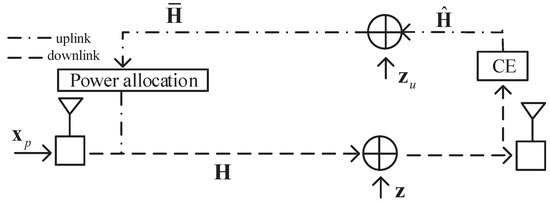
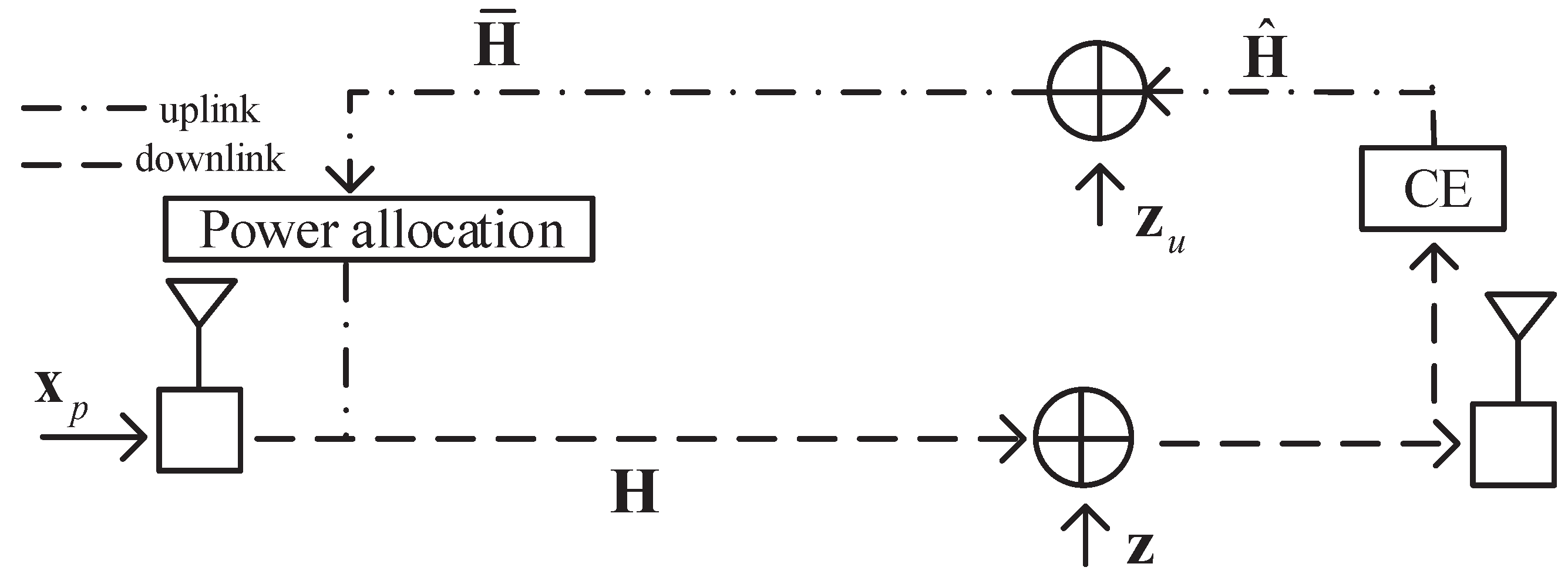
In Figure 1, the CSI based power allocation procedure is described in detail. Based on characteristics of the pilot sequences, the estimated is obtained by CE in the downlink, and then shared with the transmitter via feedback in the uplink. However, except for CE error, there is distortion in the uplink, which ulteriorly deteriorates the accuracy of feedback CSI.
Figure 1.
Traditional CE and feedback model.
The received pilot sequence in the downlink can be modeled as:
Assume the channel has been used for a total of Q symbol transmissions. Among all these transmissions, the initial L symbols are known as training symbols and the observed outputs are thus training outputs. Stacking the training symbols as a matrix, we have , where the pilot sequence is orthogonal.
can be estimated by using the observation of the training sequence in the receiver. Then, a general result is presented to quantify the improvement in estimation accuracy of traditional CE and and the feedback model.
To simplify the EE optimization, we only make a detailed derivation of the CE error in and the CRB bound of the CE scheme. The downlink interference terms corresponding to CE error and channel noise have been approximated to in Section 3.1. We proceed to derive the SNR loss for uplink feedback. The effect of uplink feedback can be modeled as an unfaded AWGN channel [16,17,18].
Proof:
The details of the proof for the achieved uplink channel model can be found in Appendix A. □
3.3. CE Error Bound for
This paper utilizes the theory of CRB reported in [12] to exactly quantify CE error over a training-based CE technique. The lower bound of the CE error is proportional to the number of unconstrained real parameters needed to describe :
For the TCE method, the error bound for estimation of matrix from the reference data is given as:
where is the number of the parameters required to describe the complex channel matrix , and is any estimation of . It is evident that the lower limit of the CE error exists:
3.4. The Uplink Distortion for Feedback
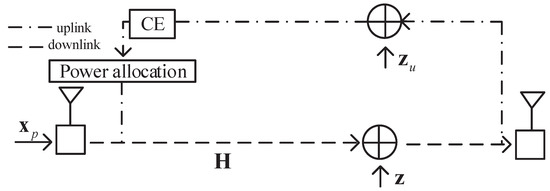
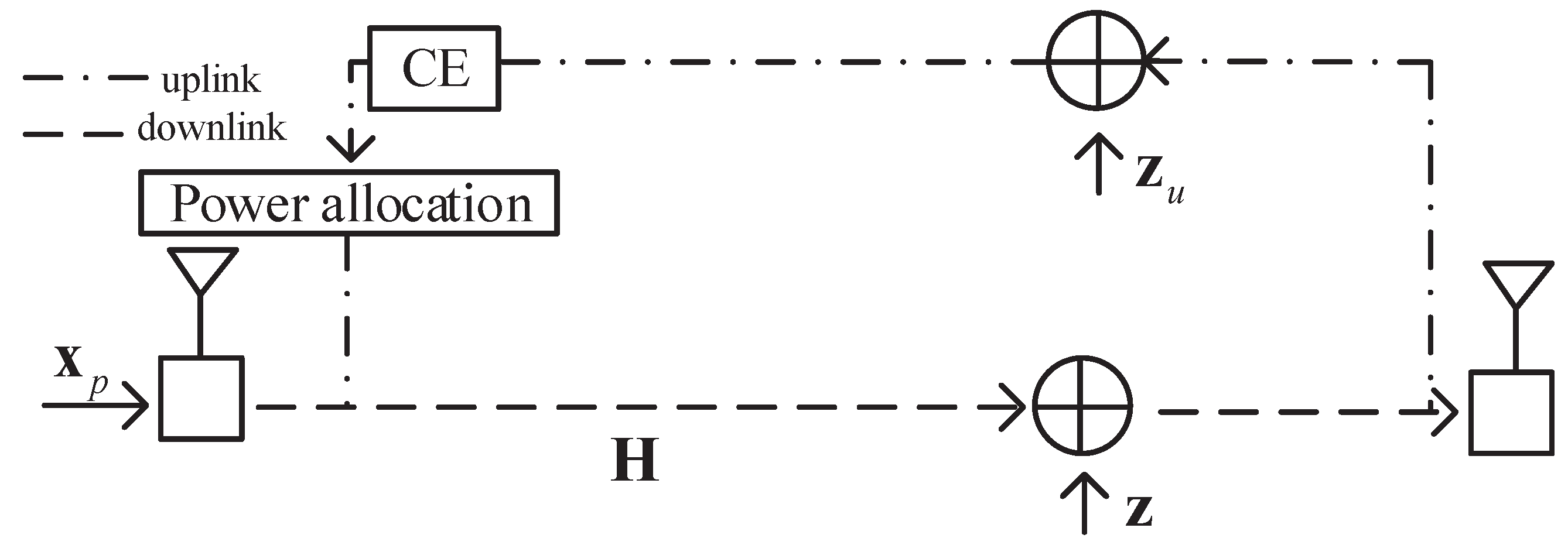
In previous works, instead of idealizing the feedback channel as a fixed-rate, error-free bit pipe, transmission from each receiver to the transmitter over the noisy feedback channel is considered. Assume that the downlink channel is a faded channel and the dedicated uplink channel can be modeled as an unfaded AWGN channel. In this work, we refer to the channel model [16,17,18]. The corresponding schematic is illustrated in Figure 1, where the terminals directly feed the estimated CSI (TCE) or received training pilots (SCE) back to the BS. Note that the terminals use analog linear modulation to transmit the feedback data, where the terminals directly modulate the carrier using the transfer form in [19]. On this basis, the feedback CSI for power allocation can be modeled:
where is the uplink channel matrix and satisfies: .
Based on Equations (11) and (15), the CE error and the uplink distortion in Appendix A can be integrated as overlap-added noise. Rearranging Equation (11) via confirming Equation (15) and overlapping uplink distortion in Equation (16), the total equivalent noise can be given by:
Then, based on Equations (4) and (5), the Signal-to-Interference-plus-Noise Ratio (SINR) on the WF condition experienced at the equivalent noise can be obtained as:
As considered in some previous studies in this field [11], the achieved downlink SINR for the CC algorithm in Equation (5) is closely related to the total equivalent noise. Mathematically stating:
where .
Both the CE error and the uplink distortion will significantly lead to a decrease of CC. Commonly for a certain CSI distortion, the CC performance via power allocation optimizing is even worse than that through ED.
4. The Separated and Bi-Directional Channel Estimation (SCE) and Feedback
To overcome the drawbacks of CSI distortion in TCE and feedback, the design of separated and bi-directional estimation can significantly increase the accuracy of CSI feedback. The corresponding schematics is illustrated in Figure 2. Different from Figure 1, the distorted pilot at the receiver is directly fed back to the transmitter without CE procedure in the downlink.
Figure 2.
The separated CE and feedback model.
Assume that the received pilots in the downlink is modeled in Equation (12). To simplify the process of feedback and efficiently utilize the spatial characteristic construct in Equation (4), the spatially selective noise filtration is implemented via the feedback relative to transmitter observation. More concretely, the feedback of received pilot in the uplink in Appendix A is formulated as:
where , represents the AWGN noise variance both in the uplink and downlink.
The proposed separated CE algorithm is based on the SVD process: . and can be estimated using only received data at both sides by exploiting channel and noise spatial separation. Utilizing CRB, theoretical results show that that the lower bound of CE error is directly proportional to its number of unconstrained parameters. Then, in the BS, the orthogonal procrustes (OP) estimating only the matrix can perform more efficiently than estimating directly from the pilot’s data. The following theorem will derive the approximated estimation of , and .
4.1. The Estimation of and with Spatially Selective Noise Filtration
Making the following assumptions for signal separation in Equation (20):
- are assumed to be spatially and temporally independent with identical source power: :where k and l represent the time instant.
- is spatio-temporally white additive Gaussian noise such that:
- The source signal and additive noise are statistically independent:
Using (21–23), the correlation matrix of can be described:
where denotes the overall noise power both in the downlink and uplink.
Performing EVD on , (24) can be rewritten as:
where and represent the eigenvalues and eigenvectors of the matrix H, and and represent the eigenvalues and eigenvectors of the noise subspace.
Assuming that is known exactly, and can be obtained on both sides via spatially selective noise filtration from only received data:
where can be separated by spatially selective noise filtration. In addition, in the downlink and uplink can be eliminated in this case for power allocation.
4.2. The OP Estimation of
OP Estimation
When can be accurately estimated, let denote the Frobenius matrix norm. Then, the following optimization problem is given to describe the process of applying to estimate :
where . From [20], the optimization problem can be regarded as a generalization of the orthogonal procrustes (OP) problem. The Frobenius matrix norm can be rewritten as:
Hence, the minimization of Equation (30) is equivalent to the maximum of the function . Letting be a SVD, and can be rewritten as:
where . The equation can only be established when . Hence, the OP solution is given by:
As is perfectly known in Section 4.1, the error of the CE is directly determined by the accuracy of . This error is directly caused by the embedded noise in , which is detailed as:
In fact, the actual can be recovered from by performing SVD. is the root cause of the estimation error. Let , the autocorrelation function of can be described as:
The MSE of is given as:
where represents the eigenvalue of the channel autocorrelation matrix, and . For a fixed SNR, the error of is determined by the sum of eigenvalues of the channel autocorrelation matrix. It can be proven that a smaller sum of eigenvalues of the channel autocorrelation matrix offers a more accurate estimation [21].
4.3. CE Error for
When is exactly known by spatially selective noise filtration, in view of Equation (12), the bound for the error of estimation of is:
where is the number of parameters required to describe a complex unitary matrix . It is evident that the lower limit of the CE error exists:
It is cleared that: when , where is the lower limit variance of CE error in a separated CE model.
Based on Equations (11) and (37), the total equivalent noise in SCE model can be given by:
Considering the improved CE and feedback model, CC algorithm in Equation (5) can be rewritten as:
To this end, the upper bound on the achievable CC with method is derived. What’s more, the exact eigenvalues for power allocation can be obtained.
The two competing techniques (TCE and SCE) mentioned in Section 3.4 and Section 4.3 are compared as:
(a) In the following conditions from Equations (21)–(23), and are exactly known. is any unbiased estimate of . Note that is the number of the parameters required to describe the complex channel matrix , while is the number of parameters required to describe a complex unitary matrix . In particular, as the receiving antennas N increases, the number of the parameters needed to estimate increases, while that for remains constant value . This can be expected since, as N increases, the complexity of estimating increases while the estimation of remains the constant value.
(b) Under CRB, the minimum estimation error in a channel matrix is directly proportional to the number of unconstrained real parameters required for description. In fact, obviously, from Equations (14) and (36), one can find that the proposed OP algorithm can achieve about gain over the estimating method in terms of minimum estimation error for the same orthogonal training pilots. The estimation gain significantly increases as the number of receive antennas increases.
(c) When the statistical characteristics of CE error is achieved in CRB boundary conditions, the total equivalent noise for downlink is given in Equations (17) and (38) for TCE and SCE, respectively. It is clear that:
(d) The separated and bi-directional channel estimation is a distributed and parallel computing strategy, which has great advantages in computational complexity and delay, especially for the receiver.
5. The Maximum EE in Separated CE and a Feedback Model
The power consumption will increase when the number of transmit antennas increases in practical systems. Thus, the optimal CC obtained by using the ideal threshold value in WF is overoptimistic, and the corresponding transmit antennas is more than the accurate value. To overcome this shortcoming, we consider the EE optimization problem with the optimal active antenna subset in the reconstructed MIMO systems. Specifically, the number of transmit antennas at the transmitter has a significant impact on the EE. To increase the CC, more transmit antennas are required to be activated to exploit a higher diversity gain. However, allowing more antennas to be active will increase the circuit power consumption at the transmitter [22]. To constrain the circuit power consumption, the achievable EE can be established as:
where denotes the total power consumption which contains not only the power consumption at the transmitter, but also a transmission independent power representing the power consumed by circuit dissipation. can be written as:
where donates the power consumption at the transmitter, is the power amplifier efficiency, and is the total circuit power consumption. , where denotes the activated RF chains set of the transmitter, and , denotes the size of set A. , , , and are the power consumption of digital to analog converter, filter, mixer, and the static power, respectively [13].
To analyze the maximal EE with respect to the parameters of a massive MIMO system, the following optimization problem is formulated. By substituting Equation (42) into Equation (41), the optimization problem can be given as:
where is decreasing in order. r is the number of available RF chains and . represents the pilot overhead (PO); is related to the number of pilots based on Equation (13). . denotes the circuit power consumption proportional to the number of the active transmitted antennas. denotes the static power which is independent of both P and , including the power consumption of the baseband processing, etc.
As increases, the sum of CC increases, but the gains grow slowly. When the CC gain is small for a large , the circuit power consumption dominates EE. There indeed exists a convex optimal to achieve the maximum energy efficiency.
The influence of transmit power on the objective function is considered. Equation (43) can be rewritten as:
If the objective function is a fractional programming problem and the objective function is pseudo-concave, then any stagnation point is a global maximum point. The following derivation proves that the objective function is pseudo-concave with respect to the transmit power.
Take the first derivative of :
Take the second derivative of :
where , is a concave function of the transmit power, and is a linear function of the transmit power. Therefore, the objective function is pseudo-concave and there exists a unique transmit power to achieve the maximum energy efficiency.
Taking maximum as the objective function, optimization is used to achieve the global optimized parameters in this work. Specifically, for the operational parameters , , , is as a substitute to the global optimization problem. Then, the quasi-Newton global optimization method is used to reconstruct its parameters to improve search performance and computation speed, as
where is assigned to . The Quasi-Newton method defines as the next search direction of in practical operation, where the gradient of a function is denoted as and the Hessian matrix is denoted as . The Quasi-Newton method approximates the objective function Hessian inverse using rank-one (SR1) Algorithm in [23].
6. Simulation Results
In this section, numerical simulations are conducted to evaluate the performance of the proposed CE method and EE optimization algorithm. We consider a FDD massive MIMO system with an equal number of transmit and receive antennas. Results are obtained over uncorrelated Rayleigh fading channels in the downlink. The training pilot is extracted from a Gaussian distribution with zero mean and variance equal to at the transmitter. For simplicity, the variance of additive white Gaussian noise is assumed to be fixed with different SNR cases. The main parameters for the simulation are provided in Table 1.
Table 1.
Simulation parameters.
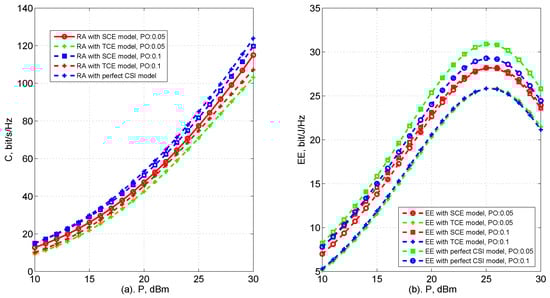
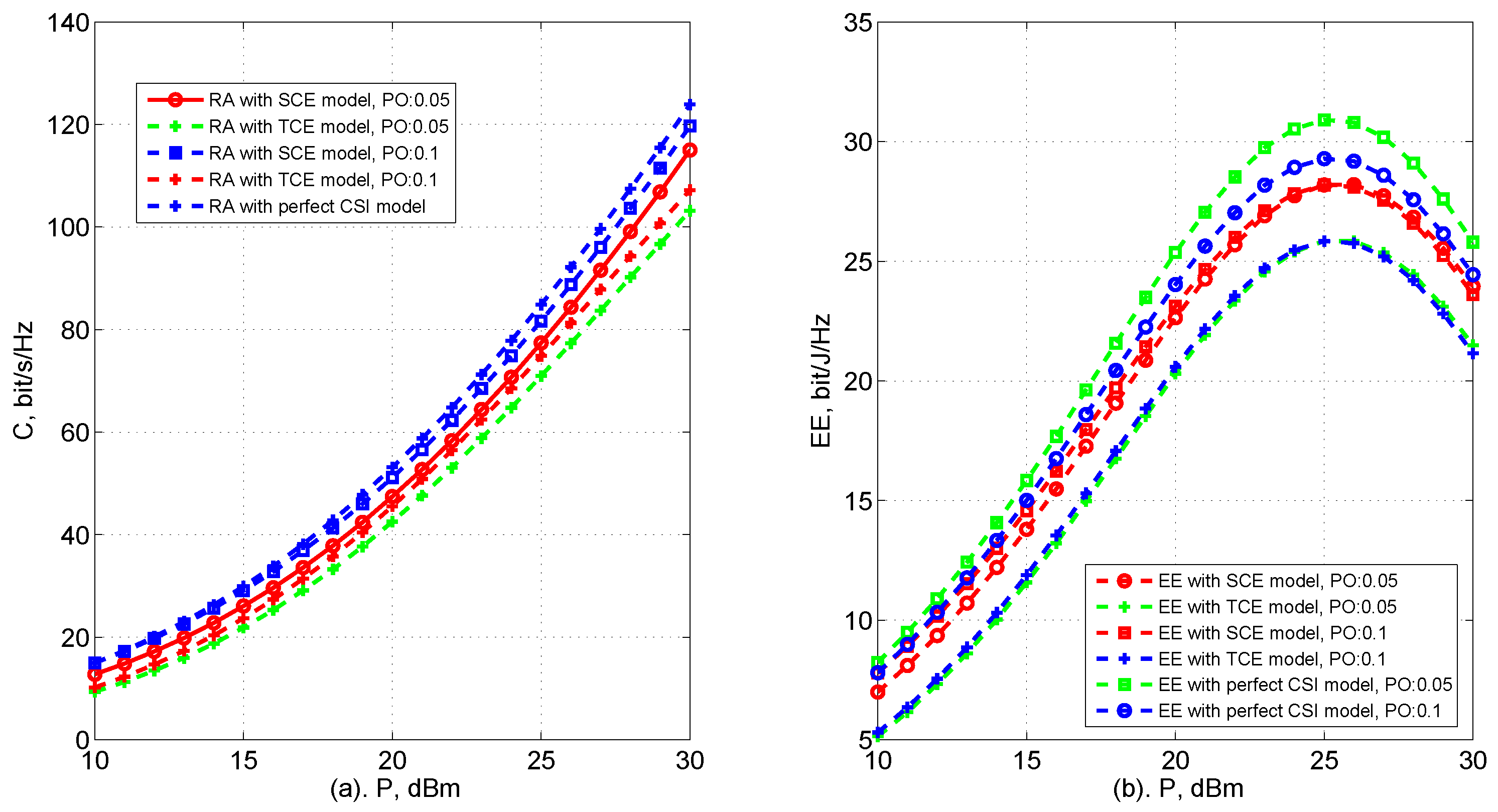
In Figure 3, the efficacy and behavior of channel capacity C and EE in the massive MIMO system are demonstrated. In Figure 3a, the C of resource allocation (RA) under the TCE model in [9], proposed SCE model, and the perfect CSI model are presented, respectively. The proposed SCE model and TCE model under different are also compared. From Figure 3a, the C obtained by the proposed SCE model is higher than by the TCE model over the whole range of values shown. In the meantime, when PO , for C = 60 bit/s/Hz, the proposed SCE scheme surpasses TCE and perfect CSI scheme by 2.2 dB and –0.2 dB, respectively. The reasons are as follows: the proposed SCE scheme can directly eliminate the CSI distortion problem to source allocation and obtain the gain of CE in (40). As transmit power increases, the C increases significantly, but the gains grow slowly. There is a smooth layer of C with respect to P; hence, it is more meaningful to measure the effectiveness by EE.
Figure 3.
Comparison of the RA under the TCE model, SCE model, and perfect CSI model: (a) channel capacity versus different transmit power; (b) energy efficiency versus different transmit power.
In Figure 3b, the EE of RA under TCE, proposed SCE, and perfect CSI model are presented, respectively. As P increases, the EE performance first increases and then decreases after reaching the maximum. It is obvious that the optimizing EE is a convex optimization problem and exiting the maximum EE boundary in valid coverage of P. By comparing the maximum boundary obtained by the proposed SCE scheme and TCE model when , the proposed SCE scheme can achieve the EE gain of 10%, and the optimal value of P obtained by the proposed SCE scheme is in good agreement with the value obtained by the TCE scheme.
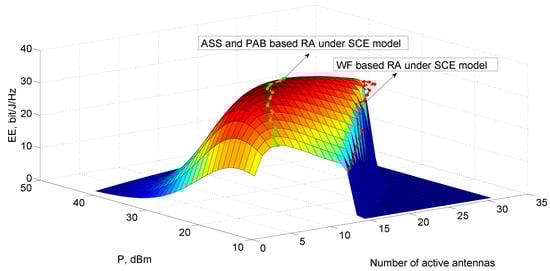
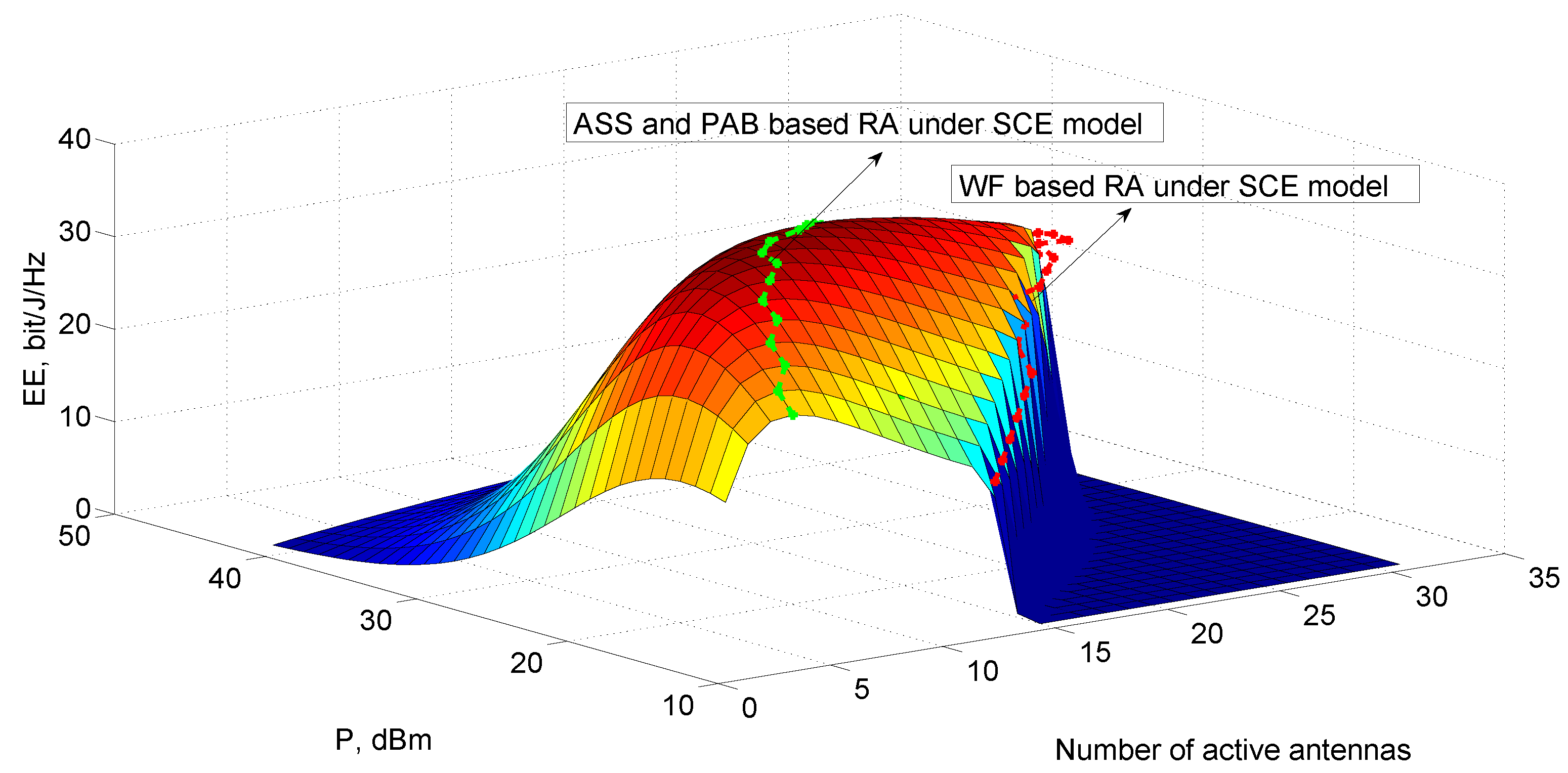
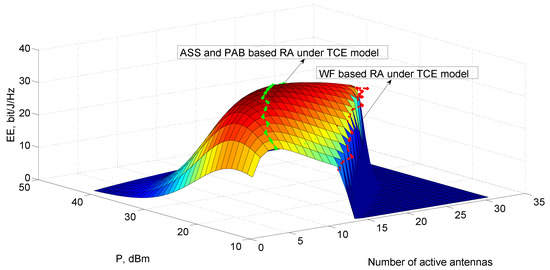
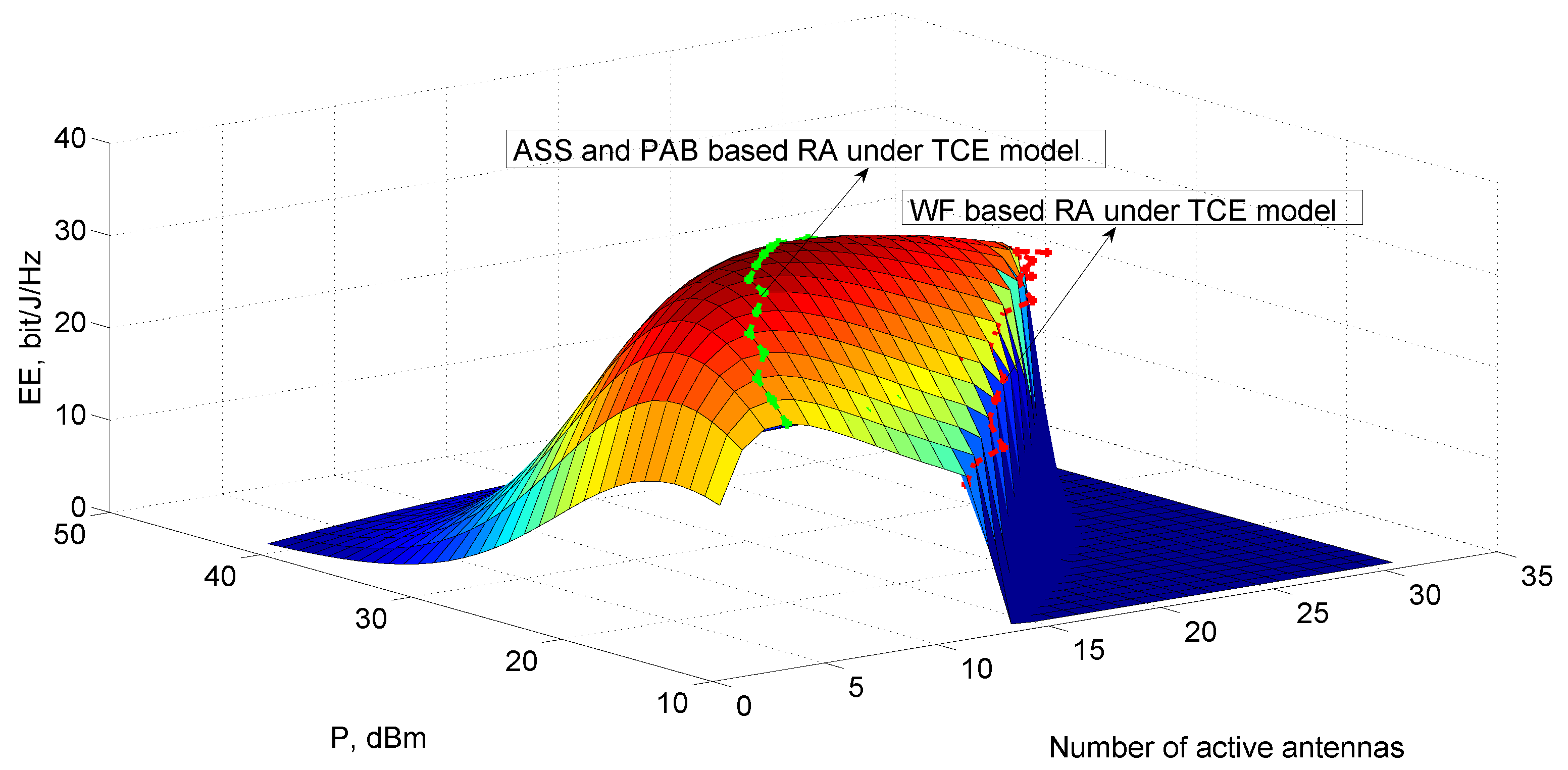
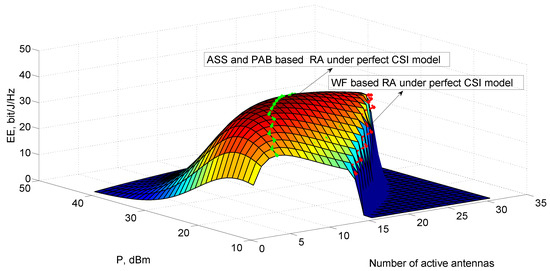
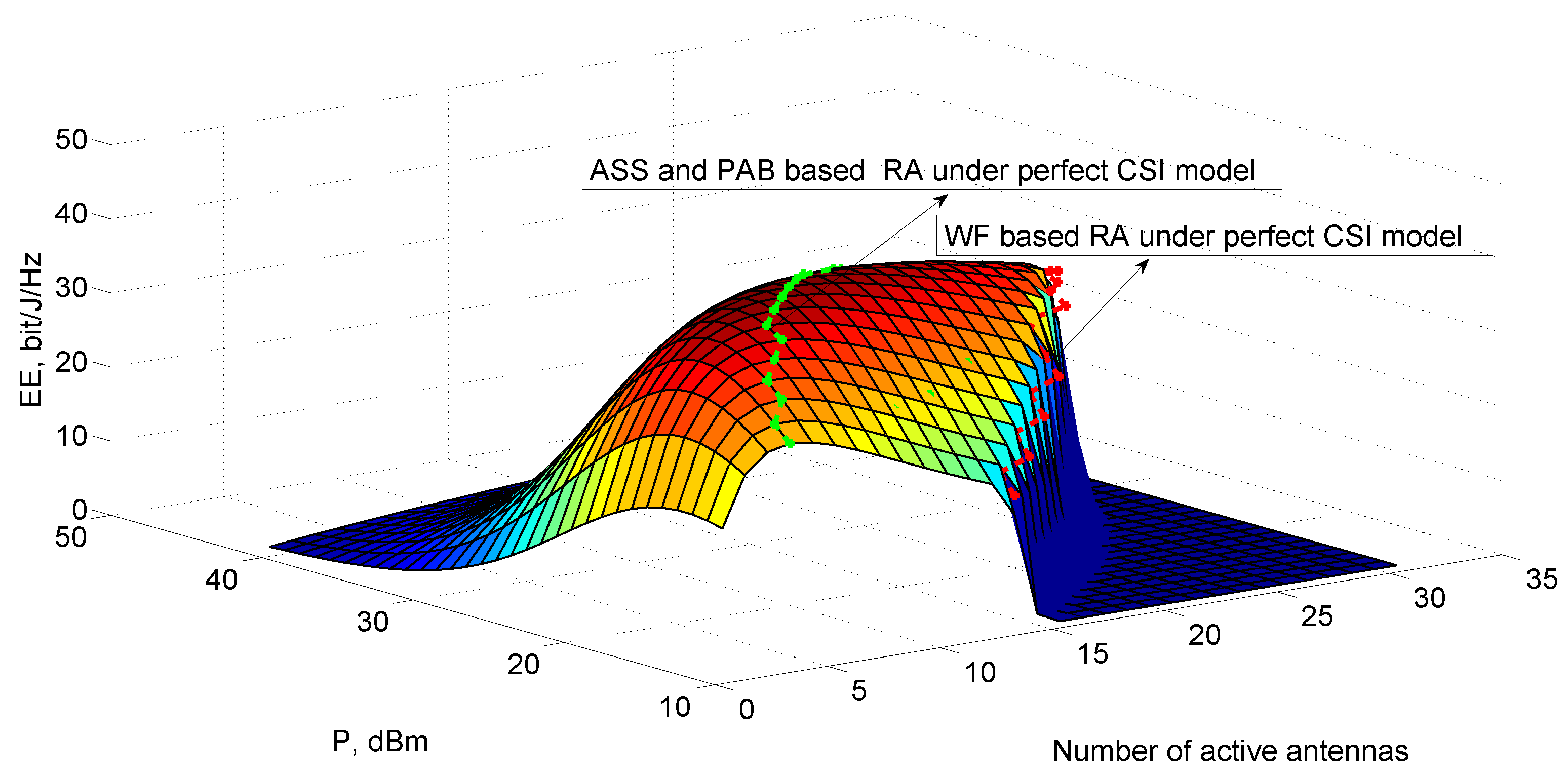
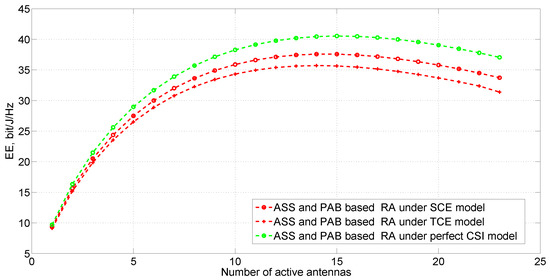
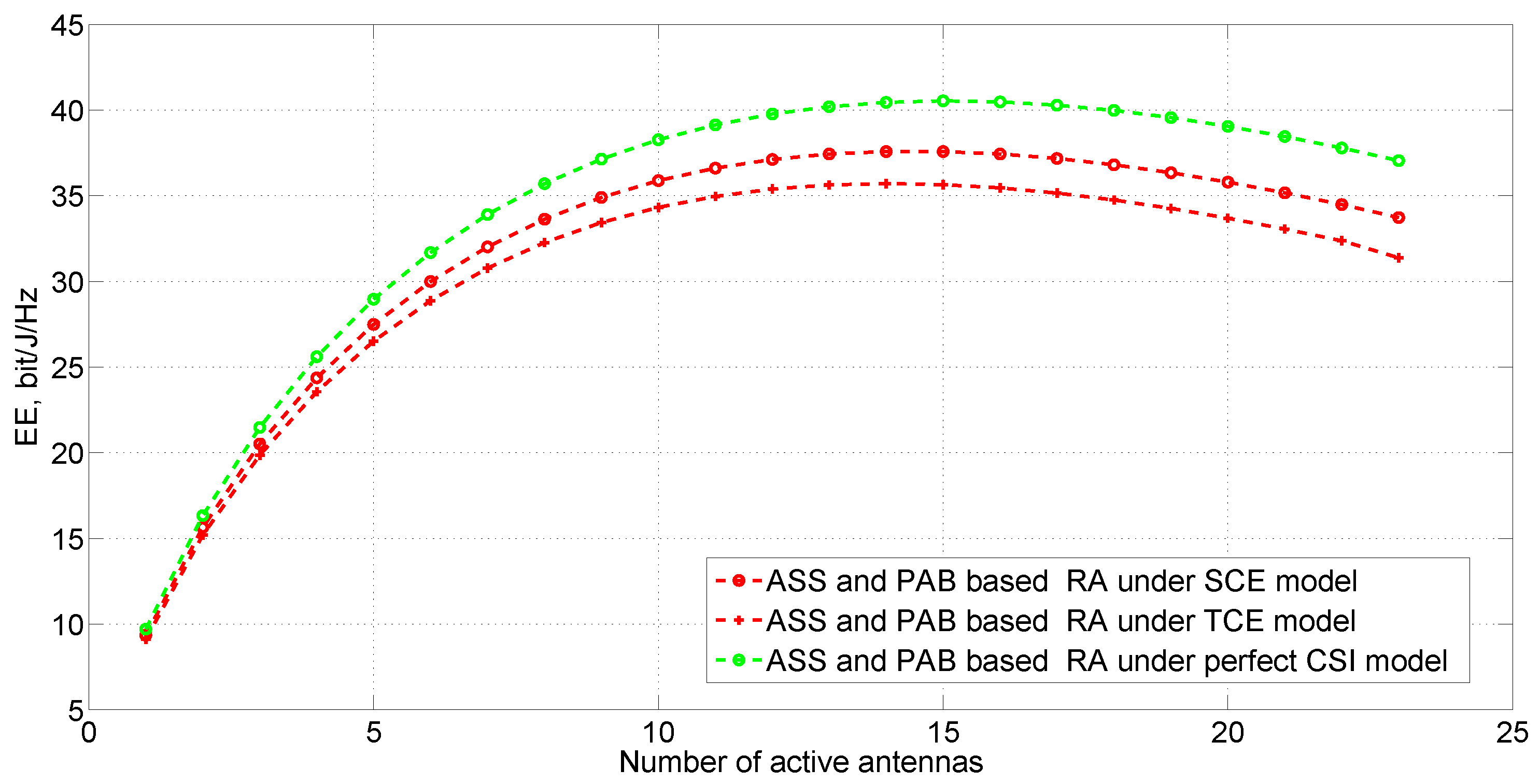
The WF threshold value in Equation (39) can be set to optimize the C, but the active antennas are redundancy and the EE decreases significantly. In Figure 4, the efficacy and behavior of the EE in Equation (41) based on antenna subset selection (AAS) and power allocation boundary (PAB) compared with WF in the massive MIMO system are demonstrated. The maximum EE can be obtained by using the Quasi-Newton iteration method. It is observed that the EE optimization is a convex optimization problem and the maximum EE boundary is existing under the multidimensional rules condition. For a clearer comparison of the maximum EE of the proposed ASS and PAB based RA, WF based RA under the SCE model, the green curve and red curve are indicated, respectively, when . It is clear that the proposed scheme can outperform the WF based RA scheme, which shows the efficacy of the adjustive objective function. When the C gain is small, the RF power consumption dominates EE, which can be chosen adaptively to guarantee EE. It can be clearly seen that the maximum EE boundary is different for different P, and proper P can improve the EE effectively. Figure 5 and Figure 6 show the proposed scheme and WF scheme under the TCE model and perfect CSI model with the same parameters. For clarity from Figure 4 to Figure 6, when P are adaptively optimized, the EE performance by varying are presented in Figure 7. The EE performance first increases and then decreases after reaching the maximum as the number of antennas increases. For example, when the maximum EE is considered, the proposed scheme under the SCE model can achieve 5% EE gains compared to the TCE model, and 6% less than EE gains under the perfect CSI model.
Figure 4.
Energy efficiency with proposed ASS and PAB based RA under the SCE model for different number of activated antennas and transmit power.
Figure 5.
Energy efficiency with proposed ASS and PAB based RA under the TCE model for different number of activated antennas and transmit power.
Figure 6.
Energy efficiency with proposed ASS and PAB based RA under the perfect CSI model for different number of activated antennas and transmit power.
Figure 7.
Energy efficiency with proposed SCE, TCE, and perfect CSI model for different number of activated antennas.
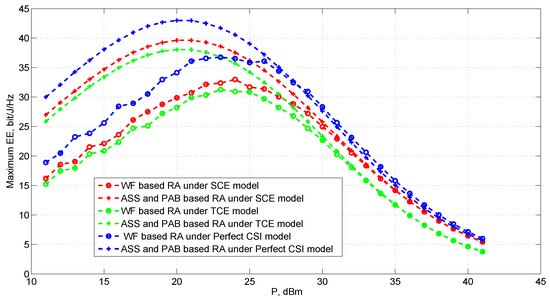
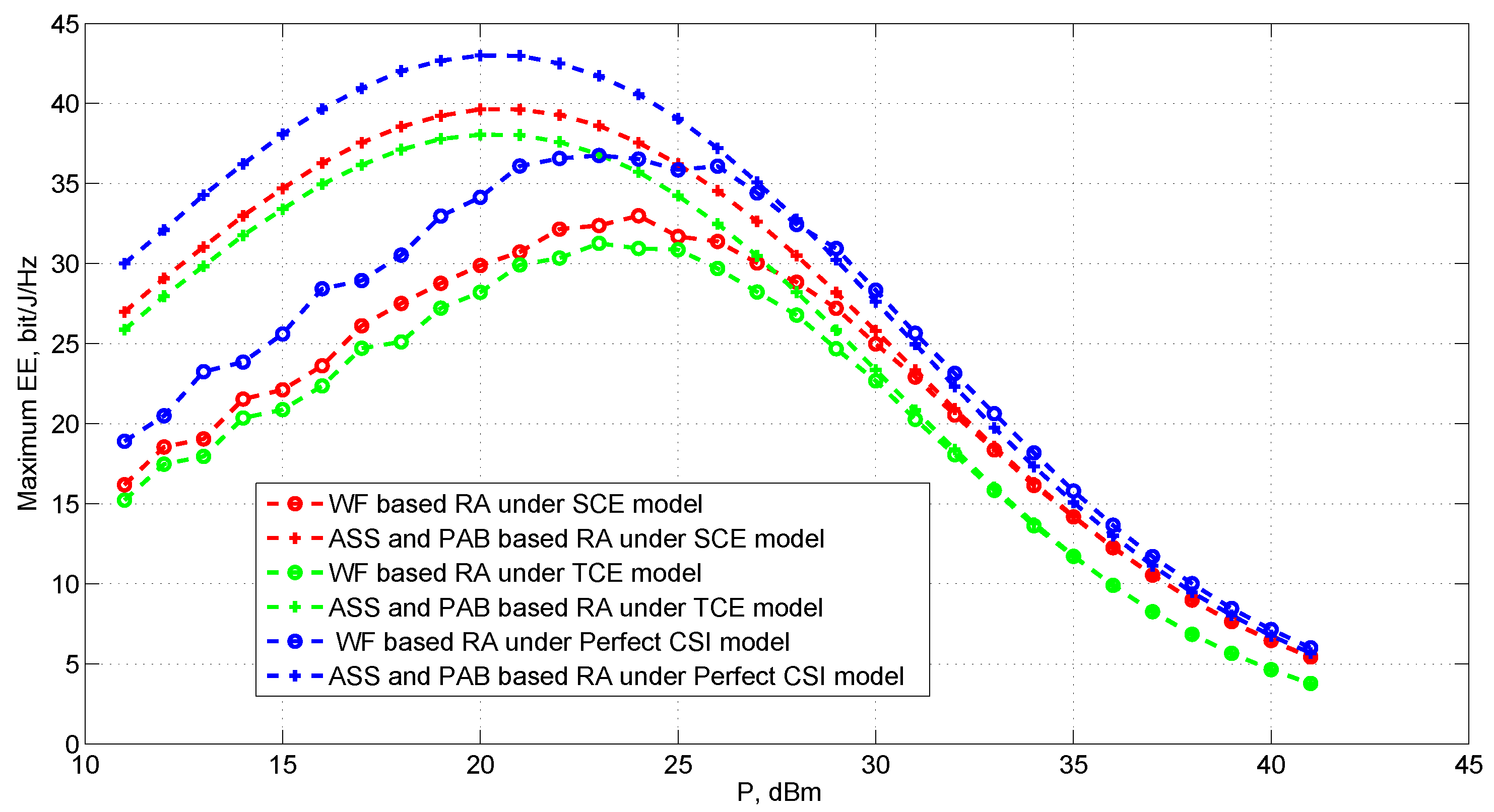
In Figure 8, the maximum EE of the proposed ASS and PAB based RA, WF based RA under TCE, proposed SCE, and the perfect CSI model in the massive MIMO system are demonstrated, respectively. When are adaptively optimized, the EE performance by varying P is presented. It is observed that the maximum EE under the SCE model is closest to the ideal. From Figure 8, the maximum EE obtained through the proposed scheme surpasses the WF scheme under the SCE model by 23%. The simulation results show that the maximum EE obtained through the proposed RA strategy under the SCE model surpasses the strategy 5% when TCE is chosen and 6% less than the perfect CSI condition.
Figure 8.
The maximum energy efficiency comparison for different schemes and models.
7. Conclusions
In this paper, the problem of resource allocation in two-way links Massive MIMO Systems with imperfect CSI is considered. The design of separated and bi-directional estimation can significantly increase the accuracy of CSI feedback and enhance the system capacity margin. Then, in order to maximize EE of a massive MIMO system by optimizing the optimal transmit power allocation, the pilot assignment and the number of available antennas have been investigated. Owing to the formulation of resource allocation in EE, the maximum EE obtained through the proposed ASS and PAB based RA scheme surpasses the WF based RA scheme under the SCE model by 23%. The simulation results show that the maximum EE obtained through the proposed RA strategy under the SCE model surpasses the strategy 5% when the TCE model is chosen and 6% less than the perfect CSI condition.
Author Contributions
F.H. and K.W. conceived and designed the experiments; K.W. performed the experiments; F.H. and S.L. analyzed the data; L.J. contributed the laboratory equipment; K.W. and F.H. wrote the paper. All authors have read and agreed to the published version of the manuscript.
Funding
This work was supported by “the Fundamental Research Funds for the Central Universities”.
Acknowledgments
The authors would like to thank the Editor and the anonymous reviewers for their valuable comments and suggestions.
Conflicts of Interest
The authors declare no conflict of interest.
Abbreviations
The following abbreviations are used in this manuscript:
| MIMO | Multiple Input Multiple Output |
| BS | Base Station |
| EE | Energy Efficiency |
| CC | Channel Capacity |
| CSI | Channel State Information |
| CE | Channel Estimation |
| FDD | Frequency Division Duplexing |
| TDD | Time Division Duplexing |
| WF | Water Filling |
| TCE | Traditional Channel Estimation |
| RA | Resource Allocation |
| SCE | Separated Channel Estimation |
| SVD | Singular Value Decomposition |
| EVD | Eigenvalue Decomposition |
| SNR | Signal-to-Noise Ratio |
| SINR | Signal-to-Interference-plus-Noise Ratio |
| MSE | Mean Square Error |
| MMSE | Minimum Mean Square Error |
| ZF | Zero-forcing |
| OP | Orthogonal Procrustes |
| CRB | Cramer–Rao Bound |
| AAS | subset selection selection |
| PAB | power allocation boundary |
Appendix A
The feasibility of AWGN model in uplink is described as follows:
Primarily, the transmitter can estimate the uplink CSI as , based on the observation of uplink pilots. In addition, the CE is considered: . As described above: , , and can be assumed as uncorrelated identically distributed (i.i.d.) complex white Gaussian with random variables.
The receiving signal in the uplink (BS) can be written as:
where represents the AWGN noise in the uplink.
Using Equations (8)–(10) in Section 3.1, the equivalent observation can be described as complex white Gaussian noise. Consider that , , and are mutually independent and steady-state distribution in a certain time. In particular, will not be adopted in EE optimization. While the equalization at the BS is designed by applying the well-known minimum mean squared error (MMSE) or zero-forcing (ZF) criterion to cope with the interference in the uplink, the effect of additive noise and the CE error can be approximated to AWGN:
where is the uplink channel matric and satisfies: .
Considering that perfectly digital modulation and error-correcting mechanisms are being utilized in the uplink feedback, the AWGN will be approached to 0. Assume that a flat channel constrains the time delay, when digital modulation and error-correcting mechanisms are utilized. For the assumption without error-correcting mechanisms, can be fully exploited.
References
- De Figueiredo, F.A.P.; Dias, C.F.; Cardoso, F.A.C.M.; Fraidenraich, G. On the Distribution of an Effective Channel Estimator for Multi-Cell Massive MIMO. IEEE Access 2019, 7, 114508–114519. [Google Scholar] [CrossRef] [Scilit]
- Dong, G.; Zhang, H.; Jin, S.; Yuan, D. Energy-Efficiency-Oriented Joint User Association and Power Allocation in Distributed Massive MIMO Systems. IEEE Trans. Veh. Technol. 2019, 68, 5794–5808. [Google Scholar] [CrossRef] [Scilit]
- Liu, T.; Tong, J.; Guo, Q.; Xi, J.; Yu, Y.; Xiao, Z. Energy Efficiency of Massive MIMO Systems with Low-Resolution ADCs and Successive Interference Cancellation. IEEE Trans. Wirel. Commun. 2019, 18, 3987–4002. [Google Scholar] [CrossRef] [Scilit]
- Huang, Y.; He, S.; Wang, J. Spectral and Energy Efficiency Tradeoff for Massive MIMO. IEEE Trans. Veh. Technol. 2018, 67, 6991–7002. [Google Scholar] [CrossRef] [Scilit]
- Liu, Z.; Li, J.; Sun, D.; Marzetta, T.L. Circuit Power Consumption-Unaware Energy Efficiency Optimization For Massive MIMO Systems. IEEE Wirel. Commun. Lett. 2017, 6, 370–373. [Google Scholar] [CrossRef] [Scilit]
- Bjornson, E.; Sanguinetti, L.; Hoydis, J. Joint spectral efficiency and energy efficiency in ffr based wireless heterogeneous networks. IEEE Trans. Veh. Technol. 2018, 67, 8154–8168. [Google Scholar]
- Khan, T.A.; Yazdan, A.; Heath, R.W. Optimization of Power Transfer Efficiency and Energy Efficiency for Wireless-Powered Systems with Massive MIMO. IEEE Trans. Wirel. Commun. 2018, 17, 7159–7172. [Google Scholar] [CrossRef] [Scilit]
- Lu, L.; Li, G.Y.; Swindlehurst, A.L.; Zhang, R. An overview of massive MIMO: Benefits and challenges. IEEE J. Sel. Top. Sign. Proces. 2014, 8, 742–758. [Google Scholar] [CrossRef] [Scilit]
- Choi, J.; Love, D.J.; Bidigare, P. Downlink Training Techniques for FDD Massive MIMO Systems: Open-Loop and Closed-Loop Training with Memory. IEEE J. Sel. Top. Sign. Proces. 2014, 8, 802–814. [Google Scholar] [CrossRef] [Scilit]
- Gao, Z.; Dai, L.; Wang, Z.; Chen, S. Spatially Common Sparsity Based Adaptive Channel Estimation and Feedback for FDD Massive MIMO. IEEE Trans. Signal Process. 2015, 63, 6169–6183. [Google Scholar] [CrossRef] [Scilit]
- Varma, V.S.; Lasaulce, S.; Debbah, M.; Elayoubi, S.E. An Energy-Efficient Framework for the Analysis of MIMO Slow Fading Channels. IEEE Trans. Signal Process. 2013, 61, 2647–2659. [Google Scholar] [CrossRef] [Scilit]
- Jagannatham, A.K.; Rao, B.D. Whitening-rotation-based semi-blind MIMO channel estimation. IEEE Trans. Signal Process. 2006, 54, 861–869. [Google Scholar] [CrossRef] [Scilit]
- Eskandari, M.; Doost-Hoseini, A.M.; Jung, J.; Lee, I. Antenna Selection and Power Allocation for Energy Efficient MIMO Systems. J. Commun. Netw. 2018, 20, 546–553. [Google Scholar] [CrossRef]
- Kim, Y.; Kang, M.; Varshney, L.R.; Shanbhag, N.R. Generalized Water-Filling for Source-Aware Energy-Efficient SRAMs. IEEE Trans. Commun. 2018, 66, 4826–4841. [Google Scholar] [CrossRef] [Scilit]
- He, P.; Zhao, L. Solving A Class of Sum Power Minimization Problems Using Generalized Water-Filling. IEEE Trans. Wirel. Commun. 2015, 14, 6792–6804. [Google Scholar] [CrossRef] [Scilit]
- Shirani-Mehr, H.; Caire, G. Channel State Feedback Schemes for Multiuser MIMO-OFDM Downlink. IEEE Trans. Commun. 2009, 57, 2713–2723. [Google Scholar] [CrossRef] [Scilit]
- Caire, G.; Jindal, N.; Kobayashi, M.; Ravindran, N. Multiuser MIMO Achievable Rates With Downlink Training and Channel State Feedback. IEEE Trans. Inf. Theory 2010, 56, 2845–2866. [Google Scholar] [CrossRef] [Scilit]
- Shen, W.; Dai, L.; Shi, Y.; Shim, B.; Wang, Z. Joint Channel Training and Feedback for FDD Massive MIMO Systems. IEEE Trans. Veh. Technol. 2016, 65, 8762–8767. [Google Scholar] [CrossRef] [Scilit]
- Marzetta, T.L.; Hochwald, B.M. Fast transfer of channel state information in wireless systems. IEEE Trans. Signal Process. 2006, 54, 1268–1278. [Google Scholar] [CrossRef] [Scilit]
- Tai, Y.; Yang, J.; Zhang, Y.; Luo, L.; Qian, J.; Chen, Y. Face recognition with pose variations and misalignment via orthogonal procrustes regression. IEEE Trans. Image Process. 2016, 25, 2673–2683. [Google Scholar] [CrossRef] [Scilit]
- Hu, F.; Jin, L. Orthogonal procrustes based semi-blind mimo channel estimation under space-time block code transmissions. J. China Univ. Posts Telecommun. 2011, 18, 20–24. [Google Scholar] [CrossRef] [Scilit]
- Dong, Y.; Huang, Y.; Qiu, L. Energy-efficient sparse beamforming for multiuser mimo systems with nonideal power amplifiers. IEEE Trans. Veh. Technol. 2017, 66, 134–145. [Google Scholar]
- Chen, Q.; Song, Y.; Hu, F.; Cai, C. A novel method for adjusting Digital predistortion with Modulation Error Ratio in OFDM System. In Proceedings of the 2016 9th International Congress on Image and Signal Processing, BioMedical Engineering and Informatics (CISP-BMEI), Datong, China, 15–17 October 2016. [Google Scholar]

© 2020 by the authors. Licensee MDPI, Basel, Switzerland. This article is an open access article distributed under the terms and conditions of the Creative Commons Attribution (CC BY) license (http://creativecommons.org/licenses/by/4.0/).