


Abstract
Due to the negative resistance effect of power electronic devices, power systems with a high proportion of renewable energy face a significant resonance risk. To address this, this paper proposes a resonance-suppression strategy for high-penetration renewable energy systems based on an active amplitude and phase corrector (APC). Firstly, by considering its internal dynamics and complete control loops, the impedance model of the APC is derived. Next, the similarities and differences between resonance stability and harmonic resonance are analyzed using the s-domain and frequency-domain admittance matrices, concluding that resonance suppression for low-damping s-domain modes can be handled in the frequency domain. Then, a supplementary APC control strategy in the abc-frame is proposed, which improves impedance magnitude at specific frequencies while keeping the phase almost unchanged. Finally, the proposed strategy is validated through case studies on an offshore wind power system in Zhejiang Province.
1. Introduction
To meet the “dual carbon” targets, renewable energy development has experienced rapid growth in recent years [1]. Renewable generation units, such as wind turbines (WTs) and photovoltaic systems, are typically interfaced with the grid via power electronic converters. Unlike traditional synchronous generators, these converters can exhibit negative resistance characteristics within certain frequency ranges due to the inherent dynamics introduced by their sophisticated control schemes [2]. In power systems with high renewable penetration, the collective negative resistance of multiple converters may induce wideband resonances, highlighting the need for effective resonance suppression strategies to mitigate associated risks.
Resonance stability refers to the damping characteristics of free oscillation components at natural resonance frequencies during electromagnetic transient processes [3]. In recent years, the impedance-based analysis has become the predominant approach for resonance stability analysis [4,5,6]. This method employs modular impedance models to represent components with complex dynamic behaviors, allowing stability to be assessed by examining impedance interactions according to certain criteria. Its practical advantage of direct measurability has facilitated widespread adoption in both research and engineering practice. Based on the impedance analysis framework, system impedance can be actively reshaped by adding amplitude and phase correctors (APCs) to enhance resonance stability. Due to their high adaptability, this paper focuses on cascaded active APCs based on multilevel conversion technology.
Impedance models are typically established in either the dq-domain or the sequence domain [7]. The dq-domain approach converts periodic time-varying signals into DC quantities, enabling small-signal modeling around DC operating points. Since converter control is also implemented in the dq-domain, this method naturally aligns with controller equations and has been widely adopted [8]. However, it faces challenges for converters with multi-harmonic characteristics, such as modular multilevel converters (MMCs), because harmonic components beyond the fundamental remain time-varying after dq-transformation, requiring multiple rotating reference frames and substantially increasing complexity. In contrast, sequence-domain modeling, initiated with the harmonic linearization method in [9] for two-level voltage source converters, represents time-varying signals through constant Fourier coefficients Sequence impedance models have since been developed for a variety of converters, including photovoltaic inverters, WT systems, and high-voltage DC transmission converters [10]. To handle converters with multi-harmonic characteristics, advanced impedance modeling techniques based on multi-harmonic linearization and harmonic state-space (HSS) methods have been developed, effectively capturing high-order harmonic interactions MMC impedance models using these approaches were reported in [11,12,13], with [13] further incorporating sequence extraction and frequency-shift matrices for a more compact formulation. Despite these advances, impedance modeling of cascaded active APCs employing multilevel conversion technology remains underexplored, with only limited studies available [14], highlighting the need for further investigation.
Active APCs typically achieve impedance reshaping through highly flexible supplementary control strategies, which can be categorized into phase compensation and virtual impedance control. Phase compensation control aims to enhance the phase of the equipment output impedance to mitigate negative resistance. For example, Ref. [15] proposed a current-loop-based phase compensation approach to improves the phase margin, while Ref. [16] selectively compensated the impedance phase within specific frequency ranges to provide directional damping. Ref. [17] incorporated an adaptive resonant integral filter at the phase-locked loop (PLL) front-end to reshape the PLL impedance, extending the feasible phase range toward lower frequency bands. Ref. [18] augmented the feedforward path with compensation control to suppress high-frequency negative resistance, and Ref. [19] analyzed control loop delays in the Luxi project, introducing phase compensation to enhance system dynamics Ref. [20] further achieved active damping of LCL resonance under wide grid impedance variations by employing capacitor current feedforward, extending the passive stability region up to the Nyquist frequency. Virtual impedance control, also known as active damping control, provides damping compensation through virtual impedance with clearer physical interpretation. This approach maps physical impedance circuits into the control loop to approximate equivalent damping branches. For instance, in inductor–capacitor–inductor (LCL)-filtered grid-connected inverters, impedance reshaping can be realized via capacitor current feedforward, capacitor voltage feedforward, or inductor current feedforward [21,22]. To mitigate grid influence, Ref. [23] proposed full-voltage feedforward compensation, effectively reducing inverter output impedance. Refs. [24,25] designed virtual impedances directly based on the target converter output characteristics, enabling effective damping with improved robustness. Ref. [26] investigated a converter connected to a weak AC grid via a series-compensated line, examining the combined effects of PLL, active damping, and virtual conductance on voltage stability, and provided design guidelines to enhance stability and suppress oscillations. In summary, these supplementary control strategies are predominantly implemented in the dq-frame, requiring coordinate transformations for signal transmission, whereas research on inherently more reliable abc-frame implementations remains limited.
To address the above issues, this paper investigates the modeling of APC and its supplementary control, with the specific contributions summarized as follows:
- (1)
- A comprehensive APC impedance model is developed in the HSS framework, capturing both the internal dynamics and the full control loops, with the power stage and control stage linearized separately and then integrated.
- (2)
- The mechanisms of resonance instability and harmonic amplification are clarified, and the relationship between s-domain and frequency-domain behaviors is established to enable practical frequency-domain analysis.
- (3)
- An abc-frame supplementary control is proposed, in which the output current is fed forward through a proportional gain and band-pass filter to the valve-side reference, avoiding coordinate transformation and frequency shifts while allowing reliable tuning of the characteristic frequency.
The rest of this paper includes four parts. In Section 2, the impedance model of the APC is derived. In Section 3, the similarities and differences between resonance stability and harmonic resonance are analyzed using the s-domain and frequency-domain admittance matrices, leading to the proposal of a supplementary APC control strategy in the abc-frame. In Section 4, the case studies of an offshore wind power system (OWPS) in Zhejiang Province are presented to demonstrate the effectiveness of the proposed strategy. The conclusions are summarized in Section 5.
2. APC Impedance Modeling
2.1. Linearized HSS Model of the APC Main Circuit
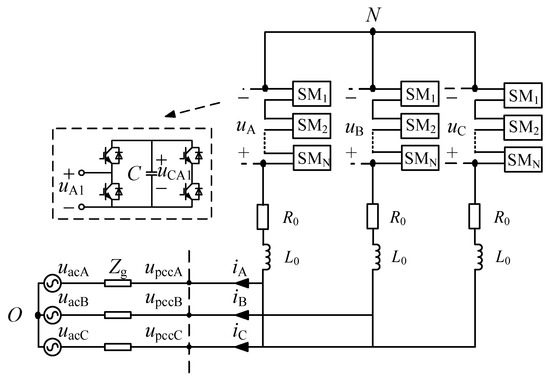
The main circuit topology of the chain-cascaded APC is shown in Figure 1.
Figure 1.
Main circuit topology of the chain-cascaded APC.
According to Figure 1, for any phase j (j = A, B, C) of the APC, the dynamic characteristics of its main circuit can be described by the following set of equations (to simplify the expression, the subscript j is omitted below):
where upcc is the voltage at the point of common coupling (PCC); i is the bridge arm current; uNO is the neutral point potential difference; u is the output voltage of the cascaded submodules; uc is the average capacitor voltage of the submodules; m is the average switching function of the submodules; N is the number of submodules per bridge arm; R0, L0, and C are the equivalent resistance of the bridge arm, equivalent inductance of the bridge arm, and submodule capacitance, respectively. According to (1), during normal operation, the three phases of the APC are coupled through uNO. To reduce the number and complexity of equations during the modeling process, it is necessary to eliminate uNO. The role of uNO is to cancel out the zero-sequence components in upcc and u, ensuring that the output current of the APC contains no zero-sequence components. Therefore, when the zero-sequence components of upcc and u are removed from the first equation of (1), uNO can be eliminated while maintaining the balance of the equation, i.e.,:
where the superscripts ± denote the positive and negative sequence components of the corresponding physical quantities. Substituting the second equation of (2) into the first equation and linearizing it yields
Further expressed in the HSS form
where S is the matrix representing the differential operation in the HSS formulation, as shown in (5).
Due to the multi-frequency coupling within the APC, when a disturbance component with frequency fp appears at the APC port, it couples with the APC’s internal frequency components, giving rise to multiple disturbance components. To facilitate analysis and analytical modeling, the frequency–phase sequence relationships inside the APC under disturbance are summarized in Table 1.
Table 1.
Frequency–phase sequence relationships inside the APC under disturbance.
Therefore, when a positive-sequence disturbance is injected at the APC port, the following set of sequence component extraction matrices can be considered to obtain the sequence components of a physical quantity in the HSS:
where the superscript + indicates that the injected disturbance is of positive sequence, while the subscripts +, −, and 0 denote the sequence components to be extracted (positive, negative, and zero sequence, respectively). Similarly, when a negative-sequence disturbance is injected at the APC port, the following set of sequence component extraction matrices can be considered to obtain the sequence components of a physical quantity in the HSS:
where the superscript − indicates that the injected disturbance is of negative sequence, while the subscripts +, −, and 0 denote the sequence components to be extracted (positive, negative, and zero sequence, respectively).
Therefore, based on the internal disturbance-phase sequence relationship of the APC and utilizing the sequence component extraction matrices, (4) can be expressed in the following form:
where E± represents the sum of the positive-sequence component extraction matrix and the negative-sequence component extraction matrix under positive-sequence or negative-sequence disturbance at the APC port.
Further rearrangement yields
where the coefficient matrices Gj (j = 1, 2, 3, 4) are as follows:
At this point, the linearized HSS model of the APC main circuit has been derived. The disturbance components of the port voltage and the submodule capacitor voltage can both be expressed in terms of the disturbance components of the port current and the modulation wave. Once the linearized HSS model of the control system is determined, combining it with the linearized HSS model of the main circuit allows for the elimination of the disturbance components of the modulation wave and the submodule capacitor voltage. This ultimately establishes the relationship between the disturbance components of the APC port voltage and the port current, enabling the solution of the APC impedance.
2.2. Linearized HSS Model of the APC Control System
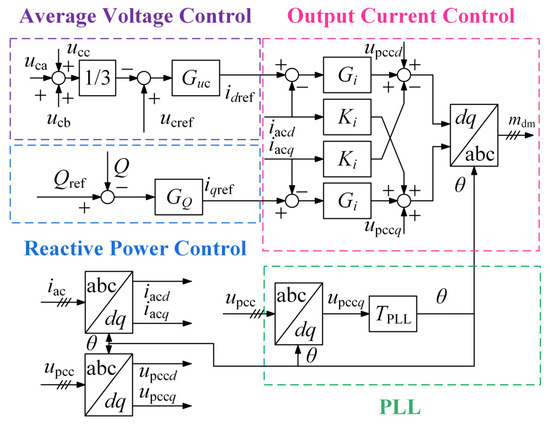
To achieve independent control of active and reactive power in the APC, a classical dual-loop control strategy is applied to the control system design of the chain-based APC. The control block diagram is shown in Figure 2, which specifically includes submodule capacitor voltage control, reactive power control, inner-loop current control, and a PLL.
Figure 2.
Control block diagram of the APC.
- (1)
- Coordinate Transformation Module
The coordinate transformations used in the APC include the Park transformation and its corresponding inverse transformation, as well as the Clark transformation. Under small disturbances, the transformation angle for the Park transformation and its inverse is θ = θ0 + Δθ. The process of transforming a variable x = x0 + Δx from the ABC coordinate system to the dq coordinate system can be expressed as (12), while the process of transforming a variable xdq = x0,dq + Δxdq from the dq coordinate system to the ABC coordinate system can be expressed as (13)
The derivation process for (12) is as follows. Under small disturbances, when the transformation angle is θ = θ0 + Δθ, the Park transformation matrix can be expressed as
The derivation process for (13) is as follows. Under small disturbances, when the transformation angle is θ = θ0 + Δθ, the inverse Park transformation matrix can be expressed as
The Clark transformation is independent of angle, and its transformation process under small disturbances is shown in (16).
According to (12) and (13), in the linearized HSS model, the dq-frame disturbance components obtained by applying the Park transformation to Δx are
The disturbance component in the ABC coordinate system obtained by applying the inverse transformation to Δxd and Δxq is
The disturbance components in the αβ coordinate system obtained by applying the Clark transformation to Δx are
In (17) to (19), Td+ and Tq+ represent the transformation to the d-frame and q-frame in the Park transformation, respectively, while Td− and Tq− represent the transformation of the d-frame and q-frame components in the inverse Park transformation, respectively. Tα and Tβ represent the transformation to the α-frame and β-frame in the Clark transformation. The steady-state quantity x0 is transformed by Tdq+ (θ0 + 90°), and the d-frame and q-frame components are extracted and expressed in Toeplitz matrix form as x’d+ and x’q+, respectively. The calculation of x’d− and x’q− follows the same principle.
The derivation of the coordinate transformation matrices in the HSS is presented below.
When Δx is a positive-sequence component (with amplitude ΔX and angular frequency ωp), its Park transformation process can be written as
(20) indicates that after the Park transformation, the frequency of the positive-sequence signal decreases by ω1, while the q-frame component lags the d-frame component by 90°.
When Δx is a negative-sequence component (with amplitude ΔX and angular frequency ωp), its Park transformation process can be written as
(21) indicates that after the Park transformation, the frequency of the negative-sequence signal increases by ω1, while the q-frame component leads the d-frame component by 90°.
Expressing (20) and (21) in the frequency domain:
(22) indicates that the Park transformation produces different frequency-shift effects for different sequence components. The frequency up-shift matrix Tup and frequency down-shift matrix Tdw are defined as follows:
The frequency up-shift matrix Tup indicates that after the Park transformation, the frequency of all components in the signal increases by ω1; the frequency down-shift matrix Tdw indicates that after the Park transformation, the frequency of all components in the signal decreases by ω1. Therefore, by combining the frequency-shift matrices with the sequence extraction matrices obtained in Section 2.1, the Park transformation matrices in the HSS can be derived:
For the inverse Park transformation, the following frequency-shift effects occur in the frequency domain:
Therefore, the transformation matrices for the inverse Park transformation in the HSS are
For the Clark transformation, when Δx is a positive-sequence component, the transformation process can be expressed as
When Δx is a negative-sequence component, the transformation process can be expressed as
Therefore, the transformation matrices for the Clark transformation in the HSS are
(25), (26), (28), (29), (32), and (33) constitute the complete set of transformation matrices representing the coordinate transformation process in the HSS.
- (2)
- PLL
The PLL calculates the PCC voltage phase based on the measured PCC voltage, providing a synchronous reference signal for the APC. The derivation of the transfer function model from the disturbed PCC voltage to the disturbed output reference phase of the PLL in the HSS form is presented below.
When a disturbance occurs in the PCC voltage, the reference phase disturbance generated by the PLL (in the HSS form) is
In the equation, Δupccq represents the q-frame component of the PCC voltage disturbance, and TPLL (ωp+k) denotes the open-loop transfer function of the PLL, expressed as
According to the second equation in (17), Δupccq can be expressed as
Under steady-state conditions, Δupccq contains only the fundamental frequency component, and u’pccq+ is, therefore, a diagonal matrix with all main diagonal elements being U0cos(ω0t + θu0). The transfer function matrix in the HSS form from the PCC disturbance voltage Δupcc to the PLL output disturbance reference phase ΔθPLL is obtained by substituting (36) into (34), i.e.,:
where GPLL is
- (3)
- Submodule Capacitor Voltage Control
The purpose of submodule capacitor voltage control is to maintain the average capacitor voltage of all submodules in the three-phase bridge arms of the APC near the rated value. This control is implemented using a PI controller, with its input being the deviation between the average submodule capacitor voltage and the commanded capacitor voltage value, and its output being the d-frame current reference value for the inner current control loop. Its linearized HSS model is
where Guc is a diagonal matrix representing the gain of the PI controller in the submodule capacitor voltage control under the HSS form. The elements on its main diagonal are composed of the transfer functions of the PI controller at different frequencies, i.e.,:
where kpuc and kiuc represent the proportional coefficient and integral coefficient of the PI controller in the submodule capacitor voltage control, respectively.
- (4)
- Reactive Power Control
The purpose of reactive power control is to regulate the reactive power output of the APC to a specified value. This control is implemented using a PI controller, with its input being the deviation between the actual reactive power value and the commanded reactive power value, and its output being the q-frame current reference value for the inner current control loop.
According to the instantaneous power theory:
Linearizing this equation and expressing it in the HSS form:
According to the control block diagram of the reactive power controller:
where GQ is a diagonal matrix representing the gain of the PI controller in the reactive power control under the HSS form. The elements on its main diagonal are composed of the transfer functions of the PI controller at different frequencies, i.e.,:
where kpQ and kiQ represent the proportional coefficient and integral coefficient of the PI controller in the reactive power control, respectively.
- (5)
- Inner-loop Current Control
The purpose of the inner-loop current control is to generate the d-frame modulation wave signal and the q-frame modulation wave signal based on the d-frame current reference value output from the submodule capacitor voltage control and the q-frame current reference value output from the reactive power control, respectively. The d-frame and q-frame modulation wave signals are then transformed into three-phase modulation wave signals via the inverse Park transformation, which are fed into the carrier phase-shift modulation stage to ultimately generate the triggering signals for each submodule.
According to the control block diagram of the inner-loop current controller:
where Gi is a diagonal matrix representing the gain of the PI controller in the inner-loop current control under the HSS form. The elements on its main diagonal are composed of the transfer functions of the PI controller at different frequencies, i.e.,:
where kpi and kii represent the proportional coefficient and integral coefficient of the PI controller in the inner-loop current control, respectively.
According to (18), the modulation wave disturbance quantity in the three-phase stationary coordinate system can be expressed as
In summary, by combining (34) to (47) and eliminating the intermediate variables, the linearized HSS model of the APC control system can be obtained as
2.3. APC Impedance
By combining the linearized HSS model of the APC main circuit ((9) and (10)) with the linearized HSS model of the APC control system ((48)), the disturbance components of the modulation wave and the submodule capacitor voltage can be eliminated. This ultimately establishes the relationship between the disturbance components of the APC port voltage and the port current, allowing the solution of the APC impedance.
Specifically, first substitute (10) into (48) to eliminate the submodule capacitor voltage disturbance component in the linearized HSS model of the APC control system:
Then substitute (49) into (9) to eliminate the modulation wave disturbance quantity:
(50) represents the relationship between the APC port voltage disturbance component Δu and the port current disturbance component Δi. The matrix Y is the transfer function matrix describing their relationship. Thus, the port impedance of the APC at the disturbance frequency fp is
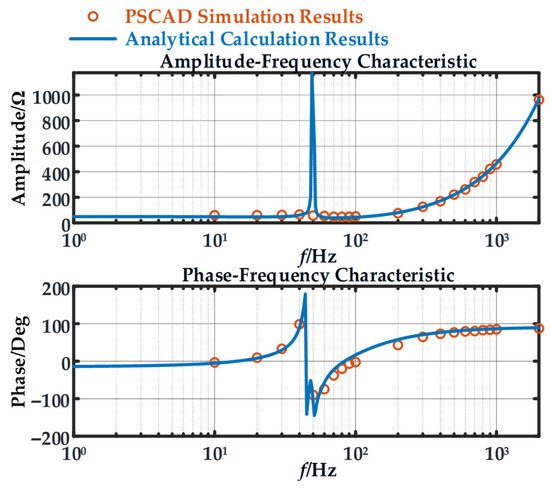
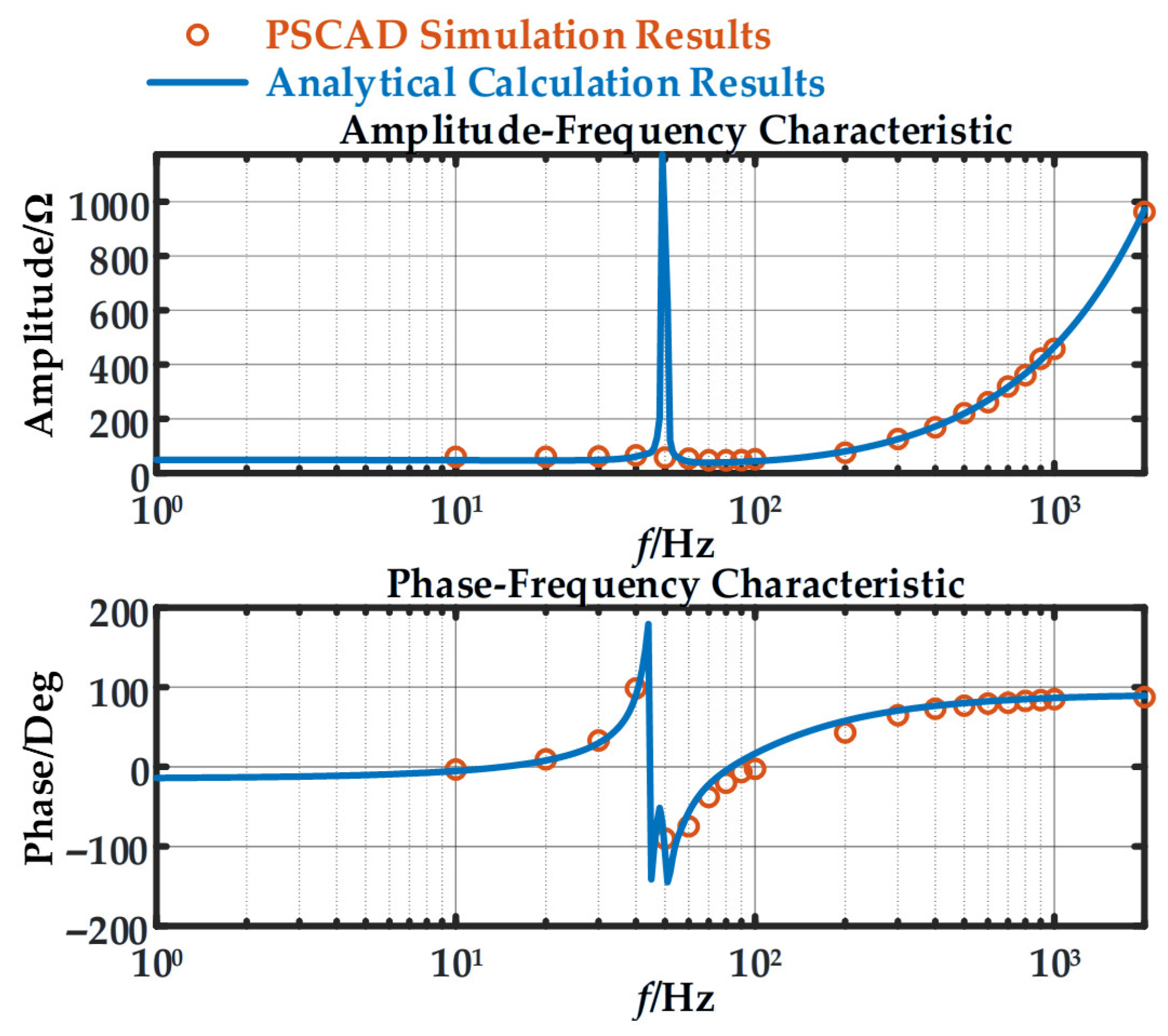
Verification is performed using the APC with parameters shown in Table 2. The electromagnetic transient model is built in PSCAD/EMTDC 4.6.2, and the simulation results of the port-impedance are obtained using the test signal method. The comparison between the analytical and simulation results of the port impedance frequency characteristics is shown in Figure 3. The analytical result closely matches the simulation one, validating the accuracy of the above analytical impedance model.
Table 2.
Parameters of the APC.
Figure 3.
Comparison of analytical and simulation results for the APC port-impedance frequency characteristic.
3. Supplementary Control Strategy of APC
3.1. Resonance Stability and Harmonic Resonance
The s-domain node admittance matrix (s-NAM) method is a common impedance-based analysis technique. The mathematical model of the s-NAM method is the s-NAM. The key to calculating the resonance modes is solving for the zeros of the determinant of the s-NAM [27,28], i.e.,
where Y(s) is the s-NAM; sres is the s-domain resonance mode; σres is the damping factor; ωres,s is the s-domain resonance angular frequency. σres determines resonance stability: if σres > 0, the system is stable; if σres ≤ 0, it is unstable.
Harmonic resonance is a steady-state phenomenon where the system exhibits a large (voltage) response to a (current) excitation at a particular frequency. This process reflects the frequency characteristics of the system, which can be described using the system’s frequency-domain node admittance matrix (F-NAM) [29,30].
The frequency-domain node voltage equation of the system is
where Y(f) is the F-NAM; V(f) and I(f) are the frequency-domain node voltage vector and the frequency-domain node injected current vector, respectively; Λ(f), R(f), and L(f) are the diagonal eigenvalue matrix, right eigenvector matrix, and left eigenvector matrix of Y(f), with Λ(f) = diag(λ1, λ2, …, λₙ) and L(f) = R(f)−1.
Transforming (53) gives
where Vmode(f) and Imode(f) are the frequency-domain modal voltage vector and frequency-domain modal current vector, respectively; Λ(f)−1= diag(, , …, ). The reciprocal of the eigenvalue is called the modal impedance. If an eigenvalue λₖ is very small, the modal current Imode_k will trigger a very high modal voltage Umode_k.
Each eigenvalue corresponds to a frequency-domain resonance mode, and the mode with the smallest eigenvalue is called the critical mode. If the smallest eigenvalue is sufficiently small at a certain frequency, a severe resonance will occur, and this frequency is called the frequency-domain resonance frequency.
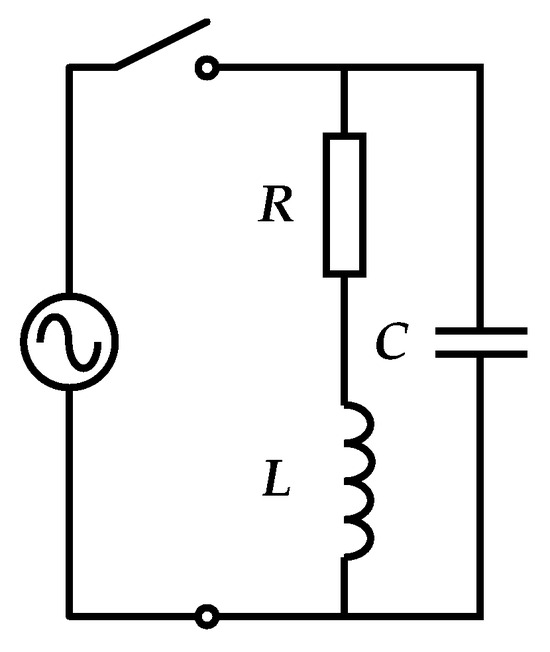
The differences and similarities between resonance stability and harmonic resonance are illustrated using the simple parallel RLC circuit (), shown in Figure 4.
Figure 4.
Parallel RLC circuit.
The s-NAM of the simple parallel RLC circuit is
The zeros of the corresponding determinant are
The F-NAM of the simple parallel RLC circuit is
The corresponding eigenvalues are
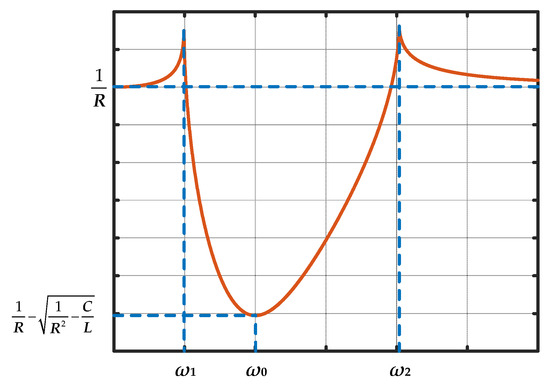
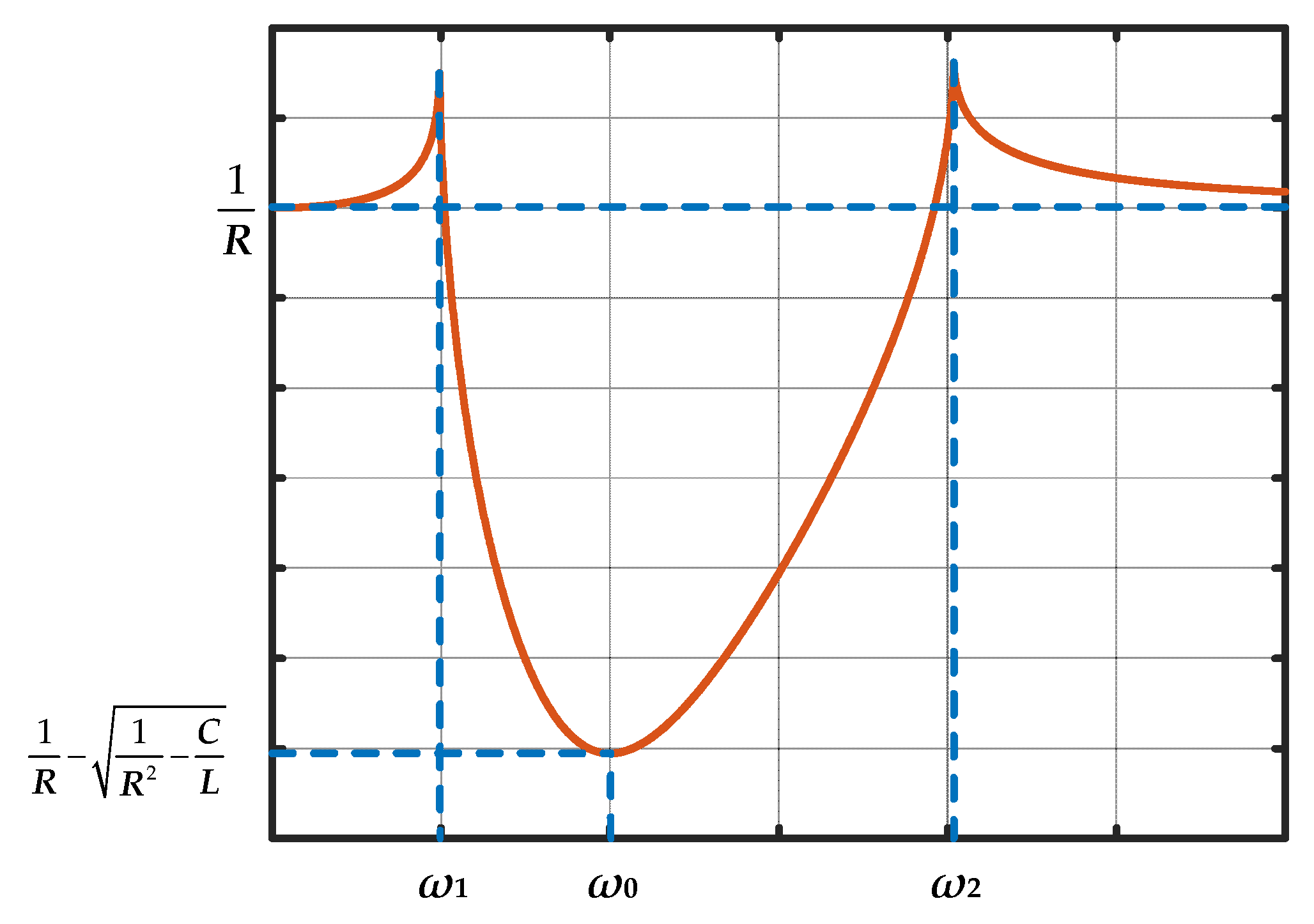
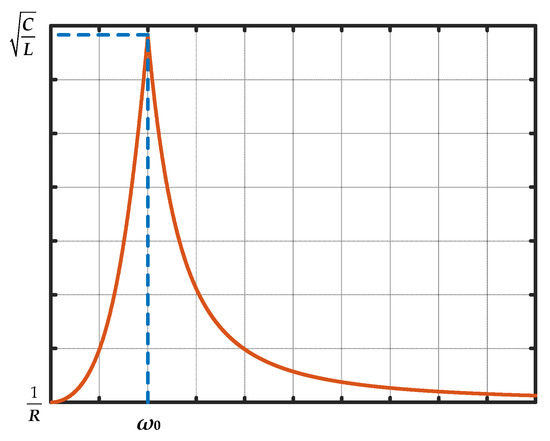
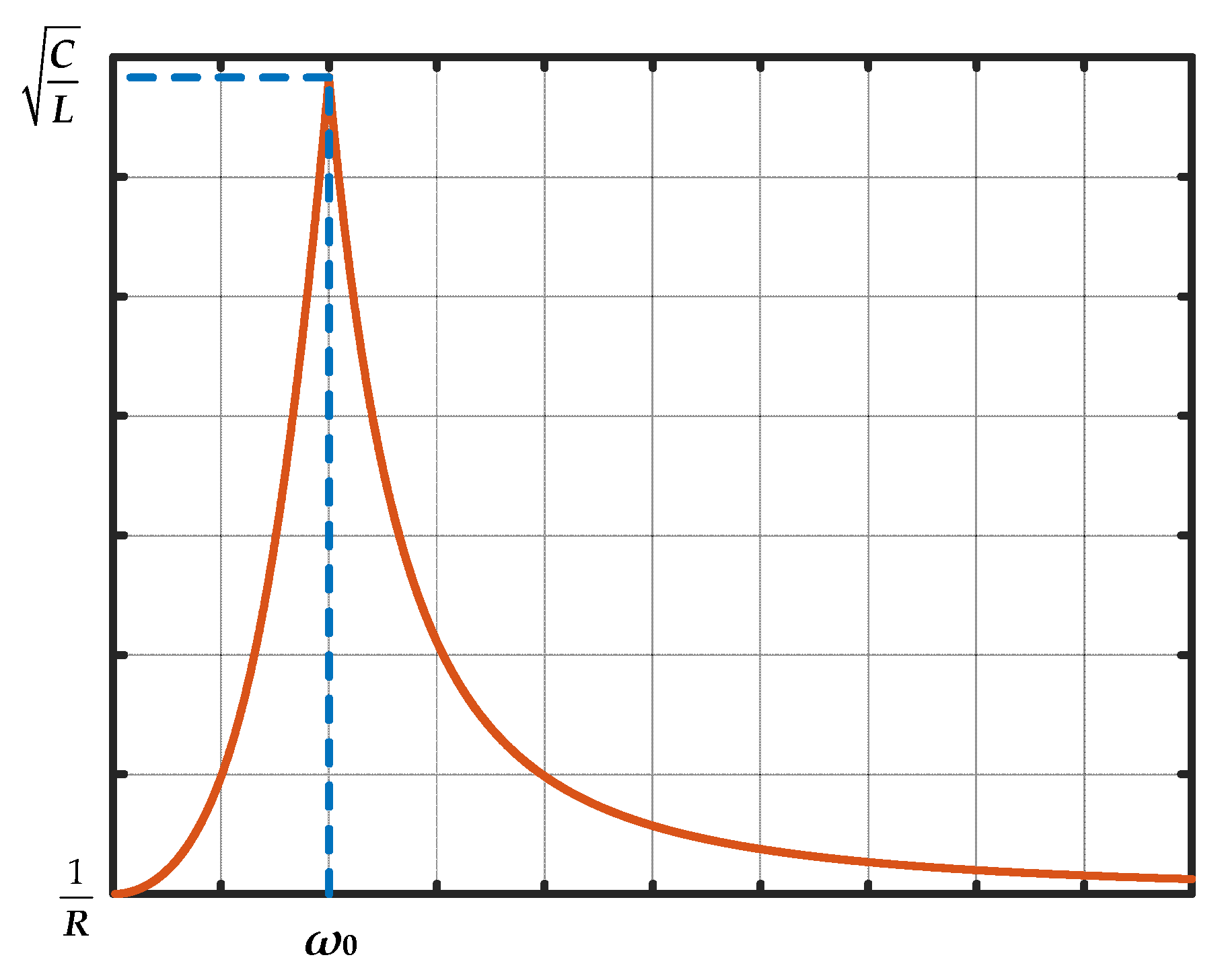
Harmonic resonance focuses on the smallest eigenvalue, which depends on the range of R. A detailed discussion is not provided here; instead, the frequency characteristics of the smallest eigenvalue for different values of R are shown in Figure 5 and Figure 6. It can be observed that for harmonic resonance to occur, must be satisfied, with frequency-domain resonance angular frequency .
Figure 5.
Frequency characteristics of the smallest eigenvalue when .
Figure 6.
Frequency characteristics of the smallest eigenvalue when .
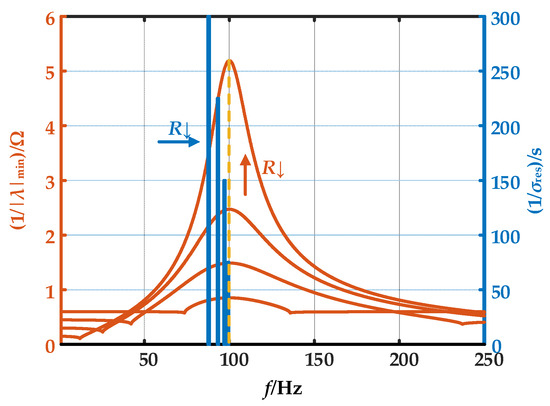
The two key parameters for resonance stability are σres, which represents the decay of free components, and ωres,s, which represents their oscillation. For harmonic resonance, the key parameters are the critical modal impedance magnitude 1/|λ|min, indicating the resonance intensity, and ωres,f, the resonance frequency. The following two relationships hold between them:
For ωres,s and ωres,f, the two are different frequencies. As R decreases, meaning the damping in the system decreases, the two frequencies become closer. For σᵣₑₛ and 1/|λ|min, as R decreases, σᵣₑₛ becomes smaller, meaning the time for free components to decay increases, and 1/|λ|min becomes larger, indicating a more intense harmonic amplification. The above relationships are shown in Figure 7.
Figure 7.
Resonance mode identification.
During resonance stability analysis, for dominant modes (with very small or negative damping), the resonance frequency and harmonic-resonance frequency are nearly identical, allowing the s-domain problem to be solved in the frequency domain.
3.2. Supplementary Control Channel Design
Based on the s-domain dominant mode resonance frequency characteristics, a band-pass filter (BPF) extracts the resonant frequency components for APC impedance reshaping. The input is the APC output current, and the designed current feedforward control channel is shown in Figure 8.
Figure 8.
Supplementary control in abc-frame.
In Figure 8, KSC is the supplementary control gain, which is typically a negative value; GBPF is the BPF transfer function, as shown in (60).
where Q is the quality factor; ωc is the characteristic angular frequency.
Based on the derivation in Section 2, the impedance of the APC with supplementary control can be simply expressed as
where GI and GU are the transfer functions from current and grid-side voltage to valve-side voltage, respectively; ΔGI and ΔGU are the transfer functions from current and grid-side voltage to valve-side voltage through supplementary control, respectively; Gpu_i is the per-unit coefficient of the current.
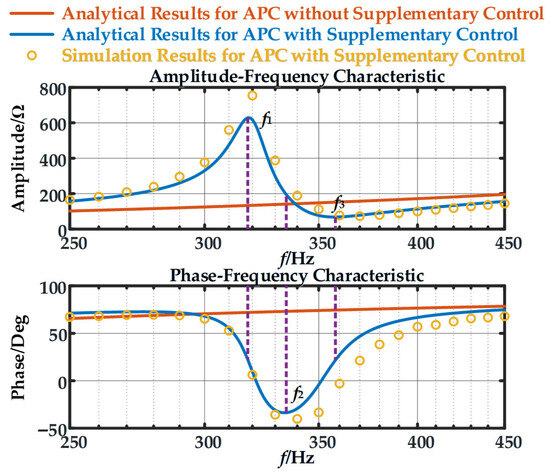
The comparison of the APC impedance frequency characteristics near the characteristic frequency after supplementary control is shown in Figure 9, where KSC = −8, Q = 20, and the characteristic frequency fc = 320 Hz, with other parameters the same as those in Table 2. Near fc, the impedance magnitude of the APC with supplementary control increases sharply, then decreases slightly, accompanied by a phase lag. The characteristic frequency is slightly higher than the local maximum magnitude frequency (f1) and lower than the local minimum phase frequency (f2), which in turn is lower than the local minimum magnitude frequency (f3). As the phase decreases to the local minimum, the magnitude decreases steadily. When the phase recovers, the magnitude first decreases and then increases.
Figure 9.
APC impedance frequency characteristics before and after supplementary control.
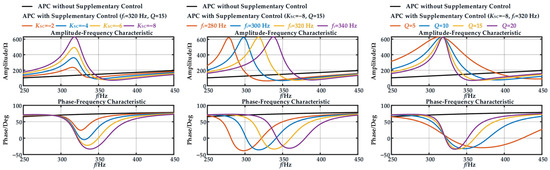
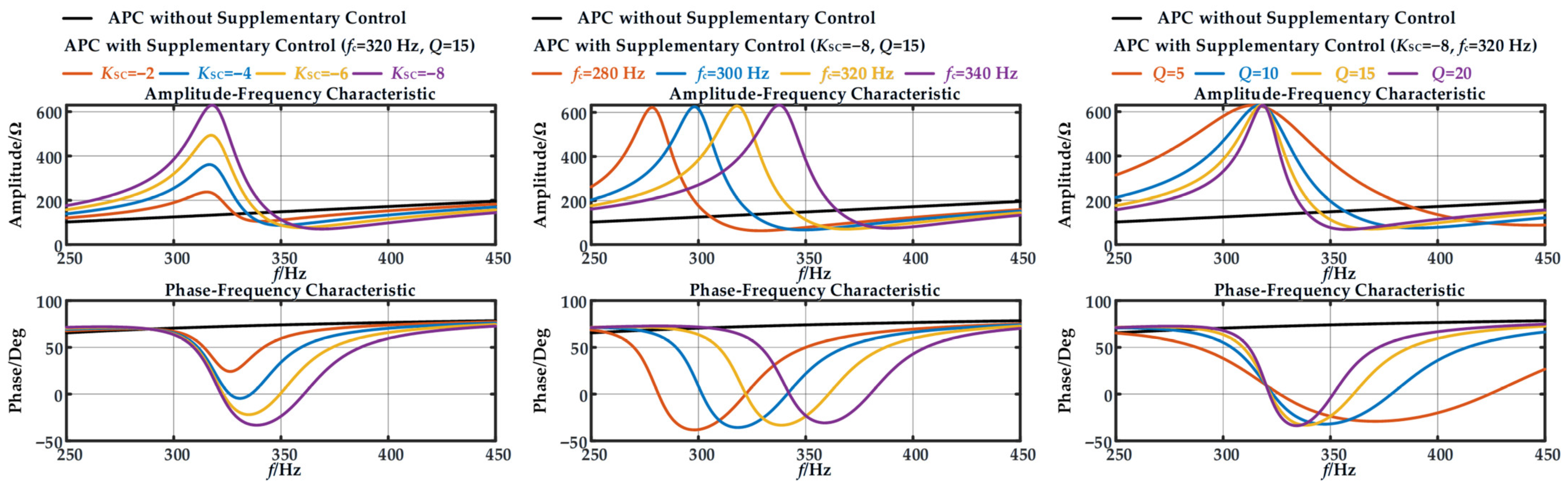
The three key parameters affecting the effectiveness of the supplementary control are KSC, fc, and Q, and their impacts on the APC impedance frequency characteristics are illustrated in Figure 10. As the magnitude of KSC increases, the local maximum magnitude increases and the local minimum phase decreases, while the extent of the phase reduction gradually diminishes. fc does not alter the local shape of the impedance frequency characteristics; instead, the local peak is in magnitude and the local valley is in phase shift with changes in fc. Q does not change the local magnitude gain or phase lag; instead, the impedance frequency characteristics scale around fc, and the curve becomes steeper as Q increases.
Figure 10.
APC impedance frequency characteristics under different supplementary control parameters.
When the same control strategy is applied in the dq-frame, as shown in Figure 11, the impedance of the APC with supplementary control can be simply expressed as
where Km is the modulation coefficient; Im0 are the magnitudes of the grid-side; φi0 is the phase difference between the grid-side current and voltage; GPLL is the transfer function from the grid-side voltage perturbation to the phase perturbation through the PLL.
Figure 11.
Supplementary control in dq-frame.
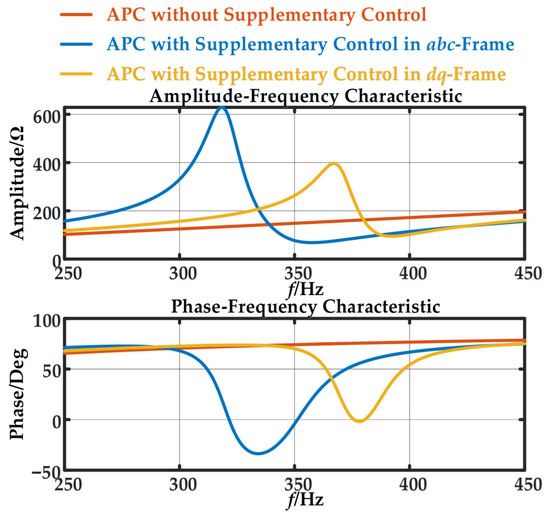
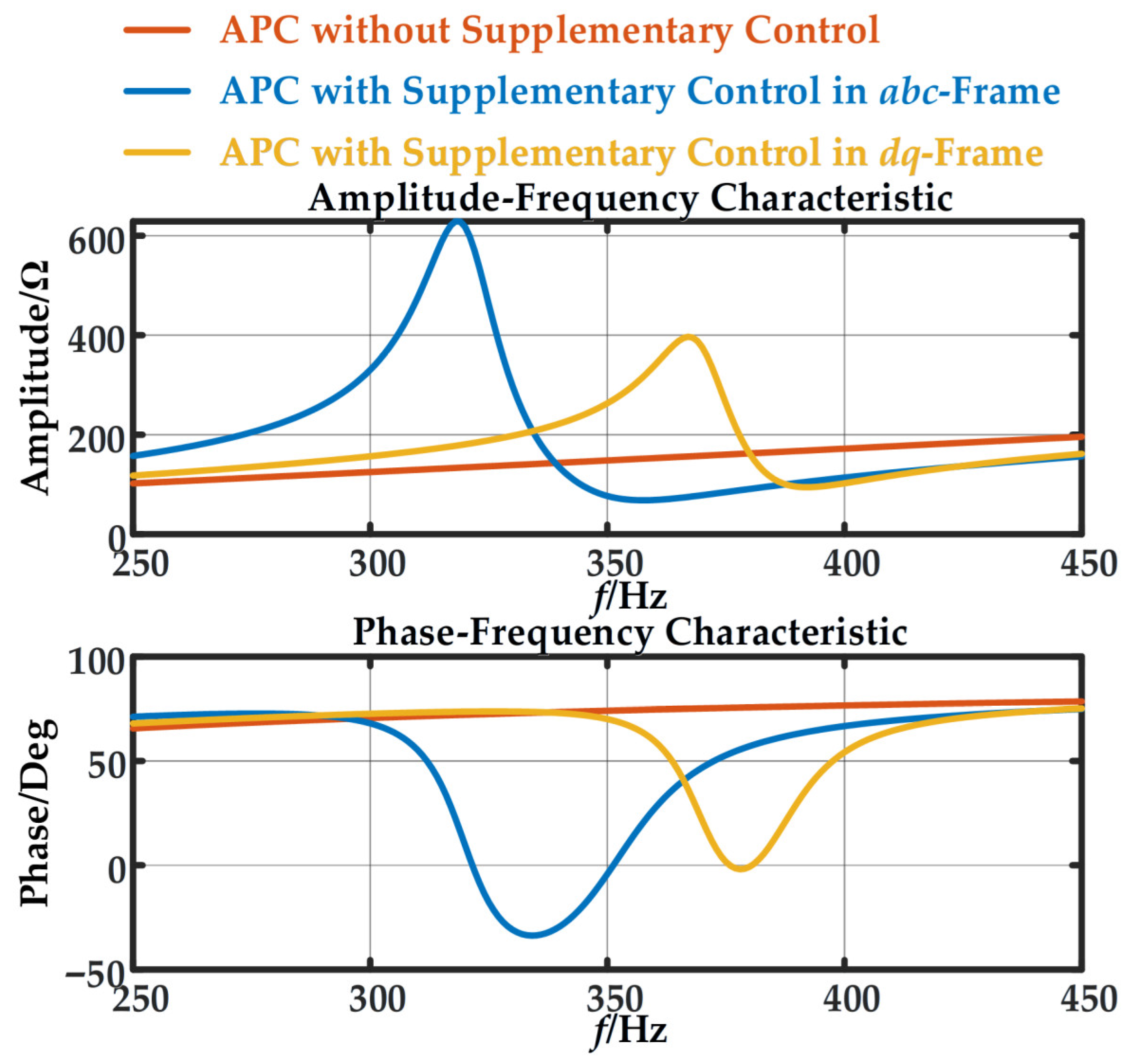
Under the same control parameters, the impedance frequency characteristics of the APC with supplementary control in different reference frames are shown in Figure 12. The supplementary control in the dq-frame results in different levels of magnitude gain and phase lag, because the corresponding ΔI terms differ by a coefficient Km, while the effect of ΔU is negligible. Moreover, the dq-frame supplementary control introduces a waveform shift caused by the coordinate transformation, leading to a local rightward shift of 50°. Therefore, the selection of fc is more straightforward and natural for the supplementary control implemented in the abc-frame.
Figure 12.
Impedance frequency characteristics of the APC with supplementary control in different reference frames.
4. Case Studies
4.1. Case Introduction
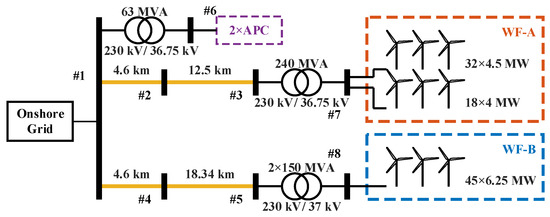
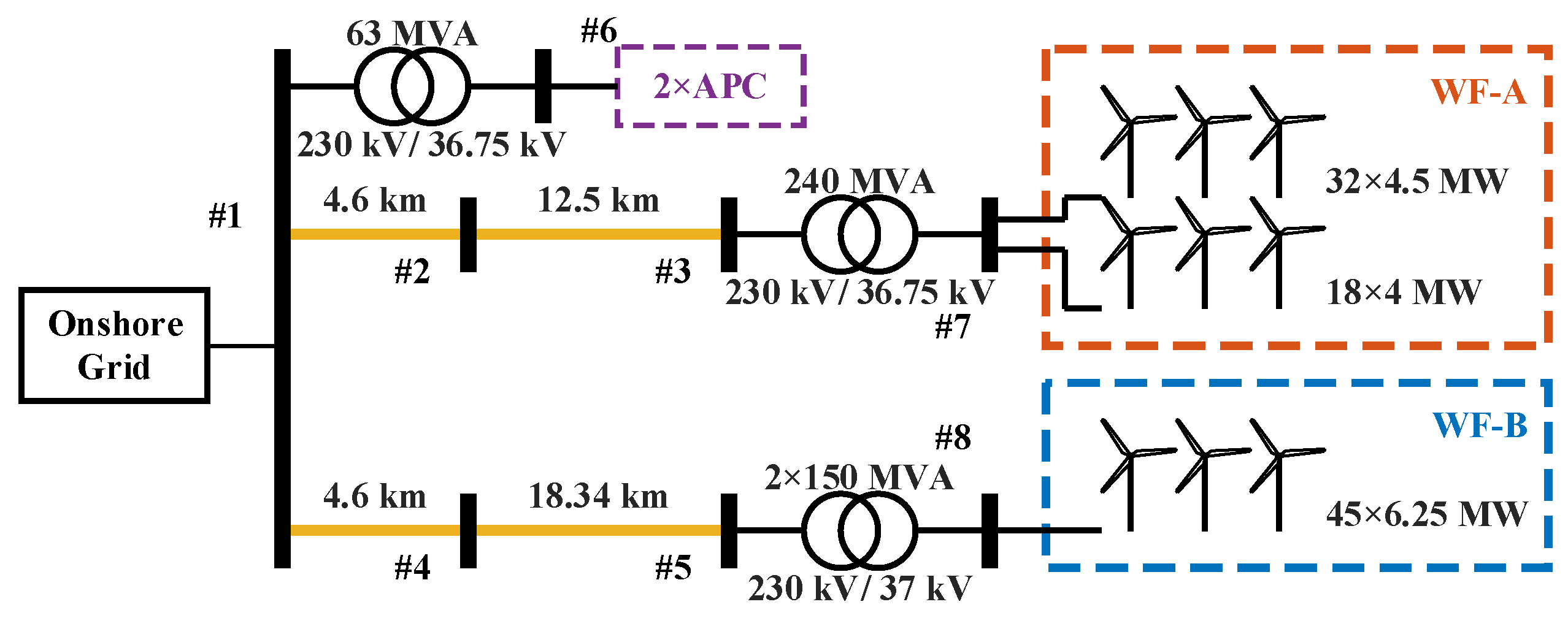
The case studied in this section is adapted from an OWPS in Zhejiang Province, China (Figure 13), consisting of two offshore wind farms (WFs), both connected to the onshore grid using the high-voltage AC transmission scenario.
Figure 13.
Target OWPS.
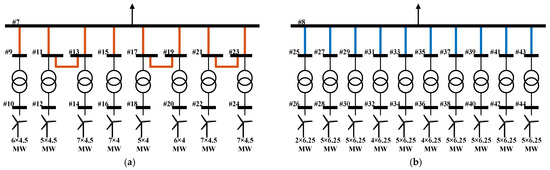
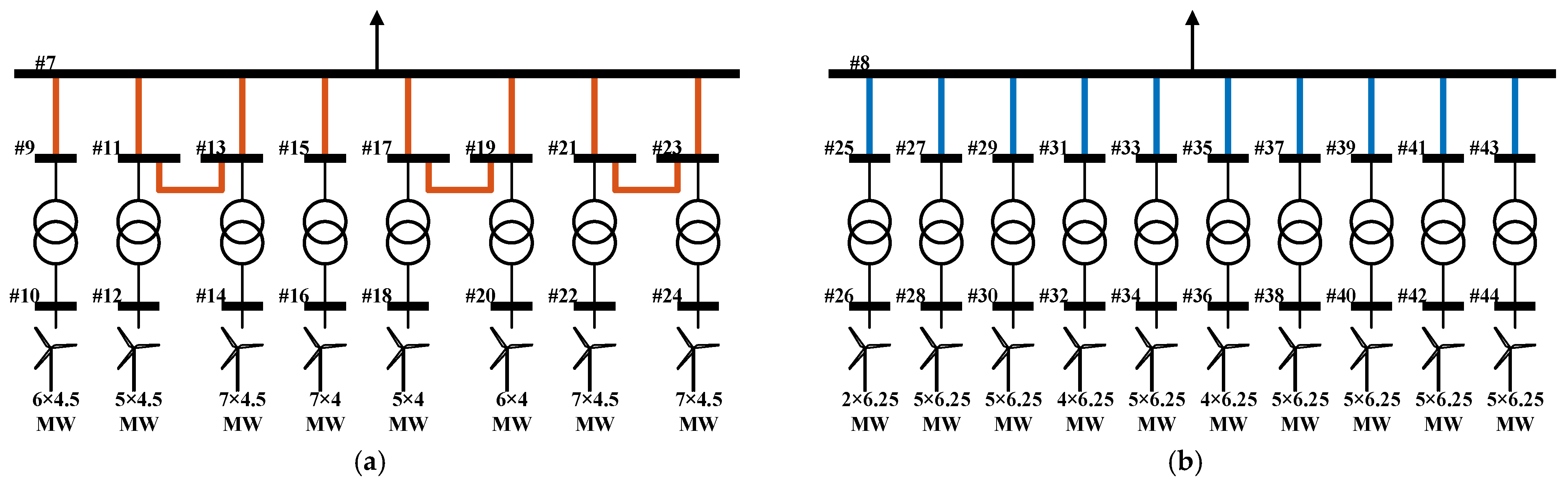
The WTs in the target system are all direct-drive type. WF-A includes 32 units of 4.5 MW WTs and 18 units of 4 MW WTs, transmitting power via a 12.5 km three-core submarine cable and 4.6 km single-core land cables. WF-B includes 45 units of 6.25 MW WTs, with power delivered through an 18.34 km three-core submarine cable and 4.6 km single-core land cables. The topologies of the power collection system in WF-A and WF-B are plotted in Figure 14. Two APCs with parameters listed in Table 2 are arranged on the onshore centralized control bus.
Figure 14.
Topologies of the power collection system in (a) WF-A and (b) WF-B.
The WTs on the same collection chain have identical types, close positions, and similar wind energy capture. Therefore, to facilitate subsequent analysis without loss of generality, each collection chain is simplified by aggregating all WTs into one node, retaining the longer submarine cables at both ends (highlighted in Figure 14) and ignoring the shorter ones between WTs.
In the OWPS, the output of all WTs is set to P = 1.0 pu and Q = 0.0 pu, and the output of all APCs is set to Q = 0.7 pu, with the target frequency range from 1 to 2000 Hz. In terms of analytical calculations, the supplementary control parameters of the APC are designed, and the resonance stability analysis results of the system before and after APC supplementary control are compared to verify the effectiveness of the proposed strategy. In terms of simulation verification, the dominant mode is observed in time-domain simulations to validate the accuracy of the analytical calculations.
4.2. Analytical Calculation
To apply the s-NAM method, each component is depicted as an s-domain impedance model. With all the models converted to the basic voltage level and arranged based on the system topology, the target system can be represented as an s-domain impedance network, further described as an s-NAM [31].
As presented in Table 3, the target system has four stable modes, with Mode 2 having a relatively small damping factor, so the APC supplementary control is designed for this mode.
Table 3.
Resonance modes of the target system.
The impedance of the OWPS is calculated as follows:
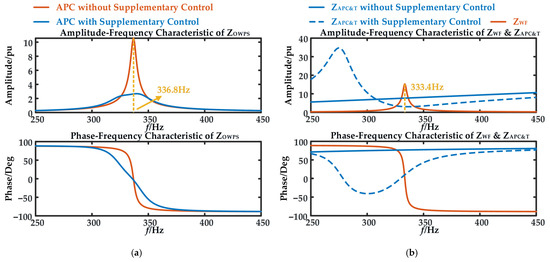
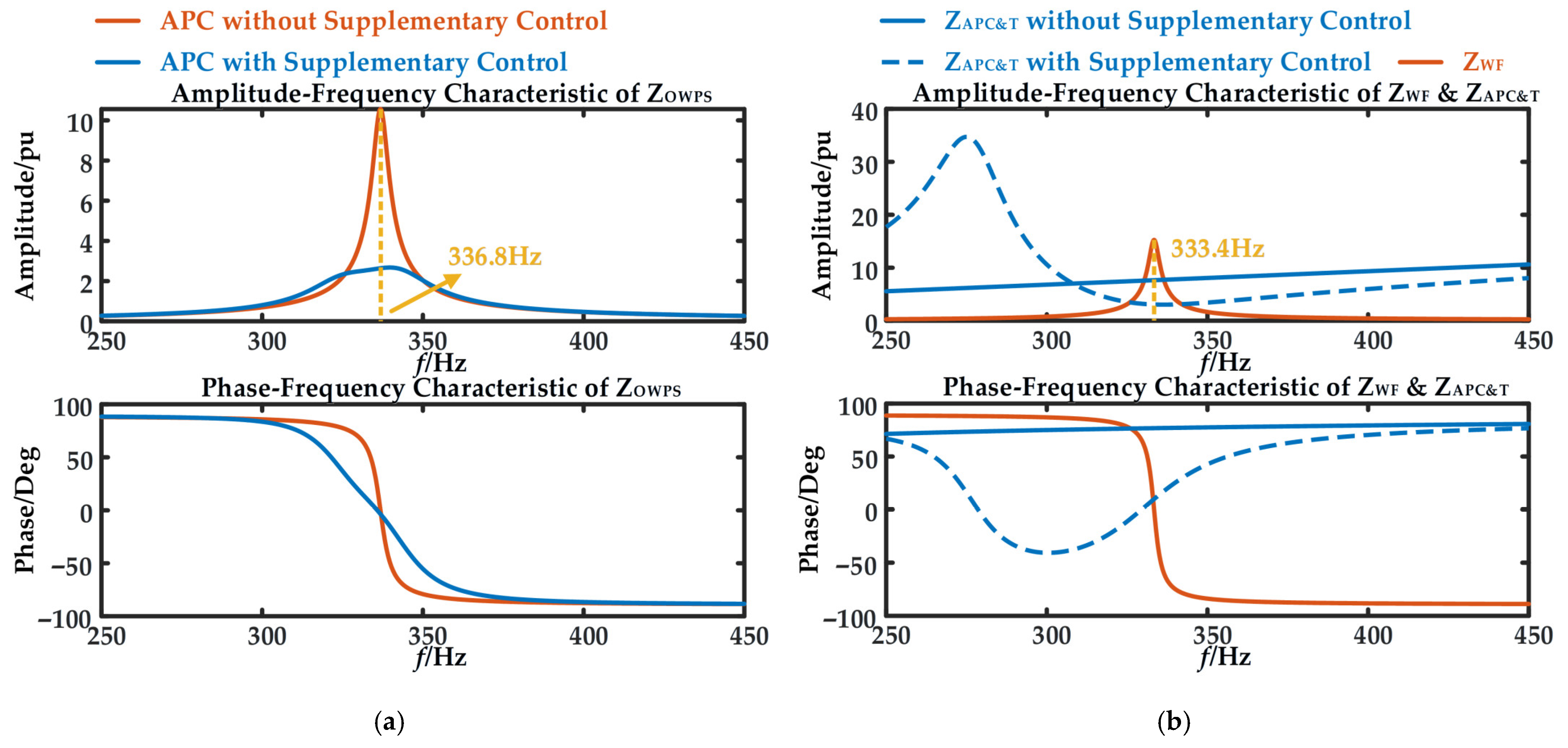
where ZOPWS is the impedance of the OWPS; ZWF is the impedance of the WFs; ZAPC&T is the impedance of the APC branch. The magnitude of ZOPWS exhibits a peak at the resonance frequency corresponding to Mode 2 (Figure 15a), which is consistent with the characteristics of the dominant mode analyzed in Section 3.1. The magnitude peak of ZOPWS is caused by the cancelation between the capacitive reactance of the WFs and the inductive reactance of the APC branch (Figure 15b).
Figure 15.
Impedance frequency characteristics of (a) ZOPWS, (b) ZWF, and ZAPC&T before and after supplementary control.
Near the local maximum magnitude frequency, ZWF exhibits strong resistive and weak reactive characteristics, with significant variation (Figure 15b). If ZAPC&T shows a similar strongly resistive and weakly reactive behavior but with much smaller variation and magnitude than ZWF, the magnitude of ZOPWS will stay below that of ZAPC&T over a broad frequency range (Figure 15b), thereby avoiding a pronounced peak in ZOPWS. This result serves as the objective for designing the supplementary control parameters.
The design principles of the three key supplementary control parameters, KSC, fc, and Q, are discussed below. Due to the inductive impedance introduced by the APC branch transformer, |KSC| must be large enough for the APC capacitive reactance to compensate this inductive component; however, it should not be excessively increased, since it would affect the impedance characteristics in other frequency ranges and, beyond a certain value, the phase-lag effect weakens while the magnitude gain remains unchanged, since the local secondary resistive frequency of ZAPC&T is higher than fc can be set below the local maximum magnitude frequency of ZWF. Moreover, Q should be chosen so that ZAPC&T varies as smoothly as possible near the local magnitude frequency of ZWF. Additionally, both fc and Q should not be too low, as this would impact the impedance characteristics across other frequency ranges. In summary, the objective function and constraints are given in (64).
where fp is local maximum magnitude frequency of ZWF.
4.3. Simulation Verification
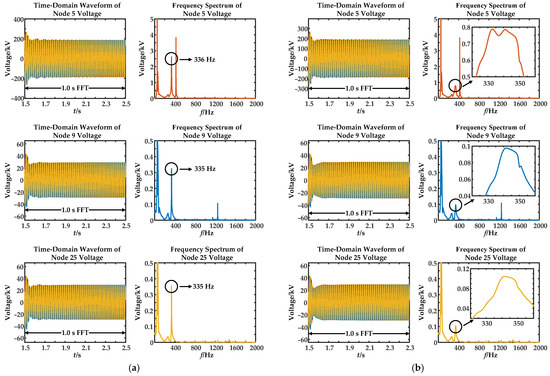
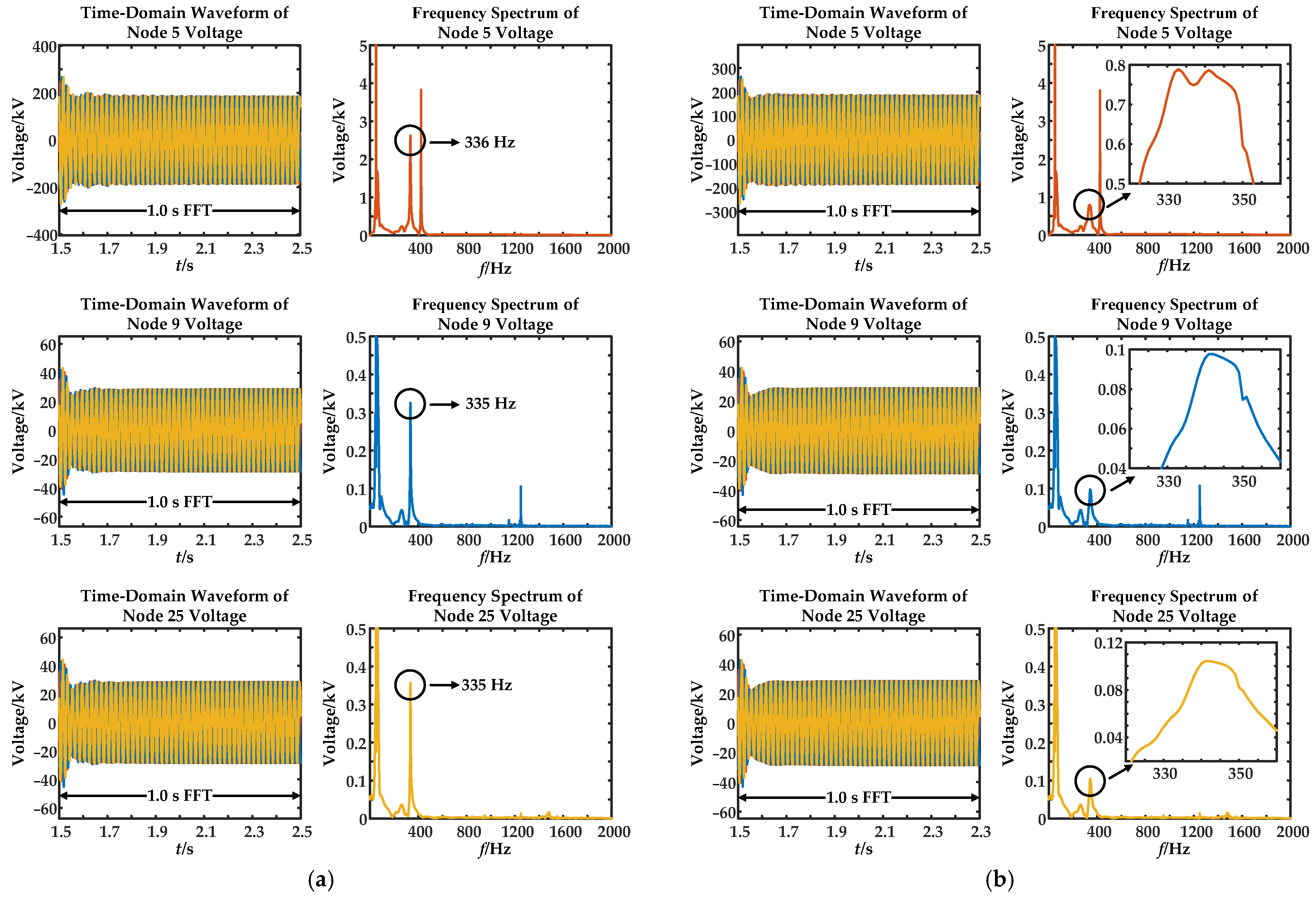
A simulation model of the studied system is built in PSCAD/EMTDC 4.6.2. At 1.45 s, a three-phase grounding fault with a 40 Ω resistance is applied at the grid connection point (node 1), lasting for 0.05s. The (phase) voltages at Node 5, Node 9, and Node 25 are observed shortly after the fault clearing, with their time-domain waveforms and frequency spectra plotted in Figure 16a. It reveals a significant resonance mode with a frequency of approximately 335 Hz, corresponding to Mode 2. After the supplementary control, the component near 335 Hz in the transient voltage significantly decreases (Figure 16b), confirming the accuracy of the analytical calculation.
Figure 16.
Voltage at Node 6, Node 9, and Node 25 of the target system with APC (a) before and (b) after supplementary control.
5. Conclusions
In response to the high resonance risk in power systems with a high proportion of renewable energy, this paper proposes a resonance-suppression strategy based on active APC. The main conclusions are as follows:
- This paper develops the APC impedance model using HSS, incorporating its internal dynamics and full control loops. The power stage and control stage models are linearized separately in HSS, and their integration results in the complete impedance model of the APC.
- Resonance instability originates from the right-half-plane zeros of the s-NAM, while harmonic amplification is caused by the maximum value of the reciprocal of the eigenvalues in the F-NAM. Although distinct, these two concepts are related. For s-domain resonance modes with low damping, the s-domain and frequency-domain resonance frequencies are nearly the same, allowing the problem to be handled in the frequency domain.
- This paper proposes an abc-frame supplementary control in which the output current is fed forward to the valve-side reference voltage through a proportional gain and a BPF. Compared with dq-frame supplementary control, the proposed approach does not require coordinate transformation, thereby avoiding frequency shift effects and enabling a more natural and reliable selection of the characteristic frequency fc.
Building on the above conclusions, future work will further investigate supplementary control in other frequency ranges and seek validation through field measurements in practical engineering applications, complementing the simulation-based results presented in this study.
Author Contributions
Conceptualization, B.H.; methodology, Z.Z.; software, B.H.; validation, B.H.; formal analysis, B.H.; investigation, B.H.; resources, Z.X.; data curation, B.H.; writing—original draft preparation, B.H. and Z.S.; writing—review and editing, Z.S.; visualization, B.H. and Z.S.; supervision, Z.Z. and Z.X.; project administration, T.L. and Z.L.; funding acquisition, Z.B. All authors have read and agreed to the published version of the manuscript.
Funding
This research was funded by the Science and Technology Projects of State Grid Corporation of China, grant number 5200-202356483A-3-2-ZN.
Data Availability Statement
The original contributions presented in this study are included in the article. Further inquiries can be directed to the corresponding author.
Conflicts of Interest
Tan Li and Zhichuang Li are being employed by State Grid Economic and Technological Research Institute Co., Ltd. Zijun Bin is being employed by Electric Power Research Institute, State Grid Jiangsu Electric Power Co., Ltd. The remaining authors declare that the research was conducted in the absence of any commercial or financial relationships that could be construed as a potential conflict of interest.
Abbreviations
The following abbreviations are used in this manuscript:
| WT | Wind Turbine |
| APC | Amplitude and Phase Corrector |
| MMC | Modular Multilevel Converter |
| HSS | Harmonic State-Space |
| PLL | Phase-Locked Loop |
| s-NAM | s-domain Node Admittance Matrix |
| F-NAM | Frequency-domain Node Admittance Matrix |
| OWPS | Offshore Wind Power System |
| WF | Wind Farm |
References
- Kang, C.; Yao, Z. Key Scientific Issues and Theoretical Research Framework for Power Systems with High Proportion of Renewable Energy. Autom. Electr. Power Syst. 2017, 41, 2–11. [Google Scholar]
- Harnefors, L.; Wang, X.; Yepes, A.G.; Blaabjerg, F. Passivity-Based Stability Assessment of Grid-Connected VSCs—An Overview. IEEE J. Emerg. Sel. Top. Power Electron. 2016, 4, 116–125. [Google Scholar] [CrossRef] [Scilit]
- Xu, Z. Resonance Stability Analysis Method Based on s-Domain Node Admittance Matrix. Electr. Power Autom. Equip. 2023, 43, 1–8. [Google Scholar]
- Sun, J. Impedance-Based Stability Criterion for Grid-Connected Inverters. IEEE Trans. Power Electron. 2011, 26, 3075–3078. [Google Scholar]
- Chen, X.; Zhang, Y.; Wang, Y. A Study of Dynamic Interaction Between PV Grid-Connected Inverters and Grid Based on the Impedance Analysis Method. Proc. CSEE 2014, 34, 4559–4567. [Google Scholar]
- Li, G.; Wang, W.; Liu, C.; Jin, D.; He, G. Mechanism Analysis and Suppression Method of Wideband Oscillation of PMSG Wind Farms Connected to Weak Grid (Part I): Analysis of Wideband Impedance Characteristics and Oscillation Mechanism. Proc. CSEE 2019, 39, 6547–6562. [Google Scholar]
- Zong, H.; Zhang, C.; Cai, X.; Molinas, M. Oscillation Propagation Analysis of Hybrid AC/DC Grids with High Penetration Renewables. IEEE Trans. Power Syst. 2022, 37, 4761–4772. [Google Scholar] [CrossRef] [Scilit]
- Zhu, S.; Liu, K.; Liao, X.; Qin, L.; Huai, Q.; Xu, Y.; Li, Y.; Wang, F. D-Q Frame Impedance Modeling of Modular Multilevel Converter and Its Application in High-Frequency Resonance Analysis. IEEE Trans. Power Deliv. 2021, 36, 1517–1530. [Google Scholar]
- Cespedes, M.; Sun, J. Impedance Modeling and Analysis of Grid-Connected Voltage-Source Converters. IEEE Trans. Power Electron. 2014, 29, 1254–1261. [Google Scholar]
- Xu, Y.; Nian, H.; Hu, B.; Sun, D. Impedance Modeling and Stability Analysis of VSG Controlled Type-IV Wind Turbine System. IEEE Trans. Energy Convers. 2021, 36, 3438–3448. [Google Scholar] [CrossRef] [Scilit]
- Sun, J.; Liu, H. Impedance Modeling and Analysis of Modular Multilevel Converters. In Proceedings of the 2016 IEEE 17th Workshop on Control and Modeling for Power Electronics (COMPEL), Trondheim, Norway, 27–30 June 2016; pp. 1–9. [Google Scholar]
- Xu, Z.; Li, B.; Li, S.; Wang, X.; Xu, D. MMC Admittance Model Simplification Based on Signal-Flow Graph. IEEE Trans. Power Electron. 2022, 37, 5547–5561. [Google Scholar] [CrossRef] [Scilit]
- Xu, Z.; Li, B.; Han, L.; Hu, J.; Wang, S.; Zhang, S.; Xu, D. A Complete HSS-Based Impedance Model of MMC Considering Grid Impedance Coupling. IEEE Trans. Power Electron. 2020, 35, 12929–12948. [Google Scholar] [CrossRef] [Scilit]
- Wang, Y.; Zhang, Y.; Sun, L.; Chen, X.; He, G.; Wang, H. Impacts of Voltage Feedforward Control on Impedance Characteristics and Stability of MMC-Based STATCOM. In Proceedings of the 2020 IEEE 9th International Power Electronics and Motion Control Conference (IPEMC2020-ECCE Asia), Nanjing, China, 29 November–2 December 2020; pp. 2939–2945. [Google Scholar]
- Zhang, Y.; Chen, Y.; Wang, Y.; Gong, C. Impedance-phased dynamic control method of grid-connected inverters under weak grid condition. Trans. China Electrotech. Soc. 2017, 32, 97–106. [Google Scholar]
- Chen, X.; Zhang, Y.; Wang, S.; Chen, J.; Gong, C. Impedance-Phased Dynamic Control Method for Grid-Connected Inverters in a Weak Grid. IEEE Trans. Power Electron. 2017, 32, 274–283. [Google Scholar] [CrossRef] [Scilit]
- Gao, J.; Xiao, F.; Jiang, F.; Guo, Q.; Lu, B. Grid-Connected Inverter Impedance Phase Reshaping Control with Novel PLL Structure in Weak Grid. Proc. CSEE 2020, 40, 6682–6694. [Google Scholar]
- Yu, H.; Lv, J.; Cai, X.; Tang, G. A Dynamic Performance-Friendly High-Frequency Self-Stabilizing Control Method for Flexible HVDC System. Proc. CSEE 2023, 43, 3293–3308. [Google Scholar]
- Zou, C.; Chen, J.; Xu, S.; Yang, Y.; Li, W.; Huang, R. Dynamic Performance Optimization of VSC-HVDC Considering its Long Delay. Power Syst. Technol. 2017, 41, 3216–3222. [Google Scholar]
- Wang, H.; Zhang, J.; Gang, S.; Zhu, M.; Cai, X.; Huang, R. An Admittance Reshaping Strategy of Three-Phase LCL Grid-Connected Inverter Based on Modified Passive Control. J. Shanghai Jiao Tong Univ. 2023, 57, 1105–1113. [Google Scholar]
- Wang, X.; Qin, K.; Ruan, X.; Pan, D.; He, Y.; Liu, F. A Robust Grid-Voltage Feedforward Scheme to Improve Adaptability of Grid-Connected Inverter to Weak Grid Condition. IEEE Trans. Power Electron. 2021, 36, 2384–2395. [Google Scholar]
- Pan, D.; Ruan, X.; Bao, C.; Li, W.; Wang, X. Capacitor-Current-Feedback Active Damping with Reduced Computation Delay for Improving Robustness of LCL-Type Grid-Connected Inverter. IEEE Trans. Power Electron. 2014, 29, 3414–3427. [Google Scholar] [CrossRef] [Scilit]
- Li, W.; Ruan, X.; Pan, D.; Wang, X. Full-Feedforward Schemes of Grid Voltages for a Three-Phase LCL-Type Grid-Connected Inverter. IEEE Trans. Ind. Electron. 2013, 60, 2237–2250. [Google Scholar] [CrossRef] [Scilit]
- Yang, D.; Ruan, X.; Wu, H. Impedance Shaping of the Grid-Connected Inverter with LCL Filter to Improve Its Adaptability to the Weak Grid Condition. IEEE Trans. Power Electron. 2014, 29, 5795–5805. [Google Scholar] [CrossRef] [Scilit]
- Zhang, Y.; Wang, Y.; Zhang, D.; Chen, X.; Gong, C. Broadband Impedance Shaping Control Scheme of MMC-Based STATCOM for Improving the Stability of the Wind Farm. IEEE Trans. Power Electron. 2021, 36, 10278–10292. [Google Scholar] [CrossRef] [Scilit]
- Haro-Larrode, M.; Eguia, P.; Santos-Mugica, M. Analysis of voltage dynamics within current control time-scale in a VSC connected to a weak AC grid via series compensated AC line. Electr. Power Syst. Res. 2024, 229, 110189. [Google Scholar] [CrossRef] [Scilit]
- Xu, Z.; Wang, S.; Xing, F.; Xiao, H. Qualitative Analysis Method of Electric Network Resonance Stability. Electr. Power Constr. 2017, 38, 1–8. [Google Scholar]
- Xu, Z.; Wang, S.; Xing, F.; Xiao, H. Study on the Method for Analyzing Electric Network Resonance Stability. Energies 2018, 11, 646. [Google Scholar] [CrossRef] [Scilit]
- Xu, W.; Huang, Z.; Cui, Y.; Wang, H. Harmonic Resonance Mode Analysis. IEEE Trans. Power Deliv. 2005, 20, 1182–1190. [Google Scholar] [CrossRef] [Scilit]
- Huang, Z.; Cui, Y.; Xu, W. Application of Modal Sensitivity for Power System Harmonic Resonance Analysis. IEEE Trans. Power Syst. 2007, 22, 222–231. [Google Scholar] [CrossRef] [Scilit]
- Zhan, Y.; Xie, X.; Liu, H.; Liu, H.; Li, Y. Frequency-Domain Modal Analysis of the Oscillatory Stability of Power Systems with High-Penetration Renewables. IEEE Trans. Sustain. Energy 2019, 10, 1534–1543. [Google Scholar] [CrossRef] [Scilit]





Disclaimer/Publisher’s Note: The statements, opinions and data contained in all publications are solely those of the individual author(s) and contributor(s) and not of MDPI and/or the editor(s). MDPI and/or the editor(s) disclaim responsibility for any injury to people or property resulting from any ideas, methods, instructions or products referred to in the content. |
© 2026 by the authors. Licensee MDPI, Basel, Switzerland. This article is an open access article distributed under the terms and conditions of the Creative Commons Attribution (CC BY) license.