


Abstract
Aiming at the chattering issue in speed observation for sensorless control, this paper proposes a sliding mode observer based on an improved double-power reaching law for high-performance speed estimation in five-phase induction motors. Traditional constant-rate reaching law observers exhibit significant chattering, while the double-power reaching law, though offering certain “variable-gain” adjustment effects, still has limited chattering suppression capability. To address this, the paper introduces a state variable related to the stator current into the conventional double-power observer, further enhancing the ability of the sliding mode gain to vary with the system state. This approach effectively suppresses chattering while maintaining convergence speed. The stability of the observer system employing the new reaching law is proven using Lyapunov stability theory, and the value ranges of key parameters are determined. Simulation results demonstrate that, compared to traditional constant-rate reaching law and conventional double-power reaching law observers, the proposed improved method significantly reduces speed observation chattering and effectively enhances the observation accuracy of the observer.
1. Introduction
As a critical energy and power foundation supporting national economic development and defense construction, electric motor systems rely heavily on induction motors, which play a key role due to their simple structure, durability, reliability, and low cost [1]. Multiphase motors offer distinct advantages such as high-power drive capability at low voltage levels, low torque pulsation, and high reliability. These characteristics make them an ideal choice for applications with stringent requirements for operational smoothness and fault tolerance. Consequently, they have garnered widespread attention and application in both defense and civilian fields, including marine electric propulsion, new energy vehicles, and aerospace [2,3]. However, induction motors constitute a nonlinear, strongly coupled complex system, typically requiring decoupling via vector control, whose performance largely depends on speed feedback and current regulation within the closed-loop system. Conventional methods usually employ speed sensors to acquire motor speed for integration into vector control. Nevertheless, due to issues such as high hardware costs and susceptibility to environmental interference associated with sensors, sensorless control technology has progressively become a focused area of research [4,5,6].
Sensorless control refers to an estimation method that reconstructs motor flux and speed information by constructing an observer based on the motor model. Common sensorless control techniques for induction motors mainly include open-loop speed estimation, model reference adaptive systems (MRAS), extended Kalman filters (EKF), sliding mode observers (SMO), and artificial neural networks (ANN), among others [7,8,9,10]. The sliding mode observer exhibits excellent robustness due to its distinctive variable-structure nature, demonstrating low sensitivity to both motor parameter variations and external disturbances [11,12,13,14].
For sliding mode observers, a key research focus lies in effectively suppressing chattering while maintaining estimation accuracy. Reference [15] proposed an improved double-power reaching law applied to the speed-loop control of permanent magnet synchronous motors, enhancing the dynamic performance and robustness of the PMSM speed regulation system. However, this control system involves multiple parameters, making parameter tuning difficult and requiring repeated adjustments through simulation and experimentation. Reference [16] applied the double-power reaching law to induction motors. Through an analysis of convergence time, it demonstrated that the double-power reaching law exhibits certain second-order sliding mode characteristics and can achieve a variable-gain effect, but significant chattering remains. Reference [17] introduced an improved exponential reaching law, incorporating observed stator current information as a variable gain into the improved law, effectively suppressing chattering while ensuring convergence speed. Nevertheless, its steady-state accuracy still has room for improvement, particularly under extremely low-speed or light-load conditions. To address the drive challenges of induction motors at zero and extremely low frequencies, Reference [18] proposes a sensorless speed control scheme. This scheme employs a novel adaptive sliding mode observer to achieve integrated estimation of stator current, rotor flux, and speed. However, replacing the sign function with a continuous switching function sacrifices a certain degree of robustness. In the field of high-performance motor drive control, recent research has focused on enhancing system performance through advanced control strategies. Reference [19] designed a fixed-time convergence sliding mode controller to simultaneously optimize the current and speed loops of permanent magnet synchronous motors, with experimental validation confirming its effectiveness. Reference [20] proposed a model-free predictive current control scheme that employs a fixed-time convergence observer for online state estimation, eliminating reliance on precise model parameters. This approach not only accelerates convergence but also significantly suppresses chattering. Reference [21] addressed variable-flux memory motors by introducing a control method that enables smooth magnetic pole switching under constant torque conditions. This method ensures continuous current transition while reducing the overall energy consumption of the drive system.
Research on sliding mode observers generally focuses on two main directions. One is the study of improved reaching laws based on first-order sliding mode observers. This approach typically features a simple structure, where parameters often directly reflect the reaching speed and chattering of the observer, and parameter tuning is relatively straightforward. However, its estimation accuracy is limited, making it suitable for applications where high precision is not critical. The other direction involves higher-order sliding mode methods. These approaches generally entail more complex model construction and relatively challenging parameter tuning, but they offer superior estimation accuracy [22,23].
This study primarily focuses on the approach of improving reaching laws. The aim is to retain the advantages of first-order sliding mode observers while enhancing estimation accuracy as much as possible. Furthermore, current research on sensorless control predominantly targets three-phase motors, with very few studies dedicated to multiphase motors, specifically five-phase motors.
To address these limitations, this paper proposes an improved double-power reaching law for a sliding mode observer applied to the sensorless control of a five-phase induction motor. The key contributions are as follows:
(1) An improved double-power reaching law sliding mode observer has been proposed. Its principle lies in introducing motor state variables based on the conventional double-power reaching law. Compared to the traditional double-power approach, the new reaching law expands the adjustable range of the sliding mode gain according to the magnitude of the stator current error, reduces the number of parameters, further enhances the variable-gain effect, effectively suppresses chattering in the sliding mode observer, and improves the accuracy of speed observation.
(2) Based on the state-space equations of a five-phase induction motor in the two-phase stationary coordinate system, a sliding mode observer is further constructed by introducing sliding mode control terms.
(3) The stability of the system was derived and proved using the Lyapunov stability theorem, and the value ranges for the relevant parameters were established.
(4) A proportional-integral (PI) structure is integrated to derive a stable and dynamic speed estimation law from the observer’s equivalent control.
(5) Based on simulation analysis of the motor under four operating conditions—no-load speed switching, load increase/decrease, low-speed forward/reverse rotation, and extremely low-speed operation with heavy load—the proposed improved double-power reaching law observer demonstrates superior performance in chattering suppression compared to observers based on the constant velocity reaching law and the conventional double-power reaching law.
2. Sensorless Control of Five-Phase Induction Motors Based on the Conventional Double-Power Reaching Law
2.1. Five-Phase Asynchronous Motor State-Space Equations
The five-phase induction motor is a nonlinear, strongly coupled multivariable system. After spatial decoupling transformation, its state-space equation in the two-phase stationary coordinate system is shown in Equation (1).
The stator current and rotor flux linkage in the equation are selected as the state variables of the system.
where , , , , , . respectively represent the components of the stator current on the axes in the two-phase stationary coordinate system. respectively represent the components of the rotor flux linkage on the axes in the two-phase stationary coordinate system. is the rotor angular frequency. respectively represent the components of the stator voltage on the axes in the two-phase stationary coordinate system. , respectively represent the stator resistance and rotor resistance. respectively represent the equivalent mutual inductance between the stator and rotor, the equivalent self-inductance of the stator, and the equivalent self-inductance of the rotor.
2.2. Conventional Constant-Rate Sliding Mode Observer
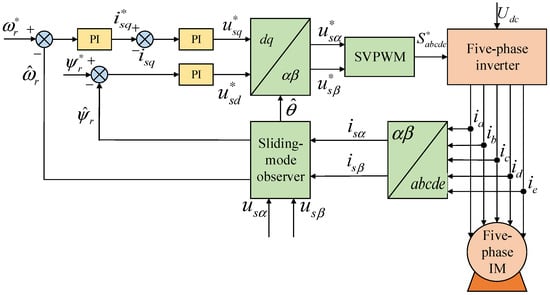
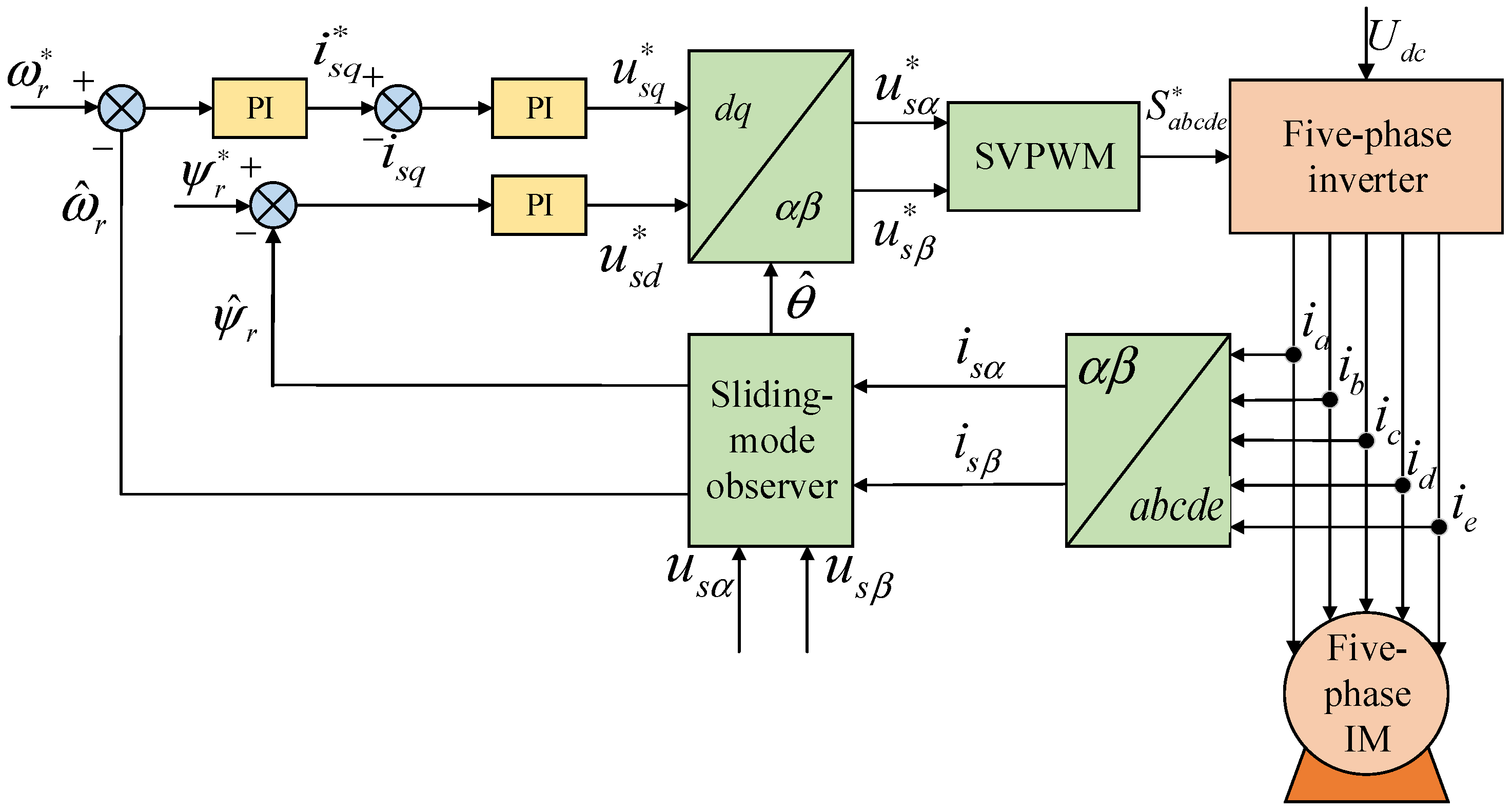
Figure 1 shows the block diagram of sensorless speed control for a five-phase induction motor based on a sliding-mode observer. In conventional systems, the feedback for the speed loop is provided by a speed sensor. Here, however, a sliding mode observer is constructed to replace the physical sensor. The inputs to the observer are the stator voltage and stator current in the axes, and its outputs are the estimated values of speed, flux, and angle.
Figure 1.
Speed sensorless control system block diagram. * represents the reference value for each quantity.
The model of a sliding mode observer is generally expressed as:
where denote the observed values of the respective quantities. are the sliding mode feedback term of the observer.
The conventional constant-rate reaching law is given by:
where is the sliding mode gain, denotes the sign function, defined as follows:
where is the sliding surface, defined as follows:
Here, the sliding surface is defined by the difference between the observed and actual values of the stator current on the axes. As the system gradually stabilizes, the state variables enter the sliding mode. At this point, the error on the sliding surface progressively converges to zero.
In conventional sliding mode observers based on the constant rate reaching law, the gain value remains fixed. This results in the system maintaining the same approach speed during both the reaching and sliding phases, which often leads to significant chattering.
2.3. Double-Power Sliding Mode Observer
To suppress chattering, a double-power reaching law is employed.
where .
As shown in Equation (6), the double-power reaching law consists of two terms. Compared with the constant-rate reaching law, each term incorporates an additional power function that includes information of the stator current, which is a state variable of the motor system. This integration contributes to chattering suppression to a certain extent. A detailed analysis is provided below.
During motor startup, the system state is far from the sliding surface, i.e., is large, corresponding to the reaching phase in sliding mode control. At this stage, a large gain is required to drive the state variables rapidly toward the sliding surface. In the double-power reaching law, , the second term dominates, providing a sufficiently high gain to ensure fast convergence. Once the sliding surface is reached and the system enters the sliding phase, gradually converges to zero. To mitigate chattering, the gain must be reduced accordingly, , the first term of the reaching law becomes dominant. Throughout this process, decreases continuously as the state variables converge, leading to a corresponding reduction in the effective gain. This mechanism achieves a variable-gain effect, improving both dynamic response and steady-state performance.
3. Improved Double-Power Reaching Law Sliding Mode Observer
3.1. Improved Double-Power Sliding Mode Observer Design
The practical application of the double-power reaching law is limited by the often ambiguous roles of its two terms. To resolve this, an improved version incorporates an extra state-based variable to explicitly regulate each term’s dominance across different sliding mode stages, formulated as:
where .
The improved double-power reaching law incorporates two key modifications. First, one parameter has been eliminated to simplify the structure. Second, a new variable is introduced, which is derived from the product of the current errors between the observed and actual values of the stator current components in the axes. When the current error is large, this multiplicative operation further amplifies the error, resulting in a significantly higher gain. Conversely, when the current error approaches zero, the multiplication further reduces the error, leading to a much smaller gain. Compared to the original double-power formulation, this modification expands the range of gain variation and enhances the flexibility of system regulation.
Based on the observer model in Equation (2), applying the new double-power reaching law yields a novel sliding mode observer. The corresponding control law is given as follows:
By subtracting Equation (1) from Equation (2), the error differential equations of the sliding mode observer can be obtained as follows:
3.2. Stability Analysis of the Improved Double-Power Sliding Mode Observer
As evidenced by the above analysis, during different operational states—namely the reaching phase and the sliding phase—one term of the double-power formulation dominates in each phase. To simplify the analysis, the stability of the system can be examined separately under these two distinct conditions.
When the system is in the reaching phase, the first term of the double-power formulation dominates, while the influence of the second term can be neglected. The stability of the proposed system is firstly analyzed using Lyapunov stability theory. Subsequently, the valid range of the gain is derived. For this purpose, consider the following Lyapunov function candidate:
According to Lyapunov’s direct method, system stability is guaranteed by the existence of a positive definite Lyapunov function whose first-order derivative is negative definite. Evidently, .
To ensure , the following range of values for can be derived through simplification:
When an appropriate value of is selected, the current observer stabilizes, and the stator current error converges to zero. Since the stator current and rotor flux are coupled through a first-order inertial element, the rotor flux error also converges to zero under the condition that the flux observer remains stable. At this point, the sliding surface satisfies , which implies .
Equation (9) can be simplified to the following form:
where , , , , , , , .
By eliminating the error term in Equation (13), the following expression can be obtained:
Similarly, We choose the following Lyapunov function candidate for the analysis:
Its first-order time derivative is given by:
The valid range of the parameter that ensures can be derived as follows:
Similarly, when the system operates in the sliding phase, the second term of the double-power formulation becomes dominant. The stability analysis follows an analogous procedure to the previously described steps.
It should be noted, however, that the parameter range obtained through this method is considered excessively wide and does not yield precise parameter values. In practical simulation applications, parameters must be adjusted iteratively based on the specific conditions to achieve satisfactory control performance.
3.3. Improved Analysis of Double-Power Finite-Time Convergence
When , Equation (7) can be simplified as follows:
Dividing both sides by yields:
Let . The above expression can be written as:
This represents a special case of the Riccati equation, whose general solution is given by:
When , , substituting into the above equation yields:
Assuming the system reaches the sliding surface with parameters and , the parameter can be determined as:
When the arctangent function attains its maximum value of , and takes its minimum value of 1, the maximum value of is given by:
Since the parameters remain invariant regardless of changes in the system state, the improved double-power reaching law can achieve convergence to the sliding surface within a finite time.
3.4. Motor Speed Estimation
From Equation (9), the following equation can also be derived:
Assuming the flux linkage error is sufficiently small, i.e., , Equation (25) can be simplified as follows:
where
Therefore, the following expression can be derived:
Consider the following positive definite Lyapunov function candidate:
where is the adaptive gain and represents the estimated speed error. Given that the mechanical time constant of the motor is relatively small, the speed variation can be considered slow, allowing the assumption that .
The time derivative of can be obtained as:
Substituting Equation (27) into Equation (29) yields:
To eliminate the influence of its uncertainty by forcing the coefficient of to zero, the expression for the estimated speed can be constructed as follows:
Therefore, the condition to ensure that this term does not contribute positively to the is:
Thus, the derivative form of the estimated speed can be solved as:
By introducing a proportional-integral (PI) control law to Equation (33) to further enhance the dynamic performance of the algorithm, the final expression for the estimated speed is derived as:
where represent the proportional and integral gains of the PI controller, respectively.
Substituting the resulting estimated speed expression from Equation (33) back into Equation (30) yields:
where is a negative definite matrix, and under the action of the improved double-power reaching law, is also negative. Therefore, it can be concluded that . According to Lyapunov stability theory, the system is asymptotically stable. When the system undergoes sliding motion along the sliding surface, the estimated values of the stator current and rotor flux will gradually converge to their actual values. Finally, the rotor speed is obtained from Equation (34).
4. Simulation Verification
To further validate the performance of the proposed improved double-power reaching law observer, simulations are conducted using a motor with parameters specified in Table 1.
Table 1.
The motor parameters.
4.1. Comparative Analysis of Speed Response Under No-Load Switching Conditions
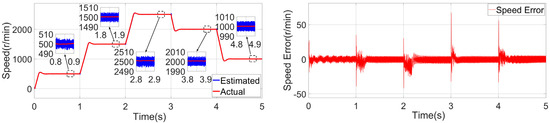
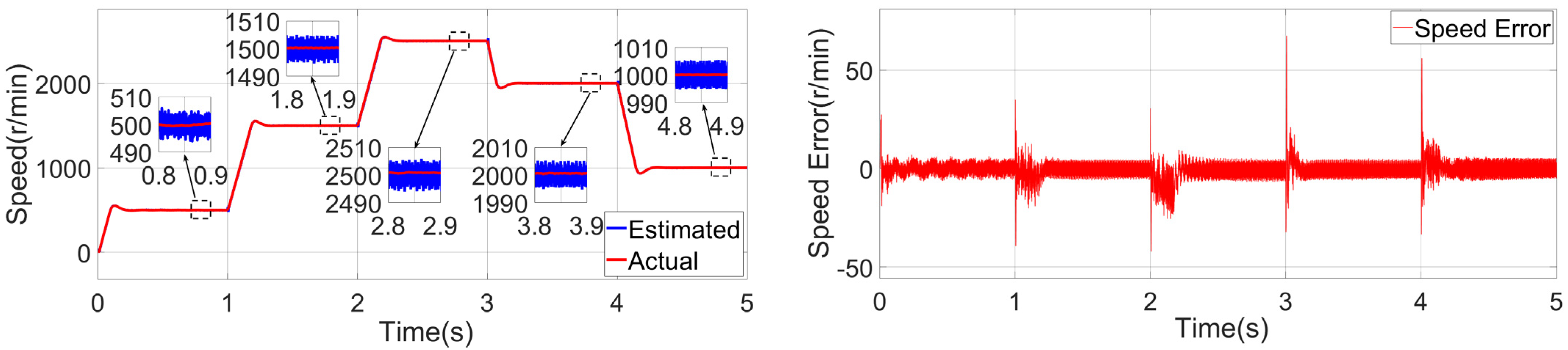
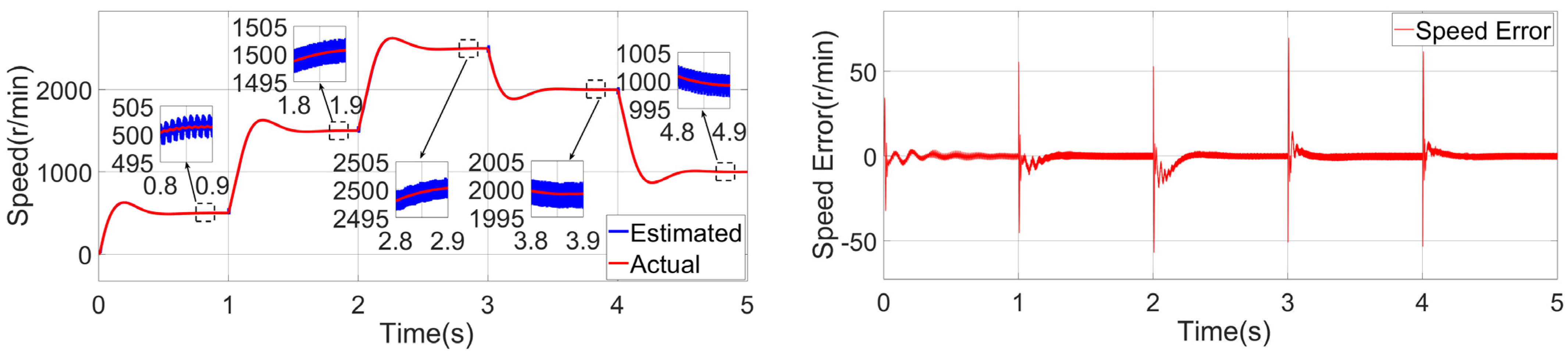
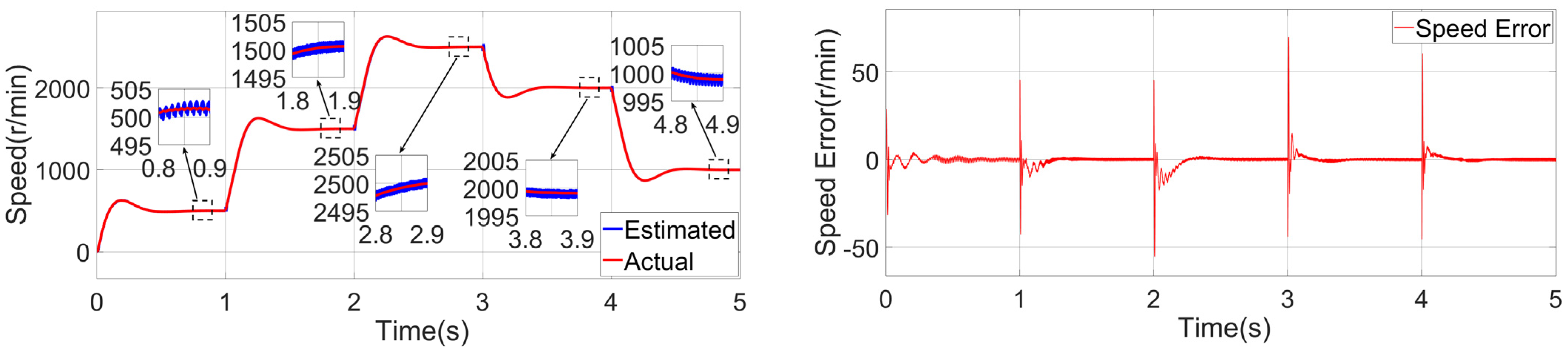
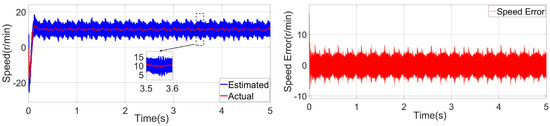
The operating conditions are set as follows: the motor starts under no-load conditions, followed by switching between different speeds to verify the observer’s speed tracking performance. The initial speed is set to 500 r/min. After 1 s, it increases to 1500 r/min; after 2 s, it further rises to 2500 r/min; after 3 s, it decreases to 2000 r/min; and finally, after 4 s, it drops to 1000 r/min. The simulation results are shown in the figure below.
Figure 2, Figure 3 and Figure 4 present the speed observation performance of different reaching law-based observers under no-load speed transition conditions. The simulation results indicate that all three observer models exhibit an initial “overshoot” phenomenon during motor startup and sudden speed changes, but they rapidly converge and ultimately stabilize to accurately track the actual motor speed. The steady-state speed observation error is approximately 10.92 r/min for the constant-rate reaching law-based observer, 4.31 r/min for the double-power reaching law-based observer, and 2.68 r/min for the improved double-power reaching law-based observer.
Figure 2.
Speed Observation Simulation with Constant-Rate Reaching Law under No−Load Conditions.
Figure 3.
Speed Observation Simulation Using Double−Power Reaching Law under No−Load Conditions.
Figure 4.
Speed Observation Simulation Using Improved Double−Power Reaching Law under No−Load Conditions.
4.2. Comparative Analysis of Dynamic Response Under Load Variation
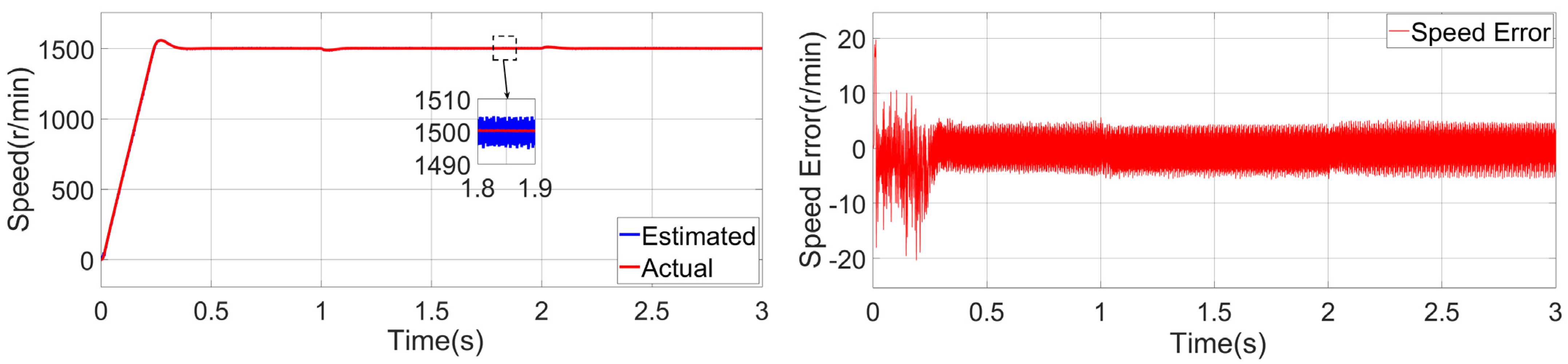
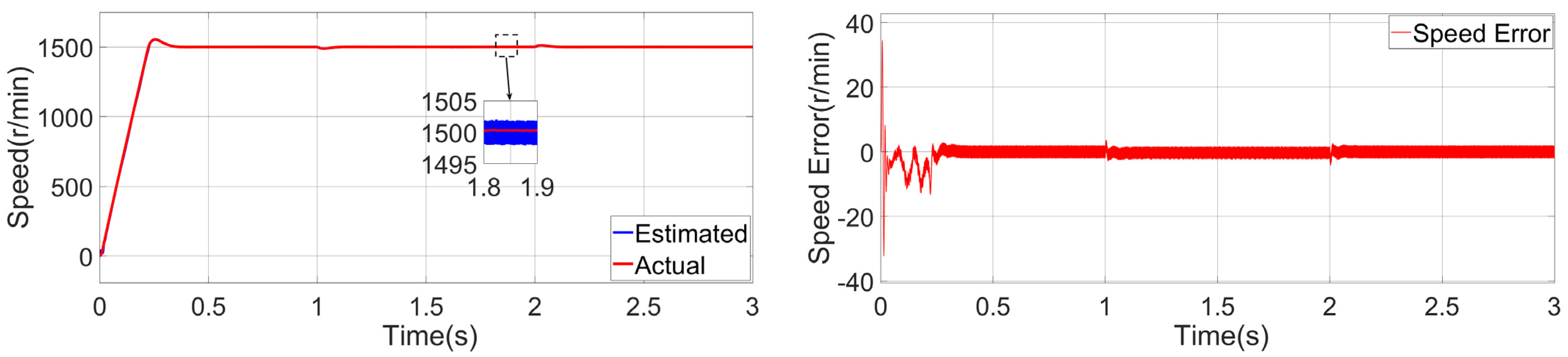
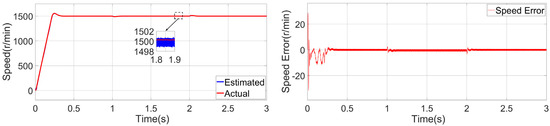
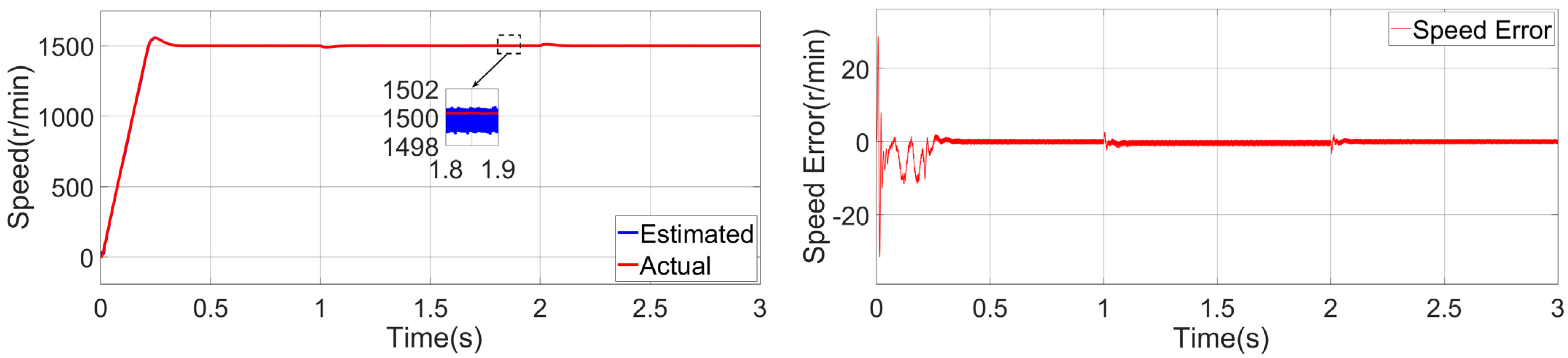
To verify the performance of the proposed observer model under load increase and decrease conditions, the following operating scenario is defined: the motor starts with a speed of 1500 r/min, a 50% rated load is applied at 1 s, and the load is removed at 2 s. The simulation results are shown in the figure below.
Figure 5, Figure 6 and Figure 7 demonstrate the speed observation performance of different reaching law-based observers under load application and removal conditions. The simulation results indicate that all three observer models exhibit an initial “overshoot” phenomenon during startup, but they quickly converge and eventually stabilize to accurately track the actual motor speed. The steady-state speed observation error is approximately 10.45 r/min for the constant-rate reaching law-based observer, 4.13 r/min for the double-power reaching law-based observer, and 2.71 r/min for the improved double-power reaching law-based observer.
Figure 5.
Speed Observation Simulation Using Constant−Rate Reaching Law under Load Application and Removal Conditions.
Figure 6.
Speed Observation Simulation Using Double−Power Reaching Law under Load Application and Removal Conditions.
Figure 7.
Speed Observation Simulation Using Improved Double−Power Reaching Law under Load Application and Removal Conditions.
4.3. Comparative Analysis of Low-Speed Forward and Reverse Switching Under Load Conditions
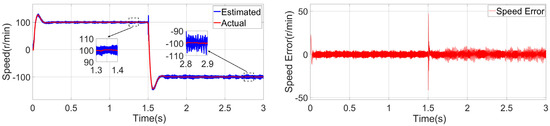
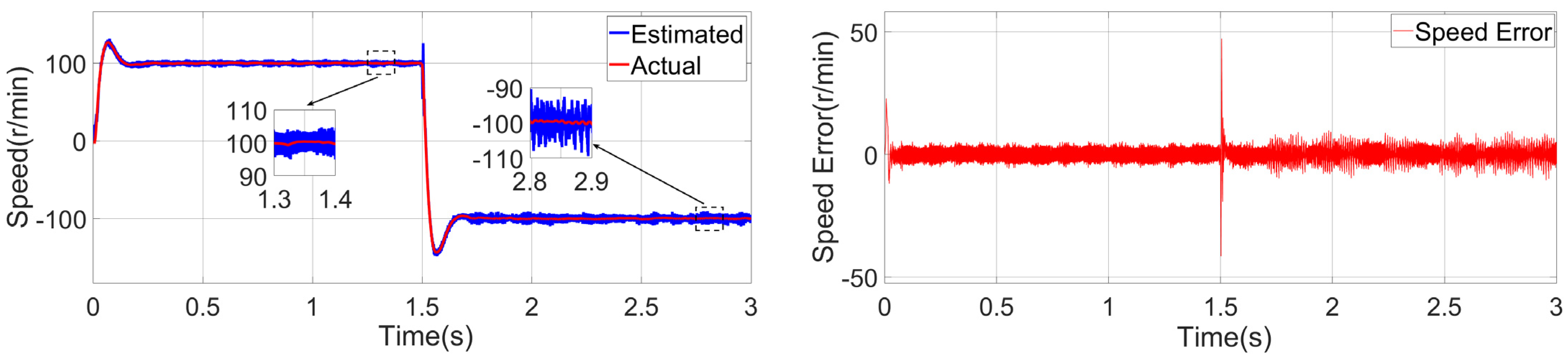
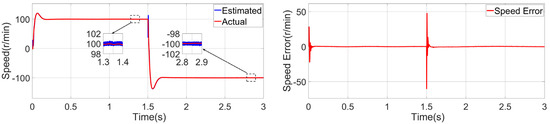
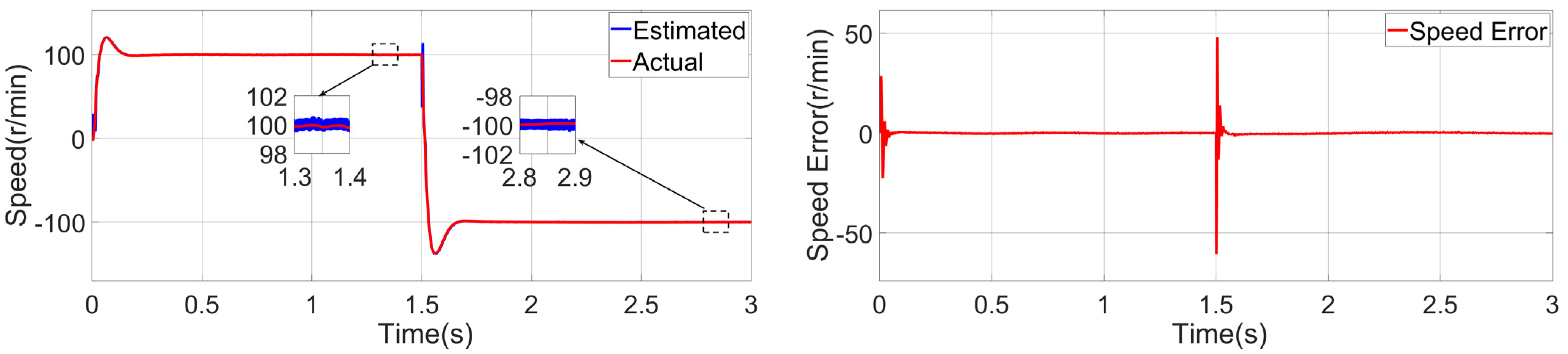
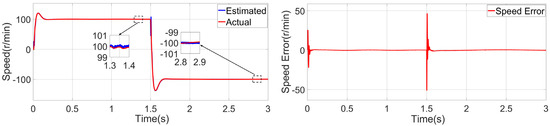
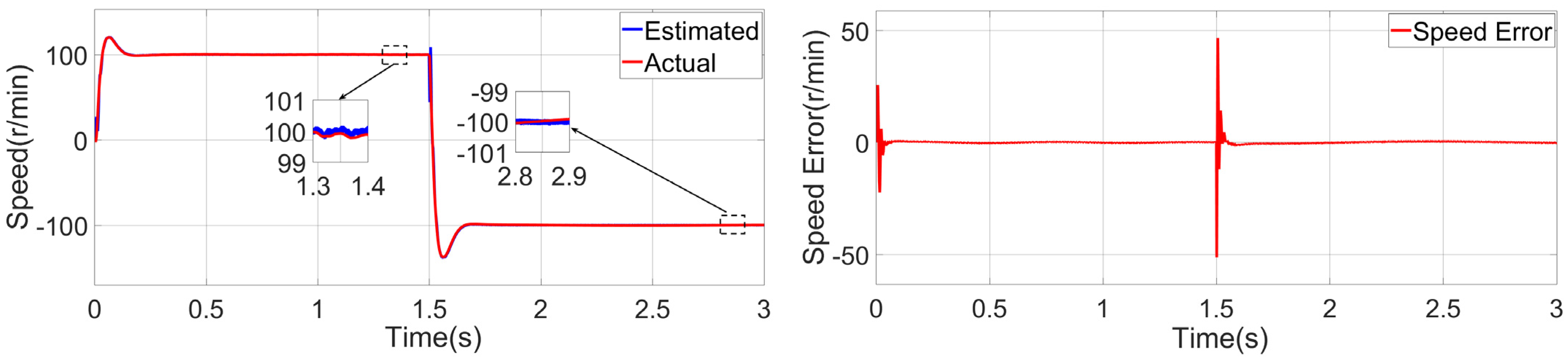
To verify the performance of the designed observer during motor forward and reverse rotation, the following operating condition is set: the motor starts with a 50% rated load at an initial speed of 100 r/min, and the speed is switched to −100 r/min at 1.5 s. The simulation results are shown in the figure below.
Figure 8, Figure 9 and Figure 10 present the observation performance of different reaching law-based observers during low-speed forward and reverse rotation under loaded conditions. The simulation results demonstrate that all three observer models exhibit an initial “overshoot” phenomenon during both startup and speed reversal transients. Nevertheless, they all converge rapidly and ultimately stabilize to accurately track the actual motor speed.
Figure 8.
Speed Observation Simulation Using Constant−Rate Reaching Law Under Load during Forward and Reverse Switching.
Figure 9.
Speed Observation Simulation with Double−Power Reaching Law Under Load during Forward and Reverse Switching.
Figure 10.
Speed Observation Simulation Using Improved Double−Power Reaching Law Under Load during Forward and Reverse Switching.
The steady-state speed observation errors are quantified as follows:
(1) The constant-rate reaching law-based observer shows an error of approximately 10.79 r/min during forward rotation, which increases to 17.66 r/min during reverse rotation.
(2) The double-power reaching law-based observer maintains an error of about 1.07 r/min.
(3) The improved double-power reaching law-based observer achieves the highest accuracy with an error of merely 0.61 r/min.
These results confirm that the designed observer maintains excellent speed estimation performance even under challenging low-speed operating conditions with direction reversals.
4.4. Operating Under Rated Load Conditions with Extremely Low Rotational Speeds
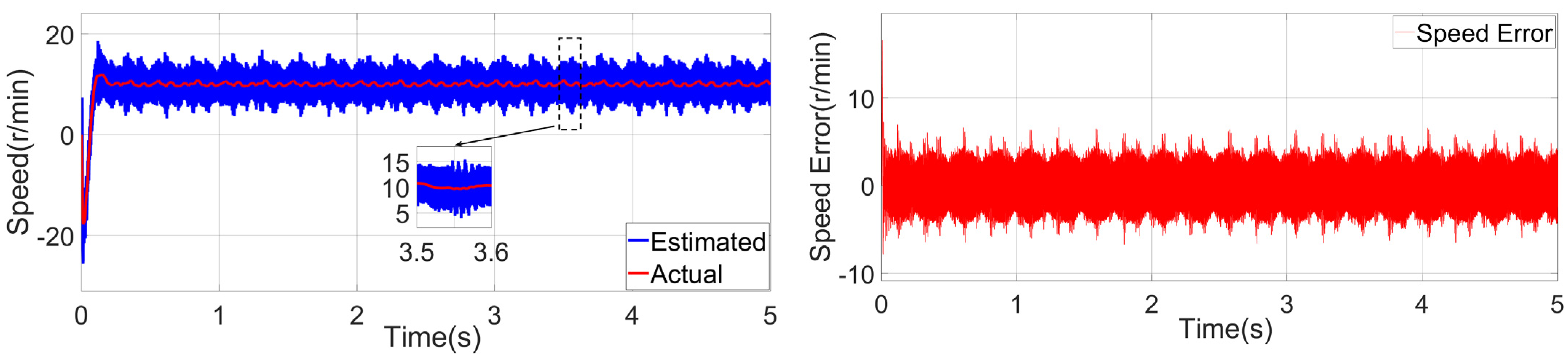
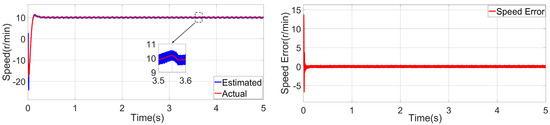
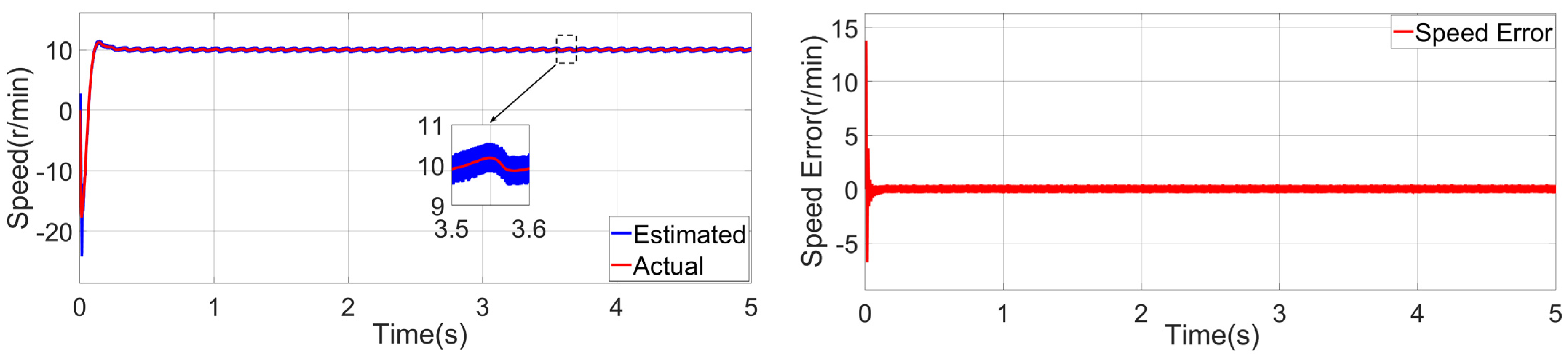
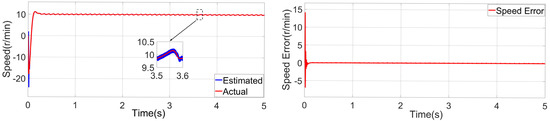
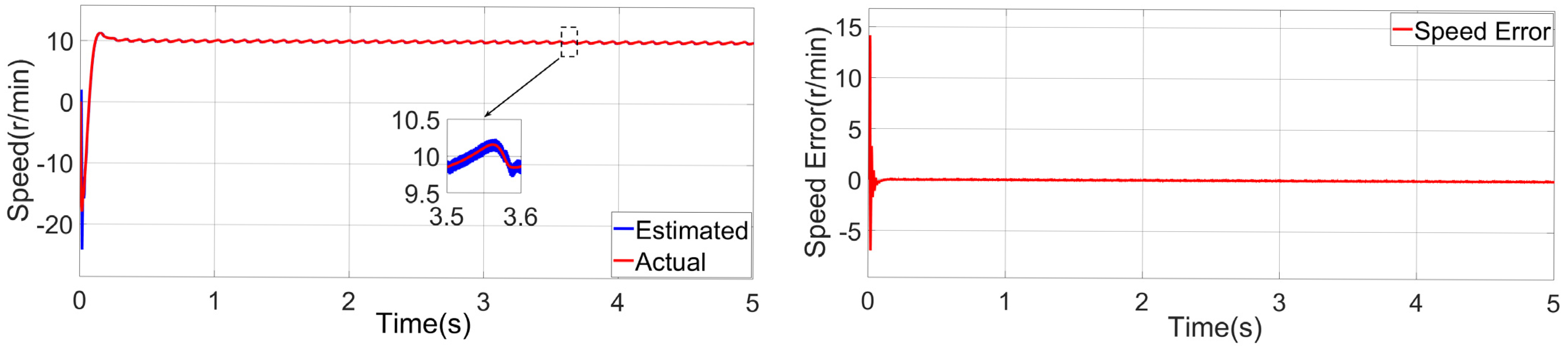
To verify the performance of the designed observer under extremely low-speed operation with rated load, the motor was started under rated load conditions with an initial speed of 10 r/min. The simulation results are shown in the figure below.
Figure 11, Figure 12 and Figure 13 present the simulation results of the motor under the harsh condition of extremely low speed with heavy load. The results indicate that all three observer models exhibit a brief reverse rotation phenomenon during motor startup. This is likely attributed to the weak signal at extremely low speeds coupled with the need to rapidly establish high torque under heavy load, leading to an initial position identification error and consequently generating a torque in the opposite direction. After entering steady-state operation, all three observers are able to stably track the actual speed. The observer based on the Constant-Rate reaching law yields a steady-state speed observation error of approximately 13.15 r/min. The observer based on the double-power reaching law results in a steady-state observation error of about 0.89 r/min. The observer utilizing the improved double-power reaching law achieves a steady-state observation error of approximately 0.29 r/min.
Figure 11.
Simulation of Speed Observation Based on the Constant−Rate Reaching Law under Rated Load and Extremely Low−Speed Conditions.
Figure 12.
Simulation of Speed Observation Using the Double−Power Reaching Law under Loaded and Extremely Low−Speed Conditions.
Figure 13.
Simulation of Speed Observation Using the Improved Double−Power Reaching Law under Loaded and Extremely Low−Speed Conditions.
5. Conclusions
This paper proposes an improved double-power reaching law applied to speed observation for a five-phase induction motor, enabling sensorless control. Simulations of three observer models were conducted under no-load speed switching, load variation, and low-speed forward and reverse operation conditions. The results demonstrate that compared to the conventional constant-rate and standard double-power sliding mode observers, the proposed improved double-power sliding mode observer achieves chattering suppression improvements of 75.5% and 37.8% (no-load speed switching), 74.1% and 34.4% (load variation), and 94.3% and 43.0% (low-speed forward and reverse operation), respectively. These findings effectively verify that the proposed improved double-power sliding mode observer can accurately estimate motor speed while significantly suppressing the inherent chattering phenomenon in sliding mode observers.
However, this study has not yet investigated the operation of the five-phase induction motor under open-phase conditions. Future work should focus on modifying the sliding mode observer to account for the characteristics of open-phase operation, which will also be a key direction for subsequent research.
Author Contributions
The authors J.T. and J.Z. mainly completed the derivation of Equations, and writing of the article. The authors S.Y., Y.M. and Y.D. mainly performed data analysis and literature analysis. All authors have read and agreed to the published version of the manuscript.
Funding
This research received no external funding.
Data Availability Statement
The datasets used and analyzed during the current study are available from the corresponding author on reasonable request.
Acknowledgments
In the process of writing this paper, I would like to extend my sincerest gratitude to my supervisor, Zhao Jinghong, for her invaluable guidance and support.
Conflicts of Interest
The authors declare no conflicts of interest.
References
- Ma, W.; Wang, D.; Cheng, S.; Chen, J. Common fundamental scientific issues and technological frontiers in high-performance electric machine systems. Proc. CSEE 2016, 36, 2025–2035. [Google Scholar]
- Tao, T.; Zhao, W.; Cheng, M.; Wang, Z. An overview of fault-tolerant control and key technologies for multiphase machines. Proc. CSEE 2019, 39, 316–326+629. [Google Scholar]
- Luo, X.; Zhao, J.; Xiong, Y.; Zeng, R. Vector Control Technology of Five-Phase Induction Motor without Speed Sensor Based on Speed-Adaptive Full-Order Observer. IEEJ Trans. Electr. Electron. Eng. 2023, 18, 1826–1836. [Google Scholar] [CrossRef] [Scilit]
- Wang, T.; Wang, B.; Yu, Y.; Xu, D. Voltage model flux observer for induction motors based on second-order variable-gain sliding mode. Proc. CSEE 2024, 44, 4490–4501. [Google Scholar]
- Yang, K.; Wang, Y.; Luo, C.; Zhan, Z. Stability enhancement strategy for low-speed generation region of sensorless induction motors based on eigenvalue distribution. Trans. China Electrotech. Soc. 2025, 40, 5907–5917. [Google Scholar]
- Liu, Y.; Zhang, X.; Yang, B.; Gong, C.; Wang, J.; Ding, X.; Niu, S. Novel Speed Observer-Based Sensorless Control Strategy Without Signal Injection for PMSMs Over Low-Speed Range. IEEE Trans. Ind. Electron. 2025, 72, 8683–8687. [Google Scholar] [CrossRef] [Scilit]
- Ye, M.; Cao, Y.; Chen, W.; Shi, T.; Xia, C. Full-Speed-Range Sensorless Control of High-Speed Permanent Magnet Synchronous Motor Based on the Prediction Methodology. IEEE Trans. Power Electron. 2025, 40, 3405–3418. [Google Scholar] [CrossRef] [Scilit]
- Wang, H.; Yu, K.; Zhao, C.; Zuo, Y.; Zhu, J.; Lee, C.H.T. Seamless Sensorless Control for IPMSM Operating in Full Speed Range. IEEE Trans. Power Electron. 2025, 1–6. [Google Scholar] [CrossRef] [Scilit]
- Wen, D.; Wang, W.; Zhang, Y. Sensorless Control of Permanent Magnet Synchronous Motor in Full Speed Range. Chin. J. Electr. Eng. 2022, 8, 97–107. [Google Scholar] [CrossRef] [Scilit]
- Ok, S.; Xu, Z.; Lee, D.H. A Sensorless Speed Control of High-Speed BLDC Motor Using Variable Slope SMO. IEEE Trans. Ind. Appl. 2024, 60, 3221–3228. [Google Scholar] [CrossRef] [Scilit]
- Zhang, Y.; Yin, Z.; Li, W.; Liu, J.; Zhang, Y. Adaptive Sliding-Mode-Based Speed Control in Finite Control Set Model Predictive Torque Control for Induction Motors. IEEE Trans. Power Electron. 2021, 36, 8076–8087. [Google Scholar] [CrossRef] [Scilit]
- Kong, Y. Research on Sensorless Control Technology of Induction Motors Based on Sliding Mode Observer. Master’s Thesis, Huazhong University of Science and Technology, Wuhan, China, 2020. [Google Scholar]
- Kousalya, V.; Singh, B. Sensorless Control of Induction Motor using MSTOGI based Super Twisting Sliding Mode Flux Observer for Electric Vehicle. In Proceedings of the IEEE Global Conference on Computing, Power and Communication Technologies (GlobConPT), New Delhi, India, 23–25 September 2022; pp. 1–6. [Google Scholar]
- Nurettin, A.; İnanç, N. Sensorless Vector Control for Induction Motor Drive at Very Low and Zero Speeds Based on an Adaptive-Gain Super-Twisting Sliding Mode Observer. IEEE J. Emerg. Sel. Top. Power Electron. 2023, 11, 4332–4339. [Google Scholar] [CrossRef] [Scilit]
- Guo, X.; Huang, S.; Peng, Y.; Yang, J.; Wang, H. Sliding mode control for IPMSM speed regulation system based on improved double-power reaching law and global fast terminal sliding mode observer. Trans. China Electrotech. Soc. 2023, 38, 190–203. [Google Scholar]
- Dong, R. Research on Speed Adaptive Observer for Induction Motors Based on Sliding Mode Theory; Harbin Institute of Technology: Harbin, China, 2022. [Google Scholar]
- Chen, C.; Wang, B.; Yu, Y.; Huo, Z.; Xu, D. Research on sliding mode speed observer for induction motors based on improved exponential reaching law. Trans. China Electrotech. Soc. 2020, 35, 155–163. [Google Scholar]
- Zaky, M.S.; Metwaly, M.K.; Azazi, H.Z.; Deraz, S.A. A New Adaptive SMO for Speed Estimation of Sensorless Induction Motor Drives at Zero and Very Low Frequencies. IEEE Trans. Ind. Electron. 2018, 65, 6901–6911. [Google Scholar] [CrossRef] [Scilit]
- Lin, X.; Wu, C.; Yao, W.; Liu, Z.; Shen, X.; Xu, R.; Sun, G.; Liu, J. Observer-Based Fixed-Time Control for Permanent-Magnet Synchronous Motors With Parameter Uncertainties. IEEE Trans. Power Electron. 2023, 38, 4335–4344. [Google Scholar] [CrossRef] [Scilit]
- Lin, X.; Liu, J.; Liu, Z.; Gao, Y.; Peretti, L.; Wu, L. Model-Free Current Predictive Control for PMSMs With Ultralocal Model Employing Fixed-Time Observer and Extremum-Seeking Method. IEEE Trans. Power Electron. 2025, 40, 10682–10693. [Google Scholar] [CrossRef] [Scilit]
- Lin, X.; Wu, Y.; Olson, G.F.; Liu, J.; Wu, L.; Peretti, L. Optimal Pole-Transition Current Distribution for Constant Torque Maintenance and Stator Copper Loss Minimization in Variable-Pole Machines. IEEE Trans. Transp. Electrif. 2025, 11, 10573–10582. [Google Scholar] [CrossRef] [Scilit]
- Gu, J.; Wang, H. Disturbance Observer-based Sliding Mode Observer with Enhanced Quadrature Phase-Locked Loop for SPMSM Sensorless Drive. IEEE J. Emerg. Sel. Top. Power Electron. 2025, 1. [Google Scholar] [CrossRef] [Scilit]
- Wang, T.; Wang, B.; Yu, Y.; Xu, D. High-Order Sliding-Mode Observer With Adaptive Gain for Sensorless Induction Motor Drives in the Wide-Speed Range. IEEE Trans. Ind. Electron. 2023, 70, 11055–11066. [Google Scholar] [CrossRef] [Scilit]

Disclaimer/Publisher’s Note: The statements, opinions and data contained in all publications are solely those of the individual author(s) and contributor(s) and not of MDPI and/or the editor(s). MDPI and/or the editor(s) disclaim responsibility for any injury to people or property resulting from any ideas, methods, instructions or products referred to in the content. |
© 2026 by the authors. Licensee MDPI, Basel, Switzerland. This article is an open access article distributed under the terms and conditions of the Creative Commons Attribution (CC BY) license.