3.1. Formulation of the Problem
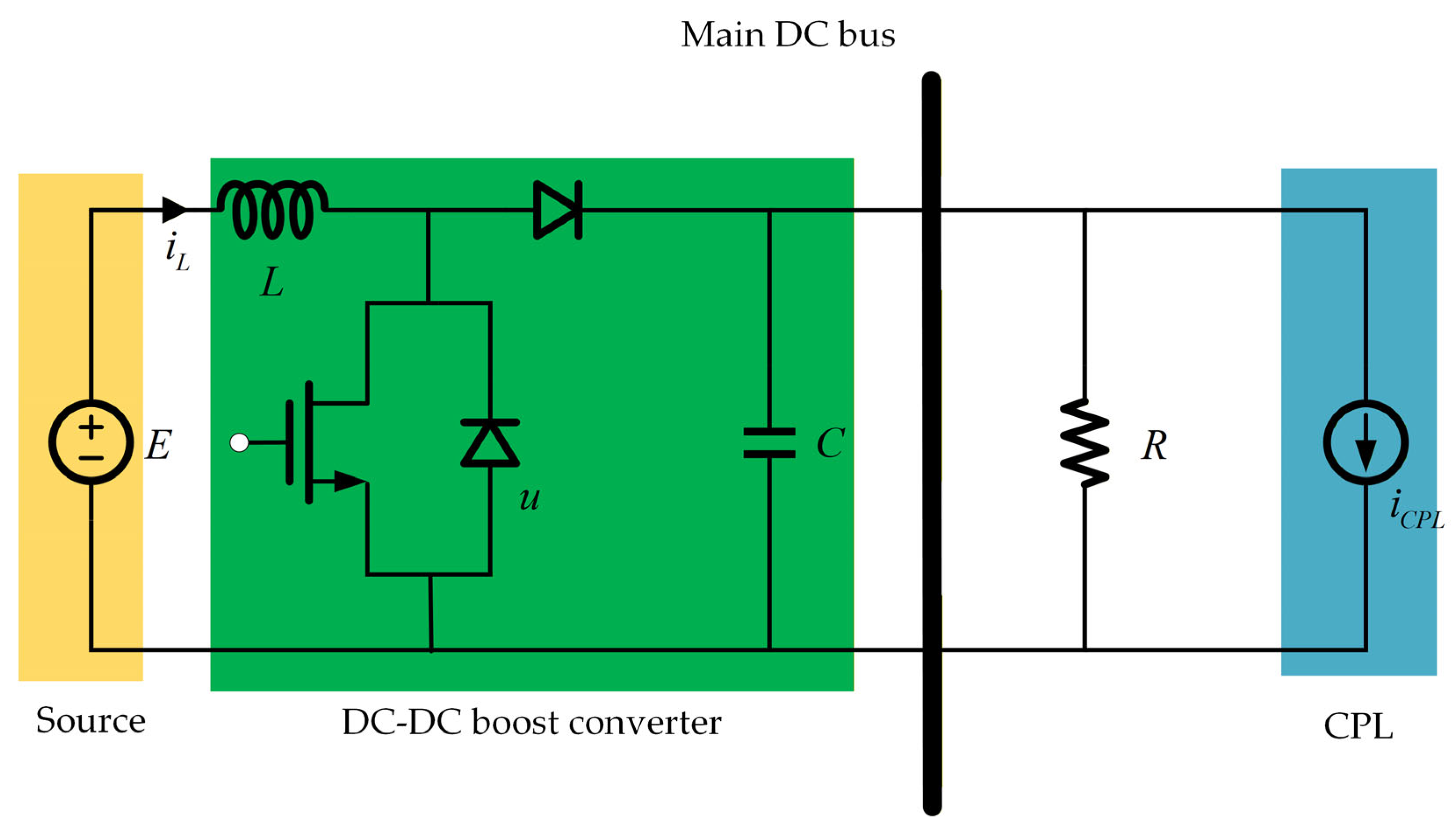
Figure 2 illustrates a simplified DC distribution system of the onboard microgrid. In this paper, the DC–DC boost converter [
22] is examined. As illustrated in
Figure 2, it can be seen that the DC source and the CPL represent the supply side and the demand side, respectively. In this mode, the DC source delivers regulated energy to the DC bus through the DC–DC boost converter. At the other end of the main bus, a CPL is connected, which is regarded as a type of load strictly regulated through a converter.
Next, using the schematic description of the DC–DC boost conversion platform, the system dynamics can be derived as
where
denotes the inductor current at each instant, while
corresponds to the instantaneous capacitor voltage in the converter.
represents the energy of the supply-side DC source, and
represents the dynamic system’s input, that is, the duty cycle.
is the equivalent resistive load, while
represents the total power of the CPL, and its behavior is captured by a current-regulated source.
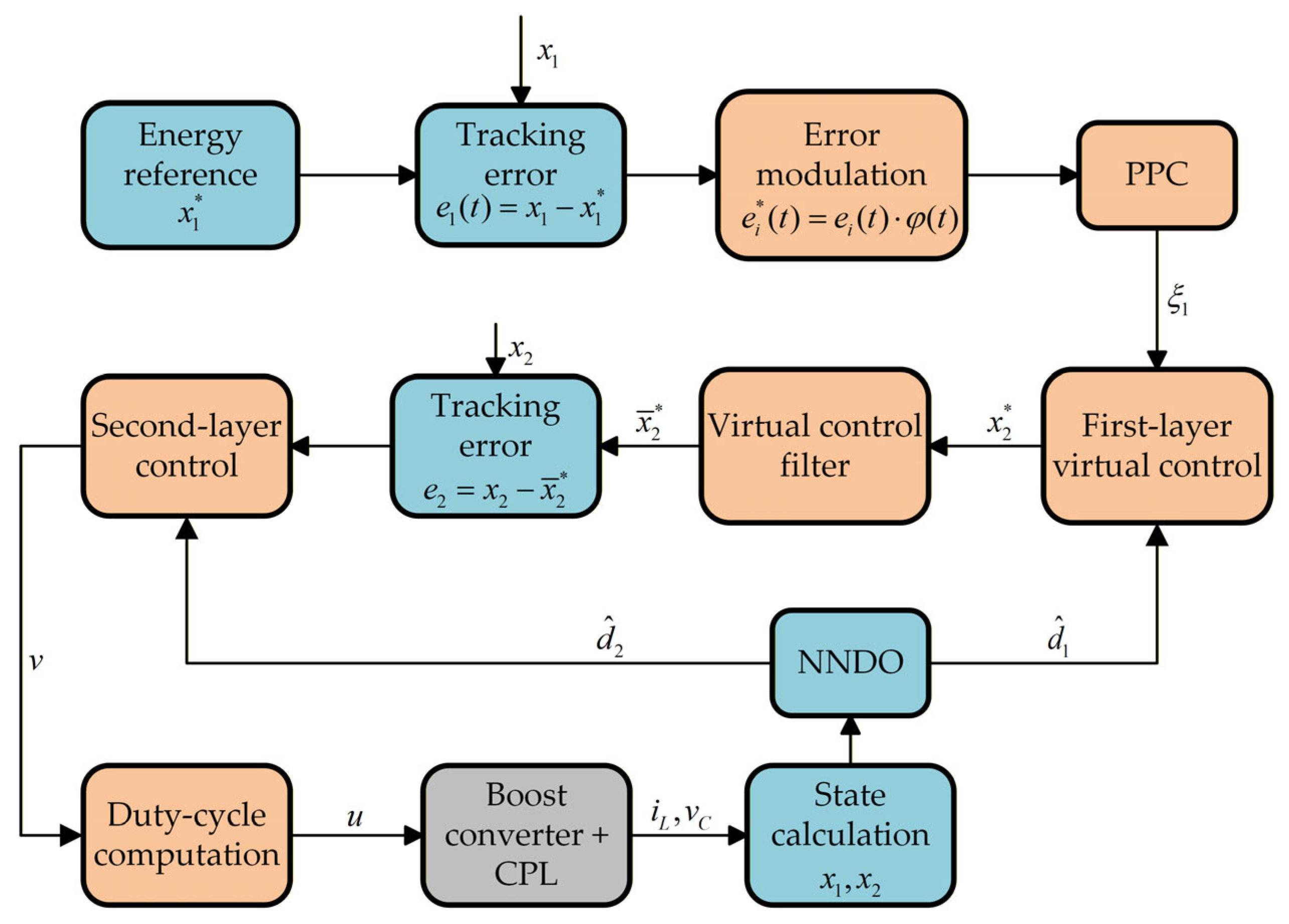
The controller with prescribed performance is obtained by applying a recursive design strategy. Model (14) is reformulated into its standard representation to facilitate the backstepping controller design. Then, an original prescribed performance tracking technique is developed to meet the accuracy requirements of the actual state errors.
For system (14), to reformulate the system into a standard structure conducive to recursive design and stability evaluation, the state variables need to be redefined. In ref. [
23], the total stored energy of the system and its rate of change were used to define two new state variables. Hence, using the framework presented in [
22], the simplified DC distribution system given in (14) is reformulated into the canonical form shown below:
where
,
,
,
,
, here,
is used to indicate the equivalent load’s nominal resistance.
From (15), the control strategy applied in practice
is capable of being written as
In real-world engineering practice, the central goal of the boost converter is designed to ensure that the DC voltage
is able to track its reference
through an appropriate control law. That is, the new state variable
needs to be able to rapidly track its reference value
, where
is defined as
where
denotes the reference the load’s total power quantity.
3.2. Recursive Framework for Designing a Prescribed Performance Controller
In this part, we employ a recursive design approach that integrates PPC and NNDO to demonstrate the stability of system (15). Since the system contains an uncertainty term related to the load power, denoted by , it is necessary to assume the boundedness of its derivative.
To uphold the prescribed system performance under uncertainties in the model and external disturbance inputs, a single hidden layer NNDO is developed in this work. This NNDO is employed to compensate for unknown dynamics and attenuate disturbance-related effects on the system response. The NNDO provides an adaptive approximation capability that allows the controller to cope with variations that cannot be explicitly modeled. In addition, since (PPC) offers a systematic way to confine state-tracking errors within user defined bounds throughout the transient process, it is integrated into the control scheme for the DC–DC boost converter–based distribution system. By combining the disturbance-rejection capability of the NNDO with the constraint-enforcing characteristics of PPC, the proposed method aims to achieve reliable voltage regulation and strong robustness under practical operating conditions.
From an engineering perspective, the aggregated disturbance terms and are considered bounded, and their rates of variation are assumed to lie within certain limits. Therefore, the assumption given next is adopted.
Assumption 1. Assume that the disturbance is bounded, satisfying , , , where and are known positive constants.
Now, we construct a single-hidden-layer NNDO to cope with the uncertainties in the system:
where
,
.
is an adjustable weight vector, and
is the input weight vector of the neural network, and
is a scalar bias. This NNDO structure acts as an online approximator that reconstructs the unknown disturbance using measurable system states, thereby avoiding explicit modeling of the CPL dynamics.
According to the approximation theorem, there exist ideal weights
such that any continuous disturbance function
satisfies
refers to the approximation error constrained within a bounded range, satisfying
.
Let
be the estimation error of
; then
where the weight error is defined as
, indicating that the disturbance estimation error consists of the weight-error term and the network approximation residual.
To drive the weight update, the auxiliary state variables of the observer are introduced as
and the estimation error is defined as
which serve as the adaptation-driving signals. The corresponding weight adaptation law is designed as
where
is a symmetric positive definite learning-rate matrix used to regulate the convergence speed of the weights, and
is the weight leakage coefficient employed to suppress weight divergence. It follows that all weight errors and disturbance estimation errors are bounded, and
, where the maximum value of
is denoted by
. Moreover, there exists a constant
such that
.
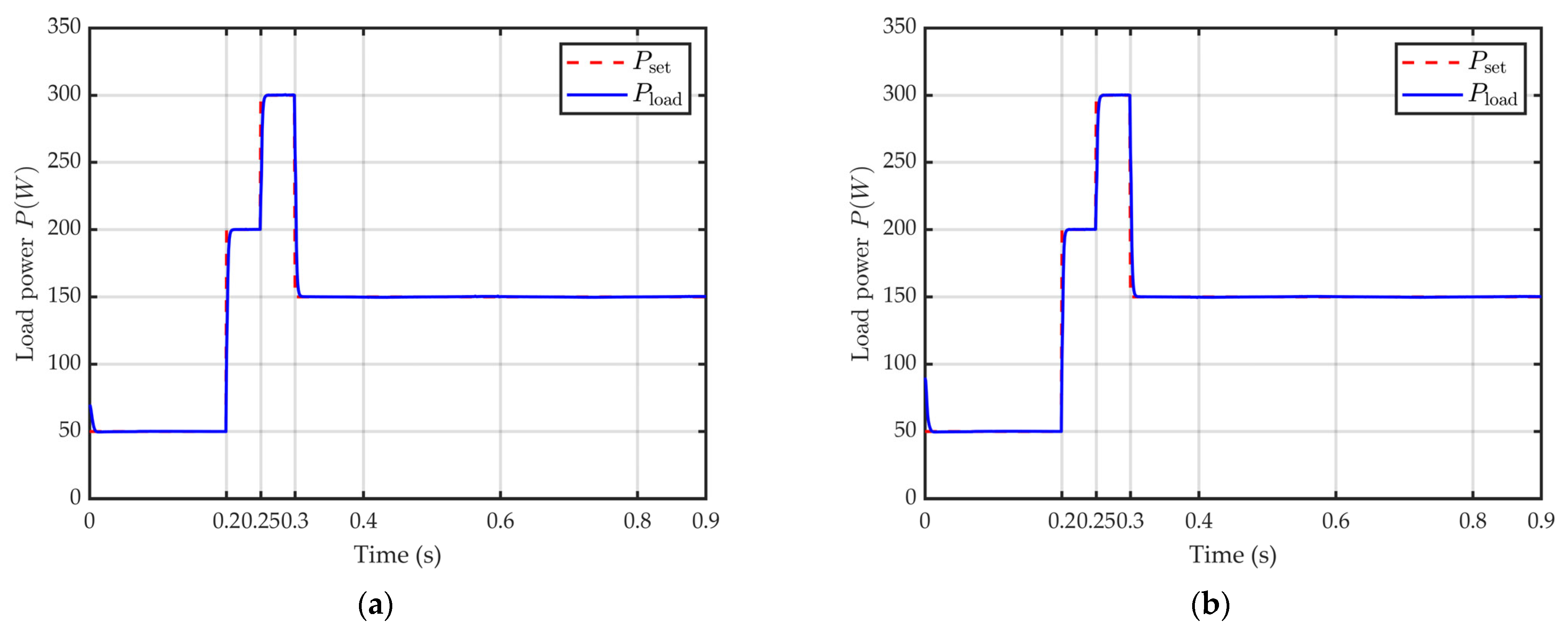
The external disturbances and load variations considered in this paper (e.g., CPL power steps) are assumed to be bandwidth-limited with finite variation rates. To ensure effective disturbance estimation, the convergence rate of the disturbance estimation error is adjusted by tuning the learning gains and as well as the leakage coefficients and . As a result, the observer dynamics are rendered significantly faster than the disturbance variation time scale, thereby achieving time-scale separation. Simulation results demonstrate that, with the selected parameters, the disturbance estimates converge within a time interval much shorter than the load variation interval after abrupt disturbance changes, ensuring effective disturbance compensation over the entire operating range.
Next, this paper presents the controller construction in a recursive manner and provides the associated stability analysis. The controller is developed using a recursive Lyapunov-based approach, where the Lyapunov function is progressively extended and the NNDO estimation errors are incorporated in the stability analysis.
Step 1: A Lyapunov function is chosen as
where the estimation error related to
is
. Next, differentiating
along (10), we obtain
where
, the estimation error related to the desired value
, is denoted by
.
Then the error in estimating
is given by
in this design,
denotes the filtered version of the virtual controller, whereas
represents its original form. Note that the auxiliary variables
and
are introduced to circumvent taking their derivatives. This filtering technique avoids repeated differentiation of virtual control signals and helps maintain a tractable recursive design. These quantities are generated through a small time constant
.
Therefore, by combining (15) and (26), (25) can be rewritten as
Using the disturbance estimation term
, we design the virtual control strategy
as
where
represents a gain constant chosen in the controller design. We can rewrite Equation (28) as
This result indicates that the first-stage error dynamics are stabilized under the designed virtual control law.
Step 2: Choose another Lyapunov function as
where the estimation error related to
is
.
Likewise, the derivative of
can be written as
where
From all the above formulas, we obtain
We can now stabilize system (15) by designing the auxiliary controller
, whose form is given as
Then
can be further recast as
Thereafter, the main theorem of this paper can be obtained.
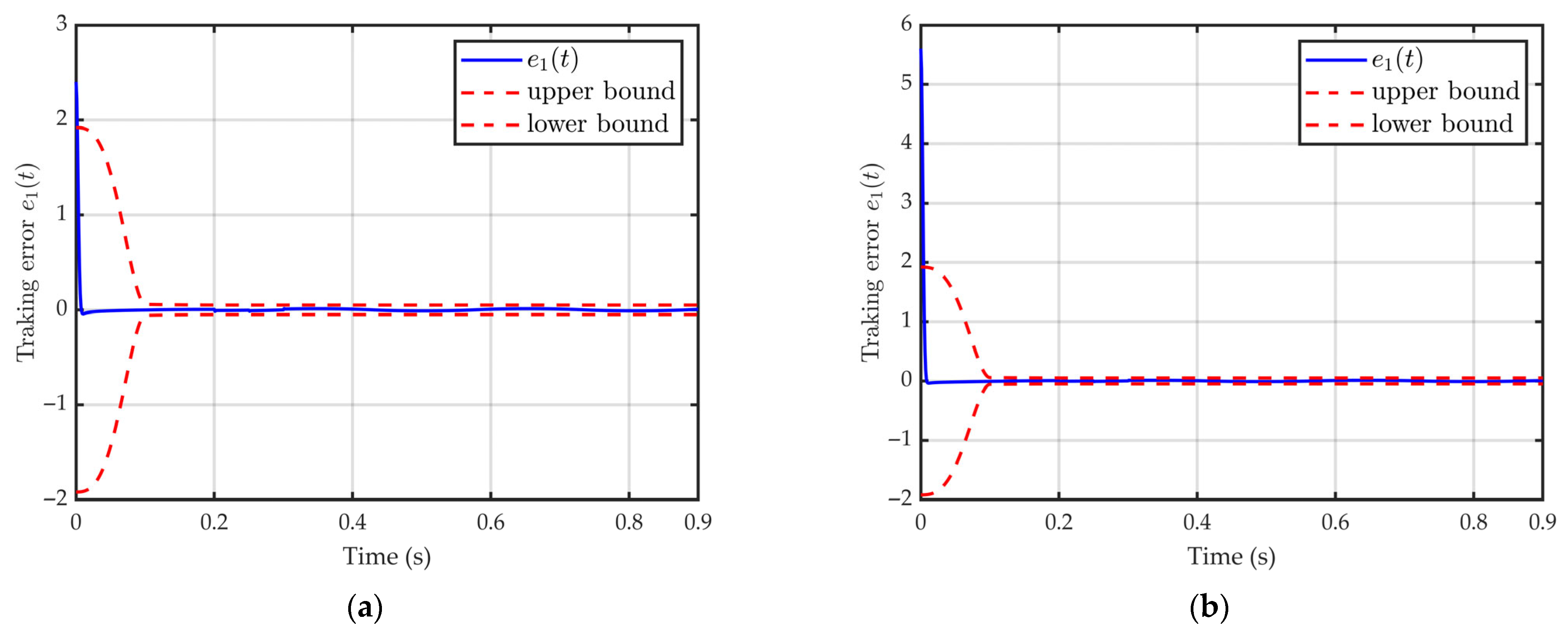
Theorem 1. When Assumption 1 is satisfied, the transformed system (15), developed through the constructions in Steps 1 and 2, ensures semi-global uniform ultimate boundedness. In addition, the prescribed performance is fulfilled, meaning that the tracking error resulting from the deviation of the DC bus voltage from its reference is confined within the predefined bounds specified in (3).
Proof. Let
and
be arbitrary constants. Define the sets
and
. Over the domain
, the function
achieves an upper bound, denoted by
. Then we can derive the following inequalities
substituting (36) into (35)
where
and
are given as follows
For the closed-loop system to remain stable, the design parameters
,
,
and
are required to be selected to satisfy the following conditions:
,
,
.
Therefore, by combining (37) and (38), we can have
According to Lemma 1, remains bounded and decays exponentially, implying that , and are all semi-globally uniformly ultimately bounded. Moreover, invoking Lemma 2 and selecting the performance function , and appropriately ensures that approaches a small neighborhood around zero. Hence, the proof is completed. □