Article

Robust Synergistic Control Architecture for High-Frequency Resonance Suppression in Precision Linear Motion Stages

1
School of Automation, Wuxi University, Wuxi 214105, China
2
Wuxi Key Laboratory of Intelligent Manufacturing Technology for High End Equipment Core Components, Wuxi 214105, China
*
Author to whom correspondence should be addressed.
Electronics 2026, 15(1), 195; https://doi.org/10.3390/electronics15010195 (registering DOI)
Submission received: 3 December 2025 / Revised: 27 December 2025 / Accepted: 28 December 2025 / Published: 1 January 2026
(This article belongs to the Section Systems & Control Engineering)

Abstract

In high-precision positioning applications, lightly damped structural resonances fundamentally limit the achievable performance of precision linear motion stages, enforcing a stringent trade-off between control bandwidth and transient vibration suppression. This paper investigates a unified synergistic control architecture integrating input shaping (IS), feedforward control (FF), and notch filtering (NF) within a feedback framework to jointly mitigate command-induced excitation, compensate predictive dynamics, and suppress narrowband resonant modes. Four representative schemes—FB, FB+NF, FF+FB+NF, and IS+FF+FB+NF—are systematically evaluated through step/ramp responses, sinusoidal tracking, and industrial S-curve trajectory under aggressive operating conditions (up to 2.8 m/s and 160 m/s2). Simulation results show that incorporating IS into the FF+FB+NF baseline effectively eliminates overshoot and suppresses residual vibration, yielding a 22.0% reduction in the ±2 μm settling time. Complementary frequency-domain analyses demonstrate that the proposed IS+FF+FB+NF architecture achieves a superior balance between tracking agility and stability, maintaining robust gain/phase margins while attenuating resonant sensitivity peaks. Robustness studies further indicate that the proposed IS+FF+FB+NF architecture preserves bandwidth consistency despite resonant frequency drifts. Overall, this coordinated integration provides a practically deployable and industrially compatible solution for enhancing vibration suppression and positioning consistency in precision motion systems.

1. Introduction

The manufacturing throughput and placement quality of advanced semiconductor die-bonding equipment are fundamentally constrained by the acceleration capability and control bandwidth of high-precision positioning stages [1,2,3]. With the rapid evolution of heterogeneous integration and fine-pitch packaging, modern die bonders increasingly demand micrometer-level positioning accuracy (on the order of ±5 μm) under extreme operating conditions characterized by high velocity exceeding 2.5 m/s and high acceleration exceeding 100 m/s2. These stringent requirements place severe demands on control bandwidth and dynamic responsiveness, necessitating actuation units capable of executing highly aggressive motion trajectories while maintaining sub-micron tracking fidelity and rapid settling performance.
However, further increasing the control bandwidth in pursuit of higher dynamic performance is fundamentally limited by the intrinsic mechanical compliance of the actuation system. From a mechatronic system perspective [4], high-velocity positioning stages in semiconductor equipment are typically non-collocated systems, in which the feedback sensor and electromagnetic actuator are separated by elastic mechanical structures. This non-collocation gives rise to lightly damped resonant and anti-resonant modes, resulting in a rapid phase drop approaching −180° in the vicinity of the resonance frequency. As a result, the achievable control bandwidth is severely limited by the erosion of phase margin, effectively forming a practical “bandwidth ceiling” for the control loop. Moreover, according to the Bode sensitivity integral constraints [5], aggressive increases in loop gain to improve transient responsiveness inevitably lead to an amplification of the maximum sensitivity peak ( M s ). Such sensitivity peaking degrades robustness margins and increases susceptibility to oscillations and residual vibrations, which is particularly detrimental to the deterministic micrometer-level positioning accuracy required in advanced die-bonding processes. Therefore, mechanical resonance is not merely a secondary dynamic artifact but a fundamental bottleneck that jointly constrains achievable bandwidth, robustness, and positioning precision.
Effective resonance suppression is therefore critical in industrial positioning systems, aiming not only to attenuate gain peaks in the frequency domain but also to ensure rapid settling in the time domain, thereby extending the usable control bandwidth. To cope with these mechanical dynamics, existing control strategies are generally categorized into command-space pre-filtering and loop-space shaping techniques, each addressing resonance effects from a different perspective and exhibiting inherent trade-offs.
Feedforward control (FF) is widely used to enhance tracking accuracy by compensating for reference trajectory dynamics [6]. This includes model-based feedforward control [7,8], iterative learning control [9,10,11], adaptive feedforward control [12,13,14], and iterative feedforward tuning [15,16,17]. However, under aggressive motion profiles with high acceleration and jerk, the feedforward signal inherently contains substantial high-frequency components, which can inadvertently excite lightly damped structural resonances and deteriorate transient performance. Input shaping (IS), as a representative command-space technique, suppresses residual vibrations through destructive interference by convolving the reference command with specially designed impulse sequences [18,19]. While IS is highly effective in reducing excitation-induced oscillations, its reliance on time delays—typically proportional to the vibration period—presents a fundamental conflict with the high-throughput requirements of semiconductor packaging, where every millisecond of motion cycle time is critical.
From the loop-space perspective, notch filtering (NF) is commonly incorporated into the control path to selectively attenuate narrowband resonant modes and stabilize high-frequency dynamics [20,21,22,23]. Nevertheless, the implementation of NF is a double-edged sword: while it suppresses gain peaks, it introduces parasitic phase lag near the crossover frequency. This phase erosion reduces the system’s robustness against parameter variations and limits the aggressive tuning of PID gains, effectively capping the closed-loop bandwidth. Beyond these classical approaches, advanced strategies such as robust control [24,25,26], adaptive control [27,28], adaptive robust control [29,30], and model predictive control [31,32,33] have been proposed to handle complex constraints and uncertainties. Despite their high theoretical performance, their practical deployment in industrial die bonders is often hindered by the high-order complexity of the resulting controllers and the prohibitive real-time computational burden, which limits their seamless integration into standard industrial PID-based servo architectures.
Despite the individual merits of these techniques, there remains a lack of a unified framework that systematically coordinates the inherent interactions between time-domain command pre-filtering and frequency-domain loop-shaping mechanisms. In high-acceleration die-bonding applications, independently designing these components often leads to suboptimal performance, as the excitation-reduction properties of input shaping and the phase-lag characteristics of notch filters are coupled through the system’s sensitivity dynamics. This gap motivates the present work, which proposes a synergistic control architecture integrated into an industry-standard PID structure. The key innovation lies in the systematic coordination of IS, FF, and NF: IS minimizes the initial vibration excitation from aggressive trajectories, FF enhances high-frequency tracking fidelity, and NF stabilizes the feedback loop against structural resonances. By providing a quantitative frequency-domain design methodology and assessing robustness under resonant frequency drifts (e.g., −8% to +13%), this work establishes a practically deployable solution that ensures broadband performance, vibration immunity, and industrial feasibility. The main contributions of this work are summarized as follows:
  • A unified synergistic control framework that coordinates time-domain modal-excitation suppression with frequency-domain loop-shaping techniques, enabling effective mitigation of lightly damped high-frequency resonances.
  • A systematic frequency-domain design and analysis methodology that quantifies the effects of IS, FF, and NF on open-loop/closed-loop characteristics, sensitivity peaks, stability margins, and control bandwidth.
  • A robustness assessment under resonant frequency drift, demonstrating how modal variations of −8% to +13% affect closed-loop sensitivity, resonant peaks, and settling times, and showing that the proposed architecture maintains substantially improved robustness compared with conventional schemes.
  • Comprehensive evaluations demonstrate the efficacy of the proposed synergistic scheme: physical experiments on a linear motion stage experimentally validate the tracking and resonance suppression of the FF+FB+NF baseline, while high-fidelity simulations systematically demonstrate that the full IS+FF+FB+NF architecture achieves micrometer-level accuracy with significantly reduced settling time and consistently improved vibration immunity relative to standard PID, PID+NF, and FF+FB+NF methods.

2. Model Identification of the Linear Motion Stage

The dynamic modeling and subsequent control design are based on the assumptions that the linear motion stage can be approximated as a Linear Time-Invariant (LTI) system dominated by rigid-body dynamics and a limited number of low-order flexible modes. Complex nonlinear effects, such as friction variations, backlash, and thermally induced structural changes, are not explicitly modeled but are instead treated as unstructured uncertainties or external disturbances. These modeling simplifications facilitate analytical controller synthesis, including the derivation of the input shaper and feedforward compensators. At the same time, they necessitate that the resulting control architecture exhibits sufficient robustness to modeling errors and parameter variations. Accordingly, robustness considerations are explicitly incorporated into the PID tuning and NF design to mitigate the influence of neglected high-order modes and uncertain dynamics.
Under these modeling assumptions, the nominal dynamics of the linear motion stage can be derived using a standard velocity-to-current formulation, providing the analytical basis for subsequent controller synthesis and frequency-domain analysis. Following the derivation procedure of the displacement-to-current transfer-function model for the linear motion stage as presented in the literature [34], the low-frequency rigid-body dynamics from velocity to current can be expressed as:
G v l f = V s I q c m d s = K v s + b v
where K v represents the steady-state gain and b v denotes the system pole.
The standard representation for a complex conjugate zero-pole pair, commonly used for modeling mechanical resonant modes [4], can be formulated as:
G z p = 1 + 2 ζ z s ω n z + s ω n z 2 1 + 2 ζ p s ω n p + s ω n p 2
where ζ is the modal damping ratio and ω n represents the natural frequency of the respective pole or zero pair.
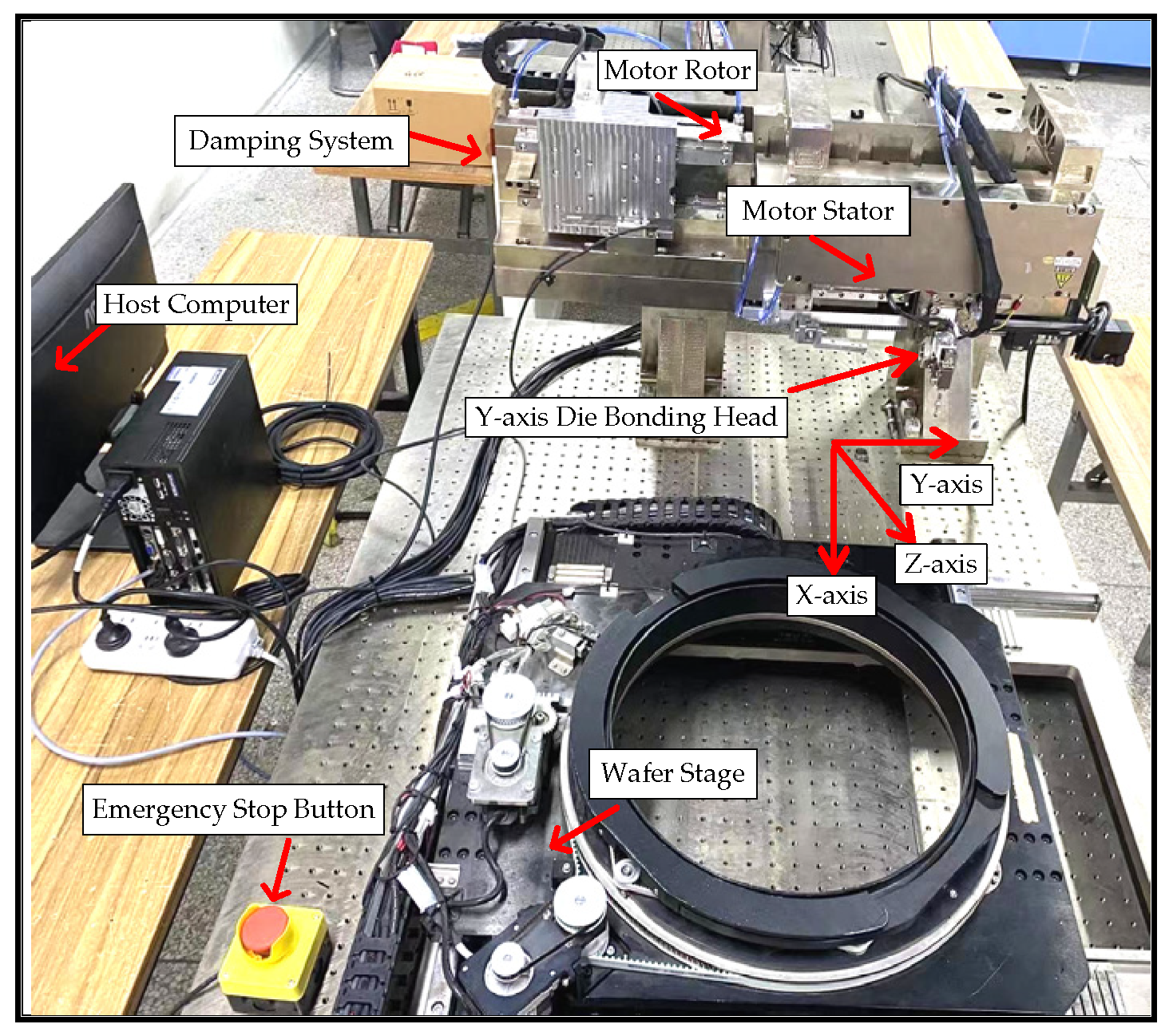
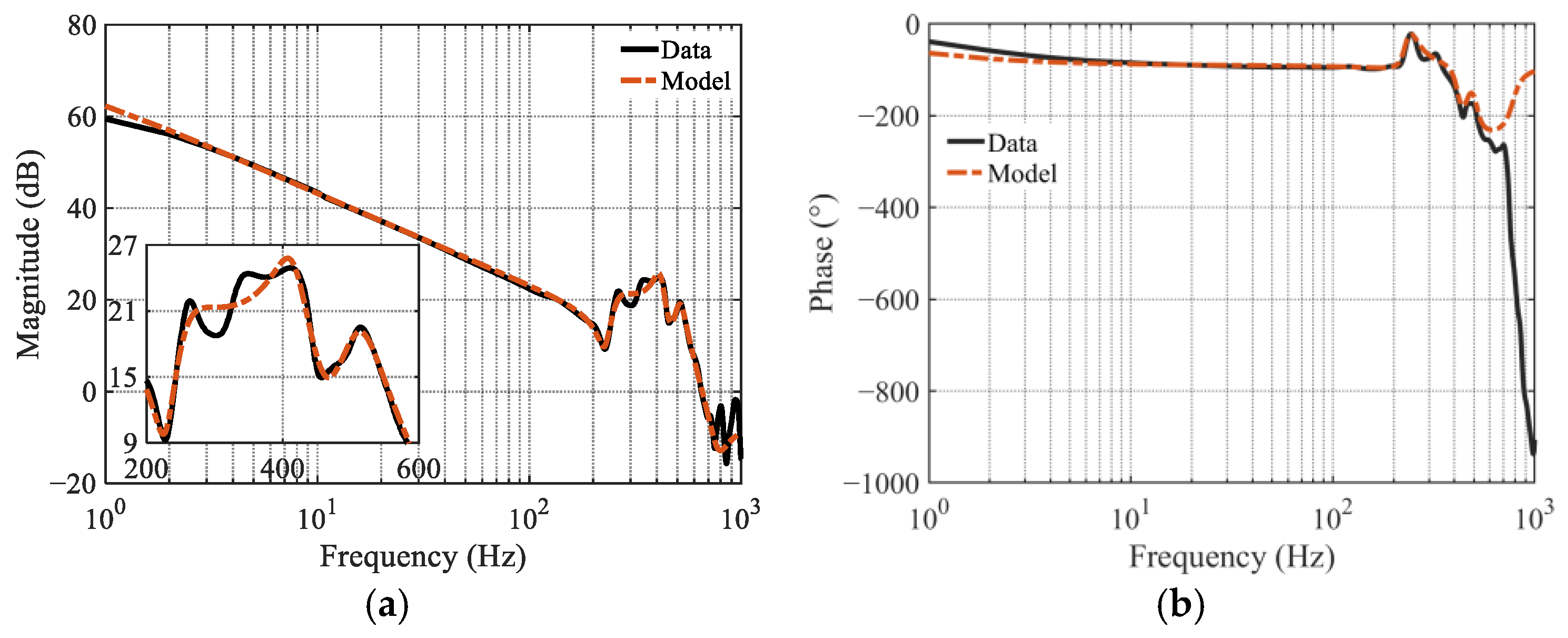
After establishing the structural form of the transfer-function model, the numerical parameters are obtained using frequency-domain identification. A sinusoid frequency sweep from 1 to 1000 Hz is applied to the linear motion stage shown in Figure 1. Processing the input–output datasets yields the frequency response curve illustrated by the solid black curve in Figure 2.
Figure 2a exhibits that the magnitude response follows an asymptotic slope of −20 dB/decade within the 10–100 Hz band, confirming the validity of the rigid-body model. Four resonant peaks emerge above 200 Hz at approximately 264, 350, 411, and 514 Hz, indicating lightly damped high-frequency structural modes.
To accurately characterize the plant dynamics, a segmented identification strategy is adopted. In the low-frequency band, the transfer-function model is identified as:
G v l f s = 9128.04 s + 3.142
Given the narrow spacing and similar amplitudes of the second and third resonant peaks, a higher-order elastic model is required. Therefore, the high-frequency dynamics are modeled using three complex conjugate zero-pole pairs, with the corresponding parameters summarized in Table 1.
By combining the rigid-body component and the identified elastic modes, the complete transfer-function model from input current to output velocity is formulated as:
G p v s = G v l f s i = 1 3 G z p , i s
providing an accurate representation of both the rigid-body behavior and the lightly damped resonant modes.
The identified model reveals that the lightly damped elastic modes produce closely spaced resonance–anti-resonance pairs that induce significant gain amplification and rapid phase decay. As the crossover frequency approaches these modes, the phase margin can drop below 20°, while resonant amplification exacerbates sensor and actuator nonlinearities. Consequently, achieving robust stability imposes the conservative requirement that the control bandwidth remain below approximately 20% of the first dominant resonant frequency.
These limitations of the plant dynamics underscore the necessity for a control framework capable of simultaneously suppressing modal excitation, shaping loop gain, and enhancing tracking performance. To address these challenges, the next section develops a synergistic control architecture that integrates IS, FF, FB, and NF within a unified design.

3. The Proposed Synergistic Control Method

3.1. System Architecture Overview

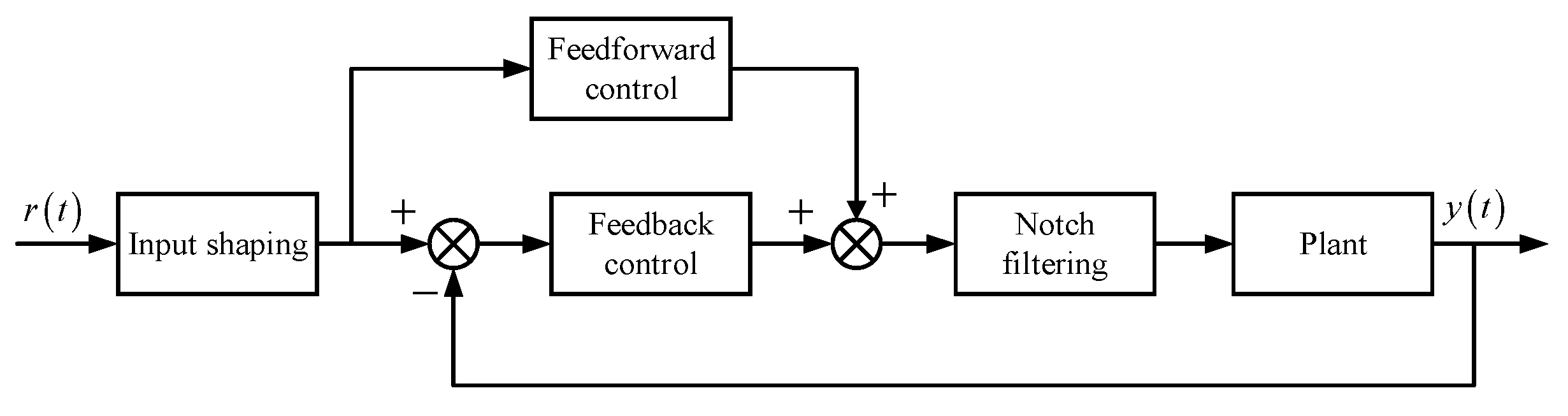
Building upon the identified model, a synergistic control architecture is proposed to suppress structural resonances and residual vibrations, enabling high-precision positioning with reduced settling time (Figure 3). The architecture consolidates multiple complementary mechanisms into a unified framework, thereby overcoming the performance limitations of singular control strategies and jointly enhancing time-domain and frequency-domain characteristics.
The architecture integrates four functional modules. IS attenuates modal excitation by convolving the reference trajectory with predesigned impulses. FF exploits trajectory velocity and acceleration to improve transient response. NF suppresses dominant high-frequency resonances to enhance robustness and stability. FB guarantees steady-state accuracy and disturbance rejection while preserving the desired bandwidth. Collectively, these mechanisms reduce residual vibrations, shorten settling time, and enable micrometer-level positioning performance, offering a cohesive solution for precision motion control. Standard design formulations for input shaping and notch filters are well established in the literature [18,20], ensuring reproducibility while preserving the novelty of the integrated architecture.

3.2. Implementation on the Linear Motion Stage

The proposed architecture is applied to the linear motion stage in a manner fully consistent with industrial three-loop servo structures. A cascaded hierarchy is adopted: the outer position loop generates the reference for the inner velocity loop.
The velocity loop utilizes an I–P regulation scheme, which removes the closed-loop zero to improve damping and eliminate overshoot but inherently reduces tracking bandwidth. To mitigate this drawback, FF is incorporated to offset dynamic lag, and an NF is inserted into the control-output path to attenuate dominant mechanical resonances. This coordinated design achieves faster transient response while preserving smooth motion profiles.
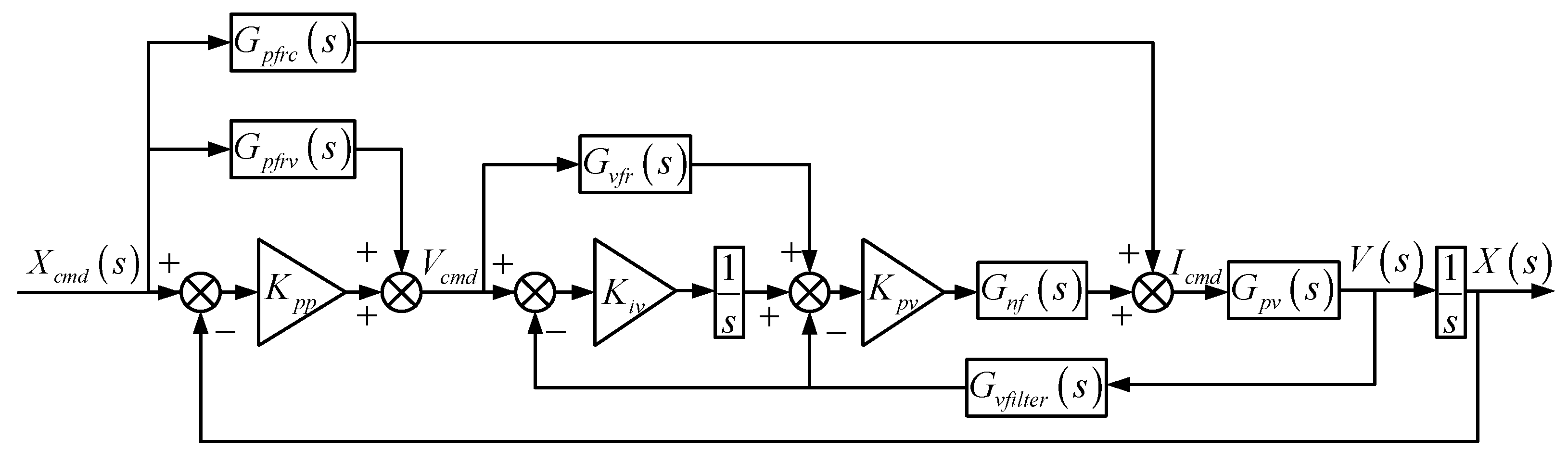
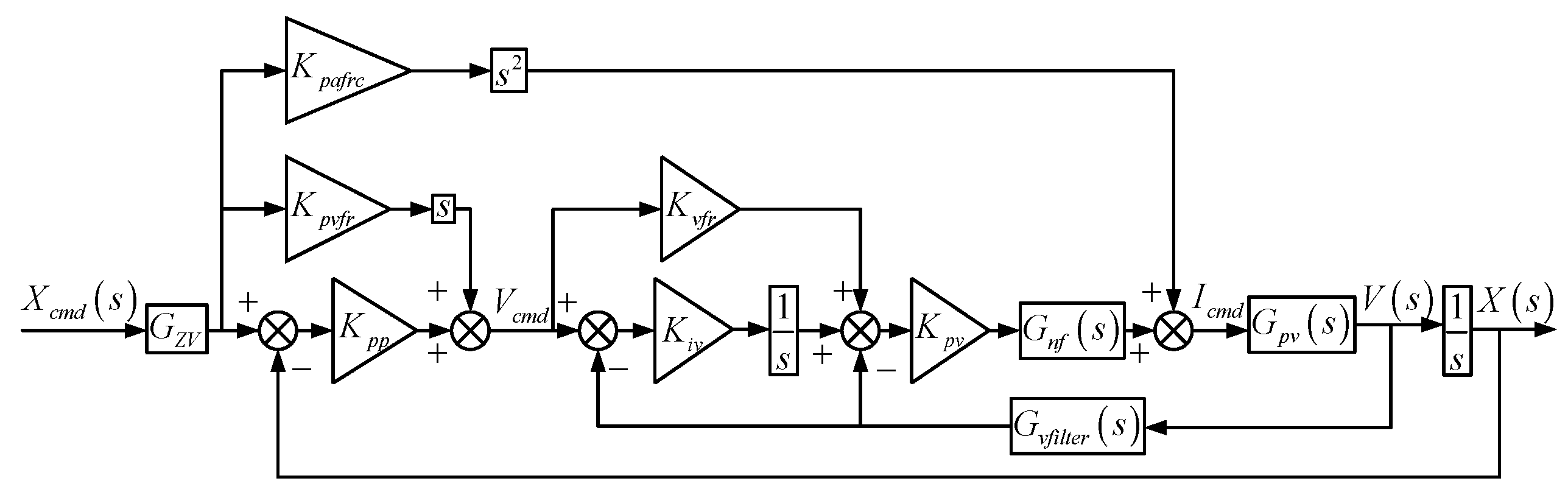
The position loop, modeled as a type-I system, is regulated by a proportional controller with gain K p p . To further enhance dynamic performance, a dual-path feedforward structure is adopted: one path injects compensation into the velocity reference ( G p f r v ), and the other directly into the current command ( G p f r c ). The resulting control architecture is summarized in Figure 4.

3.2.1. Velocity-Loop Analysis

The closed-loop transfer function of the velocity loop is
G c l v s = V s V c m d s = G v f r + K i v s K p v G n f G p v 1 + 1 + K i v s K p v G n f G p v G v f i l t e r
where G v f i l t e r denotes the velocity-feedback filter, implemented as a first-order filter in this study.
Accordingly, the velocity loop tracking error is
E v s = V c m d s V s G v f i l t e r s                   = 1 + K p v G n f G p v G v f i l t e r G v f r K p v G n f G p v G v f i l t e r 1 + 1 + K i v s K p v G n f G p v G v f i l t e r V c m d s
Letting E v s = 0 , the ideal velocity-loop feedforward term becomes
G v f r s = 1 + 1 K p v G n f G p v G v f i l t e r
Substituting Equation (7) into Equation (5) yields
G c l v s = 1 G v f i l t e r
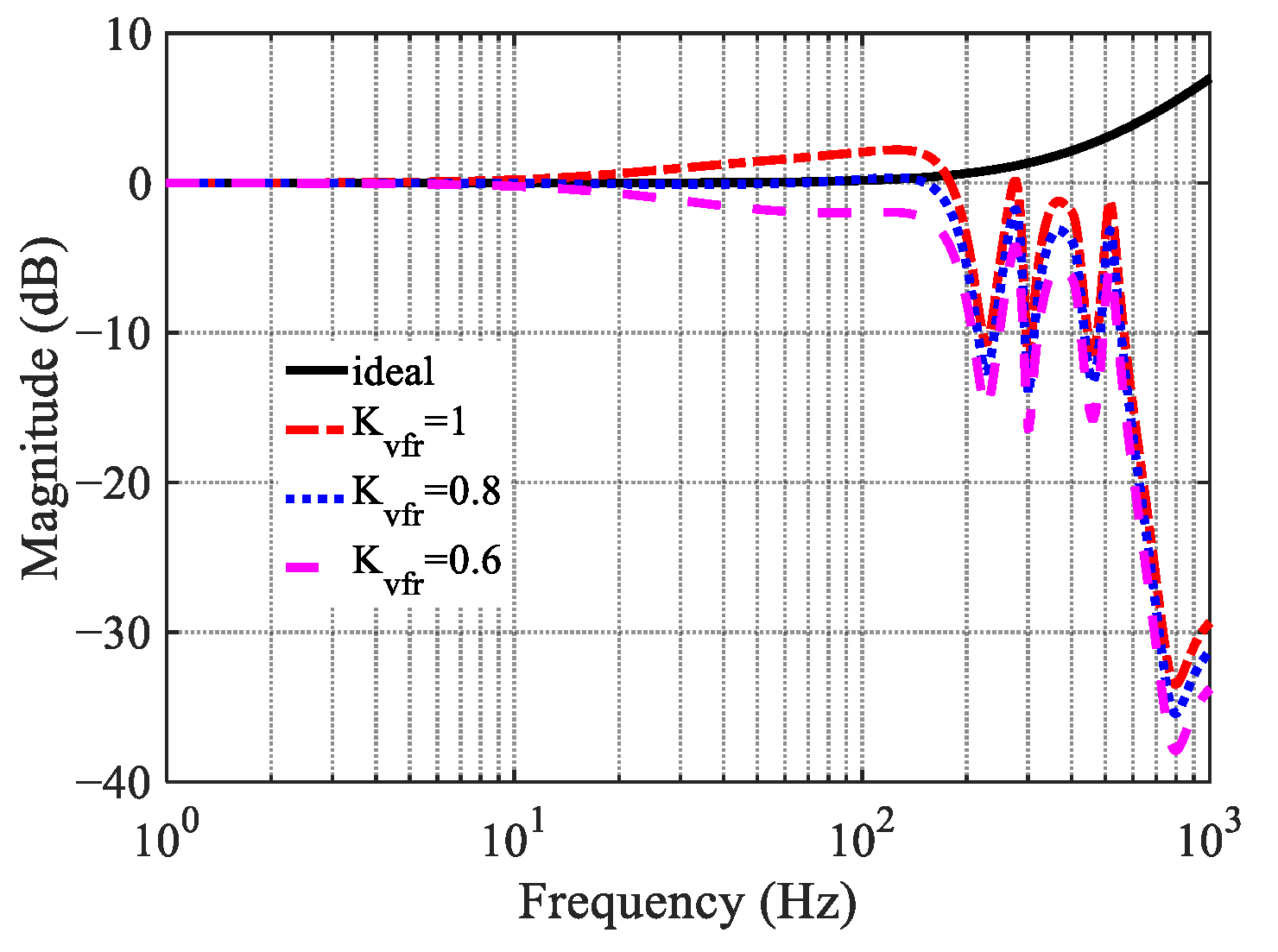
whose closed-loop magnitude response corresponds to the solid black curve in Figure 5.
However, because the embedded velocity filter prevents the compensated closed-loop from achieving unity gain, the high-frequency magnitude response exceeds 0 dB, which may excite structural modes. To avoid this effect, the feedforward compensator is simplified to a scalar gain K v f r . As shown in Figure 5, choosing an appropriate K v f r suppresses resonant peaks below 0 dB while maintaining design flexibility. The combined effect of I–P control, proportional FF, and NF expands the control bandwidth and attenuates high-frequency resonances.

3.2.2. Position-Loop Analysis

The closed-loop transfer function from the position reference to output is
G c l p s = X s X c m d s = G p f r c + G p f r v + K p p K v f r + K i v s K p v G n f G p v s + s 1 + K i v s K p v G n f G p v G v f i l t e r + K p p K v f r + K i v s K p v G n f G p v
yielding the position-loop error
E p s = X c m d s X s               = s + s 1 + K i v s K p v G n f G p v G v f i l t e r G p f r c G p v G p f r v K v f r + K i v s K p v G n f G p v s + s 1 + K i v s K p v G n f G p v G v f i l t e r + K p p K v f r + K i v s K p v G n f G p v
Setting E p s = 0 yields the ideal feedforward terms
G p f r c s = s G p v
G p f r v s = s 1 + K i v s G v f i l t e r K v f r + K i v s
Although these ideal expressions ensure unity closed-loop tracking, they depend explicitly on the velocity-loop I–P parameters and the embedded filter, thereby restricting controller-design flexibility. Considering the natural kinematic relations among position, velocity, and current in linear motors, these two feedforward terms are simplified to
G p f r c s = K p f r c s 2
G p f r v s = K p f r v s
where velocity feedforward is applied to the velocity reference and acceleration feedforward to the current reference. This simplification improves tuning flexibility and supports practical implementation. Integrating IS into this scheme yields the complete synergistic architecture shown in Figure 6.
To meet the positioning requirements of shorter settling time while suppressing resonances, a ZV input shaper is adopted, whose analytical form is
t 1 = 0 , t 2 = π ω d A 1 = 1 1 + K , A 2 = K 1 + K , K = e ζ π 1 ζ 2

3.3. Frequency-Domain Parameter Synthesis

The presence of high-frequency flexible modes renders root-locus design unsuitable; therefore, all controller parameters for both velocity and position loops are synthesized in the frequency domain. The design procedure consists of identifying the target gain crossover frequency ω g c * satisfying the phase margin (PM) requirement on the uncompensated Bode plot, and adjusting controller gains such that the compensated open loop crosses 0 dB exactly at ω g c * .
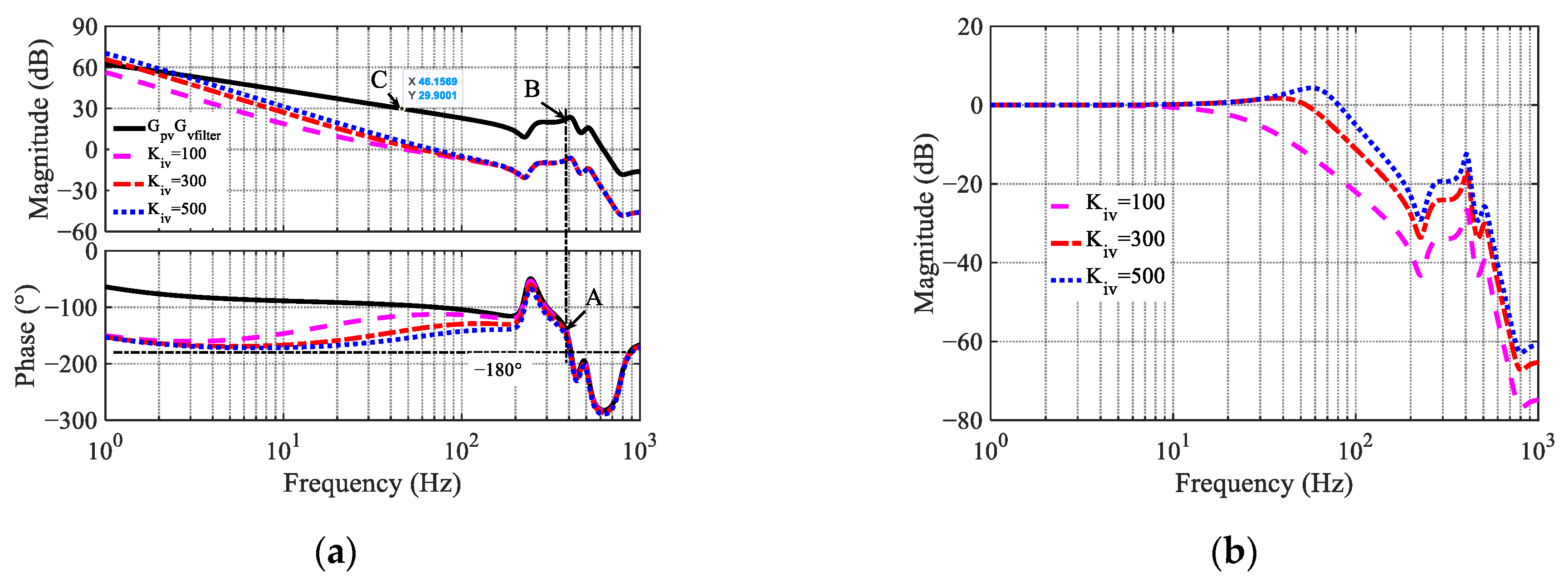
For the velocity loop, ignoring NF dynamics, the uncompensated forward path exhibits a resonant peak at (406.309 Hz, 23.582 dB), as shown in Figure 7. Point A in Figure 7 satisfies the PM requirement, and the corresponding Point B defines ω g c * . However, the resonant peak remains above 0 dB at this frequency, risking excitation of structural modes. Because the high-frequency resonance has not yet been compensated, a PI-based design that only satisfies the phase-margin criterion fails to stabilize the system.
To resolve this issue, the gain margin (GM) requirement is used to determine ω g c * . Point C (46.1569 Hz, 29.9001 dB) on the magnitude plot satisfies the GM specification, yielding the I–P proportional gain:
K p v = 10 29.9001 / 20 0.032
The integral gain strongly affects the PM, resonant peak ( M r ), and control bandwidth ω b . Comparative Bode analyses for K i v = {100, 300, 500} are shown in Figure 7, and the corresponding frequency-domain performance metrics are summarized in Table 2.
Table 2 reveals a clear trade-off between system stability and responsiveness. Small integral gains ensure adequate stability margins but restrict the achievable control bandwidth, while excessively large gains reduce the PM to unsafe levels. An intermediate gain value is found to achieve a balanced performance (e.g., PM = 43.16°, GM = 6.27 dB) while effectively suppressing the mechanical resonant peak to −16.94 dB.
To generalize this empirical observation into a systematic and reproducible design methodology, a frequency-domain synthesis procedure is formulated to explicitly resolve conflicts between performance enhancement and stability preservation. The controller synthesis follows a constrained optimization logic, in which the primary objective is to maximize the ω g c * (and hence the control bandwidth), subject to predefined stability margin constraints.
In practice, a fundamental conflict often arises: increasing ω g c * improves tracking speed but requires a higher loop gain, which may either elevate the resonant peak above the 0 dB stability limit (violating the GM constraint) or necessitate a wider NF. However, an excessively wide NF introduces additional phase lag at ω g c * , potentially violating the PM requirement. When such conflicts occur, a priority-based selection rule is applied as follows:
Step 1: Determine the minimum notch depth and bandwidth required to attenuate the dominant resonant peak below a safety threshold (e.g., −6 dB) in the open-loop frequency response.
Step 2: Evaluate the resulting phase lag ϕ N F introduced by the NF at the trial ω g c * .
Step 3: If the remaining PM does not satisfy the design specification, ω g c * is iteratively reduced until both PM and GM constraints are simultaneously met.
Final Selection: The final crossover frequency is selected at the “knee point” of the sensitivity peak M s curve, where further increases in ω g c * lead to a rapid growth of sensitivity amplification. The point represents the optimal compromise between transient responsiveness and vibration robustness.
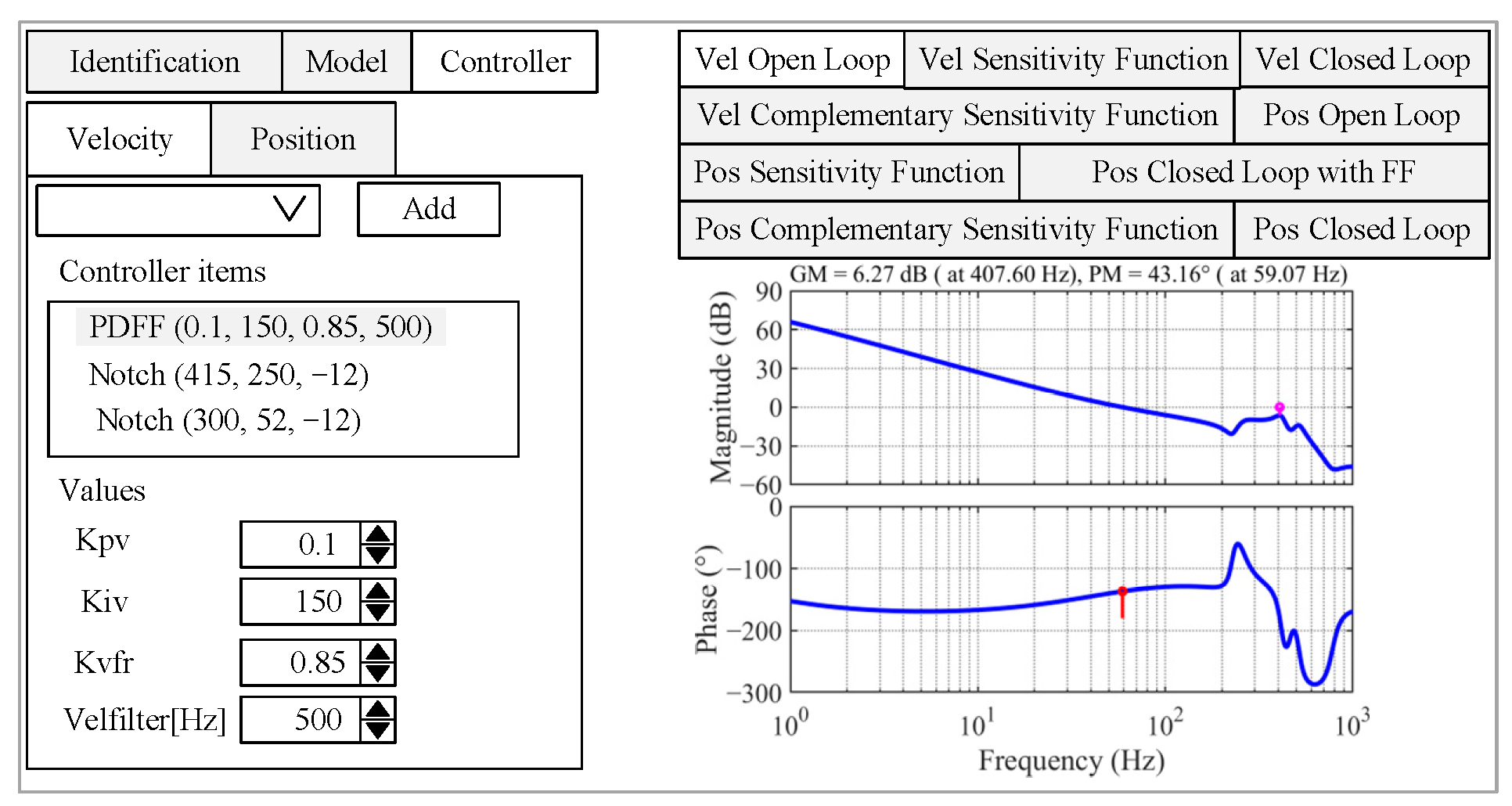
To facilitate the integrated design of IS, FF, FB, and NF—whose interactions critically influence loop stability, an interactive graphical user interface (GUI) (Figure 8) is employed, where the blue curve represents the open-loop Bode response, and the red line represents the stability margin. This environment enables a systematic exploration of the stability–performance trade-offs and ensures that all resonant peaks remain rigorously below the 0 dB stability limit throughout the design process. Notably, although the current implementation employs a GUI for visualization and interactive analysis, the underlying three-step synthesis procedure is strictly algorithmic rather than heuristic. Specifically, the PM, GM, and sensitivity peak are formulated as explicit quantitative constraints, while the crossover frequency is treated as the optimization variable. Under this formulation, the design process can be fully automated using iterative or search-based algorithms, without reliance on manual trial-and-error or subjective tuning by experienced engineers. The GUI therefore serves primarily as a diagnostic and visualization tool, rather than a prerequisite for controller synthesis.


4. Results and Discussion

4.1. Parameter Synthesis and Comparative Setup

To assess the proposed synergistic control architecture relative to the design specifications in Table 3, four control schemes with increasing functional capability—FB, FB+NF, FF+FB+NF, and IS+FF+FB+NF—are constructed. Controller parameters are obtained through a GUI-assisted frequency-domain synthesis procedure (Figure 8).
To ensure a rigorous and fair comparison among the considered control schemes, a parameter-isolation protocol is adopted. Specifically, the velocity-loop feedback controller gains and the notch filter parameters are kept identical for the FB+NF, FF+FB+NF, and IS+FF+FB+NF configurations, while the feedforward coefficients are preserved when IS is subsequently introduced. This design strategy enables the incremental contribution of each additional mechanism (NF → FF → IS) to be independently and unambiguously assessed, eliminating confounding effects arising from retuning. The resulting controller parameters are summarized in Table 4 and Table 5.

4.2. Stability, Robustness, and Performance Analysis

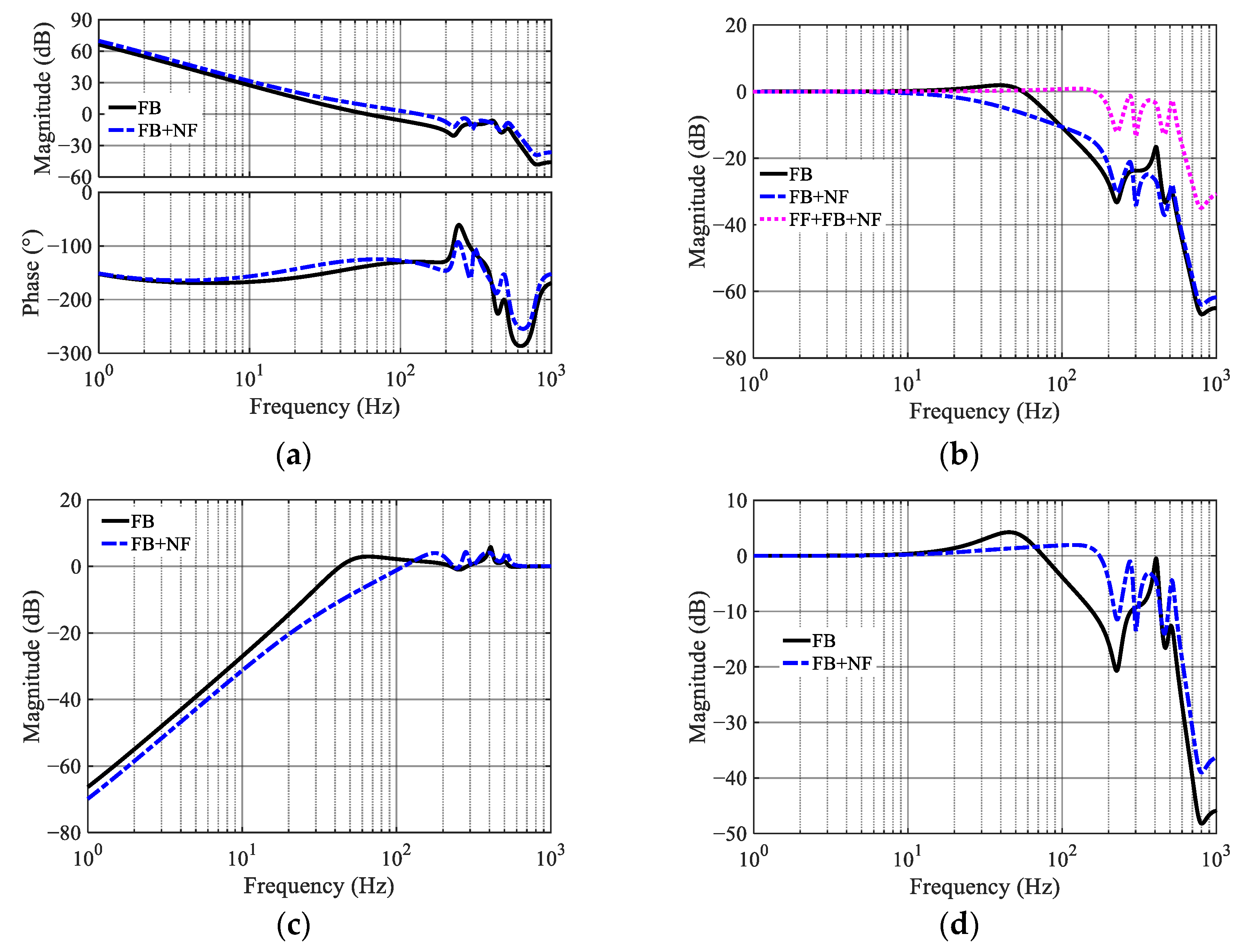
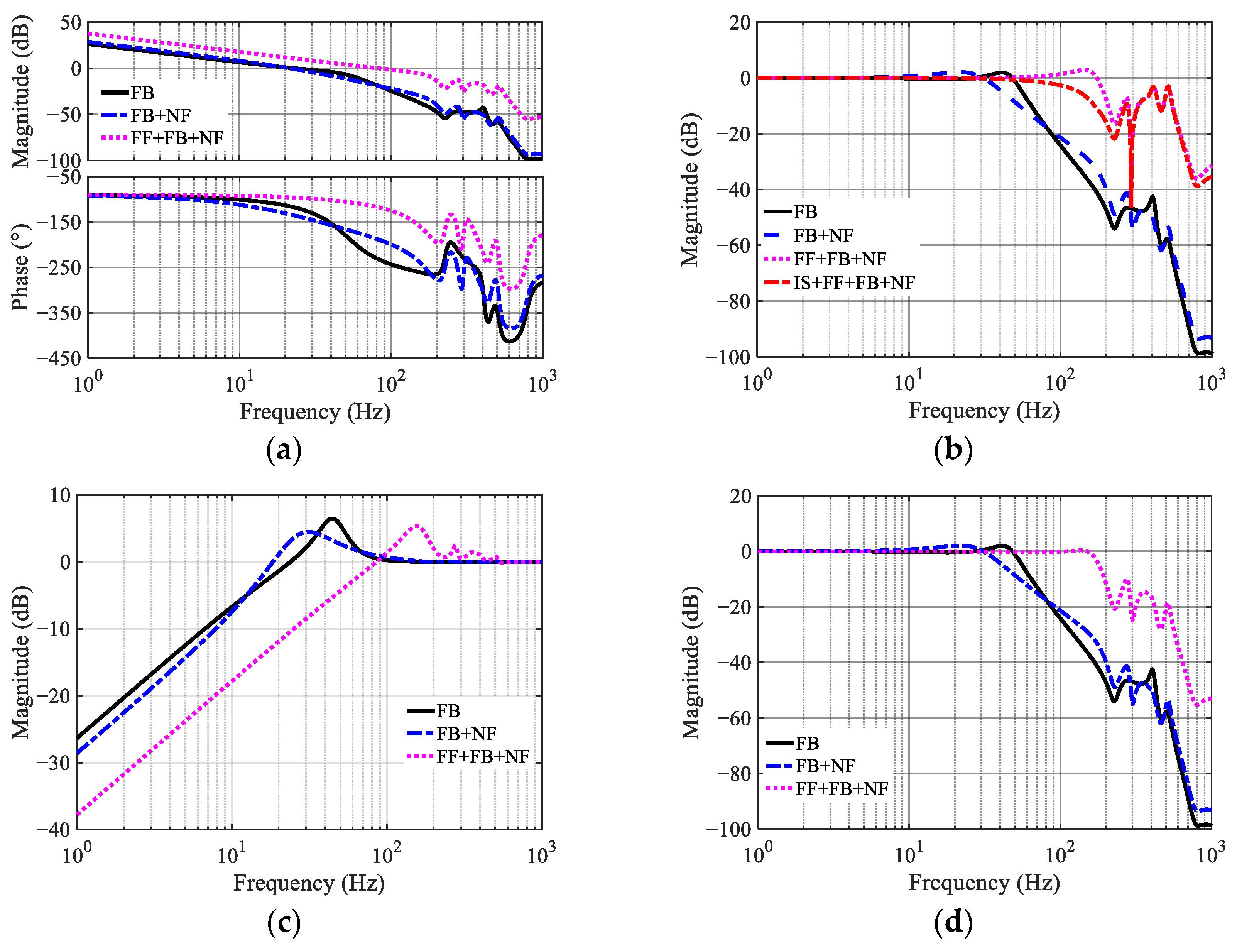
The stability, robustness, and performance characteristics of the proposed control architectures are evaluated through comprehensive frequency-domain analysis. The open-loop and closed-loop Bode responses, together with the sensitivity S j ω and complementary sensitivity T j ω functions, are presented in Figure 9 and Figure 10, while the key quantitative metrics are summarized in Table 6. The analysis is organized according to the principal performance dimensions relevant to high-precision industrial positioning systems.

4.2.1. Stability Margins

All investigated control schemes satisfy the prescribed stability requirements. Among them, the FF+FB+NF configuration achieves a gain crossover frequency of 83 Hz with a PM of 62.3° and a phase crossover frequency of approximately 178 Hz corresponding to a GM of 8.5 dB. Except for slightly reduced PM of the velocity loop under the baseline FB scheme, all other stability margins comfortably exceed conventional industrial design criteria (PM > 45°, GM > 6 dB), indicating strong robustness against parametric uncertainties, unmodeled dynamics, and moderate time delays.
The consistent satisfaction of stability margins across all configurations establishes a solid and unbiased baseline for subsequent comparisons, enabling a fair assessment of control bandwidth enhancement, resonance suppression, and transient performance among the investigated control architectures.

4.2.2. Low-Frequency Robustness

The low-frequency sensitivity functions across all configurations exhibit substantial attenuation, indicating a robust disturbance-rejection capability. As illustrated in Figure 9c, the velocity-loop sensitivity exhibits an attenuation of approximately −20 dB at 20 Hz, while Figure 10c shows that the position-loop sensitivity is reduced by about −10 dB at 25 Hz. These attenuation levels indicate effective suppression of low-frequency load disturbances and adequate robustness against moderate modeling uncertainties.
Importantly, the incorporation of FF and IS does not degrade the low-frequency robustness of the closed-loop system. This property is particularly critical for point-to-point positioning tasks in die-bonding applications, where external disturbances, payload variations, and parameter drifts must be rejected without compromising steady-state accuracy or positioning repeatability.

4.2.3. High-Frequency Resonance and Noise Sensitivity

High-frequency mechanical resonances represent the principal constraint on achievable control bandwidth in precision motion systems. The introduction of NF effectively attenuates the dominant resonant mode, resulting in a substantial reduction in the corresponding sensitivity peak. For all control schemes incorporating NF, the maximum sensitivity M s remains below the widely accepted robustness threshold of 6 dB, indicating adequate tolerance to modeling uncertainties and resonant dynamics.
In addition, the complementary sensitivity function T j ω exhibits well-contained high-frequency gain across all configurations. This behavior implies that measurement noise amplification is sufficiently limited, even under high-bandwidth operation. Such characteristics are of particularly practical importance for industrial linear motion stages, where excessively high-frequency gain can readily translate into actuator saturation or noise-induced vibrations under high-acceleration conditions. Overall, these results confirm that the proposed resonance-suppression mechanisms achieve effective attenuation of structural resonances without introducing undesirable high-frequency dynamics, thereby preserving both robustness and practical implementability.

4.2.4. Control Bandwidth

As illustrated in Figure 10b and summarized in Table 6, the baseline FB controller achieves a position-loop control bandwidth of 53 Hz. When two NFs are introduced (FB+NF), the control bandwidth is reduced to 37 Hz due to the additional phase lag induced near the crossover frequency.
By incorporating FF, the achievable control bandwidth is substantially extended to 186 Hz in the FF+FB+NF configuration. This increase directly enhances command-following capability and shortens the nominal settling time. When IS is further integrated into the architecture (IS+FF+FB+NF), the effective control bandwidth is moderated to 106 Hz. This reduction is primarily attributed to the inherent command smoothing and time delay associated with input shaping.
Nevertheless, the resulting control bandwidth remains significantly higher than that of the feedback-only baselines (FB and FB+NF). Such control bandwidth enhancement directly contributes to faster transient response and reduced motion cycle times, which are essential for high-throughput semiconductor packaging equipment.

4.2.5. Control Bandwidth–Settling Performance Trade-Off

Mechanical resonance inherently imposes a fundamental constraint on the trade-off between achievable control bandwidth and transient settling performance. Although the FF+FB+NF scheme attains the highest closed-loop bandwidth of 186 Hz, it also exhibits a pronounced resonant peak (47.21% increase relative to the baseline) accompanied by a transient overshoot of approximately 26.6%. These effects significantly prolong the effective settling time, as the high-bandwidth control unnecessarily excites structural modes, negating the benefits of a reduced nominal rise time.
In contrast, the proposed IS+FF+FB+NF architecture intentionally moderates the control bandwidth to 106 Hz while completely eliminating the resonant peak (0 dB). This results in a system with zero overshoot, the absence of sustained oscillations, and substantially improved settling behavior within the stringent ±5 μm positioning requirement. Such a bandwidth–settling compromise is often preferable in high-precision mechatronics, where rapid stabilization and vibration immunity are prioritized over marginal gains in nominal bandwidth to maximize machine throughput. These results highlight the practical advantage of the proposed synergistic architecture for industrial die-bonding systems operating under aggressive dynamic conditions.

4.3. Simulation Validation

4.3.1. Step and Ramp Response Validation

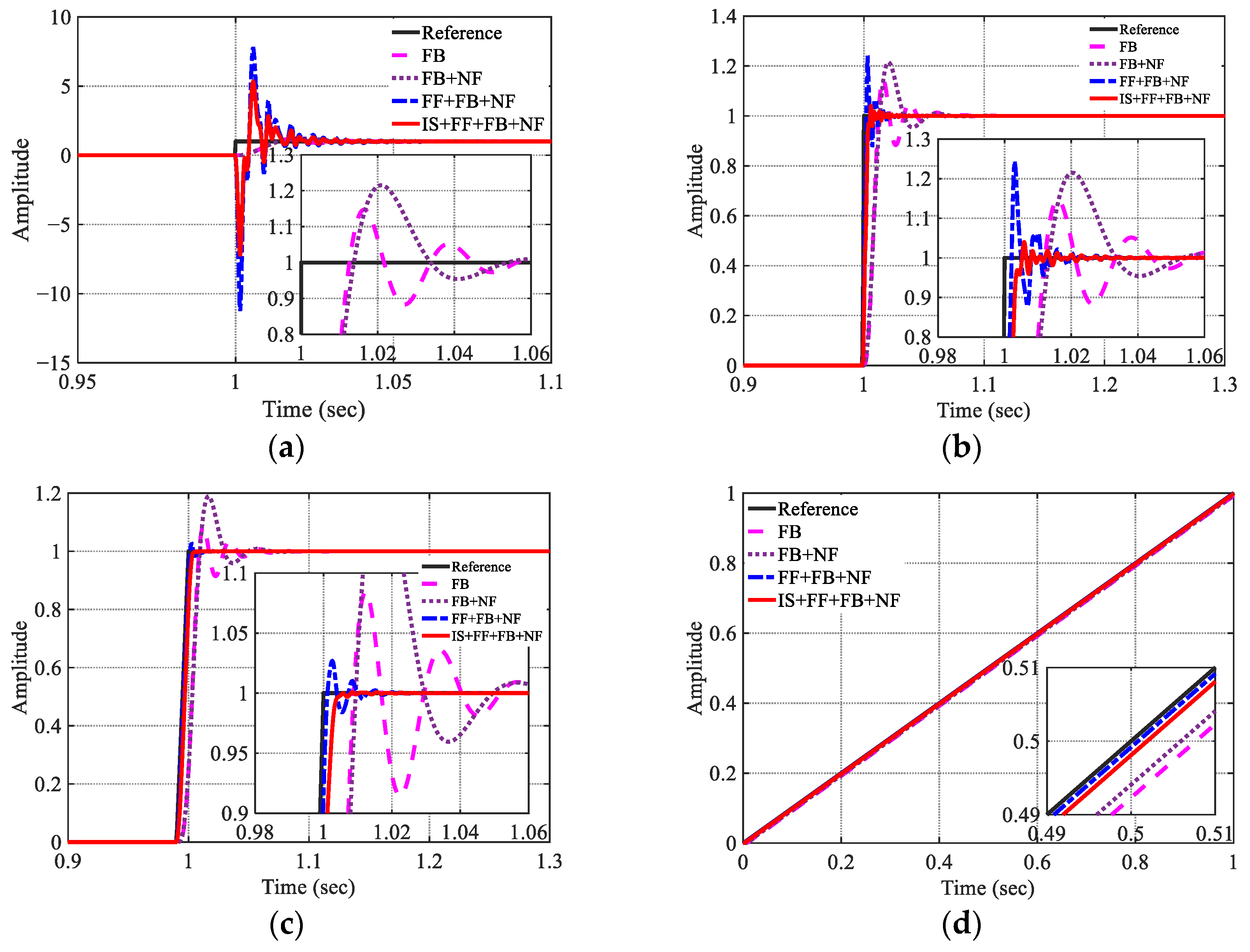
To evaluate the dynamic performance of the proposed control architecture, simulations are first conducted using step and ramp reference inputs. A unit step command is applied to the position loop of the linear motion stage under the four control schemes (FB, FB+NF, FF+FB+NF, and IS+FF+FB+NF). The resulting transient responses are shown in Figure 11a.
Under the FB controller, the system exhibits moderate overshoot (approximately 14.7%) with a settling time of 52.5 ms (within a ±2% error band). Introducing NF (FB+NF) slightly reduces the settling time to 48.8 ms but increases overshoot to about 21.5%, reflecting the trade-off between resonance attenuation and phase lag near the crossover frequency. It is observed that feedforward-based schemes (FF+FB+NF and IS+FF+FB+NF) yield non-physical transient responses under the ideal step input. This is because the feedforward channel assumes bounded derivatives of the reference command; consequently, the mathematical discontinuity at a step change leads to unrealistically large equivalent acceleration, inducing artificial overshoot in the model that violates the realizability assumption.
To ensure physically meaningful evaluation, ramp reference inputs with slopes of 1000, 100, and 1 are therefore employed. Figure 11b–d illustrate that the inclusion of IS substantially mitigates overshoot and reduces settling time. For the most aggressive case (slope = 1000), IS+FF+FB+NF reduces overshoot from 24.39% to 3.39% and shortens the settling time from 16.13 ms to 7.64 ms relative to FF+FB+NF. Similar improvements are observed at gentler slopes, while the steady-state error remains negligible (approximately 0.1%).
These results confirm the inherent trade-off in resonant motion systems: IS suppresses vibration and improves settling behavior at the cost of introducing modest command smoothing and phase delay. Consequently, FF+FB+NF may be preferable for applications prioritizing maximum bandwidth, whereas IS+FF+FB+NF is more suitable when vibration suppression and deterministic settling are critical.

4.3.2. Frequency-Dependent Tracking Performance

To further evaluate the frequency-dependent tracking characteristics, unit-amplitude sinusoidal reference inputs at discrete frequencies of 0.1, 1, 10, 100, and 200 Hz are applied to the position loop. The corresponding steady-state amplitude ratios and phase lags are summarized in Table 7.
At low frequencies (below 10 Hz), the FF+FB+NF configuration exhibits near-ideal tracking performance, with amplitude errors below 1% and phase lag less than 5°, confirming its suitability for high-precision positioning tasks. The IS+FF+FB+NF architecture maintains comparable amplitude accuracy, while introducing a marginal increase in phase lag (approximately 6.9°), which is attributable to the intrinsic delay associated with command shaping.
In contrast, the baseline FB and FB+NF controllers suffer from pronounced phase degradation. At 10 Hz, the phase lag increases to 26.9° and 22.9°, respectively, exceeding acceptable limits for precision motion control. At higher frequencies, the FF+FB+NF scheme exhibits noticeable amplitude amplification (approximately 15% at 100 Hz), consistent with the 2.9 dB closed-loop resonant peak observed in Figure 10b. Conversely, the IS+FF+FB+NF configuration effectively attenuates high-frequency responses (output/input ≈ 0.72 at 100 Hz), reflecting its moderated effective bandwidth and its ability to suppress resonance-induced energy amplification.
Overall, these results demonstrate a synergistic effect: feedforward compensation significantly reduces phase lag (by ≈88% at 10 Hz) to enhance mid-frequency tracking fidelity, while input shaping regulates high-frequency dynamics near structural resonances. This complementary behavior highlights the necessity of coordinated time-domain shaping and frequency-domain loop design in high-dynamic precision motion systems.

4.3.3. High-Velocity and High-Acceleration S-Curve Motion Validation

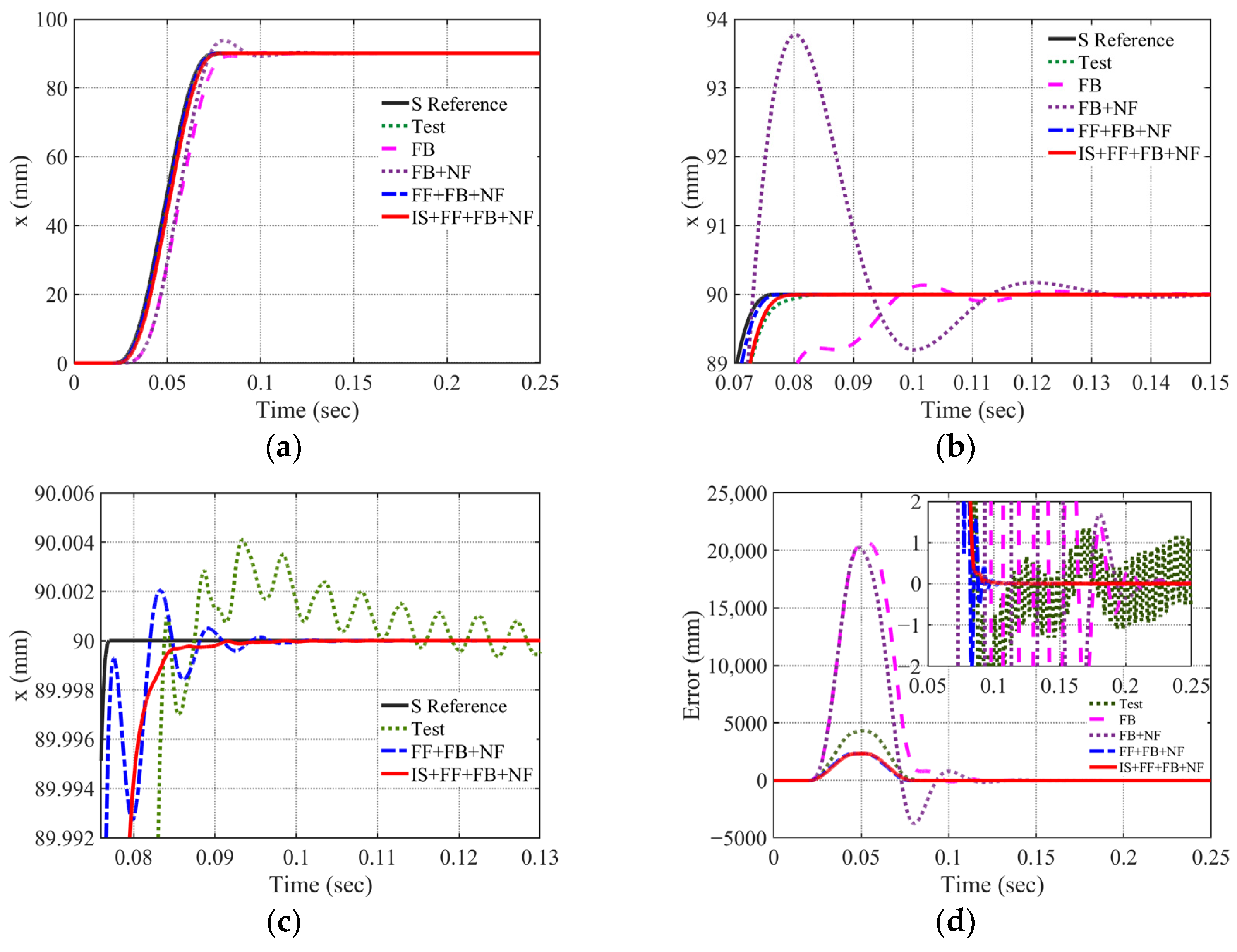
To evaluate the control performance under realistic high-dynamic operating conditions, an S-curve reference trajectory is constructed based on the actual motion profile of the precision linear motion stage (Figure 1). The trajectory is subject to stringent kinematic constraints, including a maximum jerk of 2.1 × 10 4   m / s 3 a peak acceleration of 160   m / s 2 , and a maximum velocity of 2.8   m / s . The resulting displacement tracking responses for all control schemes are illustrated in Figure 12, while the corresponding settling times for positioning accuracy bands ranging from ±10 μm to ±2 μm are summarized in Table 8.
Due to the real-time computational constraints of the current industrial controller hardware, physical experimental validation is conducted using the FF+FB+NF configuration, which represents the highest-performance scheme currently deployable on the platform. The experimental result is shown as the green dotted curve in Figure 12 and serves as a verified industrial baseline. To further investigate the performance potential enabled by the complete synergistic framework, the full IS+FF+FB+NF architecture is subsequently evaluated through high-fidelity simulations. This comparative setup enables a clear assessment of the incremental contribution of input shaping in suppressing residual vibrations under extreme dynamic excitation.
The proposed IS+FF+FB+NF architecture consistently demonstrates superior settling performance across all accuracy requirements, particularly in the ±5 μm to ±2 μm range. At the most demanding ±2 μm threshold, the proposed architecture achieves a 22.0% reduction in settling time relative to the FF+FB+NF simulation, directly quantifying the deterministic benefit introduced by the IS layer. Furthermore, when compared against the experimentally validated FF+FB+NF baseline, the full synergistic scheme exhibits a potential settling-time reduction of up to 81.5% in the high-fidelity simulation environment.
While the magnitude of this latter improvement partially reflects the idealized nature of simulation conditions, it defines a realistic upper bound on performance gains achievable through coordinated command shaping and loop-shaping integration. Across the full accuracy spectrum, the proposed IS+FF+FB+NF architecture delivers consistent settling-time reductions of 48–81% relative to the current experimental benchmark. These results underscore its capability to reconcile high-bandwidth tracking with aggressive vibration suppression, offering a clear performance pathway for next-generation industrial implementations under optimized computational resources.

4.3.4. Robustness Analysis Against Resonant Frequency Drift

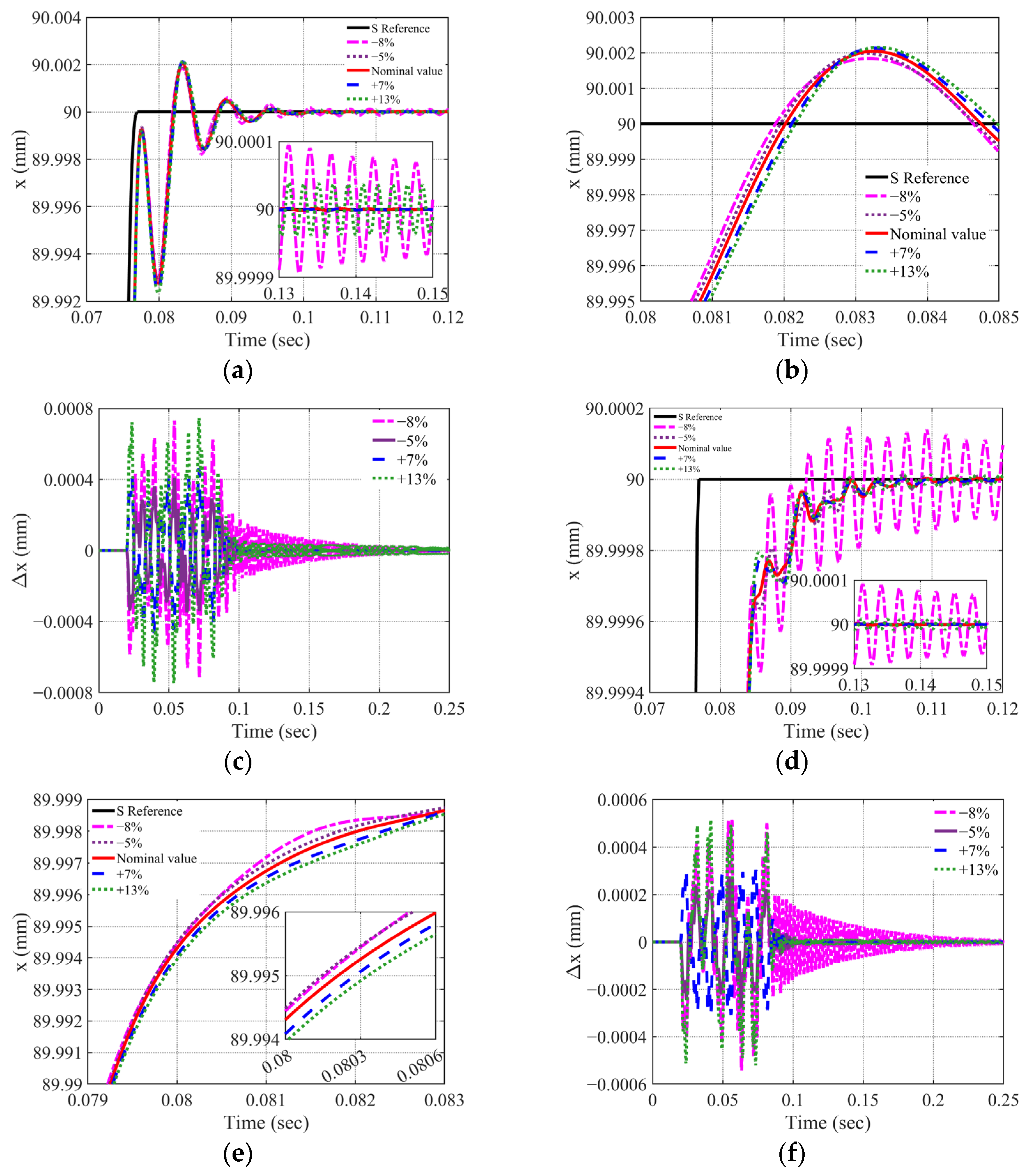
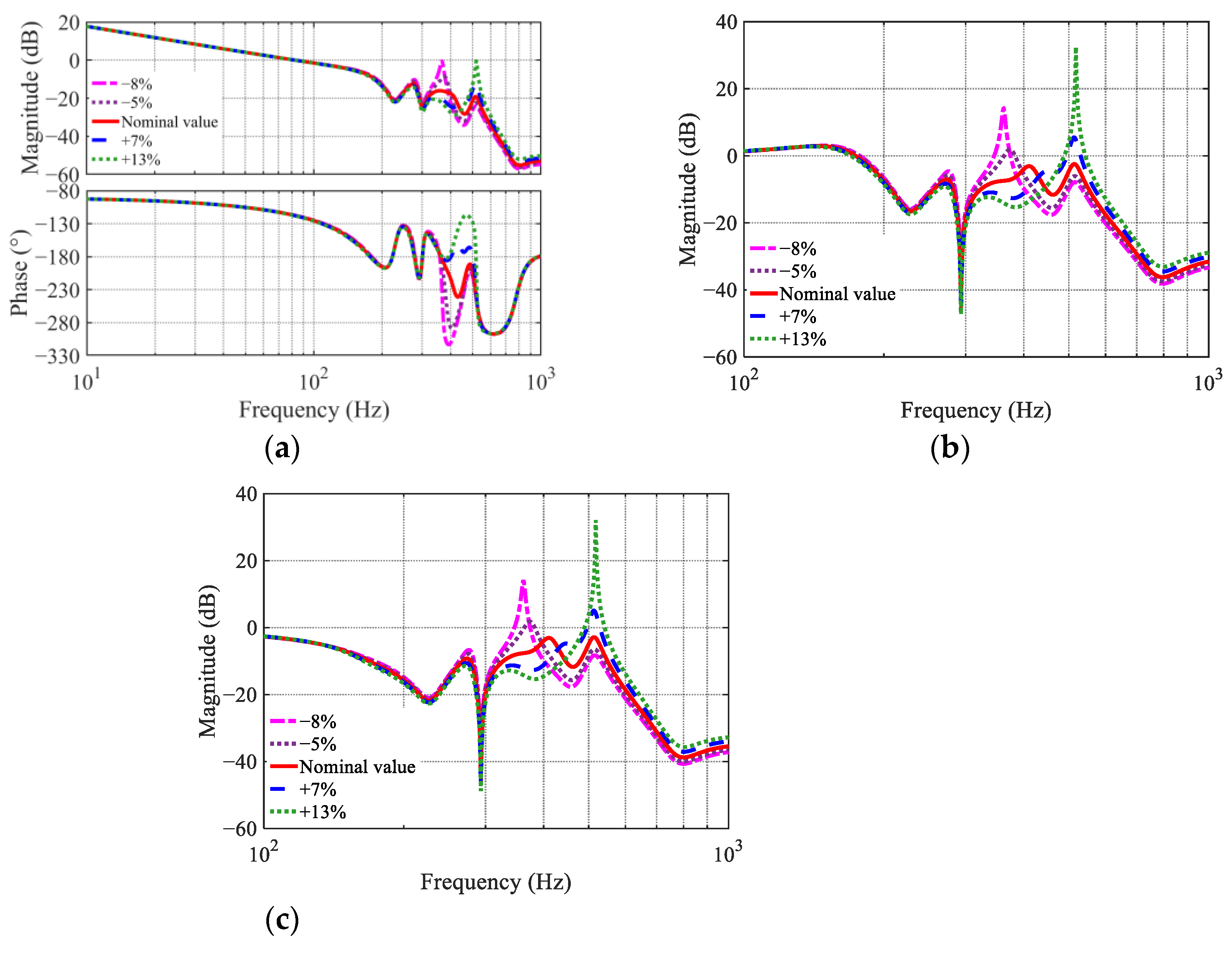
To evaluate the sensitivity of the proposed architecture to structural parameter variations, simulations are conducted under resonant frequency deviations ranging from −8% to +13% with fixed controller and NF parameters. The resulting spectral and transient behaviors are illustrated in Figure 13 and Figure 14, with quantitative performance indices summarized in Table 9. The analysis highlights the following key findings:
  • Robustness of Stability Margins
Across all scenarios, the PM remains largely insensitive to resonant frequency variations (ΔPM < 0.5°), indicating the inherent robustness of the feedback structure. In contrast, GM exhibits high sensitivity to frequency shifts. For instance, a +13% increase in resonant frequency reduced the GM of the FF+FB+NF scheme from 8.5 dB to 1.35 dB, falling below the design requirement of 6 dB. This underscores the vulnerability of static NF when resonant modes drift away from the designated rejection band.
  • Resonant Peak and Control Bandwidth Sensitivity
Resonant frequency drift exerts a profound impact on the closed-loop resonant magnitude ( M r ), whereas its influence on the control bandwidth remains comparatively moderate. In the FF+FB+NF scheme, significant resonance amplification occurs under severe spectral mismatch: the resonant peak surges to 14 dB at −8% drift and exceeds 32 dB at +13% drift, with acceptable attenuation (<6 dB) maintained only within a narrow window (−5% to +7%). In contrast, the IS+FF+FB+NF architecture substantially mitigates these peaks and reduces sensitivity to frequency shifts, although marginal resonance amplification persists under extreme deviations.
Regarding control bandwidth variations, the two schemes exhibit divergent trends: the FF+FB+NF scheme shows a decrease in control bandwidth as the resonant frequency increases (−8% to +13%), with a total fluctuation of approximately 6.8 Hz. Conversely, the IS+FF+FB+NF architecture exhibits a marginal increase over the same range, limited to only 2.1 Hz. This relative stability (a 69% reduction in variation compared to the baseline) underscores a superior trade-off between spectral robustness and bandwidth consistency under parametric uncertainty.
  • Transient Consistency and Precision Fidelity
Despite substantial resonant frequency variations, the absolute positioning error remains tightly bounded within ±0.8 μm for FF+FB+NF and ±0.6 μm for the proposed IS+FF+FB+NF. However, settling time becomes increasingly sensitive as the positioning accuracy requirement tightens. At the stringent ±2 μm threshold, the FF+FB+NF scheme exhibits a variation of 32.4% under −8% drift, whereas IS+FF+FB+NF limits this variation to 9.9%, demonstrating markedly improved settling-time consistency.
These results highlight the proposed architecture’s superior capability to preserve transient performance under parametric uncertainties while maintaining high-precision positioning. However, extreme resonant frequency deviations may still erode stability margins or violate design specifications, underscoring the practical need for periodic calibration or adaptive compensation in long-term industrial deployment.

4.3.5. Summary and Design Implications

The above analyses clarify how each control component contributes across different frequency regions and motion scenarios, leading to clear design implications. The coordinated use of FF and IS establishes a frequency-selective regulation mechanism: FF maximizes mid-frequency bandwidth to enhance tracking agility, while IS acts as a high-frequency regulator that prevents energy amplification near structural resonances. This synergy enables a balanced trade-off between responsiveness and vibration suppression. Consequently, control strategy selection can be tailored to specific application priorities. For high-throughput point-to-point positioning—where settling time is the dominant metric—the IS+FF+FB+NF architecture is preferable despite its moderated control bandwidth. In contrast, for continuous trajectory-following tasks that emphasize minimal phase lag at lower frequencies, the FF+FB+NF configuration may offer superior tracking fidelity.

5. Conclusions

This paper proposes a synergistic control architecture integrating IS, FF, and NF within a feedback framework to overcome the high-frequency resonance constraints inherent in linear motion stages. By harmonizing time-domain vibration suppression with frequency-domain loop shaping, a unified and practically deployable design methodology is established and systematically validated. The primary conclusions are summarized as follows.
  • Systematic Synergy and Trade-off Resolution
The proposed architecture effectively decouples the fundamental conflict between control bandwidth and structural resonance. While the integration of IS and NF strategically moderates the achievable control bandwidth to ensure robust stability, the FF component compensates for phase lag and preserves high tracking fidelity. This coordinated synergy eliminates resonant amplification while maintaining adequate stability margins—an outcome that is difficult to achieve using conventional single-loop control strategies.
  • Validated Performance Improvement
Evaluation under aggressive S-curve trajectories representative of industrial die-bonding cycles demonstrates the significant efficacy of the full IS+FF+FB+NF architecture. A 22.0% reduction in ±2 μm settling time is achieved relative to the high-fidelity simulation baseline, and an improvement of up to 81.5% is observed when compared with the industrial experimental benchmark. These results highlight the proposed architecture’s ability to bridge the gap between theoretical performance limits and practical implementation constraints.
  • Enhanced Spectral Robustness
The proposed framework exhibits strong resilience against plant parameter uncertainties. Under a severe −8% resonant frequency drift, the settling-time variation is confined to only 0.5 ms, outperforming non-shaping configurations by more than 75%. Such spectral robustness is particularly valuable in semiconductor manufacturing environments, where thermal effects and load variations frequently induce modal shifts.
In summary, the proposed synergistic control framework provides a robust and high-performance solution for next-generation semiconductor packaging and advanced manufacturing systems requiring extreme precision under aggressive motion profiles. The findings offer a scalable and industrially compatible methodology for precision motion control. Future work will focus on integrating adaptive identification and data-driven tuning strategies to further enhance long-term robustness and self-tuning capability.

Author Contributions

Conceptualization, H.C. and F.G.; methodology, H.C. and F.G.; validation, H.C. and F.G.; test, H.C. and F.G.; writing—original draft preparation, H.C. and F.G.; writing—review and editing, H.C. and F.G. All authors have read and agreed to the published version of the manuscript.

Funding

This research was funded by Wuxi “Light of the Taihu Lake” Scientific and Technological Key Project (K20231019).

Data Availability Statement

All data used to support the findings of this study are available from the authors upon request.

Conflicts of Interest

The authors declare no conflicts of interest.

References

  1. Iwasaki, M.; Seki, K.; Maeda, Y. High-precision motion control techniques: A promising approach to improving motion performance. IEEE Ind. Electron. Mag. 2012, 6, 32–40. [Google Scholar] [CrossRef]
  2. Oomen, T. Advanced motion control for precision mechatronics: Control, identification, and learning of complex systems. IEEJ J. Ind. Appl. 2017, 7, 127–140. [Google Scholar] [CrossRef]
  3. Wu, J.; Zhou, L. Transcending the acceleration-bandwidth trade-off: Over-actuated precision motion stages with selective compliance and servo stiffness. Mechatronics 2025, 108, 103314. [Google Scholar] [CrossRef]
  4. Janschek, K. Mechatronic System Design; Springer: Heideberg, Germany, 2012; pp. 211–275. [Google Scholar]
  5. Skogestad, S.; Postlethwaite, I. Multivariable Feedback Control Analysis and Design, 2nd ed.; John Wiley & Sons: Hoboken, NJ, USA, 2005; pp. 167–180. [Google Scholar]
  6. Tomizuka, M. Zero Phase Error Tracking Algorithm for Digital Control. J. Dyn. Syst. Meas. Cotrol 1987, 109, 65–68. [Google Scholar] [CrossRef]
  7. Dai, L.; Li, X.; Zhu, Y.; Zhang, M. Auto-tuning of model-based feedforward controller by feedback control signal in ultraprecision motion systems. Mech. Syst. Signal Process. 2020, 142, 106764. [Google Scholar] [CrossRef]
  8. Dai, L.; Zhu, X.; Zhu, Y. Quantitative Tracking Error Analysis and Feedforward Compensation Under Different Model-Based Feedforward Controllers in Different Control Architectures. IEEE Trans. Ind. Electron. 2021, 68, 381–390. [Google Scholar] [CrossRef]
  9. Xu, J.-X.; Huang, D.; Venkataramanan, V.; Huynh, T.C.T. Extreme Precise Motion Tracking of Piezoelectric Positioning Stage Using Sampled-Data Iterative Learning Control. IEEE Trans. Control Syst. Technol. 2013, 21, 1432–1439. [Google Scholar] [CrossRef]
  10. Parmar, G.; Barton, K.; Awtar, S. Large dynamic range nanopositioning using iterative learning control. Precis. Eng. 2014, 38, 48–56. [Google Scholar] [CrossRef]
  11. Zhang, G.; Zhao, X.; Wang, Q.; Ding, D.; Li, B.; Wang, G.; Xu, D. PR Internal Mode Extended State Observer-Based Iterative Learning Control for Thrust Ripple Suppression of PMLSM Drives. IEEE Trans. Power Electron. 2024, 39, 10095–10105. [Google Scholar] [CrossRef]
  12. Nguyen, M.; Chen, X. MPC Inspired Dynamical Output Feedback and Adaptive Feedforward Control Applied to Piezo-Actuated Positioning Systems. IEEE Trans. Ind. Electron. 2020, 67, 3921–3931. [Google Scholar] [CrossRef]
  13. Shi, B.; Shi, R.; Wang, F. Design of an adaptive feedforward/feedback combined control for piezoelectric actuated micro positioning stage. Precis. Eng. 2022, 78, 199–205. [Google Scholar] [CrossRef]
  14. Yang, K.; Tong, W.; Zhou, X.; Li, R.; Zhang, T.; Yurchenko, D.; Shu, Y. Active vibration isolation of a monostable nonlinear electromagnetic actuator using machine learning adaptive feedforward control. Chaos Solitons Fractals 2025, 192, 116035. [Google Scholar] [CrossRef]
  15. Song, F.; Liu, Y.; Xu, J.-X.; Yang, X.; Zhu, Q. Data-Driven Iterative Feedforward Tuning for a Wafer Stage: A High-Order Approach Based on Instrumental Variables. IEEE Trans. Ind. Electron. 2019, 66, 3106–3116. [Google Scholar] [CrossRef]
  16. Dai, L.; Li, X.; Zhu, Y.; Zhang, M. Feedforward Tuning by Fitting Iterative Learning Control Signal for Precision Motion Systems. IEEE Trans. Ind. Electron. 2021, 68, 8412–8421. [Google Scholar] [CrossRef]
  17. Fu, X.; Yang, X.; Zanchetta, P.; Tang, M.; Liu, Y.; Chen, Z. An Adaptive Data-Driven Iterative Feedforward Tuning Approach Based on Fast Recursive Algorithm: With Application to a Linear Motor. IEEE Trans. Ind. Electron. 2023, 19, 6160–6169. [Google Scholar] [CrossRef]
  18. Singer, N.C.; Seering, W.P. Preshaping Command Inputs to Reduce System Vibration. J. Dyn. Syst. Meas. Control 1990, 112, 76–82. [Google Scholar] [CrossRef]
  19. Song, F.; Wang, Y.; Chen, X.; He, P. Research on input shaping algorithm for rapid positioning of ultra-precision dual-stage. Nanoeng. Fabr. Prop. Opt. Devices XII 2015, 9556, 101–107. [Google Scholar]
  20. Chen, S.; Feng, W.; Zeng, F.; Wang, Y.; Tian, J. Resonance Suppression of Position Servo System Based on Improved Notch Filter. In Proceedings of the International Conference on Intelligent and Interactive Systems and Applications, Shanghai, China, 25–27 September 2020. [Google Scholar]
  21. Teng, W.; Zhang, X.; Zhang, Y.; Yang, L. Iterative tuning notch filter for suppressing resonance in ultra-precision motion control. Adv. Mech. Eng. 2016, 8, 1687814016674097. [Google Scholar] [CrossRef]
  22. Huang, C.; Li, H. Adaptive Notch Filter for Piezo-Actuated Nanopositioning System via Position and Online Estimate Dual-Mode. Micromachines 2021, 12, 1525. [Google Scholar] [CrossRef] [PubMed]
  23. Huang, W.-W.; Li, L.; Zhu, Z.; Hu, C.; Zhu, L.-M. Notch-filter-based repetitive control of fast tool servos for high-performance tracking of periodic trajectories. Precis. Eng. 2024, 88, 125–134. [Google Scholar] [CrossRef]
  24. Ahmad, I.; Ali, M.; Ko, W. Robust μ-Synthesis with Dahl Model Based Feedforward Compensator Design for Piezo-Actuated Micropositioning Stage. IEEE Access 2020, 8, 141799–141813. [Google Scholar] [CrossRef]
  25. Feng, H.; Pang, A.; Zhou, H. High precision robust control design of piezoelectric nanopositioning platform. Sci. Rep. 2022, 12, 10357. [Google Scholar] [CrossRef]
  26. Duan, S.; Liu, H.; Zhang, G. Modeling of dynamic characteristics and μ-synthesis control of piezoelectric positioning platform. Smart Mater. Struct. 2024, 33, 105039. [Google Scholar] [CrossRef]
  27. Liu, Y.; Chang, K.M.; Li, W.Z. Model reference adaptive control for a piezo-positioning system. Precis. Eng. 2010, 34, 62–69. [Google Scholar] [CrossRef]
  28. Xu, Q.; Jia, M. Model Reference Adaptive Control with Perturbation Estimation for a Micropositioning System. IEEE Trans. Control Syst. Technol. 2014, 22, 352–359. [Google Scholar] [CrossRef]
  29. Chen, Z.; Yao, B.; Wang, Q. μ-Synthesis-Based Adaptive Robust Control of Linear Motor Driven Stages with High-Frequency Dynamics: A Case Study. IEEE/ASME Trans. Mechatron. 2014, 20, 1482–1490. [Google Scholar] [CrossRef]
  30. Chen, Z.; Yao, B. H/µ−based Indirect Adaptive Robust Control of a Servo-table System with Significant Flexible Modes and Bounded Nonlinear Uncertainties. In Proceedings of the 2025 American Control Conference, Denver, CO, USA, 8–10 August 2025. [Google Scholar]
  31. Xie, S.; Ren, J. Note: Precision control of nano-positioning stage: An iterative learning-based model predictive control approach. Rev. Sci. Instrum. 2018, 89, 076103. [Google Scholar] [CrossRef]
  32. Huang, S.D.; Cao, G.Z.; Xu, J.; Cui, Y.; Wu, C.; He, J. Predictive Position Control of Long-Stroke Planar Motors for High-Precision Positioning Applications. IEEE Trans. Ind. Electron. 2021, 68, 796–811. [Google Scholar] [CrossRef]
  33. Huang, S.D.; Peng, K.Y.; Cao, G.Z.; Wu, C.; Xu, J.; He, J. Robust Precision Position Tracking of Planar Motors Using Min-Max Model Predictive Control. IEEE Trans. Ind. Electron. 2022, 69, 13265–13276. [Google Scholar] [CrossRef]
  34. Chen, H.; Zhang, Y.; Li, W.; Zhang, X.; Liang, W. A Composite Linear Active Disturbance Rejection Control-Sliding Mode Control Strategy with Nominal Model Compensation for Precision Motion Tracking in Semiconductor Die Attach Machines. Symmetry 2025, 17, 636. [Google Scholar] [CrossRef]
Figure 1. The linear motion stage.
Electronics 15 00195 g001
Figure 2. Frequency response curve of the linear motion stage. (a) Magnitude; (b) Phase.
Electronics 15 00195 g002
Figure 3. The proposed synergistic control architecture.
Electronics 15 00195 g003
Figure 4. Preliminary control architecture for the linear motion stage.
Electronics 15 00195 g004
Figure 5. Closed-loop magnitude response of the feedforward-compensated velocity loop.
Electronics 15 00195 g005
Figure 6. Synergistic control architecture for the linear motion stage.
Electronics 15 00195 g006
Figure 7. Bode response of the velocity loop under different integral gains (with fixed proportional gain). (a) Open loop; (b) Closed loop.
Electronics 15 00195 g007
Figure 8. GUI for parameter tuning of the synergistic control system.
Electronics 15 00195 g008
Figure 9. Frequency-domain response of velocity loop under the three control schemes. (a) Open loop; (b) Closed loop; (c) Sensitivity function; (d) Complementary sensitivity function.
Electronics 15 00195 g009
Figure 10. Frequency-domain response of position loop under the three control schemes. (a) Open loop; (b) Closed loop; (c) Sensitivity function; (d) Complementary sensitivity function.
Electronics 15 00195 g010
Figure 11. Transient response under four control schemes. (a) Step; (b) Slope of 1000; (c) Slope of 100; (d) Slope of 1.
Electronics 15 00195 g011
Figure 12. Displacement tracking responses under high-velocity and high-acceleration S-curve trajectory. (a) Full; (b) Partial 1; (c) Partial 2; (d) Tracking error.
Electronics 15 00195 g012
Figure 13. Displacement tracking responses under resonant frequency drift. (a) Global graph under the FF+FB+NF scheme; (b) Local graph under the FF+FB+NF scheme; (c) The absolute error of displacement response compared to the nominal frequency under the FF+FB+NF scheme; (d) Global graph under the IS+FF+FB+NF scheme; (e) Local graph under the IS+FF+FB+NF architecture; (f) The absolute error of displacement response compared to the nominal frequency under the IS+FF+FB+NF architecture.
Electronics 15 00195 g013
Figure 14. Frequency-domain responses under resonant frequency drift. (a) Position open loop; (b) Positional loop under the FF+FB+NF scheme; (c) Positional loop under the IS+FF+FB+NF architecture.
Electronics 15 00195 g014
Table 1. Identification results of three sets of complex conjugate zero-pole pair parameters.
TypeNo. ω /Hz ζ
Complex Zero1227.6020.061
2462.6370.062
3777.8030.088
Complex Pole1225.0070.126
2415.2080.058
3515.0380.059
Table 2. Frequency-domain performance metrics of the velocity loop under different integral gains with fixed proportional gain.
K i v GM/dB ω p c /HzPM/° ω g c /Hz M r /dB ω b w /Hz
1006.39409.7965.5648.54022.22
3006.27407.6043.1659.071.7465.55
5006.16405.3131.6769.514.3491.74
Table 3. Design specifications for the proposed synergistic control system.
LoopTime-Domain Performance SpecificationsFrequency-Domain Specifications
GM/dBPM/° M r /dB M r with FF/dB
Speed loop≥6≥40≤2≤2
Position loopSettling time (Error band: ±5 μm)| < 10 ms≥6≥40≤2≤6
Table 4. Notch Filter Design Parameters.
Notch FilterCenter/HzWidth/HzAttenuation/dB
No. 1415250−12
No. 230052−12
Table 5. Controller Design Parameters.
ItermsParameter NameValues
FBFB+NFFF+FB+NFIS+FF+FB+NF
Velocity loop K p v 0.0320.10.10.1
K i v 312150150150
K v f r 0.850.85
Position Loop K p p 130169485485
K p v f r v 0.60.6
K p a f r c 8 × 10 6 8 × 10 6
Input shaper A 0 0.64
A 1 0.36
t 1 /s0.003
Table 6. Frequency performance metrics under four control schemes.
LoopControl SchemesGM/dB ω p c /HzPM/° ω g c /Hz M s /dB M t /dB M r /dB ω b w /Hz
VelocityFB6.2640742.3605.794.251.9167
FB+NF8.5251247.31324.361.96029
FF+FB+NF8.5251247.31324.361.960.86190
PositionFB6.615061.8236.461.971.9753
FB+NF16.16946.5224.452.062.0637
FF+FB+NF8.517862.3835.350.352.90186
IS+FF+FB+NF8.517862.3835.350.350106
Table 7. Frequency tracking performance metrics (output amplitude and phase lag) of the four comparative control schemes.
PerformanceControl SchemeFrequency/Hz
0.1110100200
Output amplitudeFB1.001.000.980.060.00
FB+NF1.001.001.080.090.01
FF+FB+NF1.001.001.001.150.40
IS+FF+FB+NF1.001.001.000.720.16
Phase lag/°FB0.282.8626.93246.52278.26
FB+NF0.212.2922.92201.30265.37
FF+FB+NF0.030.572.8733.2798.26
IS+FF+FB+NF0.070.576.8865.47108.20
Table 8. Comparison of settling times under various positioning accuracy requirements for high-dynamic motion.
Control StrategySettling Time/ms
±10 μm±5 μm±3 μm±2 μm
Test5.856.2321.9627.24
FB71.4282.7484.7195.14
FB+NF72.8389.2091.7493.07
FF+FB+NF03.834.286.45
IS+FF+FB+NF2.263.214.165.03
Table 9. Comparison of frequency-domain characteristics and transient response of two control schemes under resonant frequency drift.
Control SchemeFrequency DriftGM
/dB
M r /dB ω b w /HzSettling Time/ms
±10 μm±5 μm±3 μm±2 μm
FF+FB+NF−8%4.514.27188.9903.714.154.36
−5%8.352.98187.6703.764.224.45
Nominal value8.52.90185.8003.834.286.45
+7%8.665.51183.6603.904.376.59
+13%1.3532.45182.1903.964.426.67
IS+FF+FB+NF−8%4.514.10105.412.233.163.914.53
−5%8.351.80105.822.253.154.024.82
Nominal value8.50106.412.263.214.165.03
+7%8.665.11107.092.283.284.335.32
+13%1.3532.02107.552.303.334.495.44
Disclaimer/Publisher’s Note: The statements, opinions and data contained in all publications are solely those of the individual author(s) and contributor(s) and not of MDPI and/or the editor(s). MDPI and/or the editor(s) disclaim responsibility for any injury to people or property resulting from any ideas, methods, instructions or products referred to in the content.