


Application of Quantum Computers and Their Unique Properties for Constrained Optimization in Engineering Problems: Welded Beam Design


Abstract
1. Introduction
2. The Welded Beam Problem as an Optimization Problem
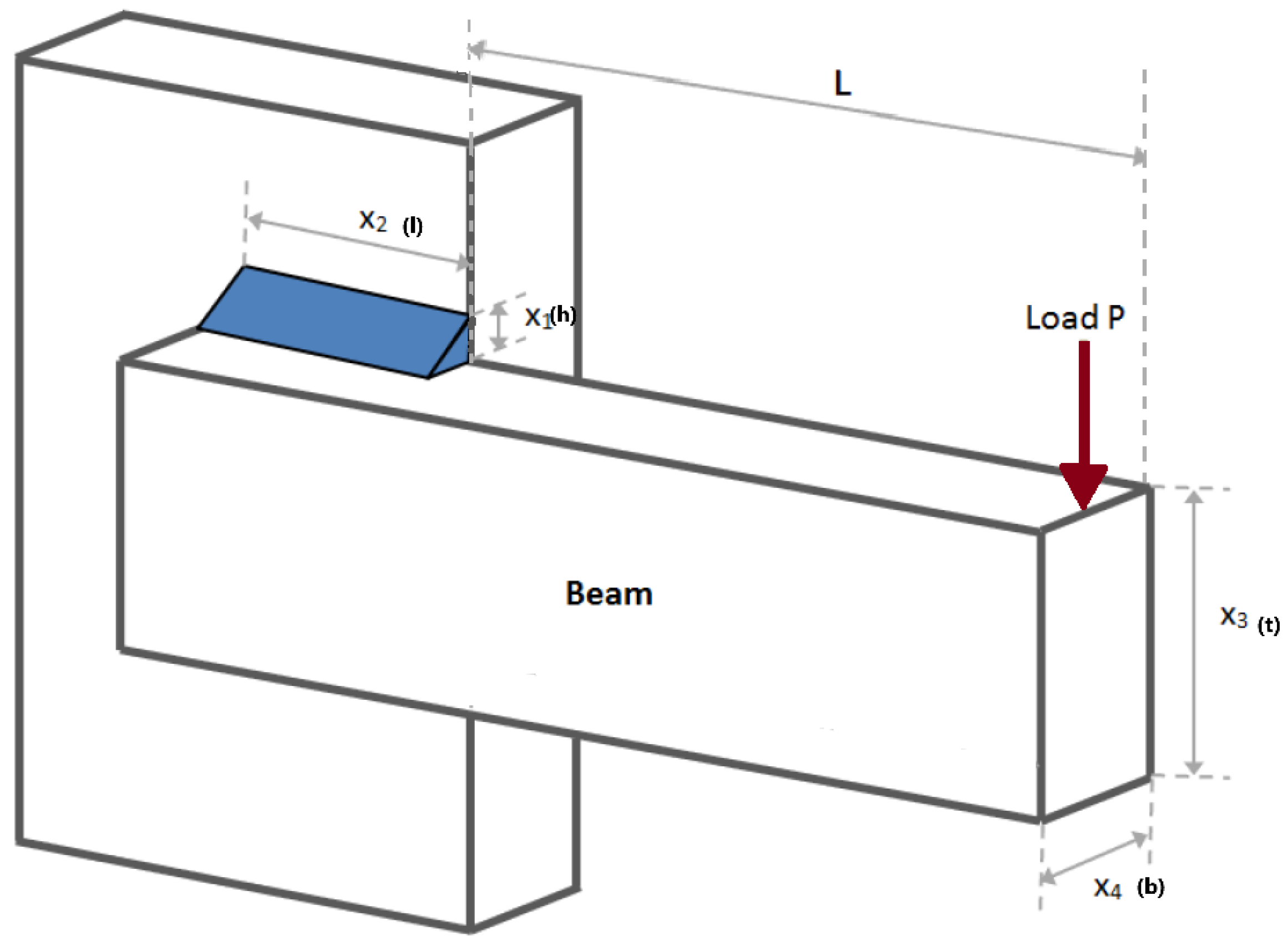
2.1. Design Variables
- : height of the weld.
- : length of the weld.
- : thickness of the beam.
- : width of the beam.
2.2. Objective Function
2.3. Constraints
- Shear stress constraintMeaning: Ensures that shear stresses in the beam do not exceed the allowable limit , preventing structural failure.Explanation: Exceeding this limit could lead to weld joint failure.
- Bending stress constraintMeaning: Prevents bending stress from exceeding , ensuring beam stability.Explanation: The structure must withstand loads without plastic deformation or fractures.
- Deflection constraintMeaning: Controls the beam’s deflection under load.Explanation: Excessive deflection may lead to structural failure and usability issues.
- Geometric constraintMeaning: Ensures that the weld height does not exceed the beam width .Explanation: Satisfying this condition ensures proper weld quality and structural integrity.
- Buckling load constraintMeaning: Guarantees that the critical buckling load is higher than the applied load, preventing buckling failure.Explanation: Exceeding the critical load may cause sudden instability and failure.
- Minimum weld thickness constraintMeaning: Ensures that the weld has a minimum acceptable height for adequate strength.Why is it important? Too small a weld may weaken the joint.
- Cost constraintMeaning: Imposes a maximum allowable manufacturing cost.Explanation: Ensures the economic feasibility of the design.
2.4. Design Variables’ Ranges
2.5. Material Properties and Parameters
- Applied force: .
- Beam length: .
- Maximum deflection: .
- Young’s modulus: .
- Shear modulus: .
- Maximum shear stress: .
- Maximum bending stress: .
2.6. Stress and Deflection Formulas
- Shear stress ():whereMeaning: Defines shear stress in the structure.Explanation: Helps prevent cracks and weld failures.
- Bending stress ():Meaning: Determines stress due to bending in the beam.Explanation: Ensures the structure is resistant to fractures and deformations.
- Deflection ():Meaning: Measures the extent of beam deflection under load.Explanation: Ensures compliance with displacement limits in construction standards.
- Buckling load ():Meaning: Defines the critical load at which the beam may buckle.Explanation: Ensures structural stability under real-world conditions.
3. Strength Constraints
- Shear stress constraintwhereMeaning: Ensures that shear stresses in the beam do not exceed the allowable value. Shear stress is one of the primary failure mechanisms in structures, making its control essential.Explanation: In quantum optimization, this constraint is formulated as a penalty added to the objective function, increasing when stress exceeds the critical value. The D-Wave system searches for solutions where shear stress remains within acceptable limits.
- Normal stress constraintwhereMeaning: Controls the stresses resulting from bending moments. Excessive stresses can lead to plastic deformation or structural failure.Explanation: Quantum optimization aims to find values for design parameters (beam thickness, length, and height) that provide bending resistance while minimizing material cost. The penalty for exceeding in QUBO ensures that the system avoids unsafe configurations.
- Deflection constraintwhereMeaning: Limits the maximum allowable deflection of the beam. Excessive deflection can lead to functional issues and structural instability.Explanation: Quantum annealing enables the optimization of geometric parameters to ensure minimum deflection without excessive material usage. Including this constraint in the QUBO model forces the solution to satisfy the rigidity requirements.
- Weld geometry constraintMeaning: Ensures that the weld height does not exceed the beam width, which is crucial for stability and weld quality.Explanation: In quantum annealing, this condition influences the proper shaping of the solution so that the obtained values of design variables are realistic. Including this inequality in QUBO restricts the solution space to physically valid combinations.
- Buckling load constraintwhereMeaning: Prevents exceeding the critical load that leads to buckling failure. This is one of the key constraints in structural design.Explanation: Quantum annealing enables the evaluation of various beam dimension configurations to find the most efficient geometry that meets the buckling resistance requirements. Adding this constraint to the QUBO model eliminates solutions that lead to structural instability.
- Minimum weld height constraintMeaning: Ensures that the weld has a minimum acceptable height to provide sufficient strength. A weld that is too small may lead to weak joints and failure under stress.Explanation: In quantum optimization, this constraint is crucial for ensuring structural integrity while optimizing material usage. In the QUBO model, a penalty is applied if (weld height) is below the minimum requirement, preventing physically unrealistic solutions.
- Cost constraintMeaning: Imposes a maximum allowable manufacturing cost, ensuring that the optimization does not lead to excessive expenses.Explanation: In quantum optimization, cost minimization is the primary goal, but it must be balanced with structural constraints. This condition is incorporated into the QUBO model as an additional penalty, ensuring that the computed solution remains within economically viable limits.
4. Quadratic Unconstrained Binary Optimization (QUBO)
4.1. Basic Elements of QUBO
- Binary variablesEach component of the vector can only be 0 or 1.
- The matrix
- Diagonal elements capture the contribution of each variable (the “linear” part in the binary sense, since for ).
- Off-diagonal elements (for ) describe the interaction between variables and .
- Objective functionIt is given by . Typically, one aims to minimize this function, though maximizing is also possible by inverting the sign of the relevant terms in .
- Constraint penaltiesIn real-world applications, constraints (e.g., ) are introduced by adding penalty terms to the objective; the following represents an example:where is sufficiently large so that violating the constraint becomes too costly.
4.2. Applications of QUBO
- Combinatorial optimization problems. The following represents an example [17]:
- –
- Max-Cut: Partitioning a graph’s vertices into two sets to maximize the sum of edges “cut” by that partition.
- –
- SAT (Satisfiability): Logical formulas can be mapped to QUBO by introducing penalties for unsatisfied clauses.
- –
- Traveling Salesman Problem (TSP): Minimizing the total route distance while visiting each city exactly once.
- Business optimization [18]
- –
- Knapsack problem: Choosing a subset of items under capacity constraints.
- –
- Production planning and scheduling: Allocating tasks to resources.
- –
- Resource allocation: Selecting investment projects with limited budgets.
- Machine learning [19]
- –
- Clustering: Minimizing a chosen error function to group data points.
- –
- Feature selection: Choosing an optimal subset of features for classification tasks.
4.3. Solving QUBO
- Simulated annealing, genetic algorithms, tabu search: Metaheuristics that search the space of solutions [20].
- Hybrid methods Combining exact search (e.g., integer programming) with heuristic approaches [21].
- Quantum annealing: Realized on machines like D-Wave, where QUBO is expressed as an equivalent Ising problem [22].
- Gate-based algorithms: For example, QAOA (Quantum Approximate Optimization Algorithm), requiring additional implementation steps and an active area of research [23].
5. Formulating Welded Beam Design as QUBO
5.1. Objective Function
5.2. Meaning of the Formula
- The welding cost, which depends on the weld height .
- The material cost, which depends on the beam thickness , beam width , and weld length .
5.3. Meaning of Individual Components in the Formula
- Constant numbers (coefficients)
- 1.10471—a constant related to the welding cost, defining how the weld height impacts the total cost.
- 0.04811—a constant determining the material cost of the beam based on its width and thickness .
- 14.0—a fixed value added to the weld length , accounting for the basic structural parameters and additional costs.
- Structural variables
- (height of weld)—the weld height, which affects the amount of material used for welding and the cost of the welding process.
- (length of weld)—the weld length, where a longer weld increases material consumption and production cost.
- (thickness of beam)—the beam thickness, which influences the weight and strength of the structure.
- (width of beam)—the beam width, where a wider beam results in higher material consumption.
- Each design variable () is discretized into a finite range of values, represented as binary vectors.
- Each variable is described as follows:where are binary variables, and n is the number of bits.
5.4. Constraints
5.5. Constraints
5.6. QUBO Matrix
- represents the linear weights for the binary variables,
- represents the quadratic interaction coefficients between the variables.
6. Pseudocode
| Algorithm 1 Welded beam design QUBO implementation |
|
Explanation of Components
- Problem parameters: The physical and design parameters (e.g., maximum shear stress , bending stress , deflection , Young’s modulus E, shear modulus G, applied load P, and beam length L) set the limits for the design.
- Variable bounds: Bounds for the design variables (, , , ) define the range in which each variable may vary.
- Discretization: Continuous variables are discretized into binary form using a fixed number of bits (num_bits = 4). A scale factor is computed for each variable to map the binary representation to its continuous value. This is described by Equation (32)
- Binary-to-continuous conversion: The binary_to_continuous function converts a binary vector into a continuous variable value using the computed scale factor and the variable’s lower bound.
- QUBO model creation: An empty QUBO (Quadratic Unconstrained Binary Optimization) model is initialized. This model will later incorporate both the cost function and constraint penalties.
- Constraints as penalties: Physical constraints (shear stress, bending stress, and deflection) are added as penalty terms. If any constraint is violated, a penalty increases the overall cost. The detailed implementation is left as a placeholder.
- Solving the QUBO: The QUBO is solved using a D-Wave quantum annealer. The solve_qubo function sets up the sampler, runs the annealing process (with num_reads = 100), and returns the best solution.
- Main flow: The pseudocode concludes by constructing the QUBO model, solving it, and printing the best solution along with its energy.
7. Results
8. Discussion
9. Conclusions
Funding
Informed Consent Statement
Data Availability Statement
Conflicts of Interest
References
- Ewald, D.; Czerniak, J.M.; Paprzycki, M. A New OFNBee Method as an Example of Fuzzy Observance Applied for ABC Optimization. In Theory and Applications of Ordered Fuzzy Numbers; Prokopowicz, P., Czerniak, J., Mikołajewski, D., Apiecionek, Ł., Ślȩzak, D., Eds.; Studies in Fuzziness and Soft Computing; Springer: Cham, Switzerland, 2017; Volume 356. [Google Scholar]
- Czerniak, J.M.; Zarzycki, H.; Ewald, D. AAO as a new strategy in modeling and simulation of constructional problems optimization. Simul. Model. Pract. Theory 2017, 76, 22–33. [Google Scholar] [CrossRef]
- Ewald, D.; Czerniak, J.M.; Zarzycki, H. Approach to Solve a Criteria Problem of the ABC Algorithm Used to the WBDP Multicriteria Optimization. In Intelligent Systems’2014; Angelov, P., Atanassov, K.T., Doukovska, L., Hadjiski, M., Jotsov, V., Kacprzyk, J., Kasabov, N., Sotirov, S., Szmidt, E., Zadrożny, S., Eds.; Advances in Intelligent Systems and Computing; Springer: Cham, Switzerland, 2015; Volume 322. [Google Scholar] [CrossRef]
- D-Wave Documentation. Available online: https://docs.dwavesys.com/docs/latest/c_gs_2.html (accessed on 26 January 2025).
- Glover, F.; Kochenberger, G.A.; Du, Y. Quantum-Inspired Evolutionary Algorithms; Studies in Computational Intelligence; Springer: Cham, Switzerland, 2019. [Google Scholar]
- What Is the Hamiltonian? Available online: https://support.dwavesys.com/hc/en-us/articles/360003684614-What-Is-the-Hamiltonian (accessed on 26 January 2025).
- D-Wave Hybrid Solver Documentation. Available online: https://docs.dwavesys.com/docs/latest/handbook_hybrid.html (accessed on 26 January 2025).
- Introduction to D-Wave Systems. Available online: https://docs.dwavesys.com/docs/latest/handbook_intro.html (accessed on 26 January 2025).
- Mirjalili, S.; Mirjalili, S.M.; Lewis, A. Grey Wolf Optimizer. Adv. Eng. Softw. 2014, 69, 46–61. [Google Scholar] [CrossRef]
- Deb, K.; Sundar, J.; Rao N, U.B.; Chaudhuri, S. Reference Point Based Multi-Objective Optimization Using Evolutionary Algorithms. Int. J. Comput. Intell. Res. 2006, 2, 273–286. Available online: https://www.softcomputing.net/ijcir/vol2-issu3-paper4.pdf (accessed on 26 January 2025).
- Ray, T.; Liew, K.M. A Swarm Metaphor for Multiobjective Design Optimization. Eng. Optim. 2002, 34, 141–153. [Google Scholar] [CrossRef]
- Deb, K. Optimal design of a welded beam via genetic algorithms. AIAA J. 1991, 29, 2013–2015. Available online: https://api.semanticscholar.org/CorpusID:122733806 (accessed on 28 February 2025). [CrossRef]
- Sarkar, M.; Roy, T.K. Multi-Objective Welded Beam Design Optimization Using T-Norm and T-Co-Norm Based Intuitionistic Fuzzy Optimization Technique. Proceedings of an Unspecified Conference. 2017. Available online: https://api.semanticscholar.org/CorpusID:228104228 (accessed on 28 February 2025).
- Kochenberger, G.; Hao, J.-K.; Glover, F.; Lewis, M.; Lü, Z.; Wang, H.; Wang, Y. The unconstrained binary quadratic programming problem: A survey. J. Comb. Optim. 2014, 28, 58–81. [Google Scholar] [CrossRef]
- Glover, F.; Kochenberger, G.; Du, Y. A Tutorial on Formulating and Using QUBO Models. arXiv 2019, arXiv:1811.11538. [Google Scholar] [CrossRef]
- Chen, M.; Chun, J.; Xiang, S.; Wei, L.; Du, Y.; Wan, Q.; Chen, Y.; Chen, Y. Learning to Solve Quadratic Unconstrained Binary Optimization in a Classification Way. In Proceedings of the Thirty-Eighth Annual Conference on Neural Information Processing Systems (NeurIPS 2024), Vancouver, BC, Canada, 9–15 December 2024; Available online: https://openreview.net/forum?id=p43ObIwJFW (accessed on 27 February 2025).
- Więckowski, A. Symulowane Wyżarzanie Problemu Kolorowania Grafu. 2019. Available online: https://www.researchgate.net/publication/335777671_Symulowane_wyzarzanie_problemu_kolorowania_grafu (accessed on 27 February 2025).
- Herman, D.; Googin, C.; Liu, X.; Sun, Y.; Galda, A.; Safro, I.; Pistoia, M.; Alexeev, Y. Quantum computing for finance. Nat. Rev. Phys. 2023, 5, 450–465. [Google Scholar] [CrossRef]
- Veszeli, M.T.; Vattay, G. Mean Field Approximation for solving QUBO problems. arXiv 2021, arXiv:2106.03238. [Google Scholar] [CrossRef] [PubMed]
- Thamilselvan, R.; Balasubramanie, P. Integrating Genetic Algorithm, Tabu Search and Simulated Annealing For Job Shop Scheduling Problem. Int. J. Comput. Appl. 2012, 48, 42–47. [Google Scholar] [CrossRef]
- Wang, Y.; Wang, S.; Wang, K. Hybrid Genetic Algorithm and Tabu Search for Solving Preventive Maintenance Scheduling Problems. Mathematics 2023, 12, 1881. [Google Scholar] [CrossRef]
- Pelofske, E.; Bärtschi, A.; Eidenbenz, S. Quantum Annealing vs. QAOA: 127 Qubit Higher-Order Ising Problems on NISQ Computers. arXiv 2023, arXiv:2301.00520. [Google Scholar] [CrossRef]
- Boothby, K.; King, A.D.; Raymond, J. Next-Generation Topology of D-Wave Quantum Processors. arXiv 2020, arXiv:2003.00133. [Google Scholar] [CrossRef]
- Hamad, R.K.; Rashid, T.A. GOOSE Algorithm: A Powerful Optimization Tool for Real-World Engineering Challenges and Beyond. arXiv 2024, arXiv:2307.10420. [Google Scholar] [CrossRef]

| Algorithm Name | Best Result | Result Source |
|---|---|---|
| WOA | 1.732 | (Mirjalili & Lewis, 2016) [24] |
| PSO | 1.742 | (Mirjalili & Lewis, 2016) [24] |
| GOOSE | 3.188 | arxiv 2024 [24] |
| GSA | 3.576 | (Mirjalili & Lewis, 2016) [24] |
| Quantum Start 1 | 1.234 | – |
| Quantum Start 2 | 1.016 | – |
| Parameter | Value |
|---|---|
| x1 (Height of weld) | 0.3533 |
| x2 (Length of weld) | 6.0400 |
| x3 (Height of beam) | 2.0800 |
| x4 (Width of beam) | 2.0000 |
| Parameter | Value |
|---|---|
| x1 (Height of weld) | 0.3533 |
| x2 (Length of weld) | 4.7200 |
| x3 (Height of beam) | 4.7200 |
| x4 (Width of beam) | 0.8600 |
Disclaimer/Publisher’s Note: The statements, opinions and data contained in all publications are solely those of the individual author(s) and contributor(s) and not of MDPI and/or the editor(s). MDPI and/or the editor(s) disclaim responsibility for any injury to people or property resulting from any ideas, methods, instructions or products referred to in the content. |
© 2025 by the author. Licensee MDPI, Basel, Switzerland. This article is an open access article distributed under the terms and conditions of the Creative Commons Attribution (CC BY) license (https://creativecommons.org/licenses/by/4.0/).
Share and Cite
Ewald, D. Application of Quantum Computers and Their Unique Properties for Constrained Optimization in Engineering Problems: Welded Beam Design. Electronics 2025, 14, 1027. https://doi.org/10.3390/electronics14051027
Ewald D. Application of Quantum Computers and Their Unique Properties for Constrained Optimization in Engineering Problems: Welded Beam Design. Electronics. 2025; 14(5):1027. https://doi.org/10.3390/electronics14051027
Chicago/Turabian StyleEwald, Dawid. 2025. "Application of Quantum Computers and Their Unique Properties for Constrained Optimization in Engineering Problems: Welded Beam Design" Electronics 14, no. 5: 1027. https://doi.org/10.3390/electronics14051027
APA StyleEwald, D. (2025). Application of Quantum Computers and Their Unique Properties for Constrained Optimization in Engineering Problems: Welded Beam Design. Electronics, 14(5), 1027. https://doi.org/10.3390/electronics14051027

