Optimal Scheduling of Hydro–Thermal–Wind–Solar–Pumped Storage Multi-Energy Complementary Systems Under Carbon-Emission Constraints: A Coordinated Model and SVBABC Algorithm

 ,
,  and
and
Abstract
1. Introduction
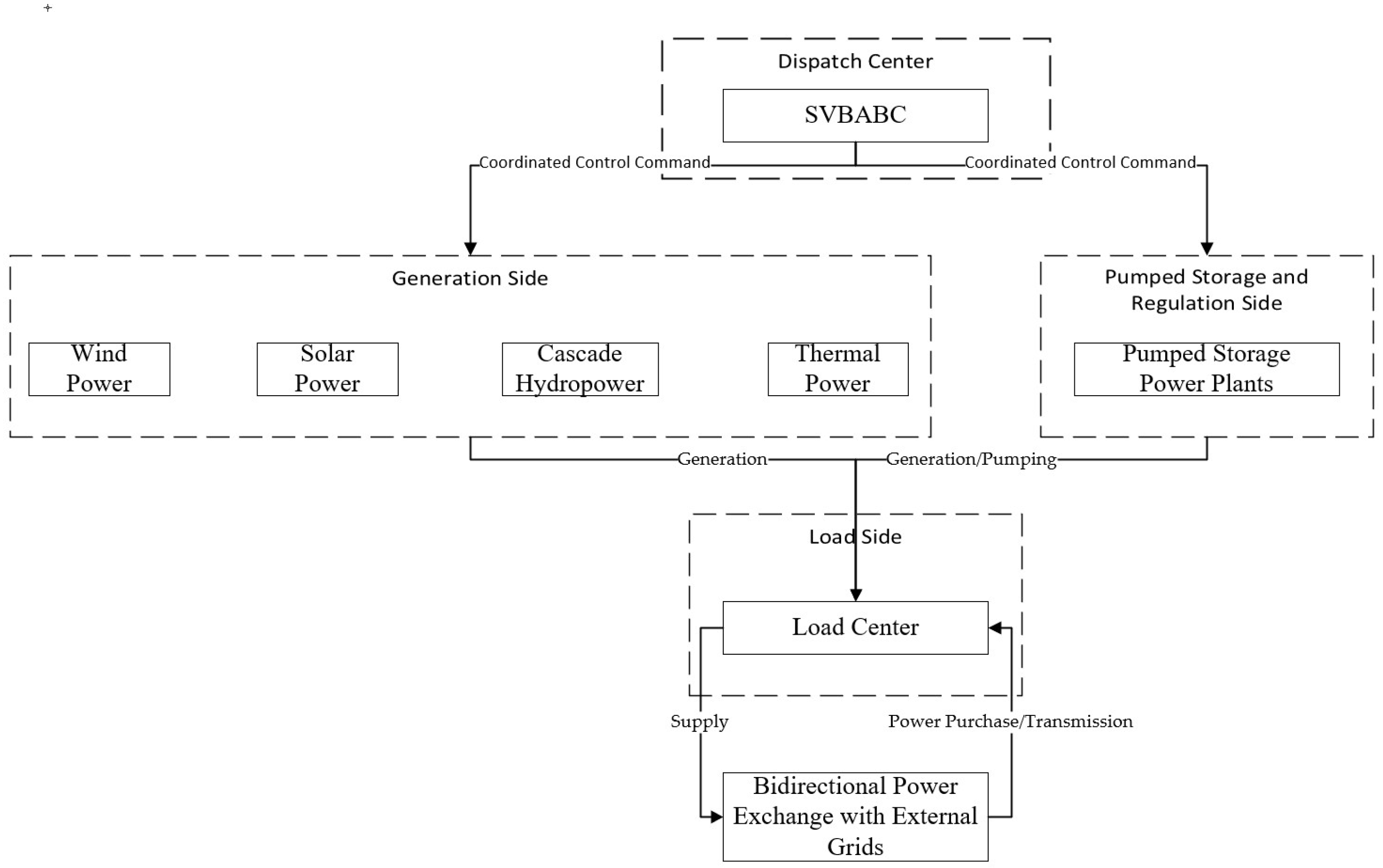
2. Integrated Dispatch Model for Hydro–Thermal–Wind–Solar–Pumped Storage
2.1. Objective Function
- (1)
- Thermal Power Generation Costs
- (2)
- Wind and Solar Curtailment Penalty Cost
2.2. Constraints
3. Model Solving
3.1. Artificial Bee Colony Algorithm
3.2. Improvements to the Artificial Bee Colony Algorithm
3.2.1. Search Equation for Worker Bees in the SVBABC Algorithm
3.2.2. Equation for Observing Bees in the SVBABC Algorithm
3.2.3. Equation for Scout Bees in the SVBABC Algorithm
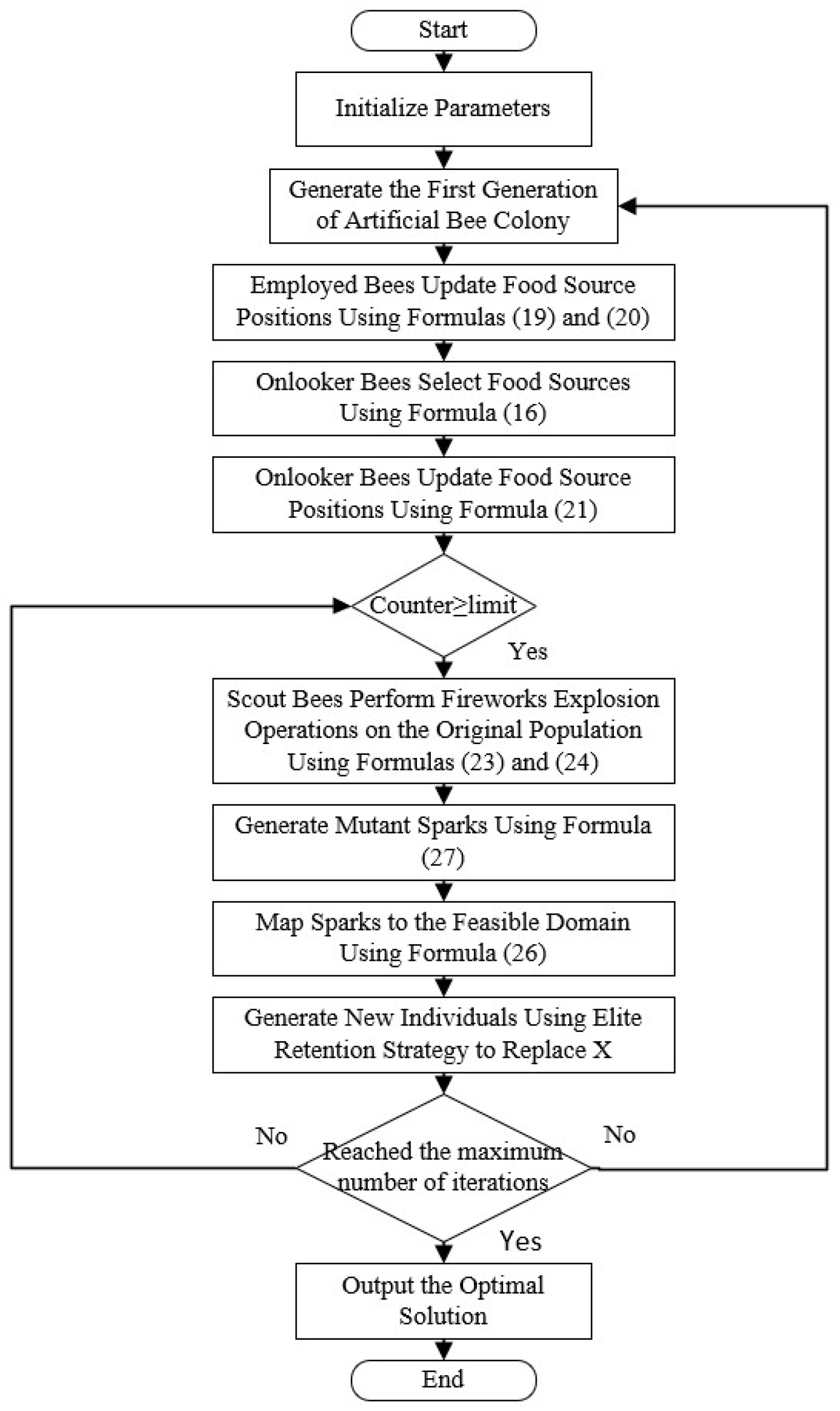
3.3. Solution Process
4. Case Study Analysis
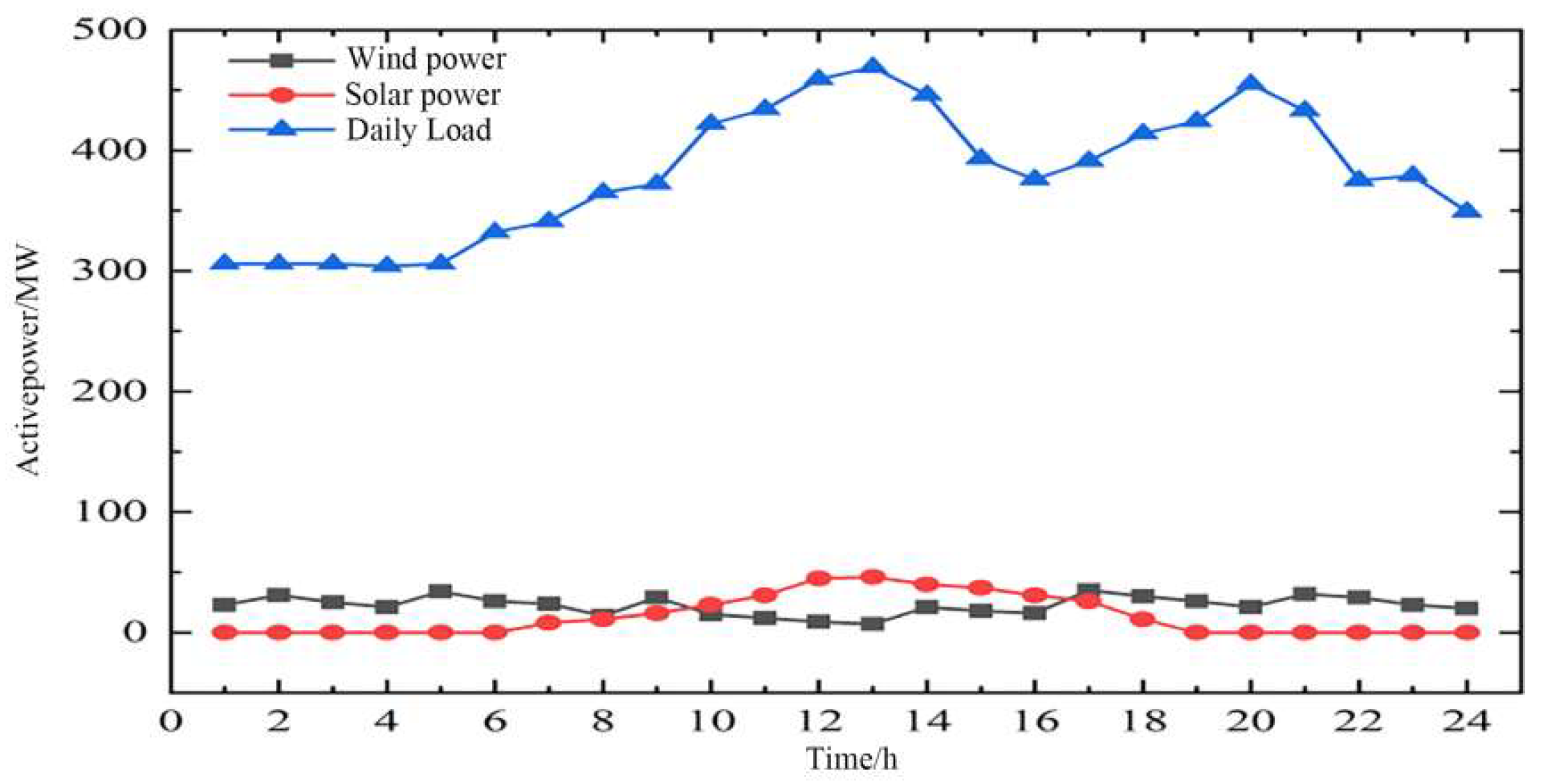
4.1. System Parameter Settings
4.2. Analysis of Simulation Results
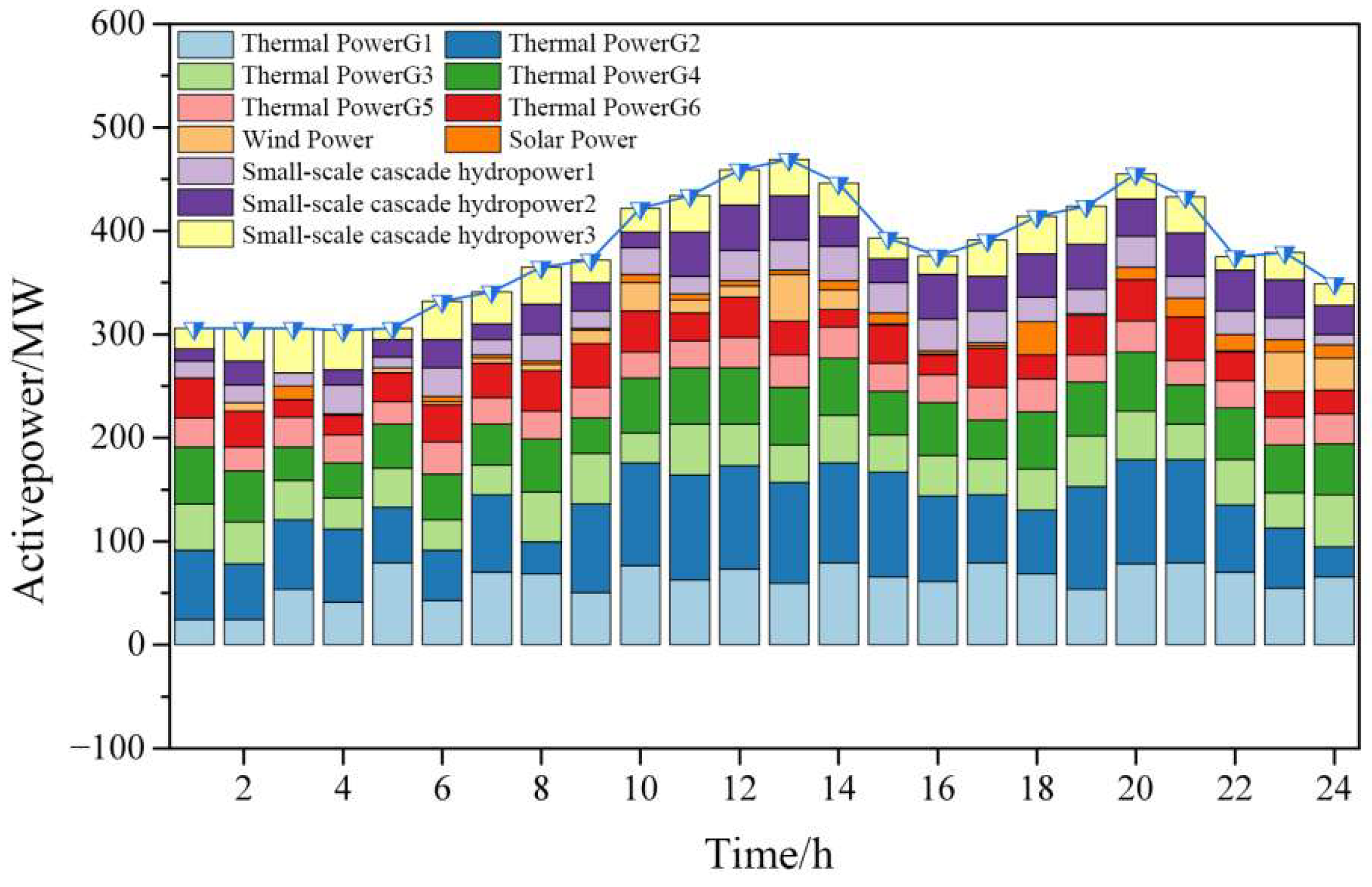
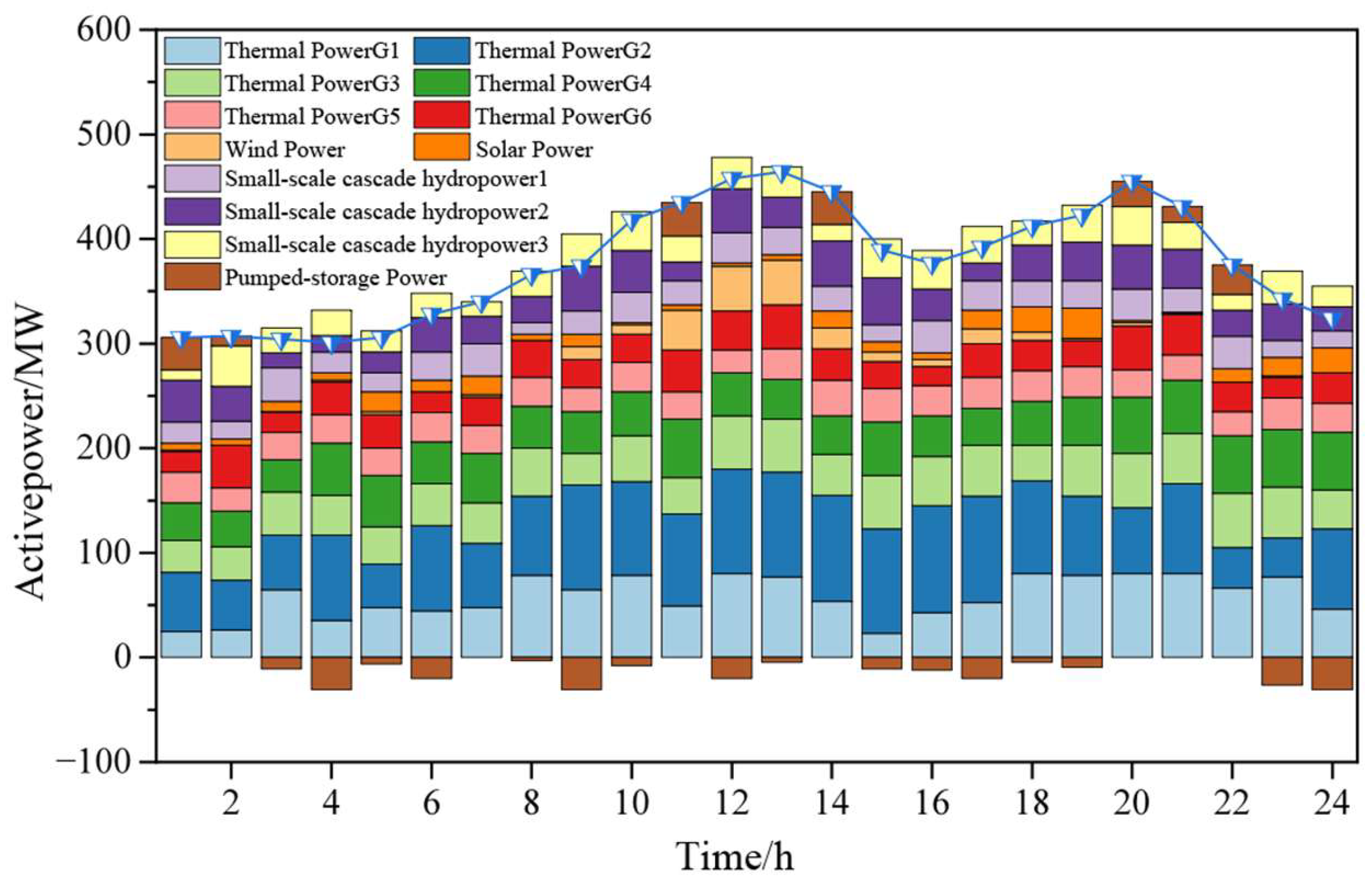
4.2.1. Optimized Scheduling Results Under Different Combinations
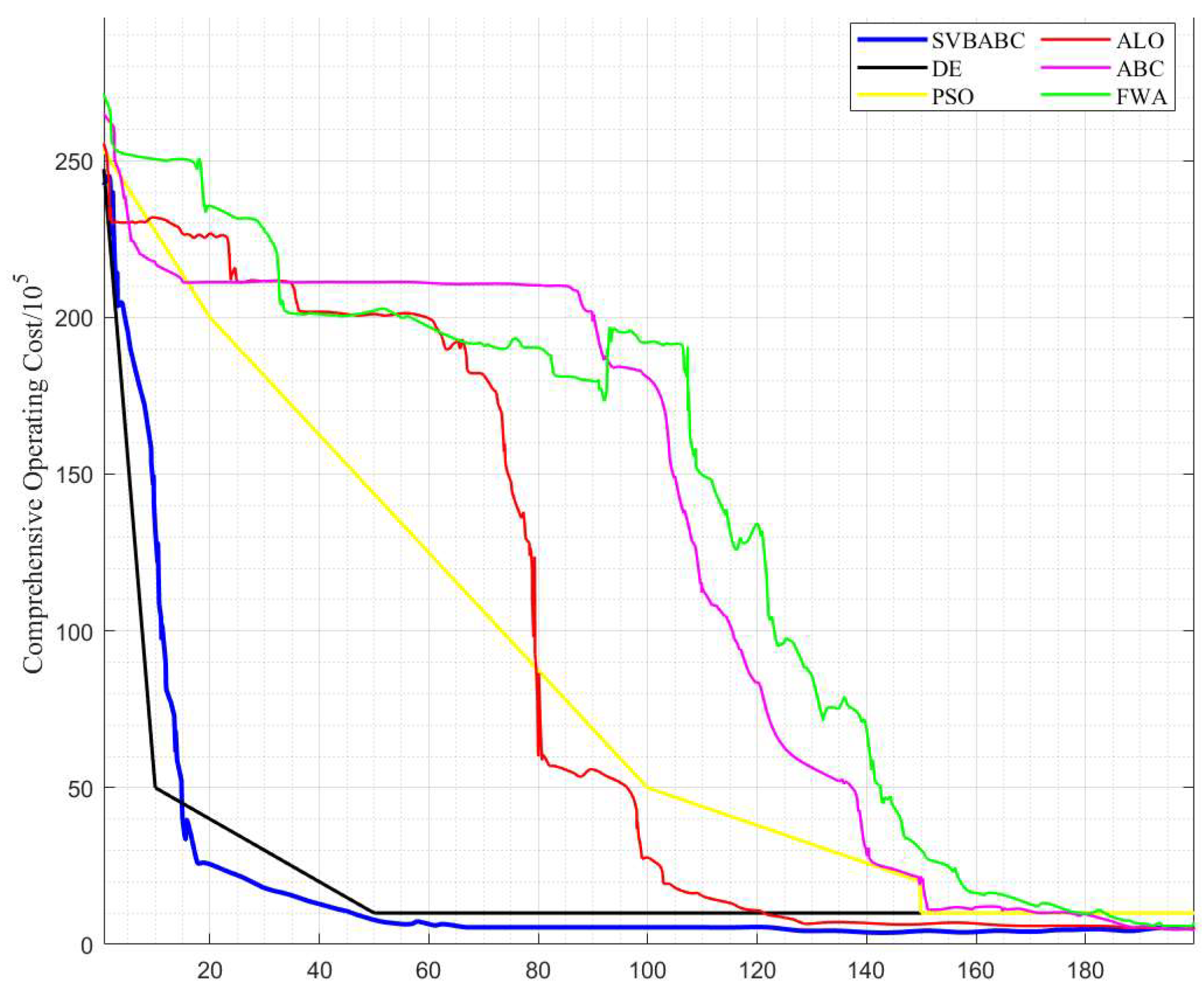
4.2.2. Analysis of Solution Results Under Different Algorithms
4.2.3. Sensitivity Analysis
4.2.4. Discussion on Carbon Reduction Pathways
5. Conclusions
- The integrated model reduces comprehensive costs by 133,900 CNY, carbon emissions by 128.61 tons based on carbon emission flow theory for accurate carbon accounting, and increases renewable utilization by 4.59% compared to non-coordinated operation.
- SVBABC outperforms six comparison algorithms in solution quality, convergence speed, and stability, with statistically significant improvements (p < 0.05).
- Developing stochastic/robust optimization frameworks, particularly by integrating advanced stochastic distributionally robust chance-constrained optimization methods to handle renewable energy uncertainty and multi-agent interactions.
- Investigating scalability to larger national-scale systems, where comprehensive carbon emission accounting during ultra-high voltage project construction becomes critical for life-cycle carbon management, and assessment methods for carbon emission reduction potential can identify optimization opportunities in transmission and distribution infrastructure.
- Exploring SVBABC’s application in other energy optimization domains.
- Integrating real-time market mechanisms and dynamic carbon pricing, including green electricity trading decomposition for accurate user-side carbon responsibility allocation.
Author Contributions
Funding
Data Availability Statement
Conflicts of Interest
References
- Jurasz, J.; Canales, F.A.; Kies, A.; Guezgouz, M.; Beluco, A. A review on the complementarity of renewable energy sources: Concept, metrics, application and future research directions. Sol. Energy 2020, 195, 703–724. [Google Scholar] [CrossRef]
- Li, Y.; Fang, N.; He, S.; Wu, F.; Li, O.; Shi, L.; Ding, R. Two-Stage Stochastic Scheduling of Cascaded Hydropower–Wind–Photovoltaic Hybrid Systems Considering Contract Decomposition and Spot Market. Sustainability 2024, 16, 1093. [Google Scholar] [CrossRef]
- Zhang, L.; Wei, D.; Xie, M.; Zheng, R.; Ye, K.; Chen, L. Time-shifting storage scheme via electricity price arbitrage: Techno-economic optimization for carbon dioxide compression cost reduction in carbon capture, utilization and storage. Energy Convers. Manag. 2025, 347, 120572. [Google Scholar] [CrossRef]
- Wang, J.; Xu, Y.; Lu, J. Multi-objective optimization and mechanism analysis of integrated hydro-wind-solar-storage system: Based on medium-long-term complementary dispatching model coupled with short-term power balance. Energy 2025, 332, 137246. [Google Scholar]
- Li, J.; Shi, L.; Fu, H. Multi-Objective Short-Term Optimal Dispatching of Cascade Hydro-Wind-Solar-Thermal Hybrid Generation System with Pumped Storage Hydropower. Energies 2024, 17, 98. [Google Scholar] [CrossRef]
- Liu, M.; Kong, X.; Lian, J.; Wang, J.; Yang, B. Distributionally robust coordinated day-ahead scheduling of Cascade pumped hydro energy storage system and DC transmission. Appl. Energy 2025, 384, 125449. [Google Scholar] [CrossRef]
- Yang, W.; Norrlund, P.; Saarinen, L.; Witt, A.; Smith, B.; Yang, J.; Lundin, U. Burden on hydropower units for short-term balancing of renewable power systems. Nat. Commun. 2018, 9, 2633. [Google Scholar] [CrossRef] [PubMed]
- Zhao, H.; Liao, S.; Ma, X.; Fang, Z.; Cheng, C.; Zhang, Z. Short-term peak-shaving scheduling of a hydropower-dominated hydro-wind-solar photovoltaic hybrid system considering a shared multienergy coupling transmission channel. Appl. Energy 2024, 372, 123786. [Google Scholar] [CrossRef]
- Chen, Y.C.; Liu, C.; Chen, X.F.; Zeng, R.Q.; Chen, L. Optimal Scheduling of Wind Solar Thermal Storage Combined Power Generation System Based on Chimp Algorithm. J. Yellow River Conserv. Tech. Univ. 2024, 36, 35–40. [Google Scholar]
- Deng, Z.G.; Yang, J.H.; Dong, C.L.; Xiang, M.Q.; Qin, Y.; Sun, Y.S. Research on economic dispatch of integrated energy system based on improved krill swarm algorithm. Energy Rep. 2022, 8, 77–86. [Google Scholar] [CrossRef]
- Yang, W.; Peng, Z.; Yang, Z.; Guo, Y.; Chen, X. An enhanced exploratory whale optimization algorithm for dynamic economic dispatch. Energy Rep. 2021, 7, 32–43. [Google Scholar] [CrossRef]
- Naderi, E.; Azizivahed, A.; Asrari, A. A step toward cleaner energy production: A water saving-based optimization approach for economic dispatch in modern power systems. Electr. Power Syst. Res. 2022, 204, 107689. [Google Scholar] [CrossRef]
- Jiang, W.; Liu, Y.; Fang, G.; Ding, Z. Research on short-term optimal scheduling of hydro-wind-solar multi-energy power system based on deep reinforcement learning. J. Clean. Prod. 2023, 385, 135704. [Google Scholar] [CrossRef]
- Li, W.; Wang, Z.; Zheng, Y.; Huo, H.; Zhang, L.; Wang, G. Dynamic Accounting Method and System Research on Carbon Emissions During Ultra-High Voltage Projects Construction Process. In Proceedings of the 2025 4th International Conference on New Energy System and Power Engineering (NESP), Fuzhou, China, 25–27 April 2025; pp. 314–318. [Google Scholar] [CrossRef]
- Karaboga, D. An Idea Based on Honey Bee Swarm for Numerical Optimization. Technical Report-TR06; Erciyes University, Engineering Faculty, Computer Engineering Department: Kayseri, Turkey, 2005. [Google Scholar]
- Zhong, J.; Zhao, Y.; Li, Y.; Yan, M.; Peng, Y.; Cai, Y.; Cao, Y. Synergistic Operation Framework for the Energy Hub Merging Stochastic Distributionally Robust Chance-Constrained Optimization and Stackelberg Game. IEEE Trans. Smart Grid 2025, 16, 1037–1050. [Google Scholar] [CrossRef]
- Yang, X.S. Nature-Inspired Metaheuristic Algorithms; Luniver Press: Beckington, UK, 2010. [Google Scholar]
- Jin, Y.; Guo, Q.; Xu, S.; Xiong, N. Research on the accounting method of indirect carbon emissions from cross-regional electricity. In Proceedings of the 2025 4th International Symposium on New Energy Technology Innovation and Low Carbon Development (NET-LC), Hangzhou, China, 9–11 May 2025; pp. 186–190. [Google Scholar] [CrossRef]
- Qing, G.; Xiang, Y. Determining User’s Indirect Carbon Emissions Considering Green Electricity Trading Decomposition. In Proceedings of the 2024 International Conference on Smart Grid and Energy (ICSGE), Singapore, 26–28 January 2024; pp. 43–47. [Google Scholar] [CrossRef]



| Reference | Main Hybrid Strategy | Advantages | Limitations | SVBABC Contribution |
|---|---|---|---|---|
| [9] | Chimp Optimization Algorithm | Good convergence | Limited constraint handling | Elite guidance + explosion mutation for complex constraints |
| [10] | Improved Krill Algorithm | Enhanced efficiency | Premature convergence | Dynamic mutation maintains diversity |
| [11] | Adaptive Whale Algorithm | Maintains diversity | Complex parameters | Simpler parameters with dynamic search |
| [12] | Wavelet Mutation in WOA | Economic optimization | Limited scalability | Demonstrated scalability in case studies |
| [5] | Greedy Moth Search | Fast convergence | Local optima trapping | Balanced exploration–exploitation |
| [13] | Integration of Deep Learning Technology | Optimized Power Revenue via Algorithms | Underexplored ABC Algorithms for Multi-energy Scheduling | Pioneers ABC for Multi-energy Systems |
| Step | Phase | Action | Key Equations/Conditions |
|---|---|---|---|
| 1 | Initialization | (i = 1 to SN) | Equation (13) |
| 2 | Main Loop Start | ||
| 3 | Employed Bee Phase | ||
| 4 | Generate new solution Vi | Equation (19) or (20) | |
| 5 | |||
| 6 | Onlooker Bee Phase | Calculate probabilities Pi | Equation (16) |
| 7 | For i = 1 to SN: | ||
| 8 | |||
| 9 | Equation (21) | ||
| 10 | Apply greedy selection | ||
| 11 | Scout Bee Phase | For each abandoned solution (Counter > limit): | |
| 12 | Generate sparks | Equations (23)–(27) | |
| 13 | Select best spark as new solution | ||
| 14 | |||
| 15 | iter = iter + 1 | ||
| 16 | Main Loop End | End while | |
| 17 | Output | Output global best solution |
| Generating Capacity (MW) | Maximum Pumping Power/MW | Power Generation Efficiency | Pump Efficiency | Maximum Storage Capacity /wm3 |
|---|---|---|---|---|
| 100 | 100 | 0.92 | 0.85 | 1380 |
| Serial Number | Maximum Output /MW | Minimum Output /MW | Climbing Rate /MWh | Fuel Cost Factor | ||
|---|---|---|---|---|---|---|
| a | b | c | ||||
| 1 | 456 | 243 | 85 | 0.017 | 21.73 | 1324.75 |
| 2 | 315 | 160 | 82 | 0.068 | 22.86 | 482.75 |
| 3 | 241 | 125 | 71 | 0.081 | 22.08 | 491.64 |
| 4 | 191 | 80 | 61 | 0.068 | 20.98 | 571.35 |
| 5 | 134 | 63 | 49 | 0.051 | 24.15 | 641.25 |
| 6 | 142 | 68 | 47 | 0.072 | 17.93 | 512.67 |
| Time Period | Electricity Price/(CNY/MWh) |
|---|---|
| 0:00–6:00, 22:00–24:00 | 296 |
| 6:00–12:00, 14:00–19:00 | 376 |
| 12:00–14:00 | 304 |
| 19:00–22:00 | 512 |
| Name | Parameter Settings |
|---|---|
| Maximum Iteration Count “” | 200 |
| Maximum Explosion Amplitude | 20 |
| Limit the total number of fireworks produced to | 50 |
| Maximum Spark Count of Explosive Fireworks | 20 |
| Minimum spark count for explosive fireworks | 2 |
| Gaussian Spark Count M_gussian | 5 |
| Combination | System Operating Costs/RMB 10,000 | Carbon Emissions/ton | Carbon Trading/Ten Thousand Yuan | Curtailed Electricity/MW | Usage Volume/% |
|---|---|---|---|---|---|
| 1 | 71.62 | 6357.92 | 5.64 | 503.21 | 68.53 |
| 2 | 59.45 | 6106.58 | 5.35 | 458.62 | 73.16 |
| Algorithm | Minimum | Maximum | Average | Variance | p-Value |
|---|---|---|---|---|---|
| SVBABC | 543,250 | 576,120 | 559,650 | 0.0723 | - |
| ALO | 550,250 | 589,670 | 570,120 | 0.1107 | 0.003 |
| ABC | 568,010 | 621,080 | 591,450 | 0.1245 | 0.001 |
| FWA | 570,120 | 634,620 | 623,860 | 0.2563 | 0.001 |
| PSO | 558,340 | 598,210 | 575,830 | 0.0895 | 0.008 |
| DE | 552,170 | 590,450 | 568,920 | 0.0841 | 0.005 |
| Scenario | Total Cost (104 CNY) | Carbon Emissions (ton) | Curtailment Rate (%) |
|---|---|---|---|
| Base Case | 59.45 | 6106.58 | 8.42 |
| +20% RE Penetration | 57.21 | 5980.32 | 12.15 |
| +50% Carbon Price | 61.23 | 5950.15 | 8.35 |
Disclaimer/Publisher’s Note: The statements, opinions and data contained in all publications are solely those of the individual author(s) and contributor(s) and not of MDPI and/or the editor(s). MDPI and/or the editor(s) disclaim responsibility for any injury to people or property resulting from any ideas, methods, instructions or products referred to in the content. |
© 2025 by the authors. Licensee MDPI, Basel, Switzerland. This article is an open access article distributed under the terms and conditions of the Creative Commons Attribution (CC BY) license (https://creativecommons.org/licenses/by/4.0/).
Share and Cite
Li, Y.; Hua, X.; Wang, L.; Lv, R.; Ouyang, C.; Zhang, F.; Yuan, F. Optimal Scheduling of Hydro–Thermal–Wind–Solar–Pumped Storage Multi-Energy Complementary Systems Under Carbon-Emission Constraints: A Coordinated Model and SVBABC Algorithm. Electronics 2025, 14, 4896. https://doi.org/10.3390/electronics14244896
Li Y, Hua X, Wang L, Lv R, Ouyang C, Zhang F, Yuan F. Optimal Scheduling of Hydro–Thermal–Wind–Solar–Pumped Storage Multi-Energy Complementary Systems Under Carbon-Emission Constraints: A Coordinated Model and SVBABC Algorithm. Electronics. 2025; 14(24):4896. https://doi.org/10.3390/electronics14244896
Chicago/Turabian StyleLi, Youping, Xiaojun Hua, Lei Wang, Rui Lv, Changhao Ouyang, Fangqing Zhang, and Fang Yuan. 2025. "Optimal Scheduling of Hydro–Thermal–Wind–Solar–Pumped Storage Multi-Energy Complementary Systems Under Carbon-Emission Constraints: A Coordinated Model and SVBABC Algorithm" Electronics 14, no. 24: 4896. https://doi.org/10.3390/electronics14244896
APA StyleLi, Y., Hua, X., Wang, L., Lv, R., Ouyang, C., Zhang, F., & Yuan, F. (2025). Optimal Scheduling of Hydro–Thermal–Wind–Solar–Pumped Storage Multi-Energy Complementary Systems Under Carbon-Emission Constraints: A Coordinated Model and SVBABC Algorithm. Electronics, 14(24), 4896. https://doi.org/10.3390/electronics14244896