

You are currently viewing a new version of our website. To view the old version click .
Electronics
  • Article
  • Open Access

6 February 2024

Research on Knowledge Graph Construction and Semantic Representation of Low Earth Orbit Satellite Spectrum Sensing Data

,
,
,
and
1
School of Telecommunications and Information Engineering, Nanjing University of Posts and Telecommunications, Nanjing 210003, China
2
Nanjing Electronic Equipment Institute (NEEI), Nanjing 210007, China
*
Author to whom correspondence should be addressed.
This article belongs to the Special Issue Graph-Based Wireless Networking and Signal Processing

Abstract

The growth of frequency-usage devices has made the electromagnetic spectrum posture complex, resulting in an urgent demand for frequency-usage posture cognition. However, the sensing of space-based platforms is limited by the transmission capacity of the satellite-to-ground link and the satellite processing capacity, which makes on-satellite data analysis and posture generation lack the efficient means. Facing the above issues, an idea of a knowledge graph construction and semantic representation for low Earth orbit (LEO) satellite spectrum sensing data is designed in this paper. In the designed construction process, technologies such as knowledge extraction, ontology construction, knowledge fusion and knowledge visualization are utilized to efficiently analyze on-satellite sensing data. Moreover, the constructed spectrum knowledge graph can be applied in the analysis and prediction of frequency-usage behavior and intelligent spectrum management, which exhibits the effectiveness of the spectrum knowledge graph. Finally, the further development of the spectrum knowledge graph is foreseen.

1. Introduction

Space-based sensing has emerged as a crucial application for the development of low earth orbit (LEO) constellations. However, space-based sensing has certain limitations. Firstly, LEO satellites are highly dynamic, and the objects they observe change dynamically in both time and space. Sensing data are massively stacked on LEO satellite [1], and the data are scattered and lack comprehensibility. Secondly, the satellite-to-ground link has limited transmission capacity, and the limited link bandwidth results in slower data transmission speed. As a result, there is a certain transmission delay, especially when transmitting large amounts of data. This delay can negatively impact the real-time performance of the data. Data may lose practical value when they need to be transmitted to the ground station or elsewhere for processing. Additionally, due to the long propagation distance between satellite and ground [2], the receiving sensitivity is limited and spatial resolution is low. This makes it difficult to achieve accurate sensing even if the satellite can carry a larger antenna. To fully utilize the semantic and scalable performance of sensing data, real-time and efficient means of massive data mining and analysis processing are required. Semantic extraction has been proposed as the main solution by existing researches. However, most studies are carried out on verbal texts, images or videos. Research on space-based spectrum sensing data is still pending. Especially, existing semantic extraction is dominated by deep neural network approaches. There are issues with subjective codebook design, invisible extraction and recovery processes, and weak physical interpretability of extraction results. In recent years, knowledge graph technology has received widespread attention. It forms a relational semantic web of the concepts, entities and relationships between them in the objective world, in a form more akin to the human cognition. As a matter of fact, frequency-usage posture is actually a discrete sampling of the electromagnetic spatial relations of continuous time, space, frequency and energy. This physical context of relationalization makes it suitable for description in terms of relational networks. A knowledge graph, as a relational descriptive model of structured information, has the ability to handle large amounts of data. Precisely because of this, the knowledge graph can be used as a way to characterize the frequency-usage posture. Spectrum posture can be effectively modeled by knowledge graph at the semantic level. With the knowledge graph, the data are correlated in the time, space and frequency, and the concepts and inter-conceptual relationships in the spectrum-sensing data are captured at the semantic level. The spatiotemporal distribution and dynamic characteristics of frequency-usage behavior can be more deeply understood. As well as, the amount of data are reduced to a certain extent, which helps to ease the burden of satellite-to-ground transmission and dilute the transmission delay. It is worth mentioning that the knowledge graph has the capability of knowledge reasoning. By eliminating the bottleneck of sorting through a large number of data facts and the interconnecting relationships, the knowledge graph allows for skipping extensive searches and narrowing down to the desired solution. Accordingly, the reasoning ability of the knowledge graph can be utilized to realize the analysis and prediction of frequency-usage behavior. On-satellite spectrum sensing data are not only semantically integrated by the relational network, but can be fully utilized to realize the sensing value.
Therefore, the construction of a knowledge graph in the field of LEO satellite spectrum sensing is investigated in this paper. There are two methods of knowledge graph construction: bottom-up approach and top-down approach. The bottom-up approach focuses on automatically extracting knowledge from various types of data, emphasizing the discovery of entities and relationships, while the top-down approach concentrates on modeling and standardizing knowledge, that is, defining the ontology and data patterns ahead of time, and then adding entities and relationships to the database. In response to the dynamic sensing characteristics of LEO satellites and the structural characteristics of spectrum sensing data, it is necessary to be able to extract concepts, conceptual hierarchies, and inter-concept relationships from heterogeneous spectrum sensing data. At the same time, as the spectrum knowledge graph needs to satisfy sufficient accuracy, the schema-layer ontology needs to be constructed to constrain the framework and rules of the knowledge graph. Accordingly, a knowledge graph construction idea applicable to the field of spectrum sensing of LEO satellite is designed, which blends the bottom-up approach and top-down approach. The idea includes knowledge extraction, ontology construction, knowledge fusion, and knowledge visualization processes. Moreover, the specific implementation of each process is described in detail. Based on the proposed research methodology, we finally complete the construction of the spectrum knowledge graph and realize the visualization display. According to the characteristics of the constructed spectrum knowledge graph, its application trends and prospects are illustrated. It is shown that the introduction of the designed spectrum knowledge graph can carry out efficient spectrum knowledge utilization and frequency-usage posture generation.

2. The Framework of the Knowledge Graph

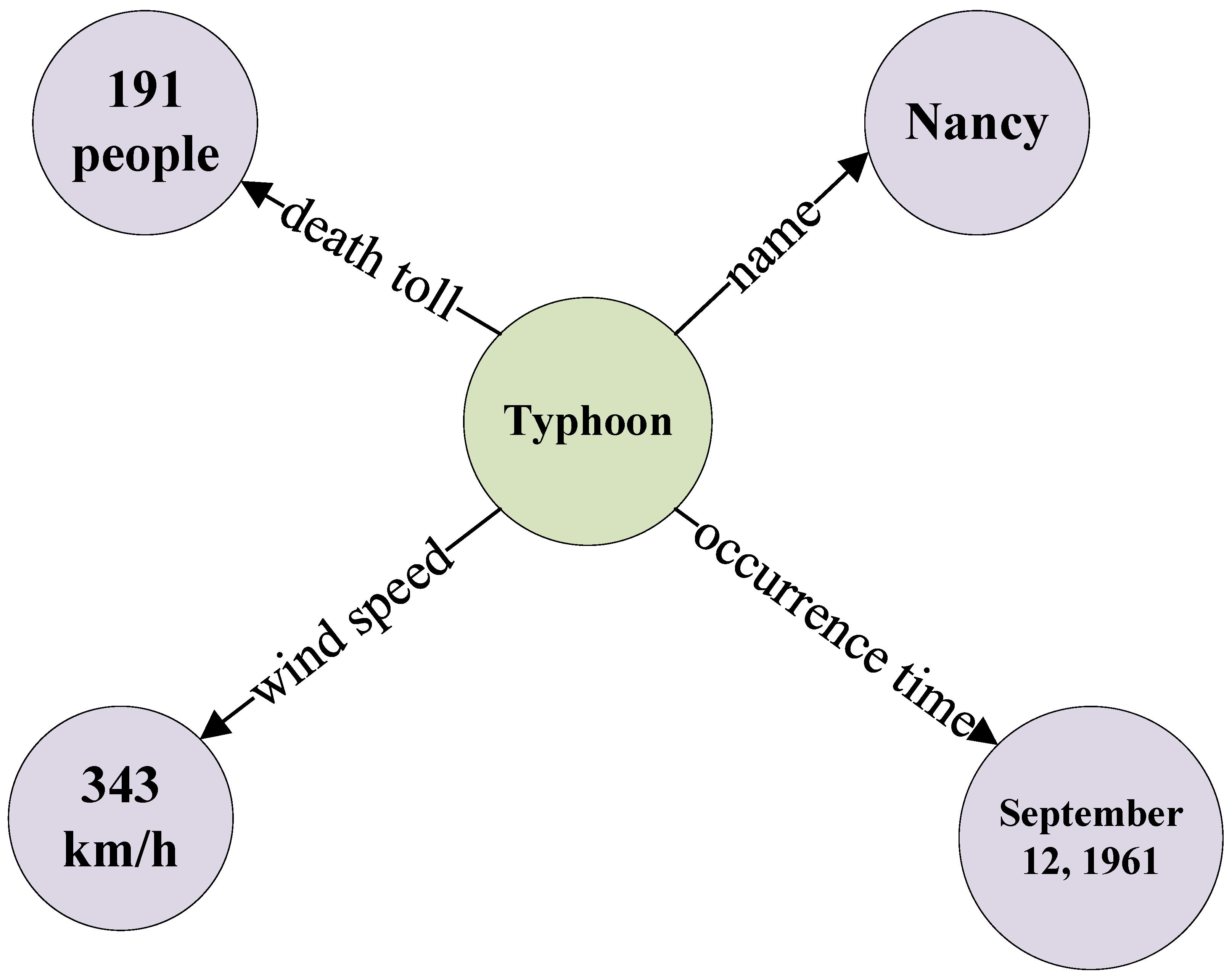
The concept of a knowledge graph was first introduced by Google in 2012 [3]. Knowledge graphs have been proven to be an effective approach of representing real-world entities, their semantic relationships, and attributes [4]. As a semantic network, knowledge graphs demonstrate powerful expression abilities and modeling interpretability, exhibiting excellent results in knowledge question-answering, knowledge recommendation, knowledge visualization, and other applications [5]. Knowledge in the knowledge graph is presented in the form of triples [6]. There are two fundamental forms: (Entity, Relationship, Entity) and (Entity, Attribute, Attribute-value). As shown in Figure 1, taking the typhoon knowledge graph as an illustration, two distinct knowledge presentation forms are evident.
Figure 1. Typhoon knowledge graph.
By eliminating the bottleneck of sorting through a large number of data facts and the interconnecting relationships, the knowledge graph allows for skipping extensive searches and narrowing down to the desired solution [7]. This provides the knowledge graph with sufficient power to mimic how human thought. Because of this, knowledge graphs have been successfully applied in many fields such as the Internet, finance, healthcare, and more. To address the issue of un-normalized radio monitoring data, Zhang Yuyu et al. [8] proposed the idea of analyzing massive radio monitoring data based on a knowledge graph. A knowledge base of structured radio monitoring data has been constructed by employing techniques like blind signal recognition. The authors of [9] employ knowledge graph to demonstrate the satellite network topology and routing architecture to optimize the performance of existing routing policy. In [10], an interpretable and efficient decision strategy was obtained with the support of the multidimensional knowledge graph. Moreover, a knowledge-graph-assisted collaborative filtering algorithm incorporating path loss was proposed in [11], which constructs a better decision system for satellite-to-ground communication.
There are two methods to construct a knowledge graph: the top-down method and the bottom-up method [12]. A comparison of the function of the two construction methods is shown in Table 1.
Table 1. The comparison of the function of the two construction methods.
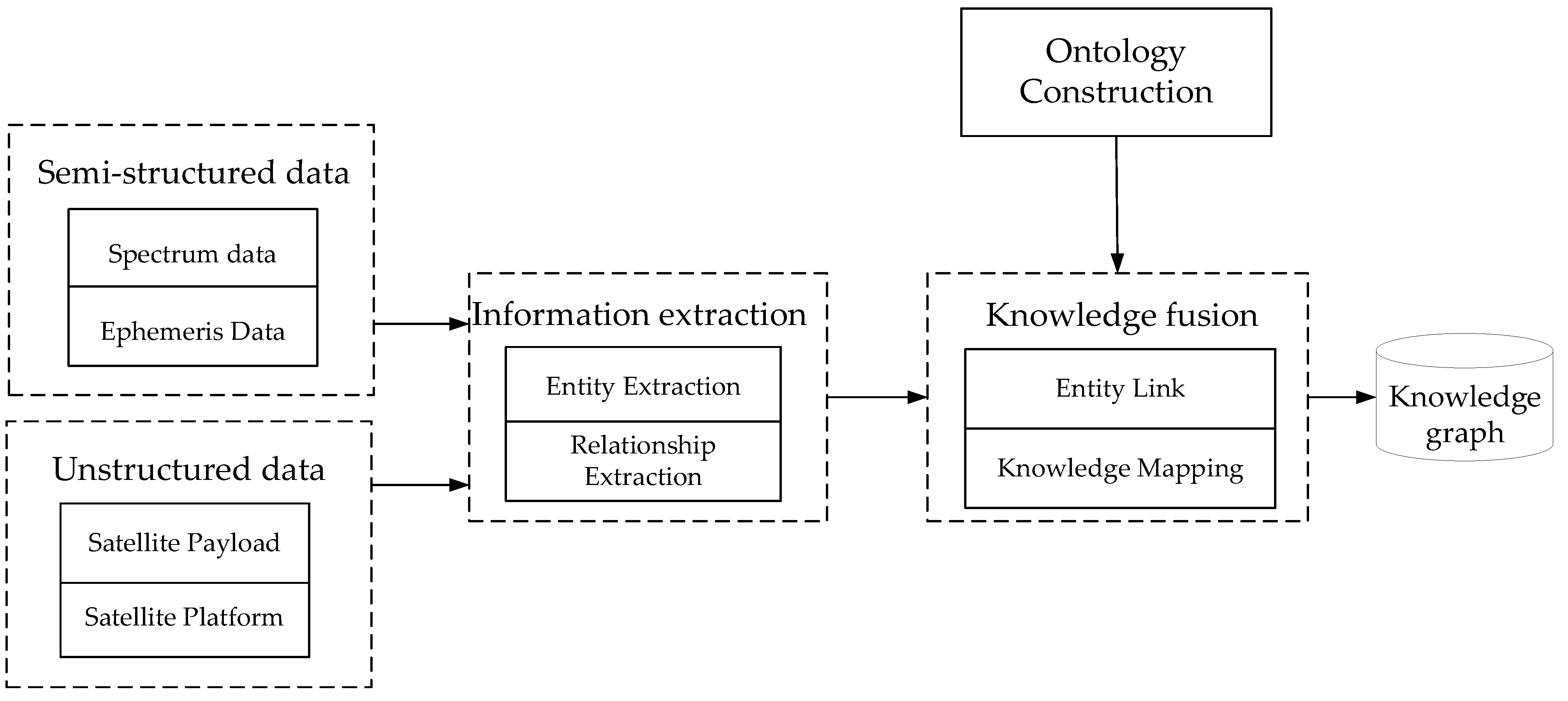
Spectrum knowledge graphs belong to domain knowledge graphs [13]. Compared to the current static knowledge graphs in the fields of medicine and finance, the high dynamics of satellite platforms, and real-time changes in frequency-usage behavior fundamentally affect the construction of the knowledge graph. For this reason, the schema-layer ontology should be designed to define the framework and rules of knowledge graph, which are used for modeling and the specification of knowledge. Furthermore, LEO spectrum sensing field contains enormous amounts of heterogeneous data, and has strict requirements for accuracy. Thus, it is necessary to be able to extract knowledge from spectrum sensing data and satellite domain knowledge for initial data collection and knowledge discovery. Taking this into consideration, it was decided to fuse the top-down and bottom-up methods to design a knowledge graph construction idea which was applicable to the spectrum sensing data of LEO satellite. The specific construction process is shown in Figure 2.
Figure 2. The specific constructing process of spectrum knowledge graph.
According to Figure 2, the first step is to obtain data and partition them. There are three types of data structure, structured data, semi-structured data, and unstructured data. Structured data are data that have a fixed format and structure, such as relational database data. Semi structured data are data that have a certain hierarchical structure but are different from traditional structured data forms, such as JSON. Unstructured data refers to data without a clear structure, such as text, images, or video. By observing the data obtained, spectrum data and ephemeris data belong to semi-structured data, while satellite platform and payload information belong to unstructured data. Knowledge extraction is then performed. Knowledge extraction is the process of extracting entities, relationships and attributes from raw data. Natural language processing and information extraction techniques are often involved. There are many methods of knowledge extraction in practical applications. Depending on the development history, they are mainly categorized into rule- and dictionary-based methods, machine-learning-based methods, and deep-learning-based methods. Unstructured or semi-structured data are converted into structured knowledge through this process. The underlying knowledge structure is built by identifying entities, relationships and attributes. Subsequently, the ontology layer of the spectrum knowledge graph is designed from LEO satellite spectrum sensing perspective to constraint the framework and boundary of knowledge. The ontology provides a common understanding of the information structure and formalized knowledge structures, and clarifies the hierarchical structure between entities. It can be used to define concepts of things in the domain and properties that can be used to describe them. However, the method of ontology construction is not standardized due to the different domains and purposes of construction. The following methods are commonly recognized in the field: Skeleton Method, Loop Acquisition Method, Methodology Method, Seven-Step Method, and so on. Due to the knowledge extraction of data with different structural types, problems such as knowledge redundancy and knowledge conflict are inevitable. These problems can impact the quality of the extracted knowledge, which in turn affects the results of the data to be analyzed and mined. Therefore, knowledge fusion is necessary to be executed for the extracted knowledge. Knowledge fusion is usually achieved through two steps: entity linking and knowledge mapping. The problems of data redundancy and data conflict can be effectively solved through knowledge fusion, and the extracted data can be consistently integrated under the constraints of the ontology. Finally, the triples constrained by the ontology layer are transformed into nodes and links, and stored in spectrum knowledge graph. Knowledge visualization refers to presenting knowledge graphs in a graphical manner. This process is usually implemented with the help of graph visualization tools such as Neo4j, Apache Jena, etc. Through graphical presentation, the fused knowledge can be explicitly observed, which leads to a better understanding and mastery of related information.

3. Construction of Knowledge Graph for Spectrum Sensing Data from LEO Satellite

3.1. LEO Satellite Sensing Scenario

LEO satellite sensing, although highly dynamic, enables globally all-day, all-weather, seamless sensing. A snapshot model is used to represent the moment of LEO satellite over-top sensing. Each time a LEO satellite passes over an area, it receives sensing data from that area, and gradually forming sensing results for that area. On-satellite spectrum sensing data are data used to characterize terrestrial electromagnetic spectrum information. They are acquired by sensors or instruments carried on the satellite payload when the satellite is used as a spectrum sensing node. This paper focus on the construction of spectrum knowledge graph for the scenario of a single satellite over-top a certain area. A LEO satellite with an orbital altitude of 500 km makes up the system’s space segment. The incline of its track is 86.4°. The Earth station for the ground segment is situated in Nanjing. LEO satellite is employed as sources for spectrum sensing to gather spectrum data. The coordinates of an earth station are given in [latitude, longitude]. Nanjing Station is located at [32°, 119°].

3.2. Knowledge Extraction

The fundamental unit of the spectrum knowledge graph is called triple [14]. There are two forms of the triples: (Entity, Relationship, Entity) and (Entity, Attribute, Attribute-value). Triples are formed by extracting from knowledge within the LEO satellite spectrum sensing scenario. By observing the data obtained, most of knowledge in the fields of LEO spectrum sensing are semi-structured or unstructured data. Among them, spectrum data and ephemeris data belong to semi-structured data, while satellite platform and payload information belong to unstructured data. Different methods are considered to extract knowledge according to different data structural types so as to generate knowledge entities, relationships and attributes. For semi-structured data, algorithms such as energy detection and higher order statistics are utilized to extract the entities and relationships. For unstructured knowledge, the deep learning method of BiLSTM-CRF [15] is applied to obtain important information. The preliminary extracted information is stored in CSV format. The knowledge extraction process extracts entities, relationships, and attributes from raw data, and unstructured or semi-structured data are converted into structured knowledge. By identifying entities, relationships and attributes, the base knowledge structure is established.

3.3. Ontology Construction

Ontology is a philosophical concept that represents “objective existence”. The ontology provides the shared comprehension [16] of information structures, and defines the concept of objects in the domain and the properties that can be used to describe them. There are many methods for ontology construction, including IDEF-5 [17], the seven-step method [18], skeleton method [19], TOVE method [20], loop acquisition method [21], methodology method [22], and the nine-step method [23], etc., which have been applied to various fields of ontology construction. In order to be able to efficiently perform on-satellite sensing data analysis, an accurate conceptual and relational model is crucial in constructing a spectrum knowledge graph. Combining the characteristics of the LEO spectrum sensing field, above methods are synthesized and a five-step method was designed to construct ontology layer. The details are as follows.
(a)
Analyze domain to determine the scope of ontology. The knowledge to be embodied in the field of the LEO satellite includes the system components and basic information of the satellite, such as the satellite number, type, operator, etc., which is used to identify the satellite. Spectrum sensing domain includes perception beams, perception time, signal bandwidth, center frequency, etc.
(b)
Consider reusing existing ontology. To the best of our knowledge, no ontology model absolutely applicable to the knowledge graph of the LEO satellite spectrum sensing data is found among the existing constructed knowledge graphs. Therefore, the development and design of the ontology model need to be considered from scratch.
(c)
Obtain knowledge definitions and design the semantic unit. The significant terms in the spectrum sensing of the LEO satellite should be listed, such as the definition of the concepts related to the satellite system composition in the satellite field. During the process of terms display, attention should be paid to the possible ambiguity issues of certain terms to ensure the accurate formation of professional concepts in the relevant field.
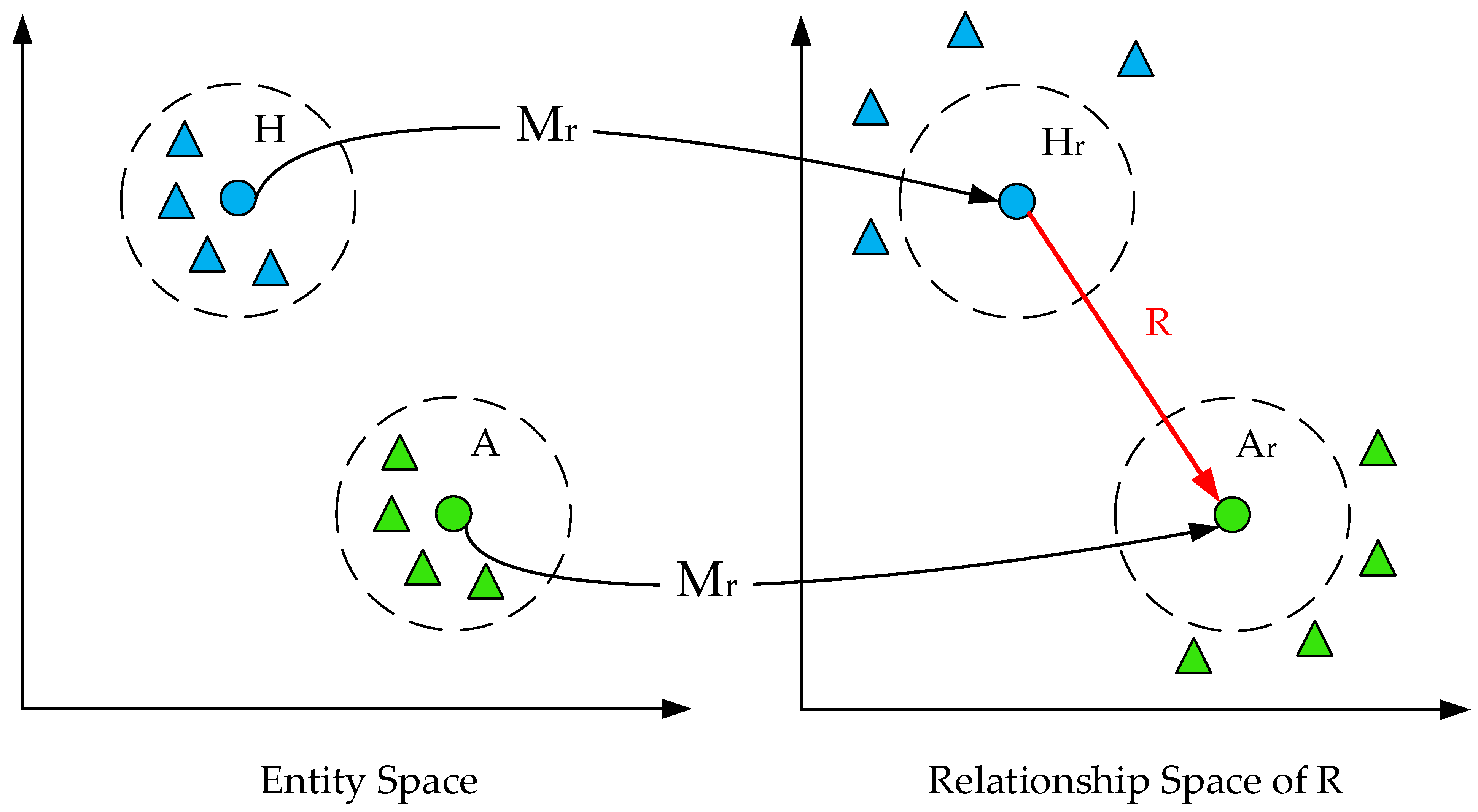
To facilitate the standardized definition of object classes, relationships, and attributes in the future, a semantic unit is designed for constraints. The semantic unit is expressed formally as S = { H , R , A } , and the specific meanings of each element are as follows:
(1)
The non-empty set of abstract entities is represented by H = { h 1 , h 2 , , h n } . Element h i represents the abstract concept type in the ontology layer, such as the LEO satellite class or signal class.
(2)
R = { r 1 , r 2 , , r n } stands for the non-empty set of connected edges in the semantic unit. Conceptual classes are linked by the element r i . For example, kind-of indicates the parent–child relationship of the nodes, part-of indicates the relationship between the whole and the part, etc.
(3)
The non-empty set of abstract attributes is represented by A = { a 1 , a 2 , , a n } . Both the object attributes and data attributes can be represented by element a i . For example, frequency value and bandwidth value are considered as data attributes, while satellite payload and beam characteristics are considered as object attributes.
(d)
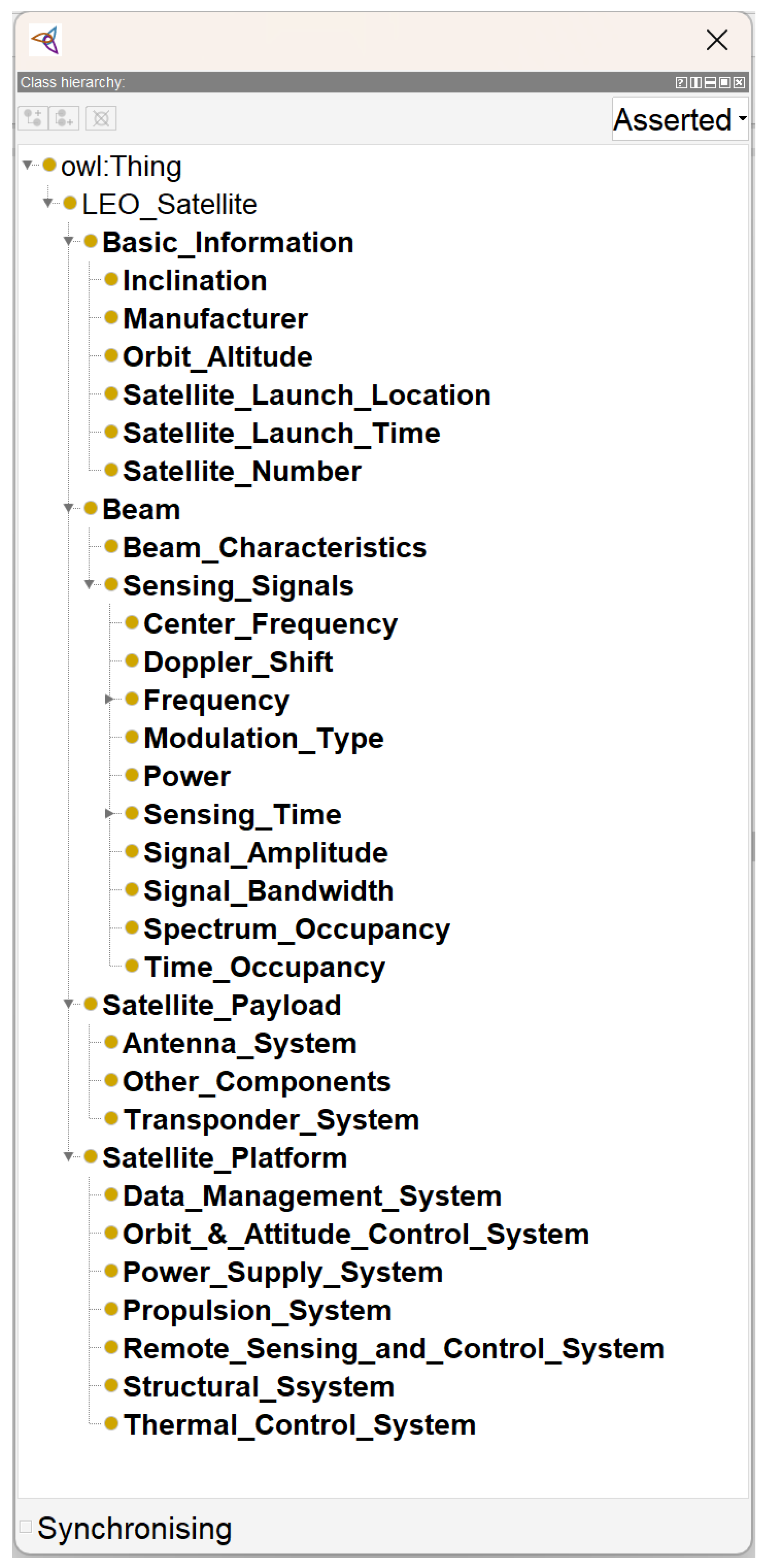
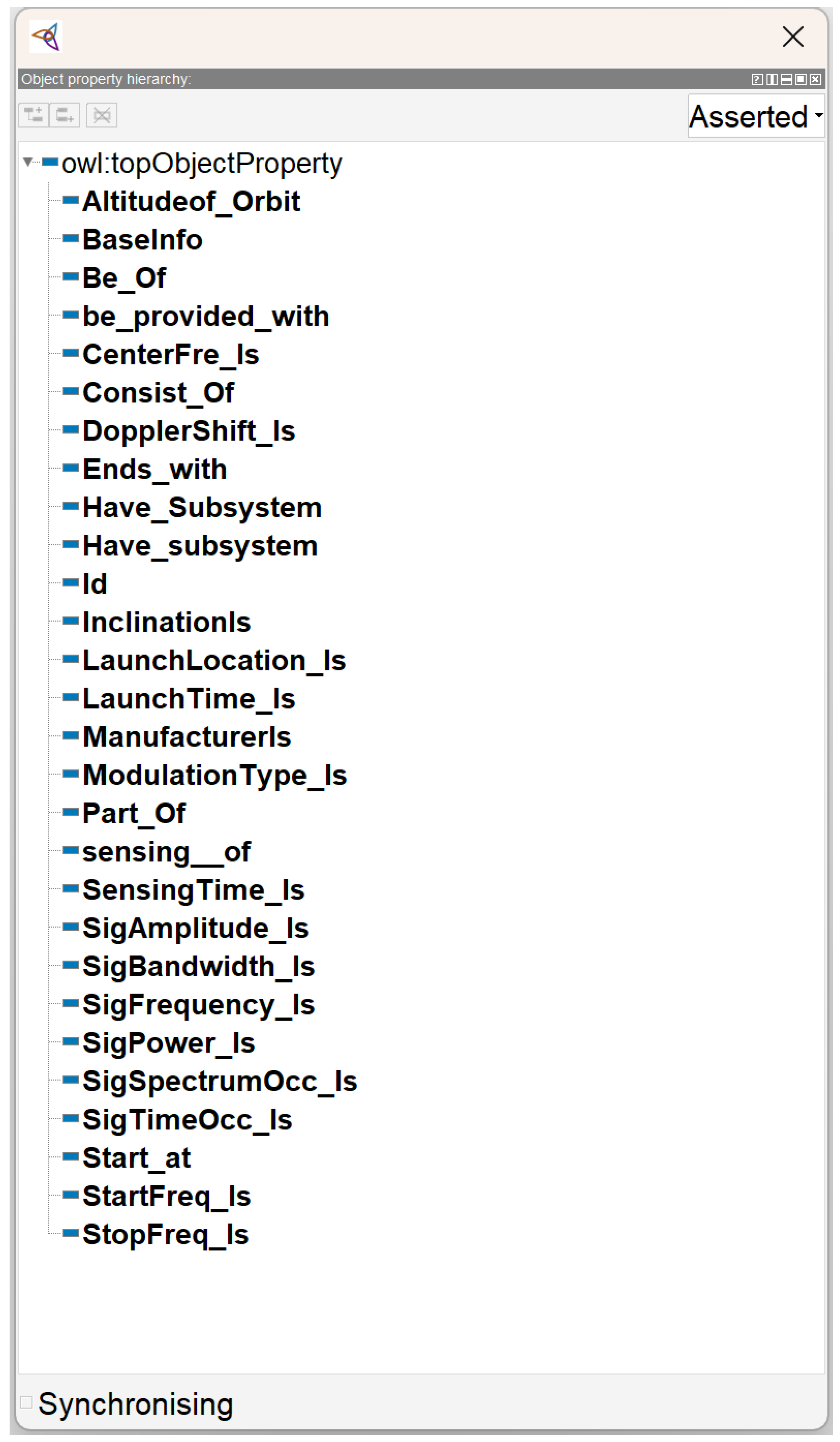
Define concept classes, attributes and relationships. Ontological classes are abstracted from objectively existing objects. According to the inherent attributes of concepts and the constraints of semantic unit, the relationships between concepts and the relationships between concepts and attributes can be fully described. The defined classes and attributes are shown in Figure 3. Three levels of classes are defined in this paper: the first level class is the LEO satellite, the second level class is the beam, and the third level class is the sensing signal. All other concepts are defined as attributes, with the exception of the third level object class. Figure 4 illustrates the defined relationships. A total of five types of relationships are specified: be provided with, consist of, sensing of, subsystem, and numerical relationships.
Figure 3. The structure of defined classes and attributes.
Figure 4. The defined relationships.
(e)
Verify and analyze ontology. After completing steps (a)–(d), the constructed ontology model should be analyzed and validated. If the constructed ontology model is unreasonable, each step needs to be checked according to the construction process. It is necessary to make corresponding modifications to the identified issues, and then the modified model should be re-evaluated until it passes validation.
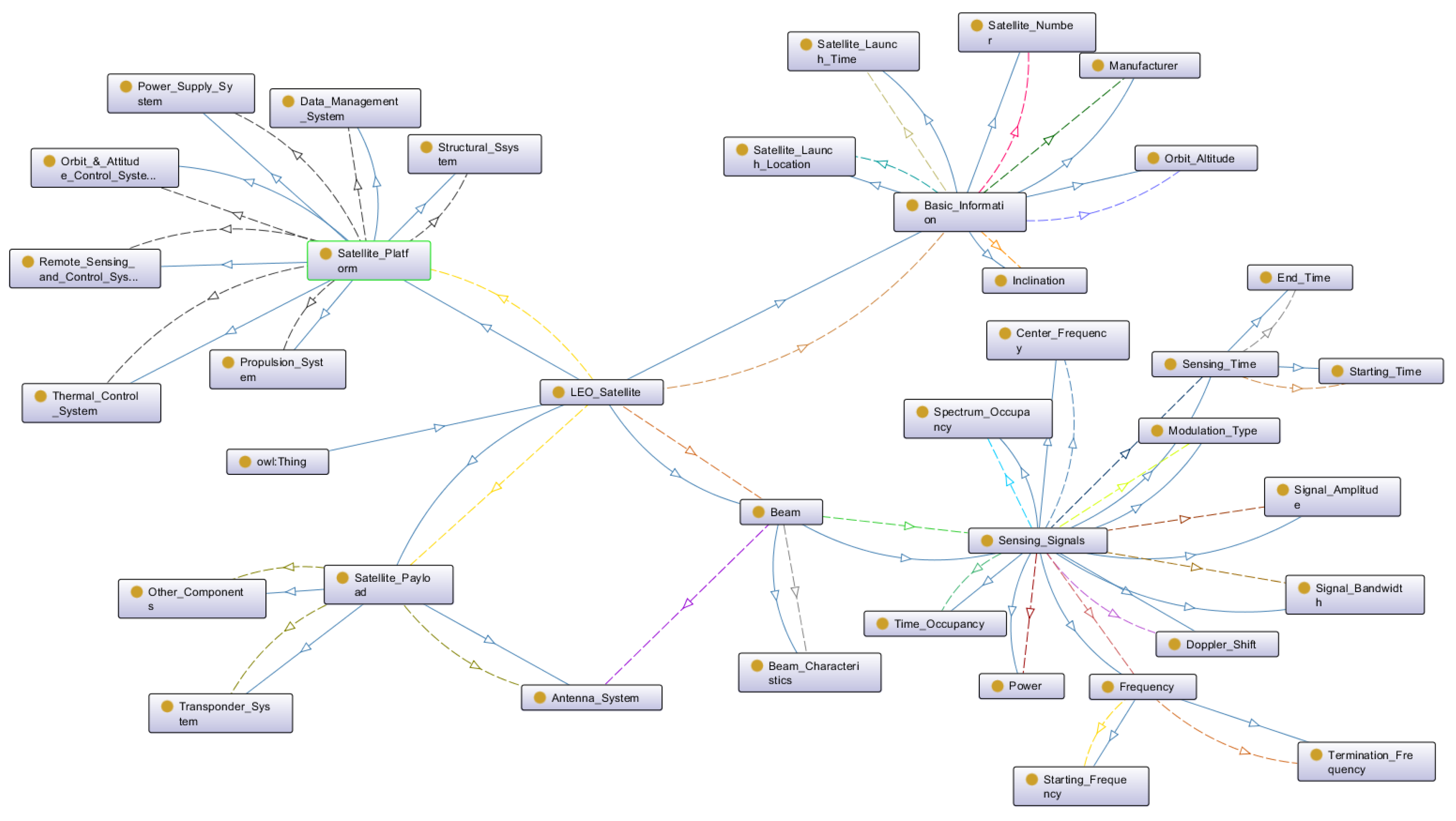
In this paper, Protégé [24], an ontology editor developed by Stanford, is applied to construct the ontology layer of the spectrum knowledge graph. The integral ontology layer is shown as Figure 5.
Figure 5. The integral schema-layer ontology. Please note that the dashed lines represent the relationship defined in Figure 4. Different colored dashed lines represent different relationships.

3.4. Knowledge Fusion and Knowledge Storage

When extracting knowledge from data with different structure types, problems such as knowledge redundancy and knowledge conflicts inevitably arise. These problems impair the quality of the extracted knowledge, which in turn affects the results of the data to be analyzed and utilized. After knowledge extraction, the data are fused through entity linking and knowledge mapping for knowledge fusion. The entity linking process primarily employs a programming language to generate unique flags for the information extracted under each specific time, space, and frequency band, and then categorizes and packages them. Entities and attributes with associations in different data types are linked, and duplicate entities are deleted. The knowledge mapping process marks each entity knowledge, relationship, and attribute knowledge, respectively, by the constraint of conceptual class, relationship, and attribute in the ontology layer. After knowledge mapping, the data in CSV files are mapped into the form of the semantic unit in the ontology, eventually forming triples. The common types of spectrum knowledge graph triples are shown in Table 2. The purpose of knowledge fusion is to eliminate invalid knowledge, avoid information silos, and make knowledge more connected and valuable.
Table 2. Spectrum knowledge graph triples.
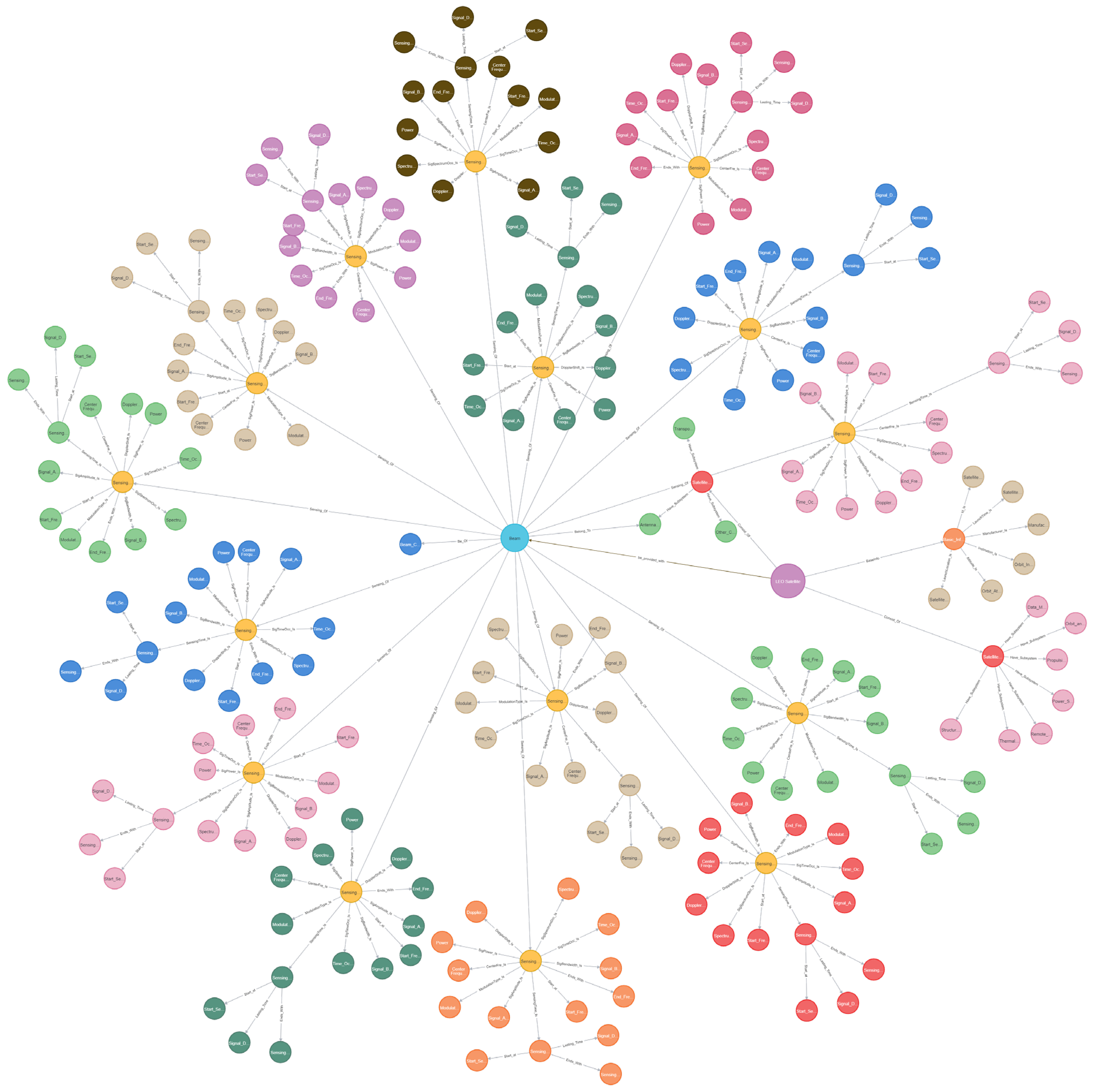
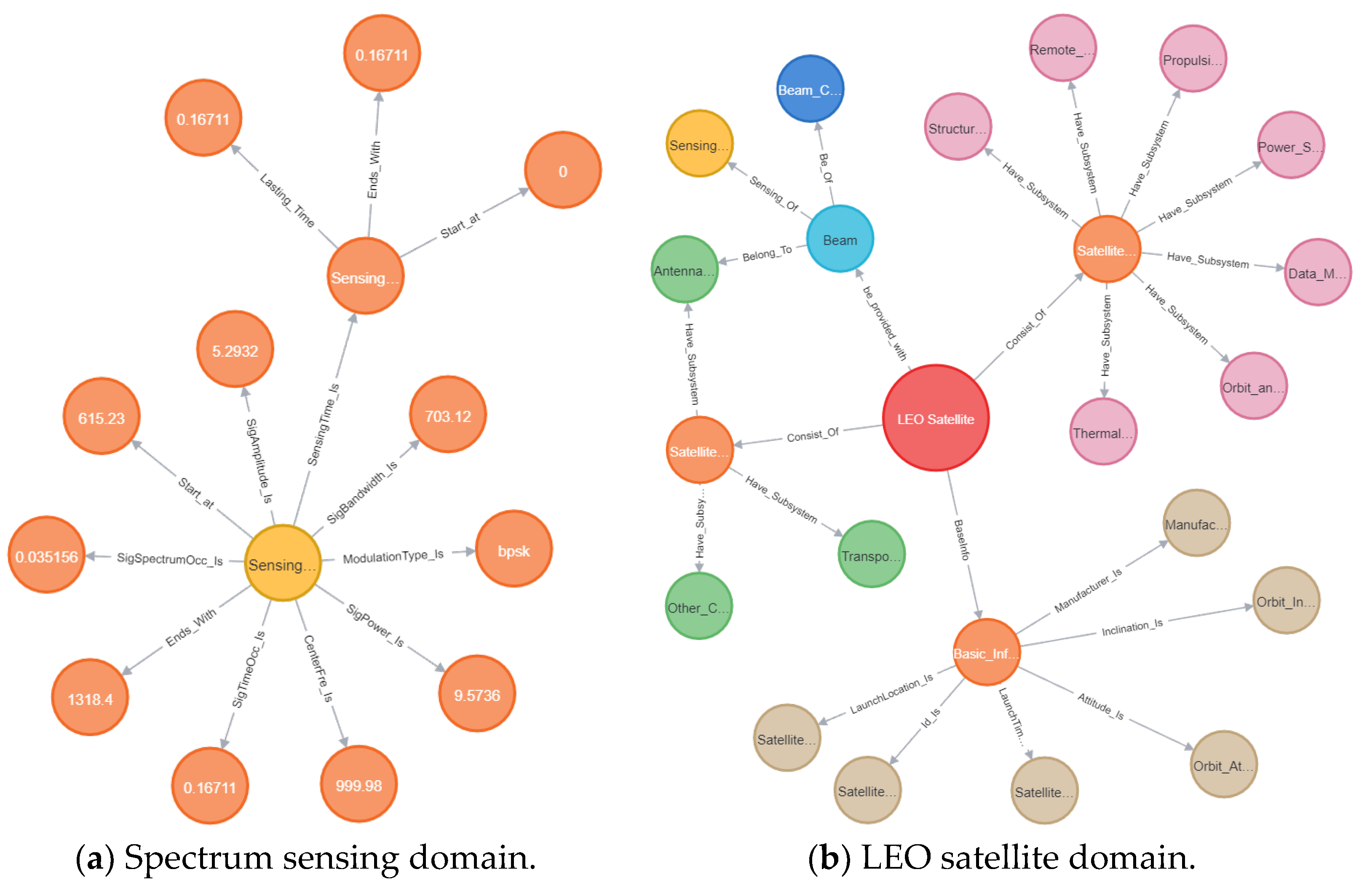
After knowledge fusion, the spectrum knowledge graph is stored and visualized through graphical means. Neo4j [25] graphical database was chosen for the visualization display. The spectrum knowledge graph was stored and visualized in the graph database of Neo4j by importing the py2neo module. Neo4j is a widely used graph database, which provides a flexible and interpretable platform for visualizing and querying large-scale data [26]. In Neo4j, fine-grained queries about entities and relationships can be performed by using the Cypher language and Match language. The entities and relationships associated with query knowledge can be presented together. The visualization sample of spectrum the knowledge graph is shown in Figure 6. Figure 7 shows the local detail of spectrum knowledge graph. Compared with the original data, it can be considered that the spectrum knowledge graph construction method proposed in this paper is complete and feasible. Based on the semantic unit, the constructed spectrum knowledge graph logically forms a vertical associative relationship with ontology layer, data layer, and cross-mapping relationship layer, but forms a horizontal networked topological structure with the corresponding concepts, attributes, and relationships.
Figure 6. Visualization of knowledge graph of LEO satellite spectrum sensing data.
Figure 7. The local detail of spectrum knowledge graph. (a) The knowledge of spectrum sensing domain. (b) The knowledge of LEO satellite domain.

5. Summary and Outlook

In order to efficiently perform on-satellite spectrum sensing data analysis and spectrum posture generation, a knowledge graph construction and semantic representation idea for LEO satellite spectrum sensing data is designed in this paper. By efficiently rearranging LEO satellite spectrum sensing data, data integration at the semantic level can be accomplished. As a result, the intricate and dynamic environment of the frequency-usage posture can be better depicted.
However, a truly usable spectrum knowledge graph relies on the long-term construction of multiple satellites and worldwide spectrum sensing data. In this context, the collaborative updating and knowledge fusion of the LEO satellite spectrum knowledge graphs are particularly crucial.
(1)
Scalable ontology model: With the increase of frequency-usage devices, the types of frequency-usage devices are gradually diversified. This makes the sensing information characteristics also diversify. The diversity will pose a challenge to the construction of ontology model. If the classes, relations and attributes defined in the ontology model are too homogeneous, the diversity of sensing features cannot be adequately characterized, and the validity of the results of the analysis and prediction of frequency-usage behaviors will also be reduced. Further research on data-driven scalable ontology construction methods is necessary. The ontology does not need to be reconstructed when the complexity of the sensing information features is enhanced. The original ontology can be evolved with automated or semi-automated extensions to fully characterize the diversity of sensing features. Thus, the validity of the results of frequency-usage behavior analysis and prediction can be improved.
(2)
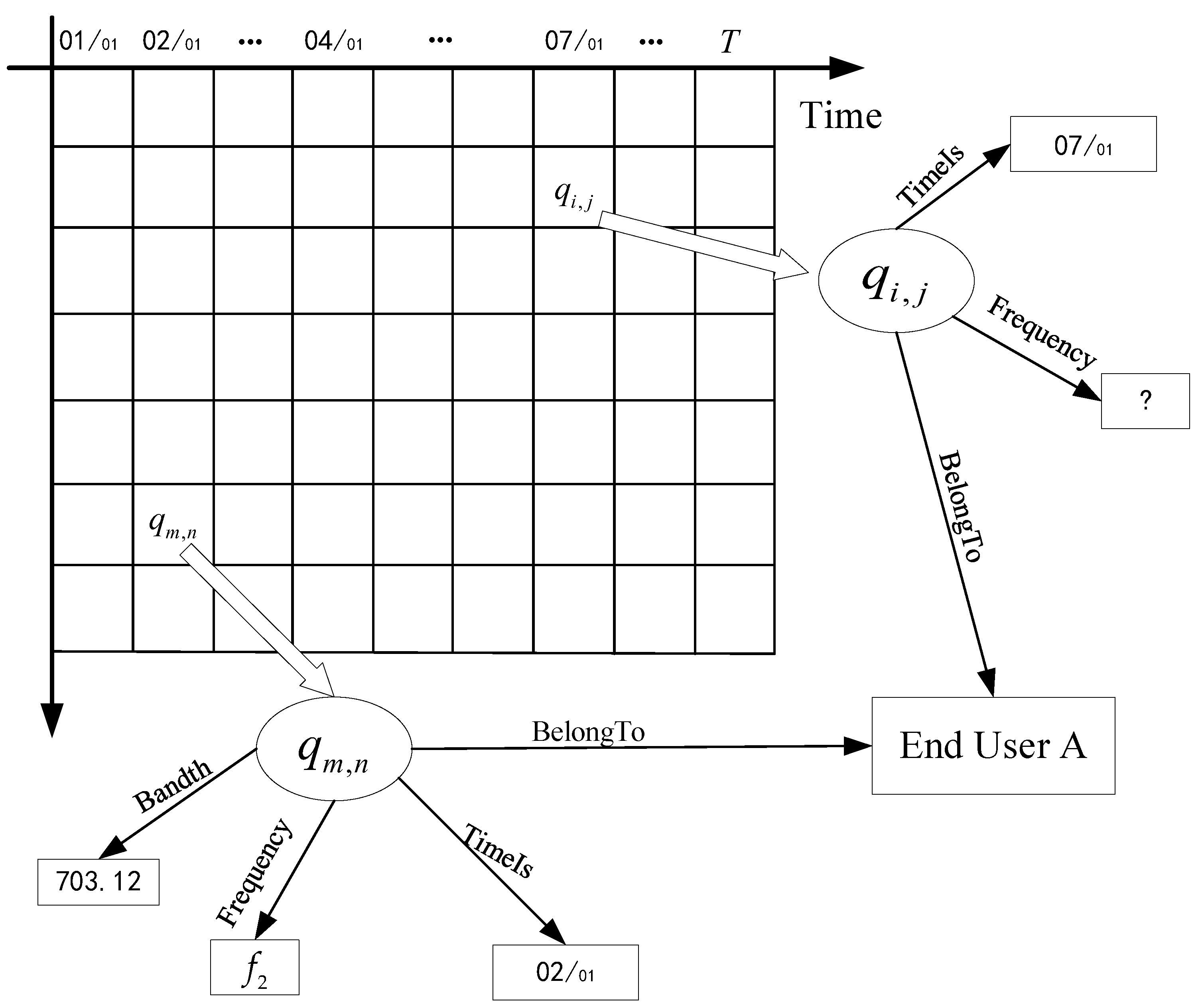
Collaborative updating: As the number of frequency-usage devices continues to increase, the status of each device is constantly changing. This will enhance the dynamism of global sensing, such as the increased probability of device switching on/off, switching of frequency-usage patterns, and diversification of behaviors. At the same time, the spectrum environment may also undergo significant changes in a short period of time. Therefore, the spectrum knowledge graph needs to be able to reflect the dynamic changes of the spectrum posture in a timely manner. If the constructed spectrum knowledge graph can be dynamically updated and evolved, it can continuously learn and adapt to the real-time changing frequency environment. By rapidly capturing the complex changes in the frequency-usage posture, the dynamic knowledge graph can furnish a comprehensive cognition of the frequency-usage posture, and offer more diversified and in-depth data support for the cognition of the frequency-usage posture. Owing to the specificity of the field, knowledge in the spectrum domain is often constrained by temporal and spatial factors, such as the high dynamism, time-sharing asynchronous observation of LEO satellites, etc. These problems can be mitigated by adding attributes such as time and geographic location. Nevertheless, it may result in a rise in the quantity of entities and relationships. Therefore, the spectrum knowledge graph is to some extent distinguished from other fields by its short timeliness and frequent updates. The problem of how to efficiently perform dynamic updating of on-satellite knowledge graph has to be considered.
(3)
Knowledge fusion: With the continuous development of satellite constellations and inter-satellite networking technology, multiple satellites can be interlinked for sensing. By fusing knowledge graphs from different satellites, various frequency-usage behaviors, patterns, and trends can be more comprehensively understood. By doing so, more accurate information can be provided for the rational planning and allocation of spectrum resources to optimize resource scheduling. However, distinct variations in satellite orbits and observation angles result in disparities in the constructed spectrum knowledge graphs on various satellite. This variability not only impacts the knowledge graph’s size, but can also result in issues like knowledge duplication and conflict. One of the most efficient ways to extend the incomplete spectrum knowledge graphs is to fuse cross entities from multiple spectrum knowledge graphs into a uniform knowledge graph. This method can address the issue of knowledge contradicting in various knowledge graphs and mitigate the problem of long-tailed distribution of data to some extent.

Author Contributions

Writing—original draft preparation, Y.M.; methodology and writing review, Z.L.; knowledge extraction, N.Y.; partial algorithm analysis, H.X.; paper structure, G.Z. All authors have read and agreed to the published version of the manuscript.

Funding

This work was supported by the National Science Foundation of China (No. U21A20450, 61971440, 62271266) and the Natural Science Foundation of Jiangsu Province Major Project (No. BK20192002).

Data Availability Statement

The data presented in this study are available in this article.

Acknowledgments

The authors are thankful to the anonymous reviewers and editors for their valuable comments and suggestions.

Conflicts of Interest

The authors declare no conflicts of interest.

References

  1. Wang, Y.F. Research on Cooperative Spectrum Sensing and Sharing Technology for LEO Satellites. Ph.D. Thesis, Nanjing University of Posts and Telecommunications, Nanjing, China, 2022. [Google Scholar]
  2. Feng, L.J. Research on Satellite Spectrum Sensing and Resource Utilization Based on Deep Learning. Master’s Thesis, Nanjing University of Posts and Telecommunications, Nanjing, China, 2023. [Google Scholar]
  3. Choi, W.; Lee, S.; Chung, C. On-road object collision point estimation by radar sensor data fusion. IEEE Trans. Intell. Transp. Syst. 2021, 23, 14753–14763. [Google Scholar] [CrossRef]
  4. Wang, H.F.; Qi, G.L.; Chen, H.J. Knowledge Graph: Methods, Practices and Applications; Publishing House of Electronics Industry: Beijing, China, 2019. [Google Scholar]
  5. Yu, H.; Zhang, J.; Wu, M.H. A framework for rapid construction and application of domain knowledge graphs. CAAI Trans. Intell. Syst. 2021, 16, 871–884. [Google Scholar]
  6. Shao, B.L.; Li, X.J.; Bian, G.Q. A Survey of Research Hotspots and Frontier Trends of Recommendation Systems from the Perspective of Knowledge Graph. Expert Syst. Appl. 2021, 165, 113764. [Google Scholar] [CrossRef]
  7. Wang, T.; Wang, C.C. The Development and Construction of Knowledge Graph. J. Nanjing Univ. Sci. Technol. 2017, 41, 23–24. [Google Scholar]
  8. Zhang, Y.Y.; Zhao, L.; Guo, W.B. Wireless Monitoring and Blind Signal Recognition Based on Knowledge Graph. Radio Eng. 2020, 50, 187–192. [Google Scholar]
  9. Li, C.X.; He, W.J.; Yao, H.P.; Mai, T.L.; Wang, J.J.; Guo, S. Knowledge graph aided network representation and routing algorithm for LEO satellite networks. IEEE Trans. Veh. Technol. 2022, 72, 5195–5207. [Google Scholar] [CrossRef]
  10. Zhang, X.X.; Li, Y.J.; Yang, T.Z.; Dong, F.; Zhang, X.; Wang, C. Satellite Fault Auxiliary Diagnosis Method Based on Multi-disciplinary Knowledge Graph. In Proceedings of the 2022 International Conference on Sensing, Measurement & Data Analytics in the era of Artificial Intelligence (ICSMD), Harbin, China, 30 November–2 December 2022. [Google Scholar]
  11. Cai, G.J.; Zhang, L.Y. Satellite-to-ground Communication Decision System Based on Knowledge Graph. J. Phys. Conf. Ser. 2021, 1856, 012060. [Google Scholar] [CrossRef]
  12. Du, Z.Q.; Li, Y.; Zhang, Y.T. Research on the Construction Method of Natural Disaster Emergency Knowledge Graph. Geomat. Inf. Sci. Wuhan Univ. 2020, 45, 1344–1355. [Google Scholar]
  13. Lin, Y.L.; Li, H.H.; Zhang, C. Research of protocol conversion based on knowledge graph. J. Integr. Technol. 2023, 12, 26–41. [Google Scholar]
  14. Chi, Q.X.; Hu, H.W. Collaborative Construction Technology of Radiation Source Threat Situation Based on Knowledge Graph. Tactical Missile Technol. 2022, 4, 168–177. [Google Scholar] [CrossRef]
  15. Wu, M.J.; Song, C.W.; Wu, Y.Q. A Method for Identifying Named Entities of Event Elements in the Field of Social Governance Based on BiLSTM-CRF. CN Patent CN115221265A, 21 October 2022. [Google Scholar]
  16. Studer, R.; Benjamins, V.R.; Fensel, D. Knowledge engineering: Principles and methods. Data Knowl. Eng. 1998, 25, 161–197. [Google Scholar] [CrossRef]
  17. Tang, Z.J.; Xu, X.Z.; Xue, Q.; He, B. Operational Action Ontology Modeling and Semantic Reasoning Based on Ontology. Comput. Integr. Manuf. Syst. 2018, 35, 1–5+398. [Google Scholar]
  18. Chen, Y.Q.; Xing, Y.X. Research on construction technology of dynamic knowledge graph based on ontology modeling. J. Southwest Minzu Univ. (Nat. Sci. Ed.) 2021, 47, 310–316. [Google Scholar]
  19. Pinto, H.S.; Martins, J.P. Ontologies: How can they be built? Knowl. Inf. Syst. 2004, 6, 441–464. [Google Scholar] [CrossRef]
  20. Liu, L.S. Research on Ontology Construction Methods and Development Tools. J. Mod. Inf. 2009, 29, 17–24. [Google Scholar]
  21. Maedche, A.; Staab, S. Ontology learning for the semantic Web. IEEE Intell. Syst. 2001, 2, 72–79. [Google Scholar] [CrossRef]
  22. Ferndandez, M.; Gormez, P.A.; Juristo, N. Methontology: From Ontological Art to Wards Ontological Engineering. In Proceedings of the AAAI97 Spring Symposium on Ontological Engineering Stanford University, Palo Alto, CA, USA, 24–26 March 1997; pp. 33–40. [Google Scholar]
  23. Yue, L.X.; Liu, W.Y. A comparative study of domain ontology construction methods at home and abroad. Inf. Stud. Theory Appl. 2016, 39, 119–125. [Google Scholar]
  24. Zhang, R.M.; Yang, C.; Yin, L. Semi-automated build of Huizhou architectural knowledge graph. J. Anhui Jianzhu Univ. 2021, 29, 13–19. [Google Scholar]
  25. Abadi, D.J.; Marcus, A.; Madden, S.R. SW-Store: A vertically partitioned DBMS for Semantic Web data management. VLDB J. 2009, 18, 385–406. [Google Scholar] [CrossRef]
  26. Vukotic, A.; Watt, N.; Abedrabbo, T. Neo4j in Action; Manning: Shelter Island, NY, USA, 2015; Volume 22. [Google Scholar]
  27. Dong, K.; Zhang, H.X.; Liu, Y.M. Anomaly Detection Approach for Broadband Satellite Network Based on Knowledge Graph. In Proceedings of the 2020 China Network Security Level Protection and Critical Information Infrastructure Protection Conference, Nanning, China, 20 December 2020. [Google Scholar]
  28. Ji, S.S.; Pan, S.R.; Cambria, E.; Marttinen, P.; Yu, P.S. A Survey on Knowledge Graphs: Representation, Acquisition, and Applications. IEEE Trans. Neural Netw. Learn. Syst. 2022, 33, 494–514. [Google Scholar] [CrossRef]
  29. Yu, M.B.; Du, J.Q.; Luo, J.G.; Nie, B.; Liu, L.; Qiu, J.Y. Research Progress of Knowledge Graph Completion Based on Knowledge Representation Learning. Comput. Eng. Appl. 2023, 59, 59–73. [Google Scholar]
Disclaimer/Publisher’s Note: The statements, opinions and data contained in all publications are solely those of the individual author(s) and contributor(s) and not of MDPI and/or the editor(s). MDPI and/or the editor(s) disclaim responsibility for any injury to people or property resulting from any ideas, methods, instructions or products referred to in the content.

Article Metrics

Citations

Article Access Statistics

Multiple requests from the same IP address are counted as one view.