Article

An Optimization Framework for Manned–Unmanned Squad Equipment System Design and Collocation Scheme Oriented to Micro-Scenarios and Operation Loops

1
School of Mechanical Engineering, Nanjing University of Science and Technology, Nanjing 210094, China
2
No. 208 Research Institute of China Ordnance Industries, Beijing 102202, China
*
Author to whom correspondence should be addressed.
Systems 2026, 14(3), 308; https://doi.org/10.3390/systems14030308
Submission received: 14 February 2026 / Revised: 6 March 2026 / Accepted: 13 March 2026 / Published: 16 March 2026
(This article belongs to the Section Systems Engineering)

Abstract

In the design of Infantry Squad Weapon Equipment System-of-Systems (ISWES), traditional text-based systems engineering primarily relies on empirical methods derived from historical designs. This approach suffers from low design efficiency, protracted development cycles, and incomplete system requirements analysis. In addition, determining effective equipment configurations to maximize the integrated operational capabilities of weapon systems has garnered increasing attention. This study proposes a micro-scenario-oriented squad equipment system design framework featuring manned–unmanned teaming collocation optimization. First, an MBSE method applicable to ISWES modeling is proposed, and the initial allocation scheme of ISWES is obtained. Subsequently, a multi-objective optimization model for an allocation scheme is established based on operation loop theory with the objectives of maximizing combat effectiveness and network robustness while minimizing weapon costs, and the CCMO algorithm is employed to obtain the Pareto set. Then, a multi-attribute scheme selection method leveraging Successive Elimination of Alternatives Based on Order and Degree of Efficiency (SEABODE)-improved TOPSIS is proposed to identify the optimal collocation. Finally, a case study on infantry squad-level equipment system design validates the framework’s feasibility and effectiveness.

1. Introduction

The design of ISWES initiates with mission task analysis to determine requisite operational capabilities, subsequently derives equipment functions and performance parameters from these capability requirements, and culminates in combinatorial design to obtain squad equipment configuration schemes. The traditional text-based systems engineering (TBSE) approach relies extensively on fragmented design documentation and researcher experience [1], demanding both a comprehensive system perspective and granular equipment expertise. Under this paradigm, the influx of voluminous information and iterative data revisions substantially extends design cycles and person-hour investments, while exacerbating information loss and interpretative ambiguities during requirements transmission.
Model-Based Systems Engineering (MBSE), as a modeling methodology supporting requirements definition, design, analysis, verification, and validation throughout the lifecycle of complex systems [2], has emerged as a prominent research focus since its inception. It has been widely adopted across domains including aerospace [3,4,5], nuclear engineering [6], naval architecture [7,8], and weapon systems [9,10]. Rather than addressing discipline-specific design issues, MBSE emphasizes process-oriented modeling for systems engineering, transforming elements from requirements, design, analysis, and verification into interconnected models. This ensures lifecycle-wide information consistency and traceability. Research across conceptual analysis [11], mission modeling [12], requirements analysis/acquisition [13], and architecture design [14] demonstrates MBSE’s significant advantages over TBSE in requirements processing and beyond.
Existing research predominantly concentrates on individual equipment/system domains to achieve single-unit designs, yet studies targeting the ISWES as a complex system remain scarce.
Infantry squad weapon equipment systems exhibit strongly coupled characteristics, featuring intensive information exchange and collaborative coordination among individual equipment components, thereby constituting a paradigmatic systems engineering problem. In addition, with the advancement of informatization and intelligentization, modern ISWESs have witnessed a growing proportion of unmanned equipment, resulting in increasingly tight manned–unmanned teaming collaboration.
Simultaneously, manned–unmanned teaming squads constitute core tactical edge nodes in future ground operations. Through human–robot collaboration, they establish tightly coupled interdependencies among squad equipment, thereby enabling real-time information exchange and coordinated tactical actions within the squad.
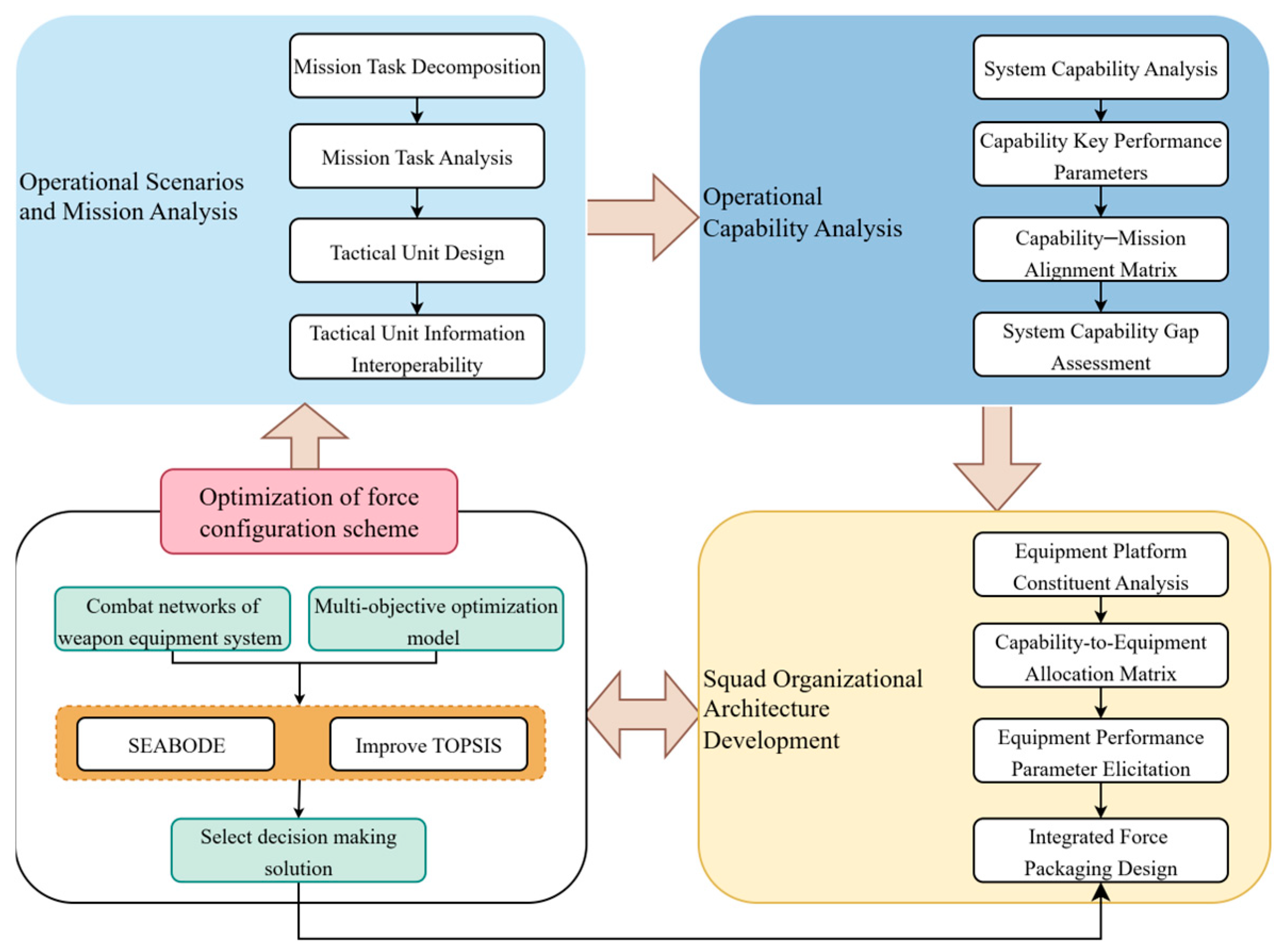
The core research challenge lies in accounting for modern ISWES combat characteristics and manned–unmanned equipment interactions to map operational capabilities to specific armaments, thereby designing effective squad configurations. To address this, the specific system design process must be detailed around the combat scenarios, operational styles, combat phases, and equipment characteristics of ISWES. By expanding and adapting the requirements, design, and analysis components within traditional MBSE methods to establish stages including operational scenarios and mission analysis, operational capability analysis, and squad organizational architecture development, the modeling requirements of ISWES can be fulfilled.
Based on the above, this paper proposes an MBSE modeling method suitable for the design of infantry squad equipment systems. During the combat scenario analysis phase, it introduces micro-scenario-level mission decomposition and atomic-action-level combat activity modeling to precisely capture required combat capabilities, subsequently conducting squad organizational architecture development to derive the initial equipment configuration of the infantry squad system.
Building upon the derived squad equipment configuration, further optimization is required to obtain the optimal solution, which is a complex problem integrating multi-objective optimization and multi-attribute decision-making. Key research challenges involve establishing valid equipment system optimization models and identifying ideal solutions from non-dominated solution sets. Tang et al. analyzed close-in weapon system effectiveness using multi-agent theory and optimized deployment configurations via GA-based algorithms [15]. Qian et al. developed a multi-objective optimization model for an equipment system using simulation-based performance evaluations and performed solution calculations [16]. Wang et al. modeled kill-webs using complex network theory, combining multi-objective optimization with prospect theory to integrate AI and human decision-making, proposing the NSACGA-II algorithm for solutions [17]. Hu et al. established an optimization model under dual uncertainties of scenarios and equipment attributes, solved by NSGA-II-DE, then determined fuzzy membership degrees on the Pareto front using fuzzy set theory [18]. Regarding multi-objective/attribute integration, Liu et al. employed DE and NSGA-II for reservoir ecological dispatch optimization, identifying Pareto front knee points through a non-curve methodology before applying improved CV-TOPSIS for solution selection [19]. Wang et al. utilized NSGA-III to solve water ecological/economic optimization models, introducing subjective trade-off ratios to measure decision-maker preferences for solution screening [20]. Wei et al. coupled NSGA-II-SEABODE for reservoir operation optimization, integrating model construction, solution generation, and scheme selection into a unified computational process [21,22].
However, existing research indicates that equipment SoS optimization modeling based on adversarial combat simulations suffers from low search efficiency and high computational costs. Furthermore, in multi-attribute decision-making, the obtained non-dominated solution sets often contain an excessive number of alternatives, making the calculation process cumbersome and rendering it difficult to identify the optimal solution solely through the SEABODE method.
To address these deficiencies, this paper employs an operation loop-based modeling approach to classify and describe the equipment and edges within the system. This method accounts for equipment interdependencies and realistically reflects the combat process by integrating the Observation–Orientation–Decision–Action (OODA) theory [23]. To overcome the limitations of traditional operation loop structures in modeling infantry squad combat networks, this paper proposes the information-sharing operation loop and the decision-support operation loop based on the collaborative combat mode of manned and unmanned equipment and establishes an ISWES combat network model oriented to micro-scenario missions. We formulated a tri-objective optimization framework maximizing combat effectiveness while maximizing network robustness and minimizing weapon costs. The solution employed coevolutionary constrained multi-objective optimization (CCMO) to generate Pareto-optimal solution sets, followed by SEABODE-improved TOPSIS for non-dominated solution screening and ranking. Upon obtaining the optimal scheme, relevant views in ISWES modeling were updated to support iterative optimization, as shown in Figure 1.

2. Micro-Scenario-Oriented ISWES Design Methodology

This section presents an MBSE-based methodology for ISWES design comprising three core phases: operational scenarios and mission analysis, operational capability analysis, and squad organizational architecture development.

2.1. Operational Scenarios and Mission Analysis

Operational scenarios and mission analysis serves as the foundational phase for ISWES design validation. This stage executes mission decomposition, operational task analysis, combat unit design, and combat unit interactions based on the infantry squad’s combat concept.
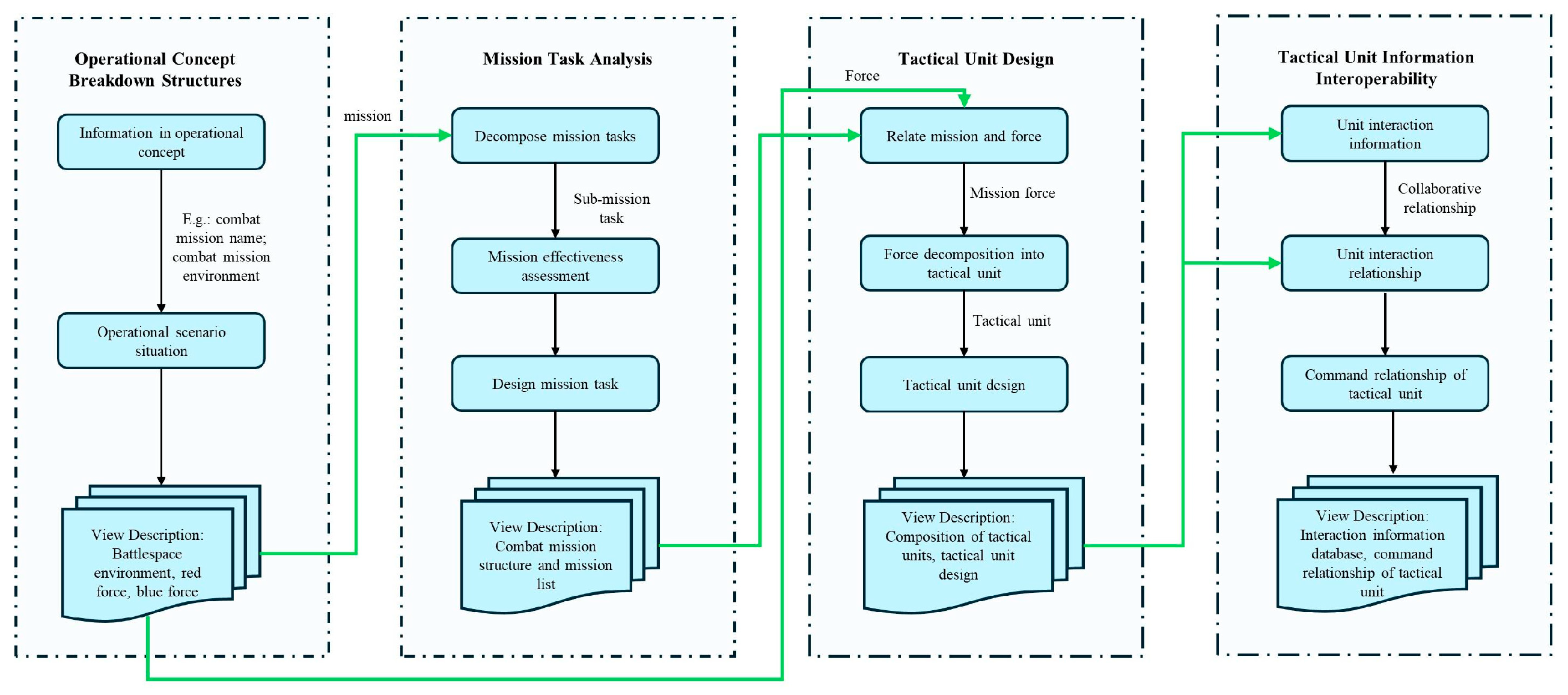
Modern infantry squads face increasingly complex environments and diversified scenarios. Addressing these operational characteristics, this study proposes a micro-scenario-level combat task decomposition methodology and an action-level operational activity design approach, where micro-scenarios refine combat tasks into highly focused, fine-grained operational missions. Utilizing micro-scenario-level combat tasks and action-level operational activities enables the precise capture of ISWES operational capability requirements.
As shown in Figure 2, the process initiates with mission decomposition to generate a standardized mission task inventory, wherein combat activities are formally specified using controlled terminology to establish normative descriptions for mission-to-activity decomposition. This inventory facilitates the concretization of mission objectives, producing a comprehensive set of micro-scenario-level combat tasks. Subsequent combat task analysis decomposes these tasks into atomic-action operational activities. By establishing correlations between operational activities and system resources, task-execution units are architecturally defined. Finally, the information exchange design for operational units is constructed based on the interactions between operational activities and units. This process, which ranges from the initial decomposition of combat scenarios to the ultimate operational activities, covers the entire combat process that ISWES is oriented towards.

2.2. Operational Capability Analysis

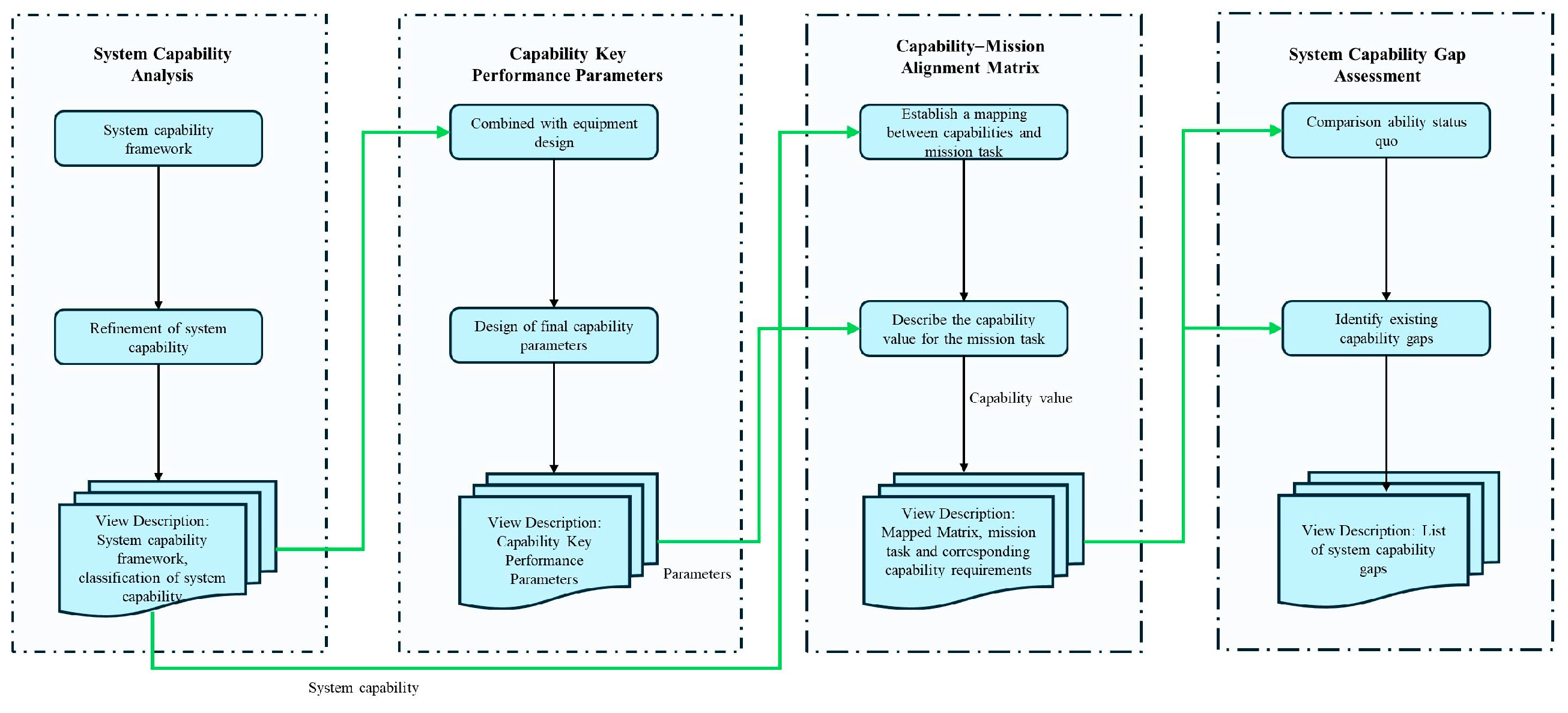
The operational capability analysis phase is the core of the design and demonstration of the ISWES. Only through reasonable and comprehensive extraction of the operational capabilities required by ISWES can we ensure that it adapts to complex battlefield demands and accomplishes established operational objectives. This phase identifies critical functions and performance metrics essential for ISWES, thereby enabling precise and effective decision-making in system design and solution allocation to ensure battlefield effectiveness and adaptability.
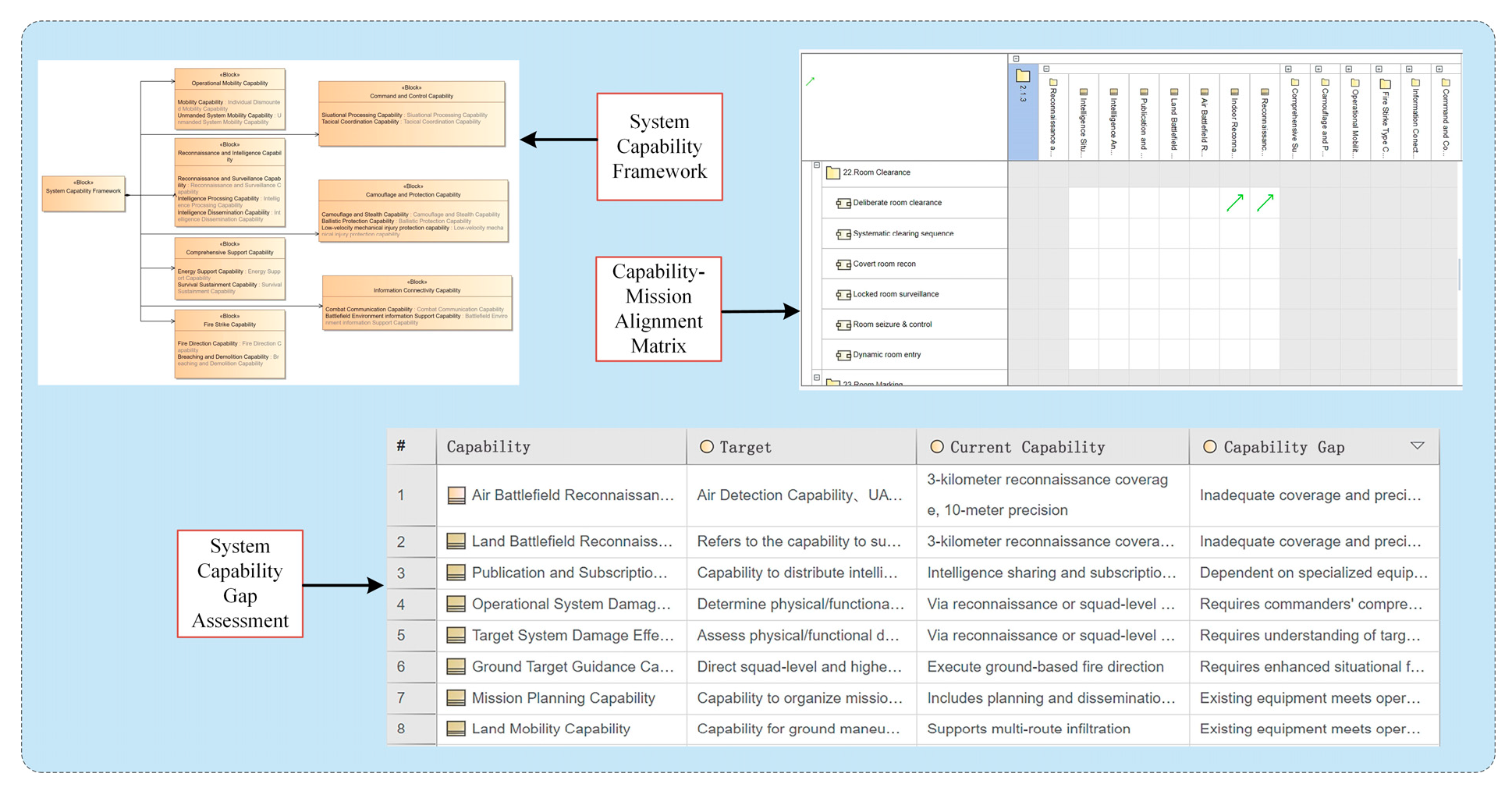
As shown in Figure 3, the process is initiated by decomposing capabilities based on operational activities to establish a system capability framework, a structured aggregation of capability elements categorized by mission profiles. Subsequently, terminal capabilities within this framework are quantified using relevant metrics and parameters. Operational activities are then mapped to system capabilities, constructing explicit activity–capability relationships. This concretizes capability descriptors to specific operational activities while quantitatively characterizing required capability values, ensuring precise capability support for each activity. Finally, capability gap analysis is conducted to define ISWES development requirements and formulate specific requirements addressing these gaps.

2.3. Squad Organizational Architecture Development

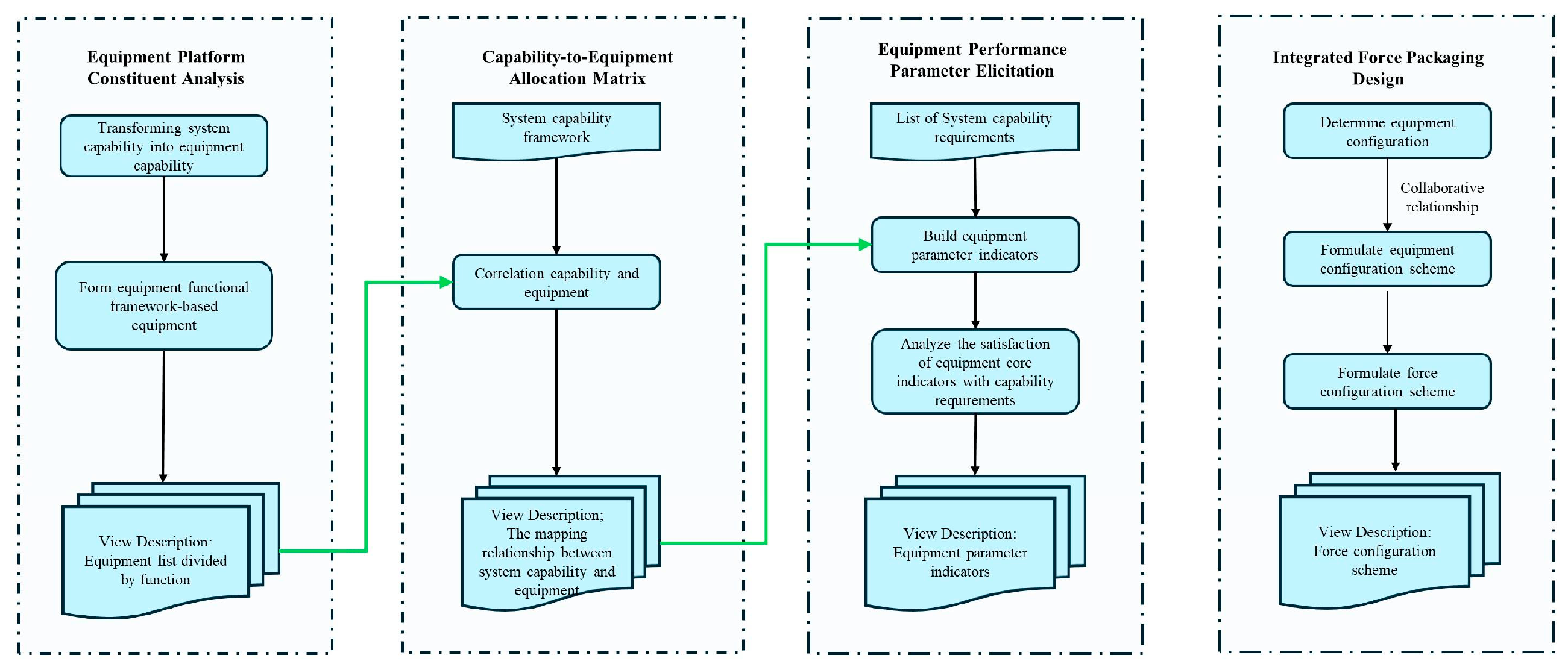
This stage includes equipment platform constituent analysis, capability-to-equipment allocation matrix, equipment performance parameter elicitation, and integrated force packaging design.
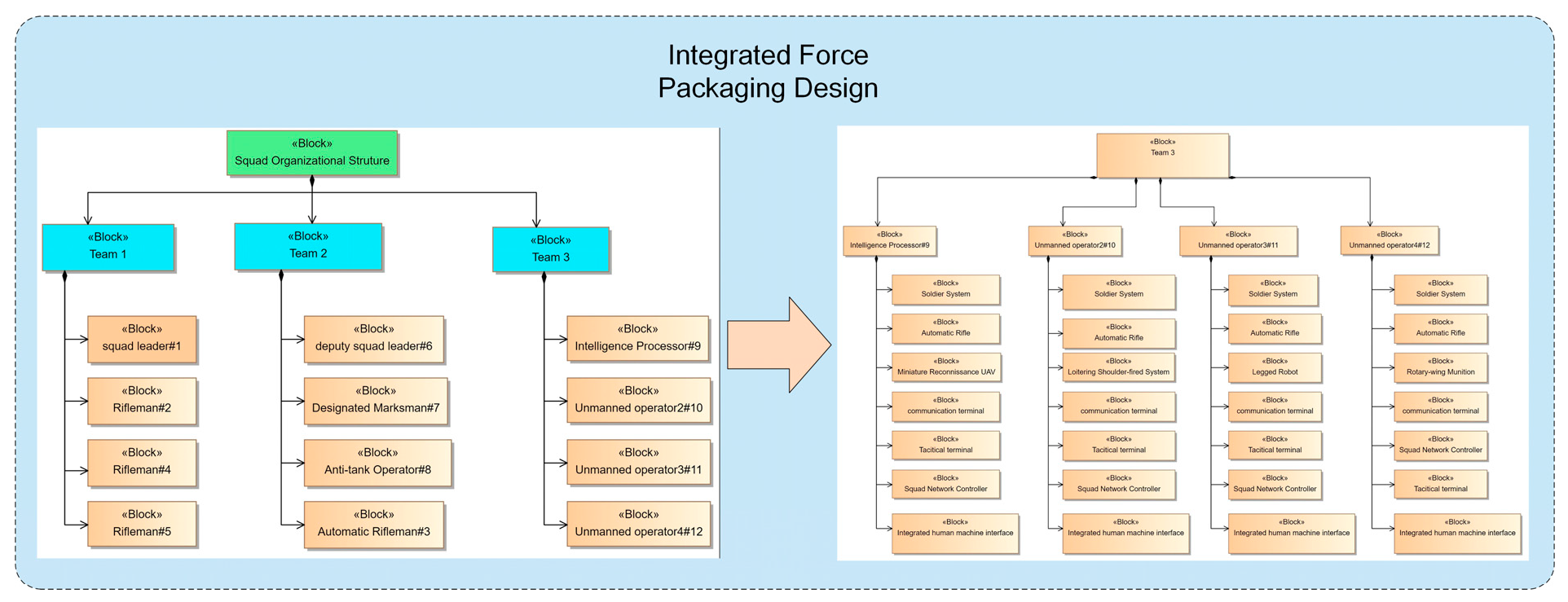
As shown in Figure 4, the process begins by screening capabilities delivered by equipment entities from the system capability inventory, followed by establishing an equipment function list based on existing or planned equipment. Next, with system capabilities and equipment functions as inputs, a capability-to-equipment mapping matrix is constructed. Subsequently, equipment performance parameters are obtained to finalize the equipment inventory. Finally, drawing on the equipment inventory, the equipment composition is formulated, and the preliminary equipment composition and allocation scheme for the infantry squad are determined.

3. Optimization Method for the Allocation of Squad Equipment Systems Considering Collaborative Engagement

ISWES comprises manned and unmanned equipment components that achieve combat effectiveness through coordinated interdependencies. We constructed a combat network model for configuration schemes based on the operation loop, establishing a multi-objective optimization mathematical model with three goals: maximized combat effectiveness, maximized robustness, and minimized equipment costs. The solution employed the CCMO algorithm to generate Pareto solution sets for configurations, followed by SEABODE-improved TOPSIS processing to screen and rank Pareto solutions, and ultimately obtained the optimal collocation scheme.

3.1. Modeling of the Combat Network

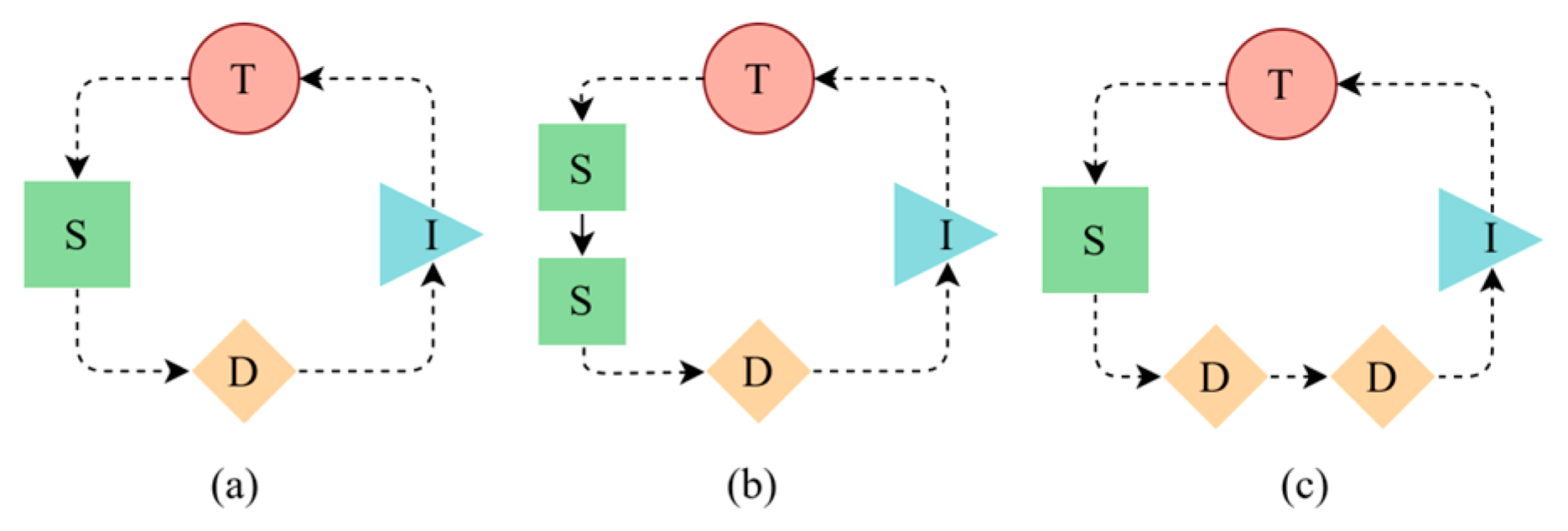
The operation loop concept is derived from the OODA theory, which is a high-level abstraction of the combat process [24]. This modeling approach aims to analyze the flow of information in combat by incorporating the enemy target into the modeling process. Combat entities are categorized based on their roles in the weapon and equipment system: Sensor (S), Decision (D), Influence (I), and Target (T).
For ISWES configuration schemes, due to the close manned–unmanned collaboration within the infantry equipment system and the complex interaction relationships between equipment, the simple operation loops used in previous studies cannot meet the requirements for modeling infantry squad combat networks [25]. This paper extends the simple operation loop to establish two new types of operation loop models, namely, the information-sharing operation loop and the decision-support operation loop, as shown in Figure 5.
The information-sharing operation loop refers to the process where, after reconnaissance information is acquired, it is shared among reconnaissance nodes and then transmitted to decision nodes. This loop applies to scenarios where multiple types of reconnaissance nodes exist in the configuration scheme. The decision-support operation loop involves transmitting reconnaissance information to auxiliary decision nodes, which perform preliminary processing before forwarding it to the next decision node for issuing commands. This loop is suitable for cases where unmanned equipment is present in the configuration scheme to conduct information feedback and decision support. The combat network is constructed by selecting the corresponding operation loop type according to the manned and unmanned equipment types in the equipment system configuration scheme.
The fundamental process of an operation loop involves reconnaissance units detecting enemy targets and transmitting target information to command units. Command units analyze intelligence and situational data to issue engagement orders to strike units, which then execute attacks against enemy targets. For specific combat missions, multiple operation loops form an integrated combat network model. This paper formalizes the combat network model as follows:
G = V , C v , L
where G denotes the combat network model, V denotes the node set within the model, C v denotes the capability set of nodes, and L denotes the edge set formed between nodes.
Based on the categorization of the four types of weapon and equipment nodes (sensor, decision, influence, and target) within the operation loop, modeling is conducted for each type of node in the ISWES. By considering the information transfer roles between these nodes, a generalized communication capability term is established, and capability calculation index terms are provided for each type of node [26]. Let the equipment system functional node capability set be V , which can be expressed as follows:
V = V S , V D , V I , V I , V C
where V S enotes a sensor-type functional node, V D denotes a decision-type functional node, V I denotes an influence-type functional node, V T denotes a target-type node, and V C denotes a communication functional item.
Further, the functional node capability indicator term can be represented as C v i :
C v i = c S 1 , c S 2 , c C m
where m denotes the number of functional node capacity indicator items.
The capability indicators considered for sensor nodes include maneuvering speed, maximum detection distance, detection accuracy, identification probability, and tracking probability, which can be expressed as follows:
C S i = c S 1 , c S 2 , c S 3 , c S 4 , c S 5
The capability indicators considered for decision nodes include decision-making time, decision-making accuracy, and assisted decision-making, which can be expressed as follows:
C D i = c D 1 , c D 2 , c D 3
The capability indicators considered for influence nodes include maneuvering speed, damaging radius, striking accuracy, and damage probability, which can be expressed as follows:
C I i = c I 1 , c I 2 , c I 3 , c I 4
The capability indicators that need to be considered for the target category are maneuvering speed, warning time, destructive capability, and stealth capability, which can be expressed as follows:
C T i = c T 1 , c T 2 , c T 3 , c T 4
The capability indicators that need to be considered for communication capability are communication rate, communication capacity, and communication delay, which can be expressed as follows:
C C i = c C 1 , c C 2 , c C 3
To address the differences in units among various indicators and ensure comparability, normalization is necessary. In this paper, based on the extreme value processing method, a nonlinear dimensionless method is used to process the indicator values. Let c i j be the value of a capability indicator, c i max j and c i min j be the maximum and minimum values of the capability indicator, and k be the function parameter determined by the utility interval.
If c i j represents a benefit-type capability indicator, the normalized value is expressed as follows:
c i j ˜ = 1 exp ( k ( ( c i j c i   min j c i   max j c i   min j ) 2 ) , c i   min j < c i j < c i   max j 0 , c i j < c i   min j
If c i j represents a cost-type capability indicator, the normalized value is expressed as follows:
c i j ˜ = 1 exp ( k ( ( c i j c i   max j c i   min j 1 ) 2 ) , c i   min j < c i j < c i   max j 0 , c i j > c i   max j
The nodes interact with each other through the operation loop to establish the combat network of ISWES. There are four types of nodes in the functional layer. Since some of the edge nodes do not have actual combat significance or their probability of occurring in combat is extremely small, these edges are not taken into account. The analysis in this study focuses on six types of node edges, and the set of edges is L i j , which can be expressed as follows:
L i j = L T S , L S D , L S S , L D I , L D D , L I T
Table 1 illustrates the connection modes of connecting edges between different functional nodes based on their practical implications:
The association relationship represented by node edges is modeled based on the mutual transfer effects between nodes. The capacity value of each edge is calculated using information entropy [27]. Meanwhile, the data for equipment capability indicators are derived from public data and processed using the normalization method. The weights of each capability indicator are determined by combining expert scoring with the improved AHP method, which is not described in detail in this paper.
1. Edge T S . This edge represents a directed edge from the target node to the reconnaissance node, established when reconnaissance-type functional nodes conduct reconnaissance on the target. It primarily considers the reconnaissance capability of the reconnaissance node and the counter-reconnaissance capability of the target node. The value of this connected edge is calculated based on the discovery and recognition ability, the tracking ability of the reconnaissance node, and the hiding ability of the target node. The involved indicators are the indicator terms for the connection between reconnaissance-class nodes and target-class nodes, which can be expressed as follows:
c T - S = exp ( w f ln p f + w g ln p g ) p f = k × exp ( j = 1 n ω c S j ln ( c S j ˜ ) ) exp ( j = 1 n ω c T j ln ( c T j ˜ ) ) , p f [ 0 , 1 ]
where p f and p g denote the discovery recognition capability and target tracking capability, respectively; w c i j is the weight value of the node capability index; and k is the environment correction parameter, which is assigned a value of 1 when the operation loop exerts no influence on target reconnaissance.
2. Edge I T . The I T edge is a directed edge that represents the strike class node sending combat commands to the target class node. The value of the connected edge is calculated based on the killing ability of the strike class node and the defense ability of the target class node and can be expressed by the following:
c I T = k × exp ( j = 1 n ω c I j ln ( c I j ˜ ) ) exp ( j = 1 n ω c T j ln ( c T j ˜ ) )
where w c i j denotes the weight value of the node capability index and k is the environment correction parameter, which is assigned a value of 1 when the operation loop exerts no influence on target reconnaissance.
3. The four classes of edges, such as S S , S D , D D and D I , indicate the transmission and interaction of intelligence or decision-making information among nodes of sensor, decision, and influence classes and can be expressed as follows:
p 1 = min ( C C i 1 , C C j 1 ) p 2 = min ( C C i 2 , C C j 2 ) p 3 = ( C C i 3 + C C j 3 ) c C = exp ( i = 1 3 ω p i ln ( p i ) )
The operation loop is directed. After obtaining the node boundary values, the capability value of a single operation loop is calculated, and this capability value is defined as E L i :
E L i = c T S c S D c D I c I T

3.2. Optimization Model for Collocation Scheme

In the design of ISWES collocation schemes, it is necessary to configure different types of equipment within a limited budget while ensuring high combat effectiveness. Therefore, the optimization objectives should include the combat effectiveness of the equipment system, equipment costs, and the robustness of the combat network.

3.2.1. Optimization Objective

  • Combat effectiveness
In the combat network, different equipment function nodes form several operation loops based on target nodes and inter-node relationships, ultimately constituting a heterogeneous equipment system combat network. For combat networks, expanding the scale of the combat system without optimizing its internal structure may increase the number of nodes, leading to redundancy. However, as long as the number of nodes in the combat network has not reached saturation, considering the heterogeneity of equipment and their association relationships, a combat network with more operation loops will exhibit higher effectiveness. Therefore, this paper uses the capability value of operation loops and the number of operation loops to evaluate the combat effectiveness of ISWES.
E C T i is defined as the combat effectiveness value for the target node, C T i , which is given by the following equation:
E C T i = E L 1 + E ¯ L 1 E L 2 + E ¯ L 2 E L ( m 1 ) + E ¯ L ( m 1 ) E L m
where m is the number of operation loops containing the target node, C T i .
In general, a combat network consists of multiple target nodes that require attack. The weights of these target nodes are determined based on their respective importance levels and then aggregated to calculate the combat effectiveness value of the ISWES.
E = i = 1 n ω i E C T i
where ω i is the weight of the target node.
2.
Cost
In the ISWES, the primary equipment considered includes reconnaissance and strike equipment, while decision-making equipment, such as command-and-control systems or human–machine collaborative control systems, is not taken into account for the time being.
Definition: The objective function for the consumption cost of equipment, such as reconnaissance and strike equipment, can be described as follows:
E C k = e c S u i , e c S m j , e c I u i , e c I m j cos t ( e c ) = e c k min ( e c k ) max ( e c k max ) min ( e c k min ) cos t e c S = j = 1 m j i = 1 u i cos t ( e c S u i ) cos t ( e c S m j ) i + j cos t e c I = j = 1 m j i = 1 u i cos t ( e c I u i ) cos t ( e c I m j ) i + j Cos t ( e c ) = ( cos t e c S + cos t e c I / 2
where e c represents the equipment cost; e c s u i , e c s m i , e c i u j , e c i m j denote the cost of unmanned reconnaissance–strike equipment, unmanned reconnaissance equipment, unmanned strike equipment, and manned strike equipment, respectively; cos t ( e c ) is the normalized value of equipment cost; cos t ( e c S ) is the total cost of reconnaissance equipment; and cos t ( e c I ) is the total cost of strike equipment.
3.
Robustness of the combat network
The robustness of the ISWES combat network is a crucial guarantee of the combat effectiveness of infantry squads. In robustness assessment, algebraic connectivity ( λ 2 L ) [28] and the standard deviation of node degree distribution ( σ d ) are typical indicators. Algebraic connectivity refers to the second smallest eigenvalue of the Laplacian matrix corresponding to the combat network. The standard deviation of node degree distribution measures the dispersion of all vertex degrees in the combat network graph; a smaller value indicates a more uniform node degree distribution and better robustness.
This paper integrates algebraic connectivity and the standard deviation of node degree distribution to form a comprehensive index, R c , which is used as the optimization objective for configuration schemes.
R c = λ 2 L 1 + σ d σ d = 1 n i = 1 n d i μ d 2
where L is the Laplacian matrix of the combat network, n is the total number of nodes, d i is the degree of node i , and μ d is the average node degree.

3.2.2. Optimization Constraints

In ISWES, equipment and soldiers operate in tight coordination. Unmanned equipment requires operation and control by soldiers, and its quantity is constrained by the number of unmanned equipment operators in the squad, which must not exceed this number. Meanwhile, the number of decision nodes in the squad must not exceed the number of command-and-control personnel in the subgroups within the squad. The combat effectiveness of the collocation scheme must not be lower than the minimum effectiveness value, and the cost must not exceed the limit. These serve as the constraints for the collocation scheme in ISWES and can be described as follows:
i = 1 i = 1 j = 1 n S u i n S m i n I u j n u p i = 1 n D i n d p E E min cos t ( e c ) cos t e c max
where n u p denotes the number of unmanned equipment operators in the squad and n d p denotes the number of command personnel in the subgroups within the squad.
Finally, the established optimization model is shown as follows:
min E , R c , cos t ( e c ) s . t . i = 1 i = 1 j = 1 n S u i n S m i n I u j n u p E E min cos t ( e c ) cos t e c max

3.2.3. CCMO Algorithm

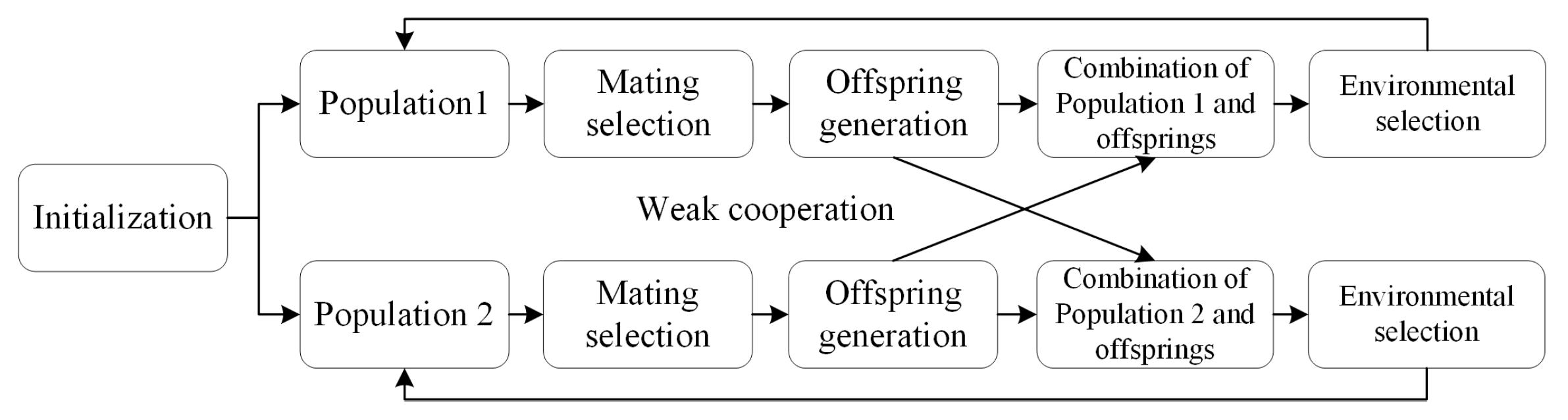
In the optimization process of ISWES collocation schemes, there exist numerous optimization objectives and design variables. Choosing a suitable multi-objective evolutionary algorithm can effectively shorten computation time and ensure better convergence. Tian et al. proposed a multi-objective evolutionary algorithm based on the cooperative coevolutionary framework (CCMO) [29]. CCMO seeks optimal solutions through the coevolution of two populations: the first population focuses on exploring the objective space and endeavors to identify the Pareto frontier of the objective function, while the second population takes constraint conditions into account to ensure that all obtained optimal solutions are feasible. Information exchange and synergy between the two populations enhance the algorithm’s search efficiency, enabling it to better approximate the true Pareto frontier. The workflow of the CCMO algorithm is shown in Figure 6.

3.3. Decision-Making Method Based on SEABODE and Improved TOPSIS

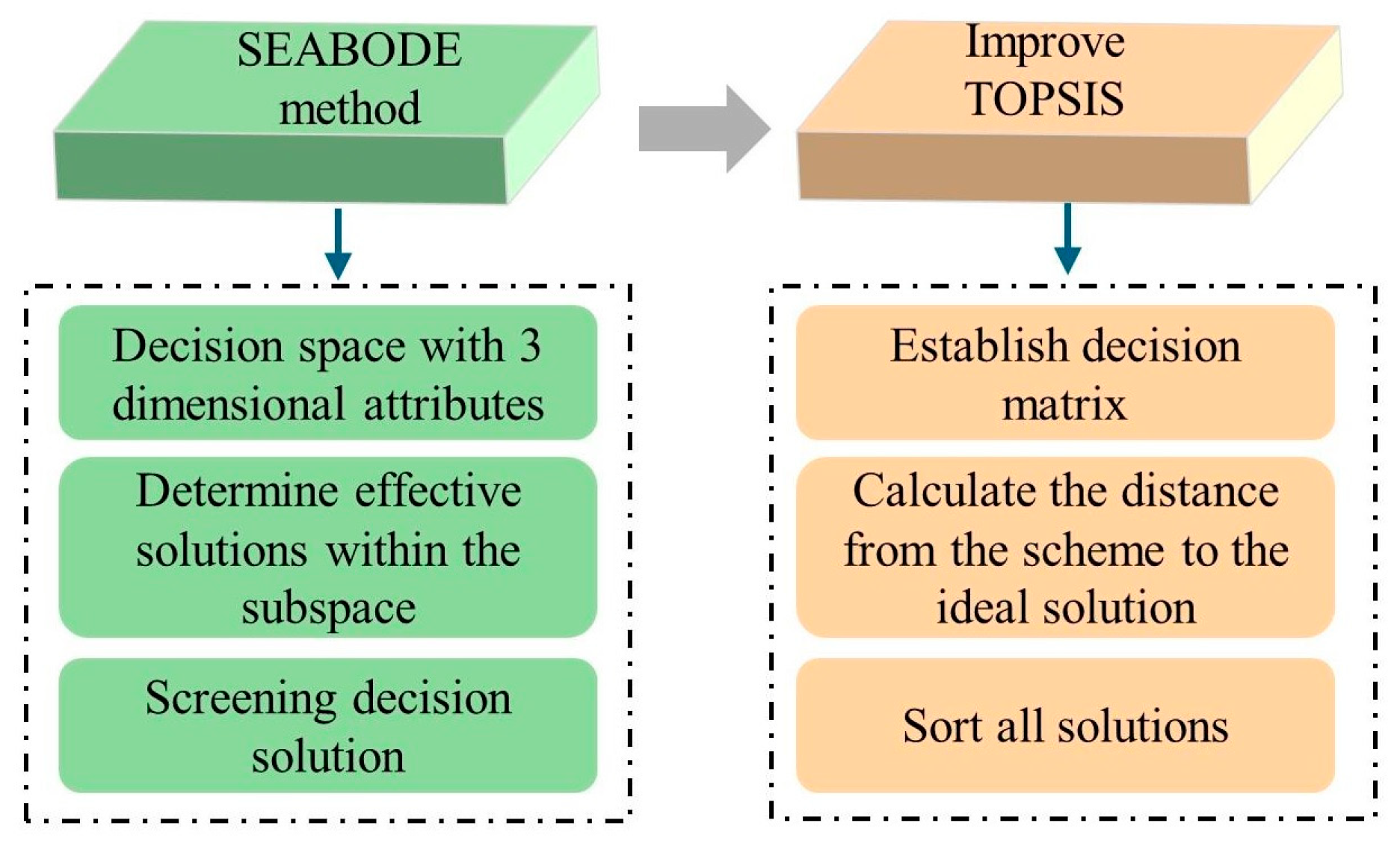
To avoid the issue in traditional multi-attribute decision-making methods where the rationality of the preferred scheme cannot be guaranteed due to decision-makers’ subjectivity, this paper establishes a SEABODE-improved TOPSIS method to obtain the optimal collocation scheme, as shown in Figure 7. Upon obtaining the Pareto solution set, the SEABODE method is used to screen the non-dominated solutions. The optimal solution is then determined using the improved TOPSIS method.

3.3.1. SEABODE Method

The SEABODE method processes the decision matrix constructed from non-dominated solution sets and evaluation indicators, employing the k-order and p-degree efficiency concept to assess the superiority of solutions and eliminate inferior ones [30], thereby achieving the preliminary screening of the Pareto solution set.
(1)
k -order efficiency: For the set of alternative schemes, X = X 1 , X 2 , , X m , the n-dimensional evaluation index set is D = D 1 , D 2 , , D n . A scheme, X i , is a k-order efficient scheme if and only if the scheme X i is non-dominated in all C n k   k -order subspaces of the n-dimensional evaluation index set.
(2)
p -degree efficiency: Suppose there are a certain number of k + 1-order efficient schemes, none of which are k-order efficient schemes. Then, a scheme that simultaneously holds non-dominated advantages in p subspaces among all C n k  k-order subspaces is called a k -order and p -degree efficient scheme.
To evaluate the quality of non-dominated solution sets (i.e., collocation schemes), this study considers three quantitative indicators: network operational capability, network redundancy, and network strike capability [31].
  • Network operational capability, R L
The network structure mainly affects the operation efficiency of the collocation scheme. The faster the operation efficiency, the better the completion efficiency of forming a combat network. The operational efficiency of the combat network is represented by the average shortest path length of the combat network. Define the shortest path length, d i j , between two nodes, i   j , in the combat network as the number of edges in the shortest path between these two nodes. The maximum value of the shortest path lengths between any two nodes in the combat network is the diameter of the network, denoted as D, and can be described as follows:
D = max i , j ( d i j )
The average path length of the entire network is obtained by averaging the shortest path lengths between any two nodes in the combat network, and the operation efficiency, R L , is expressed as:
R L = 2 N ( N 1 ) j N , i j d i j
2.
Network redundancy, R G
Within a combat network, multiple pieces of equipment are used to conduct reconnaissance and strikes against targets through various means. The more parallel and mutually substitutable equipment there is in the combat network and the greater the number of links between nodes in the network, the stronger the redundancy of the combat network. This paper uses the natural connectivity of the network as a measure of network redundancy, defined as follows:
R G = ln ( 1 N i = 1 N e λ i )
where λ i denotes the eigenvalue of the adjacency matrix formed by the combat network G
3.
Network strike capability, R F
Strike capability quantifies the impact magnitude of equipment directly engaging targets within combat networks. A higher value indicates the superior direct combat effectiveness of the collocation scheme. In the collocation scheme, it is mainly the reconnaissance and strike equipment that have direct relations with targets, and the strike capability is calculated based on the attributes of these two types of equipment.
c S 4 ¯ = 1 i = 1 n 1 c S i 4 ˜ c I 3 ¯ = 1 i = 1 n 1 c I 3 ˜ c I 4 ¯ = 1 i = 1 n 1 c I 4 ˜ R F = ω 1 c S 4 ¯ + ω 2 c I 3 ¯ + ω 3 c I 4 ¯
where c S 4 ˜ , c I 3 ˜ , and c I 4 ˜ represent the identification probability of sensor nodes, strike accuracy of influence nodes, and damage probability, respectively; c S 4 ¯ , c I 3 ¯ , and c I 4 ¯ are the normalized calculation values of multiple indicators of the same type; and ω 1 , ω 2 , and ω 3 are the calculation weights of each indicator.

3.3.2. Improved TOPSIS Method

After screening by SEABODE, the optimal collocation scheme is obtained by ranking the filtered schemes based on the improved TOPSIS method. The traditional TOPSIS method uses Euclidean distance to calculate the distance between different schemes and the ideal scheme [32]. However, Euclidean distance struggles to reasonably evaluate objects with multiple complex indicators. Mahalanobis distance is independent of measurement scales, is unaffected by the dimensions between coordinates, and can eliminate interference from correlations between variables [33]. This paper uses the weighted generalized Mahalanobis distance instead of Euclidean distance for calculation, with the main steps as follows:
Step 1: Establish a decision matrix. Establish the decision matrix, A = ( x i j ) m × k , where m is the number of filtered solutions and k is the number of evaluation indicators.
Step 2: Normalize the decision matrix. A standardized evaluation index decision matrix, R = ( y i j ) m × k , is established using the range transformation method.
For benefit-type indicators:
y i j = x i j min x i j max ( x i j ) min ( x i j ) 1
For cost-type indicators:
y i j = max x i j x max ( x i j ) min ( x i j ) 1
Step 3: Determine the ideal solution.
For benefit-type indicators:
f j + = max i   y i j f j = min i   y i j
For cost-type indicators:
f j + = min i   y i j f j = max i   y i j
Step 4: Obtain the weights of evaluation indicators and derive the weight matrix.
ω = d i a g ω 1 , ω 2 , ω 3
where ω 1 , ω 2 , and ω 3 are the calculation weights of the indicator.
Step 5: Calculate the weighted generalized Mahalanobis distance between the filtered collocation schemes and the ideal solution.
D i + = y i j f j + ω Σ 1 ω T y i j f j + T D i = y i j f j ω Σ 1 ω T y i j f j T
where Σ is the sample covariance matrix.
Step 6: Rank all schemes. Calculate the relative closeness, C i , between each scheme and the ideal solution.
C i = D i D i + + D i , i = 1 , 2 , , m
Finally, sort the C i values in descending order. The solution with the largest C i value is the optimal collocation scheme in the Pareto solution set.

4. Case Study

4.1. ISWES Design Model

A case study is conducted with the infantry squad executing the urban building clearance (UBC) mission task.

4.1.1. Mission Analysis Model

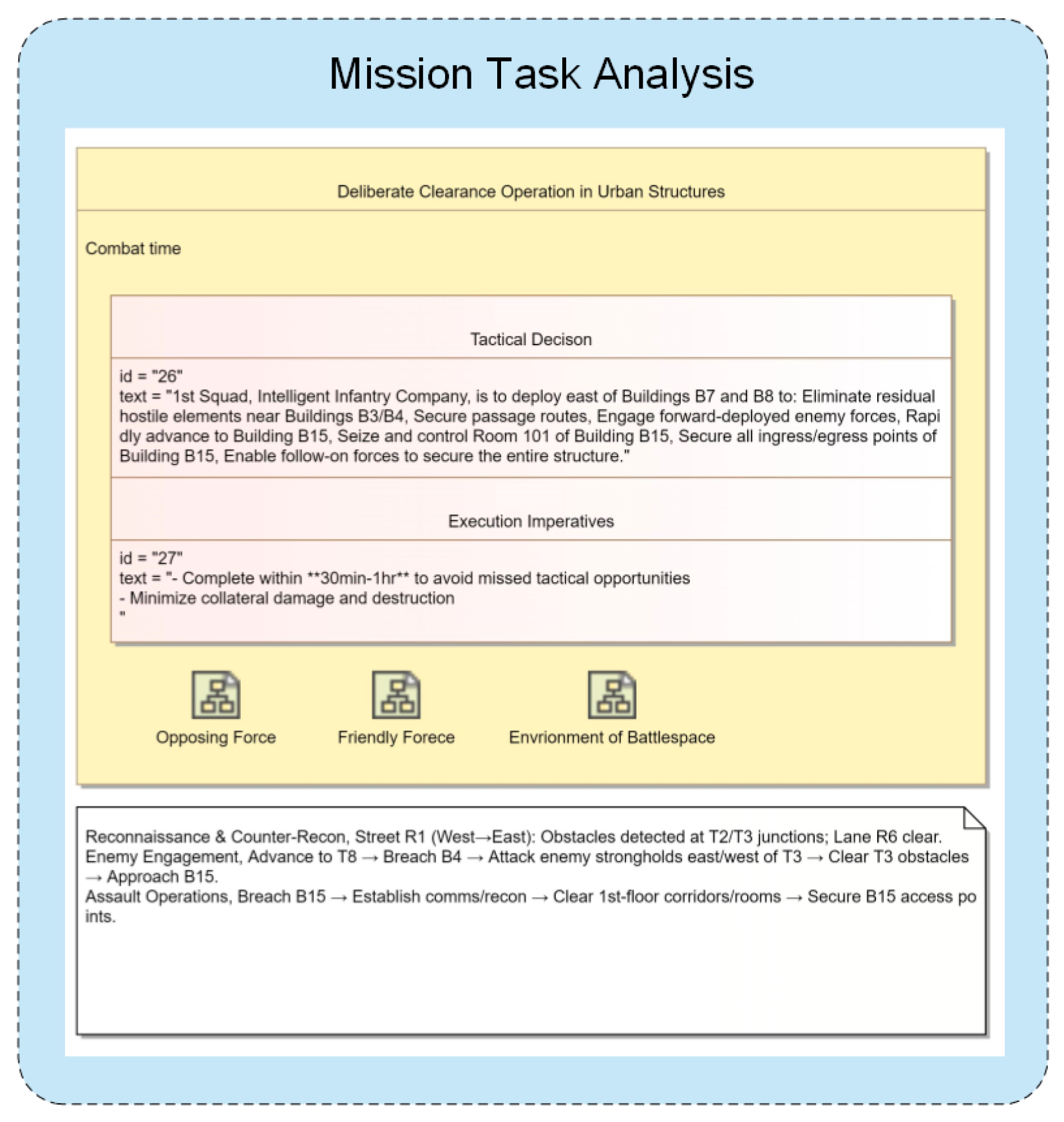
The primary objectives include: reconnaissance of enemy-occupied streets and buildings, initiation of engagement operations, execution of close-quarters assaults, and completion of the mission within specified time constraints to secure and clear target buildings, enabling follow-on force entry. Figure 8 depicts the mission objectives, requirements, and operational descriptions for the UBC mission task.
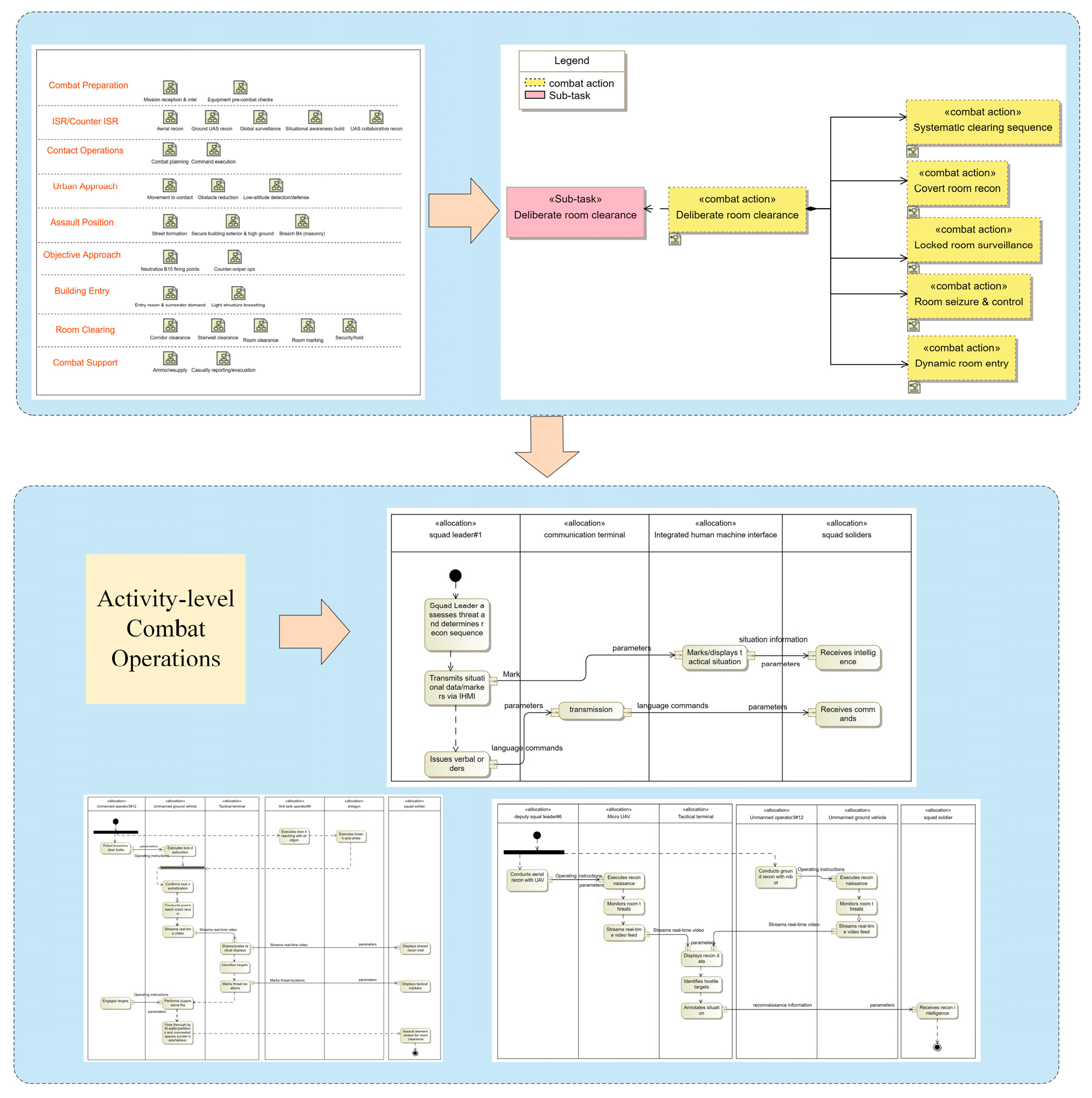
As illustrated in Figure 9, the combat subtask list was obtained through micro-scenario decomposition, along with atomic-action-level operational activities. The subtask list comprises nine categories: Combat Preparation, ISR/Counter-ISR, Contact Operations, Urban Approach, Assault Position, Objective Approach, Building Entry, Room Clearance, and Combat Support. Further decomposition of these subtasks yielded operational activities. Due to space limitations, Room Clearance is presented as an illustrative example, with decomposed activities including: Systematic Clearing Sequence, Covert Room Reconnaissance, Locked Room Surveillance, Room Seizure and Control, and Dynamic Room Entry.
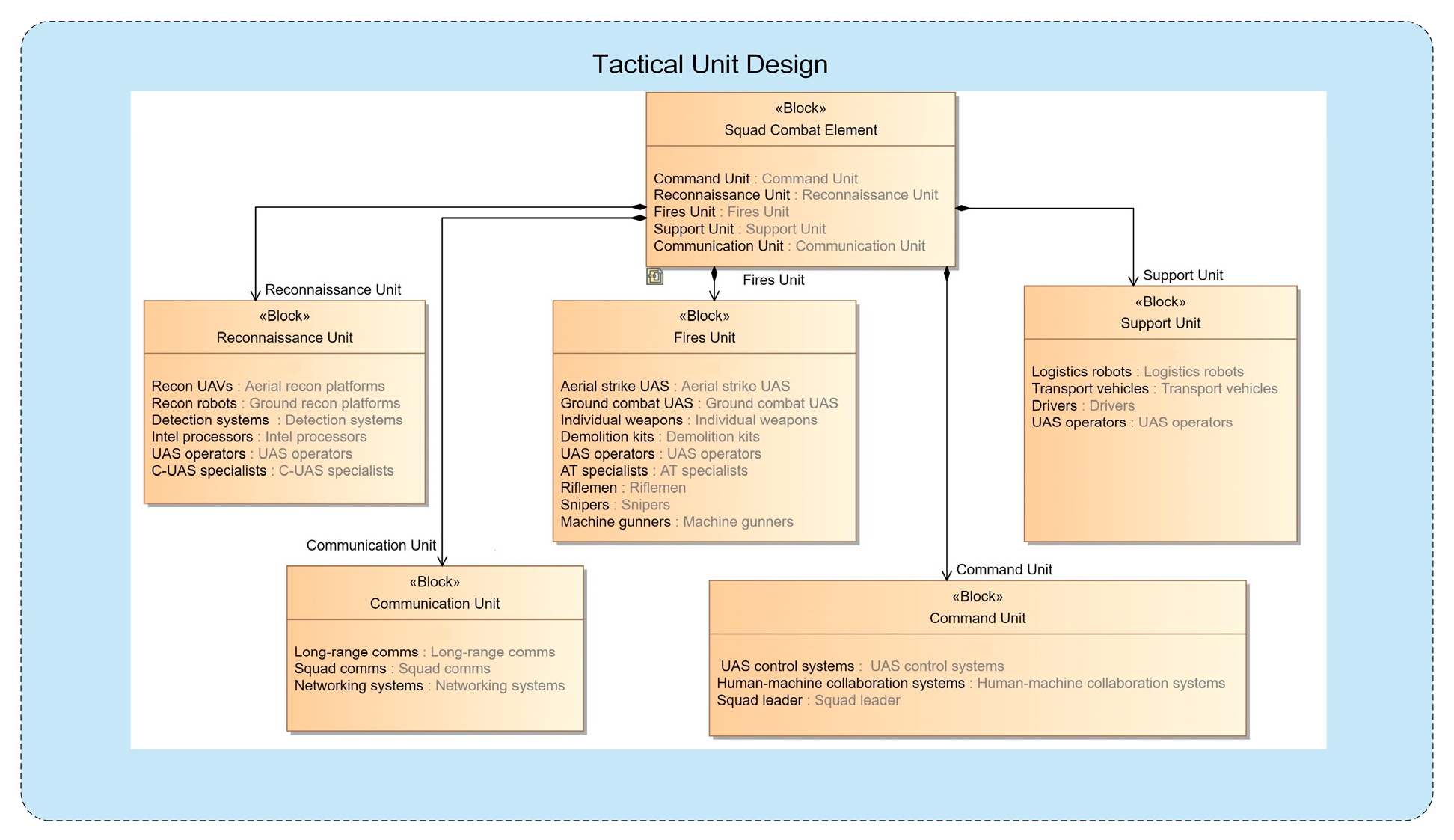
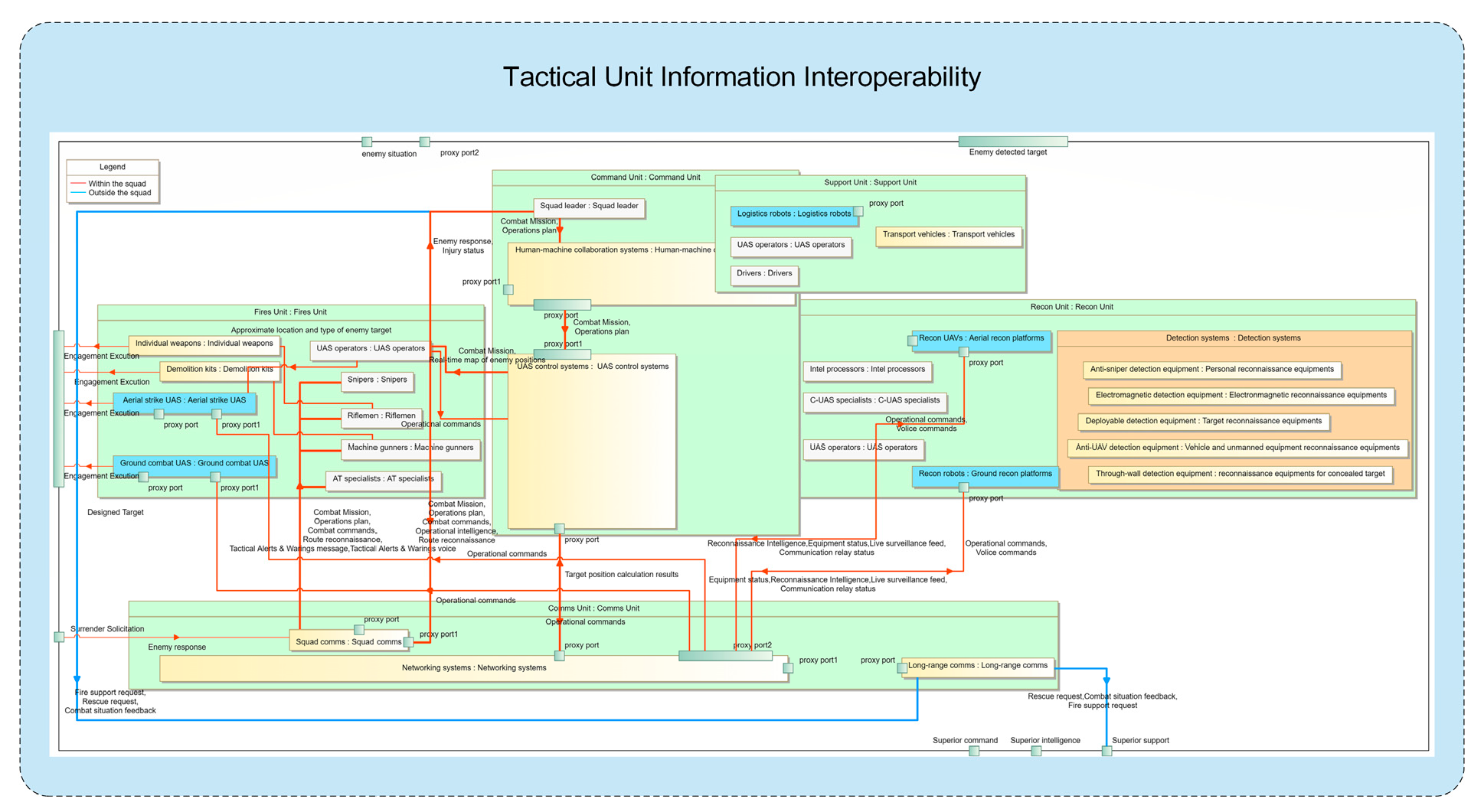
Figure 10 displays the preconfigured operational units for the UBC mission task. Based on actual execution requirements of combat actions within the squad, a baseline equipment system configuration was established to form urban combat units. These comprise five unit types: Command Unit, Reconnaissance Unit, Fires Unit, Support Unit, and Communication Unit, including personnel and equipment components. Figure 11 illustrates inter-unit interactions, depicting information transmission paths and exchange content.

4.1.2. Capability Analysis

Building upon operational activities, the system capability framework was derived, which includes seven categories of capabilities: operational mobility capability, reconnaissance and intelligence capability, comprehensive support capability, fire strike capability, command-and-control capability, camouflage and protection capability, and information connectivity capability, as well as seven sub-capabilities.
Figure 12 shows the various capabilities after detailed decomposition, along with the capability mission alignment matrix and system capability gap assessment. With operational activities and the capability framework as inputs, the corresponding capabilities were extracted from the capability framework by analyzing the correlation between operational activities and capability requirements, forming a mapping matrix of operational activities and capabilities.
By comparison with the capability indicators of the existing equipment system, the directions for capability development and enhancement were identified. These are mainly reflected in sub-capabilities under reconnaissance and intelligence capability, such as air battlefield reconnaissance and surveillance capability and land battlefield reconnaissance and surveillance capability, as well as sub-capabilities under command-and-control capability, such as situational processing capability; meanwhile, in terms of aerial unmanned strikes and ground unmanned strikes, diverse strike means need to be equipped.

4.1.3. Collocation Scheme Model

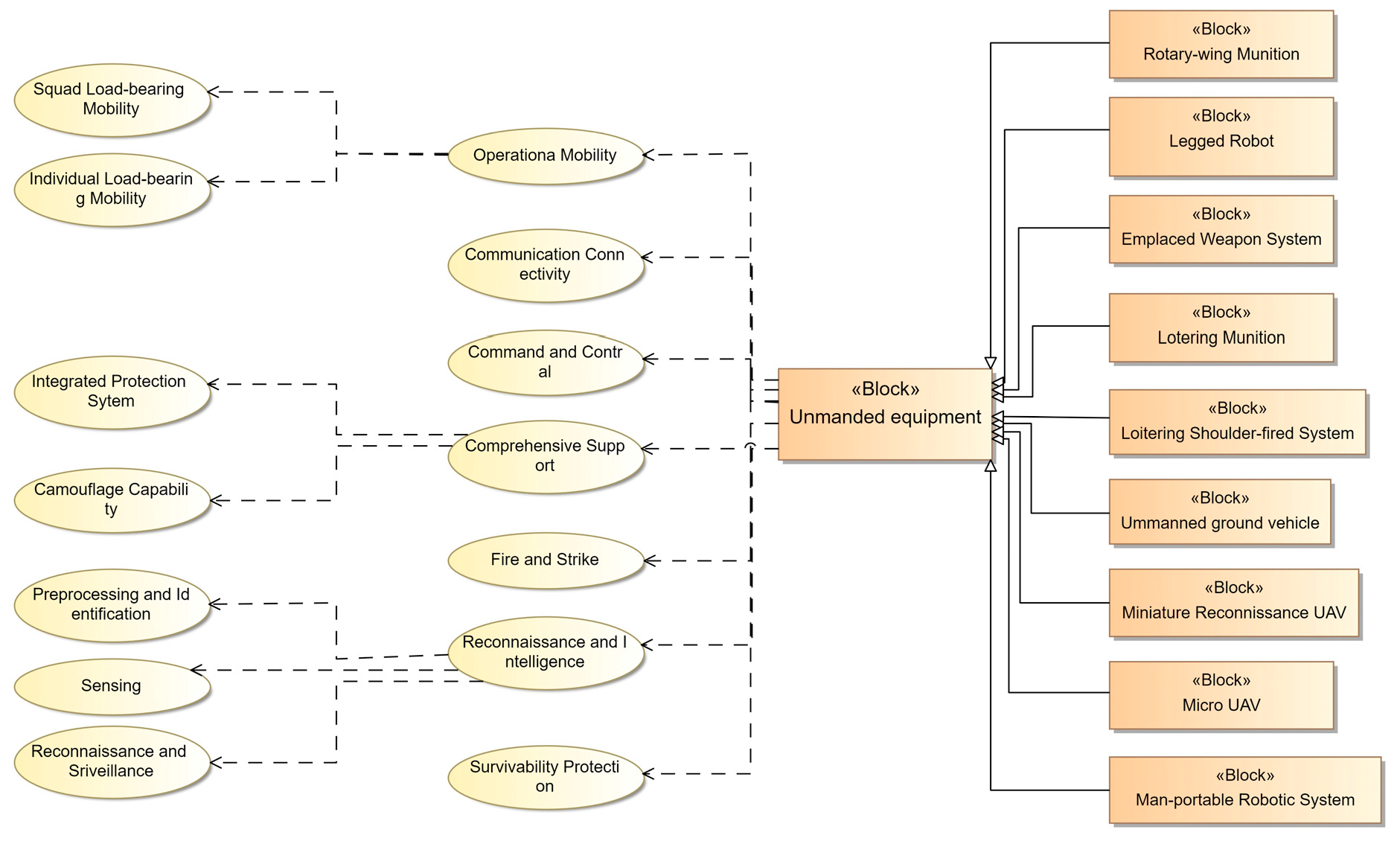
The squad system construction phase encompasses four core components: equipment functional framework design, capability-to-equipment mapping, equipment performance parameter elicitation, and collocation scheme design. Figure 13 shows the unmanned equipment framework within the infantry squad equipment system established in this study. As manned equipment demonstrates minimal deviations from existing systems, it is excluded from this visualization. The framework primarily incorporates rotary-wing munition platforms, legged robot systems, and other unmanned combat platforms.
This study also modeled a core capability indicator for both manned and unmanned equipment, though specific metric values were not presented. Subsequently, centering on the capability framework, equipment selection was completed according to the functional and performance requirements in the capabilities, forming the capability configuration of combat capabilities within the equipment system. Following this, squad personnel organization and equipment allocation were designed according to the system architecture.
Figure 14 shows the preliminary allocation scheme: a 12-soldier infantry squad divided into three groups by tactical roles and equipment. The third team is an unmanned operation team, mainly responsible for the operation of unmanned equipment, providing unmanned reconnaissance and unmanned strike support for the entire squad.

4.2. Optimized Calculation Results

4.2.1. Pareto Solution Set

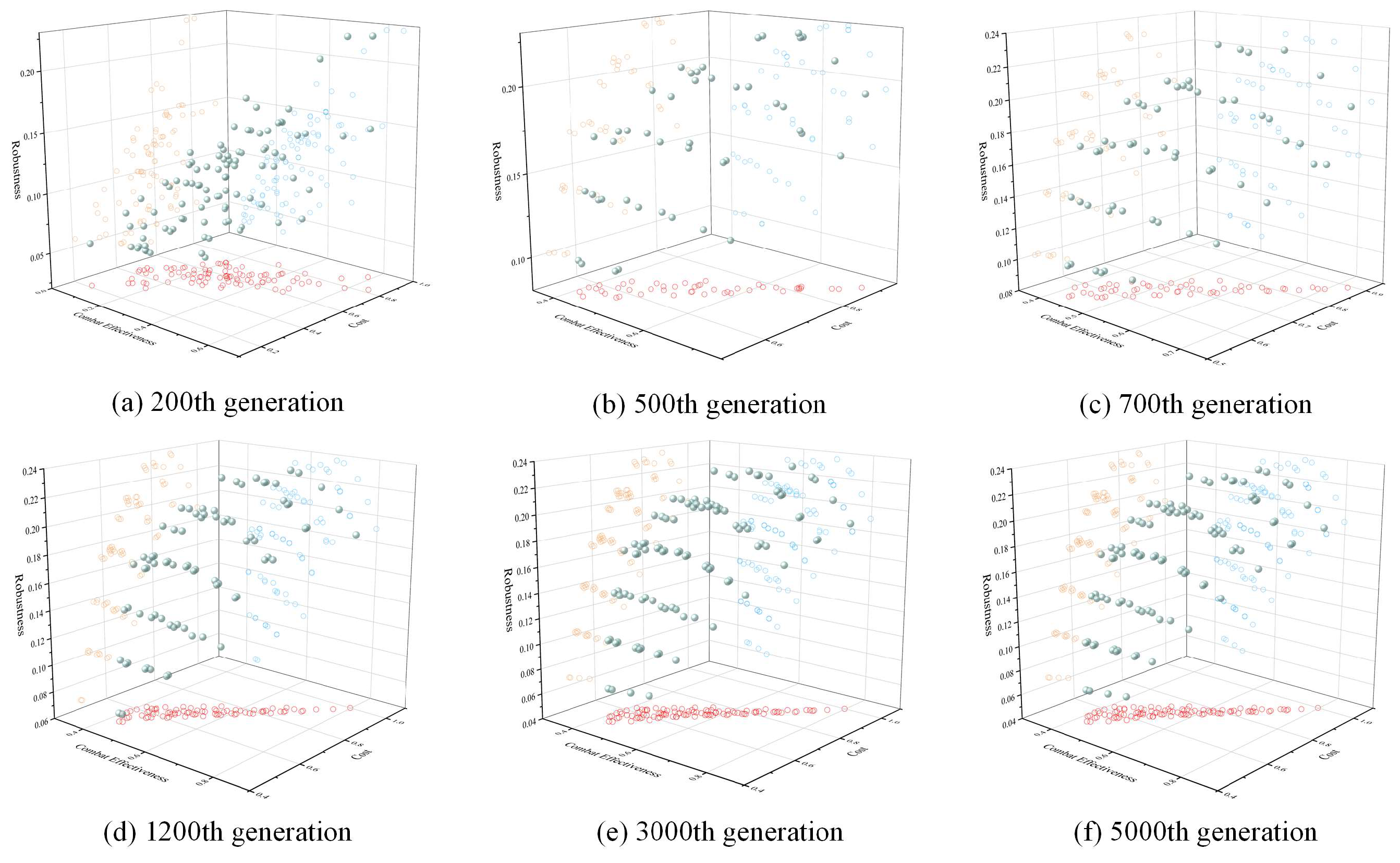
Building upon the preliminary infantry squad equipment system, the multi-scenario configuration optimization model was solved using the CCMO algorithm with the population size set to 100 and the number of iterations set to 5000. The dynamic evolution of solution sets during computation is shown in Figure 15. The Pareto solution set stabilized after 3000 generations with no further evolution. It can be observed that a significant positive correlation between combat effectiveness and cost is observed in ISWES, while robustness initially increases then decreases with rising combat effectiveness.
Further comparative analysis was conducted between this optimization model and widely adopted multi-objective algorithms, such as AGE-MOEA-II [34], MOEA/D-DAE [35], cDPEA [36], and NSGA-III [37], using Hypervolume (HV) [38], Inverse Generational Distance (IGD) [39], and runtime [40] as evaluation indicators. HV and IGD measure the convergence and diversity of evolutionary algorithms, while runtime reflects computational efficiency. Generally, a higher HV alongside a lower IGD and runtime indicates superior algorithmic performance.
Table 2 presents the comparison of the indicators among various algorithms. Among them, the CCMO algorithm has advantages in both the IGD and the runtime indicator. Although MOEA/D-DAE achieves a marginally higher HV, CCMO emerges as the optimal approach when comprehensively considering all indicators.

4.2.2. Solution Decision-Making

The Pareto solution set (100 solutions) serves as the candidate pool for multi-attribute decision-making, with solutions assigned identifiers 1 to 100. Initial computation yielded values for three evaluation indicators per solution, with their value ranges detailed in Table 3
Table 4 shows the number of valid alternatives in different subspaces after SEABODE screening. When k = 3, after the first round of screening for all solution sets, the number of valid alternatives obtained was 10, which represents a 90% reduction compared to the initial 100 alternatives. For k = 2, the efficient solutions per distinct subspace numbered 5, 9, and 3. Further p-level screening was conducted.
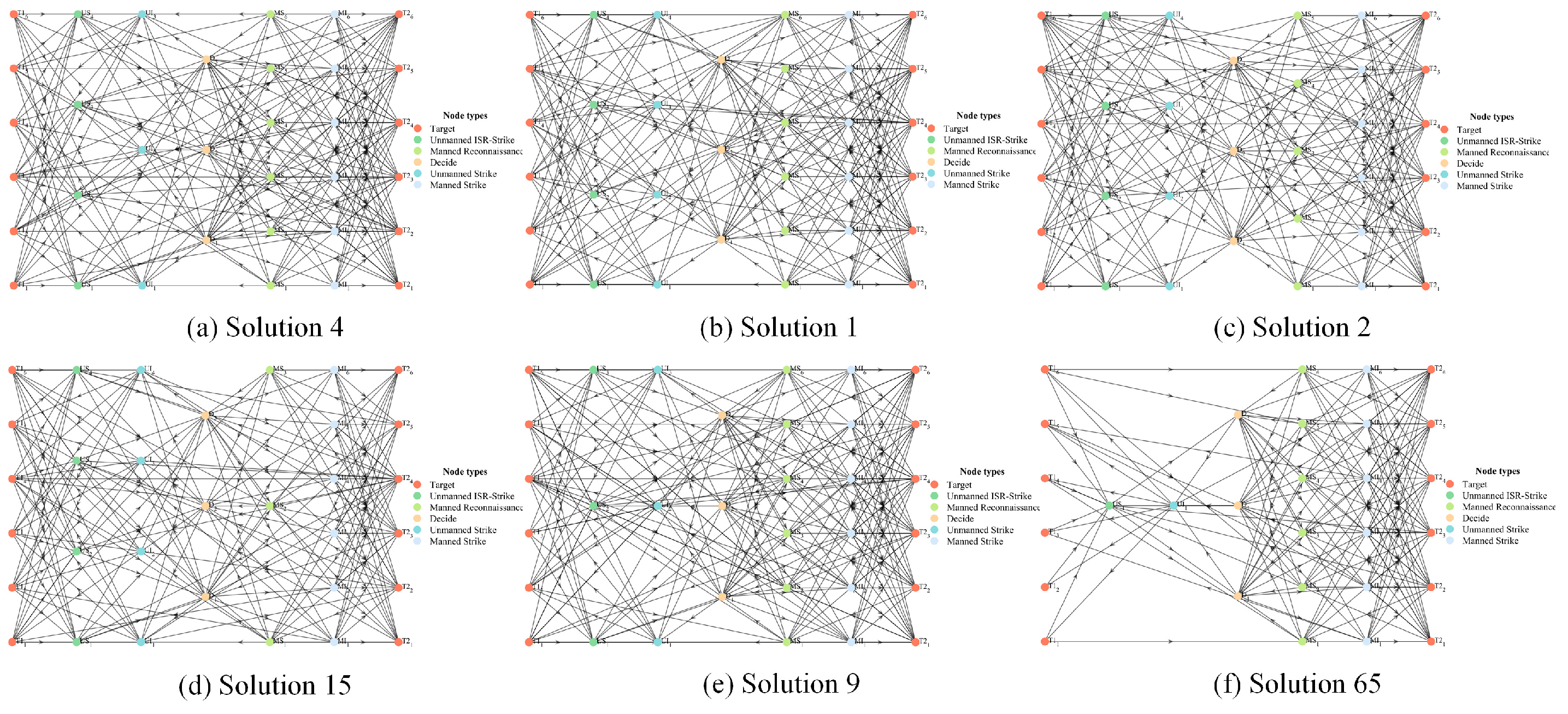
Table 5 shows all efficient solutions satisfying the k = 2 and p = 2 criteria, alongside the computed values of indicators R L , R G , and R F for each solution. It can be seen that no efficient solutions satisfy the p = 3 criterion. After screening, six efficient solutions remain, identified as collocations 1, 2, 4, 9, 15, and 65.
Figure 16 illustrates the combat networks formed by the six efficient solutions after screening. Solutions 2 and 15 exhibited higher strike capabilities, attributable to their deployment of four unmanned pieces of strike equipment, enabling effective target engagement. Solutions 1, 4, and 9 demonstrated superior network robustness. This was due to the larger number of operational loops in the formed operational networks, which could better maintain their original capabilities after being attacked. Solution 65 achieved optimal operational efficiency through a smaller number of unmanned equipment deployments, facilitating rapid combat deployment.
After screening the schemes using the SEABODE method, six efficient schemes were obtained. The improved TOPSIS method was further adopted to rank these efficient schemes to get the final allocation scheme. We used the improved AHP method to obtain the weights for network operation efficiency, network redundancy, and network strike capability, which were 0.237, 0.307, and 0.456, respectively.
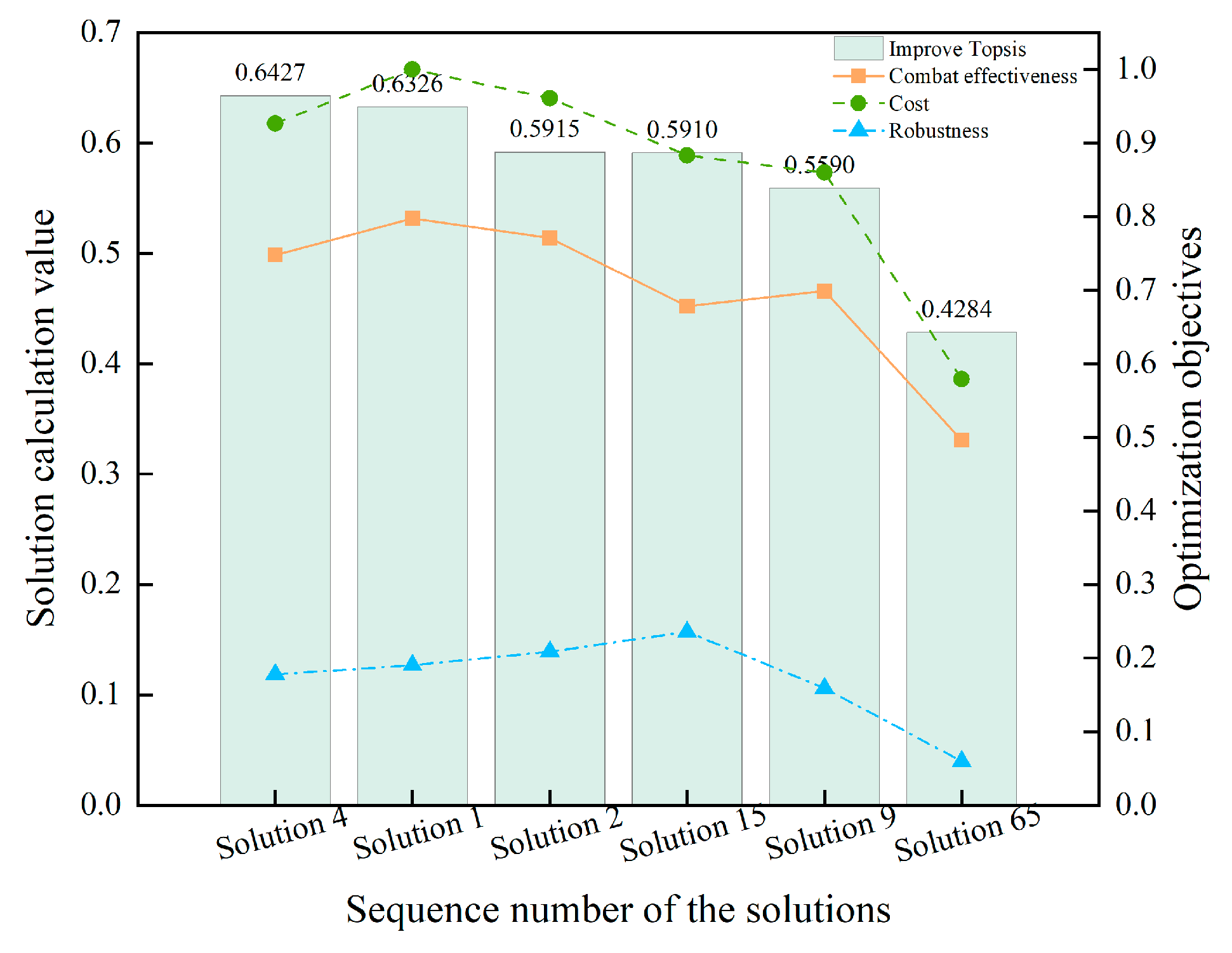
The improved TOPSIS method was used to rank the six schemes. Figure 17 shows the ranking results as well as the values for combat effectiveness, equipment cost, and the robustness index corresponding to each scheme. It can be seen that Scheme 4 was the optimal solution, followed by Scheme 1, and Scheme 65 was the worst. Although Solution 1 surpasses Solution 4 in combat effectiveness and robustness, it incurs higher equipment costs. When cost constraints are disregarded, Solution 1 becomes the optimal choice as it delivers the highest combat effectiveness.
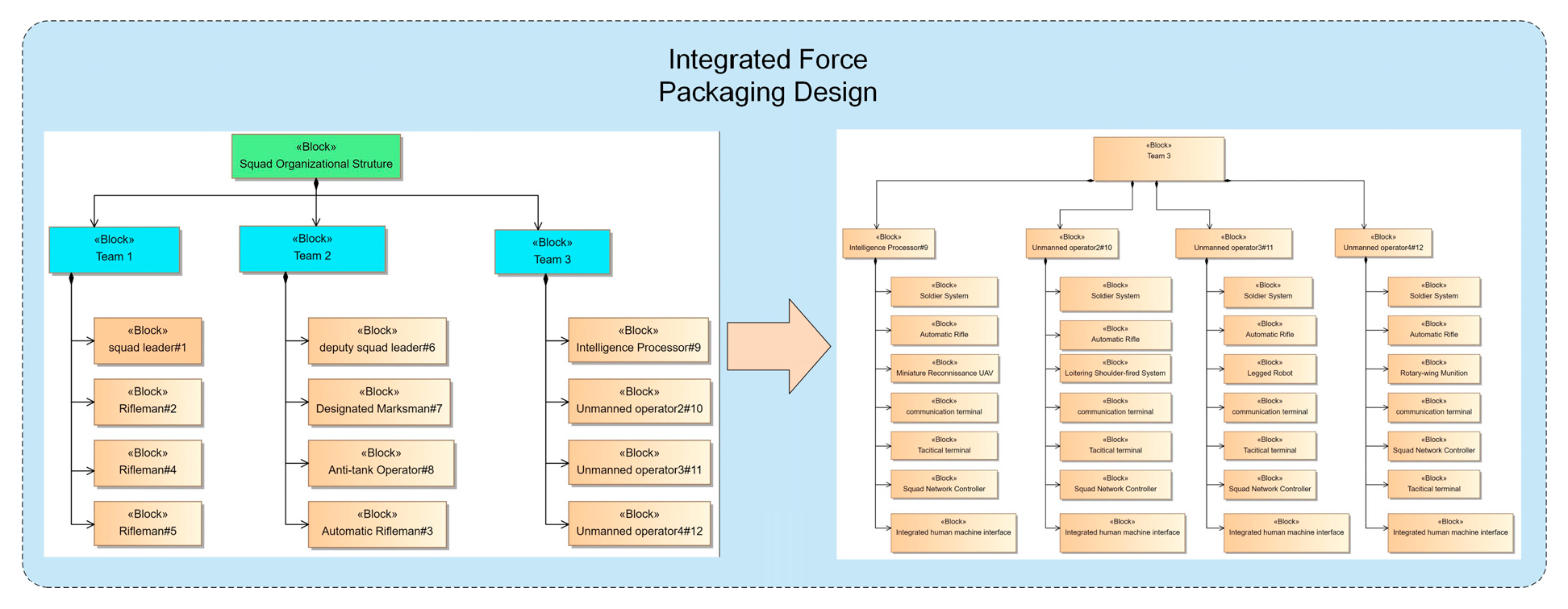
The optimal Solution 4 was implemented through integrated force packaging design to reconstruct relevant views, yielding the final ISWES configuration. As shown in Figure 18, the squad consists of 12 personnel, divided into three operational teams: the assault team, the firepower team, and the unmanned operation team. It is mainly equipped with four unmanned pieces of reconnaissance and strike equipment and three unmanned pieces of strike equipment, including three decision-making units, the squad leader, deputy squad leader, and intelligence processor.

4.2.3. Simulation Verification

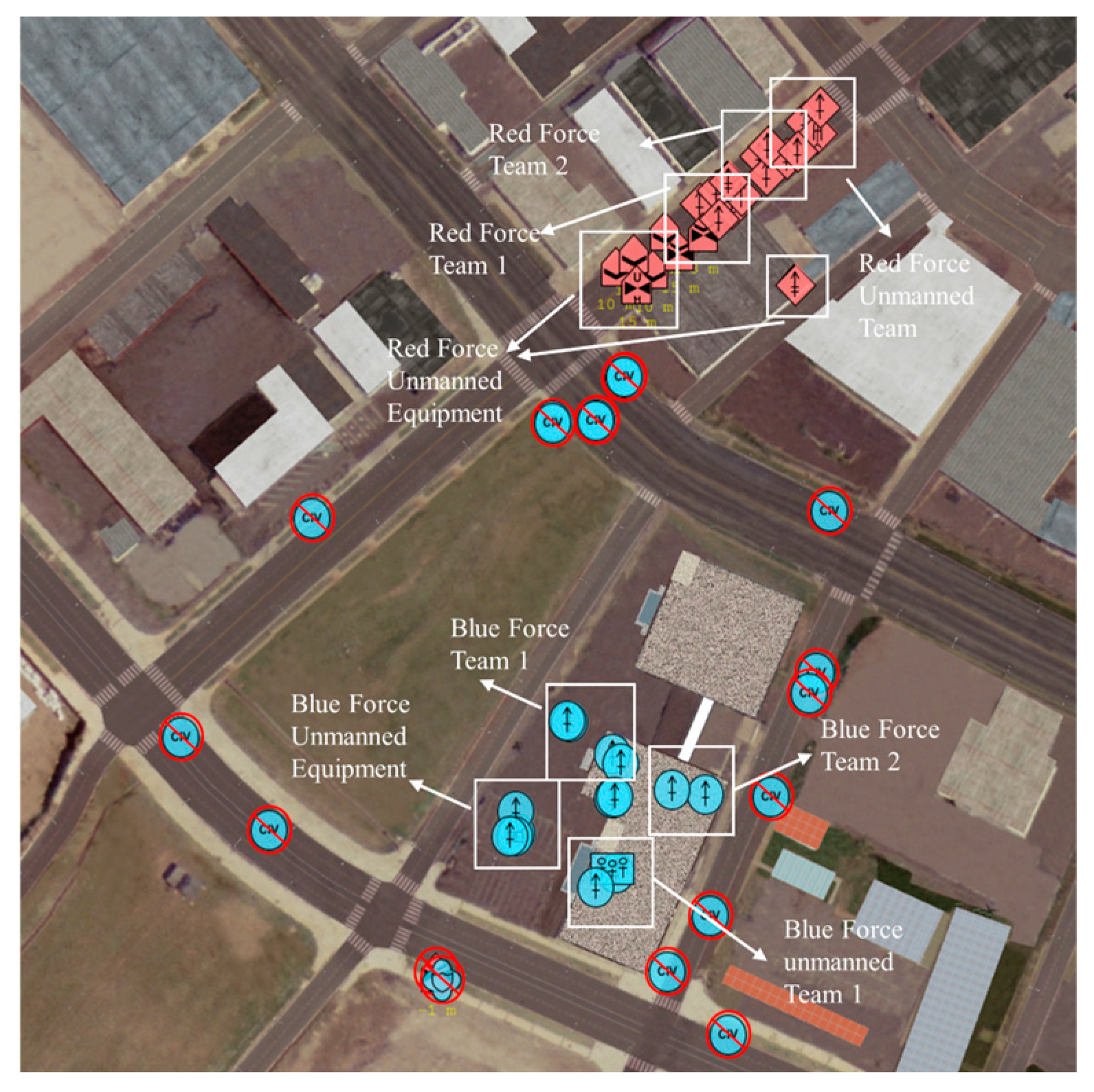
To verify the rationality and feasibility of the ISWES optimization design method proposed in this paper, an urban building clearance mission scenario was constructed using a combat simulation platform [41]. The existing ISWES served as the control group, while the optimized ISWES constituted the experimental group.
Figure 19 shows the urban building clearance mission established in Section 4.1, which serves as the scenario background. Detailed information about the depicted scenario will not be elaborated here. Through multiple simulations, combat data were collected, and a comparative analysis of the experimental group and the control group was conducted using four combat effectiveness indicators, including red force equipment losses, red/blue force casualties, and mission completion time [42], to assess their respective strengths and weaknesses.
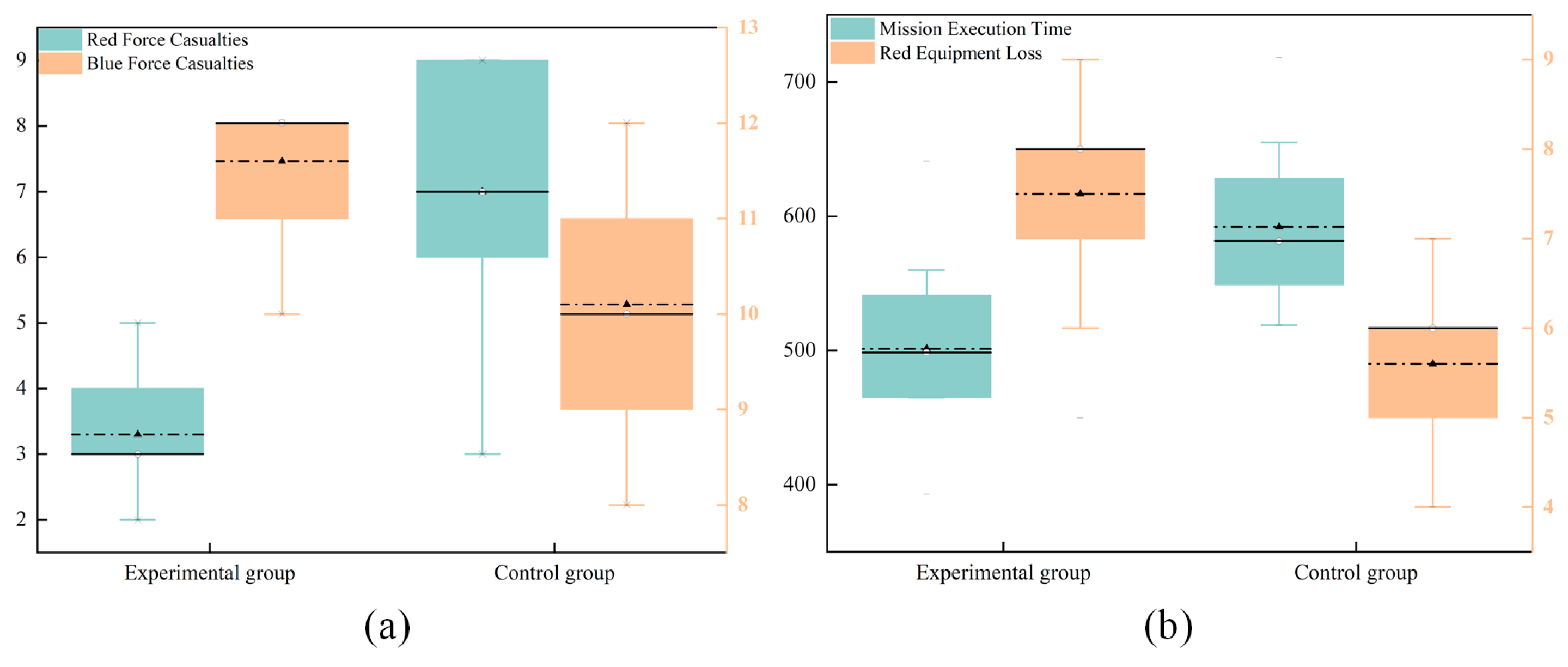
As illustrated in Figure 20, the experimental group demonstrated superior performance to the control group across three indicators: mission execution time, red force casualties, and blue force casualties. Specifically, mission execution time and red force casualties decreased by 15.34% and 52.86%, respectively, while blue force casualties increased by 14.85%. Due to the extensive deployment of unmanned equipment, the experimental group exhibited a 33.93% higher red force equipment loss rate than the control group. Overall, the comparative analysis indicates that, at the cost of increased losses of unmanned equipment, the experimental group significantly reduces its personnel casualties, achieves more effective neutralization of enemy personnel, and shortens the mission completion time compared to the control group.

5. Conclusions

The synergy between manned and unmanned equipment within ISWES necessitates closer collaboration, where rational configuration schemes serve as critical enablers for maximizing squad combat capabilities. This study proposed an integrated framework for ISWES design and optimization. The framework comprises two core components: First, drawing on MBSE architecture, we established a model-based design methodology for ISWES, executing mission analysis, capability requirement analysis, and system architecture modeling throughout the design process. Subsequently, based on the operation loop concept and targeting operational effectiveness, system robustness, and equipment cost, we constructed a multi-objective optimization model for ISWES configuration schemes. A SEABODE-improved TOPSIS decision-making method was proposed to validate the optimal configuration through combat simulation, culminating in iterative reconstruction of the configuration model view.
This integrated framework offers the following advantages:
  • The proposed ISWES modeling method employs micro-scenario decomposition for combat task breakdown and atomic-action-level combat activity modeling, enabling more precise capturing of operational capabilities required for mission execution.
  • The operation loop-based combat network modeling fully incorporates equipment interdependencies and interactions, integrating operational effectiveness, system robustness, and equipment cost into a comprehensive multi-objective optimization model.
  • The SEABODE-improved TOPSIS decision method effectively screens Pareto solution sets and determines optimal configurations, ensuring scientifically rigorous selection of the optimal equipment configuration scheme.
There is still much work to be done in the future, such as incorporating dynamic variations in operation loops and integrating configuration scheme optimization processes with MBSE design frameworks.

Author Contributions

Conceptualization, C.H. and Y.W.; methodology, C.H.; software, S.Z.; validation, F.Y. and S.Z.; formal analysis, Y.Z.; investigation, Y.W.; resources, F.Y.; data curation, C.H.; writing—original draft preparation, C.H.; writing—review and editing, C.H.; visualization, F.Y.; supervision, Y.Z.; project administration, Y.W. All authors have read and agreed to the published version of the manuscript.

Funding

This research was supported by the National Defense Basic Scientific Research Program of China, grant number JCKY202109B017.

Data Availability Statement

Due to the confidential nature of the project, the data supporting the findings of this study cannot be shared. We adhere to strict privacy and ethical guidelines that prevent the dissemination of sensitive information. While we understand the importance of data transparency, we must prioritize the security and integrity of the program and all parties involved. We assure you that all analyses were conducted rigorously and that the result reports are an accurate reflection of the work performed.

Conflicts of Interest

The authors declare no conflicts of interest.

Abbreviations

The following abbreviations are used in this manuscript:
ISWESInfantry Squad Weapon Equipment System-of-Systems
TBSEText-Based Systems Engineering
MBSEModel-Based Systems Engineering
OODAObservation–Orientation–Decision–Action
CCMOCoevolutionary Constrained Multi-Objective Optimization
UBCUrban Building Clearance

References

  1. Zheng, X.C.; Hu, X.D.; Lu, J.Z.; Arista, R.; Lentes, J.; Kiritsis, D. An Aircraft Assembly Process Formalism and Verification Method Based on Semantic Modeling and MBSE. Adv. Eng. Inform. 2024, 60, 102412. [Google Scholar] [CrossRef]
  2. Ma, J.; Wang, G.; Lu, J.; Zheng, X.; Yan, Y. Application of Multi Architecture Modelling Method in Intelligent Electric–Vehicle Design. Int. J. Prod. Res. 2025, 63, 5493–5511. [Google Scholar] [CrossRef]
  3. Sun, X.J.; Luo, M.Q.; Cui, Z.Y.; Ji, Z.P.; Liu, H. A Methodology for Constructing the Aircraft Design Schema. Chin. J. Aeronaut. 2023, 36, 148–167. [Google Scholar] [CrossRef]
  4. Nematiyan, S.; Sabour, M.H.; Moradli, M.; Tabatabaie, M. Model-Based Systems Engineering Examination of Failures Ontology in Aircraft Turbine Blades. Eng. Fail. Anal. 2023, 154, 107709. [Google Scholar] [CrossRef]
  5. Chu, C.Y.; Yin, C.F.; Shi, S.; Su, S.H.; Chen, C. Multidisciplinary Modeling and Optimization Method of Remote Sensing Satellite Parameters Based on SysML-CEA. Comput. Model. Eng. Sci. 2022, 135, 1413–1434. [Google Scholar] [CrossRef]
  6. Tang, M.; Yang, J.Q.; Zhao, P.C.; Wang, K. Research on Design Requirements for Passive Residual Heat Removal System of Lead Cooled Fast Reactor via Model-Based System Engineering. Nucl. Eng. Technol. 2024, 56, 3286–3297. [Google Scholar] [CrossRef]
  7. Basnet, S.; Bahootoroody, A.; Chaal, M.; Valdez Banda, O.A.; Lahtinen, J.; Kujala, P. A Decision-Making Framework for Selecting an MBSE Language–A Case Study to Ship Pilotage. Expert Syst. Appl. 2022, 193, 116451. [Google Scholar] [CrossRef]
  8. Nakashima, T.; Kutsuna, K.; Kureta, R.; Nishiyama, H.; Yanagihara, T.; Nakamura, J.; Ando, H.; Murayama, H.; Kuwahara, S. Model-Based Design and Safety Assessment for Crewless Autonomous Vessel. J. Phys. Conf. Ser. 2022, 2311, 012024. [Google Scholar] [CrossRef]
  9. Mao, R.T.; Yang, C.W.; Sun, Y.Y.; Wang, Y.B.; Zhang, Y.W.; Wang, X.L.; Chen, J.J. Cruise Missile Weapon System Logic Architecture Design and Simulation Based on MBSE. In Proceedings of the 2024 IEEE International Conference on Unmanned Systems (ICUS), Nanjing, China, 18–20 October 2024; pp. 351–356. [Google Scholar]
  10. Wang, J.H.; Ma, X.D.; He, X.F.; Hu, L.F. Research on Architecture Modeling of Aviation-Guided Munitions System Based on MBSE. J. Phys. Conf. Ser. 2023, 2478, 122007. [Google Scholar] [CrossRef]
  11. Krupa, G.P. Application of Agile Model-Based Systems Engineering in Aircraft Conceptual Design. Aeronaut. J. 2019, 123, 1561–1601. [Google Scholar] [CrossRef]
  12. Wang, L.; Meng, T.; Sun, S.; Li, R. A MBSE-based mission thread design method. Syst. Eng. Electron. 2025; in press. Available online: https://link.cnki.net/urlid/11.2422.TN.20250520.1821.018 (accessed on 4 February 2026).
  13. Zhu, S.F.; Tang, J.; Gauthier, J.-M.; Faudou, R. A Formal Approach Using SysML for Capturing Functional Requirements in Avionics Domain. Chin. J. Aeronaut. 2019, 32, 2717–2726. [Google Scholar] [CrossRef]
  14. Gregory, J.; Berthoud, L.; Tryfonas, T.; Faure, L.; Prezzavento, A. The Spacecraft Early Analysis Model: An MBSE Framework for Early Analysis of Spacecraft Behavior. IEEE Trans. Syst. Man Cybern. Syst. 2025, 55, 6658–6670. [Google Scholar] [CrossRef]
  15. Tang, T.; Wang, Y.; Jia, L.J.; Hu, J.; Ma, C. Close-in Weapon System Planning Based on Multi-Living Agent Theory. Def. Technol. 2022, 18, 1219–1231. [Google Scholar] [CrossRef]
  16. Qian, X.; Dong, C.; LU, Z. Weapon System Optimization Design Based on Effectiveness Evaluation. Syst. Simul. Technol. 2017, 13, 286–291+362. [Google Scholar] [CrossRef]
  17. Wang, L.Y.; Chen, L.B.; Yang, Z.W.; Li, M.H.; Yang, K.W.; Li, M.J. A Prospect-Theory-Based Operation Loop Decision-Making Method for Kill Web. Mathematics 2022, 10, 3486. [Google Scholar] [CrossRef]
  18. Hu, C.S.; Wang, X.L.; Li, M.H.; Jiang, J. Navigating Uncertainty in Weapon System-of-Systems Planning: A Hybrid Multiobjective Network-Based Optimization and Fuzzy Set Approach. Int. J. Comput. Intell. Syst. 2023, 16, 136. [Google Scholar] [CrossRef]
  19. Liu, Z.X.; Mo, L.; Lou, S.J.; Zhu, Y.X.; Liu, T. An Ecology-Oriented Single–Multi-Objective Optimal Operation Modeling and Decision-Making Method in the Case of the Ganjiang River. Water 2024, 16, 970. [Google Scholar] [CrossRef]
  20. Wang, X.J.; Dong, Z.; Ai, X.S.; Dong, X.; Li, Y. Multi-Objective Model and Decision-Making Method for Coordinating the Ecological Benefits of the Three Gorger Reservoir. J. Clean. Prod. 2020, 270, 122066. [Google Scholar] [CrossRef]
  21. Wei, N.; Yang, F.; Lu, K.M.; Xie, J.C.; Zhang, S.F. A Method of Multi-Objective Optimization and Multi-Attribute Decision-Making for Huangjinxia Reservoir. Appl. Sci. 2022, 12, 6300. [Google Scholar] [CrossRef]
  22. Wei, N.; He, S.N.; Lu, K.M.; Xie, J.C.; Peng, Y.X. Multi-Stakeholder Coordinated Operation of Reservoir Considering Irrigation and Ecology. Water 2022, 14, 1970. [Google Scholar] [CrossRef]
  23. Wang, Y.; Tao, J.Y.; Zhang, X.K.; Bai, G.H.; Zhang, Y.N. Mission-Oriented Capability Evaluation for Combat Network Based on Operation Loops. Def. Technol. 2024, 42, 156–175. [Google Scholar] [CrossRef]
  24. Li, J.; Yang, K.; Fu, C.; Zhang, X.; Chen, Y. An Operational Efficiency Evaluation Method for Weapon System-of-Systems Combat Networks Based on Operation Loop. In Proceedings of the 2014 9th International Conference on System of Systems Engineering (SOSE), Glenelg, SA, Australia, 9–13 June 2014; IEEE: Adelade, SA, Australia, 2014; pp. 219–223. [Google Scholar]
  25. Han, Q.; Pang, B.; Li, S.; Li, N.; Guo, P.S.; Fan, C.L.; Li, W.M. Evaluation Method and Optimization Strategies of Resilience for Air & Space Defense System of Systems Based on Kill Network Theory and Improved Self-Information Quantity. Def. Technol. 2023, 21, 219–239. [Google Scholar] [CrossRef]
  26. Li, J.C.; Zhao, D.; Ge, B.F.; Jiang, J.; Yang, K.W. Disintegration of Operational Capability of Heterogeneous Combat Networks Under Incomplete Information. IEEE Trans. Syst. Man Cybern. Syst. 2020, 50, 5172–5179. [Google Scholar] [CrossRef]
  27. Luo, C.; Chen, Y.; Wang, L.; Wang, Z.; Chang, Z. Effectiveness evaluation method of system-of-systems based on operation loop and improved information entropy. Syst. Eng. Electron. 2019, 41, 73–80. [Google Scholar]
  28. Xia, C.; Hou, X. Algorithm for Maximizing Algebraic Connectivity Based on Graph Neural Network. Comput. Syst. Appl. 2024, 33, 146–157. [Google Scholar] [CrossRef]
  29. Tian, Y.; Zhang, T.; Xiao, J.H.; Zhang, X.Y.; Jin, Y.C. A Coevolutionary Framework for Constrained Multiobjective Optimization Problems. IEEE Trans. Evol. Comput. 2021, 25, 102–116. [Google Scholar] [CrossRef]
  30. Kang, L.; Zhang, S.; Ding, Y.; He, X.C. Extraction and Preference Ordering of Multireservoir Water Supply Rules in Dry Years. Water 2016, 8, 28. [Google Scholar] [CrossRef]
  31. Ming, Z.; Yuan, K.; Wang, G.; Yan, Y.; Ding, W.; YU, L. Integrated Effectiveness Assessment Methodology for Combat Systems Con-sid-ering Static and Dynamic Capabilities. Trans. Beijing Inst. Technol. 2025, 45, 144–153. [Google Scholar] [CrossRef]
  32. Xiao, Y.; Tang, X.; Li, Y.; Huang, H.; An, B.W. Social Vulnerability Assessment of Landslide Disaster Based on Improved TOPSIS Method: Case Study of Eleven Small Towns in China. Ecol. Indic. 2022, 143, 109316. [Google Scholar] [CrossRef]
  33. Zhou, X.J.; Tan, W.; Sun, Y.; Huang, T.W.; Yang, C.H. Multi-Objective Optimization and Decision Making for Integrated Energy System Using STA and Fuzzy TOPSIS. Expert Syst. Appl. 2024, 240, 122539. [Google Scholar] [CrossRef]
  34. Panichella, A. An Improved Pareto Front Modeling Algorithm for Large-Scale Many-Objective Optimization. In Proceedings of the Genetic and Evolutionary Computation Conference, Boston, MA, USA, 9–13 July 2022; ACM: Boston, MA, USA, 2022; pp. 565–573. [Google Scholar]
  35. Zhu, Q.L.; Zhang, Q.F.; Lin, Q.Z. A Constrained Multiobjective Evolutionary Algorithm With Detect-and-Escape Strategy. IEEE Trans. Evol. Comput. 2020, 24, 938–947. [Google Scholar] [CrossRef]
  36. Ming, M.J.; Trivedi, A.; Wang, R.; Srinivasan, D.; Zhang, T. A Dual-Population-Based Evolutionary Algorithm for Constrained Multiobjective Optimization. IEEE Trans. Evol. Comput. 2021, 25, 739–753. [Google Scholar] [CrossRef]
  37. Deb, K.; Jain, H. An Evolutionary Many-Objective Optimization Algorithm Using Reference-Point-Based Nondominated Sorting Approach, Part I: Solving Problems With Box Constraints. IEEE Trans. Evol. Comput. 2014, 18, 577–601. [Google Scholar] [CrossRef]
  38. Zitzler, E.; Thiele, L. Multiobjective Evolutionary Algorithms: A Comparative Case Study and the Strength Pareto Approach. IEEE Trans. Evol. Comput. 1999, 3, 257–271. [Google Scholar] [CrossRef]
  39. Tian, Y.; Zhang, X.Y.; Cheng, R.; Jin, Y.C. A Multi-Objective Evolutionary Algorithm Based on an Enhanced Inverted Generational Distance Metric. In Proceedings of the 2016 IEEE Congress on Evolutionary Computation (CEC), Vancouver, BC, Canada, 24–29 July 2016; IEEE: Vancouver, BC, Canada, 2016; pp. 5222–5229. [Google Scholar]
  40. Chen, Q.H.; Zhao, Q.S.; Zou, Z.G.; Qian, Q.Y. Bi-Objective Optimization for Equipment System-of-Systems Development Planning Using a Novel Co-Evolutionary Algorithm Based on NSGA-II and HypE. Comput. Ind. Eng. 2024, 198, 110677. [Google Scholar] [CrossRef]
  41. Zhang, G.H.; Wang, X.Y.; Qi, X.D.; Li, G.N. Research of Key Techniques of VR-Forces and VRNET’s Collaboration Simulation. In Proceedings of the 2013 Sixth International Symposium on Computational Intelligence and Design, Hangzhou, China, 28–29 October 2013; Volume 2, pp. 265–268. [Google Scholar]
  42. Peng, B.; Liu, S.; Xu, L.; He, Z. Combat Process Simulation and Attrition Forecasting Based on System Dynamics and Multi-Agent Modeling. Expert Syst. Appl. 2022, 187, 115976. [Google Scholar] [CrossRef]
Figure 1. ISWES design framework.
Systems 14 00308 g001
Figure 2. Process of operational scenario and mission analysis.
Systems 14 00308 g002
Figure 3. Process of operational capability analysis.
Systems 14 00308 g003
Figure 4. Process of squad organizational architecture development.
Systems 14 00308 g004
Figure 5. Three types of operation loop. (a) simple operation loop; (b) information-sharing operation loop; (c) decision-support operation loop.
Systems 14 00308 g005
Figure 6. The workflow of the CCMO algorithm.
Systems 14 00308 g006
Figure 7. Scheme screening and decision-making process.
Systems 14 00308 g007
Figure 8. Mission task decomposition.
Systems 14 00308 g008
Figure 9. Combat activity breakdown.
Systems 14 00308 g009
Figure 10. Tactical unit design.
Systems 14 00308 g010
Figure 11. Tactical unit information interoperability.
Systems 14 00308 g011
Figure 12. Operational capability analysis.
Systems 14 00308 g012
Figure 13. Unmanned equipment framework.
Systems 14 00308 g013
Figure 14. Preliminary collocation scheme.
Systems 14 00308 g014
Figure 15. The results of different evolutionary generations.
Systems 14 00308 g015
Figure 16. The combat networks formed by different schemes.
Systems 14 00308 g016
Figure 17. The ranking results for each scheme.
Systems 14 00308 g017
Figure 18. Optimal collocation scheme.
Systems 14 00308 g018
Figure 19. Urban building clearance scenario based on a simulation platform.
Systems 14 00308 g019
Figure 20. The values of the indicators after multiple simulations. (a) comparision of casualties between red and blue force; (b) comparision of mission execution time and red equipment loss.
Systems 14 00308 g020
Table 1. Six categories of edges.
Edge TypeMeaning
T S Intelligence acquisition
S S Intelligence sharing
S D Information uploading
D D Collaboration between the decision nodes
D I Fire control
I T Destroy enemy targets
Table 2. Results of algorithm comparison.
AlgorithmHVIGDRuntime
CCMO3.9362 × 10−15.8312 × 10−16.0541 × 102
AGE-MOEA-II3.9251 × 10−15.8312 × 10−11.071 × 103
MOED/D-DAE3.9382 × 10−15.8450 × 10−19.9568 × 102
cDPEA3.9303 × 10−15.8355 × 10−17.6093 × 102
NSGA-III3.8791 × 10−15.9428 × 10−11.1087 × 103
Table 3. Indicator calculation value.
Evaluation IndexRange
R L [1.3253, 1.3870]
R G [0.109, 0.1733]
R F [0.6741, 0.9525]
Table 4. Number of solutions at different k-order efficiencies.
SubspaceNumber
R L , R G , R F 10
R L , R G 5
R L , R F 9
R G , R F 3
Table 5. Indicator values under different effective schemes.
Solution R L R G R F R L , R G R L , R F R G , R F
11.38500.17330.9461
21.37940.16530.9472
31.37140.16840.9412
41.36380.16560.9164
51.38570.14640.9525
Disclaimer/Publisher’s Note: The statements, opinions and data contained in all publications are solely those of the individual author(s) and contributor(s) and not of MDPI and/or the editor(s). MDPI and/or the editor(s) disclaim responsibility for any injury to people or property resulting from any ideas, methods, instructions or products referred to in the content.