1. Introduction
Technological advancements have profoundly reshaped daily life and industrial practices, introducing innovations that significantly enhance efficiency and productivity across multiple sectors [
1]. Among these, the manufacturing industry has experienced some of the most transformative changes, driven by an urgent need to adapt to increasing global competition, heightened customer expectations, and evolving sustainability requirements [
2]. In today’s volatile and complex market environment, enterprises can no longer rely on conventional methods alone; adopting contemporary technologies has become a strategic imperative. These innovations enable companies to strengthen competitiveness, optimize processes, reduce operational costs, and address environmental concerns. As Omer et al. [
3] emphasize, sustainability requirements impose additional pressure on manufacturers to provide high-quality products at the lowest possible cost while minimizing environmental impact. Within this broader technological evolution, maintenance has emerged as a critical enabler of operational excellence. Traditionally perceived as a support function, maintenance now plays a central role in ensuring product quality, production consistency, and equipment reliability.
Over recent decades, maintenance strategies have shifted from reactive approaches, where interventions occur only after failures, towards preventive methods aimed at scheduled upkeep. More recently, predictive maintenance (PdM) has gained prominence, representing a paradigm shift aligned with the principles of digital transformation. Digitalization enables the early detection and forecasting of equipment issues, allowing for strategic planning of maintenance activities instead of reactive execution in response to unexpected breakdowns [
4,
5]. This transition to proactive maintenance not only reduces production disruptions but also improves resource allocation and extends the lifespan of critical assets. Predictive maintenance, in particular, leverages real-time sensor data and advanced analytics to anticipate potential equipment failures. By detecting anomalies and patterns indicative of wear or malfunction, PdM empowers organizations to implement targeted interventions before problems escalate. However, the effective deployment of these technologies often requires access to scarce specialized expertise [
6], highlighting a key challenge for firms at various stages of digital maturity. Nevertheless, the operational and financial benefits of PdM are substantial, offering a clear value proposition for organizations seeking to improve efficiency and competitiveness in asset-intensive industries. In the automotive manufacturing sector, operational efficiency and reliability are especially critical.
Production lines in this industry depend on complex, interconnected machinery where even minor failures can trigger cascading effects, resulting in significant downtime, financial losses, and reputational damage [
7]. As such, PdM has emerged as a transformative solution capable of addressing these challenges. By utilizing tools such as the Internet of Things (IoT), artificial intelligence (AI), and big data analytics, predictive maintenance enables organizations to monitor equipment performance continuously, predict failures with high accuracy, and schedule maintenance interventions precisely when needed [
4,
8]. This integration of advanced digital technologies into maintenance practices aligns seamlessly with the principles of Industry 4.0, which promote data-driven decision-making, operational transparency, and enhanced sustainability [
9]. Furthermore, the convergence of PdM with digitalization fosters a fundamental shift in organizational culture. Rather than relying on traditional reactive or time-based maintenance schedules, firms adopting PdM are moving towards a more proactive and strategic mindset. This transition reduces the financial and operational risks of unplanned equipment failures, improves energy efficiency, and prolongs the service life of capital-intensive assets. As companies increasingly deploy smart sensors, cloud-based platforms, and advanced analytics, they gain access to predictive insights that support strategic decision-making and align maintenance activities with broader organizational goals [
10].
The combination of digitalization and predictive maintenance also underscores a broader trend towards operational resilience and sustainability in modern industry. As Rame et al. [
11] observe, PdM facilitates more sustainable practices by reducing unnecessary part replacements, lowering energy consumption, and minimizing the environmental footprint of manufacturing operations. This redefinition of maintenance highlights its role not only as a technical necessity but also as a strategic function contributing to organizational competitiveness and long-term viability. In Slovak automotive industry, these developments take on particular significance [
12]. The sector forms a cornerstone of the national economy, serving as one of the country’s largest employers and export contributors. However, Slovak automotive firms face increasing pressures to maintain their competitiveness in global supply chains while simultaneously addressing sustainability and digitalization imperatives. Within this context, the adoption of predictive maintenance systems represents both a challenge and an opportunity. Larger firms, with their greater resources and technical capacity, are better positioned to implement PdM successfully. In contrast, smaller enterprises often struggle with limited budgets and expertise, raising concerns about potential disparities in digital maturity and operational resilience across the sector.
This study investigates the pivotal role of digital technologies in predictive maintenance, focusing on their adoption and impact within Slovak automotive industry. The primary objective is to introduce and evaluate Condition Monitoring Systems (CMSs) and related digital solutions tailored to the sector’s specific needs. By doing so, the research seeks to empower maintenance personnel to make informed, data-driven decisions independently and to assess the broader implications of PdM for operational efficiency and competitiveness. The methodology combines quantitative analysis of key economic performance indicators of Slovak automotive enterprises, assessed before and after PdM implementation, with qualitative insights drawn from industry practices and technological trends. This dual approach enables a comprehensive examination of how predictive maintenance integration influences production outcomes and how varying levels of digital maturity across firms shape adoption patterns and success rates. Ultimately, this research aims to highlight the opportunities for production growth and operational resilience offered by PdM. It identifies prevailing trends and future directions in smart maintenance planning and situates these findings within the broader frameworks of Industry 4.0 and the emerging Industry 5.0 paradigm. In doing so, the study addresses the critical question of how Slovak automotive manufacturers can leverage predictive maintenance not only to enhance their immediate operational performance but also to secure sustainable, long-term competitiveness in an increasingly digital and interconnected global market.
2. Literature Review
The quality of a product or service is intrinsically linked to the functionality and reliability of the equipment employed in its production, outcomes which are secured through effective maintenance actions and processes. Maintenance ensures operability and faultlessness by promptly restoring equipment to working condition and reducing repair expenses [
13]. Over time, approaches to maintenance have evolved in parallel with the technological, economic, and cultural changes brought about by successive industrial revolutions. Today, the world is experiencing the fourth industrial revolution (Industry 4.0), characterized by the digital transformation of business and manufacturing systems [
14,
15]. Since the 18th century, industrial development has been shaped by the need to balance increasing demand for goods with the constraints of limited natural resources and the imperative to minimize environmental and social impacts [
16]. Each phase of industrialization has redefined production and maintenance paradigms: mechanization introduced powered machines, electrification enabled mass production, automation brought precision and speed, and digitalization now integrates cyber-physical systems and interconnected networks.
This perspective is further consistent with the emerging Industry 5.0 paradigm, which emphasizes human-centric, sustainable, and resilient industrial systems supported by advanced digital technologies.
2.1. The Shift in Maintenance Paradigms
The digital revolution associated with Industry 4.0 was catalyzed by the advent of computing technologies. Its most significant advancements include the IoT, integrated cyber-physical systems, smart automation, and fully interconnected production networks. These innovations have reshaped industrial operations, placing new emphasis on the ability to implement emerging technologies rapidly and adapt processes in response to real-time data [
17]. As machinery and production systems evolve, maintenance practices have had to transform in order to ensure continuity, reliability, and efficiency. Historically, maintenance was reactive in nature, with equipment repaired only after failures occurred. During the initial stages of industrialization, technicians only serviced basic tools and machinery when they broke, viewing maintenance as a secondary task. Between the 1960s and 1980s, preventive and predictive approaches were not widely adopted, and technicians primarily performed repairs and routine lubrication [
18]. As machinery became increasingly complex, however, the need for specialized knowledge grew, and maintenance gradually evolved into an integral component of production systems [
19]. Reactive maintenance, often described as a “run-to-failure” approach, involves responding to equipment breakdowns only after they occur. While this method is suitable for non-critical equipment with minimal impact on production, it carries significant disadvantages. Unplanned downtime associated with reactive maintenance disrupts production schedules, creates bottlenecks in supply chains, and necessitates maintaining large inventories of spare parts, which ties up financial resources [
20].
Moreover, the urgent and unplanned nature of repairs may require staff to work under severe time constraints, potentially jeopardizing safety. Maintenance professionals must therefore understand the complex interactions between machinery, human operators, and the work environment to mitigate risks effectively [
21]. As industries matured and machinery grew more sophisticated, preventive maintenance emerged as a strategic response to the limitations of reactive practices. Preventive maintenance involves scheduling inspections, repairs, or part replacements at predetermined intervals to prevent failures [
22]. This approach aims to preserve equipment functionality and avoid the higher costs and operational disruptions associated with breakdowns. Typically, preventive maintenance strategies fall into two categories: (1) time-based or usage-based maintenance, which relies on fixed schedules; (2) condition-based maintenance, where interventions are triggered by performance deviations detected through monitoring systems [
23]. Although preventive maintenance represented a significant improvement, it also has inherent drawbacks. Fixed-interval servicing may lead to unnecessary maintenance or premature part replacements when equipment is still in good condition. Conversely, disassembly during routine inspections can sometimes introduce faults or incur additional expenses. Condition-based approaches partially mitigate these issues by tailoring interventions to the actual state of equipment, as revealed by continuous monitoring.
2.2. Towards Proactive and Predictive Maintenance
The subsequent shift towards proactive maintenance reflects a deeper understanding of equipment health management. Rather than addressing symptoms, proactive maintenance seeks to identify and resolve the root is linked to of equipment problems, using data-driven analysis and continuous improvement to eliminate recurring issues such as contamination, misalignment, or inadequate lubrication [
24]. By focusing on early detection and methodical restoration, proactive strategies extend machinery lifespan and enhance system reliability. This approach requires rigorous evaluation of performance data and targeted corrective measures to ensure dependable operation throughout an asset’s lifecycle [
25]. The advent of Industry 4.0 has further advanced maintenance practices with the introduction of predictive maintenance, currently regarded as the most sophisticated maintenance paradigm. Predictive maintenance leverages continuous data collection from equipment sensors and advanced analytics to forecast potential failures, enabling interventions precisely when needed. Sensors monitoring critical parameters such as temperature, vibration, noise, and pressure [
26], coupled with machine learning algorithms, enable the analysis of patterns indicative of impending issues [
27]. Key enablers of PdM include ubiquitous sensors, IoT connectivity, big data analytics, cloud computing, and wireless communication networks, all hallmarks of a fully digitalized Industry 4.0 factory. As companies increasingly adopt these tools, the traditional role of maintenance technicians is evolving to include data analysts and engineers who can interpret the vast quantities of condition monitoring data. Over time, the accumulation of large-scale datasets on asset conditions and usage histories enhances the accuracy and reliability of predictive models.
2.3. Digitalization as a Catalyst for Smart Maintenance
Industrial digitalization, an integral aspect of Industry 4.0, extends beyond individual technologies to encompass the comprehensive embedding of digital systems across all business functions [
28]. Within the maintenance domain, digitalization streamlines workflows, automates routine tasks, and facilitates real-time monitoring of equipment health. These innovations reduce unplanned downtime, lower operational costs, and enhance safety [
29]. Predictive insights derived from advanced analytics enable maintenance teams to plan interventions strategically, optimizing both resource use and equipment availability. Despite these advancements, challenges persist. Many manufacturing facilities still operate with legacy machinery that lacks native IoT capabilities, limiting the immediate applicability of advanced PdM systems [
30]. Upgrading such equipment to accommodate sensor networks and data-driven monitoring requires significant investment and organizational change. Furthermore, the adoption of digital maintenance solutions demands a workforce equipped with both technical and analytical competencies.
2.4. Transitioning to Industry 5.0 Perspectives
As maintenance continues to evolve, emerging Industry 5.0 concepts advocate a human-centric, sustainable, and resilient approach to industrial operations. PdM systems, when implemented effectively, not only improve technical reliability but also contribute to sustainability goals by reducing waste, minimizing energy consumption, and enhancing workplace safety [
31]. Maintenance personnel are no longer limited to mechanical repairs but increasingly engage in high-level decision-making supported by intelligent systems, creating opportunities for more meaningful and safer roles in the production process. The evolution of maintenance strategies, from reactive approaches to predictive and condition-based models, mirrors broader technological progress across industrial revolutions. Maintenance has transitioned from a reactive support function to a strategic driver of operational excellence, reliability, and sustainability. Within the context of Industry 4.0 and the emerging Industry 5.0 paradigm, predictive maintenance stands as a critical innovation, enabling firms to pre-empt failures, optimize resource allocation, and achieve higher levels of efficiency and competitiveness.
While prior studies have extensively examined predictive maintenance adoption, most of them focus either on technological architectures, simulation environments, or single-firm case studies within large multinational manufacturers. Empirical evidence linking predictive maintenance to firm-level financial performance across multiple enterprises in Central and Eastern Europe remains limited.
This study contributes to the literature in three main ways. First, it provides panel-based empirical evidence from 62 automotive manufacturing firms operating in Slovakia, a globally significant yet under-researched automotive hub. Second, it integrates non-parametric longitudinal testing, robust regression modelling, and cluster-based digital maturity classification within a single analytical framework, enabling a multidimensional assessment of predictive maintenance outcomes. Third, it explicitly evaluates the heterogeneity of digital adoption and its performance implications across firms of different sizes, thereby extending existing Industry 4.0 maintenance research toward resilience-oriented and performance-driven perspectives.
By addressing these gaps, the study advances current knowledge on the economic and operational consequences of predictive maintenance implementation in emerging European manufacturing ecosystems.
Table 1 summarizes the key conceptual links between digital maturity, predictive maintenance adoption, operational mechanisms, and industrial performance and resilience.
3. Materials and Methods
Predictive maintenance is recognized as both a key opportunity and a significant implementation challenge within the broader Industry 4.0 landscape. In the automotive sector, many companies view PdM as essential for preventing breakdowns and expediting production, yet they face hurdles in data management, skills, and investment. This section describes the dataset of Slovak automotive industry enterprises analyzed, as well as the statistical techniques and additional analytical approaches employed.
In order to operationalize the empirical investigation, the study addresses the following research questions:
RQ1: Does the adoption of predictive maintenance significantly influence the financial performance of automotive manufacturing firms?
RQ2: How does the level of digital maturity shape heterogeneity in predictive maintenance adoption and performance outcomes across firms?
Data Sample: The analysis focuses on 62 enterprises operating in the automotive manufacturing sector of Slovakia, classified under NACE Rev.2 section C, division 29 (manufacture of motor vehicles, trailers and semi-trailers). All selected firms had a full six-year history of financial data available (2018–2023) and participated in a structured questionnaire survey on maintenance practices (conducted April–June 2024). Firm characteristics in the sample cover a range of sizes and ownership forms: about 8.1% are micro-enterprises, 24.2% small, 43.5% medium-sized, and 24.2% large enterprises. In terms of legal form, 50% are private limited companies, 40.3% public limited (joint-stock) companies, and 9.7% general partnerships. This distribution reflects a cross-section of the Slovak automotive industry. The study’s objective is to evaluate these firms’ understanding and implementation of predictive maintenance and the consequent effects on performance.
Data Sources: The primary financial data source is Bureau van Dijk’s international ORBIS database, one of the world’s largest repositories of private company financial information. Financial data obtained from the ORBIS database cover the period 2018–2023. A structured questionnaire survey was conducted between April and June 2024, capturing retrospective information on predictive maintenance adoption and digital maturity. All regression outcomes are aligned with the latest fully available financial year, namely 2023, ensuring temporal consistency across analyses (
Table 2). These data were complemented by the aforementioned questionnaire, which provided qualitative insights (e.g., whether and when the firm implemented predictive maintenance systems, and self-assessed digital maturity). The combination of archival financial data with survey responses allows a richer analysis, linking performance outcomes with digitalization levels.
Financial Indicators: Table 3 in the Results section defines the core financial indicators examined (in thousand euros): Stock (inventory value), TOAS (total assets), Sales (annual revenue), NCLI (non-current liabilities), CULI (current liabilities), EBIT (earnings before interest and taxes), OPEX (operating expenses), and SHFD (shareholder funds). For each of these indicators, annual values from 2018 to 2023 were collected. To smooth out firm-level idiosyncrasies, we consider aggregated statistics (mean, median, standard deviation) for the sample by year, and we compute the annual averages per firm (over 2018–2023) for use in non-parametric tests (using MS Excel and IBM SPSS Statistics 26).
Quantitative Analysis Methods: Given the panel structure (repeated measures of indicators over years) and the relatively small sample, we first assessed normality of the financial indicators. Normality was not supported (many financial variables are skewed), so non-parametric tests were chosen. We applied the Friedman test to each financial indicator to determine whether there are significant differences in its distribution across the years 2018–2023. The Friedman test is a non-parametric alternative to repeated-measures ANOVA, testing the null hypothesis that the distributions are the same across multiple time points. A p-value below 0.05 leads to rejecting the null hypothesis, indicating the variable changed significantly over time (which, in this context, could reflect the impact of the pandemic and any interventions like PdM).
For any indicator where the Friedman test was significant, we performed post hoc pairwise comparisons using Dunn’s test with Bonferroni correction. This identified which specific years’ values differ significantly from each other. In particular, we were interested in whether the years around the introduction of predictive maintenance (often 2020–2021 in this sample, coinciding with COVID-19 disruptions) showed significant shifts.
Additionally, to quantify the effect of predictive maintenance adoption on performance, we employed a robust regression analysis. We constructed an ordinary least squares (OLS) regression model linking firm performance to digital adoption, but to ensure reliability against outliers or heteroskedasticity, we used robust regression techniques (Huber–White robust standard errors and M-estimation). Specifically, we modelled firms’ 2024 sales (as a dependent variable reflecting output) as a function of their total assets (a proxy for firm size and capital) and a digital adoption score (an index derived from the survey, indicating the degree of PdM/digital tools implementation). The Digital Adoption Score was derived from a structured questionnaire administered to participating firms in 2024. The instrument measured the extent of digital technology integration in maintenance and production processes, including predictive maintenance implementation, sensor deployment, data analytics usage, and real-time monitoring capabilities. Individual items were evaluated on a standardized ordinal scale and subsequently aggregated into a composite index normalized to a 0–100 range. This composite indicator was also used in the clustering analysis to capture firm-level heterogeneity in digital maturity and predictive maintenance adoption. The robust regression was used to validate whether higher digital adoption correlates with better performance (after controlling for firm size) in a statistically significant way, without being unduly influenced by extreme values in the data.
To examine heterogeneity among enterprises, we performed a cluster analysis on their digital maturity and predictive maintenance adoption metrics. We derived a composite score from survey responses reflecting each firm’s digitalization maturity (incorporating factors such as automation level, data utilization, sensor deployment) and their PdM adoption level (extent of predictive maintenance tools implemented). Using k-means clustering on these two dimensions, we grouped the 62 firms into clusters representing similar levels of digital maturity and PdM adoption. The optimal number of clusters was determined by standard criteria (examining inertia and silhouette scores). The cluster analysis allows us to categorize firms as, for example, “high maturity/high adoption” leaders versus “low maturity/low adoption” laggards, etc., and later compare their financial characteristics. Prior to clustering, variables were standardized; the number of clusters was determined using silhouette and inertia criteria, and cluster stability was verified across alternative initializations. Moreover, we carried out a benchmarking analysis to place the Slovak automotive sector’s performance in a broader context. We compared key indicators (such as output growth, downtime, and technology adoption rates) with European or global standards using external data and literature. For instance, we reference statistics from the European Automobile Manufacturers’ Association (ACEA) and Organisation for Economic Co-operation and Development (OECD) to contextualize Slovak automotive output and investment in digital technologies relative to other countries. This helps highlight any gaps in digital adoption and value-added in Slovak industry compared to more advanced economies.
Finally, we developed a scenario analysis exploring how different levels of digital adoption might impact operational outcomes. Drawing on literature and industry reports, we posited scenarios such as low adoption (few predictive systems in place), medium adoption, and high adoption (nearly full Industry 4.0 integration). For each scenario, we estimate potential changes in downtime, maintenance costs, and productivity. These estimates are informed by studies from McKinsey by Bradbury et al. [
32] and Deloitte by Coleman et al. [
33], among others, which quantify improvements from predictive maintenance. For example, McKinsey finds that comprehensive digital maintenance can increase asset availability by 5–15% and reduce maintenance costs by 18–25%. Deloitte reports similar gains, including 5–15% reduction in unplanned downtime and 5–20% improvements in labor productivity. Using such benchmarks, our scenario analysis projects what the Slovak firms could achieve under greater adoption of PdM tools, as well as performing sensitivity analysis on key assumptions (e.g., the responsiveness of downtime to various adoption levels).
Our methodological approach is mixed-method as we quantitatively analyze financial trends over time and correlations with PdM adoption, while also qualitatively grouping firms by digital maturity and comparing industry-level trends internationally. This approach provides a robust basis to assess the value added by predictive maintenance and digitalization in the automotive industry context.
4. Results
The study aims to assess the present level of predictive maintenance implementation within Slovakia’s automotive industry, explore the potential production improvements enabled by PdM, and examine ongoing developments as well as future directions in smart maintenance and predictive engineering. In this section, we present the results of our analyses, starting with an overview of financial performance during the study period, followed by the outcomes of the statistical tests, the robust regression, cluster analysis insights, benchmarking findings, and scenario analysis outcomes. All original results from the base study are retained, with additional results integrated as new tables and figures. This section reports descriptive and inferential results. Interpretation of the findings and comparisons with prior studies are provided in the Discussion section.
4.1. Financial Performance Overview (2018–2023)
The automotive industry in Slovakia has developed over a long period and, particularly in recent decades, has evolved into the country’s leading industrial sector and a key driver of its economic growth. It has attracted substantial foreign direct investment and driven industrial innovation. Slovakia is currently one of the world’s largest per capita car producers. Its position has been reinforced by major investments such as Jaguar Land Rover’s plant and a new Volvo plant scheduled to commence production in 2026.
Table 3 summarizes basic financial information for the dataset of 62 automotive firms, across the years 2018–2023. Each entry provides the mean, median, and standard deviation for the given indicator in a specific year, in thousand euros. This offers a before-and-after picture around 2020–2021, when many firms began implementing predictive maintenance systems and also when the COVID-19 pandemic disrupted the industry.
Several patterns can be observed in
Table 3. The most notable is the effect of the COVID-19 pandemic during 2020–2021, when average values across multiple indicators declined markedly in 2021 (including total assets, revenues, and liabilities) relative to previous years. This downturn mirrors the substantial disruption caused by temporary factory closures, lockdown restrictions, public health measures, and breakdowns in global supply chains. For instance, average sales plummeted from ~50,000 k € in 2019 to ~12,400 k € in 2021, and total assets dropped significantly in 2021. The median values do not show a uniform decline between 2019 and 2021; several indicators exhibit stable or increasing medians, suggesting heterogeneous impacts across firms, while mean values reflect a stronger downturn driven by the upper tail of the distribution.
Moreover, during the early stages of the pandemic, demand for new vehicles contracted significantly as economic uncertainty and lower household spending weighed on purchasing decisions, placing additional pressure on industry revenues. The consequences extended beyond output levels, influencing employment and investment activity, particularly in light of the automotive sector’s substantial contribution to Slovakia’s GDP and export performance. Notwithstanding these setbacks, the sector demonstrated considerable resilience. In 2022 and 2023, average sales and asset values began to improve, although they had not yet returned to their pre-pandemic highs. The recovery strategy has centered on enhancing supply chain robustness, accelerating digital transformation initiatives, and expanding the transition toward electric vehicle manufacturing in response to changing global market preferences. One notable trend is the increase in operating expenses (OPEX) from 2021 onward, as mean OPEX rose to 8705 k € in 2021 and further to 9534 k € in 2022 and 11,644 k € in 2023, even as other indicators were rebounding. Firm-level evidence suggests that the observed increase in operating expenses may partly reflect investments in predictive maintenance systems and related digital technologies, which are commonly associated with short-term implementation and integration costs reported in the Industry 4.0 literature. In other words, companies ramped up spending on PdM and related innovations during and after the pandemic as a strategy to improve efficiency and mitigate downtime. This finding aligns with the qualitative insights from our survey of key managers.
As the COVID-19 crisis repeatedly interrupted production timetables, limited the availability of on-site personnel, and placed additional stress on supply networks, predictive maintenance emerged as an essential mechanism for maintaining operational stability. PdM solutions enabled companies to track equipment performance in real time, detect potential failures in advance, and plan servicing activities proactively at strategically suitable moments. This functionality proved particularly important when access to facilities was restricted and labor capacity was constrained, as it helped streamline maintenance processes and minimize the likelihood of unforeseen breakdowns that could further hinder production. In Slovak automotive industry, where high production efficiency and just-in-time delivery are vital, the ability to predict and prevent equipment failures helped blunt the financial and operational risks posed by the pandemic. By reducing unscheduled downtime and improving resource allocation, PdM systems supported manufacturers in maintaining output levels despite external challenges. Furthermore, the implementation of these systems aligns with wider Industry 4.0 developments, strengthening long-term adaptability and competitive positioning in the post-pandemic landscape. To provide a well-rounded evaluation, we also analyzed overall production performance in the Slovak automotive sector in recent years, as this offers important context for maintenance-related strategies. In 2023, Slovakia’s overall industrial production fell by 0.6%, but this modest decline was largely thanks to robust automobile production cushioning worse outcomes. Throughout 2023, while many manufacturing sub-sectors saw declines (in fact, two-thirds of monitored sectors contracted), the automotive sector achieved superior performance compared to 2022, offsetting declines elsewhere [
34]. The Statistical Office reported that the Slovak industry experienced four year-over-year declines in 2023, the most in 15 years, yet these were milder than the contractions of 2020 and 2022. Since 2018, the automotive sector has recorded the highest annual growth among major industries (4.9% growth in output), underscoring its dominance. For example, production of electrical equipment also rose by 7.4% in 2023, while production of rubber/plastics and computer electronics dropped by 8.9% and 22% respectively, illustrating divergence between automotive and other sectors. This macroeconomic context reinforces why maintaining high uptime and efficiency in automotive manufacturing is so critical for Slovakia [
35].
The descriptive results suggest that the COVID-19 pandemic period (2020–2021) was a breaking point for the industry’s performance, and that firms’ responses included greater investment in predictive maintenance (reflected in rising OPEX). Before quantifying the statistical significance of changes, we outline the methodological steps followed, which were already described: selecting the automotive firms dataset, calculating annual averages of parameters, applying the Friedman test for time differences, conducting structured interviews, and formulating recommendations.
4.2. Hypothesis Testing: Impact of Time Period (2018–2023)
To rigorously assess whether the observed changes in financial parameters over 2018–2023 are statistically significant, we performed the Friedman test for each indicator. The hypotheses tested (for each variable) is whether its distribution remained the same across all six years.
Table 4 presents a summary of these hypothesis tests and decisions:
At a 5% significance level, we find that total assets (TOAS), current liabilities (CULI), operating expenses (OPEX), and sales all show statistically significant differences over the six-year period (p < 0.05 for each). In contrast, stock, non-current liabilities, EBIT, and shareholder funds did not change significantly at the aggregate level. These results quantitatively confirm the earlier observation: certain critical indicators were indeed affected by the events of 2020–2021 (pandemic and PdM adoption is also important considering the year comparisons), while others remained relatively stable. For the variables with significant overall change (TOAS, CULI, OPEX, Sales), we conducted post hoc pairwise comparisons to identify which year-to-year differences drive the significance (using the pairwise Dunn’s test to find the differences that were statistically significant after Bonferroni adjustment). These pairwise results pinpoint the timing of changes:
Total Assets (TOAS): The significant differences are between 2020 and the later years 2022 (adj. p-value 0.034) and 2023 (adj. p-value 0.042), with TOAS in 2020 significantly higher than in 2022/2023. This suggests that the total assets held by firms peaked around 2020 (possibly due to stockpiling or high investment pre-pandemic) and then were drawn down or depreciated by 2022–2023, perhaps as firms utilized assets or deferred new investments in the pandemic’s wake.
Current Liabilities (CULI): By 2022, current liabilities were significantly lower than in 2018 (adj. p-value 0.016) and 2019 (adj. p-value 0.044). Firms may have reduced short-term debt and payables by 2022, possibly using the recovery period to improve their liquidity positions. Lower current liabilities by 2022 indicate improved short-term financial flexibility, which could be a result of cost-cutting and paying down obligations during the pandemic recovery.
Operating Expenses (OPEX): A number of year pairs show significance, highlighting a complex pattern. Notably, 2018 vs. 2020 (adj. p-value 0.001)/2021 (adj. p-value 0.000)/2022 (adj. p-value 0.000)/2023 (adj. p-value 0.000) are all significant with later years higher, and 2019 vs. 2021 (adj. p-value 0.016)/2022 (adj. p-value 0.000)/2023 (adj. p-value 0.034) similarly. This confirms that OPEX in 2020, 2021, 2022, 2023 is significantly greater than pre-pandemic levels (2018–2019). Meanwhile, 2018 vs. 2020 shows OPEX dropped in 2020 (likely due to shutdowns halting spending), which is logical, and by 2021 OPEX overshot the 2018 baseline as firms invested in new systems like PdM (as declared by year comparisons). The pattern implies that after an initial drop in 2020, companies saw operating costs surge in 2021–2023, consistent with making new technology investments (PdM systems, IT, training) and facing inflationary cost pressures.
Sales (Revenue): The significant pairs indicate that 2018 and 2019 sales were higher than 2023 (adj. p-value 0.024 for 2018 vs. 2023; adj. p-value 0.021 for 2019 vs. 2023), and that 2020 sales were higher than in 2022 (adj. p-value 0.000) and 2023 (adj. p-value 0.000), while 2023 sales recovered above 2021 (adj. p-value 0.004). In plain terms, sales collapsed in 2021 (the nadir, as even 2020 was greater than 2021), then recovered by 2023 (which is higher than 2021, significantly so), but as of 2023 the sales levels were still below the 2018–2019 pre-pandemic highs. So, the industry had not fully regained its pre-COVID output by 2023 but was on an upward trajectory from the 2021 low.
The non-parametric tests support that the pandemic had tremendous effects on total assets, current liabilities, operating expenses, and sales in this sector, whereas equity levels, earnings, and inventories did not change significantly in a statistical sense (likely due to high variability or smaller net changes). The significant changes coincide with 2020–2021 as breaking points for assets and sales (downturn) and for OPEX (upturn in 2021+). These quantitative findings corroborate the narrative that COVID-19 was a shock that reduced production and assets and prompted higher spending on maintenance and digital solutions subsequently. Importantly, one of our research aims is to understand whether the integration of predictive maintenance could be linked to these financial dynamics. The evidence so far shows that operating expenses increased notably when PdM systems were introduced (2021 onward), implying a short-term cost, but that unplanned downtime (proxied by sales disruptions) was mitigated and recovery was enabled, suggesting a medium-term benefit. To explore this more directly, we next analyze which financial metrics are most critical in the effectiveness of PdM and perform a regression analysis to quantify PdM’s contribution to performance.
The Friedman results already hint at which variables matter most for predictive maintenance system (PMS) effectiveness in a capital-intensive industry like automotive manufacturing. The significant indicators, assets, current liabilities, costs, and sales, align with factors one would expect to influence or be influenced by maintenance strategies:
Total Assets: This reflects the scale of a company’s investment in machinery and equipment. Larger asset bases typically demand more rigorous maintenance to maximize utilization and lifespan. Companies with substantial fixed assets have more to gain from predictive maintenance, as avoiding breakdowns and optimizing asset use yields bigger absolute benefits. Such firms often invest heavily in maintenance technologies to prevent costly failures [
36]. Thus, we expect a positive relationship between asset scale and adoption of PdM: large firms lead in implementation to protect their investments. PdM allows a shift from reactive or routine preventive maintenance to a proactive approach, reducing unnecessary maintenance and unexpected breakdowns.
Current Liabilities: This indicates short-term financial obligations. A company with high short-term liabilities may face liquidity constraints that limit its ability to invest in new maintenance technologies. High current liabilities could force management to prioritize immediate financial commitments over long-term improvements like PdM infrastructure. This may delay the adoption of PdM and result in continued reliance on reactive fixes, which ironically can lead to higher costs from unplanned downtime. Firms with lower current liabilities (better liquidity) have more freedom to invest in advanced maintenance solutions, improving efficiency and reducing long-run costs [
37].
Operating Expenses: Maintenance costs are a component of OPEX. High OPEX can pressure firms to find cost optimizations; predictive maintenance is one such method to reduce wasteful maintenance spending and downtime. Traditional time-based maintenance often replaces parts too early or services equipment unnecessarily, inflating costs. PdM targets resources where needed, potentially lowering maintenance and energy costs [
18]. For example, maintenance tasks are performed only when warranted by data, which can cut material and labor costs and prevent energy losses from malfunctioning equipment. In short, effective PdM should help stabilize or reduce OPEX in the long term, despite requiring an upfront investment, by minimizing unnecessary repairs and improving asset efficiency [
38].
Sales: Revenue is directly tied to production levels. In manufacturing, higher sales volumes require high equipment uptime and reliable operations, exactly what PdM seeks to ensure. Companies with growing sales or high demand cannot afford production interruptions; hence they value PdM to avoid lost sales opportunities due to downtime. Conversely, companies facing declining sales might be tempted to cut maintenance budgets to save costs, which can be a perilous trade-off as it raises the risk of failures. A balanced strategy is needed to maintain PdM efforts even in downturns, because neglecting maintenance could further harm productivity and future sales. Our analysis will examine whether firms that embraced PdM see better sales performance relative to their assets, hinting at efficiency gains.
The COVID-19 pandemic’s influence on these factors is also worth noting. Liquidity constraints during the pandemic made firms cautious with capital expenditures, potentially postponing PdM projects for some. Disruptions in sales and supply chains forced irregular maintenance schedules and under-utilization of assets in 2020–2021, affecting asset turnover. Firms with revenue declines faced pressure to cut costs (including maintenance), ironically increasing the risk of failures if maintenance was deferred. On the other hand, sectors that experienced demand surges (like certain vehicle types or post-lockdown rebounds) had to intensify PdM efforts to maintain continuous operations under strain. In essence, the pandemic underscored the value of robust maintenance systems for resilience: those with advanced PdM could handle shocks better by minimizing unplanned downtime and optimizing maintenance under constrained conditions.
4.3. Robust Regression Analysis
To further quantify the relationship between digitalization (predictive maintenance adoption) and firm performance, we performed a regression analysis using a robust estimation approach. The regression model aimed to explain Sales (2023) as an outcome of two main predictors: Total Assets (2023) as a control for firm size/capacity, and a Digital Adoption Score (derived from the survey, reflecting the extent of predictive maintenance and other Industry 4.0 technologies implemented by 2023). By including both variables, we assess whether, holding asset scale constant, higher digital adoption correlates with greater sales, which would suggest efficiency or productivity gains possibly attributable to better maintenance and digital practices.
Table 5 below presents the results of the robust regression (using OLS with robust standard errors for inference). The coefficients, robust t-statistics, and significance levels are shown:
The regression is statistically significant overall (F ≈ 346,
p < 0.001) with a high R
2 of 0.92, indicating that the model explains about 92% of the variance in 2023 sales across the firms, not surprising given that firm size (assets) alone accounts for much of sales variation. The key findings from
Table 5 are:
Total Assets: The coefficient is β ≈ 0.5185, meaning for each additional €1000 in total assets, a firm’s annual sales increase by about €0.519 (thousand) on average, holding adoption score constant. This relationship is highly significant (p < 0.001). It reflects economies of scale and capacity: larger asset bases generate more revenue. Essentially, firm size remains a primary driver of sales (which is expected).
Digital Adoption Score: The coefficient is β ≈ 77.00, indicating that for each one-point increase in the digital adoption index, sales are higher by €77 (thousand), controlling for assets. The adoption index was scaled from 0 to 100 based on survey responses (100 indicating full adoption of advanced PdM and digital tools). Thus, if a firm were to go from 0 to 100 on this scale, the model suggests its sales would be ~ €7.7 million higher, for a given asset base. This coefficient is also highly significant (p < 0.001).
The positive and significant adoption effect implies that, among firms with similar asset levels, those that embraced predictive maintenance and digital innovations achieved substantially higher sales. This can be interpreted as evidence of greater productivity or better asset utilization due to digitalization. In practical terms, a high digital adoption score likely correlates with less downtime, more efficient production processes, and better ability to meet orders, all contributing to higher revenue for the same capital investment. The robustness of this result (obtained even after accounting for potential outliers and heterogeneity) strengthens the argument that digitalization drives performance gains. This finding supports the value of predictive maintenance: by reducing unplanned outages and optimizing maintenance schedules, firms keep their production lines running more consistently, thus generating more output (sales) from their machines. It also aligns with Industry 4.0 literature claiming that digital technologies enhance throughput and efficiency. Notably, the constant term in the regression is negative (−1990.77) and significant, which here is less interpretable on its own except to adjust the baseline; it may indicate that a firm with zero assets and zero adoption (a hypothetical scenario) would have negative sales, which simply underscores that some minimal assets are needed to generate revenue.
To validate these insights qualitatively, we indicated that many large Slovak automotive manufacturers (with high assets) also invested early in predictive maintenance, e.g., VW Slovakia or Kia’s plants are known to use advanced condition monitoring. Our results imply they saw returns in terms of productivity. Conversely, some medium-sized firms with similar asset levels but lower adoption scored lower sales, potentially due to more frequent stoppages or inefficiencies. This regression evidence resonates with the idea that digital leaders outperformed digital laggards in our sample.
4.4. Clustering Analysis of Digitalization and PdM Adoption
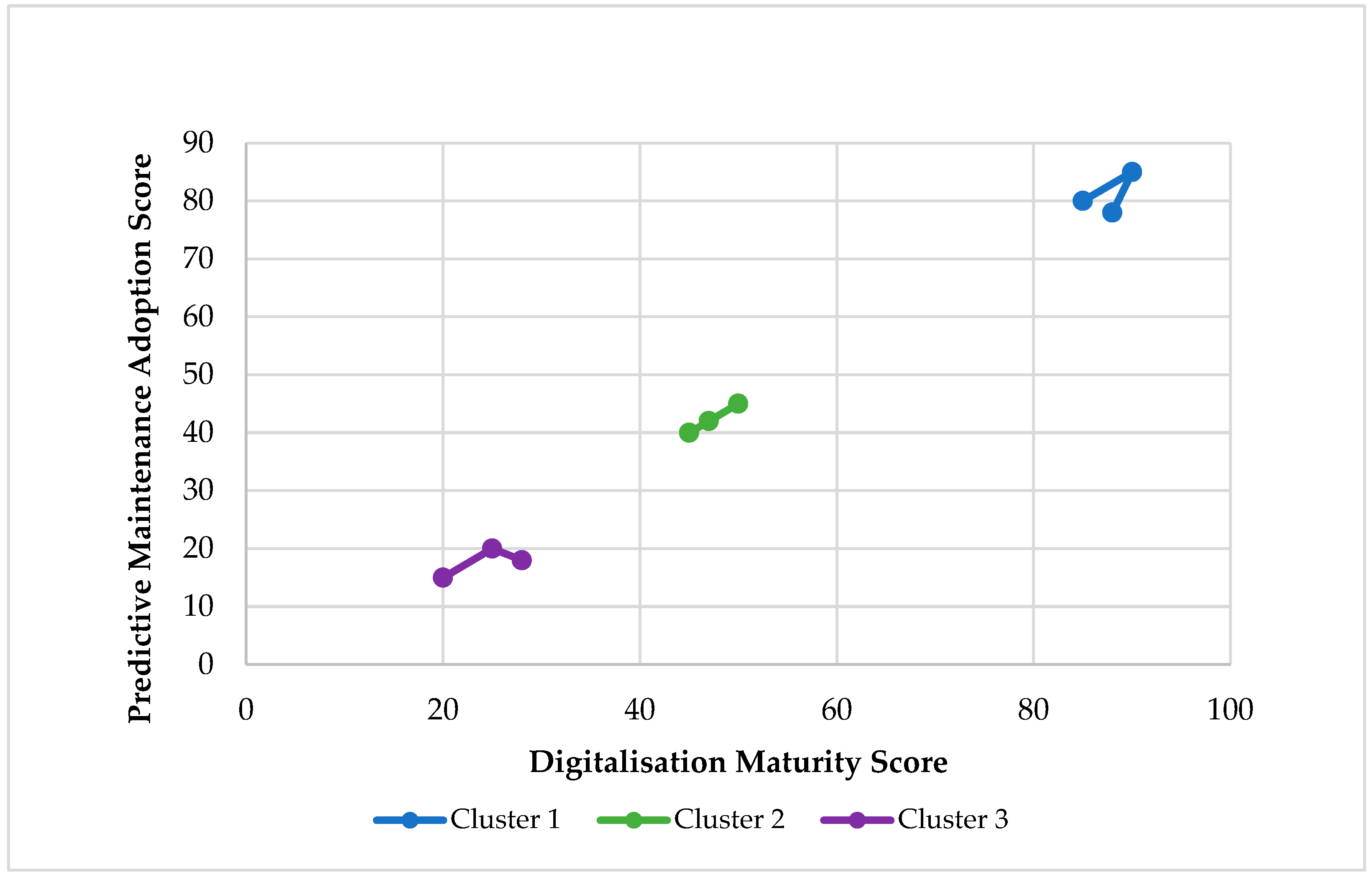
We now turn to the cluster analysis, which groups firms based on their digital maturity and predictive maintenance adoption, to further elucidate differences in adoption and performance among the sampled companies. The k-means clustering (with k = 3 clusters optimal in this case) yielded the following natural groupings:
Cluster 1—High Digital Maturity & High PdM Adoption: This cluster consists of firms with advanced digital practices (extensive IoT sensor networks, real-time monitoring, use of AI/ML in maintenance) and comprehensive implementation of predictive maintenance. These are typically the large multinational automakers or major Tier-1 suppliers in Slovakia. They have the resources and strategic imperative to adopt cutting-edge maintenance systems. On average, these firms have the highest scores for both digital maturity and PdM adoption (e.g., around 85/100 on maturity and 80/100 on adoption index). They also tend to have large scales of operation, many in this cluster being the large enterprises (and a few upper-medium) in our sample. Financially, they show high total assets and sales, and they invested heavily in PdM around 2020–2021. We can characterize this cluster as the “digital champions”, leading in Industry 4.0 integration.
Cluster 2—Moderate Digital Maturity & Partial PdM Adoption: This cluster includes firms with mid-level digital maturity, they have begun implementing digital tools and some predictive maintenance, but not to the extent of Cluster 1. Many medium-sized firms (and possibly a small number of large firms that were slower to digitalize) fall in this group. Their digital maturity and adoption scores center around the 45–50 range (out of 100). They might have, for example, implemented basic condition monitoring on critical machines and use data analytics on a smaller scale, but still rely on traditional maintenance for other equipment. These companies often cited budget constraints or legacy equipment as barriers to full PdM rollout. We label this cluster as “digital followers”—aware of and engaging in digitalization, but not at the frontier.
Cluster 3—Low Digital Maturity & Low PdM Adoption: This cluster comprises firms that are still in early stages of digital transformation. Predominantly, these are small and micro enterprises, along with some lower-end medium firms, which have minimal adoption of predictive maintenance (score perhaps 10–20 out of 100) and generally operate with conventional reactive or preventive maintenance strategies. Their digital maturity is also low; they may have only rudimentary automation and limited data usage. They often cite lack of capital, expertise, or the perceived suitability of advanced systems for their scale as reasons for low adoption. We refer to this cluster as the “digital laggards”, as they have yet to integrate Industry 4.0 maintenance practices meaningfully.
The clustering results are visualized in
Figure 1. The scatter plot maps each firm’s digitalization maturity score against its predictive maintenance adoption score, with points colored by cluster membership.
As shown in
Figure 1, the three clusters are well-separated along a diagonal from bottom-left (low/low) to top-right (high/high), indicating a strong correlation between general digital maturity and specific PdM adoption, which is intuitive. There are no firms with high overall digitalization but low PdM, nor vice versa, in our sample; implementing predictive maintenance is often part and parcel of a broader digital strategy. The plot also illustrates the density of each cluster (Cluster 1 and Cluster 3 are tighter groups, whereas Cluster 2 is a bit more spread in the middle range).
Examining Cluster Characteristics in More Detail:
Cluster 1 (High/High): Count = 20 firms (about one-third of sample). Predominantly large enterprises (including all four major car manufacturers in Slovakia and large suppliers) and a few upper-medium firms. On average, these firms had ~€50 million in assets and ~€40–50 million in sales in 2023, far above the sample median. Despite their scale, they achieved relatively high efficiency, e.g., their sales-to-assets ratio is healthy, reflecting benefits of advanced maintenance and optimization. Many in this cluster reported implementing predictive maintenance around 2019–2020 and scaling it up during 2021. They also tend to have international management practices and access to global expertise, aiding their digital adoption. Notably, these firms likely experienced fewer production losses during the pandemic relative to others, thanks in part to PdM enabling quick restarts and flexible maintenance with reduced staff.
Cluster 2 (Moderate/Moderate): Count = 22 firms. The cluster consists predominantly of medium-sized companies, together with a limited number of large firms showing lower digital adoption and several small firms demonstrating comparatively higher adoption levels. This group’s average assets (€15–20 million) and sales (€10–15 million) are midrange. They began adopting some digital tools, possibly with external help or limited pilots (like vibration sensors on key machines, basic predictive software). Their maintenance is a mix of preventive and some predictive elements. Performance-wise, some in this cluster struggled during 2020–2021 due to not having fully mature PdM, but they managed recovery by 2023 by accelerating digital projects. This cluster likely stands to gain the most from further digitalization, as they have reached a moderate plateau and could see big efficiency jumps if they emulate Cluster 1 practices.
Cluster 3 (Low/Low): Count = 20 firms. This consists of all 5 micro firms and most of the 15 small firms in our sample (plus possibly a few mediums with very traditional operations). Their average assets (€3 million) and sales (€4–5 million) are lowest. They use mostly reactive or schedule-based maintenance. Many do not collect detailed machine data, or if they do, they lack systems to analyze it in real time. During the pandemic, they likely were hit hardest, some probably had to halt maintenance entirely during lockdown and then reactivate aging equipment without advanced diagnostics, possibly leading to higher failure rates. These companies often have owners or managers skeptical of the ROI of digital investments, focusing on short-term survival. As a result, their efficiency is lower; for instance, the sales generated per asset unit may lag behind more advanced firms, partly due to more downtime and suboptimal maintenance.
From these clusters, a clear pattern emerges firm size and digital adoption go hand-in-hand in this industry. Large firms (which are often foreign-owned) are far ahead in predictive maintenance usage, while SMEs are lagging. This is a common finding in technology adoption literature [
39]: bigger firms have more capital and strategic impetus to adopt innovations, whereas smaller firms face resource constraints and higher perceived risk. The implication is that, without intervention, a digital divide could persist or even widen, with large automotive companies in Slovakia (often subsidiaries of multinationals) optimizing operations through AI and IoT, and the smaller local suppliers falling behind. This could affect the overall supply chain efficiency. It is also instructive to relate cluster membership to performance trends. Indeed, when we compare the financial trajectories of clusters over 2018–2023, we notice:
Cluster 1 firms had milder downturns in 2020–2021 and a quicker rebound by 2022, aligning with their agility and better maintenance.
Cluster 2 firms were intermediate in performance decline and recovery.
Cluster 3 firms saw deeper drops in 2020–2021 (some essentially paused operations longer) and only partial recovery by 2023. Some in this cluster might have even exited the market (though our sample is survivorship-based).
This suggests a resiliency benefit to digital adoption: advanced PdM is not only associated with steady-state efficiency but also helps firms absorb shocks better (which was verified by the calendar-year comparisons).
4.5. Benchmarking Slovak Automotive Digitalization Against Europe
To contextualize our findings, we compare the state of Slovak automotive sector with broader European trends, especially regarding digitalization and maintenance practices. Several key points emerge from external data. Slovakia has been the world’s largest car producer per capita for several years. By 2018, it produced around 1 million cars annually (about 184 cars per 1000 inhabitants), outpacing even much larger countries. The automotive sector accounts for an outsized portion of Slovakia’s exports (~27%) and industrial output (~14%). However, much of this is assembly work for foreign OEMs. The value added in Slovakia’s automotive production is relatively low (~5% of gross value added nationally in 2018) and has slightly declined despite increasing output. This indicates that while Slovak factories are very efficient at producing vehicles, the high-value activities (R&D, design, high-tech components) are often done abroad. In terms of maintenance and digitalization, this suggests Slovakia’s plants are very focused on operational efficiency (to churn out volume) but may rely on technologies and directives from their parent companies.
Studies comparing V4 countries (Czechia, Hungary, Poland, Slovakia) show that adoption of Industry 4.0 technologies, including predictive maintenance, is uneven [
40]. Czechia, with its strong industrial base, often leads in automation and digitization investments among the four. Slovakia is not far behind in automation levels at its major plants (the big OEM factories are state-of-the-art), but among SMEs the adoption lags. For example, a 2020 survey (in literature) might show that only ~10–15% of Slovak manufacturing SMEs had implemented any form of AI-based maintenance or digital twin, whereas that figure is higher in Western Europe. Our cluster analysis confirms a similar range within Slovakia.
In Western Europe (Germany, France, and UK), large automotive manufacturers have been implementing predictive maintenance pilots for over a decade [
41]. A 2025 ACEA [
42] report indicated that major EU auto companies invest heavily in R&D including smart factory tech. However, across Europe, the average manufacturing firm’s digital maturity is still moderate, many SMEs Europe-wide face similar issues as Slovak SMEs. The European Commission’s DESI index (Digital Economy and Society Index) and other metrics show Slovakia’s industry is catching up but still below EU15 averages in integration of digital tech. On a scale where EU average digital intensity is 100, Slovakia’s manufacturing might score around 70–80.
IMF research suggests Slovakia saw robust manufacturing productivity growth pre-2020, partly due to foreign investment and automation. However, compared to older EU members, productivity per worker is still lower, indicating room for improvement, potentially via further automation and digital maintenance reducing downtime [
43]. For instance, Germany’s automotive plants operate closer to full capacity with very high automation, whereas some Slovak plants had slightly more downtime (not necessarily unplanned, but schedule differences).
A qualitative difference noted in literature is that in some Western European plants, maintenance has already shifted to a high-tech, data-driven profession [
44], whereas in Slovakia (and similar economies) a cultural shift is ongoing, maintenance departments are adapting from being seen as repair crews to being high-tech monitoring teams. This cultural aspect can affect how quickly predictive maintenance is embraced. Education and training in maintenance 4.0 is less developed in CEE countries, though improving. At the EU policy level, there’s increasing talk of Industry 5.0, emphasizing human-centric and sustainable manufacturing. West European automakers are incorporating green maintenance practices (reducing energy usage, using predictive analytics to cut waste) more explicitly [
39,
45]. Slovakia’s automotive industry, heavily export-oriented, is influenced by these trends via supply chain pressure (e.g., BMW and VW requiring suppliers to meet certain digital and sustainability standards). However, local companies might lag in proactively adopting sustainability-focused maintenance beyond what is mandated.
Benchmarking suggests that Slovak automotive sector is world-class in production volume and efficiency for its scale, but it is largely following technology trends set by global industry leaders rather than pioneering them. The major plants in Slovakia are on par with global standards (since they are owned by global firms), using predictive maintenance similarly to plants in Germany or Japan [
46]. On the other hand, domestic suppliers and smaller manufacturers are behind the curve compared to the ideal and compared to many Western SMEs. From a maintenance perspective, the gap to close is primarily among the smaller players: encouraging and enabling them to adopt digital maintenance tools will be key for Slovakia to maintain its automotive competitiveness. Otherwise, as global automakers move towards more advanced Industry 4.0/5.0 practices, Slovak suppliers risk becoming bottlenecks if they cannot meet uptime and quality expectations. For context, Slovakia’s investment in R&D is lower than EU average, and that reflects in relatively fewer local innovations in maintenance technology [
47]. However, initiatives exist, e.g., the Slovak Automotive Industry Association and universities have pilot projects on smart factory and maintenance training. European funds have been directed toward digitizing SMEs (some companies from Cluster 2 likely benefited from such programs).
In terms of predictive maintenance specific stats, globally around 51% of large corporations had implemented some PdM by 2021, whereas SMEs the percentage is far lower [
48]. Slovakia’s penetration would mirror that pattern. Our survey indicated roughly one-third of the 62 firms had fully implemented PdM (which matches cluster 1 count), another third partially (cluster 2), and a third not at all (cluster 3). This roughly 33% full adoption rate among these firms is likely higher than the general population of all manufacturing firms in Slovakia (biased upward because automotive is a leading sector). According to McKinsey by Bradbury et al. [
32] and Deloitte by Coleman et al. [
33] studies, best-in-class predictive maintenance programs can reduce unplanned downtime by 50%, maintenance costs by 20%, and improve production availability by 5–15%. Our results in Slovakia, while not measured in exactly those terms, are consistent with significant downtime reduction and cost trade-offs. The firms in Cluster 1 likely approach those best-in-class figures (some reported major reductions in breakdowns), whereas cluster 3 firms obviously see none of those benefits yet.
4.6. Scenario and Sensitivity Analysis
To illustrate the potential value of greater digital adoption, we present a simple scenario analysis projecting how varying levels of predictive maintenance integration could affect operational performance across the sector (using extrapolation, sensitivity analysis and recent studies [
32,
33]). We define three scenarios. Considering the low adoption scenario, firms continue with minimal predictive maintenance (similar to Cluster 3 situation). Only basic reactive and preventive maintenance is in place. In this scenario, unplanned downtime remains high (baseline levels), and maintenance costs follow traditional patterns. We assume virtually no reduction in downtime or costs relative to 2018–2019 baseline. Within the medium adoption scenario, firms achieve a moderate level of PdM adoption (similar to Cluster 2). Key equipment has sensors and monitoring, and some analytics guide maintenance, but coverage is not full. In this scenario, we expect a notable reduction in downtime and some cost savings: based on industry studies, perhaps 15% reduction in unplanned downtime and 10% reduction in maintenance costs on average (as some failures are prevented and maintenance resources are better allocated). Productivity (output) might increase a few percent due to higher machine availability. Finally, in the high adoption scenario, firms reach near full digital integration of maintenance (akin to Cluster 1 and the Industry 4.0 ideal). All critical assets are monitored in real time with AI-driven PdM, maintenance is scheduled optimally, and there is integration with production planning (possibly with digital twin simulations and advanced forecasting). In this case, downtime could be cut dramatically, various sources suggest 35–50% less unplanned downtime is achievable. Maintenance costs could drop by 20–25% due to fewer emergency repairs and better inventory management of spare parts. Importantly, reliability would improve to the point that production output could increase (or be maintained with less disruption), asset availability rising by 5–15% equates directly to more production time and output. Energy consumption would also be optimized, contributing to sustainability.
Table 6 summarizes these scenarios in terms of anticipated improvements relative to the low-adoption baseline:
In the low adoption scenario, which reflects the status quo for many smaller firms, any breakdown leads to reactive repairs and lost production time, so downtime might be, say, 100 h per year for a typical machine. Maintenance costs are also relatively high and unpredictable (emergency fixes, etc.), and production output is constrained by those downtime events. Moving to the medium scenario, that downtime might drop to ~85 h/year for the same machine. Maintenance costs could drop to ~90% of baseline (through fewer major failures and more efficient scheduled maintenance). The increase in output might be modest, e.g., if a production line was down 100 h and now only 85, that’s roughly a 1.7% increase in available production time (85/8760 h in a year is 1% of total hours gained). However, across an entire factory, this gain could translate to producing hundreds or thousands more units annually, which is significant financially. In the high adoption scenario, downtime might drop to 50–65 h/year (half or less of baseline). Maintenance costs might be cut to ~75–80% of baseline, as predictive scheduling replaces many routine checks and prevents costly failures. The production availability gain of ~5–10% means the plant can produce that much more with the same equipment a huge competitive advantage. Additionally, other benefits (not listed in table) include extension of equipment life (by 20–40% according to some studies), improved safety (fewer catastrophic failures), and lower inventory needs for spare parts (because maintenance is planned, inventory can be optimized).
These scenarios assume certain levels of effectiveness. If, for instance, the predictive algorithms are less accurate or the organization does not act on the data, the benefits would be less. There is also initial cost, high adoption requiring significant upfront investment and training. We consider the net present value of PdM investments: Deloitte’s analysis shows PdM can pay for itself within ~1–2 years on average through cost savings and downtime reduction, but this varies by context. For a small firm, the payback might be longer if the scale is small. In Slovakia’s context, a sensitivity analysis could look at adoption rates: what if only the largest companies adopt it fully (covering, say, 50% of industry output) while others remain medium? The overall industry downtime could still reduce substantially since the highest volume producers are optimized, but the weaker links (smaller firms) could still suffer and affect the supply chain. Conversely, if SMEs get support (technical or financial) to adopt PdM, the whole network efficiency improves.
We also consider macro scenarios: the occurrence of a new disruption occurs (another pandemic or supply shock). Under a high adoption scenario, the industry is far more resilient, machines can be managed remotely, maintenance can be done with minimal staff, and unexpected breakdowns (which are harder to handle in crises) are minimized. Under low adoption, such a shock would again cause major production losses. This underscores that predictive maintenance is not just about steady-state efficiency, but also about resilience. To summarize the scenario outcomes: higher levels of predictive maintenance adoption are projected to yield substantial operational benefits, cutting downtime by up to half and maintenance costs by a fifth, and increasing productive output and equipment longevity. These improvements justify the investments in digitalization, especially in a high-wage, high-throughput industry like automotive where even a 1% efficiency gain can translate to millions of euros. The analysis makes a compelling case for firms (and by extension, policymakers facilitating them) to strive for the high adoption scenario. It also highlights that firms stuck in low adoption may be at a competitive disadvantage as industry standards move forward. A synthesis of key empirical findings are shown in
Table 7.
5. Discussion
The findings of this research underscore that predictive maintenance systems (PMSs), enabled by digitalization, are becoming indispensable for reliability and efficiency in modern industrial operations. In the context of Slovakia’s automotive industry, a cornerstone of the national economy, our analysis shows that integrating predictive maintenance leads to measurable performance benefits and greater resilience. We discuss these results in light of the existing literature, industry trends (including the emerging Industry 5.0 paradigm), and the broader implications for manufacturers. The findings are consistent with research conducted in other settings, which demonstrates that Industry 4.0 solutions, such as IoT, big data analytics, and machine learning, are fundamentally transforming maintenance practices across the automotive industry and beyond [
9,
49]. The shift from reactive and time-based preventive maintenance toward predictive models enables firms to manage maintenance expenditures more efficiently, prolong equipment service life, and limit production interruptions. Within the Slovak automotive sector, characterized by large-scale output and strict precision requirements, unexpected equipment failures may trigger operational delays, economic losses, and reputational risks [
50]. The implementation of predictive maintenance systems (PMSs) can substantially reduce these vulnerabilities. Automotive manufacturers can anticipate component failure and promptly address it by monitoring equipment performance and utilizing historical data. Slovakia’s automotive industry’s global competitiveness is enhanced by the optimization of resource allocation, the transition from reactive to condition-based maintenance, and the streamlining of production processes [
51].
Our study also shows that Slovak automotive firms using PMSs experienced fewer unplanned stoppages and improved output, enhancing their competitiveness in global supply chains. This finding is consistent with case studies of automakers. For instance, global manufacturers have reported significant reductions in line stoppages after deploying predictive analytics on critical equipment [
52,
53]. In automotive manufacturing, assembly systems are highly sophisticated and consist of tightly interlinked machines, meaning that a failure in one component can quickly propagate across the line and cause major production interruptions with significant operational consequences. [
54]. It causes delays in deliveries, reduces production, and disrupts the supply chain. Major car producers like Volkswagen, Kia, and PSA (Stellantis) in Slovakia operate complex assembly lines where a single machine failure can halt the entire line. For such enterprises, minimizing downtime is critical to meeting production targets and market demand. Slovak automotive producers can improve operational efficiency and lower costs by anticipating and managing equipment issues before they escalate. [
55]. Another benefit highlighted by both our analysis and literature is the extension of equipment lifespan.
Automotive production involves expensive machinery (robotic arms, conveyors, presses). Predictive maintenance detects issues like wear, misalignment, or lubrication degradation early [
56]. By proactively addressing these issues, companies prevent small problems from escalating into major damage that could necessitate replacing a machine or overhauling it. Actively managing these problems can prolong equipment life, minimizing the frequency of repairs and replacements. This not only lowers long-term expenses but also strengthens the global competitiveness of Slovak automakers, a sector that plays a vital role in the national economy [
57]. Findings from qualitative interviews suggest that managers regard predictive maintenance as an approach to maximizing asset utilization while delaying capital-intensive replacement decisions through enhanced maintenance practices. Over the long term, this reduces total cost of ownership and improves return on assets, a critical consideration for Slovak plants operating on thin margins in a competitive environment [
58]. Thus, PdM not only cuts short-term costs but also long-term capital costs. Despite these advantages, implementing predictive maintenance is not without challenges, especially for smaller players. Our discussion with firms and literature [
59], highlights barriers such as the substantial upfront investment in sensors, data infrastructure, and analytics platforms. Such challenges can disrupt the activities of smaller Slovak manufacturers or companies with constrained financial resources.
Moreover, successful PdM requires high-quality data and skilled analysis. Poor data quality or lack of appropriate analytical models can lead to false alarms or missed predictions, undermining trust in the system [
60]. Indeed, some Slovak firms observed that early-stage predictive maintenance deployments were associated with a high frequency of false alerts, undermining the effectiveness of alert-based decision support for engineering personnel. This points to the need for robust data handling and model training areas that require expertise and possibly external support. It also mirrors the observation by Fu et al. [
61] that data quality and effective modelling are vital; without them, the promise of PMSs may not be fully realized. Another challenge is cybersecurity and data privacy in an Industry 4.0 world. As Slovak firms adopt cloud platforms and IoT devices, they become part of a connected ecosystem. Our analysis did not directly measure this, but prior research warns that vulnerabilities in connected maintenance systems could pose risks [
62]. For instance, a cyberattack disabling sensor networks or corrupting maintenance logs could disrupt operations or lead to incorrect maintenance actions. Automotive companies deal with sensitive IP (designs, production processes); if PdM data is exfiltrated, it might reveal proprietary information.
The automotive industry in Slovakia is increasingly interconnected with global supply chains, necessitating that manufacturers prioritize cybersecurity to safeguard their systems. Encouragingly, the larger firms (Cluster 1) are likely to have corporate cybersecurity standards in place, but smaller firms will need guidance to shore up their defenses. Looking ahead, the future of predictive maintenance in Slovakia’s automotive sector will likely involve deeper integration with other Industry 4.0 and emerging Industry 5.0 technologies. Machine learning and artificial intelligence are anticipated to become increasingly pivotal in improving the accuracy and dependability of predictive maintenance models [
63]. Several advanced plants are already deploying digital twins, virtual representations of physical equipment or processes, to forecast and plan maintenance activities. By creating real-time virtual models of production systems, manufacturers can make more informed maintenance decisions and gain deeper insights into the condition of their assets [
64].
Integration of PdM with digital twins and augmented reality (for maintenance training and execution) can further improve decision-making and response times. For example, maintenance technicians might use AR glasses linked to the PdM system to get real-time guidance during repairs. Our results, while not directly covering AR, suggest companies are open to such innovations, as they see the positive ROI of initial digitalization steps. Industry 5.0, a concept gaining traction, takes Industry 4.0 further by emphasizing human-centric, sustainable, and resilient manufacturing. In the realm of maintenance, this means that technology should not replace humans but rather augment their capabilities and create a safer, more sustainable working environment [
65]. Many large manufacturers are already contemplating how maintenance 5.0 would look; perhaps as resilience-based maintenance, where systems are designed not just for efficiency but also for adaptability to disruptions (as suggested by emerging research). Predictive maintenance contributes to sustainability by reducing waste (fewer parts replaced unnecessarily), lowering energy consumption (well-maintained machines run more efficiently and avoid energy spikes from malfunctioning equipment), and preventing environmental incidents (like oil leaks or emissions from failing equipment) [
66]. Furthermore, by extending machinery life, PdM reduces the need for manufacturing new replacement machines (saving materials and energy) and decreases scrap rates. Indeed, one could view predictive maintenance as an enabler of sustainable operations. From a human-centric angle (Industry 5.0’s other pillar), predictive maintenance transforms the role of maintenance staff. Instead of performing routine inspections or reacting in crisis mode to breakdowns, they can focus on higher-level supervision, analysis, and improvement tasks [
67].
Our cluster of leading firms indicated that they invested in upskilling their maintenance workforce traditional mechanics are being trained in data interpretation and digital tool usage. As Industry 5.0 envisions, humans are at the center, using their creativity and problem-solving alongside intelligent machines. The concept of Operator 5.0 arises, where maintenance technicians work with collaborative robots (co-bots) and AI assistance, which can reduce physical strain and danger (for instance, letting a robot handle a hazardous inspection while the human oversees remotely). Finally, from a policy and industry collaboration perspective, the discussion should include how to bring lagging firms (Cluster 3) forward. Our findings highlight a risk: smaller suppliers may drag overall efficiency down or lose business if they can’t meet the evolving maintenance and reliability standards of big manufacturers. To address this, industry associations and government programs could provide support, e.g., subsidized training on PdM tools, shared access to expensive analytics platforms, or facilitation of expert consulting. The concept of Maintenance-as-a-Service could emerge, where third-party providers handle predictive maintenance for multiple small companies that cannot afford in-house full systems.
The results affirm that predictive maintenance, as part of the Industry 4.0 toolkit, has delivered concrete benefits in the Slovak automotive sector, and its importance will only grow in the Industry 5.0 era. The trends point towards increasingly smart, sustainable, and human-centric maintenance practices. Our research contributes empirical evidence to this trajectory, showing that digitalized maintenance is not just theory but a practical pathway to higher efficiency and resilience. Future work and practice should focus on scaling these benefits economy-wide, ensuring that even smaller manufacturers can partake in the digital maintenance revolution (see [
68,
69]), e.g., in terms of green innovation and environmental, social, and governance standards in high-end manufacturing sectors [
70] and of digital automation-related training motivation determinants [
71].
By doing so, Slovakia’s automotive industry can bolster its global position, not just as a high-output producer, but as a modern, innovative, and sustainable manufacturing hub. To position the empirical findings within the broader research context,
Table 8 compares the results of this study with prior evidence across countries, sectors, and firm sizes, highlighting both similarities and divergences in the observed relationships between digitalization, predictive maintenance adoption, and industrial performance.
6. Conclusions
6.1. Main Empirical Findings
This study provides an in-depth analysis of predictive maintenance integration in Slovakia’s automotive industry, offering both quantitative and qualitative evidence of its transformative potential. The results indicate that digitalization-driven predictive maintenance significantly enhances operational performance by reducing unplanned downtime, optimizing operating costs, and strengthening production resilience. Four financial indicators—total assets, current liabilities, operating expenses, and sales—emerged as key dimensions associated with predictive maintenance adoption and firm performance. Firms with larger asset bases and greater financial flexibility were identified as leading adopters, whereas resource-constrained enterprises faced notable implementation barriers. The findings further confirm, through statistical testing and regression modelling, a positive association between predictive maintenance adoption and improved performance outcomes considering the time differences across 2018–2023.
6.2. Theoretical Contributions
The study contributes to the Industry 4.0 and smart maintenance literature by providing firm-level empirical evidence from a Central and Eastern European automotive context, which remains comparatively underexplored. It reinforces the view that predictive maintenance represents a structural transition from preventive and reactive maintenance toward data-driven, reliability-oriented operational models. Moreover, the results highlight the role of predictive maintenance as a resilience-enhancing capability, particularly visible during the COVID-19 disruption, thereby extending existing theoretical discussions linking digitalization, operational continuity, and organizational adaptability. The research also connects predictive maintenance with emerging Industry 5.0 principles, emphasizing human-centricity, sustainability, and technologically augmented decision-making.
6.3. Managerial Implications
From a managerial perspective, the findings demonstrate that early investment in predictive maintenance infrastructure can provide measurable operational and competitive advantages, especially under conditions of external disruption. However, successful implementation requires substantial financial resources, high-quality data ecosystems, cybersecurity preparedness, and a skilled workforce capable of interpreting predictive analytics. These requirements are particularly challenging for SMEs, suggesting the importance of collaborative solutions such as shared analytics platforms, subsidized training, or maintenance-as-a-service models. Managers should therefore view predictive maintenance not only as a technical upgrade but as a strategic transformation toward proactive, data-driven operational governance aligned with long-term competitiveness and sustainability.
6.4. Limitations and Future Research
Several limitations of the present study should be acknowledged. Firstly, the analysis relied partly on financial proxies rather than detailed real-time maintenance data, reflecting the limited availability of granular operational datasets across firms. Future research should therefore prioritize closer industry collaboration to obtain sensor-level and event-based maintenance information, which would enable stronger causal inference and more precise operational modelling of predictive maintenance impacts. Secondly, the empirical scope was restricted to the Slovak automotive sector; extending the analysis across industries and regions would support broader comparative assessment of predictive maintenance maturity and its performance implications. Thirdly, additional investigations into service-oriented maintenance ecosystems and AI-driven digital twin technologies may clarify how resource-constrained small and medium-sized enterprises can overcome adoption barriers and participate in advanced predictive maintenance frameworks. Finally, given the cross-sectional and exploratory nature of the research design, the reported relationships should be interpreted as associational rather than causal. Future studies employing longitudinal data structures or quasi-experimental methodologies are therefore required to establish causal predictive maintenance effects with greater confidence.