Article

Multiobjective Distributionally Robust Dominating Set Design for Networked Systems Under Correlated Uncertainty


by
Pablo Adasme
1,*,
Ali Dehghan Firoozabadi
2,*,
Renata Lopes Rosa
3,
Matthew Okwudili Ugochukwu
3 and
Demóstenes Zegarra Rodríguez
3
1
Department of Electrical Engineering, Universidad de Santiago de Chile, Avenida Víctor Jara 3519, Santiago 9170124, Chile
2
Department of Electricity, Universidad Tecnológica Metropolitana, Avenida Jose Pedro Alessandri 1242, Santiago 7800002, Chile
3
Department of Computer Science, Federal University of Lavras, Lavras 37200-900, Brazil
*
Authors to whom correspondence should be addressed.
Systems 2026, 14(2), 174; https://doi.org/10.3390/systems14020174
Submission received: 9 January 2026 / Revised: 30 January 2026 / Accepted: 3 February 2026 / Published: 5 February 2026
(This article belongs to the Section Systems Engineering)

Abstract

Networked systems operating under uncertainty require decision making frameworks capable of balancing nominal efficiency and robustness against correlated risks. In this work, we study a distributionally robust weighted dominating set problem as a system-level model for robust network design, where node selection decisions are affected by uncertainty in costs and their correlation structure. We formulate the problem as a bi-objective optimization model that simultaneously minimizes the expected price and a risk measure derived from mean–covariance ambiguity. Rather than proposing new optimization algorithms, we conduct a systematic, methodological, and computational analysis of classical multiobjective solution approaches within this nonconvex and combinatorial setting. In particular, we compare weighted-sum, lexicographic, and ε -constraint methods, highlighting their ability to reveal different structural properties of the Pareto Frontier. Our numerical results demonstrate that the methods that use scalarization allow us to obtain only partial insights for networked systems where robustness is inherent. However, the ε -constraint method is highly efficient in recovering the full set of Pareto-optimal solutions. Once obtained, the Pareto Frontier exposes non-supported solutions and disruptive changes in its form. Notice that the latter is directly related to different configurations of dominating sets which are induced by the uncertainties. Consequently, these observations allow us to select from different subsets of relevant operating conditions for robust network designs that are significantly different for a decision maker.

1. Introduction

Modern interconnected systems increasingly rely on decision making frameworks that must balance efficiency and robustness under uncertainty. In many networked system design problems—such as monitoring, control, and resource localization—the selection of a subset of nodes plays a fundamental role in determining the global system configuration. In this context, the combinatorial optimization problem known as the weighted dominating set (WDS) has proven to be a powerful modeling tool for large-scale wireless network design. By representing a wireless network as a connected graph, a dominating set corresponds to a subset of nodes such that every node is either selected or covered by a neighboring selected node. When node-specific attributes such as deployment cost, energy consumption, or operational priority are considered, the WDS formulation naturally captures essential system-level design decisions.
From a systems point of view, dominating-set-based models allow the design of network infrastructures that ensure coverage and coordination while considering global properties such as controllability, resilience, and operational efficiency. As such, WDS formulations have been frequently utilized for backbone construction, base station placement, cluster head selection, and control-node deployment in wireless networks. Their importance is highly relevant for emerging 5G and 6G network systems, where ultra-dense deployments of heterogeneous infrastructures include cost and energy constraints that require coordinated operation over a limited subset of nodes. In such scenarios, minimizing the size or total weight of dominating sets remains a central objective for next-generation wireless network design.
However, notice that real wireless scenarios commonly have inherent uncertainty. Different phenomena including interference, shadowing, fading, and transmission quality are affected by significant spatial correlation, particularly between neighboring nodes. Consequently, deterministic formulations can lead to network configurations that perform poorly under uncertain conditions. Thus, ignoring correlated uncertainty can therefore lead to suboptimal or erroneous system designs. The latter motivates the use of robust optimization techniques, and in particular distributionally robust optimization (DRO). This approach provides a principled framework for decision making under partial or imperfect information. Instead of assuming a known probability distribution, DRO constructs sets of ambiguities based on empirical moment information, particularly mean vectors and covariance matrices [1]. As such, it allows to optimize and take decisions against the worst-case distribution within these sets. This approach yields solutions that are more stable with respect to correlated uncertainty.
From a management and planning point of view, network operators often must select a small number of nodes to act as coordinators, relays, or control-plane components taking into account budget, regulatory, and reliability constraints. Under these situations, the goal is not only to identify a single optimal network configuration but also to understand how robustness trade-offs against deployment cost behave. The latter naturally leads to a multiobjective optimization approach where efficiency and robustness are treated as conflicting system-level criteria. Characterizing these trade-offs in an explicit manner allows decision makers to explore alternative network designs corresponding to different operational priorities and levels of risk tolerance. For this purpose, the analysis of the Pareto Frontier provides an important decision-support tool to assess the additional infrastructure required and to achieve higher levels of robustness in evolving wireless systems.
Several studies have investigated formulations based on dominating sets for connected graphs under deterministic assumptions [2,3], as well as extensions that incorporate limited forms of uncertainty or stochasticity [4]. Robust optimization techniques have also been applied to improve network resilience under uncertainty [5,6], while multiobjective approaches have been used to analyze trade-offs between cost, latency, and energy consumption in wireless networks [7,8]. However, these research directions have evolved largely independently. Existing work typically considers either deterministic or scenario-based uncertainty, focuses on single-objective robust formulations, or analyzes multiobjective trade-offs without explicitly accounting for correlated distributional ambiguity.
To the best of our knowledge, no prior work jointly investigates weighted dominating set problems within a distributionally robust optimization framework while explicitly characterizing the resulting Pareto Frontier. In particular, the combined impact of correlated uncertainty, combinatorial domination constraints, and non-convex multiobjective trade-offs has not yet been systematically examined. This paper addresses this gap by providing a comprehensive Pareto-front analysis of the distributionally robust weighted dominating set problem (DRO–WDS).
The main contributions of this paper are summarized as follows:
  • We introduce a distributionally robust formulation of the weighted dominating set problem that explicitly accounts for correlated uncertainty through mean–covariance ambiguity sets.
  • We model the resulting DRO–WDS problem as a bi-objective approach that allows us to simultaneously capture the deployment cost and risk. This, in turn, enables a systematic exploration of efficiency–robustness trade-offs.
  • A detailed computational is conducted and a geometric analysis of the Pareto Frontier is studied, revealing non-supported solutions, structural discontinuities, and regions where small robustness gains require significant cost increases. These features cannot be captured by standard scalarization methods.
The remainder of this paper is organized as follows. Section 2 reviews related work on dominating set formulations, robust and distributionally robust optimization, and Pareto-based multiobjective analysis. Section 3 introduces the weighted dominating set problem under correlated uncertainty and presents the proposed distributionally robust formulations. Section 4 discusses the multiobjective solution approaches considered in this work, including scalarization techniques and an adaptive ε -constraint method. Section 5 reports and analyzes numerical experiments highlighting the geometry of the Pareto Frontier and its implications for network design. Finally, Section 6 concludes the article and outlines future research directions.

2. Related Work

The dominating set problems and their variants have received considerable attention because of their relevance in network design in wireless communication systems. Generally, it is assumed that networks operate in a deterministic setting where node costs are assumed to be known and fixed. More recently, uncertainty-aware models have emerged, dealing with stochastic, robust, and distributionally robust formulations, aiming to capture the variability and correlation in node weights or network conditions. Similarly, multiobjective optimization methods have also been employed to analyze trade-offs between conflicting criteria such as cost, robustness, coverage, and risk, among many others. However, these studies have evolved particularly and largely independently. This section reviews the most relevant contributions in the areas of dominating set optimization, uncertainty modeling, and multiobjective solution methods, and positions our work within this landscape. Rather than providing an exhaustive survey, we emphasize conceptual gaps that motivate the proposed distributionally robust multiobjective framework.
The dominating set problem and its weighted variants have been widely considered in wireless networks due to their relevance to dealing with virtual backbone construction and graph-based optimization. Often, research focuses on deterministic formulations in which node costs and network conditions are assumed to be fixed and fully known. Notice that these models are based on dominating sets, which are hard NP-Hard combinatorial optimization problems. However, they neither address uncertainty nor design conflicting objectives. For example, in [2], the authors study an optimization network problem related to dominating sets and propose algorithmic strategies to reduce the cost of deployment and communication. Their model assumes deterministic parameters and considers a unique objective limiting the applicability in scenarios where uncertainty and risk-aware facts are highly relevant. In [3], an optimization weighted graph problem motivated by wireless networks communications is considered. Their approach reflects the importance of efficient utilization of resources and connectivity. For this purpose, the authors have proposed classic optimization techniques and heuristic methods. However, the authors do not consider the uncertainty of the weights of the nodes and their analysis is restricted to a single objective framework. The authors in [4] extend dominating set-based models while incorporating additional structural constraints including connectivity and coverage. Although the proposed approach improves the quality of solutions under deterministic assumptions, they do not consider either the stochastic effects or the ambiguity sets of distributional input data.
Reference [5] explores algorithmic approaches for solving large-scale graph optimization problems that are useful in network design. However, the authors focus on computational efficiency and approximation quality, but the objective function remains deterministic and scalar. The latter does not allow an explicit analysis of trade-offs between competing metrics. Reference [6] addresses a robust or uncertainty-aware model for a network optimization problem related to domination or coverage. However, uncertainty is handled through worst-case or scenario-based assumptions, leading to more conservative solutions. Nevertheless, the approach does not investigate Pareto-efficient trade-offs, nor does it employ a distributionally robust framework based on moment information. The authors of [7] propose heuristic or metaheuristic solution methods for a weighted domination or coverage problem in graphs. Although these methods are effective in practice, they neither provide scarce practical insights into the structure of optimal solutions nor analyze the impact of uncertainty on the solution space. Reference [8] considers adaptive or dynamic aspects of network optimization, where decisions can be taken sequentially while the information is revealed. Although this approach is relevant for uncertain environments, the optimization criteria are typically based on expected cost, and multiobjective considerations are not explicitly considered. The authors in [9] study multiobjective optimization methods that are used to analyze trade-offs between competing network performance metrics. Scalarization methods, such as weighted sums, are used to approximate the Pareto Frontier. However, these methods are known to recover only supported Pareto solutions and may fail to capture the full structure of the efficient frontier in combinatorial problems. Reference [10] introduces an adaptive optimization framework for connected dominating sets in uncertain graphs, modeling node availability through random states and providing approximation guaranties in expectation. Despite its robustness-oriented motivation, the problem is treated as a single-objective problem, and the Pareto structure induced by conflicting objectives is not examined. Reference [11] addresses a related graph optimization problem under uncertainty and proposes an algorithmic or analytical tool to improve the reliability or guarantee the performance. Although the study highlights the importance of uncertainty modeling, it does not combine distributionally robust optimization with an explicit multiobjective analysis of domination-based structures.
Reference [12] deals with the computation of minimum connected dominating sets in ad hoc networks using integer linear programming. The authors propose a centralized optimization method that consists of decomposing the problem into a dominating set phase and a connectivity enforcement phase. Although the model provides exact solutions for small and medium-sized instances, it optimizes a single scalar objective and does not consider uncertainty or multiobjective trade-offs. Reference [13] studies contention-aware connected dominating sets (CACDS) for wireless multi-hop networks. The authors explicitly model transmission contention and extend classical MCDS formulations by applying integer programming models, which they solve via Benders decomposition. Although the approach accounts for interference, optimization remains a single objective and does not analyze Pareto-efficient solutions under conflicting criteria. Reference [14] investigates aggregation scheduling in wireless sensor networks and demonstrates that neither shortest-path- nor dominating-set-based structures are sufficient to guarantee minimum latency. The authors propose a greedy growing tree algorithm guided by scheduling decisions. Despite its strong algorithmic contribution, the work does not address domination problems under uncertainty or provide a multiobjective optimization framework. In [15], channel-based connected dominating sets are introduced for multi-channel wireless mesh networks. The proposed model selects in a joint manner the resending nodes and transmission channels to reduce overload. Although this procedure improves performance and efficiency, it utilizes heuristic selection rules and does not provide an exact optimization model nor a risk-aware formulation. Reference [16] presents distributed heuristic algorithms to construct CDS in multi-channel environments, highliting scalability and local decision making. The methods are efficient in reducing redundant transmissions. However, they do not offer optimality certification nor allow an explicit analysis between compromises such as cost, robustness, and performance. The authors in reference [17] formulate related CDS problems. More precisely, they propose mathematical programming approaches to explore decomposition-based solution methods. Although exact formulations are derived, the objective functions are purely deterministic and focus on minimizing cardinality or transmission cost, without considering stochastic variability or risk measures. Similarly, reference [18] considers wireless network planning problems using multiobjective optimization techniques combining cost, coverage, and throughput criteria. Pareto Frontiers are approximated using heuristic or evolutionary methods. However, the resulting solutions are limited to supported Pareto points, and the uncertainty in the node or link parameters is not explicitly modeled. In reference [19], the authors propose a multiobjective formulation for network deployment and design to balance installation cost and quality-of-service metrics. Nevertheless, they recognize the importance of scalarization methods to be employed for the exploration of non-convex or disconnected Pareto Frontiers in combinatorial settings. Reference [20] addresses stochastic aspects of wireless network optimization while incorporating uncertainty through probabilistic models. These approaches neither improve reliability nor adopt a distributionally robust framework based on moment information. In addition, they do not investigate the structure of Pareto-efficient solutions. Similarly, reference [21] addresses optimization based on the dominating set in wireless networks. The study also emphasizes the relevance of robustness and scalability but is still focused on single-objective formulations.
The work in [22] proposes a robust optimization framework consisting of a two-stage distribution approach that allows energy management in cellular networks with energy harvesting. The authors construct ambiguity sets using first- and second-order moments and reformulate their original stochastic program into a tractable second-order cone program. Their work demonstrates the effectiveness of DRO in large-scale wireless systems. However, the work only focuses on continuous decision variables, and it considers neither graph-based domination constraints nor multiobjective Pareto analysis. In reference [23], a robust distributional optimization model is investigated for wireless or communication systems under uncertain traffic or channel conditions. The uncertainty is captured through moment-based ambiguity sets, leading to convex reformulations with strong theoretical guarantees. However, the proposed framework optimizes a single expected performance metric and does not address discrete network design decisions, such as selecting the dominating set. Reference [24] explores robust or distributionally robust learning-based approaches for network control. For this purpose, the authors combine optimization with data-driven or reinforcement learning techniques. Although the integration of learning and robustness is promising for dynamic environments, the underlying optimization problems are typically continuous and do not capture the combinatorial complexity of domination problems in graphs. In [25], a distributionally robust deep reinforcement learning framework is proposed for wireless communication systems under ambiguous environmental uncertainties. The authors define uncertainty sets over policies or system states and provide worst-case performance guarantees. Despite its methodological relevance, the work does not consider explicit multiobjective optimization nor exact Pareto-front construction, and it is not applied to graph-based network backbone design. Finally, ref. [26] studies advanced robust or learning-assisted optimization methods for next-generation wireless networks, highlighting the role of partial statistical information and robust decision making. However, the proposed formulations improve reliability and adaptability; they deal with scalar objectives and continuous control variables, without addressing distributionally robust multiobjective topics for combinatorial structures.
Collectively, the existing literature demonstrates substantial progress in dominating set optimization, connected backbone construction, robust network design, and multiobjective methodologies, as well as a growing interest in robust and distributionally robust optimization under uncertainty in wireless and networked systems. However, these research directions have evolved largely in isolation. In particular, current studies do not jointly address the challenges posed by discrete domination constraints, covariance-driven distributional ambiguity, and the explicit characterization of the Pareto-efficient solution set. Although robustness, connectivity, and performance objectives are often considered individually, none of the existing approaches combine distributionally robust risk modeling with covariance information and a systematic exploration of Pareto trade-offs in weighted dominating set structures. These gaps motivate the robust distributional multiobjective dominating set framework proposed in this work.
Lastly, and in contrast to the above work, our study provides an integrated analysis of a distributionally robust weighted dominating set model under a multiobjective framework. By explicitly considering both expected cost and risk through a covariance-based DRO formulation, we characterize the Pareto Frontier of the problem and analyze how different scalarization methods (lexicographic, weighted-sum and ε -constraint) behave in this setting. Our results demonstrate highly non-convex and irregular Pareto structures as a consequence of the combinatorial effects and matrix covariances inducing interactions, which cannot be captured by classical scalarization techniques alone. This positions our work at the intersection of dominating set optimization, distributional robustness, and multiobjective analysis.
Notice that evolutionary multiobjective algorithms, such as NSGA-II, have been successfully applied to approximate sets of non-dominated solutions in large-scale network optimization problems. These methods are particularly effective when the goal is to obtain a diverse approximation of the Pareto Frontier in complex or high-dimensional settings. However, they do not guarantee that the returned solutions are truly Pareto-efficient nor can they certify the absence of dominated solutions within the approximation set. As a result, evolutionary approaches are inherently limited in their ability to provide a guarantee of dominance and optimality. Since the objective of this work is not to approximate the Pareto Frontier but to rigorously characterize its exact geometry and structural properties under correlated uncertainty, we focus exclusively on exact or gap-controlled optimization methods. These approaches enable a precise identification of Pareto-efficient and dominated regions of the solution space, which is essential for a faithful analysis of the Pareto Frontier in distributionally robust dominating set models.
To clearly position the contribution of this paper within the existing literature, Table 1 summarizes the main modeling and methodological features of representative related works. The comparison highlights that while prior studies address dominating set structures, uncertainty modeling, or multiobjective optimization in isolation, none jointly combine distributionally robust optimization with covariance-aware uncertainty and exact Pareto-front analysis for dominating set problems.
As summarized in Table 1, the distinguishing feature of this work lies in the exact recovery and geometric analysis of the Pareto Frontier for a distributionally robust weighted dominating set problem under correlated uncertainty.

3. Problem Formulation and Mathematical Models

This section introduces the optimization problem addressed in this study and presents its corresponding mathematical formulations. We first describe the classical weighted dominating set problem defined on undirected graphs, which serves as a deterministic reference (baseline) model. Subsequently, we extended this formulation to a distributionally robust setting to explicitly account for uncertainty in node weights. In the proposed framework, the weights are treated as random variables whose probability distributions are not known exactly but are characterized by partial moment information, such as mean values and covariance matrices. This leads to distributionally robust optimization models that balance expected performance and risk, resulting in mixed-integer nonconvex formulations that can be solved using state-of-the-art optimization solvers.

3.1. Notation and Problem Definition

Let us denote by G = ( V , E ) a connected undirected graph, where V = { 1 , 2 , , n } represents the set of nodes and E V × V the set of edges. Each node i V has a set of neighboring nodes denoted by N ( i ) = { j V : ( i , j ) E } and a dominating set is a subset of nodes D V such that every node i V belongs to D or has at least one neighbor in D. The decision variable associated with each node is defined as
x i = 1 , if node i is selected in the dominating set , 0 , otherwise .
In the deterministic model, each node i V has a nonnegative weight w i associated with it and represents the cost of selecting that node. The objective consists in finding a dominating set with a minimum total weight. Consequently, the deterministic version of the problem can be formulated as the following mixed-integer linear program:
min i V w i x i
s . t . x i + j N ( i ) x j 1 , i V
x i { 0 , 1 } , i V
where the objective function (1) minimizes the total weight of the network. Notice that in the case of future wireless network communications, these values can represent waste energy per node, for example. Then, the first set of constraints (2) ensures that every node is dominated by itself or by at least one neighboring node, while the binary domain constraints (3) define the selection decision.

3.2. Distributionally Robust Weighted Dominating Set

We now consider the case where the weights of the nodes are uncertain. Let w ˜ = ( w ˜ 1 , , w ˜ n ) denote a random vector of node weights. The exact probability distribution of w ˜ is assumed to be unknown, but partial moment information is available. Specifically, we define an ambiguity set of probability distributions as
P = P : E P [ w ˜ ] = μ , E P [ ( w ˜ μ ) ( w ˜ μ ) ] ,
where μ R n is the mean vector and R n × n is a positive semidefinite covariance matrix. The distributionally robust weighted dominating set problem seeks a dominating set that minimizes the expected worst-case total weight over all distributions in P , that is,
min x { 0 , 1 } n sup P P E P i V w ˜ i x i .
Using standard results from distributionally robust optimization, the expected worst-case value admits the closed-form representation [1]
sup P P E P [ w ˜ x ] = i V μ i x i + i V j V x i i j x j .
Thus, the DRO-WDS problem can be written as the following mixed-integer nonconvex program:
min i V μ i x i + t
    s . t .     t 2 i V j V x i i j x j ,
x i + j N ( i ) x j 1 , i V ,
x i { 0 , 1 } , i V ,
t 0 .
where the auxiliary variable t captures the risk associated with the weight uncertainty, resulting in a mixed-integer second-order conic (MISOC) optimization problem.

3.3. A Feasible Solution to (Distributionally Robust) Weighted Dominating Set

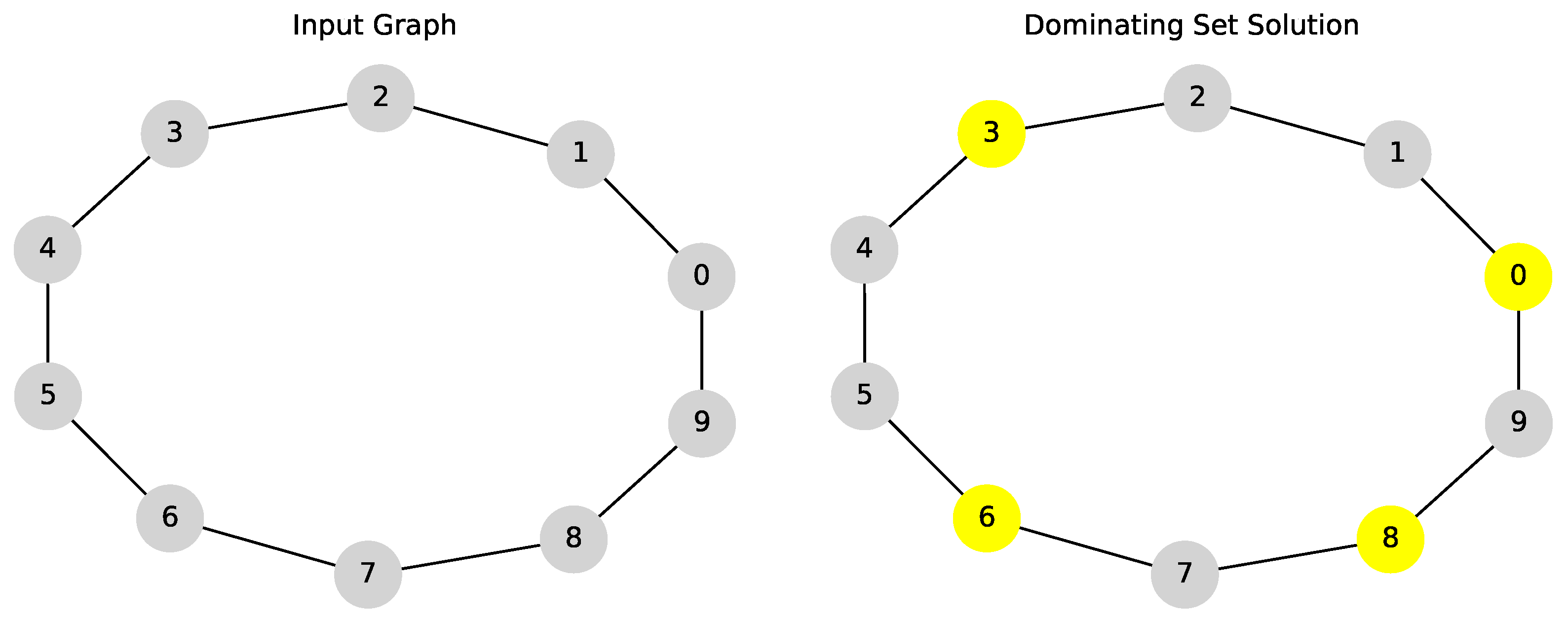
In Figure 1, the left subplot shows an input graph network where, in the deterministic case, the selection of nodes is based solely on the nominal weights, resulting in a configuration that minimizes the expected cost. In contrast, the right subplot presents the solution obtained under uncertainty, in which the weights of the nodes are modeled as random variables characterized by a mean vector μ and a covariance matrix . In this setting, the optimal dominating set accounts not only for expected values but also for variability and correlation effects among node weights. Consequently, the selected nodes may differ between the deterministic and uncertain formulations, since variations in μ and in the correlation structure of can substantially influence the optimal solution.
In this figure, in the left subplot, it is observed that the input graph is a ring-type network. In the right subplot, the dominating yellow nodes conform to the minimum weighted dominating set since these nodes reach any of the remaining gray nodes.

3.4. The Distributionally Robust Weighted Dominating Set Multiobjective Formulation

Before introducing the bi-objective formulation, it is important to clarify the rationale behind the separation of the risk-related term. In the single-objective DRO model, the objective combines deployment cost and a distributionally robust risk measure into a single scalar function which is valid. However, this approach fixes the trade-off between efficiency and robustness. Notice that risk captures the worst-case impact of correlated uncertainty and it is also independent of the cost of deployment. Consequently, the risk term can be explicitly separated and defined as a second objective f 2 . The latter allows for a trade-off between cost and robustness to be explored explicitly through Pareto-front analysis. This leads us to propose a multiobjective model concerning the distributionally robust weighted dominating set problem including risk awarenessand deployment costs. Notice that by doing so, we can simultaneously minimize both the expected cost of the dominating set and the risk measure that captures the impact of uncertainty and correlation on the node weights. This approach allows for a systematic exploration of trade-offs between nominal efficiency and robustness. This cannot be performed through single-objective approaches. Consequently, the multiobjective DRO–WDS problem can be formulated as follows:
min f 1 = i V μ i x i
min f 2 = i V j V x i i j x j
s . t . x i + j N ( i ) x j 1 , i V ,
x i { 0 , 1 } , i V .
where the objective f 1 minimizes the expected cost of the dominating set and f 2 minimizes the associated risk, taking into account the variability and correlation effects between the weights of the nodes under distributional ambiguity.
This bi-objective model constitutes the foundation for the multiobjective solution approaches discussed in the following sections. It allows for a systematic comparison of scalarization-based and Pareto-exploration methods. It also allows for highlighting how uncertainty and correlation structures influence the trade-offs between expected cost and robustness in network design.

4. Multiobjective Solution Approaches

The distributionally robust weighted dominating set (DRO–WDS) problem naturally gives rise to a bi-objective formulation, where the minimization of the expected cost and the control of uncertainty-induced risk are conflicting objectives. As a consequence, the analysis of the Pareto Frontier becomes essential to understand the trade-offs induced by robustness and correlation effects. In this section, we discuss and compare different multiobjective solution strategies applied to the DRO–WDS framework.

4.1. Scalarization-Based Methods

A common approach to handling multiobjective optimization problems consists in transforming them into single-objective formulations through scalarization techniques. In this work, we consider two classical scalarization strategies: the weighted-sum method and lexicographic optimization. The weighted-sum method combines the objectives into a single scalar objective by assigning relative importance through a convex combination parameter. Although this approach is straightforward to implement and computationally efficient, it is well known that it can only recover supported Pareto-optimal solutions [27,28,29]. Regarding the DRO–WDS problem involving binary decision variables and second-order cone constraints, the resulting Pareto Frontier is typically non-convex and disconnected. Consequently, several Pareto-optimal solutions cannot be obtained through weighted-sum scalarization, regardless of the choice of weights. The Lexicographic optimization approach deals with this limitation by imposing a strict priority order among the objectives. Although this approach guarantees optimality concerning the primary objective, it leads to obtaining only a single Pareto-optimal solution corresponding to an extreme point of the frontier. However, changing the priority order generally leads to different solutions. The latter highlights the sensitivity of lexicographic solutions to modeling choices. In general, scalarization-based methods provide limited insight into the global structure of the Pareto Frontier in the DRO–WDS problem, and particularly in the presence of combinatorial effects and uncertainty correlations [27,29].

4.2. ε -Constraint Method

To overcome the structural limitations of the approaches based on scalarization, we adopt the ε -constraint method. This classical technique optimizes one objective while bounding the other through an explicit constraint.
By systematically varying the bound parameter, the method can recover supported and non-supported Pareto-optimal solutions [27,28,29]. In the DRO–WDS setting, the  ε -constraint method is particularly well suited, as it allows the explicit exploration of trade-offs between expected cost and risk under uncertainty. Notice that the discrete nature of the problem for a fixed uniform grid on the constraint bound can lead to redundant or infeasible subproblems. Because of this, we propose using an adaptive strategy that dynamically adjusts the constraint values based on previously identified Pareto points. This ensures efficient and complete exploration of the frontier. It also enables the recovery of the full Pareto Frontier, revealing geometric features that remain hidden under scalar formulations. The pseudocode of this variant can be depicted as in Algorithm 1 to describe the adaptive ε -constraint method to explore the Pareto Frontier of the DRO–WDS problem. Observe that the method begins by computing the extreme Pareto-optimal solutions corresponding to the individual minimization of each objective. The extreme solutions define an initial interval in the objective which is then refined iteratively. Within each iteration, the algorithm selects an interval between two previously identified Pareto points and solves a constrained optimization problem that limits the risk objective with an adaptively chosen value of ε . If a new Pareto-optimal solution is obtained, the interval is split and further refined. Otherwise, the interval is discarded. This process continues until no additional Pareto points can be identified. Unlike fixed-grid implementations of the ε -constraint method, the proposed strategy dynamically generates constraint bounds based on the structure of the solution set itself. This allows the method to efficiently recover both supported and non-supported Pareto-optimal solutions, avoid redundant subproblems, and provide an exact characterization of the Pareto Frontier in discrete and non-convex settings such as the DRO–WDS problem.
Algorithm 1 Adaptive ε -Constraint Method for DRO–WDS
Require: 
Bi-objective problem with objectives ( f 1 , f 2 )
Ensure: 
Complete set of Pareto-optimal solutions P
  1:
Initialize empty set P
  2:
Solve min f 1 ( x ) subject to feasibility constraints
  3:
Let x ( 1 ) be the optimal solution
  4:
Add ( f 1 ( x ( 1 ) ) , f 2 ( x ( 1 ) ) ) to P
  5:
Solve min f 2 ( x ) subject to feasibility constraints
  6:
Let x ( 2 ) be the optimal solution
  7:
Add ( f 1 ( x ( 2 ) ) , f 2 ( x ( 2 ) ) ) to P
  8:
Initialize list of intervals I { ( x ( 1 ) , x ( 2 ) ) }
  9:
while  I is not empty do
10:
      Select and remove an interval ( x ( a ) , x ( b ) ) from I
11:
      Set ε f 2 ( x ( a ) ) + f 2 ( x ( b ) ) 2
12:
      Solve min f 1 ( x ) subject to f 2 ( x ) ε and feasibility constraints
13:
      if a new Pareto-optimal solution x ( c ) is found then
14:
            Add ( f 1 ( x ( c ) ) , f 2 ( x ( c ) ) ) to P
15:
            Add intervals ( x ( a ) , x ( c ) ) and ( x ( c ) , x ( b ) ) to I
16:
      end if
17:
end while
18:
return  P
In general, a comparison of multiobjective solution methods shows that the choice of the method has a direct impact on the information extracted from the DRO–WDS model. However, scalarization techniques provide limited insight and may conceal relevant trade-offs, particularly in the presence of integrality and correlated uncertainty. In contrast, the adaptive ε -constraint approach allows a complete and structured exploration of the Pareto Frontier. Hence, it is revealed that geometric features and decision-relevant trade-offs that are not accessible through single-objective or scalarized formulations can be obtained. In the next section, we take advantage of this methodology to analyze the geometry of the Pareto-front and its implications for robust network design.

4.3. Methodological Comparison

Notice that each multiobjective method in our paper is utilized for a distinct purpose. For example, scalarization-based approaches are useful for quickly obtaining representative solutions or extreme trade-offs, obtaining only partial information about the Pareto Frontier. In contrast, with the ε -constraint algorithm, we can present a comprehensive view of the solution space while capturing unsupported solutions, highlighting the impact of uncertainty and correlation structures. Consequently, the choice of the solution approach influences the interpretation of robustness and risk in the DRO–WDS problem. Also, notice that the analysis of the Pareto Frontier and the conclusions drawn from it are inherently method-dependent. This observation motivates the comparative analysis presented in the numerical experiments.
Notice that the number of dominating nodes is not an additional optimization objective but a structural attribute of Pareto-optimal solutions that enhances interpretability and explains discrete transitions observed along the Frontier. It is also worth noting that the Pareto Frontier is invariant to the order in which the objectives are considered. However, different approaches to multiobjective solutions, such as using different primary and secondary objectives, lead to distinct extreme solutions and exploration paths along the Frontier. The latter highlights the importance of method selection rather than objective ordering. The next Proposition formalizes these observations by clarifying the structural properties of the Pareto Frontier and the implications of different multiobjective solution approaches in the DRO–WDS problem.
Proposition 1. 
In the bi-objective DRO–WDS problem, the Pareto-optimal solutions obtained with the weighted-sum scalarization approach correspond exclusively to supported Pareto points. Due to the presence of binary decision variables and second-order conic constraints, the Pareto Frontier is generally non-convex. The latter implies that the existence of non-supported Pareto-optimal solutions cannot be recovered straightforwardly by a convex combination of objectives.
Proof. 
Proof sketch: See that the weighted-sum scalarization can only generate Pareto-optimal solutions that minimize a supporting hyperplane of the feasible objective set. Since the DRO–WDS problem includes binary variables and second-order conic constraints, the resulting Pareto Frontier is generally non-convex, and this implies the existence of Pareto-optimal points that do not admit supporting hyperplanes and therefore cannot be recovered by scalarization. □
Consequently, the impact of the chosen multiobjective solution strategy is crucial. We illustrate these observations in the numerical results in Section 5. The corresponding computational results reported also highlight how different solution methods lead to distinct trade-offs between expected cost and risk, reinforcing the method-dependent nature of Pareto-front analysis in the DRO–WDS problem. We mention that this paper does not claim novelty in the multiobjective methods themselves; our main contribution lies in their systematic application and comparative analysis within a distributionally robust weighted dominating set framework, revealing geometric and decision-relevant properties that cannot be observed through a single-objective formulation.
Remark 1. 
The implications of Proposition 1 are visually confirmed in the Pareto Frontiers and in the dominating sets ( D S ), where several Pareto-optimal solutions identified by the ε-constraint method lie outside the set of solutions obtained by weighted-sum scalarization. See that these non-supported points correspond to structurally distinct dominating sets and illustrate the non-convex geometry of the Pareto Frontier induced by integrality and uncertainty correlations.
Notice also that from a network design point of view, the ability to explicitly characterize the Pareto Frontier is highly relevant for informed decision making in future communication networks. Since different Pareto-optimal dominating sets correspond to different trade-offs between nominal efficiency and robustness against correlated uncertainties, network operators can select configurations with certain risk tolerance, reliability requirements, and operational priorities.
For completeness, single-objective results are omitted, as they do not provide additional insight into the Pareto-front structure studied in this work. To complement the multiobjective analysis, in the Supplementary Materials, we report the same numerical results as for n = 50 for the n = 200 and n = 500 nodes to illustrate the limits of scalability to solve DRO-WDS without Pareto exploration.

5. Numerical Experiments

This section presents numerical experiments, which we conduct to analyze the behavior of the multiobjective distributionally robust weighted dominating set problem. Recall that the goal of the computational study is not to benchmark optimization solvers but to systematically investigate how uncertainty, correlation structures, and multiobjective solution methods affect the geometry of the Pareto Frontier and the resulting network design trade-offs. We utilize synthetic yet representative network instances that are generated under controlled settings. The latter allows us to isolate the impact of key parameters such as network density, transmission radius, covariance structure, and solution methodology. All of our experiments are performed using exact or gap-controlled optimization methods to provide a reliable and interpretable characterization of Pareto-optimal solutions.

5.1. Experimental Setup and Instance Generation

Each of our network instances is modeled as an undirected connected disk graph, where nodes are randomly deployed in a square region, and edges are established between pairs of nodes where their Euclidean distance does not exceed a given transmission radius. This model is widely used to represent wireless communication networks and allows us to control network density through the transmission range parameter. We consider instances with n { 50 , 200 , 500 } nodes to analyze scalability and structural effects as the network size increases. For each instance size, multiple transmission radii are tested to ensure connectivity while inducing different levels of graph density. These settings enable the study of how network topology influences both the structure of dominating sets and the resulting Pareto Frontier.

5.2. Uncertainty and Covariance Structures

Uncertainty in node weights is modeled through a mean–covariance ambiguity set. The mean vector μ represents nominal deployment costs, while the covariance matrix captures the correlation effects induced by spatial proximity, shared environmental conditions, or common interference sources. Three covariance structures are considered. Mode 1 corresponds to a dense covariance matrix, where all node costs are correlated. Mode 2 represents a sparse covariance matrix with 50% nonzero off-diagonal entries. Thus, we model the partial correlation among nodes. Finally, Mode 3 corresponds to a diagonal covariance matrix that represents independent uncertainties. These three modes allow us to determine the significant correlation strength on robustness and Pareto-front geometry. Notice that the sparse covariance structure of a sparsity level of 50% is selected as an intermediate case between fully dense and purely diagonal correlation patterns. This approach captures realistic situations where uncertainty correlations behave neither globally nor locally.They arise from partial spatial proximity, interference, or shared environmental effects. A low sparsity level tends to behave similarly to a diagonal covariance matrix. In contrast, a higher sparsity level increasingly resembles dense structures. Therefore, the 50% sparsity level simulates a balanced and informative benchmark, allowing for a clearly partial correlation. The three scenarios affect the geometry of the Pareto Frontier without introducing redundant extreme cases.

5.3. Multiobjective Solution Approaches and Implementation Details

The multiobjective DRO–WDS problem is solved using three different approaches: lexicographic optimization, weighted-sum scalarization, and the adaptive ε -constraint method described in Section 4. All formulations are implemented as mixed-integer second-order cone programs and solved using Gurobi [30].
To ensure fairness and comparability, identical solver settings are used in all experiments. When applicable, a relative optimality gap of zero is enforced, and time limits are imposed only when explicitly stated. The adaptive ε -constraint method is used to recover the complete set of Pareto-optimal solutions, while scalarization-based methods are employed to highlight their limitations in discrete and non-convex settings. All experiments are conducted on a workstation equipped with an AMD Ryzen 7 5825U processor and 16 GB of RAM, running a 64-bit operating system. This information is reported to ensure reproducibility and to provide context for the reported computational times. In what follows, we present illustrative Pareto-front results for the DRO–WDS problem and discuss their main structural implications for robust network design. Extended Pareto-front visualizations, detailed geometric analyzes, and comprehensive numerical results for different transmission radii and covariance structures are reported in the Supplementary Materials.
The transmission radii considered in the experiments (200 m, 250 m, and 300 m) are selected to reflect realistic connectivity ranges observed in contemporary wireless networks. In particular, these values are consistent with typical coverage radii reported for sub-6 GHz 5G small cells, outdoor Wi-Fi access points, and dense Internet of Things (IoT) or mesh network deployments, where effective communication ranges commonly vary between 100 and 300 m depending on propagation conditions and node density. Within our framework, the transmission radius is interpreted as an abstract connectivity threshold rather than a strict physical coverage limit, allowing us to systematically analyze how network density and coverage capability influence robustness–cost trade-offs under correlated uncertainty.
By analyzing the Pareto-front structures obtained for different transmission radii and covariance patterns, several structural insights emerge that are central to the proposed framework. By analyzing the Pareto-front structures obtained for different transmission radii and covariance patterns, several structural insights emerge that are central to the proposed framework. First, the shape and continuity of the Pareto Frontier are strongly influenced by both network density and the underlying covariance structure. Denser networks and stronger correlation patterns tend to generate smoother but steeper trade-offs between deployment cost and robustness. Second, sparse and diagonal covariance matrices lead to more fragmented and irregular Pareto Frontiers, where small changes in robustness requirements can induce abrupt structural transitions in the selected dominating sets. Third, in all considered settings, scalarization-based approaches consistently fail to recover portions of the efficient frontier, particularly in regions associated with high marginal robustness costs, while the adaptive ε -constraint method systematically identifies both supported and non-supported Pareto-optimal solutions.
These observations confirm that uncertainty correlation and network density jointly shape the geometry of the Pareto Frontier and that a complete, decision-oriented analysis requires adaptive multiobjective exploration rather than scalarized optimization. Extended Pareto-front visualizations supporting these observations are reported in the Supplementary Materials.
Additional numerical results and detailed performance indicators are reported in the Supplementary Materials (including network sizes of n = 200 and n = 500 ). We report a summary of the computational performance obtained with the adaptive ε -constraint method for the instance with n = 50 . More precisely, we report the number of Pareto-efficient solutions identified, the total number of ε -constrained subproblems that were solved, and aggregated computational indicators such as average and maximum CPU times and optimality gaps, for all different transmission radii and covariance matrices.
The numerical results reported (in the Supplementary Materials) show that the adaptive ε -constraint method is able to systematically recover a rich and diverse set of Pareto-optimal solutions across all scenarios while maintaining stable computational performance at low cost. In particular, the number of identified Pareto points increases with network density and correlation complexity, reflecting a richer trade-off structure rather than increased computational instability. At the same time, average and maximum CPU times remain moderate, and optimality gaps remain within tight bounds, confirming that the proposed approach enables a complete and reliable exploration of the Pareto Frontier without incurring prohibitive computational costs.
Table 2 compares the number of Pareto-optimal solutions recovered by weighted-sum scalarization and by the adaptive ε -constraint method for instances with n = 50 across different transmission radii and covariance structures. The comparison is intended to quantify the extent to which scalarization-based approaches are able to explore the Pareto Frontier in the DRO–WDS setting.
The numerical results clearly show that the weighted-sum scalarization approach consistently recovers only a small and fixed subset of Pareto-optimal solutions, regardless of network density or uncertainty structure. However, the adaptive ε -constraint method identifies a substantially larger and scenario-dependent set of efficient solutions, revealing a rich and highly non-convex Pareto Frontier. Notice that this gap becomes very pronounced under sparse covariance-positive semidefinite matrices, where correlation effects induce additional non-supported Pareto points, which are entirely missed by the scalarization methods. These findings confirm that weighted-sum formulations provide a severely incomplete representation of robustness–cost trade-offs in the DRO–WDS problem, underscoring the necessity of adaptive Pareto-exploration methods for decision-oriented analysis.
From Table 3, we observe ranges of objective values for instances with n = 50 . More precisely, the table presents the minimum and maximum values of the deployment cost ( f 1 ) and the correlated risk measure ( f 2 ) in all Pareto-efficient solutions and for different transmission radii and covariance matrices.
The numerical results indicate that both the transmission radius and the covariance matrices substantially influence the range and dispersion of the attainable objective values. Notice that larger transmission radii generally reduce the minimum achievable deployment cost, reflecting increased coverage efficiency, while simultaneously narrowing the variability of the risk objective. However, sparse covariance matrices are consistently ignored to obtain wider ranges for both f 1 and f 2 . The latter indicates a broader and more heterogeneous set of trade-offs between cost and robustness. These findings confirm that the correlation effect affects not only the shape of the Pareto Frontier, but also the scale and variability of the decision space, thus reinforcing the need for a multiobjective and distributionally robust analysis in network design.
The scalability results reported (in the Supplementary Materials) show that the number of ε -constraint subproblems remains moderate in all scenarios. It reports the number of ε -constraint subproblems required to accurately reconstruct the Pareto Frontier, for example, with n = 50 nodes with different transmission radii and covariance structures. These results provide additional information on the computational behavior and scalability of the adaptive ε -constraint method, complementing the illustrative results presented in the main manuscript.
The numerical results report that the number of ε -constraint solves is moderate in all scenarios and closely follows the complexity of the underlying Pareto Frontier. Notice that it is also relevant to see that the number of identified Pareto-optimal solutions (i.e., ε -points) is always less than or equal to the number of ε -constraint solves, confirming that each additional solve either reveals a new efficient solution or certifies the absence of further Pareto points in a given interval. Subsequently, sparse covariance matrices generally require a larger number of solves, reflecting a more fragmented and irregular frontier, whereas dense and diagonal covariance patterns lead to fewer solves due to smoother trade-off structures. These observations confirm that the adaptive strategy scales with the intrinsic complexity of the decision space rather than with arbitrary discretization, ensuring both completeness and computational efficiency.
Additional results on the impact of the covariance matrix on the geometry of the Pareto Frontier for n = 50 can in seen in the Supplementary Materials. These results quantify the number of Pareto-efficient solutions and the occurrence of jumps in the deployment cost objective, highlighting the non-smooth trade-offs induced by correlation effects. From a decision making perspective, the presence of jumps along the Pareto Frontier has important practical implications. A jump indicates a structural threshold where a marginal change in the robustness requirement induces a discontinuous change in the optimal dominating set configuration. For a network operator, this behavior implies that robustness improvements are not always gradual: in certain regions, a small increase in budget may yield a disproportionately large gain in robustness, while in other regions similar investments may produce negligible benefits. Identifying these jump regions is therefore critical for informed planning, as they highlight tipping points where strategic investments can significantly enhance network resilience or, conversely, where robustness gains become structurally expensive.
The numerical results provide valuable information for the covariance structure. Notice that it shows a pronounced effect on both the richness and the irregularity of the Pareto Frontier. The sparse matrices consistently allow for obtaining a larger number of Pareto-efficient solutions and a higher frequency of objective jumps. Again, indicating fragmented and highly non-smooth trade-offs between cost and robustness. However, dense and diagonal matrices produce smoother frontiers with fewer abrupt transitions. These findings show that correlation behavior, instead of uncertainty magnitudes alone, plays a key role in shaping the decision landscape of the DRO–WDS problem while reinforcing the need for adaptive Pareto-exploration methods capable of capturing such structural discontinuities.
Detailed CPU-time profiles for the ε -constraint subproblems as a function of the parameter ε , for n = 50 and different transmission radii and covariance structures, are also reported in the Supplementary Materials.
In general, it is clearly evidenced that the computational cost varies significantly with the Pareto Frontier and is strongly influenced by network density and covariance matrices. Similarly, in some regions of the Pareto Frontier, which are associated with sparse covariance matrices, the Pareto exhibits more pronounced fluctuations and peaks in CPU time. The latter reflects the increased combinatorial difficulty and the structural instability of the corresponding Pareto lines. In contrast, dense and diagonal covariance matrices produce smoother CPU-time profiles, indicating more regular trade-offs. These results confirm that computational difficulty is not uniform across the frontier and that adaptive ε -constraint exploration naturally concentrates effort on structurally complex regions, further supporting its suitability for exact Pareto-front analysis in distributionally robust network design problems.
Detailed optimality-gap profiles along the Pareto Frontier for n = 50 , under different transmission radii and covariance structures, are also reported (see Supplementary Materials). The numerical tests show that the quality of the solution is not uniform along the Pareto Frontier, which is clearly and strongly influenced by both the density of the network and the correlation of uncertainty. In particular, sparse covariance structures exhibit frequent and pronounced gap spikes, indicating regions where the combinatorial structure of the dominating set problem becomes especially difficult to solve. In contrast, dense and diagonal covariance matrices allow for more stable and near-zero gaps across most of the frontier. These observations show that computational difficulty is localized in specific Pareto regions and not globally, thus reinforcing the need for adaptive exploration strategies that can identify and characterize such challenging segments while preserving the quality of the solution.
Additional results on the evolution of the branch-and-bound search effort along the Pareto Frontier, for n = 50 under different transmission radii and covariance structures, are also reported (see Supplementary Materials). The numerical results obtained indicate that the combinatorial effort varies significantly through the Pareto Frontier and that they are highly sensitive to the covariance matrices. For instance, sparse covariance matrices induce pronounced peaks in the number of explored branch-and-bound nodes. This reveals regions of increased structural complexity and increased decision ambiguity. Secondly, diagonal covariance matrices allow for consistently low and stable search efforts. These observations certify somehow that the hardness of the DRO–WDS problem is localized to specific Pareto regions and driven by correlation-induced interactions. Together, these observations clearly justify the use of adaptive multiobjective exploration methods to identify and analyze such critical segments.
A comparative multiobjective analysis of the DRO–WDS problem for n = 50 , relating Pareto-optimal solutions to the cardinality of the dominating set and comparing lexicographic optimization, weighted-sum scalarization, and the adaptive ε -constraint method, is reported (Supplementary Materials). The analysis considers different combinations of transmission radii and covariance structures, enabling a direct visual comparison of the solution sets produced by each approach.
There, the structural effects of network density and covariance matrices on the size of dominating sets associated with Pareto-optimal solutions are clearly shown. Larger transmission radii systematically allow for obtaining smaller dominating sets, reflecting increased coverage efficiency, whereas smaller radii require denser node selections to maintain domination. In addition, covariance structure plays a decisive role: sparse covariance matrices induce a wider dispersion in dominating set sizes across the Pareto Frontier, whereas diagonal covariance structures lead to more stable and homogeneous solutions. These structural variations are captured almost exclusively by the adaptive ε -constraint method, as scalarization-based approaches fail to expose the full range of feasible dominating set configurations induced by correlated uncertainty. Together, these results demonstrate that Pareto-front analysis not only characterizes cost–risk trade-offs, but also provides interpretable structural insights into network topology and control-node deployment decisions.
Notice that beyond changes in dominating set cardinality, the Pareto-front analysis also reveals important variations in set composition. Although the model does not explicitly optimize for node persistence or frequency, the observed structural transitions indicate that robustness-driven solutions tend to favor nodes with higher structural relevance in the underlying network topology. As robustness requirements increase, dominating sets are not obtained by uniformly adding nodes, but rather through discrete reconfigurations in which certain nodes are replaced by others that better mitigate correlated risk effects. From a practical perspective, this suggests the emergence of structurally critical nodes that act as anchors for robust configurations, while other nodes appear only in cost-oriented solutions. A systematic analysis of node recurrence along the Pareto Frontier constitutes an interesting direction for future work.
To close this section, we can say that the numerical results confirm that the exact Pareto-front analysis of the DRO–WDS problem provides decision-relevant insights into robustness, complexity, and network structure that cannot be obtained through scalarized or single-objective approaches.

5.4. Pareto-Front Analysis and Discussion for n = 50

In this subsection, we discuss the numerical results for an instance of n = 50 nodes. The results provide some insights for the structural, computational and decision making process related to weighted robust WDS while taking into account correlated uncertainty. Instead of pointing out unique optimal solutions obtained in each case, the analysis of the Pareto Frontier geometry and the sensibility associated with the density of the network and the covariance matrices are considered. The latter reveals novel phenomena which are not accessible from a single objective. These findings also demonstrate that the Pareto Frontier of the DRO-WDS problem is notoriously nonconvex and irregular, particularly for disperse covariance matrices. The scenarios considered allow us to consistently obtain a significantly larger number of Pareto-efficient solutions. We also observe frequent jumps in the objective values and pronounced discontinuities. As a consequence, the correlated patterns induce compromising, fragmented, and unstable regions. On the other hand, the dense and diagonal covariance matrices lead to smoother Frontiers with less efficient solutions and more predictible transitions. The latter confirms that the correlated matrices and not uniquely the uncertain magnitudes play a crucial role in the decisional system configurations.
Later, we see that a comparison between the solving approaches of multiobjective optimization exposes fundamental methodological differences. Observe that the scalarization methods, such as the weighted sum and the lexicographic optimization methods, recover only a limited subset of supported or extreme solutions and systematically omit large portions of the efficient set. In contrast, the adaptive proposed method using ε constraints successfully recovers Pareto-optimal non-supported solutions. This shows internal regions of the Frontier where the improvements of robustness imply higher marginal costs. These findings show that the exact exploration of the Pareto Frontier is highly relevant for a faithful representation relating to the compromise of robustness and cost.
From a computational point of view, the numerical results reported show that algorithmic difficulties are not uniformly distributed along the Pareto Frontier. Notice that the peaks regarding CPU times, the number of nodes of the Branch and Bound algorithm, and the differences between optimality regions associated with covariance matrix structures are significant. The Branch and Bound algorithm is used by the Gurobi solver to optimally solve each optimization problem [30]. The latter again reflects the importance of the proposed adaptive ε -constrained approach, since it scales appropriately with the complexity of the Frontier. Notice that the latter evidences the close relationship between the number of ε solutions that are Pareto-efficient, which confirms that the proposed adaptive method avoids calculating unnecessary problems while simultaneously guaranteeing the completeness of the set of solutions.
The analysis of the Pareto Frontier also reveals structural information that is important for the dominating resulting sets. The larger the transmission radius, the smaller the sizes of the dominating sets. This reflects better coverage efficiency while the covariance patterns are disperse, which induces at the same time a higher variability concerning the selection of nodes. These structural effects are not visible at first sight under the use of scalarization methods. However, they become visible through the entire Pareto Frontier. Hence, the proposed framework value is reinforced as a supporting tool for system decision making.
In general, we can say that the results for n = 50 nodes demonstrate that the DRO–WDS problem should be interpreted as a multiobjective optimization problem instead of solving a unique task effort. Combining distributional robustness, exact exploration of the Pareto Frontier, and structural interpretations with the proposed framework allows a deeper understanding of how correlated uncertainty and network topology affect resilient network design decisions.

6. Conclusions

This paper investigated the design of network configurations based on dominating sets under correlated uncertainty using a distributionally robust optimization framework. By formulating the weighted dominating set problem within a mean–covariance ambiguity setting and adopting a bi-objective perspective, we explicitly captured the trade-off between deployment cost and robustness. Rather than focusing on the development of new algorithms, the study emphasized a system-level analysis of how uncertainty and correlation structures shape optimal network design decisions. Through a detailed Pareto-front analysis, we showed that the resulting efficiency–robustness trade-offs are highly non-convex and structurally irregular due to the combined effects of combinatorial constraints and correlated uncertainty. In particular, the results revealed the presence of non-supported Pareto-optimal solutions and abrupt transitions in network configurations, which cannot be recovered by classical scalarization methods such as weighted-sum or lexicographic optimization. These features highlight the limitations of robust single-objective or scalarized formulations when applied to complex networked systems. The adaptive ε -constraint method proved effective in recovering the complete Pareto Frontier, enabling a rigorous characterization of decision-relevant trade-offs. From a practical perspective, the explicit visualization and interpretation of the Pareto Frontier provide valuable insight for network operators, allowing them to select configurations that align with specific cost constraints, robustness requirements, and risk-tolerance levels. Future research directions include the extension of the proposed framework to dynamic or multi-stage settings, the incorporation of additional system-level objectives such as energy efficiency or latency, and the investigation of scalable decomposition or approximation techniques for very large-scale networks. These extensions would further enhance the applicability of distributed multiobjective optimization for the design of next-generation resilient networked systems.

Supplementary Materials

The following supporting information can be downloaded at: https://www.mdpi.com/article/10.3390/systems14020174/s1.

Author Contributions

Conceptualization, P.A., A.D.F., R.L.R. and D.Z.R.; methodology, P.A., A.D.F. and D.Z.R.; software, P.A. and A.D.F.; validation, P.A., A.D.F., R.L.R., M.O.U. and D.Z.R.; formal analysis, P.A., A.D.F., R.L.R., M.O.U. and D.Z.R.; investigation, P.A., A.D.F., R.L.R., M.O.U. and D.Z.R.; resources, P.A. and A.D.F.; data curation, P.A., A.D.F., R.L.R., M.O.U. and D.Z.R.; writing—original draft preparation, P.A., A.D.F., R.L.R. and D.Z.R.; writing—review and editing, P.A., A.D.F., R.L.R., M.O.U. and D.Z.R.; visualization, P.A., A.D.F., R.L.R., M.O.U. and D.Z.R.; supervision, P.A., A.D.F., R.L.R. and D.Z.R.; project administration, P.A. and A.D.F.; funding acquisition, P.A. and A.D.F. All authors have read and agreed to the published version of the manuscript.

Funding

The authors acknowledge the financial support from Projects Dicyt 062313AS, and ANID/FONDECYT Iniciación No. 11230129.

Data Availability Statement

Dataset available on request from the authors. The raw data supporting the conclusions of this article will be made available by the authors on request.

Acknowledgments

The authors acknowledge the support of the Vicerrectoría de Investigación, Innovación y Creación (VRIIC) of the Universidad de Santiago de Chile.

Conflicts of Interest

The authors declare no conflicts of interest.

References

  1. Delage, E.; Ye, Y. Distributionally robust optimization under moment uncertainty with application to data-driven problems. Oper. Res. 2010, 58, 595–612. [Google Scholar] [CrossRef]
  2. Yang, Y.; Feng, X.; Zhang, J.; Yang, H.; Zheng, T. Multi-objective optimization of UAV relay deployment for air-to-ground communications via distributed collaborative beamforming. IEEE Open J. Commun. Soc. 2025, 6, 6437–6450. [Google Scholar] [CrossRef]
  3. Ren, Y.; Friderikos, V. Pareto optimal task offloading and mobile robots paths in edge cloud assisted mmWave networks. In 2024 IEEE 35th International Symposium on Personal, Indoor and Mobile Radio Communications (PIMRC); IEEE: Piscataway, NJ, USA, 2024; pp. 1–6. [Google Scholar] [CrossRef]
  4. Wang, Q.; Chang, H.; Hou, P.; Zhang, H.; Zhao, H.; Zhu, H. Pilot assignment in NOMA-aided cell-free mMIMO systems: A hypergraph coloring scheme. IEEE Wirel. Commun. Lett. 2025, 14, 2079–2083. [Google Scholar] [CrossRef]
  5. Melo, M.C.D.; Santos, P.B.; Faustino, E.; Bastos-Filho, C.J.A.; Cerqueira Sodré, A. Computational intelligence-based methodology for antenna development. IEEE Access 2022, 10, 1860–1870. [Google Scholar] [CrossRef]
  6. Xu, S.; Li, R.; Yang, Q. Improved genetic algorithm-based intelligent resource allocation in 5G ultra-dense networks. In 2018 IEEE Wireless Communications and Networking Conference (WCNC); IEEE: Piscataway, NJ, USA, 2018; pp. 1–6. [Google Scholar] [CrossRef]
  7. Bi, Y.; Meixner, C.C.; Bunyakitanon, M.; Vasilakos, X.; Nejabati, R.; Simeonidou, D. Multi-objective deep reinforcement learning-assisted service function chains placement. IEEE Trans. Netw. Serv. Manag. 2021, 18, 4134–4150. [Google Scholar] [CrossRef]
  8. Shang, W.; Friderikos, V. The energy-delay Pareto Frontier in cache-enabled integrated access and backhaul mmWave HetNets. In 2022 IEEE International Conference on Communications Workshops (ICC Workshops); IEEE: Piscataway, NJ, USA, 2022; pp. 758–763. [Google Scholar] [CrossRef]
  9. Cai, X.; Sun, W.; Misir, M.; Tan, K.C.; Li, X.; Xu, T.; Fan, Z. A bi-objective constrained robust gate assignment problem: Formulation, instances and algorithm. IEEE Trans. Cybern. 2021, 51, 4488–4500. [Google Scholar] [CrossRef] [PubMed]
  10. Ma, J.; Zhang, Y.; Wang, Y.; Gong, D.; Sun, X.; Zeng, B. A multitask multiobjective operation optimization method for coal mine integrated energy system. IEEE Trans. Ind. Inform. 2024, 20, 11149–11160. [Google Scholar] [CrossRef]
  11. Fukunaga, T. Adaptive algorithm for finding connected dominating sets in uncertain graphs. IEEE/ACM Trans. Netw. 2020, 28, 387–398. [Google Scholar] [CrossRef]
  12. Pang, L.M.; Ishibuchi, H.; Shang, K. Decomposition-based multi-objective evolutionary algorithm design under two algorithm frameworks. IEEE Access 2020, 8, 163197–163208. [Google Scholar] [CrossRef]
  13. Sheikh, M.M.; Sreenath, J.G.; Tripathy, P.; Adda, R. Topology-guided network clustering and allocation of edge estimation points for monitoring of distribution networks. IEEE Trans. Smart Grid 2025, 16, 4279–4292. [Google Scholar] [CrossRef]
  14. Tang, K.; Osaragi, T. Multi-objective distributionally robust optimization for earthquake shelter planning under demand uncertainties. GeoHazards 2024, 5, 1308–1325. [Google Scholar] [CrossRef]
  15. Benyamina, D.; Hafid, A.; Gendreau, M. Wireless mesh network planning: A multi-objective optimization approach. In 2008 5th International Conference on Broadband Communications, Networks and Systems (BROADNETS); IEEE: Piscataway, NJ, USA, 2008; pp. 602–609. [Google Scholar] [CrossRef]
  16. Mnif, K.; Rong, B.; Kadoch, M. A distributed approach for computing the minimum connected dominating set in ad hoc networks. In Canadian Conference on Electrical and Computer Engineering (CCECE), 2005; IEEE: Piscataway, NJ, USA, 2005; pp. 2065–2068. [Google Scholar] [CrossRef]
  17. Ferdous, C.N.; Karimi, L.; Gaur, D.R. Integer programs for contention-aware connected dominating sets in wireless multi-hop networks. In 2022 IEEE Wireless Communications and Networking Conference (WCNC); IEEE: Piscataway, NJ, USA, 2022; pp. 2142–2147. [Google Scholar] [CrossRef]
  18. Tian, C.; Jiang, H.; Wang, C.; Wu, Z.; Chen, J.; Liu, W. Neither shortest path nor dominating set: Aggregation scheduling by greedy growing tree in multihop wireless sensor networks. IEEE Trans. Veh. Technol. 2011, 60, 3462–3472. [Google Scholar] [CrossRef]
  19. Mao, Z.; Wang, H.; Dong, C. On calculating channel-based connected dominating sets for efficient broadcast in multi-channel WMNs. In 2016 First IEEE International Conference on Computer Communication and the Internet (ICCCI); IEEE: Piscataway, NJ, USA, 2016; pp. 129–134. [Google Scholar] [CrossRef]
  20. Adasme, P. Stochastic value-at-risk-based optimization and independent dominating sets for wireless network design. IEEE Access 2025, 13, 203086–203112. [Google Scholar] [CrossRef]
  21. Wu, W.; Liu, R.; Yang, Q.; Quek, T.Q.S. Robust resource allocation for vehicular communications with imperfect CSI. IEEE Trans. Wirel. Commun. 2021, 20, 5883–5897. [Google Scholar] [CrossRef]
  22. Sun, J.; Chen, X.; Wang, J.; Cui, H.; Jia, H.; Wu, S. Data-driven distributionally robust optimization for energy-efficient offloading in UAV-satellite edge computing networks. In 2025 International Wireless Communications and Mobile Computing Conference (IWCMC); IEEE: Piscataway, NJ, USA, 2025; pp. 734–739. [Google Scholar] [CrossRef]
  23. Zhan, M.; Xu, S. Delay-aware distributionally robust trajectory UAV-assisted MEC with uncertain task size. In 2024 IEEE Wireless Communications and Networking Conference (WCNC); IEEE: Piscataway, NJ, USA, 2024; pp. 1–6. [Google Scholar] [CrossRef]
  24. Lan, X.; Tang, X.; Zhang, R.; Li, B.; Zhai, D.; Lin, W.; Han, Z. Distributionally robust mining for proof-of-work blockchain under resource uncertainties. In 2024 IEEE Wireless Communications and Networking Conference (WCNC); IEEE: Piscataway, NJ, USA, 2024; pp. 1–6. [Google Scholar] [CrossRef]
  25. Du, P.; Li, B.; Zeng, Q.; Zhai, D.; Zhou, D.; Ran, L. Distributionally robust two-stage energy management for hybrid energy powered cellular networks. IEEE Trans. Veh. Technol. 2020, 69, 12162–12174. [Google Scholar] [CrossRef]
  26. Zhao, J.; Yu, L.; Cai, K.; Zhu, Y.; Han, Z. RIS-aided ground-aerial NOMA communications: A distributionally robust DRL approach. IEEE J. Sel. Areas Commun. 2022, 40, 1287–1301. [Google Scholar] [CrossRef]
  27. Miettinen, K. Nonlinear Multiobjective Optimization; Kluwer Academic Publishers: Boston, MA, USA, 1999. [Google Scholar]
  28. Ehrgott, M. Multicriteria Optimization; Springer: Berlin/Heidelberg, Germany, 2005. [Google Scholar] [CrossRef]
  29. Stewart, R.H.; Palmer, T.S.; DuPont, B. A survey of multi-objective optimization methods and their applications for nuclear scientists and engineers. Prog. Nucl. Energy 2021, 138, 103830. [Google Scholar] [CrossRef]
  30. Gurobi Optimization, LLC. Gurobi Optimizer Reference Manual; Gurobi Optimization, LLC: Beaverton, OR, USA, 2023; Available online: https://www.gurobi.com (accessed on 15 November 2025).
Figure 1. Deterministic input graph (left) and uncertainty-aware (right) weighted dominating set solution.
Systems 14 00174 g001
Table 1. Positioning of this work with respect to the related literature on dominating set formulations under uncertainty. The table highlights whether existing approaches consider distributional robustness, correlation effects, multiobjective formulations, and the ability to perform an exact Pareto-front analysis.
ReferenceDominating SetUncertaintyDROCorrelationMultiobjectiveExact Pareto Frontier Analysis
[2]
[3]
[7]
[8]
[9]
[11]
[14]
[15]
[16]
[17]
[18]
[19]
[20]
[22]
[23]
[25]
This work
Table 2. Comparison between multiobjective solution approaches for n = 50 . The table presents the number of solutions that the weighted-sum method obtained and those obtained by the ε -constraint approach, highlighting the limited coverage of the Pareto Frontier achieved by weighted-sum formulations.
ScenarioNumber of WeightedNumber of ε -Points
Rad = 200, Dense 1557
Rad = 200, Sparse (50%)15131
Rad = 200, Diagonal 1571
Rad = 250, Dense 15101
Rad = 250, Sparse (50%)15239
Rad = 250, Diagonal 15171
Rad = 300, Dense 1597
Rad = 300, Sparse (50%)1593
Rad = 300, Diagonal 1593
Table 3. Observed ranges of objective values obtained for n = 50 . The table shows the minimum and maximum values of the deployment cost ( f 1 ) and correlated risk ( f 2 ) across all Pareto-efficient solutions and for different transmission radii and covariance matrices.
Scenario f 1 min f 1 max f 2 min f 2 max
Rad = 200, Dense 2.053.9219.8621.64
Rad = 200, Sparse (50%)2.014.178.749.13
Rad = 200, Diagonal 2.053.901.481.65
Rad = 250, Dense 1.663.9714.7119.76
Rad = 250, Sparse (50%)1.684.417.398.57
Rad = 250, Diagonal 1.694.631.191.49
Rad = 300, Dense 1.233.7012.3712.78
Rad = 300, Sparse (50%)1.234.078.579.23
Rad = 300, Diagonal 1.233.991.021.28
Disclaimer/Publisher’s Note: The statements, opinions and data contained in all publications are solely those of the individual author(s) and contributor(s) and not of MDPI and/or the editor(s). MDPI and/or the editor(s) disclaim responsibility for any injury to people or property resulting from any ideas, methods, instructions or products referred to in the content.