Article

High-Performance Silicon–Carbon Materials with High-Temperature Precursors for Advanced Lithium-Ion Batteries


1
School of Chemistry and Chemical Engineering, Anhui University of Technology, Ma’anshan 243032, China
2
School of Materials Science and Engineering, Anhui University of Technology, Ma’anshan 243032, China
3
Anhui Provincial Jointly Constructed Key Laboratory of New Energy Battery Anode Materials, Ma’anshan 243000, China
4
Advanced Copper-Based Materials Industry Generic Technology Research Center of Anhui Province, School of Mechanical Engineering, Tongling University, Tongling 244061, China
*
Authors to whom correspondence should be addressed.
Coatings 2026, 16(2), 188; https://doi.org/10.3390/coatings16020188
Submission received: 6 January 2026 / Revised: 26 January 2026 / Accepted: 29 January 2026 / Published: 2 February 2026

Abstract

In silicon–carbon (Si-C) anode materials fabricated via chemical vapor deposition (CVD), the pore size distribution of porous carbon is a critical parameter that strongly affects the overall electrochemical performance. In this study, biomass-derived hard carbon was employed as the precursor, and porous carbon materials with distinct pore size characteristics were prepared via fluidized bed porosimetry after carbonization at different temperatures. Based on these porous carbon substrates, three types of Si-C anodes corresponding to low-, medium-, and high-temperature treatments were synthesized through a combination of SiH4 deposition and carbon coating processes. Electrochemical evaluation demonstrated that all three Si-C anodes exhibited favorable electrochemical performance and suppressed volume expansion. Among them, the Si-C anode prepared at a medium temperature of 1100 °C, denoted as NT-P-SC, delivered the most balanced performance, achieving an initial coulombic efficiency of 94.47% together with excellent rate capability. Furthermore, when Si-C anodes derived from different porous carbon matrices were blended with graphite to achieve a composite capacity of 500 mAh/g and evaluated in full-cell configurations, the NT-P-SC silicon-based composite exhibited superior cycling stability. The composite delivered an initial discharge capacity of 3.53 mAh and maintained a capacity of 2.74 mAh after 1628 cycles, corresponding to a capacity retention of 77.62%. The improved electrochemical performance of the Si-C anode is primarily attributed to the optimized pore structure of the porous carbon matrix synergistically combined with the carbon coating process.

1. Introduction

With the rapid expansion of the new energy market, lithium-ion batteries, as key electrochemical energy storage devices, have attracted extensive attention in electric vehicles, power tools, consumer electronics, and related applications. In particular, the continuous pursuit of high energy density, low cost, and high safety has become a central objective in both academic research and industrial development, thereby accelerating the evolution and optimization of material and battery systems [1]. One of the most effective strategies for achieving high-energy-density lithium-ion batteries is the development of electrode materials with low cost and high specific capacity. On the anode side, the conventional commercial first-generation graphite anode has approached its theoretical specific capacity of 372 mAh/g, leaving limited scope for further improvement in energy density. Among various candidates, silicon (Si) is widely regarded as the most promising next-generation anode material owing to its exceptionally high theoretical specific capacity of approximately 4200 mAh/g, suitable lithium deintercalation and intercalation potential in the range of 0.1–0.4 V, and abundant availability in the Earth crust [2,3,4,5]. Nevertheless, when employed as an anode material for lithium-ion batteries, Si still suffers from several critical challenges, most notably the severe volume expansion and contraction stress during repeated charge–discharge cycles and its intrinsically low electrical conductivity. These inherent limitations significantly hinder the direct commercial application of Si-based anodes [6,7].
To overcome these challenges, extensive efforts have been devoted by both academia and industry, primarily focusing on the nanostructuring of Si and its integration with carbon-based composite architectures. At present, three main technological routes for Si-based anodes have been developed based on these strategies [8,9,10,11,12,13,14,15]. The first approach involves the physical milling of low-cost commercial micrometer-sized silicon (m-Si) to achieve nanoscale particles, typically with sizes ranging from 20 to 200 nm. Subsequently, silicon–carbon (Si-C) anode materials are fabricated through a combination of spray drying, heat treatment, and sintering processes. However, this route is associated with several inherent drawbacks. The milling process is time-consuming, and nanosized Si particles are prone to agglomeration. In addition, achieving a uniform particle size distribution remains challenging, which adversely affects the cycling stability of the resulting materials. Furthermore, surface oxidation is likely to occur during the milling refinement and subsequent processing steps, thereby impairing the realization of the initial coulombic efficiency (ICE) [16,17]. The second route consists of mixing Si with silicon dioxide (SiO2) to prepare silicon oxide precursors via high-temperature evaporation. In this process, nanosilicon is dispersed within the silica matrix and forms specific bonding interactions, generally yielding Si particles with an average size of approximately 10 nm. Carbon-coated silicon monoxide (SiO) anode materials are then obtained through chemical vapor deposition (CVD) carbon coating. Although the introduction of inert silica consumes part of the reversible capacity by forming intermediate-valence Si-O bonds, it effectively alleviates the volume expansion of Si during charge–discharge cycling. Despite this advantage, such materials typically exhibit low ICE, and additional complex treatments, such as pre-magnetization or pre-lithiation, are often required to further enhance their electrochemical performance [18,19,20,21].The third route employs the pyrolysis of gaseous Si precursors to disperse nanosilicon within a porous carbon matrix, generally producing Si particles with sizes below 10 nm and a high degree of uniformity. Carbon-coated Si anode materials are subsequently synthesized via CVD carbon coating. However, for porous carbon matrices, the pore volume and pore size distribution are critical parameters that govern the effective deposition of nanosilicon within the internal porous structure [15,22,23,24].
In view of the aforementioned considerations, commercial hard carbon precursors were carbonized at different heat treatment temperatures—namely, low temperature, 800 °C; medium temperature, 1100 °C; and high temperature, 1400 °C—followed by activation using a fluidized-bed pore-forming process to obtain porous carbon matrices. Subsequently, silane (SiH4) gas was employed as the Si source to deposit nanosilicon within the porous carbon through chemical decomposition, and an additional acetylene-derived carbon coating was applied using a rotary furnace. Regarding material preparation, silicon derived from silane decomposition was deposited into porous carbon. The primary focus of this study was to investigate the influence of precursor heat treatment temperatures on the properties of both the porous carbon and the vapor-deposited silicon–carbon composites. The influence of the heat treatment temperature of the hard carbon matrix on the lithium storage performance of Si-C anodes was then systematically investigated. Owing to the optimized pore structure and the introduction of surface carbon layers, the resulting Si-C anode, when assembled into a full cell with a commercial nickel-rich cathode, retained 80% of its capacity after 1500 cycles. Moreover, this practical strategy provides a feasible pathway for the preparation of Si anode materials for use in high-energy-density lithium-ion batteries.

2. Experimental

2.1. Materials Synthesis

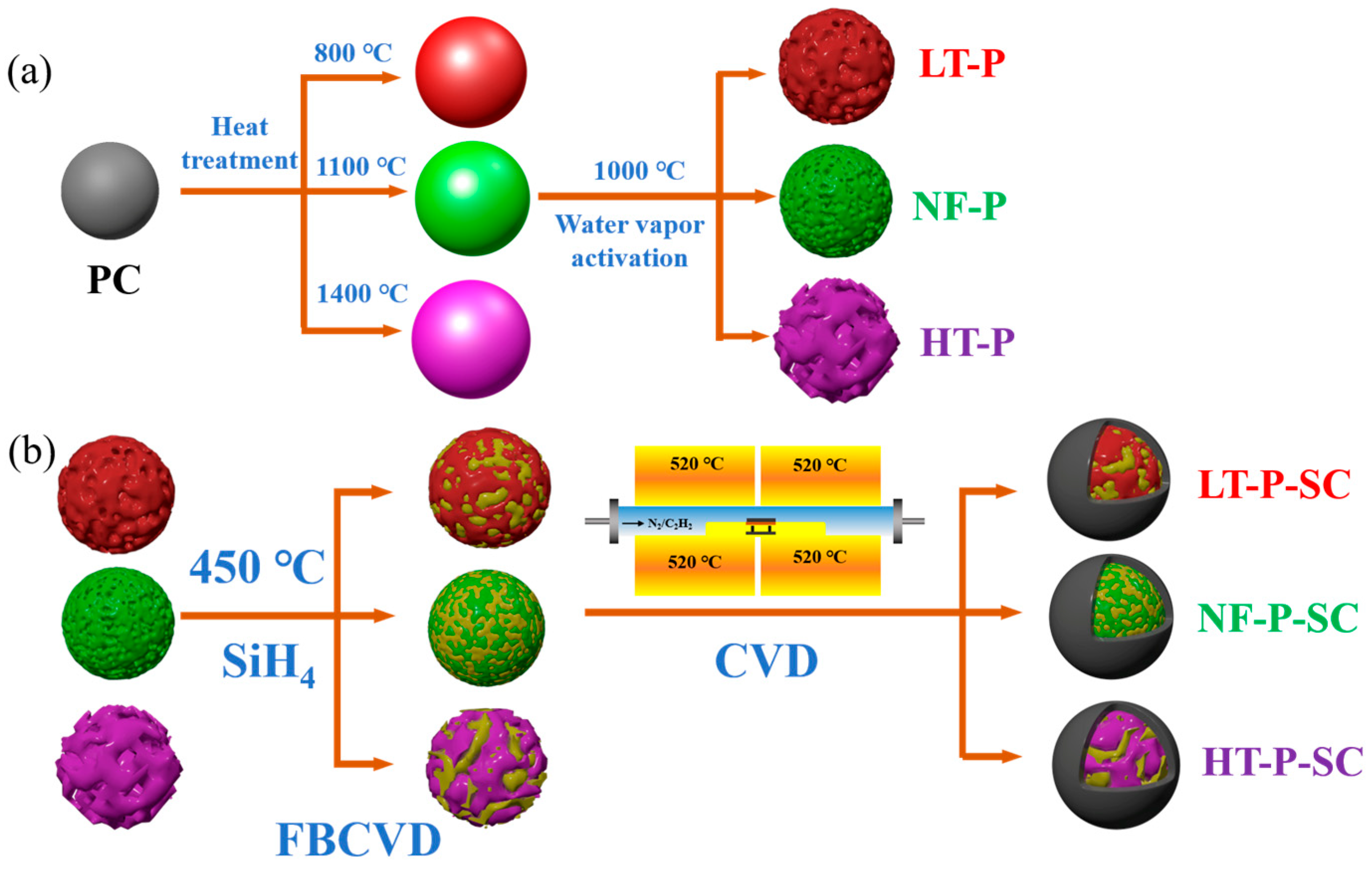
The purchased hard carbon precursor (LITAN (Jiangxi) New Material Co., Ltd., Ganzhou, China), consisting of biomass carbonized at 600 °C, was denoted as PC and subjected to heat treatment in a box furnace at different temperatures. The heating rate was maintained at 3 °C/min, with a holding time of 4 h, and the target temperatures were set to 800, 1100, and 1400 °C. For clarity, the resulting hard carbons treated at low, intermediate, and high temperatures were designated as LT, NT, and HT, respectively. Subsequently, pore formation was carried out for the hard carbons treated at different temperatures using water vapor activation in a fluidized bed. The temperature was increased at a rate of 3 °C/min to 1000 °C and maintained for 12 h. Nitrogen (LITAN (Jiangxi) New Material Co., Ltd., Ganzhou, China) was supplied at a flow rate of 60 L/min to provide a protective atmosphere and to ensure effective fluidization of the hard carbon powder, while the water vapor flow was fixed at 20 L/min. The obtained porous carbons materials were labeled as LT-P, NT-P, and HT-P. A schematic illustration of this process is presented in Figure 1a. The as-prepared porous carbons (LT-P, NT-P, and HT-P) were further subjected to SiH4 deposition in a fluidized bed chemical vapor deposition reactor (FB-CVD). The temperature was raised at 3 °C/min to 450 °C and maintained for 10 h, with nitrogen and SiH4 flow rates of 100 L/min and 30 L/min, respectively. After cooling to room temperature, the samples were transferred to a rotary furnace for acetylene coating. The temperature was increased at 3 °C/min to 520 °C and held for 2 h, under a nitrogen flow rate of 1 L/min and an acetylene flow rate of 25 L/min. After cooling to room temperature, the final products were collected and denoted as LT-P-SC, NT-P-SC, and HT-P-SC. A schematic diagram of the overall preparation procedure is shown in Figure 1b.

2.2. Structural Characterization

X-ray powder diffraction (XRD) patterns were collected using an X-ray diffractometer (X’Pert3 Powder, PANalytical) operated at 40 mA and 45 kV with Cu Kα radiation. The measurements were performed over a range of 10–80° at a scan rate of 9.8 (°) min−1. Scanning electron microscopy (SEM) images were obtained using a JSM-7610F microscope equipped with an energy-dispersive X-ray spectrometer (X-MaxN-50 EDX). The pore structure of the porous carbon materials was characterized using a Quantachrome 2460 specific surface area analyzer. The powder resistivity was measured using the PCR3000 instrument by IETS Technology.

2.3. Electrochemical Testing

2.3.1. Coin-Type Cells Test

The electrode slurry was prepared by mixing the active material, carboxymethyl cellulose (CMC), and conductive agent (acetylene black) in deionized water at a mass ratio of 85:10:5. The resulting slurry was uniformly coated onto a copper current collector and dried in a vacuum oven at 100 °C for 8 h with loading level of 3 mg cm−2. Coin-type CR2430 cells were assembled in an Ar-filled glove box, using lithium metal as the counter electrode, the prepared electrodes as the working electrode, a Celgard 2400 membrane as the separator, and 1.0 M LiPF6 dissolved in ethylene carbonate (EC)/dimethyl carbonate (DMC) with a weight ratio of 1:1 as the electrolyte. The coin cells were allowed to stand for 12 h at room temperature. Galvanostatic charge–discharge measurements were conducted on the CR2430 cells within a voltage window of 0.005–1.5 V versus Li/Li+ using a Neware Battery Testing System (CT-2001A, Wuhan LAND Electronics Co., Ltd., Wuhan, China). The initial discharge process was performed using a simulated constant current-constant voltage protocol at current densities of 0.1, 0.05, and 0.02 C.

2.3.2. Preparation of Full-Cell Electrodes, Cell Assembly and Electrochemical Performance Tests

Preparation of Si-C/graphite composite anodes: The as-prepared Si anode material was mixed with graphite at mass ratios ranging from 10:90 to 80:20 to obtain composite powders (specific capacity of the composite: 500 mAh/g). The composite powder, Super P, carbon nanotubes (CNT), CMC, and styrene–butadiene rubber (SBR) were then dispersed in deionized water at a mass ratio of 94:1.9:1:0.1:3 with a solid content of 48%. After homogenization, the slurry was coated onto a copper foil current collector and vacuum-dried at 100 °C for 4 h. The electrodes were cold-pressed using a roller press to a compaction density of 1.5 g/cm3 and cut into circular disks to obtain Si composite anodes. The electrodes were weighed to determine the active material mass.
Preparation of LiNi0.8Co0.1Mn0.1O2 (NMC 811) cathodes: Commercial NMC 811, Super P, and polyvinylidene fluoride (PVDF) were mixed in N-methyl-2-pyrrolidone (NMP) at a mass ratio of 95:3:2 with a solid content of 46%. The homogenized slurry was coated onto an aluminum foil current collector, followed by vacuum drying at 100 °C for 4 h. The electrodes were cold-pressed using a roller press to a compaction density of 1.3–1.4 g/cm3 and cut into circular disks. The electrodes were further dried under vacuum (−0.1 MPa) at 85 °C for 8 h and weighed to determine the active material mass.
Cell assembly and electrochemical testing: A polyethylene (PE) separator and 20 μL 1.0 M LiPF6 in EC/DMC (1:1, v/v) with 10 wt% fluoroethylene carbonate (FEC) as the electrolyte were used as the electrolyte. CR2430 coin full cells were assembled in a glove box with an N/P (areal capacity ratio of anode to cathode) ratio of 1.10. The cells were rested at room temperature for 4 h, activated by charge–discharge cycling at 0.1 C using a LAND battery testing system, and then cycled at 1 C between 2.8 and 4.2 V.

3. Results and Discussion

3.1. Microstructure and Morphology Characterization

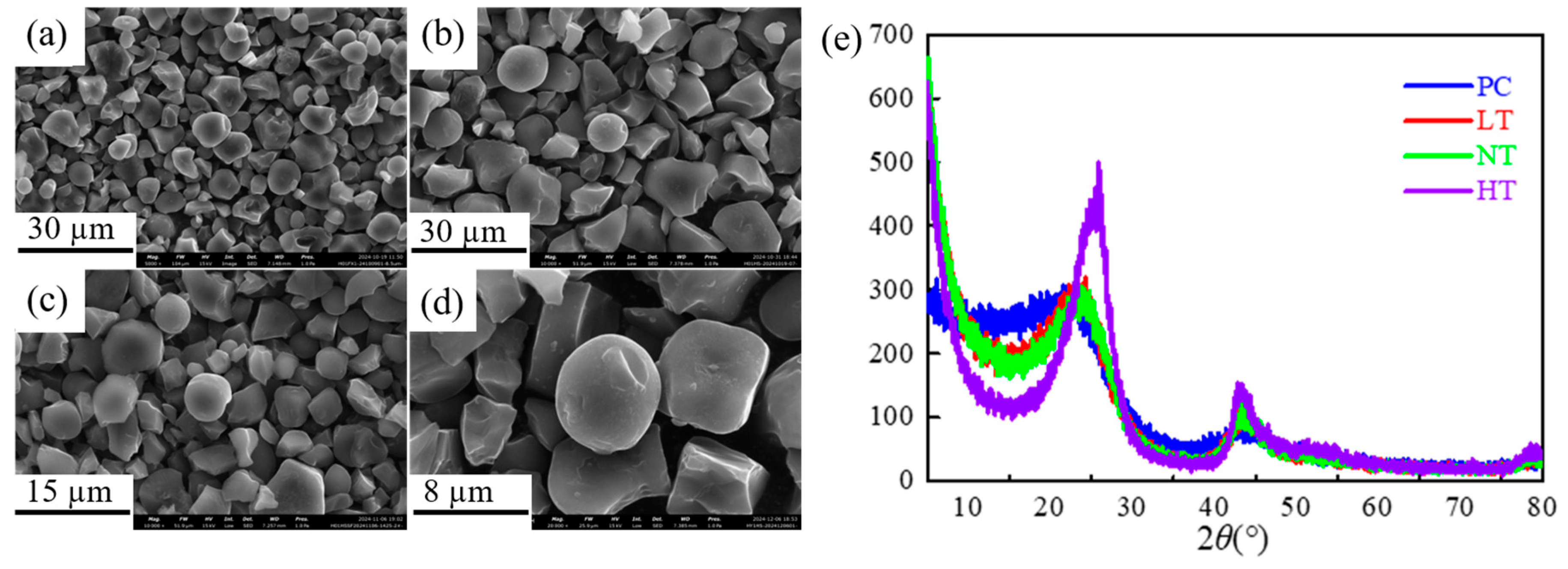
To clarify the morphological structure of the carbon-based materials, as shown in Figure 2, the original low-temperature hard carbon (a) and hard carbons treated at different temperatures (LT, NT, and HT, corresponding to (b–d), respectively) were characterized using SEM. The results indicate that the treatment temperatures do not significantly affect the morphology of the carbon materials, which retain the spherical or quasi-spherical structure observed in the original low-temperature hard carbon (a). The particles are primarily concentrated within a size range of approximately 4–8 μm. Figure 2e presents the XRD patterns of the original low-temperature hard carbon (a) and hard carbons treated at various temperatures (LT, NT, and HT, corresponding to (b–d), respectively). The XRD patterns show no significant shift in peak positions, all corresponding to typical carbon peaks. However, it is evident that as the temperature increases, the peaks for LT and NT are broad, indicative of an amorphous carbon structure. In contrast, the HT hard carbon peaks are noticeably sharper, suggesting a more ordered carbon structure, which may enhance conductivity. No additional impurity phases were detected in the phase analysis, confirming that the synthesis process was free of contamination and ensuring the accuracy of the results.
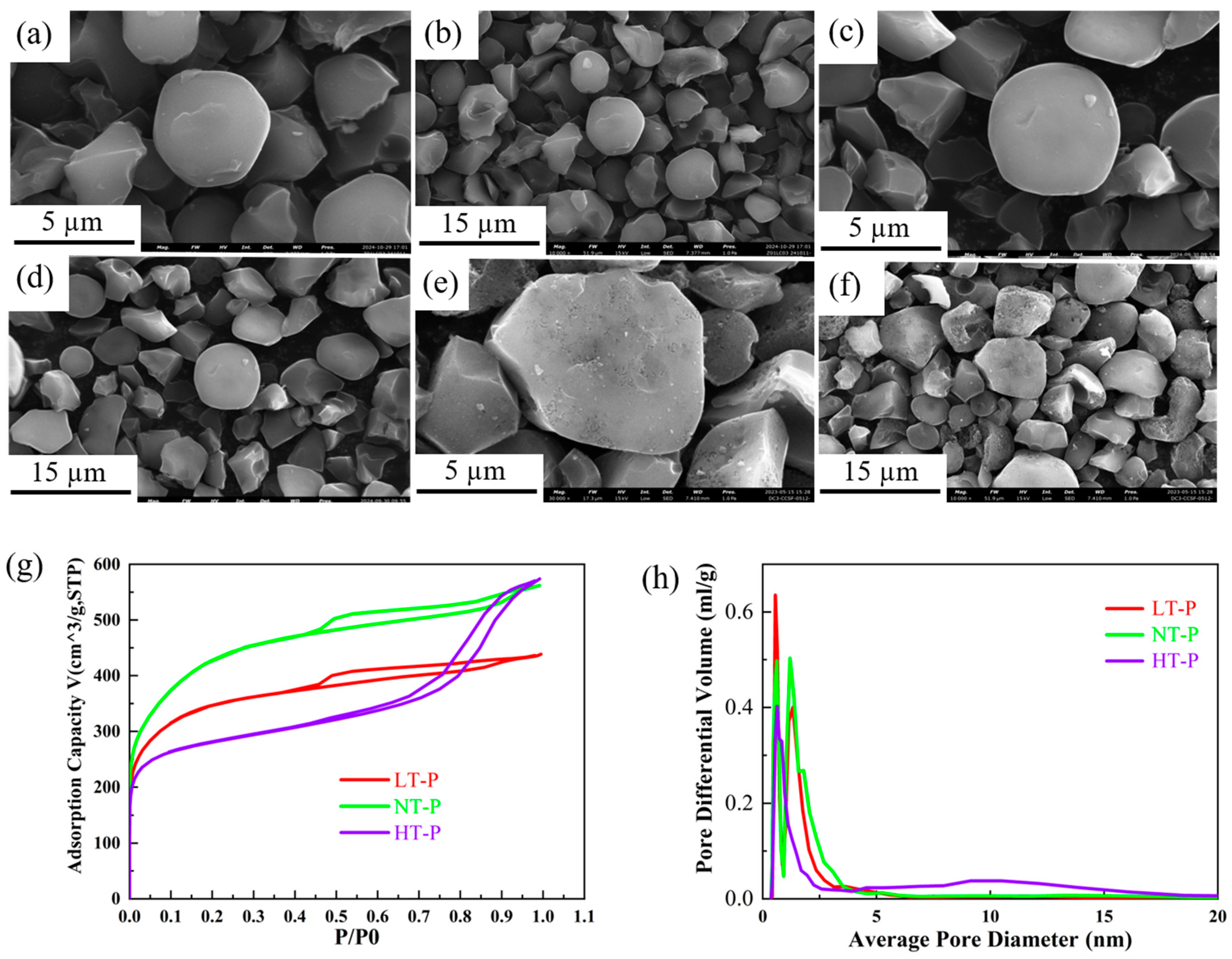
Steam activation at 1000 °C was applied to the hard carbons pretreated at different temperatures to generate surface porosity. The post-activation morphology is shown in Figure 3, where (a,b) correspond to LT-P, (c,d) to NT-P, and (e,f) to HT-P. The overall particle size shows no obvious change after activation and remains concentrated at approximately 4–8 μm. In contrast, clear differences appear on the particle surfaces: with increasing precursor treatment temperature, surface pores become progressively more apparent, and HT-P exhibits pronounced etching with a higher density of surface pores. These observations confirm successful pore formation and indicate that higher precursor treatment temperatures facilitate the development of larger pores. To further compare porosity among the samples, N2 adsorption–desorption isotherms and the corresponding pore size distributions were measured using a specific surface area and micropore analyzer.
As shown in Figure 3g,h, the adsorption–desorption isotherms are closed, supporting the reliability of the measurements. LT-P and NT-P display type I isotherms, characteristic of microporous adsorption where internal pore surface dominates and uptake is governed by pore volume, whereas HT-P exhibits a type II isotherm, indicative of relatively larger pores and substantial external surface. Pore generation effectively enriches the microporous structure, and the moderate increase in the curvature at the isotherm knee suggests the formation of larger micropores and small mesopores in the carbon framework. Consistently, Figure 3b shows that the pore sizes are mainly distributed within 0–20 nm, covering micropores (<2 nm) and small mesopores (2–50 nm) according to the conventional classification [25]. The pore volume fractions are summarized in Table 1: LT-P and NT-P are dominated by micropores, which facilitates adsorption of Si derived from SiH4 into the pores, while HT-P contains predominantly mesopores. A small fraction of macropores is also present in several samples.
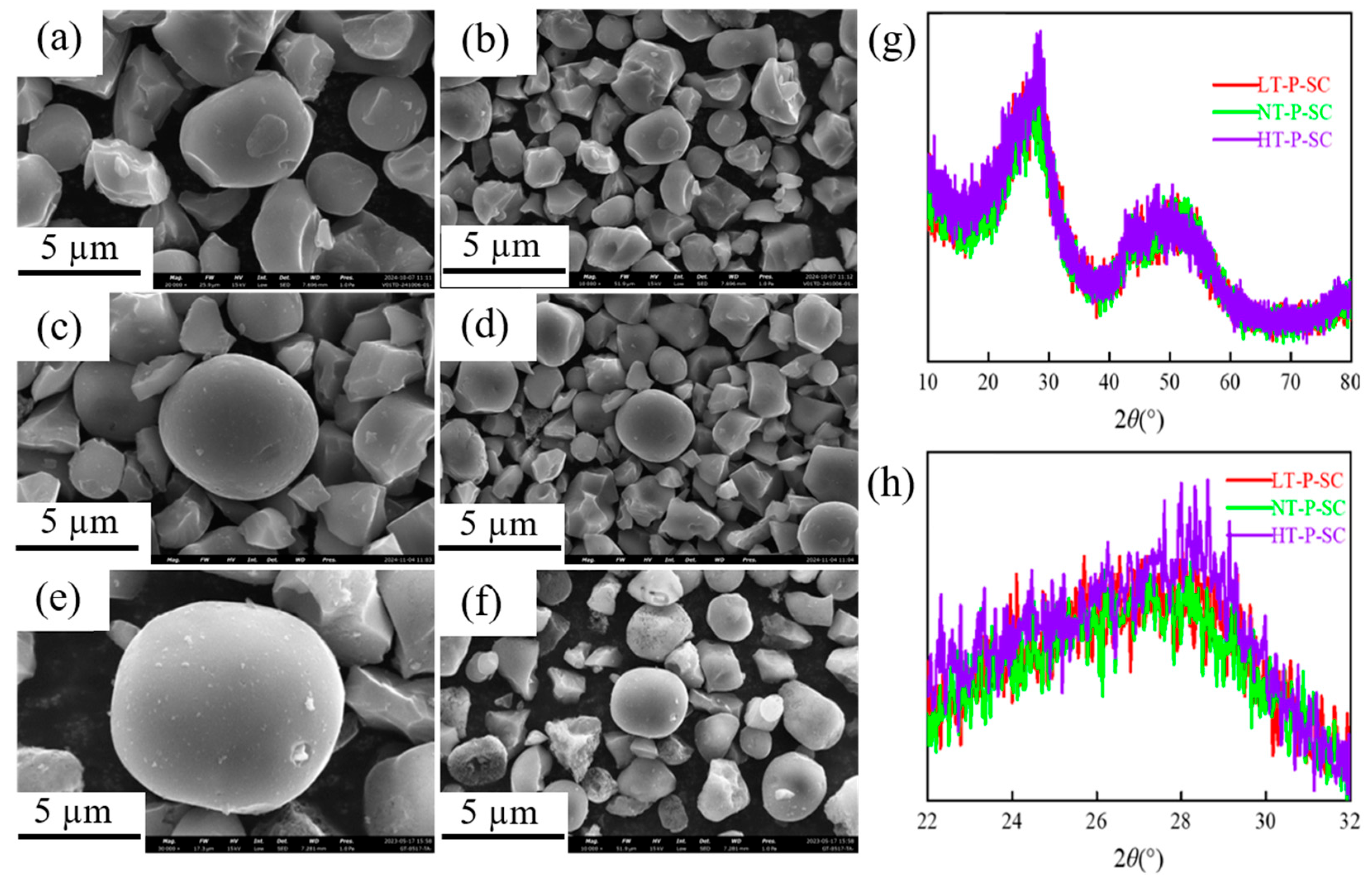
The morphology and phase structure of the Si-C anodes after SiH4 deposition and carbon coating on different porous carbons were examined, as shown in Figure 4. For LT-P-SC (Figure 4a,b), NT-P-SC (Figure 4c,d), and HT-P-SC (Figure 4e,f), the particles become more uniform and the surfaces appear smooth with no discernible surface pores, indicating effective surface coverage. With increasing precursor treatment temperature, the surface morphology of LT-P-SC and NT-P-SC changes little, whereas small surface particulates are observed on HT-P-SC. This behavior is likely related to the predominance of mesopores in HT-P, which favors surface-deposited Si, while LT-P-SC and NT-P-SC are primarily microporous, where adsorption is governed by pore volume and Si preferentially deposits inside the pores [26]. Uniform deposition of SiH4-derived Si within the porous carbon matrix is critical for subsequent electrochemical performance.
Specifically, the heat treatment temperature is a key factor regulating the internal crystal structure and atomic arrangement order of hard carbon. As the temperature increases from 1000 °C to 1400 °C, the carbon atoms in hard carbon gain sufficient thermal energy, driving their migration, rearrangement, and gradual approximation to a graphitized structure. This renders the carbon structure more ordered and dense, while the number of defect sites (such as vacancies, dislocations, and edge defects) in the carbon matrix decreases significantly [27]. Hard carbon treated at 1000 °C retains a large number of disordered carbon regions with loose atomic arrangement and dense defect sites, whereas hard carbon treated at 1400 °C forms larger-sized ordered carbon grains with improved crystal integrity and drastically reduced defect density [28].
When both types of hard carbon treated at different temperatures are activated for pore formation with water vapor at 1000 °C, the aforementioned structural differences directly lead to a significant divergence in mesoporosity. The activation reaction between water vapor and hard carbon is mainly achieved by etching the carbon matrix (reaction formula: C + H2O → CO + H2), and the etching behavior is dependent on the orderliness of the carbon structure [29]. For hard carbon treated at 1400 °C, its ordered carbon regions have large sizes and few defects, so water vapor etching tends to proceed directionally along the edges and interlayer gaps of ordered carbon grains. This etching method is not prone to forming micropores, but rather facilitates the construction of mesopores with pore sizes ranging from 2 to 50 nm. In contrast, hard carbon treated at 1000 °C has dense defects, leading to random water vapor etching at defect sites, which mostly forms a large number of micropores. The mesopore generation efficiency is significantly lower than that of the former, ultimately resulting in higher mesoporosity of hard carbon treated at 1400 °C after activation [29].
The hard carbon structure with high mesoporosity significantly promotes the formation of surface free silicon. During the chemical vapor deposition (CVD) of silane (SiH4), the adsorption and deposition behaviors of gas-phase silicon species are strongly influenced by the pore structure characteristics of the carbon matrix: mesopores have large pore sizes and relatively lower specific surface areas than micropores, leading to weak adsorption capacity for silicon species generated by gas-phase decomposition and difficulty in effectively confining silicon species inside the pores [30]. Therefore, most silicon species cannot be effectively adsorbed and deposited in mesopores, and are more likely to migrate to the surface of hard carbon, where nucleation and growth occur, ultimately forming surface free silicon. In contrast, hard carbon with low mesoporosity and high microporosity can confine silicon species in micropores through strong adsorption, reducing the formation of surface free silicon [31]. Figure 4g shows the XRD patterns of the Si-C composites derived from the different porous carbons. All three samples exhibit broadened peaks at 2θ = 28.3° and 47.2°, corresponding to Si (111) and (220), respectively, in agreement with JCPDS NO. 27-1402. The peak broadening mainly arises from the nanoscale size of the deposited Si. To further compare the phases and their implications for electrochemical behavior, the peak at 2θ = 28.3° was examined. HT-P-SC shows a relatively sharper peak, and according to the Scherrer equation, the corresponding crystallite size 2.3 nm is somewhat larger than the 1.9 nm of NT-P-SC [32].
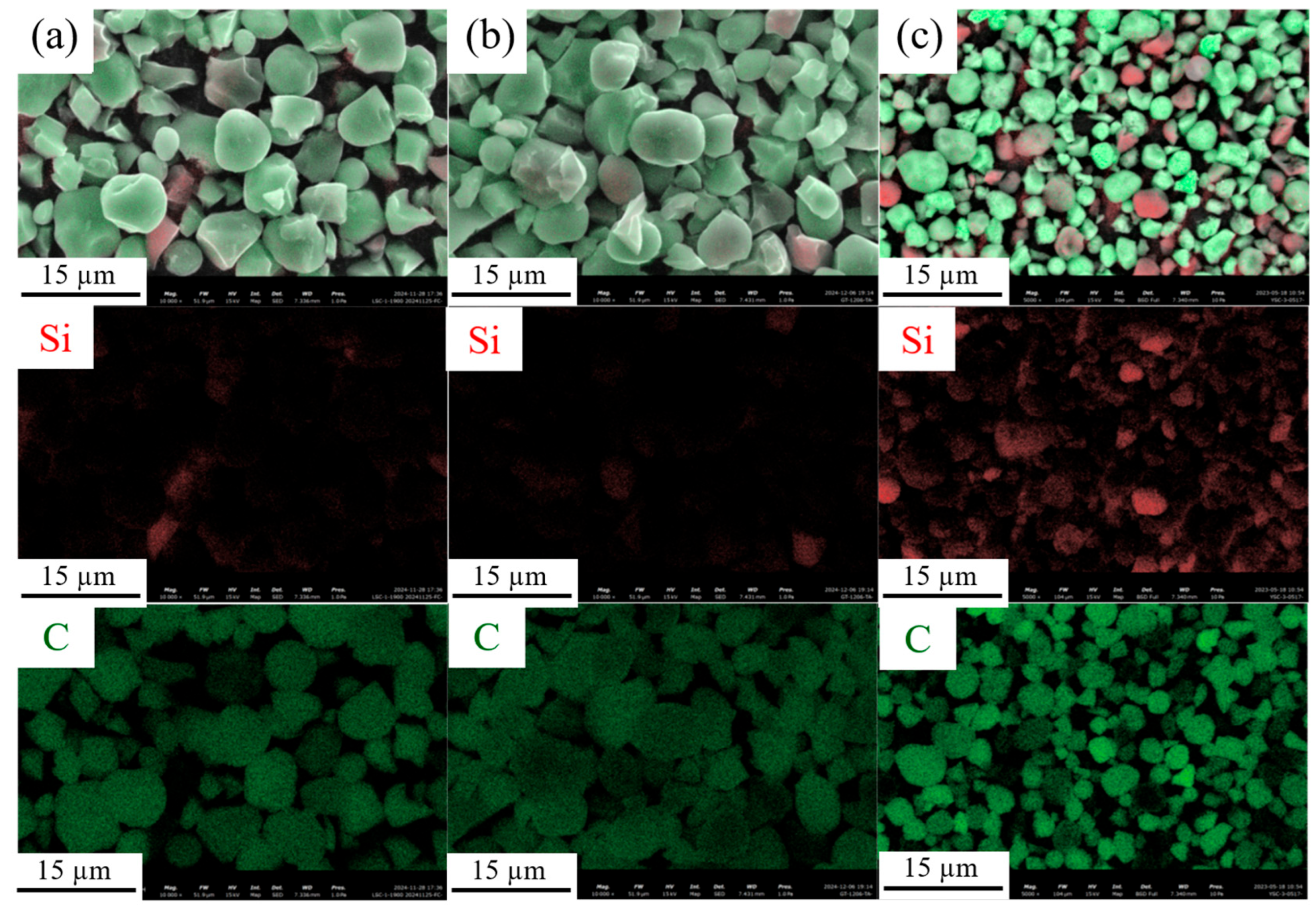
To better resolve differences among the three samples, EDX elemental mapping was performed (Figure 5). The particle morphology and C maps show a uniform C distribution, indicating effective coating coverage. In addition, Si signals are scarcely observed for LT-P-SC and NT-P-SC, implying that most Si is confined within the micropores of the porous carbon and that the carbon coating is continuous. By contrast, HT-P-SC exhibits pronounced Si signals on particle surfaces with 52.4 wt% Si which is more than 46.6 wt% of NT-P-SC, indicative of surface-deposited Si, which can influence cycling performance.
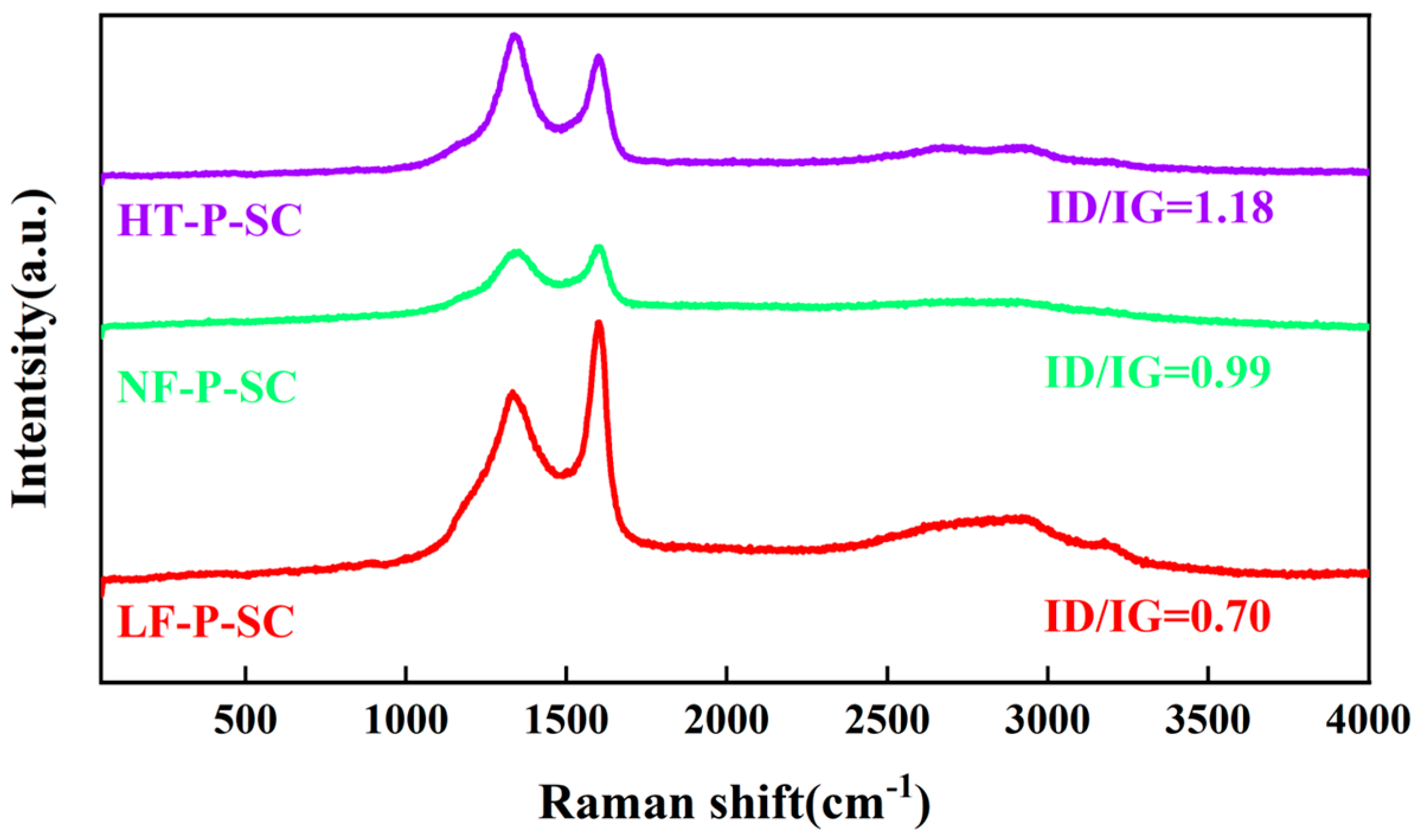
Raman spectra of the obtained samples were used to further verify the existence of amorphous carbon in the network, as shown in Figure 6. The D and G bands appeared at 1352 and 1588 cm−1, corresponding to the disordered phase and graphitic phase in the carbonized carbon, respectively [33]. The intensity of the G peak can be used to characterize the degree of integrity of the sp2 hybridized bond structure, which usually originates from the incompleteness of graphite crystallites and structural defects [34]. Consequently, the integrated intensity ratios (ID/IG) of LT-P, NT-P, and HT-P are estimated to be 1.18, 0.99, and 0.70, respectively. A higher ratio indicates the presence of amorphous carbon in the final product
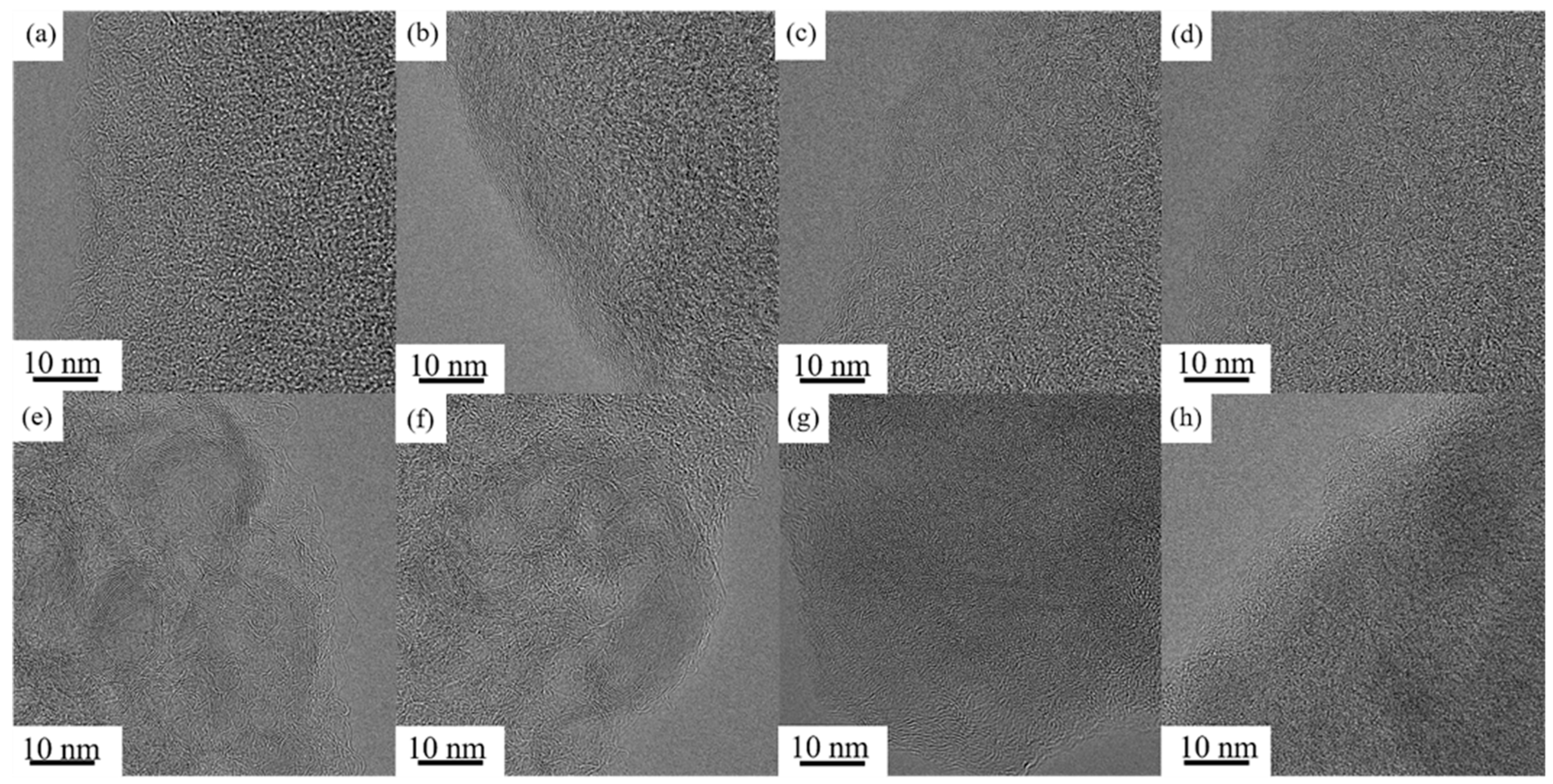
Figure 7 shows the TEM images of the four materials. It can be seen from Figure 7a–f that, compared with the pristine silicon–carbon (Figure 7g,h), the surface of the porous NT-SC composite is distributed with a large number of pores. The connectivity between these pores creates rapid transport channels for electrons and ions, while providing more active sites [35]. The porous carbon prepared at high temperature exhibits a significant increase in microscopic order and distinct macropores, which is consistent with the results of Raman, XRD, and pore size distribution measurements.

3.2. Electrochemical Performance Characterization

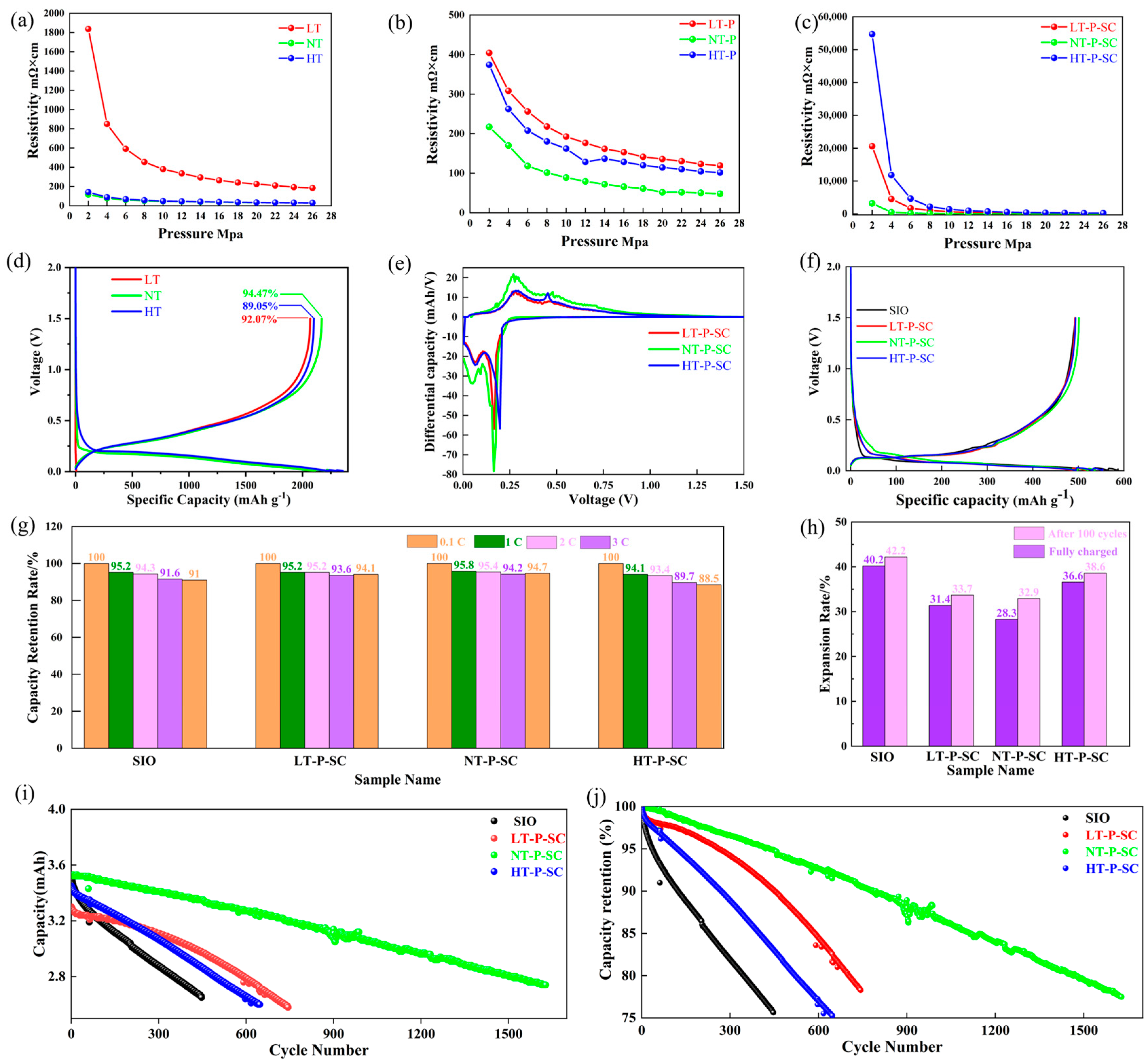
Figure 8a–c shows the resistivity of the materials at successive processing stages, which tracks the evolution of electrical conductivity as anode materials and directly influences rate capability. As shown in Figure 8a, the resistivity of the porous carbon precursors (LT, NT, HT) decreases monotonically with increasing temperature, indicating progressively improved electrical conductivity. This behavior arises from enhanced graphitization at elevated temperature, which increases structural order and facilitates electron transport.
After activation and pore formation (Figure 8b), the resistivity of LT-P decreases, whereas that of NT-P and HT-P increases. For LT-P, the activation temperature (1000 °C) exceeds the precursor carbonization temperature (800 °C); despite some etching of the internal conductive network during activation, the higher temperature promotes a denser carbon framework and lowers volatile content, yielding better conductivity. In contrast, for NT-P and HT-P the activation temperature is lower than the corresponding precursor carbonization temperature, so activation-induced damage to the conductive network dominates, leading to higher resistivity. Nevertheless, NT-P, treated at medium temperature, exhibits the lowest resistivity and the best electrical conductivity among the three activated samples.
Subsequent Si deposition and carbon coating further increase resistivity because Si is a semiconductor with relatively poor conductivity. HT-P-SC shows the highest resistivity. Consistent with SEM and mapping of the porous carbon, Si in HT-P-SC is mainly located on the external surface and does not effectively infiltrate the pores, so the semiconducting layer interrupts the carbon network and causes a larger increase in resistivity. In comparison, NT-P-SC maintains the lowest resistivity and the best electrical conductivity.
Initial charge–discharge tests were then performed on LT-P-SC, NT-P-SC, and HT-P-SC to assess the effect of different porous carbon matrices on ICE (Figure 8d). All samples display similar voltage plateaus: a lithiation plateau near 0.1 V associated with alloying of Si with Li, and a delithiation plateau around 0.42 V corresponding to dealloying of lithium-silicon. The charge/discharge specific capacities are 2069.1/2247.2, 2169.6/2290.5, and 2100.3/2358.0 mAh/g for LT-P-SC, NT-P-SC, and HT-P-SC, respectively, with corresponding ICE values of 92.07%, 94.47%, and 89.05%. The silicon content was measured to be 55 wt% via the ignition method. Notably, the ICE of NT-P-SC approaches the level of conventional graphite anodes, whereas HT-P-SC shows a lower ICE. Combined with the above analysis, high-temperature-treated porous carbon is dominated by mesopores and macropores, which favor Si deposition on the surface during SiH4 deposition, leading to incomplete coating and Si crystallization. These factors induce more irreversible reactions and reduce ICE. Even so, the ICE of HT-P-SC remains higher than that of most reported Si-based anode materials.
To further verify this conclusion, differential capacity (dQ/dV) measurements were performed on the three samples, as illustrated in Figure 8e [36,37]. All samples exhibit similar redox peaks corresponding to the lithiation/delithiation processes of Si, consistent with previously reported results. Notably, HT-P-SC displays a distinct peak around 0.5 V, corresponding to the delithiation of crystalline LiXSi, indicating a higher degree of crystallinity of Si in HT-P-SC. This observation is consistent with prior characterization analyses.
Additionally, the as-prepared Si-C samples were blended with graphite to achieve a target specific capacity of 500 mAh/g. The charge–discharge performance, rate capability, volume expansion rate, and cycling stability of the composite anodes were evaluated, with commercial carbon-coated SiO used as the control group to demonstrate practical applicability. Initial charge–discharge tests were performed at the target capacity of 500 mAh/g, as shown in Figure 8f. All samples exhibited similar charge–discharge plateaus, with charge specific capacities of 493 mAh/g (SiO), 508 mAh/g (LT-P-SC), 501 mAh/g (NT-P-SC), and 499 mAh/g (HT-P-SC), corresponding to ICE of 84.0%, 92.2%, 93.4%, and 90.2%, respectively. All samples achieved the expected reversible specific capacity of approximately 500 mAh/g, with NT-P-SC exhibiting the highest capacity and ICE demonstrating superior electrochemical performance.
To further assess the rate capability and cycling stability, full-cell tests were conducted using SiO as the reference, with results presented in Figure 8h. After cycling at rates of 0.1 C, 1 C, 2 C, and 3 C (1 C = 500 mA/g), followed by cycling at 0.1 C, NT-P-SC maintained a capacity retention of 94.7%, outperforming LT-P-SC (94.1%) and HT-P-SC (88.5%), and surpassing the SiO control group by 3.7 percentage points. Notably, NT-P-SC maintained a high capacity retention rate of 95.4% even at the high rate of 3 C, outperforming all other reference samples. The excellent rate capability is attributed to the synergistic effect of the porous carbon structure, the uniform deposition of nanoscale Si, and the enhanced electrical conductivity of the carbon matrix derived from medium-temperature precursor treatment.
Volume expansion rate is a critical performance indicator for Si-based anode materials, which was obtained by measuring the height variation in the electrode sheets before battery assembly and after lithiation. The expansion rates of the blended samples were tested, and the results are shown in Figure 8g. NT-P-SC exhibited a relatively low volume expansion rate: the expansion rate at full charge was 28.3%, lower than those of LT-P-SC (31.4%) and HT-P-SC (36.6%). After 100 cycles, the expansion rate of NT-P-SC was 32.9%, significantly lower than the low- and high-temperature counterparts, and approaching the level of commercial graphite anodes. Notably, the expansion rates of all prepared Si-C samples were lower than that of the commercial SiO anode. The remarkable improvements in rate capability and volume expansion performance are closely related to the uniformly dispersed fine Si nanoparticles deposited in situ. Moreover, the selection of porous carbon matrices treated at different temperatures further contributes to the enhanced rate capability. Specifically, a higher precursor heat treatment temperature results in a higher degree of graphitization of the carbon matrix, which benefits electrical conductivity and rate capability. However, excessively high temperatures increase the difficulty of activation, leading to a higher proportion of mesopores and macropores, which not only reduces the electrical conductivity of the carbon matrix but also promotes the formation of free surface Si, thereby deteriorating the rate capability and increasing the volume expansion rate.
Figure 8i shows the cycling performance of coin-type full cells assembled with composite anodes (SiO, LT-P-SC, NT-P-SC, HT-P-SC blended with graphite), directly tracking capacity fade with the diameter of the electrode sheet is 14 mm and corresponding area of 1.54 cm2. All vapor-deposited Si-C samples exhibit better cycling stability than the commercial SiO anode. For the commercial SiO anode, the initial discharge capacity is 3.5 mAh and the remaining capacity is 2.65 mAh after 447 cycles, giving a capacity retention rate of 75.71%. For LT-P-SC, the initial discharge capacity is 3.3 mAh, with 2.58 mAh remaining after 744 cycles, corresponding to a capacity retention rate of 78.18%. NT-P-SC delivers an initial discharge capacity of 3.53 mAh and retains 2.74 mAh after 1628 cycles, yielding a capacity retention rate of 77.62%. HT-P-SC shows an initial discharge capacity of 3.45 mAh and 2.6 mAh remaining after 647 cycles, corresponding to a capacity retention rate of 75.36%.
Figure 8j presents the cycle numbers at 80% capacity retention for each sample: 346, 703, 1470, and 521 cycles for SiO, LT-P-SC, NT-P-SC, and HT-P-SC, respectively. Under identical deposition conditions, the temperature used to treat the porous carbon matrix exerts a pronounced effect on the cycling performance. In line with the previous analysis, porous carbon derived from low-temperature precursor treatment shows relatively low electrical conductivity and an inferior pore structure. By contrast, porous carbon obtained at excessively high temperatures is dominated by mesopores and macropores, which lowers electrical conductivity and promotes the formation of surface free Si with incomplete coating, leading to degraded electrochemical performance. NT-P-SC achieves the best overall electrochemical performance, indicating that an appropriate heat-treatment protocol for the porous carbon precursor is critical to improving the electrochemical properties of the composite anode. It can be seen from the comparison with other recent Si-C anode studies in Table 2 that NT-P-SC exhibits excellent initial coulombic efficiency and cycling performance.
In summary, the superior electrochemical performance of NT-P-SC mainly arises from the pore architecture of the porous carbon matrix derived from medium-temperature precursor treatment, which is dominated by micropores with a small fraction of mesopores. This architecture promotes deposition of ultrafine nanoscale Si within the pores and disperses the Si nanoparticles with the porous carbon acting as a buffer medium, thereby mitigating volume expansion stress during cycling and enabling low volume expansion with stable performance. The higher electrical conductivity of the NT-P porous carbon matrix further supports the rate capability and other electrochemical metrics. In addition, the carbon coating process suppresses side reactions, resulting in high ICE and improved cycling stability, which helps maintain electrode structural integrity and supports long-cycle stability. The synergistic effect of the optimized porous carbon structure and the carbon coating process enables the NT-P-SC composite anode to deliver excellent overall electrochemical performance.

4. Conclusions

Porous carbon was derived from biomass carbon precursors through heat treatment at different temperatures, followed by activation and pore formation. Si-C composite anode materials were subsequently fabricated via vapor-phase SiH4 deposition and carbon coating. Increasing the heat-treatment temperature leads to a higher proportion of mesopores and macropores in the porous carbon, which influences the SiH4 deposition behavior. In comparison, Si-C composites prepared at low temperature (LT-P-SC) and medium temperature (NT-P-SC) exhibit more effective surface coating, whereas the high-temperature sample (HT-P-SC) shows relatively loose coating due to the presence of surface free Si.
The as-prepared Si-C anodes exhibit good electrical conductivity and high ICE. Owing to its structural characteristics, the medium-temperature sample (NT-P-SC) achieves an ICE of 94.47% together with optimal resistivity, which is directly reflected in the rate performance. Specifically, a capacity retention of 94.3% is maintained at a rate of 3 C. Notably, the corresponding full cell blended with graphite to a target capacity of 500 mAh/g also demonstrates excellent cycling performance, retaining 80% of its capacity after 1470 cycles.
By employing porous carbons with different structural characteristics as deposition matrices, Si-C composite materials can be effectively constructed, thereby enhancing the electrochemical performance of Si-based anodes. This practical strategy provides guidance for the rational selection of carbon matrices in advanced Si-C composite anodes and shows potential for the large-scale fabrication of high-performance, low-cost Si-based composite anode materials.

Author Contributions

H.M.: Investigation; Methodology; Writing—original draft. Z.Y.: Writing—Review and Editing. S.W.: Formal analysis; Methodology. Z.H.: Validation, Formal analysis. K.Z.: Conceptualization; Supervision; Writing—Reviewing and Editing; Funding acquisition. J.L.: Writing—Review and Editing. All authors have read and agreed to the published version of the manuscript.

Funding

This work was financially supported by the Natural Science Foundation of Anhui Province (Grant No. 2408085JX004), the Provincial University Research and Innovation Team (Grant No. 2022AH010023), Tongling University Talent Research Initiation Fund Project (Grant No. 2023tlxyrc42), the Outstanding Young Teachers Cultivation Key Project (Grant No. YQZD2024044) and Anhui Provincial Department of Education Research Project (Grant No.: 2025AHGXZK30513).

Institutional Review Board Statement

Not applicable.

Informed Consent Statement

Not applicable.

Data Availability Statement

The data presented in this study are available on request from the first author.

Conflicts of Interest

The authors declare no conflict of interest associated with this article.

References

  1. Feng, Z.; Peng, W.; Wang, Z.; Guo, H.; Li, X.; Yan, G.; Wang, J. Review of silicon-based alloys for lithium-ion battery anodes. Int. J. Miner. Metall. Mater. 2021, 28, 1549–1564. [Google Scholar] [CrossRef]
  2. Shao, Y.; Mateen, A.; Li, J.; Chen, J.; Bao, Z. Metal silicide-based anode materials: A review of their types, preparation and applications in energy storage. J. Alloys Compd. 2025, 1010, 178076. [Google Scholar] [CrossRef]
  3. Chen, S.; Shen, L.; Van Aken, P.A.; Maier, J.; Yu, Y. Dual-Functionalized Double Carbon Shells Coated Silicon Nanoparticles for High Performance Lithium-Ion Batteries. Adv. Mater. 2017, 29, 1605650. [Google Scholar] [CrossRef]
  4. Han, J.; Tang, X.; Ge, S.; Shi, Y.; Zhang, C.; Li, F.; Bai, S. Si/C particles on graphene sheet as stable anode for lithium-ion batteries. J. Mater. Sci. Technol. 2021, 80, 259–265. [Google Scholar] [CrossRef]
  5. Bitew, Z.; Tesemma, M.; Beyene, Y.; Amare, M. Nano-structured silicon and silicon based composites as anode materials for lithium ion batteries: Recent progress and perspectives. Sustain. Energy Fuels 2022, 6, 1014–1050. [Google Scholar] [CrossRef]
  6. Yang, Y.; Lu, Z.; Xia, J.; Liu, Y.; Wang, K.; Wang, X. Crystalline and amorphous carbon double-modified silicon anode: Towards large-scale production and superior lithium storage performance. Chem. Eng. Sci. 2021, 229, 116054. [Google Scholar] [CrossRef]
  7. Ma, Z.; Zhu, J.; Zeng, F.; Yang, Z.; Ding, Y.; Tang, W. Structural Control and Optimization Schemes of Silicon-Based Anode Materials. Energy Technol. 2023, 11, 2201496. [Google Scholar] [CrossRef]
  8. Chan, C.K.; Peng, H.; Liu, G.; McIlwrath, K.; Zhang, X.F.; Huggins, R.A.; Cui, Y. High-performance lithium battery anodes using silicon nanowires. Nat. Nanotechnol. 2008, 3, 31–35. [Google Scholar] [CrossRef] [PubMed]
  9. Laïk, B.; Eude, L.; Pereira-Ramos, J.-P.; Cojocaru, C.S.; Pribat, D.; Rouvière, E. Silicon nanowires as negative electrode for lithium-ion microbatteries. Electrochim. Acta 2008, 53, 5528–5532. [Google Scholar] [CrossRef]
  10. Collins, G.A.; Kilian, S.; Geaney, H.; Ryan, K.M. A Nanowire Nest Structure Comprising Copper Silicide and Silicon Nanowires for Lithium-Ion Battery Anodes with High Areal Loading. Small 2021, 17, 2102333. [Google Scholar] [CrossRef] [PubMed]
  11. Saito, G.; Sasaki, H.; Takahashi, H.; Sakaguchi, N. Solution-Plasma-Mediated Synthesis of Si Nanoparticles for Anode Material of Lithium-Ion Batteries. Nanomaterials 2018, 8, 286. [Google Scholar] [CrossRef]
  12. Li, C.; Shi, T.; Li, D.; Yoshitake, H.; Wang, H. Effect of surface modification on electrochemical performance of nano-sized Si as an anode material for Li-ion batteries. RSC Adv. 2016, 6, 34715–34723. [Google Scholar] [CrossRef]
  13. Yang, Y.; Wang, Z.; Zhou, R.; Guo, H.; Li, X. Effects of lithium fluoride coating on the performance of nano-silicon as anode material for lithium-ion batteries. Mater. Lett. 2016, 184, 65–68. [Google Scholar] [CrossRef]
  14. Galashev, A.Y.; Suzdaltsev, A.V.; Ivanichkina, K.A. Design of the high performance microbattery with silicene anode. Mater. Sci. Eng. B 2020, 261, 114718. [Google Scholar] [CrossRef]
  15. Li, J.; Wang, F.; Xue, L.; Dang, D.; Liu, Q.; Ye, C.; Zhang, C.; Tan, J. Research progress on the structure design of nano-silicon anode for high-energy lithium-ion battery. Appl. Energy 2025, 390, 125820. [Google Scholar] [CrossRef]
  16. Hou, S.-C.; Su, Y.-F.; Chang, C.-C.; Hu, C.-W.; Chen, T.-Y.; Yang, S.-M.; Huang, J.-L. The synergistic effects of combining the high energy mechanical milling and wet milling on Si negative electrode materials for lithium ion battery. J. Power Sources 2017, 349, 111–120. [Google Scholar] [CrossRef]
  17. Kohandehghan, A.; Cui, K.; Kupsta, M.; Memarzadeh, E.; Kalisvaart, P.; Mitlin, D. Nanometer-scale Sn coatings improve the performance of silicon nanowire LIB anodes. J. Mater. Chem. A 2014, 2, 11261. [Google Scholar] [CrossRef]
  18. Miao, R.; Zhu, J.; Kang, S.; Yang, J.; Wang, J.; Fu, J.; Li, M.; Shi, C. In-situ mechanochemical synthesis of sub-micro Si/Sn@SiOx-C composite as high-rate anode material for lithium-ion batteries. Electrochim. Acta 2021, 384, 138413. [Google Scholar] [CrossRef]
  19. Chen, Z.; Wang, X.; Jian, T.; Hou, J.; Zhou, J.; Xu, C. One-step mild fabrication of branch-like multimodal porous Si/Zn composites as high performance anodes for Li-ion batteries. Solid State Ion. 2020, 354, 115406. [Google Scholar] [CrossRef]
  20. Kalidas, N.; Shen, X.; Yuan, M.; Zhao, X.; Lehto, V.-P. Controlled surface oxidation of mesoporous silicon microparticles to achieve a stable Si/SiOx anode for lithium-ion batteries. Microporous Mesoporous Mater. 2022, 344, 112243. [Google Scholar] [CrossRef]
  21. Yan, L.; Zhang, H.; Li, Z.; Gao, X.; Wang, H.; Lin, Z.; Ling, M.; Liang, C. Millimeter Silicon-Derived Secondary Submicron Materials as High-Initial Coulombic Efficiency Anode for Lithium-Ion Batteries. ACS Appl. Energy Mater. 2020, 3, 10255–10260. [Google Scholar] [CrossRef]
  22. Tan, W.; Yang, F.; Lu, Z.; Xu, Z. A Design Strategy of Carbon Coatings on Silicon Nanoparticles as Anodes of High-Performance Lithium-Ion Batteries. ACS Appl. Energy Mater. 2022, 5, 12143–12150. [Google Scholar] [CrossRef]
  23. Zhou, R.; Guo, H.; Yang, Y.; Wang, Z.; Li, X.; Zhou, Y. An alternative carbon source of silicon-based anode material for lithium ion batteries. Powder Technol. 2016, 295, 296–302. [Google Scholar] [CrossRef]
  24. Nandan, R.; Takamori, N.; Higashimine, K.; Badam, R.; Matsumi, N. Black glasses grafted micron silicon: A resilient anode material for high-performance lithium-ion batteries. J. Mater. Chem. A 2022, 10, 15960–15974. [Google Scholar] [CrossRef]
  25. Fan, M.; Pan, X.; Lin, W.; Zhang, H. Carbon-Covered Hollow Nitrogen-Doped Carbon Nanoparticles and Nitrogen-Doped Carbon-Covered Hollow Carbon Nanoparticles for Oxygen Reduction. ACS Appl. Nano Mater. 2020, 3, 3487–3493. [Google Scholar] [CrossRef]
  26. Liu, Y.; Liu, X.; Zhu, Y.; Wang, J.; Ji, W.; Liu, X. Scalable Synthesis of Pitch-Coated Nanoporous Si/Graphite Composite Anodes for Lithium-Ion Batteries. Energy Fuels 2023, 37, 4624–4631. [Google Scholar] [CrossRef]
  27. Okabe, J.; Fang, Y.; Moriguchi, I.; Furó, I. Structural evolution by heat treatment of soft and hard carbons as Li storage materials: A joint NMR/XRD/TEM/Raman study. J. Mater. Chem. A 2025, 13, 13962–13975. [Google Scholar] [CrossRef]
  28. Yeh, I.-C.; Tran, N.T.; Knorr, D.B. Effects of high-temperature annealing on structural and mechanical properties of amorphous carbon materials investigated by molecular dynamics simulations. Carbon 2025, 234, 120006. [Google Scholar] [CrossRef]
  29. Duan, Z.; Zhou, W.; Mo, Y.; Tang, R.; Duan, Y.; Hu, A.; Liu, J. Tuning hard carbon pore structure via water vapor activation for enhanced sodium-ion storage. Green Energy Environ. 2025, S2468025725003589. [Google Scholar] [CrossRef]
  30. Zheng, Z.; Pei, B.; Zhang, L.; Cao, X.; Liang, S. Pore structure in hard carbon: From recognition to regulation. Energy Storage Mater. 2025, 75, 104068. [Google Scholar] [CrossRef]
  31. Yuan, Q.; Liu, Q.; Li, H. Adsorption and Aggregation Behavior of Si, Sn, and Cu Atoms on Carbon Nanotubes (CNTs) According to Classical Molecular Dynamics Simulations. Nanomaterials 2025, 15, 1406. [Google Scholar] [CrossRef]
  32. Huang, Y.; Li, Q.; Wang, S.; Cai, Z.; Ma, Y.; Song, G.; Yang, W.; Wen, C.; Xie, Y. Enhanced electrochemical performance of silicon anode materials with titanium hydride treatment. J. Electroanal. Chem. 2023, 933, 117292. [Google Scholar] [CrossRef]
  33. Liu, H.; Zou, Y.; Huang, L.; Yin, H.; Xi, C.; Chen, X.; Shentu, H.; Li, C.; Zhang, J.; Lv, C.; et al. Enhanced electrochemical performance of sandwich-structured polyaniline-wrapped silicon oxide/carbon nanotubes for lithium-ion batteries. Appl. Surf. Sci. 2018, 442, 204–212. [Google Scholar] [CrossRef]
  34. Zhao, J.; Lu, Z.; Wang, H.; Liu, W.; Lee, H.-W.; Yan, K.; Zhuo, D.; Lin, D.; Liu, N.; Cui, Y. Artificial Solid Electrolyte Interphase-Protected LixSi Nanoparticles: An Efficient and Stable Prelithiation Reagent for Lithium-Ion Batteries. J. Am. Chem. Soc. 2015, 137, 8372–8375. [Google Scholar] [CrossRef] [PubMed]
  35. Liang, G.; Qin, X.; Zou, J.; Luo, L.; Wang, Y.; Wu, M.; Zhu, H.; Chen, G.; Kang, F.; Li, B. Electrosprayed silicon-embedded porous carbon microspheres as lithium-ion battery anodes with exceptional rate capacities. Carbon 2018, 127, 424–431. [Google Scholar] [CrossRef]
  36. Wang, K.; Tan, Y.; Li, P.; Xue, B.; Sun, J. Facile Synthesis of Double-Layer-Constrained Micron-Sized Porous Si/SiO2/C Composites for Lithium-Ion Battery Anodes. ACS Appl. Mater. Interfaces 2019, 11, 37732–37740. [Google Scholar] [CrossRef]
  37. Huang, Y.; Shao, B.; Wang, Y.; Han, F. Solid-state silicon anode with extremely high initial coulombic efficiency. Energy Environ. Sci. 2023, 16, 1569–1580. [Google Scholar] [CrossRef]
  38. Shi, H.; Zhang, W.; Wang, D.; Wang, J.; Wang, C.; Xiong, Z.; Chen, F.-R.; Dong, H.; Xu, B.; Yan, X. Facile preparation of silicon/carbon composite with porous architecture for advanced lithium-ion battery anode. J. Electroanal. Chem. 2023, 937, 117427. [Google Scholar] [CrossRef]
  39. Ma, L.; Fu, X.; Zhao, F.; Yu, L.; Su, W.; Wei, L.; Tang, G.; Wang, Y.; Wu, F.; Guo, X. Microsized Silicon/Carbon Composite Anodes through In Situ Polymerization of Phenolic Resin onto Silicon Microparticles for High-Performance Lithium-Ion Batteries. ACS Appl. Energy Mater. 2023, 6, 4989–4999. [Google Scholar] [CrossRef]
  40. Li, X.; Li, K.; Yuan, M.; Zhang, J.; Liu, H.; Li, A.; Chen, X.; Song, H. Graphene-doped silicon-carbon materials with multi-interface structures for lithium-ion battery anodes. J. Colloid Interface Sci. 2024, 667, 470–477. [Google Scholar] [CrossRef] [PubMed]
  41. Jiang, X.; Sun, L.; Lu, Y.; Wang, H.; Shi, J.; Yang, L.; Zhang, L.; Lv, R.; Jin, Z. Ladderlike polysilsesquioxanes derived dual-carbon-buffer-shell structural silicon as stable anode materials for lithium-ion batteries. J. Power Sources 2024, 602, 234331. [Google Scholar] [CrossRef]
  42. Zhao, J.; Wang, B.; Zhan, Z.; Hu, M.; Cai, F.; Świerczek, K.; Yang, K.; Ren, J.; Guo, Z.; Wang, Z. Boron-doped three-dimensional porous carbon framework/carbon shell encapsulated silicon composites for high-performance lithium-ion battery anodes. J. Colloid Interface Sci. 2024, 664, 790–800. [Google Scholar] [CrossRef] [PubMed]
Figure 1. (a) Preparation schematic of porous C; (b) Preparation schematic of Si-C composite.
Coatings 16 00188 g001
Figure 2. SEM patterns of different samples (a) Raw hard carbon PC; (b) Low temperature (800 °C, LT) treated hard carbon; (c) Medium temperature (1100 °C, NT) treated hard carbon; (d) High temperature (1400 °C, HT) treated hard carbon; (e) XRD patterns.
Coatings 16 00188 g002
Figure 3. SEM images of different porous carbons: (a,b) LT-P; (c,d) NT-P; (e,f) HT-P; (g) adsorption–desorption curves; (h) pore size distribution curves.
Coatings 16 00188 g003
Figure 4. SEM (af); (g,h) XRD of Si-C composite anode materials obtained from different porous carbon.
Coatings 16 00188 g004
Figure 5. Mapping of Si and C elements of Si-C composite anode materials obtained with different porous carbon (a) LT-P-SC; (b) NT-P-SC; (c) HT-P-SC.
Coatings 16 00188 g005
Figure 6. Raman spectra of LT-P, NT-P, and HT-P.
Coatings 16 00188 g006
Figure 7. (a,b) TEM images of LT-P; (c,d) TEM images of NT-P; (e,f) TEM images of HT-P; (g,h) TEM images of NT-SC.
Coatings 16 00188 g007
Figure 8. (a) Resistivity of carbon materials treated with different temperatures; (b) Resistivity of porous carbon materials; (c) Resistivity curves, (d) initial charge–discharge curves, (e) dq/dv curves for different Si-C samples; (f) initial charge/discharge curves, (g) rate performance, (h) swelling performance, (i) cycling performance, (j) capacity retention of different Si-C blended graphite.
Coatings 16 00188 g008
Table 1. Pore volume percentage of different porous carbon.
Porosity Proportion
SampleMicropore
(≤2 nm)
Mesoporous
(2–50 nm)
Macropore
(≥50 nm)
LT-P57.2%41.8%1.0%
NT-P65.6%34.2%0.3%
HT-P36.3%61.8%1.9%
Table 2. The comparison between NT-P-SC and others.
Silicon–Carbon AnodeCurrent DensityCycling PerformanceICERef.
Capacity RetentionCycle
NT-P-SC1 C80%147094.47%This work
C@void/Si-G0.2 C90.1%10083.3%[38]
μSi@PF1 C87.7%10080%[39]
Si/G/P-1085 mA/g95%10075.7%[40]
DCS-Si0.2 A/g50%30091.8%[41]
B-3DCF/Si@C400 mA/g89.1%15075.2%[42]
Disclaimer/Publisher’s Note: The statements, opinions and data contained in all publications are solely those of the individual author(s) and contributor(s) and not of MDPI and/or the editor(s). MDPI and/or the editor(s) disclaim responsibility for any injury to people or property resulting from any ideas, methods, instructions or products referred to in the content.