Review

Contrast Agents Delivery: An Up-to-Date Review of Nanodiagnostics in Neuroimaging

by
Daniel Mihai Teleanu
1,
Cristina Chircov
2,3,
Alexandru Mihai Grumezescu
3,4,
Adrian Volceanov
3,* and
Raluca Ioana Teleanu
5
1
Emergency University Hospital, “Carol Davila” University of Medicine and Pharmacy, 050474 Bucharest, Romania
2
Faculty of Engineering in Foreign Languages, Politehnica University of Bucharest, 060042 Bucharest, Romania
3
Faculty of Applied Chemistry and Materials Science, Politehnica University of Bucharest, 011061 Bucharest, Romania
4
ICUB—Research Institute of University of Bucharest, University of Bucharest, 36-46 M. Kogalniceanu Blvd., Bucharest 050107, Romania
5
“Victor Gomoiu” Clinical Children’s Hospital, “Carol Davila” University of Medicine and Pharmacy, 050474 Bucharest, Romania
*
Author to whom correspondence should be addressed.
Nanomaterials 2019, 9(4), 542; https://doi.org/10.3390/nano9040542
Submission received: 1 March 2019 / Revised: 28 March 2019 / Accepted: 29 March 2019 / Published: 3 April 2019

Abstract

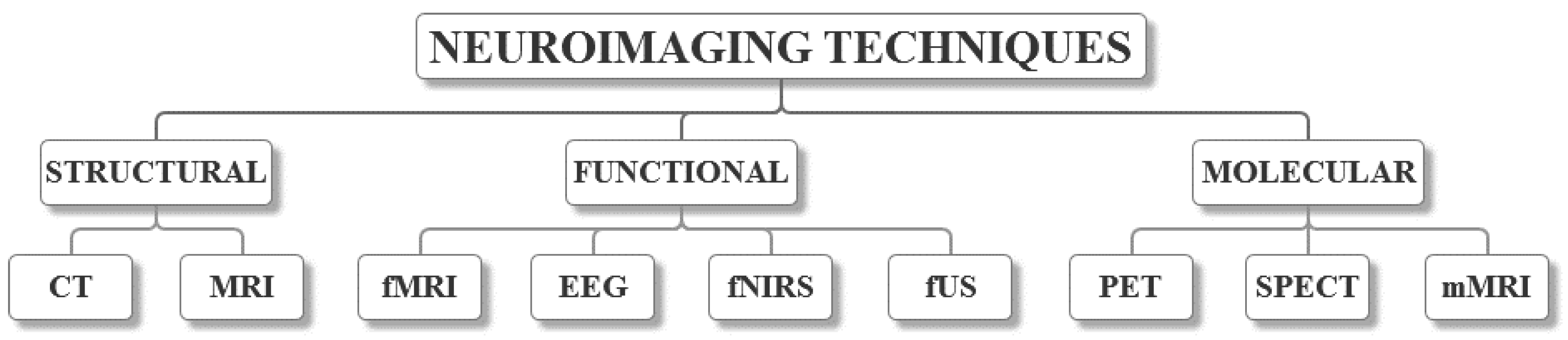
Neuroimaging is a highly important field of neuroscience, with direct implications for the early diagnosis and progression monitoring of brain-associated diseases. Neuroimaging techniques are categorized into structural, functional and molecular neuroimaging, each possessing advantages and disadvantages in terms of resolution, invasiveness, toxicity of contrast agents and costs. Nanotechnology-based approaches for neuroimaging mostly involve the development of nanocarriers for incorporating contrast agents or the use of nanomaterials as imaging agents. Inorganic and organic nanoparticles, liposomes, micelles, nanobodies and quantum dots are some of the most studied candidates for the delivery of contrast agents for neuroimaging. This paper focuses on describing the conventional modalities used for imaging and the applications of nanotechnology for developing novel strategies for neuroimaging. The aim is to highlight the roles of nanocarriers for enhancing and/or overcome the limitations associated with the most commonly utilized neuroimaging modalities. For future directions, several techniques that could benefit from the increased contrast induced by using imaging probes are presented.
Keywords: neuroimaging; neuroscience; nanotechnology; imaging; contrast agents neuroimaging; neuroscience; nanotechnology; imaging; contrast agents