Article

Sputtering Deposited CuCrO2 and CuCrO2-ZnSnN2 Heterojunctions
1
Key Laboratory of Optoelectronic Devices and Systems of Ministry of Education and Guangdong Province, Shenzhen Key Laboratory of Advanced Thin Films and Applications, College of Physics and Optoelectronic Engineering, Shenzhen University, Shenzhen 518060, China
2
State Key Laboratory of Radio Frequency Heterogeneous Integration, Shenzhen University, Shenzhen 518060, China
*
Author to whom correspondence should be addressed.
Nanomaterials 2026, 16(7), 416; https://doi.org/10.3390/nano16070416 (registering DOI)
Submission received: 15 December 2025 / Revised: 22 January 2026 / Accepted: 28 January 2026 / Published: 30 March 2026
(This article belongs to the Special Issue Next-Generation Optoelectronic Nanomaterials and Devices)

Abstract

There has been no experimental work on CuCrO2-ZnSnN2 heterojunctions (HJs), though theoretical work shows that their photoelectric conversion efficiency is around 20%. Here, CuCrO2 thin films and p CuCrO2-n ZnSnN2 HJs are prepared by varying the sputtering power of the Cu-Cr alloy target while the other parameters are held constant. The as-deposited CuxCryOz thin films are amorphous, with CuCrO2 as the major phase. The CuCrO2 thin films are p-type conductive, with an optical band gap of about 3.64–3.84 eV. The ZnSnN2 thin films are wurtzite and n-type conductive. The dark current density J versus voltage V curve measurements show that all the HJs showed rectification, while only the samples deposited at 40 and 50 W had a photo-induced current. Further analysis shows the HJs deposited at 40 W have the lowest shunt conductance, saturation current density, and trap density, implying an effect of fabrication conditions on the properties of HJs.

1. Introduction

CuCrO2 is a p-type semiconductor with a delafossite structure and a direct band gap of 2.95–3.30 eV [1,2,3,4,5,6,7,8,9,10,11]. Its application areas [1,2,3,4,5,6,7,8,9,10,11] include transparent electronic devices, photoelectrodes, catalysis and photocatalysis, gas and temperature sensing, magnetic and electrical energy storage, oxygen storage, water reduction, thermoelectricity, superconductivity, dye-sensitized or thin film solar cells, etc. Research has been conducted on CuCrO2. In 2014, a research team led by K.C. Sanal [2] deposited transparent p-type amorphous C u 1 x C r x O 2 δ thin films on glass substrates using radio frequency (RF) magnetron co-sputtering at room temperature. In 2018, H. Zhang et al. [3] developed inverted perovskite solar cells with CuCrO2 nanocrystals as the hole transport layer (HTL), which were obtained through low-temperature solution processing, and achieved a high steady-state photoelectric conversion efficiency (PCE) of 19.0%. In 2022, the team of Fusheng Li [4] reported a simple, low-cost, and highly reproducible method for depositing a copper-poor CuCrO2 film through spray pyrolysis deposition. In 2023, a research team led by Sreeram Sundaresh [5] investigated the effect of annealing temperature (600–900 °C in N2 atmosphere) on the electrical, optical, structural, and morphological properties of CuCrO2 thin films. Their study showed the presence of the Cu+ oxidation state in pure CuCrO2 films. In 2024, a research team led by Selma Rabhi [6] reported the use of computational modeling to demonstrate that Mg-doped CuCrO2 thin films serve as an efficient HTL in perovskite solar cells (PSCs), and the optimized devices exhibited a PCE of approximately 22% under both front and rear illumination, highlighting their potential for high-performance applications. Recently, CuCrO2 heterojunctions with high breakdown voltage and low leakage current have also been demonstrated [10].
Despite the fact that there has been research about CuCrO2, including some theoretical work [12,13,14], there are still limited experimental studies on pn heterojunctions integrating CuCrO2 as the p-type layer and other semiconductors as the n-type layer. ZnSnN2 is a new n-type semiconductor and could potentially be used as a solar cell absorption layer due to its advantages, including its direct band gap, its high absorption coefficient, the abundance of its elements on Earth, and its lack of toxicity [15,16,17,18,19,20,21,22]. In 2018, E. Arca et al. theoretically showed that the photoelectric conversion efficiency of CuCrO2-ZnSnN2 heterojunction solar cells is 23.5%, based on the wx-AMPS simulation [12]. In their work, CuCrO2 was doped with Mg [12]. In 2020, A. Laidouci et al. also showed that, without Mg doping, the photoelectric conversion efficiency of the heterojunction is 22%, based on a simulation with SCAPS-1D [13]. Recently, it has also been shown that the photoelectric conversion efficiency is 18% [14]. However, there has been no experimental work about CuCrO2-ZnSnN2 heterojunctions. In this paper, the properties of CuCrO2 thin films deposited at different sputtering powers are first studied. Subsequently, CuCrO2-ZnSnN2 heterojunctions are prepared and the properties are revealed.

2. Experiments

2.1. Material and Device Fabrication

CuCrO2 thin films were deposited with direct current (DC) sputtering at room temperature. To study the properties of CuCrO2, K9 glass was used as the substrate. The substrates were cleaned in acetone, ethanol, and deionized water, and the washing time was 15 min for each liquid. The target was a copper–chromium alloy (99.999% purity; Tianqi Advanced Materials Co., Ltd, Beijing, China) with the Cu/Cr atomic ratio being 1. The DC sputtering power was 30–50 W. The sputtering chamber was evacuated to 5.0 × 10⁻⁴ Pa before film deposition. Ar (99.99%) and O2 (99.999%) were then introduced to the chamber, and the chamber pressure was maintained at 0.7 Pa during sputtering. The flow rate of Ar was 3 standard cubic centimeters per minute (sccm), and that of O2 was 7 sccm. Before film deposition, the target was sputtered for 5 min. The deposition time for CuCrO2 was 2 h. During deposition, the substrates were not intentionally heated and rotated with the substrate holder at 0.6π rad/s. The DC sputtering power was 30–50 W, and 5 batches of CuCrO2 thin films were prepared.
Radio frequency (RF) magnetron sputtering was used to prepare ZnSnN2, and the power was 30 W. The target for depositing ZnSnN2 was a high-purity zinc–tin (99.999%) alloy plate with a Zn/Sn atomic ratio of 4:1. The substrate temperature was maintained at 100 °C during deposition, and the rotational speed of the substrate holder was the same as that for depositing CuCrO2. The flow rates for Ar (99.99%) and N2 (99.999%) were 8 and 5 sccm, respectively. The work pressure was 5 Pa. The target was sputtered for 5 min to clean the surface before depositing ZnSnN2. The deposition time for ZnSnN2 was 3 h.
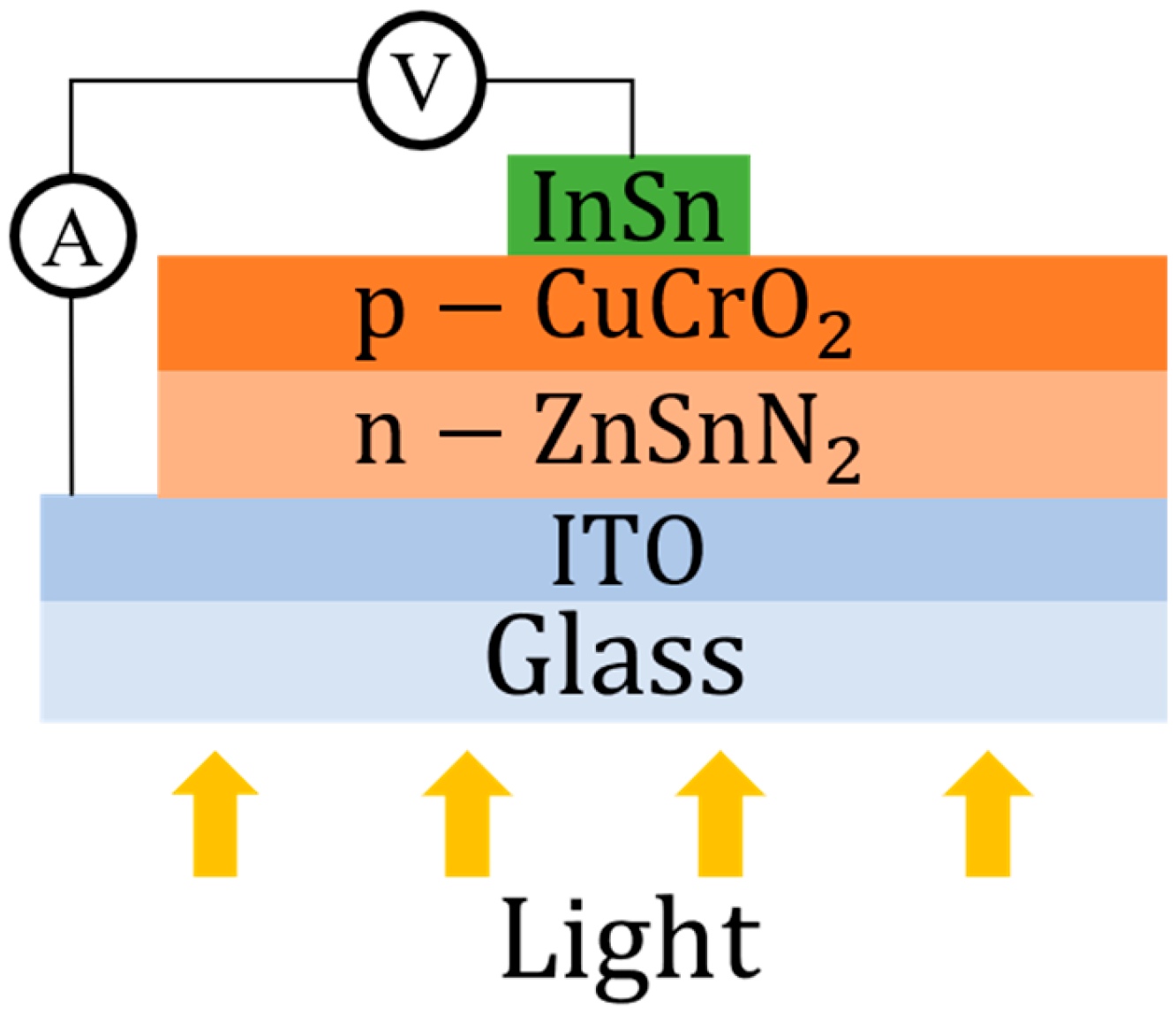
A schematic diagram of the CuCrO2-ZnSnN2 heterojunctions is shown in Figure 1. Indium tin oxide (ITO) coated glass of 20 × 20 mm2 was used as the substrate. The parameters for depositing ZnSnN2 and CuCrO2 were exactly the same as those mentioned in the previous two paragraphs. Before depositing ZnSnN2 on ITO, a shadow mask of the same size as the substrate was placed on the substrate. The shadow mask had nine 3 × 3 mm2 square apertures through which ZnSnN2 was deposited. After depositing ZnSnN2, CuCrO2 was then deposited on the ZnSnN2 (and the effective area of the heterojunctions was 3 × 3 mm2). Finally, a melted alloy of In and Sn (the In/Sn atomic ratio is 1.1) was pasted on the CuCrO2 layer to act as electrodes. By varying the sputtering power of CuCrO2, 5 batches of heterojunctions with CuCrO2 deposited at 30, 35, 40, 45, and 50 W were prepared.

2.2. Material and Device Characterization

The thickness of the films was measured using a surface profiler (Veeco Dektak 3ST). The crystal structure of the films was characterized with X-ray diffraction (XRD, Rigaku Ultima IV, θ–2θ scan). The electrical properties of the films were evaluated through Hall effect measurements (HL 5500 PC system) using the Van der Pauw method, with molten In-Sn alloy electrodes applied at the four corners of square samples. The optical properties, including reflectance and transmittance, were measured using a UV/VIS/NIR spectrophotometer (PerkinElmer Lambda 900). The chemical states of elements in the CuCrO2 thin films were analyzed by X-ray photoelectron spectroscopy (XPS, Thermo Fisher ESCALAB Xi+, Al Kα radiation, 1486.7 eV), where the C 1s peak was calibrated to be at 284.80 eV. Prior to the XPS measurements, the samples were surface-cleaned by Ar+ ion sputtering for 25 s at a relative etch rate of 0.25 nm/s (referenced to Ta2O5). The dark and photovoltaic performance were assessed by measuring the current density J versus the voltage V (JV) under dark or illuminated conditions (AM 1.5G, 100 mW/cm2) using a Keithley 2400 source meter coupled with a solar simulator (Zolix SS150, Zolix, Beijing, China) which was calibrated with a standard Si reference cell.

3. Results and Discussion

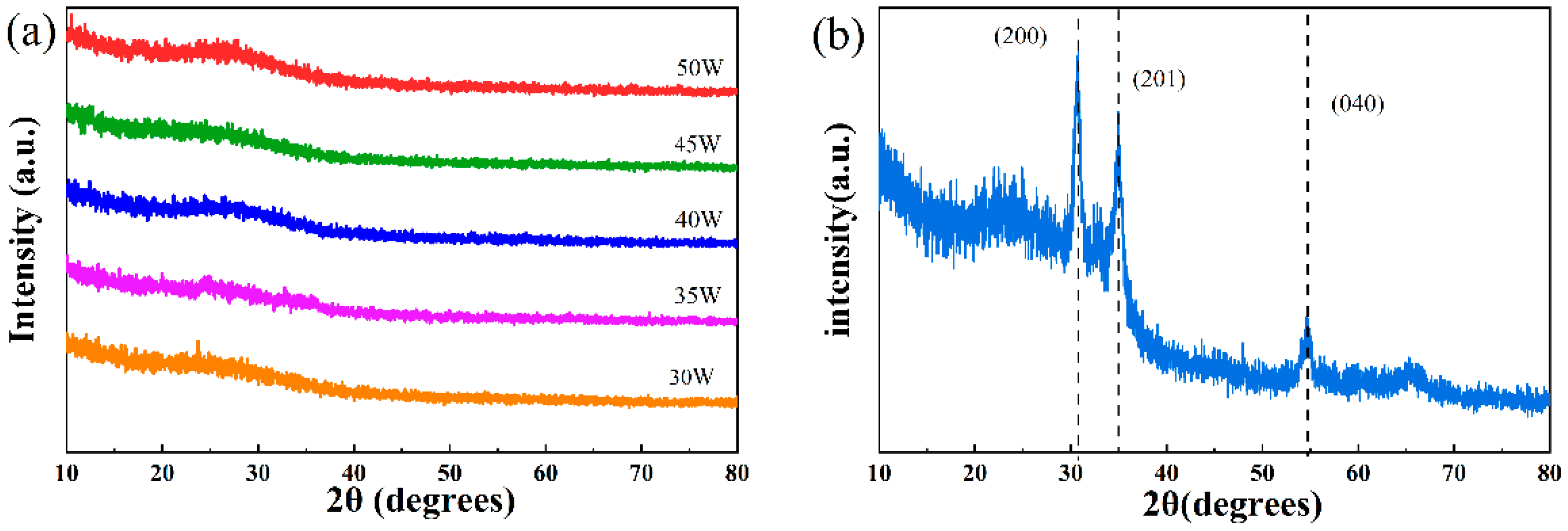
Figure 2a shows the XRD spectra of the CuCrO2 films deposited at room temperature. All the thin films deposited at different sputtering powers had no diffraction peaks, indicating an amorphous structure and in agreement with the literature [8]. This resulted from the fact that the substrates were not heated during deposition. It is reported that after annealing the CuxCryOz films, which were deposited at room temperature, at 550 °C and 575 °C, both CuO and CuCr2O4 could be detected, while after annealing the CuxCryOz films at 600 °C, CuCrO2 emerged as the dominant phase, with CuO as the minor phase [8]. In our work, post-deposition annealing was not conducted, since post-deposition annealing was not compatible with the heterojunction preparation. Figure 2b shows the XRD pattern of ZnSnN2. Weak diffraction peaks were observed, implying poor crystallization, and ZnSnN2 could be indexed as wurtzite with grain sizes at the nanometer level [17,18,19].
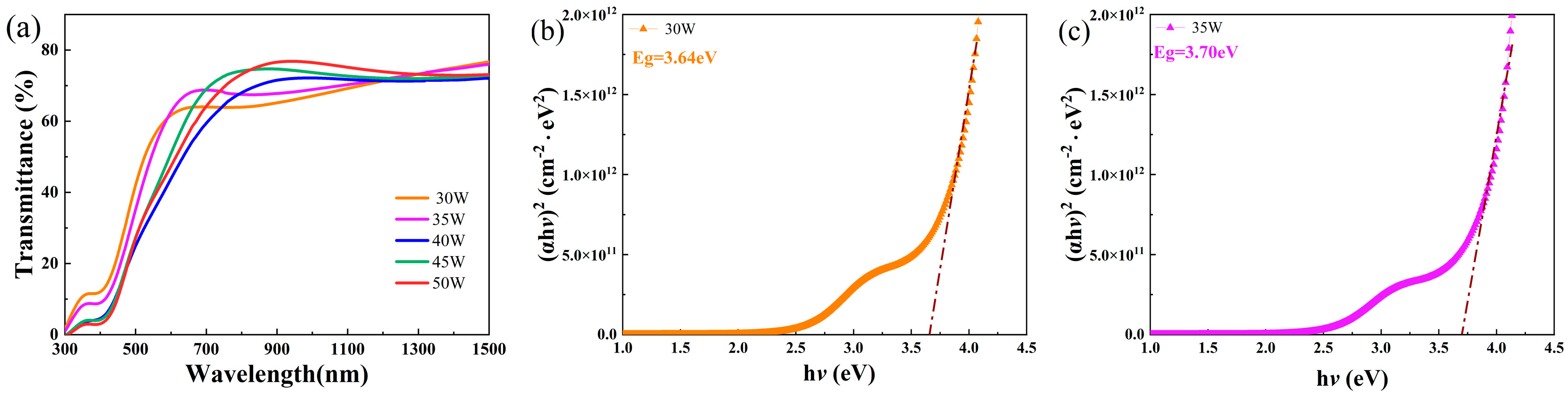
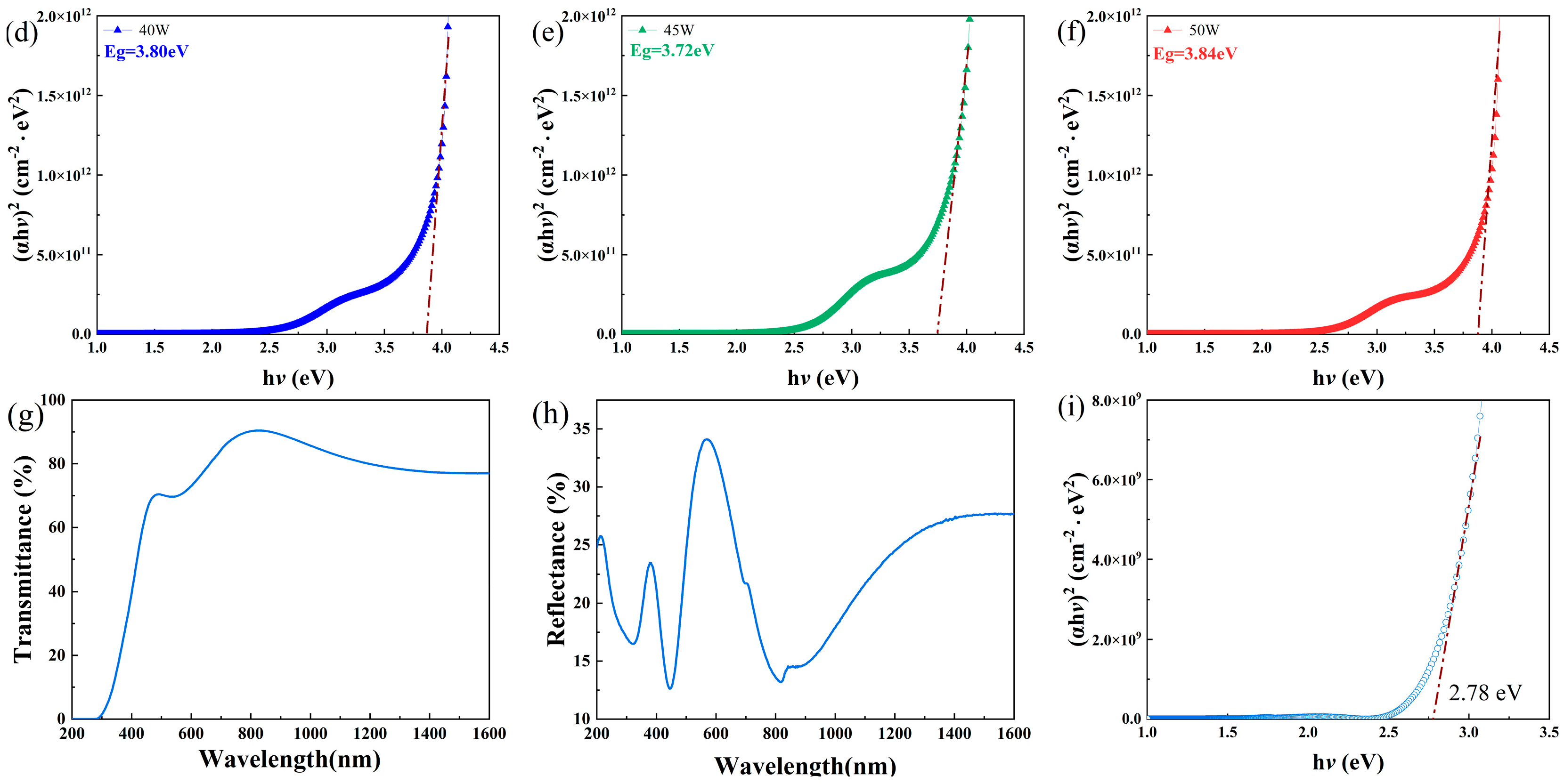
The thickness of CuCrO2 films deposited at 30, 35, 40, 45, and 50 W was 102.1, 129.5, 199.1, 163.5, and 196.3 nm, respectively. Hall effect measurements showed that CuCrO2 films were p-type-conductive, and the hole density was about 1.07 × 1010 cm−3. Cu vacancies, together with oxygen interstitials, were possibly the major acceptors according to theoretical work [23,24,25]. The transmittance and optical band gap of the CuCrO2 samples varied with the sputtering power, as shown in Figure 3a–f. The CuCrO2 films prepared under different sputtering powers had similar transmittance. The transmittance of the films at 750 nm was between 60% and 75%, which is consistent with the literature [7]. The absorption coefficient α can be calculated from the transmittance Tr and reflectance Rr data, since α = d−1ln[(100 − Rr)/Tr], where d is the film thickness. The relation between α and the optical band gap Eg for CuCrO2 is (αhν)2 = AL(hν − Eg), where AL is a constant, h is the Plank constant, and ν is the photon frequency [26]. From the (αhν)2 versus hν curves or the Tauc plots in Figure 3b–f, the effective optical band gap Eg can be obtained by extrapolating the linear region to intercept the hν axis [26]. The effective optical band gaps of the samples prepared under sputtering powers of 30, 35, 40, 45, and 50 W are 3.64, 3.70, 3.80, 3.72, and 3.84 eV, respectively. The band gap was larger than in other work (2.1–2.8 eV [2]; 3.61 eV [11]) due to the amorphous nature of the samples. The optical characterization of ZnSnN2 is shown in Figure 3g–i. The thickness of ZnSnN2 was 228 nm. Similarly, the band gap of ZnSnN2 was found to be 2.78 eV. The electron concentration of ZnSnN2 was measured to be 9.63 × 1017 cm−3.
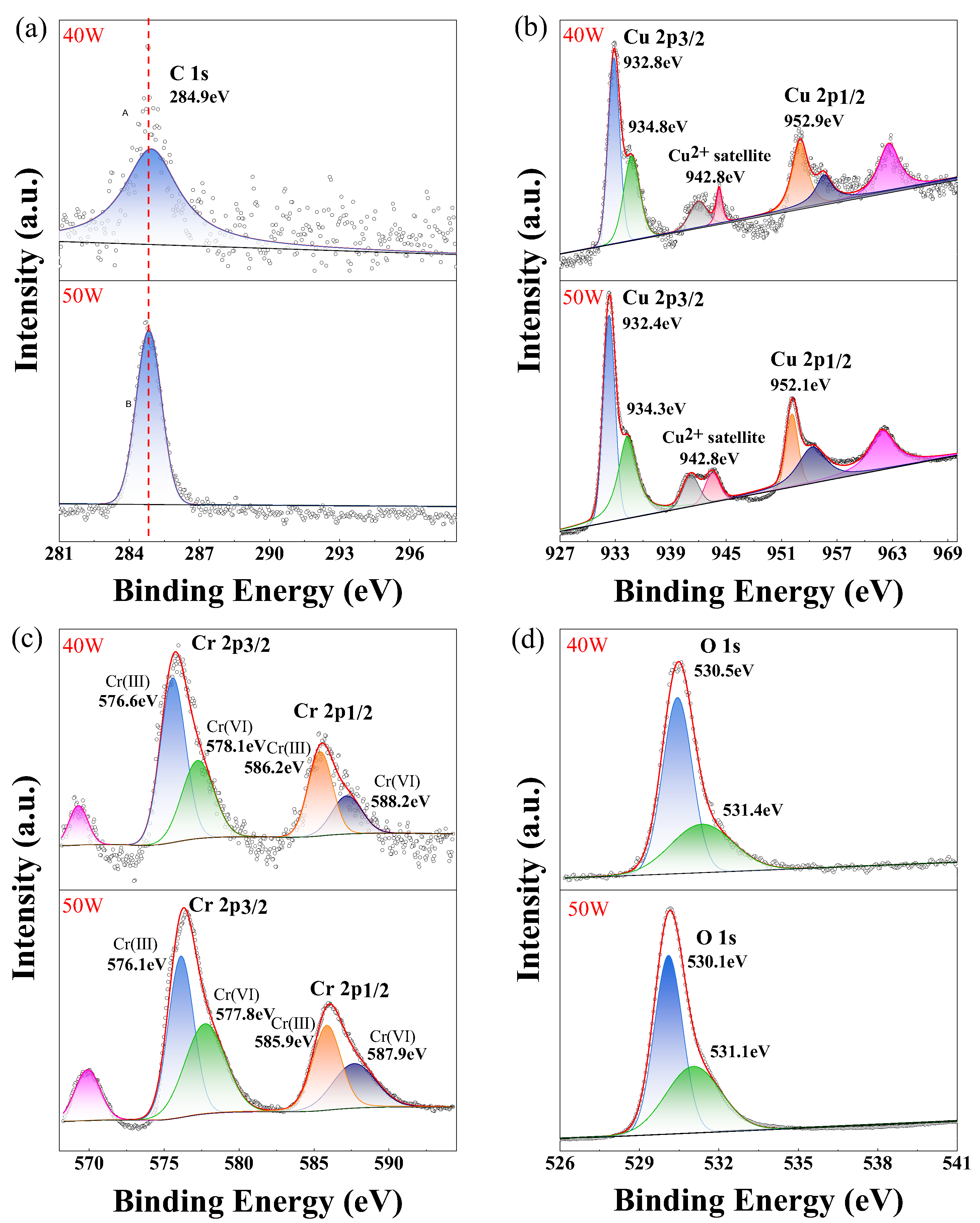
The chemical composition and electronic states of the glass/CuCrO2 thin films were characterized by X-ray photoelectron spectroscopy (XPS). The XPS survey spectra of CuCrO2 films deposited at room temperature with the sputtering powers of 40 W and 50 W show that the samples contain Cu, Cr, and O. The atomic percentages of Cu, Cr, and O were 21.48%, 20.50%, and 58.02%, respectively. Figure 4 displays the deconvoluted high-resolution XPS spectra of Cu 2p, Cr 2p, and O 1s for CuCrO2 films deposited at 40 W and 50 W. For both samples, the Cu 2p1/2 peak appears at approximately 952 eV, while the Cu 2p3/2 peak is located at around 932 eV [26,27,28]. The Cu 2p3/2 peak can be deconvoluted into two peaks: the stronger one, at 932 eV, corresponds to Cu+ cations, and the weaker one, at 934 eV, represents Cu2+ cations [26,27,28]. Previous studies [26,27,28] have demonstrated that copper chromium oxides primarily exist in two distinct phases: delafossite CuCrO2 and spinel CuCr2O4. In CuCrO2, copper exists in the +1 oxidation state (Cu1+), whereas in CuCr2O4, it is in the +2 oxidation state (Cu2+). These two copper oxidation states exhibit markedly different core-level spectral characteristics: Cu2+ spectra display intense shake-up satellite peaks, while such satellite features are absent in Cu1+ spectra, and these spectral differences serve as a reliable fingerprint for distinguishing these two copper oxidation states in mixed-phase systems [26,27,28]. As observed in Figure 4, the Cu 2p high-resolution XPS spectra of samples prepared at 40 W and 50 W exhibit similar satellite peaks at 943 eV. These results demonstrate the coexistence of both Cu+ and Cu2+ cations in the films, with the Cu2+ oxidation state likely originating from the CuCr2O4 phase. In the spectra in Figure 4c, the Cr-2p doublet can be observed. The Cr 2p1/2 and Cr 2p3/2 peaks are approximately at 586 eV and 576 eV, implying that the Cr in the films is at +3 [27,28]. Two peaks are observed in the deconvoluted O-1s high-resolution XPS spectra (Figure 4d). The major peak at about 530 eV corresponds to lattice oxygen, while the minor one at about 531 eV is due to adsorbed oxygen species [27].
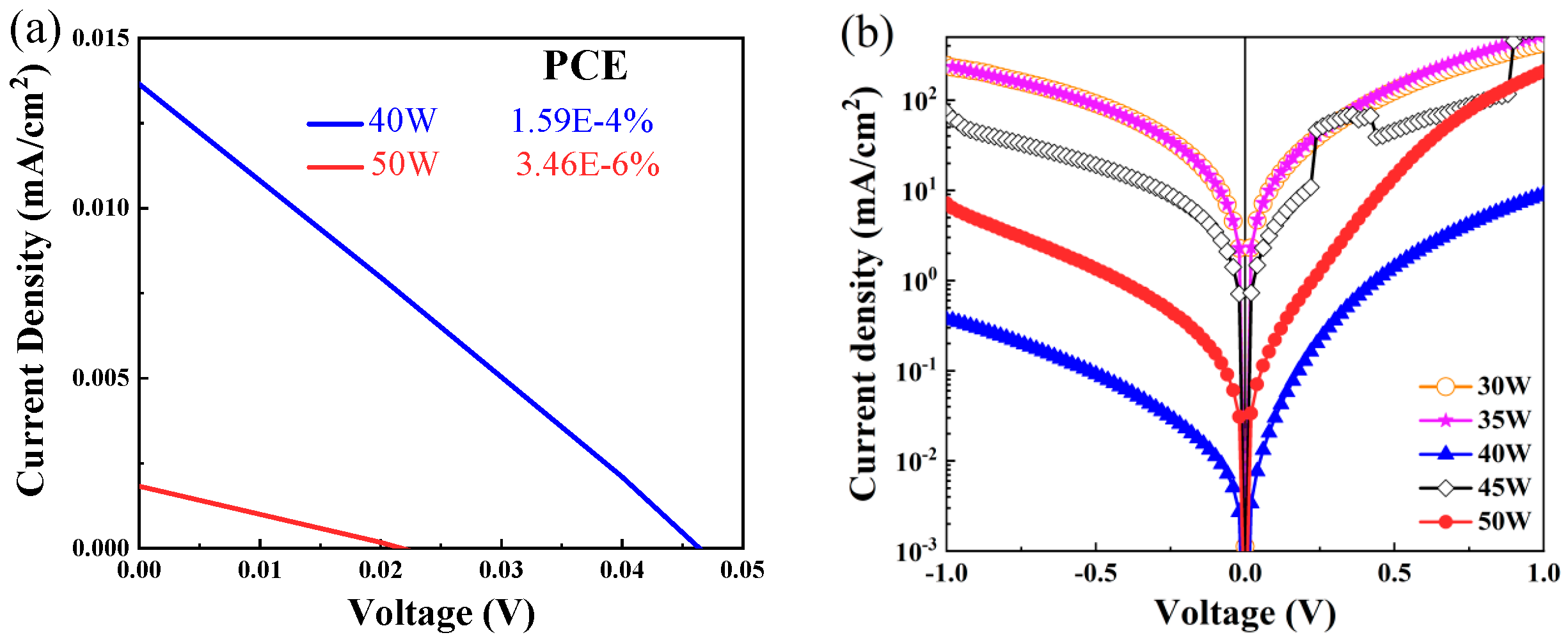
The illuminated and dark JV curves of CuCrO2-ZnSnN2 heterojunctions were measured and are presented in Figure 5. Only the heterojunctions deposited at 40 W and 50 W have photo-induced currents (Figure 5a). From the dark JV curves of all the samples (Figure 5b), rectification is observed. The heterojunction prepared at 40 W demonstrates a power conversion efficiency (PCE) of 1.88 × 10⁻⁴% with an open voltage (VOC) of 0.046 V, fill factor (FF) of 29.209%, and short-current density (JSC) of 0.014 mA/cm2, while the 50 W sample shows a PCE of 7.27 × 10⁻⁶% (VOC = 0.022 V, FF = 16.529%, JSC = 0.002 mA/cm2). The low PCE possibly mainly resulted from the band gap, which was not the optimal one. The thickness of ZnSnN2 was also insufficient. As shown in Figure 5b, all heterojunctions fabricated with sputtering powers ranging from 30 W to 50 W exhibited effective rectifying characteristics, confirming the formation of functional heterojunctions.
According to the single-diode model [29], the JV relation is
J = J 0 exp [ q A k T ( V J R ) ] + G V J L .
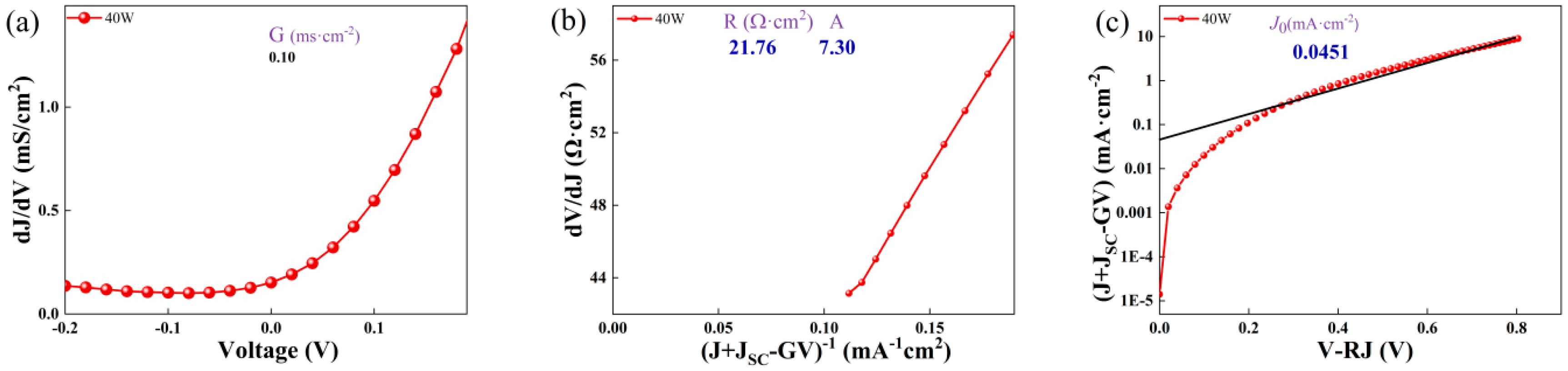
Here, J0 represents the diode saturation current, q denotes the elementary charge, A stands for the ideality factor, k is the Boltzmann constant, T indicates temperature, R is the series resistance, G refers to the shunt conductance, and JL is the light-induced current density. The method to extract these parameters is shown in Figure 6 (assuming JL = 0 for dark JV curves). The shunt conductance (G) values can be extracted from the plateau regions of the dJ/dV versus V curves (Figure 6a). Subsequently, through the analysis of the dV/dJ versus (J + JSC-GV)−1 curves (Figure 6b), the values of the series resistance (R) and ideality factor (A) can be obtained, with the y-axis intercept providing the R value and the slope of AkT/q yielding the A value. Furthermore, the reverse saturation current (J0) was extracted from the ln(J + JSC-GV) versus V-RJ curves (Figure 6c). The obtained parameters for the four heterojunctions are summarized in Table 1.
As shown in Table 1, the samples deposited at 40 and 50 W have lower G and J0 compared with those deposited at 30 and 35 W, indicating lower defect densities both within the CuCrO2-ZnSnN2 layer and at its front/back interfaces, and suggesting improved carrier transport and reduced current leakage pathways. Smaller series resistance, R, corresponds to lower back-contact resistance and reduced back-contact potential barriers in solar cell devices. The samples deposited at 40 W have larger R values at 40 W, and this accounts for their significant VOC losses and low fill factors (FF (%)) [19,30]. The ideality factors (A) exceeding 2 for the samples deposited at 40 and 50 W possibly indicate significant recombination and interface defects at the CuCrO2-ZnSnN2 interface. Of the four parameters, only the reverse saturation current (J0) differs by orders of magnitude. This substantial variation in J0 dominates the device performance, explaining why the samples deposited under 40 and 50 W conditions had photo-induced currents, as well as why the photovoltaic conversion efficiency of the heterojunction deposited at 40 W was higher than that at 50 W.
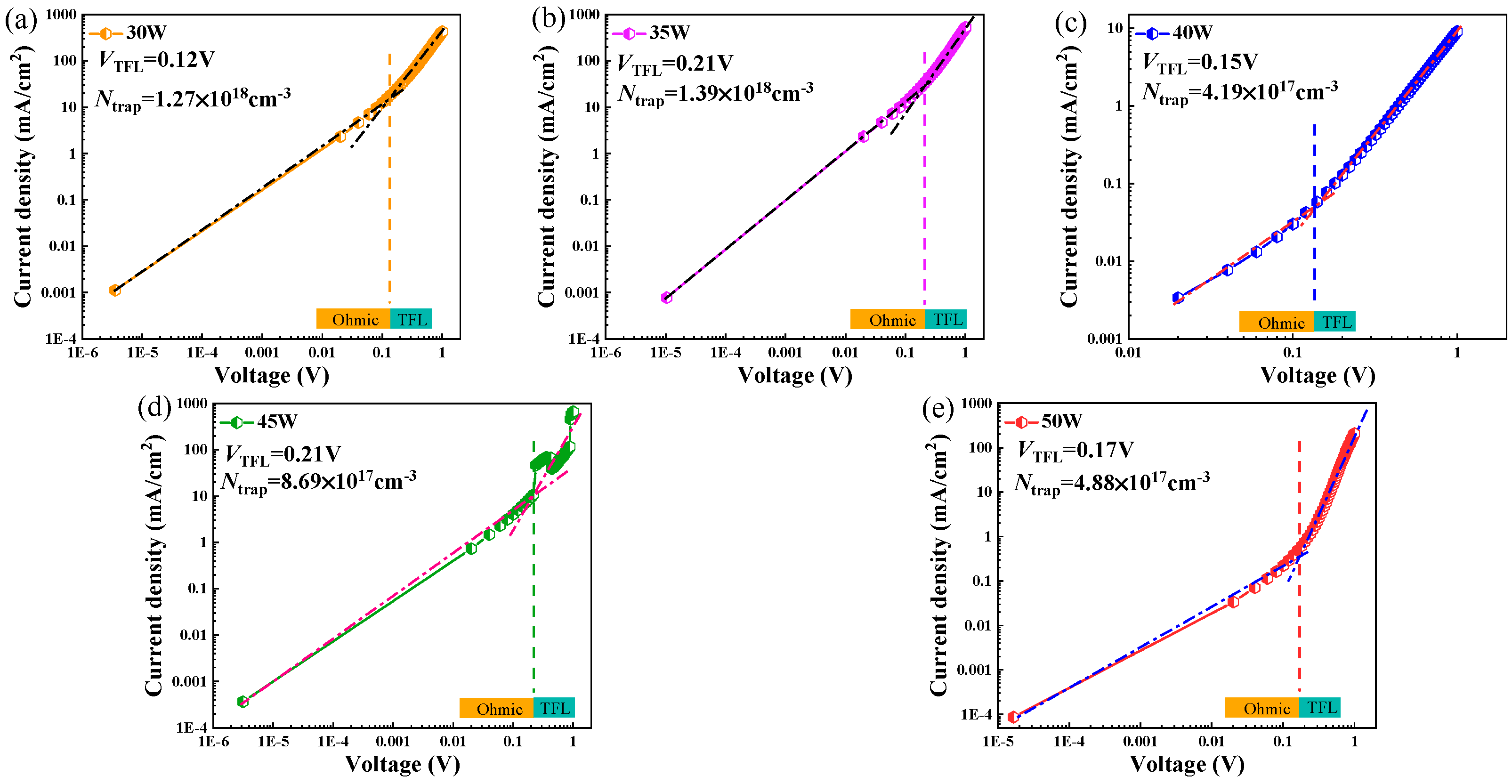
From the forward-bias logarithmic JV curves of these samples (Figure 7), two regions can be clearly identified. In the low-voltage region (below about 0.14 V), the slope of the curve is close to 1, which clearly indicates that current is ohmic and controlled by the pn junction. As the voltage increases, the slope of the curve increases over 2, indicating the current is space-charge-limited (SCL) or in the mode of the trap filling limit (TFL) effect [19,31]. In this mode, the trap density Ntrap can be estimated according to the following equation:
N t r a p = 2 ε 0 ε r V T F L q L 2 .
Here, L is the thickness of the CuCrO2 film, ε0 is the vacuum dielectric constant, εr (9.5 [32]) is the relative dielectric constant, and VTFL is the critical voltage for the presence of TFL. The value of VTFL can be read in Figure 7, and the trap densities (Ntrap) of the heterojunctions deposited at 30 to 50 W were calculated to be 1.27 × 10¹⁸, 1.39 × 10¹⁸, 4.19 × 10¹⁷, 8.69 × 10¹⁷, and 4.88 × 1017 cm−3, respectively. Since the effect of the ZnSnN2 layer was ignored during the calculation, the calculated trap density can only be used as an order-of-magnitude estimation. The samples deposited at 40 W and 50 W had smaller trap densities.
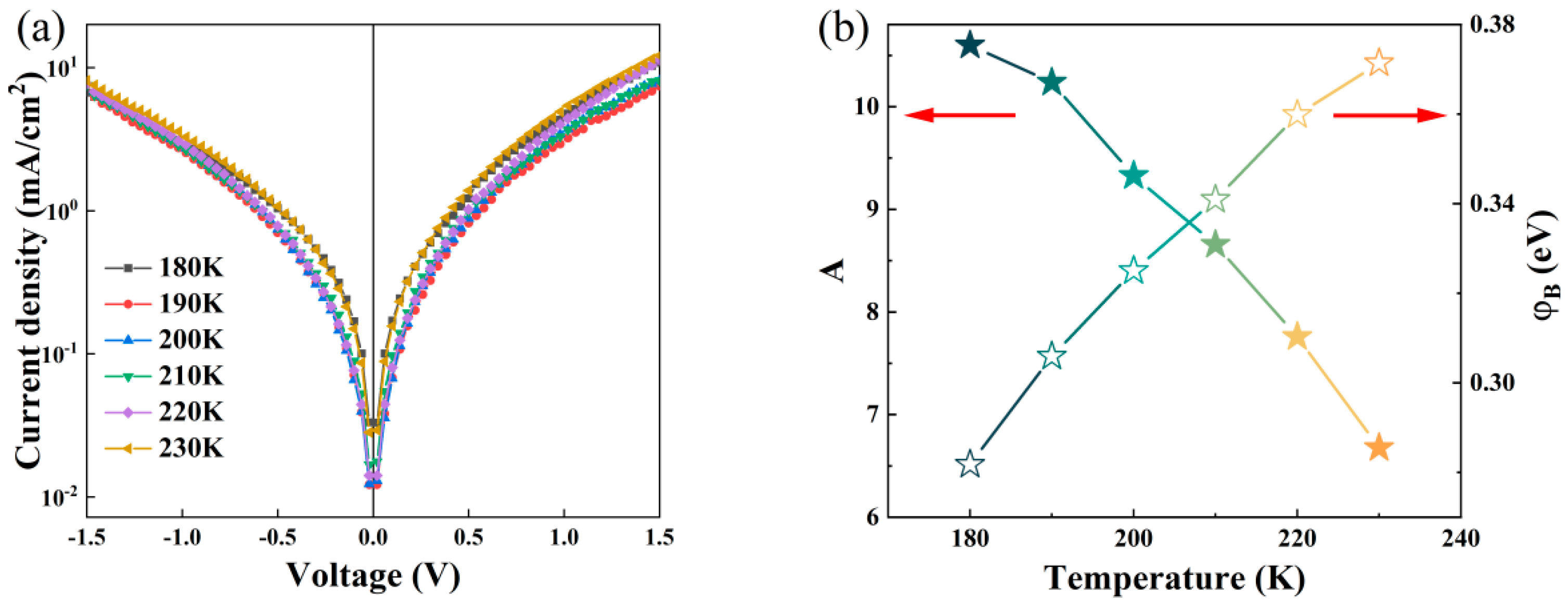
Dark JV measurements under varying temperatures were performed on the CuCrO2-ZnSnN2 heterojunction with CuCrO2 deposited at 40 W (Figure 8a). According to the thermionic emission (TE) model [33], the JV relationship is
J = J 0 exp ( q V A k T ) [ 1 exp ( q V k T ) ] ,
where J0 represents the saturation current density, and other parameters are the same as previously defined. The saturation current density J0 can be expressed as
J 0 = A * * T 2 exp ( q φ B k T ) .
Here, φB is the barrier height, while A** represents the effective Richardson constant (the Richardson constant A** is given by 4 π q m * k 2 h 3 ; m* is the effective mass of charge carriers and m* = 3.8m0, where m0 is the electron rest mass [34]).
From Equation (3), Equation (5) can be obtained as follows:
l n { J / [ 1 e x p ( q V k T ) ] } = q V A k T + l n J 0 .
The temperature-dependent JV curves of the sample can be processed according to Equation (5). From the slope of l n { J / [ 1 e x p ( q V k T ) ] } versus V curves, the ideality factor A can be obtained, while the saturation current density J0 can be obtained from the intercept on the vertical axis. The barrier height φ B can then be calculated according to Equation (4). The obtained ideality factor A and barrier height φ B are in Figure 8b.
The barrier height increases while the ideality factor decreases with an increase in temperature, implying barrier height inhomogeneity. The reduction in the ideality factor indicates significant suppression of interface recombination effects at elevated temperatures. This decreasing trend primarily originates from the defect state density distribution characteristics at the CuCrO2-ZnSnN2 heterojunction interface. At low temperatures, unsaturated dangling bonds at the interface form recombination centers, resulting in a larger ideality factor A. With increasing temperature, the thermal activation of carrier filling of interface states leads to gradual passivation of recombination channels, thereby reducing the A value [35]. The anomalous increase in the barrier height ( φ B ) primarily originates from the spatial inhomogeneity of barrier potential, coupled with dielectric confinement effects and transitions in carrier transport mechanisms [36]. As temperature increases, the enhanced interfacial polarization effect partially offsets the image-force-induced barrier lowering, resulting in a net increase in the apparent barrier height. At lower temperatures, the conduction is dominated by variable-range hopping (VRH) through low-barrier defect clusters, while rising temperatures broaden the carrier energy distribution, enabling thermally activated carriers to overcome higher potential barriers and extend current pathways to higher-barrier regions. This transition in transport mechanisms effectively modifies the statistical weighting of the conduction channels, leading to the observed increase in φ B , which fundamentally reflects the intrinsic inhomogeneity of the barrier height distribution at the heterointerface [36].
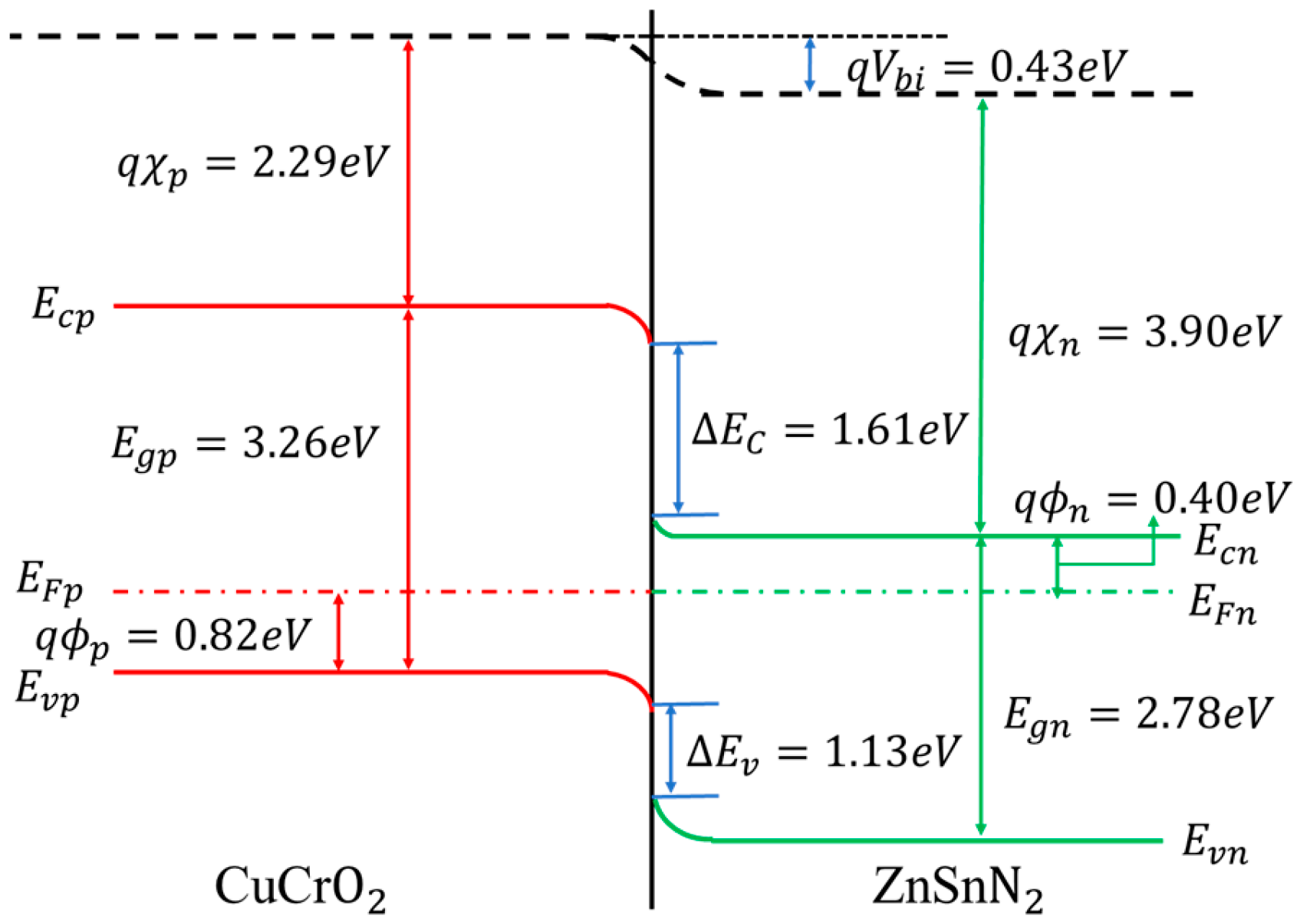
Figure 9 shows the energy band diagram of CuCrO2-ZnSnN2. The band gap of ZnSnN2 is 2.78 eV. The electron concentration of ZnSnN2 is 9.63 × 1017 cm−3, and the energy difference between the conduction band minimum and Fermi level (EC − EF) is calculated to be 0.40 eV [18,37]. For the p-type CuCrO2 thin films, the effective hole mass is mp* = 3.8m0 [38]. At room temperature, the effective density of states in the valence band (NV) is 4.69 × 1019 cm−3. The energy difference between the Fermi level and valence band maximum (EF − EV) is 0.82 eV with the hole concentration p0 = 1.07 × 1010 cm−3. The band gap of CuCrO2 thin films used here is 3.26 eV (which is near that used in the simulation [14]). The electron affinity of ZnSnN2 thin films is 3.90 eV [19,21,38], and that of CuCrO2 thin films is 2.29 eV [32]. With these parameters, the built-in potential is 0.43 eV. The conduction band offset is 1.61 eV and the valence band offset is 1.13 eV. The large band offset will result in strong interface recombination, which could possibly be reduced with interfacial passivation layers such as AlN. The band diagram is not optimal to obtain high PCE. The band gap of ZnSnN2 here is much larger than the optimal band gap (1.5 eV) and this is the major reason for why the efficiency is much lower than the calculated results [12,13,14]. Another reason is that both CuCrO2 and ZnSnN2 lack crystallinity. This results in lower mobility, larger defect density, and, finally, poorer photovoltaic performance. More work is needed in optimizing the properties of both CuCrO2 and ZnSnN2 in order to improve the PCE of CuCrO2-ZnSnN2 heterojunctions.

4. Conclusions

In summary, firstly, the preparation of CuCrO2 was studied. CuCrO2 thin films were prepared with DC magnetron sputtering at different sputtering powers. XRD showed that the as-deposited films were amorphous due to room temperature deposition. The optical band gap was in the range of 3.64–3.84 eV. XPS measurement showed that CuCrO2 was the dominant phase. CuCrO2 films were p-type conductive. Secondly, CuCrO2-ZnSnN2 heterojunctions with CuCrO2 deposited at different sputtering powers were prepared, and their properties were characterized. The dark JV curves of all the heterojunctions showed rectification, while the samples deposited at 40 and 50 W had photo-induced currents due to their relatively lower diode saturation current density, lower shunt conductance, and smaller trap density. The barrier heights of the heterojunctions were inhomogeneous, with the barrier height increasing and ideality factor decreasing as the measurement temperature increased. Since the device performance was poor, the extracted parameters, including diode parameters, trap densities, and barrier heights, might represent a relative trend rather than the absolute device quality. The energy band diagram of CuCrO2-ZnSnN2 heterojunctions was not optimal to obtain higher PCE, and further work is needed in optimizing the properties of CuCrO2 and ZnSnN2 in order to improve their PCE.

Author Contributions

Conceptualization, F.Y.; Formal analysis, W.-F.X.; Investigation, J.-L.L. and Y.-F.M.; Writing—original draft, F.Y.; Writing—review & editing, X.-M.C. and F.Y. All authors have read and agreed to the published version of the manuscript.

Funding

This work was financially supported by the National Natural Science Foundation of China (No.: 61674107).

Data Availability Statement

The original contributions presented in this study are included in the article. Further inquiries can be directed to the corresponding author.

Conflicts of Interest

The authors declare no conflicts of interest.

References

  1. Pk, J.S.; Shah, M.; Pradyumnan, P.P. Tailoring Structure and Nanoscale Surface Topography in Mg–N doped CuCrO2 Thin Films via Post Deposition Annealing for Optothermoelectric Application. Opt. Mater. 2024, 147, 114703. [Google Scholar] [CrossRef]
  2. Sanal, K.C.; Jayaraj, M.K. Room Temperature Deposited P-Channel Amorphous Cu1−xCrxO2−δ Thin Film Transistors. Appl. Surf. Sci. 2014, 315, 274–278. [Google Scholar] [CrossRef]
  3. Zhang, H.; Wang, H.; Zhu, H.; Chueh, C.; Chen, W.; Yang, S.; Jen, A.K.Y. Low-Temperature Solution-Processed CuCrO2 Hole-Transporting Layer for Efficient and Photostable Perovskite Solar Cells. Adv. Energy Mater. 2018, 8, 1702762. [Google Scholar] [CrossRef]
  4. Wang, S.; Wang, L.; Liu, C.; Shan, Y.; Li, F.; Sun, L. Spray Pyrolysis Deposition of CuCrO2 Films as Promising Inorganic Hole Transport Layers for Highly Efficient Perovskite Solar Cells. Energy Technol. 2022, 10, 2200518. [Google Scholar] [CrossRef]
  5. Sreeram, S.; Bharath, A.H.; Sundaram, K.B. Effect of Annealing Temperature on Radio Frequency Sputtered p-Type Delafossite Copper Chromium Oxide (CuCrO2) Thin Films and Investigation of Diode Characteristics Forming Transparent pn-Heterojunction. Coatings 2023, 13, 263. [Google Scholar] [CrossRef]
  6. Rabhi, S.; Hidouri, T.; Goumri-Said, S.; Alathlawi, H.J.; Alsulaim, G.M.; Waqas Alam, M. Bifacial Perovskite Solar Cells with >21% Efficiency: Computational Insights into Novel Htls Materials and Architectures. Sol. Energy 2024, 284, 113083. [Google Scholar] [CrossRef]
  7. Sun, C.; Tsai, D.; Chang, Z.; Chen, E.; Shieu, F. Structural. Optical, and Electrical Properties of Conducting P-Type Transparent Cu–Cr–O Thin Films. Ceram. Int. 2016, 42, 13697–13703. [Google Scholar] [CrossRef]
  8. Yu, R.; Wu, C. Characteristics of P-Type Transparent Conductive CuCrO2 Thin Films. Appl. Surf. Sci. 2013, 282, 92–97. [Google Scholar] [CrossRef]
  9. Cheng, W.; Cheng, P.; Sun, C.; Tian, Y.; Zhang, Y.; He, Y. Solution-Driven Epitaxial Structure Formation of the Delafossite CuCrO2 Thin Film. Cryst. Growth Des. 2025, 25, 4700–4704. [Google Scholar] [CrossRef]
  10. Li, Y.; Lin, J.; Tian, C.; Wang, X.; Wei, S.; Zhang, G.; Zhang, F.; Yang, W. First Demonstration of CuCrO2/β-Ga2O3 p-n Heterojunction Diode With High Breakdown Voltage and Low Leakage Current. IEEE Trans. Electron. Devices 2025, 72, 4005–4010. [Google Scholar] [CrossRef]
  11. Shah, A.A.; Parveen, A.; Alvi, P.A.; Azam, A. Low Temperature Synthesis and Effect of Co Doping on Structural, Optical and Dielectric Properties of CuCrO2 Hexagonal Nanoplates. Ceram. Int. 2020, 46, 19827–19834. [Google Scholar] [CrossRef]
  12. Arca, E.; Fioretti, A.; Lany, S.; Tamboli, A.C.; Teeter, G.; Melamed, C.; Pan, J.; Wood, K.N.; Toberer, E.; Zakutayev, A. Band Edge Positions and Their Impact on the Simulated Device Performance of ZnSnN2-Based Solar Cells. IEEE J. Photovolt. 2018, 8, 110–117. [Google Scholar] [CrossRef]
  13. Laidouci, A.; Aissat, A.; Vilcot, J.P. Numerical Study of Solar Cells Based on ZnSnN2 Structure. Sol. Energy 2020, 211, 237–243. [Google Scholar] [CrossRef]
  14. Ghadhab, B.N.M.; Bahrami, A. A Comprehensive Study on ZnSnN2-Based Solar Cells with Different Cu-Based Delafossite as Buffer Layers: A Numerical Analysis Using Scaps-1d. Sol. Energy Mater. Sol. Cells 2025, 289, 113675. [Google Scholar] [CrossRef]
  15. Punya, A.; Paudel, T.R.; Lambrecht, W.R.L. Electronic and Lattice Dynamical Properties of II-IV-N2 Semiconductors. Phys. Status Solidi C 2011, 8, 2492–2499. [Google Scholar] [CrossRef]
  16. Lewis, N.S. Research Opportunities to Advance Solar Energy Utilization. Science 2016, 351, 1920. [Google Scholar] [CrossRef]
  17. Quayle, P.C.; He, K.; Shan, J.; Kash, K. Synthesis, Lattice Structure, and Band Gap of ZnSnN2. MRS Commun. 2013, 3, 135–138. [Google Scholar] [CrossRef]
  18. Cai, X.; Wang, B.; Ye, F.; Vaithinathan, K.; Zeng, J.; Zhang, D.; Fan, P.; Roy, V.A.L. Tuning the Photoluminescence, Conduction Mechanism and Scattering Mechanism of ZnSnN2. J. Alloys Compd. 2019, 779, 237–243. [Google Scholar] [CrossRef]
  19. Ye, F.; He, C.; Wu, T.; Chen, S.; Su, Z.; Zhang, X.; Cai, X.; Liang, G. Sputtering Deposited and Energy Band Matched ZnSnN2 Buffer Layers for Highly Efficient Cd-Free Cu2ZnSnS4 Solar Cells. Adv. Funct. Mater. 2024, 34, 2402762. [Google Scholar] [CrossRef]
  20. Skrylev, A.; Nezhdanov, A.; Usanov, D.; Shestakov, D.; Baratta, M.; De Filpo, G.; Mashin, A. Raman Spectroscopy Study of Disorder in Cation Sublattice of Nonstoichiometric and Annealed ZnSnN2. Opt. Mater. 2024, 156, 116035. [Google Scholar] [CrossRef]
  21. Ye, F.; Zhao, Z.; He, C.; Liang, J.; Gao, Q.; Xie, Y.; Zhang, D.; Cai, X. Capacitance Characterization and Current Transport Mechanism of ZnSnN2 Heterojunctions. Appl. Phys. Lett. 2024, 125, 242102. [Google Scholar] [CrossRef]
  22. Kim, J.H.; Hwang, J.; Yoon, S.J.; Kim, J.; Lee, Y.K.; Park, K.; Lee, H.E. Monolithic Green-sensitive Photodetectors Enabled by a ZnSnN2/GaN Nanorods/Silicon Double Heterojunction. Inorg. Chem. Front. 2025, 12, 1958–1968. [Google Scholar] [CrossRef]
  23. Katayama-Yoshida, H.; Koyanagi, T.; Funashima, H.; Harima, H.; Yanase, A. Engineering of Nested Fermi Surface and Transparent Conducting p-type Delafossite CuAlO2: Possible Lattice Instability or Transparent Superconductivity? Solid State Commun. 2003, 126, 135–139. [Google Scholar] [CrossRef]
  24. Katayama-Yoshida, H.; Sato, K.; Kizaki, H.; Funashima, H.; Hamada, I.; Fukushima, T.; Dinh, V.A.; Toyoda, M. Ab Initio Materials Design for Transparent-Conducting-Oxide-Based New-Functional Materials. Appl. Phys. A 2007, 89, 19–27. [Google Scholar] [CrossRef]
  25. Banerjee, A.N.; Ghosh, C.K.; Chattopadhyay, K.K. Effect of Excess Oxygen on the Electrical Properties of Transparent p-type Conducting CuAlO2+x Thin Films. Sol. Energy Mater. Sol. Cells 2005, 89, 75–83. [Google Scholar] [CrossRef]
  26. Sun, H.; Arab Pour Yazdi, M.; Briois, P.; Pierson, J.F.; Sanchette, F.; Billard, A. Towards Delafossite Structure of Cu–Cr–O Thin Films Deposited by Reactive Magnetron Sputtering: Influence of Substrate Temperature on Optoelectronics Properties. Vacuum 2015, 114, 101–107. [Google Scholar] [CrossRef]
  27. Yu, R.; Wang, M. Plasma Annealing Effects on the Material Characteristics of Sputtering Deposited CuCrO2 Thin Films. ECS J. Solid State Sci. Technol. 2016, 5, 641–645. [Google Scholar] [CrossRef]
  28. Tsai, D.; Chang, Z.; Kuo, B.; Chen, C.; Chen, E.; Shieu, F. Influence of Chemical Composition on Phase Transformation and Optoelectronic Properties of Cu–Cr–O Thin Films by Reactive Magnetron Sputtering. J. Mater. Res. Technol. 2019, 8, 690–696. [Google Scholar] [CrossRef]
  29. Hegedus, S.S.; Shafarman, W.N. Thin-film Solar Cells: Device Measurements and Analysis. Prog. Photovolt. Res. Appl. 2004, 12, 155–176. [Google Scholar] [CrossRef]
  30. Tseberlidis, G.; Hasan Husien, A.; Riva, S.; Frioni, L.; Le Donne, A.; Acciarri, M.; Binetti, S. Semi-Transparent Cu2ZnSnS4 Solar Cells by Drop-Casting of Sol-Gel Ink. Sol. Energy 2021, 224, 134–141. [Google Scholar] [CrossRef]
  31. Buyukbas-Ulusan, A.; Altındal-Yerişkin, S.; Tataroğlu, A. Forward and Reverse Bias Current–Voltage (I–V) Characteristics in the Metal–Ferroelectric–Semiconductor (Au/SrTiO3/n-Si) Structures at Room temperature. J. Mater. Sci. Mater. Electron. 2018, 29, 16740–16746. [Google Scholar] [CrossRef]
  32. Huang, M.; Wang, Y.; Zhang, H.; Mao, M.; Cen, B.; Wang, T.; Zhang, Z.; Li, Q.; Liu, K.; Kong, P.; et al. O, N Co-doped CuCrO2 as Efficient Hole Transport Layer for High-Performance Ultraviolet Photodetectors. J. Alloys Compd. 2024, 971, 172743. [Google Scholar] [CrossRef]
  33. Roul, B.; Bhat, T.N.; Kumar, M.; Rajpalke, M.K.; Sinha, N.; Kalghatgi, A.T.; Krupanidhi, S.B. Barrier Height Inhomogeneities in InN/GaN Heterostructure Based Schottky Junctions. Solid State Commun. 2011, 151, 1420–1423. [Google Scholar] [CrossRef]
  34. Sinnarasa, I.; Thimont, Y.; Presmanes, L.; Barnabe, A.; Tailhades, P. Thermoelectric and Transport Properties of Delafossite CuCrO2:Mg Thin Films Prepared by RF Magnetron Sputtering. Nanomaterials 2017, 7, 157. [Google Scholar] [CrossRef]
  35. Werner, J.H.; Güttler, H.H. Barrier Inhomogeneities at Schottky Contacts. J. Appl. Phys. 1991, 69, 1522–1533. [Google Scholar] [CrossRef]
  36. Simmons, J.G. Generalized Formula for the Electric Tunnel Effect between Similar Electrodes Separated by a Thin Insulating Film. J. Appl. Phys. 1963, 34, 1793–1803. [Google Scholar] [CrossRef]
  37. Ye, F.; Hong, R.; Qiu, Y.; Xie, Y.; Zhang, D.; Fan, P.; Cai, X. Nanocrystalline ZnSnN2 Prepared by Reactive Sputtering, Its Schottky Diodes and Heterojunction Solar Cells. Nanomaterials 2023, 13, 178. [Google Scholar] [CrossRef]
  38. Javaid, K.; Yu, J.; Wu, W.; Wang, J.; Zhang, H.; Gao, J.; Zhuge, F.; Liang, L.; Cao, H. Thin Film Solar Cell Based on ZnSnN2/SnO Heterojunction. Phys. Status Solidi RRL 2018, 12, 1700332. [Google Scholar] [CrossRef]
Figure 1. The cross-sectional diagram of the CuCrO2-ZnSnN2 heterojunction (glass\ITO\ZnSnN2\CuCrO2\InSn).
Nanomaterials 16 00416 g001
Figure 2. (a) The XRD patterns of CuCrO2 films deposited at room temperature; (b) the XRD pattern of ZnSnN2 thin film.
Nanomaterials 16 00416 g002
Figure 3. The transmittance and Tauc plots of the samples deposited at different sputtering powers. (a) Transmittance spectra; (bf) the Tauc plots of the samples with CuCrO2 deposited at 30–50 W. The transmittance (g) and reflectance spectrum (h) of ZnSnN2; (i) the Tauc plot for ZnSnN2.
Nanomaterials 16 00416 g003aNanomaterials 16 00416 g003b
Figure 4. High-resolution XPS energy spectra of C, Cu, Cr, and O elements in the films deposited at 40 W and 50 W. (a) C; (b) Cu; (c) Cr; (d) O.
Nanomaterials 16 00416 g004
Figure 5. (a) The illuminated JV curves of CuCrO2-ZnSnN2 heterojunctions deposited at 40 W and 50 W; (b) the dark JV curves of all the CuCrO2-ZnSnN2 heterojunctions.
Nanomaterials 16 00416 g005
Figure 6. The analysis curves to extract the parameters of the CuCrO2-ZnSnN2 heterojunction deposited at 40 W. (a) dJ/dV–V curve; (b) dV/dJ–(J + JSC-GV)−1 curve; (c) ln(J + JSC-GV)–(V-RJ) curve.
Nanomaterials 16 00416 g006
Figure 7. The forward-biased logarithmic JV curves of CuCrO2-ZnSnN2 heterojunctions fabricated under different sputtering powers. (a) 30 W; (b) 35 W; (c) 40 W; (d) 45 W; (e) 50 W.
Nanomaterials 16 00416 g007
Figure 8. (a) Dark temperature-dependent JV curves of the CuCrO2/ZnSnN2 heterojunction deposited at 40 W. (b) The ideality factor A and the barrier height φ B .
Nanomaterials 16 00416 g008
Figure 9. The energy band diagram of the CuCrO2-ZnSnN2 heterojunction.
Nanomaterials 16 00416 g009
Table 1. The shunt conductance (G), series resistance (R), ideality factor (A), and reverse saturation current density (J0) of the CuCrO2-ZnSnN2 heterojunctions.
Sputtering Power (W)G (mS·cm−2) J 0 (mA·cm−2)R (Ω·cm2)A
301146.35 × 10−11.641.11
351146.90 × 10−11.301.14
400.104.51 × 10−221.767.30
501.494.82 × 10−21.373.52
Disclaimer/Publisher’s Note: The statements, opinions and data contained in all publications are solely those of the individual author(s) and contributor(s) and not of MDPI and/or the editor(s). MDPI and/or the editor(s) disclaim responsibility for any injury to people or property resulting from any ideas, methods, instructions or products referred to in the content.