Next Article in Journal
Emerging Material Paradigm: Strategic Optimization of Spinel Oxides as High-Performance Air Electrodes for Nanostructured Ceramic Fuel Cells
Previous Article in Journal
Development and Application of a 3D-Printed Microfluidic Sulfide-Selective Sensor for Online Monitoring of a Hydrogenotrophic Sulfidogenic Bioreactor
 
 
Due to scheduled maintenance work on our servers, there may be short service disruptions on this website between 11:00 and 12:00 CEST on March 28th.
Article

Constructing Cu3P Quantum Dots/Cu-Doped ZnIn2S4 p-n Heterojunctions for Efficient Methanol Oxidation Coupled with Synchronous Hydrogen Generation


School of Materials Science & Engineering, Jiangsu University, Zhenjiang 212013, China
*
Authors to whom correspondence should be addressed.
Nanomaterials 2026, 16(3), 210; https://doi.org/10.3390/nano16030210
Submission received: 6 January 2026 / Revised: 2 February 2026 / Accepted: 4 February 2026 / Published: 6 February 2026
(This article belongs to the Special Issue Nanostructured Catalysts for Solar Energy Conversion)

Abstract

The solar-driven direct conversion of methanol to ethylene glycol, formaldehyde and simultaneous H2 generation is an appealing strategy for converting sunlight to chemical energy. However, the low efficiency and stability of the photocatalyst remain critical bottlenecks hindering the practical implementation of this reaction. Herein, we synthesized the Cu3P quantum dots/Cu-doped ZnIn2S4 p-n junction for efficient methanol oxidation and synchronous H2 generation. The highly dispersed Cu3P quantum dots promote electron–hole separation and furnish abundant catalytic sites. Moreover, the constructed p-n junction with a tight interface boosts the electron transfer, avoiding the serious photocorrosion of ZnIn2S4. Benefiting from these synergistic effects, the 2Cu3P/Cu0.5ZIS composite exhibits the highest photocatalytic conversion efficiency of methanol, yielding H2, formaldehyde, and ethylene glycol with 10.34 mmol·g−1·h−1, 10.35 mmol·g−1·h−1 and 8.84 mmol·g−1·h−1 yields, which are 3.01, 3.05 and 3.10 times those of pure ZnIn2S4, respectively. A series of characterizations including X-ray diffraction, X-ray photoelectron spectroscopy, transmission electron microscopy and UV-Vis diffuse reflectance spectroscopy are employed to analyze the structure, composition, and photoelectrochemical properties of the materials. This work demonstrates a novel catalyst design paradigm for the high-efficiency solar light-driven photocatalytic activation of methanol enabling the co-production of value-added C1/C2 oxygenates and clean H2 fuel simultaneously.

Graphical Abstract

1. Introduction

The surging global demand for solar-powered clean energy and high-value chemicals has spurred intensive research aimed at addressing the pressing challenges of environmental sustainability and energy utilization [1,2,3,4,5,6,7,8]. As a versatile renewable C1 building block and an appealing hydrogen (H2) carrier, methanol can be transferred into high-value products (ethylene glycol and formaldehyde) and H2 energy via redox reactions [9,10,11]. However, existing strategies for the conversion of methanol to organic products (ethylene glycol and formaldehyde) and H2 always show limited activity and poor catalyst stability [12,13]. Thus, there is an urgent need to design highly efficient and stable photocatalysts for simultaneous oxidation and reduction of alcohols.
Sulfide semiconductors have emerged as highly promising materials in different fields such as photocatalysis, photoelectrocatalysis, gas sensing, environmental remediation, etc., owing to their favorable band structures, excellent light absorption capability, and tunable morphologies [14,15,16,17,18]. Among these, ZnIn2S4 is a crucial ternary chalcogenide semiconductor, which has shown potential in the activation of alcohol molecules [19,20]. Like most pure-phase semiconductors, ZnIn2S4 suffers from high exciton binding energy and low carrier mobility, which lead to low reactivity, while severe photocorrosion restricted its practical application [21,22]. To overcome these limitations, a series of strategies including doping, heterojunction construction and co-catalyst introduction have been put forward [23,24,25]. Recently, Li et al. designed a Ni-doped ZnIn2S4 for improving the photocatalytic performance of aromatic alcohol dehydrogenative coupling and synchronous H2 evolution via enhancing the light absorption and charge carrier separation [26]. Li et al. fabricated a 1T/2H MoSe2/ZnIn2S4 S-scheme heterojunction that enhances structural stability and charge separation, enabling efficient photocatalytic hydrogen evolution coupled with benzyl alcohol oxidation [27]. All these pioneering works indicate that doping engineering and heterojunction construction serve as the feasible approaches to enhance the performance of ZnIn2S4. Currently, most research efforts focus on a single strategy to enhance catalyst performance, and there are scarce reports on the simultaneous adoption of both approaches to address the issues of inferior catalytic activity and poor stability [28,29]. Indeed, constructing heterojunctions is also a viable method for achieving internal modification. The incorporation of copper atoms can effectively broaden the light absorption of the semiconductors and create more active sites (such as vacancies or metal-doped sites), thereby significantly enhancing its photocatalytic performance [30,31,32]. In addition, Cu3P quantum dots (QDs) as a p-type semiconductor can couple with the CuxZnIn2S4 which improves the redox ability and stability through promoting the charge transfer.
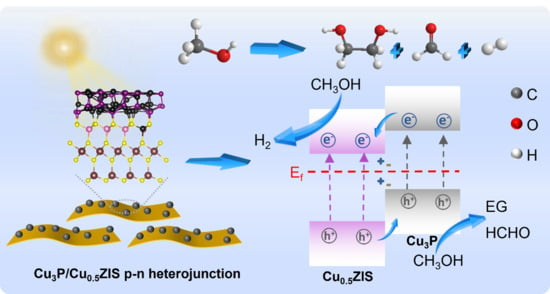
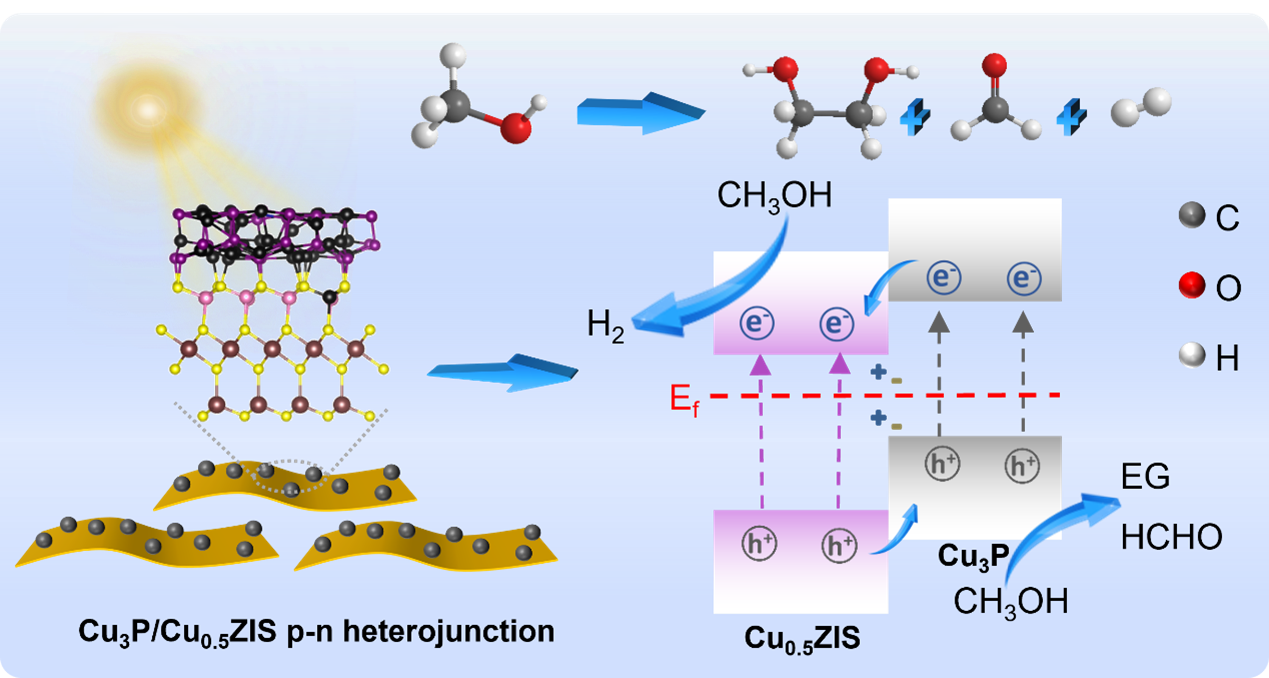
Herein, we constructed a p-n heterojunction composed of Cu-doped ZnIn2S4 nanosheet and Cu3P QDs for efficient methanol oxidation to ethylene glycol and formaldehyde and synchronous reduction to H2. As a result, the optimized 2Cu3P/Cu0.5ZIS composite achieved high yields of H2, formaldehyde, and ethylene glycol of 10.34 mmol·g−1·h−1, 10.35 mmol·g−1·h−1 and 8.84 mmol·g−1·h−1, which are 3.01, 3.05 and 3.10 times those of pure ZnIn2S4, respectively. The enhanced activity and stability may be due to the synergistic effect of Cu doping and p-n heterojunction construction, which not only promote the charge separation but also afford abundant spatially separated active sites. The Cu doping broadened the light absorption and created more vacancies. The tight interfacial contact not only improved the charge separation, thereby suppressing the photocorrosion of ZnIn2S4, but also provides oxidation reaction sites for methanol molecules, enhances charge transfer efficiency, and increases the surface electron concentration. This work demonstrates an effective strategy for constructing heterostructure photocatalysts with efficient photocatalytic methanol oxidation and synchronous H2 generation.

2. Experimental Section

2.1. Preparation of Cu3P QDs

The Cu3P QDs were synthesized via a calcination method. As is typical, 1 g CuCl2·H2O and 5 g NaH2PO2·H2O were mixed in a flask with continuous grinding for half an hour. Then, the mixture was transferred to a porcelain boat and kept at 300 °C in N2 atmosphere for 2 h. The crude product was then centrifuged and washed three times with deionized water. After vacuum drying at 60 °C for 24 h, the gray powder Cu3P quantum dots were obtained.

2.2. Preparation of ZnIn2S4 (ZIS) and CuxZnIn2S4 Nanosheets (CuxZIS, x = 0.3, 0.5 and 0.7)

The ZIS and CuxZIS nanosheets were synthesized according to our previously reported method. For the preparation of ZIS nanosheet, 175.6 mg Zn(Ac)2·2H2O, 469.1 mg InCl3·4H2O and 150 mg TAA were dissolved in 60 mL of a mixed solvent including deionized water and ethanol (volume ratio = 1:1) with stirring for 30 min. Then, the above solution was moved to a stainless steel autoclave and kept at 180 °C for 24 h. Upon cooling to 25 °C, the production was washed three times with ethanol and deionized water. Finally, ZIS was obtained by freeze-drying at 60 °C overnight. Similarly, CuxZIS nanosheets were also prepared by the above procedure, except that 0.3, 0.5 and 0.7 mL 0.1 M Cu(NO3)2 were added to the solution before the hydrothermal process, respectively.

2.3. Synthesis of Cu3P/CuxZIS Heterojunction

The Cu3P/CuxZIS compositions were synthesized via an electrostatic self-assembly process. Typically, 100 mg CuxZIS ultrathin nanosheets was added to 20 mL DMF with ultrasonic vibration for 30 min, adding a certain amount of Cu3P quantum dots (0.05, 0.10 and 0.15 mg·mL−1) and 20 mL ethanol into the above CuxZIS aqueous. After sonicating for 20 min, the resulting sample was washed twice with ethanol, and then dispersed in a 50 mL ethanol solution with stirring for 8 h. Conclusively, the samples were subjected to three ethanol washes and subsequent drying under a vacuum at 60 °C, yielding 1Cu3P/Cu0.5ZIS, 2Cu3P/Cu0.5ZIS, and 3Cu3P/Cu0.5ZIS, respectively.

2.4. Photocatalytic Activity

The photocatalytic reaction was carried out in a 20 mL sealed quartz-tube reactor under a 300 W Xe lamp. The solid catalyst powder (10 mg) was dispersed in 3 mL of mixture containing 2.5 mL methanol and 0.5 mL H2O. Before light irradiation, the reactor was evacuated by vacuum pump. Then, the photocatalytic reaction was carried out by continuous irradiation of the reactor with a full-spectrum Xe lamp for 6 h at 25 °C. After the reaction, the gaseous products were extracted and analyzed by an online gas chromatograph (Tian Mei GC-7900, argon as carrier gas), and the supernatant of the solution was extracted and analyzed by gas chromatography.
The detailed information for materials and material characterization can be seen in the supporting information.

3. Results and Discussion

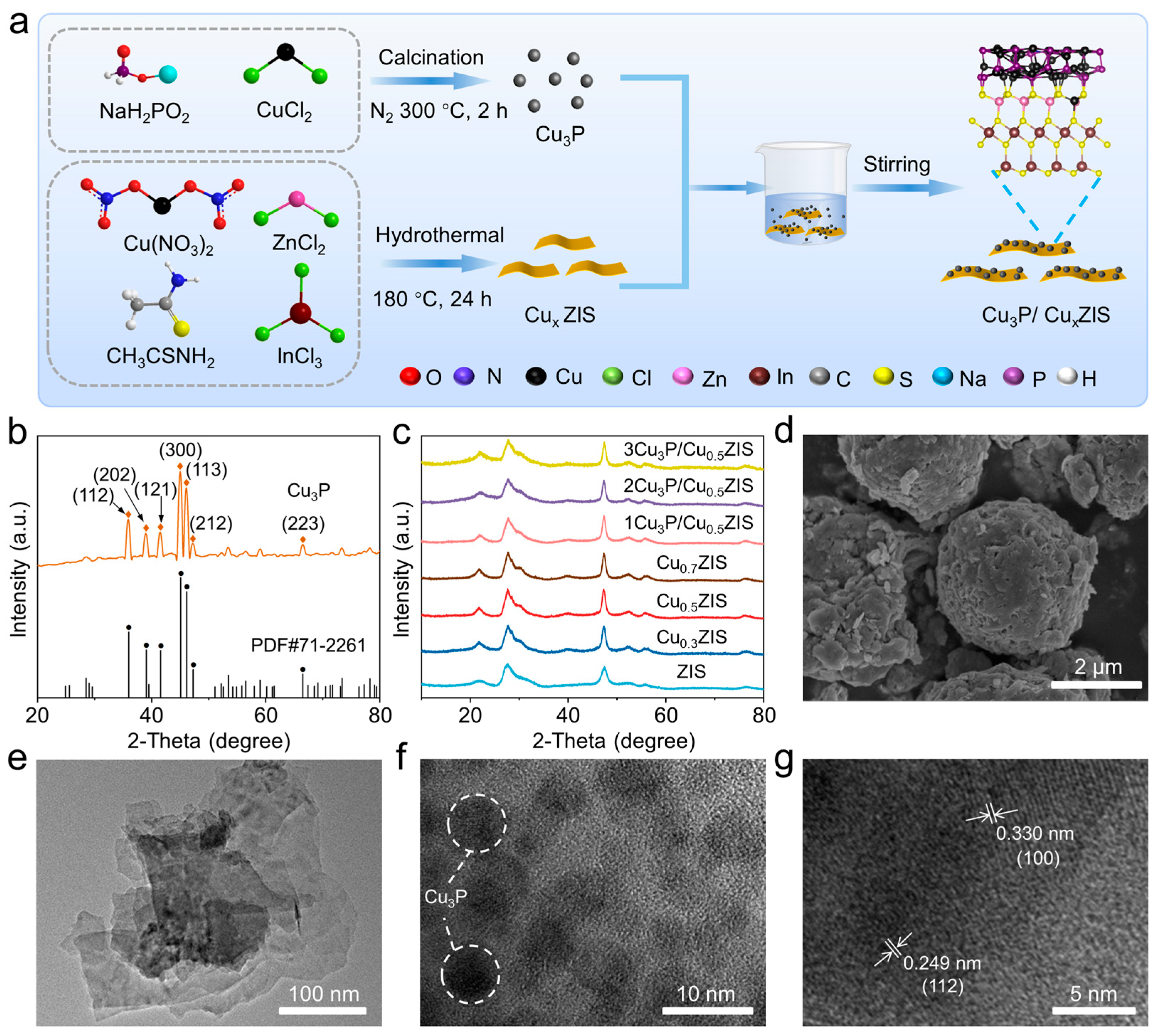
The synthesis of the 0D/2D Cu3P quantum dot CuxZIS nanosheet composites is illustrated in Figure 1a. The crystal structure and microstructures of the samples were clearly verified by X-ray diffraction (XRD) patterns, scanning electron microscopy (SEM) and transmission electron microscopy (TEM) measurements [33,34,35]. The peaks centered at 36.04°, 39.12°, 41.60°, 45.17°, 46.20°, 47.35° and 66.58° can be indexed to the (112), (202), (121), (300), (113), (212) and (223) crystal planes of a hexagonal phase of Cu3P (PDF#71-2261), respectively (Figure 1b) [36]. Compared with pure ZIS, no change is observed in the XRD patterns of CuxZIS (x = 0.3, 0.5 and 0.7), indicating that trace Cu atom doping did not change the crystal phase (Figure 1c) [37]. As shown in Figure 1d, pure ZIS exhibited 3D flower spheres composed of nanosheets. Different from the pristine ZIS flower spheres, the CuxZIS presented an ultrathin nanosheet morphology with an average size of around 100 nm after Cu doping, which exposed more active sites for photoreactions (Figure 1e). Cu3P was observed as quantum dot structures with an average size of 5 nm (Figure 1f). A TEM image of 2Cu3P/CuxZIS heterojunction indicated that Cu3P quantum dots deposited on the surface of CuxZIS nanosheets. The lattice spacing of CuxZIS nanosheets was 0.330 nm, corresponding to the (110) phase of ZIS (Figure 1g). The lattice spacing of 0.249 nm on Cu3P corresponds to the (112) face. Partially distorted lattice fringes can be observed in CuxZIS nanosheets, which were induced by Cu doping. Meanwhile, the crystalline Cu3P phase was found to be regularly dispersed in the vicinity of the ZIS distorted lattice, which serves as direct evidence that Cu doping directionally induces Cu3P deposition (Figures S1 and S2). The energy-dispersive X-ray (EDX) element mapping and HRTEM images in Figure S3 showed that Zn, In, S, Cu and P elements were uniformly distributed in the sample, which proved the successful synthesis of the 2Cu3P/Cu0.5ZIS heterojunction.
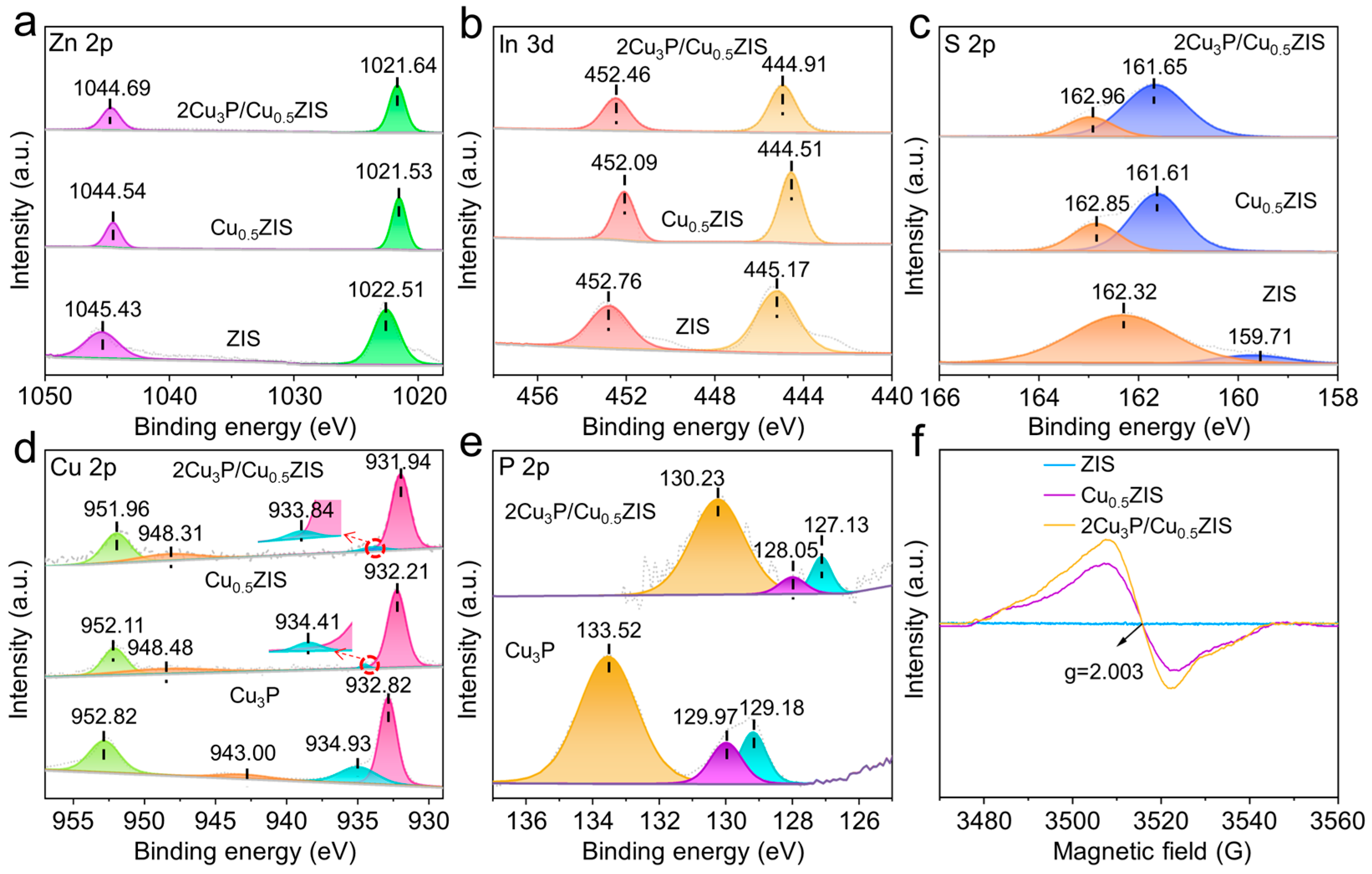
X-ray photoelectron spectroscopy (XPS) was also tested to investigate the chemical composition of these samples [38,39]. The survey spectra show the presence of Zn, In, S, P and Cu elements in the 2Cu3P/Cu0.5ZIS composites, confirming the successful synthesis (Figure S4). The high-resolution Zn 2p XPS spectroscopy showed two peaks located at 1022.51 and 1045.43 eV, belonging to the binding energy of Zn 2p3/2 and Zn 2p1/2, respectively (Figure 2a) [40]. The In 3d spectra revealed two peaks at 445.17 and 452.76 eV corresponding to the 3d3/2 and 3d1/2 signals of In, respectively (Figure 2b) [41]. The S 2p peaks of ZIS showed two peaks at 159.71 and 162.32 eV, attributed to S 2p3/2 and S 2p1/2, respectively (Figure 2c) [40]. The Zn 2p and In 3d peaks in Cu0.5ZIS shifted to lower bonding energy, while the peaks of S 2p in the Cu0.5ZIS show a higher bonding energy compared with pure ZIS. The results indicate that Cu doping can lead to the generation of S vacancies (Vs), which induced a rearrangement of charges on the ZIS surface and might be favorable for the loading of Cu3P. The Cu 2p XPS spectra of Cu3P can be deconvoluted into four peaks at 932.82, 934.93, 943.00 and 952.82 eV, corresponding to Cu 2p1/2 and Cu 2p3/2, respectively (Figure 2d) [42]. Three peaks at 129.18, 129.97 and 133.52 eV in P 2p XPS spectra can be found, which are ascribed to the P 2p3/2, P 2p1/2 and P-O bond, respectively (Figure 2e) [42]. In the Cu3P/Cu0.5ZIS composites, the signals for Zn 2p, In 3d and S 2p shifted toward higher bonding energies while the Cu 2p and P 2p signals shifted to the lower bonding energies compared to Cu0.5ZIS and Cu3P, respectively. A built-in electric field (IEF) is formed at the 2Cu3P/Cu0.5ZIS heterojunction interface directing from Cu0.5ZIS to Cu3P. In particular, the bonding energy of the P 2p3/2 peaks in the composite moved from 129.18 to 127.13 eV compared with pure Cu3P, indicating that the P ions were captured by the electron traps (Vs) in Cu0.5ZIS. Electron paramagnetic resonance (EPR) measurement was also conducted to analyze the formation of S vacancy (Vs). In Figure 2f, a strong signal at g = 2.003 was detected in the presence of Cu0.5ZIS, Cu3P and 2Cu3P/Cu0.5ZIS heterojunction, which accounts for the signal of Vs. No signal can be detected in ZIS. The above results indicated that the composition with an IEF at the interface will enhance the charge separation, affording high redox activity in the photocatalytic reactions.
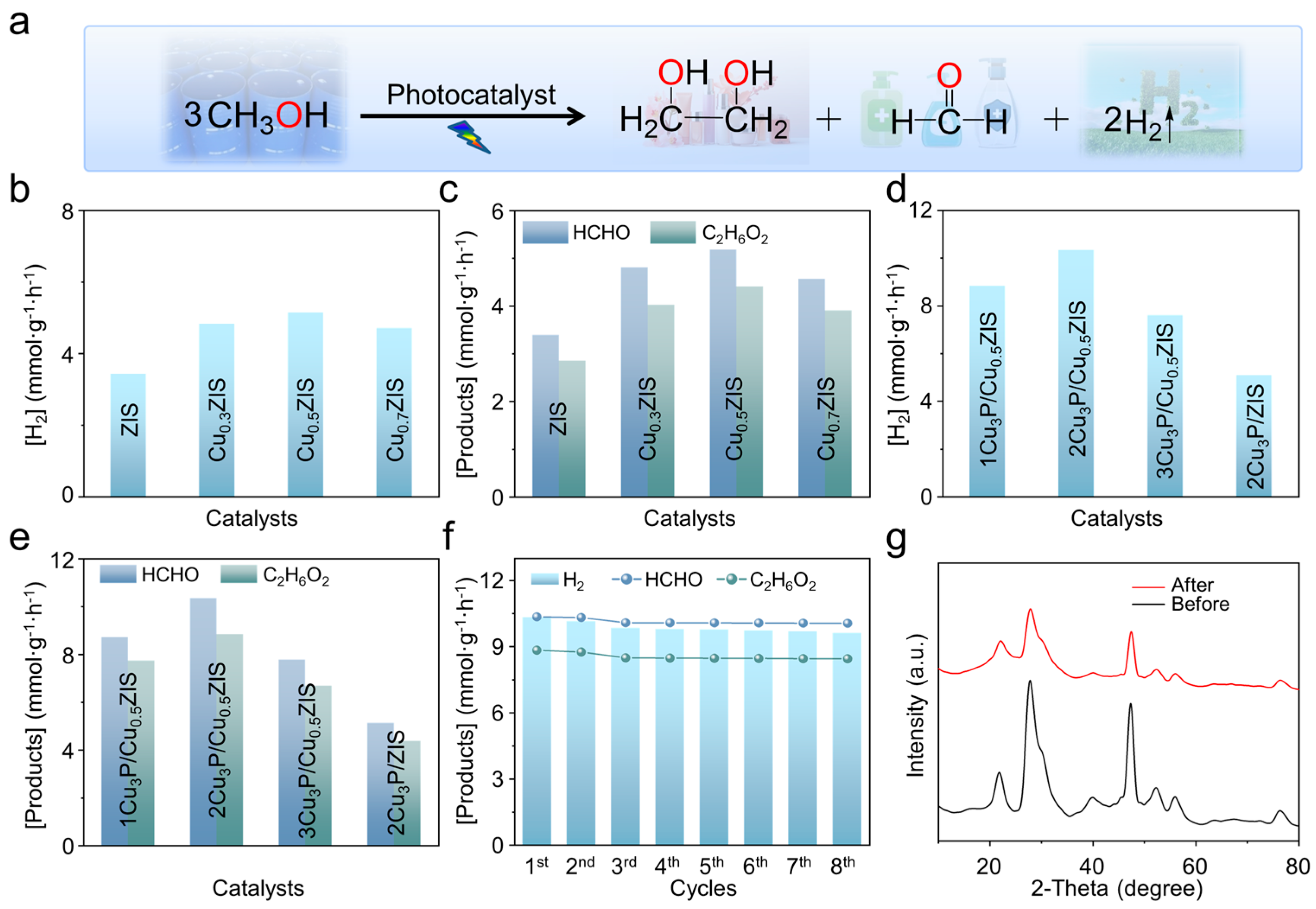
To analyze the photocatalytic activity of these samples, the methanol dehydrogenation coupling H2 evolution reaction (HER) was carried out under UV-Vis-NIR light irradiation (Figure 3a). As illustrated in Figure 3b–e, all samples could simultaneously activate methanol to give H2, formaldehyde and ethylene glycol. Under light irradiation, methanol undergoes a redox reaction, in which the generated H+ was reduced by the electrons to generate H2 while the intermediate reacted with photogenerated holes to generate formaldehyde and ethylene glycol through an oxidation and C-C coupling reaction, respectively. Pure ZIS shows the H2 production of 3.43 mmol·g−1·h−1. After a reaction period of 6 h, the production of formaldehyde and ethylene glycol was measured at 3.39 mmol·g−1·h−1 and 2.85 mmol·g−1·h−1, respectively. The rate of H2, formaldehyde and ethylene glycol production improves with increasing Cu dopant. The Cu0.5ZIS shows the highest HER rate of 5.14 mmol·g−1·h−1, 5.18 mmol·g−1·h−1 for formaldehyde production and 4.41 mmol·g−1·h−1 for ethylene glycol production, which are 1.50, 1.52 and 1.54 times that of pure ZIS. However, the photocatalytic performance of the photocatalyst decreases with excess Cu doping. Furthermore, the introduction of Cu3P quantum dots further enhanced the catalytic activity of the Cu0.5ZIS. The highest H2, formaldehyde and ethylene glycol production can reach 10.34 mmol·g−1·h−1, 10.35 mmol·g−1·h−1 and 8.84 mmol·g−1·h−1 in the presence of 2Cu3P/Cu0.5ZIS photocatalyst, which is 3.01, 3.05 and 3.10 times that of pure ZIS, respectively. In addition, the photocatalytic performance for 2Cu3P/Cu0.5ZIS is higher than that of 2Cu3P/ZIS, proving that Cu doping-induced Cu3P loading can effectively improve the photocatalytic activity of ZIS to achieve far more than the direct loading of ZIS by Cu3P (Figure 3d,e). The calculated selectivities for formaldehyde and ethylene glycol are 53.93% and 46.07%, respectively, with a high methanol molar balance of 99% (Table S1 and Formulas (S1) and (S2)). The methanol conversion can reach 3.02% according to Formula (S3). As shown in Figure S5, no formaldehyde, ethylene glycol, or H2 can be detected under dark, catalyst-free and pure-solvent conditions. Adaptive vacancies generated via Cu doping enable the site-specific deposition of Cu3P quantum dots in the Vs, which efficiently suppresses electron–hole recombination and thus accounts for the enhanced catalytic activity. To further test the stability of the catalyst, the long-term photocatalytic activity of 2Cu3P/Cu0.5ZIS sample was also tested. As shown in Figure 3f, the production can be retained with no obvious decrease even after 8 rounds of irradiation. No significant change can be detected in the XRD and TEM patterns of the samples before and after the reaction, while a 0.08% mass loss can be observed, indicating the outstanding photo-stability (Figure 3g and Figure S6, Table S2). Compared with the previously reported works, the 2Cu3P/Cu0.5ZIS sample in this work exhibits higher photocatalytic H2 evolution, formaldehyde and ethylene glycol production (Table 1). All these results indicate that the Cu incorporation and coupling with Cu3P can significantly enhance the photocatalytic activity of ZIS.
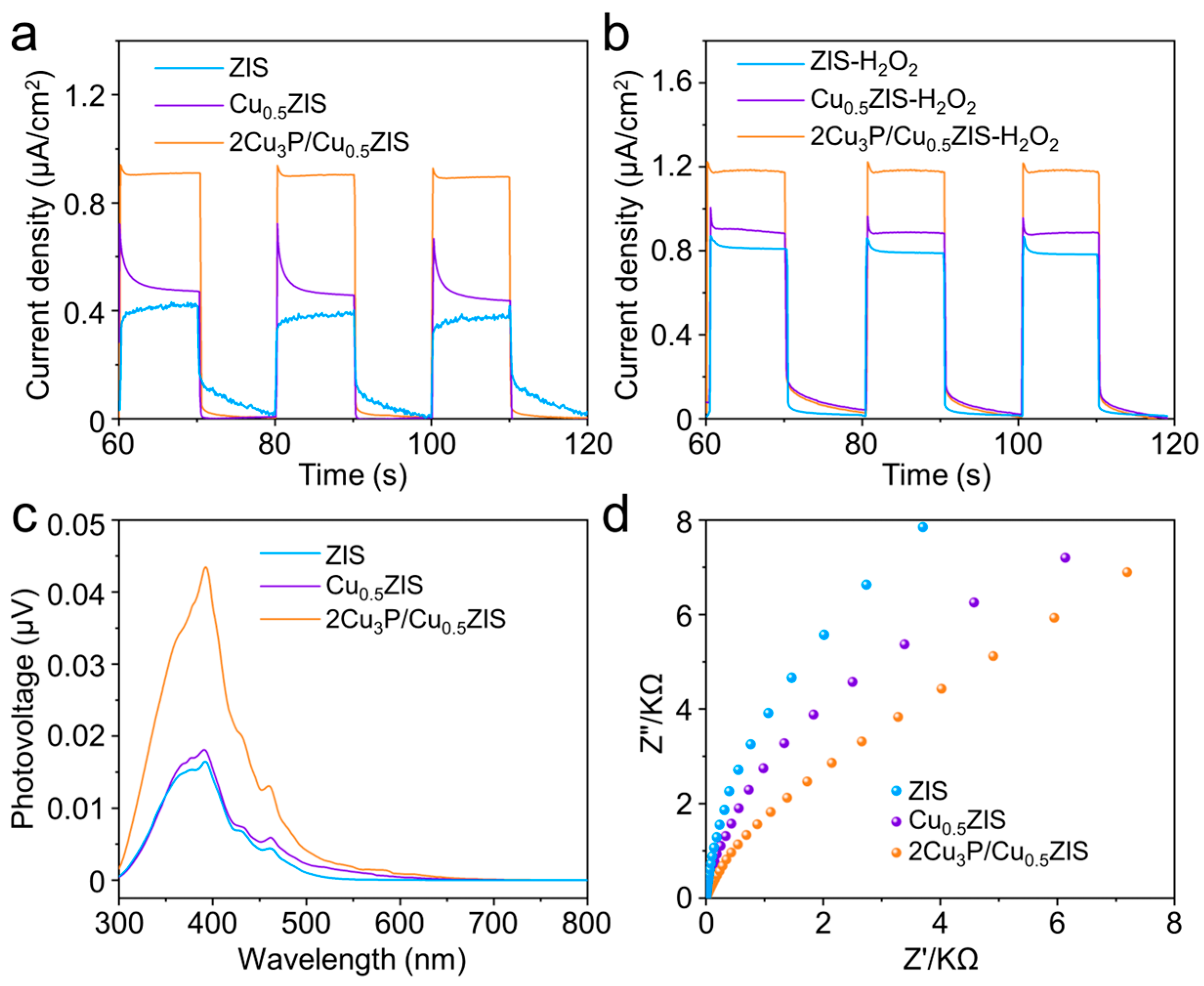
To elucidate the reason for the improved photocatalytic activity of 2Cu3P/Cu0.5ZIS composite, the charge separation efficiency for the samples was investigated by photocurrent (PC) response, surface photovoltage (SPV), linear sweep voltammetry (LSV) and electrochemical impedance spectroscopy (EIS) measurement. As displayed in Figure 4a, the 2Cu3P/Cu0.5ZIS showed the highest photocurrent intensity, while the ZIS showed the lowest intensity, indicating that Cu doping and coupling with Cu3P can effectively enhance the carrier separation of the ZIS. Simultaneously, the surface charge transfer efficiency (ηtrans) was investigated by adding a fast electron scavenger (H2O2) to the electrolyte solution. As expected, the photocurrent intensities of all samples increase with the addition of H2O2 (Figure 4b). The photocurrent intensity of ZIS, Cu0.5ZIS and 2Cu3P/Cu0.5ZIS increases from 0.41, 0.48 and 0.88 μA·cm−2 to 0.80, 0.89 and 1.18 μA·cm−2, respectively. Accordingly, the ηtrans values of ZIS, Cu0.5ZIS and 2Cu3P/Cu0.5ZIS samples were determined to be 51.3%, 54.0% and 74.5%, respectively, suggesting that the 2Cu3P/Cu0.5ZIS sample demonstrates faster carrier separation. The surface photovoltage (SPV) is also measured; compared with ZIS (0.016 μV) and Cu0.5ZIS (0.018 μV), a stronger photovoltage is observed in the 2Cu3P/Cu0.5ZIS sample, up to 0.043 μV (Figure 4c). The 2Cu3P/Cu0.5ZIS sample showed a lower overpotential than that of ZIS and Cu0.5ZIS, in the LSV curves, illustrating that the 2Cu3P/Cu0.5ZIS is more prone to HER (Figure S7). As shown in Figure 4d, the 2Cu3P/Cu0.5ZIS showed the smallest semicircle radius in EIS spectra, indicating that a Cu doping-induced Cu3P deposition strategy results in reduced interfacial charge transfer resistance between ZIS and Cu3P and accelerates carrier migration kinetics.
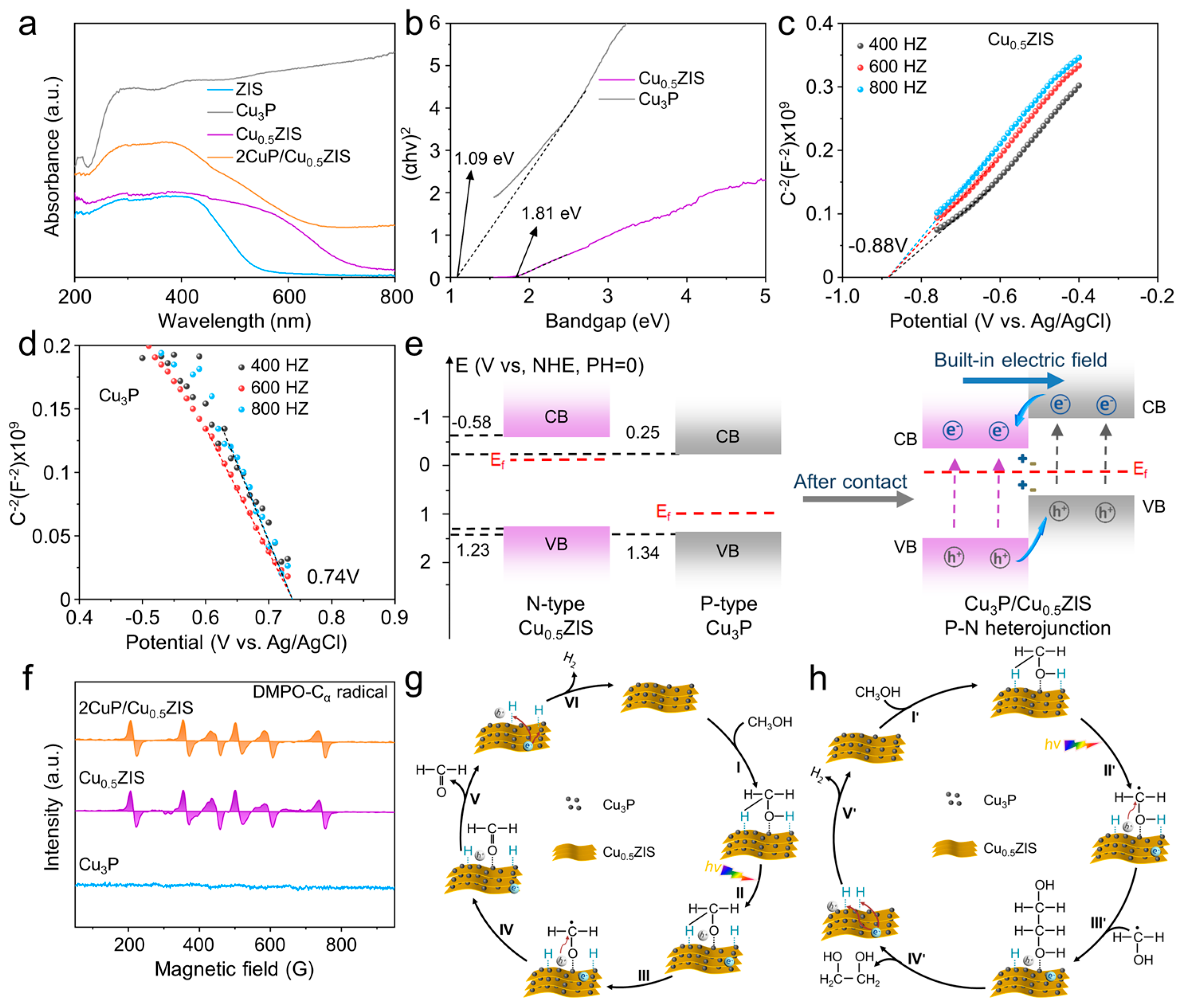
The light response and band structure of the samples were also tested. As shown in Figure 5a, the ZIS showed a wide light response range with an absorption edge at ~520 nm. After Cu doping, the adsorption edge of CuxZIS redshifted. The Cu3P quantum dots exhibit full-spectrum light-response ability. The loading of Cu3P quantum dots further enhances the light absorption of CuxZIS. The band gaps of ZIS and Cu0.5ZIS samples were calculated to be 2.43 and 1.81 eV via using the Kubelka–Munk function (detailed information can be seen in the supporting information), suggesting that Cu doping could narrow the band gap of ZIS nanosheets (Figure S8) [49,50,51]. The band gap of Cu3P is 1.09 eV (Figure 5b). The Mott–Schottky plots of Cu0.5ZIS and Cu3P processes show positive and negative slopes at different frequencies (at 400, 600, 800 Hz), revealing the n-type and p-type nature of the Cu0.5ZIS and Cu3P, respectively. Through the processing of these curves at three frequencies, the flat band potentials of Cu0.5ZIS and Cu3P were determined to be −0.88 V and 0.74 V, respectively (Figure 5c,d). The p-n type heterojunction was formed after interface contact between Cu3P and Cu0.5ZIS, inhibiting the recombination of electron–hole pairs (Figure 5e). When the Cu3P makes contact with Cu0.5ZIS, the electrons of Cu0.5ZIS spontaneously transfer to Cu3P at the interface of the heterojunction to equilibrate the Fermi energy (Ef). The electrons migrate from Cu0.5ZIS to Cu3P, resulting in the formation of a built-in electric field directed from Cu0.5ZIS to Cu3P. Upon light excitation, the Cu3P and Cu0.5ZIS were excited. The photogenerated electrons transferred from the CB of Cu3P to Cu0.5ZIS while the holes transferred from the VB of Cu0.5ZIS to Cu3P, preventing their recombination via forming the p-n heterojunctions. These photogenerated holes and electrons take part in following surface redox reactions, thereby significantly enhancing the photocatalytic reaction activity.
Generally, there are two possible reaction pathways for the activation of methanol: one is to break the C-H bond to form a hydroxymethyl radical (·CH2OH, Cα) and then generate ethylene glycol; another is to activate the O-H bond to form the formaldehyde via generating methoxy intermediate (CH3O*). To confirm the possible reaction pathways for methanol activation, EPR measurement and radical scavenger experiments were conducted. As shown in Figure 5f, when 5, 5-dimethyl-1-pyrroline-N-oxide (DMPO) was used as the trapping agent for the carbon radical intermediates, the signal corresponding to the Cα (·CH2OH) signal can be detected in the presence of 2Cu3P/Cu0.5ZIS heterojunction and Cu0.5ZIS. No signal can be seen with Cu3P as the photocatalyst. As shown in Figure S9, the addition of electron scavenger (nitrobenzene) reduced the H2 production rate rapidly, while the yields of formaldehyde and ethylene glycol remained unaffected. The addition of hole scavengers (Na2S/Na2SO3) led to a significant decrease in formaldehyde and ethylene glycol, accompanied by a slight increase in H2 evolution. The presence of a superoxide scavenger (1,4-benzoquinone, BQ) showed negligible effects on the generation of all the products. Furthermore, the addition of the ·CH2OH trapping agent 5,5-dimethyl-1-pyrroline N-oxide (DMPO) markedly suppressed the formation of both formaldehyde and ethylene glycol. These results confirm that the photogenerated carriers and ·CH2OH free radicals serve as the key species.
Based on these results, the reaction mechanism for photocatalytic methanol activation was proposed (Figure 5g,h). Before light excitation, the adsorption of methanol substrate molecules on the surface of 2Cu3P/Cu0.5ZIS catalyst takes place, which is a prerequisite step for the following reaction. Under light excitation, the generated electrons and holes accumulated on the surface of Cu0.5ZIS and Cu3P to take part in the redox reactions. Upon light irradiation, the 2Cu3P/Cu0.5ZIS was excited to generate electrons and holes. Driven by the functional difference between Cu3P and Cu0.5ZIS, the photogenerated electrons and holes accumulated on the CB and VB of Cu0.5ZIS and Cu3P, respectively [52,53]. The oxidation of C-H and O-H bond of methanol takes place on the surface of Cu3P, while the reduction of H+ to H2 takes place on the surface of Cu0.5ZIS. The α-C-H bond break of methanol results in the generation of ·CH2OH radical, affording ethylene glycol via subsequent C-C coupling. At the same time, the O-H bond can also be activated, forming the CH3O*. After α-C-H bond cleavage, formaldehyde can be obtained. The photogenerated electrons react with H+ stripped from methanol to produce H2.

4. Conclusions

In conclusion, a Cu3P/Cu0.5ZIS p-n heterojunction was constructed for the simultaneous production of H2 and value-added organics from methanol by coupling Cu3P quantum dots with Cu-doped CuxZIS ultrathin nanosheets. The heterojunction structure significantly enhances charge separation/migration, photocatalytic activity and stability. Using methanol as the substrate, C-H/O-H activation and H+ reaction were promoted to form ethylene glycol formaldehyde and H2 in a reaction system. The optimized 2% Cu3P/Cu0.5ZIS achieves H2 evolution of 10.34 mmol·g−1·h−1, with formaldehyde and ethylene glycol yields of 10.35 mmol·g−1·h−1 and 8.84 mmol·g−1·h−1, respectively, nearly 3.01-, 3.05- and 3.10-fold those of pure ZIS. Cu doping increases surface area and active sites, while Cu3P deposition establishes an efficient charge transfer pathway, improving carrier mobility, adsorption, light harvesting, and stability. This work provides an effective strategy for a highly active and stable semiconductor photocatalyst.

Supplementary Materials

The following supporting information can be downloaded at https://www.mdpi.com/article/10.3390/nano16030210/s1.

Author Contributions

Q.L. and L.W. conceived and designed the project. L.W. and M.X. developed the catalytic method. M.X., K.W., J.X., J.H. and W.W. carried out the chemical synthesis experiments and prepared the manuscript. M.X., K.W. and L.W. analyzed the data and discussed the results. All authors have read and agreed to the published version of the manuscript.

Funding

This work was supported by the National Natural Science Foundation of China (22472069 and 22102064), China Postdoctoral Science Foundation (2023M740376) and Young Scientific and Technological Talents Support Project of Zhenjiang Association for Science and Technology.

Data Availability Statement

The original contributions presented in this study are included in the article/Supplementary Material. Further inquiries can be directed to the corresponding authors.

Conflicts of Interest

The authors declare no conflicts of interest.

References

  1. Xue, W.; Ye, J.; Zhu, Z.; Kumar, R.; Zhao, J. Harnessing trace water for enhanced photocatalytic oxidation of biomass-derived alcohols to aldehydes. Energy Environ. Sci. 2025, 18, 214–226. [Google Scholar] [CrossRef]
  2. Kumar, R.; Kumar, D.; Lokhande, P.E.; Kadam, V.; Jagtap, C.; Vedapathak, A.S.; Singh, K.; Mishra, Y.K.; Kaushik, A. Emergence of perovskites oxides as advanced photocatalysts for energy and environmental remediation applications. Coord. Chem. Rev. 2025, 534, 216556. [Google Scholar] [CrossRef]
  3. Cheng, X.; Jiang, D.; Zhu, W.; Xu, H.; Ling, Q.; Yang, J.; Wang, X.; Zhang, K.; Zheng, X.; He, S.; et al. Iron and nitrogen Co-doping biochar for simultaneous and efficient adsorption of oxytetracycline and norfloxacin from wastewater. Ind. Crops Prod. 2025, 226, 120646. [Google Scholar] [CrossRef]
  4. Khan, K.Y.; Tang, Y.; Cheng, P.; Song, Y.; Li, X.; Lou, J.; Iqbal, B.; Zhao, X.; Hameed, R.; Li, G.; et al. Effects of degradable and non-degradable microplastics and oxytetracycline Co-exposure on soil N2O and CO2 emissions. Appl. Soil Ecol. 2024, 197, 105331. [Google Scholar] [CrossRef]
  5. Bi, X.; Li, L.; Luo, L.; Liu, X.; Li, J.; You, T. Photoinduced electron transfer from CdTe QDs to WS2NTs for the sensitive detection of zearalenone in cereal crops. Food Chem. 2022, 385, 132657. [Google Scholar] [PubMed]
  6. Li, X.; Liu, Z.; Shao, S.; Yu, Y.; Wang, W.; Sun, T.; Wu, S. A Ca-modified Ni/CeO2·Al2O3 bifunctional catalyst for two-stage steam reforming of biomass pyrolysis oil for hydrogen production. Ind. Crops Prod. 2025, 228, 120891. [Google Scholar] [CrossRef]
  7. Meng, S.; Liu, D.; Li, Y.; Dong, N.; Chen, T.; You, T. Engineering the signal transduction between CdTe and CdSe quantum dots for in situ ratiometric photoelectrochemical immunoassay of Cry1Ab protein. J. Agric. Food Chem. 2022, 70, 13583–13591. [Google Scholar] [CrossRef]
  8. Gong, C.; Meng, X.; Jin, C.; Yang, M.; Liu, J.; Sheng, K.; Pu, Y.; Ragauskas, A.; Ji, G.; Zhang, X. Green synthesis of cellulose formate and its efficient conversion into 5-hydroxymethylfurfural. Ind. Crops Prod. 2023, 192, 115985. [Google Scholar] [CrossRef]
  9. Zhu, G.; Wang, T.; Zhang, S.; Yang, X.; Liu, W.; Wang, X.; Luo, N.; Yu, H. Pt single atoms as electron shuttle for high-quantum-efficient photocatalytic methanol dehydrogenation. Chem. Eng. J. 2025, 524, 169511. [Google Scholar] [CrossRef]
  10. Sun, S.; Zhang, Z.; Meng, G.; Zhang, J.; Zhang, X.; Yin, Y.; Li, X.; Hu, G.; Wang, B. Oxygen-gradient-doped ZnS@ZnIn2S4 heterojunctions for efficient photocatalytic co-generation of ethylene glycol and hydrogen. Chem. Eng. J. 2025, 518, 164602. [Google Scholar] [CrossRef]
  11. Song, Y.X.; Shen, Y.L.; Zhang, W.; Li, L.N.; An, C.H. Engineered metal-atom aggregates enable selective ethylene glycol production through photocatalytic methanol C-C coupling. Nano Res. 2025, 18, 94907765. [Google Scholar]
  12. Liang, J.L.; Song, Q.Q.; Zhang, H.B.; Liu, Z.Y.; Li, Y.; Jiang, Z.F.; Lou, X.W.; Lee, C.S. Oxygen-activated boron nitride for selective photocatalytic coupling of methanol to ethylene glycol. Angew. Chem. Int. Ed. 2024, 63, e202318236. [Google Scholar]
  13. Wang, L.M.; Sun, Y.; Zhang, F.Y.; Hu, J.T.; Hu, W.T.; Xie, S.J.; Wang, Y.K.; Feng, J.; Li, Y.B.; Wang, G.Y.; et al. Precisely constructed metal sulfides with localized single-atom rhodium for photocatalytic C-H activation and direct methanol coupling to ethylene glycol. Adv. Mater. 2023, 35, 2205782. [Google Scholar]
  14. Hassan, M.M.; Xu, Y.; Zareef, M.; Li, H.; Chen, Q. Photoelectrochemical transducer-based microfluidic devices for pesticide and mycotoxin detection in food and water: A review. Trends Food Sci. Technol. 2023, 142, 104230. [Google Scholar]
  15. Liang, J.; Li, H.; Chen, L.; Ren, M.; Fakayode, O.A.; Han, J.; Zhou, C. Efficient hydrogen evolution reaction performance using lignin-assisted chestnut shell carbon-loaded molybdenum disulfide. Ind. Crops Prod. 2023, 193, 116214. [Google Scholar] [CrossRef]
  16. Ji, Q.; Yu, X.; Chen, L.; Yarley, O.P.N.; Zhou, C. Facile preparation of sugarcane bagasse-derived carbon supported MoS2 nanosheets for hydrogen evolution reaction. Ind. Crops Prod. 2021, 172, 114064. [Google Scholar] [CrossRef]
  17. Tang, C.; He, Y.; Yuan, B.; Li, L.; Luo, L.; You, T. Simultaneous detection of multiple mycotoxins in agricultural products: Recent advances in optical and electrochemical sensing methods. Compr. Rev. Food Sci. Food Saf. 2024, 23, 8026–8051. [Google Scholar] [CrossRef]
  18. Luo, H.; Liu, Z.; Lv, H.; Vequizo, J.J.M.; Zheng, M.; Han, F.; Ye, Z.; Yamakata, A.; Shangguan, W.; Lee, A.F.; et al. Efficient and stable n-Type sulfide overall water splitting with separated hydrogen production. Nat. Commun. 2025, 16, 8786. [Google Scholar] [CrossRef]
  19. Liu, S.; Zhan, J.; Yang, C.; Wei, C.; Hu, Y. Regulating interfacial dual active sites on Co/N carbon nanocages enables oriented charge flow on ZnIn2S4 for cooperative photocatalytic hydrogen evolution and highly selective oxidation. Appl. Catal. B Environ. Energy 2026, 380, 125803. [Google Scholar]
  20. Sun, B.; Ye, M.; Xu, Y.; Jiang, Y.; Hou, D.; Qiao, X.-q.; Wang, M.; Du, Y.; Li, D.-S. Utilizing photothermal effect enhances photocatalytic water splitting coupled with selective benzyl alcohol oxidation over schottky junctions. Adv. Sci. 2025, 12, 2501931. [Google Scholar] [CrossRef]
  21. Liu, D.; Jiang, L.; Chen, D.; Hao, Z.; Deng, B.; Sun, Y.; Liu, X.; Jia, B.; Chen, L.; Liu, H. CuFe2O4/ZnIn2S4 heterojunction: Mechanism insight, degradation pathway and toxicity evaluation of a photocatalytic self-fenton system for ciprofloxacin. Chem. Eng. J. 2024, 482, 149165. [Google Scholar] [CrossRef]
  22. Ali, S.; Ali, S.; Li, S.-L.; Ismail, A.; Ali, S.; Ismail, P.M.; Bakhtiar, S.U.H.; Raziq, F.; Rahman, M.Z.; Qiao, L. Electron-rich sulfur sites and dual interfacial bonds in S-Scheme heterojunction enable high quantum yield and stable hydrogen Production. Chem. Eng. J. 2025, 528, 172029. [Google Scholar] [CrossRef]
  23. Bu, Q.; Yu, F.; Cai, J.; Bai, J.; Xu, J.; Wang, H.; Lin, H.; Long, H. Preparation of sugarcane bagasse-derived Co/Ni/N/MPC nanocomposites and its application in H2O2 detection. Ind. Crops Prod. 2024, 211, 118218. [Google Scholar]
  24. Yang, W.; Gao, M.; Zhang, Y.; Dai, Y.; Peng, W.; Ji, S.; Ji, Y.; Huang, W.; Xu, W. Self-driven photoelectrochemical sensor based on Z-type perovskite heterojunction for profenofos detection in milk and cabbage. J. Food Compos. Anal. 2024, 136, 106738. [Google Scholar] [CrossRef]
  25. Chen, L.; Liu, Y.; Mitra, S.; Kim, D.; Huang, Z.; Vahey, D.M.; Annuar, A.B.M.; Reisner, E. Solar lignin reforming with tunable selectivity using a hybrid photocatalyst in aqueous solution. J. Am. Chem. Soc. 2025, 147, 43509–43516. [Google Scholar] [CrossRef] [PubMed]
  26. Li, J.-Y.; Qi, M.-Y.; Xu, Y.-J. Efficient splitting of alcohols into hydrogen and C-C coupled products over ultrathin Ni-doped ZnIn2S4 nanosheet photocatalyst. Chin. J. Catal. 2022, 43, 1084–1091. [Google Scholar] [CrossRef]
  27. Li, G.; Liang, H.; Fan, X.; Li, C.; Bai, J. 1T/2H MoSe2 modified ZnIn2S4 with modulating internal electric field to boost efficient performance of photocatalytic H2 evolution. Fuel 2024, 368, 131668. [Google Scholar] [CrossRef]
  28. Zhang, S.; Zhang, Z.; Si, Y.; Li, B.; Deng, F.; Yang, L.; Liu, X.; Dai, W.; Luo, S. Gradient hydrogen migration modulated with self-adapting S vacancy in copper-doped ZnIn2S4 nanosheet for photocatalytic hydrogen evolution. ACS Nano 2021, 15, 15238–15248. [Google Scholar] [CrossRef]
  29. Zhang, P.; Guo, P.; Zhang, M.; Qiao, X.; Wang, R.; Zhang, Z.; Qiu, S. Full-spectrum responsive dual-defect mediated S-Scheme heterojunction for cooperative benzyl alcohol conversion and H2 evolution. Chem. Eng. J. 2024, 479, 147265. [Google Scholar] [CrossRef]
  30. Wu, X.; Chen, G.; Li, L.; Wang, J.; Wang, G. ZnIn2S4-based S-Scheme heterojunction photocatalyst: A review. J. Mater. Sci. Technol. 2023, 167, 184–204. [Google Scholar] [CrossRef]
  31. Li, J.; Guo, C.; Niu, Y.; Wang, Y.; Wang, K.; Li, J.; Yang, Z.; Shi, M.; Wang, J. C-C coupling/dehydrogenation pathways for solar-driven benzyl alcohol conversion over Z-Scheme ZnS-based heterojunctions. Chem. Eng. J. 2025, 514, 163119. [Google Scholar] [CrossRef]
  32. Ling, G.Z.S.; Kok, S.H.W.; Zhang, P.; Chiah, Z.-J.; Tan, L.-L.; Chen, B.; Ong, W.-J. In situ construction of fuzzy sea-urchin ZnIn2S4/W18O49 leveraging interfacial Z-Scheme redox sites toward cooperative electron–hole utilization in photocatalysis. Adv. Funct. Mater. 2025, 35, 2409320. [Google Scholar] [CrossRef]
  33. Chen, H.; Wang, J.; Zhang, W.; Li, Y.; Zhang, X.; Huang, X.; Shi, J.; Zou, Y.; Li, Z.; Shi, Y.; et al. Highly catalytic Ce-based MOF for powering electrochemical aptasensing toward evaluating dissolution rate of microelement copper from tea-leaves. J. Food Compos. Anal. 2025, 140, 107266. [Google Scholar] [CrossRef]
  34. Yuan, J.; Zhu, Y.; Wang, J.; Gan, L.; He, M.; Zhang, T.; Li, P.; Qiu, F. Preparation and application of Mg-Al composite oxide/coconut shell carbon fiber for effective removal of phosphorus from domestic sewage. Food Bioprod. Process. 2021, 126, 293–304. [Google Scholar] [CrossRef]
  35. Dai, Y.; Peng, W.; Ji, Y.; Wei, J.; Che, J.; Huang, Y.; Huang, W.; Yang, W.; Xu, W. A self-powered photoelectrochemical aptasensor using 3D-carbon nitride and carbon-based metal-organic frameworks for high-sensitivity detection of tetracycline in milk and water. J. Food Sci. 2024, 89, 8022–8035. [Google Scholar] [CrossRef]
  36. Yang, B.; Jin, F.; Jin, Z.; Tsubaki, N. Directional electron transfer via Cu3P–graphdiyne-Ni3SbS6-δ interface: Role of ohmic contact and graphdiyne synergy in boosting photocatalytic hydrogen evolution. Appl. Catal. B Environ. Energy 2025, 378, 125624. [Google Scholar] [CrossRef]
  37. Su, L.; Wang, P.; Wang, J.; Zhang, D.; Wang, H.; Li, Y.; Zhan, S.; Gong, J. Pt-Cu interaction induced construction of single Pt sites for synchronous electron capture and transfer in photocatalysis. Adv. Funct. Mater. 2021, 31, 2104343. [Google Scholar] [CrossRef]
  38. Liu, H.; Li, P.; Zhang, T.; Zhu, Y.; Qiu, F. Controllable preparation of FeOOH/CuO@WBC composite based on water bamboo cellulose applied for enhanced arsenic removal. Food Bioprod. Process. 2020, 123, 177–187. [Google Scholar] [CrossRef]
  39. Yuan, J.; Zhu, Y.; Wang, J.; Liu, Z.; Zhang, T.; Li, P.; Qiu, F. Cu-Al bimetallic hydroxide-functionalized waste oilseed rape straw biomass composite and its potential for boosting synergistic removal of ammonia. Food Bioprod. Process. 2025, 150, 240–251. [Google Scholar] [CrossRef]
  40. Gao, F.; Cui, W.-G.; Wang, X.; Li, Z.; Chen, Y.; Shen, Z.; Wang, K.; Gao, Y.; Miao, J.; Yang, Y.; et al. Harnessing hydrogen spillover by lattice strain for enhanced photocatalytic hydrogen evolution of ZnIn2S4. ACS Catal. 2025, 15, 2367–2379. [Google Scholar] [CrossRef]
  41. Xu, J.; Wang, L.; Sun, L.; Wang, W.; Kong, T.; Jiang, H.; Liu, Q. Boosting photocatalytic synchronous production of H2 coupled with acetone over Co-doped Cu3P quantum Dots/ZnIn2S4 nanosheets p–n nanojunction. J. Colloid Interface Sci. 2023, 646, 254–264. [Google Scholar] [CrossRef]
  42. Chen, R.; Zhou, H.; Han, C.; Wang, P.; Wang, R.; Liu, Z.; Ma, X.; Huang, Y. Facile construction of Cu3P/ZnIn2S4 heterojunctions for efficient photocatalytic hydrogen evolution. ACS Appl. Energy Mater. 2022, 5, 12897–12906. [Google Scholar]
  43. Dong, G.-X.; Zhang, M.-R.; Yuan, S.-X.; Zhang, M.; Lu, T.-B. Chlorine radical-mediated photocatalytic C-C coupling of methanol to ethylene glycol with near-unity selectivity. Angew. Chem. Int. Ed. 2025, 64, e202510993. [Google Scholar]
  44. Fagnoni, M.; Dondi, D.; Ravelli, D.; Albini, A. Photocatalysis for the formation of the C-C bond. Chem. Rev. 2007, 107, 2725–2756. [Google Scholar] [CrossRef] [PubMed]
  45. Xie, S.; Shen, Z.; Deng, J.; Guo, P.; Zhang, Q.; Zhang, H.; Ma, C.; Jiang, Z.; Cheng, J.; Deng, D.; et al. Visible light-driven C-H activation and C-C coupling of methanol into ethylene glycol. Nat. Commun. 2018, 9, 1181. [Google Scholar] [CrossRef]
  46. Zhang, H.; Xie, S.; Hu, J.; Wu, X.; Zhang, Q.; Cheng, J.; Wang, Y. C-H activation of methanol and ethanol and C-C coupling into diols by zinc-indium-sulfide under visible-light. Chem. Commun. 2020, 56, 1776–1779. [Google Scholar] [CrossRef] [PubMed]
  47. Gao, J.; Qian, X.; Wang, J.; Hu, T.; Kang, L.; Wu, L.-Z.; Zhao, Y.; Zhang, T. Ammonia-assisted photosynthesis of ethylene glycol. J. Am. Chem. Soc. 2025, 147, 42777–42785. [Google Scholar] [CrossRef] [PubMed]
  48. Wang, L.; Du, D.; Zhang, B.; Xie, S.; Zhang, Q.; Wang, H.; Wang, Y. Solar-energy-driven C-H activation of methanol for direct C-C coupling to ethylene glycol with high stability by nitrogen doped tantalum oxide. Chin. J. Catal. 2021, 42, 1459–1467. [Google Scholar] [CrossRef]
  49. Wei, J.; Zhang, Y.; Peng, W.; Huang, W.; Cao, Y.; Yang, W.; Xu, W. Co-Doped Bi2MoO6 photoelectrochemical aptasensor for highly sensitive detection of profenofos residues in milk. J. Food Compos. Anal. 2025, 144, 107675. [Google Scholar] [CrossRef]
  50. Du, X.; Du, W.; Sun, J.; Jiang, D. Self-powered photoelectrochemical sensor for chlorpyrifos detection in fruit and vegetables based on metal–ligand charge transfer effect by Ti3C2-based schottky junction. Food Chem. 2022, 385, 132731. [Google Scholar] [CrossRef]
  51. Lai, J.; Ding, L.; Liu, Y.; Fan, C.; You, F.; Wei, J.; Qian, J.; Wang, K. Zero-gate-bias organic photoelectrochemical transistor aptasensor based on ZnO nanorod arrays toward high-sensitive T-2 toxin detection in milk. Food Chem. 2023, 423, 136285. [Google Scholar] [CrossRef] [PubMed]
  52. Zhang, X.; Kim, D.; Guo, X.; Zhu, Y.; Lee, L.Y.S. Impacts of boron doping on the atomic structure, stability, and photocatalytic activity of Cu3P nanocrystals. Appl. Catal. B Environ. 2021, 298, 120515. [Google Scholar] [CrossRef]
  53. Zhao, Y.; Zuo, G.; Wang, Y.; Teo, W.L.; Xie, A.; Guo, Y.; Dai, Y.; Zhou, W.; Jana, D.; Xian, Q.; et al. Ultrathin ZnIn2S4 nanosheets anchored on Ti3C2Tx MXene for photocatalytic H2 evolution. Angew. Chem. Int. Ed. 2020, 59, 11287–11292. [Google Scholar]
Figure 1. (a) Synthesis of Cu3P/CuxZIS heterostructure. (b,c) XRD patterns of different samples. (d) SEM image of ZIS samples. (eg) HRTEM images of Cu0.5ZIS, Cu3P and 2Cu3P/Cu0.5ZIS samples.
Nanomaterials 16 00210 g001
Figure 2. High-resolution XPS spectra of Zn 2p (a), In 3d (b), S 2p (c), Cu 2p (d) and P 2p (e). (f) EPR spectra for the S vacancy of ZIS, Cu0.5ZIS and 2Cu3P/Cu0.5ZIS.
Nanomaterials 16 00210 g002
Figure 3. (a) Reaction equation for methanol activation. (b,c) The photocatalytic activity of different samples. (d,e) The photocatalytic activity of 1Cu3P/Cu0.5ZIS, 2Cu3P/Cu0.5ZIS, 3Cu3P/Cu0.5ZIS and Cu3P/ZIS samples. (f) The cyclic reaction of 2Cu3P/Cu0.5ZIS sample under light irradiation. (g) Recycled XRD pattern of 2Cu3P/Cu0.5ZIS sample.
Nanomaterials 16 00210 g003
Figure 4. (a) Photocurrent response of the 2Cu3P/Cu0.5ZIS, Cu0.5ZIS and ZIS. (b) Photocurrent response of the 2Cu3P/Cu0.5ZIS, Cu0.5ZIS and ZIS with H2O2. (c) SS-SPV spectra of 2Cu3P/Cu0.5ZIS, Cu0.5ZIS and ZIS. (d) EIS Nyquist plots of 2Cu3P/Cu0.5ZIS, Cu0.5ZIS and ZIS.
Nanomaterials 16 00210 g004
Figure 5. (a) DRS spectra of all samples. (b) The band structure of Cu0.5ZIS and Cu3P samples. Mott–Schottky plots of Cu0.5ZIS (c) and Cu3P (d) samples. (e) Band structure of Cu0.5ZIS and Cu3P samples. (f) EPR spectra of Cu3P, Cu0.5ZIS and 2Cu3P/Cu0.5ZIS samples. (g) Reaction mechanism of the generation of H2 and formaldehyde. (h) Reaction mechanism of the generation of H2 and ethylene glycol.
Nanomaterials 16 00210 g005
Table 1. Comparison of the photocatalytic performance in methanol activation to generate H2 and oxidation products for different materials.
PhotocatalystH2
(mmol·g−1·h−1)
Ethylene Glycol
(mmol·g−1·h−1)
Formaldehyde (mmol·g−1·h−1)References
2CuP/Cu0.5ZIS10.348.8410.35This work
ZnIn2S4/TiO2-Cl8.87.21.2[43]
CdS0.750.460.38[44]
MoS2/CdS12.011.02.5[45]
0.1%-Ni-15%-ZIS/ZCS11.212.5trace[11]
0.25CoP/Zn2In2S57.87.21.2[46]
ZCS-Amine6.25.11.0[47]
BNH0.490.46trace[12]
2%N-Ta2O58.64.02.5[48]
Disclaimer/Publisher’s Note: The statements, opinions and data contained in all publications are solely those of the individual author(s) and contributor(s) and not of MDPI and/or the editor(s). MDPI and/or the editor(s) disclaim responsibility for any injury to people or property resulting from any ideas, methods, instructions or products referred to in the content.