Primary Radiation Damage in a Strain-Engineering-Based SiGe/Si Heterostructure: A Molecular Dynamics Simulation

 ,
,
Abstract
1. Introduction
2. Materials and Methods
3. Results and Discussion
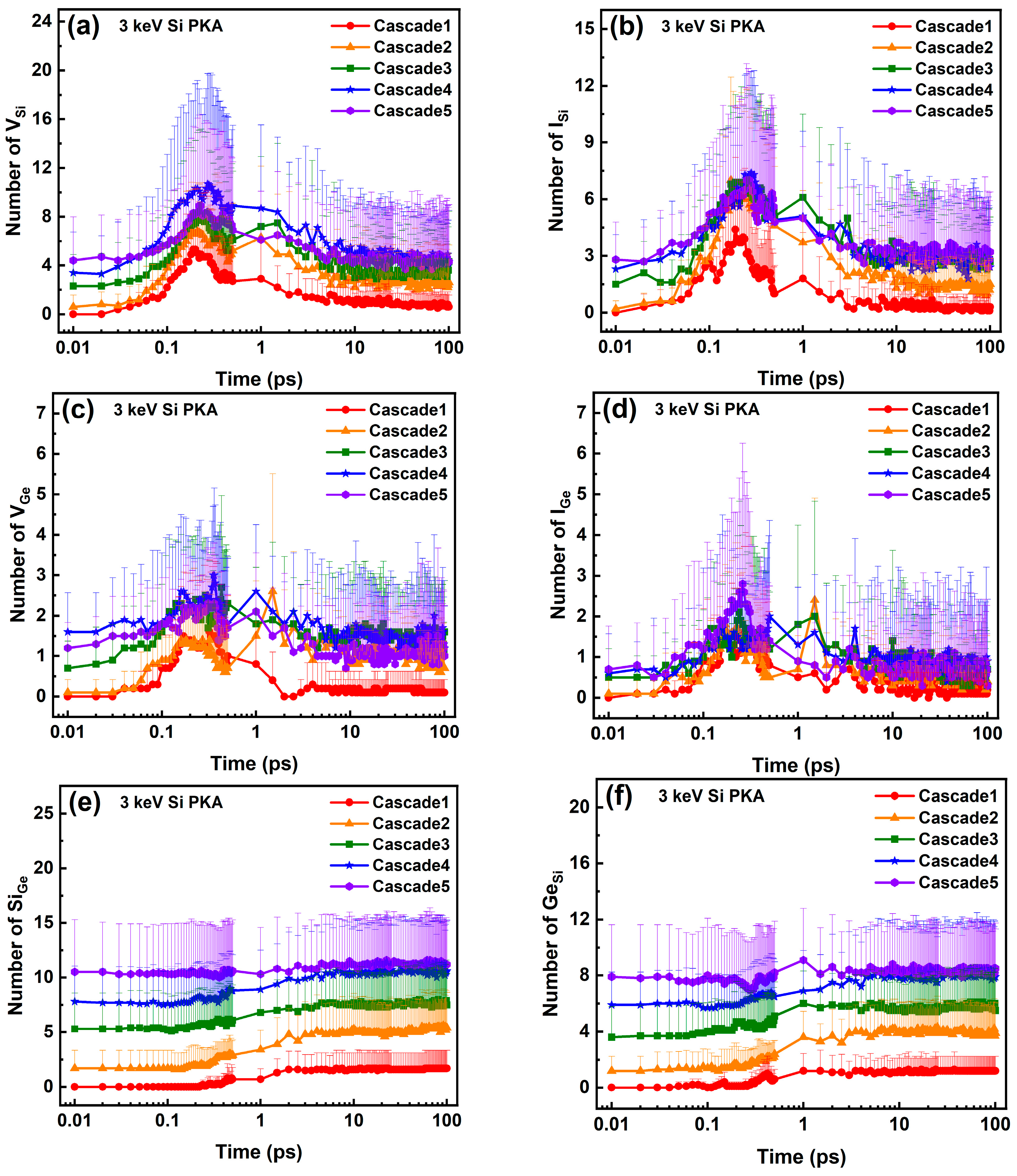
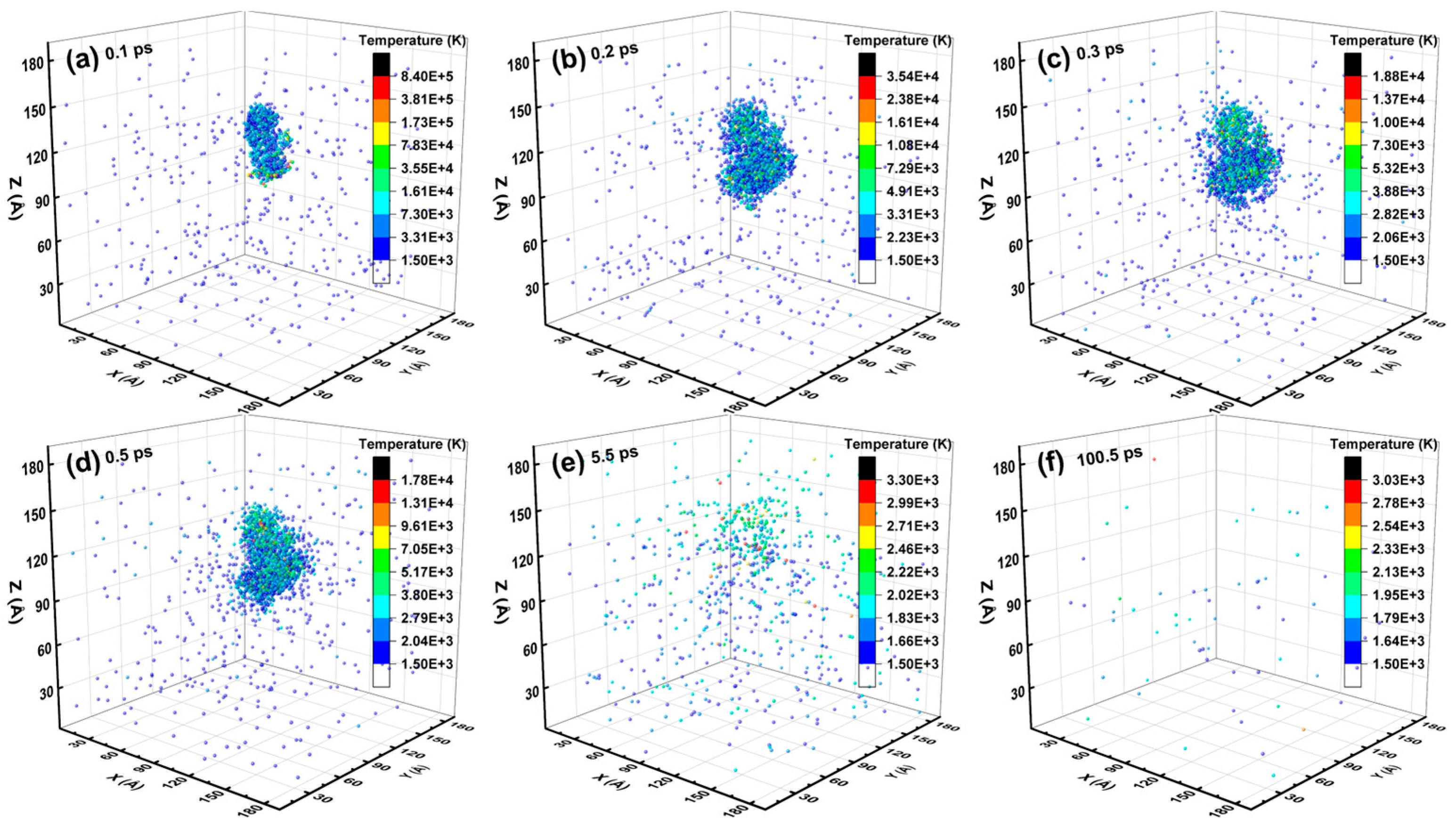
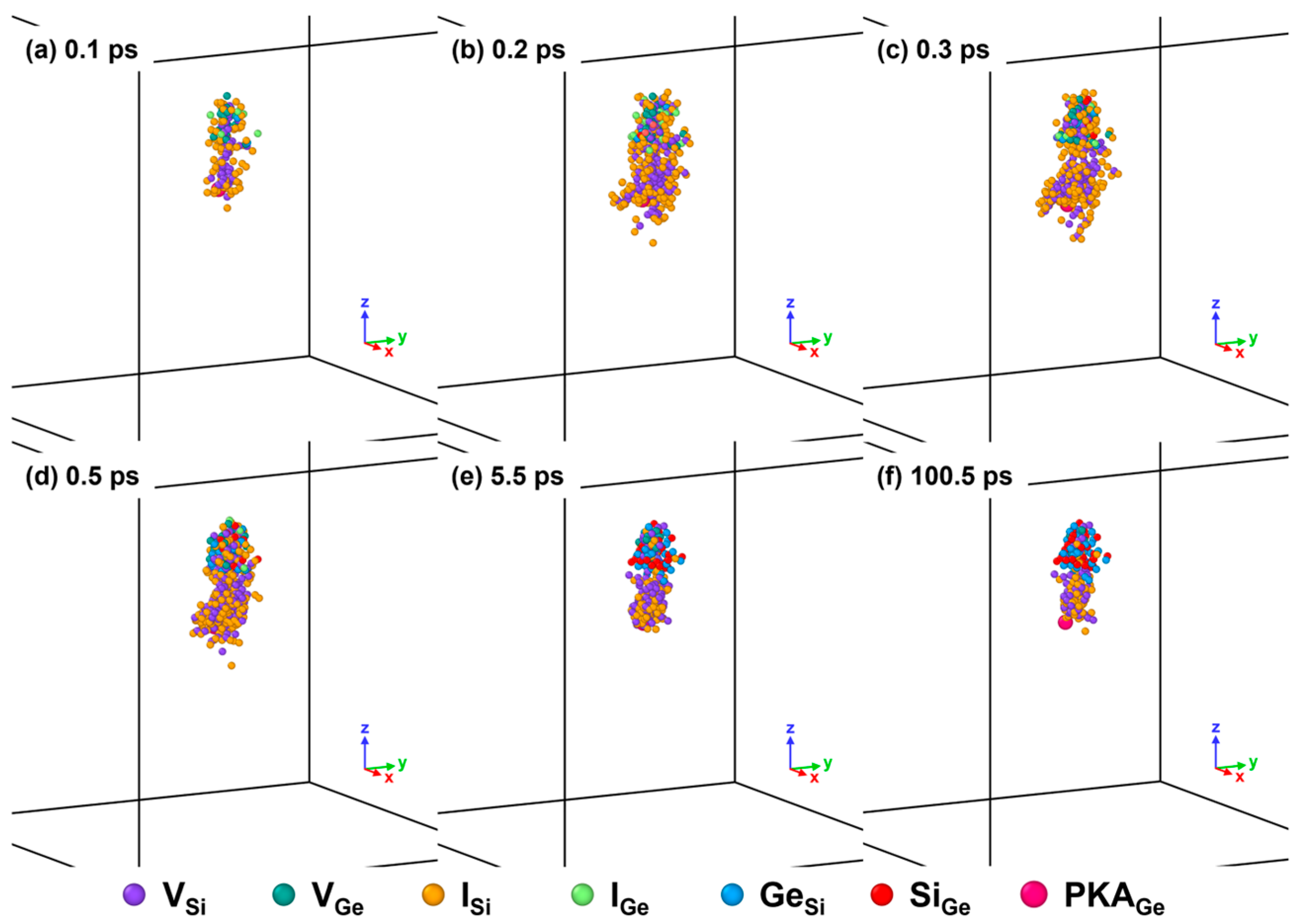
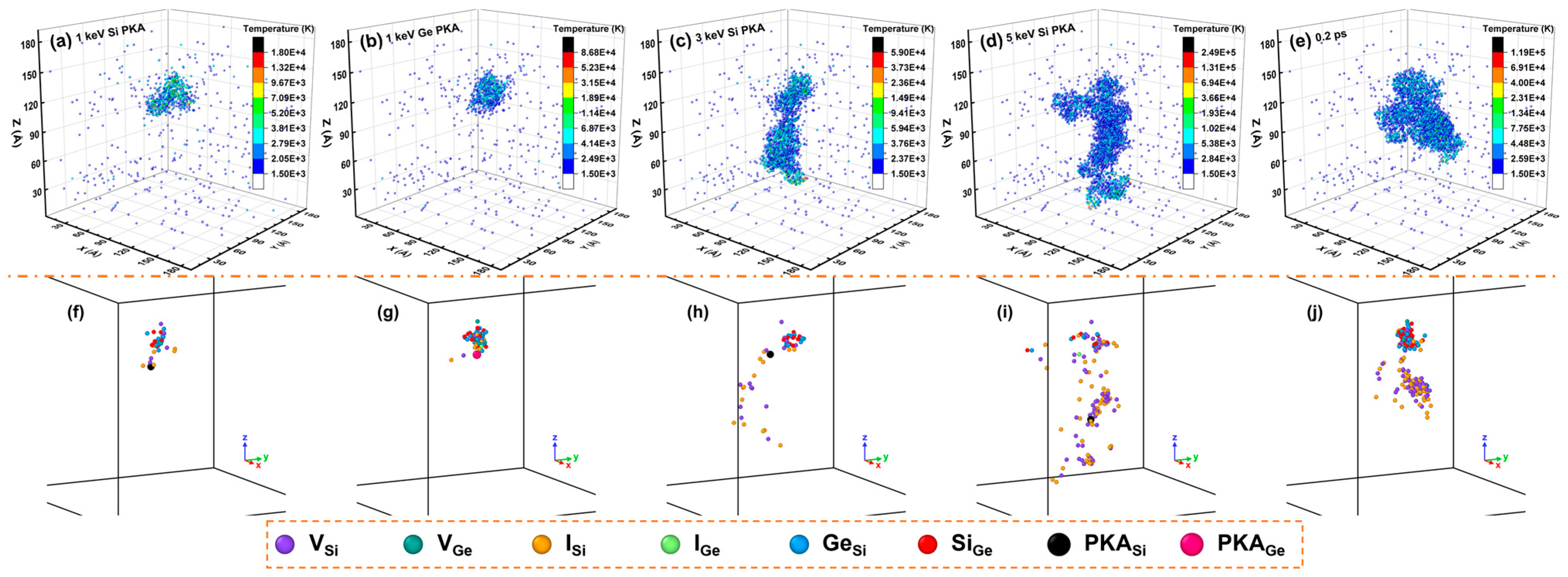
3.1. Defect Evolution of an Independent Collision Cascade
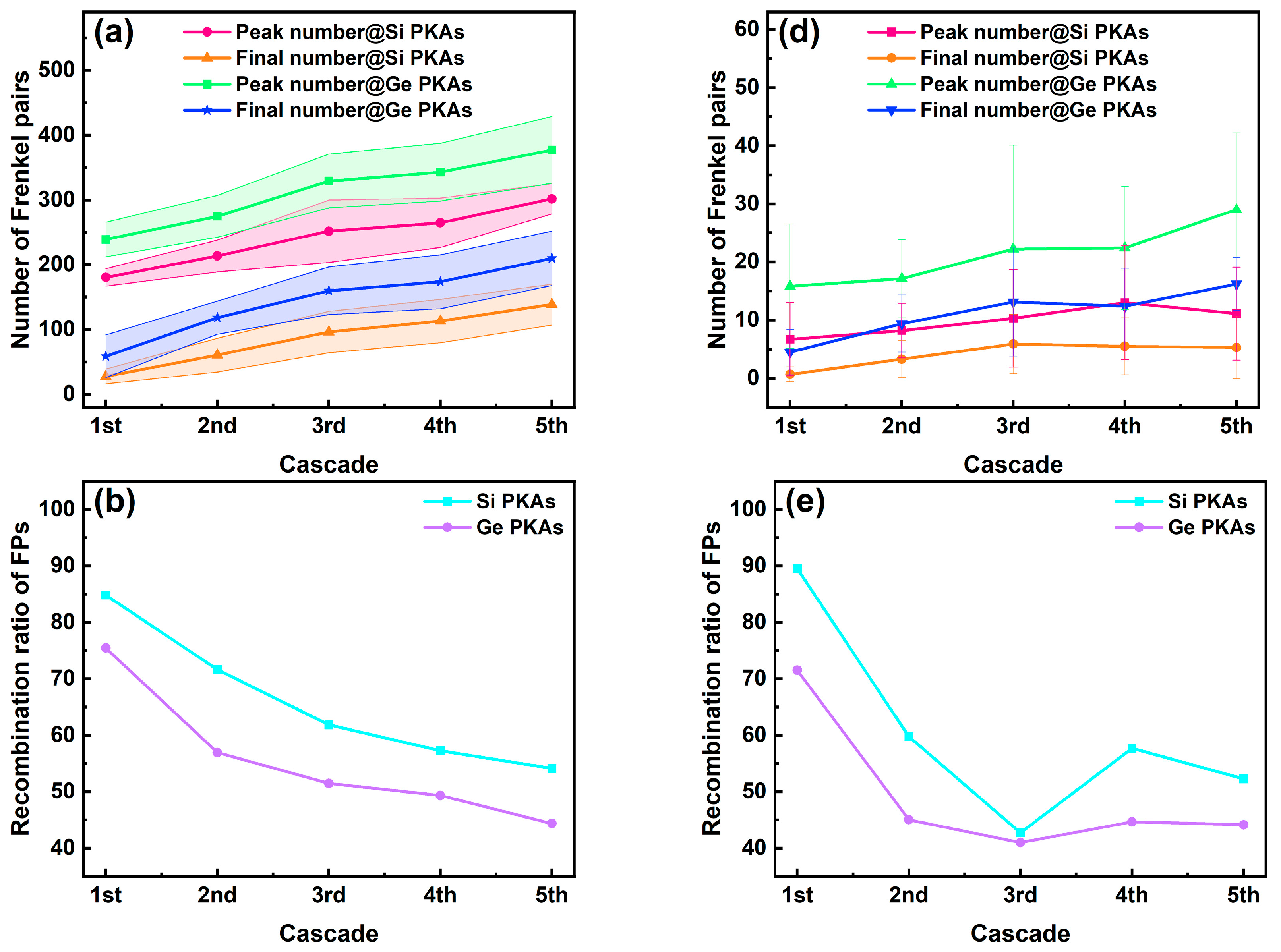
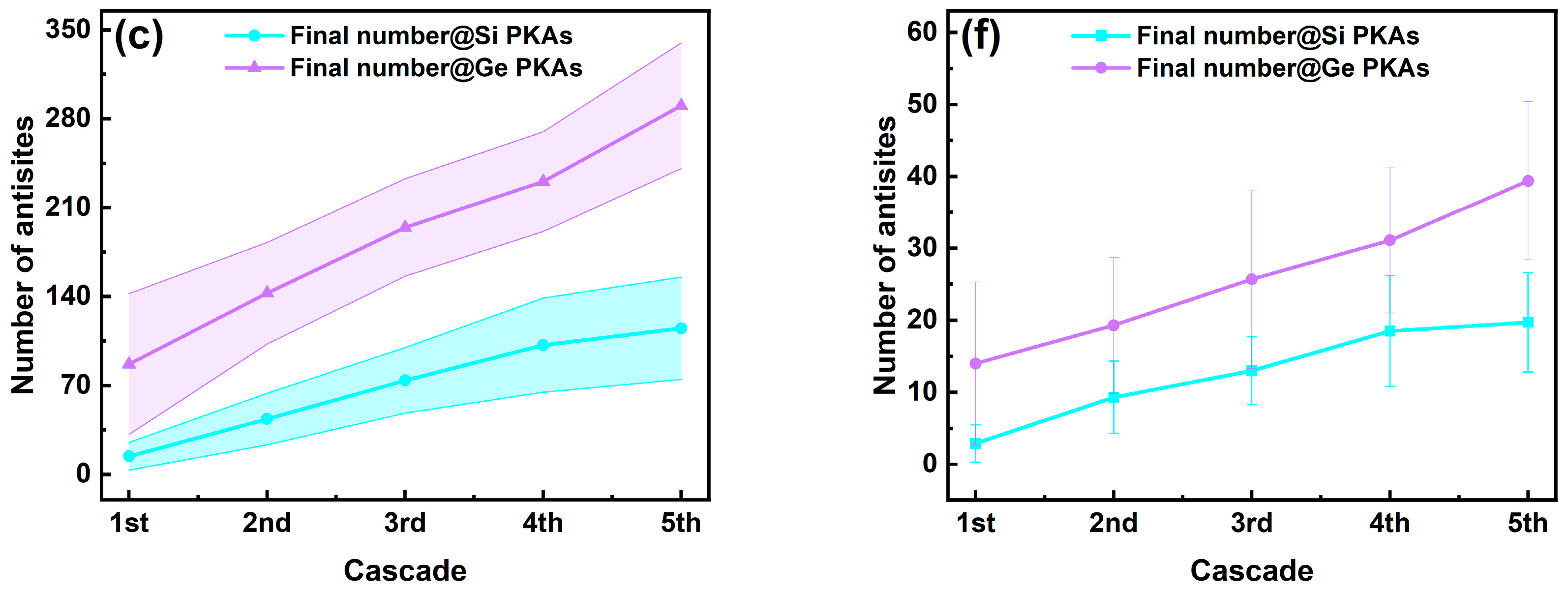
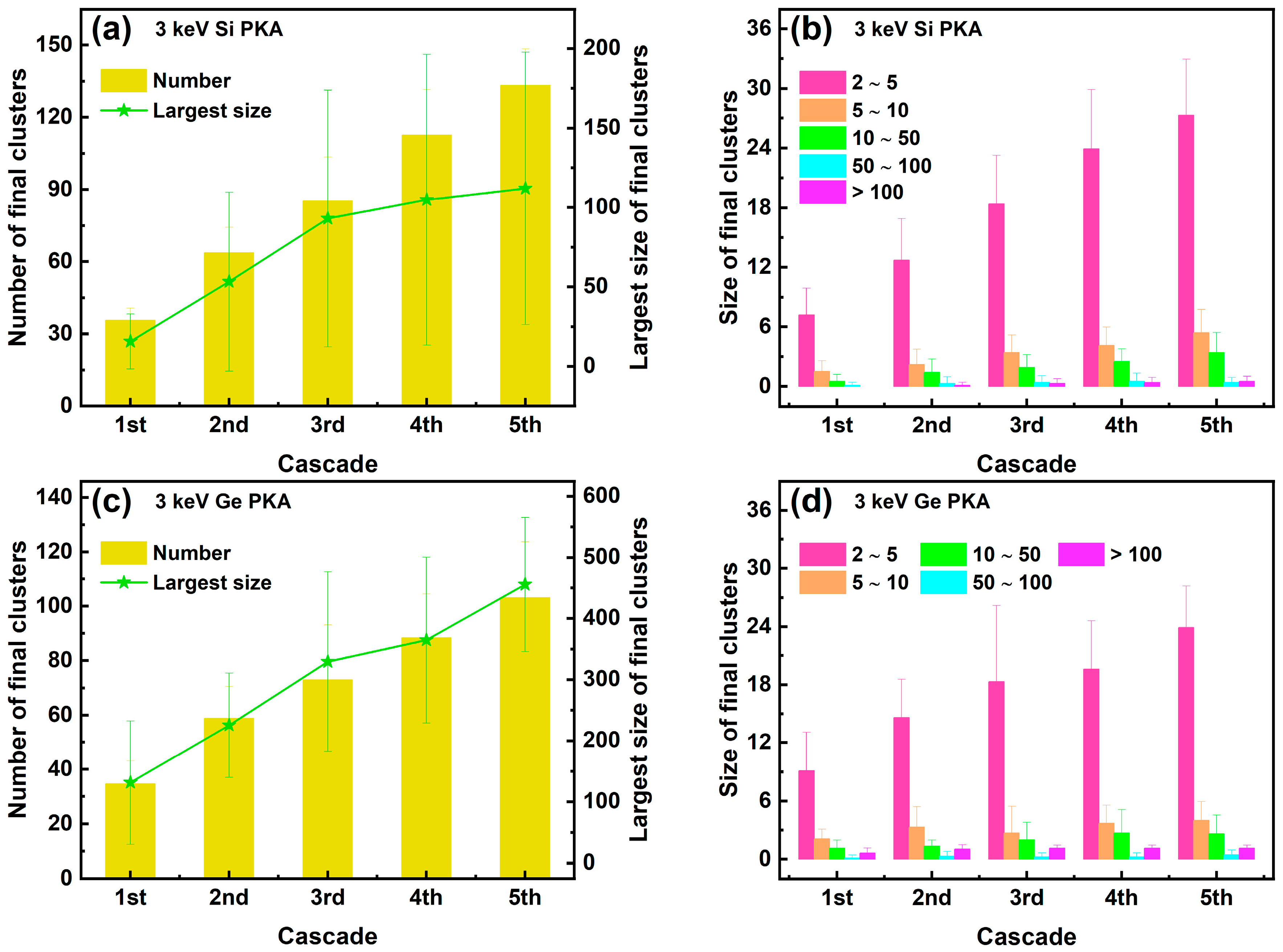
3.2. Defect Evolution of the Overlapping Cascades
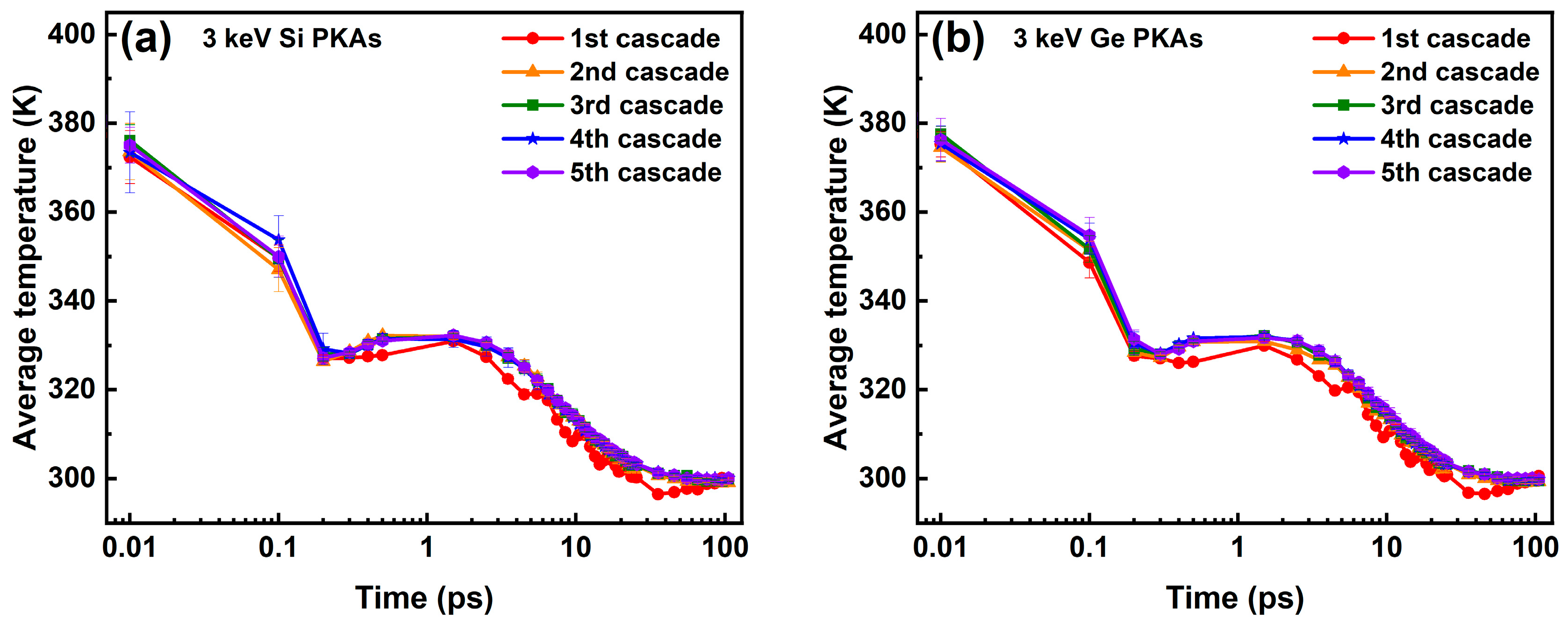
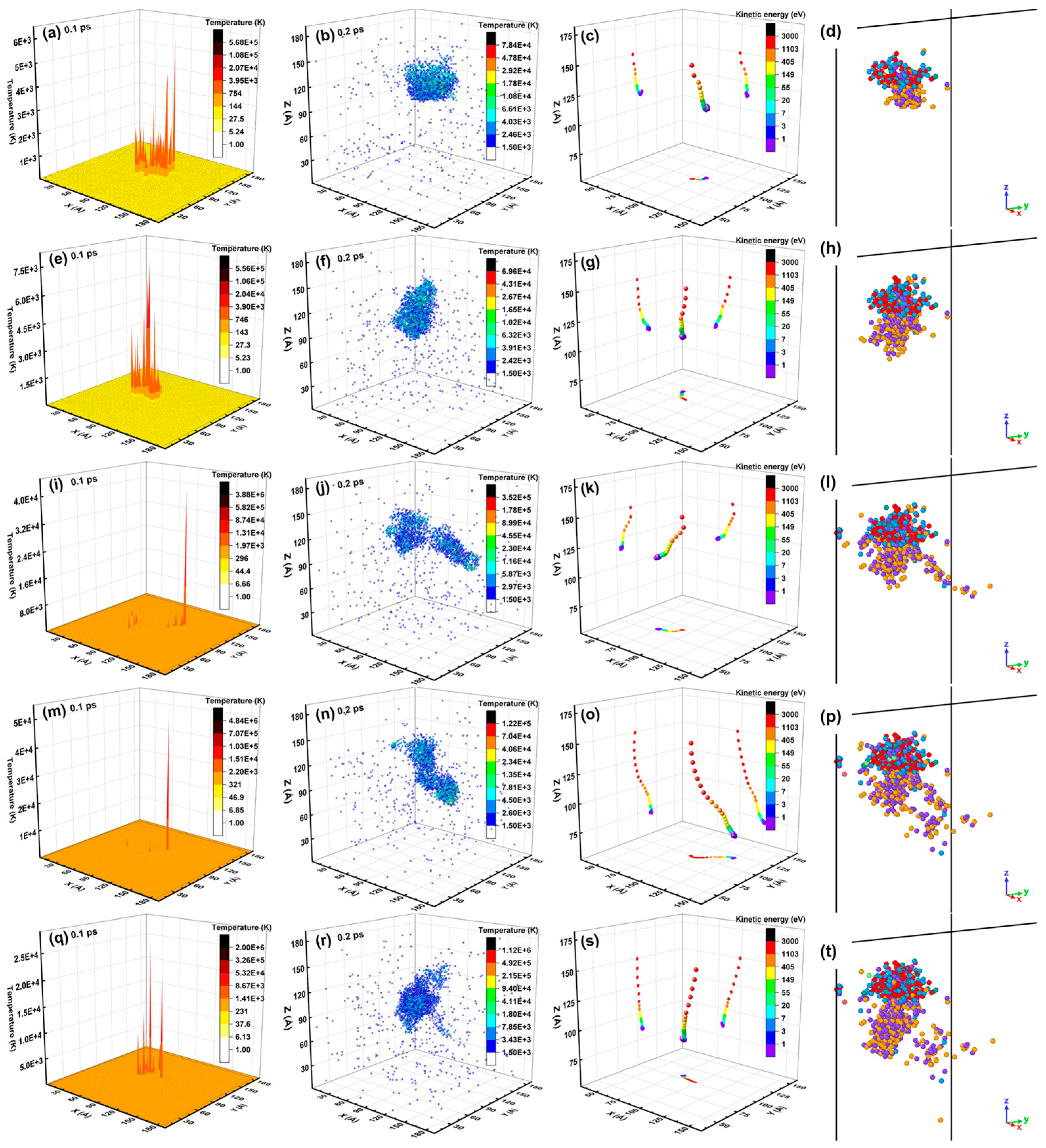
3.3. Temperature Evolution of Independent and Overlapping Collision Cascades
4. Conclusions
- (1)
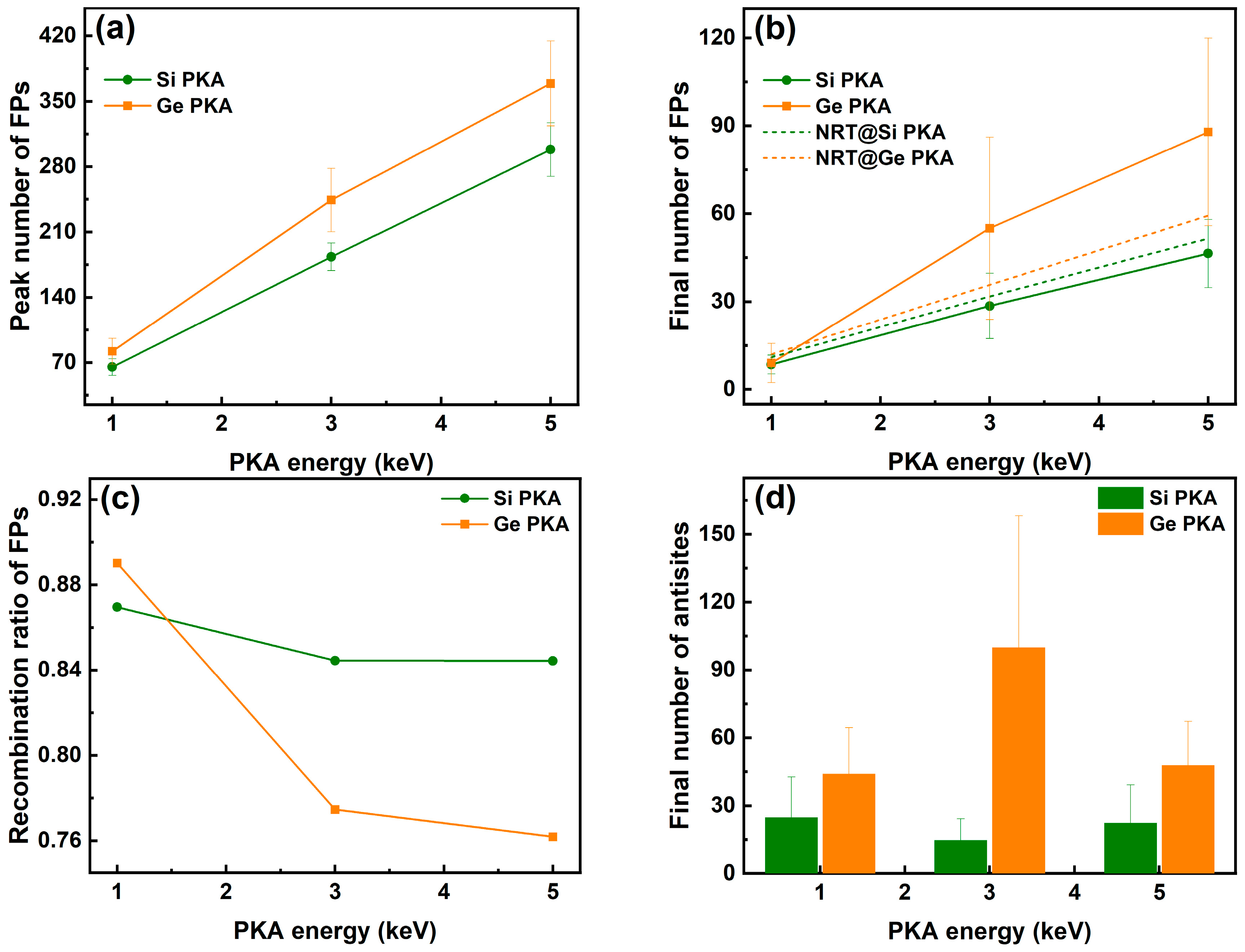
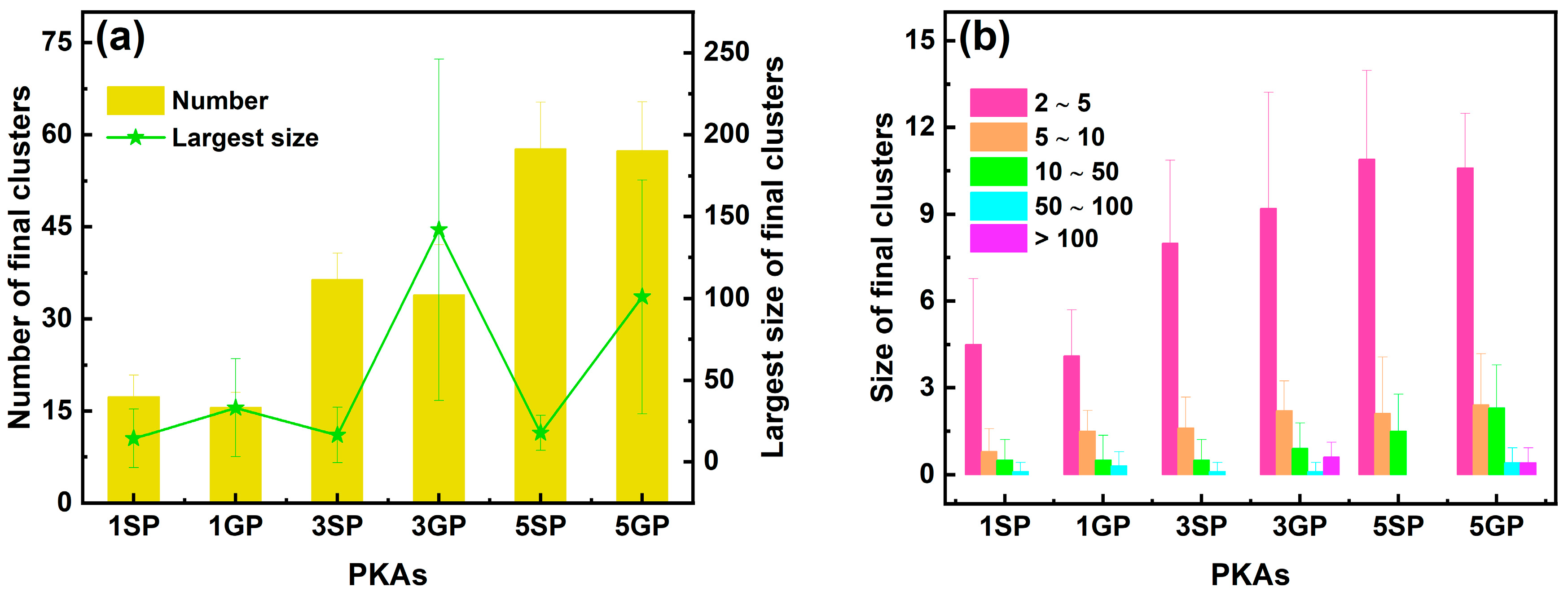
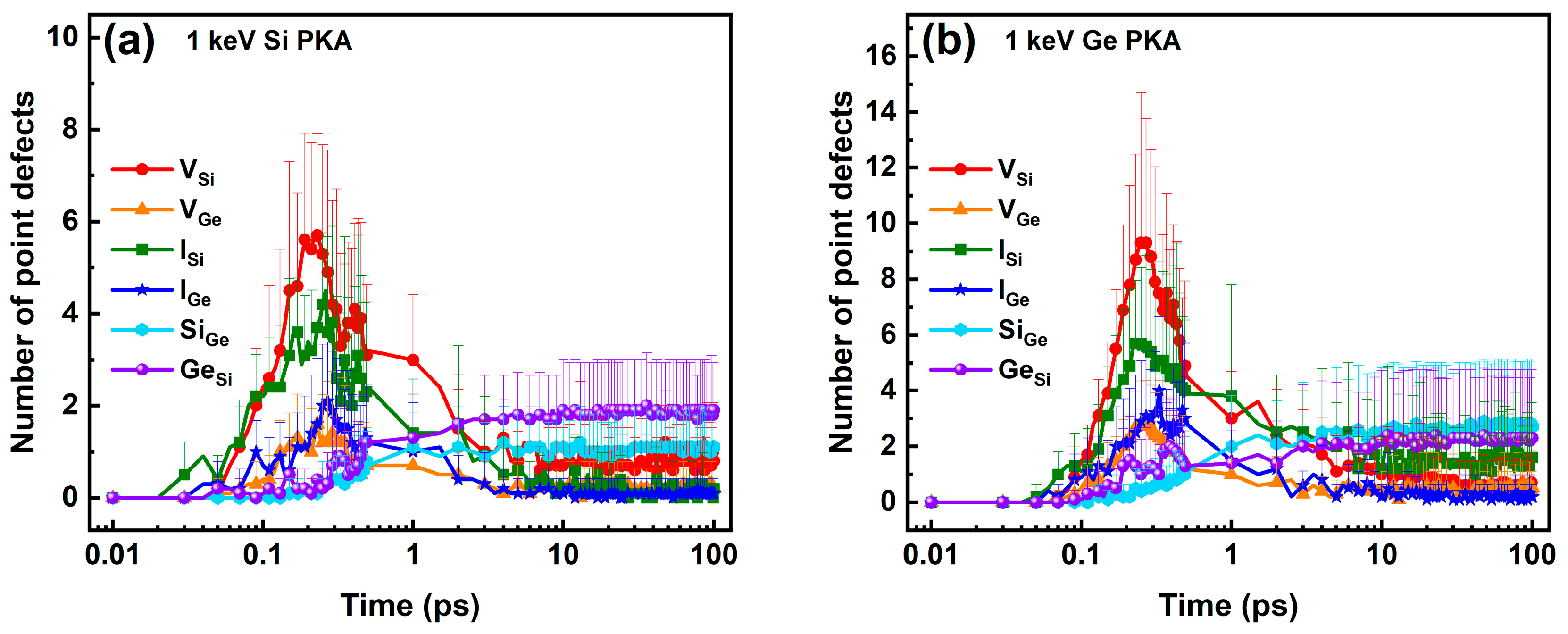
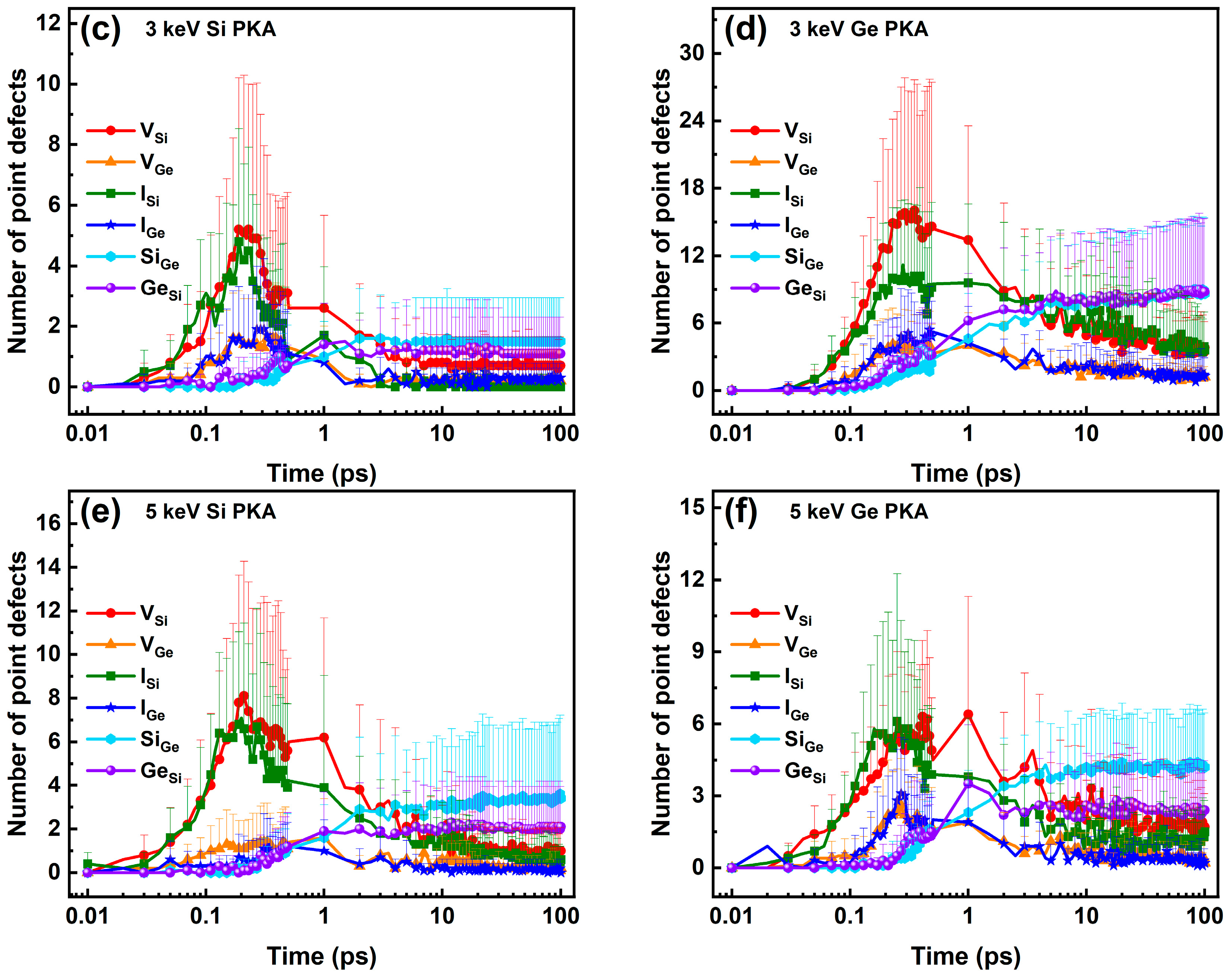
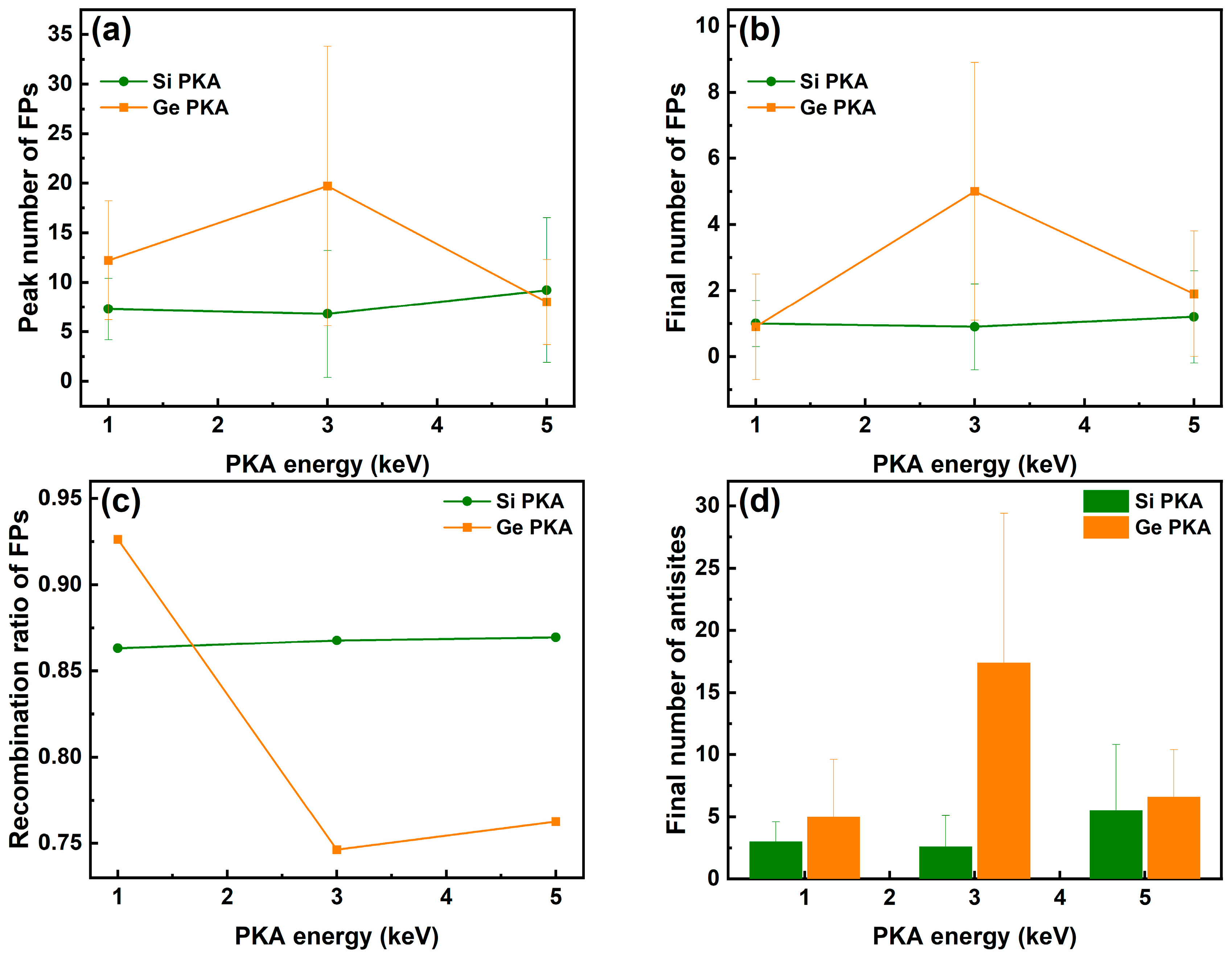
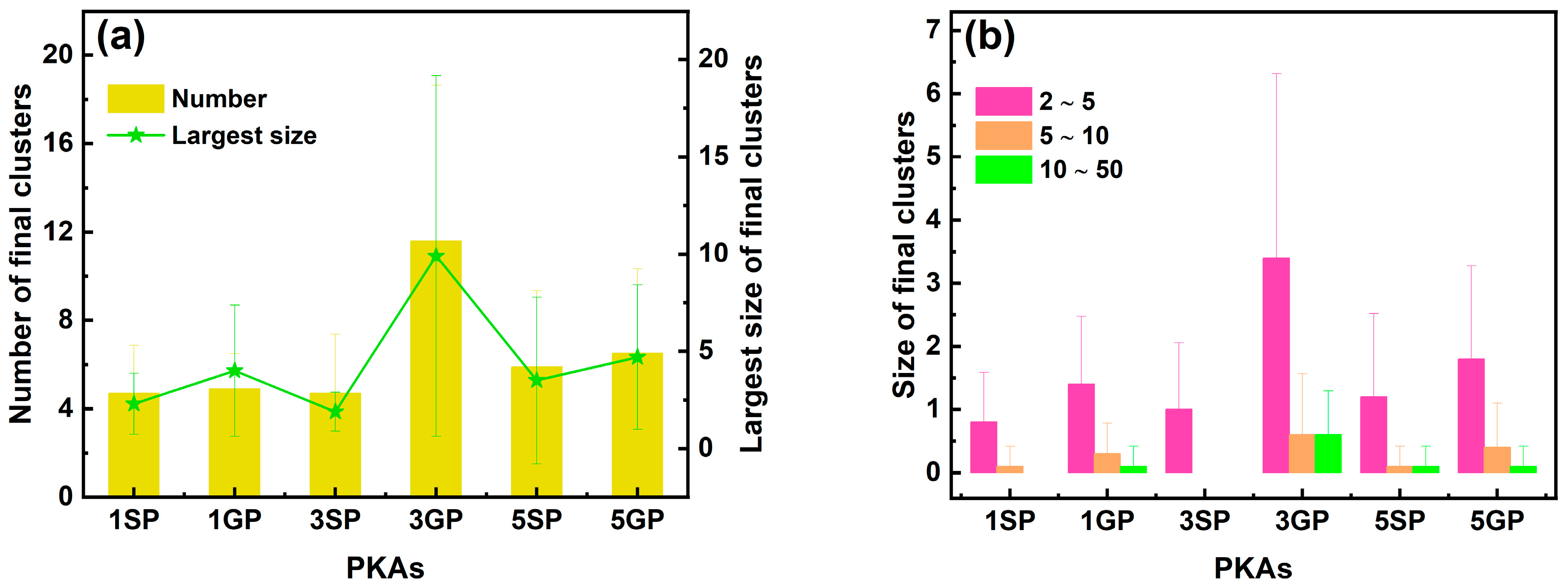
- Among 1 keV, 3 keV, and 5 keV Si PKAs and Ge PKAs, 5 keV Ge PKAs produced the most Frenkel pairs and clusters in the whole heterostructure, while 3 keV Ge PKAs acquired the most point defects (especially antisites) and clusters at the heterointerface.
- (2)
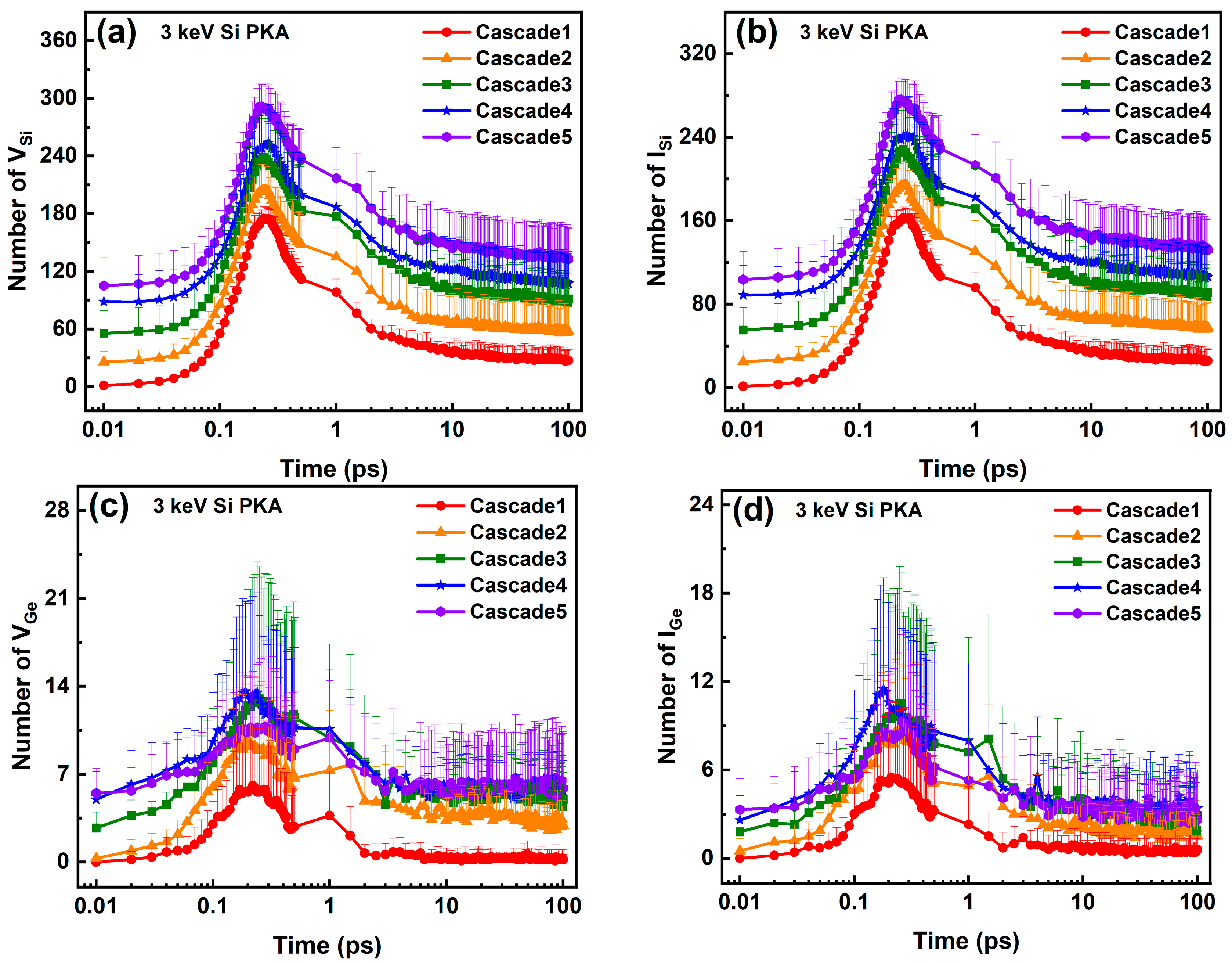
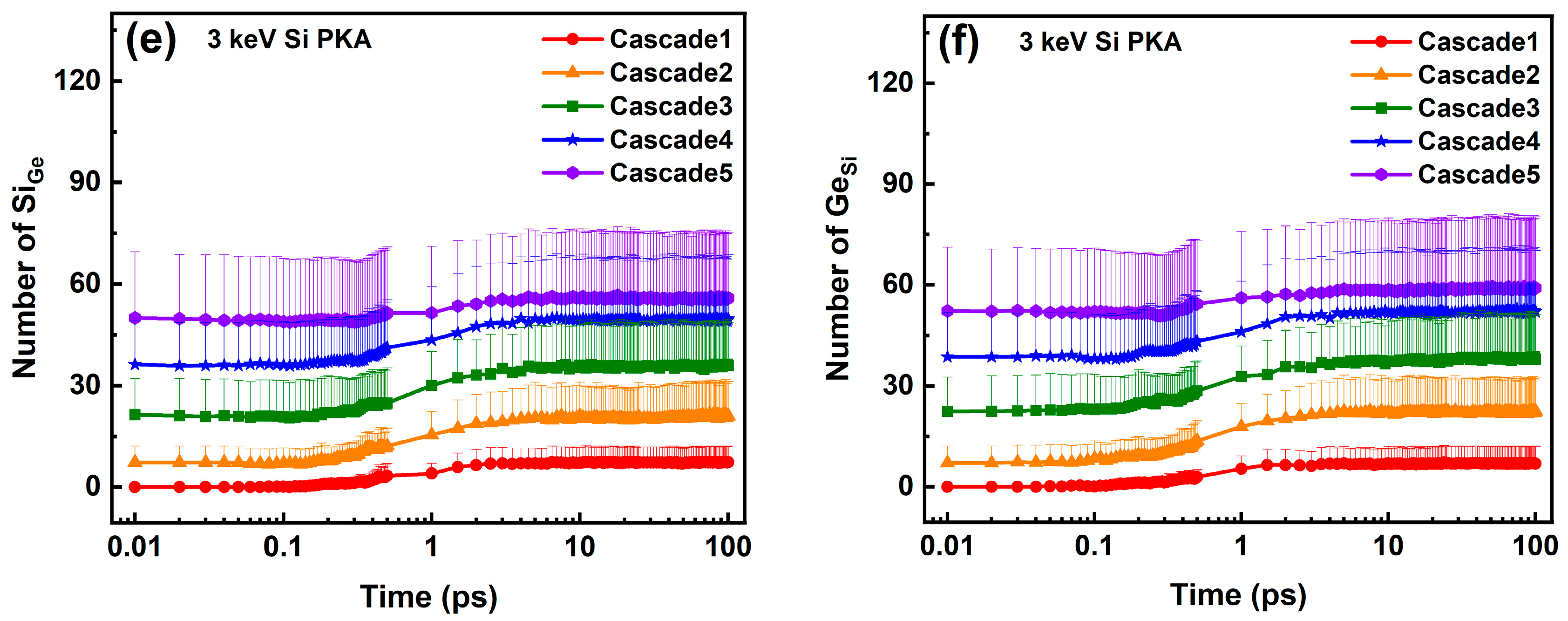
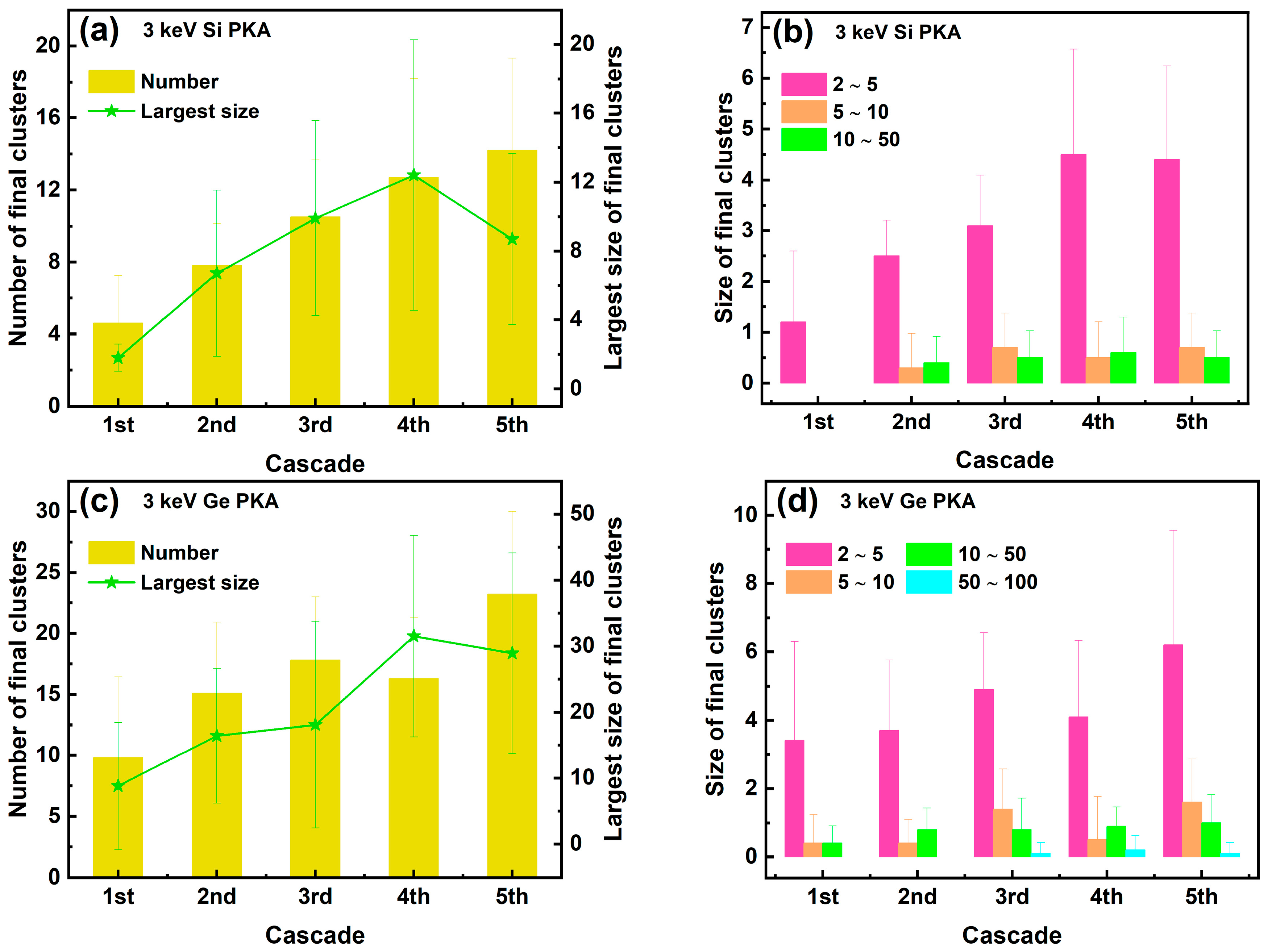
- The numbers of point defects and clusters in the whole heterostructure induced by 3 keV Si PKAs and Ge PKAs could accumulate proportionally from the first to the fifth cascades, while those at the heterointerface tended to fluctuate in the fourth or the fifth cascades.
- (3)
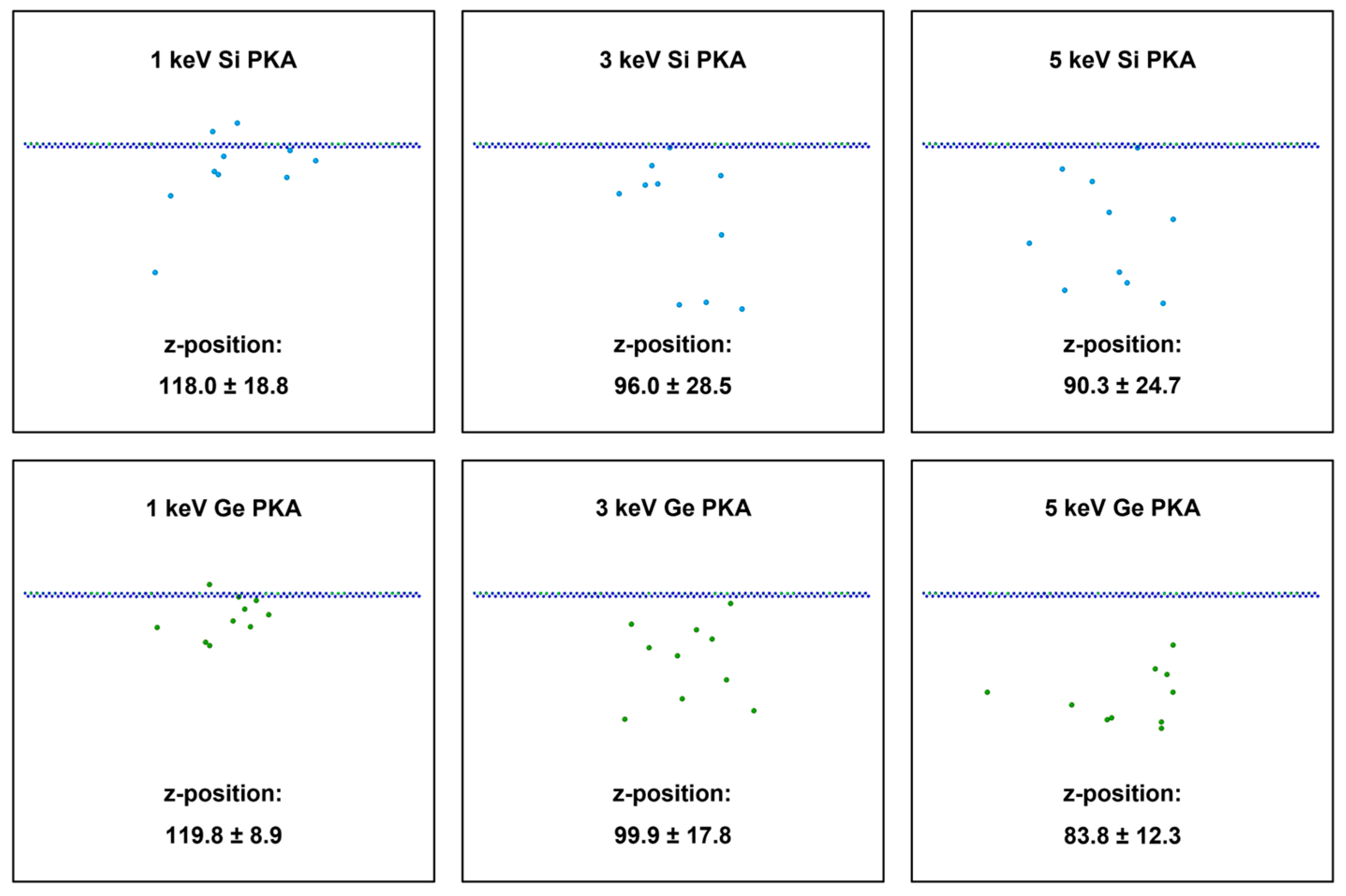
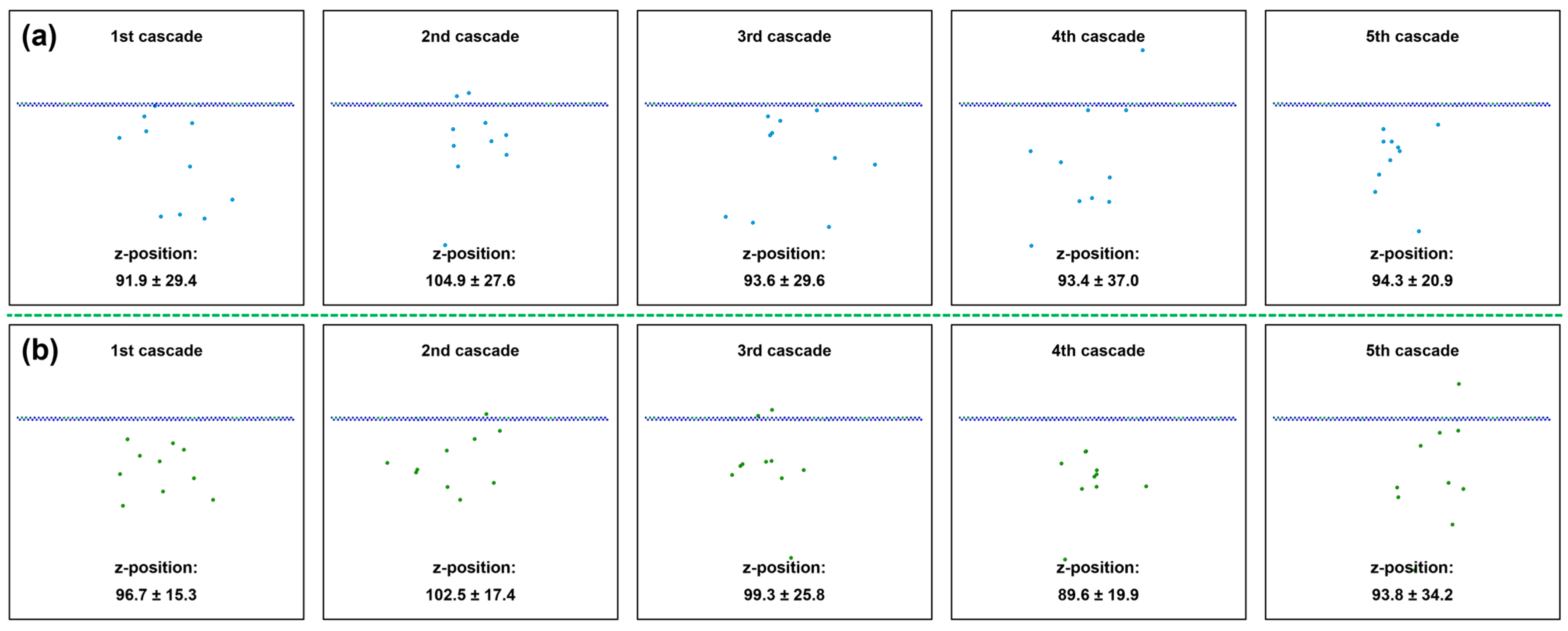
- The spatial distribution of surviving point defects in the whole heterostructure induced by 3 keV Si PKAs and Ge PKAs was dominated by the melting region, while it could be superimposed on the subsequent ones during the overlapping cascades.
Supplementary Materials
Author Contributions
Funding
Data Availability Statement
Conflicts of Interest
References
- Ren, Y.; Zhu, M.; Xu, D.; Liu, M.; Dai, X.; Wang, S.; Li, L. Overview on Radiation Damage Effects and Protection Techniques in Microelectronic Devices. Sci. Technol. Nucl. Install. 2024, 2024, 3616902. [Google Scholar] [CrossRef]
- Pan, X.; Guo, H.; Feng, Y.; Liu, Y.; Zhang, J.; Li, Z.; Luo, Y.; Zhang, F.; Wang, T.; Zhao, W.; et al. Single event transient characterization of SiGe HBT by SPA experiment and 3-D process simulation. Sci. China Technol. Sci. 2022, 65, 1193–1205. [Google Scholar] [CrossRef]
- Höeffgen, S.K.; Metzger, S.; Steffens, M. Investigating the Effects of Cosmic Rays on Space Electronics. Front. Phys. 2020, 8, 318. [Google Scholar] [CrossRef]
- Chancellor, J.; Nowadly, C.; Williams, J.; Aunon-Chancellor, S.; Chesal, M.; Looper, J.; Newhauser, W. Everything you wanted to know about space radiation but were afraid to ask. J. Environ. Sci. Health Part. C 2021, 39, 113–128. [Google Scholar] [CrossRef] [PubMed]
- Parize, J.; Jarrin, T.; Fées, A.; Lambert, D.; Jay, A.; Morin, V.; Hemeryck, A.; Richard, N. Comparative Study of Collision Cascades and Resulting Displacement Damage in GaN, Si, and Ge. IEEE Trans. Nucl. Sci. 2024, 71, 1461–1469. [Google Scholar] [CrossRef]
- Li, L.; Bi, R.; Dong, Z.; Ye, C.; Xie, J.; Wang, C.; Li, X.; Pey, K.-L.; Li, M.; Wu, X. Atomic-scale strain analysis for advanced Si/SiGe heterostructure by using transmission electron microscopy. Electron 2024, 2, e32. [Google Scholar] [CrossRef]
- Fadaly, E.M.T.; Dijkstra, A.; Suckert, J.R.; Ziss, D.; van Tilburg, M.A.J.; Mao, C.; Ren, Y.; van Lange, V.T.; Korzun, K.; Kölling, S.; et al. Direct-bandgap emission from hexagonal Ge and SiGe alloys. Nature 2020, 580, 205–209. [Google Scholar] [CrossRef]
- Pimachev, A.K.; Neogi, S. First-principles prediction of electronic transport in fabricated semiconductor heterostructures via physics-aware machine learning. npj Comput. Mater. 2021, 7, 93. [Google Scholar] [CrossRef]
- Rücker, H.; Heinemann, B. High-performance SiGe HBTs for next generation BiCMOS technology. Semicond. Sci. Technol. 2018, 33, 114003. [Google Scholar] [CrossRef]
- Sotskov, D.I.; Elesin, V.V.; Kuznetsov, A.G.; Zhidkov, N.M.; Metelkin, I.O.; Amburkin, K.M.; Amburkin, D.M.; Usachev, N.A.; Boychenko, D.V.; Elesina, V.V. Displacement Damage Effects Mitigation Approach for Heterojunction Bipolar Transistor Frequency Synthesizers. IEEE Trans. Nucl. Sci. 2020, 67, 2396–2404. [Google Scholar] [CrossRef]
- Li, P.; Dong, Z.-Y.; Guo, H.-X.; Zhang, F.-Q.; Guo, Y.-X.; Peng, Z.-G.; He, C.-H. Investigation of laser-induced single event effect on SiGe BiCMOS low noise amplifiers. Acta Phys. Sin. 2024, 73, 044301. [Google Scholar] [CrossRef]
- Sun, Y.; Liu, Z.; Fu, J.; Li, X.; Shi, Y. Investigation of total dose effects in SiGe HBTs under different exposure conditions. Radiat. Phys. Chem. 2018, 151, 84–89. [Google Scholar] [CrossRef]
- Teng, J.W.; Ildefonso, A.; Tzintzarov, G.N.; Ying, H.; Moradinia, A.; Wang, P.F.; Li, X.; Zhang, E.X.; Fleetwood, D.M.; Cressler, J.D. Variability in Total-Ionizing-Dose Response of Fourth-Generation SiGe HBTs. IEEE Trans. Nucl. Sci. 2021, 68, 949–957. [Google Scholar] [CrossRef]
- Hegde, V.N.; Praveen, K.C.; Pradeep, T.M.; Cressler, J.D.; Prakash, A.P.G. 50 MeV lithium ion irradiation studies on silicon-germanium heterojunction bipolar transistors at low temperature. Microelectron. Reliab. 2022, 137, 114754. [Google Scholar] [CrossRef]
- Zhang, J.; Wang, X.; Guo, H.; Hajdas, W.; Yan, Y.; Feng, J.; Wang, H.; Wu, X. Effects of the Total Ionizing Dose on the Single Event Transient Sensitivity of SiGe HBT Exposed to Heavy-Ion Beam. IEEE Trans. Nucl. Sci. 2025, 72, 2799–2807. [Google Scholar] [CrossRef]
- Wei, J.-N.; He, C.-h.; Li, P.; Li, Y.-h.; Guo, H.-X. Impact of displacement damage on single event transient charge collection in SiGe HBTs. Nucl. Instrum. Methods Phys. Res. Sect. A Accel. Spectrometers Detect. Assoc. Equip. 2019, 938, 29–35. [Google Scholar] [CrossRef]
- Sotskov, D.I.; Kuznetsov, A.G.; Elesin, V.V.; Selishchev, I.A.; Kotov, V.N.; Nikiforov, A.Y. Characterization of the Effects of Neutron-Induced Displacement Damage on the SiGe:C Heterojunction Bipolar Transistors. In Proceedings of the 2021 21th European Conference on Radiation and Its Effects on Components and Systems (RADECS), Vienna, Austria, 13–17 September 2021; pp. 1–4. [Google Scholar] [CrossRef]
- Pan, X.; Guo, H.; Feng, Y.; Liu, Y.; Zhang, J.; Fu, J.; Yu, G. Temperature dependence of single-event transients in SiGe heterojunction bipolar transistors for cryogenic applications. Chin. Phys. B 2023, 32, 098503. [Google Scholar] [CrossRef]
- Xing, T.; Liu, S.; Wang, X.; Adekoya, M.A.; Wang, C.; Zhou, J.; Chen, W. Coupled radiation effects of swift heavy ions and strong electromagnetic pulses on a SiGe HBT: A TCAD-based simulation. Nucl. Instrum. Methods Phys. Res. Sect. B Beam Interact. Mater. At. 2025, 563, 165673. [Google Scholar] [CrossRef]
- Xing, T.; Liu, S.; Wang, X.; Wang, C.; Zhou, J.; Zhang, X.; Chen, W. Monte Carlo simulations of proton-induced displacement damage in SiGe alloys and SiGe/Si heterostructures. Acta Phys. Sin. 2025, 74, 162401. [Google Scholar] [CrossRef]
- Sun, Y.; Liu, Z.; Fu, J.; Shi, Y.; Li, X. Degradation and annealing characteristics of NPN SiGe HBT exposed to heavy ions irradiation. Radiat. Phys. Chem. 2019, 165, 108433. [Google Scholar] [CrossRef]
- Li, P.; He, C.; Guo, H.; Li, Y.; Wei, J. Synergistic Effects of Ionizing Dose and Displacement Damage on SiGe Heterojunction Bipolar Transistors. IEEE Trans. Nucl. Sci. 2022, 69, 1051–1056. [Google Scholar] [CrossRef]
- Arutt, C.N.; Warren, K.M.; Schrimpf, R.D.; Weller, R.A.; Kauppila, J.S.; Rowe, J.D.; Sternberg, A.L.; Reed, R.A.; Ball, D.R.; Fleetwood, D.M. Proton Irradiation as a Screen for Displacement-Damage Sensitivity in Bipolar Junction Transistors. IEEE Trans. Nucl. Sci. 2015, 62, 2498–2504. [Google Scholar] [CrossRef]
- Diaz de la Rubia, T.; Gilmer, G.H. Structural Transformations and Defect Production in Ion Implanted Silicon: A Molecular Dynamics Simulation Study. Phys. Rev. Lett. 1995, 74, 2507–2510. [Google Scholar] [CrossRef] [PubMed]
- Zhou, Y.; Chen, B.; He, H.; Li, B.; Wang, X. Displacement Cascades in Monocrystalline Silicon: Effects of Temperature, Strain, and PKA Energy. Nucl. Technol. 2020, 206, 32–39. [Google Scholar] [CrossRef]
- López, P.; Pelaz, L.; Santos, I.; Marqués, L.A.; Aboy, M. Molecular dynamics simulations of damage production by thermal spikes in Ge. J. Appl. Phys. 2012, 111, 033519. [Google Scholar] [CrossRef]
- Jarrin, T.; Jay, A.; Hémeryck, A.; Richard, N. Parametric study of the Two-Temperature Model for Molecular Dynamics simulations of collisions cascades in Si and Ge. Nucl. Instrum. Methods Phys. Res. Sect. B Beam Interact. Mater. At. 2020, 485, 1–9. [Google Scholar] [CrossRef]
- Gao, F.; Chen, N.; Hernandez-Rivera, E.; Huang, D.; LeVan, P.D. Displacement damage and predicted non-ionizing energy loss in GaAs. J. Appl. Phys. 2017, 121, 095104. [Google Scholar] [CrossRef]
- Xing, T.; Liu, S.; Song, C.; Wang, X.; Adekoya, M.A.; Wang, C.; Li, H.; Meng, F.; Du, X.; Sun, Y.; et al. Simulation of proton-induced primary displacement damage in GaAs under different ambient temperatures. AIP Adv. 2024, 14, 015142. [Google Scholar] [CrossRef]
- He, H.; He, C.; Zhang, J.; Liao, W.; Zang, H.; Li, Y.; Liu, W. Primary damage of 10 keV Ga PKA in bulk GaN material under different temperatures. Nucl. Eng. Technol. 2020, 52, 1537–1544. [Google Scholar] [CrossRef]
- Guo, P.; Song, C.; Wu, Y.-N.; Chen, S. Temperature Effect on GaN Threshold Displacement Energy Under Low-Energy Electron Beam Irradiation. Adv. Electron. Mater. 2024, 10, 2400014. [Google Scholar] [CrossRef]
- Liao, W.; He, C.; He, H. Molecular dynamics simulation of displacement damage in 6H-SiC. Radiat. Eff. Defects Solids 2019, 174, 729–740. [Google Scholar] [CrossRef]
- Nuckols, L.; Crespillo, M.L.; Xu, C.; Zarkadoula, E.; Zhang, Y.; Weber, W.J. Coupled effects of electronic and nuclear energy deposition on damage accumulation in ion-irradiated SiC. Acta Mater. 2020, 199, 96–106. [Google Scholar] [CrossRef]
- Li, H.; Meng, X.; Jing, Y.; Cong, L.; Zhang, X.; Zhao, J.; Sun, Y.; Li, W.; Yan, J.; Yang, J.; et al. Primary radiation damage in Si1−xGex alloys: Molecular dynamics study with machine-learning interatomic potential. Comput. Mater. Sci. 2025, 246, 113484. [Google Scholar] [CrossRef]
- Xing, T.; Liu, S.; Wang, X.; Adekoya, M.A.; Wang, C.; Li, H.; Meng, F.; Du, X.; Sun, Y.; Zhu, S.; et al. Molecular dynamics simulations of displacement damage in SiGe alloys induced by single and binary primary knock-on atoms under different temperatures. Radiat. Eff. Defects Solids 2023, 178, 1384–1403. [Google Scholar] [CrossRef]
- Jarrin, T.; Jay, A.; Raine, M.; Mousseau, N.; Hémeryck, A.; Richard, N. Simulation of Single Particle Displacement Damage in Si1−xGex Alloys—Interaction of Primary Particles With the Material and Generation of the Damage Structure. IEEE Trans. Nucl. Sci. 2020, 67, 1273–1283. [Google Scholar] [CrossRef]
- Wang, C.-L.; Wang, Q.-Y.; Zhang, Y.; Li, Z.-Y.; Hong, B.; Su, Z.; Dong, L. Molecular dynamics study of cascade damage at SiC/C interface. Acta Phys. Sin. 2014, 63, 153402. [Google Scholar] [CrossRef]
- Wallace, J.; Chen, D.; Wang, J.; Shao, L. Molecular dynamics simulation of damage cascade creation in SiC composites containing SiC/graphite interface. Nucl. Instrum. Methods Phys. Res. Sect. B Beam Interact. Mater. At. 2013, 307, 81–85. [Google Scholar] [CrossRef]
- Huang, H.; Tang, X.; Chen, F.; Yang, Y.; Liu, J.; Li, H.; Chen, D. Radiation damage resistance and interface stability of copper–graphene nanolayered composite. J. Nucl. Mater. 2015, 460, 16–22. [Google Scholar] [CrossRef]
- Zong, M.; Chen, F.; Tang, X.; Ge, G.; Li, C.; Liu, Y. Molecular dynamics simulation of radiation defect evolution mechanism of NiFe-graphene nanocomposite. Appl. Surf. Sci. 2022, 584, 152503. [Google Scholar] [CrossRef]
- Jiang, M.; Xiao, H.; Peng, S.; Yang, G.; Liu, Z.; Qiao, L.; Zu, X. A Theoretical Simulation of the Radiation Responses of Si, Ge, and Si/Ge Superlattice to Low-Energy Irradiation. Nanoscale Res. Lett. 2018, 13, 133. [Google Scholar] [CrossRef]
- Huang, X.; Guo, J.; Yue, Y. Graphene coated 3C-SiC with improved irradiation resistance and enhanced heat conduction property after collision cascade. Int. J. Heat Mass Transf. 2022, 194, 122988. [Google Scholar] [CrossRef]
- Granberg, F.; Byggmästar, J.; Nordlund, K. Defect accumulation and evolution during prolonged irradiation of Fe and FeCr alloys. J. Nucl. Mater. 2020, 528, 151843. [Google Scholar] [CrossRef]
- Wei, G.; Byggmästar, J.; Cui, J.; Nordlund, K.; Ren, J.; Djurabekova, F. Revealing the critical role of vanadium in radiation damage of tungsten-based alloys. Acta Mater. 2024, 274, 119991. [Google Scholar] [CrossRef]
- Thompson, A.P.; Aktulga, H.M.; Berger, R.; Bolintineanu, D.S.; Brown, W.M.; Crozier, P.S.; in ‘t Veld, P.J.; Kohlmeyer, A.; Moore, S.G.; Nguyen, T.D.; et al. LAMMPS—A flexible simulation tool for particle-based materials modeling at the atomic, meso, and continuum scales. Comput. Phys. Commun. 2022, 271, 108171. [Google Scholar] [CrossRef]
- Basu, R.; Singh, A. High temperature Si–Ge alloy towards thermoelectric applications: A comprehensive review. Mater. Today Phys. 2021, 21, 100468. [Google Scholar] [CrossRef]
- Panda, S.R.; Zimmer, T.; Chakravorty, A.; Fregonese, S. Recent progress in bipolar and heterojunction bipolar transistors on SOI. Solid-State Electron. 2025, 227, 109101. [Google Scholar] [CrossRef]
- Comeau, J.P.; Sutton, A.K.; Haugerud, B.M.; Cressler, J.D.; Wei-Min Lance, K.; Marshall, P.W.; Reed, R.A.; Karroy, A.; Art, R.V. Proton tolerance of advanced SiGe HBTs fabricated on different substrate materials. IEEE Trans. Nucl. Sci. 2004, 51, 3743–3747. [Google Scholar] [CrossRef]
- Chen, D.; Pellish, J.; Phan, A.; Kim, H.; Burns, S.; Albarian, R.; Holcombe, B.; Little, B.; Salzman, J.; Marshall, P.; et al. Radiation Performance of Commercial SiGe HBT BiCMOS High Speed Operational Amplifiers. In Proceedings of the 2010 IEEE Radiation Effects Data Workshop, Denver, CO, USA, 20–23 July 2010; p. 5. [Google Scholar]
- Kissinger, D.; Kahmen, G.; Weigel, R. Millimeter-Wave and Terahertz Transceivers in SiGe BiCMOS Technologies. IEEE Trans. Microw. Theory Tech. 2021, 69, 4541–4560. [Google Scholar] [CrossRef]
- Douglas, J.P. Si/SiGe heterostructures: From material and physics to devices and circuits. Semicond. Sci. Technol. 2004, 19, R75. [Google Scholar] [CrossRef]
- Wu, J.; Xu, Z.; Zhao, J.; Rommel, M.; Nordlund, K.; Ren, F.; Fang, F. MD simulation of two-temperature model in ion irradiation of 3C-SiC: Effects of electronic and nuclear stopping coupling, ion energy and crystal orientation. J. Nucl. Mater. 2021, 557, 153313. [Google Scholar] [CrossRef]
- Stillinger, F.H.; Weber, T.A. Computer simulation of local order in condensed phases of silicon. Phys. Rev. B 1985, 31, 5262–5271. [Google Scholar] [CrossRef] [PubMed]
- Ding, K.; Andersen, H.C. Molecular-dynamics simulation of amorphous germanium. Phys. Rev. B 1986, 34, 6987–6991. [Google Scholar] [CrossRef] [PubMed]
- Laradji, M.; Landau, D.P.; Dünweg, B. Structural properties of Si1−xGex alloys: A Monte Carlo simulation with the Stillinger-Weber potential. Phys. Rev. B 1995, 51, 4894–4902. [Google Scholar] [CrossRef] [PubMed]
- Medvedev, N.; Volkov, A.E.; Rymzhanov, R.; Akhmetov, F.; Gorbunov, S.; Voronkov, R.; Babaev, P. Frontiers, challenges, and solutions in modeling of swift heavy ion effects in materials. J. Appl. Phys. 2023, 133, 100701. [Google Scholar] [CrossRef]
- Zhang, M.; Rao, Z.; Kim, K.-S.; Qi, Y.; Fang, L.; Sun, K.; Chason, E. Molecular dynamics simulation of stress induced by energetic particle bombardment in Mo thin films. Materialia 2021, 16, 101043. [Google Scholar] [CrossRef]
- Chen, X.; Zhang, J.; Han, L.; Tang, Z. Molecular dynamics study of the effect of point defects on the stress at the Si/Ge interface. Appl. Surf. Sci. 2018, 456, 43–48. [Google Scholar] [CrossRef]
- Zhou, X.; Yu, X.; Jacobson, D.; Thompson, G.B. A molecular dynamics study on stress generation during thin film growth. Appl. Surf. Sci. 2019, 469, 537–552. [Google Scholar] [CrossRef]
- Gao, F.; Weber, W.J. Cascade overlap and amorphization in 3C–SiC: Defect accumulation, topological features, and disordering. Phys. Rev. B 2002, 66, 024106. [Google Scholar] [CrossRef]
- Chen, N.; Huang, D.; Heller, E.R.; Cardimona, D.A.; Gao, F. Atomistic simulation of displacement damage and effective nonionizing energy loss in InAs. Phys. Rev. Mater. 2021, 5, 033603. [Google Scholar] [CrossRef]
- Zarkadoula, E.; Samolyuk, G.; Zhang, Y.; Weber, W.J. Electronic stopping in molecular dynamics simulations of cascades in 3C–SiC. J. Nucl. Mater. 2020, 540, 152371. [Google Scholar] [CrossRef]
- Farrell, D.E.; Bernstein, N.; Liu, W.K. Thermal effects in 10 keV Si PKA cascades in 3C–SiC. J. Nucl. Mater. 2009, 385, 572–581. [Google Scholar] [CrossRef]
- Ran, Q.; Zhou, Y.; Zou, Y.; Wang, J.; Duan, Z.; Sun, Z.; Fu, B.; Gao, S. Molecular dynamics simulation of displacement cascades in cubic silicon carbide. Nucl. Mater. Energy 2021, 27, 100957. [Google Scholar] [CrossRef]
- Nordlund, K.; Zinkle, S.J.; Sand, A.E.; Granberg, F.; Averback, R.S.; Stoller, R.E.; Suzudo, T.; Malerba, L.; Banhart, F.; Weber, W.J.; et al. Primary radiation damage: A review of current understanding and models. J. Nucl. Mater. 2018, 512, 450–479. [Google Scholar] [CrossRef]
- Agarwal, S.; Lin, Y.; Li, C.; Stoller, R.E.; Zinkle, S.J. On the use of SRIM for calculating vacancy production: Quick calculation and full-cascade options. Nucl. Instrum. Methods Phys. Res. Sect. B Beam Interact. Mater. At. 2021, 503, 11–29. [Google Scholar] [CrossRef]
- Chavoshi, S.Z.; Xu, S.; Goel, S. Addressing the discrepancy of finding the equilibrium melting point of silicon using molecular dynamics simulations. Proc. R. Soc. A Math. Phys. Eng. Sci. 2017, 473, 20170084. [Google Scholar] [CrossRef]
- Gao, T.; Zhang, Z.; Chen, Q.; Huang, J.; Li, L.; Xie, Q.; Xiao, Q.; Gao, Y.; Liu, Y. Microstructure evolution of Si nanoparticles during the melting process: Insights from molecular dynamics simulation. Mater. Sci. Semicond. Process. 2022, 152, 107038. [Google Scholar] [CrossRef]
- Zhang, M.; Peng, W.; Zhang, H.; Wu, B.; Sun, K.; Fang, L. The effect of PKA directions on the primary radiation damage in the alpha iron nanowires. Mater. Chem. Phys. 2019, 232, 16–22. [Google Scholar] [CrossRef]
- Razumovskiy, V.I.; Ecker, W.; Wimler, D.; Fischer, F.D.; Appel, F.; Mayer, S.; Clemens, H. An atomistic view on Oxygen, antisites and vacancies in the γ-TiAl phase. Comput. Mater. Sci. 2021, 197, 110655. [Google Scholar] [CrossRef]
- Devanathan, R.; Weber, W.J.; Gao, F. Atomic scale simulation of defect production in irradiated 3C–SiC. J. Appl. Phys. 2001, 90, 2303–2309. [Google Scholar] [CrossRef]
- Niu, H.; Zhao, J.; Li, H.; Sun, Y.; Park, J.H.; Jing, Y.; Li, W.; Yang, J.; Li, X. A machine-learning interatomic potential to understand primary radiation damage of silicon. Comput. Mater. Sci. 2023, 218, 111970. [Google Scholar] [CrossRef]
- Rymzhanov, R.A.; Volkov, A.E.; Skuratov, V.A. Bulk, overlap and surface effects of swift heavy ions in CeO2. J. Nucl. Mater. 2025, 604, 155480. [Google Scholar] [CrossRef]
- Scott, E.A.; Hattar, K.; Lang, E.J.; Aryana, K.; Gaskins, J.T.; Hopkins, P.E. Reductions in the thermal conductivity of irradiated silicon governed by displacement damage. Phys. Rev. B 2021, 104, 134306. [Google Scholar] [CrossRef]
- Holmström, E.; Nordlund, K.; Kuronen, A. Threshold defect production in germanium determined by density functional theory molecular dynamics simulations. Phys. Scr. 2010, 81, 035601. [Google Scholar] [CrossRef]


Disclaimer/Publisher’s Note: The statements, opinions and data contained in all publications are solely those of the individual author(s) and contributor(s) and not of MDPI and/or the editor(s). MDPI and/or the editor(s) disclaim responsibility for any injury to people or property resulting from any ideas, methods, instructions or products referred to in the content. |
© 2026 by the authors. Licensee MDPI, Basel, Switzerland. This article is an open access article distributed under the terms and conditions of the Creative Commons Attribution (CC BY) license.
Share and Cite
Xing, T.; Liu, S.; Wang, Q.; Wang, C.; Wang, Y.; Adekoya, M.A.; Wang, X.; Li, X.; Sheng, H.; Cai, L.; et al. Primary Radiation Damage in a Strain-Engineering-Based SiGe/Si Heterostructure: A Molecular Dynamics Simulation. Nanomaterials 2026, 16, 193. https://doi.org/10.3390/nano16030193
Xing T, Liu S, Wang Q, Wang C, Wang Y, Adekoya MA, Wang X, Li X, Sheng H, Cai L, et al. Primary Radiation Damage in a Strain-Engineering-Based SiGe/Si Heterostructure: A Molecular Dynamics Simulation. Nanomaterials. 2026; 16(3):193. https://doi.org/10.3390/nano16030193
Chicago/Turabian StyleXing, Tian, Shuhuan Liu, Qian Wang, Chao Wang, Yuchen Wang, Mathew Adefusika Adekoya, Xuan Wang, Xinkun Li, Huawei Sheng, Luyang Cai, and et al. 2026. "Primary Radiation Damage in a Strain-Engineering-Based SiGe/Si Heterostructure: A Molecular Dynamics Simulation" Nanomaterials 16, no. 3: 193. https://doi.org/10.3390/nano16030193
APA StyleXing, T., Liu, S., Wang, Q., Wang, C., Wang, Y., Adekoya, M. A., Wang, X., Li, X., Sheng, H., Cai, L., Tan, J., Yi, Y., & Li, Z. (2026). Primary Radiation Damage in a Strain-Engineering-Based SiGe/Si Heterostructure: A Molecular Dynamics Simulation. Nanomaterials, 16(3), 193. https://doi.org/10.3390/nano16030193