Next Article in Journal
Lennard–Jones Parameter Fitting for Gold/Water Interaction Based on Structural Analysis: A QM, MM, and QM/MM Study
Previous Article in Journal
Defect Reduction in HEMT Epilayers on SiC Meta-Substrates
 
 
Due to scheduled maintenance work on our servers, there may be short service disruptions on this website between 11:00 and 12:00 CEST on March 28th.
Article

Proximity-Assisted Synthesis of Large Area MoS2 on Different Target Substrates by Chemical Vapor Deposition Using a Mo Nanofilm Substrate


1
Department of Physics and Astronomy, Ohio University, Athens, OH 45701, USA
2
Nanoscale and Quantum Phenomena Institute (NQPI), Athens, OH 45701, USA
3
Department of Physics and Astronomy, College of Science and Humanities, Prince Sattam bin Abdulaziz University, 173, Al-Kharj 16278, Saudi Arabia
*
Author to whom correspondence should be addressed.
Nanomaterials 2026, 16(3), 159; https://doi.org/10.3390/nano16030159
Submission received: 1 January 2026 / Revised: 19 January 2026 / Accepted: 20 January 2026 / Published: 24 January 2026
(This article belongs to the Section Synthesis, Interfaces and Nanostructures)

Abstract

Despite efforts to produce scalable, substrate-independent, low-defect-density, and high-quality MoS2, this continues to be a critical challenge for industrial-scale applications. This work aims to present a chemical vapor deposition (CVD) method for growing high-quality and potentially large-area mono- to few-layer MoS2 films via proximity between the Mo nanofilm substrate and the target substrates. By using stoichiometry-guided knowledge of Mo-S and Mo-O-S phase diagrams, Mo nanofilms are oxidized and then sulfurized under optimized conditions to grow high-quality, millimeter-scale mono- to few-layer MoS2 films in proximity to the target substrate. We have achieved millimeter-scale continuous growth of MoS2 revealed via optical microscopy. Two-dimensional Raman maps of Full Width at Half Maximum show high-quality growth, and photoluminescence-based B/A exciton amplitude ratio shows high crystalline and optical quality with low defect density.

1. Introduction

Scientific research on two-dimensional (2D) materials has discovered diverse groups of layered structures with remarkable physical properties. Transition metal dichalcogenides (TMDs) have appeared as a varied and rich family within this group of 2D materials because of their semiconducting properties [1]. TMDs are represented by the general formulae MX2, where M is the transition metal that belongs to groups 4 through 10 of the periodic table, and X is a chalcogen that belongs to group 16. The chemical composition, crystal structure, and quantum confinement in TMDs give rise to peculiar behavior in their physical properties. Each monolayer TMD holds a layer of transition metal (M) atoms sandwiched between two layers of chalcogen (X) atoms to form a tri-layered atomic plane [2]. The monolayers, each with a thickness of ~0.65 nm, are stacked together by weak van der Waals forces to form bulk materials [3]. MoS2 and WS2 are members of the TMDs, which change from an indirect bandgap to a direct bandgap from bulk to monolayer form. These are well known as quantum materials, which are incredibly useful for futuristic devices, for example, in the fields of optoelectronics, flextronics, photonics, and quantum information technologies [4,5,6].
The research for scalable, uniform, continuous, reproducible, and high-quality synthesis techniques of TMDs like MoS2 and WS2 is the primary focus of researchers for its use in semiconducting devices to transform from the basic research facility to large-scale fabrication. Among synthesis techniques, chemical vapor deposition (CVD) is the most widely used bottom-up approach for producing high-quality and large-scale TMD films [4,5,6]. However, it faces challenges of uniform growth, defect density control, and substrate-independent growth. These limitations can be overcome using Plasma Enhanced CVD (PECVD), pulsed CVD, and strategies like thermal mismatch, substrate engineering, and space confinement [6,7,8,9]. For example, space confined setup combined with ambient pressure CVD has yielded a 2-inch WS2 film to control layer thickness and modulate nucleation density for use in advanced optoelectronic applications [7]. Similarly, innovative research showed the growth of wrinkled WS2 nanostructures using a thermal mismatch strategy for potential use in strain sensing and non-linear optics applications [8]. Emerging CVD techniques have achieved lower growth temperatures, uniformity, control of defects, fine-tuning of composition, modulation of growth kinetics, and improved material properties [6]. In addition, precursor engineering and two-step conversion techniques improved crystallinity and stoichiometry [10,11].
For the growth of MoS2 using CVD, compounds having molybdenum (Mo) and sulfur (S) precursors chemically react at elevated temperatures in the presence of an inert gas, such as argon (Ar), to grow MoS2 on a substrate. Precursors, such as oxides of Mo and S containing compounds, are managed to react chemically in a reaction chamber called the growth zone, allowing MoS2 to grow on a substrate. At the growth temperature, sulfur reduces oxides of Mo to synthesize MoS2. For example, a research team from the University of Oxford described the shape evolution of monolayer MoS2 crystals using the CVD method and the effect of variation of molybdenum and sulfur precursor concentrations [12]. They investigated the impact of Mo ratios on different crystal morphologies and the contribution of the temperature gradient along the dual furnace CVD setup. An alternative approach by Chang et al. (2020) was focused on the importance of the design of the precursors and experiments to control the lateral growth and how it enhances lateral growth by self-limiting reaction to achieve continuous and uniform 2D films [13]. A pioneering approach by Choi et al. (2020) showed the proximity technique for growing inch-scale 2D MoS2 films using two Mo films on sapphire substrates [14]. The study saw how Mo films on two sapphire substrates form self-limiting oxides, which are then sulfurized using H2S to form a uniform and continuous monolayer of MoS2. The results showed a uniform and single-crystal monolayer by using physical characterization techniques [14]. Their work provides optimized parameters for the process, which helps to achieve a large-area and uniform monolayer of MoS2. A similar two-step approach has also been shown by another group without using toxic H2S gas for growing MoS2 [15]. However, they grew only on sapphire substrates, which works well for the proof-of-concept growth process but could be challenging and costly for integration into industrial processes. We provide a qualitative and quantitative comparison of our proximity-assisted CVD technique with the previously reported similar techniques in Table 1. As the substrates like sapphire are costly, we achieved high-quality mono- to few-layer growth on different substrates and achieved growth on both substrates, making our technique cost-effective compared to others.
Taken together, these studies suggest that the growth using the CVD techniques depends on the types of precursors, growth temperature, type of carrier gas, and its pressure; however, synthesizing a uniform, high-quality, continuous, and large-area monolayer MoS2 film on a variety of substrates is still a critical challenge. Here, we present an unconventional and new growth technique for two-dimensional (2D) molybdenum disulfide (MoS2) nanofilms using the ambient pressure CVD method via proximity between a Mo film on SiO2/Si substrate and other substrates such as SiO2/Si, sapphire, and Si. Our research investigates a CVD method, which offers an adaptable technique for synthesizing large-area, uniform, and high-quality 2D MoS2 films. We used stoichiometric knowledge guided by phase diagrams to develop a new proximity technique for the growth of MoS2. This research aims to set up a potentially large-area mono- to few-layer of MoS2 on distinct types of substrates compatible with industrial processes. The findings show the growth method provides a promising pathway toward scalable synthesis of MoS2 with some level of control over uniformity and crystallinity.

2. Materials and Methods

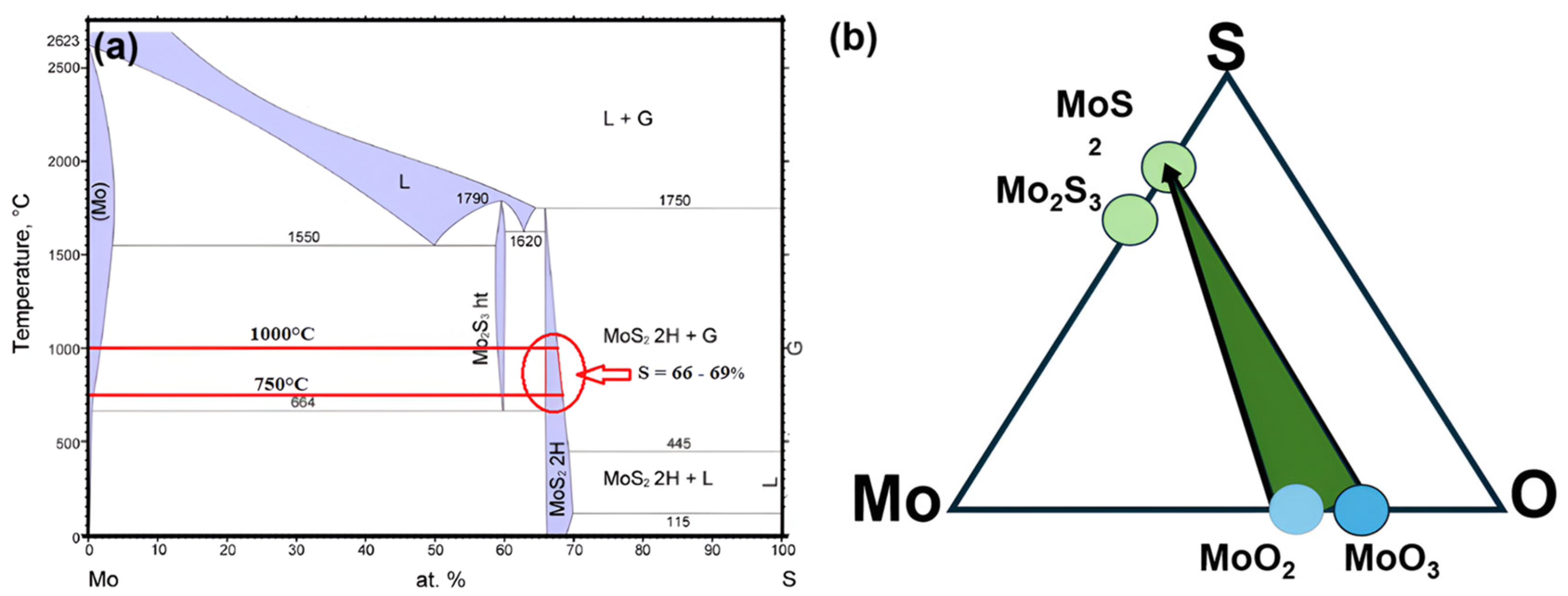
The synthesis of MoS2 with desired properties is affected by the stoichiometry of precursors, explained by the Mo-S and Mo-O-S systems phase diagrams. Consideration of stoichiometry and these diagrams is fundamental for manipulating growth to achieve the intended material properties. The Mo-S binary phase diagram displayed in Figure 1a shows the difficulty of the chemical reaction between Mo and S to synthesize pure MoS2 and specific sulfide phases of interest. It shows that stable sulfides, i.e., MoS2 and Mo2S3, can be grown from their elements under specific conditions of temperature, pressure, and precursor concentrations. Mo2S3 is stable just above 610 °C, and MoS2 exhibits a stable 2H form in a wide range of temperatures. In the range of growth temperatures from 750 °C to 1000 °C, the sulfur content in MoS2 lies between 66% and 69% and presents difficulties in keeping stoichiometry during MoS2 synthesis. The area of the 2H region, as highlighted in the diagram, focuses on the challenge of supporting reliable precursor ratios. The slight variations in these parameters can change the sulfur content and influence the quality of the grown material. Higher sulfur concentrations can lead to the formation of amorphous forms and hinder attempts to synthesize uniform MoS2 [16].
The ternary phase diagram is a triangle with Mo, O, and S at the vertices, illustrating the coexistence of distinct phases in a green triangle, i.e., MoO2, MoO3, and MoS2, as shown in Figure 1b. The Mo-O-S diagram provides insight into the synthesis of MoS2 using CVD techniques. These diagrams can help to envision the reaction pathways and challenges involved. Sulfurization of molybdenum thin films is one of the widely researched key techniques for growing MoS2, but it can also lead to unwanted phases, such as Mo2S3. Additionally, the sulfurization of molybdenum’s stable oxides, specifically MoO2 or MoO3, has been employed in CVD techniques for the growth of MoS2. In our growth technique, we propose the following possible reaction pathways for the development of MoS2 films [17].
Mo + 2S → MoS2
2MoO3 + 4S → 2MoS2 + 3O2
MoO2 + 2S→MoS2 + O2
Phase diagrams help predict the challenges of MoS2 synthesis, such as sulfur concentration, temperature, and growth time, to limit the formation of undesirable phases. Changes in these parameters can alter the growth process and lead to deformities that compromise the material’s quality. The coexistence of MoS2, MoO2, and MoO3 requires reasonable control of these parameters to complete the reaction. These phase diagrams function as a roadmap for predicting and optimizing the growth of high-quality MoS2.
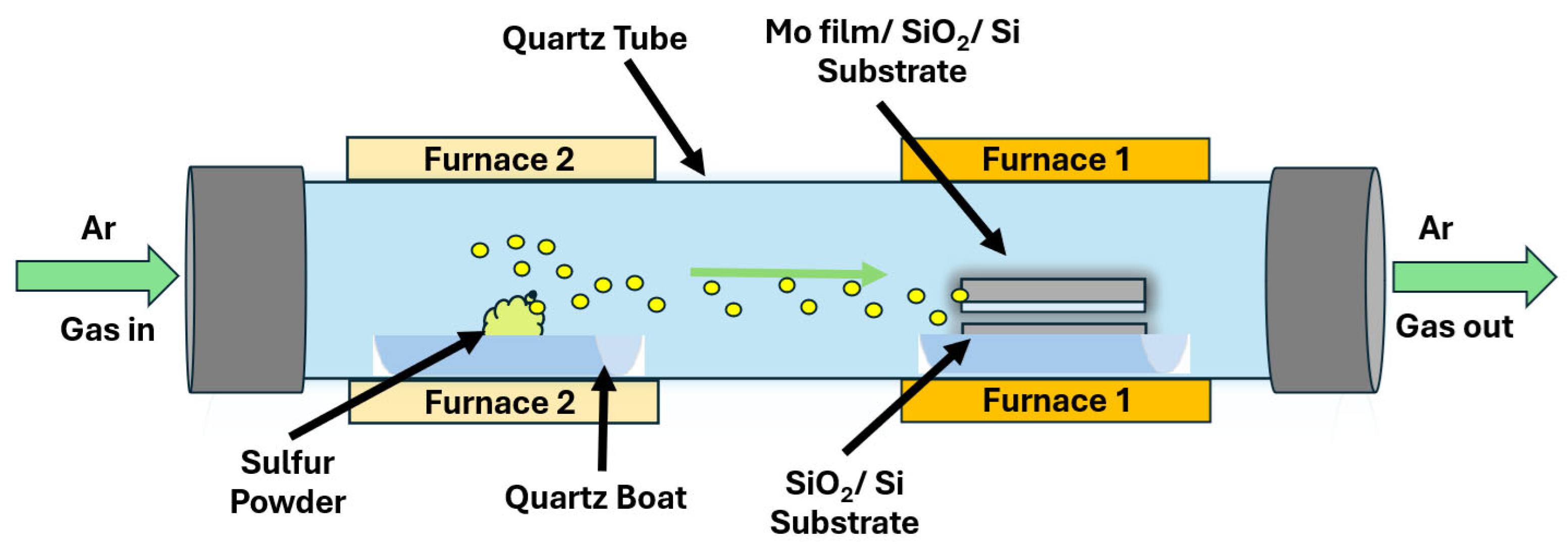
A conventional double-furnace CVD system consists of a 1-inch-diameter quartz tube and is used for the growth of MoS2, as displayed in Figure 2. This new growth technique includes the following four fundamental steps: a warm-up step, an oxidation step, a growth step, and a cooldown step. For the experimental setup, a clean substrate is situated face-to-face below a molybdenum (Mo) thin film-coated substrate; complete sputtering details are provided in the Supplementary Materials. A gap of 0.5–1 mm is supported between the two substrates using a curved quartz boat piece as a sample holder. The sample holder is then carefully positioned in the central region of the growth furnace. At the same time, the second furnace is used to hold a quartz boat holding 10–20 milligrams of precursor sulfur powder. This boat is situated at the midpoint of the second furnace. After the apparatus is arranged correctly, the quartz tube is securely fixed with accessories, and Ar gas is allowed to flow as the carrier gas for sulfur. The gas passes through the quartz tube in a manner that the growth substrate is positioned downstream of the sulfur precursor, as shown in Figure 2.
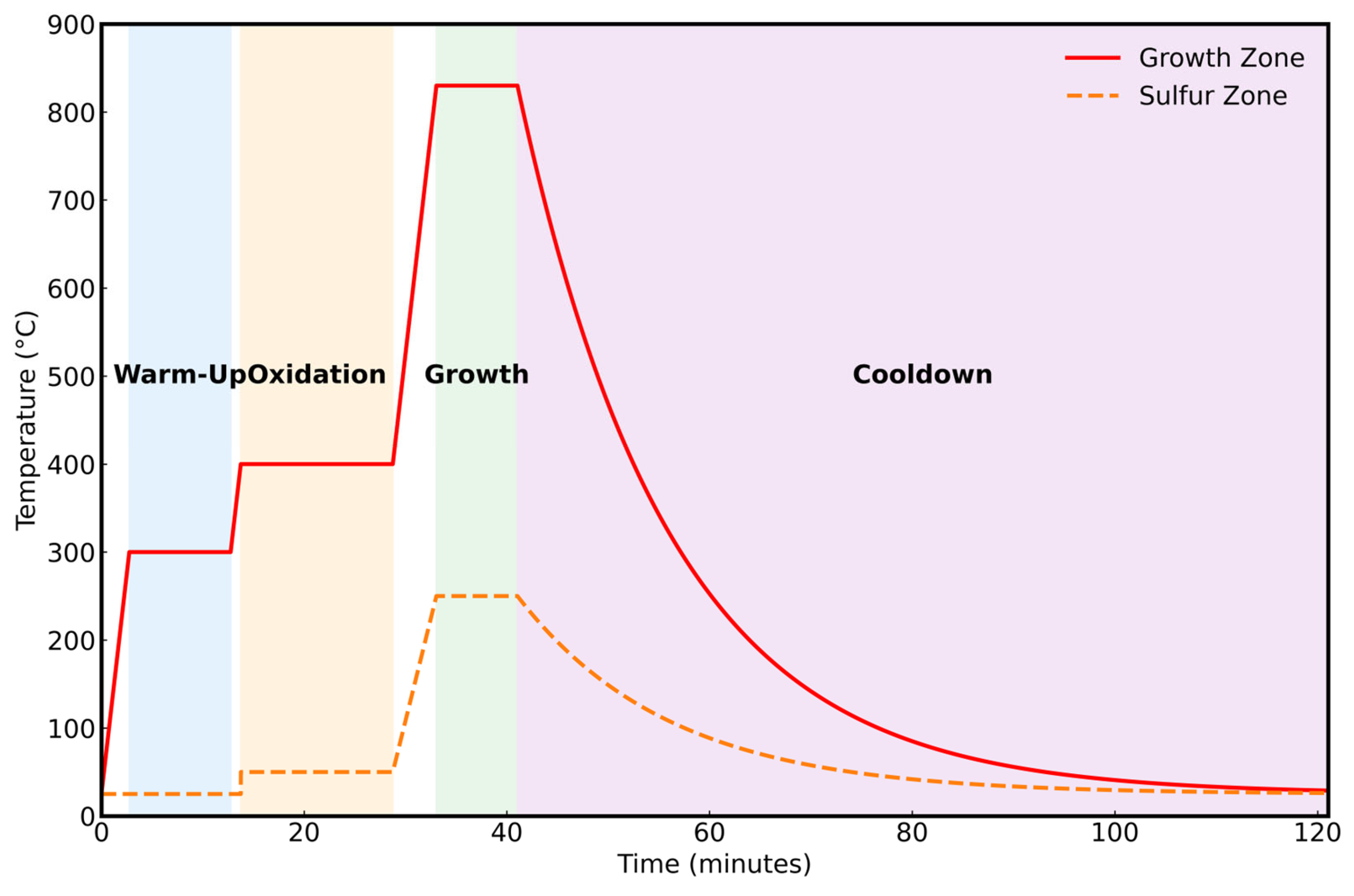
During the first stage, Ar gas is made to flow at a rate of 15 sccm to flush and purge the quartz tube, minimizing the contamination. The growth furnace is kept between 250 and 300 °C to drive off adsorbed moisture from the growth zone, while the precursor furnace is kept at room temperature. This step lasts approximately 5–10 min, keeping the Ar gas flow rate the same. In the oxidation step, the temperature of the growth region is raised to 350–450 °C to perform oxidation of the Mo film with residual (background) oxygen present in the tube while Ar flows at a rate of 15 sccm through the quartz tube. Simultaneously, the sulfur precursor furnace is warmed to 50 °C to remove moisture from the powder and prepare a dry sulfur source. This step typically lasts 10–15 min to achieve the best oxidation. For the growth step, the Ar gas flow rate is reduced to 5 sccm, and the temperature in the growth zone is increased to 780–860 °C, depending on the thickness of the Mo film. As the temperature approaches the intended growth temperature, the sulfur zone is heated up to 250 °C to vaporize the sulfur and allow it to flow into the growth zone. This step lasts 5–8 min to achieve a reaction between the sulfur fumes and the oxides of Mo, leading to the growth of a mono- to few-layer MoS2 on the bottom substrate. A general temperature profile of the steps is shown in Figure 3. The furnaces are then set to cool down to room temperature under a consistent flow of Ar gas after the growth step.

3. Results and Discussion

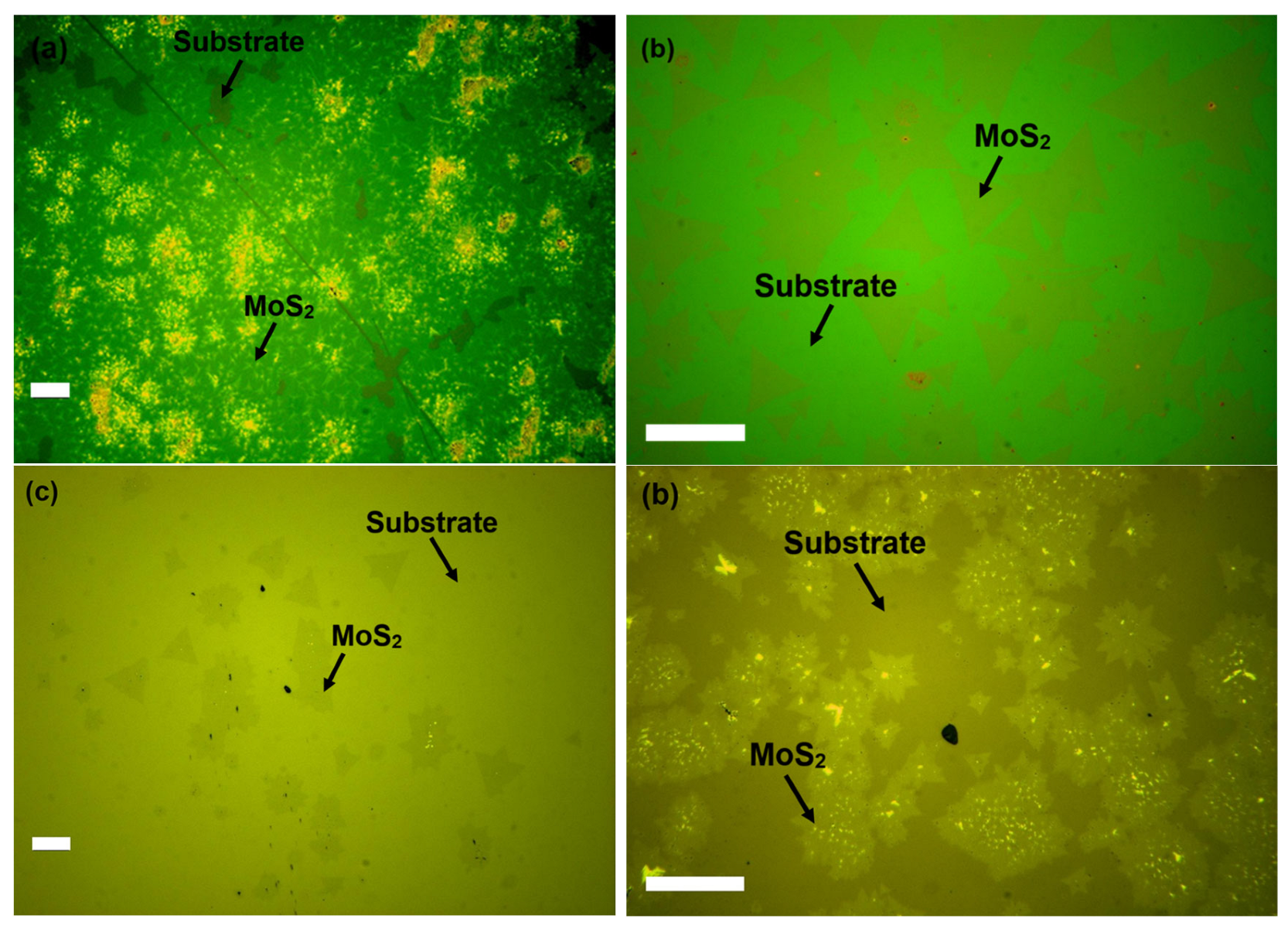
Multiple carefully designed growth experiments were performed to achieve the reproducible synthesis of mono- to few-layer MoS2 using the proximity technique at ambient pressure. We used wet oxide 300 nm SiO2/Si, dry oxide 800 nm SiO2/Si, Si, and sapphire substrates for the growth of MoS2 in the series of experiments, as shown in Figure 4a–d. For the growth of MoS2 on sapphire, we used miscut c-plane sapphire using this technique, to compare with reports of wafer-scale single-crystal growth on such substrates [18]. The annealing details are provided in the Supplementary Materials. It is also relevant to note that graphite boats were used in the first experiments. However, their tendency to cause carbon contamination and uncontrolled nucleation, along with bulky non-stoichiometric MoS2 films as discussed in the Supplementary Materials, compelled the use of quartz boats. This strategy was also helpful in keeping separation between substrates by using quartz boat curvature to create a vertical gap between the Mo film substrate and the growth substrate. The use of the quartz boat also helps in keeping the Mo:S ratio because of no sulfur consumption by the boat and yields with low defects or carbon doping as revealed by the Raman peaks FWHM values and PL intensity maps as discussed below.
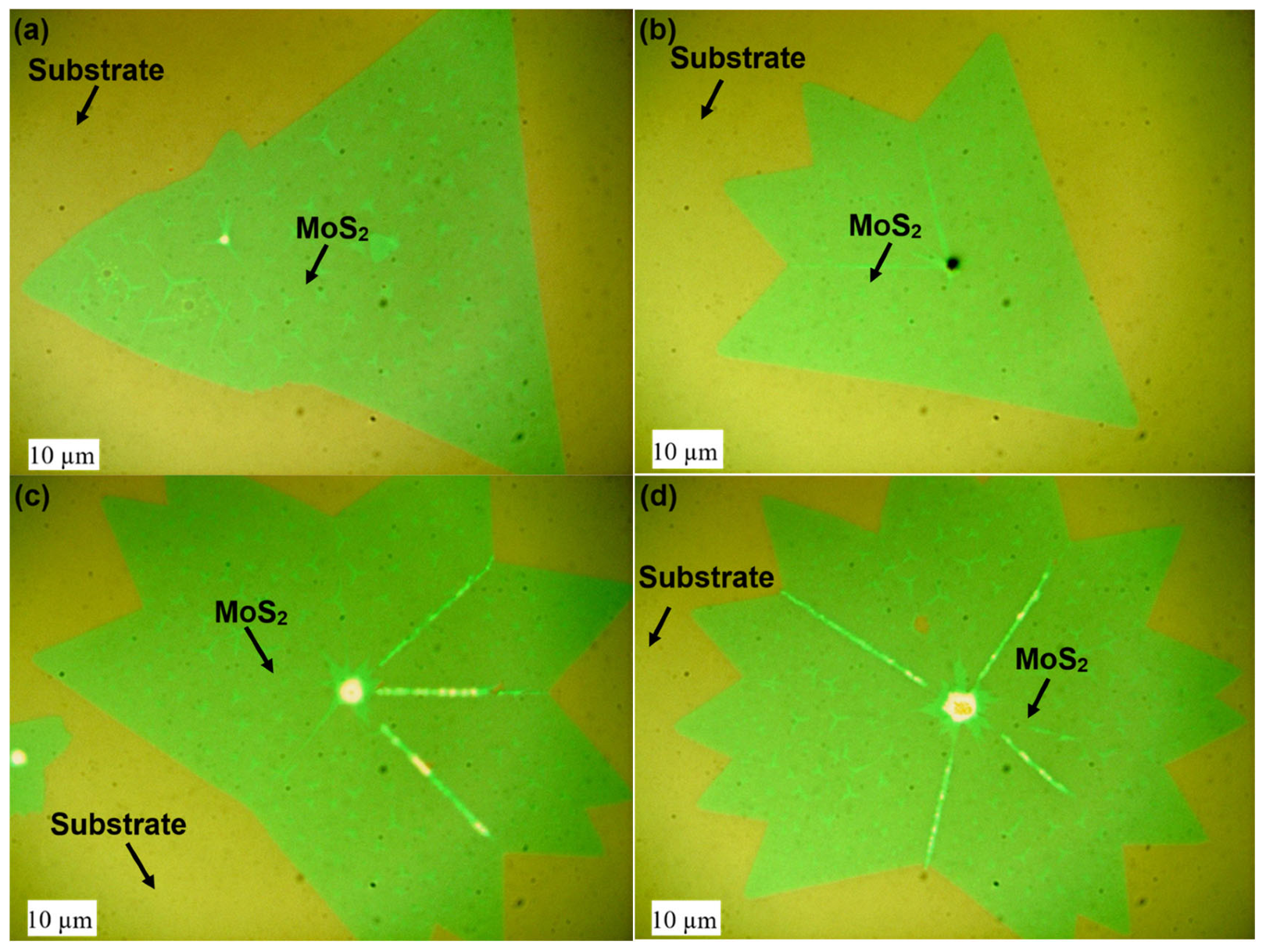
The optical microscopy images in Figure 5 show as-grown individual MoS2 flakes using proximity technique. The size of individual flakes of MoS2 growth was seen on the millimeter (mm) scale, and the size of continual growth was on the centimeter (cm) scale, images are provided in Supplementary Materials. The as-grown MoS2 showed high-quality uniformity over an investigated area, with random nucleation sites of bulk material remaining. Though the triangle is the most common shape of MoS2 growth, flakes with unusual shapes were noticed. These variations in shape can be attributed to the self-limiting Mo: S precursor ratios on the SiO2 surface [14,19]. During the growth process, thermal displacement of the Mo oxide film by S atoms in very close proximity to the growth substrate can create concentration gradients and random patterns, giving rise to unusual growth.
The theory of crystal growth suggests that the morphology of crystals is regulated by the relative growth rates of their crystal faces, starting at the nucleation sites. The slow-developing features govern the final shape, while quickly developing sides vanish or fade out. The growth rate is attributed to the surface free energy and low-energy features developing more slowly than high-energy faces, allowing them to become prominent [12]. The shape of the monolayer MoS2 is decided by the growth rate of the terminating features. The Mo nanofilm also influences crystal morphology, and any change in the Mo:S ratio can affect the chemical activity of the terminating faces. The theoretical dynamics of crystal growth suggest that it is hard to achieve precise control over the growth process without controlling the crystal seeds or nucleation sites [20,21,22,23].
The investigations focused on studying and optimizing the effects of growth parameters, including temperature within the experimental range of 780 °C to 860 °C, precursor content from 10 to 30 mg, separation between substrates within a range of ~0.4 to 1.7 mm, and thickness of the Mo film for sputtering time 1 to 10 min. The substrates, with a maximum area of 1 inch × 1/2 inch, were used for the series of experiments due to the diameter limitation of a 1-inch quartz tube setup. However, this technique can be scaled up for further possible large-area growth. With carefully controlled conditions, the proximity growth technique produced high-quality and reproducible mm-scale mono- to few-layer MoS2 and individual flakes of MoS2 monolayers. Optimal conditions were achieved by adjusting parameters such as temperature, substrate distance, and Mo film thickness. This technique requires reasonable control to support reproducibility, as any variation can result in unusual growth patterns that conflict with earlier reported findings. A temperature of ~820 °C was identified as favorable for growing high-quality mono- to few-layer MoS2, using ~60 nm Mo film substrate under controlled conditions. Additionally, the distance between the substrates of ~0.5 mm was found to be crucial for consistent growth results. As the growth temperature is the main factor for the structure and morphology of as-grown MoS2, we performed multiple experiments using a thickness of less than 100 nm at different reaction temperatures to find the optimal growth temperature. Later, we fixed the range of ~15–60 nm Mo film thickness as this was producing growth on both the bottom, clean substrate, as well as the top substrate with the Mo film, making our experiments cost-effective. Optimal temperatures were found empirically, based on the coverage (≥70%) of MoS2 growth on the sample. The optimal growth temperature values of 780 °C, 800 °C, and 820 °C correspond to Mo film thicknesses of 15 nm, 40 nm, and 60 nm, respectively, for improved crystallinity and quality of MoS2 growth. It was seen that an increase of 10 nm thickness requires ~15 to 20 °C to support the thermal vaporization and mass transfer of oxides of Mo.
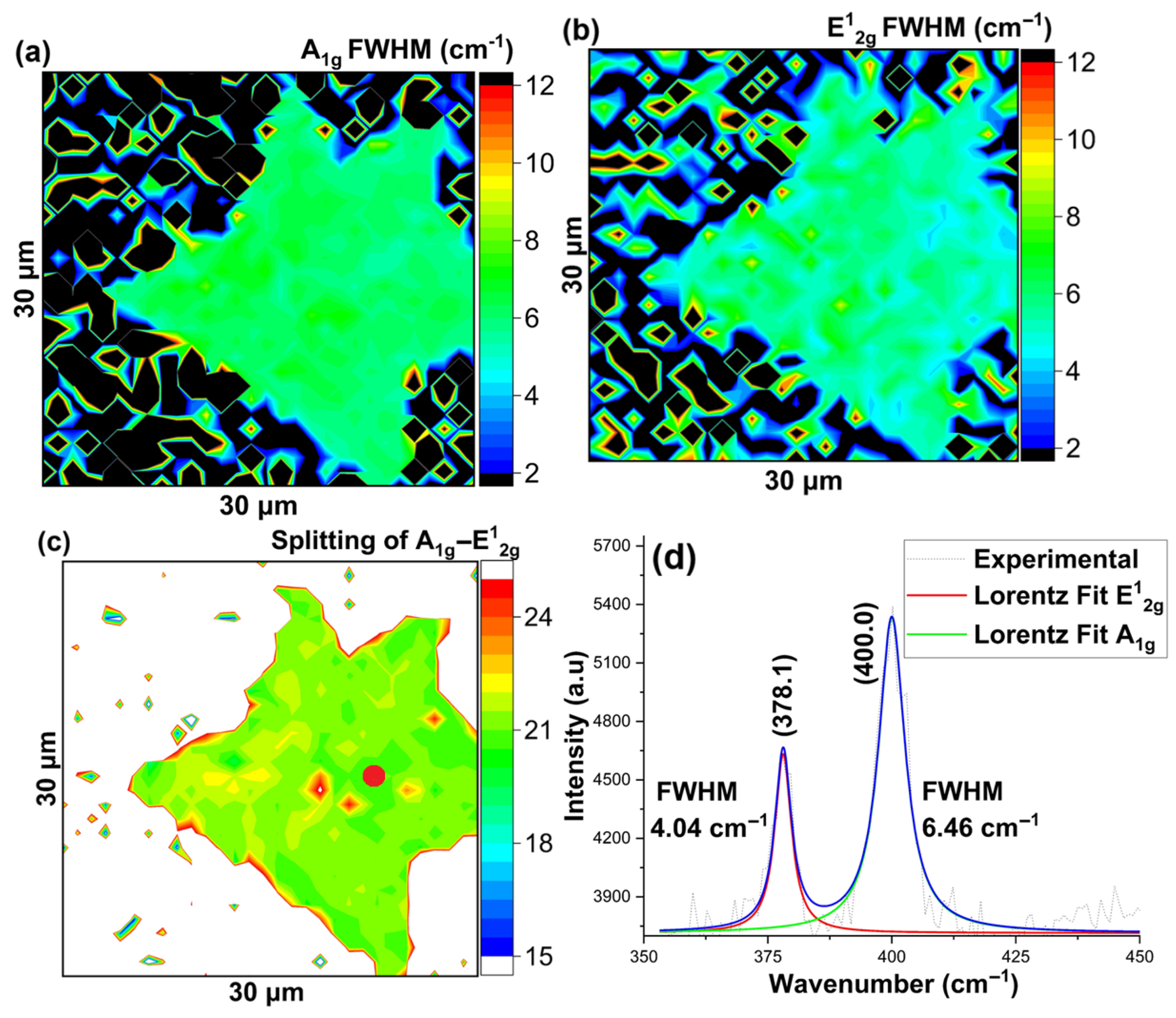
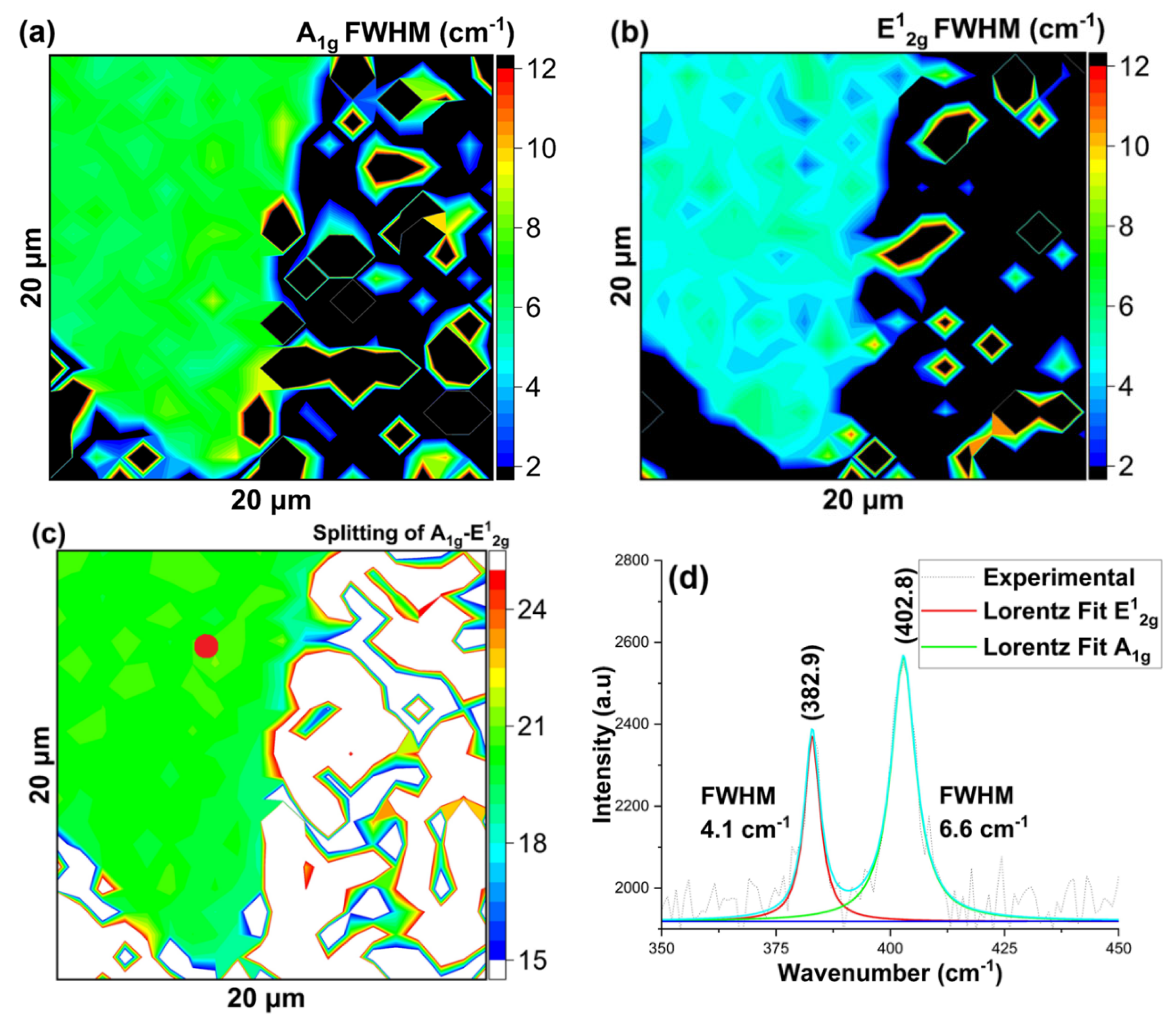
To confirm our results and assess the quality of the as-grown material on different substrates, we conducted Raman and photoluminescence (PL) spectroscopy on as-grown MoS2 using a 532 nm excitation laser, as shown in Figure S4. Both Raman and PL spectroscopy are sensitive to the number of layers as well as the quality of the material and are therefore two of the most extensively used characterization techniques. For Raman spectroscopy, the E12g mode is associated with the in-plane vibration of Mo atoms in one direction and S atoms in the opposite direction, respectively, while the A1g mode corresponds to the out-of-plane vibration of S atoms in opposite directions. The wavenumber difference between the two vibrational modes is characteristic of the number of layers with bulk material having a separation of ~26 cm−1, which decreases to ~19 cm−1 for a monolayer [24]. Additionally, it has been shown that the defect density in the as-grown MoS2 causes the peak broadening, and the Full Width at half maximum (FWHM) of the Raman modes is related to the quality of the 2D MoS2 [25,26]. Specifically, earlier work reported that the FWHM of the E12g mode is a quantitative indicator of defect density in the monolayer of MoS2, which was grown by the CVD method on SiO2/Si substrate. They correlated the narrow FWHM to the low defect density (~1012/cm−2) and classified growth as a high-quality monolayer. For PL, multilayer MoS2 has an indirect bandgap (~1.2–1.3 eV) and shows reduced PL intensity by orders of magnitude due to the indirect transition. This weak or negligible emission with broadened width is due to the low quantum efficiency of phonon-assisted transitions [24,25]. In contrast, monolayer MoS2 has a direct bandgap (~1.8–1.9 eV) and shows strong PL intensity with quantum yield orders of magnitude higher due to direct optical transitions dominated by A exciton peak and often with weak B exciton peak [24,25].
As a qualitative measure of defect density, McCreary et al. (2018) showed that the B/A intensity ratio could show the presence of defects in the as-grown material, and a high ratio corresponds to high defect density [27,28,29]. It is important to note that the PL B/A ratio can also be influenced by factors like strain, substrate-induced charge transfer, and dielectric effects. These factors can affect the excitonic recombination process and change the bandgap, useful for bandgap and strain engineering-based technologies [30]. Also, interaction with the target substrate changes the electronic states of MoS2 and causes changes in excitonic behavior [31]. Additionally, Hossen et al. (2025) studied that the growth with lower defect density shows higher PL intensity and vice versa, which is attributed to variation in the pristine band structure of MoS2 [25]. Below, we present spatially resolved maps of the Raman and PL spectra for as-grown material on SiO2/Si, sapphire, and Si. We found a Lorentzian to provide the best fit for evaluating the Raman spectra, indicating that the dominant component was from the intrinsic, homogeneous broadening. For the photoluminescence (PL) spectra, we found a Gaussian profile to provide the best fit, indicative of the typical inhomogeneous broadening observed in room-temperature PL from MoS2 [32,33].
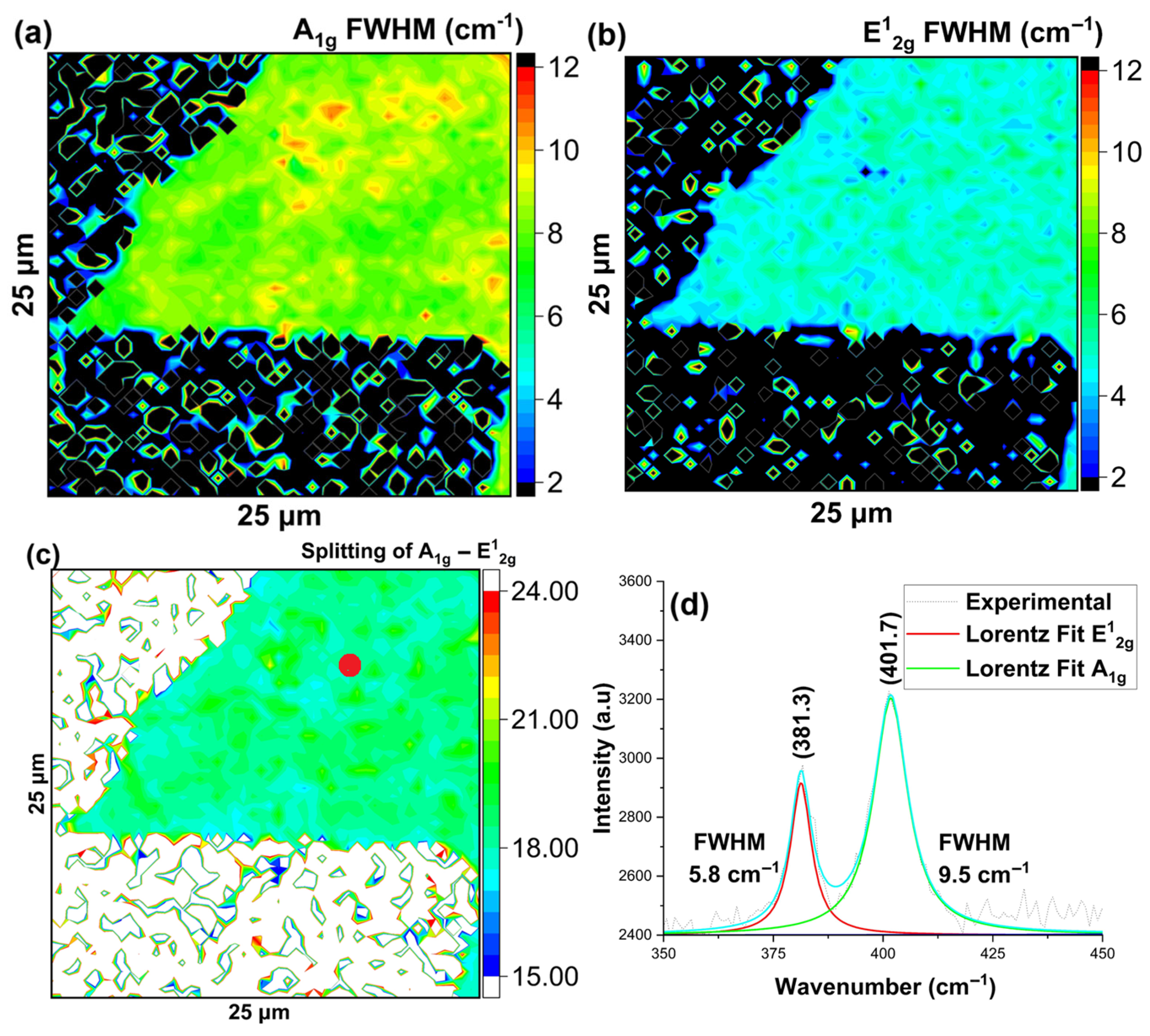
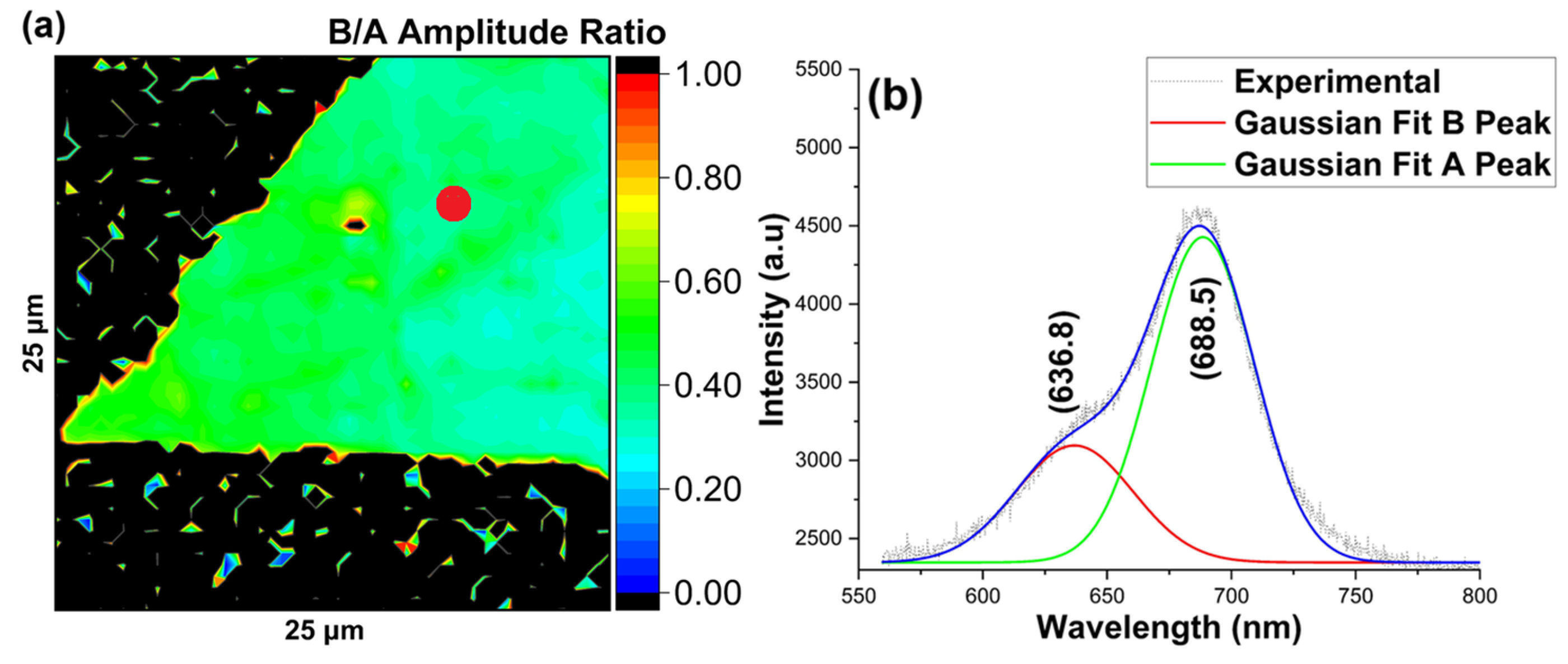
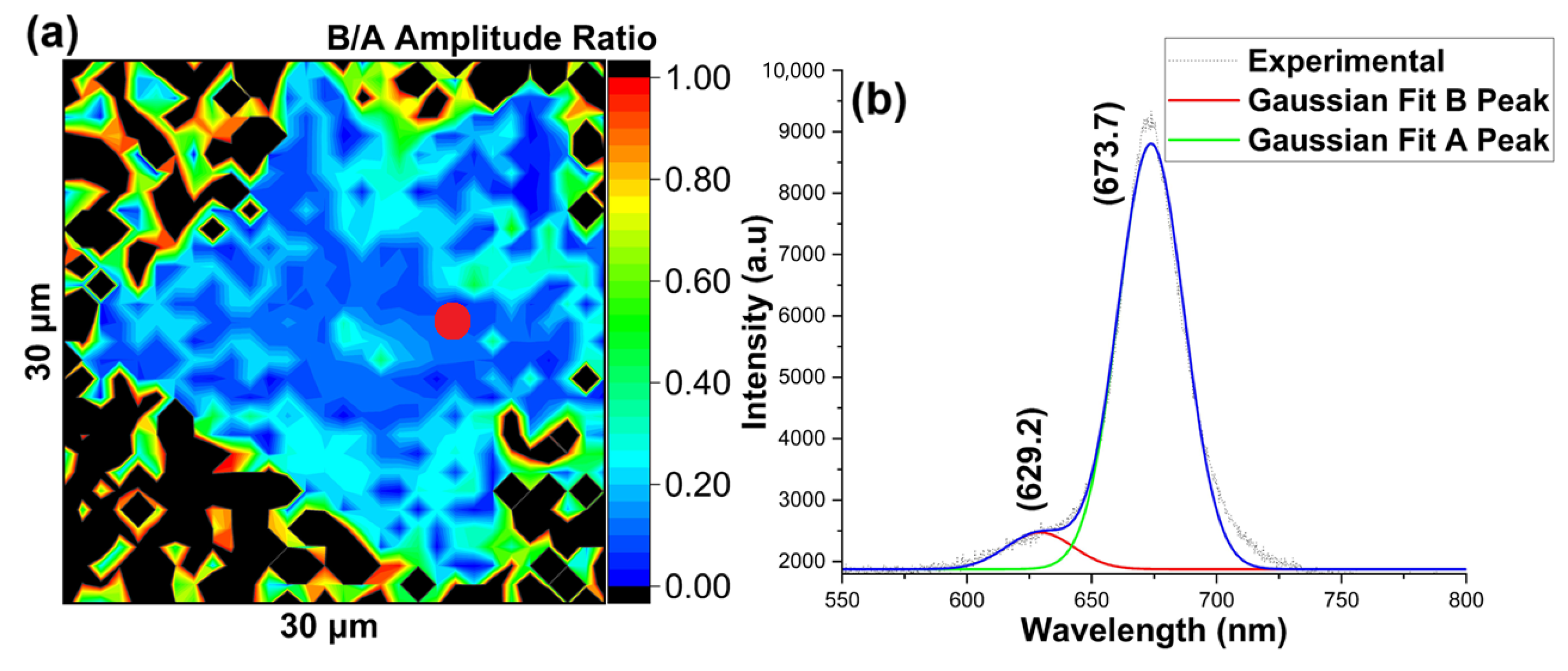
First, for material grown on SiO2/Si substrates, the FWHM maps of the A1g and E12g Raman modes revealed the uniformity and high quality of the monolayer over the investigated area, as shown in Figure 6a,b. The splitting between A1g and E12g Raman modes, as shown in Figure 6c,d, indicates the presence of a monolayer, while the B/A ratio of the Gaussian amplitudes and PL intensity suggested the presence of low defects related to impurity or vacancy-induced localized states, as shown in Figure 7a,b.
Next, we show Raman and PL spectroscopy of a MoS2 flake grown on the sapphire substrate. We took 2D spatial maps of Raman modes and PL intensity by integrating the spectra over an area of 30 μm × 30 μm of a MoS2 flake. Similar to the SiO2/Si substrate, the FWHM maps of the Raman modes showed the excellent quality of the MoS2 flake, as shown in Figure 8a–d.
The observed Gaussian fitted B/A amplitude ratio suggested even lower defect density than the as-grown MoS2 on SiO2/Si substrate, as shown in Figure 9a,b.
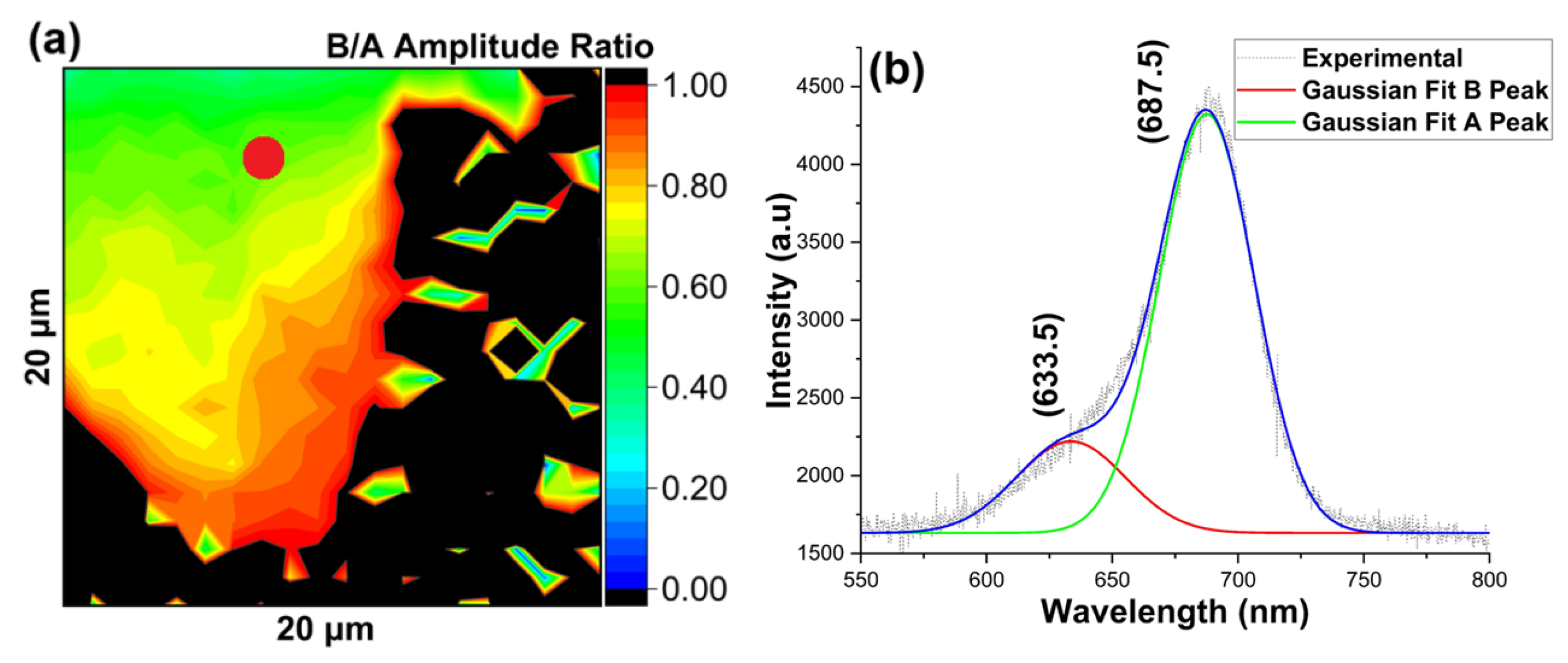
Lastly, we performed Raman and PL spectra analysis of MoS2 grown on a Si substrate with an area of 20 μm × 20 μm of the edge of the MoS2 flake grown on a Si substrate, as shown in Figure 10a–d and Figure 11a,b, respectively. Here, the Raman and PL data indicate a defect density similar to the SiO2/Si substrate.
For each substrate, the measured PL spectra show intense emissions with well-defined A and B peaks, which are consistent with reported work for monolayer MoS2 [25,26]. While our samples are mono- to few-layer MoS2, we intentionally performed spectroscopy on optically found monolayer areas to investigate the material quality, which provides a standard measure of the overall quality of the material [24]. The observed PL spectra also confirmed that the analyzed areas correspond to monolayer regions. The PL and Raman maps of MoS2 on SiO2/Si, sapphire, and Si samples confirmed the excellent quality of the as-grown MoS2 on each of these substrates and showed low defect density in the investigated regions [25,26].
To estimate a quantitative measure of the defect densities, we used a linear regression model (R2 = 0.71, Figure S5 in the Supplementary Materials) on the reported data of Hossen et al. (2025) [25] and predicted the defect density from the measured FWHM value of our samples, as shown in Table 2. Other researchers have also reported the defect density in the order of 1012 for as-grown MoS2 monolayer as a high-quality material for applications [34,35]. The B/A intensity ratio of the PL is highly sensitive to non-radiative recombination and well-established qualitative indicator of sample quality. The estimated defect density, along with the observed low B/A ratio, provides evidence that our growth technique yields high crystalline quality of MoS2.
The low defect density could be assigned to higher temperature growth as it ensures crystallinity, the adoption of a quartz boat to reduce the carbonaceous impurities, and the desorption of sulfur precursor performed by warming. Also, the low defect density of as-grown MoS2 on sapphire could be due to influencing factors like substrate surface energy, lattice mismatch, and chemical interactions. Sapphire substrates have higher surface energy and an ordered surface as compared to the SiO2 substrate and enhance uniform nucleation. The lower surface energy, along with the amorphous nature of SiO2 substrates, causes bulky growth and promotes defects with grain boundaries [21,36]. Also, the sapphire substrate has a low lattice mismatch (~3.5%) with 2D MoS2, and silicon substrates have a higher mismatch. This low lattice mismatch minimizes strain-induced defects such as dislocations or vacancies when MoS2 is grown on sapphire. On the other hand, the amorphous nature of silicon substrates promotes polycrystalline growth with relatively higher defect densities [37,38]. In addition, chemical interactions with the substrate influence the quality of the as-grown MoS2. On silicon substrates, S-O covalent bonds and potential interdiffusion can increase sulfur vacancies and edge defects [39]. These influencing mechanisms may explain the high-quality growth of MoS2 on sapphire substrate in our findings.

4. Conclusions

In this research, we investigated a robust, reproducible, potentially scalable, and effective CVD technique for growing mm-scale mono- to few-layer MoS2 films by the proximity of the Mo film substrate and multiple target substrates like SiO2/Si, Si, and sapphire. We optimized the growth parameters like Mo film thickness, substrate gap, temperature, and sulfur concentration, and studied the effects of using different substrates to achieve consistent MoS2 growth. We controlled the contamination and defect density of growth by using a quartz boat instead of a graphite boat. It was found that growth temperature of ~820 °C, and substrate separation of ~0.5 mm proved helpful in producing crystalline, high-quality, and laterally mm-scale, mono- to few-layer MoS2 films on target substrates. Raman spectroscopy confirmed the uniformity and high-quality growth, while PL mapping confirmed low defect densities and optical quality of the investigated areas of MoS2 growth. This study indicates the potential of unconventional methods for synthesizing MoS2, addressing challenges of scalability, substrate versatility, defect density, and high-quality growth of MoS2. This work paves the way for future investigations to grow other high-quality TMDs for integration into electronic, optoelectronic, and quantum devices.

Supplementary Materials

The following supporting information can be downloaded at https://www.mdpi.com/article/10.3390/nano16030159/s1, References [24,25,26,40,41,42] are cited in the supplementary materials.

Author Contributions

Conceptualization, Methodology, Investigation, and Writing—Original Draft Preparation, M.T.; Writing—Review and Editing, W.P., N.A., G.J., M.B. and E.S.; Supervision, E.S. All authors have read and agreed to the published version of the manuscript.

Funding

The Higher Education Commission (HEC) of Pakistan supported this research under the ‘US-Pakistan Knowledge Corridor’ Scholarship.

Data Availability Statement

The raw data supporting the conclusions of this article will be made available by the authors on request.

Conflicts of Interest

The authors declare no conflicts of interest.

References

  1. Duong, D.L.; Yun, S.J.; Lee, Y.H. van der Waals layered materials: Opportunities and challenges. ACS Nano 2017, 11, 11803–11830. [Google Scholar] [CrossRef]
  2. Paul, S.; Karak, S.; Talukdar, S.; Negi, D.; Saha, S. Tailoring the defects and electronic band structure in WS2/h-BN heterostructure. arXiv 2023, arXiv:2311.08948. [Google Scholar]
  3. Liu, H.F.; Wong, S.L.; Chi, D.Z. CVD growth of MoS2-based two-dimensional materials. Chem. Vap. Depos. 2015, 21, 241–259. [Google Scholar] [CrossRef]
  4. Sovizi, S.; Angizi, S.; Ahmad Alem, S.A.; Goodarzi, R.; Taji Boyuk, M.R.R.; Ghanbari, H.; Szoszkiewicz, R.; Simchi, A.; Kruse, P. Plasma processing and treatment of 2D transition metal dichalcogenides: Tuning properties and defect engineering. Chem. Rev. 2023, 123, 13869–13951. [Google Scholar] [CrossRef] [PubMed]
  5. Zeng, Q.; Wang, H.; Fu, W.; Gong, Y.; Zhou, W.; Ajayan, P.M.; Lou, J.; Liu, Z. Band engineering for novel two-dimensional atomic layers. Small 2015, 11, 1868–1884. [Google Scholar] [CrossRef] [PubMed]
  6. Zhang, S.; Hao, Y.; Hao, S.; Lu, X.; Zhou, J.; Fan, C.; Liu, J.; Hao, G. Wafer-scale synthesis of transition metal dichalcogenides and van der Waals heterojunctions. Nanotechnology 2025, 36, 232004. [Google Scholar] [CrossRef]
  7. Zhang, S.; Hao, Y.; Gao, F.; Wu, X.; Hao, S.; Qiu, M.; Zheng, X.; Wei, Y.; Hao, G. Controllable growth of wafer-scale two-dimensional WS2 with outstanding optoelectronic properties. 2D Mater. 2023, 11, 015007. [Google Scholar] [CrossRef]
  8. Hao, S.; Hao, Y.; Li, J.; Wang, K.; Fan, C.; Zhang, S.; Wei, Y.; Hao, G. Controllable growth of two-dimensional wrinkled WSe2 nanostructures via chemical vapor deposition based on thermal mismatch strategy. Appl. Phys. Lett. 2024, 125, 072102. [Google Scholar] [CrossRef]
  9. Hao, Y.; Zhang, S.; Fan, C.; Liu, J.; Hao, S.; Lu, X.; Zhou, J.; Qiu, M.; Li, J.; Hao, G. Te nanomesh-monolayer WSe2 vertical van der Waals heterostructure for high-performance photodetector. Appl. Phys. Lett. 2025, 126, 031904. [Google Scholar] [CrossRef]
  10. Xie, Y.; Zhang, A.; Wang, G.; Huo, S.; Niu, P.; Wu, E. Plasma engineering of two-dimensional transition metal dichalcogenides: From material synthesis to functional device integration. Nano Res. 2025, 18, 94907853. [Google Scholar] [CrossRef]
  11. Everhart, B.M.; Austin, D.R.; Anayee, M.; Altvater, M.A.; Robertson, B.M.; Kleyn, M.; Josephson, L.; Simmons, M.; Woll, A.R.; Stevenson, P.R.; et al. High-throughput synthesis and evaluation of metal and metal oxide precursor films for two-step conversion to MoSe2. NPJ 2D Mater. Appl. 2025, 9, 60. [Google Scholar] [CrossRef]
  12. Wang, S.; Rong, Y.; Fan, Y.; Pacios, M.; Bhaskaran, H.; He, K.; Warner, J.H. Shape evolution of monolayer MoS2 crystals grown by chemical vapor deposition. Chem. Mater. 2014, 26, 6371–6379. [Google Scholar] [CrossRef]
  13. Chang, M.C.; Ho, P.H.; Tseng, M.F.; Lin, F.Y.; Hou, C.H.; Lin, I.K.; Wang, H.; Huang, P.-P.; Chiang, C.-H.; Yang, Y.-C.; et al. Fast growth of large-grain and continuous MoS2 films through a self-capping vapor-liquid-solid method. Nat. Commun. 2020, 11, 3682. [Google Scholar] [CrossRef] [PubMed]
  14. Choi, H.J.; Jung, Y.S.; Lee, S.M.; Kang, S.; Seo, D.; Kim, H.; Choi, H.-J.; Lee, G.-H.; Cho, Y.S. Large-scale self-limiting synthesis of monolayer MoS2 via proximity evaporation from Mo films. Cryst. Growth Des. 2020, 20, 2698–2705. [Google Scholar] [CrossRef]
  15. Napoleonov, B.; Petrova, D.; Minev, N.; Rafailov, P.; Videva, V.; Karashanova, D.; Ranguelov, B.; Atanasova-Vladimirova, S.; Strijkova, V.; Dimov, D.; et al. Growth of monolayer MoS2 flakes via close proximity re-evaporation. Nanomaterials 2024, 14, 1213. [Google Scholar] [CrossRef]
  16. Gaponova, O.P.; Antoszewski, B.; Tarelnyk, V.B.; Kurp, P.; Myslyvchenko, O.M.; Tarelnyk, N.V. Analysis of the quality of sulfomolybdenum coatings obtained by electrospark alloying methods. Materials 2021, 14, 6332. [Google Scholar] [CrossRef]
  17. Seravalli, L.; Bosi, M. A review on chemical vapour deposition of two-dimensional MoS2 flakes. Materials 2021, 14, 7590. [Google Scholar] [CrossRef]
  18. Yu, H.; Liao, M.; Zhao, W.; Liu, G.; Zhou, X.J.; Wei, Z.; Xu, X.; Liu, K.; Hu, Z.; Deng, K.; et al. Wafer-scale growth and transfer of highly oriented monolayer MoS2 continuous films. ACS Nano 2017, 11, 12001–12007. [Google Scholar]
  19. Lu, Y.; Chen, T.; Ryu, G.H.; Huang, H.; Sheng, Y.; Chang, R.J.; Warner, J.H. Self-limiting growth of high-quality 2D monolayer MoS2 by direct sulfurization using precursor-soluble substrates for advanced field-effect transistors and photodetectors. ACS Appl. Nano Mater. 2018, 2, 369–378. [Google Scholar] [CrossRef]
  20. Nie, Y.; Liang, C.; Cha, P.R.; Colombo, L.; Wallace, R.M.; Cho, K. A kinetic Monte Carlo simulation method of van der Waals epitaxy for atomistic nucleation-growth processes of transition metal dichalcogenides. Sci. Rep. 2017, 7, 2977. [Google Scholar] [CrossRef]
  21. Paul, S.; Torsi, R.; Robinson, J.A.; Momeni, K. Effect of the substrate on MoS2 monolayer morphology: An integrated computational and experimental study. ACS Appl. Mater. Interfaces 2022, 14, 18835–18844. [Google Scholar] [CrossRef] [PubMed]
  22. Zhou, D.; Shu, H.; Hu, C.; Jiang, L.; Liang, P.; Chen, X. Unveiling the growth mechanism of MoS2 with chemical vapor deposition: From two-dimensional planar nucleation to self-seeding nucleation. Cryst. Growth Des. 2018, 18, 1012–1019. [Google Scholar] [CrossRef]
  23. Dong, J.; Ding, D.; Jin, C.; Liu, Y.; Ding, F. Edge reconstruction-dependent growth kinetics of MoS2. ACS Nano 2022, 17, 127–136. [Google Scholar] [CrossRef] [PubMed]
  24. Kolobov, A.V.; Tominaga, J. Two-Dimensional Transition-Metal Dichalcogenides; Springer: Berlin/Heidelberg, Germany, 2016; Volume 239. [Google Scholar]
  25. Hossen, M.F.; Shendokar, S.; Khan, M.A.R.; Aravamudhan, S. Quantitative Defect Analysis in CVD-Grown Monolayer MoS2 via In-Plane Raman Vibration. Nano Sel. 2025, 6, e202400103. [Google Scholar]
  26. Aldosari, N.; Poston, W.; Jensen, G.; Bizhani, M.; Tariq, M.; Stinaff, E. Controlled Oxidation of Metallic Molybdenum Patterns via Joule Heating for Localized MoS2 Growth. Nanomaterials 2025, 15, 131. [Google Scholar] [CrossRef]
  27. McCreary, K.M.; Hanbicki, A.T.; Sivaram, S.V.; Jonker, B.T. A-and B-exciton photoluminescence intensity ratio as a measure of sample quality for transition metal dichalcogenide monolayers. APL Mater. 2018, 6, 111106. [Google Scholar]
  28. Chen, J.; Tang, W.; Tian, B.; Liu, B.; Zhao, X.; Liu, Y.; Ren, T.; Liu, W.; Geng, D.; Jeong, H.Y.; et al. Chemical vapor deposition of high-quality large-sized MoS2 crystals on silicon dioxide substrates. Adv. Sci. 2016, 3, 1500033. [Google Scholar]
  29. Bizhani, M.; Jensen, G.; Poston, W.; Aldosari, N.; Tariq, M.; Aleithan, S.; Stinaff, E. Selective oxidation of metallic contacts for localized chemical vapor deposition growth of 2D-transition metal dichalcogenides. Mater. Res. Express 2024, 11, 015901. [Google Scholar] [CrossRef]
  30. Conley, H.J.; Wang, B.; Ziegler, J.I.; Haglund, R.F., Jr.; Pantelides, S.T.; Bolotin, K.I. Bandgap engineering of strained monolayer and bilayer MoS2. Nano Lett. 2013, 13, 3626–3630. [Google Scholar] [CrossRef]
  31. Szczęśniak, D.; Kais, S. Gap states and valley-spin filtering in transition metal dichalcogenide monolayers. Phys. Rev. B 2020, 101, 115423. [Google Scholar] [CrossRef]
  32. Peter, Y.U.; Cardona, M. Fundamentals of Semiconductors: Physics and Materials Properties; Springer Science & Business Media: Berlin/Heidelberg, Germany, 2010. [Google Scholar]
  33. Klingshirn, C. Semiconductor Optics; Springer: Berlin/Heidelberg, Germany, 2007. [Google Scholar]
  34. Zhang, X.; Xu, J.; Zhi, A.; Wang, J.; Wang, Y.; Zhu, W.; Han, X.; Tian, X.; Bai, X.; Sun, B.; et al. Low-Defect-Density Monolayer MoS2 Wafer by Oxygen-Assisted Growth-Repair Strategy. Adv. Sci. 2024, 11, 2408640. [Google Scholar] [CrossRef]
  35. Picker, J.; Gan, Z.; Neumann, C.; George, A.; Turchanin, A. Low defect density in MoS2 monolayers grown on Au (111) by metal-organic chemical vapor deposition. Micron 2024, 186, 103708. [Google Scholar] [CrossRef]
  36. Annamalai, M.; Gopinadhan, K.; Han, S.A.; Saha, S.; Park, H.J.; Cho, E.B.; Kumar, B.; Patra, A.; Kim, S.-W.; Venkatesan, T. Surface energy and wettability of van der Waals structures. Nanoscale 2016, 8, 5764–5770. [Google Scholar] [CrossRef]
  37. Xiang, Y.; Sun, X.; Valdman, L.; Zhang, F.; Choudhury, T.H.; Chubarov, M.; Robinson, J.A.; Redwing, J.M.; Terrones, M.; Ma, Y.; et al. Monolayer MoS2 on sapphire: An azimuthal reflection high-energy electron diffraction perspective. 2D Mater. 2020, 8, 025003. [Google Scholar] [CrossRef]
  38. Soni, A.; Kamath, N.S.; Shen, Y.Y.; Seksaria, H.; De Sarkar, A.; Chang, W.H.; Pal, S.K. Substrate-induced modulation of transient optical response of large-area monolayer MoS2. Sci. Rep. 2025, 15, 7537. [Google Scholar] [CrossRef]
  39. Sohn, W.; Kwon, K.C.; Suh, J.M.; Lee, T.H.; Roh, K.C.; Jang, H.W. Microscopic evidence of strong interactions between chemical vapor deposited 2D MoS2 film and SiO2 growth template. Nano Converg. 2021, 8, 11. [Google Scholar] [CrossRef] [PubMed]
  40. Cui, J.; Sun, A.; Reshichkov, M.; Yun, F.; Baski, A.; Morkoç, H. Preparation of sapphire for high quality III-nitride growth. Mater. Res. Soc. Internet J. Nitride Semicond. Res. 2000, 5, e7. [Google Scholar] [CrossRef]
  41. Poston, W.B. Alloying and Structural Modification of Two-Dimensional Transition Metal Dichalcogenides. Doctoral Dissertation, Ohio University, Athens, OH, USA, 2025. [Google Scholar]
  42. Domínguez, A.; Dutt, A.; de Melo, O.; Huerta, L.; Santana, G. Molybdenum oxide 2-D flakes: Role of thickness and annealing treatment on the optoelectronic properties of the material. J. Mater. Sci. 2018, 53, 6147–6156. [Google Scholar] [CrossRef]
Figure 1. (a) Binary phase diagram of the Mo-S system [16], (b) ternary phase diagram of the Mo-O-S system showing pathways [17].
Nanomaterials 16 00159 g001
Figure 2. Chemical vapor deposition (CVD) setup—double furnace system.
Nanomaterials 16 00159 g002
Figure 3. A general temperature profile of the process.
Nanomaterials 16 00159 g003
Figure 4. (a) As-grown MoS2 on wet oxide 300 nm SiO2/Si, (b) As-grown MoS2 on dry oxide 800 nm SiO2/Si, (c) As-grown MoS2 on Si, (d) As-grown MoS2 on sapphire (scalebars at 100 µm).
Nanomaterials 16 00159 g004
Figure 5. (ad) As-grown MoS2 individual flakes on wet oxide 300 nm SiO2/Si substrate.
Nanomaterials 16 00159 g005
Figure 6. MoS2 growth on SiO2/Si substrate using quartz boat (a) Map of A1g Raman Mode’s Full Width at Half Maxima (FWHM), (b) Map of E12g Raman Mode’s Full Width at Half Maxima (FWHM), (c) Map of Raman band Splitting of A1g and E12g modes, (d) Representative Raman spectra of the indicated (red) spot. The blue line represents the cumulative fit.
Nanomaterials 16 00159 g006
Figure 7. MoS2 growth on SiO2/Si substrate using quartz boat (a) map of B/A amplitude ratio obtained by Gaussian fitting of PL intensity map, (b) representative PL spectra of the shown (red) spot. The blue line represents the cumulative fit.
Nanomaterials 16 00159 g007
Figure 8. MoS2 growth on sapphire substrate using quartz boat (a) Map of A1g Raman Mode’s Full Width at Half Maxima (FWHM), (b) Map of E12g Raman Mode’s Full Width at Half Maxima (FWHM), (c) Map of Raman band Splitting of A1g and E12g modes, (d) Representative Raman spectra of the indicated (red) spot. The blue line represents the cumulative fit.
Nanomaterials 16 00159 g008
Figure 9. MoS2 growth on sapphire substrate (a) B/A amplitude ratio map obtained by Gaussian fitting of PL intensity map, (b) representative PL spectra of the shown (red) spot. The blue line represents the cumulative fit.
Nanomaterials 16 00159 g009
Figure 10. MoS2 growth on sapphire Si using quartz boat (a) Map of A1g Raman Mode’s Full Width at Half Maxima (FWHM), (b) Map of E12g Raman Mode’s Full Width at Half Maxima (FWHM), (c) Map of Raman band Splitting of A1g and E12g modes, (d) Representative Raman spectra of the indicated (red) spot. The blue line represents the cumulative fit.
Nanomaterials 16 00159 g010
Figure 11. MoS2 growth on Si substrate (a) B/A amplitude ratio map obtained by Gaussian fitting of PL intensity map, (b) representative PL spectra of the shown (red) spot. The blue line represents the cumulative fit.
Nanomaterials 16 00159 g011
Table 1. Qualitative and quantitative comparison of proximity techniques.
Precursors
/Gas
Temperature
(°C)
Growth Time
(Minutes)
Flake Size
/Type
SubstrateReference
Mo Film
(<100 nm)
+S/Ar
~780–860
(Moderate)
~5–8
(Lower)
~1–3 mm
(Medium)
mono- to few-layer
SiO2/Si
Sapphire
Si
Our Work
Mo Films
(20 and 40 nm)
+H2S
~690–810
(Lower)
~10
(Moderate)
2 inches
(Large)
monolayer
Sapphire[14]
MoO3 + PTAS + S
Bulk MoS2
Re-evaporation
/Ar
~1000
(Higher)
~120
(Higher)
~10 µm
(Small)
mono- to few-layer
Sapphire[15]
Table 2. Predicted defect density of the investigated monolayer.
SubstrateFWHM of E12g Mode
(cm−1)
Predicted Defect Density
(cm−2)
PL B/A Ratio
SiO2/Si~4–61.6–2.7 (×1012)~0.3–0.6
Sapphire~3–60.46–2.7 (×1012)~0.1–0.4
Si~4–61.6–2.7 (×1012)~0.5–0.8
Disclaimer/Publisher’s Note: The statements, opinions and data contained in all publications are solely those of the individual author(s) and contributor(s) and not of MDPI and/or the editor(s). MDPI and/or the editor(s) disclaim responsibility for any injury to people or property resulting from any ideas, methods, instructions or products referred to in the content.