Article

Facile Galvanic Replacement Toward One-Dimensional Cu-Based Bimetallic Nanobelts

1
School of Physics and Advanced Energy, Henan University of Technology, Zhengzhou 450001, China
2
Guoneng Mengjin Thermal Power Co., Ltd., Luoyang 471112, China
*
Authors to whom correspondence should be addressed.
Nanomaterials 2026, 16(1), 38; https://doi.org/10.3390/nano16010038
Submission received: 21 November 2025 / Revised: 18 December 2025 / Accepted: 23 December 2025 / Published: 26 December 2025
(This article belongs to the Section Nanoelectronics, Nanosensors and Devices)

Abstract

We report a galvanic replacement-driven strategy for the in situ growth of highly uniform one-dimensional (1D) Cu@CuO-X (X = Ag, Bi) nanobelts directly on aluminum foils. Unlike conventional multi-step coating or hard-template replication strategies, the formation of these heterostructured nanobelts is governed by a spontaneous interfacial galvanic replacement process between Cu and the introduced metal species, ensuring in situ growth and intimate interfacial integration. Comprehensive SEM, TEM, XRD, and XPS characterizations confirm the successful formation of Cu@CuO-Ag and Cu@CuO-Bi architectures, where Bi predominantly exists in the oxidized Bi3+ state, forming Bi2O3-like surface species. Benefiting from their 1D anisotropic framework and controllable heterointerfaces, this work underscores the distinctiveness and versatility of the self-templated galvanic replacement strategy for the design of multifunctional nanomaterials.

1. Introduction

Low-dimensional metal nanostructures, such as nanowires, nanorods, and nanotubes, have emerged as a distinct class of materials with unique geometric and physicochemical advantages [1,2,3]. Their large surface-to-volume ratios expose abundant active sites, thereby promoting interfacial reactions. In particular, the intrinsic anisotropy of one-dimensional (1D) nanostructures enables directional charge transport and enhanced light-matter coupling, giving rise to tunable electronic, plasmonic, and catalytic properties. Rational nanostructural design is therefore essential for effectively translating these intrinsic advantages into practical performance across a wide range of applications, including plasmon-enhanced sensing, energy conversion, optoelectronic devices, and catalysis [4,5,6,7,8,9,10,11,12,13,14,15].
Among various metal materials, copper (Cu)-based catalysts stand out owing to their abundance, low cost, excellent catalytic activity, and well-established morphology-regulation strategies [16,17,18,19,20,21,22,23]. In particular, the multiple valence states of Cu (Cu0, Cu+, and Cu2+) endow it with rich redox flexibility and diverse surface chemistry, enabling its participation in a wide range of chemical reactions, such as CO2 reduction [24,25,26,27,28,29,30,31,32]. However, despite the promising catalytic potential of Cu and CuxO phases, their performance is limited by low intrinsic activity, poor stability, and competing hydrogen evolution reactions. To overcome these limitations, the incorporation of a secondary metal component has emerged as an effective strategy to modulate the local electronic structure, regulate atomic coordination, and enhance structural integrity [33,34,35,36]. Ag and Bi are especially attractive candidates. Ag preferentially facilitates CO formation, whereas Bi promotes formate generation, and their integration with Cu has been shown to improve product selectivity, reduce overpotentials, and enhance structural stability in bimetallic nanostructures [37,38].
Beyond composition, catalyst architecture plays a critical role in determining catalytic performance. One-dimensional Cu nanobelts provide continuous frameworks with large, exposed surface areas. To date, Cu nanobelts and related belt-like nanostructures have been synthesized via chemical reduction, surfactant-assisted growth and interfacial self-assembly approaches [39,40,41]. In contrast, galvanic replacement offers a distinct advantage for constructing nanostructures on self-supported substrates by enabling spontaneous redox-driven metal exchange accompanied by structural reconstruction under mild conditions [42]. Importantly, galvanic replacement allows the introduction of Ag or Bi while retaining the preformed nanobelt architecture, making it particularly suitable for constructing bimetallic Cu-based nanobelts with controlled composition and well-defined interfacial structures.
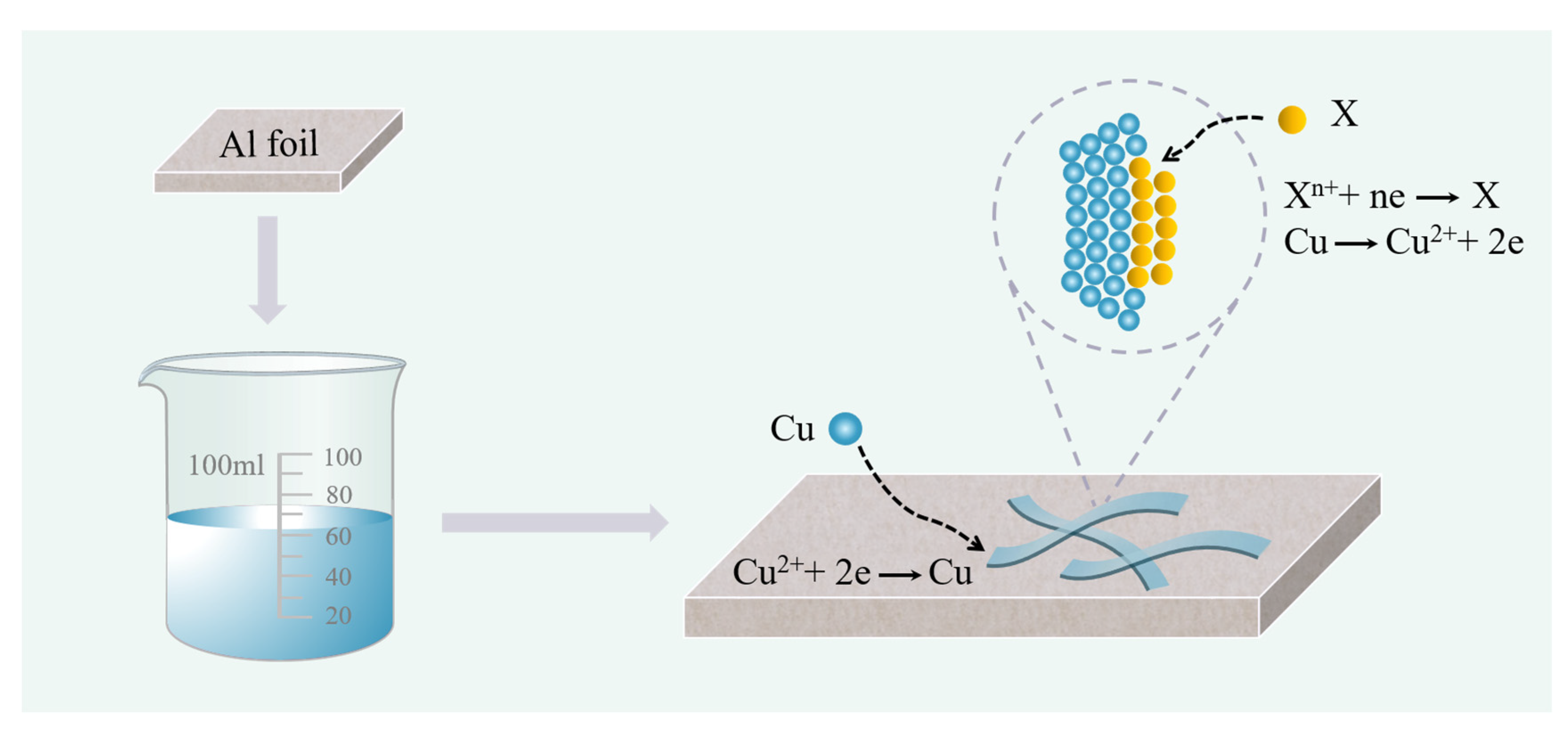
Herein, we present a facile galvanic replacement strategy for the in situ fabrication of highly uniform 1D Cu@CuO-X (X = Ag, Bi) nanobelts on aluminum (Al) foil (Scheme 1). Comprehensive structural and compositional analyses confirm the successful formation of well-defined bimetallic heterostructures. The method establishes a general framework for directing self-regulated redox transformations toward structurally integrated heterostructures, offering distinct advantages in achieving controllable composition, coherent interfaces, and scalable synthesis with potential for future exploration in photocatalysis and related functional applications.

2. Materials and Methods

2.1. Chemicals and Materials

Copper (II) chloride dihydrate (CuCl2·2H2O, ≥99.0%), silver nitrate (AgNO3, ≥99.8%), bismuth (III) nitrate pentahydrate (Bi(NO3)3·5H2O, ≥98.0%), nitric acid (HNO3, ≥65%), phosphoric acid (H3PO4, ≥85%) were purchased from Sigma-Aldrich. (St. Louis, MO, USA). Hexadecyltrimethylammonium chloride (CTAC, 97%) was purchased from Aladdin Chemical Reagent Co., Ltd. (Shanghai, China). Al foil was purchased from Haochen Metal Materials Trading Company (Chaohu, China) with a thickness is 0.01 mm.

2.2. Preparation of Cu@CuO-X (Ag, Bi) Nanobelts

Cu@CuO-X (Ag, Bi) nanobelts were synthesized through a galvanic replacement process on aluminum foils.
For Cu@CuO-Ag nanobelts, CuCl2 (65 mg) was first dissolved in 50 mL of an aqueous CTAC solution (1.78 mM) containing HNO3 (12 μL) under stirring in a glass vial. Subsequently, AgNO3 (4.3 mg) was added, and the solution was stirred for 5 min to ensure homogeneous mixing. An Al foil (2.5 × 2.5 cm2) was pre-cleaned by immersion in 3 mL of aqueous H3PO4 for 2 min, rinsed thoroughly with deionized water, and immersed in the mixture at 5 °C without stirring. During this process, a spontaneous galvanic replacement reaction occurred between Cu2+ species and the Al substrate, leading to the formation of Cu-based nanobelts, followed by interfacial replacement between Cu and Ag+ ions. After 24 h, the Al foil was removed and rinsed with deionized water. For Cu@CuO-Bi nanobelts, the procedures were identical except that AgNO3 was replaced by Bi(NO3)3 solution (80 μL, 100 mM) as the precursor.

2.3. Sample Characterization

The morphology and structure of products were characterized by field-emission scanning electron microscopy (FESEM, Regulus 8100, Hitachi High-Tech, Tokyo, Japan, and Gemini SEM-300, ZEISS, Oberkochen, Germany) coupled with an energy dispersive spectrometer (EDS), as well as by transmission electron microscopy (TEM, JEM-2800, JEOL, Tokyo, Japan). X-ray diffraction (XRD) patterns were recorded using a Bruker D8 Advance diffractometer equipped with a Cu Kα X-ray source (Bruker, Karlsruhe, Germany). X-ray photoelectron spectroscopy (XPS) measurements were performed on an ESCALab 220XL spectrometer (VG Scientific, East Grinstead, UK) using 300 W Al Kα radiation.

3. Results and Discussion

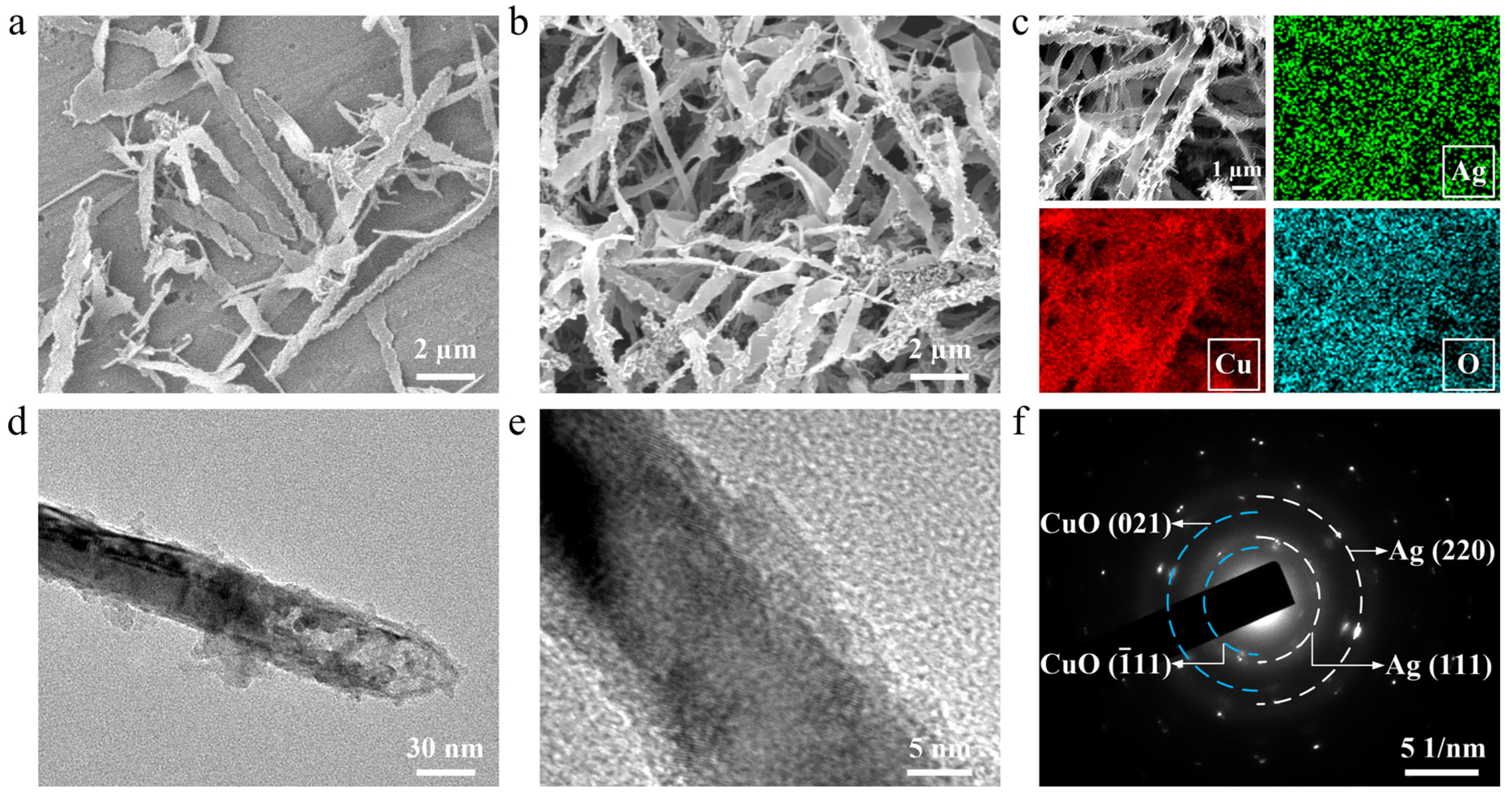
Cu@CuO-Ag catalysts were synthesized via a galvanic replacement method, using CuCl2·2H2O and AgNO3 as precursors in an aqueous CTAC solution. Al foil was selected as the substrate due to its practical advantages and highly negative standard reduction potential, enabling spontaneous galvanic replacement reactions [43]. The morphology of the samples was characterized by scanning electron microscopy (SEM). As shown in Figure 1a, highly uniform 1D Cu nanobelts were distributed on the Al foil when CuCl2·2H2O was used as the precursor at 5 °C. In contrast, at room temperature, the relatively fast reaction kinetics favor rapid axial growth, resulting predominantly in the formation of Cu nanowires (Figure S1). Lowering the reaction temperature to 5 °C effectively slows the reaction kinetics and promotes lateral anisotropic growth, thereby leading to the formation of well-defined Cu nanobelts. When both CuCl2·2H2O and AgNO3 were employed, SEM images confirmed the preservation of the belt-like morphology (Figure 1b and Figure S2). The low-magnification SEM image (Figure S3) revealed uniform and continuous nanobelt coverage on the Al foil with only a small fraction of the substrate exposed, while the mass increase after synthesis (Δm ≈ 0.02 mg cm−2) indicated a high nanobelt loading. The nanobelts exhibited an average width of 577.1 nm, and lengths of up to 5 µm (Figure S4). EDS elemental mapping of Cu@CuO-Ag nanobelts revealed that Ag and O were uniformly distributed, whereas Cu was relatively dispersed (Figure 1c). In addition, Al signals were detected, which can be attributed to the Al foil substrate (Figure S5). TEM image revealed a belt-like morphology, consistent with SEM observations (Figure 1d). High-resolution TEM (HRTEM) image showed an approximately 1.0 nm-thick shell surrounding the nanobelts, which was attributed to surface oxidation of Cu upon exposure to dissolved oxygen (Figure 1e). Based on contrast features, the nanobelts were inferred to consist of a metallic Cu core encapsulated by a thin oxidized surface layer. To further investigate the phase composition and crystal structure of the outer layer, selected-area electron diffraction (SAED) pattern exhibited concentric, discontinuous rings rather than discrete single-crystal spots, indicating the presence of a polycrystalline shell (Figure 1f). Diffraction analysis revealed that the experimental patterns matched face-centered cubic Ag and monoclinic CuO. Simulated half-ring diffraction patterns were provided in Figure 1f for comparison. The measured d-spacings of 0.23 and 0.14 nm were assigned to Ag (111) and Ag (220), whereas 0.25 and 0.16 nm were indexed to CuO ( 1 ¯ 11) and CuO (021). These results confirm the coexistence of metallic Ag and a thin CuO shell, with Ag embedded within the nanobelts.
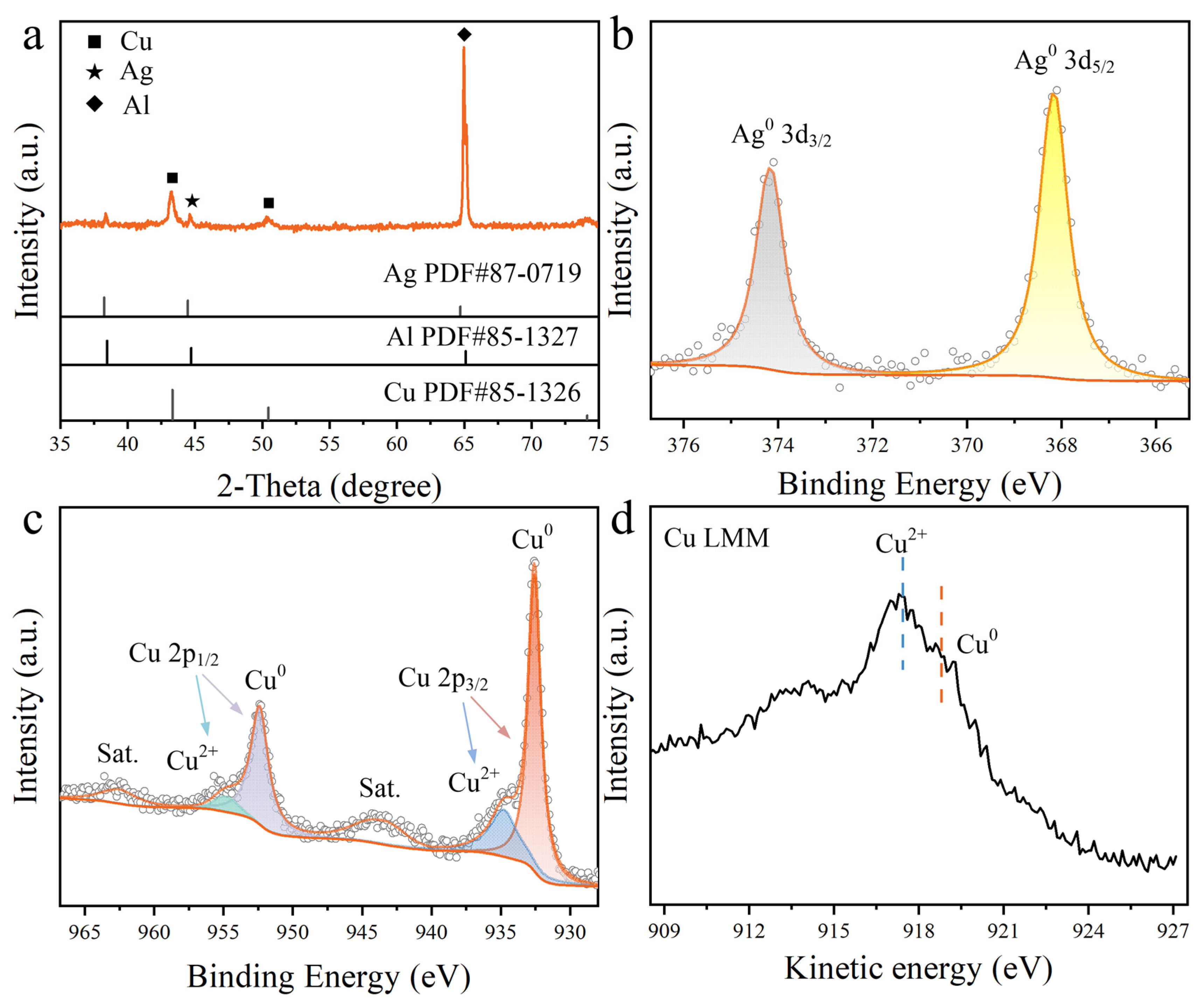
The XRD pattern showed the diffraction peaks at 43.3° and 50.4°, which were assigned to the (111) and (200) planes of Cu (PDF#85-1326), confirming the presence of the metallic Cu core (Figure 2a). An additional peak at 44.5° was indexed to the (200) plane of metallic Ag (PDF#87-0719). The diffraction peak at 65.1° was attributed to the (220) plane of the Al substrate (PDF#85-1327). No characteristic CuO diffraction peaks were observed, confirming the presence of an amorphous CuO surface layer [32]. XPS results further confirmed the presence of Ag, Cu, and O species. The Ag 3d XPS peaks at 368.2 eV and 374.2 eV were assigned to Ag0 species, consistent with the XRD results (Figure 2b). The Cu 2p spectrum was deconvoluted into six peaks, corresponding to the 2p3/2 and 2p1/2 states of Cu0, Cu2+, along with shake-up satellite peaks (Figure 2c). The Cu LMM Auger spectrum exhibited a dominant peak at 917.5 eV, characteristic of the oxidized Cu2+ state, and a weaker peak at 918.8 eV attributable to metallic Cu0 (Figure 2d). Considering that the Cu 2p signal contains contributions from both the outer surface and the near-surface bulk, whereas the Cu LMM transition is more surface-sensitive and primarily reflects the outermost atomic layers, these results indicate that the surface copper species are predominantly composed of CuO, while the underlying bulk of the nanobelts remains metallic Cu, consistent with the TEM observations.
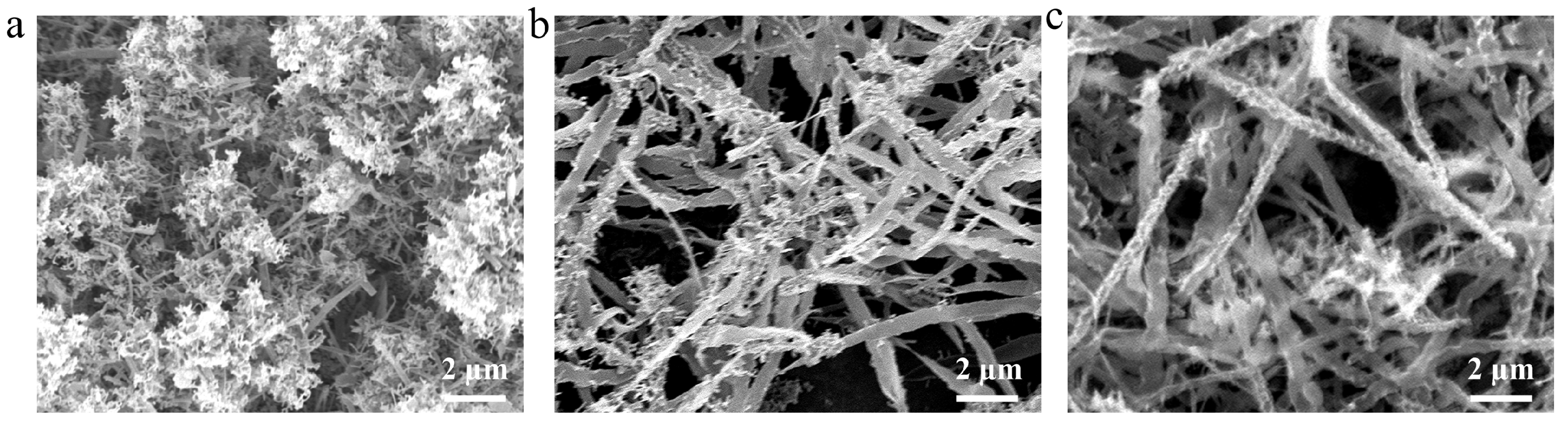
The addition of HNO3 was found to be critical in regulating the galvanic displacement process. At low concentrations, HNO3 sustained acidic conditions and locally adjusted the acidity near the Cu surface, thereby promoting activation of the Cu surface. Under acidic conditions, HNO3 also suppressed Ag+ hydrolysis and Ag2O formation, thereby promoting selective Ag deposition on Cu and preserving the nanobelt-like morphology. The morphological evolution under varying HNO3 concentrations is shown in Figure 3. In the absence of HNO3, dendritic nanostructures were obtained. With increasing HNO3 concentration, well-defined nanobelts were obtained, highlighting the critical role of acidity in enabling controlled Ag deposition (Figure 3b,c).
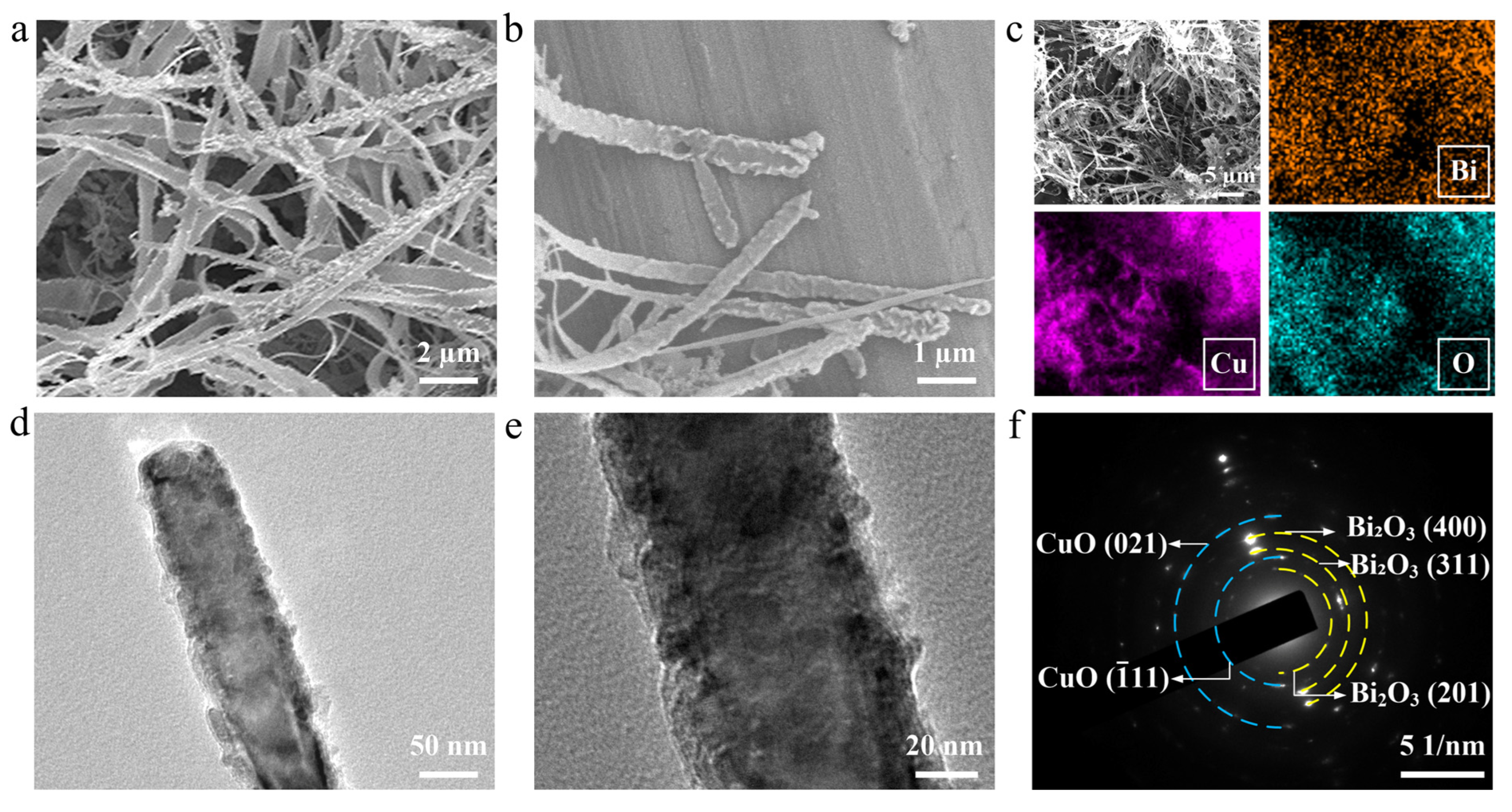
A similar synthetic strategy was employed to synthesize Cu@CuO-Bi belt-like nanostructures, with Bi(NO3)3 replacing AgNO3 as the precursor. SEM analysis revealed uniform 1D Cu@CuO-Bi nanobelts resembling those of Cu@CuO-Ag (Figure 4a,b and Figures S6 and S7). EDS elemental mapping showed the distribution of Bi, Cu, O and Al elements (Figure 4c and Figure S8). TEM and enlarged TEM images of individual Cu@CuO-Bi nanobelts revealed the presence of some nanoparticles decorating the surface (Figure 4d,e). The corresponding SAED pattern showed diffraction rings with d-spacings of 0.32 and 0.19 nm, which were assigned to the (201), (311), and (400) planes of Bi2O3. Additional rings at 0.25 and 0.16 nm were indexed to the ( 1 ¯ 11) and (021) planes of CuO, confirming the coexistence of Bi2O3 and CuO (Figure 4f).
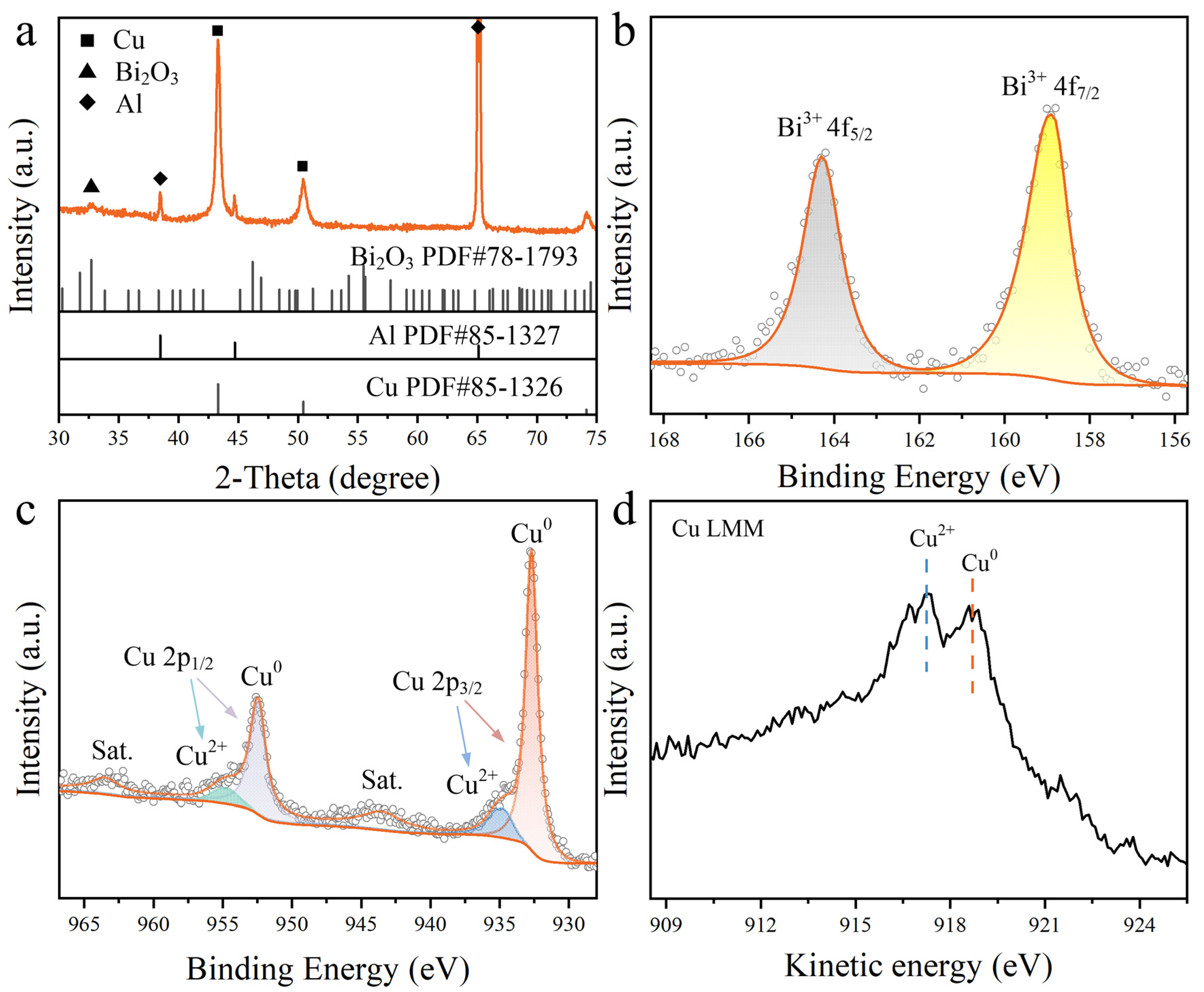
It is worth noting that in the XRD pattern of the Cu@CuO-Bi nanobelts (Figure 5a), a weak peak at 32.7°, indexed to the (220) planes of Bi2O3 (PDF#78-1793), was observed, consistent with the SAED results, which suggests that Bi2O3 likely forms at the interface. Similarly, the diffraction peaks from the Cu nanobelts and the Al substrate were also detected. The Bi 4f XPS peaks observed at 158.9 eV and 164.2 eV were also characteristic of Bi3+ species in the Cu@CuO-Bi nanobelts (Figure 5b). These results indicated that the displaced Bi was prone to oxidation into Bi2O3 and therefore predominantly existed in an oxidized state. Unlike Ag, which can remain in the metallic state and incorporate into the Cu lattice, Bi has a stronger thermodynamic tendency toward oxidation owing to the high stability of Bi–O bonds, forming surface oxide nanoparticles [33,34,35]. Meanwhile, Cu XPS for Cu@CuO-Bi was consistent with Cu@CuO-Ag, indicating comparable Cu oxidation states (Figure 5c,d). However, the Cu LMM Auger spectrum in Figure 5d exhibited a much more pronounced Cu0 feature, whereas that in Figure 2d was dominated by Cu2+, indicating that Cu@CuO-Bi nanobelts possess a thinner CuO layer and a more metallic Cu core than Cu@CuO-Ag nanobelts.

4. Conclusions

In conclusion, we have successfully developed a galvanic replacement-driven strategy for the in situ growth of highly uniform 1D Cu@CuO-X (X = Ag, Bi) nanobelts on aluminum foils. The formation of Cu@CuO-Ag and Cu@CuO-Bi heterostructures was confirmed through comprehensive characterization. This replacement reaction enables the direct substitution of various metals or materials, allowing the creation of diverse composite materials and heterostructures on the substrate, which, in turn, broadens the scope of potential applications. The resulting unique 1D anisotropic structure and tunable heterointerfaces further highlight the potential of this self-templated strategy for designing multifunctional nanomaterials, particularly for photocatalytic applications.

Supplementary Materials

The following supporting information can be downloaded at https://www.mdpi.com/article/10.3390/nano16010038/s1.

Author Contributions

Y.X.: writing—original draft, investigation, methodology, and validation. Q.S.: investigation, and date curation. Y.L.: investigation, supervision, and date curation. W.L.: investigation, supervision, and resources. Z.H.: supervision, investigation, and writing—review and editing. L.W.: supervision, investigation, and writing—review and editing. S.G.: supervision, project administration, and writing—review and editing. All authors have read and agreed to the published version of the manuscript.

Funding

This research was funded by the Cultivation Programme for Young Backbone Teachers in Henan University of Technology (No. 21421220) and the Key Research Project of Higher Education Institutions in Henan Province (No. 26B140003), China.

Data Availability Statement

The data presented in this study are available on request from the corresponding author after obtaining permission.

Acknowledgments

The authors acknowledge the Henan University of Technology and the Department of Higher Education of Henan Province for providing research resources and financial support.

Conflicts of Interest

Author Lihui Wei was employed by Guoneng Mengjin Thermal Power Co., Ltd. The remaining authors declare that the research was conducted in the absence of any commercial or financial relationships that could be construed as a potential conflict of interest.

References

  1. Du, J.; Liu, S.; Liu, Y.; Wu, G.; Liu, X.; Zhang, W.; Zhang, Y.; Hong, X.; Li, Q.; Kang, L. One-Dimensional High-Entropy Compounds. J. Am. Chem. Soc. 2024, 146, 8464–8471. [Google Scholar] [CrossRef]
  2. Fan, X.; Walther, A. 1D Colloidal Chains: Recent Progress from Formation to Emergent Properties and Applications. Chem. Soc. Rev. 2022, 51, 4023–4074. [Google Scholar] [CrossRef]
  3. Huo, D.; Kim, M.J.; Lyu, Z.; Shi, Y.; Wiley, B.J.; Xia, Y. One-Dimensional Metal Nanostructures: From Colloidal Syntheses to Applications. Chem. Rev. 2019, 119, 8972–9073. [Google Scholar] [CrossRef] [PubMed]
  4. Kim, M.; Nara, H.; Asakura, Y.; Hamada, T.; Yan, P.; Earnshaw, J.; An, M.; Eguchi, M.; Yamauchi, Y. End-to-End Pierced Carbon Nanosheets with Meso-Holes. Adv. Sci. 2025, 12, 2409546. [Google Scholar] [CrossRef]
  5. Kim, M.; Leong, K.K.; Amiralian, N.; Bando, Y.; Ahamad, T.; Alshehri, S.M.; Yamauchi, Y. Nanoarchitectured MOF-Derived Porous Carbons: Road to Future Carbon Materials. Appl. Phys. Rev. 2024, 11, 041302. [Google Scholar] [CrossRef]
  6. Jung, I.; Lee, S.; Lee, S.; Kim, J.; Kwon, S.; Kim, H.; Park, S. Colloidal Synthesis of Plasmonic Complex Metal Nanoparticles: Sequential Execution of Multiple Chemical Toolkits Increases Morphological Complexity. Chem. Rev. 2025, 125, 7321–7388. [Google Scholar] [CrossRef]
  7. Lin, W.; Nabi, A.G.; Palma, M.; Di Tommaso, D. Copper Nanowires for Electrochemical CO2 Reduction Reaction. ACS Appl. Nano Mater. 2024, 7, 27883–27898. [Google Scholar] [CrossRef]
  8. Zhang, S.; Zhang, H.; Gu, Y.; Mao, X.; Gao, X.; Xu, D. Surface Plasmon Enhancement of 1D Ag Nanowires Modified Electro-Treated BiVO4 Photoanode with Abundant Oxygen Vacancies for Solar Water Oxidation. Fuel 2024, 370, 131847. [Google Scholar] [CrossRef]
  9. Abdelsalam, I.; Wang, S.; Santos, H.L.; Kitching, E.; Pakala, P.; Chundak, M.; Ritala, M.; Haigh, S.J.; Slater, T.J.A.; Camargo, P.H.C. Plasmonically Enhanced Hydrogen Evolution on Anisotropic AuPt Nanowires with Submonolayer Pt Surface Coverage. Small 2025, 21, e10990. [Google Scholar] [CrossRef] [PubMed]
  10. Li, S.; Jin, H.; Wang, Y. Recent Progress on the Synthesis of Metal Alloy Nanowires as Electrocatalysts. Nanoscale 2023, 15, 2488–2515. [Google Scholar] [CrossRef] [PubMed]
  11. Han, S.; Xu, L.; Ma, C.; Cao, W.; Lu, Q. Ultrathin High-Entropy Alloy Nanowires as a Bi-Functional Catalyst for the Hydrogen Evolution Reaction and Methanol Oxidation Reaction. J. Mater. Chem. A 2025, 13, 28019–28025. [Google Scholar] [CrossRef]
  12. Mattarozzi, F.; van der Willige, N.; Gulino, V.; Keijzer, C.; van de Poll, R.C.J.; Hensen, E.J.M.; Ngene, P.; de Jongh, P.E. Oxide-Derived Silver Nanowires for CO2 Electrocatalytic Reduction to CO. ChemCatChem 2023, 15, e202300792. [Google Scholar] [CrossRef]
  13. Shi, G.; Tano, T.; Tryk, D.A.; Iiyama, A.; Uchida, M.; Kuwauchi, Y.; Masuda, A.; Kakinuma, K. Pt Nanorods Oriented on Gd-Doped Ceria Polyhedra Enable Superior Oxygen Reduction Catalysis for Fuel Cells. J. Catal. 2022, 407, 300–311. [Google Scholar] [CrossRef]
  14. Datta, D.; Lim, J.W.; Maji, R.C.; Maji, S.K. Graphene Oxide-Wrapped Gold Nanorods for Direct Plasmon-Enhanced Electrocatalysis to Detect Hydrogen Peroxide and in the Hydrogen Evolution Reaction. ACS Appl. Nano Mater. 2023, 6, 2729–2740. [Google Scholar] [CrossRef]
  15. Dai, H.; Zhang, T.; Dong, K.; Pu, H.; Wang, Y.; Deng, Y. Electrochemical Synthesis of Rh Nanorods with High-Index Facets for the Oxidation of Formic Acid. Energy Fuels 2023, 37, 7353–7360. [Google Scholar] [CrossRef]
  16. Wang, L.; Meng, Q.; Xiao, M.; Liu, C.; Xing, W.; Zhu, J. Insights into the Dynamic Surface Reconstruction of Electrocatalysts in Oxygen Evolution Reaction. Renewables 2024, 2, 272–296. [Google Scholar] [CrossRef]
  17. Zhong, H.; Zhang, Q.; Yu, J.; Zhang, X.; Wu, C.; Ma, Y.; An, H.; Wang, H.; Zhang, J.; Wang, X.; et al. Fundamental Understanding of Structural Reconstruction Behaviors in Oxygen Evolution Reaction Electrocatalysts. Adv. Energy Mater. 2023, 13, 2301391. [Google Scholar] [CrossRef]
  18. Zeng, Y.; Liang, J.; Zhong, W.; Li, G.; Deng, D.; Fan, X.; Wu, Q. Surface Reconstruction Regulation of Catalysts for Cathodic Catalytic Electrosynthesis. Appl. Catal. O Open 2025, 202, 207036. [Google Scholar] [CrossRef]
  19. Chen, S.; Farzinpour, F.; Kornienko, N. Dynamic Active Sites behind Cu-Based Electrocatalysts: Original or Restructuring-Induced Catalytic Activity. Chem 2025, 11, 102575. [Google Scholar] [CrossRef]
  20. Shen, W.; Yin, J.; Jin, J.; Hu, Y.; Hou, Y.; Xiao, J.; Zhao, Y.-Q.; Xi, P. Progress in In Situ Research on Dynamic Surface Reconstruction of Electrocatalysts for Oxygen Evolution Reaction. Adv. Energy Sustain. Res. 2022, 3, 2200036. [Google Scholar] [CrossRef]
  21. Simon, G.H.; Kley, C.S.; Roldan Cuenya, B. Potential-Dependent Morphology of Copper Catalysts during CO2 Electroreduction Revealed by In Situ Atomic Force Microscopy. Angew. Chem. Int. Ed. 2021, 60, 2561–2568. [Google Scholar] [CrossRef]
  22. Grosse, P.; Yoon, A.; Rettenmaier, C.; Herzog, A.; Chee, S.W.; Roldan Cuenya, B. Dynamic Transformation of Cubic Copper Catalysts during CO2 Electroreduction and Its Impact on Catalytic Selectivity. Nat. Commun. 2021, 12, 6736. [Google Scholar] [CrossRef]
  23. Amirbeigiarab, R.; Tian, J.; Herzog, A.; Qiu, C.; Bergmann, A.; Roldan Cuenya, B.; Magnussen, O.M. Atomic-Scale Surface Restructuring of Copper Electrodes under CO2 Electroreduction Conditions. Nat. Catal. 2023, 6, 837–846. [Google Scholar] [CrossRef]
  24. Wang, J.; Liu, Z.; Jin, W.; Tuo, Y.; Zhou, Y.; Zhou, S.; Gong, T.; Li, J.; Ni, Y.; Wang, M.; et al. In Situ Construction of Highly Durable Cuδ+ Species Boosting Electrocatalytic Reduction of CO2 to C2+ Products. Appl. Catal. B Environ. 2025, 375, 125434. [Google Scholar] [CrossRef]
  25. Wang, L.; Chen, Z.; Xiao, Y.; Huang, L.; Wang, X.; Fruehwald, H.; Akhmetzyanov, D.; Hanson, M.; Chen, Z.; Chen, N.; et al. Stabilized Cuδ+-OH Species on In Situ Reconstructed Cu Nanoparticles for CO2-to-C2H4 Conversion in Neutral Media. Nat. Commun. 2024, 15, 7477. [Google Scholar] [CrossRef]
  26. Wu, H.; Yu, H.; Chow, Y.L.; Webley, P.A.; Zhang, J. Toward Durable CO2 Electroreduction with Cu-Based Catalysts via Understanding Their Deactivation Modes. Adv. Mater. 2024, 36, 2403217. [Google Scholar] [CrossRef]
  27. Rhimi, B.; Zhou, M.; Yan, Z.; Cai, X.; Jiang, Z. Cu-Based Materials for Enhanced C2+ Product Selectivity in Photo-/Electrocatalytic CO2 Reduction: Challenges and Prospects. Nano-Micro Lett. 2024, 16, 64. [Google Scholar] [CrossRef]
  28. Du, J.; Loiudice, A.; Kumar, K.; Zaza, L.; Buonsanti, R. Well-Defined Cu Precatalysts Indicate Design Rules for Reactivity in Nitrate Electroreduction. J. Am. Chem. Soc. 2025, 147, 35438–35445. [Google Scholar] [CrossRef]
  29. Wang, Y.; Liu, J.; Zheng, G. Designing Copper-Based Catalysts for Efficient Carbon Dioxide Electroreduction. Adv. Mater. 2021, 33, 2005798. [Google Scholar] [CrossRef]
  30. Xu, S.; Ruan, X.; Ganesan, M.; Wu, J.; Ravi, S.K.; Cui, X. Transition Metal-Based Catalysts for Urea Oxidation Reaction (UOR): Catalyst Design Strategies, Applications, and Future Perspectives. Adv. Funct. Mater. 2024, 34, 2313309. [Google Scholar] [CrossRef]
  31. Sabir, A.S.; Pervaiz, E.; Khosa, R.; Sohail, U. An Inclusive Review and Perspective on Cu-Based Materials for Electrochemical Water Splitting. RSC Adv. 2023, 13, 4963–4993. [Google Scholar] [CrossRef]
  32. Lyu, Z.; Zhu, S.; Xie, M.; Zhang, Y.; Chen, Z.; Chen, R.; Tian, M.; Chi, M.; Shao, M.; Xia, Y. Controlling the Surface Oxidation of Cu Nanowires Improves Their Catalytic Selectivity and Stability toward C2+ Products in CO2 Reduction. Angew. Chem. Int. Ed. 2021, 60, 1909–1915. [Google Scholar] [CrossRef]
  33. Yang, Z.; Wang, H.; Fei, X.; Wang, W.; Zhao, Y.; Wang, X.; Tan, X.; Zhao, Q.; Wang, H.; Zhu, J.; et al. MOF-Derived Bimetallic CuBi Catalysts with Ultra-Wide Potential Window for High-Efficient Electrochemical Reduction of CO2 to Formate. Appl. Catal. B Environ. 2021, 298, 120571. [Google Scholar] [CrossRef]
  34. Zhao, R.; Yan, Q.; Yu, L.; Yan, T.; Zhu, X.; Zhao, Z.; Liu, L.; Xi, J. A Bi-Co Corridor Construction Effectively Improving the Selectivity of Electrocatalytic Nitrate Reduction toward Ammonia by Nearly 100%. Adv. Mater. 2023, 35, 2306633. [Google Scholar] [CrossRef]
  35. Song, X.; Ma, X.; Chen, T.; Xu, L.; Feng, J.; Wu, L.; Jia, S.; Zhang, L.; Tan, X.; Wang, R.; et al. Urea Synthesis via Coelectrolysis of CO2 and Nitrate over Heterostructured Cu-Bi Catalysts. J. Am. Chem. Soc. 2024, 146, 25813–25823. [Google Scholar] [CrossRef]
  36. Wang, J.; Ji, Y.; Shao, Q.; Yin, R.; Guo, J.; Li, Y.; Huang, X. Phase and Structure Modulating of Bimetallic CuSn Nanowires Boosts Electrocatalytic Conversion of CO2. Nano Energy 2019, 59, 138–145. [Google Scholar] [CrossRef]
  37. Yu, Y.; He, Y.; Yan, P.; Wang, S.; Dong, F. Boosted C-C Coupling with Cu-Ag Alloy Sub-Nanoclusters for CO2-to-C2H4 Photosynthesis. Proc. Natl. Acad. Sci. USA 2023, 120, e2307320120. [Google Scholar]
  38. Liu, J.; Liu, Y.; Zhao, S.; Chen, B.; Mo, G.; Chen, Z.; Wei, Y.; Wu, Z. Recent Advances in Regulation Strategy and Catalytic Mechanism of Bi-Based Catalysts for CO2 Reduction Reaction. Nano-Micro Lett. 2026, 18, 26. [Google Scholar] [CrossRef]
  39. Mahmoudian, M.R. L-cysteine-assisted synthesis of polypyrrole-coated copper nanobelts and their application in the detection of hydrazine. Microchem. J. 2022, 183, 107995. [Google Scholar] [CrossRef]
  40. Han, M.; Yuan, D.; Liu, S.; Bao, J.; Dai, Z.; Zhu, J. Facile synthesis of porous copper nanobelts and their catalytic performance. Mater. Res. Bull. 2012, 47, 4438–4444. [Google Scholar] [CrossRef]
  41. Liu, X.; Li, Y.; Zheng, Z.; Zhou, F. Ionic liquids as two-dimensional templates for the spontaneous assembly of copper nanoparticles into nanobelts and observation of an intermediate state. RSC Adv. 2013, 3, 341–344. [Google Scholar] [CrossRef]
  42. Cheng, H.; Wang, C.; Qin, D.; Xia, Y. Galvanic Replacement Synthesis of Metal Nanostructures: Bridging the Gap between Chemical and Electrochemical Approaches. Acc. Chem. Res. 2023, 56, 900–909. [Google Scholar] [CrossRef] [PubMed]
  43. Gutés, A.; Carraro, C.; Maboudian, R. Silver dendrites from galvanic displacement on commercial aluminum foil as an effective SERS substrate. J. Am. Chem. Soc. 2010, 132, 1476–1477. [Google Scholar] [CrossRef]
Figure 1. (a) SEM image of Cu nanobelts grown on Al foil. (b,c) SEM and EDS mapping images of Cu@CuO-Ag nanobelts. (df) TEM, HRTEM image and corresponding SAED pattern of Cu@CuO-Ag nanobelts.
Nanomaterials 16 00038 g001
Figure 2. (a) XRD spectrum of Cu@CuO-Ag nanobelts. Standard XRD peaks for Cu, Ag, and Al are represented by the symbol “■”, “★”, and “◆”, respectively. (bd) XPS spectra of Ag 3d (b), Cu 2p (c) and Cu LMM (d) for Cu@CuO-Ag nanobelts, respectively. Sat. refers to the satellite peaks characteristic of the Cu2+ oxidation state.
Nanomaterials 16 00038 g002
Figure 3. (ac) SEM characterization of the nanostructures synthesized without HNO3 (a), with 12 µL HNO3 (b), and with 15 µL HNO3 (c).
Nanomaterials 16 00038 g003
Figure 4. (ac) SEM, enlarged SEM and EDS mapping images of Cu@CuO-Bi nanobelts. (df) TEM image, enlarged TEM image and corresponding SAED pattern of Cu@CuO-Bi nanobelts.
Nanomaterials 16 00038 g004
Figure 5. (a) XRD spectrum of Cu@CuO-Bi nanobelts. Standard XRD peaks for Cu, Bi2O3, and Al are represented by the symbol “■”, “▲”, and “◆”, respectively. (bd) XPS spectra of Bi 4f (b), Cu 2p (c) and Cu LMM (d) for Cu@CuO-Bi nanobelts, respectively. Sat. refers to the satellite peaks characteristic of the Cu2+ oxidation state.
Nanomaterials 16 00038 g005
Scheme 1. Schematic illustration of the synthesis process of Cu@CuO-X nanobelts (X = Ag, Bi) via a spontaneous galvanic-replacement strategy on an Al substrate.
Nanomaterials 16 00038 sch001
Disclaimer/Publisher’s Note: The statements, opinions and data contained in all publications are solely those of the individual author(s) and contributor(s) and not of MDPI and/or the editor(s). MDPI and/or the editor(s) disclaim responsibility for any injury to people or property resulting from any ideas, methods, instructions or products referred to in the content.