

Does Generative Artificial Intelligence Improve Students’ Higher-Order Thinking? A Meta-Analysis Based on 29 Experiments and Quasi-Experiments

Abstract
1. Introduction
2. Literature Review
2.1. Conceptualizing HOT
2.2. The Positive Impact of Gen-AI on the Cultivation of HOT
2.2.1. Critical Thinking
2.2.2. Creativity
2.2.3. Problem-Solving Ability
2.3. Potential Risks and Challenges of Gen-AI in Fostering HOT
2.4. Potential Moderators
2.5. Related Reviews and Meta-Analyses on the Impact of Gen- AI on HOT
2.6. The Present Study
- Q1. What is the overall effect size of Gen-AI on students’ HOT? Separately, what are the effect sizes of Gen-AI on the three levels of HOT (critical thinking, creativity, and problem-solving skills)?
- Q2. Do moderating variables—such as intervention duration, educational level, instructional method, and self-regulated learning ability—impact the relationship between Gen-AI and the development of HOT? If so, how do they moderate the effect of Gen-AI on students’ HOT?
3. Methods
3.1. Data Sources and Search Strategies
3.2. Eligibility Criteria
3.3. Literature Coding
3.4. Publication Bias Test
3.5. Heterogeneity Test
4. Results
4.1. The Analysis of the Overall Effect Size
4.2. The Analysis of Moderator Effect Size
4.2.1. Intervention Duration
4.2.2. Educational Level
4.2.3. Instructional Method
4.2.4. Self-Regulated Learning Ability
5. Discussion
5.1. The Effectiveness of Gen-AI on Students’ HOT
5.2. The Moderating Effects of Gen-AI on Students’ HOT
5.2.1. Intervention Duration
5.2.2. Education Level
5.2.3. Instructional Method
5.2.4. Self-Regulated Learning Ability
6. Conclusions and Limitations
Author Contributions
Funding
Institutional Review Board Statement
Informed Consent Statement
Data Availability Statement
Conflicts of Interest
Abbreviations
| Gen-AI | Generative Artificial Intelligence |
| HOT | Higher-order Thinking |
| SRL | Self-regulated Learning |
| PBL | Project-based Learning |
References
- Adijaya, Made Aryawan, I Wayan Widiana, I Gusti Lanang Agung Parwata, and I Gede Wahyu Suwela Antara. 2023. Bloom’s taxonomy revision-oriented learning activities to improve procedural capabilities and learning outcomes. International Journal of Educational Methodology 9: 261–70. [Google Scholar] [CrossRef]
- Alkhatib, Omar J. 2022. An Effective Assessment Method of Higher-Order Thinking Skills (Problem-Solving, Critical Thinking, Creative Thinking, and Decision-Making) in Engineering and Humanities. Paper presented at 2022 Advances in Science and Engineering Technology International Conferences (ASET), Dubai, United Arab Emirates, February 21–24; pp. 1–6. [Google Scholar] [CrossRef]
- Alzubi, Ali Abbas Falah, Mohd Nazim, and Naji Alyami. 2025. Do AI-generative tools kill or nurture creativity in EFL teaching and learning? Education and Information Technologies 30: 15147–84. [Google Scholar] [CrossRef]
- Anderson, Lorin W., and David R. Krathwohl. 2001. A Taxonomy for Learning, Teaching, and Assessing: A Revision of Bloom’s Taxonomy of Educational Objectives: Complete Edition. Albany: Addison Wesley Longman, Inc. Available online: http://eduq.info/xmlui/handle/11515/18824 (accessed on 6 November 2015).
- Arista, Artika, Liyana Shuib, and Maizatul Akmar Ismail. 2023. A glimpse of ChatGPT: An introduction to features, challenges, and threats in higher education. Paper presented at Informatics, Multimedia, Cyber and Information Systems Conference, Jakarta Selatan, Indonesia, November 7–8; pp. 694–98. [Google Scholar] [CrossRef]
- Bailey, Daniel, Norah Almusharraf, and Ryan Hatcher. 2021. Finding satisfaction: Intrinsic motivation for synchronous and asynchronous communication in the online language learning context. Education and Information Technologies 26: 2563–83. [Google Scholar] [CrossRef] [PubMed]
- Bloom, Benjamin S. 1956. Taxonomy of Educational Objectives: The Classification of Educational Goals. Boynton Beach: Susan Fauer Company. [Google Scholar]
- Borge, M., B. K. Smith, and T. Aldemir. 2024. Using generative AI as a simulation to support higher-order thinking. International Journal of Computer-Supported Collaborative Learning 19: 479–532. [Google Scholar] [CrossRef]
- Bower, Matt, and Panos Vlachopoulos. 2018. A critical analysis of technology—Enhanced learning design frameworks. British Journal of Educational Technology 49: 981–97. [Google Scholar] [CrossRef]
- Cam, Emre, and Mübin Kiyici. 2022. The impact of robotics-assisted programming education on academic success, problem-solving skills, and motivation. Journal of Educational Technology and Online Learning 5: 47–65. [Google Scholar] [CrossRef]
- Chiu, Thomas K. F., Benjamin Luke Moorhouse, Ching Sing Chai, and Murod Ismailov. 2023. Teacher support and student motivation to learn with Artificial Intelligence (AI) based chatbot. Interactive Learning Environments 32: 3240–56. [Google Scholar] [CrossRef]
- Cohen, Jacob. 1992. Statistical power analysis. Current Directions in Psychological Science 1: 98–101. [Google Scholar] [CrossRef]
- Costa, Alexandra R., Natércia Lima, Clara Viegas, and Amélia Caldeira. 2024. Critical minds: Enhancing education with ChatGPT. Cogent Education 11: 2415286. [Google Scholar] [CrossRef]
- Deng, Ruiqi, Maoli Jiang, Xinlu Yu, Yuyan Lu, and Shasha Liu. 2025. Does ChatGPT enhance student learning? A systematic review and meta-analysis of experimental studies. Computers & Education 227: 105224. [Google Scholar] [CrossRef]
- Du, Xing, Mingcheng Du, Zihan Zhou, and Yiming Bai. 2025. Facilitator or hindrance? The impact of AI on university students’ higher-order thinking skills in complex problem solving. International Journal of Educational Technology in Higher Education 22: 39. [Google Scholar] [CrossRef]
- Ganesh, D., M. Sunil Kumar, P. Venkateswarlu Reddy, Kavitha Sadam, and D. Sudarsana Murthy. 2022. Implementation of AI pop bots and its allied applications for designing efficient curriculum in early childhood education. International Journal of Early Childhood Special Education 14: 2282–92. [Google Scholar] [CrossRef]
- García-Martínez, Inmaculada, José María Fernández-Batanero, José Fernández-Cerero, and Samuel P. León. 2023. Analysing the impact of artificial intelligence and computational sciences on student performance: Systematic review and meta-analysis. Journal of New Approaches in Educational Research 12: 171–97. [Google Scholar] [CrossRef]
- Gonsalves, Chahna. 2024. Generative AI’s Impact on Critical Thinking: Revisiting Bloom’s Taxonomy. Journal of Marketing Education 1: 1–16. [Google Scholar] [CrossRef]
- Guo, Kai, Yuchun Zhong, Danling Li, and Samuel Kai Wah Chu. 2023. Effects of chatbot-assisted in-class debates on students’ argumentation skills and task motivation. Computers & Education 10: 1–19. [Google Scholar] [CrossRef]
- Heung, Yuk Mui Elly, and Thomas K.F. Chiu. 2025. How ChatGPT impacts student engagement from a systematic review and meta-analysis study. Computers and Education: Artificial Intelligence 8: 100361. [Google Scholar] [CrossRef]
- Higgins, Julian P. T., Simon G. Thompson, Jonathan J. Deeks, and Douglas G. Altman. 2003. Measuring inconsistency in meta-analyses. The BMJ 327: 557–60. [Google Scholar] [CrossRef]
- Hou, Chenyu, Gaoxia Zhu, and Vidya Sudarshan. 2025. The role of critical thinking on undergraduates’ reliance behaviours on generative AI in problem-solving. British Journal of Educational Technology 56: 1919–41. [Google Scholar] [CrossRef]
- Huang, Kuo-Liang, Yi-Chen Liu, and Ming-Qing Dong. 2024a. Incorporating AIGC into design ideation: A study on self-efficacy and learning experience acceptance under higher-order thinking. Thinking Skills and Creativity 52: 101508. [Google Scholar] [CrossRef]
- Huang, Yueh-Min, Wei-Sheng Wang, Hsin-Yu Lee, Chia-Ju Lin, and Ting-Ting Wu. 2024b. Empowering virtual reality with feedback and reflection in hands-on learning: Effect of learning engagement and higher-order thinking. Journal of Computer Assisted Learning 40: 1413–27. [Google Scholar] [CrossRef]
- Hwang, Gwo-Jen, Chiu-Lin Lai, Jyh-Chong Liang, Hui-Chun Chu, and Chin-Chung Tsai. 2018. A long-term experiment to investigate the relationships between high school students’ perceptions of mobile learning and peer interaction and higher-order thinking tendencies. Educational Technology Research and Development 66: 75–93. [Google Scholar] [CrossRef]
- Hwang, Sunghwan. 2022. Examining the effects of artificial intelligence on elementary students’ mathematics achievement: A meta-Analysis. Sustainability 14: 13185. [Google Scholar] [CrossRef]
- Ilgun Dibek, Munevver, Merve Sahin Kursad, and Tolga Erdogan. 2024. Influence of artificial intelligence tools on higher order thinking skills: A meta-analysis. Interactive Learning Environments 33: 2216–38. [Google Scholar] [CrossRef]
- Iskender, Ali. 2023. Holy or unholy? Interview with open AI’s ChatGPT. European Journal of Tourism Research 34: 3414. [Google Scholar] [CrossRef]
- Johinke, Rebecca, Robert Cummings, and Frances Di Lauro. 2023. Reclaiming the technology of higher education for teaching digital writing in a post—Pandemic world. Journal of University Teaching & Learning Practice 20: 01. [Google Scholar] [CrossRef]
- Khan, Talha Ahmed, Muhammad Alam, Safdar Ali Rizvi, Zeeshan Shahid, and M. S. Mazliham. 2023. Introducing AI applications in engineering education (PBL): An implemen-tation of power generation at minimum wind velocity and turbine faults classification using AI. Computer Applications in Engineering Education 32: 438. [Google Scholar] [CrossRef]
- Kimberly, A. Riegel. 2023. Project-based learning (PBL): Less project, more problem. The Journal of the Acoustical Society of America 152: 272. [Google Scholar] [CrossRef]
- Kimmel, Sara. 2024. AI Facilitated Critical Thinking in an Undergraduate Project Based Service-Learning Course. Journal of Behavioral and Applied Management 24: 123–30. [Google Scholar] [CrossRef]
- King, F. J., Ludwika Goodson, and Faranak Rohani. 1998. Higher Order Thinking Skills: Definitions, Strategies, Assessment. Center for Advancement of Learning and Assessment. Tallahassee: Florida State University. [Google Scholar]
- Kooli, Chokri. 2023. Chatbots in education and research: A critical examination of ethical implications and solutions. Sustainability 15: 5614. [Google Scholar] [CrossRef]
- Larson, Barbara Z., Christine Moser, Arran Caza, Katrin Muehlfeld, and Laura A. Colombo. 2024. Critical thinking in the age of generative AI. Academy of Management Learning & Education 23: 373–78. [Google Scholar] [CrossRef]
- Lee, Hsin-Yu, Pei-Hua Chen, Wei-Sheng Wang, Yueh-Min Huang, and Ting-Ting Wu. 2024. Empowering ChatGPT with guidance mechanism in blended learning: Effect of self-regulated learning, higher-order thinking skills, and knowledge construction. International Journal of Educational Technology in Higher Education 21: 16. [Google Scholar] [CrossRef]
- Lewis, Arthur, and David Smith. 1993. Defining higher order thinking. Theory into Practice 32: 131–37. [Google Scholar] [CrossRef]
- Li, Haifeng, and Wei Wang. 2023. Human-machine collaborative in-depth inquiry teaching model: The case of ChatGPT and QQ-based collaborative inquiry learning system. Open Education Research 29: 69–81. [Google Scholar] [CrossRef]
- Li, Haifeng, and Wei Wang. 2024. Human-machine debate inquiry method: A study on using debate-style intelligent dialogue robots to foster students’ higher-order thinking skills. E-education Research 45: 106–12+128. [Google Scholar] [CrossRef]
- Li, Haifeng, Wei Wang, Guangxin Li, and Yuan Wang. 2024a. Smart midwifery teaching method: The practice of “smart Socratic dialogue robot” teaching. Open Education Research 30: 89–99. [Google Scholar] [CrossRef]
- Li, Pin-Hui, Hsin-Yu Lee, Chia-Ju Lin, Wei-Sheng Wang, and Yueh-Min Huang. 2024b. InquiryGPT: Augmenting ChatGPT for enhancing inquiry-based learning in STEM education. Journal of Educational Computing Research 62: 1–30. [Google Scholar] [CrossRef]
- Li, Yan, Jie Xu, Chengyuan Jia, and Xuesong Zhai. 2024c. The current status and reflections on the application of generative artificial intelligence among university students: A case study from Zhejiang University. Open Education Research 30: 89–98. [Google Scholar] [CrossRef]
- Liu, Jun, Zile Liu, Cong Wang, Yanhua Xu, Jiayu Chen, and Yichun Cheng. 2024a. K-12 students’ higher-order thinking skills: Conceptualization, components, and evaluation indicators. Thinking Skills and Creativity 52: 101551. [Google Scholar] [CrossRef]
- Liu, Ming, Shuo Guo, Zhongming Wu, and Jian Liao. 2024b. Generative artificial intelligence reshaping the landscape of higher education: Content, cases, and pathways. E-educational Research 45: 57–65. [Google Scholar] [CrossRef]
- Liu, Yangxia. 2022. Connotation and cultivation of mathematical advanced thinking ability. Creative Education Studies 10: 1294–300. [Google Scholar] [CrossRef]
- Lu, Kaili, Jianrong Zhu, Feng Pang, and Rustam Shadiev. 2024. Understanding the relationship between college students’ artificial intelligence literacy and higher-order thinking skills using the 3P model: The mediating roles of behavioral engagement and peer interaction. Educational Technology Research and Development 72: 10434. [Google Scholar] [CrossRef]
- Luo, Gongbo, Changsong Niu, Lu Lu, Ling Wu, and Lin Huang. 2025. Empirical study on the double-edged effects of generative artificial intelligence on team creativity among university students. Education and Information Technologies 30: 18853–78. [Google Scholar] [CrossRef]
- Maniktala, Mehak, Min Chi, and Tiffany Barnes. 2023. Enhancing a student productivity model for adaptive problemsolving assistance. User Modeling and User-Adapted Interaction 33: 159–88. [Google Scholar] [CrossRef]
- Means, Barbara, Yukie Toyama, Robert Murphy, and Marianne Baki. 2013. The effectiveness of online and blended learning: A meta-analysis of the empirical literature. Teachers College Record 115: 1–47. [Google Scholar] [CrossRef]
- Ministry of Education Singapore. 2021. Framework for 21st-Century Competencies and Student Outcomes. Available online: https://www.moe.gov.sg/education-in-sg/21st-century-competencies (accessed on 17 September 2024).
- OECD. 2019. Fostering Students’ Creativity and Critical Thinking: What it Means in School. Available online: https://read.oecd-ilibrary.org/education/fostering-students-creativity-and-critical-thinking_62212c37-en (accessed on 24 October 2019).
- Peters, Jaime L., Alex J. Sutton, David R. Jones, Keith R. Abrams, and Lesley Rushton. 2008. Contour-enhanced meta-analysis funnel plots help distinguish publication bias from other causes of asymmetry. Journal of Clinical Epidemiology 61: 991–96. [Google Scholar] [CrossRef]
- Pujawan, I. G. N., N. N. Rediani, I. G. W. S. Antara, N. N. C. A. Putri, and G. W. Bayu. 2022. Revised Bloom taxonomy-oriented learning activities to develop scientific literacy and creative thinking skills. Jurnal Pendidikan IPA Indonesia 11: 47–60. [Google Scholar] [CrossRef]
- Putra, Febri W., Itsar B. Rangka, Siti Aminah, and Mint. H. R. Aditama. 2023. ChatGPT in the higher education environment: Perspectives from the theory of higher-order thinking skills. Journal of Public Health 45: 840–41. [Google Scholar] [CrossRef]
- Qi, Jia, Yanru Xu, Ji’an Liu, and Kai Xue. 2024. The impact of generative AI tools on critical thinking and independent learning ability in university students. E-Education Research 45: 67–74. [Google Scholar] [CrossRef]
- Rusandi, M Arli, Ahman, Ipah Saripah, Deasy Yunika Khairun, and Mutmainnah. 2023. No worries with ChatGPT: Building bridges between artificial intelligence and education with critical thinking soft skills. Journal of Public Health 45: 602–3. [Google Scholar] [CrossRef] [PubMed]
- Shahzad, Muhammad Farrukh, Shuo Xu, and Hira Zahid. 2024. Exploring the impact of generative AI-based technologies on learning performance through self-efficacy, fairness & ethics, creativity, and trust in higher education. Education and Information Technologies 30: 3691–716. [Google Scholar] [CrossRef]
- Shi, Wanruo, and Xibin Han. 2024. The impact of generative artificial intelligence on learning analytics research: Current status and future directions—A review of LAK24. E-Educational Research 45: 113–20. [Google Scholar] [CrossRef]
- Sun, Dan, Chengcong Zhu, Zuodong Xu, and Guangtao Xu. 2024. Analysis of college students’ programming learning behavior based on generative AI. E-Education Research 45: 113–20. [Google Scholar] [CrossRef]
- Sun, Shuhua, Zhuyi Angelina Li, Maw-Der Foo, Jing Zhou, and Jackson G. Lu. 2025. How and for whom using generative AI affects creativity: A field experiment. Journal of Applied Psychology, 1–13. [Google Scholar] [CrossRef] [PubMed]
- Tan, Shuxin, and Young Woo Cho. 2021. Towards a higher order thinking skills—Oriented translation competence model. Translation, Cognition & Behavior 4: 187–211. [Google Scholar] [CrossRef]
- Van der Willik, Esmee M., Erik W. van Zwet, Tiny Hoekstra, Frans J. van Ittersum, Marc H. Hemmelder, Carmine Zoccali, Kitty J. Jager, Friedo W. Dekker, and Yvette Meuleman. 2021. Funnel plots of patient-reported outcomes (PROs) to evaluate healthcare quality: Basic principles, pitfalls and considerations. Nephrology 26: 95–104. [Google Scholar] [CrossRef]
- Wang, Jin, and Wenxiang Fan. 2025. The effect of ChatGPT on students’ learning performance, learning perception, and higher-order thinking: Insights from a meta-analysis. Humanities and Social Sciences Communications 12: 621. [Google Scholar] [CrossRef]
- Wang, Siyao, and Yating Huang. 2024. Facilitation or Inhibition: The Impact of Generative Artificial Intelligence on College Students’ Creativity. China Higher Education Research 11: 29–36. [Google Scholar] [CrossRef]
- Wang, Wei-Sheng, Chia-Ju Lin, Hsin-Yu Lee, Yueh-Min Huang, and Ting-Ting Wu. 2025. Enhancing self-regulated learning and higher-order thinking skills in virtual reality: The impact of ChatGPT-integrated feedback aids. Education and Information Technologies 30: 19419–45. [Google Scholar] [CrossRef]
- Wang, Yanbei, and Liping Liu. 2024. Learning elements for developing higher-order thinking in a blended learning environment: A comprehensive survey of Chinese vocational high school students. Education and Information Technologies 29: 19443–70. [Google Scholar] [CrossRef]
- Wang, Yan, Jari Lavonen, and Kirsi Tirri. 2019. Twenty-first century competencies in the Chinese science curriculum. In Nordic-Chinese Intersections Within Education. Palgrave Studies on Chinese Education in a Global Perspective. Edited by Haiqin Liu, Fred Dervin and Xiangyun Du. London: Palgrave Macmillan, pp. 151–71. [Google Scholar]
- Xu, Yeqing, Jingdong Zhu, Minkai Wang, Fang Qian, Yiling Yang, and Jie Zhang. 2024. The impact of a digital game-based AI chatbot on students’ academic performance, higher-order thinking, and behavioral patterns in an information technology curriculum. Applied Sciences 14: 6418. [Google Scholar] [CrossRef]
- Yang, Ya-Ting Carolyn. 2015. Virtual CEOs: A blended approach to digital gaming for enhancing higher-order thinking and academic achievement among vocational high school students. Computers & Education 81: 281–95. [Google Scholar] [CrossRef]
- Zawacki-Richter, Olaf, Victoria I. Marín, Melissa Bond, and Franziska Gouverneur. 2019. Systematic review of research on artificial intelligence applications in higher education—Where are the educators? International Journal of Educational Technology in Higher Education 16: 1–27. [Google Scholar] [CrossRef]
- Zhang, Wenlan, and Jiao Hu. 2019. Has project-based learning taken effect? A meta-analysis based on 46 experimental and quasi-experimental studies. Audio-Visual Education Research 2: 95–104. [Google Scholar] [CrossRef]
- Zhang, Yanjun, and Yijin Zhu. 2022. Effects of educational robotics on the creativity and problem-solving skills of K-12 students: A meta-analysis. Educational Studies 50: 1539–57. [Google Scholar] [CrossRef]
- Zhao, Guoqing, Haixi Sheng, Yaxuan Wang, Xiaohui Cai, and Taotao Long. 2025. Generative artificial intelligence amplifies the role of critical thinking skills and reduces reliance on prior knowledge while promoting in-depth learning. Education Sciences 15: 554. [Google Scholar] [CrossRef]
- Zheng, Lanqin, Jiayu Niu, Lu Zhong, and Juliana Fosua Gyasi. 2023. The effectiveness of artificial intelligence on learning achievement and learning perception: A meta-analysis. Interactive Learning Environments 31: 5650–64. [Google Scholar] [CrossRef]
- Zheng, Lanqin, Lei Gao, and Zichen Huang. 2024. Can generative AI-powered dialogue robots promote online collaborative learning performance? E-Education Research 45: 70–76+84. [Google Scholar] [CrossRef]
- Zhou, Xue, Da Teng, and Hosam Al-Samarraie. 2024. The mediating role of generative AI self-regulation on students’ critical thinking and problem-solving. Education Sciences 14: 1302. [Google Scholar] [CrossRef]
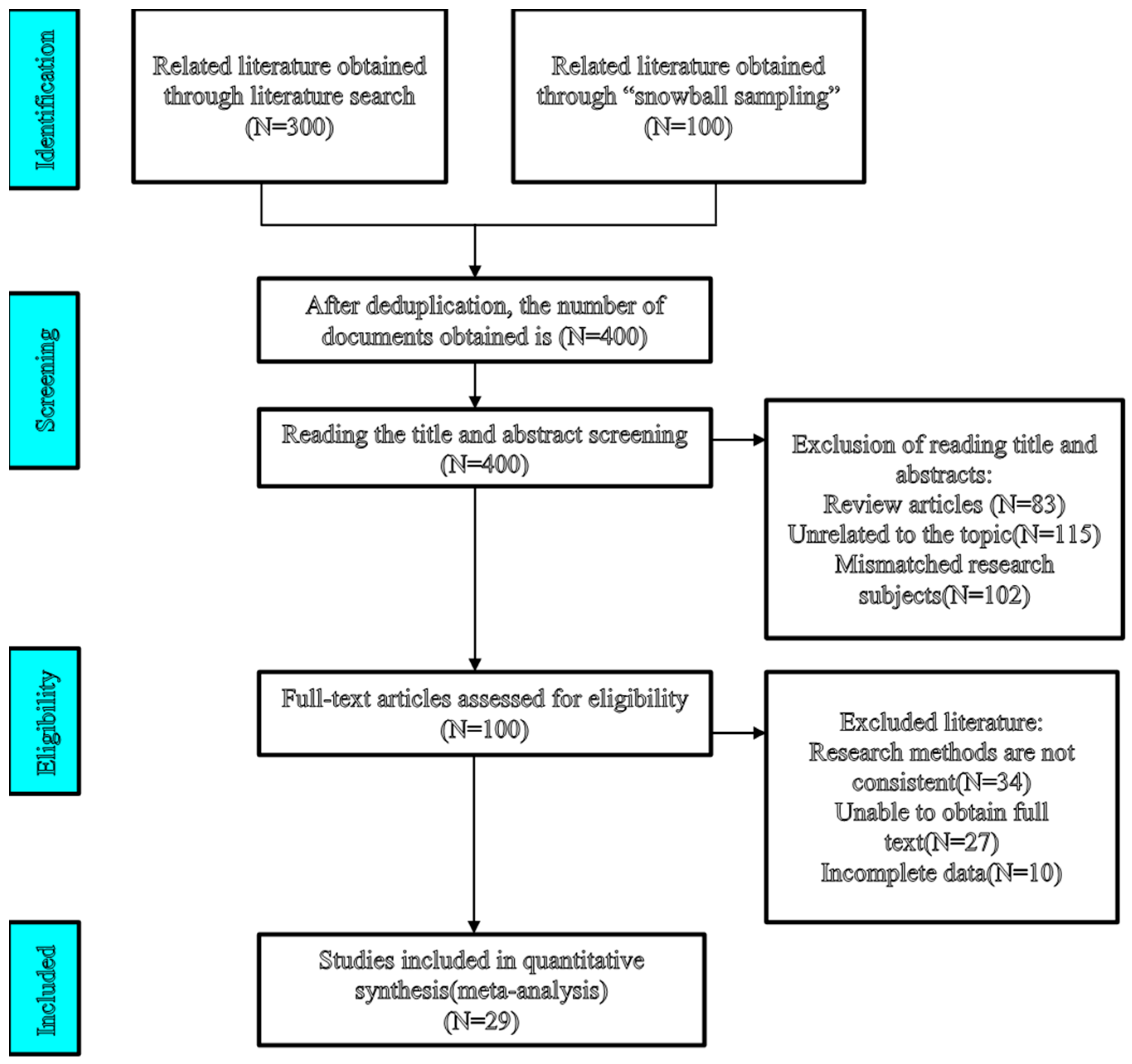
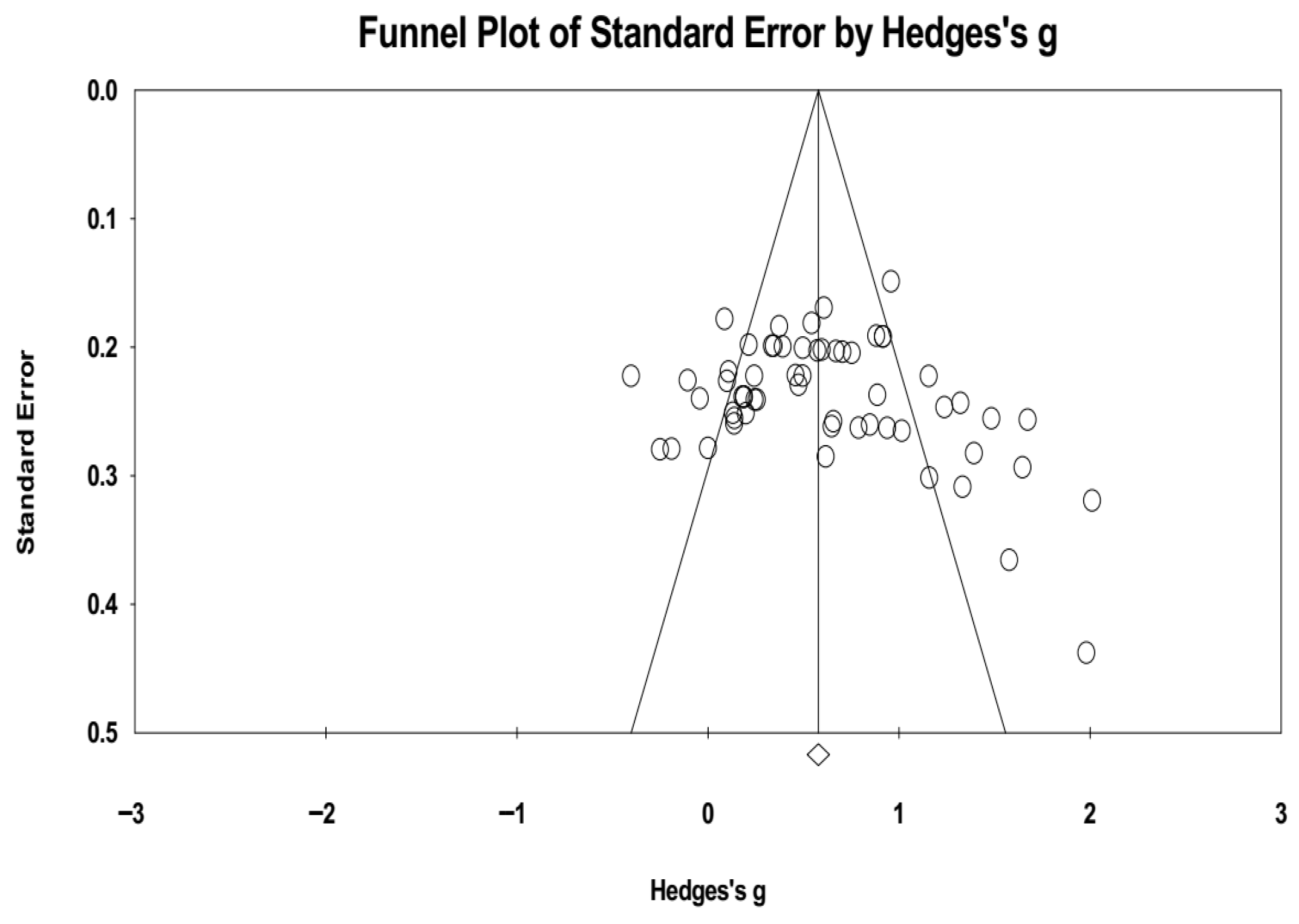
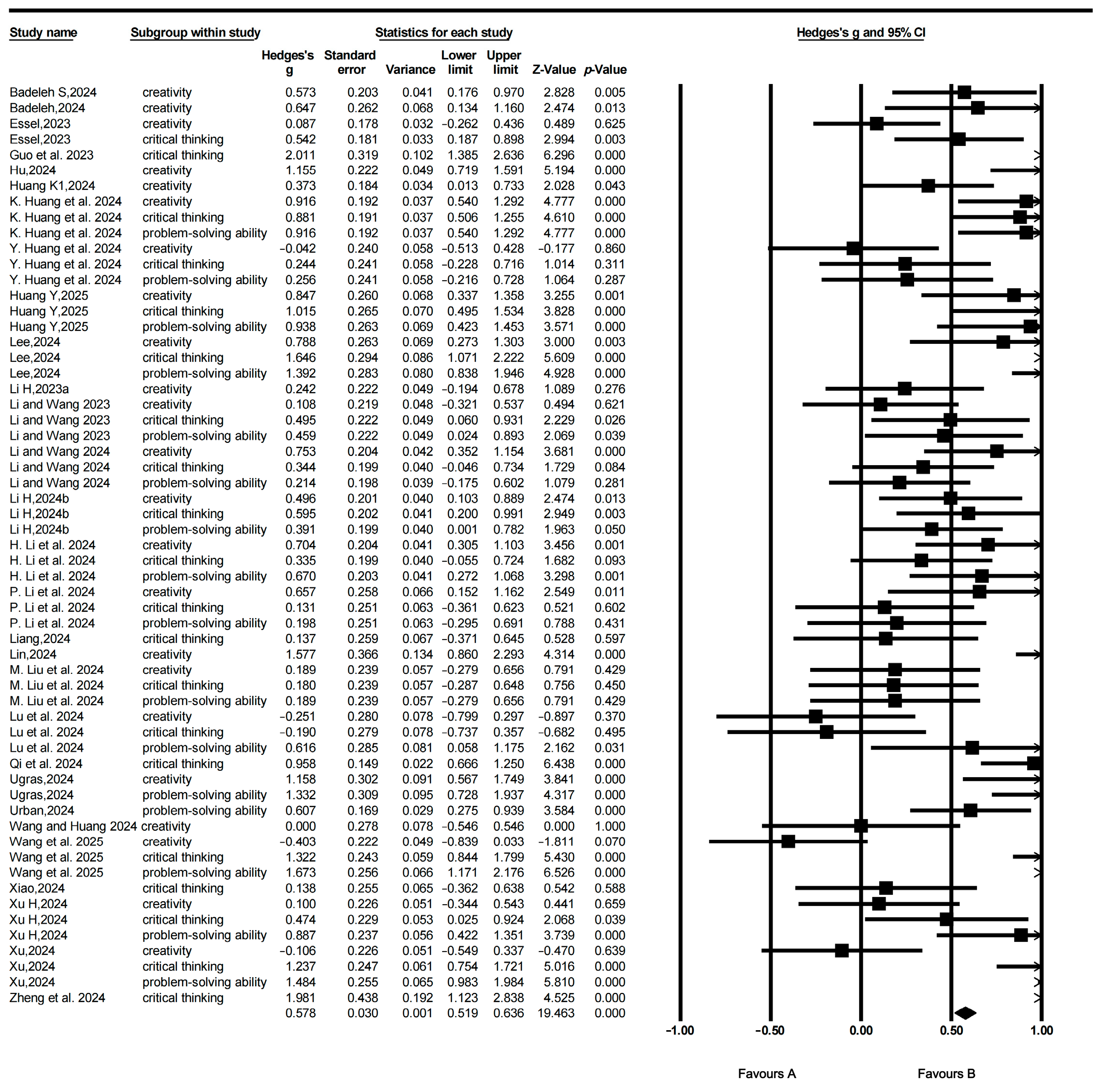


| Scholar (Year) | Discipline | Core Dimensions of HOT |
|---|---|---|
| Liu (2022) | Mathematics Education | Critical thinking, creative thinking, problem-solving skills, metacognition |
| Xu et al. (2024) | Information Technology Education | Problem-solving ability, computational thinking, creativity |
| Tan and Cho (2021) | Translation Studies | Critical thinking, creative thinking, communicative thinking, affective cognition |
| Hwang et al. (2018) | Cross-disciplinary | Collaboration, communication, complex problem-solving, critical thinking, creativity |
| Alkhatib (2022); Yang (2015); Ilgun Dibek et al. (2024) | Cross-disciplinary | Critical thinking, problem-solving ability, creativity |
| Variable | Code |
|---|---|
| Intervention Duration | 1 = 0–8 weeks |
| 2 = 8–16 weeks | |
| 3 = >16 weeks | |
| Educational Stage | 1 = K-12 (Kindergarten through 12th grade) |
| 2 = Post-secondary (undergraduate through graduate) | |
| Instructional Method | 1 = lecture-based |
| 2 = project-based | |
| 3 = blended | |
| Self-Regulated Learning Ability | 1 = high SRL ability |
| 2 = low SRL ability |
| Model | Number Studies | Effect Size | 95% Confidence Interval | Heterogeneity | ||||
|---|---|---|---|---|---|---|---|---|
| Lower Limit | Upper Limit | Q-Value | df | p-Value | I-Squared | |||
| Fixed | 59 | 0.578 | 0.519 | 0.636 | 255.208 | 58 | 0.000 | 77.273% |
| Random | 59 | 0.609 | 0.485 | 0.732 | ||||
| Higher-Order Thinking | N | ES | 95%CI | Two-Tailed Test | Heterogeneity | ||||
|---|---|---|---|---|---|---|---|---|---|
| Lower Limit | Upper Limit | Z-Value | p-Value | Q-Value | df | p-Value | |||
| Creativity | 23 | 0.444 | 0.259 | 0.629 | 4.698 | <0.001 | 4.961 | 2 | 0.084 |
| Critical thinking | 20 | 0.691 | 0.464 | 0.918 | 5.973 | <0.001 | |||
| Problem-solving ability | 16 | 0.745 | 0.521 | 0.970 | 6.507 | <0.001 | |||
| Moderator | Subgroup | N | ES | 95%CI | Two-Tailed Test | Intergroup Effect | ||
|---|---|---|---|---|---|---|---|---|
| Lower Limit | Upper Limit | Z-Value | p-Value | |||||
| Intervention Duration | 0–8 weeks (1) | 15 | 0.494 | 0.272 | 0.717 | 4.350 | <0.001 | Q = 9.106 p = 0.011 |
| 8–16 weeks (2) | 31 | 0.759 | 0.576 | 0.943 | 8.113 | <0.001 | ||
| >16 weeks (3) | 13 | 0.372 | 0.196 | 0.549 | 4.133 | <0.001 | ||
| Educational Stage | K-12 (1) | 13 | 0.857 | 0.542 | 1.172 | 5.335 | <0.001 | Q = 3.353 p = 0.067 |
| Post-secondary (2) | 46 | 0.539 | 0.412 | 0.667 | 8.263 | <0.001 | ||
| Instructional Method | lecture-based (1) | 6 | 0.396 | −0.088 | 0.879 | 1.605 | >0.001 | Q = 2.918 p = 0.232 |
| project-based (2) | 31 | 0.717 | 0.507 | 0.928 | 6.674 | <0.001 | ||
| Blended (3) | 22 | 0.525 | 0.406 | 0.644 | 8.636 | <0.001 | ||
| Self-Regulated Learning Ability | High (1) | 31 | 0.863 | 0.679 | 1.048 | 9.181 | <0.001 | Q = 40.962 p = 0.000 |
| Low (2) | 25 | 0.284 | 0.188 | 0.380 | 5.788 | <0.001 | ||
Disclaimer/Publisher’s Note: The statements, opinions and data contained in all publications are solely those of the individual author(s) and contributor(s) and not of MDPI and/or the editor(s). MDPI and/or the editor(s) disclaim responsibility for any injury to people or property resulting from any ideas, methods, instructions or products referred to in the content. |
© 2025 by the authors. Licensee MDPI, Basel, Switzerland. This article is an open access article distributed under the terms and conditions of the Creative Commons Attribution (CC BY) license (https://creativecommons.org/licenses/by/4.0/).
Share and Cite
Zhao, Y.; Yue, Y.; Sun, Z.; Jiang, Q.; Li, G. Does Generative Artificial Intelligence Improve Students’ Higher-Order Thinking? A Meta-Analysis Based on 29 Experiments and Quasi-Experiments. J. Intell. 2025, 13, 160. https://doi.org/10.3390/jintelligence13120160
Zhao Y, Yue Y, Sun Z, Jiang Q, Li G. Does Generative Artificial Intelligence Improve Students’ Higher-Order Thinking? A Meta-Analysis Based on 29 Experiments and Quasi-Experiments. Journal of Intelligence. 2025; 13(12):160. https://doi.org/10.3390/jintelligence13120160
Chicago/Turabian StyleZhao, Yan, Yuhe Yue, Zhonghua Sun, Qiang Jiang, and Gangsheng Li. 2025. "Does Generative Artificial Intelligence Improve Students’ Higher-Order Thinking? A Meta-Analysis Based on 29 Experiments and Quasi-Experiments" Journal of Intelligence 13, no. 12: 160. https://doi.org/10.3390/jintelligence13120160
APA StyleZhao, Y., Yue, Y., Sun, Z., Jiang, Q., & Li, G. (2025). Does Generative Artificial Intelligence Improve Students’ Higher-Order Thinking? A Meta-Analysis Based on 29 Experiments and Quasi-Experiments. Journal of Intelligence, 13(12), 160. https://doi.org/10.3390/jintelligence13120160



