
Article

Heat Transfer Mixing in Closed Domain with Circular and Elliptical Cross-Sections

1
Department of Mechanics, Mathematics and Management (DMMM), Polytechnic University of Bari, 70125 Bari, Italy
2
Interdepartmental Center TTEC, Polytechnic University of Bari, 74123 Taranto, Italy
*
Author to whom correspondence should be addressed.
Computation 2026, 14(4), 79; https://doi.org/10.3390/computation14040079
Submission received: 25 February 2026 / Revised: 24 March 2026 / Accepted: 26 March 2026 / Published: 31 March 2026
(This article belongs to the Section Computational Engineering)

Abstract

Rayleigh–Bénard convection (RBC) provides a benchmark for studying buoyancy-driven instabilities and heat transport in confined fluids. Heat transfer scaling in cylindrical geometries is well established, whereas the role of the anisotropy induced by the domain geometry, such as elliptical shapes, has not fully explored. This study presents direct numerical simulations of RBC in two domains of equal height, H = 0.0124 m, and different cross-sections: a circular cylinder with radius R = 3.11 × 10 3 m and an elliptical cylinder with semi-axes equal to R max = 3.11 × 10 3 m, R min = 1.55 × 10 3 m, respectively. The simulations, performed at Rayleigh number Ra = 2 × 10 6 and Prandtl number Pr = 1.68 (for water) under the Boussinesq approximation, reveal that (i) the average Nusselt number is comparable in both cases ( Nu 38.23 for the circular case and Nu 39.22 for the elliptical one) and (ii) the different domain geometries influence the thermal transport mechanism and flow organization. Specifically, in the cylindrical cell, heat transfer is regulated by a large-scale circulation roll, whereas in the case of the elliptical shape, the domain is populated by thermal plumes driving the convective dynamics. The latter phenomenon is evidenced by larger Nusselt number fluctuations at the lower and upper plates, with a standard deviation increasing from σ 2.21 in the circular cylinder to σ 4.57 in the elliptical domain. These results highlight that the geometric anisotropy modifies the coupling between boundary layers and the core flow dynamics, leading to enhanced intermittency without affecting the magnitude of the heat flux. Therefore, the elliptical domain is suitable for applications characterized by enhanced mixing.

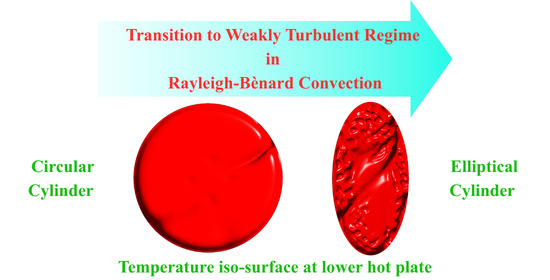
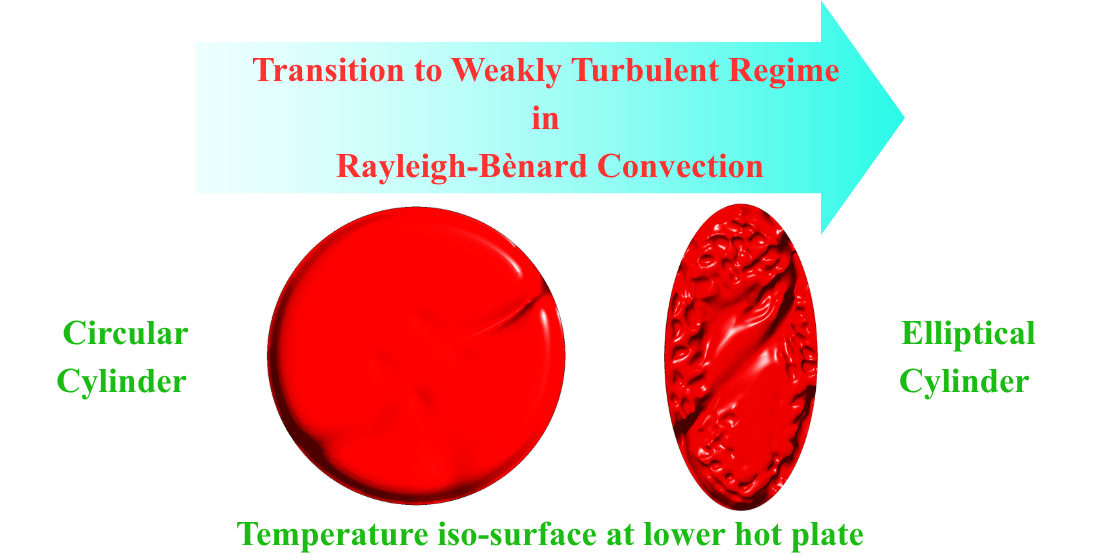
Graphical Abstract

1. Introduction

The study of buoyancy-driven instabilities and energy transport in confined geometries is a central theme in fundamental fluid dynamics. The relevant insights are investigated via Rayleigh–Bénard convection (RBC), which is a buoyancy-driven motion that develops in a horizontal fluid layer heated from below and cooled from above. It has been the canonical model system for studying thermally driven flows, hydrodynamic instabilities, and turbulent transport in incompressible fluids. Since the pioneering experiments by Bénard [1] and the theoretical analysis by Rayleigh [2], this configuration has served as a fundamental model for understanding self-organization, pattern formation, and energy transfer in nonlinear dissipative systems. Despite the simplicity of its geometry and boundary conditions, the system exhibits a remarkable richness of dynamics, encompassing steady cellular patterns, oscillatory and chaotic states, and fully developed turbulence depending on the control parameters and confinement geometry [3]. Under the Boussinesq approximation, the dynamics of RBC are governed primarily by two dimensionless parameters: the Rayleigh number
Ra = g β Δ T H 3 ν κ
which quantifies the ratio between buoyant driving and diffusive damping, and the Prandtl number
Pr = ν κ
which characterizes the relative diffusivities of momentum and heat. When Ra exceeds a critical threshold Ra c [2,4], the purely conductive equilibrium becomes unstable, leading to the development of convective rolls. As Ra further increases, plume emission, boundary-layer instabilities, and large-scale circulation (LSC) are reinforced, leading to an enhancement of heat transport and complex time-dependent fluctuations. The physical theory of RBC has been significantly promoted by Chandrasekhar [4], who derived the linear stability conditions and modal structures at the onset of convection, and by Busse [5], who extended the analysis to weakly nonlinear regimes. In turbulent convection, the scaling laws connecting global transport quantities such as the Nusselt Nu and Reynolds Re numbers to Ra and Pr have been extensively explored. The unifying framework proposed by Grossmann and Lohse [6,7] successfully bridges the laminar, transitional, and turbulent regimes by coupling bulk turbulence and boundary-layer dissipation, providing quantitative predictions of Nu ( Ra , Pr ) and Re ( Ra , Pr ) across a broad parameter range. These theories have been validated and refined through high-resolution direct numerical simulations (DNS) [8,9] and experiments [10,11], which revealed the complex multiscale organization of thermal plumes, the anisotropy of velocity fluctuations, and the intermittency of boundary-layer detachment. Beyond the canonical horizontally extended or cylindrical geometries, the influence of lateral confinement and wall curvature on convective organization has recently received increasing attention [12,13]. Both experimental and numerical studies have demonstrated that the geometry and lateral confinement of the container can strongly affect the symmetry, stability, and orientation of the LSC [14,15], as well as the efficiency of global heat transport [15,16]. Verzicco and Camussi [9] showed that even modest modifications in lateral curvature can alter the coherence of plume structures and induce azimuthal oscillations in cylindrical domains. Similarly, investigations by Emran et al. [14], Bailon-Cuba et al. [16], Koschmieder [17], and Clever and Busse [18] revealed that noncircular cross-sections, including elliptical or polygonal enclosures, may shift the critical Rayleigh number, modify onset modes, and break flow symmetry, leading to preferential roll alignments and secondary mean flows. Moreover, systematic measurements by Nikolaenko et al. [15] showed that for cylindrical cells with aspect ratio Γ = D H 0.43 , with D, the diameter of the cylinder, and H, its height, the effective scaling exponent γ E F F in Nu Ra γ EFF approaches 1 / 3 at high Ra , in agreement with classical arguments, whereas at a smaller aspect ratio, confinement suppresses the LSC and modifies the transport scaling. More recent works have emphasized that geometric anisotropy, such as ellipticity or azimuthal asymmetry, can either enhance or inhibit convective transport depending on the interplay between wall curvature and boundary-layer dynamics [12,13] and its impact on global heat transport [6,7]. Despite these advances, numerical investigations of RBC in non-axisymmetric domains remain relatively scarce, particularly in the intermediate Rayleigh-number range 10 5 Ra 10 7 and for moderate Pr , where laminar, time-dependent, and weakly turbulent features coexist. More recent works have emphasized that geometric anisotropy, such as ellipticity or azimuthal asymmetry, can either enhance or inhibit convective transport depending on the interplay between wall curvature and boundary-layer dynamics [12,13] and its impact on global heat transport [19]. Understanding how geometric anisotropy influences the transition to unsteady convection and the efficiency of thermal transport is crucial not only for fundamental fluid dynamics but also for technological applications in microfluidics. Our selection of the Rayleigh number was strategic. It places the study squarely within the transitional/weakly turbulent regime, maximizing the LSC’s sensitivity to confinement and allowing us to clearly isolate the physical mechanism. The objective was to demonstrate that geometric anisotropy accelerates the flow transition: the elliptical domain exhibits the intermittent, plume-dominated behavior typically observed in circular cells only at much higher Rayleigh numbers. This high-fidelity DNS study differentiates itself by focusing on the effect of continuously varying lateral curvature, in contrast to prior work on sharp-cornered domains, and demonstrates that this geometry acts as a passive flow modulator, accelerating the transition from a single large-scale circulation to a quasi-periodic plume dynamic at the intermediate Rayleigh number. In the present study, we carried out direct numerical simulations (DNS) of Rayleigh–Bénard convection in three-dimensional enclosures with the same height and different cross-sections: a circular section and an elliptical section with maximum and minimum semi-axes. In this framework, the initial turbulence intensity is zero; the chaotic behavior emerges naturally from the non-linear coupling of the Navier–Stokes and energy equations. The flow is modeled as incompressible under the Boussinesq approximation, with the control parameters—Rayleigh number, Prandtl number, and a corresponding Reynolds number—defined based on the free-fall velocity. The top and bottom plates are maintained at constant temperatures; on the other hand, the sidewalls are adiabatic. Whereas adiabatic sidewalls represent an idealization, this study adopts the canonical Rayleigh–Bénard configuration to ensure consistency with established literature benchmarks. This standardized approach was strategically necessary to isolate the specific effects of lateral curvature and geometric anisotropy on convective dynamics without the influence of external thermal perturbations. As demonstrated by Verzicco et al. [20], the thermal properties and finite conductivity of sidewalls in non-canonical cases can significantly influence heat transport and trigger different mean flow states. By maintaining adiabatic boundaries, we ensure that the observed phenomena are strictly geometry-induced, providing a clear baseline for identifying the fundamental mechanisms of flow modulation. The main advantage of this study, compared to investigations involving active forcing or specialized material properties, is the identification of passive geometric control. The elliptical cross-section acts as a passive modulator that effectively anticipates the transition to an intermittent, plume-dominated regime typically observed in circular domains only at much higher Rayleigh numbers. Although it is acknowledged that environmental thermal coupling may influence these structures in practical applications, this study establishes the robustness of geometry-driven transitions. Future research will extend these findings by addressing conjugate heat transfer to evaluate the stability of these regimes under more realistic thermal boundary conditions. This setup enables a direct comparison between the two geometries under conditions of the same thermal forcing, thus allowing the identification of geometry-induced modulations in convective structures and transport efficiency. The average Nusselt number is roughly the same in both cases; however, the different domain geometries influence the thermal transport mechanism and flow organization. Specifically, in the cylindrical cell, heat transfer is regulated by a large-scale circulation roll, whereas in the case of the elliptical geometry, the domain is populated by thermal plumes that drive the convective dynamics. The latter phenomenon is evidenced by larger Nusselt-number fluctuations at the lower and upper plates, indicating anisotropic plume dynamics and intermittent heat-flux intensification. These features are consistent with earlier findings on symmetry breaking in noncircular RBC [21]. Such insights are particularly relevant for confined convective systems employed in engineering, microfluidic, and biomedical applications, where precise thermal regulation is essential [22,23]. The core novelty of this study lies in demonstrating how geometric anisotropy induced by an elliptical cross-section serves as a passive control mechanism in Rayleigh–Bénard convection. Although heat transfer in circular cylinders is well documented, it is shown here for the first time that an elliptical cross-section inhibits the stabilization of the large-scale circulation (LSC) typical of circular domains. The study quantifies the impact of this anisotropy on the temporal fluctuations of heat transfer, as reflected by the increased standard deviation of the Nusselt number. In particular, the modified flow dynamics promote intense detachment of thermal plumes from the boundary layers, leading to a transition from a global circulation regime to a plume-dominated state. At Ra = 2 × 10 6 , the elliptical domain already exhibits statistical signatures of a more advanced convective regime, characterized by larger Nusselt number fluctuations compared to the circular case. This result indicates that geometric anisotropy can be used as a design parameter to trigger enhanced mixing in confined geometries where the achievable Rayleigh number is limited.

2. Model

This study addresses three-dimensional Rayleigh–Bénard convection in confined domains. We investigated a circular cylinder with radius R = 3.11 × 10 3 m and height H = 1.24 × 10 2 m, and aspect ratio Γ = 2 R H = 0.5 . The results of this case have been compared with the flow dynamics in an elliptical cylinder with the same height H and semi-axes R max = 3.11 × 10 3 m and R min = 1.55 × 10 3 m. The sidewalls are adiabatic, and the lower (hot) and the upper (cold) plates are kept at constant temperatures equal to T h = 372.15 K and T c = 370.15 K, respectively. The no-slip condition has been applied at the domain boundaries. The fluid is water with kinematic viscosity ν = 2.92 × 10 7 m 2 s 1 , thermal diffusivity κ = 1.74 × 10 7 m 2 s 1 , and thermal expansion coefficient β = 2.69 × 10 3 K 1 . In such a system, the key feature of heat transfer is the total dimensionless heat flux, quantified by the Nusselt number. The choice of Ra = 2 × 10 6 and Pr = 1.68 was strategic, placing the study within the transitional and weakly turbulent regime to maximize the sensitivity of the large-scale circulation (LSC) to lateral confinement and isolate the physical mechanisms driving the flow transition. While at very low Rayleigh numbers the flow remains laminar and at extremely high numbers the dynamics follow scaling laws where container shape becomes secondary, our investigation focuses on the intermediate regime where geometric anisotropy acts as a passive modulator. In this range, the elliptical geometry effectively accelerates the transition to a plume-dominated and intermittent state a behavior typically observed in circular cells only at much higher Rayleigh numbers. Although the qualitative benefits of improved mixing are expected to persist, the relative advantage of the elliptical shape may decrease as the flow enters a fully turbulent regime where bulk scaling increasingly dominates boundary-induced effects. The Nusselt number computed at the lower hot and upper cold plates reads
Nu = H Δ T T z A , t z = 0 , z = H ,
The Nusselt number can be equivalently obtained by integrating the energy equation over the domain volume:
Nu = 1 + H κ Δ T u z ( T T c ) V , t ,
Here, · A , t denotes an area- and time-average over the plate, whereas · V , t denotes a volume- and time-average over the entire domain.
Natural convection is governed by the Rayleigh ( Ra ), Prandtl ( Pr ), and Reynolds ( Re ) numbers:
Ra = g β Δ T H 3 ν κ , Pr = ν κ , Re = Ra Pr ,
with Δ T = T h T c = 2   K , yielding Ra = 2 × 10 6 , Pr = 1.68 , and Re = 1.09 × 10 3 . The large-scale flow is characterized by the free-fall velocity U, the length scale H, and the time scale τ :
U = g β Δ T H , τ = H U ,
with U = 2.56 × 10 2 m/s and τ = 4.85 × 10 1 s.
In the core region, the smallest dissipative vortex scales can be estimated according to Kolmogorov theory [24]:
U η = U Re 1 / 4 , τ η = τ Re 1 / 2 , η = H Re 3 / 4 ,
for velocity U η = 4.45 × 10 3 m/s, time τ η = 1.47 × 10 2 s, and length η = 6.56 × 10 5 m. Towards the wall, the viscous boundary layer develops with thickness δ = 3.77 × 10 4 m, and it can be estimated from Prandtl boundary-layer theory as [25]:
δ = H Re ,
Moreover, the thickness of the thermal boundary layer δ T = 3.17 × 10 4 m can be estimated according to [26]:
δ T = Pr 1 / 3 δ .
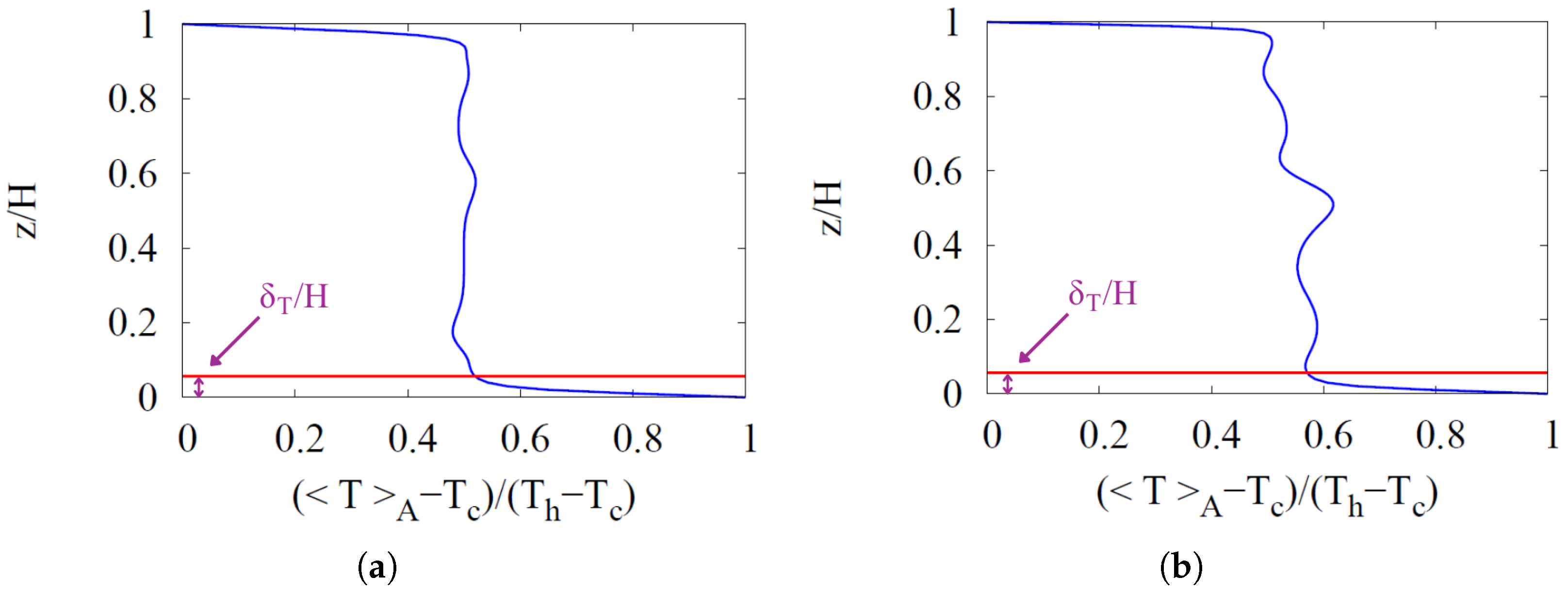
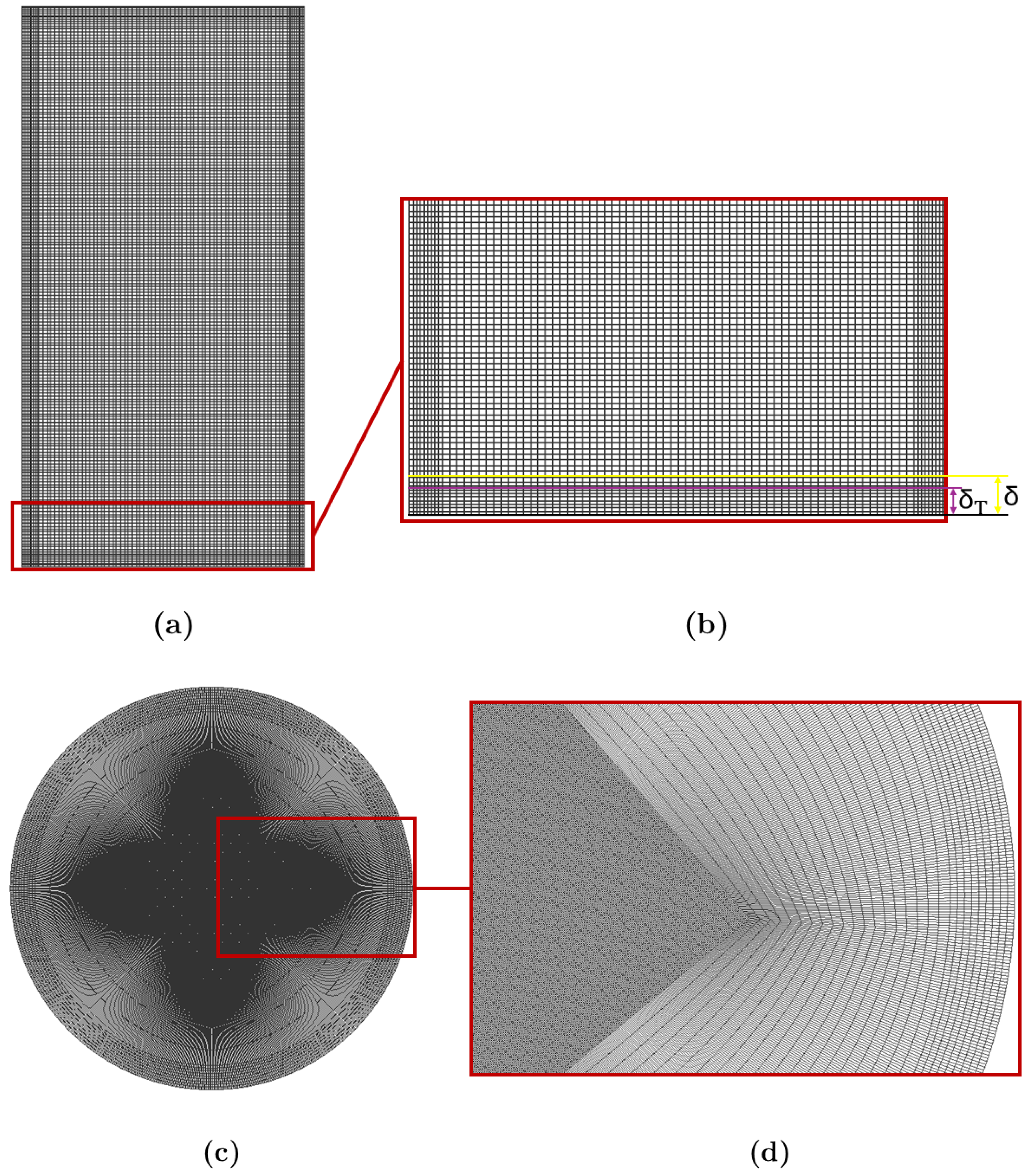
The numerical simulations have been carried out with a mesh size Δ x = η in the core region. The mesh refinement close to the walls is based on a grid size Δ x bl = δ n p , with n p = 10 grid points in the viscous boundary layer. According to established DNS criteria, the thermal boundary layer must be resolved by at least 8 grid points to ensure adequate resolution [26]. In the present simulations, the grid refinement near the walls was designed to ensure n p = 10 grid points within the viscous boundary layer, consistent with established DNS benchmarks for Rayleigh–Bénard convection [9]. As a result of the adopted grid design, the thermal boundary layer is resolved by n p = 15 grid points in the final DNS for both geometries, corresponding to a dimensionless thickness δ T / H = 5.62 × 10 2 . The comparison between these DNS results and the theoretical predictions is summarized in Table 1, whereas the profile is shown in Figure 1.
We demonstrate the adequacy of our spatial resolution by analyzing the horizontally-averaged temperature profile as a function of the vertical coordinate in Figure 1. This analysis yields a computed thermal boundary layer thickness that shows excellent agreement with the estimated theoretical value derived from the mean Nusselt number. Temporal convergence was ensured by basing the time step on the Kolmogorov time scale. We confirm that the maximum Courant–Friedrichs–Lewy (CFL) number remained well below unity (typically CFL < 0.5 ) for the entire simulation duration, validating the stability of the second-order scheme.
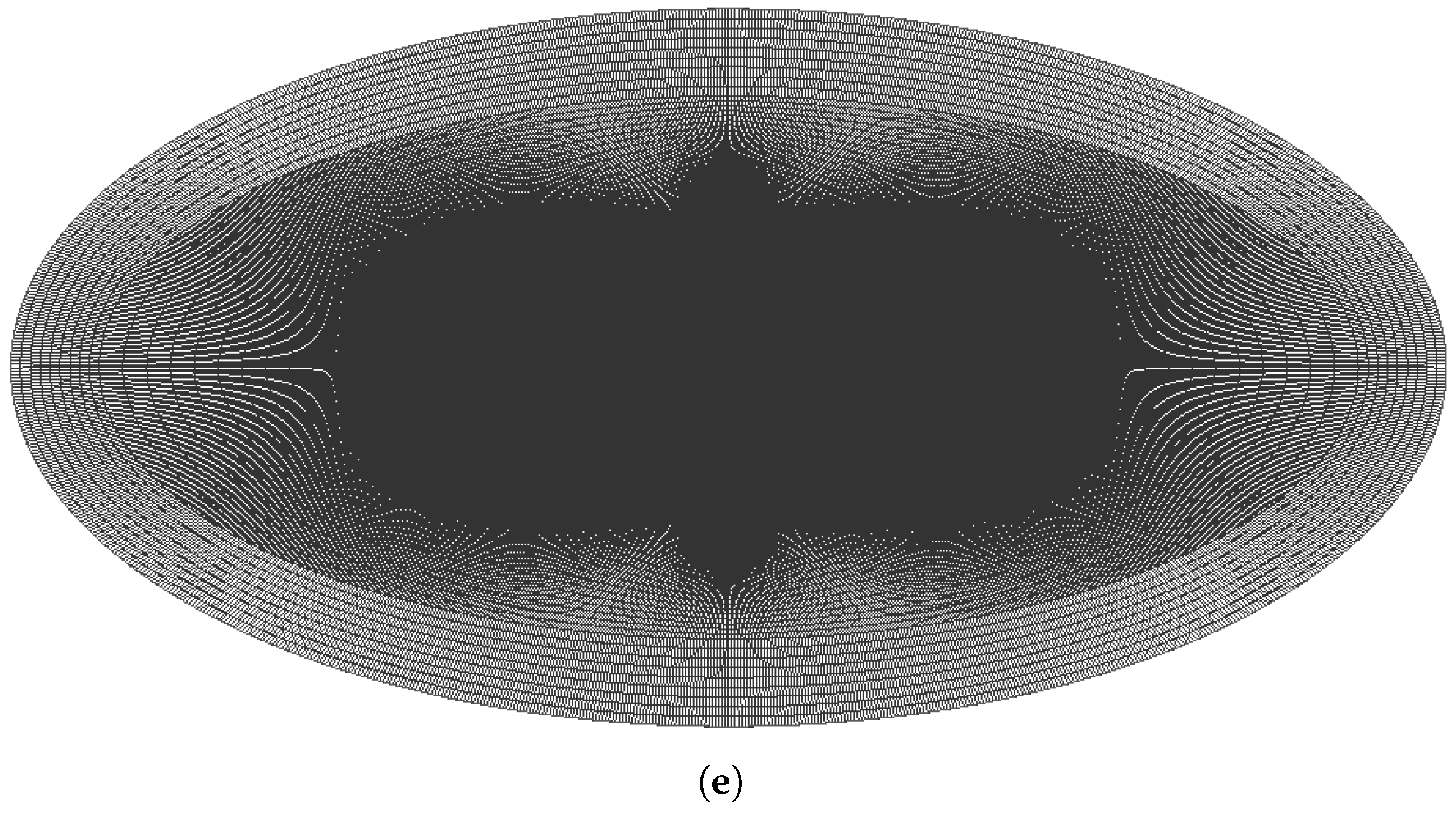
In Figure 2, the mesh is shown for the simulations carried out.
Similarly, the time step size is set equal to d t = τ η in order to capture the faster dynamics of the smallest vortical structures. The numerical simulations have been carried out for a time Δ t = 500 τ = 242.5 s.
The Navier–Stokes equations with the Boussinesq approximation are numerically solved.

2.1. Governing Equations

The adoption of the Boussinesq approximation implies that the thermophysical properties, namely viscosity, thermal diffusivity, and thermal expansion coefficient, are assumed to be constant. Density variations are accounted for only in the buoyancy term through the relation ρ ( T ) = ρ 0 [ 1 β ( T T 0 ) ] . We acknowledge that for larger temperature differences, non-Oberbeck–Boussinesq (NOB) effects, such as temperature-dependent viscosity and thermal conductivity, can break the top-bottom symmetry and modify flow organization, as detailed by Sugiyama et al. [27] for Rayleigh–Bénard convection in water. However, for the present small temperature difference, this canonical approach is strategically chosen to isolate the impact of geometric anisotropy and lateral curvature, preventing non-linear instabilities associated with temperature-dependent property variations from masking the geometry-induced flow features. Under these assumptions, the mass conservation reads
· u = 0
The momentum balance is written as
u t + ( u · ) u = 1 ρ p + ν 2 u + g β ( T T c ) z ^
where u denotes the fluid velocity field, t the time, ρ the density, p the pressure, ν the kinematic viscosity, g z ^ the gravity, β the thermal expansion coefficient, T the temperature field, and T c the cold temperature at the upper plate.
The energy equation is
T t + ( u · ) T = κ 2 T
where κ is the thermal diffusivity. The initial and boundary conditions are provided in Table 2.

2.2. Numerical Method

The Navier–Stokes equations were numerically solved using Ansys® Fluent 2024 R2 with the pressure-based solver. A second-order implicit time formulation was adopted to improve the accuracy of temporal discretization and to ensure numerical stability. Pressure–velocity coupling was handled through the Semi-Implicit Method for Pressure-Linked Equations Consistent algorithm. The pressure interpolation at the control-volume faces was ensured by Rhie–Chow momentum-based correction, which deals with spurious pressure oscillations. Both the momentum and energy equations were discretized using second-order upwind schemes to reduce numerical diffusion and improve the resolution of the gradients, while the pressure equation was solved using a second-order interpolation scheme to enhance the reconstruction of the pressure field. These numerical settings and the grid refinement described above allow for accurate time and spatial resolution of both the thermal and viscous boundary layers and vortices populating the core region.

3. Results

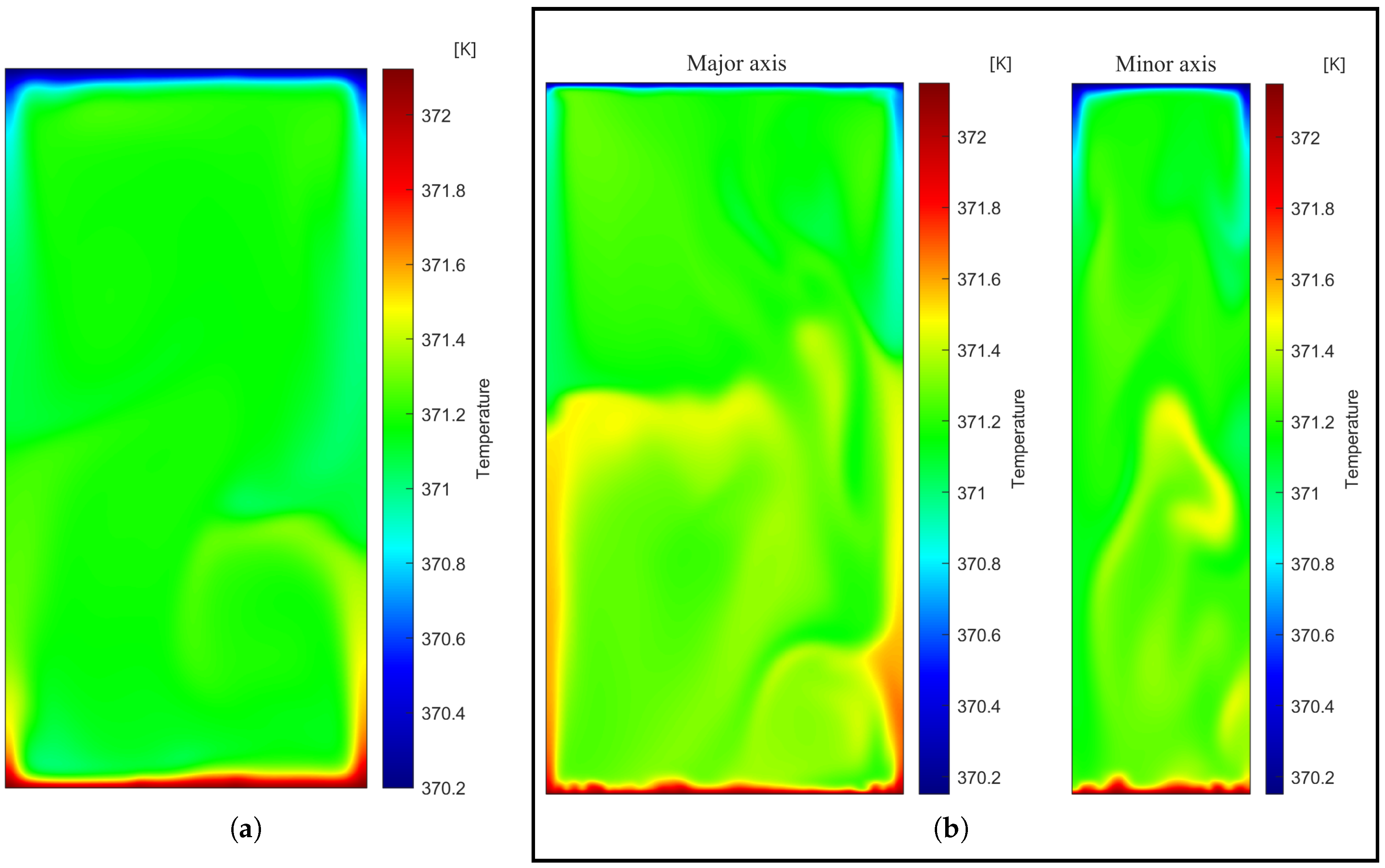
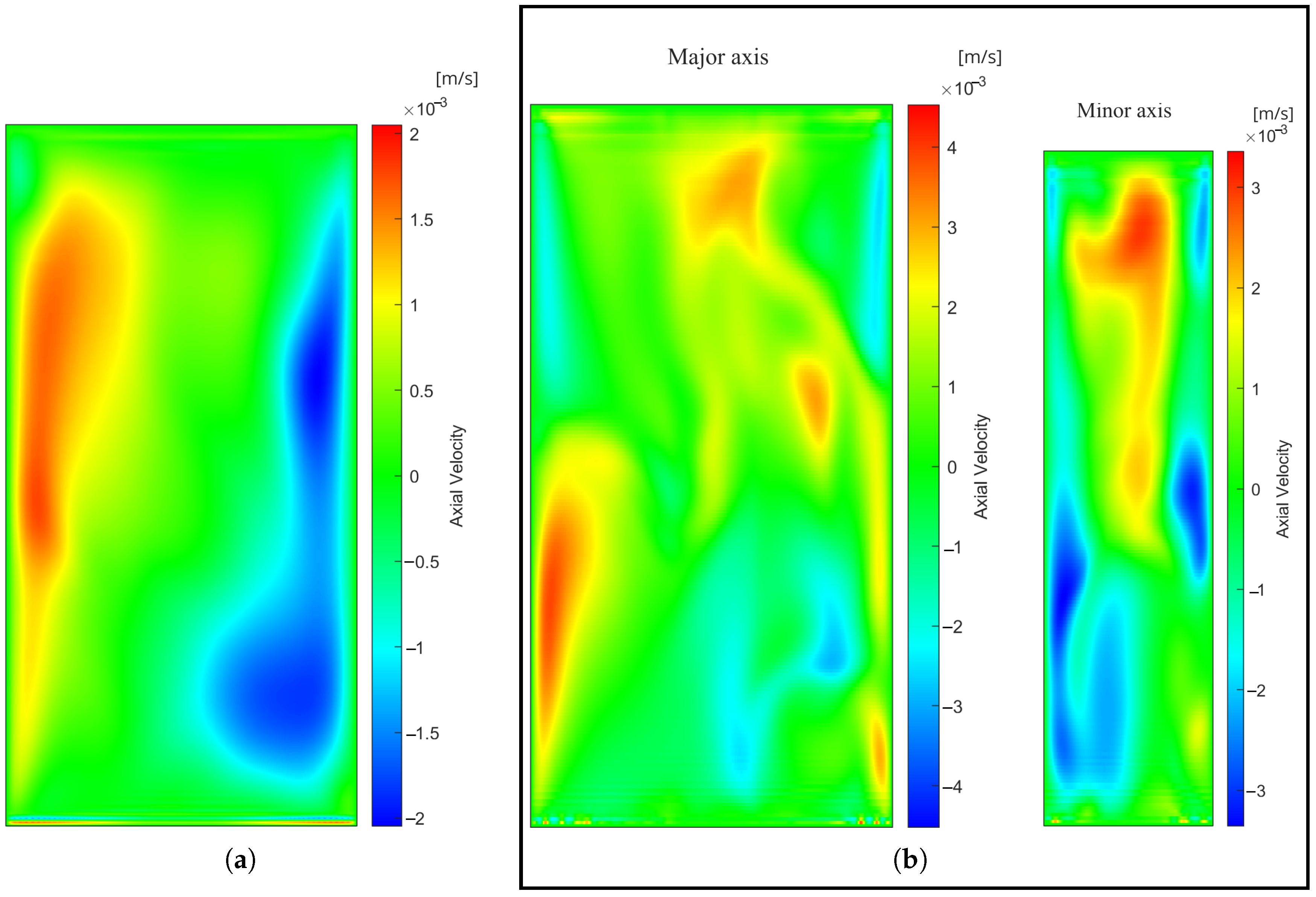
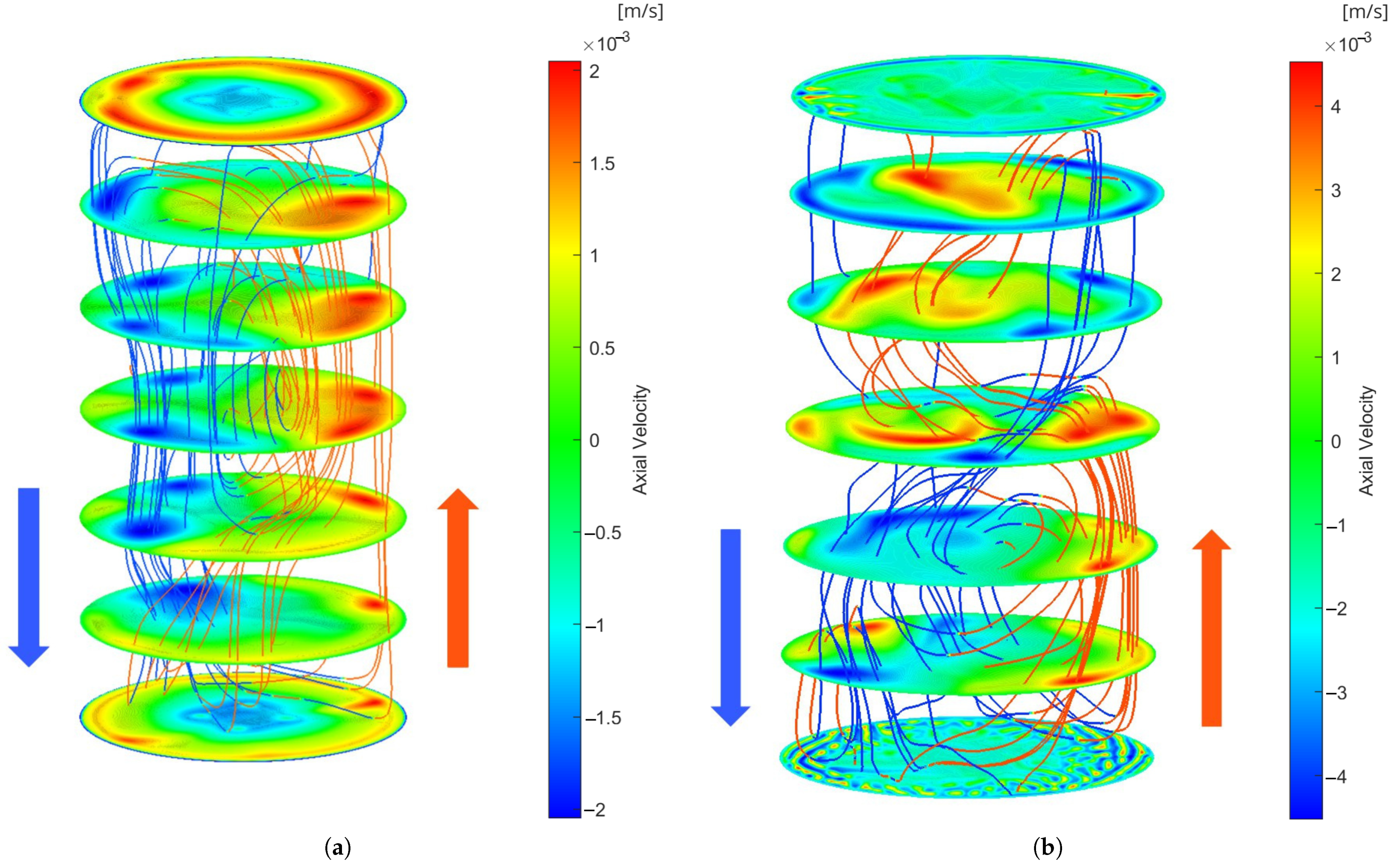
In this section, the results of the direct numerical simulations are presented systematically, with particular attention to the effects of the domain geometry on the heat transport and flow organization. We highlight the differences between the domains with circular and elliptical cross-sections. We evaluate their heat transfer efficiency and mixing properties as a function of the main flow structures. The reliability of the presented results is rooted in a methodological framework designed to ensure numerical consistency across both investigated geometries. While the second-order finite-difference method in cylindrical coordinates, proposed by Verzicco et al. [28], stands as the established benchmark for circular domains, our study utilizes a finite volume method (FVM) discretization. As noted by Shishkina et al. [29], high-order finite volume methods provide a robust framework for capturing complex plume dynamics in cylindrical geometries. This choice is specifically intended to manage the geometric anisotropy and variable curvature of the elliptical configuration. Unlike standard finite-difference approaches, the FVM framework ensures strict local and global conservation of mass and momentum by directly integrating fluxes across the control-volume faces. This conservative property is fundamental for ensuring high physical accuracy where the elliptical wall induces localized flow accelerations. Furthermore, the adoption of the Boussinesq approximation allows us to isolate these geometry-driven effects from instabilities related to temperature-dependent fluid properties. Specifically, thermal convection exhibits time-dependent behavior modulated by the evolution of the vortical structures populating the domain. At large scales, the flow is organized in a single roll that fills the whole domain, coexisting with the thermal plumes detaching from the hot and cold plates. Plume formation occurs through the intermittent accumulation of hot/cold spots rising/falling towards the upper/lower plates. The distribution of the axial velocity component u z and the temperature field exhibits substantial differences in flow structure and thermal morphology between cylindrical and elliptical configurations, which directly impact heat transport efficiency. In the cylindrical domain, the u z field shows clear radial symmetry, as shown in Figure 3, characterized by upward flow concentrated in the central region and downward motion along the lateral walls. This organization is indicative of the formation of stable convective rolls. This flow organization is attributable to the dynamics of large-scale coherent structures (LSC), whose identification is essential for characterizing global thermal transport and the coherence of motion within confined domains [30]. The gradual transition between regions with opposite u z polarity reflects moderate shear gradients and relatively steady flow dynamics, consistent with the low standard deviation observed in the mean Nusselt numbers. The associated temperature field, as shown in Figure 4, exhibits an ordered vertical stratification, with nearly-horizontal isotherms and a smooth transition between hot lower regions and cooler upper regions, confirming a stationary and symmetric convective regime [31,32]. In the elliptical geometry, pronounced anisotropies emerge in both the velocity and temperature fields. Along the major axis, the upward flow is strongly focused within a narrow central band, while the downward regions are thinner and laterally confined, with a marked increase in transverse shear. This configuration suggests the presence of elongated and deformed convective rolls, accompanied by lateral instabilities that enhance convective activity and increase heat transfer efficiency at the cold surface, as evidenced by higher Nu ¯ T c values [16]. The corresponding temperature field reveals a more extensive hot region concentrated near the base, with significantly deformed isotherms and stronger vertical gradients, consistent with more energetic impingement of the ascending flow on the cold surface and enhanced convective activity [16,33].
Along the minor axis of the ellipse, the u z distribution becomes more fragmented and asymmetric, with localized upward motions and diffuse downward flow, indicating increased intermittency and the possible presence of secondary flow structures. Similarly, the temperature field shows irregular distribution, with cold regions penetrating deeper toward the base and inclined isotherms, indicative of compressed rolls and localized instabilities [16,33]. Overall, the combination of focused flows, geometric anisotropy, and modal instabilities in the elliptical configuration leads to increased vertical heat transport, but also higher temporal and spatial variability, consistent with the larger standard deviations observed, particularly in the upper-wall temperature T h . Although the elliptical geometry introduces stronger fluctuations and a less stable convective regime, it appears to promote more efficient heat transfer compared to the cylinder, especially during the heat extraction phase. These results therefore confirm the decisive role of anisotropic curvature in modulating the structure of the velocity and temperature fields, significantly influencing the overall performance of Rayleigh–Bénard convective systems [31,32]. To further clarify the nature of these convective structures and address the potential for three-dimensional spiral motion, the flow is visualized using 3D streamlines in Figure 5. Analysis of the three-dimensional flow topologies reveals fundamental discrepancies in convective organization between the two investigated geometries. In the cylindrical domain, the dynamics are governed by a single, stable, and radially symmetric large-scale circulation (LSC) roll, characterized by predominant vertical advection and minimal lateral interactions. Conversely, the anisotropy induced by the elliptical cross-section inhibits the formation of a coherent LSC, forcing a transition toward a regime dominated by intermittent thermal plumes and complex, quasi-spiral 3D trajectories that occupy the domain core. These results indicate that the elliptical geometry acts as a passive flow modulator, effectively anticipating the transition to a weakly turbulent state typically observed in circular domains only at significantly higher Rayleigh numbers. While the mean thermal transport remains statistically invariant between the two cases, the marked increase in vertical velocity standard deviations confirms that the elliptical configuration optimizes chaotic mixing efficiency, suggesting the superiority of this geometry for applications requiring intensive mixing without increasing the system’s thermal forcing.
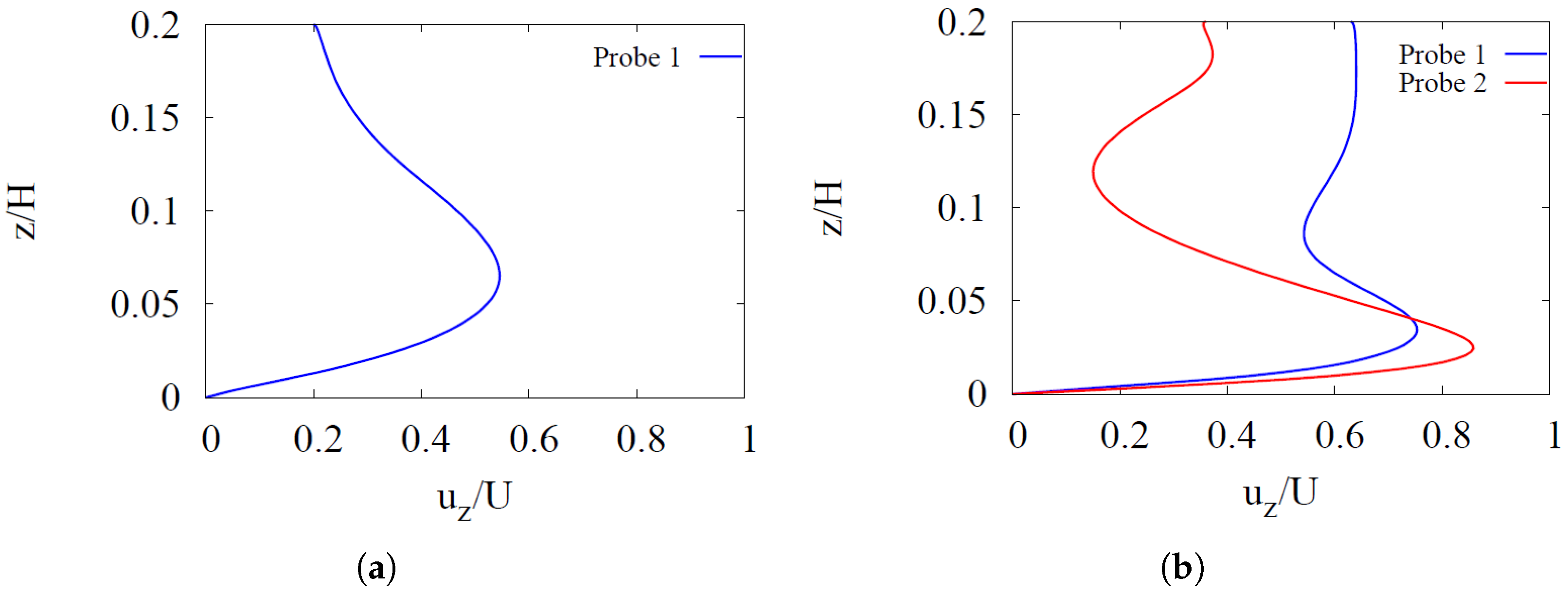
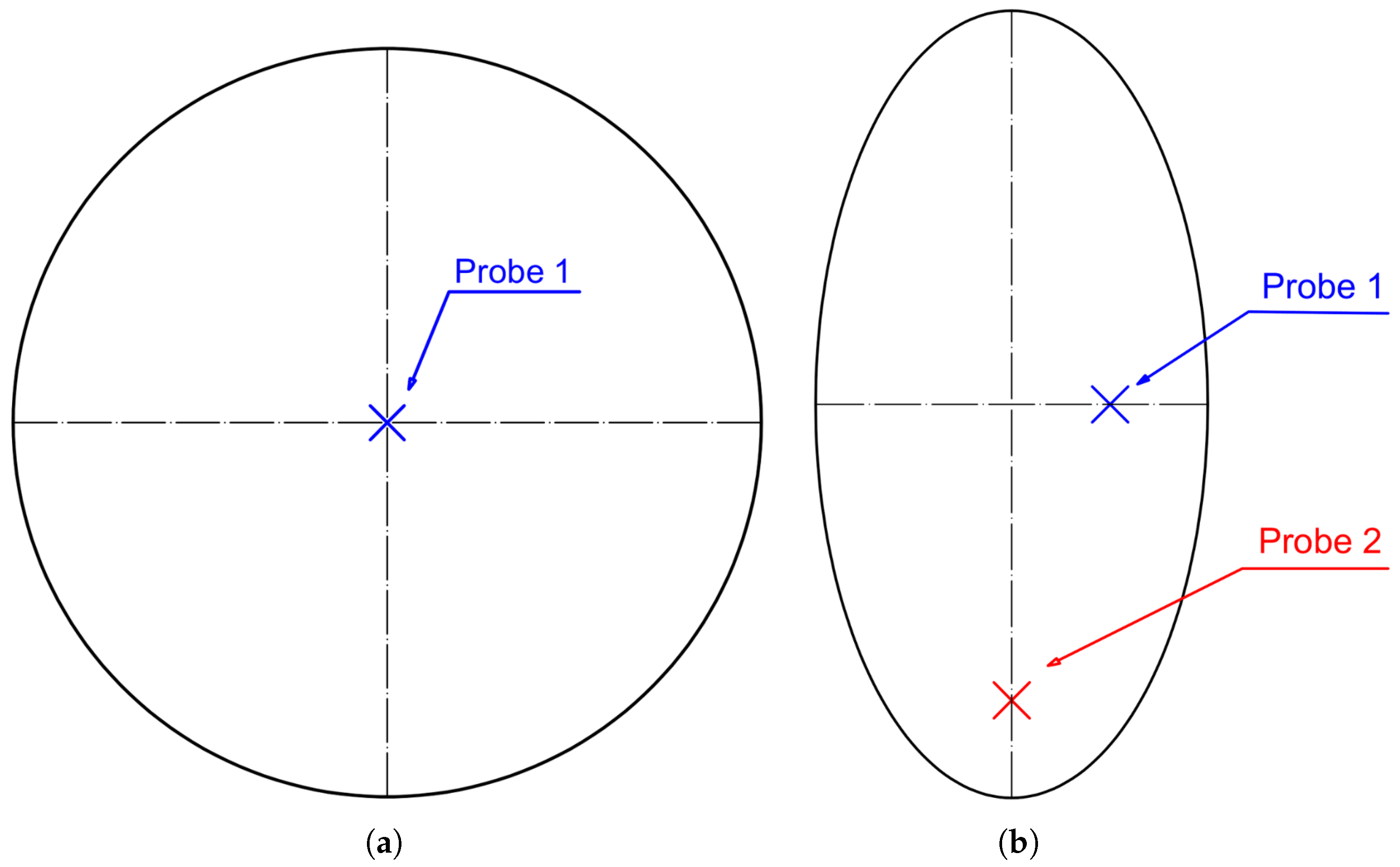
Elliptic anisotropy induces a non-uniform distribution of the viscous boundary layer thickness ( δ ) due to the variable local curvature. To quantify this effect, we performed vertical velocity measurements ( u z / U ) in the near-wall region ( z / H 0.2 ). In the cylindrical domain, a single probe was positioned at the center ( r = 0 ) to capture the primary upward advection. For the elliptical geometry, two dedicated probes were positioned along the major and minor axes at a distance R c = 7.72 × 10 4 m, corresponding to the radius of the osculating circle at the vertex of the major axis, as illustrated in Figure 6. The comparative analysis highlights a fundamental spatial modulation of the viscous boundary layer induced by the elliptical anisotropy. In regions of maximum curvature along the major axis, the geometry acts as a focal point for convective flow intensification, which results in a localized thinning of the viscous boundary layer. As demonstrated by the velocity profiles recorded near the wall in Figure 7, the distribution along the minor axis (blue line, Probe 1) exhibits greater momentum diffusivity, resulting in a thicker and more diffuse boundary layer that resembles the stable circulation of the cylindrical case. In contrast, the profile at the major axis (red line, Probe 2) shows significantly higher peak magnitudes occurring closer to the wall. This intensification is a direct consequence of the conservation of mass, as the geometric constriction induced by the maximum curvature forces the fluid to accelerate to maintain the flow rate. This localized acceleration creates significantly steeper velocity gradients which, by increasing the local shear stress, trigger the transition toward flow instability. Ultimately, these high-curvature zones act as the primary sites for plume detachment, effectively accelerating the natural transition toward the intermittent, plume-dominated regime typically observed in circular cells only at much higher Rayleigh numbers.
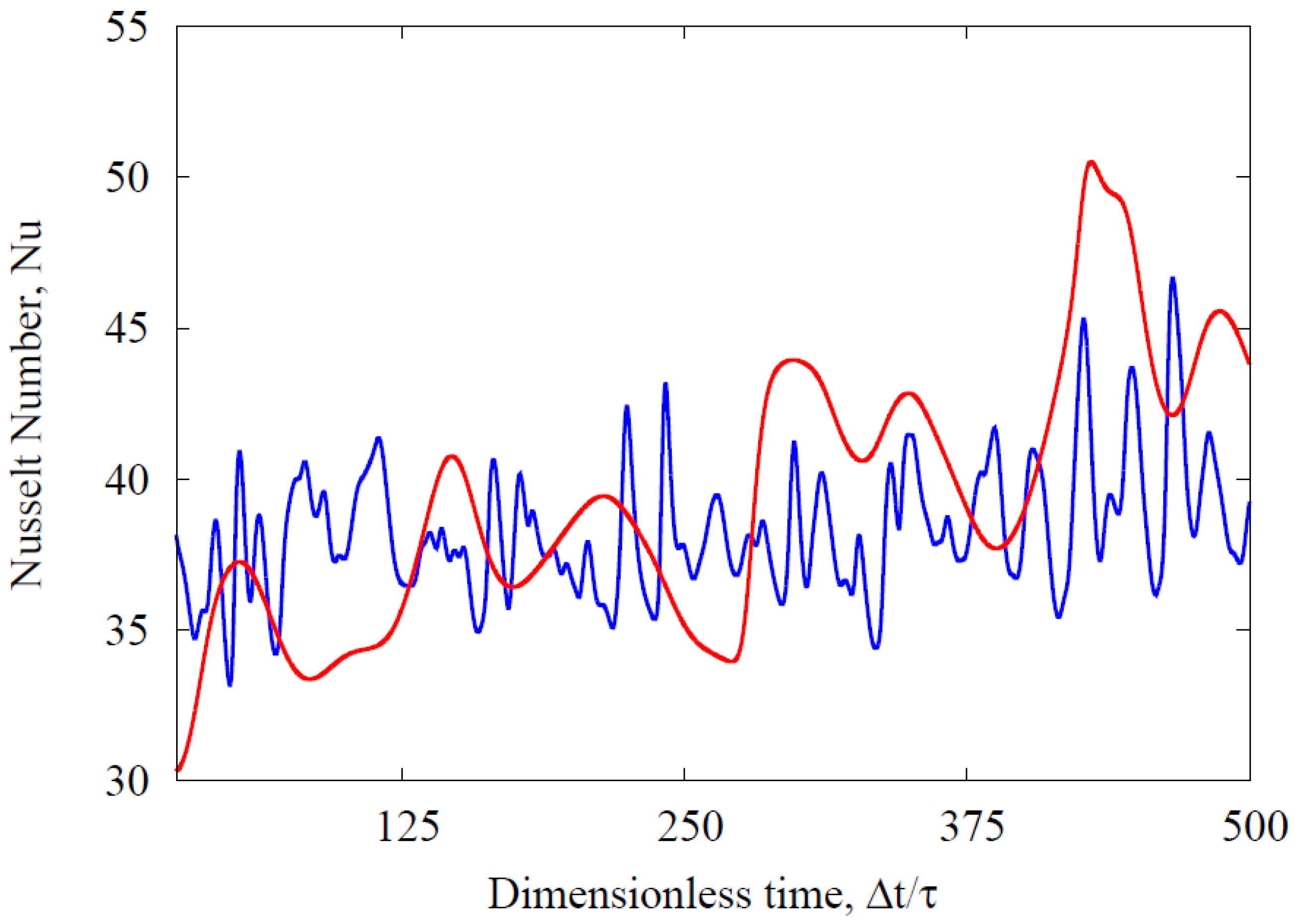
A comparative evaluation of the convective heat transfer shows significant geometry-induced differences, even though the mean Nusselt numbers are roughly the same in both cases, whereas their time fluctuations exhibit relevant differences between the two configurations analyzed. In Figure 8, the Nusselt number as a function of the dimensionless time Δ t / τ is shown for circular (blue line) and elliptical (red line) cross-sections, with τ being the large-scale circulation time.
The values of the mean, Nu , and standard deviation, σ , of the Nusselt number are summarized in Table 3.
The magnitude of heat flux is roughly the same in both domain geometries, but the higher standard deviation of the Nusselt number induces a stronger intermittency of the thermal layers in the case of the elliptical cross-section.
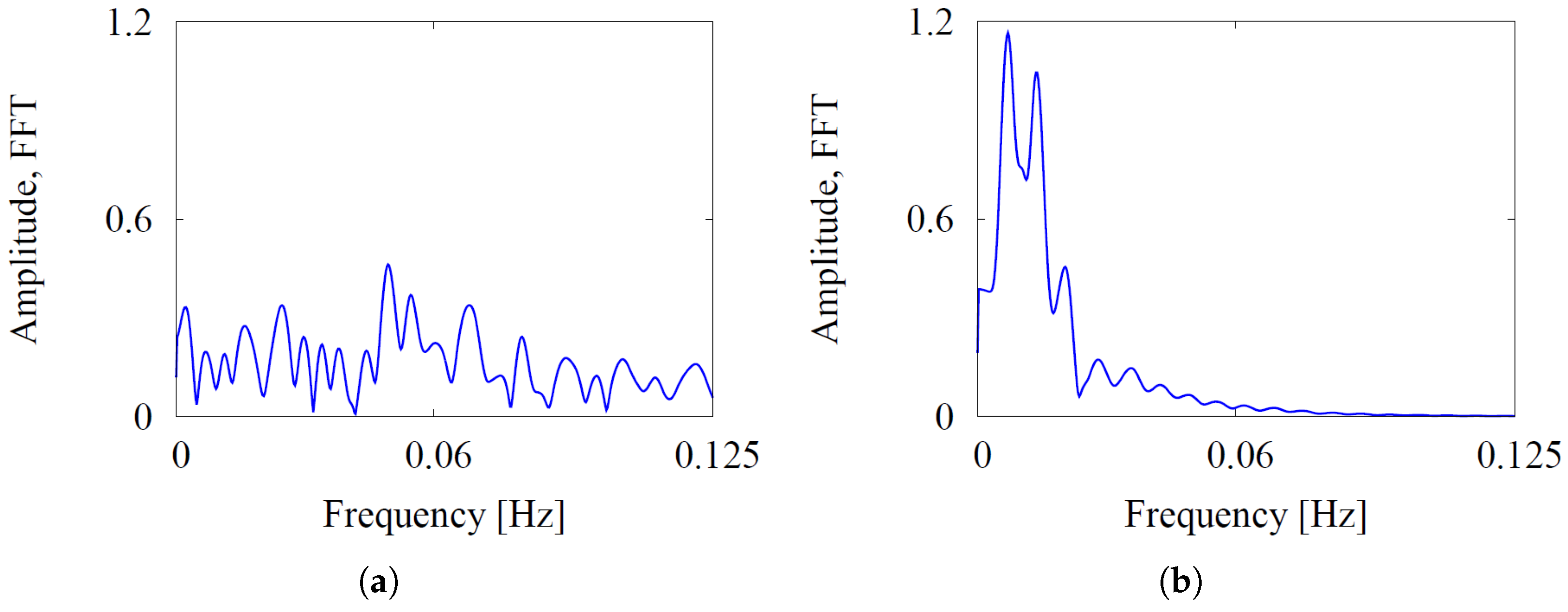
This phenomenon indicates that the heat transfer is influenced by a kind of plume detachment with localized intensification of the heat flux, as observed by Shishkina et al. [26]. In this case, the system exhibits higher spatiotemporal variability, a feature consistent with the enhanced plume dynamics described by Ahlers et al. [34] and symmetry breaking observed in noncircular RB configurations, as discussed by Chillà and Schumacher [35]. The standard deviation of the Nusselt number highlights the strength of the intermittent phenomenon. Its occurrence is further demonstrated by the low-frequency fluctuations in the Nusselt number time evolution, which dominate in the elliptical cross-section case compared to the circular one. These temporal observations are reinforced by spectral analysis of the Nusselt number, which provides insights into the temporal structure of heat transport. In the circular cylinder (Figure 9a), the spectrum shows a diffuse energy distribution without dominant peaks, with components spread over the 0–0.1 Hz range. This non-periodic and weakly chaotic behavior reflects a stationary regime dominated by a stable large-scale circulation (LSC) that fills the entire domain. The moderate amplitudes (0–0.6) and the limited energy content at low frequencies (<0.02 Hz) indicate the absence of persistent plumes and a quasi-isotropic, regular flow, with weak high-frequency oscillations (0.04–0.1 Hz) associated with small-scale local instabilities. In the elliptical cylinder (Figure 9b), the spectrum exhibits a strong concentration of energy at low frequencies (<0.02 Hz) and a sharp, high-amplitude dominant peak, indicating quasi-periodic thermal plume release. The rapid decay at higher frequencies denotes a more coherent yet anisotropic flow shaped by the geometry. The loss of radial symmetry reorganizes the large-scale circulation into multiple interacting convective cells distributed along the major axis of the domain. The formation of these multi-cellular structures reflects the emergence of multiple steady states, a phenomenon intrinsic to Rayleigh–Bénard convection in domains where geometric anisotropy and the aspect ratio Γ force a reorganization of convective patterns [36]. These coupled structures generate temporal modulation of the heat flux, enhance mixing efficiency, and promote the intermittent intensification of convective transport. Overall, the circular domain maintains a stationary and isotropic convective regime, whereas the elliptical configuration displays a multi-cellular, quasi-turbulent behavior, in which geometric anisotropy amplifies Nusselt number fluctuations and drives the system toward a more unstable and three-dimensionally organized convective state.
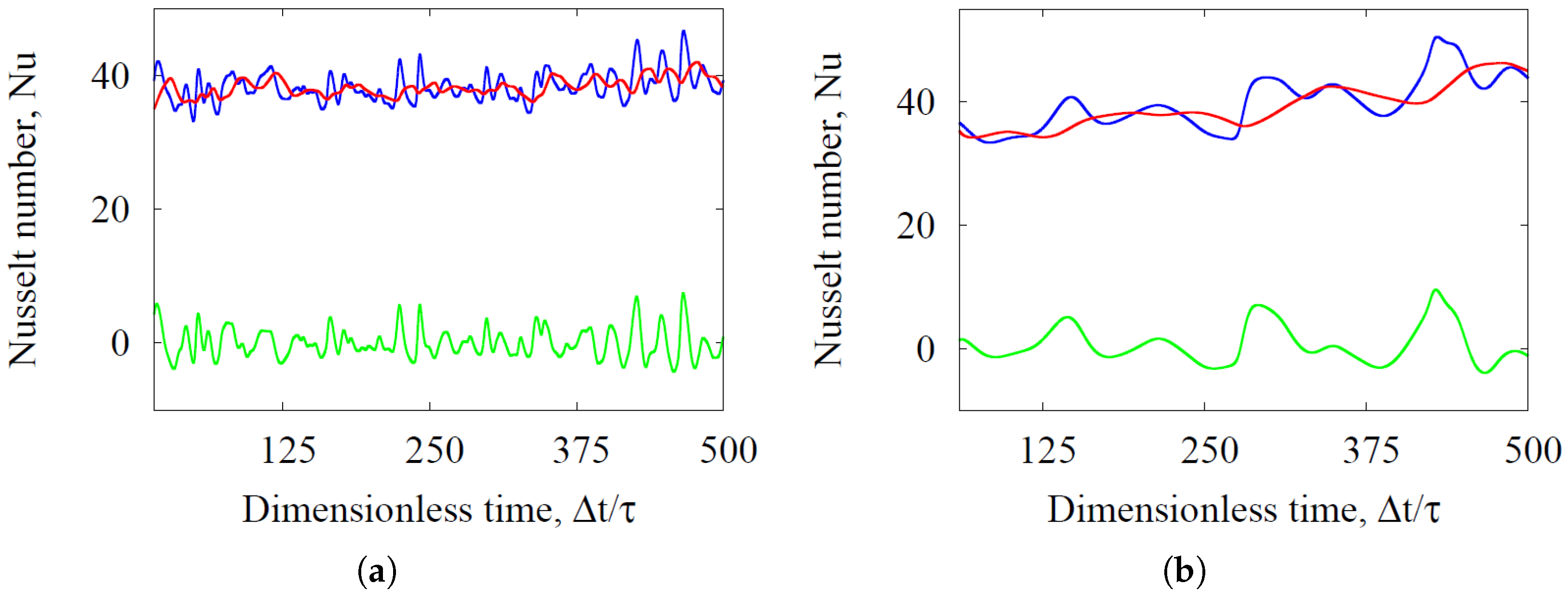
For these reasons, the flow patterns are revealed by the time fluctuations of the Nusselt number, θ ( t ) (Figure 10), which is defined as
θ ( t ) = Nu ( t ) Nu t
The elliptical cross-section configuration (Figure 10b) shows smoother, lower-frequency oscillations, suggesting that heat transfer is delayed due to the time required for thermal plume formation before detachment from the thermal layer towards the opposite plate. This heat transfer instability, caused by fragmented vertical convection cells and strong plume–plume interactions, has also been observed in slender cylindrical geometries but at higher Rayleigh numbers [5,37]. The elliptical cross-section induces a transition to moderately turbulent convection regimes, as discussed by Ahlers et al. [34] for turbulent transport, Chilla et al. [35] for transition behavior in confined geometries, and Verzicco et al. [9] for boundary layer dynamics in RBC.
The structure and stability of the thermal boundary layer (TBL) play a decisive role in defining global mixing efficiency and shaping the dynamics of large-scale circulation (LSC). In this context, alternating ‘pump’ and ‘dump’ events induce the periodic detachment of thermal plumes from the boundary layer [9,34,35]. This behavior leads to intense, spatially localized mixing and moderately coherent global dynamics. The elliptical cell triggers more frequent and unevenly distributed plume emissions, corresponding to a more coordinated pump–dump cycle and improved large-scale coherence [34,35], as observed by Zhou et al. [38] for plume dynamics and Sugiyama et al. [39] for plume detachments. From an applied standpoint, these differences are directly relevant for enhancing mixing while preserving the total heat flux, thereby promoting thermally driven biochemical processes [22,23].
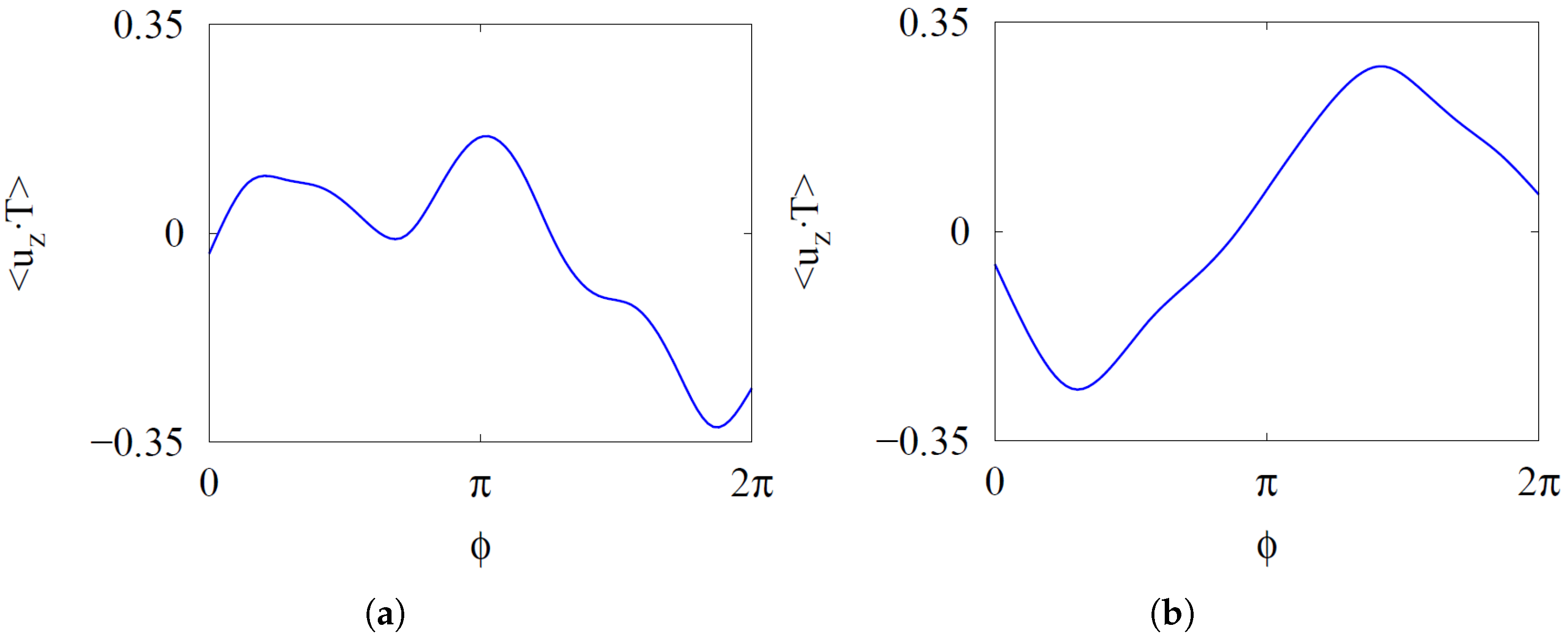
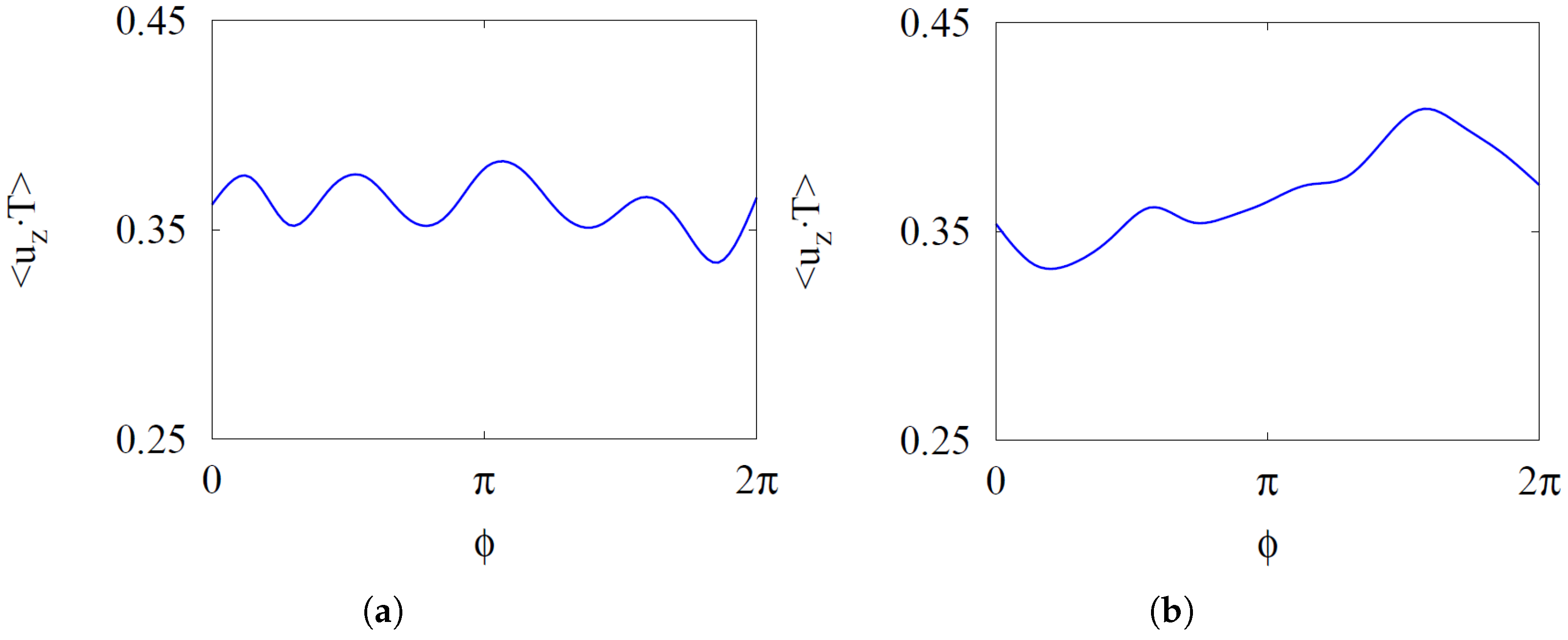
In the core region, the mechanisms governing heat transfer have been analyzed through the angular profiles of the time-averaged vertical heat flux, u z · T t ( φ ) , which reveal distinct thermal transport characteristics between cylindrical and elliptical Rayleigh–Bénard cells. The mean angular profiles further support this interpretation: the cylindrical configuration exhibits irregular oscillations around zero, reflecting intermittent reversals in vertical transport, while the elliptical geometry maintains a more symmetric and coherent oscillatory pattern. These findings suggest that the elliptical cell sustains slower, more thermally buffered circulation, whereas the cylindrical cell favors faster, impulsive convective dynamics. The geometric modulation of curvature thus plays a critical role in shaping the temporal and spatial structure of thermal transport in confined Rayleigh–Bénard systems, in agreement with prior numerical studies on boundary-driven convection [26,40].
At the lower plate, the elliptical geometry exhibits a broader amplitude range (0.33–0.41) compared to the circular counterpart (0.33–0.38), indicating enhanced upward thermal extraction near the base, Figure 11. This suggests that the elliptical curvature promotes the localized intensification of convective plumes, consistent with geometric modulation effects observed in non-circular domains [9]. In the elliptical geometry, the thermal plumes detaching from the hot lower plate are also dominant and persistent in the core region, as shown by the coherence of the azimuthal distribution of u z · T t . This quantity was recorded by 15 probes arranged along a circumference of radius R / 2 at heights of H / 2 and δ / 2 , Figure 12. In the cylindrical domain, the plumes detaching from the lower boundary layer are collected into a single roll filling the cell, which exhibits a smoothed yet fluctuating distribution of the heat flux u z · T t .
To further substantiate the interpretation of a geometry-induced transition toward a more unsteady and weakly turbulent regime, the temporal evolution of the Reynolds number has been analyzed. The Reynolds number is defined as
Re = u z 2 V · D ν
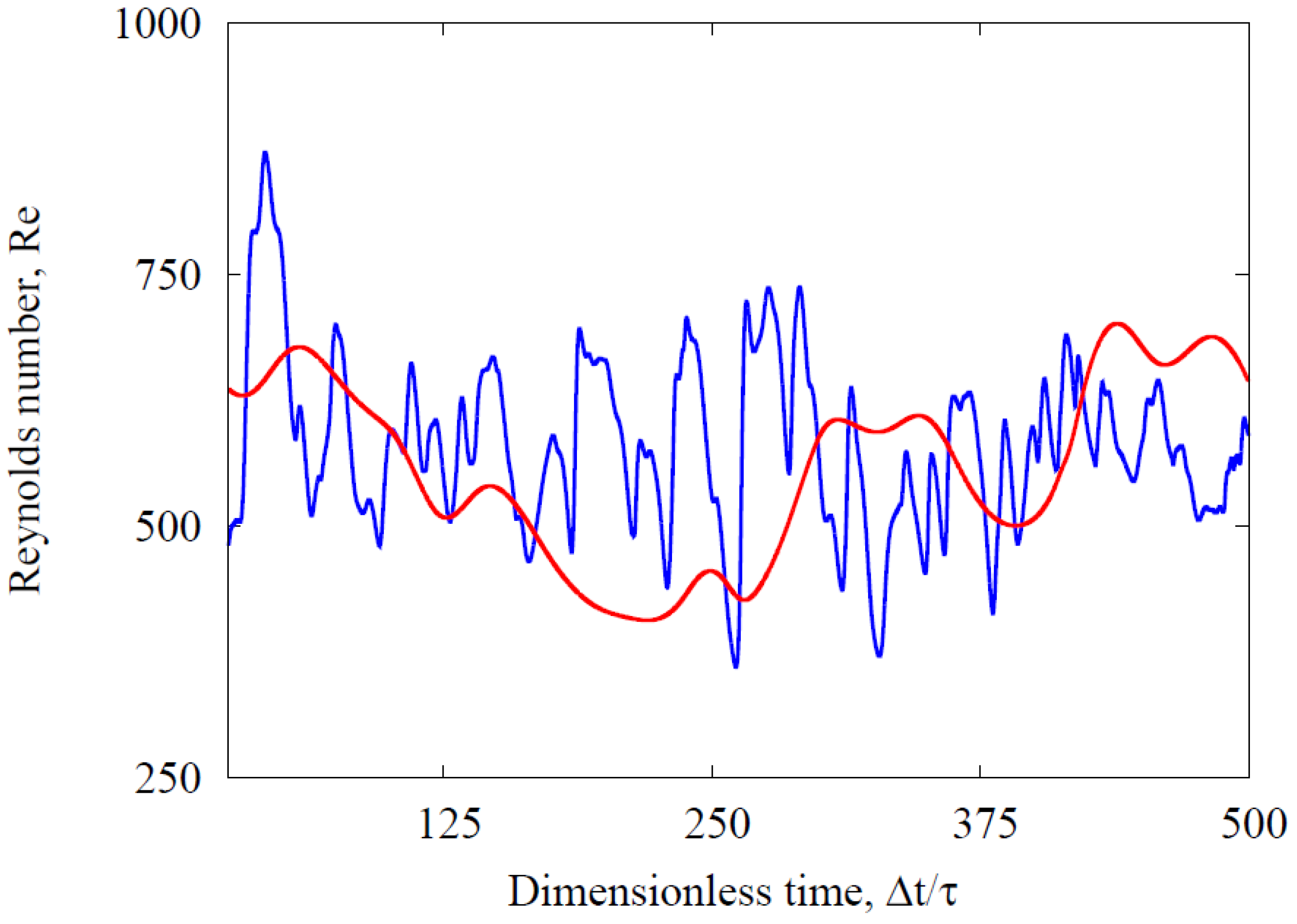
where u z 2 V is the volume-averaged mean square of the vertical velocity component and D is the characteristic horizontal length scale of the domain. This definition captures the intensity of the vertical convective motions that dominate heat and momentum transport in Rayleigh–Bénard convection. Figure 13 reports the evolution of Re ( t ) for both circular and elliptical cross-sections. The simulation time Δ t is made dimensionless by the large-scale circulation time τ . While the mean Reynolds number is comparable in the two configurations, consistent with the identical Rayleigh and Prandtl numbers, marked differences emerge in the temporal dynamics.
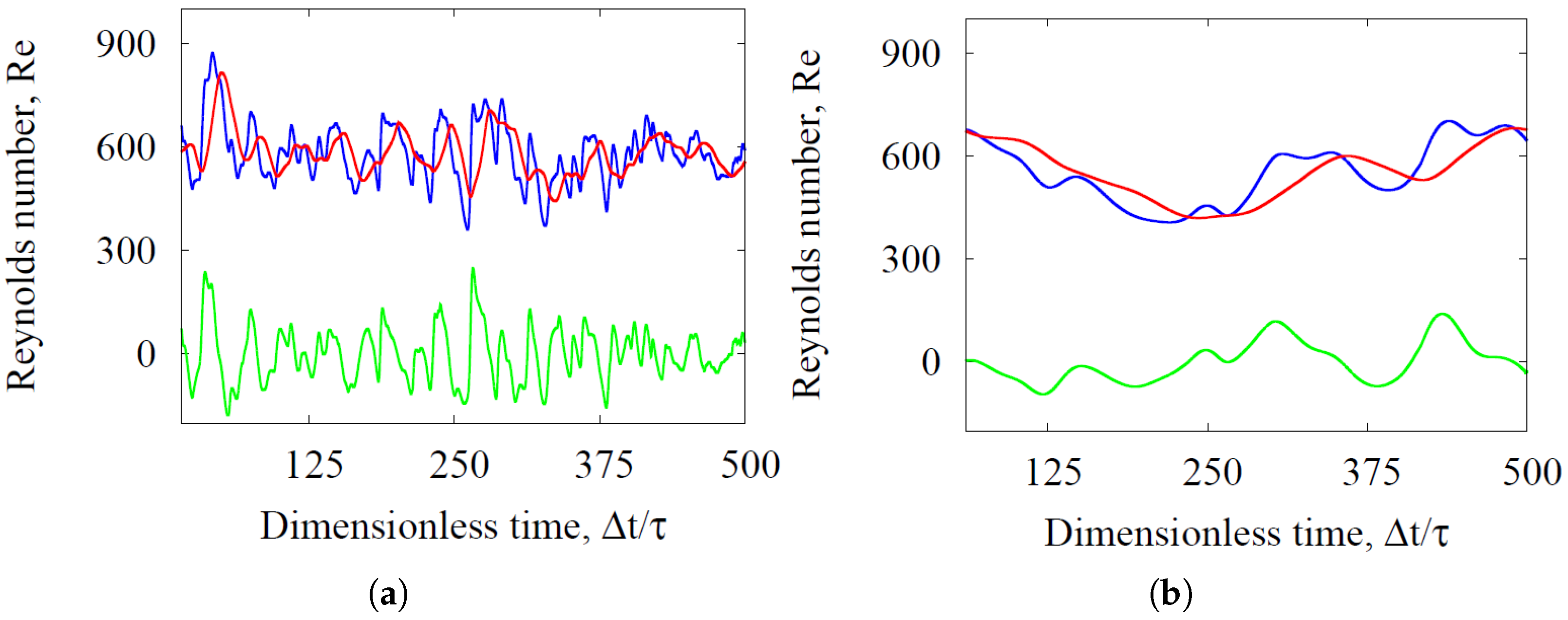
In the circular cylinder, the Reynolds number exhibits relatively small-amplitude, high-frequency fluctuations around its mean value, indicative of a stable large-scale circulation governing the flow. This behavior is characteristic of a transitional regime in which inertia is significant but the flow organization remains largely coherent and roll-dominated. In contrast, the elliptical geometry displays larger-amplitude, low-frequency oscillations of Re ( t ) , revealing pronounced intermittency in the velocity field. These fluctuations are quantified by a Reynolds-number deviation, defined in the next equation and shown in Figure 14:
γ ( t ) = Re ( t ) Re t
The elliptical case exhibits stronger and more coherent excursions of γ ( t ) , reflecting episodic accelerations and decelerations of the flow associated with plume emission and plume–plume interactions.
Such behavior provides clear dynamical support for an accelerated transition toward a weakly turbulent regime in the elliptical cell. The enhanced Reynolds-number fluctuations indicate that kinetic energy is intermittently injected into the bulk flow through boundary-layer instabilities, a hallmark of plume-dominated convection typically observed at higher Rayleigh numbers in cylindrical geometries. Therefore, although the global control parameters are identical, the geometric anisotropy of the elliptical cross-section promotes stronger velocity intermittency and disrupts the dominance of a single large-scale roll. This confirms that the elliptical domain effectively anticipates the transition to turbulence by enhancing vertical momentum transport and unsteady convective dynamics, in agreement with the observed increase in Nusselt-number fluctuations and the quasi-periodic plume behavior discussed above.

4. Discussion and Conclusions

The present results reveal that, in the cylindrical domain, the flow is organized in a single roll, filling the whole domain, whereas in the elliptical cross-section, convection is mostly dominated by thermal plumes. In both systems, the heat flux measured by means of the Nusselt number has the same magnitude but shows significant differences in the time fluctuations, which are of smaller amplitude and higher frequency in the cylindrical case compared to the domain with elliptical cross-section. The experimental design prioritizes maintaining a constant maximum aspect ratio rather than an equal cross-sectional area, ensuring consistent maximum horizontal confinement. Crucially, the mean Nusselt number remains statistically invariant between the domains, confirming that global heat transfer efficiency is governed by the vertical scale and the Rayleigh number. This allows the observed dynamical differences to be confidently attributed to geometric anisotropy. The temporal fluctuation of the Nusselt number reflects either the detachment of thermal plumes or the dominance of a single-roll mechanism governing heat transport. In the domain with an elliptical cross-section, thermal plume formation persists across the core region, as the azimuthal heat-flux profile is preserved in both amplitude and frequency. In contrast, the single roll in the cylindrical geometry leads to a change in the azimuthal profile of the heat flux, which exhibits a slightly increased amplitude and higher-frequency oscillations. The results indicate that, even though the total heat flux is roughly the same, the geometry with an elliptical cross-section is dominated by a transition toward a turbulent regime that, in cylindrical domains, is typically observed only at higher Rayleigh numbers. The key finding is that the elliptical geometry accelerates this natural transition. The non-uniform confinement forces the flow to adopt an intermittent, high- Ra -like regime at a significantly lower Ra = 2 × 10 6 . The fluctuations of the Nusselt number, Reynolds number, and heat flux are a signature of this quasi-periodic plume ejection, which is consistent with intermittent plume dynamics observed by other authors [33] in studies of coherent structure emission from the boundary layer. This confirms that geometric anisotropy acts as an effective passive mechanism for turbulence enhancement in confined fluids. Such instabilities are of critical importance for devices designed to promote the mixing of chemical species by means of passive systems, without mechanical actuation. The role of elliptical geometry as a passive flow modulator suggests strategic applications across various technological sectors. In biotechnology, these findings can inform the development of biomedical mixing devices for the reagents in microfluidic environments. Similarly, the adoption of elliptical channels represents a potential baseline for optimizing direct water Cooling (DWC) in data centers by enhancing passive heat extraction. Finally, these geometry-driven transitions are relevant for the thermal management of high-density AI accelerators, where managing localized thermal loads through passive cooling is critical. Future research will investigate a wide range of Prandtl numbers, treating this parameter as the primary control for plume formation, and will explore narrow geometries with elliptical cross-sections in order to identify the saturation limit of heat-transfer fluctuations.

Author Contributions

Conceptualization, P.O.; methodology, P.O.; software, M.E.B.; validation, P.O.; formal analysis, P.O.; investigation, M.E.B.; data curation, M.E.B.; writing—original draft preparation, M.E.B. and A.N.; writing—review and editing, P.O.; visualization, M.E.B. and A.N.; supervision, P.O. All authors have read and agreed to the published version of the manuscript.

Funding

This research received no external funding.

Data Availability Statement

The original contributions presented in this study are included in the article. Further inquiries can be directed to the corresponding author.

Conflicts of Interest

The authors declare no conflicts of interest.

Abbreviations

SymbolDefinitionValuesUnit
β Thermal expansion coefficient 2.69 × 10 3 K−1
Δ t Simulation time 242.5 s
δ Viscous thickness of the boundary layer 3.77 × 10 4 m
δ T Thermal thickness of the boundary layer 4.48 × 10 4 m
DNSDirect numerical simulation--
η Dissipative Kolmogorov length scales 6.56 × 10 5 m
Γ Aspect ratio 0.5 -
g z Gravity 9.81 m s 2
HHeight of the domain 1.24 × 10 2 m
κ Thermal diffusivity 1.74 × 10 7 m 2 s 1
LSCLarge scale circulation--
Nu Nusselt number 38.234 -
ν Kinematic viscosity 2.92 × 10 7 m 2 s 1
Pr Prandtl number 1.68 -
Ra Rayleigh number 2 × 10 6 -
RRadius, circular cylinder 3.11 × 10 3 m
R max Maximum semi-axis, elliptical cylinder 3.11 × 10 3 m
R min Minimum semi-axis, elliptical cylinder 1.55 × 10 3 m
Re Reynolds number 1.09 × 10 3 -
ρ Density 9.58 × 10 2 kg m 3
σ Nusselt number standard deviation 2.208 -
TBLThermal boundary layer--
T c Cold constant temperature at upper plate 370.15 K
T h Hot constant temperature at lower plate 372.15 K
τ η Dissipative Kolmogorov time step 1.47 × 10 2 s
UFree-fall velocity 2.56 × 10 2 m s 1

References

  1. Bénard, H. Les tourbillons cellulaires dans une nappe liquide. Rev. Gén. Sci. Pures Appl. 1900, 11, 1261–1271. [Google Scholar]
  2. Rayleigh, L. On convection currents in a horizontal layer of fluid when the higher temperature is on the under side. Philos. Mag. 1916, 32, 529–546. [Google Scholar] [CrossRef]
  3. Manneville, P. Instabilities, Chaos and Turbulence; Imperial College Press: London, UK, 2004. [Google Scholar]
  4. Chandrasekhar, S. Hydrodynamic and Hydromagnetic Stability; Oxford University Press: Oxford, UK, 1961. [Google Scholar]
  5. Busse, F.H. Non-linear properties of thermal convection. Rep. Prog. Phys. 1978, 41, 1929–1970. [Google Scholar] [CrossRef]
  6. Grossmann, S.; Lohse, D. Scaling in thermal convection: A unifying theory. J. Fluid Mech. 2000, 407, 27–56. [Google Scholar] [CrossRef]
  7. Grossmann, S.; Lohse, D. Fluctuations in turbulent Rayleigh–Bénard convection: The role of plumes. Phys. Rev. E 2002, 66, 016305. [Google Scholar] [CrossRef]
  8. Stevens, R.J.A.M.; Lohse, D.; Verzicco, R. Turbulent thermal superstructures in Rayleigh-Bénard convection. J. Fluid Mech. 2013, 730, 295–320. [Google Scholar] [CrossRef]
  9. Verzicco, R.; Camussi, R. Numerical experiments on strongly turbulent thermal convection in a slender cylindrical cell. J. Fluid Mech. 2003, 477, 19–49. [Google Scholar] [CrossRef]
  10. Niemela, J.; Skrbek, L.; Sreenivasan, K.R.; Donnelly, R.J. Turbulent convection at very high Rayleigh numbers. Nature 2000, 404, 837–840. [Google Scholar] [CrossRef]
  11. Brown, E.; Nikolaenko, A.; Funfschilling, D.; Ahlers, G. Heat transport in turbulent Rayleigh-Bénard convection: Effect of finite top- and bottom-plate conductivities. Phys. Fluids 2005, 17, 075108. [Google Scholar] [CrossRef]
  12. Kim, N.; Schindler, F.; Vogt, T.; Eckert, S. Thermal boundary layer dynamics in low-Prandtl-number Rayleigh–Bénard convection. J. Fluid Mech. 2024, 994. [Google Scholar] [CrossRef]
  13. Ahlers, G.; Bodenschatz, E.; Hartmann, R.; He, X.; Lohse, D.; Reiter, P.; Stevens, R.J.A.M.; Verzicco, R.; Wedi, M.; Weiss, S.; et al. Aspect Ratio Dependence of Heat Transfer in a Cylindrical Rayleigh-Bénard Cell. Phys. Rev. Lett. 2022, 128, 084501. [Google Scholar] [CrossRef]
  14. Emran, M.S.; Schumacher, J. Large-scale mean patterns in turbulent convection. J. Fluid Mech. 2015, 776, 96–108. [Google Scholar] [CrossRef][Green Version]
  15. Nikolaenko, A.; Brown, E.; Funfschilling, D.; Ahlers, G. Heat transport by turbulent Rayleigh–Bénard convection in cylindrical cells with aspect ratio one and less. J. Fluid Mech. 2005, 523, 251–260. [Google Scholar] [CrossRef]
  16. Bailon-Cuba, J.; Emran, M.S.; Schumacher, J. Aspect ratio dependence of heat transfer and large-scale flow in turbulent convection. J. Fluid Mech. 2010, 655, 152–173. [Google Scholar] [CrossRef]
  17. Koschmieder, E. Bénard Cells and Taylor Vortices: Patterns in Fluid Flow; Cambridge University Press: Cambridge, UK, 1993. [Google Scholar]
  18. Clever, R.M.; Busse, F.H. Transition to time-dependent convection. J. Fluid Mech. 1974, 65, 625–645. [Google Scholar] [CrossRef]
  19. Ettel, M.; Vieweg, P.P.; Schumacher, J. Effects of conjugate heat transfer on large-scale flow structures in convection. J. Fluid Mech. 2025, 1016. [Google Scholar] [CrossRef]
  20. Stevens, J.A.M.; Lohse, D.; Verzicco, R. Sidewall effects in Rayleigh–Bénard convection. J. Fluid Mech. 2014, 741, 1–27. [Google Scholar] [CrossRef]
  21. van der Poel, E.; Stevens, R.J.A.M.; Sugiyama, K.; Lohse, D. Flow states in two-dimensional Rayleigh-Bénard convection as a function of aspect-ratio and Rayleigh number. Phys. Fluids 2012, 24, 085104. [Google Scholar] [CrossRef]
  22. Beebe, D.J.; Mensing, G.A.; Walker, G.M. Physics and applications of microfluidics in biology. Annu. Rev. Biomed. Eng. 2002, 4, 261–286. [Google Scholar] [CrossRef]
  23. Squires, T.M.; Quake, S.R. Microfluidics: Fluid physics at the nanoliter scale. Rev. Mod. Phys. 2005, 77, 977–1026. [Google Scholar] [CrossRef]
  24. Pope, S.B. Turbulent Flows; Cambridge University Press: Cambridge, UK, 2000; pp. 182–188. [Google Scholar]
  25. Prandtl, L. Über Flüssigkeitsbewegung bei sehr kleiner Reibung. In Verhandlungen des III. Internationalen Mathematiker Kongresses (Heidelberg, 1904); Teubner: Leipzig, Germany, 1905; pp. 484–491. [Google Scholar]
  26. Shishkina, O.; Stevens, R.J.A.M.; Grossmann, S.; Lohse, D. Boundary layer structure in turbulent thermal convection and its consequences for the required numerical resolution. Phys. Rev. Lett. 2010, 105, 264501. [Google Scholar] [CrossRef]
  27. Sugiyama, K.; Calzavarini, E.; Grossmann, S.; Lohse, D. Flow organization in two-dimensional non-oberbeck–boussinesq rayleigh–bénard convection in water. J. Fluid Mech. 2009, 637, 105–135. [Google Scholar] [CrossRef]
  28. Verzicco, R.; Orlandi, P. A Finite-Difference Scheme for Three-Dimensional Incompressible Flows in Cylindrical Coordinates. J. Comput. Phys. 1996, 123, 402–414. [Google Scholar]
  29. Shishkina, O.; Wagner, C. A fourth order accurate finite volume scheme for numerical simulations of turbulent Rayleigh–Bénard convection in cylindrical containers. Comptes Rendus Mécanique 2005, 333, 17–28. [Google Scholar] [CrossRef]
  30. Smirnov, S.; Smirnovsky, A.; Bogdanov, S. The Emergence and Identification of Large-Scale Coherent Structures in Free Convective Flows of the Rayleigh-Bénard Type. Fluids 2021, 6, 431. [Google Scholar]
  31. Grossmann, S.; Lohse, D. On geometry effects in Rayleigh–Bénard convection. J. Fluid Mech. 2003, 486, 105–114. [Google Scholar] [CrossRef]
  32. Huang, S.; Xia, K.-Q. Effects of geometric confinement in quasi-2D turbulent Rayleigh–Bénard convection. J. Fluid Mech. 2016, 794, 359–386. [Google Scholar] [CrossRef]
  33. Puthenveettil, B.A.; Arakeri, J.H. Plume structure in high-Rayleigh-number convection. J. Fluid Mech. 2007, 586, 121–134. [Google Scholar] [CrossRef]
  34. Ahlers, G.; Grossmann, S.; Lohse, D. Heat transfer and large-scale dynamics in turbulent Rayleigh–Bénard convection. Rev. Mod. Phys. 2009, 81, 503–537. [Google Scholar] [CrossRef]
  35. Chillà, F.; Schumacher, J. New perspectives in turbulent Rayleigh–Bénard convection. Eur. Phys. J. E 2012, 35, 58. [Google Scholar] [CrossRef]
  36. Carlier, J.; Papalexandris, M.V. Multiple Steady States in Laminar Rayleigh–Bénard Convection of Air. Fluids 2024, 9, 7. [Google Scholar] [CrossRef]
  37. Davis, D.V. Natural Convection of Air in a Square Cavity: A Bench Mark Numerical Solution. Int. J. Numer. Methods Fluids 1983, 3, 249–264. [Google Scholar] [CrossRef]
  38. Zhou, Q.; Xia, K.-Q. Measured instantaneous viscous boundary layer in turbulent RBC. Phys. Rev. Lett. 2010, 104, 104301. [Google Scholar] [CrossRef]
  39. Sugiyama, K.; Ni, R.; Stevens, R.J.A.M.; Chan, T.S.; Zhou, S.-Q.; Xi, H.; Sun, C.; Grossmann, S.; Xia, K.Q.; Lohse, D. Flow reversals in thermally driven turbulence. Phys. Rev. Lett. 2010, 105, 034503. [Google Scholar] [CrossRef]
  40. Oresta, P.; Stringano, G.; Verzicco, R. Transitional regimes and rotation effects in Rayleigh–Bénard convection in a slender cylindrical cell. Eur. J. Mech. B/Fluids 2007, 26, 1–14. [Google Scholar] [CrossRef]
Figure 1. Temperature profile as a function of the axial coordinate (blue line) and the thickness of thermal boundary layer (red line) for the circular cross-section (a) and the elliptical cross-section (b).
Computation 14 00079 g001
Figure 2. Structured mesh configurations for the two geometries. Panels (ad) show the circular and vertical cross-sections; panel (e) shows the elliptical cross-section with local refinement near the walls.
Computation 14 00079 g002aComputation 14 00079 g002b
Figure 3. Vertical velocity component ( u z [m/s]) in the plane of symmetry for two geometries. Image (a) shows the vertical plane of the circular cylinder. Image (b) shows the vertical plane of the elliptical cylinder: the left figure corresponds to the plane of symmetry along the major axis, whereas the right figure corresponds to the plane of symmetry along the minor axis.
Computation 14 00079 g003
Figure 4. Temperature field (T [K]) in the plane of symmetry for two geometries. Image (a) shows the vertical plane of the circular cylinder. Image (b) shows the vertical plane of the elliptical cylinder: the left figure corresponds to the plane of symmetry along the major axis, whereas the right figure corresponds to the plane of symmetry along the minor axis.
Computation 14 00079 g004
Figure 5. Three-dimensional streamline visualization. Red streamlines indicate ascending flow, whereas blue ones represent descending flow; the streamline distribution is calibrated based on the logarithmic scale of the recorded velocities. Horizontal cross-sections refer to the axial velocity values [m/s] reported in the legend. (a) Circular cylinder. (b) Elliptical cylinder.
Computation 14 00079 g005
Figure 6. Probe positioning for boundary layer analysis. (a) In the circular cylinder, a single probe is used at the center ( r = 0 ). (b) In the elliptical cylinder, Probe 1 (blue) is located at the minor axis and Probe 2 (red) at the major axis, both at a distance R c = 7.72 × 10 4 m from the wall.
Computation 14 00079 g006
Figure 7. Vertical velocity profiles ( u z / U ) in the near-wall region ( z / H 0.2 ). (a) Circular cross-section. (b) Elliptical cross-section. Probe 1 (blue) is located along the minor axis (minimum curvature) and Probe 2 (red) along the major axis (maximum curvature).
Computation 14 00079 g007
Figure 8. Time evolution of the Nusselt number in the case of circular (blue line) and elliptical (red line) cross-sections. The simulation time Δ t is made dimensionless by the large circulation time τ .
Computation 14 00079 g008
Figure 9. Amplitude FFT of Nusselt number fluctuation time series. (a) Amplitude for the circular cross-section. (b) Amplitude for the elliptical cross-section.
Computation 14 00079 g009
Figure 10. Time evolution of the Nusselt number. The plots show the instantaneous value (blue line), moving average (red line), and fluctuation (green line). (a) Time evolution for the circular cross-section. (b) Time evolution for the elliptical cross-section. The simulation time Δ t is normalized by the large circulation time τ .
Computation 14 00079 g010
Figure 11. Angular distribution of u z · T t [(m/s)·K] from the lower plate at z / H = 0 . The angular coordinate φ is sampled at 15 probes located at a radial distance R / 2 from the center and uniformly distributed along the circumference from 0 to 2 π . Image (a) shows the distribution for the circular cross-section. Image (b) shows the distribution for the elliptical cross-section: the left figure corresponds to the plane of symmetry along the major axis, while the right figure corresponds to the plane of symmetry along the minor axis.
Computation 14 00079 g011
Figure 12. Angular distribution of u z · T t [(m/s)·K] from the mid-plane at z / H = 0.5 . The angular coordinate φ is sampled at 15 probes located at a radial distance R / 2 from the center and uniformly distributed along the circumference from 0 to 2 π . Image (a) shows the distribution for the circular cross-section. Image (b) shows the distribution for the elliptical cross-section.
Computation 14 00079 g012
Figure 13. Time evolution of the Reynolds number for circular (blue line) and elliptical (red line) cross-sections. The simulation time Δ t is made dimensionless by the large circulation time τ .
Computation 14 00079 g013
Figure 14. Time evolution of the Reynolds number. The plots display the instantaneous value (blue line), the moving average (red line), and the fluctuation (green line). Image (a) shows the distribution for the circular cross-section. Image (b) shows the distribution for the elliptical cross-section. The simulation time Δ t is made dimensionless by the large-scale circulation time τ .
Computation 14 00079 g014
Table 1. Theoretical prediction and the Direct Numerical Simulation (DNS) results for the dimensionless thermal boundary layer thickness ( δ T / H ) and the number of grid points within the layer ( n p ).
Boundary Layer Thickness
Theoretical PredictionDNS
δ T / H 2.55 × 10 2 5.62 × 10 2
n p 815
Table 2. Boundary conditions: The temperatures of the bottom and top plates are T h and T c , respectively, whereas n is the unit vector normal to the sidewall and u is the flow velocity. Flow Field Initial Conditions: T is the temperature, p is the pressure, u x and u y are the horizontal velocities, and u z is the vertical velocity.
Flow Field Initial ConditionsBoundary Conditions
T = T h = 372.15 [K] T h = 372.15 [K]
p = 0 [bar] T c = 370.15 [K]
u x = u y = 0 [m/s] T n = 0
u z = 1 × 10 4 [m/s] u = 0 [m/s]
Table 3. Mean and standard deviation of the Nusselt number for circular and elliptical cross-sections, reported to quantify heat-transfer magnitude and statistical variability.
Nusselt Number
AverageStd. Dev.
Circular cylinder38.2342.208
Elliptical cylinder39.2154.572
Disclaimer/Publisher’s Note: The statements, opinions and data contained in all publications are solely those of the individual author(s) and contributor(s) and not of MDPI and/or the editor(s). MDPI and/or the editor(s) disclaim responsibility for any injury to people or property resulting from any ideas, methods, instructions or products referred to in the content.