


Abstract
The triplex reciprocating drilling pump is a critical piece of equipment in drilling platforms, and the operational condition of its core component—the valve body—directly affects the pump’s performance and the stability of the entire system. Therefore, accurate prediction of the valve body’s Remaining Useful Life (RUL) is of great significance for ensuring the safe operation of drilling pumps and enabling predictive maintenance. However, achieving this goal involves two major challenges: (1) The complex degradation process of the valve body, which involves strong impact loads, nonlinear wear, and coupling effects between fluid and mechanical systems, makes it difficult to establish a stable degradation model and achieve accurate RUL prediction. (2) There is a lack of publicly available real-world datasets for research purposes. To address these challenges, we propose CEEMDAN-BWO-optimized Bidirectional LSTM for Remaining Useful Life prediction (CB2-RUL). The method first applies Complete Ensemble Empirical Mode Decomposition with Adaptive Noise (CEEMDAN) to the raw vibration signals for decomposition and denoising, thereby improving signal stationarity and enhancing feature representation. Next, the Black Widow Optimization (BWO) algorithm is employed to automatically tune key hyperparameters of a Bidirectional Long Short-Term Memory (BiLSTM) network. Finally, the optimized BiLSTM captures the temporal evolution patterns of valve-body degradation and produces high-accuracy RUL estimates. Finally, to verify the effectiveness of the proposed approach, we constructed a real-world dataset named VB-Lifecycle, which comprises ten valve bodies from different positions within the equipment and spans the complete lifecycle from pristine condition to failure. Extensive experiments conducted on the VB-Lifecycle dataset demonstrate that the proposed method provides accurate RUL prediction for valve bodies.
1. Introduction
The triplex reciprocating drilling pump, a vital unit in drilling platforms, circulates and delivers high-pressure drilling fluid, directly affecting drilling efficiency and safety [1]. Among its components, the hydraulic valve body is essential for suction–discharge conversion, and its condition largely determines pump performance and system stability [2]. Operating under high pressure and severe impacts, the valve body is prone to wear, leakage, and jamming. Undetected faults may cause system failure, production interruptions, and substantial economic losses, making accurate RUL prediction crucial for safe operation and predictive maintenance.
In the field of RUL prediction, early research primarily relied on physics-based models such as logistic regression [3], Markov chains [4], and Wiener processes [5]. While these methods offer good interpretability when the degradation mechanism is clearly defined, they require extensive prior knowledge and are difficult to adapt to complex and dynamic operating conditions. With the rapid development of sensing technologies and intelligent algorithms, data-driven deep learning approaches have become the mainstream trend. For instance, Hewamalage et al. [6] applied recurrent neural networks (RNNs) for lifetime prediction, whereas Wang [7] and Xiao [8] employed LSTM and GRU architectures to address the challenge of long-sequence modeling. Subsequently, attention mechanisms were introduced to improve feature representation in deep learning models [9]. More recently, the integration of BiLSTM with attention mechanisms has been proven effective for automatically learning from sequential data and achieving accurate RUL prediction [10]. However, directly applying these general-purpose models to valve bodies remains challenging. Their unique degradation patterns—driven by impacts, nonlinear wear, and fluid–structure interaction—require specialized signal processing and optimized architectures that standard BiLSTM networks and manual tuning cannot adequately address.
Research on the valve body itself has predominantly focused on fault diagnosis rather than RUL prediction. Multiple studies have demonstrated effective fault identification through diverse techniques. For instance, Kulakov et al. [11] provided a theoretical analysis of hydraulic section failures, while Bejger et al. [12] and Guo Pan et al. [13] diagnosed valve leakage using acoustic emission with wavelet packet analysis and probabilistic neural networks, respectively. Li Rui [14], Mou Zhuqing [15], and Wu Man [16] improved vibration signal analysis via statistical and modal decomposition methods. Furthermore, Zhang Zhidong et al. [17] enhanced the speed and accuracy of hydraulic-end fault diagnosis by leveraging statistical indicators of vibration signals with neural networks. Additionally, Kim et al. [18] created a self-diagnostic system integrating diagnosis and prognosis, and Zhang et al. [19] and Li Zheren et al. [20] proposed diagnostics using time-series clustering and cumulative harmonic amplitude. Together, these works confirm the significance and practicality of valve body health monitoring.
Nevertheless, in sharp contrast to the abundant progress in fault diagnosis, research dedicated to RUL prediction of valve bodies remains highly limited. Compared with components such as bearings or seals, valve bodies operate under harsher environments with stronger impact loads and more concealed degradation processes, making their lifetime modeling and prediction substantially more challenging. Currently, a systematic methodological framework for RUL modeling of fracturing truck valve bodies is still lacking. Therefore, bridging the research gap between fault diagnosis and lifetime prediction through systematic RUL modeling tailored to the complex operating conditions of valve bodies has become an urgent need for improving equipment reliability and maintenance efficiency.
To address the above challenges, this study proposes a CB2-RUL framework, integrating signal-level enhancement and model-level optimization for accurate valve body RUL prediction. At the signal level, the Complete Ensemble Empirical Mode Decomposition with Adaptive Noise (CEEMDAN) algorithm is employed to perform multiscale decomposition and denoising on the raw vibration signals, thereby improving signal stability and highlighting degradation-related features. At the model level, the BWO algorithm is introduced to adaptively optimize key hyperparameters of a Bidirectional Long Short-Term Memory (BiLSTM) network, enabling the network to capture both forward and backward temporal dependencies of degradation evolution. Finally, a real-world dataset, VB-Lifecycle, is constructed to validate the proposed method under actual fracturing pump working conditions. The main innovations of this study are as follows:
- (1)
- A hybrid CEEMDAN-BWO-BiLSTM framework (CB2-RUL) is proposed, combining signal enhancement and intelligent optimization for valve body RUL prediction.
- (2)
- A real-world full-lifecycle dataset (VB-Lifecycle) of fracturing truck valve bodies is constructed, filling the data gap in practical RUL studies.
- (3)
- An Early Degeneration Points Detection mechanism is designed based on statistical indicators, enabling adaptive determination of early degradation stages for more reliable label construction.
2. Preliminaries
2.1. Operating Principle of the Valve Body in Fracturing Trucks
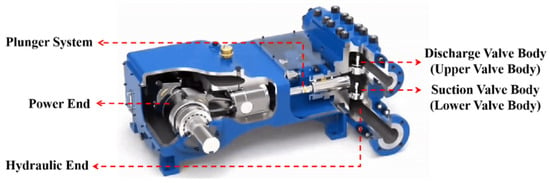
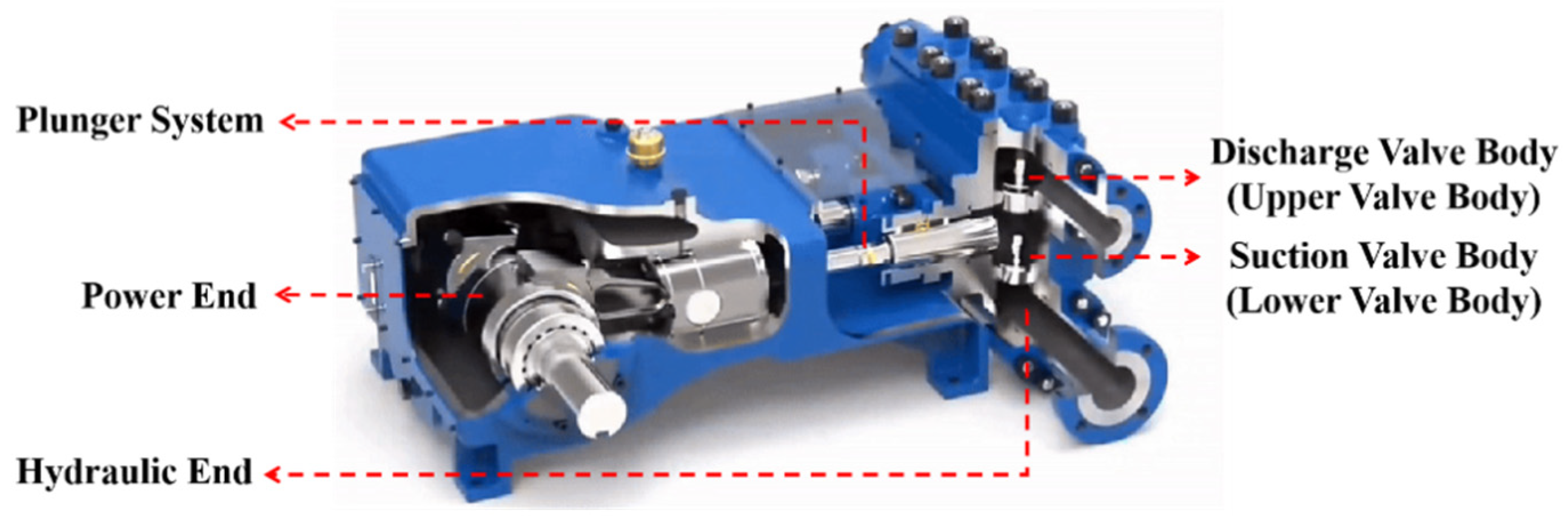
Figure 1 illustrates a typical cross-sectional structure of the hydraulic end of a fracturing truck pump. From left to right, the overall structure consists of the power end, the plunger system, and the hydraulic end. The power end contains the crankshaft and drive mechanism, which actuate the plunger to perform reciprocating motion. The plunger system, driven by the motor, propels the fluid along the flow channel.
Figure 1.
Cross-sectional schematic of the fluid end in a fracturing truck pump.
The hydraulic end serves as the core region of the pump where fluid suction and discharge take place, representing the working space of the valve body. The suction valve body (lower valve) and the discharge valve body (upper valve) are arranged on the lower and upper sides of the hydraulic end, respectively. They control the suction and discharge of fracturing fluid and, through coordination with the plunger motion, achieve unidirectional flow control. The central cylindrical passage provides the main flow path for fracturing fluid, while its periphery is enclosed by a high-pressure housing and fixed connecting components, ensuring reliable sealing, structural stability, and pressure resistance of the system.
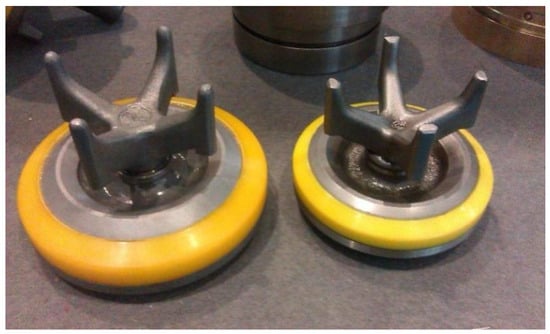
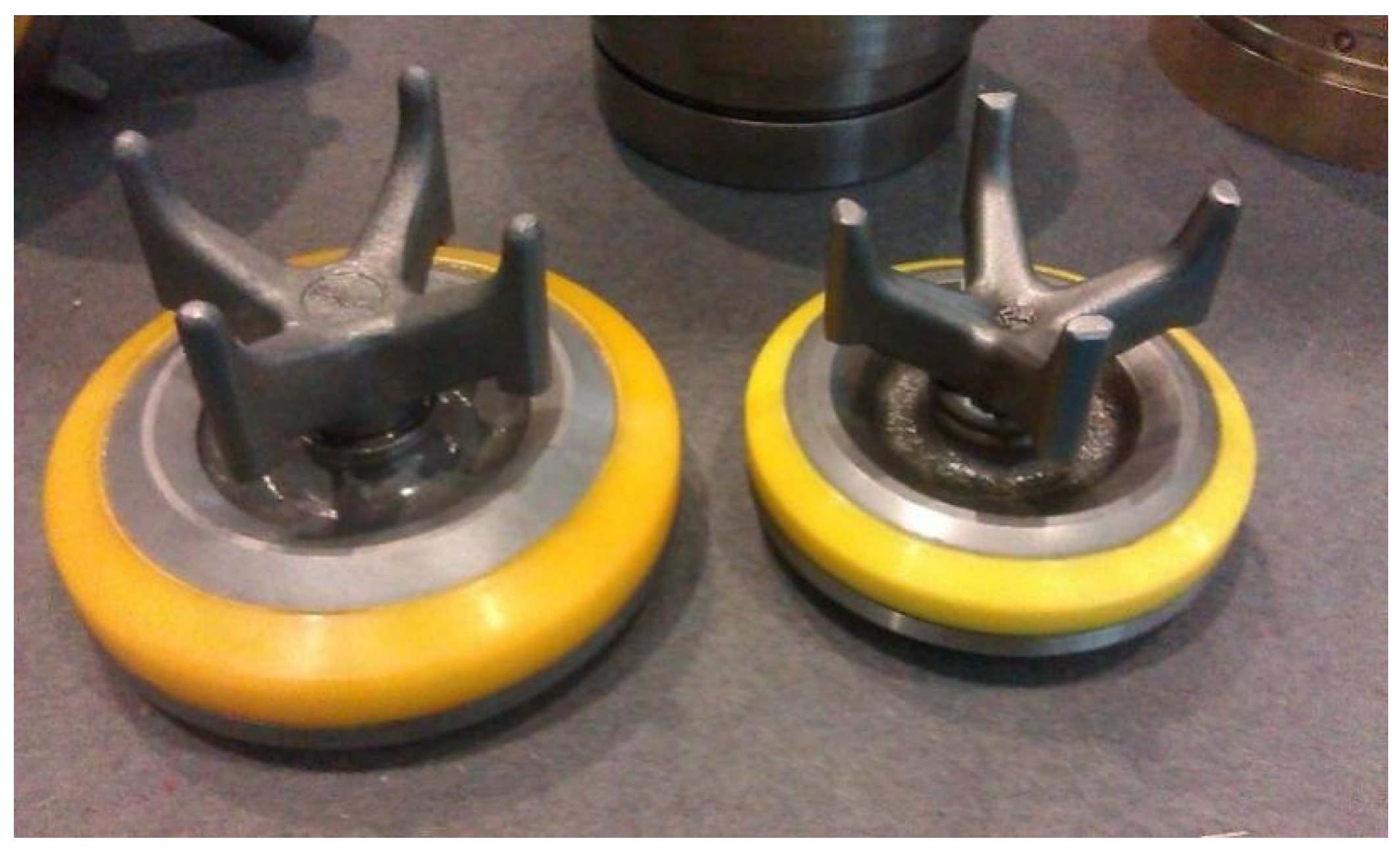
Figure 2 shows the physical photograph of the valve body assembly, which typically consists of components such as the valve seat, valve body, valve ball (or valve plate), and spring. The basic working principle is as follows: when the pump plunger moves backward, the suction pressure opens the suction valve, allowing fracturing fluid to enter the liquid cylinder; when the plunger moves forward, the suction valve closes, and the discharge valve opens under high pressure, expelling the fluid at extremely high pressure. This cyclic process enables high-frequency and high-pressure fluid delivery, thereby ensuring the continuous propagation of fractures in the formation.
Figure 2.
Photograph of the valve body.
During fracturing operations, the valve body is subjected to high-velocity impacts, frequent opening and closing, and severe vibrations, making it highly prone to fatigue wear, leakage failure, sticking, and material erosion. Once a failure occurs, it may result in reduced pump efficiency in mild cases, or lead to operation interruption and even equipment scrapping in severe cases. Therefore, real-time monitoring of the valve body’s operating condition, together with the development of effective RUL prediction models, is of great significance for ensuring the continuity and safety of fracturing operations.
2.2. Bi-LSTM Network
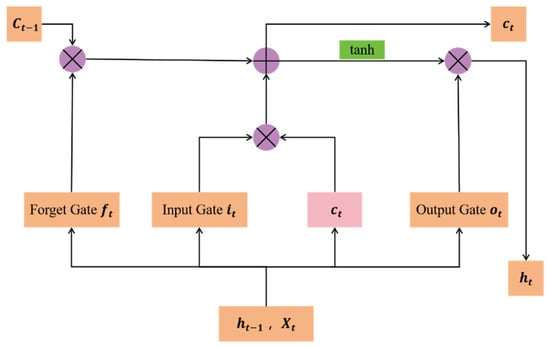
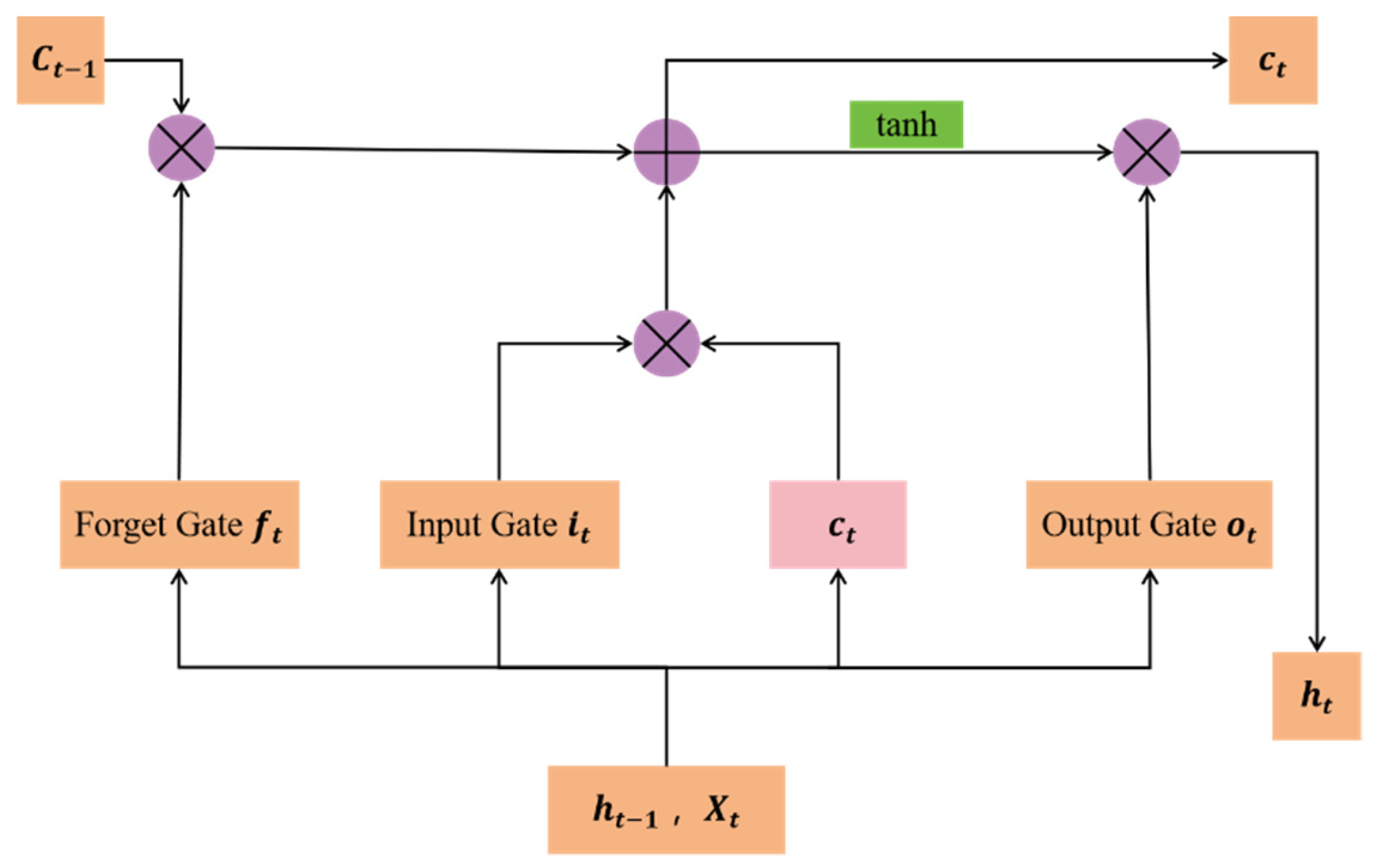
The traditional Long Short-Term Memory (LSTM) network controls the flow of information through a gating mechanism, effectively capturing long-term dependencies. Its unit structure consists of a forget gate, an input gate, and an output gate [21], as illustrated in Figure 3. Although LSTM exhibits clear advantages in mitigating the vanishing gradient problem and modeling long sequences, its structure is relatively complex, with a large number of parameters and high training costs. Moreover, due to its unidirectional information propagation mechanism, it only leverages historical data, making it difficult to fully capture the global temporal correlations within the sequence.
Figure 3.
LSTM structure diagram.
The computation formulas of the forget gate , input gate , output gate , cell state , and hidden state are as follows:
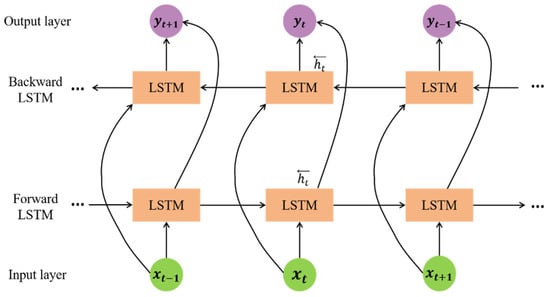
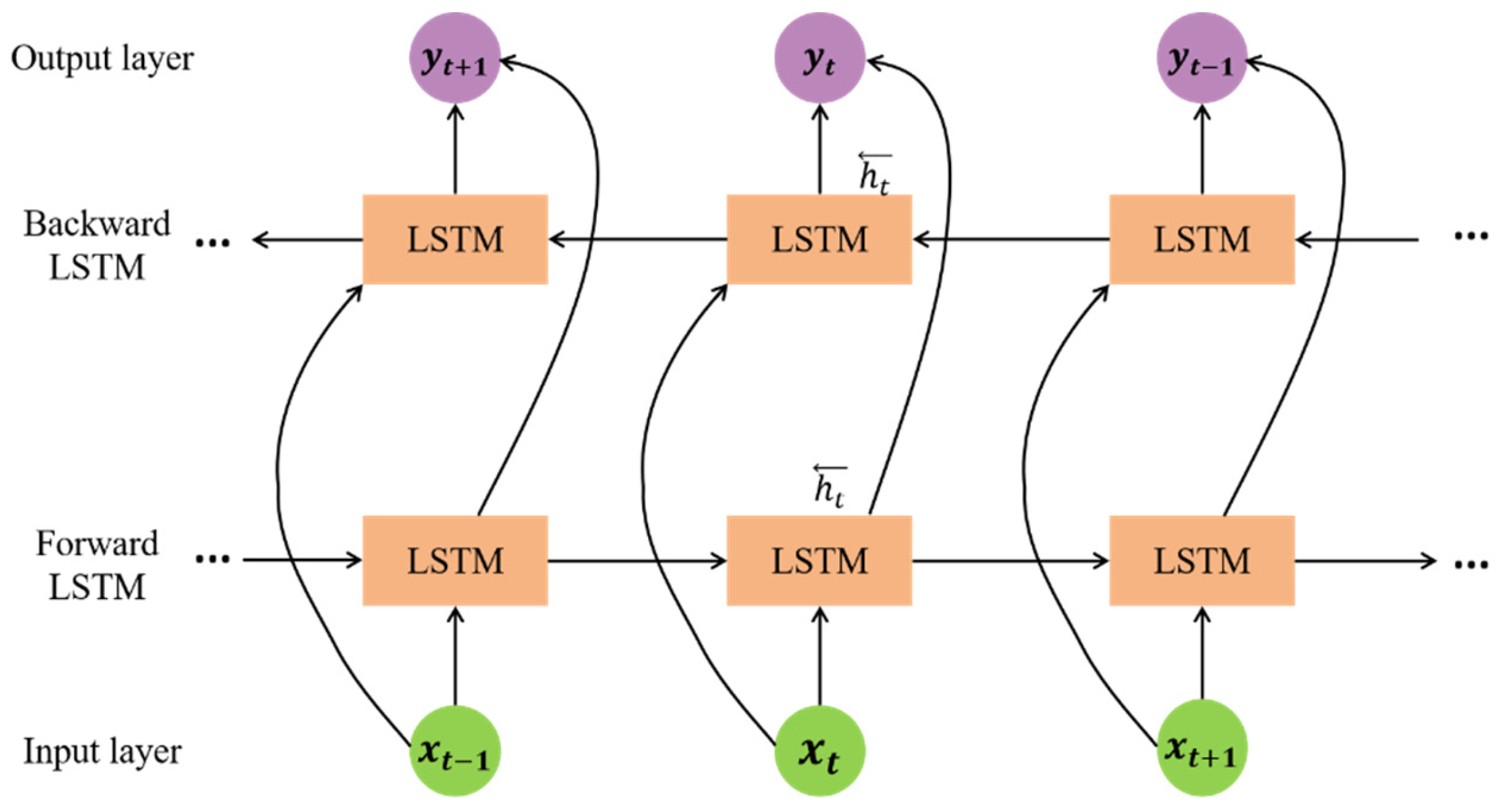
The Bidirectional Long Short-Term Memory (BiLSTM) network, based on the LSTM architecture, captures bidirectional dependencies in time series by combining the outputs of forward and backward LSTM networks, thereby improving prediction accuracy to some extent. The structure of the BiLSTM network is illustrated in Figure 4. However, BiLSTM still presents certain limitations in practical applications: its network architecture is relatively complex, leading to longer training times and higher computational costs; moreover, its performance is highly sensitive to the selection of hyperparameters such as hidden layer size, learning rate, and batch size. Different hyperparameter combinations may result in significant variations in model performance. Manual hyperparameter tuning is not only inefficient but also unlikely to guarantee a globally optimal configuration. Therefore, it is necessary to introduce efficient intelligent optimization algorithms to automatically search for the key hyperparameters of BiLSTM, thereby further enhancing prediction accuracy and model generalization capability.
Figure 4.
BiLSTM structure diagram.
2.3. Black Widow Optimization
The BWO algorithm features a simple structure, few parameters, fast convergence, and strong global search capability, enabling it to effectively avoid local optima in high-dimensional and complex search spaces. Its unique pheromone-based update mechanism maintains population diversity while preserving convergence accuracy, exhibiting excellent stability and robustness in nonlinear and multimodal optimization problems. Since the performance of the BiLSTM model is highly sensitive to hyperparameters such as learning rate and hidden layer size, and the hyperparameter space is high-dimensional, non-convex, and strongly coupled, BWO can perform effective global search in such optimization tasks, thereby providing a reliable guarantee for improving model prediction accuracy. Based on this, this study introduces BWO to optimize the key hyperparameters of BiLSTM. The specific procedure includes five stages, namely population initialization, reproduction, cannibalism, mutation, and population update, which are iteratively performed to identify the individual with the optimal fitness, achieving global optimization [22].
- Population Initialization: Each black widow spider is represented by a one-dimensional array.where i represents the dimension of the optimization sample, and each dimension is initialized with a random value. During population initialization, j black widow spiders (corresponding to the population size) are generated, resulting in a j × i times black widow matrix. The fitness of each black widow spider is evaluated using a fitness function, as shown in Equation (8).
- Reproduction: In the Black Widow Optimization algorithm, each pair of male and female black widow spiders utilizes an α array to simulate the reproduction process.where x1 and x2 represent the female and male black widow parents, respectively, while y1 and y2 denote the offspring produced during reproduction. This process is repeated i/2 times. The pheromone rate of the black widow spiders is then calculated as shown in Equation (10).where and denote the best and worst fitness values, respectively, while represents the fitness of the i-th spider. Black widow spiders with a pheromone rate less than or equal to 0.3 are defined as “hungry” spiders. When such individuals are present, they are excluded from selection, and instead a healthy black widow spider is chosen. The position update of the black widow spider is then performed as shown in Equation (11).where Xi(t) represents the position of a low-pheromone black widow spider, σ is a random binary value {0,1}, and Xr1 and Xr2 denote the positions of the r1-th and r2-th spiders, respectively, where r1 and r2 are distinct integers within the population size.
- Cannibalism: In this stage, black widow spiders with lower fitness values are eliminated by those with higher fitness values.
- Mutation: During this stage, several black widow spiders are randomly selected based on the mutation rate, and two elements within their solution arrays are exchanged at random.
- Population Update: After each iteration, the surviving black widow spiders form the initial population for the next iteration. The position update of the black widow spiders is performed as shown in Equation (12).where Xbest represents the position of the currently best-performing black widow spider, β is a random number within the range [−1, 1], m is a random number within [0.4, 0.9], Xr1(t) denotes the position of a randomly selected r1-th black widow spider, and Xi(t) is the current position of the i-th black widow spider.
3. Proposed Methodology
To achieve precise RUL prediction, this study proposes a deep RUL prediction method based on temporal evolution features, termed CB2-RUL. First, considering the complex interference components present in real-machine vibration signals, the CEEMDAN method is employed for multiscale decomposition and preprocessing of the raw signals. By extracting intrinsic mode functions (IMFs), environmental noise is effectively suppressed, and the representation of degradation-related features is enhanced, thereby significantly improving the signal-to-noise ratio and the adaptability of non-stationary signal modeling. Subsequently, the key hyperparameters of the BiLSTM model are optimized by the BWO algorithm. The optimized BiLSTM model is then employed to capture both forward and backward temporal dependencies in the vibration signals, enabling comprehensive learning of the health evolution patterns of the valve body. By integrating signal enhancement with deep temporal modeling, CB2-RUL effectively addresses the complex fluctuations in the valve body and achieves high-precision RUL prediction.
In this chapter, the overall architecture and key components of the CB2-RUL prediction method are systematically presented. For clarity, Section 3.1 first introduces the overall architecture, followed by a detailed description of each component.
3.1. Flowchart of Proposed Method
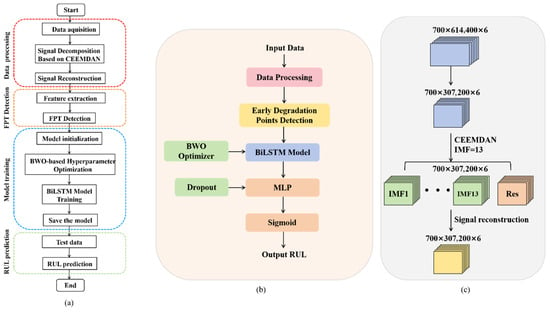
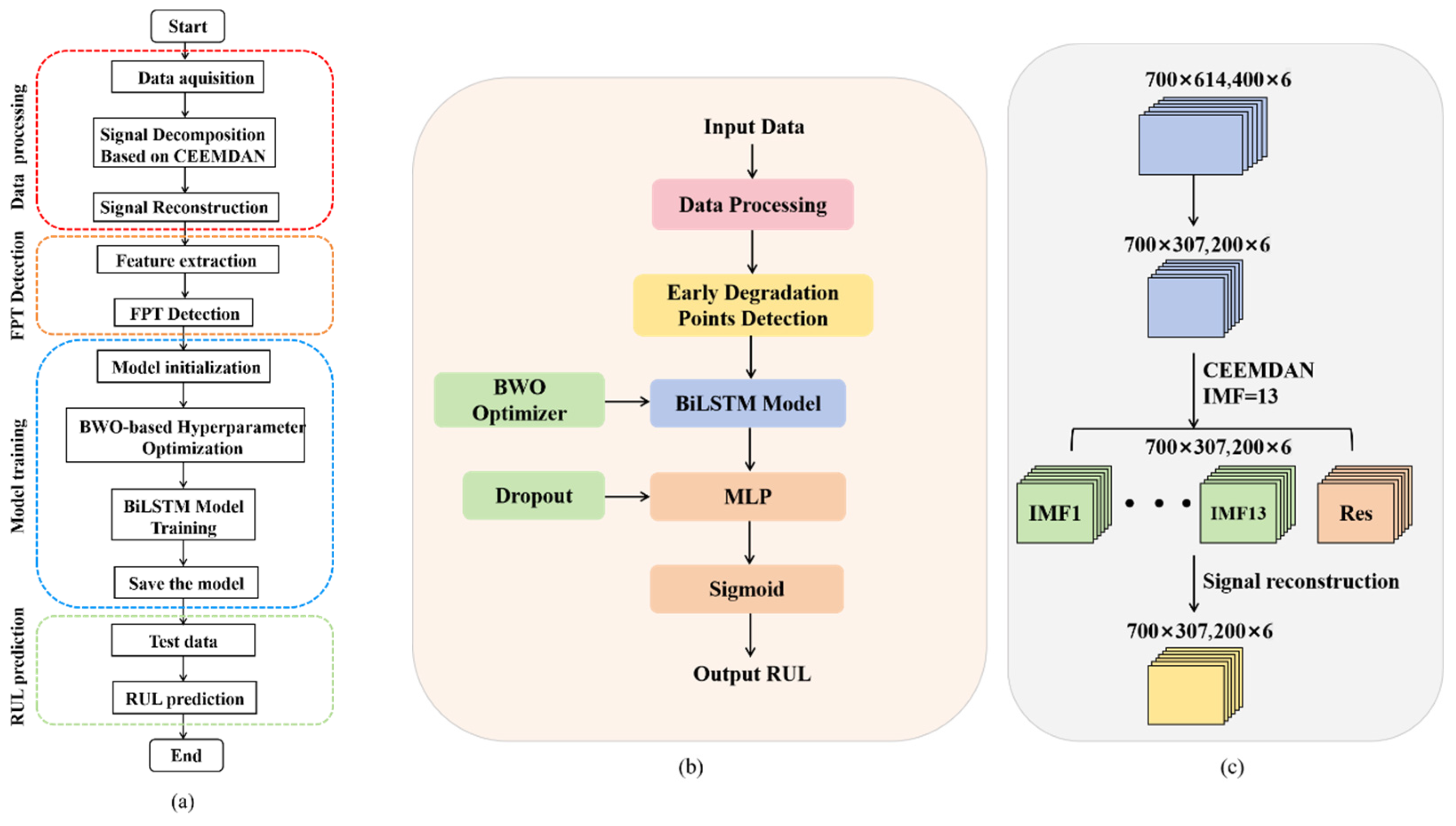
Considering the operational characteristics of the valve body in fracturing pump trucks, this study proposes the CB2-RUL prediction method, whose overall architecture and components are illustrated in Figure 5. The proposed model consists of the following four core modules:
Figure 5.
Overall architecture of our proposed method and its components. (a) Flowchart of the proposed method. (b) Architecture of the proposed model. (c) Data processing block.
- (1)
- Signal Preprocessing Module: The raw vibration signals are first processed using the CEEMDAN algorithm to achieve signal stabilization and feature enhancement. Intrinsic mode functions (IMFs) with strong correlation to the original signals are then selected based on the Pearson correlation coefficient and reconstructed together with the residual components, effectively suppressing noise interference while preserving key degradation features.
- (2)
- Early Degradation Point Detection Module: Early performance degradation points of the equipment are detected by constructing health indicators and applying threshold-based criteria.
- (3)
- BWO-BiLSTM Module: A deep temporal modeling framework based on BiLSTM is established, and the BWO algorithm is introduced to perform intelligent hyperparameter search and adaptation.
- (4)
- Training and Evaluation Module: After obtaining the optimal hyperparameters, the BiLSTM model is trained, and its RUL prediction performance is systematically evaluated using multiple performance metrics.
3.2. Signal Preprocessing Module
In this study, in order to effectively extract features from the raw vibration signals that are valuable for lifetime prediction, we first apply the Complete Ensemble Empirical Mode Decomposition with Adaptive Noise (CEEMDAN) method to decompose each sample signal into a set of intrinsic mode functions (IMFs) and a residual component [23]. Each IMF exhibits distinct vibration characteristics in the time–frequency domain: high-frequency components mainly reflect local impact information, low-frequency components capture the long-term trend of the signal, and the residual represents the overall trend part of the signal [24]. For the original sequence x(t), the decomposition procedure is as follows:
- (1)
- Gaussian white noise is added N times to the original sequence, generating N different sequences , which is expressed as the following:
- (2)
- Each sequence is individually decomposed using EMD, yielding NNN intrinsic mode functions . The first intrinsic mode function of the CEEMDAN decomposition, denoted as , is obtained by averaging these NNN IMFs, as shown in Equation (14).
- (3)
- By subtracting from the original sequence , the first residual is obtained. Treating as the new input sequence, steps (1) and (2) are repeated to obtain the second intrinsic mode function of the CEEMDAN decomposition.
- (4)
- Repeat step (3) until the residual becomes a monotonic function, at which point the algorithm terminates. Consequently, the original sequence is decomposed into k intrinsic mode functions (IMFs) and a final residual , as shown in Equation (15).
To select the components that exhibit strong correlation with the original signal, this study computes the Pearson correlation coefficient between each IMF component and the original signal:
where denotes the k-th intrinsic mode function, X represents the original signal, denotes the standard deviation, and Cov represents the covariance. By calculating the Pearson correlation coefficient between each IMF and the original signal, the linear correlation between the components and the original signal can be evaluated, thereby enabling the selection of components that are more representative for lifetime prediction.
Subsequently, the IMF components with the highest absolute Pearson correlation values are selected for signal reconstruction. In this study, the number of selected IMFs is determined based on the cumulative correlation contribution criterion—that is, IMFs are included in descending order of correlation until the cumulative sum of their absolute correlation coefficients exceeds 85% of the total. Under the experimental conditions of this study, the first three IMFs satisfy this criterion and thus are used for reconstruction. The reconstructed signal preserves the main trend information and key vibration characteristics of the original signal, thus providing more effective input data for feature extraction in the subsequent lifetime prediction model. Compared with directly using all IMFs or the raw signal, the reconstructed signal obtained through component selection effectively suppresses noise interference while retaining dynamic information useful for lifetime prediction, thereby improving the accuracy and stability of the prediction model.
In addition, the reconstructed vibration signals serve as the input for the Early Degeneration Points Detection Module, providing denoised and feature-enhanced time-series data for accurate health indicator construction.
3.3. Early Degeneration Points Detection Module
This study employs an automated detection method for early degradation points based on root mean square (RMS) health indicators and statistical threshold determination. This approach differs from the conventional Fault Occurrence Time (FOT). FOT typically denotes the actual time point when equipment failure occurs, whereas the degradation point defined herein represents the moment when the health indicator first exhibits sustained abnormal fluctuations. This point occurs earlier than FOT and is more suitable for automatic extraction of degradation-phase data and model initialization in RUL prediction tasks. The specific implementation steps are as follows:
- (1)
- Health Indicator Calculation
Time-domain feature extraction methods are employed to calculate the root mean square (RMS) value of vibration signals, serving as a key indicator for characterizing equipment health status. The RMS value is sensitive to changes in signal energy and effectively reflects the degradation trend of equipment performance. Its calculation formula is as follows:
where represents the i-th sample point of the vibration signal, and N denotes the sample length.
- (2)
- Threshold Determination
This paper employs a sliding standard deviation mechanism to select the length l of the healthy phase. By performing sliding variance analysis on the RMS metric sequence, the equipment is deemed to have entered the degradation phase when volatility first significantly increases. The preceding segment is defined as the healthy segment, and its length l is automatically obtained for subsequent statistical modeling and threshold setting. This method requires no manual intervention and exhibits good generalization and engineering practicality. Subsequently, the first l sample points are treated as the statistical baseline for the device’s healthy operating phase RMS values, from which the mean (μ) and standard deviation (σ) are calculated. Under the assumption of a normal distribution, the health threshold is set as follows:
This threshold not only accounts for inherent fluctuations during normal operation but also effectively identifies early degradation risks associated with abnormal increases in health indicators.
- (3)
- Degeneration Point Detection
To enhance detection accuracy, this study employs the Savol filter algorithm to smooth the raw RMS sequence, eliminating interference from short-term high-frequency fluctuations. Subsequently, the entire RMS indicator sequence is examined to identify the first instance where the value exceeds the health threshold, defining this point as the First Point of Degeneration (FPT).
The detected degradation points and corresponding RUL labels are then passed to the BWO-BiLSTM Module, serving as supervisory signals for model training and performance evaluation.
3.4. BWO-BiLSTM Model
This paper introduces the BWO algorithm to optimize key hyperparameters of the BiLSTM network, including the number of LSTM layers, the number of nodes in the hidden layer, and the learning rate. The entire optimization process is as follows:
- (1)
- Initialize Population and Parameter Settings
Initialize Black Widow population individuals and set the maximum iteration count. Construct the two-layer BiLSTM network architecture and define the search space for optimizing hyperparameters: hidden layer node count, learning rate, and LSTM layer count. Simultaneously, use the RMSE of the BiLSTM model on the training set as the fitness function to evaluate individual performance.
- (2)
- Fitness Calculation and Population Initialization
Input training data into the BiLSTM model to perform initial fitness evaluation of population individuals, calculating the RMSE value corresponding to each Black Widow individual’s BiLSTM model.
- (3)
- Position Update and Pheromone Adjustment Mechanism
Based on the evolutionary mechanism of the BWO algorithm, the positions of the black widow population are updated. By calculating pheromone levels, individuals with low fitness are guided toward those with high fitness. Positions are dynamically updated, and fitness values are reassessed. If a new solution is found to be superior to the current optimal solution, the optimal individual is updated.
- (4)
- Termination Criteria and Output of Optimal Solution
Determine whether the current iteration count has reached the preset maximum iteration limit. If reached, terminate the optimization process and output the current globally optimal hyperparameter combination. If not reached, return to Step 2 to continue the optimization iteration.
The BWO-BiLSTM model integrates the reconstructed vibration signals and degradation labels from the preceding modules, forming integrated data-driven framework for valve body RUL estimation.
In summary, the proposed CB2-RUL method establishes an integrated and systematic framework for the Remaining Useful Life prediction of valve bodies in fracturing pumps. By combining adaptive signal decomposition, automated degradation point detection, and optimization-driven deep temporal modeling, the method effectively bridges the gap between signal-level feature enhancement and high-level lifetime prediction. Specifically, CEEMDAN is utilized to achieve multiscale noise suppression and feature enrichment, while the statistical-based detection mechanism enables the automatic identification of early degradation phases, providing reliable supervisory information for model training. The BWO-optimized BiLSTM model further captures the bidirectional temporal dependencies of vibration signals, leading to improved robustness and precision under complex working conditions. Overall, the proposed CB2-RUL framework offers a unified, data-driven approach that enhances prediction stability, interpretability, and practical applicability for real-world maintenance and reliability optimization of fracturing equipment.
4. Experiments
To validate the effectiveness of this method in predicting the service life of valve components in fracturing trucks, this study conducted experiments based on actual vibration data collected from fracturing trucks operating in the Yancheng shale formation.
4.1. Data Construction
In the field of engineering equipment lifecycle prediction research, publicly available datasets are extremely scarce, which has to some extent constrained progress in this area. To address this gap, we collected operational data from a fracturing unit throughout its entire lifecycle, constructing a real-world unit dataset named VB-Lifecycle. Specifically, the VB-Lifecycle dataset was acquired during shale fracturing operations in Yancheng from 19 to 23 July 2024. Continuous monitoring at a high sampling frequency of 10.24 kHz yielded approximately 31 h of total data collection, with actual equipment operating time (non-zero rotational speed) spanning roughly 700 min. This comprehensively covers the entire process from initial component break-in and stable operation to performance degradation.
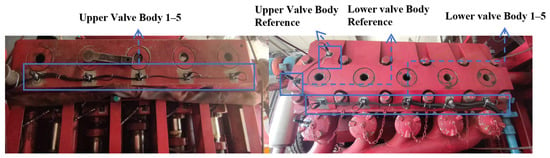
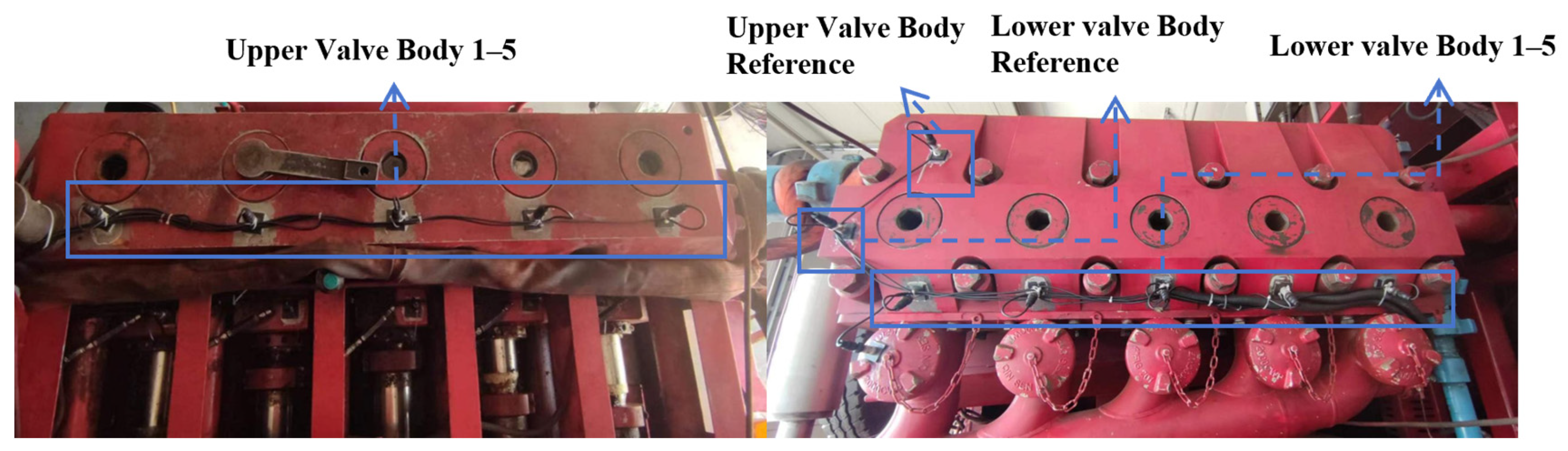
To comprehensively monitor the vibration status of critical fracturing pump components, 12 accelerometers were deployed to record the operating conditions of the valve body. Based on their mounting locations, sensors were categorized into upper valve body and lower valve body groups, each comprising five primary monitoring points and one reference point. The physical installation layout is shown in Figure 6, with detailed point configurations listed in Table 1.
Figure 6.
Sensor Installation Location Diagram.
Table 1.
Survey Point Layout Table.
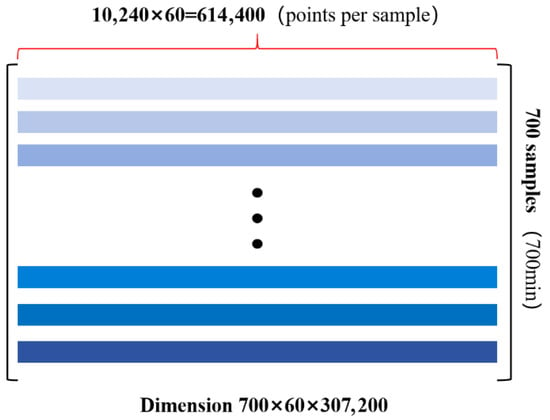
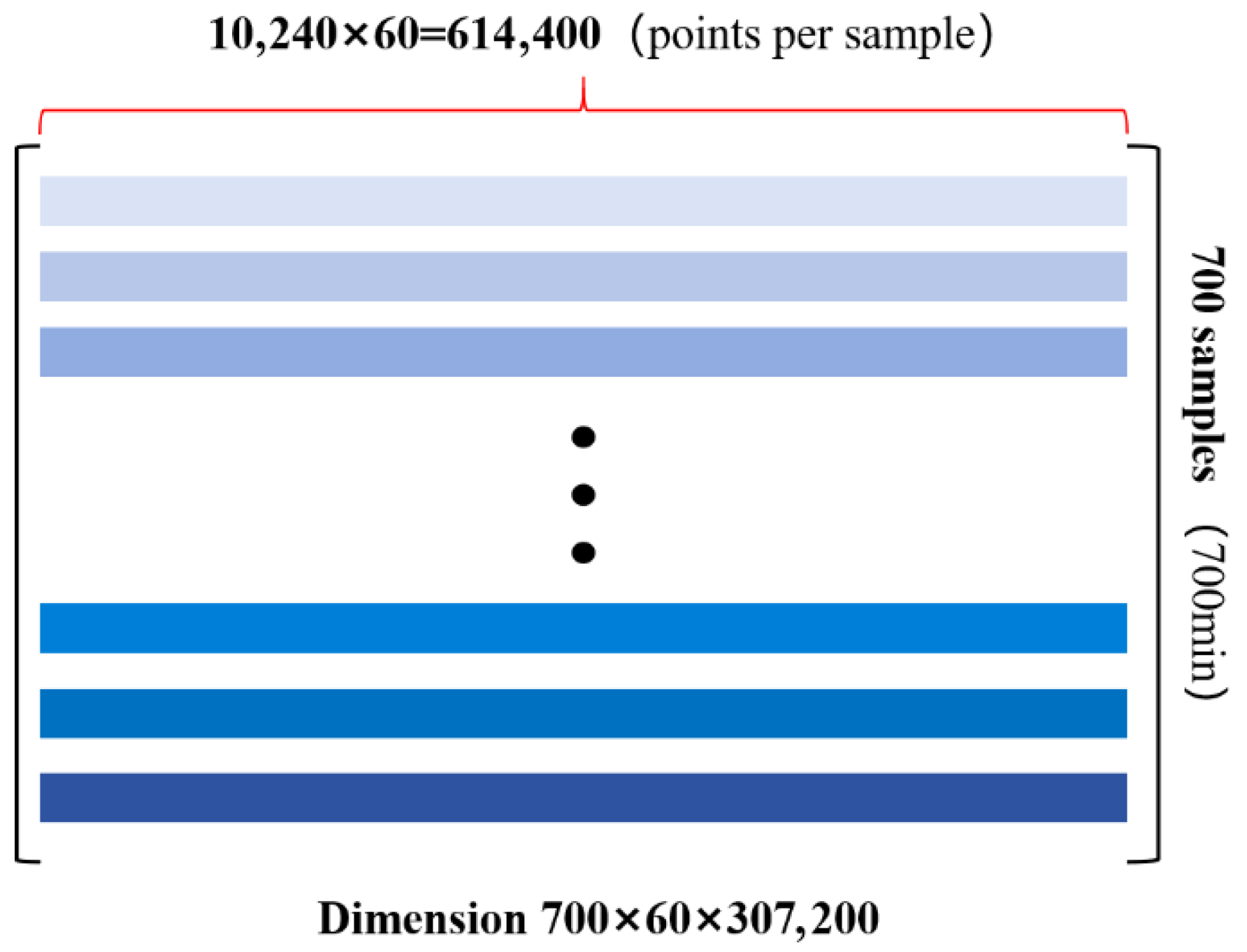
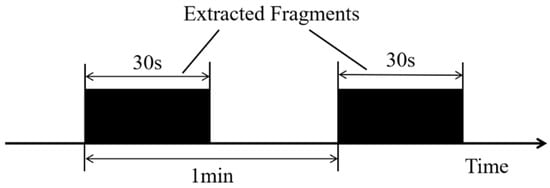
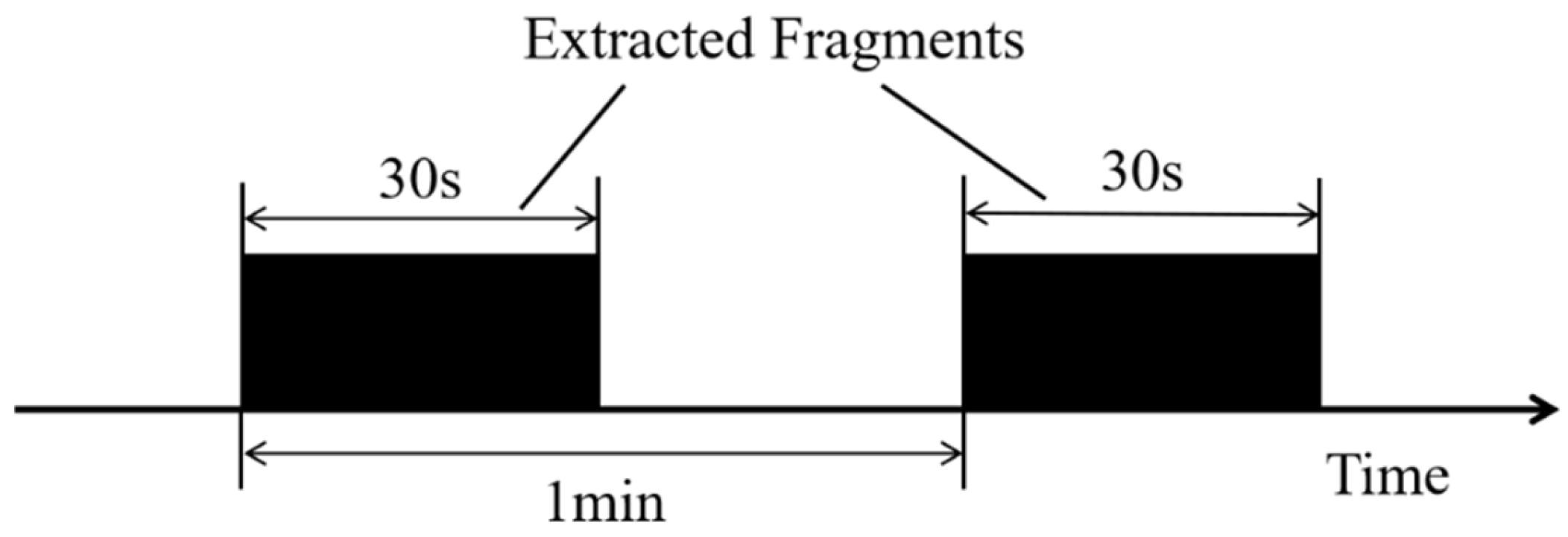
During data acquisition, the sensor sampling rate is 10,240 samples per second. Consequently, each accelerometer yields a time series of 10,240 × 60 × 700 data points, corresponding to the entire operational cycle of a single valve body—from initial break-in to performance degradation. We then segmented this 10,240 × 60 × 700 sequence into minute-based units, yielding 700 time series corresponding to 700 min of continuous equipment operation. Figure 7 illustrates the schematic representation of data collected from a single valve body. To manage computational complexity, we do not sample at the minute level but instead extract 30 s segments from each minute’s data as individual samples. The specific data extraction process is shown in Figure 8.
Figure 7.
Schematic Diagram of Data Capture.
Figure 8.
Mat Format Data Organization Diagram.
During actual data collection, we gathered data from 12 valve bodies. Considering the independence between valve bodies, each set of data was processed separately, resulting in 12 distinct datasets. Consequently, VB-Lifecycle comprises 12 datasets, each containing 700 samples. Each sample represents a 10,240 × 30 data segment. VB-Lifecycle is stored in MAT format. All subsequent experiments utilize this dataset.
4.2. Data Processing
In this section, to ensure the life prediction model receives more stable and representative inputs, we perform decomposition, feature selection, degradation point detection, and label construction on the raw vibration signal.
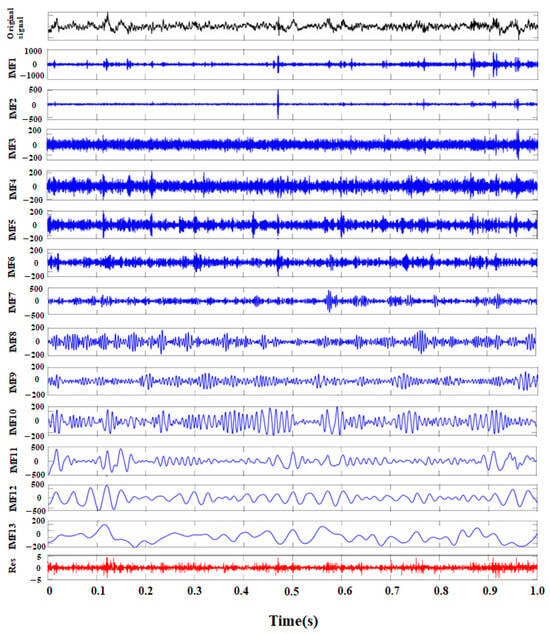
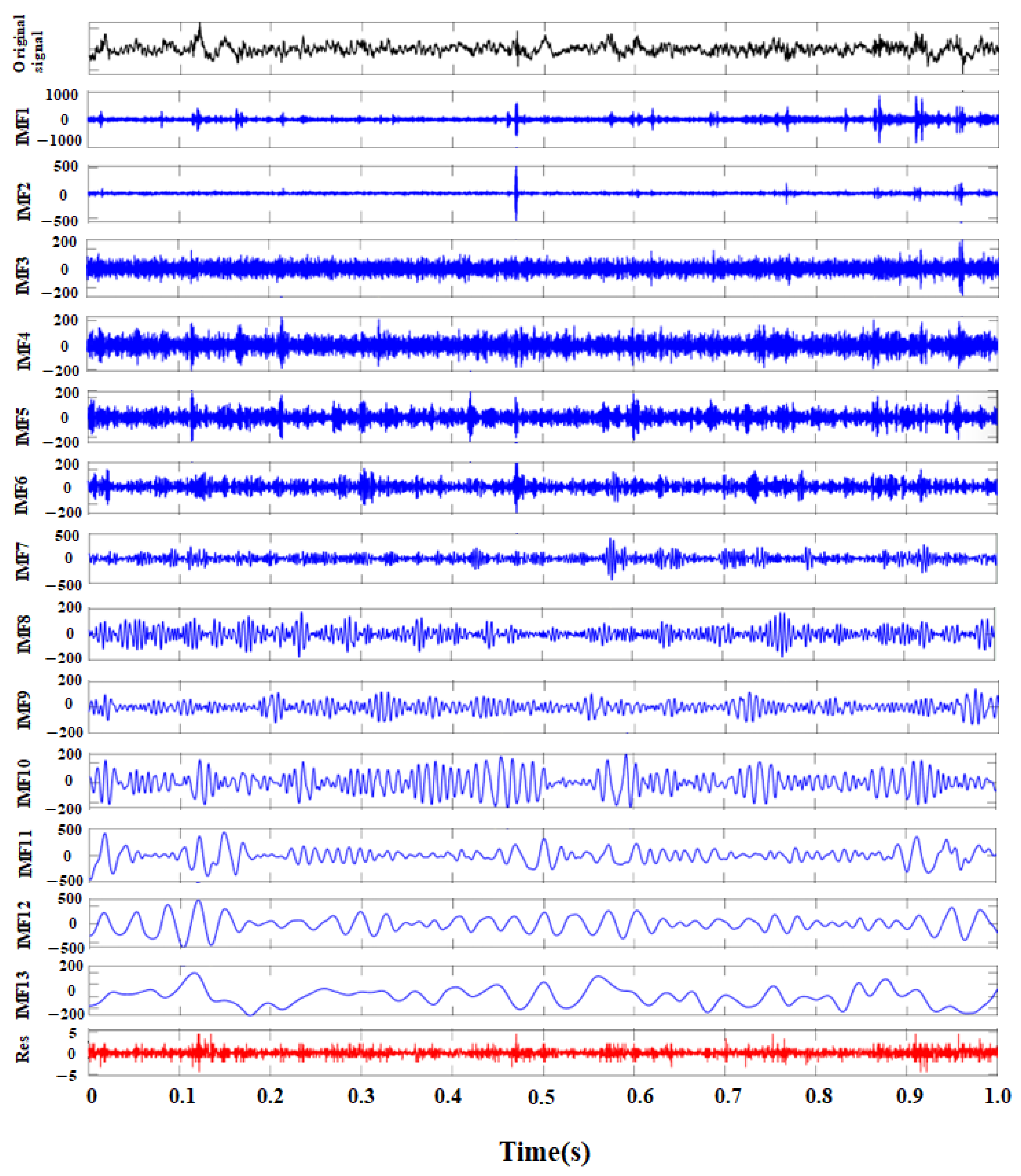
Taking a single 1 s segment as an example, the decomposition results are shown in Figure 9. The original signal is decomposed into 13 IMF components and a residual term. It can be observed that high-frequency impact components are primarily concentrated in the first three IMF components, while mid-to-low-frequency components gradually exhibit periodic and trend characteristics. The residual term reflects the overall degradation trend.
Figure 9.
CEEMDAN Decomposition Results.
Subsequently, we calculated the Pearson correlation coefficients between each IMF component and the original signal to quantitatively assess the importance of these components. As shown in Table 2, IMF9, IMF11, and IMF12 exhibit high correlations with the original signal, indicating that these components largely preserve the key features of the original signal.
Table 2.
Pearson Correlation Coefficients Between IMF Components and the Original Signal.
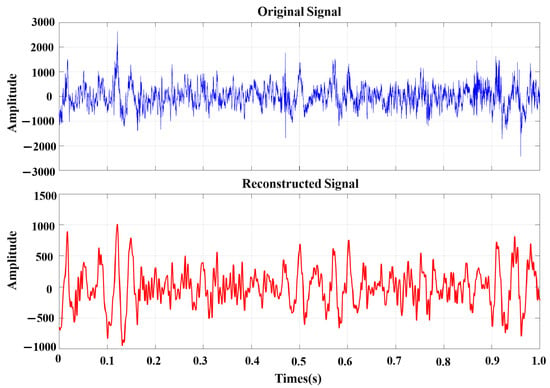
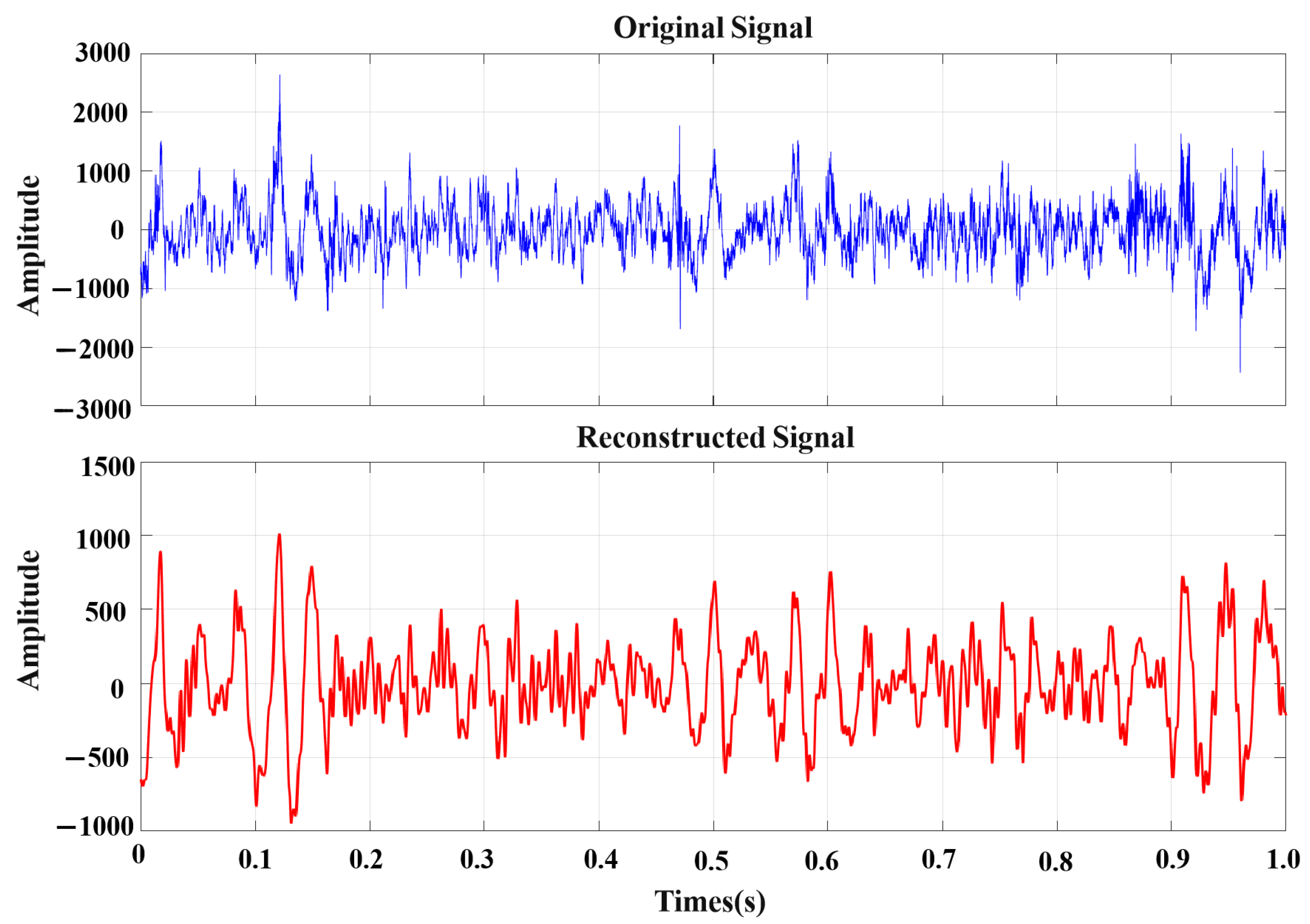
Based on this analysis, we selected the top three IMF components ranked by Pearson correlation coefficient for signal reconstruction, aiming to preserve key features while suppressing noise. Figure 10 compares the original signal with the reconstructed signal, demonstrating that the reconstructed signal effectively filters out high-frequency noise while retaining the primary trend and impact characteristics. This preprocessing method ensures the stability and representativeness of input features, providing more reliable training data for subsequent life prediction models.
Figure 10.
Comparison of Raw and Reconstructed Signals.
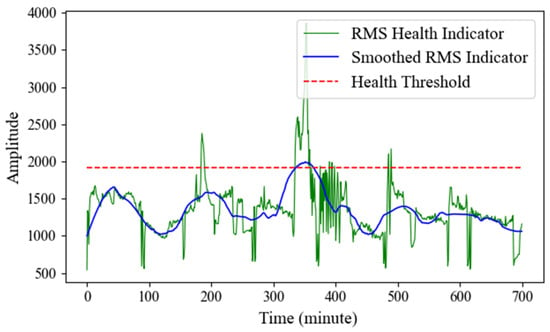
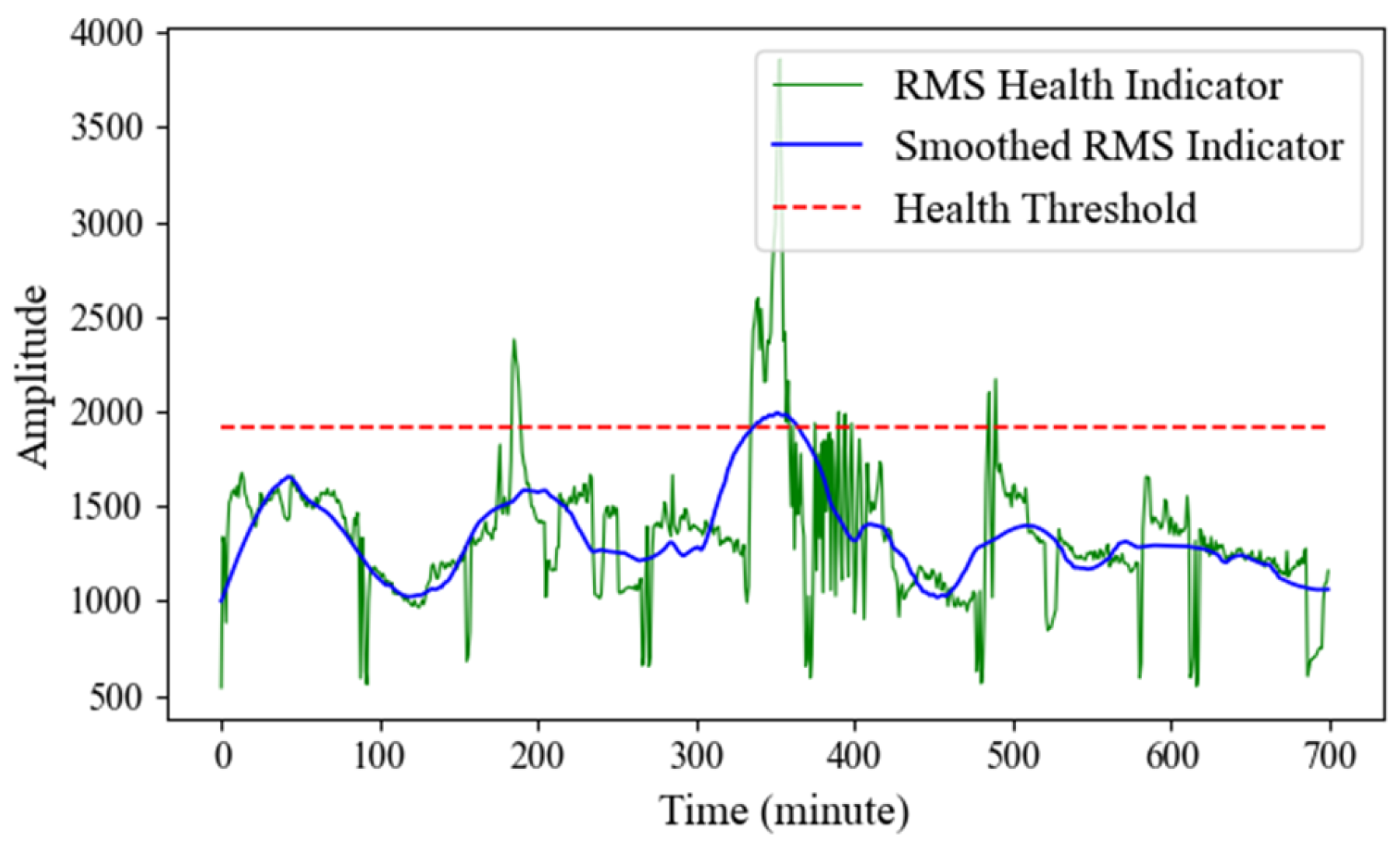
The sample’s lifespan prediction label is constructed based on early failure points. To this end, we employed the method described in Section 3.3 to detect early failure points for Upper Valve 1–5 and Lower Valve 1–5. The early failure points for the ten valves are shown in Table 3. Since the control group does not involve lifespan prediction for specific individual valves, its FPT was not detected separately. Figure 11 illustrates the detection of early degradation points for Upper Valve 1. The figure shows that the RMS value for Upper Valve 1 exceeded the health threshold around 180 min, with the specific value indicating an early degradation point at 184 min.
Table 3.
Early Degeneration Points in the Verger Type.
Figure 11.
Schematic diagram of early degradation point detection for Upper Valve Body 1.
Subsequently, we define the RUL supervisory labels using a piecewise normalization approach, with the early degradation point as the starting reference. Specifically, prior to the early degradation point, the equipment is considered to be in a fully healthy state, and the RUL labels of all samples are uniformly set to 1. Beginning from the early degradation point (FPT, First Prediction Time), the RUL labels gradually decrease and are linearly normalized to 0, indicating the end of the equipment’s lifetime. For the i-th sample of the j-th valve body, the RUL label is defined as follows:
Among these, FPTj represents the early degradation point of the j-th Veret body, and N denotes the total number of samples taken over the entire lifecycle of the j-th Veret body, i.e., N = 700.
4.3. Experimental Setting
- (1)
- Experimental Parameters
This paper employs BWO to optimize three critical hyperparameters of the BiLSTM: the number of LSTM layers, the number of hidden layer nodes, and the learning rate. Their optimization ranges are [2, 4], [16, 64], and [0.0005, 0.001], respectively. The optimized BiLSTM model parameters are shown in Table 4. Specifically, the LSTM has 2 layers, 95 hidden layer nodes, and a learning rate of 0.000205. Additionally, the LSTM employs the Sigmoid activation function. During model training, the Dropout rate is set to 0.5, the batch size is 128, and the loss function is Mean Squared Error (MSE).
Table 4.
Key Parameter Configuration of the Model.
- (2)
- Evaluation Metrics
To evaluate the performance of the proposed method, three evaluation metrics are employed: Root Mean Square Error (RMSE), Mean Absolute Error (MAE), and the average Score. A lower value of RMSE and MAE, together with a higher Score, indicates better prediction performance of the model.
where denotes the predicted value of the i-th sample, and represents the corresponding RUL label. The relative error is defined as , which represents the percentage of deviation between and . A positive indicates that the model predicts a longer remaining useful life than the actual value, corresponding to a lagging prediction, which may lead to a delayed replacement of the valve body. Conversely, a negative indicates that the predicted RUL is shorter than the actual RUL, corresponding to an early prediction, which may cause certain resource waste.
- (3)
- Baseline Methods
To comprehensively evaluate the effectiveness of the proposed CB2-RUL method, it is compared with four representative deep learning models. For a fair comparison, all models are trained and tested using vibration signals preprocessed by the same CEEMDAN method to ensure consistent input quality and feature representation. LSTM captures long-term temporal dependencies in sequential data through gated recurrent units, enabling effective modeling of time-series degradation patterns. BiLSTM processes sequences in both forward and backward directions, leveraging contextual information from the entire sequence to improve prediction accuracy. CNN-BiLSTM first extracts local spatial features from vibration signals using convolutional layers, and then captures temporal dependencies via BiLSTM layers.
4.4. RUL Prediction Results of Valve Bodies
To systematically evaluate the robustness and generalization capability of the model under different operating conditions, this study employs a six-fold cross-validation strategy for experimental design. Specifically, five full-lifetime datasets from the training set are randomly selected as the training set each time, while the remaining one dataset serves as the validation set. This process is repeated for five rounds (excluding the control group from testing), ensuring each sample undergoes one validation cycle. This approach effectively prevents model overfitting to specific operating conditions, enhancing the robustness and reliability of experimental results.
Experimental results are presented in Table 5 and Table 6, where Table 5 shows test results for the upper valve body and Table 6 shows results for the lower valve body. It can be observed that the proposed CB2-RUL method demonstrates superior performance across different valve body lifetime prediction tasks.
Table 5.
Comparison of Remaining Useful Life Prediction Performance for Upper Valve Bodies Using Different Deep Learning Models.
Table 6.
Comparison of Remaining Useful Life Prediction Performance for Lower Valve Bodies Using Different Deep Learning Models.
Compared to pure LSTM and BiLSTM, the CB2-RUL method achieves significant reductions in RMSE and MAE metrics, demonstrating markedly improved prediction accuracy. This indicates that signal smoothing and feature enhancement via CEEMDAN effectively mitigates the non-stationarity of raw vibration signals, enhancing the model’s ability to learn degraded features.
Compared to CNN-BiLSTM, CB2-RUL achieves lower errors and higher PHM Scores in most experiments. This indicates that, relative to local features extracted by convolutional layers, the BWO-optimized BiLSTM is better suited for modeling long-term dependencies and adapting hyperparameters to handle the complex degradation patterns of valve bodies.
Overall, CB2-RUL maintains high scores across all experiments, validating its robustness and generalization capability under diverse operating conditions.
To evaluate the robustness of our results, we conducted statistical significance analysis on the Upper Valve Body Group using the PHM Score as the evaluation metric. For each of the five valve bodies, experiments were repeated with five different random seeds to compute the 95% confidence intervals. The results are summarized in Table 7. One can see that the confidence intervals for each valve body are very narrow, indicating that the model’s predictive performance is both stable and reliable.
Table 7.
PHM Scores with 95% confidence intervals for the Upper Valve Body Group.
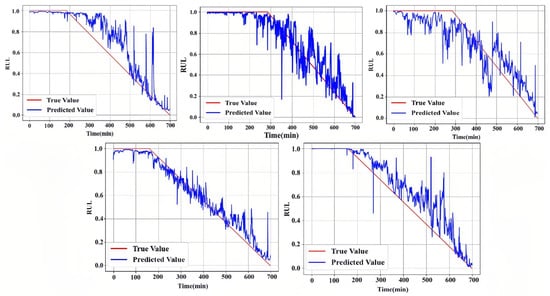
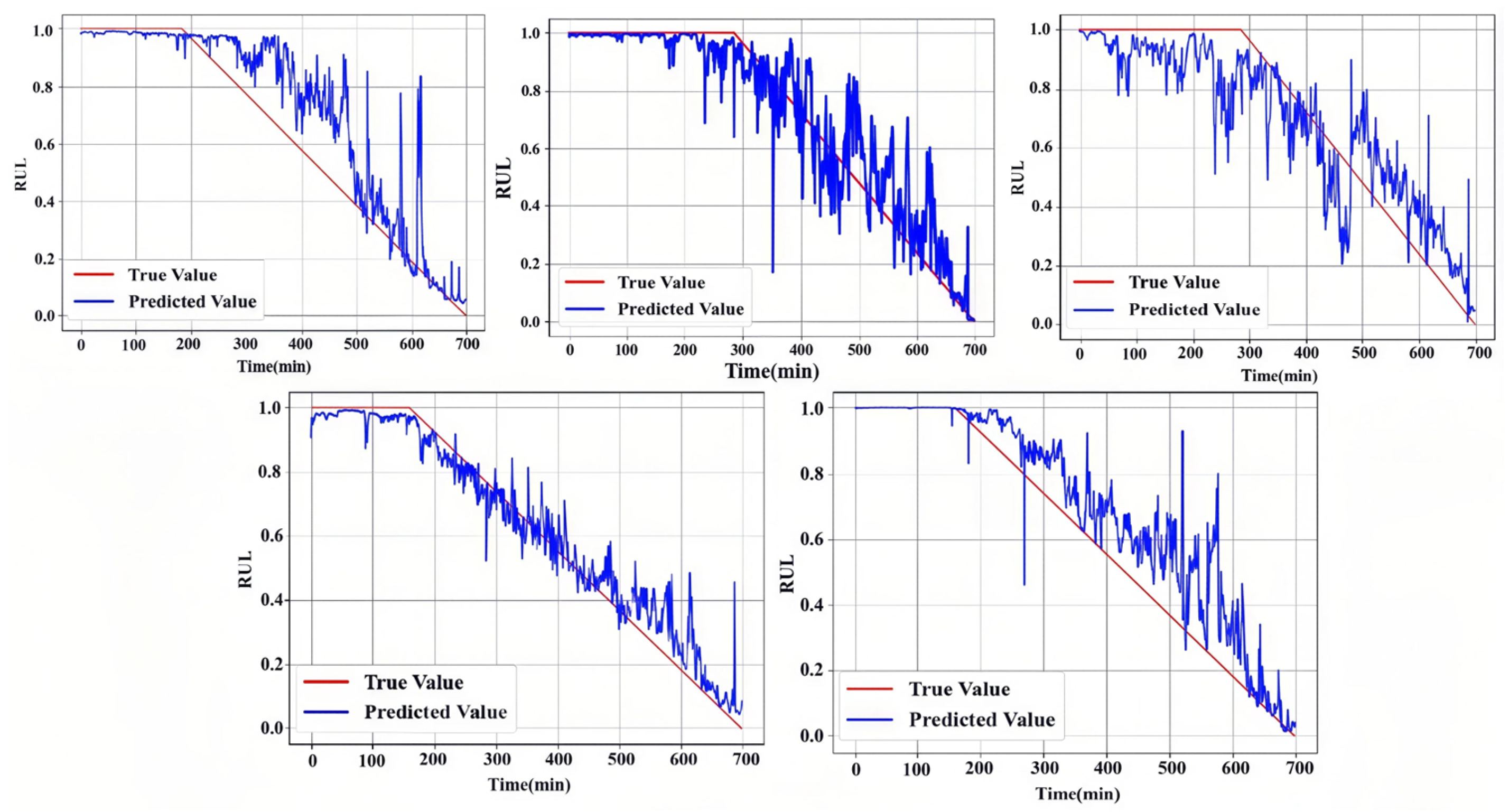
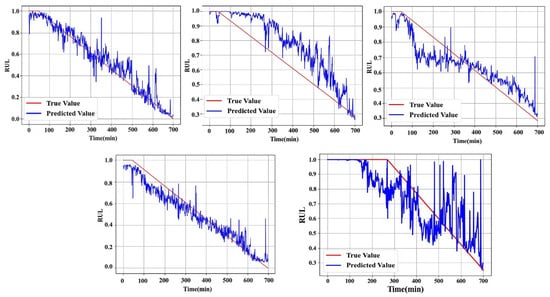
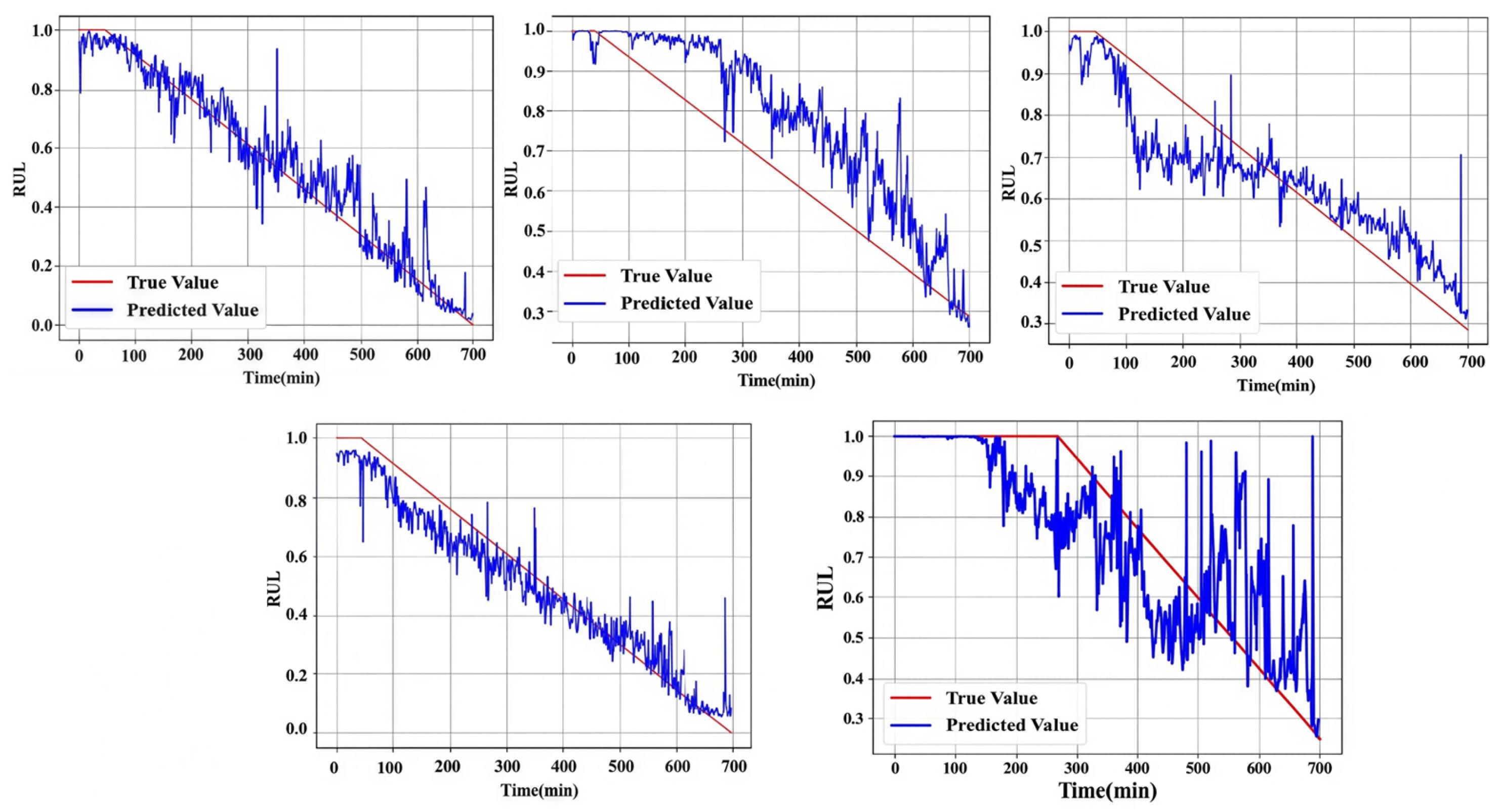
To further evaluate the prediction performance of the model, the RUL prediction curves of the valve bodies were visualized, as shown in Figure 12 and Figure 13. It can be observed that the CB2-RUL prediction curves closely match the true RUL trajectories, effectively capturing the overall trend of lifespan evolution. Notably, after the early degradation point, the predicted curves smoothly follow the actual degradation path, avoiding both excessive early predictions that may lead to resource waste and lagging predictions that could result in delayed maintenance. Compared with other baseline methods, the CB2-RUL curves exhibit smaller fluctuations and greater stability, indicating a stronger adaptability in handling local signal noise and short-term variations. Furthermore, one can find that the proposed model closely follows the ground-truth RUL in the late-life stage, exhibiting reduced deviation and stable behavior as failure approaches. No noticeable divergence or abrupt oscillations are observed near the end of life.
Figure 12.
Prediction curve of the Upper Valve Bodies.
Figure 13.
Prediction curve of the Lower Valve Bodies.
The predictive behavior of our method can be interpreted from both the signal and temporal perspectives. At the signal level, CEEMDAN decomposes the raw vibration signals into intrinsic mode functions (IMFs) with distinct physical meanings. High-frequency IMFs mainly capture impact-related components associated with valve opening and closing, while mid- and low-frequency IMFs reflect cumulative wear, clearance variation, and long-term degradation trends. By selecting IMFs with high correlation to the original signal and reconstructing the signal, the model can adaptively focus on components that are most relevant to degradation. At the temporal level, the BWO-optimized BiLSTM learns the evolution patterns of these reconstructed signals across the entire lifecycle. In particular, the model emphasizes the sustained trend changes and degradation acceleration after the early degradation point, rather than isolated fluctuations. This enables effective characterization of late-life degradation behavior, where long-term temporal dependencies are more informative for RUL estimation.
4.5. Sensitivity Analysis of Early Degeneration Points
In practical applications, accurately identifying the early degradation onset is often challenging. To evaluate the robustness of the proposed method to such uncertainty, a sensitivity analysis was conducted by artificially perturbing the detected early degradation point (FPT). To ensure a representative evaluation, four valve bodies with different degradation characteristics were selected for the sensitivity analysis. Specifically, the original FPT for each sample was shifted forward and backward by ±5% and ±10% of the total lifecycle length, resulting in five degradation onset scenarios. For each scenario, RUL labels were reconstructed following the same labeling strategy described in Section 4.2, while all other preprocessing steps and model configurations were kept unchanged.
The proposed model was retrained and evaluated under each perturbation condition using RMSE and MAE as evaluation metrics. The results are summarized in Table 8. As shown, the variations in prediction performance across different onset perturbations are limited, and the overall RUL prediction trends remain stable. These results indicate that the proposed method does not overly rely on a precisely determined degradation onset point and demonstrates strong robustness against moderate onset uncertainty.
Table 8.
Sensitivity analysis of RUL prediction performance under early degradation onset perturbations.
4.6. Computational Complexity and Efficiency Analysis
In practical RUL prediction applications, computational complexity and efficiency are critical. Accordingly, we analyze the computational cost of the proposed framework and compare it with several baseline models. Specifically, we evaluate the models in terms of three aspects: model size, training time, and inference time. All experiments are conducted under the same experimental environment. It should be noted that the BWO algorithm is employed only during the offline hyperparameter optimization stage and does not introduce any additional computational burden during online inference.
The results are shown in Table 9. One can find that our model has a model size comparable to most baseline approaches. Although our model incurs a moderate increase in training time, this overhead is acceptable given the substantial performance gains achieved. Importantly, once training is completed and the model is deployed, its inference efficiency remains comparable to that of the baseline models. This indicates that the proposed method is well suited for real-time prediction and edge deployment scenarios.
Table 9.
Model complexity and computational efficiency comparison.
4.7. Robustness Analysis
To further investigate the robustness of the proposed CB2-RUL framework, we conducted additional experiments to evaluate the sensitivity of the model to sensor placement variations and signal noise. In the first experiment, the six sensors randomly move up by 0 to 3 cm to simulate the changes in their positions, with displacements of 0.7, 1.4, 0.9, 2.1, 1.6, and 2.7 cm, respectively. In the second experiment, Gaussian noise with a standard deviation of 1% of each signal’s standard deviation was added to the test signals to assess robustness to signal quality variations.
The experimental results are reported in Table 10. The results indicate that the model’s prediction performance is completely robust to sensor position variations, and the addition of noise does not significantly affect the prediction performance. This robustness can be attributed to the CEEMDAN-based signal decomposition employed in the framework. By decomposing raw signals into intrinsic mode functions and reconstructing the signals using components with high correlation to the original signal, random noise and position-dependent disturbances are effectively suppressed, while degradation-related features are preserved.
Table 10.
Sensitivity analysis of the proposed CB2-RUL framework under sensor position perturbation and noise injection.
4.8. Transferability to Other Mechanical Systems
To assess the transferability of the proposed CB2-RUL framework to other mechanical systems, we conducted additional experiments on the IEEE PHM 2012 dataset, which is a vibration data from rolling-element bearings. The Mean Absolute Error (MAE) was used as the evaluation metric, and the results were compared with previous works [25,26,27]. The experimental results are presented in Table 11. The results demonstrate that the proposed framework can effectively generalize to the bearing dataset, achieving competitive performance and showing its strong transferability to mechanical systems beyond the originally studied component.
Table 11.
Transferability evaluation on the IEEE PHM 2012 bearing dataset.
4.9. Comparison with Other Hyperparameter Optimization Algorithms
To justify the effectiveness of the proposed BWO algorithm, a comparative analysis with other commonly used hyperparameter optimization techniques was conducted, including Genetic Algorithm (GA) and Particle Swarm Optimization (PSO), using the upper valve body dataset as the evaluation benchmark. In this experiment, the PHM Score was adopted as the evaluation metric.
For a fair comparison, all optimization algorithms were applied to the same BiLSTM architecture and optimized identical hyperparameters, including the number of hidden units, the number of BiLSTM layers, and the learning rate. The population size, maximum number of iterations, and stopping criteria were kept consistent across all methods.
As shown in Table 12, the BWO-optimized BiLSTM consistently achieves higher PHM Scores than the GA- and PSO-based counterparts across all evaluated valve bodies. In particular, the performance improvement is more pronounced for valve bodies with stronger degradation nonlinearity (e.g., Valve IDs 2 and 5). The superior PHM Score suggests that BWO-enhanced models can better penalize late-life prediction errors, leading to more reliable maintenance-oriented RUL estimation. The reason is that, compared with other optimization algorithms, BWO possesses strong global search capability and fast convergence. Specifically, the cannibalism mechanism of BWO accelerates convergence while maintaining a proper exploration–exploitation balance, making it particularly suitable for computationally expensive deep learning hyperparameter optimization tasks.
Table 12.
Comparison of hyperparameter optimization methods based on PHM Score.
5. Limitations and Future Work
Despite the strong predictive performance and robustness demonstrated by the CB2-RUL framework, several limitations remain and suggest directions for future research. First, the current study primarily relies on vibration signals. Incorporating multimodal sensing information, such as pressure, temperature, or acoustic signals, could further enhance the robustness, interpretability, and generalization of the framework. Second, the experiments in this study are conducted on datasets of moderate scale. Extending the evaluation to larger-scale and more diverse industrial datasets would further validate the generalizability and practical applicability of the framework. These limitations and corresponding future directions provide a roadmap for extending the current work.
6. Conclusions
This study addresses the challenges of complex lifespan evolution and difficult prediction for fracturing truck valve bodies by proposing the CB2-RUL method. At the signal level, the method suppresses non-stationarity and noise, while at the model level, it achieves globally optimal hyperparameter configuration through intelligent optimization, thereby effectively characterizing degradation patterns under complex operating conditions.
Validation results on the self-constructed VB-Lifecycle full-lifecycle dataset demonstrate that CB2-RUL achieves significant improvements across multiple evaluation metrics. Compared with baseline methods such as LSTM, BiLSTM, and CNN-BiLSTM, the proposed method achieves lower errors in RMSE and MAE and higher scores in PHM Score, showing superior prediction accuracy and generalization capability. Moreover, the predicted curves closely align with the true degradation trajectories, exhibiting a smooth and stable decline after the early degradation point. This behavior suggests that the proposed method captures degradation-relevant signal components and long-term temporal patterns that are physically consistent with valve body wear processes. This not only avoids resource waste caused by excessive early predictions but also reduces operational risks associated with lagging predictions.
Comprehensive analysis indicates that CB2-RUL can learn long-term trends in valve body lifespan while adapting to local fluctuations, outperforming traditional models in terms of continuity and reliability of prediction curves. This advantage renders the method highly valuable for predictive maintenance of critical components in fracturing trucks. Future work could further integrate multimodal sensor data, explore more lightweight and interpretable model structures, and extend the approach to other key hydraulic-end components, providing theoretical and technical support for full-lifecycle management of complex equipment.
Author Contributions
Methodology, X.C.; Software, G.Y.; Validation, X.C.; Formal analysis, X.C. and J.R.; Investigation, Y.W.; Resources, X.G.; Data curation, J.H.; Writing—original draft, X.C.; Visualization, Y.W.; Supervision, X.G.; Project administration, J.H.; Funding acquisition, J.R. All authors have read and agreed to the published version of the manuscript.
Funding
This research received no external funding.
Data Availability Statement
The data presented in this study are available on request from the corresponding author due to the confidential nature of the project.
Conflicts of Interest
Authors Xinyue Chen, Jishun Ren, Yang Wang, Jiquan He, Xuyou Guo, Gantailai Ye were employed by the company Beijing Zhongyuan Ruixun Technology Co., Ltd. All authors declare that the research was conducted in the absence of any commercial or financial relationships that could be construed as a potential conflict of interest.
References
- Tang, A.; Zhao, W. A fault diagnosis method for drilling pump fluid ends based on time–frequency transforms. Processes 2023, 11, 1996. [Google Scholar] [CrossRef] [Scilit]
- Chu, T.; Nguyen, T.; Yoo, H.; Wang, J. A review of vibration analysis and its applications. Heliyon 2024, 10, e26282. [Google Scholar] [CrossRef] [Scilit] [PubMed]
- Liao, H.; Zhao, W.; Guo, H. Predicting remaining useful life of an individual unit using proportional hazards model and logistic regression model. In Proceedings of the RAMS’06. Annual Reliability and Maintainability Symposium, Washington, DC, USA, 14–16 June 2006; IEEE: Piscataway, NJ, USA, 2006; pp. 127–132. [Google Scholar]
- Chiachío, J.; Jalón, M.L.; Chiachío, M.; Kolios, A. A Markov chains prognostics framework for complex degradation processes. Reliab. Eng. Syst. Saf. 2020, 195, 106621. [Google Scholar] [CrossRef] [Scilit]
- Wang, H.; Ma, X.; Zhao, Y. An improved Wiener process model with adaptive drift and diffusion for online remaining useful life prediction. Mech. Syst. Signal Process. 2019, 127, 370–387. [Google Scholar] [CrossRef] [Scilit]
- Hewamalage, H.; Bergmeir, C.; Bandara, K. Recurrent neural networks for time series forecasting: Current status and future directions. Int. J. Forecast. 2021, 37, 388–427. [Google Scholar] [CrossRef] [Scilit]
- Zhang, Z.; Qin, H.; Yao, L.; Lu, J.; Cheng, L. Interval prediction method based on Long-Short Term Memory networks for system integrated of hydro, wind and solar power. Energy Procedia 2019, 158, 6176–6182. [Google Scholar] [CrossRef] [Scilit]
- Zhou, J.; Qin, Y.; Chen, D.; Liu, F.; Qian, Q. Remaining useful life prediction of bearings by a new reinforced memory GRU network. Adv. Eng. Inform. 2022, 53, 101682. [Google Scholar] [CrossRef] [Scilit]
- Chen, Z.; Wu, M.; Zhao, R.; Guretno, F.; Yan, R.; Li, X. Machine remaining useful life prediction via an attention-based deep learning approach. IEEE Trans. Ind. Electron. 2020, 68, 2521–2531. [Google Scholar] [CrossRef] [Scilit]
- Zhao, Z.; Li, Q.; Yang, S.; Li, L. Remaining useful life prediction based on BiLSTM and attention mechanism. J. Vib. Shock 2022, 41, 44–50. [Google Scholar]
- Kulakov, P.A.; Apparov, I.H.Y.; Afanasenko, V.G. Improvement of mud pump valve. Proc. IOP Conf. Ser. Mater. Sci. Eng. 2018, 451, 012201. [Google Scholar] [CrossRef] [Scilit]
- Bejger, A.; Piasecki, T. The use of acoustic emission elastic waves for diagnosing high pressure mud pumps used on drilling rigs. Energies 2020, 13, 1138. [Google Scholar] [CrossRef] [Scilit]
- Siano, D.; Panza, M.A. Diagnostic method by using vibration analysis for pump fault detection. Energy Procedia 2018, 148, 10–17. [Google Scholar] [CrossRef] [Scilit]
- Zhang, G.; Song, Q.; Gong, Q.; Liu, D.; Li, D.; Sun, M. Vibration Characteristics of Double-Shield TBM Cutterhead Under Rock–Machine Interaction Excitation. Buildings 2025, 15, 1824. [Google Scholar] [CrossRef] [Scilit]
- Chen, Y.; Huang, G.; Feng, Z. Early Fault Diagnosis of High Pressure Diaphragm Pump Check Valve Based on VMD-HMM. In Proceedings of the 2019 IEEE 8th Data Driven Control and Learning Systems Conference (DDCLS), Dali, China, 24–27 May 2019; IEEE: Piscataway, NJ, USA, 2019; pp. 808–813. [Google Scholar]
- Wu, J.D.; Huang, C.K. An engine fault diagnosis system using intake manifold pressure signal and Wigner–Ville distribution technique. Expert Syst. Appl. 2011, 38, 536–544. [Google Scholar] [CrossRef] [Scilit]
- Deng, S.; Pei, J.; Wang, Y.; Liu, B. Research on fault diagnosis of mud pump fluid end based on acoustic emission. Adv. Mech. Eng. 2017, 9, 1687814017711393. [Google Scholar] [CrossRef] [Scilit]
- Kim, W.; Lim, C.; Chai, J. Development of a sdms (Self-diagnostic monitoring system) with prognostics for a reciprocating pump system. Nucl. Eng. Technol. 2020, 52, 1188–1200. [Google Scholar] [CrossRef] [Scilit]
- Zhang, Z.; Lai, X.; Wu, M.; Chen, L.; Lu, C.; Du, S. Fault diagnosis based on feature clustering of time series data for loss and kick of drilling process. J. Process Control 2021, 102, 24–33. [Google Scholar] [CrossRef] [Scilit]
- Li, Z.; Liu, Z.; Liao, F.; Wang, W.; Gao, Y.; Wan, F.; Mo, W. Fault diagnosis method for valve body of drilling pump hydraulic end based on cumulative sum of pumping frequency harmonic amplitudes. Fail. Anal. Prev. 2024, 19, 225–232. [Google Scholar]
- Gers, F.A.; Schmidhuber, J.; Cummins, F. Learning to forget: Continual prediction with LSTM. Neural Comput. 2000, 12, 2451–2471. [Google Scholar] [CrossRef] [Scilit]
- Chen, Z.; Li, W.; Liu, X.; Wang, Y.; Chan, T.H.T. A Multistrategy Fusion–Improved Black Widow Optimization Algorithm for Structural Damage Identification. Struct. Control Health Monit. 2025, 2025, 2939779. [Google Scholar] [CrossRef] [Scilit]
- Torres, M.E.; Colominas, M.A.; Schlotthauer, G.; Flandrin, P. A complete ensemble empirical mode decomposition with adaptive noise. In Proceedings of the 2011 IEEE International Conference on Acoustics, Speech and Signal Processing (ICASSP), Prague, Czech Republic, 22–27 May 2011; IEEE: Piscataway, NJ, USA, 2011; pp. 4144–4147. [Google Scholar]
- Mandic, D.P.; Ur Rehman, N.; Wu, Z.; Huang, N.E. Empirical mode decomposition-based time-frequency analysis of multivariate signals: The power of adaptive data analysis. IEEE Signal Process. Mag. 2013, 30, 74–86. [Google Scholar] [CrossRef] [Scilit]
- Huang, P.; Wang, Y.; Gu, Y.; Qiu, G. A bearing RUL prediction approach of vibration fault signal denoise modeling with Gate-CNN and Conv-transformer encoder. Meas. Sci. Technol. 2024, 35, 066104. [Google Scholar] [CrossRef] [Scilit]
- Zhang, T.; Ye, M.; Li, X.; Bi, D.; Peng, L.; Xie, Y. Fractional derivative kernel recursive generalized maximum correntropy for RUL prediction of rolling bearings. Mech. Syst. Signal Process. 2024, 217, 111527. [Google Scholar] [CrossRef] [Scilit]
- Liu, W.; Liu, S. Bearing remaining useful life prediction based on optimized VMD and BiLSTM-CBAM. PLoS ONE 2025, 20, e0326399. [Google Scholar] [CrossRef] [Scilit]

Disclaimer/Publisher’s Note: The statements, opinions and data contained in all publications are solely those of the individual author(s) and contributor(s) and not of MDPI and/or the editor(s). MDPI and/or the editor(s) disclaim responsibility for any injury to people or property resulting from any ideas, methods, instructions or products referred to in the content. |
© 2026 by the authors. Licensee MDPI, Basel, Switzerland. This article is an open access article distributed under the terms and conditions of the Creative Commons Attribution (CC BY) license.