


Article

Forestland Resource Exploitation Challenges and Opportunities in the Campo Ma’an Landscape, Cameroon

by
Raoul Ndikebeng Kometa
1,2,
Cletus Fru Forba
3,
Wanie Clarkson Mvo
1 and
Jude Ndzifon Kimengsi
2,4,*
1
Department of Geography and Planning, University of Bamenda, Northwest Region P.O. Box 39, Cameroon
2
Forest Institutions and International Development (FIID) Research Group, Faculty of Environmental Sciences, Technische Universität Dresden, 01062 Dresden, Germany
3
National Advanced School of Public Works Annex Buea, The University of Yaounde I, Yaoundé P.O. Box 337, Cameroon
4
Department of Geography, HTTC, University of Bamenda, Bambili P.O. Box 39, Cameroon
*
Author to whom correspondence should be addressed.
Challenges 2026, 17(1), 2; https://doi.org/10.3390/challe17010002 (registering DOI)
Submission received: 28 October 2025 / Revised: 22 December 2025 / Accepted: 24 December 2025 / Published: 31 December 2025

Abstract

The global literature underscores a set of human wellbeing challenges and opportunities for forestland exploitation, albeit the lack of region-specific evidence. This concerns the Congo Basin, the second-largest forest ecosystem in the world. This study uses the case of the Campo Ma’an Landscape to: (i) analyze the challenges linked to the exploitation of forestland resources, and (ii) explore forest resource exploitation opportunities in the landscape. The study employed a random sample of 200 natural resource-dependent households drawn from four study zones—Niete, Campo, Ma’an and Akom II. This was complemented by focus group discussions (n = 4), key informant (n = 6) and expert (n = 6) interviews. The descriptive and inferential analyses led to the following results: First, economic, technical, socio-cultural and institutional challenges affect the sustainable exploitation of forestland resources in the Campo Ma’an Landscape. The economic challenges of forest (B = −0.389, p = 0.01) and land resource exploitation (B = −0.423, p = 0.006) significantly affect sustainable exploitation compared to other challenges, leading to biodiversity loss and deforestation. These constitute a threat to planetary health systems. Almost all households rely on forestland resources for their livelihoods and development, with opportunities for land resource exploitation outweighing those in forest resource exploitation. Protected area management and agriculture are affected owing to competing interests among farmers, conservationists and other land users. Thus, short-term economic gains are prioritized over long-term sustainability, putting the resource landscape at risk of degradation and future uncertainties. Integrated stakeholder engagement, capacity building, and policy revision could enhance the planetary health approach by linking the social, economic and environmental dimensions of forestland resource management.

1. Introduction

Forestland resources are essential in the provision of varied opportunities. Yet, they are characterized by challenges linked to their access, use, and management [1,2,3,4]. Subject to wide-scale agreements, support, commitments, cooperation and relevance, resources like fisheries, forests, pastures, wildlife- and nature-based tourism, soil productivity, and renewable energy are central to securing livelihoods, and they are a fundamental engine for human survival and development for billions of people around the world [5,6,7,8]. They serve as “safety nets”, providing pathways and interventions for economic, social, and environmental development, thus enhancing human resilience in poverty and advancing Sustainable Development Goals (SDGs) [9,10,11]. According to the Organization of Economic Co-operation and Development [12], the forestry industry globally contributes more than 10% of the GDP and provides 40% to 60% of formal and informal employment, especially in developing countries. Also, close to 150 million people consider wildlife a significant livelihood asset, with agriculture accounting for 34% of the global Gross Domestic Product [12,13]. Reports from the United Nations Environmental Program (UNEP), the International Labour Organization (ILO), the International Organization of Employers (IOE), and the International Trade Union Confederation (ITUC) indicate that by 2030 about 20 million people will be employed globally in the energy sector. Forestland resources serve as a regimen for wealth, power to nations, fiscal revenue, income and poverty alleviation [14,15], supporting life, health, and economic processes, especially through the sustainable provision of different livelihood options like food, shelter, medicine and economic and cultural pursuits [16].
Millions of people in sub-Saharan Africa (SSA) depend on natural resources for their economic, social and cultural needs [15]. Communities survive by making use of land resources like agriculture, tourism, and forest resources like bush meat and Non-Timber Forest Products (NTFPs), like Njansang (Ricinodendron heudoloti), Bush Mango (Irvingia gabonensis), bitter cola (Garcinia kola) and Kolanut (Cola nitida) [17]. However, their effective and sustainable use is linked to sub-optimal outcomes, especially for the rural poor, making them vulnerable due to the difficulty in obtaining food, the accumulation of other assets due to issues related to natural resource law enforcement and governance [18], the impacts of health shocks (communicable and non-communicable diseases) [19,20,21], climate change, inadequate capital, poor management of water and forest species [11,22]. Women contribute significantly to the exploitation of natural resources, accounting for between 60% and 80% of staple food that feeds 90% of the rural poor, thus bearing the responsibility of obtaining fuelwood and water, gathering forest products, and relying on forestland resources [17]. The poorest in the region have the least secure and smallest entitlements to land and forest resources, with limited secure rights to access and control over productive resources.
Households in Cameroon depend on a variety of forestland resource activities like agriculture, harvesting of non-timber products, fishing, and hunting. These resources constitute the total wealth potential for the rural poor, paving the way for the sustainable growth, development, and emergence of the country, with 53% of Cameroon’s rural poor earning between XAF 100,000 (USD 177.90) to XAF 200,000 (USD 355.80) per month, especially in the greater south region [23]. These activities are dependent on the availability of assets, resources, culture, labor, skills, education, social capital, seasonality, agro-climate, or ecology and gender [17]. Forestland resource exploitation constitutes a challenge in the greater south region of Cameroon, as ineffective resource management prevails, along with inadequate resources and complicity to crime [18]. Climate change and the loss of biodiversity represent lost opportunities for sustainable economic development. Here, powerful actors use (dis)incentives, dominant information and coercion to force subordinates into compliance with their interests, producing segregated outcomes that disfavor the subordinates and hinder biological continuity in some areas. This study contributes to this domain by analyzing the challenges associated with forestland resource exploitation and exploring opportunities thereof in the Campo Ma’an National Park and surrounding communities. This is important because as highlighted in the aspirations of the African Union Agenda 2063, for “a prosperous Africa based on inclusive growth and sustainable development” to be achieved, citizens need to benefit from forestland opportunities, while tackling challenges involved in sustainable exploitation. The study was conducted in the Campo Ma’an landscape due to the huge and diverse forestland resources and presence of indigenous communities like the Bagyelis, who have relied on forestland resource extraction for their livelihoods and are believed to have inhabited this area for more than 4000 years [24]. The region is at a crossroads due to surrounding projects, a transit point to Equatorial Guinea, and a recent population increase.
The Campo Ma’an National Park is a priority forestland resources area featuring unique wildlife species such as chimpanzees (Pan troglodytes), western lowland gorilla (Gorilla gorilla), 28 species of bats, forest elephants (Loxodonta cyclotis), giant pangolins, marine turtles, forest tortoise, monkeys, duikers, and many other plant species. The animal population (flagship species) such as great apes (gorillas and chimpanzees = 2326 [95%CI 1583–3418]) and elephants (596 [95%CI 368–964]) are significantly stable as per the 2008 and 2011 wildlife surveys, with ahigh concentration in the Dipikar Island and the south corridor through the UFA 09025. There are a series of economic, natural, socio-cultural, technical, and institutional challenges linked to forestland resources exploitation around the Campo Ma’an National Park, which reveal significant spatial variations. The system of forestland governance and organization of human knowledge in the landscape is considered inadequate to address planetary health issues, such as health impacts of environmental change, and pathways to realizing timely policy and behavior change.
Planetary health is secured through healthy forestland systems, the protection and management of land and water sources, and biodiversity protection, among others. However, governance challenges such as uncertainty and social conflicts, significantly threaten planetary health through biodiversity loss and climate change. The impacts are felt by households whose livelihoods and wellbeing are tied to forest and land resources in the region. Competing interests among farmers, conservationists, and other land users affect the management of the Campo Ma’an National Park. Furthermore, agriculture, which provides short-term economic gains, is prioritized over long-term sustainability, putting the resources of the landscape at risk of degradation. From the foregoing issues, this study sought to (i) analyze the challenges linked to the exploitation of forestland resources and (ii) explore the forest resource exploitation opportunities in the Campo Ma’an landscape. Addressing these challenges provides a unique opportunity to build resilient landscapes to overcome current and future planetary health challenges in the frame of integrating social, economic, and environmental dimensions in forestland resources management and stakeholder engagement. The knowledge could potentially shape actions geared towards the wise stewardship of health and quality of life, and the protection of present and future generations.

2. Material and Methods

2.1. Study Area

The Campo Ma’an National Park (Figure 1a,b) is located between longitude 9°50′−0°54′ East of the Greenwich Meridian and latitude 2°10′–2°52′ North of the equator. It borders the Republic of Equatorial Guinea to the South and the Atlantic Ocean to the west. It is situated in the South Region of Cameroon. Conservation efforts in the area dates to 19th November 1932 with the appellation “Campo Fauna Reserve”. The protected area was officially established through Prime Ministerial decree No. 2000/004/PM of 6 January 2000 as compensation for the environmental damages of the Chad–Cameroon pipeline project [24]. The park occupies 264,064 ha and constitutes an integral part of the Technical Operations Unit (TOU) of the first category. Its forest cover extends over 80% of the landscape. Typical tree species include Red Eyoum (Dialium bipendensis), Tali (Erythrophleum ivorense), white Doussie (Afzelia Pachyloba), Iroko (Millitia ap.), Bubinga (Guibourtia ehie), Doussie (Afzelia bipindensis), rattan, raffia and its derivatives, bamboo, and certain vines. The landscape is made up of over 100 villages in the vicinity with different ethnic groups in the area, especially the Bagyeli, Bebilis, and Bantu. The Bagyelis are believed to be the original inhabitants.

2.2. Survey and Sampling

The study employed the mixed methods approach to gain deeper insights, identify emerging challenges, characterize their implications, as well as the opportunities in the exploitation of forestland resources. Focus group discussions were conducted with resource-dependent communities like farmers, fishermen, and forest harvesters. This allowed for a nuanced exploration of the impacts of forestland exploitation. The study was carried out in the Campo Ma’an National Park communities with over 100 sedentary villages whose population is estimated at about 280,000 people [24]. This involves ethnic groups like the Batanga, Bulu, Yassa, Mvae, Mabeas, and Ntumu, as well as the Bagyelis who possess deep indigenous knowledge of natural resources exploitation for centuries [24]. Empirical findings spanned from December 2023 to January 2024 and August 2024. Institutions like the World Wide Fund for Nature (WWF), the conservation service for Campo and the African Wildlife Foundation (AWF) and traditional institutions provided relevant information. Primary data were obtained through field observation, focus group discussions and interviews. A checklist of themes for semi-structured interviews and focus group discussions was established, and the main quantitative instrument used was the household structured questionnaire. The questionnaire contained 40 questions on the challenges and opportunities involved in the exploitation of forestland resources. About 95% of the questions captured in the questionnaire were structured, while less than 5% were unstructured. The questionnaires were administered randomly through a ballot based on the number of households in the resource communities to ensure that every household had an equal chance of representation in the sample process—See Table 1. Also, the interview guide was used with a focus on the leaders of the selected villages, farmers, fishermen, and NTFP collectors. Interviewees were given the same context of questioning to obtain convergent and divergent opinions. The study considered 11 communities around the Campo Ma’an National Park based on reports from WWF and AWF. These include Ebodje, Campo Beach, Akak, Nkeolon, Mabiogo, Mvini, Ebianemeyong, Nyamabande, Ngock, Nazareth, Niete, and Akom II. Two hundred natural resource dependent households were randomly sampled using a 10% rule based on the total number of households in each community, to ensure representativeness and ensure robustness of the research process. Two research assistants with cultural geographic knowledge of the landscape were employed to assist in data collection. Questions were translated into the dialect of the people, and responses were in French and some in Pidgin English to ease communication and comprehension.

2.3. Data Treatment and Analysis

Descriptive content analysis was used to analyze qualitative data. Coding and analysis of challenges and opportunities in forestland exploitation were performed to identify themes and patterns. Data cleaning was done using SPSS version 21.0 and Microsoft Excel version 2010. The binary logistic regression analysis was used for this study. The dependent variable (Natural Resource Exploitation) took 1 for Affected and 0 for Not Affected. By denoting P as the probability of reaching an alternative from the predictors X1, X1…, Xn, the mathematical formula for the Binary Logit Model used in this analysis, is expressed in Equation (1) [27]:
Logit   ( P )   =   in   ( P 1 P )   =   +   β 1 X 1 ,   β 2 X 1 β n X n
where;
  • P: Probability that Natural Resource Exploitation is affected by challenges.
  • 1 − P: Probability that Natural Resource Exploitation is not affected by challenges.
  • X1, X1…, Xn: Different predictor/explanatory variables.
In the Logit Model (Equation (1)), β 1 ,   β 2 and βn (generally termed as β) denote the slope coefficients of the explanatory variables X1, X1…, Xn (generally termed as X) and α is the intercept term (constant).

3. Results

The economic challenges of forest resources (B = −0.389, p = 0.01) and the economic challenges of land resources (B = −0.423, p = 0.006) exploitation significantly affect the sustainable management of the Campo Ma’an landscape compared to other challenges like technical, institutional, and social (See Table 2a,b and Table 3). By implication, the economic challenges of forest resource exploitation as well as the economic challenges of land resources exploitation significantly affect the probability of sustainable exploitation in Campo Ma’an as compared to other challenges (technical, institutional, and socio-economic) by 0.678 times and 1.527 times, respectively. It therefore holds that economic challenges significantly affect forestland resource exploitation over other challenges in the Campo Ma’an National landscape (B = −0.423, p = 0.006).
The model explains 24% of the factors that affect forest resource exploitation in the Campo Ma’an landscape (see Nagelkerke R Square value).
Socio-cultural, economic, technical and institutional challenges linked to forestland resources exploitation exhibit variations in the Campo Ma’an landscape. Table 4 and Table 5 present the challenges involved in the exploitation of forestland resources in the region.

3.1. Challenges Involved in Forest Resource Exploitation Around the CMNP

3.1.1. Socio-Cultural Challenges

The exploitation of forest resources around the Campo Ma’an National Park is challenged by socio-cultural factors like human–wildlife conflicts, poor state of roads infrastructure, cultural limitations, demographic increase, physical and mental health issues, inaccessibility, and poorly equipped tourist sites. Human–wildlife conflicts constitute the main socio-cultural challenge in forest exploitation in communities around the Campo Ma’an National Park (53.6%). The Campo Ma’an landscape equally witnessed an increase in physical and mental health issues (17.5%) as reported by field evidence. This affects the exploitation of forest resources in the region, coupled with increasing population (16.5%), which mounts pressure on available resources. In addition, inaccessibility (2.1%) and poorly equipped tourist sites (2.6%) limit effective exploitation and mobility for ecotourism and other purposes. Moreover, 2.6% of the respondents reported that cultural limitation is the socio-cultural challenge affecting their capability of forest resource exploitation. The creation of the Campo Ma’an National Park to date has received very little acceptance by the indigenous people of the region. A key informant explained this as follows:
“The park has long existed since 1932. Before the coming of the park, our parents lived well until the road came and divided the village, brought development, and the conflict between man against animal and people became uncomfortable. Many young people left for the city, each one being afraid”.

3.1.2. Economic Challenges

These challenges include poor living standards, economic transition, market power, low per capita income, unemployment, inadequate forest funding and economic deprivation. Forest exploitation in communities around the Campo Ma’an National Park has been challenged by poor living standards (37.1%) market power, which is mirrored by the fluctuation in prices of forest products (11.9%). This has led to a high rate of deforestation and low level of socioeconomic progress. Also, low per capita income accounted for 19.6%. In addition, economic transition (21.1%) constituted a major challenge through the Cameroon Structural Adjustment Program (SAP) that led to the devaluation of the currency (Franc CFA), eroding local people’s purchasing power and impoverishing especially rural communities like the Campo Ma’an area, and reducing the standards of living of the population. The least economic challenge affecting the exploitation of forest resources in the region was economic deprivation and unemployment (2.6%).

3.1.3. Technical Challenges

The key technical challenges in forest resource exploitation around the Campo Ma’an National Park include low technical capacity, limited training in participation, limited forest research, and unsustainable forest management. Low technical capacity accounted for 30.9% of the population, as indigenous populations are limited in modern forest exploitation skills, especially in terms of transforming and/or domesticating forest-based products like Njangsang into semi-finished or finished products. Also, the conservation services of the park are in separate locations distant from the park, making management ineffective (12.9%). Coordination is very difficult between the different conservation services of the Campo Ma’an National Park, thus requiring a more coordinated approach that harmonizes their capacities for effective and sustainable forest management. Also, technology constitutes a major challenge in the exploitation of forest resources around the Campo Ma’an National Park. The application of technology is limited (22.2%) to monitor forest change and sustainable exploitation units in the landscape. The least technical challenge affecting forest exploitation is the limited research in the region. Despite being prominent in natural capital, the area is limited in research (11.9%), especially on the adaptation measures of forest users.

3.1.4. Institutional Challenges

The institutional challenges of forest resource exploitation include weak forest strategy, institutional failures, elite capture and foreign donor dependence. The main institutional challenge identified is the lack of a management strategy for the landscape, which accounts for 46.4%. This is followed by institutional failures (33.0%) in the park communities. Institutional ineffectiveness is visible through constant human–wildlife conflicts, which sometimes degenerates and contributes to unsustainable resource exploitation and poor management measures. The coordination among forest departmental functions contributes to the unsustainable exploitation of natural resources, especially forests in the region. These departments include the management of the Campo Ma’an National Park, and the management of the Forest Management Unit (FMU). Weak coordination between these departments tends to hinder the sustainable exploitation of natural resources in the region. The absence of an effective coordination mechanism creates loopholes or gaps for illegal exploitation and hinders effective conservation and sustainable natural resource exploitation. The least institutional challenge is the high dependence of policy on foreign donors, reported by 5.7% of the sample.

3.2. Challenges Linked to Land Resource Exploitation in the Campo Ma’an National Park

3.2.1. Socio-Cultural Challenges

These include poor physical and mental health of the population, human–wildlife conflicts, increasing population and consumption, and limited infrastructure. Land resource exploitation has been greatly affected by the impacts of communicable and non-communicable diseases. Findings indicate that diseases such as malaria, hypertension, HIV and AIDS, tuberculosis, and COVID-19, amongst others, severely affect the Campo Ma’an National Park communities, especially over the past five years [19]. This has affected the exploitation of resources and triggered a decline in income and employment. Moreover, human–wildlife conflict (24.2%) is recurrent within the Campo Ma’an landscape. Farmers incur severe losses due to crop destruction by wildlife, especially elephants. The least socio-cultural challenge in land resource exploitation in the Campo Ma’an landscape was limited infrastructure. Hospitals and healthcare personnel are limited in the region, with severe impacts on communities like Mabiogo, Nkeolon, and Akak to the Southwest, and Ebianemeyong, Nyabissan to the East, and to the Northwest, Nyamabande, Ngock, and Niete. Access into and out of these villages constitutes a serious problem, especially for farmers transporting their resources to the market and inputs to their farms.

3.2.2. Economic Challenges

The region has witnessed a change in human population (10.3%) brought about by several developmental projects around the park, like the Memve’ele Hydroelectric Power project, as well as agro-industrial plantations like Rubber of Cameroon (HEVECAM), Cameroon Green Palm Oil (CAMVERT), and Cameroon palm oil company (SOCAPALM), all operating within the TOU (Technical Operations Unit) of the Campo Ma’an National Park. These development projects affect land resource exploitation in the communities through land grabbing. Resource exploitation and management is challenged economically by unemployment, market power, low socio-economic status, and economic transition. Economic transition (34.5%) is the main economic challenge. The impact of Cameroon’s economic transition is particularly felt in the Campo Ma’an landscape. The country’s Structural Adjustment Program (SAP) continues to impoverish the population as poverty looms. Many farmers resort to unsustainable practices to meet their needs, with forestland being replaced by large agro-industrial plantations, like CAMVERT. Also, the living standards of the population are low (31.4%). The least economic challenge is economic deprivation. Land resources present opportunities for equitable community and household development, especially through ecotourism, with little or no benefits for the indigenous population. This sustains their poverty situation.

3.2.3. Technical Challenges

These include limited scholarization, low technical know-how, low application of technology, and unsustainable land management. Agricultural exploitation around the Campo Ma’an National Park is challenged by the presence of pests and diseases, and highly leached ferralitic soils, which promotes rapid loss of soil fertility and low yields. Crops are affected by pests and diseases, which reduce crop yield in the region. Farmers are bound to practice shifting cultivation or incur the cost of fertilizers to improve crop yields. Coupled with the limited application of technology, this reduces production yields. Limited application of technology hampers effective land exploitation for the indigenes around the Campo Ma’an National Park, affecting 12.9% of the population of the region. Agriculture around the park is dominated by the use of crude tools on relatively extensive farm plots, while a greater part of the landscape remains uncultivated, despite an increasing population. Increasing demand for food locally and abroad from the landscape increases hunger and food insufficiency in the region, mainly because of the underutilization of technological skills for land resource exploitation, especially agriculture enhancement. Moreover, tourist interactions also create health risks, which are poorly monitored.

3.2.4. Institutional Challenges

Human–wildlife conflict is recurrent in the communities of the park. Farmers incur high losses due to wildlife destruction of farms and crops in the region. Management issues around the park trigger the recurrence of human–wildlife conflicts in the region as accounted for by 39.7% of the population. Also, the misalignment of endogenous and exogenous institutions triggers conflicts over land ownership and the management of land resources (22.7%). The last institutional challenge in land resource exploitation is foreign donor dependence. This is illustrated by 6.7% of the population. Policies on natural resources exploitation, especially land in the communities of the Campo Ma’an National Park, often rely on projects of foreign donors. Foreign projects and policy tasks influence institutional power, affecting exploitation.

3.3. Forest Resources Opportunities Around the Campo Ma’an National Park

The forest landscape of the Campo Ma’an National Park belongs to the category of the dense Humid-Guinea Congolese evergreen forest. This offers a snapshot of untouched natural beauty, a spectacular mosaic of wildlife with perfect scenery that whispers the ancient heritage of the Bagyelis and the Bantus. Its unique biodiversity offers opportunities for ecotourism in the landscape, alongside NTFP domestication, energy potentials, carbon sequestration, and sustainable wood products and materials. Ecotourism generates revenue while promoting conservation efforts. Table 6 presents opportunities in the forest sector in the landscape.
Forest resources provide lots of opportunities for the population of the Campo Ma’an National Park, including ecotourism services and benefits (35%). Ecotourism is practiced especially in places like the Campo Ma’an National Park (CMNP) forest Massif and its peripheral zone, the gorilla habituation site, the tree museum and the green turtle site at Ebodje. Also, energy potential from forest biomass could be used for bioenergy in the region. This involved the use of wood pellets and other forest residues for heating and electricity. The least forest opportunity provided in the landscape is carbon sequestration, illustrated by 4.1% representation of the population. The amount of pollution in this region is limited, and thus carbon sequestration is low. However, increasing human activities, economic activities and urbanization of neighboring areas, as well as projects, threaten the serenity of the landscape, especially in terms of pollution and deforestation. Investing in reforestation and conservation projects could constitute part of a carbon offset program in the region.

3.4. Opportunities in Land Resources Exploitation Around the Campo Ma’an National Park

Land resources offer the potential for resource users to benefit from economic growth (31.4%). Properly managed land resources can finance investments needed for human development and infrastructure of the region. Land resource exploitation has the potential to create jobs and improve standards of living. The benefits from land resource exploitation are durable only under sustainable land exploitation practices, as illustrated by 27.8% of the population. Thus, the implementation of sustainable land resource exploitation has the potential to preserve the environment while allowing for resource exploitation. This involves reforestation, soil conservation, and sustainable farming techniques. The least land resource opportunity in the Campo Ma’an landscape is land rights, as illustrated by 3.6% of the population. By strengthening land ownership rights of the population, land could be used as collateral for loans, which contributes to spurring economic activities and investments. In the Campo Ma’an landscape, land is acquired through donation, rental, or purchase. Purchasing land is based on negotiations with the village chief or his advisers. Generally, due to the high availability of land, the procedure for acquiring a piece of land is simple, due to the small number of people, estimated at about 280,000 to 300,000 inhabitants [24], compared to the available land (700,000 ha).

4. Discussion

4.1. Main Challenges in Forest Resources Exploitation in the Campo Ma’an National Park Communities

From Table 2, the exploitation of forest resources around the Campo Ma’an National Park is challenged by socio-cultural factors like poor state of roads, cultural limitations, demographic increase, health shocks (communicable and non-communicable diseases), poorly equipped tourist sites, and limited infrastructure. These factors are responsible for the shifts in livelihood systems as well as the prolonged and slowed development initiatives in the region. Human–wildlife conflicts constitute a major challenge affecting forest exploitation in communities around the Campo Ma’an National Park. Land use transformation, biodiversity loss, and deforestation continue to destroy wildlife habitats, forcing them to roam around neighboring farmlands and settlements, destroying crops and causing fatal injuries to humans and settlements in the region. Also, over the past few decades, the Campo Ma’an landscape has witnessed an increase in communicable and non-communicable diseases like malaria, flu, Human-Immuno Deficiency Virus (HIV) and Acquired Immune Deficiency Syndrome (AIDS), tuberculosis, hypertension, trypanosomiasis, polio, measles, diabetes, cancer, salmonellosis, etc. These diseases affect the exploitation of forest resources in the region, especially as the population keeps increasing, thus exerting pressure on available resources. In addition, poorly equipped tourist sites limit effective exploitation and mobility for tourists and researchers. Some parts of the Campo Ma’an landscape are very inaccessible, especially in the Ma’an area. For example, the poorly equipped tourists’ sites and ecolodges limit the exploitation of resources in the landscape. The heavily infested and undulating topography poses severe difficulties for smooth mobility and access to certain areas within the landscape, limiting actual and potential exploitation objectives. These challenges threaten planetary health through environmental degradation and human wellbeing, affecting households whose livelihoods are tied to forest and land resources in the region. Competing interests among conservationists, tourism managers and other land users affects protected area management (Campo Ma’an National Park) as short term economic gains are prioritized over long term sustainability. This puts the resources of the landscape at risk of degradation and creates uncertainties linked to planetary health, especially with envisaged linkages between Cameroon and Equatorial Guinea. This is consistent with the findings of [8], who emphasized that access by the poor to natural resources like land, forests, water, fisheries, and pastures is essential for sustainable poverty reduction. Natural resource inaccessibility challenges faced by indigenous people renders them vulnerable due to difficulty in acquiring food, assets, or natural capital. The conservation service of Campo reported that over the past five years, the number of tourists has dwindled, due to social and cultural challenges, especially the advent of the COVID-19 pandemic. This is consistent with the situation in Ethiopia, as the COVID-19 pandemic reduced the travel of foreign tourists to the Bale Mountain National Park. However, this was compensated for by the promotion of domestic tourism to the park [28,29]. Culturally, the creation of the Campo Ma’an National Park to date has met with incomplete acceptance by the indigenous people of the region who lay claims of insignificant compensation from state agencies. Also, economic development initiatives are seldom welcomed in the region. However, a different scenario obtains in Zambia, where proper education increases benefits from forest income, including farm and non-farm income, while forest access and markets and the size of land holding affect forest negatively. Thus, the sustainable exploitation of forests lies in households with lower educational levels, limited access to markets, and fewer livelihood opportunities [30]. Elsewhere, the exploitation of forest resources in South East Asia is challenged by climate change, urbanization, rising consumption, unsustainable exploitation of resources, and high demand from an increasing population. This has led to resource depletion in the region. The impacts are evident in Borneo’s tropical forests, Indonesia’s rainforests, The Philippines’ forests, and Myanmar’s forests. Thus, the Ostrom design principles and the resilience approaches are recommended to facilitate understanding and analysis of practical solutions and evidence-based learning in the effective exploitation of common-pool resources like forests, especially in the context of Asia [31,32].
In terms of economic challenges, the most significant challenge was poor living standards. The least significant challenge was the economic deprivation of the region. This is contrary to the forest exploitation challenges in Bhutan. Exploitation here is challenged by economic development, transforming social values and institutions and traditional perceptions of the forest in the country. Traditional perception with unlimited access to forest resources like fuel wood contrasts with the modern perception of government ownership limiting access to locals. The forest serves as a source of income for the state through the enactment of the Forest Act of 1969, with full control and authority of the forest controlled by the state [33]. Also, technical challenges greatly affect the exploitation of forest resources communities of the Campo Ma’an National Park. The most significant technical challenge was the low application of technological capacity (30.9%), especially in terms of transforming forest-based products like Njangsang. The least significant technical challenge was limited forest research. Research is limited to monitoring and survey of forest change, and disease emergence and re-emergence. Despite its natural wealth, the area is limited in research, especially in aspects of monitoring and controlling diseases that affect development initiatives. This applies to the East African context, where the COVID-19 pandemic led to economic challenges. The same scenario obtains in Kenya during the pre-pandemic period, as over 1000 small, medium and large saw millers were operational in Kenya with assets worth over KES 500 billion shillings (USD 5 billion), an investment trend for nearly thirty years before the pandemic. But due to travel restrictions during the pandemic, many sawmills operated below full capacity, while others were forced to shut down. In Cameroon, there was a 5% drop in export volumes, especially during the first half of the year. Central Africa was struck by the pandemic, with a reduction in exports and lower production quantities. Prices of forest products were negatively affected by the COVID-19 pandemic in both domestic and world market in many African contexts [34].
In terms of institutional challenges, the main institutional challenge is the lack of a forest strategy for the forest landscape. This is accounted for by 46.4% of the population. The least institutional challenge is the dependence on foreign donors for funding in the forest landscape. This finding contradicts [35], which emphasized that between 2015 and 2017 in the contested Abyei Administrative Area between the Sudan and South Sudan, natural resource use generated conflicts that degenerated into violence in the communities. However, the FAO identified a window of opportunity by working with local authorities and in collaboration with the peacekeeping mission, the United Nations Interim Security Force for Abyei (UNISFA). This allowed wider resource use issues to be addressed, including movement and access concerns. However, forest resources exploitation in Ethiopia is challenged in the Gambella Regional State of Western of the country through a complex mix of institutional ambiguity, especially in the Mejengir Zone. Here, forest users’ perception and actions are heterogeneous, and decentralization of forests in the region has led to ambiguity. Also, the inability of the state of Ethiopia to supervise forests and manage corruption has contributed to the problem. The absence of property rights reflects the weakness of the forest governance structure. Thus, uncertainty among forest users exerts pressure on forest resources and more conversion of forestland [28]. Such effects, therefore, can be mitigated through institutional strengthening and community conflict management skills. Peace and security conditions are better where stronger institutional-level conflict management skills and systems are in place [36]. In the Southern Bakundu forest reserve of Cameroon, issues of sustainable forest management lie with its governance as well as forest law enforcement challenges, corruption in management, amidst limited fertile land outside the forest reserve, leaving the local population disgruntled (18). This aligns with [37], which argues that forest management in the south of Cameroon involve contradictory interests of legal rules with the ill definition of legal pluralism that has seen law makers allocating uncertain rights in line with the Cameroon 1994 forest law.

4.2. Challenges in Land Resources Exploitation in the Campo Ma’an National Park

The most significant socio-cultural challenge affecting the sustainable exploitation of land resources is the physical and mental health of the population. Activities such as agro-industrial agriculture and logging increase deforestation and land degradation, increasing the risk and prevalence of diseases in the region. Diseases such as malaria, hypertension, HIV and AIDS, tuberculosis, COVID-19, amongst others, have triggered a social crisis that intersects with productivity. The least socio-cultural challenge in land resource exploitation in the Campo Ma’an landscape is limited infrastructure. Agricultural productivity in the region is affected by limited infrastructures. Hospitals and healthcare personnel are limited as well as markets and connectivity for enhanced trade in the region thus limiting the economic integration of the region. According to [38], pandemics have been heterogeneous within and between rural areas. Food security is a persistent challenge that has been made worse by the COVID-19 pandemic. However, the pandemic creates a new opportunity to develop policies and programmes aimed at addressing multiple dimensions of food security in rural spaces. The COVID-19 pandemic has been heterogeneous in the region, affecting development and food systems and ushering in benefits from ecotourism. Moreover, accessibility to and out of these villages constitutes a serious problem, especially for farmers transporting their agricultural produce to the market and inputs to their farms.
The exploitation of land resources in communities of the Campo Ma’an National Park over the past few decades has been challenged by economic factors. Land grabbing for agro-industrial agriculture is on the rise. This has led to huge implications for productivity and livelihoods, as well as the economic growth of the region. Economic transition is the main economic challenge affecting the exploitation of land resources in communities of the Campo Ma’an National Park. Funding land resources management is becoming adequate in the region with calls for diversification, value addition, infrastructural development and sustainable practices. The challenges of land resources exploitation significantly threaten planetary health through biodiversity loss and climate change. In Italy, ref. [39] argued that land resources exploitation is challenged not only by environmental mechanisms such as degradation but also by the impact of the transmission of economic and social factors on the ecosystem, with significant variations across the country. Moreover, ref. [37] confirms this, adding that the exploitation of land resources in Cameroon is challenged by a high rate of deforestation despite the presence of regulations.
In terms of technical challenge, land resources exploitation is challenged by limited training in participatory planning (35.2%). This includes limited training in pests and diseases management and technical know-how, which affects crop yield in the region. The least significant technical challenge was unsustainable land management (3.1%). Looking at institutional challenges, human–wildlife conflict is a recurrent institutional challenge in the landscape. Farmers incur high losses due to wildlife destruction of farms and crops. In the G5 Sahel countries like Mauritania, Mali, Burkina Faso, Niger, and Chad, the main challenges in resources exploitation include political shocks including institutional and legal complexities, low capacities of local governments, political volatility, and limited endorsement by populations. For example, the share of farmers holding an official land ownership document ranges between 0.1% and 6% across countries, and 31% of the Sahel population reports tenure insecurity. Natural resources exploitation is thus often adhoc and informal, either in the hands of the customary or, in the most fragile territories, armed groups [36]. However, the least institutional challenge in land resource exploitation is foreign donor dependence especially on funding, illustrated by 6.7% of the population. In different contexts, unlike limited participatory planning in the Campo Ma’an landscape, weather shocks and market shocks in rural Southeast Asia forced households to extract more natural resources. Thus, the natural resources in the region are depleting at an alarming rate which causes threats to the sustainable development of Cambodia, Laos, Thailand, and Vietnam likewise other developing countries. Also, low education and limited access to electricity are positively linked with land resources extraction in the region [31].

4.3. Opportunities in Forest Resources Exploitation in the Campo Ma’an National Park

The most significant opportunity in forest resources exploitation in the Campo Ma’an Landscape is ecotourism potential. The landscape is an important touristic destination with unique physical and human attributes. Its pristine landscape features the gorilla habituation site, the tree museum, and the green turtle site at Ebodje and forest Massif in its peripheral zone. This landscape is recognized for its ecological, cultural, and economic importance. CMNP’s unique biodiversity offers opportunities for ecotourism in the landscape, and the cultural trait and habituation of the pygmies serve as a lasting symbol of cultural heritage bequeathed for posterity. Ecotourism generates revenue while promoting conservation efforts alongside other activities like NTFP domestication, energy potential, carbon sequestration, and sustainable wood products and materials. The least forest opportunity provided in the landscape is carbon sequestration illustrated by 4.1% of the population. Increasing economic activities and urbanization of neighboring areas threatens the serenity of the landscape especially in terms of pollution and deforestation. Thus, investing in reforestation and conservation projects could constitute part of a carbon offset program, thus enhancing planetary health. The opportunities of forest resources exploitation significantly sustain planetary health with impacts on households whose livelihoods and wellbeing are tied to forest in the region. This ensures management among conservationists, tourism managers, and other land users of the Campo Ma’an National Park, and agriculture management. In the East African region, ref. [40] indicates the contributions of forests as absorbers of climate shocks, as they serve as carbon sinks. This aligns with [3] in the case of Argentina, which reported that forests maintain carbon cycle, soil quality biodiversity, and water availability, and are thus essential for mitigating climate change. Thus, the country boasts of a 66% growth in forest value chains among all products, especially in sawn wood, paper, cardboard, and pulp [41]. In the case of Nigeria, the economic benefits of forest exploitation attributed 41.3% to 67.2% as total incomes for all households, significantly benefiting poorer households than well to do households. Thus, forest products provide opportunities for employment (139.8 man-days), and supply energy to 78.2% of households [42]. The opportunities were a function of household size, education and income level, product prices, and proximity to the forest. Moreover, the Asian region is endowed with enormous biodiversity, which constitutes an integrated part of its rich cultural and economic beauty as it provides food, medicine and shelter through hotspots like Borneo’s tropical forests, Indonesia’s rainforests, The Philippines’ forests, and Myanmar’s forests. However, these landscapes have been severely threatened over the past decades even though restorative initiatives continue [32].

4.4. Opportunities in Land Resources Exploitation in the Campo Ma’an National Park

Land resources offer potential for resource users of the landscape to benefit from economic growth. Properly managed land resources benefits can finance investments needed for the human development and infrastructure of the region. Land resource exploitation has the potential to create jobs and improve standards of living. The benefits from land resource exploitation are durable only under sustainable land exploitation practices. Thus, the implementation of sustainable land resource exploitation techniques like reforestation, soil conservation, and sustainable farming techniques has the potential to preserve the environment while allowing for resource exploitation. The least land resource opportunity in the Campo Ma’an landscape is land rights. Strengthening the rights of land ownership of the population could contribute to spur economic activities and investments. Thus, land could be used as collateral for loans. In the Campo Ma’an landscape, land is acquired through donation or rental or purchase. Procurement of land is done based on negotiations with the village chief or his advisers, a process less complex especially with the current high availability of land in the region. These opportunities have the potential to ensure planetary health by preserving the environment and promoting human health and prosperity, with links on social, economic, and environmental dimensions. In other contexts, growing investment targets land in South East Asia, especially Myanmar’s land where agricultural policies aim to expand productivity by 2030 through the cultivation of crops like palm oil, rubber, rice and sugarcane. However, this is challenged by dominant information on land holding and government jurisdiction on land especially in conflicting regions [43]. Moreover, in sub-Saharan Africa, access to land is essential as it enhances economic development, gender equality, social stability and sustainable use of resources. This entails both institutional and social policies, academics as well as development practitioners [40]. Land resources have the capacity to alleviate poverty, maintain biodiversity and wellbeing, promote economic prosperity, as well as facilitate progress towards meeting the sustainable development goals [44].

5. Conclusions

Clearly, Forestland resources offer diverse opportunities like ecotourism potential, energy potential, agricultural development, economic growth, and sustainable practices, among others. These resource potentials tend to significantly improve livelihood and development, with higher prospects for better welfare improvement, environmental preservation, human health and prosperity, especially in forestland-dependent regions like the Campo Ma’an landscape. However, the sustainable exploitation of these resources continues to be affected especially by economic challenges, alongside technical, socio-cultural, and institutional challenges. This creates delays in environmental action and thus invalidates the sustainable development of the resource landscape. The economic challenges of forest and land resources exploitation significantly affect the sustainable exploitation of forestland resources compared to other challenges. Opportunities for land resource exploitation outweighed those in forest resource exploitation in the region. The challenges of forest and land resources exploitation significantly affect planetary health with impacts on households whose livelihoods and wellbeing are tied to forest and land resources in the Campo Ma’an landscape. Addressing these challenges will contribute to meeting planetary health sustainability targets by preserving the environment and promoting human health and prosperity. Moreover, there is a need to adopt and implement a suitable forest strategy for investments in sustainable exploitation programs and building resilient economic systems, which can respond to economic challenges affecting the sustainable exploitation of forestland resources in the region. Critically, there is a need to incorporate trade-offs between diverse goals like conservation and development for synergetic solutions, meaning fewer competing interests that support people’s livelihoods in the Campo Ma’an landscape. This has the potential to reduce vulnerability and improve well-being and development in the landscape. Future studies could explore the challenges and opportunities in water resources exploitation with emphasis on resources diversification, value addition, infrastructural development, and sustainable practices in the region and/or in different contexts for complementary empirical evidence.

Author Contributions

Conceptualization, R.N.K., J.N.K., W.C.M. and C.F.F.; Investigation, R.N.K. and J.N.K.; Methodology, R.N.K., J.N.K., W.C.M. and C.F.F.; Writing—original draft, R.N.K.; Writing—review and editing, R.N.K., J.N.K., W.C.M. and C.F.F.; Data curation, R.N.K. and C.F.F.; Validation, R.N.K., J.N.K., W.C.M. and C.F.F.; Supervision, J.N.K. and W.C.M. All authors have read and agreed to the published version of the manuscript.

Funding

This research was funded by the Deutsche Forschungsgemeinschaft (DFG)—Projektnummer (437116427).

Institutional Review Board Statement

Ethical review and approval were waived for this study due to the fact that the study focused on analyzing the perceptions of community members on the forest resource exploitation challenges in the Campo Ma’an Landscape of Cameroon. The data collection process was conducted in strict respect of the integrity and privacy of all respondents. The research process did not involve data collection on human specimen.

Informed Consent Statement

Prior informed consent was sought from all participants during data collection. The researchers informed the participants that the information provided shall not be misused and the principle of anonymity shall be strictly respected. All respondents gave their verbal consent prior to data collection.

Data Availability Statement

The original contributions presented in this study are included in the article. Further inquiries can be directed to the corresponding author(s).

Conflicts of Interest

The authors declare no conflicts of interest.

References

  1. International Institute for Sustainable Development (IISD). The Sustainable Use of Natural Resources: The Governance Challenge; Still Only One Earth: Lessons from 50 years of UN sustainable development policy Brief #16; IISD: Winnipeg, MB, Canada, 2021. [Google Scholar]
  2. Green, J.E. Resource Exploitation and Environmental Degradation. 2025. Available online: https://www.ebsco.com/research-starters/environmental-sciences/resource-exploitation-and-environmental-degradation (accessed on 2 December 2025).
  3. Gupta, G.; Kumar, R.; Singh, K.; Rawat, V.; Lavania, P.; Kumari, P.; Rani, M.; Dobriyal, M.; Srivastav, M.; Kumar, P. Chapter 4—Forest resources: Sustainable exploitation and management. In Earth Observation; Elsevier: Amsterdam, The Netherlands, 2026; pp. 85–109. [Google Scholar] [CrossRef]
  4. Ullah, R.; Inoue, M.; Shivakoti, G.P.; Sharma, S. Chapter 1. Managing natural resources in Asia: Challenges and approaches. In Natural Resource Governance in Asia. from Collective Action to Resilience Thinking; Elsevier: Amsterdam, The Netherlands, 2021; pp. 1–12. [Google Scholar]
  5. German Federal Ministry for Economic Cooperation and Development (BMZ). The World Needs Forests. Germany’s Forest Action Plan for Sustainable Development; Division 122: Rural Development; Land rights; Forests: Berlin, Germany, 2017.
  6. World Bank. The Natural Resource Degradation and Vulnerability Nexus: An Evaluation of the World Bank’s Support for Sustainable and Inclusive Natural Resource Management (2009–2019); World Bank Independent Evaluation Group: Washington, DC, USA, 2021. [Google Scholar]
  7. Kimengsi, J.N.; Lambi, C.M. Reflections on the natural-resource development paradox in the Bakassi Area (Ndian Division) of Cameroon. J. Afr. Stud. Dev. 2015, 7, 239–249. [Google Scholar]
  8. Ellis, F.; Allison, E. Livelihood Diversification and Natural Resources Access; Livelihood support programme (LSP), Working paper 9; FAO: Rome, Italy, 2004. [Google Scholar]
  9. Wang, L.; Wang, E.; Mao, X.; Benjamin, W.; Liu, Y. Sustainable poverty alleviation through forests: Pathways and strategies. Sustainable poverty alleviation through forests: Pathways and strategies. Sci. Total Environ. 2023, 904, 167336. [Google Scholar] [CrossRef] [PubMed]
  10. Kimengsi, J.N.; Nkongwibuen, A.L.; Assako, R.A.; Tume, S.J.P.; Yemmafouo, A.; Mairomi, H.W. Hollow Frontier Dynamics and Land Resource Exploitation in the Mungo Landscape of Cameroon. Can. J. Trop. Geogr. 2023, 9, 7–13. [Google Scholar]
  11. Norfolk, S. Examining Access to Natural Resources and Linkages to Sustainable Livelihoods: A Case Study of Mozambique; LSP working paper 17; Food and Agricultural organization of the United Nations: Rome, Italy, 2004. [Google Scholar]
  12. OECD. Natural Resources and Pro-Poor Growth: The Economics and Politics; OECD: Paris, France, 2008; ISBN 978-092-64-04182-0. [Google Scholar]
  13. FAO; IFAD; UNICEF; WHO. The State of Food Security and Nutrition in the world 2018. Building Climate Resilience for Food Security and Nutrition; FAO: Rome, Italy, 2018. [Google Scholar]
  14. OECD. The Economic Significance of Natural Resources: Key Points for Reformers in Eastern Europe, Caucasus and Central Asia; Environmental Performance and Information Division; Environment Directorate: Paris, France, 2011; pp. 1–42.
  15. Kimengsi, J.N.; Pretzsch, J.; Kechia, M.A.; Ongolo, S. Measuring Livelihood Diversification and Forest Conservation Choices: Insights from Rural Cameroon. Forests 2019, 10, 8. [Google Scholar] [CrossRef]
  16. Scottish Government. Recognizing the Importance of Scotland’s Natural Capital; PPDAS1297902 (06/23); APS Group: Edinburgh, Scotland, 2021.
  17. Nkembi, L.; Nkengafac, N.; Forghab, N.E. Assessment of livelihood activities for conservation in the Deng Deng National Park-Belabo council Forest conservation corridor, East Region of Cameroon. Int. J. Life Sci. Arch. 2022, 2, 10. [Google Scholar] [CrossRef]
  18. Ewane, E.B.; Olome, E.B.; Lee, H.-H. Challenges to Sustainable Forest Management and Community Livelihoods Sustenance in Cameroon: Evidence from the Southern Bakundu Forest Reserve in Southwest Cameroon. J. Sustain. Dev. 2015, 8, 9. [Google Scholar] [CrossRef]
  19. RKometa, N.; Kimengsi, J.N.; Wanie, C.M. Dynamics of Communicable and Non-Communicable Health Shocks in the Campo Ma’an National Park: Implications on Natural Resources Dependent Livelihoods. J. Geogr. Environ. Earth Sci. Int. 2025, 29, 21–44. [Google Scholar] [CrossRef]
  20. Kuuwill, A.; Kimengsi, J.N.; Campion, B.B. Pandemic-induced shocks and shifts in forest-based livelihood strategies: Learning from COVID-19in the Bia West District of Ghana. Environ. Res. Lett 2022, 17, 064033. [Google Scholar] [CrossRef]
  21. Giles-Vernick, T.; Rupp, S. Death does not come from the forest but from the village. People, great apes, and disease in the Equatorial African rain forest. Dans Cah. D’anthropologie Soc. 2012, 8, 119–136. [Google Scholar] [CrossRef]
  22. Amawa, S.G.; Atiekum, Z.E.; JKimengsi, N.; Sunjo, T.E. Water Resources Exploitation Practices and Challenges: The Case of River Meme, Cameroon. International 2020, 24, 13–24. [Google Scholar]
  23. Kimengsi, J.N.; Owusu, R.; Djenontin, I.N.S. What Do we (Not) Know on Forest Management institutions in Sub-saharan Africa? A regional Comparative Review. Land Use Policy 2022, 14, 105931. [Google Scholar] [CrossRef]
  24. CMNP. Management Plan of the Campo Ma’an National Park and Its Periphery 2015–2019 Period; Campo Ma’an National Park: Océan, Cameroon, 2014; pp. 1–139. [Google Scholar]
  25. NIC. Cameroon—Subnational Administrative Boundaries. Cameroon Administrative Level 0-3 Boundaries (COD-AD) Dataset Version 01. Ocha Field Information Section (FISS). 2000. Available online: https://data.humdata.org/dataset/cod-ab-cmr (accessed on 10 August 2024).
  26. UNEP-WCMC; IUCN. World Database on Protected Areas. 2024 Report on Worlds Protected and Conserved Areas. Available online: https://www.protectedplanet.net/en/thematic-areas/wdpa?tab=WDPA (accessed on 10 August 2024).
  27. Jaza, F.; Tsafack, P.P.; Kamajou, F. Logit model of analysing the factors affecting the adoption of goat raising activity by farmers in the non-pastoral centre region of Cameroon. Tropicultura 2018, 36, 54–62. [Google Scholar]
  28. Girma, W.; Beyene, F. Institutional Challenges in Sustainable Forest Management: Evidence from the Gambella Regional State of Western Ethiopia. J. Sustain. For. 2015, 34, 233–258. [Google Scholar] [CrossRef]
  29. SDSN; IEEP. The 2020 Europe Sustainable Development Report: Meeting the Sustainable Development Goals in the Face of the COVID-19 Pandemic; Sustainable Development Solutions Network and Institute for European Environmental Policy: Paris, France; Brussels, Belgium, 2022. [Google Scholar]
  30. Kazungu, M.; Zhunusova, E.; Yang, A.L.; Kabwe, G.; Gumbo, D.; Gunter, S. Forest use strategies and their determinants among rural households in the Miombo Wood-lands of the Copperbelt Province, Zambia. For. Policy Econ. 2021, 111, 102078. [Google Scholar] [CrossRef]
  31. Nguyen, T.T.; Nguyen, T.T.; Do, M.H.; Nguyen, D.L.; Grote, U. Shocks, agricultural productivity, and natural resource extraction in rural Southeast Asia. World Dev. J. 2022, 159, 106043. [Google Scholar] [CrossRef]
  32. Lutz, R.C. Resource Management in Asia; EBSCO: Ipswich, MA, USA, 2023. [Google Scholar]
  33. FAO. The State of Food and Agriculture 2000; Lessons from the past 50 years no. 32; FAO Agriculture Series Food and Agriculture Organization of the United Nations: Rome, Italy, 2000; ISSN 008 I-4539. [Google Scholar]
  34. Attah, A.N. Second Assessment of the Impact of COVID-19 on Forests and Forest Sector in the African Region. Challenges, strategies, recovery measures and best practice for reducing impact of COVID-19 on forests and the forest sector, Africa Region Report. In Proceedings of the 17th Session of the United Nations Forum on Forests, New York, NY, USA, 9–13 May 2022. [Google Scholar]
  35. FAO. Forests: Facing the Challenges of Global Change; Mediterra: Rome, Italy, 2016. [Google Scholar]
  36. Mathys, E.; Murphy, E.; Woldt, M. USAID Office of Food for Peace Food Security Desk Review for Mali; FY2015–FY2019; FHI 360/FANTA: Washington, DC, USA, 2015. [Google Scholar]
  37. Beckline, M.; Manan, A.; Dominic, N.; Mukete, N.; Hu, Y. Patterns and Challenges of Forest Resources Conservation in Cameroon. Open Acess Libr. J. 2022, 9, e8683. [Google Scholar] [CrossRef]
  38. Bordi, L.; Jojanna, L.; Silje, F.; Sanna, N. COVID-19 Related Job Demands and Resources, Organizational Support and Employment Well-Being: A Study of Two Nordic Countries. Chall. J. Planet. Health 2021, 13, 10. [Google Scholar]
  39. Salvia, R.; Quaranta, V.; Sateriano, A.; Quaranta, G. Land Resource Depletion, Regional Disparities, and the Claim for a Renewed ‘Sustainability Thinking’ under Early Desertification Conditions. Resources 2022, 11, 28. [Google Scholar] [CrossRef]
  40. United Nations Human Settlements Programme (UN-habitat). Land and Natural Resource Tenure in Selected Countries of Eastern and Southern Africa; UN–Habitat: Nairobi, Kenya, 2019. [Google Scholar]
  41. International Labour Organization (ILO). A Forest of Opportunities: Living and Working Conditions in Argentina’s Forestry Sector; ILO: Geneva, Switzerland, 2023. [Google Scholar]
  42. Inoni, O.E. Effects of forest resources exploitation on the economic well-being of rural households in delta state, Nigeria. Agric. Trop. et Subtrop. 2009, 42, 20–27. [Google Scholar]
  43. World Economic Forum. The Global Risks Report 2022, 17th ed.; World Economic Forum: Geneva, Switzerland, 2022; Available online: https://www.weforum.org/publications/global-risks-report-2022/ (accessed on 17 January 2024).
  44. ELD Initiative. The Value of Land: Prosperous Lands and Positive Rewards Through Sustainable Land Management; ELD Initiative: Washington, DC, USA, 2015; Available online: www.eld-initiative.org (accessed on 12 December 2025).
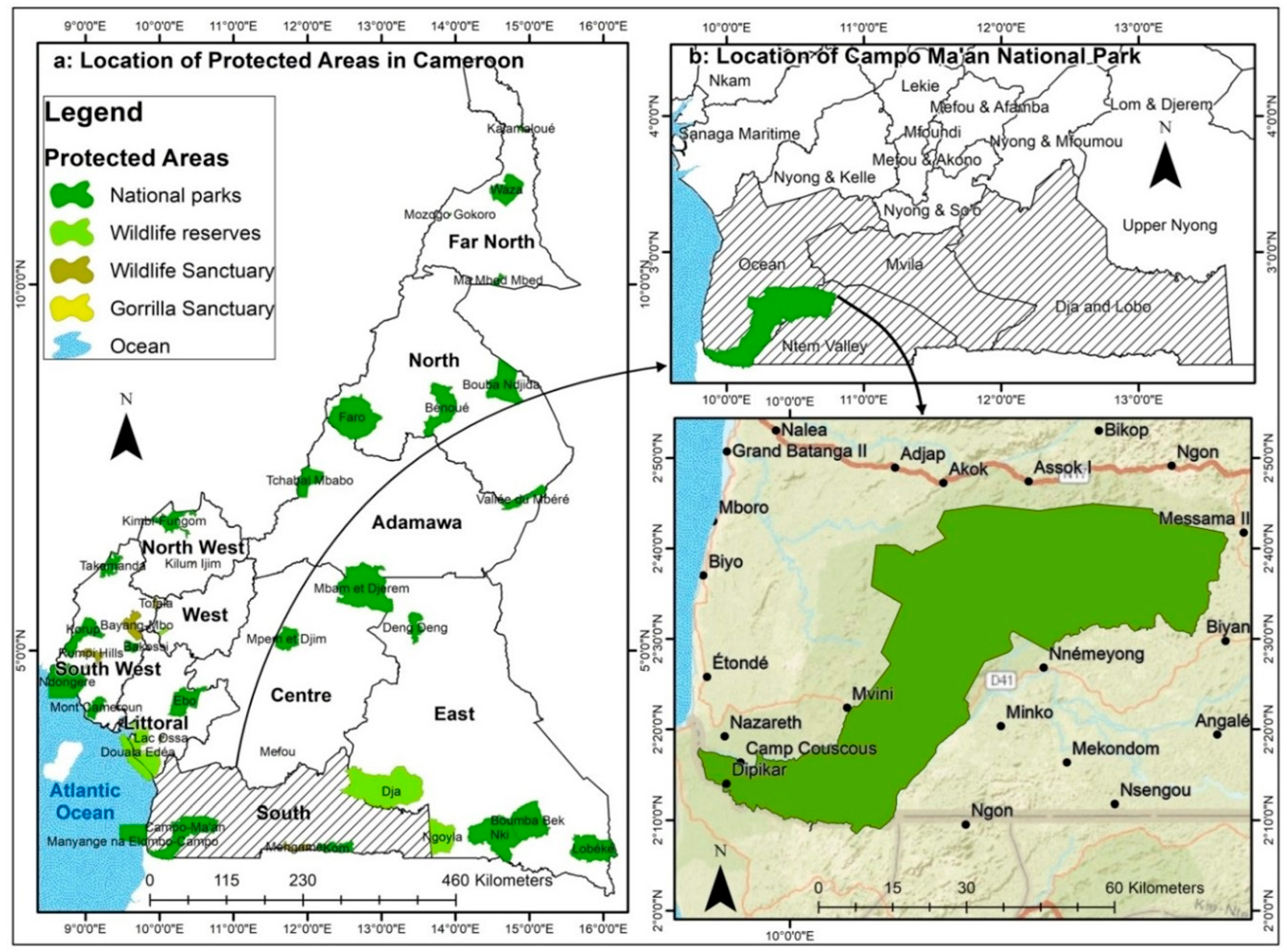
Figure 1. (a) shows the distribution of protected areas in Cameroon. (b) shows the location of the Campo Ma’an National Park including the villages in and around the landscape. Source: [25,26].
Challenges 17 00002 g001
Table 1. Distribution of questionnaires.
Selected CommunitiesEstimated Population per CommunityTotal Number of HouseholdsSampled HouseholdsEffective
Responses
Ebodje1018603130
Campo Beach735713736
Mvini/Akak336241212
Nkoelon104281414
Mabiogo159191010
Ebianemeyong181251313
Nkwadjap284231212
Nazareth83744
Niete(Nyamabande/Ngock)144301616
Melen (Ma’an)1311798
Ndageng (Akom II)1230814240
Totals11 villages4405385200195
Table 2. (a) Omnibus tests of model coefficients. (b) Model Summary.
(a) Omnibus Tests of Model Coefficients
Chi-squareDfSig.
Step 1Step36.849110.000
Block36.849110.000
Model36.849110.000
(b) Model Summary
Step−2 Log likelihoodCox and Snell R SquareNagelkerke R Square
1217.055 a0.1770.240
a indicates the successful convergence of model estimates, a better fit.
Table 3. Binary logistic regression results.
DriverBeta (B)S. Ep-ValueExp (B)
Technical challenges of forest resources exploitation−0.1970.1400.1590.821
Economic challenges of forest resources exploitation−0.3890.1510.0100.678
Institutional challenges of forest resources exploitation0.2960.2170.1731.345
Socio-demographic challenges of forest resources exploitation−0.0030.1310.9820.997
Technical challenges of land resources exploitation0.1480.1900.4361.160
Economic challenges of land resources exploitation0.4230.1530.0061.527
Institutional challenges of land resources exploitation0.1620.1650.3261.176
Socio-demographic challenges of land resources exploitation−0.1210.1320.3590.886
Table 4. Challenges of forest resources exploitation in the Campo Ma’an National Park communities.
Challenges of Forest Resources Exploitation
TechnicalTechnological challengesLow technical capacityLimited training in participatory planningLimited forest researchUnsustainable forest management
22.230.917.511.912.9
EconomicMarket powerEconomic TransitionPoor Living standardsLow per capita incomeUnemploymentEconomic DeprivationInadequate forest Funding
11.921.137.119.62.62.63.1
InstitutionalElite CaptureLack of forest strategyInstitutional failuresForeign donor dependence
12.946.433.05.7
Socio-cultural Demographic increaseHuman–Wildlife conflictsPhysical and mental healthInaccessibilityPoor infrastructureCultural limitation
16.553.617.52.1 2.62.6
Table 5. Challenges of land resources exploitation in the Campo Ma’an National Park communities.
Challenges of Land Resources Exploitation
TechnicalTechnological challengesLow technical capacityLimited training in participatory planningLimited agricultural researchUnsustainable Land Management
10.816.555.212.43.1
EconomicMarket powerEconomic TransitionPoor Living standardsLow per Capita incomeUnemploymentEconomic deprivationInadequate land related funding
14.934.531.49.32.13.1
InstitutionalElite captureHuman–Wildlife conflictInstitutional FailuresPower and conviction on land resources
14.439.722.714.4
Socio-culturalDemographic increaseHuman–Wildlife conflictphysical and mental health issuesInaccessibilityIncrease consumptionLimited infrastructure
10.324.245.47.25.23.1
Table 6. Opportunities in forestland resources exploitation in the Campo Ma’an National Park communities.
Opportunities in Forestland Resources Exploitation in the Campo Ma’an National Park Communities
Opportunities in forest resources%Opportunities in forest resources%
NTFP domestication5.7Land use diversification13.9
Energy potentials24.7Agricultural development23.2
Processing and storage of medicinal plants14.4Economic growth31.4
Ecotourism35.6Sustainable practices27.8
Biodiversity conservation through indigenous knowledge7.2Land rights3.6
Carbon sequestration4.1
Sustainable wood products and materials (Timber)6.2
Disclaimer/Publisher’s Note: The statements, opinions and data contained in all publications are solely those of the individual author(s) and contributor(s) and not of MDPI and/or the editor(s). MDPI and/or the editor(s) disclaim responsibility for any injury to people or property resulting from any ideas, methods, instructions or products referred to in the content.


