1. Introduction
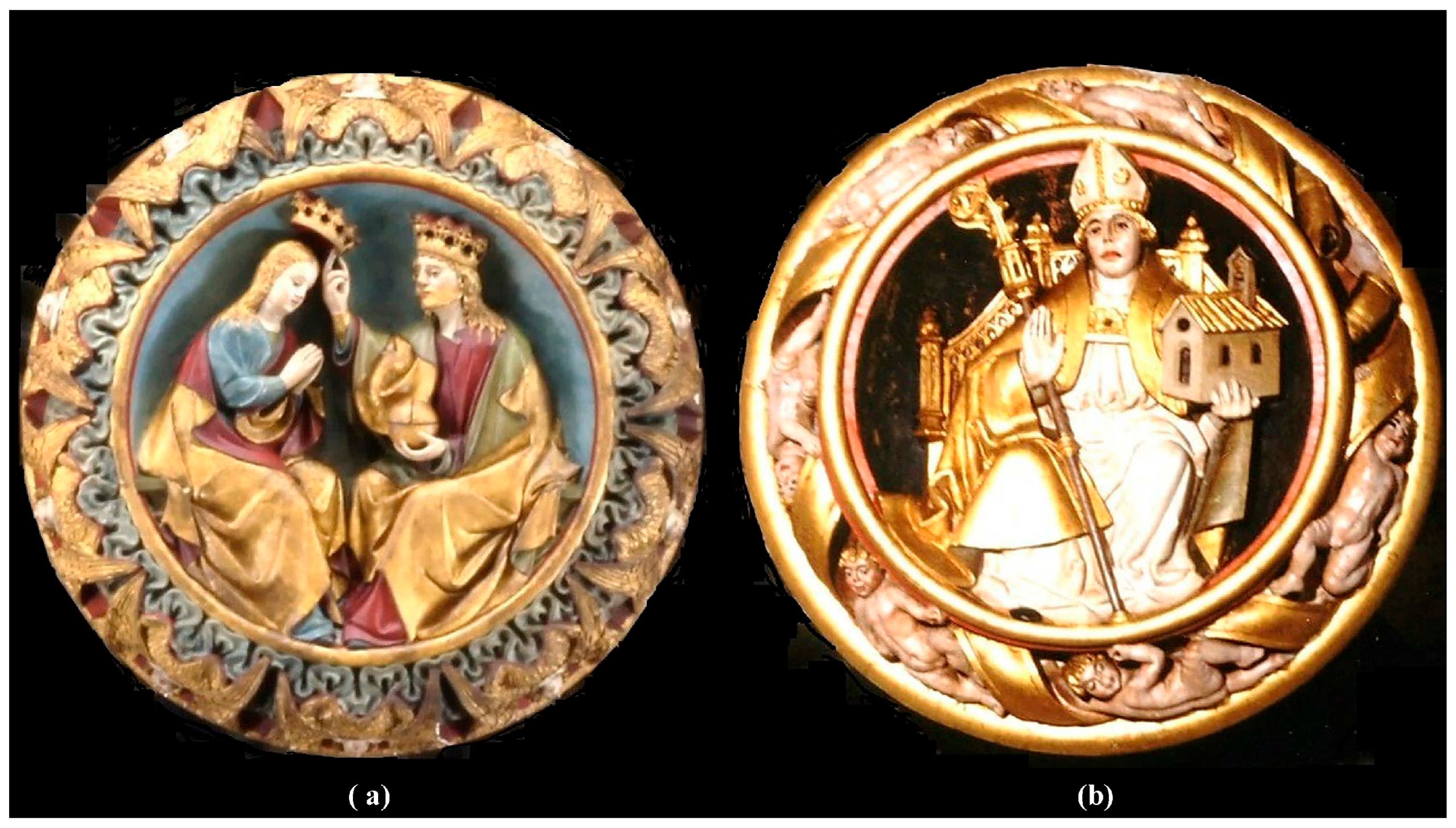
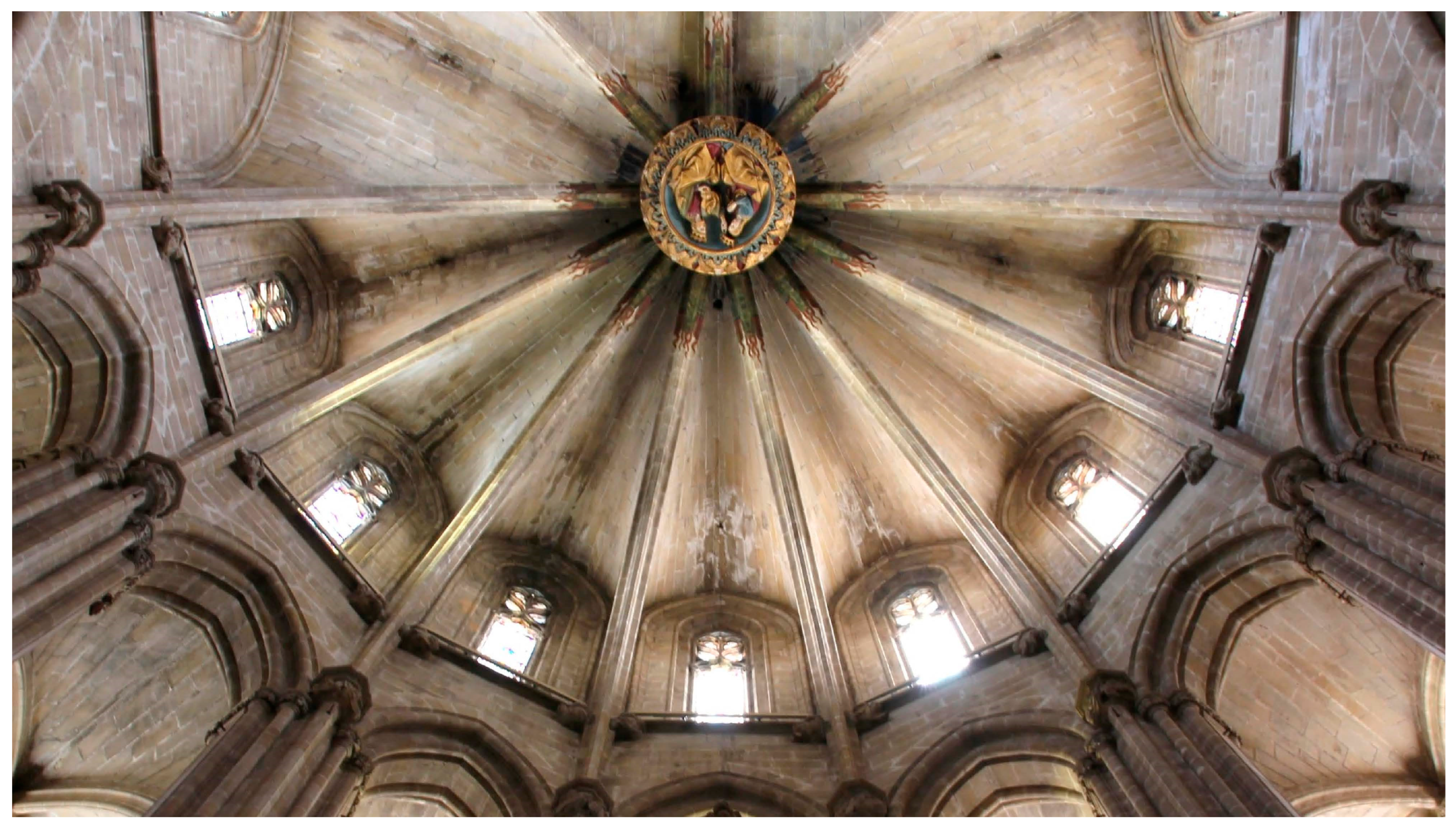
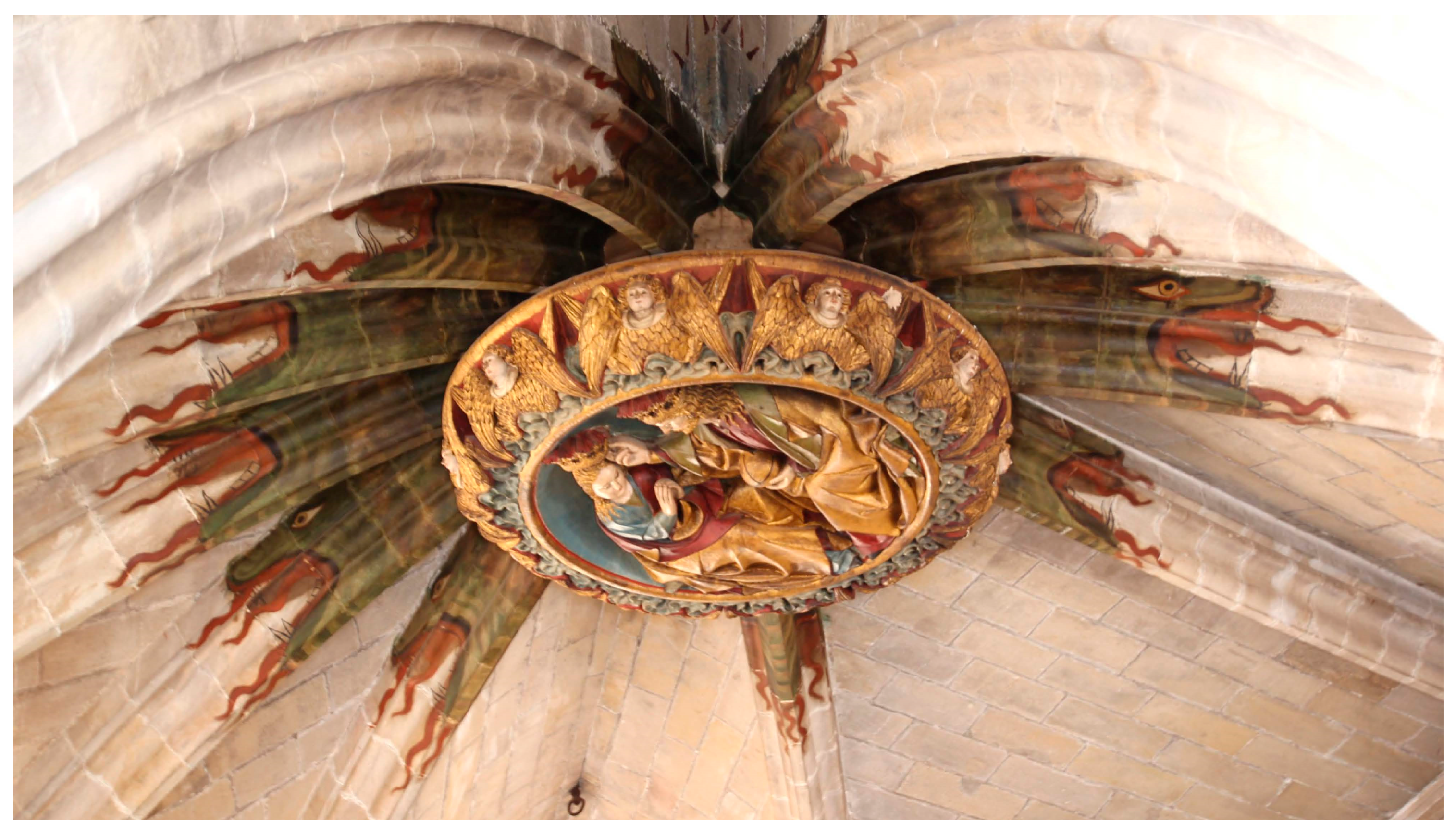
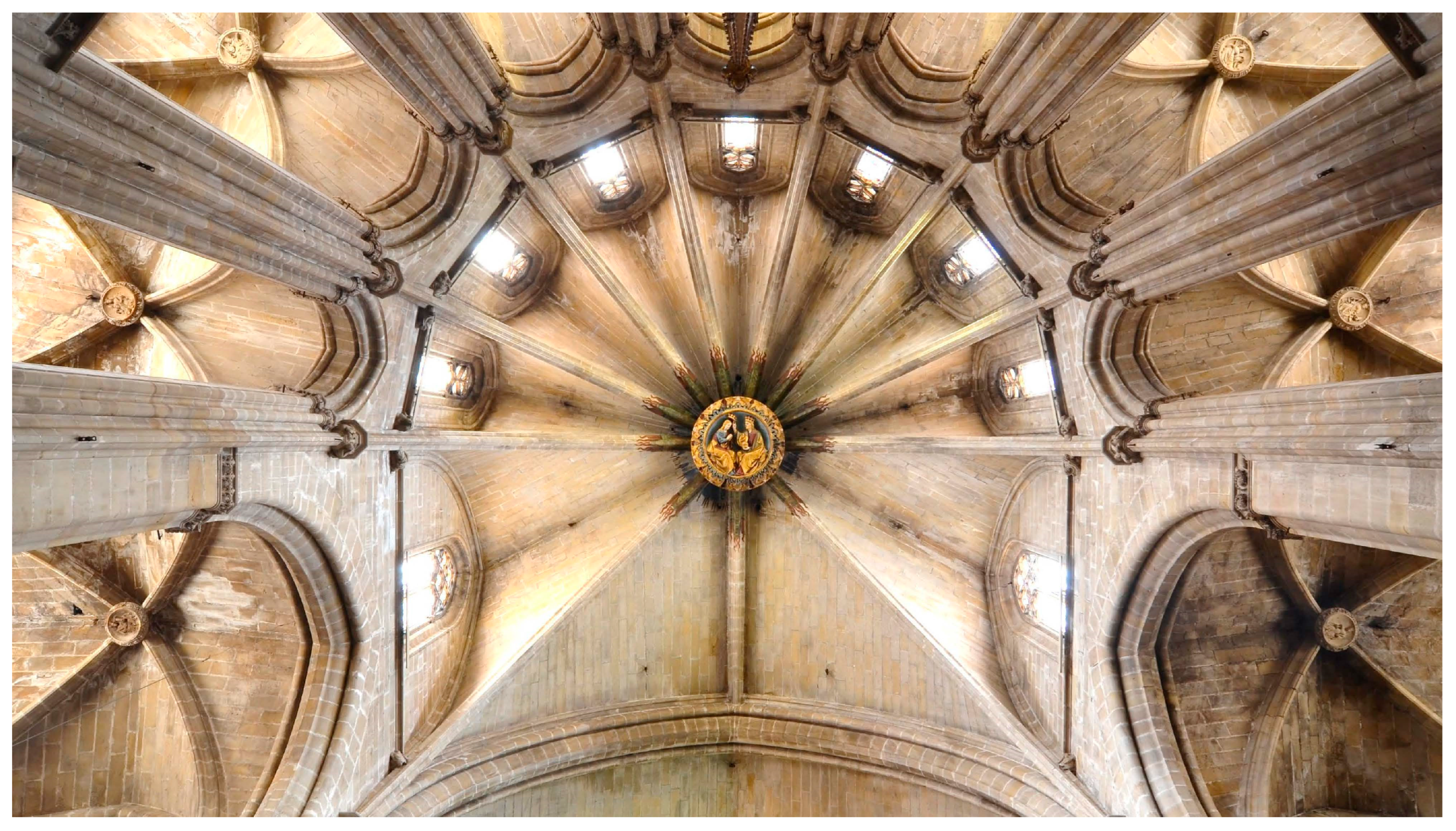
The presbytery of the Gothic apse of Tortosa Cathedral (1346–1441) is presided over by a large keystone representing the Coronation of the Virgin, which was placed in 1439 before the vaults were closed (
Figure 1a). This event has been previously studied from a construction perspective (
Lluis i Ginovart et al. 2015), and its presence and metrology were preserved in Martín Abaria’s facade project (1621–1625), which served as an inspiration for Bishop Luis de Tena (1616–1622) (
Lluis-Teruel and Lluis i Ginovart 2024). These studies were completed through Terrestrial Laser Scanner (TLS) analysis, which allows for graphical experimentation on architectural objects and provides verified explanations based on hypotheses rooted in the geometric and constructive research of Tortosa Cathedral. The results obtained from the layout of the apse, based on these records, have shown that its metrological foundation is rooted in the thought of Augustine of Hippo (354–420) (
Lluis-Teruel et al. 2024). This figure is omnipresent in the cathedral, with thirty-two of his works preserved in its Chapter Archives (ACTo) and figuratively presiding over the cathedral’s main nave (
Figure 1b).
Taking this last study as a precedent (
Lluis-Teruel et al. 2024), its numerical values allow for an interpretative treatment regarding the iconography of the keystone. This makes it possible to establish a cause-and-effect dialogue between the Chapter and the bishop, on one hand, and the
magister operis, on the other. In this way, the complexity of this sacred space can be explained, generated by the complementarity of two types of knowledge that, from the perspective of medieval philosophy, were defined as
scientia theoria and
scientia practica (
Alonso 1955, pp. 85–112). These definitions were disseminated throughout the world of European cathedrals via the
Speculum doctrinale by Vincent of Beauvais (c. 1194–1264) (
Mâle 1910, pp. 37–40).
Classical historiography assumes that Gothic architecture is the manifest result of the will of two parties: the developer and the builder, in the scholastic context. The interaction between these two figures was highlighted by Wilhelm Worringer (1881–1965) in
Formprobleme der Gotik, especially in the chapter “Transzendentalismus der gotischen Ausdruckswelt” (
Worringer 1911, pp. 48–54). Erwin Panofsky (1892–1968) also analyses the homology between the structure of a
Summa Theologiae and the design of the cathedral in Gothic Architecture and Scholasticism. He argues that, although Scholasticism is a logical method, it recognises that the ultimate goal is spiritual enlightenment, a goal inherited from Neoplatonism that seeks union with Truth through the contemplation of harmony and metrological proportion (
Panofsky 1951, pp. 70–85).
The research focuses on the presbytery keystone representing the Coronation of the Virgin, taking as a reference the works of Augustine of Hippo and those to which the canons of the 14th and 15th centuries had access in the Tortosa Chapter Archives (ACTo). Augustine of Hippo’s principle of numerical order is present in the chapter library within the codices
De civitate Dei (ACTo 20),
De Trinitate (ACTo 55),
De libero arbitrio (ACTo 86),
De genesi ad litteram (ACTo 86) and
De Confessione peccatorum (ACTo 230). Likewise, those from the 1420 cathedral inventory, such as
Supra psalterium (ACTo [6]), are included, while other authors such as Jacobus de Voragine (ca. 1229–1298) and Pseudo-Albertus Magnus, present in the inventory (
Baiges 1999), are also considered. Of particular interest is
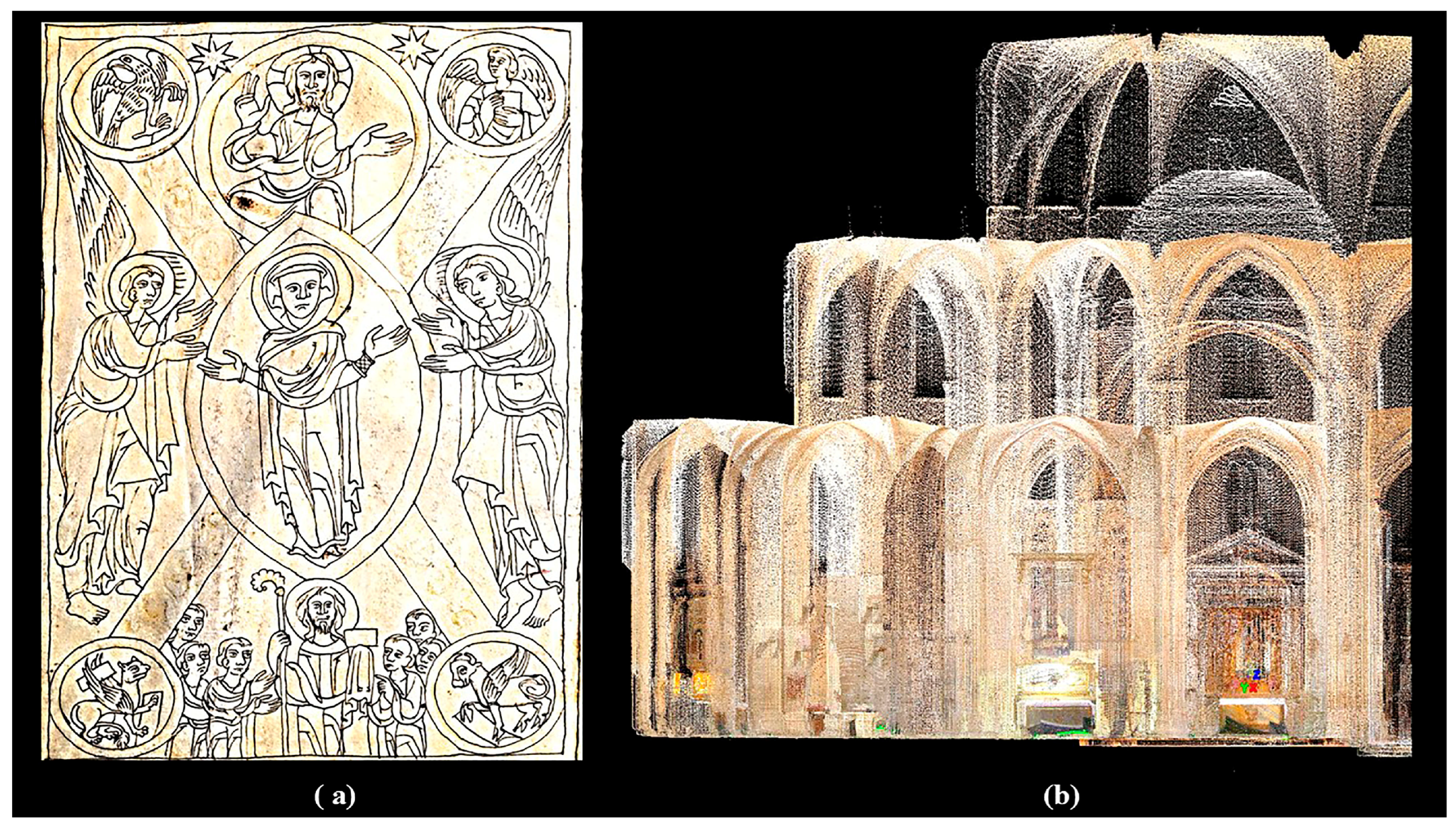
De civitate Dei (ACTo 20), where the Virgin of the Assumption is depicted accompanied by angels in the presence of her Son, framed by the tetramorph (
Bayerri 1962, pp. 615–18) (
Figure 2a).
The research on the Coronation of the Virgin is based on a comparative methodology between iconography and the analysis of the liturgical space, using metrological data obtained through (TLS) (
Figure 2b). Reference is made to Gothic architecture and French manuscript illumination from the period of the cathedral’s construction, given the close relationship that existed with the Papal See in Avignon (1309–1377).
The canonry was refounded in 1155 by Bishop Geoffrey (+1165), Abbot of Saint-Ruf in Avignon, governing itself by the principle ‘
vivere sub regula Beati Agustini, et iuxta consuetudines Ecclesiae Sancti Ruffi’ (
García 1998, pp. 10–13). Its rule originated in 1039 by Benedictus bishop of Avignon, especially governing the functions of the choir and the recitation of the psalter as well as other cathedrals of the current Catalan territory such as Vic, Lérida, Gerona, and Seo de Urgel (
Calvo 2014, pp. 78–79). The
Regula 37 orders, within the canonical timetable, the request of books for study (
Orozco 1881, p. 36). Given this principle, the aim is to look for the influence of Augustine of Hippo’s thought through the Chapter in the order that was established in the construction of the Gothic cathedral, taking as a reference the codices that they had at their disposal in the Chapter Archive of Tortosa (ACTo) at the time of the construction of the Gothic apse (1346–1441). Furthermore, before replacing the Romanesque cathedral and constructing the Gothic one, Bishop Arnau de Lordat (1340–1346) sent Bernat Dalguaire (+1347), the future
magister operis of the cathedral, on a journey to the city of Avignon in 1346 (
Almuni 1991, pp. 289–90).
2. The Coronation of the Virgin in the De Civitate Dei (ACTo 20)
The codex ACTo 20 was catalogued as S. Augustini
De civitate Dei libri II–XXII. In-cipit: institutum moremque bellorum (
Denifle and Chatelain 1896, pp. 7–26), dated to the 12th century. Other authors date the writing to the first third of the 12th century (
Ibars and Ibars 1991, p. 586), and within the Carolingian or Ottoman tradition, the iconography could extend to the early 13th century (
Ibarburu 1999, pp. 13, 586, ill. 447). It also coincides with references to line drawings and architectural forms in the Reiner Musterbuch (c. 1208–1213) of the Österreichische Nationalbibliothek, Cod. 507 HAN MAG (
Grabner 1988), and Le carnet de Villard de Honnecourt (c. 1220–1230) Ms. Français 19,093 of the BnF (
Barnes 2017, pp. 27–230).
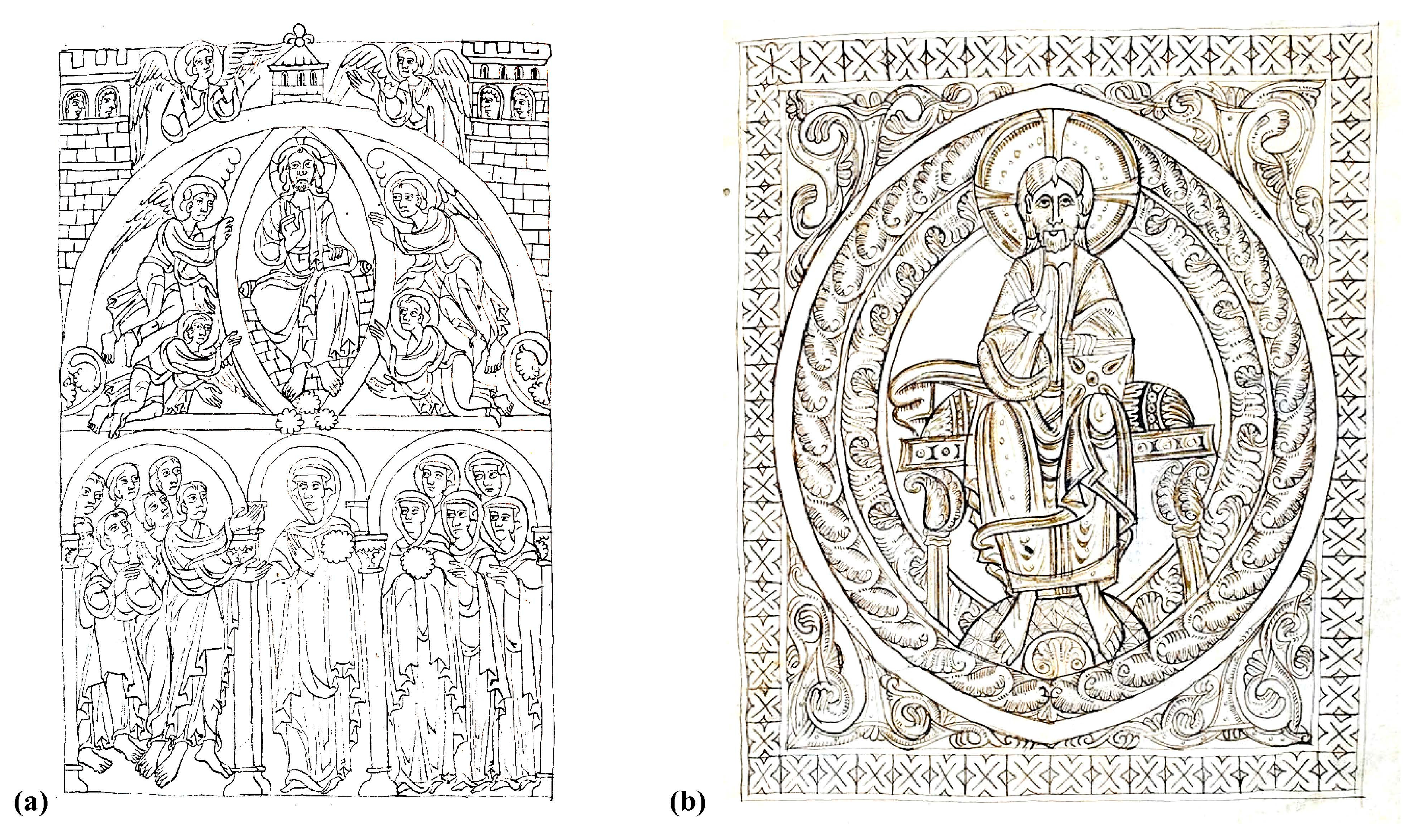
The graphic representations in ink are executed directly onto the parchment, achieving a certain formal volume through a very agile line-drawing technique (
Ibarburu 1997, pp. 125–31) (
Figure 3a). This typology is shared with other Catalan illustrated codices and, especially, with the 12th-century Evangéliaire du Perpignan, preserved in the Municipal Library of Perpignan (
Boinet 1906, pp. 93–124) (
Figure 3b).
Earlier Hispanic codices lack illustrations, such as the ninth-century manuscript from the El Escorial Library (S.I.16), or the 10th-century De civitate Dei sancti Augustini episcopi (cod. 29) from the Royal Academy of History (Real Academia de la Historia), as well as those from the National Library of Spain: Mss./9557 (1100), Mss./528 (c. 1201–1300), and Mss./1411 (c. 1301–1400).
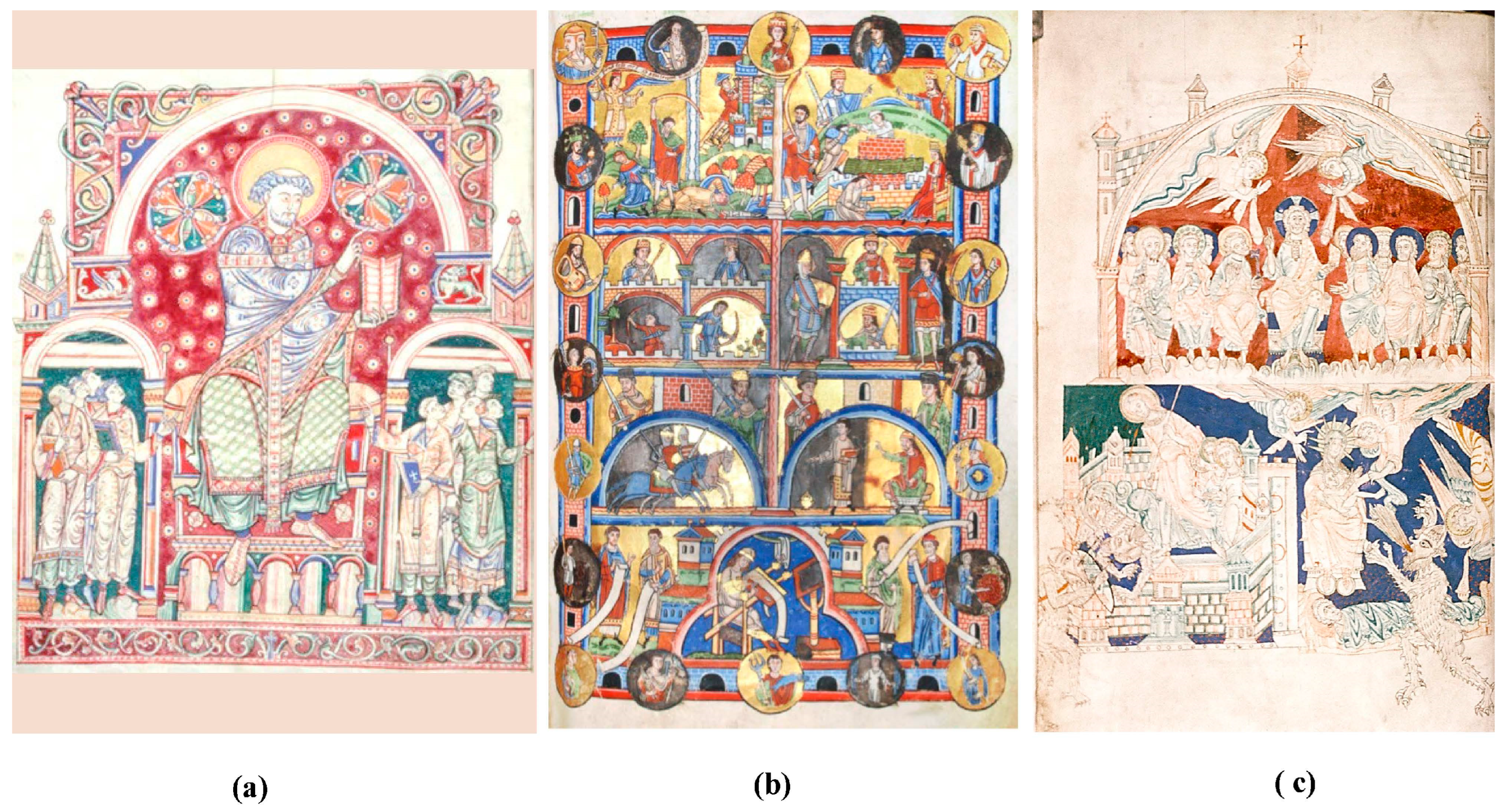
The first two illustrations of the De civitate Dei appear in (Plut. 12.21, fol. 1v, fol. 2v) of the Biblioteca Medicea Laurenziana in Florence (c. 1101–1200), generalising the representation of the iconographic cycle of the two Augustinian cities, including St. Augustine’s preaching in the (Plut. 12.17, fol. 3v) (c. 1120) in the same library (
Brilli 2016) (
Figure 4a). Likewise, the illustrations by Erkenbert von Bosau between 1168 and 1180 in the Benedictine monastery of Bosau, were first preserved in (Bibliothek der Landesschule Ms. lat. A. 10, fol. 3r) (
Figure 4b) (
Laborde 1909, vol. 1, pp. 218–25) and are now in the Bibliothek der Fürstenschule Sächsische Landesbibliothek Staats und Universitätsbibliothek (
Brilli 2011). Similarly, based on the illustrations in Ms. Laud-Misc469 fol. 7v of the Bodleian Library in Oxford (c. 1125–1149) (
Pächt and Alexander 1973, p. 14, plate XII: 112 a) (
Brilli 2013, pp. 139–58) (
Figure 4c), the representation is close to that of
ACTo 20 fol. 2r, and the theme is related to the
Maiestas Mariae (ACTo 20 fol. 2v), an iconography referring to the
De Assumptione Beatae Mariae Virginis. This work was attributed to Augustine of Hippo during that period, although it is now considered apocryphal by Teodoro Calvo Madrid (1929–2010) (
Augustine of Hippo 2002, pp. 641–82).
The direct reference to the Coronation of the Virgin does not appear explicitly in the work of St. Augustine; however, the graphic interpretation of some codices is that which represents the most noble part of the construction of the City of God. Thus, when this City reaches its eternal perfection, she is crowned at the top of that spiritual structure: “Of the eternal happiness of the City of God and the perpetual Sabbath” (Civ. Dei XXII.30) (ACTo 20, fol. 408r) (
Augustine of Hippo 1864, col. 801–804).
The illuminations of the Coronation of the Virgin will appear to illustrate book XXII of De civitate Dei, whose object is the eternal happiness of the saints as the end of the City of God. In this way, the faith in the resurrection of the bodies is given solidity, and it is explained what it will consist of. The Coronation is linked to the Last Judgement, since it is the “crown of life” (Revelation 2:10). Virgo already benefits from the promise that concerns every man. This purely human woman is the first to understand the divine plan for the deification of man, where the act takes place in Paradise as recorded in the Bible of Jean de Sy (c. 1350–1380) of the Bibliothèque Nationale de France, MS fr. 15397 and (B.L., Mss. Lat. Add. 15244-45, fol. 365) of the British Library (1370–1377), as well as in the one preserved in London (c. 1380) by collector Henry Yates Thompson (1838–1928) (Ms. Franc. 80, fol. 288r).
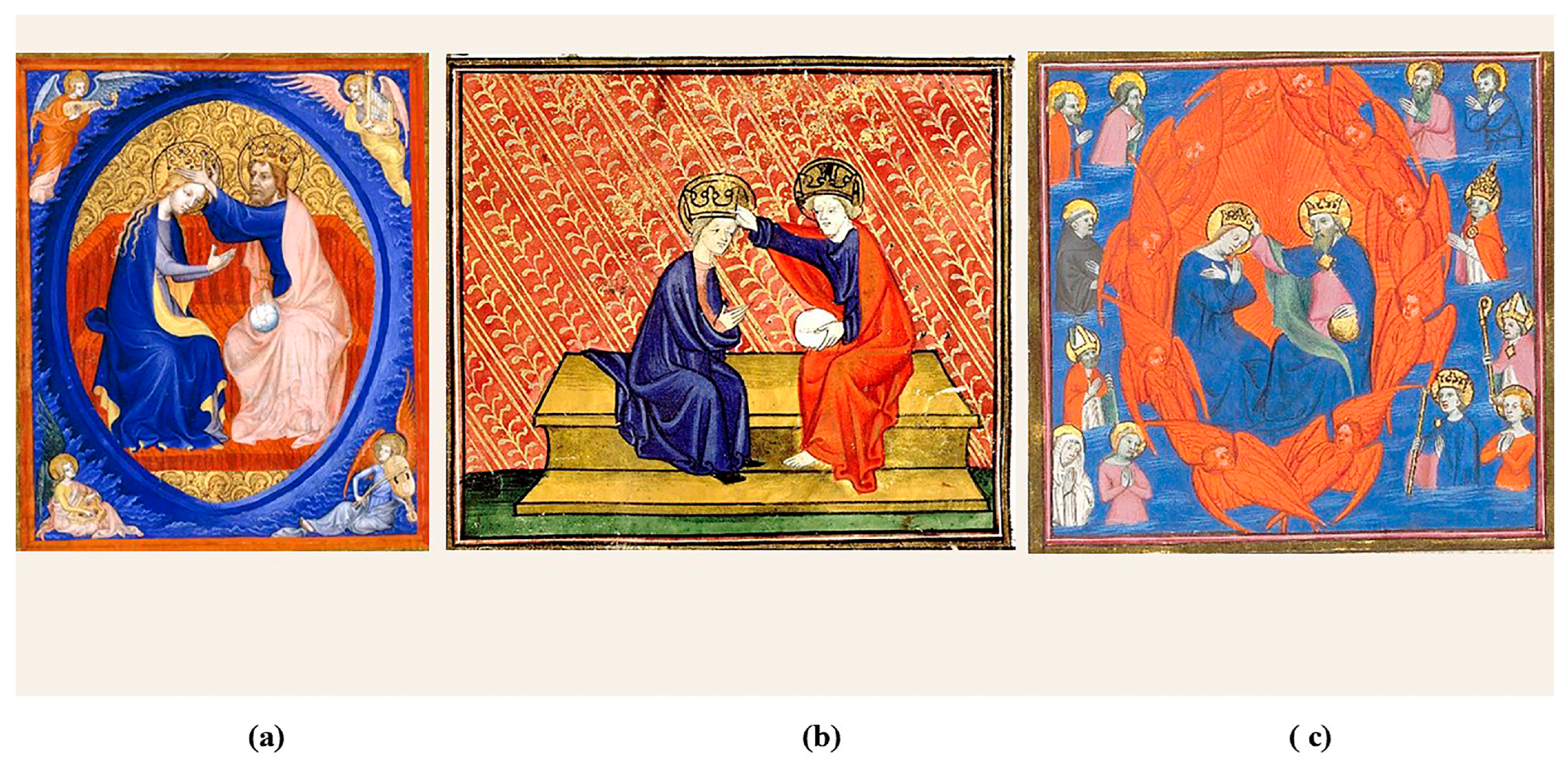
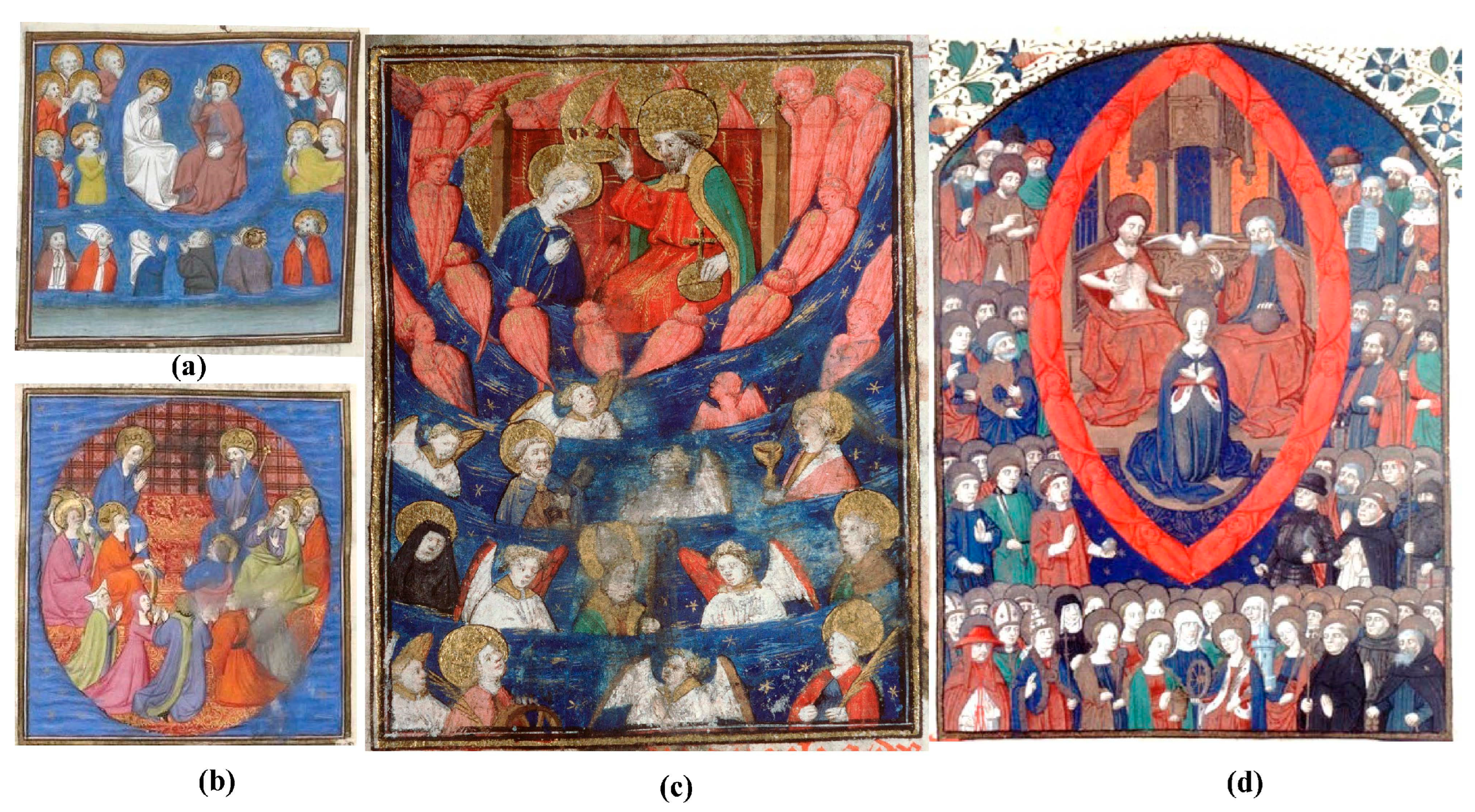
Especially prolific are the French illuminations, such as the (BnP, Ms. Franc. 174) (c. 1400–1405), translated and annotated by Raoul de Presles (1316–1382) and illuminated by Maître de la Cité des Dames and Jacquemart de Hesdin (BnF, Ms. Franc. 174, fol. 364r) (
Figure 5a), where the Virgin is crowned by her son in the presence of the twelve apostles, like the one from the same period by the Maître des cleres femmes (BnF, Ms. Franc. 173, fol 335 278 r) (
Figure 5b) in the presence of saints and those who aspire to her. Another Coronation surrounded by angels and Saints is (BM, ms. 216, t. II, fol. 375v) (c 1425–1449) from the Bibliothèques d’Amiens Métropole, (
Figure 5c). In the Trinitarian coronation iconography of Rouen (c. 1450–1474) from the (BnF, Ms. Franc. 28, fol. 273v), it is emphasised that the act signifies eternal life, communion with the divine energies and communion with the love of the Trinitarian God, with the three divine persons (
Figure 5d).
The
editio prínceps of Saint Augustine’s
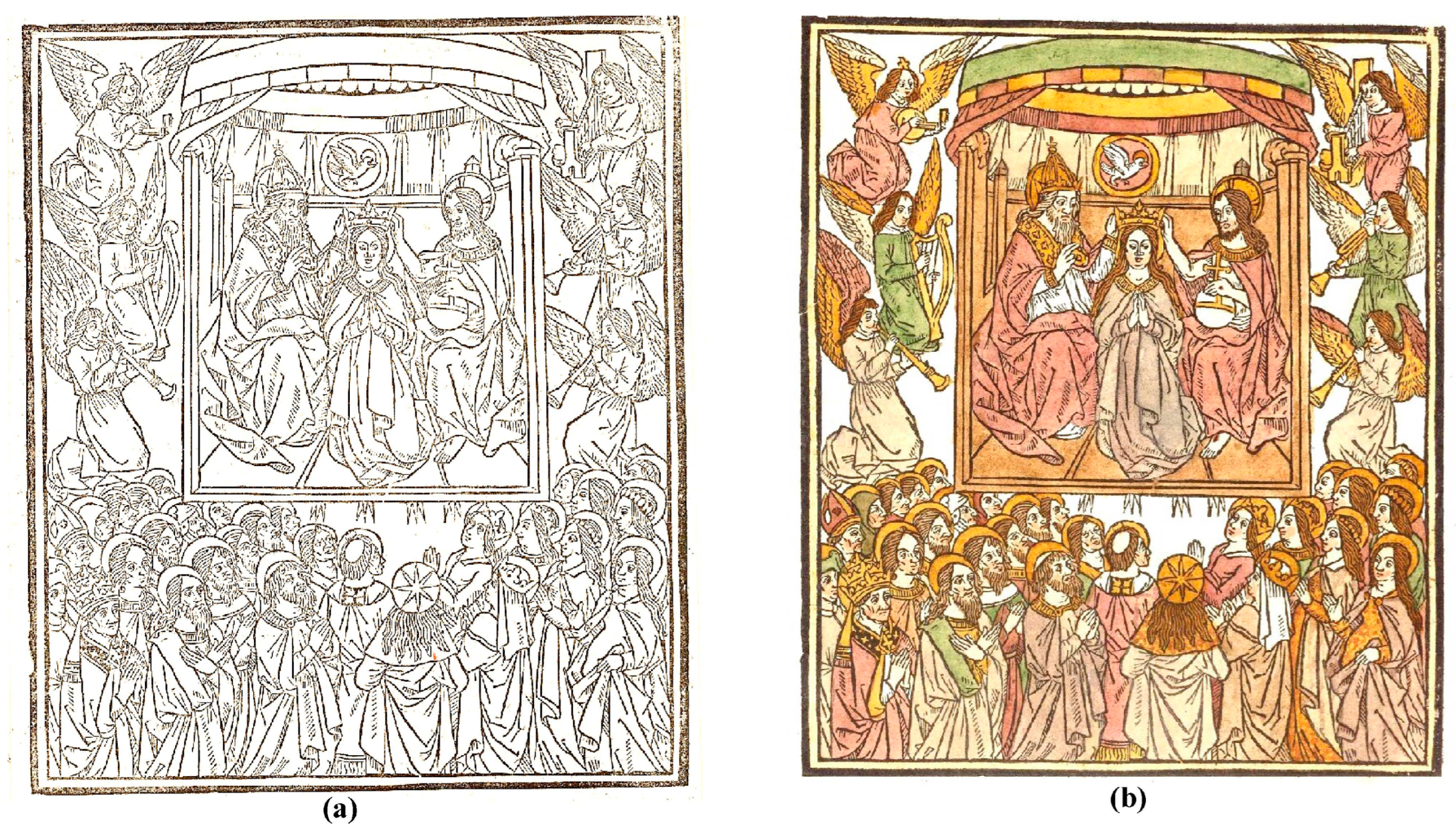
De civitate Dei was produced in Subiaco in 1467 by the typographers Conrad Sweynheym (1430–1477) and Arnold Pannartz (fl. 1463–1477) in large format, although it has no illustrations. From this period onwards, they were combined with incunabula and engravings, such as the Raoul de Presles translation (1316–1382) preserved in Cambrai, (BM, inc. B 076, 7181-71822), published in Abbeville with engravings (1486–1487) by Pierre Gérard (d.1486) and Jean Du Pré (+1504) (
Figure 6a); on some six occasions, the work was decorated with colour in tempera, as in the case of the Abbeville edition, (BM, inc. 002, t. II c) (
Figure 6b)3.
3. The Coronation of the Virgin in Other Illustrated Works
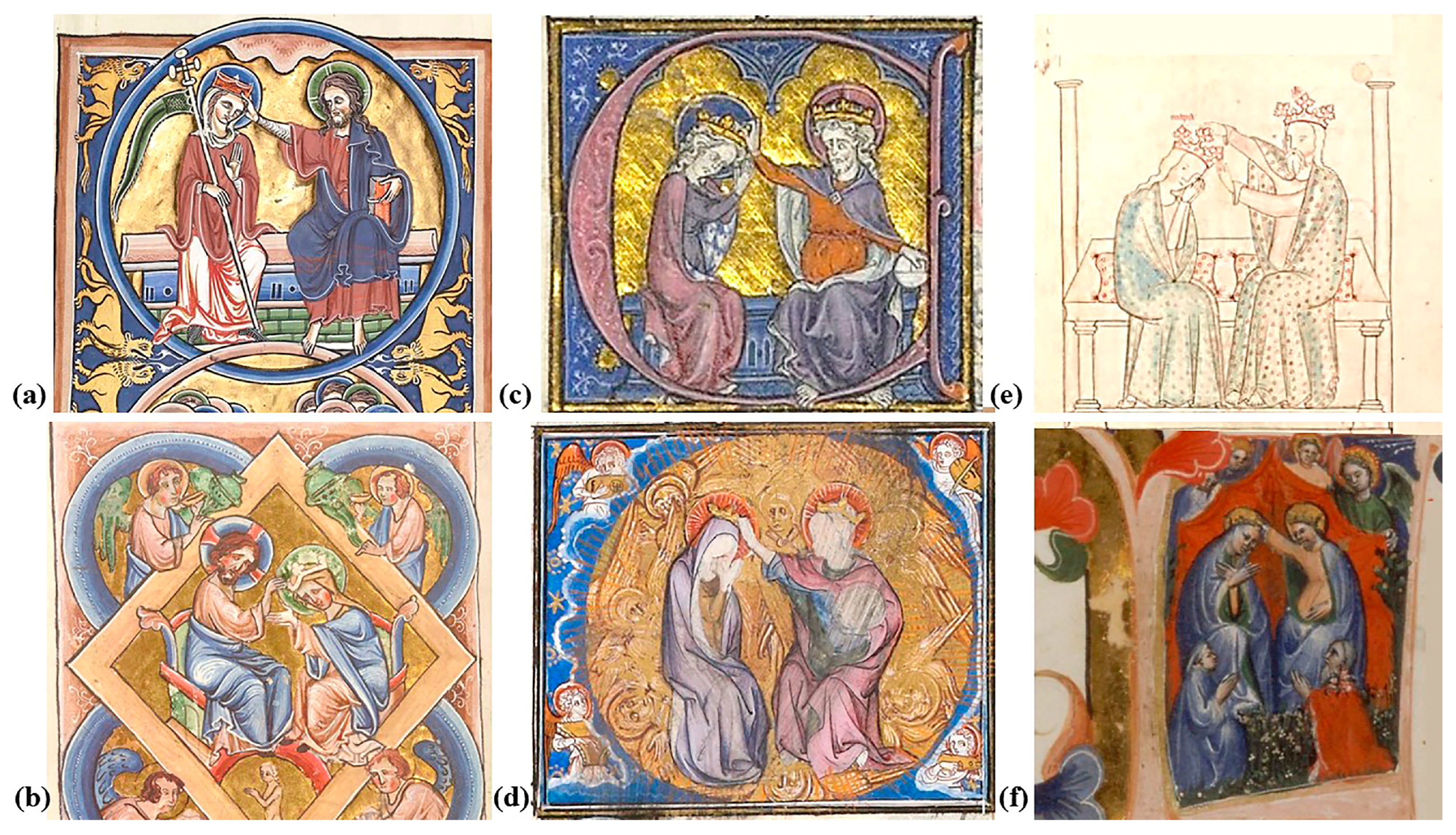
This iconography was common at the time, as seen in the Psalter of Saint Louis and Blanche of Castile (1225–1235) from the Arsenal Library (Ms. 1186 réserve, fol. 29v) (
Figure 7a) or in the Psalter for the use of the Church of Troyes (13th century) (BnF, Latin 238, fol. 62v) (
Figure 7b). It is also found in the Breviary of Philippe le Bel (Paris, BnF, Latin 1023, fol. 398v) from the 13th century, where the Virgin is already crowned and seated on the same throne (
Figure 7c), and in the same position in the Belleville Breviary (c. 1300–1400) (Paris, BnF, Latin 10484, fol. 290v) (
Figure 7d). Additionally, it appears in Bible illustrations such as the
Figures de l’Ancien et du Nouveau Testament (BnF, Ms. Français 400, fol. 48v) from the 14th century (
Figure 7e), or La divina commedia Dante, in BnF, Ms. Italien 530, fol. 96r, from the 15th century (
Figure 7f).
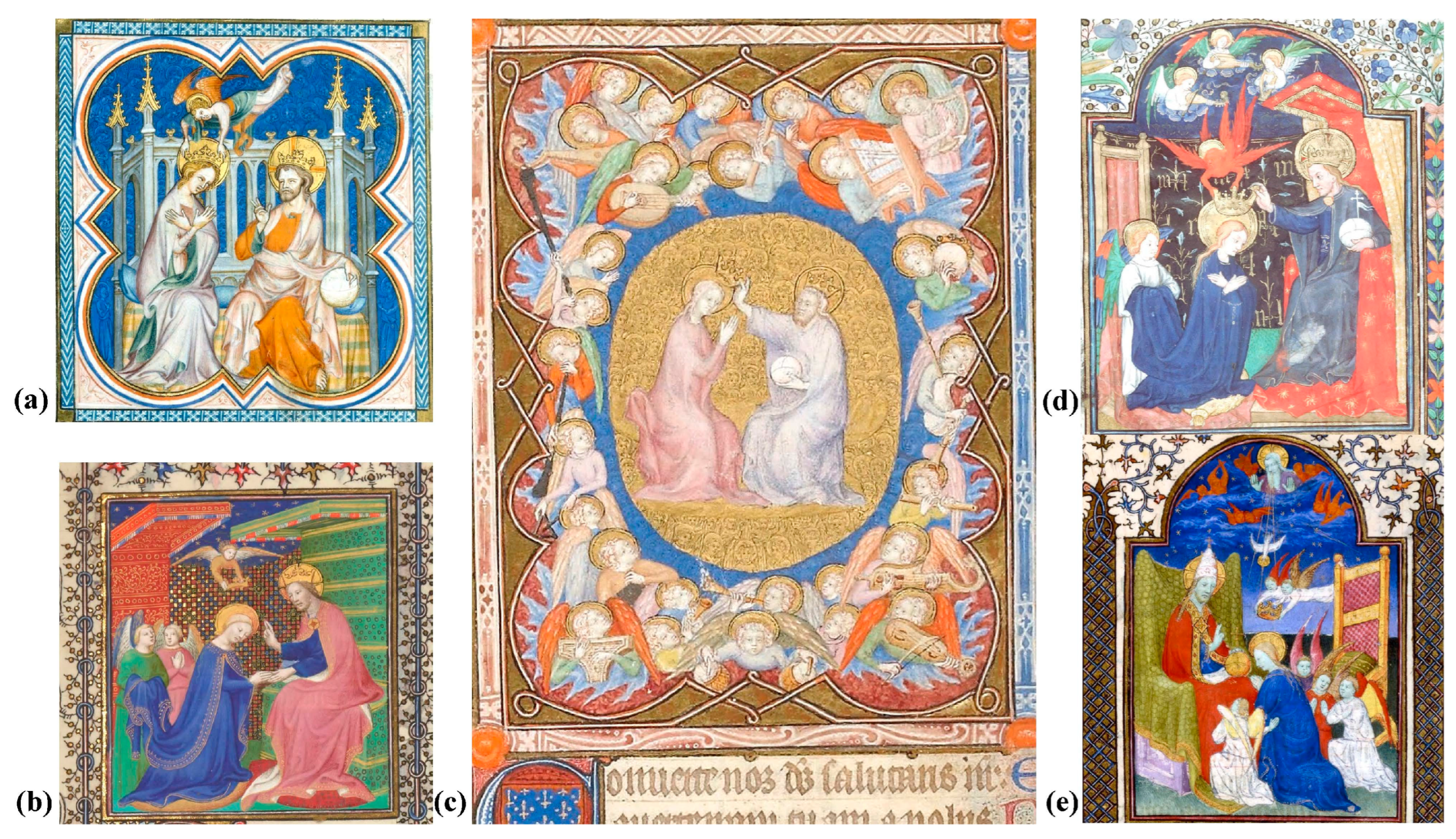
They are illustrated with the image of the Virgin already crowned by an angel in the Hours of Joan II, Queen of Navarre (c. 1330–1340) (BnF, NAL 3145, fol. 65v) (
Figure 8a), or with the angel on the way to the coronation in the
Horae ad usum Parisiensem (c. 1375–1424) (BnF, Latin 1161, fol. 91) (
Figure 8b). The act of crowning is depicted in the
Petites Heures de Jean de Berry (14th century) (BnF, Latin 18014, fol. 48v) (
Figure 8c), or the joint coronation by her Son and an angel, as seen in the
Heures de Marie de Rieux (c. 1450) from the Bibliothèque municipale de Tours (Ms. 217, fol. 032v) (
Figure 8d). It is also shown with the presence of the Holy Spirit in the
Horae ad usum romanem (15th century) (BnF, Latin 10538, fol. 91r) by the Mazarine Master (
Figure 8e).
The Coronation of the Virgin established itself as a recurring iconographical theme during the completion of the presbytery, serving as the symbolic culmination of its visual programme. The selection of this motif at Tortosa Cathedral was not incidental; rather, it was underpinned by a well-defined institutional bibliographic culture. According to the 1420 Cathedral Inventory, the chapter possessed and frequently consulted key titles, such as the Liber vocatus Flos sanctorum (ACTo [38]) and the Summa Aurea (ACTo [40]), and Flos sanctorum is repeated (ACTo [45, 48, 61, 62, 65]) and referred to the Summa aurea (1261–1266) of Jacobus de Voragine (ca. 1229–1298).
Jacobus de Voragine presents the Coronation of the Virgin as the definitive conclusion to the narrative cycles of the Dormition and the Assumption. Originally attributed to Melito of Sardis (d. c. 180), this account was disseminated throughout the Christian West following the Council of Ephesus (431), largely through the influence of Gregory of Tours (538–594). This celestial triumph finds its scriptural basis in the Book of Revelation, where the Virgin is envisioned as the woman clothed with the sun, crowned with twelve stars and with the moon beneath her feet as a pedestal (Rev 12:1). Nevertheless, the decisive textual source for Gothic imagery is the Summa Aurea (1261–1266). In the chapter Assumptio Beatae Mariae Virginis (Ch. CXIX), De Voragine records the divine summons: ‘Come from Lebanon, you are going to be crowned.’ To this, Mary responds with total devotion: ‘I am coming, Lord… for in the Book of the Law it is said of me that in everything and always I will do your will.’ At that very moment, according to hagiographical tradition, the Virgin’s soul departed her body to fly into eternity in the arms of her Son.
Subsequently, the Saviour Himself, with a joyful countenance, went out to meet His Mother, took her by the hand, and personally led her to the throne. There, with unspeakable joy, He placed her upon it so that she might remain eternally at His side, sharing in the governance of the Kingdom (
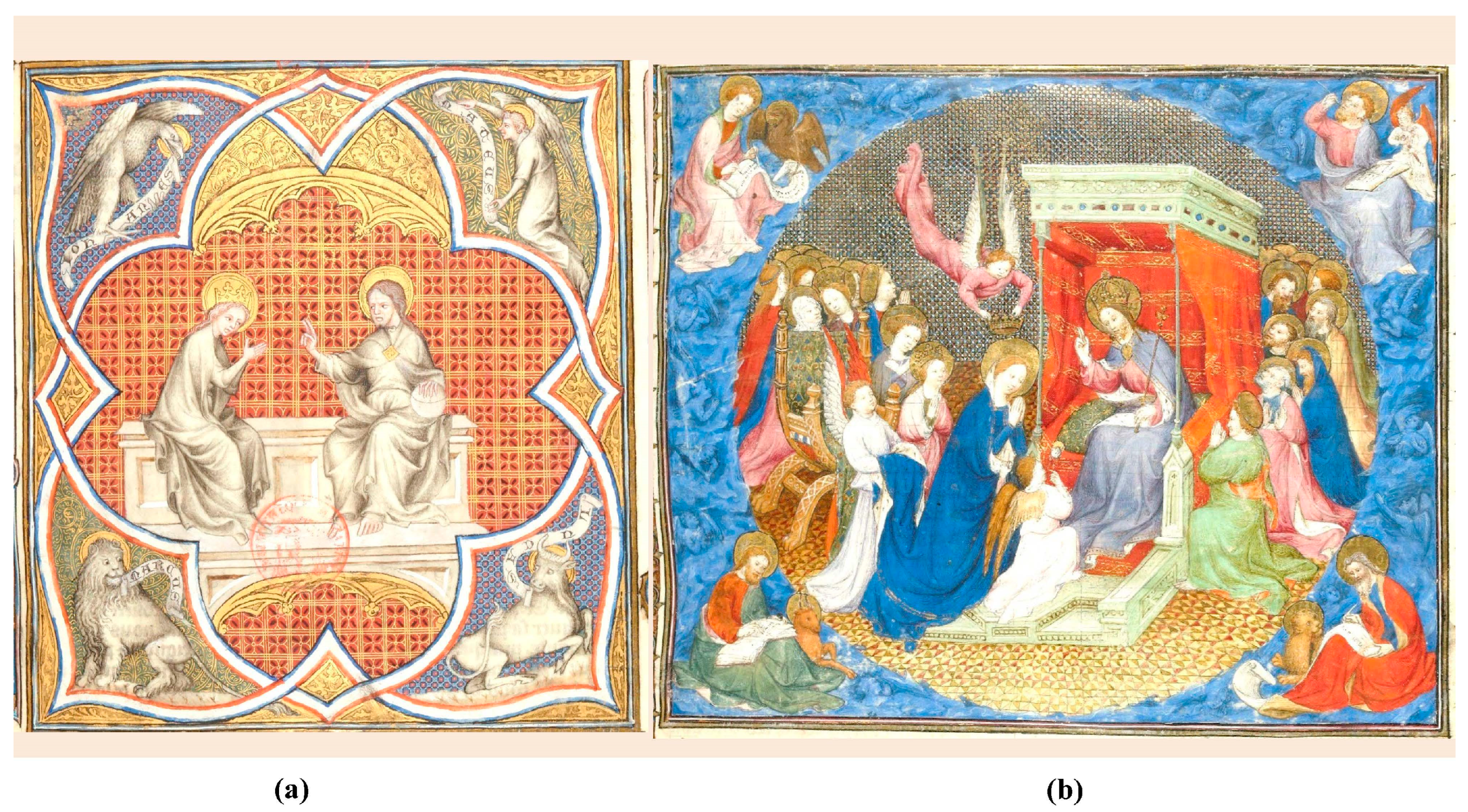
Voragine 1999, pp. 479–83). The profound impact of this passage is illustrated in the frontispieces of the French translations of the
Legenda Aurea by Jean de Vignay (c. 1282–c. 1350). Notable examples include the illuminations in the Bibliothèque Mazarine (Ms. 1729, fol. 15, c. 1370–1380) (
Figure 9a), and the Bibliothèque nationale de France (BnF, Fr. 242, fol. Ar, c. 1402) (
Knowles 1954, pp. 353–83) (
Figure 9b).
There are three other codices entitled
De laudibus Virginis Marie (ACTo [15, 114, 116]) whose authorship is difficult to determine, being attributed either to Bernard of Clairvaux (1090–1153) or, as is currently more common, to Pseudo-Albert the Great. In both cases, they provide significant references. On one hand, there is Bernard’s metaphor in his second homily
Super Missus est, in which he compares the Virgin to the Star of the Sea (
Stella Maris) (
Bernard of Clarivaux 2014, p. 65). On the other hand, Pseudo-Albert the Great presents the concept of
Maria figuratur edificiis, where Mary is depicted as the Temple of Solomon (
Pseudo-Albertus Magnus 1898, vol. 36, pp. 593–617), framing her as a sacred architectural structure.
4. The Coronation of the Virgin as Decorum in Architecture
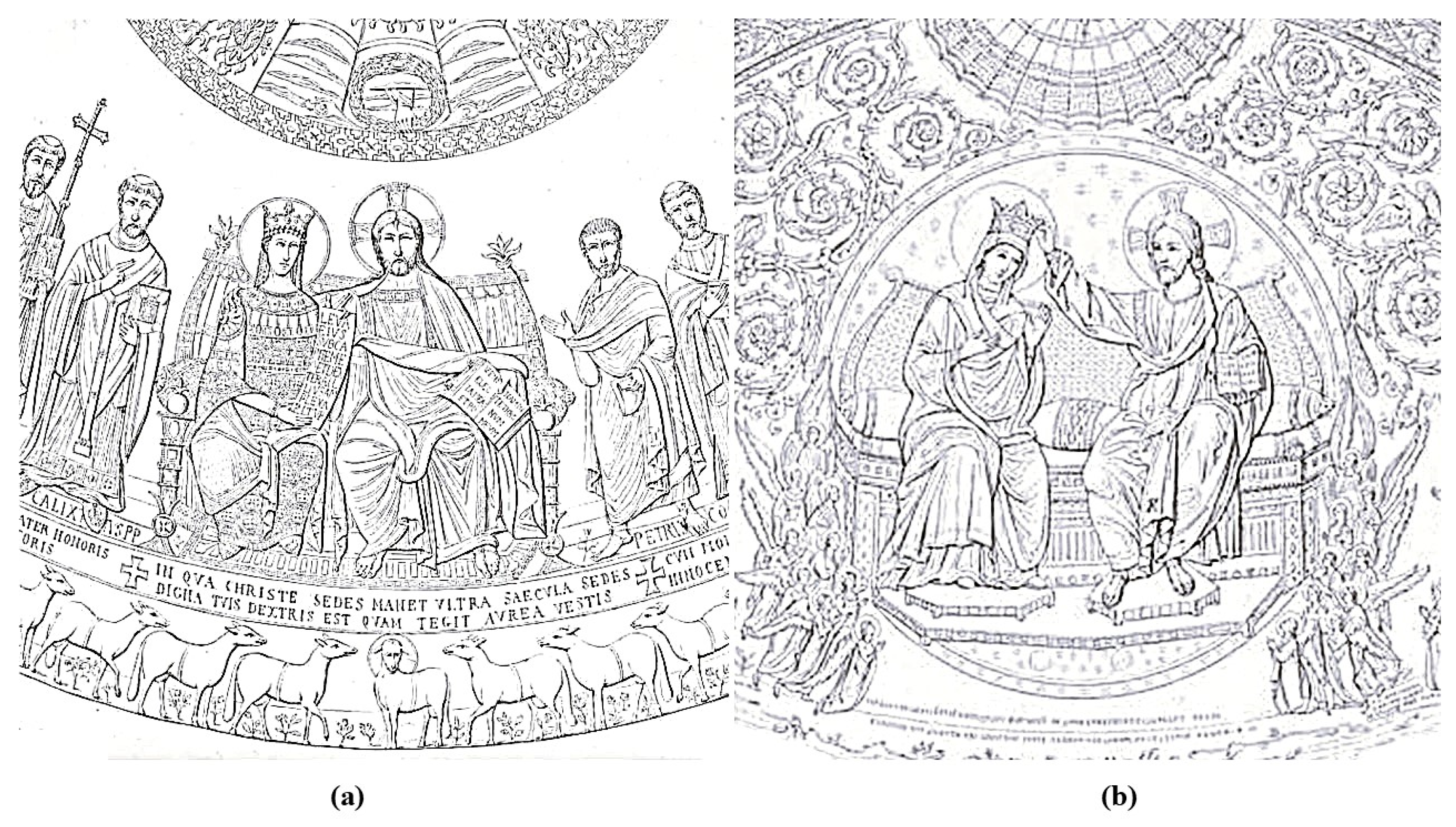
During the papacy of Innocentius II (1130–1143), a new iconography was proposed at Santa Maria in Trastevere, where the crowned Virgin shares the same throne as her Son. The latter with a book in his hand from Psalm 44 of the Song of Songs: “Come, my chosen one, and I will put my throne in you”, and where the scroll that the Virgin holds in her hands says: “Let your left hand be under my head, and your right hand embrace me.” Under her figures, the verses: “This is in your honour, Mother of honour. The kingdom of heaven shines with the splendour of beauty. In which Christ’s throne, place shall remain beyond the ages. Worthy is thy right hand covered with the garment of gold. When the mass of the old ruin burns, from here.” Pope Innocentius II restored it (
Fontana 1890, vol. 1, Planche XXXVIII B) (
Figure 10a). Similar iconography was used in the mosaics of the apse of Santa Maria Maggiore (1295–1296), when Pope Niccolo IV (1288–1292) commissioned them to the Franciscan Jacopo Torriti (ac. 1270–1300) (
Salvador 2013, pp. 1–48;
Fontana 1890, vol. 3, Planche XXIX;
Viollet-le-Duc 1854–1868, vol. 3, Planche XXIX) (
Figure 10b).
Eugène-Emmanuel Viollet-le-Duc (1814–1879) in his article
Couronnement de la Vierge recognises that within architectural iconography it is one of the themes frequently represented by sculptors and glassmakers of the 13th century, given that the cult of the Virgin had acquired great importance, so that most of the bishops of northern France had in voked her with the name of the Mother of God (
Viollet-le-Duc 1854–1868, vol. 4, pp. 367–68).
The first references to this image are to be found in the north portal of the church of Cunnington in Gloucestershire (c. 1140) (
Wood 2014). It was later used in French monumental sculptures from the tympanum of the Cathédrale Notre-Dame de Senlis (1160–1170) (
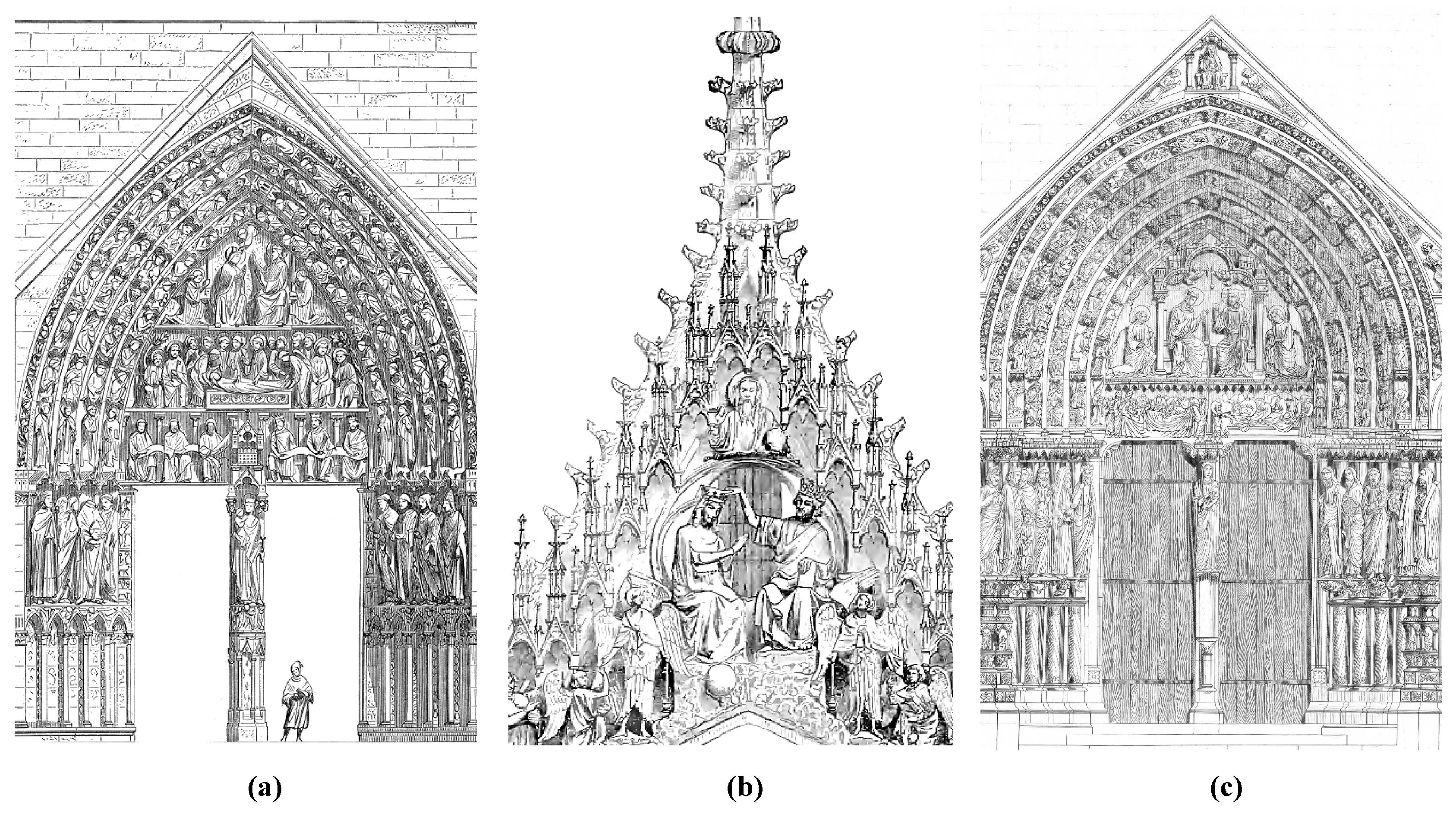
Thérel 1984, pp. 247–339), as well as in the one dedicated to the Virgin Mary on the south façade of Notre-Dame de Paris (1210–1220) (
Viollet-le-Duc 1854–1868, vol. 7, p. 424;
De Guilhermy and Viollet-le-Duc 1856, pp. 50–62) (
Figure 11a), that of the central portal of the north transept of the Cathédrale de Chartres (1198–1224) (
Durand 1881, pp. 85–94), (
Lassus 1867, Planche XVIII) (
Figure 11c) and to which the interior decoration of the sculptural group (1516) (POP. IM28000453), or that of the south portal of the Cathédrale d’Amiens must be added (c. 1220–1230). Similar representation was found on the gable of the central portal of the west façade of the Cathédrale de Reims (12311247) (POP. V1-032117), (
Viollet-le-Duc 1854–1868, vol. 6, p. 4;
Kurmann 1996) (
Figure 11b).
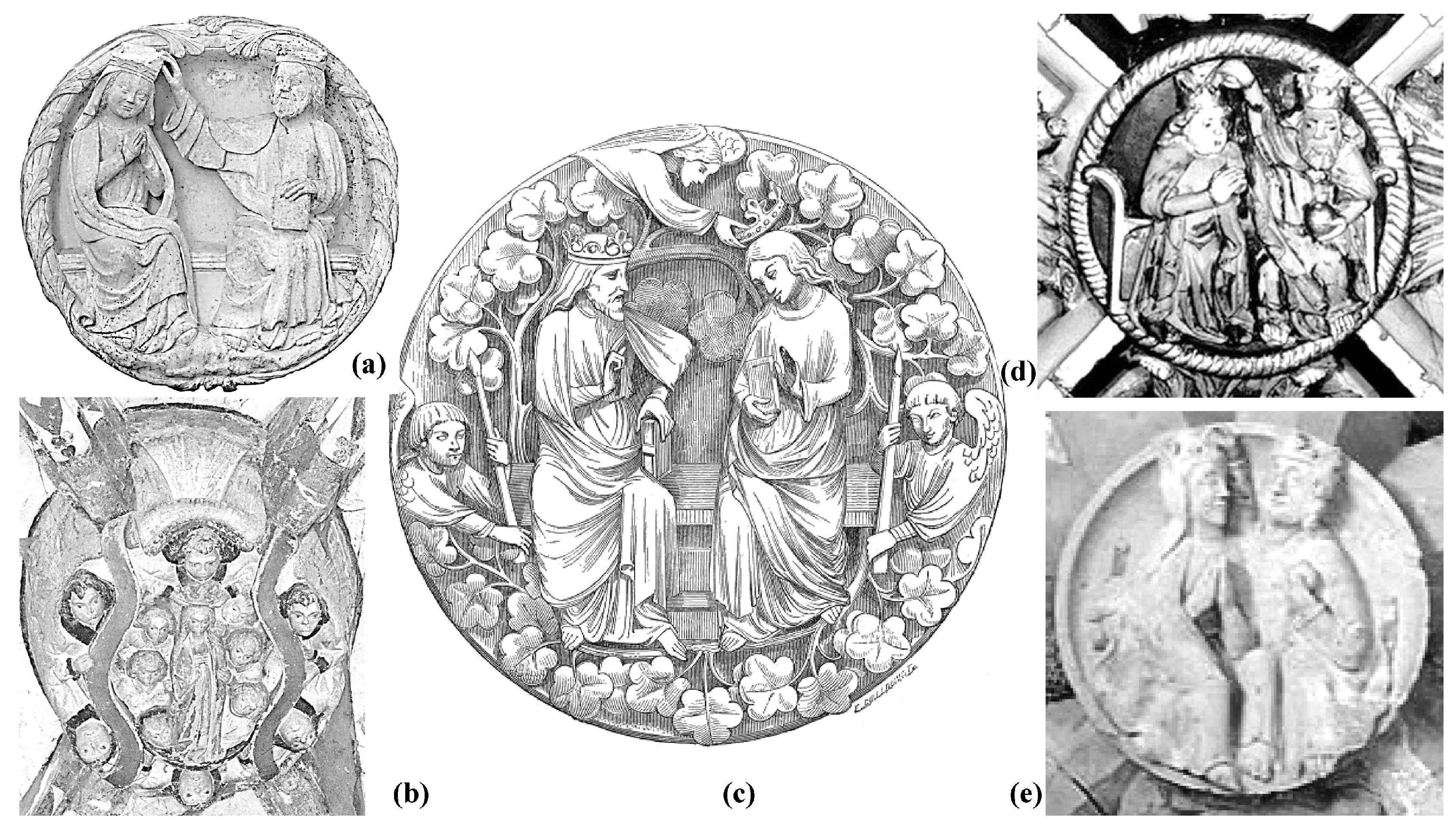
As a structural closing element, it is used in the keystones of ribbed vaults in the 13th century cathedral of Saint-Pierre de Troyes, preserved in the Musée des Beaux-arts et d’Archéologie, Musée Saint-Loup (inv. D.843.1) (
Figure 12a), as well as in the Chapelle de Lenoux, à Laives (1474–1499), where the coronation is surrounded by twelve angels with the moon at their feet (Apoc. 12.1) (POP. PA0013304) (
Figure 12b) and the keystone of the Collégiale Saint-Thiébaut from the second half of the 14th century (P.O.P. IVR42_19716801510X) (
Figure 12d). The major keystones of Collégiale Notre-Dame de Semur-en-Auxois (1235) are on a pentagonal apse, where an angel places the divine crown on Mary’s head, placed to the left of Christ, who leans on the sacred book and blesses his mother, while two other angels with a candle emerge halfway up the branches (
Viollet-le-Duc 1854–1868, vol. 3, p. 267) (
Figure 12c). Of the same typology is the keystone of the sexpartite vault of the octagonal chapel of the Château de Puivert (14th century) (POP. PA00102872) (
Figure 12e).
5. The Apse of Tortosa Cathedral and the Coronation of the Virgin Mary
When Bernat Dalguaire returned from Avignon, he signed the contract for the execution of the new Gothic cathedral (
Matamoros 1932, pp. 39–40). After that, he made a model of the work in August 1346 under the pontificate of Bernat de Oliver (1346–1348) belonging to the
Ordo Fratrum Sancti Augustini, starting the work on 21 May 1347, which was halted by the Black Death of 1348, with the death of the bishop and the master himself, and with the aggravating factor of the war episode of the War of the Two Peters (1356–1369).
The relationship with Avignon was also established through Andreu Julià (+1381), master builder of Tortosa Cathedral after work resumed (1376–1378), who had worked on Cardinal Andouin Aubert’s (+1363) Livrée d’Albano Palace in 1358. The following year, in 1359, he participated in the purchase of materials for the construction of the Papal Palace in Avignon itself (
Miquel 2009).
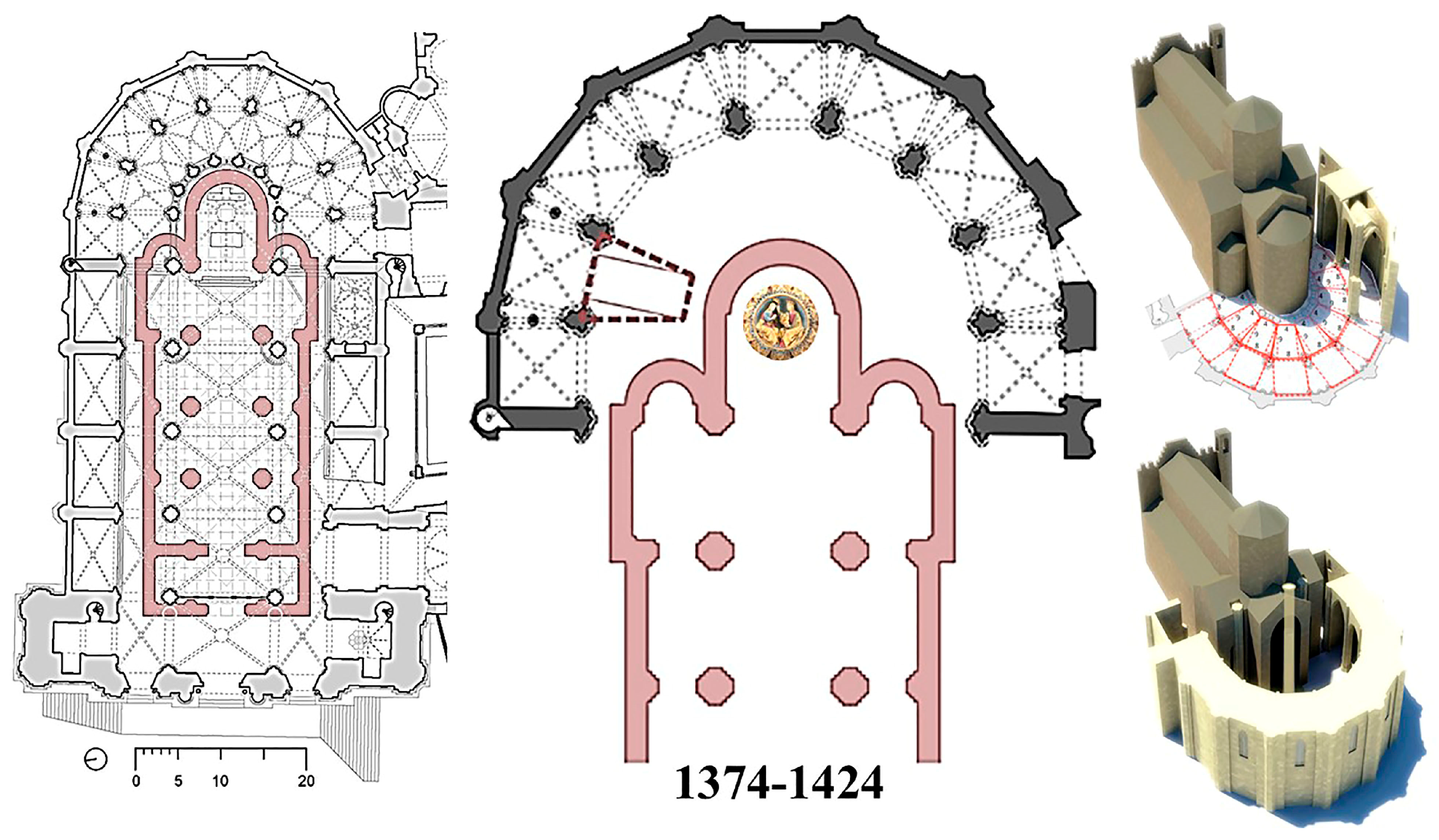
The apse with the double ambulatory was built between 1374 and 1441, embracing and replacing the previous Romanesque cathedral on the outside (
Figure 13). The first phase (1374–1424) involved the construction of the belt of radial chapels, executed in a correlative and sequential manner, from the gospel to the epistle sector. The second determined the construction of the ambulatory (1424–1434), and they were covered symmetrically on the axis of the presbytery, on the balance of a major pillar. Finally, the presbytery was completed (1435–1441) with the placing of the keystone representing the coronation of the Virgin (1439) on the main pillar and the closing of the choir vaults; the first construction phase was finished (
Figure 14).
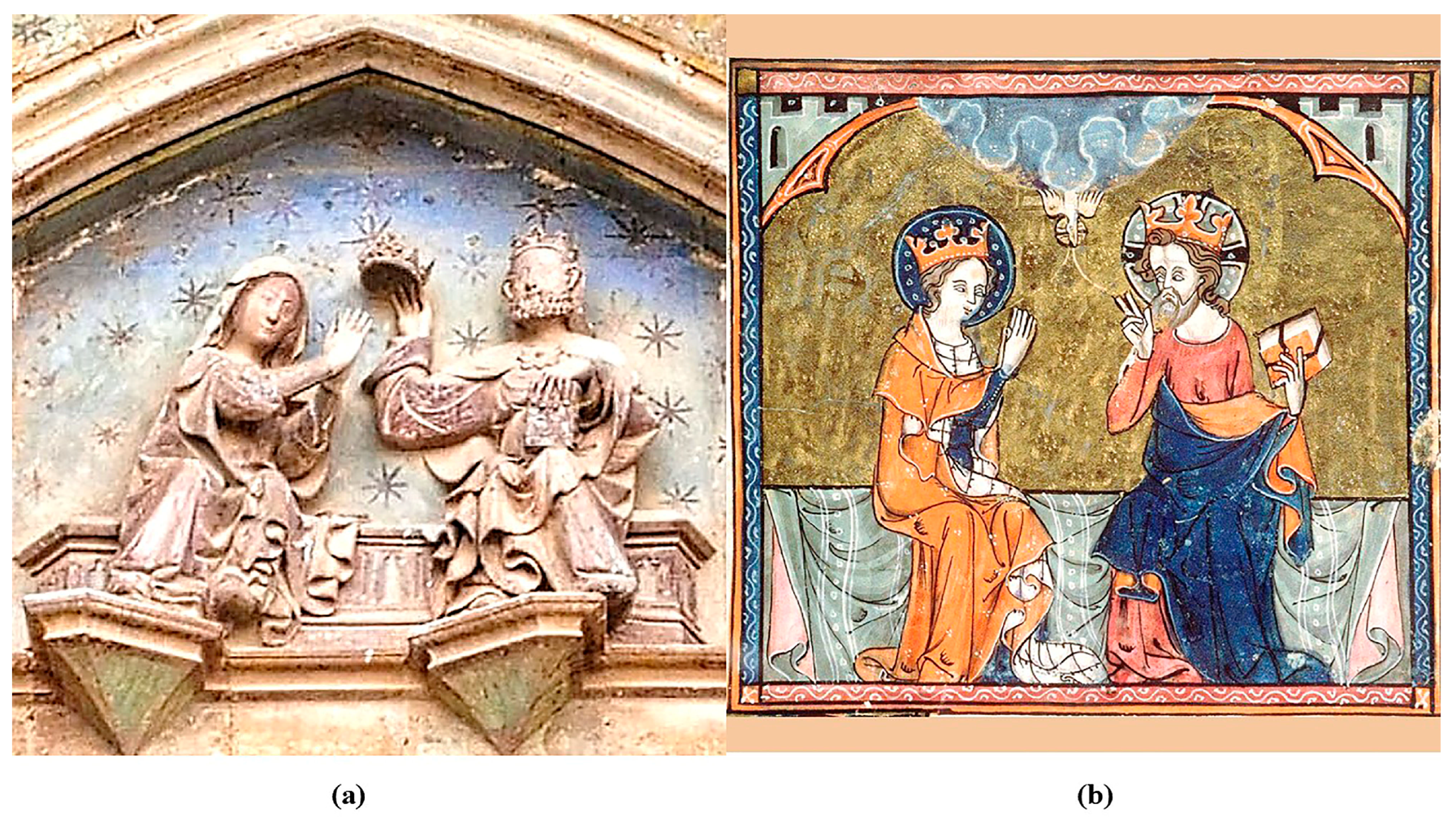
The iconography of the Coronation of the presbytery corresponds to the enthroned Virgin, situated to the right of her Son (
Puigarnau 2023), was already used in the diocese of Tortosa in the construction of the doorway of the Apostles of the Archpriestly Church of Morella after 1352, in which Domènec Prunyonosa (d. 1346) may have participated (
Garcia 2020); he was the son-in-law of Bernat Dalguaire, a master who was in Avignon before starting the cathedral of Tortosa. The tympanum depicts the Coronation of the Virgin before being crowned by her Son with the book in her hands (
Figure 15a), chronologically coinciding with that of the
Psalterium Horae of Avignon (c. 1330–1340), (Avignon, Bibliothèque municipale Ceccan Ceccano, Ms. 121 fol. 47r), already crowned in the presence of the Holy Spirit (
Figure 15b).
In the cathedral, the Virgin appears at the right hand of her Son in the crowning action, crowned with glory and honour, (Hebrews 2:9) with the orb in her hands, bowing before the King of kings and Lord of lords (Revelation 19:16), sharing his throne, and surrounded by the presence of ten angels supported in flight, very similar to the
Horae ad usum parisiensem (1375–1425) from the workshop of the Maître du parement de Narbonne (BnF, NAL 3093-2, fol. 75v) (
Figure 16a), as well as in the case of the Virgin already Crowned seated on the same throne in the Pèlerinage de vie humaine (c. 1370) by Guillaume de Digulleville (c. 1295–1380) from the Bibliothèque Sainte-Geneviève (Ms. 1130 f. 227v) (
Figure 16b).
The Angels surrounding the coronation are referred to in the
De civitate Dei (BnF, Franc. 24 fol. 262v) (15th c.) (
Figure 16c). The whole is protected by eleven-winged dragons arranged on the crossing arches that converge in the main keystone, signifying the battle to be won by the representative of Virtue (
Figure 17). The roughhewn and carved block with the sculptural decoration was attributed to Bartomeu Santalínia, who was active in the cathedral between 1420 and 1440, belonging to a family of goldsmiths (
Almuni 2007, vol. 2, p. 538), and was employed for 59 days between May and July 1439 (
Almuni 2007, vol. 1, p. 181). The placing of the keystone before the closing of the vaults took place on a date that was likely chosen with precision. While the Feast of the Assumption was celebrated on the fifteenth of August, Jacobus de Voragine describes how the Virgin was resurrected forty days after her death and dormition, in the presence of the apostles who had carried her body to the tomb (
Voragine 1999, p. 482).
This chronological precision is confirmed by a deed dated 27 September 1439, the date on which the placement of the Coronation keystone was celebrated. This event coincided with the first Sunday following the forty-day period described by Voragine. The occasion was marked by a solemn ceremony with a Eucharist dedicated to the Assumption, featuring the opening of the altarpiece and the ringing of bells, signalling the culminating moment in the construction of the presbytery (
O’Callaghan 1887, pp. 17–20).
6. The Coronation, Sciencia Theoria Versus Sciencia Practica
The quarrying of the 10 × 10 × 6 palms (2.323 × 2.323 × 1.394 m) keystone, which possessed a volume of 6.944 m
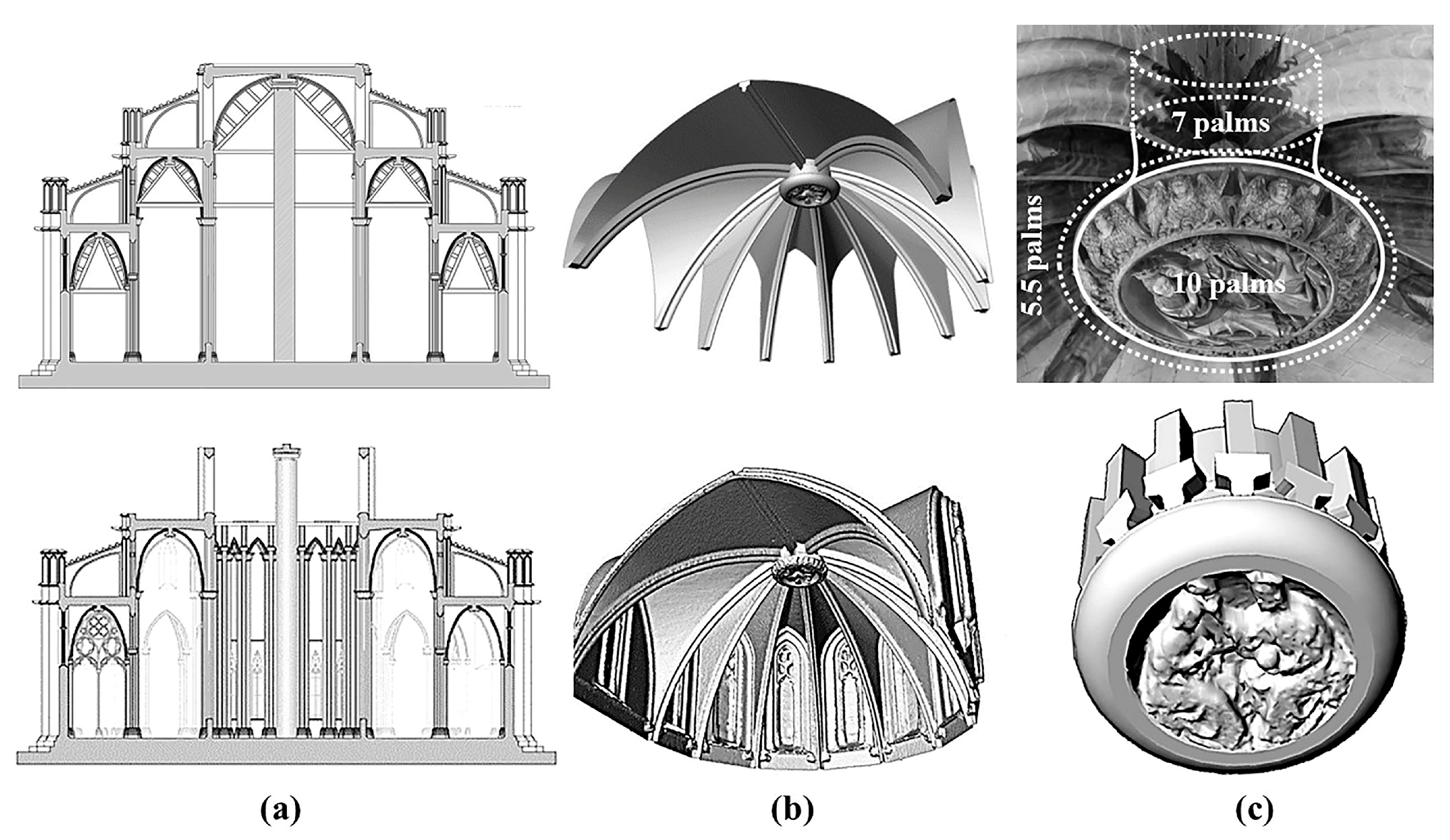
3 and a weight of 18.678 tonnes (1867.846 KN), was a formidable undertaking. Following an initial unsuccessful extraction attempt at the quarry on the banks of the Ebro River, a delegate representing the Master of Works travelled to the site in June 1438 to personally oversee the selection of a second block (ACTo, ll. o. 1437–1438, fol. 35r). The river transport and unloading of the piece in January 1439 entailed repair work both in the port and in the street that was to take it to the cathedral (ACTo, ll. o. 1438–1439. fol. 27r) (
Figure 18a). The size of the neck (1.625 m ± 1.502%) is within the range of 7 spans, and the height (1.280 m ± 1.502%) within 5.5 spans, where the eleven crossing arches concur (
Figure 18b). Although the crown of angels’ measurements were not exact (203.00 m ± 1.502%), due to the difficulty of the stone carving, it is possible to think that it could have been ten spans (2.323 m) in diameter, weighing 97.916 kN (9.8 tons) (
Figure 18c).
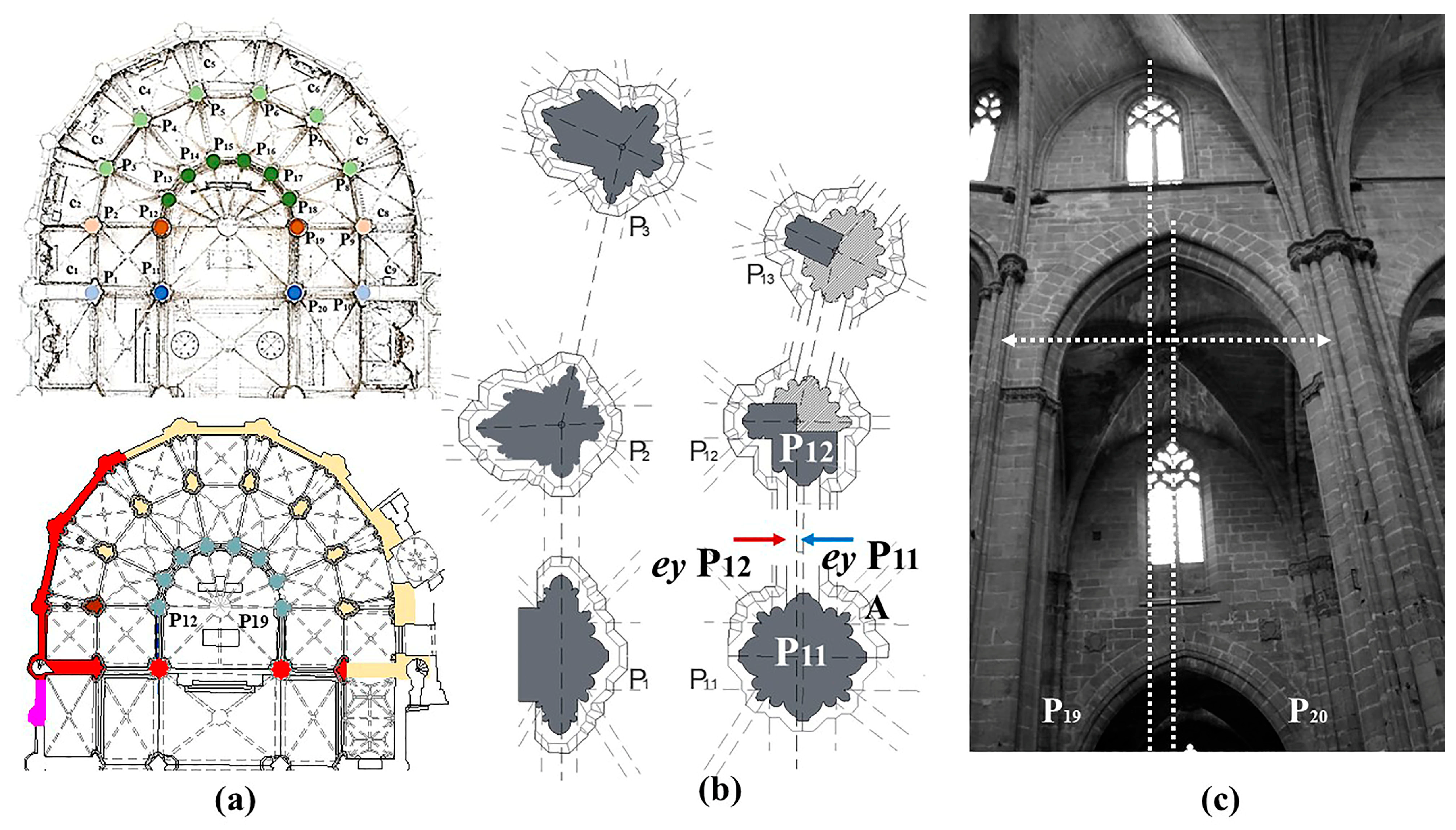
The decision of the keystone measurement must have been taken in the change in model of the pillars of the presbytery (P12–P19) made by Pascacio Xulbi (ac. 1383–1441) and Juan Xulbi (ac. 1416–1428) (
Figure 19a), where there was a readjustment of the geometric centre with respect to pillars P19 and P20, so that the displacement of P11 and P12 was 0.107 m, and that of between P19 and P20 was 0.168 m (
Figure 19b). This circumstance had consequences on the design of the vaults with respect to the arches; this correction of (0.248 m) is perfectly visible in the first portico of the apse (
Figure 19c). The centres of the chancel pillars (P-P
11,12) and (P-P
19,20) correspond to a radius of 27 spans, half of the 54 spans (2 × 27) of the width of the chancel (2 × 27). In turn, the ambulatory was set out at 108 spans (2 × 2 × 27).
The height of the main keystone is determined indirectly through the points (TLS). Knowing a point A (22.908 m), and given that it has a quarter section, we can deduce, by prolonging this arch, that the centre of the keystone is 23.237 m from the pavement, metrologically 100 palms (23.230 m). The
De civitate Dei deals with the final judgement in Book XX (ACTo 20 fol. 333r–359r), regarding the two resurrections and the thousand years of the apocalypse (
Civ. Dei XX.7) (fol. 337v–338v); it uses it to designate the temporality of the world, using a perfect number to denote the fullness. The number one thousand is the cube of ten, and ten times ten is one hundred. This is a flat figure, and to make it solid, it is necessary to multiply a hundred by ten, and we have the thousand (
Civ. Dei XX.7.2) (
Augustine of Hippo 1864, col. 667–68).
Hypothetically, it is possible to think that the keystone could have had ten spans, so that 10 multiplied by 10 equals 100 spans, and by 10 it becomes a cube, resulting in 1000, the fullness of time. The interior width of the cathedral of 150 spans is determined from the statistical value of its radii (17.423 ± 0.065 m (17.423 m)), which is equivalent to 75 spans. Given the
Supra psalterium (ACTo [6]) of the old inventory, interpreted as
Enarrationes in Psalmos (392) in the commentary on Psalm 150, Augustine of Hippo will make the great apology of this number (
Augustine of Hippo 1865, col. 1960–1964). He considers that 150 is constructed from fifteen times 10, considering 15 as the conformity of the two Testaments (
Enr. Psal. 150, 1). He adds that 50 refers to penance, 100 to mercy and judgement, and 150 to the praise of God that we are on our way to eternal life (
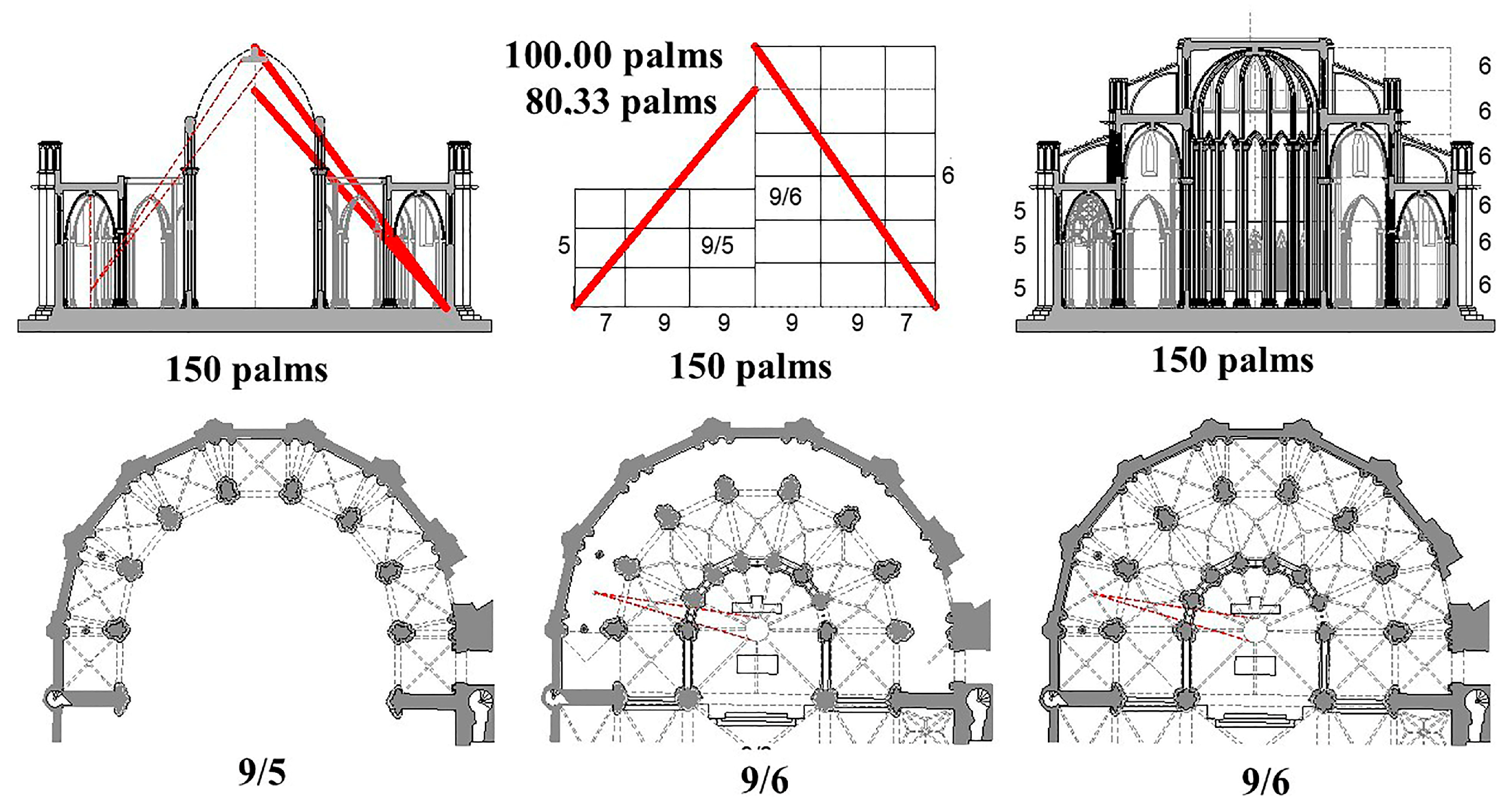
Enr. Psal. 150, 3). Analysing the relationship between the size of the ground plan and the height of the radial chapels (45 spans) in relation to the proportionality of the theory of the Gothic section, it expresses an initial development of (9 ÷ 5). The reference of the keystones of the ambulatory [16.070–15.94 m] is close to 70 spans, and the main keystone is 100 spans over a total width of 150 spans 594 with an unfolding of (9 ÷ 6).
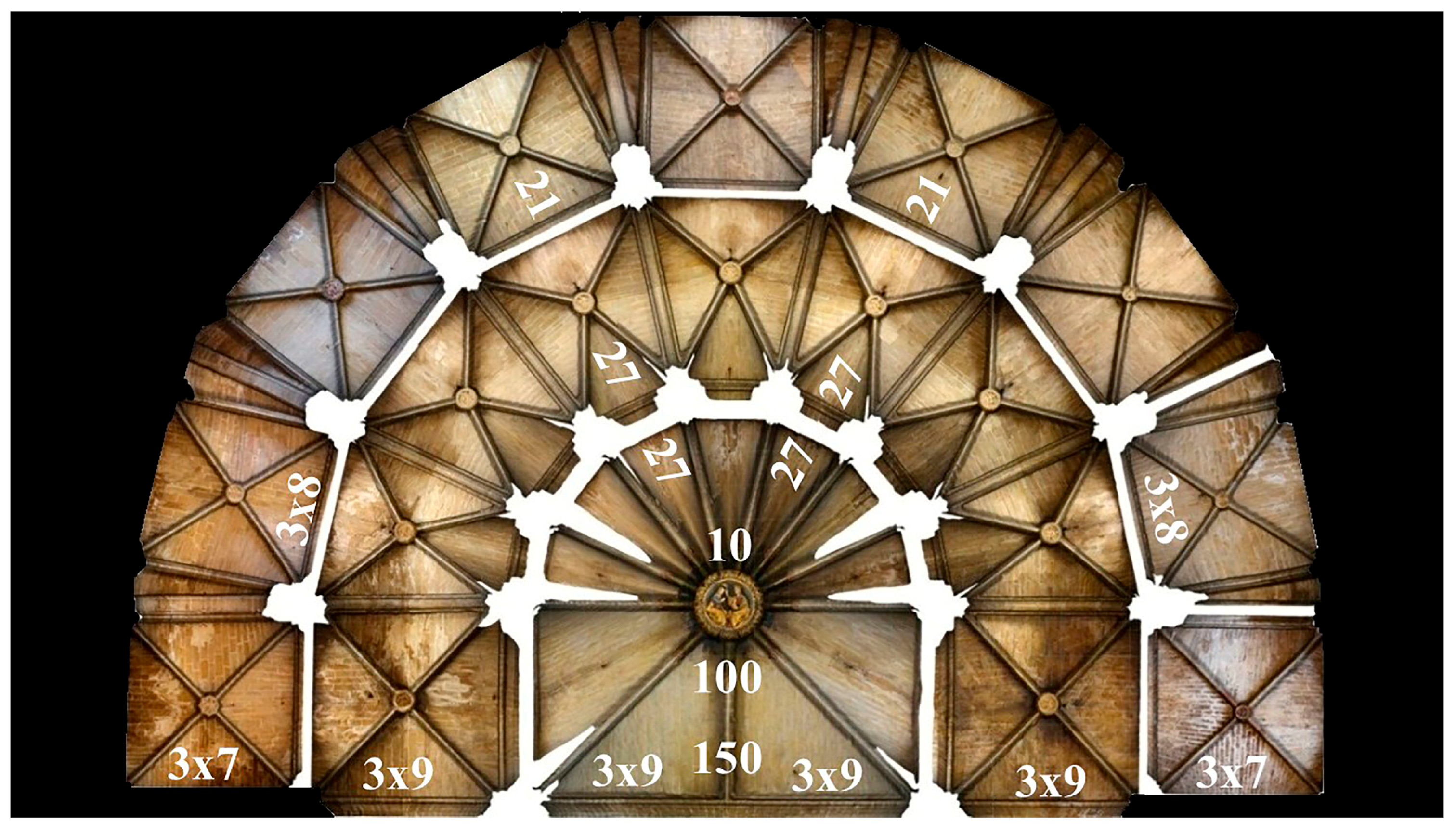
The points on the plan of measurements [81-105-150 palms] give rise to a height of [45-70-100 palms. The evidence of the change in proportionality of the Xulbi model entailed a structural and visual change, where the image of the Coronation of the Virgin not only 598 had a central vision but also presided centrally over the chapels of the ambulatory (
Figure 20). The metrological condition is based on the width of the chapel with 24 palms (3 × 8 p), or three canes of Tortosa, constructing a total interior width of 150 by 100 p in height. The 150 is equal to [21-27-27-27-2727-21 p] since the radial chapels have 21 spans, so the metrological construction is (3 × 7, 3 × 9, 3 × 9, 3 × 9, 3 × 9, 3 × 9 3 × 7 p) and the apse can be traced without tracing a circumference that inscribes it (
Figure 21).
The presidency of the Coronation of the Virgin as the crown of the presbytery of the cathedral of Tortosa (
Figure 22) is in the middle of an orderly sequence related to
De civitate Dei (413–426) (ACTo 20) and the spirit of Saint Augustine among the bishops and the Chapter that built the apse. These recognise in the
De ordine, libri duo (386) that the programme of the Trivium and Quadrivium is the basic instrument for the understanding of the Holy Scriptures. St. Augustine proposes the formation of man in the arts (
De Ord. II.16, 44) since they promote the elevation of the spirit on the way to God (
Augustine of Hippo 1845, col. 1015). In the
Confessionum, libri tredecim (397) (ACTo 230), he says that he understood geometry, music and arithmetic, because the ability to understand and sharpness in discernment are gifts of God (
Conf. IV, 16, 30), (
Augustine of Hippo 1845, col. 705).
He resolves that what unfolds reasonably in orderly forms was designated by the name of rhythm, numerus (
De Ord. II, 14, 41) (
Augustine of Hippo 1845, col. 1014), so that he sees the necessity of the study of numbers for the order of music, geometry and movement of the stars (
De Ord. II, 5,14) (
Augustine of Hippo 1845, col. 1011). He defines geometry as the beauty in the figures, and in figures, the dimensions, and in dimensions, the numbers; he inquired whether in the real are lines and spheres or any other form and figure, as they are contained in the intelligence. He called geometry the science that distinguishes and orders this knowledge (
De Ord. II.15, 42) (
Augustine of Hippo 1845, col. 1014).
7. Conclusions
The Gothic Cathedral of Tortosa, begun in 1346 under the pontificate of Bernat de Oliver—a member of the Ordo Fratrum Sancti Augustini—constitutes an exceptional example of architecture as material exegesis. The project not only responds to the principles of ecclesiastical repositioning established in 1155 by Bishop Godofredo (+1165) of Avignon, linked to the Rule of Saint Augustine and the customs of Saint Rufus but also materialises a quest for knowledge rooted in the vast Augustinian bibliographic legacy still preserved in the Chapter Archive.
The subsequent connection with the Papal See in Avignon—evidenced by the iconography of the Coronation of the Virgin on the main keystones, inspired by French codices such as the Psalterium Horae, and confirmed by the travels of master builders like Bernat Dalguaire and Andreu Julià—reveals a high-level transfer of intellectual and technical models. However, the most significant contribution of this research lies in the technical verification through the analysis of the keystone using photogrammetry (CRP) and (TLS), thereby demonstrating an exact metrological coincidence with Augustinian numerical patterns (10, 100, and 150).
This convergence between the scientia theoria of the Cathedral Chapter and the scientia practica of the builders finds its documentary support in works such as De Civitate Dei and Enarrationes in Psalmos, both present in the chapter library. Ultimately, this methodological process allows for the scientific validation, in the case of Tortosa, of the classical historiographical theses of Wilhelm Worringer and Erwin Panofsky. It thus confirms the intrinsic relationship between the mental structure of Late Classical thought and the architectural proportion of its cathedrals. In this manner, the cathedral represents a theological structure transformed into a structure of stone.
As a final colophon, the survival for nearly six centuries of the De laudibus Virginis Mariae—manifested in the chanting of the Ave Maris Stella beneath this very keystone—bears witness to the persistence of a sacred memory found in its ancient codices. It is thus linked to the symbolism of the Temple of Solomon and the Stella Maris of Bernard of Clairvaux, ensuring that the liturgy continues to inhabit, even today, a space whose geometry and proportions were originally dictated by the influence of Augustinian thought.