Article

Restoring Faith and Form: Challenges and Strategies in the Preservation of Lord Guan Temples in Southern Shanxi


Faculty of Arts and Social Sciences, The University of Sydney, Sydney, NSW 2006, Australia
*
Author to whom correspondence should be addressed.
Religions 2026, 17(2), 265; https://doi.org/10.3390/rel17020265
Submission received: 30 January 2026 / Revised: 16 February 2026 / Accepted: 18 February 2026 / Published: 20 February 2026
(This article belongs to the Special Issue Temple Art, Architecture and Theatre)

Abstract

Guan Yu (d. AD 220), better known by his posthumous title as Guan Gong or Lord Guan, was a prominent military general in the late Han dynasty (AD 206–220). For centuries, Lord Guan has been widely worshipped as both a god of war and a god of wealth throughout China. His worship is particularly prevalent in southern Shanxi, which is celebrated as his birthplace. This region features a notable array of temples dating from the late imperial period, many of which are specifically dedicated to his cult. As tangible heritage, Lord Guan temples represent a significant facet of Chinese architectural and religious history. Today, they continue to serve as religious spaces, where pilgrims and devotees come together to honour the deity through ritual practices and theatrical performances. These activities not only reinforce the community’s religious beliefs but also help to perpetuate the cultural and historical traditions associated with Lord Guan’s worship. Based on fieldwork conducted between 2023 and 2025, the study scrutinises the restoration, preservation and conservation challenges faced by these sacred spaces and structures, emphasising the ongoing tension and collaboration between grassroots religious practices and state-led restoration initiatives. Through this examination, the paper sheds light on the multifaceted nature of tangible and intangible heritage conservation and its implications for Lord Guan’s cult in contemporary society.

1. Introduction

In 2024, the release of the action role-playing game Black Myth: Wukong unexpectedly drew national and international attention to Shanxi Province, a region not typically regarded as a major tourist destination in China. Of the game’s thirty-six major filming locations, twenty-seven are situated in Shanxi (China National Radio 2024), propelling the province’s extraordinary cultural heritage into the public eye. The old saying—‘For China’s underground relics, look to Shaanxi; for its above-ground heritage, look to Shanxi’—is hardly an exaggeration: nearly eighty per cent of China’s surviving historic architecture stands in Shanxi, where traces of the past remain visible almost everywhere—one only needs to look up (Fang and Zhu 2025).
Within this rich architectural landscape, Lord Guan temples occupy a distinctive place. One such temple features prominently in Black Myth: Wukong, underscoring the enduring cultural visibility of these sites. As sacred spaces, Lord Guan temples function simultaneously as places of worship, where devotees offer sacrifices and pray for blessings, and as cultural institutions that sustain and reinforce the Lord Guan cult.
This paper argues that an interdependent relationship exists between faith and form: believers’ devotion enhances the religious and social significance of the temples, while the physical structures themselves serve as material anchors that preserve and perpetuate the cult. Their preservation thus requires attention to not only tangible heritage—the temples and temple theatres—but also to intangible heritage, including ritual practice and theatrical performance.
This dynamic is embedded in China’s broader religious, cultural and architectural landscape. Across the country, especially in rural areas, it is not uncommon to find multiple temples dedicated to local deities and nationally venerated gods within a single village. A case in point is Jiacun Village, Lucheng in southeastern Shanxi, which boasts seventeen temples and shrines, including one dedicated to Lord Guan (Zhao 2021). Indeed, Lord Guan occupies an exceptionally prominent position in the Chinese pantheon, a status reflected in the widespread presence of temples dedicated to him across the country. His cult was added to the National-level List of Intangible Cultural Heritage (Guojiaji feiwuzhiwenhua yichan minglu 國家級非物質文化遺產名錄) in 2008 (The State Council of the People’s Republic of China 2008), and since then, many temples and related ritual traditions have been recognised as both tangible and intangible cultural heritage at national and local levels.
As tangible heritage, Lord Guan temples have long shaped the development and dissemination of his cult. Equally important are Lord Guan temple theatres, which occupy a crucial intersection between religious devotion and traditional Chinese opera (xiqu). As spaces for ritual and theatrical performances, these temple theatres play a crucial role in conveying Lord Guan’s virtues and heroic deeds. Ritual and theatrical performances held during temple festivals and seasonal celebrations reaffirm community devotion while continually revitalising xiqu traditions (Zhao 2021; Tian and Zhao 2025). Temple theatres thus constitute an essential component of both Chinese temple and theatre history.
This study draws on extensive fieldwork conducted in southern Shanxi between 2023 and 2025. Through interviews, ethnographic observation and documentation of restoration sites, it examines both state-funded and grassroots efforts to conserve Lord Guan temples and temple theatres. These practices reveal intricate negotiations between professional conservation frameworks and vernacular modes of maintaining intangible heritage rooted in ritual, performance and community participation. They also highlight how professional conservation intersects with the daily practices that give these structures meaning.
Building on these observations, this paper explores how devotion, authenticity and sustainability may be balanced in contemporary conservation efforts. Lord Guan temples embody irreplaceable cultural value; without appropriate preservation, they risk gradual physical deterioration that threatens not only the buildings themselves but also the survival of the Lord Guan cult. The loss of these structures would entail more than architectural decline: it would signify the erosion of a living tradition that continues to shape local identities and sustain cultural continuity.

2. Literature Review

The origins of heritage conservation are often traced to nineteenth-century Europe, where Eugène Viollet-le-Duc (1814–1879) and John Ruskin (1819–1900) articulated two fundamentals yet opposing perspectives (Muñoz-Viñas 2005, p. 4). Viollet-le-Duc (1875, p. 14) advocated for restoring architecture to an idealised original state—often one that may never have existed in practice—while Ruskin ([1840] 2001, pp. 252, 254) condemned restoration as ‘the most total destruction which a building can suffer’ and rejected any attempt to recreate the past as ‘a lie from beginning to end’. These divergent positions have shaped subsequent debates in conservation theory, inspiring generations of scholars to reflect on questions of authenticity, interventions and cultural and historical continuity.
In recent decades, scholarly research on heritage conservation has expanded significantly, yielding a diverse range of perspectives and approaches addressing both tangible and intangible heritage. Governments, NGOs and academic communities increasingly recognise that intangible cultural heritage—rituals, religions, craftsmanship, performance traditions and other embodied knowledge—is crucial to sustaining community livelihoods and cultural diversity in an era of globalisation (Stefano et al. 2012). This shift reflects broader debates about the dynamic, living nature of cultural heritage and the need to preserve not only physical structures but also the practices and beliefs that animate them.
In China, modern architectural conservation began with early-twentieth-century efforts led by Zhu Qiqian 朱啟鈐 (1872–1964), who founded Zhongguo yingzao xueshe 中國營造學社 (the Society for Research in Chinese Architecture) in 1930. He appointed Liang Sicheng 梁思成 (1901–1972) and Liu Dunzhen 劉敦楨 (1897–1978) as deputy directors. During the 1930s, Liang and his wife, Lin Huiyin 林徽因 (1904–1955), undertook extensive surveys across China, documenting more than 1000 architectural structures from the medieval and late imperial periods. Their work laid the foundation for both architectural historiography and systematic preservation practices in China.
Building on this foundation, Liang developed a theoretical framework that remains influential today. His principle of ‘restoring the old as it was’ (xiujiu rujiu修舊如舊) emphasised maintaining original form and materials rather than replacing them with new fabric (Liang 1963, p. 6). This approach reflected an emphasis on authenticity and continuity that distinguishes much of Eastern Asian conservation philosophy. Liang applied this principle in major projects, including the Temple of Confucius in Qufu, the Wenyuan Pavilion in the Forbidden City, the Wanchuan Pavilion in Jingshan Park, the Liuhe Pagoda in Hangzhou, and the Tengwang Pavilion in Nanchang. A significant milestone came in his 1935 report, Qufu Kongmiao zhi jianzhu jiqi xiuqi jihua 曲阜孔廟之建築及其修葺計劃 (The Architecture of the Confucius Temple in Qufu and Its Restoration Plan), where he systematically proposed—arguably for the first time—the principle of ‘restoring old buildings to their original state’, marking a turning point in Chinese conservation history.
Subsequent scholarship has extended these concerns to temple–theatre complexes that embody both tangible and intangible heritage. Since the 1980s, the Research Institution of Xiqu Relics at Shanxi Normal University (SXNU) has played a leading role in documenting and preserving these structures, particularly in rural areas where Lord Guan temples and temple theatres remain central to local ritual life. Their research has yielded substantial insights into architectural design, historical evolution and performance traditions. Feng (2006), for example, examines five Lord Guan temple theatres dating from the Hongwu 洪武 (1368–1398) to the Kangxi 康熙 (1662–1722) eras, offering a detailed analysis of their spatial configuration and ritual–theatrical functions. Niu (2014) explores sacrificial drama at the Lord Guan Temple in Yangqu County, highlighting its social and cultural significance. Additional studies published in Chinese Traditional Opera (Zhonghua xiqu 中華戲曲)—including Li (2011), Wei (2011), Shao (2013), Xu (2014), Yan (2015) and Cheng and Cheng (2016)—as well as theses by Wan (2020), Dong (2019), Q. Yang (2016), etc., contribute regional case studies and fieldwork-based analyses that enrich our understanding of how these spaces mediate between devotion and performance.
Research on the architecture of Lord Guan temples and Lord Guan temple theatre stages also provides important context. Chai (2002) offers a detailed study of the Haizhou Lord Guan Temple, analysing its layout and restoration, although the temple’s state-funded restoration limits insights into local religious community participation. Zhang (2006) investigates the architectural features of Lord Guan temples in Shanxi, arguing that these temples serve not only as sites for worshipping Lord Guan but also as venues for everyday social activities within local communities.
Temple theatres—primary venues for ritual and theatrical performance—are ubiquitous in southern Shanxi, the birthplace of Lord Guan. These structures have witnessed the historical development of both the Lord Guan cult and its associated xiqu performances, yet they have not received sustained scholarly attention. Existing studies tend to focus on either architectural conservation or ritual and theatrical aspects within theatre historiography. However, they often overlook the intricate interplay between local devotion and state-led restoration, as well as the mutually constitutive relationship between tangible structures and intangible practices.
This study addresses these gaps by integrating fieldwork and archival research to examine how tangible and intangible heritage interact in the preservation of Lord Guan temples and temple theatres. It highlights how state conservation frameworks, community devotion and ritual–theatrical traditions shape one another, thus establishing the foundation for the argument developed in the subsequent sections of this paper.

3. Cultural Significance and Current State of Lord Guan Temples

The cultural and religious significance of Lord Guan temples is inseparable from the long and complex history of Guan Yu 關羽 (d. AD 220), later venerated as Lord Guan (Guangong 關公) and Emperor Guan (Guangdi 關帝). Originally a military general under Liu Bei 劉備 (161–224) of Shu Han 蜀漢 (221–263), Guan Yu’s reputation for loyalty and martiality led to his deification from the Sui and Tang periods (581–907) onward and rapid ascent within the Chinese pantheon during the Song period (960–1279). By the Ming (1368–1644) dynasty, he had been officially honoured with the imperial rank of di 帝 and accumulated more than 1600 years’ worth of posthumous titles. His cult has permeated the religious life of China—including Buddhism, Daoism and Confucianism—as well as the daily practices of communities across the country. The circulation of his historical, legendary and mythic narratives, especially through xiqu from the Song-Yuan period onwards, further broadened the reach of his cult and cemented his presence in temple festivals and ritual performances. Nowhere is this more visible than in Haizhou, in southern Shanxi, the heartland of his cult and the setting for many long-standing ritual practices.
Haizhou Lord Guan Temple, recognised as the oldest and largest of its kind, stands as the symbolic centre of this devotional landscape. First built during the Chen (557–589) or the Sui dynasty (557–618) (Chai 2002, p. 11), the Haizhou temple represents the earliest institutionalised form of Lord Guan worship. Yet the spread of his cult was neither confined to Haizhou nor limited to monumental temples. Rural Shanxi—particularly Zezhou, Gaoping and surrounding areas—once hosted dense networks of Lord Guan temples. Yao (2013, p. 40) records 268 Lord Guan temples in Zezhou alone during the Qing dynasty, while Hao and Yang (2019, p. 22) note that every village in Gaoping historically had at least one, with some villages housing multiple temples. Although the Cultural Revolution and urbanisation led to the destruction of many sites, a considerable number still survive, underscoring the historical depth and geographical breadth of the Lord Guan cult.
In the architectural and spatial design of Lord Guan temples, the temple theatre stands out as one of the most iconic features. Shanxi, particularly its Jinnan region, has preserved a rich heritage of xiqu performance, and temple theatres continue to serve as a venue for both ritual and theatrical activities. Theatrical performances staged at Lord Guan temples are not restricted to Lord Guan narratives; plays featuring a wide range of characters and storylines are also common. Likewise, Lord Guan plays may also be performed in temples devoted to other deities, reflecting an established cultural logic in which theatrical performance is both an expression of devotion and an integral part of communal celebration. Participant observation of the annual ritual performance of ‘Lord Guan Patrols the City’ (Guangong xuncheng 關公巡城) during the Lord Guan Temple Festival in Haizhou on 26 May 2023 confirms that ‘blessing’ and ‘play’ remain at the core of the temple festivals for performers, pilgrims and spectators (Tian and Zhao 2025, p. 94). These observations align with the arguments in the Introduction and Literature Review sections, in that intangible heritage—ritual practices and theatrical performances—operates in dynamic interplay with the tangible structures that host them.
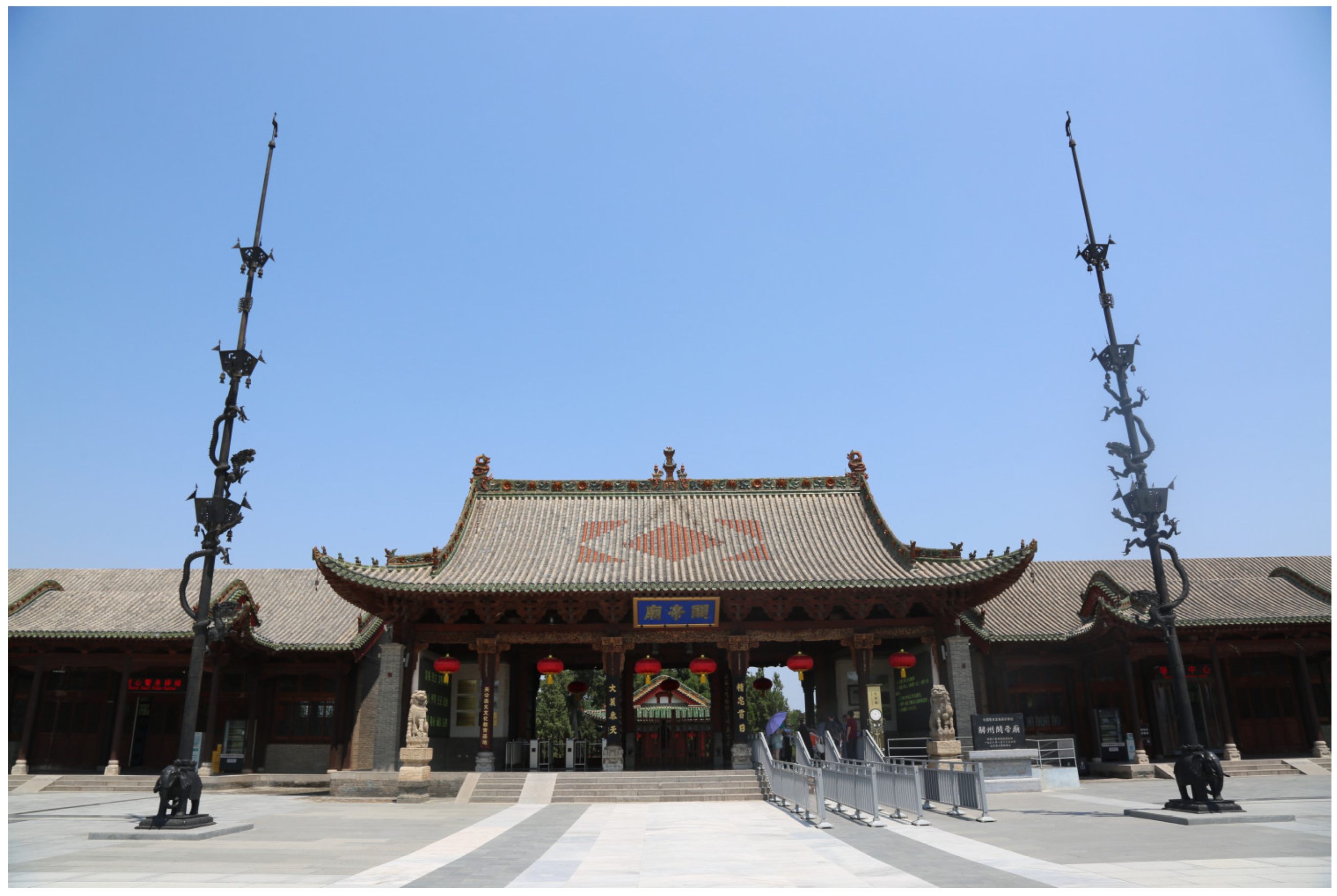
Our fieldwork in Jinnan between 2023 and 2025 further illustrates the diversity and uneven conditions of surviving Lord Guan temples there. Nearly one hundred sites were examined, ranging from single-courtyard (danjin 單進) to triple-courtyard (sanjin 三進) complexes; as shown in Appendix A, they vary significantly in scale, craftsmanship and condition. At one end of the spectrum stands the meticulously conserved Haizhou Lord Guan Temple (Figure 1). Oriented along a traditional north–south axis, the temple complex—measuring 500 m in length and 216.5 m in width, and covering an area of 108,250 m2 —include a sequence of monumental structures: the Main Entrance (duanmen 端門), the Pheasant Gate (zhimen 雉門), the Theatre Stage, the Meridian Gate, the Wooden Memorial Archway, the Emperor Inscription Tower (yushu lou 御書樓), the Hall for the Veneration of Peace (chongning dian 崇寧殿) (also called the Main Hall or zhengdian 正殿) and the Spring and Autumn Tower (chunqiu lou 春秋樓), where Lord Guan’s sculptures are situated. The Garden of Sworn Brothers (jieyiyuan 結義園) reinforces the temple’s symbolic associations with loyalty and brotherhood.
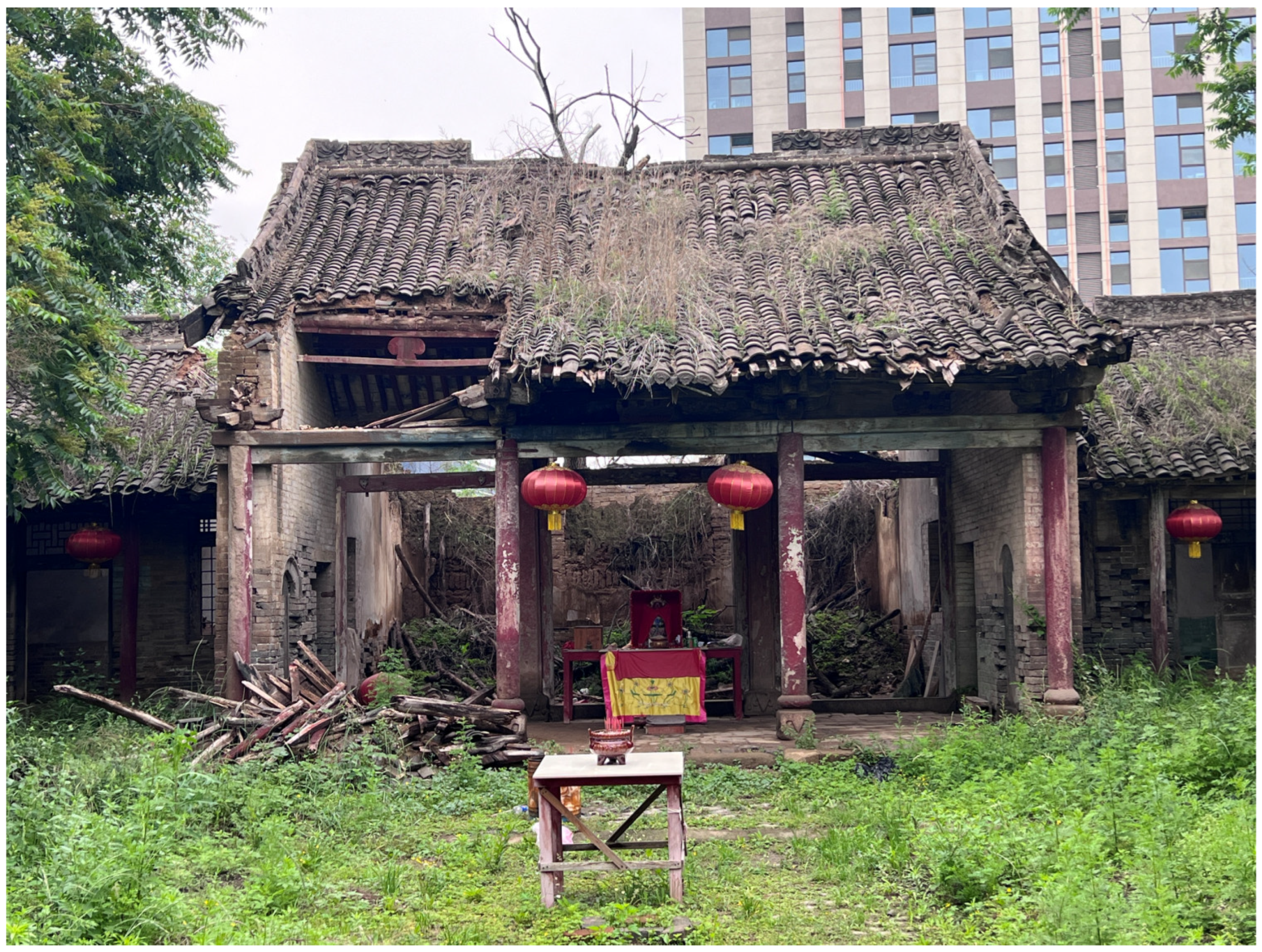
In stark contrast, most rural Lord Guan temples are in varying states of decline. Natural degradation—rot, fire, and seismic damage—has been exacerbated by human-induced destruction, most notably the Cultural Revolution (1966–1976). In many impoverished villages, limited financial resources prevent timely repairs, leading to the gradual collapse of key structures. In Gangtou 崗頭, Jincheng, for example, villagers set up an altar in the crumbling temple hall and placed a donation box on it to raise funds for restoration (Figure 2). Meanwhile, damage wrought by historical events is often irreversible, as illustrated by the severely defaced sculptures on the eave columns of Lord Guan Temple in Hetaowa 核桃窊, Jincheng (Figure 3). These cases echo the broader issues raised in earlier sections: formal conservation frameworks may exist, but the survival of both tangible and intangible heritage ultimately depends on local resources, community commitment and the continuing relevance of ritual life.
Taken together, these observations underscore the dual nature of Lord Guan temples as both cultural and architectural relics animated by ongoing ritual and theatrical performance traditions. The wide variation in their current condition—from exemplary preservation in major sites to perilous decay in many rural communities—demonstrates how historical circumstances, economic capacity and community devotion shape their trajectories in an uneven way. The challenges faced by these temples, therefore, cannot be understood solely in terms of structural conservation. Their long-standing role as centres of ritual life, theatrical expression and local identity means that the safeguarding of these sites must address not only the survival of their material fabric but also the continuity of the practices and meanings that give them life. A sustainable approach to their preservation must therefore recognise the interwoven relationship between built form, cultural memory and living tradition, treating these temples not as static relics but as evolving cultural ecosystems sustained through the interplay of faith, performance and participation in communication.

4. Government-Involved Restoration Efforts

As tangible embodiments of belief and carriers of cultural heritage, Lord Guan temples require preservation strategies that address both their architectural fabric and their embedded ritual life. Government engagement has long shaped the conservation landscape in China, although historical records also reveal significant contradictions. Since the 1960s, the Chinese state has built an extensive legal and administrative framework of cultural heritage protection, and by 2019, a total of 5058 sites had been officially designated as ‘Key National Cultural Heritage Protection Units’ (quanguo zhongdian wenwubaohu danwei 全國重點文物保護單位), including 2160 architectural sites (State Council Information Office 2019). At the same time, many historic structures were severely damaged or destroyed during the Cultural Revolution, as documented in the ‘List of Cultural Relics Destroyed during the Cultural Revolution’ (Weiji Baike 2025). This historical tension underscores the complexity of state involvement in cultural preservation, which combines both efforts towards protection and episodic destruction.
Today, heritage protection operates through a multi-tiered system of ‘Cultural Relic Protection Units’ (wenwu baohu danwei 文物保護單位) at the national, provincial, municipal, and county levels. ‘the Law of the People’s Republic of China on the Protection of Cultural Relics’ (Zhonghuarenmin gongheguo wenwubaohu fa 中華人民共和國文物保護法, revised in 2024) specifies that national-level Cultural Relics Protection Units are approved by the State Council on the basis of their exceptional historical, artistic, or scientific value, while provincial, municipal and county governments approve protection units at their respective levels, with corresponding obligations for registration and oversight (NCHA 2024, Art. 23). Unclassified immovable cultural relics must also be recorded and publicly announced by the county level (NCHA 2024, Art. 23). This framework establishes the administrative environment in which temples—including Lord Guan temples—are managed, funded and prioritised for conservation.
Haizhou Lord Guan Temple exemplifies this hierarchical system. First designated as a provincial-level Cultural Relic Protection Unit in 1957 and elevated to the status of a Key National Cultural Relic Protection Unit in 1988, the temple has benefited from significant state investment. According to Fu Wenyuan 傅文元, head of the Bureau of Cultural Relics for Haizhou Lord Guan Temple, its prominence has resulted in preferential government funding. From 2010 to 2012, the National Development and Reform Commission allocated 74 million yuan to resurface temple grounds and rebuild walls. Between 2015 and 2016, an additional 17.43 million yuan was used to restore major architectural components—including the Main Gate, the Pheasant Gate, the Meridian Gate, the Main Hall and 183 side halls—as well as the Halls of the Princes and the Sacrifice Hall in the Changping Ancestral Shrine were also repaired (Fu, personal interview, 31 January 2024).
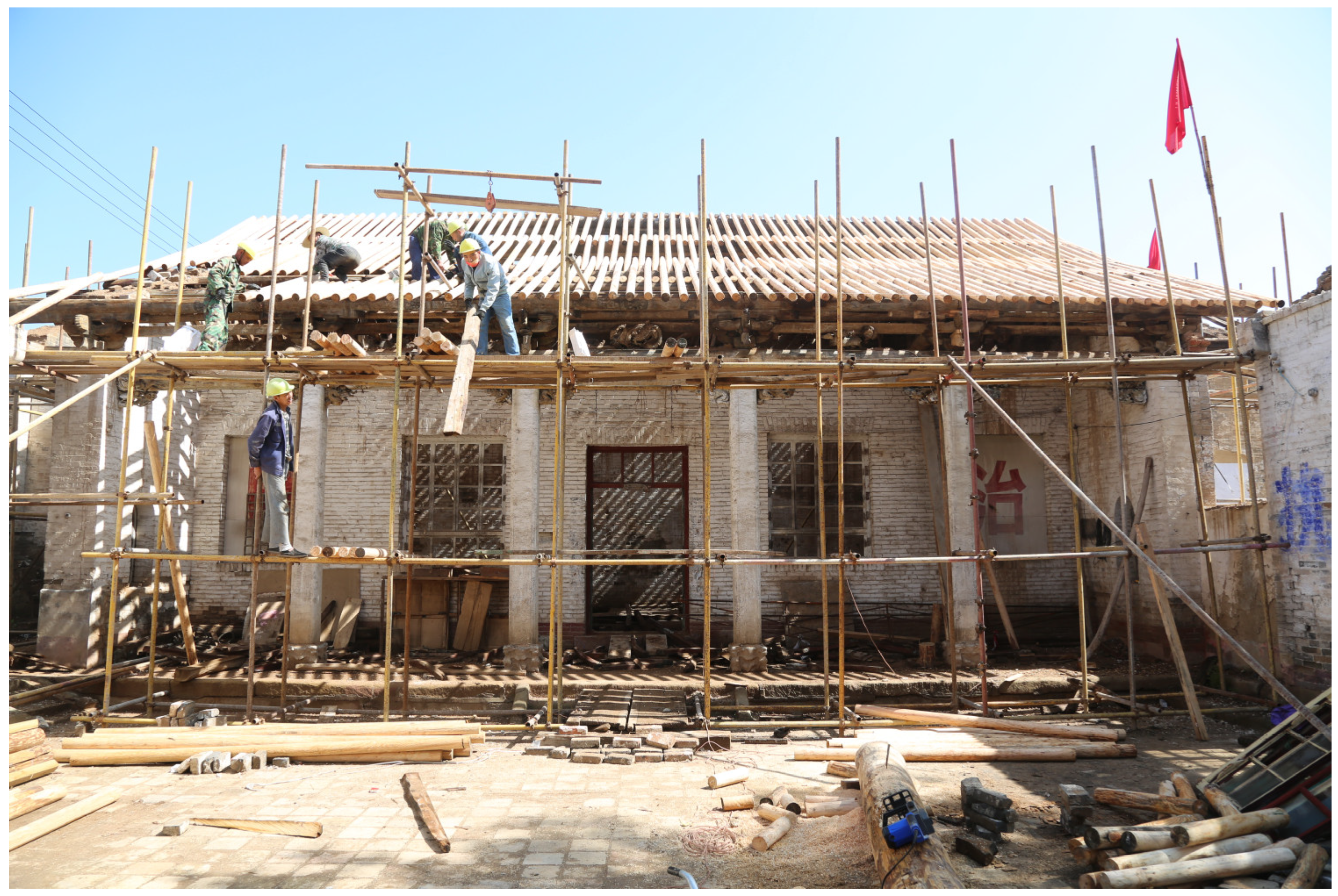
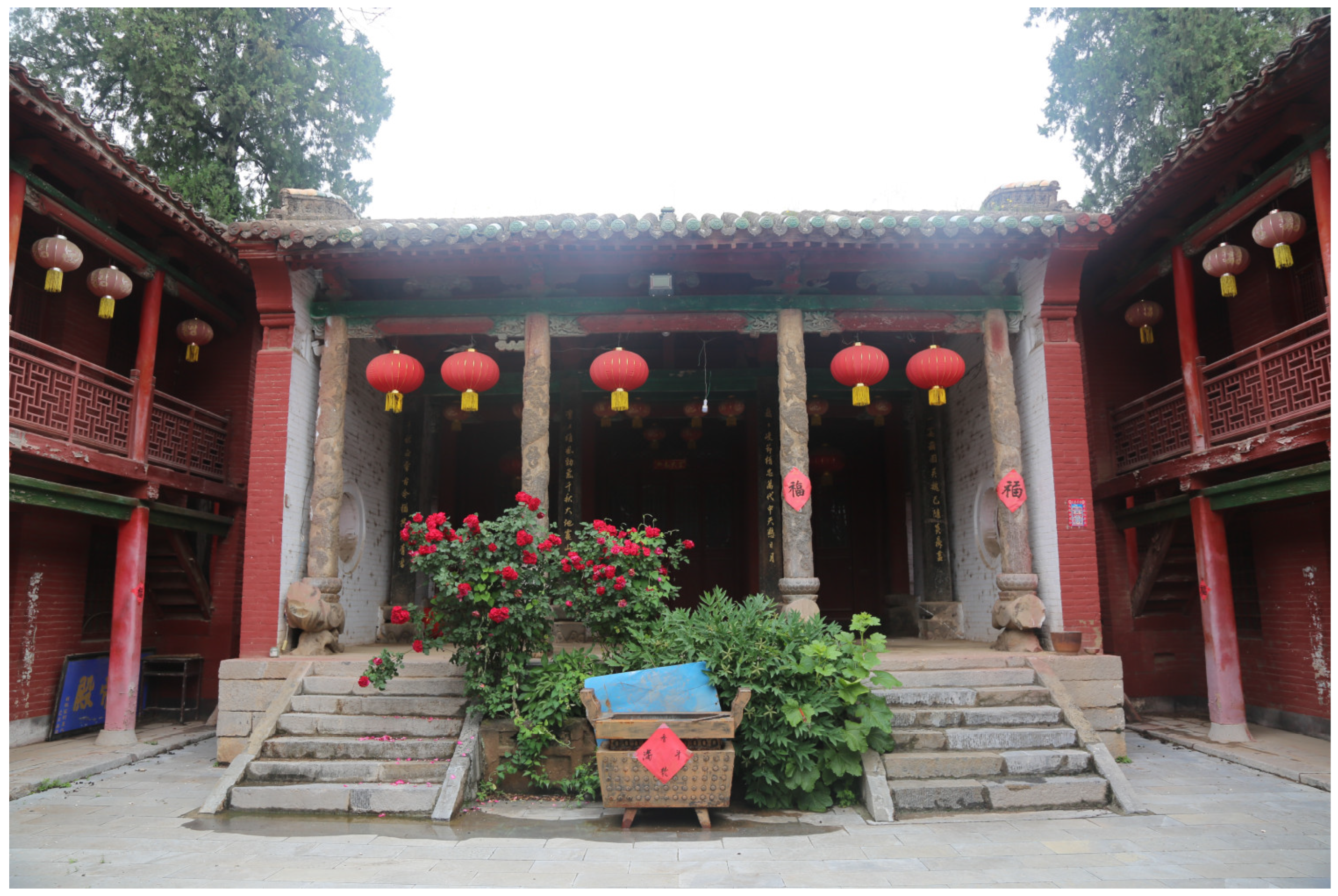
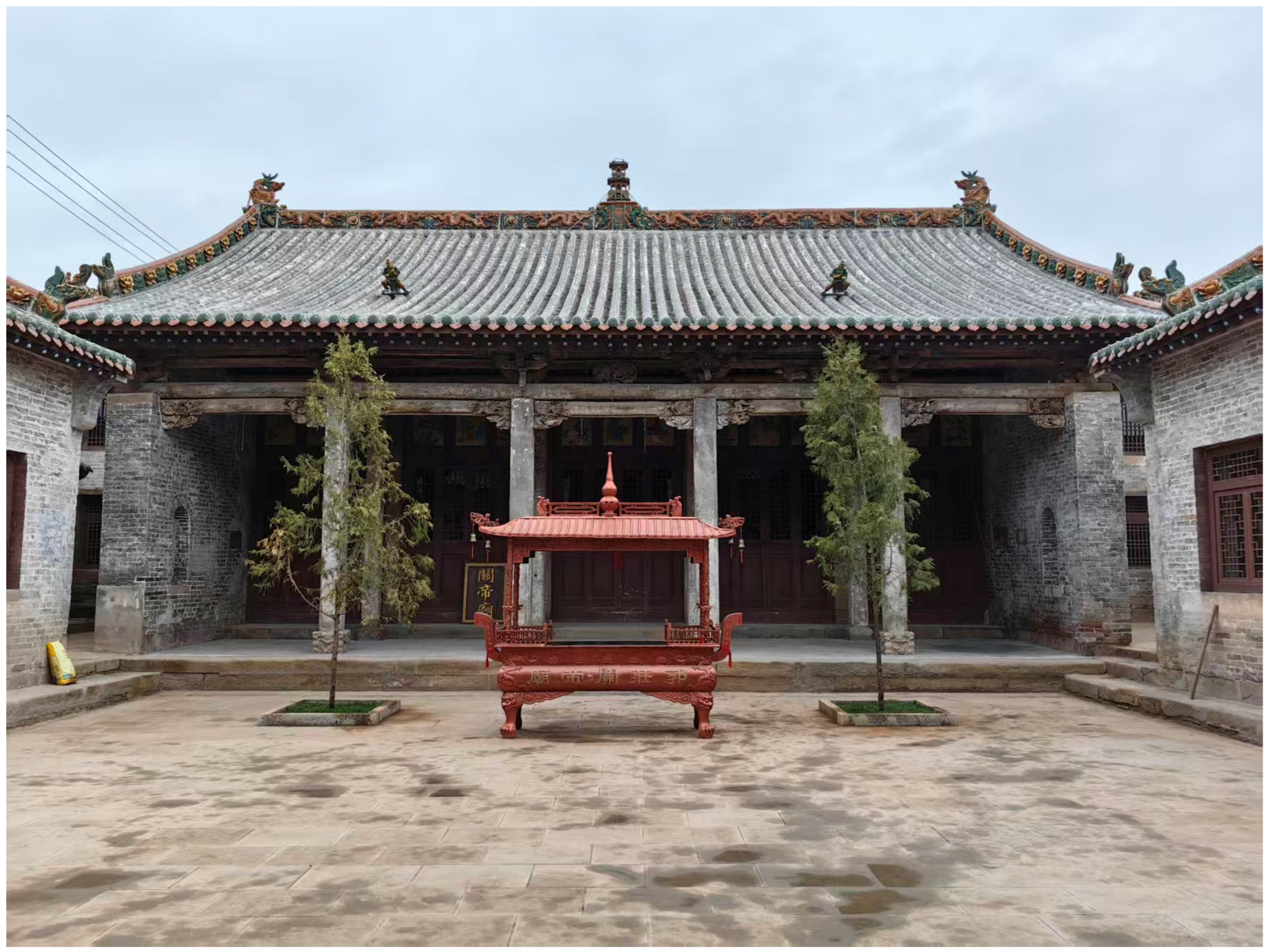
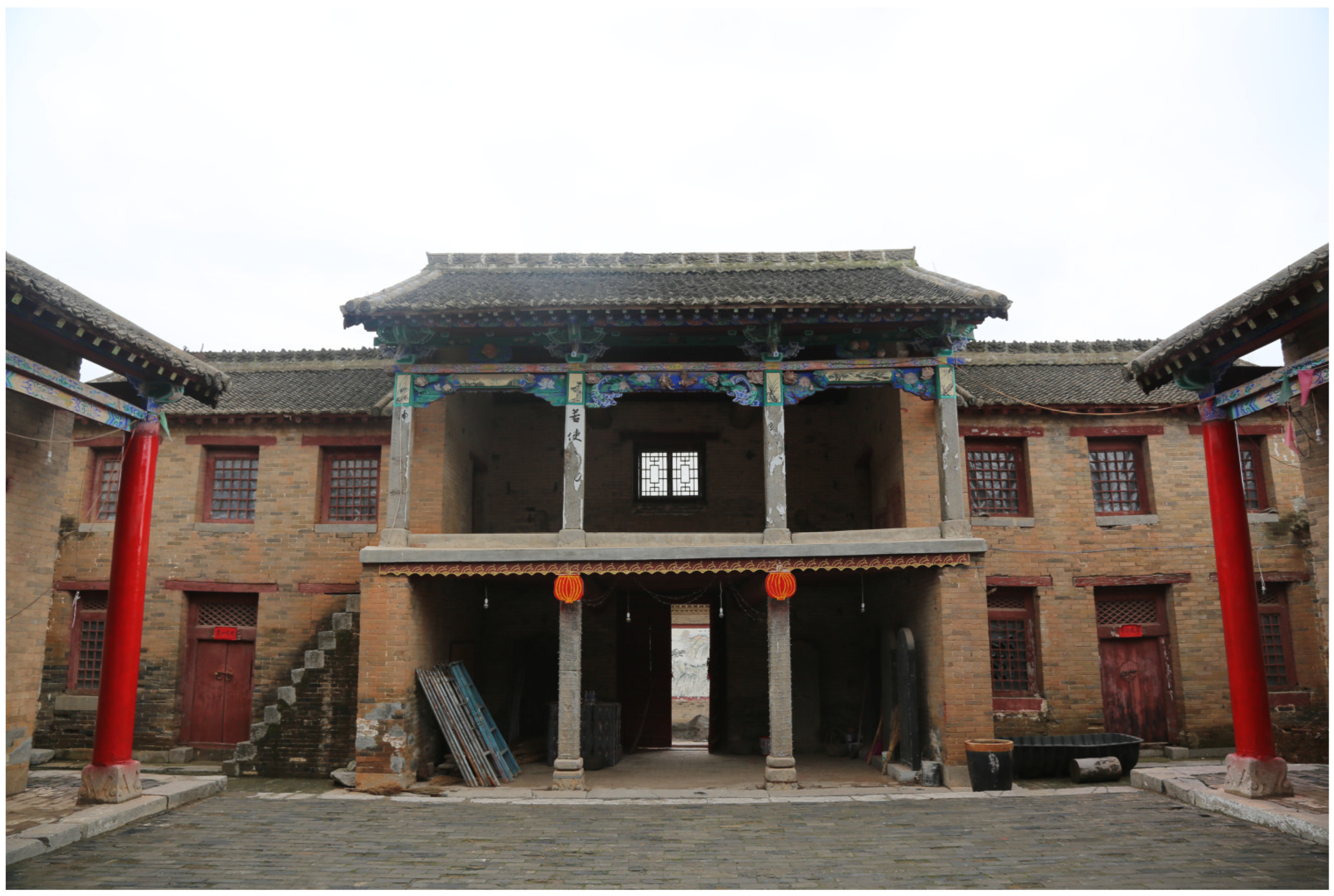
Government involvement is also evident in county-level protection and restoration. In Guozhuang village, Gaoping, for example, a Lord Guan temple was undergoing extensive repairs during our 2024 fieldwork (Figure 4). The village head, Yang Wenguang 楊文廣, explained that the restoration was part of the ‘new countryside construction’ (xin nongcun jianshe 新農村建設) initiative aimed at preventing further deterioration and supporting tourism development. Because many local temples had been damaged during the Cultural Revolution, the municipal government invested over one million yuan to commission a professional restoration team, supplemented by donations from local enterprises and villagers. Through coordinated planning, bidding and expert oversight, the temple has now been restored to excellent condition (Figure 5), and an application for county-level cultural relics protection status has been submitted (Yang, personal interview, 1 June 2024).
These examples demonstrate that governmental involvement—while uneven across regions—provides essential resources, regulatory oversight and technical capacity. Yet state interventions alone cannot meet the massive demand for preservation among the countless Lord Guan temples scattered across Shanxi, highlighting the indispensable role of community-based devotion and grassroots action.

5. Local Devotion and Grassroots Restoration Efforts

Parallel to formal state initiatives, grassroots protection and restoration arise from deep-rooted devotion to Lord Guan and a strong sense of community responsibility. Villagers emphasise that the incense offered to Lord Guan reflects accumulated merit and that a neglected or closed temple—where worship must take place outdoors—constitutes disrespect or even blasphemy (Anonym, personal interview, 30 June 2023). Personal testimonies further illustrate this devotion. One villager recounted surviving a near-fatal crash, attributing it to Lord Guan’s divine protection; he continues to maintain the temple as an expression of gratitude to the deity (Anonym, personal interview, 1 June 2023).
However, relying solely on local contributions often leads to prolonged or incomplete repairs. B. Yang (2023, p. 154) notes that the restoration of the Fucheng Lord Guan Temple in Zezhou took more than 20 years due to a lack of funds and community disunity, despite persistent efforts by the merchant Xu Youli. Such challenges persist today. One elderly temple keeper shared that incense money (xianghuo qian 香火錢) barely covers basic maintenance costs, and that a recent burglary emptied the donation box, leaving her uncertain how to fund repairs that year (Anonym, personal interview, 27 May 2023). Another temple keeper, believing us to be officials from the Cultural Relics Bureau, excitedly identified areas in need of repair in the hope that the restoration work would begin soon.
Technical challenges compound financial constraints. In some villages—especially those with limited economic resources—non-professional renovations have left temples, such as at Lord Guan Temple in Taoyuan Village, Zezhou County (Figure 6), looking newly built and lacking historical authenticity. While such repairs reflect local initiatives, they compromise the architectural integrity that gives temple structures their cultural significance, as emphasised by Liang (1935). These cases contrast sharply with the high-standard conservation work at the Haizhou Lord Guan Temple, illustrating how disparities in resources and expertise shape the fates of rural temples.
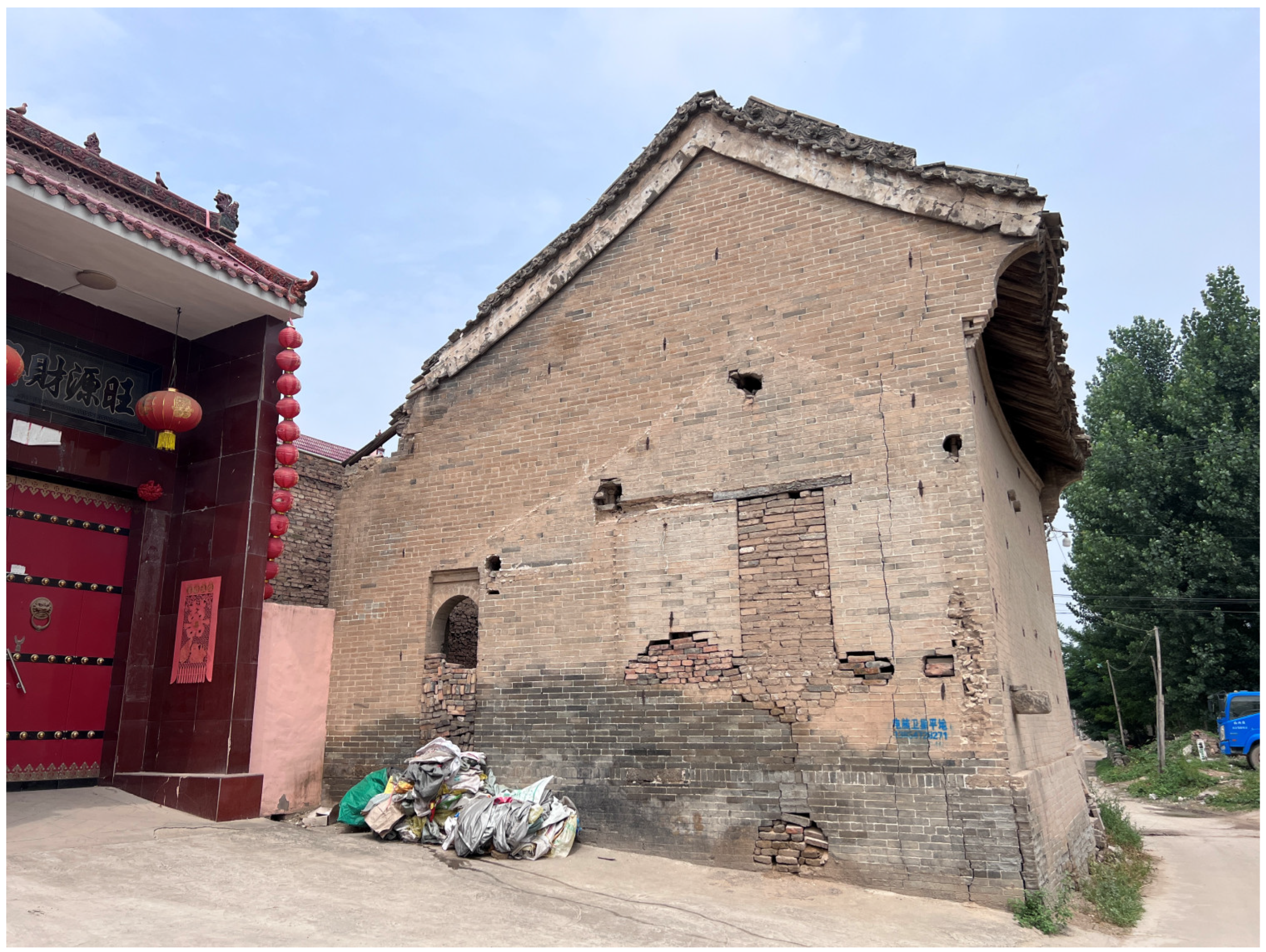
In many places, protection remains nominal. Even county-level Cultural Relic Protection Units do not always ensure preservation. During our 2023 fieldwork in Jishan County, we attempted to locate the Lord Guan Temple in Wucheng Village, which is officially registered as a county-level Cultural Relics Protection Unit. After repeated inquiries and extensive searching, we discovered a Cultural Relic Protection Stele concealed in the grass. Although the stele inscription, dated 18 August 2006, recorded the existence of a stage in the Lord Guan Temple, the stage itself was nowhere to be found. Only after reaching a partially bricked-up side door and climbing over the wall did we identify remnants of the structure. The front of the stage is now blocked by a wall that forms part of a residential courtyard (Figure 7). Inside, debris and rubbish are scattered across the ground; the roof has deteriorated, and the main beam bears an inscription indicating that the structure dates to the Daoguang reign of the Qing dynasty (1820–1850). The faded mural on the wall still hinted at the temple’s former splendour.
The gap between legal designation and practical protection reflects structural challenges. For example, protective boundaries and construction control zones—defined according to the classification level and architectural type of each site—are intended to safeguard. At Haizhou Lord Guan Temple, the protected zone extends 5–35 m beyond the exterior walls, with a construction control zone extending 100–500 m further. Yet, such regulations require enforcement capacity and continuous monitoring—an unrealistic expectation given the sheer number of rural temples. As a result, many protected sites have deteriorated or even disappeared, underscoring the limitations of state oversight and the urgent need for coordinated, community-centred strategies.

6. Professional Restoration Practices and Technical Challenges

Professional restoration plays a critical role in maintaining the authenticity and longevity of Lord Guan temples, particularly where local resources are insufficient. Yet, effective professional intervention depends on specialised expertise, appropriate materials and adherence to conservation principles that prioritise authenticity and respect for original structure.
Gao Tengfei 郜騰飛, a construction team manager in Jincheng with over a decade of experience in architectural restoration, described his team’s meticulous procedures (Gao, personal interview, 1 June 2023). Restoration typically begins with consultation with stele inscriptions and close architectural analysis, which informs repair plans tailored to each structure. Among the challenges, sourcing matching glazed tiles was particularly difficult because kilns produce only limited tile sizes that must align with the temple’s specific roof scales. Bracket sets represented the highest expense, with two-layered brackets crafted from Chinese rosewood (huanghuali 黃花梨) costing RMB 1000 yuan each, while pinewood alternatives were priced at 200 yuan each. Labour charges followed, with skilled workers paid 300 yuan daily for constructing main structures and general labourers earning 150 yuan daily for support tasks like delivering bricks.
Gao emphasised that the primary goal of restoration was protection, making it essential to preserve original components, such as bracket sets. Their focus included repairing the roofs of the Main Hall, stage and side halls, along with interior decoration, altar renovation and the restoration of niches and sculptures.
Technical measures for protecting wooden structures are essential. As both Gao and Fu noted, fireproofing, insect prevention, moisture control and corrosion protection must all be carefully implemented. Historical records document devastating fires that have destroyed temples multiple times, while bats’ excrement corrodes roof beams. Moisture-proofing is vital for preserving walls, murals and sculptures, and protective coatings are required to prevent structural erosion in wooden columns and beams.
These technical challenges highlight the importance of professional expertise in balancing restoration needs with authenticity principles. They also reinforce a central theme of this study: safeguarding Lord Guan temples requires integrating faith, form, material practice, and community involvement. Only by aligning governmental resources, local devotion and professional knowledge can these temples—both their tangible structures and the intangible traditions they sustain—be preserved as living heritage for generations to come.

7. Preservation of Intangible Heritage: Temple Theatre and Ritual Practice

Conservation extends beyond architecture to encompasses intangible cultural heritage (ICH), the practices, representations, expressions, skills and knowledge, through which communities transmit meaning and identity (UNESCO 2003, Art. 2). Rather than static relics, ICH is a dynamic process through which communities continuously reinterpret inherited traditions in relation to their environment and history, thereby reinforcing collective identity and cultural continuity (UNESCO 2003, Art. 2). Summarising UNESCO’s position, the domains of ICH cover oral traditions and expressions (including language), performing arts, social practices, rituals and festive events; these living practices are essential to how people make sense of, and enact, their heritage.
Fieldwork in southern Shanxi indicates that, even when interviewees did not explicitly use the word ‘identity’, many expressed a strong sense of being descendants of Lord Guan, regarding him as a moral exemplar whose virtues they feel obliged to inherit and embody through ritual activities. This lived devotion exemplifies cultural inheritance and reinterpretation in modern society. As Alivizatou (2012, p. 18) observes, the significance of intangible heritage lies in ‘the creative engagement with the past in a present; a past that is manifested in cultural practices and revived traditions that reflect contemporary identities.’
ICH also functions as the interpretative lens through which tangible heritage acquires meaning, ‘transforming inert landscapes of objects and monuments, turning them into living archives of cultural values’ (Munjeri 2004, p. 18), thereby revitalising temples as sites of lived history. In practice, ritual and theatrical performances during temple festivals bring vitality and incense offerings to the temple, reaffirm the temple’s role as a focal point of communal belief and sustain cultural continuity. In this sense, faith (practice, performance, and participation) and form (architectural fabric and spatial layout) are mutually reinforcing—each sustains the other’s relevance and durability.

8. Discussion: Balancing Devotion, Authenticity and Sustainability

China’s evolving legal and policy environment provides the formal scaffolding for heritage protection, from the Cultural Relics Protection Law (first implemented in 1982, revised in 2022, with a comprehensive update taking effect on 1 March 2025) to The Law on Intangible Cultural Heritage (effective 1 June 2011). These instruments strengthen management mechanisms, penalties and digital integration for documentation, and aim to balance state oversight with public participation and sustainable use. Read together with policy documents such as the 2011 Opinions, they form a multi-layered framework intended to support tangible and intangible heritage.
Despite these legal and policy advances, practical tensions persist, particularly around the use of historic temple theatres. Wooden-structured temple theatres—highly valued as cultural relics—are often prohibited from live performance to avoid damage. To meet ritual and communal needs without compromising conservation, new concrete-structured theatre stages have been built in some villages. This solution helps sustain performance traditions yet raises questions about authenticity and the cultural integrity of experience.
Field observations clarify this negotiation. In Qiangxia, a village in Yuncheng, the Lord Guan Temple is a nationally protected Major Historical and Cultural Site protected with a theatre dating back to the Kangxi reign of the Qing dynasty (1662–1722). During the Lantern Festival, villagers gather in the Main Hall of the temple to offer incense and donations, while xiqu is staged in a concrete-structured theatre at the village committee square. According to the temple manager (Zhang, personal interview, 4 February 2023), the original temple theatre remains closed to performances because frequent use could damage its fragile structure; government investment in new theatres enables ritual performance and theatrical entertainment without endangering heritage assets. Similar arrangements recur across many rural villages, highlighting the ongoing negotiation between conserving material heritage and sustaining living traditions.
These restrictions inevitably affect perceptions of authenticity. Concrete stages enable festivals, xiqu performances and community gatherings, but they cannot replicate the historical experience of watching xiqu in the temple theatre, where performances were offered first and foremost to the temple god(s). Thus, measures designed to safeguard material heritage may simultaneously alter the cultural meanings and practices they aim to preserve, underscoring the persistent tension between conservation, authenticity and cultural integrity.
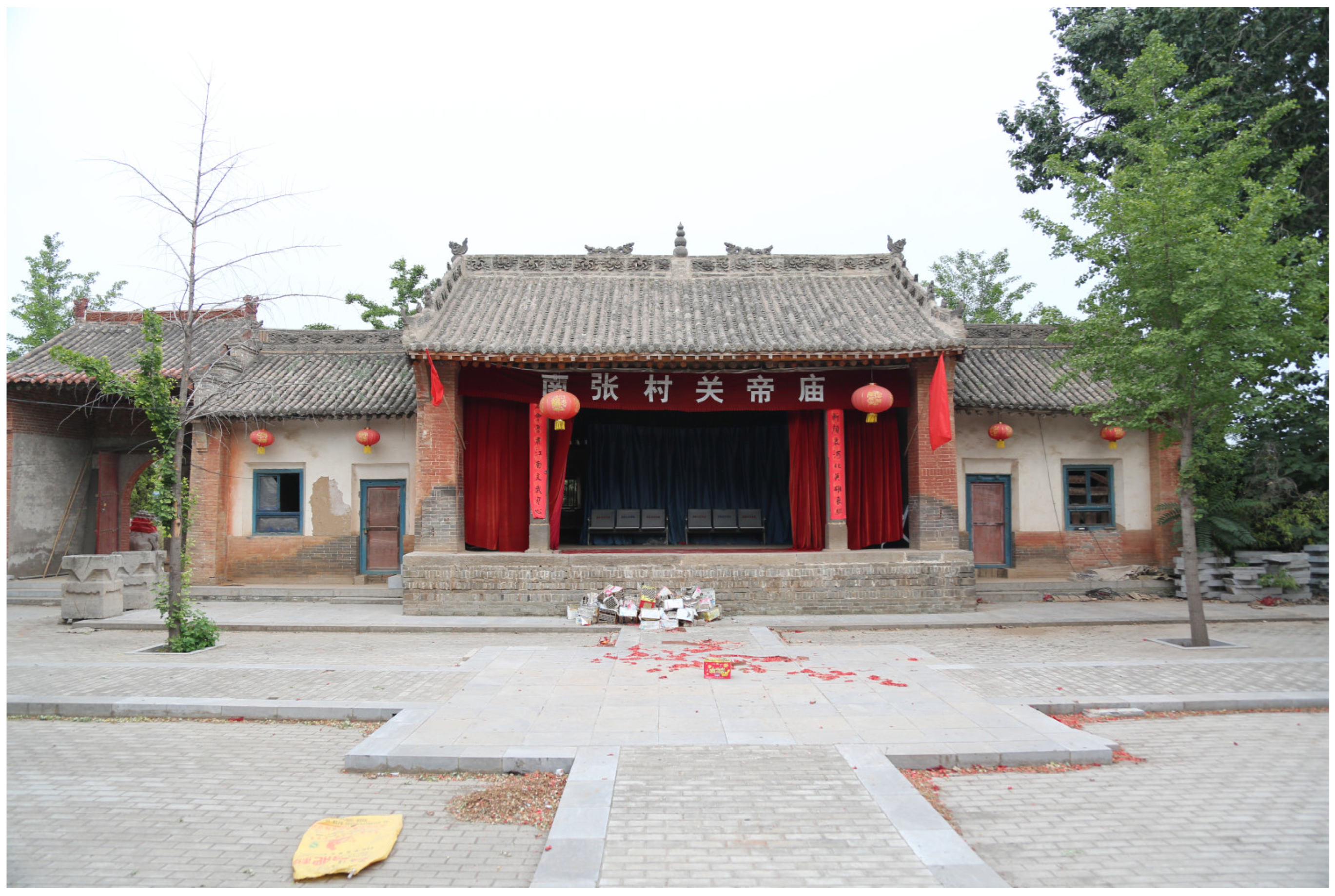
Local governments also adopt different approaches. In some places—for example, Nanzhuang Lord Guan Temple in Xinjiang County (Figure 8)—performances continue inside temple theatres after reinforcement with concrete to meet safety and load-bearing requirements. This option is more convenient and economical than restoring a traditional wooden stage, yet it compromises material authenticity, prompting questions about ethical restoration and the thresholds of acceptable interventions.
International guidance underscores why these choices matter. The UNESCO 2025 revised Operational Guidelines for the Implementation of the World Heritage Convention emphasise that properties must meet integrity and/or authenticity conditions and maintain adequate protection and management systems to be considered of Outstanding Universal Value, in order to ensure their safeguarding (UNESCO World Heritage Centre 2025, Art. 78). The guidelines also point out that authenticity concerns the extent to which cultural values are expressed through its various attributes, including form and design, materials and substance, use and function, traditions, techniques, and management systems (UNESCO World Heritage Centre 2025, Art. 82).
The purpose of respecting authenticity is to highlight the local value of heritage (Liang et al. 2023, p. 5). Respecting authenticity, therefore, prioritises originality, discouraging over-repair, and cautions against fabricating a false sense of the ancient. Over-restored temples and temple theatres may appear new but have lost their original authenticity and local value. Authenticity also requires retaining multilayered historical traces during restoration and conservation: many wooden-structured temples—particularly those from the Yuan and Ming periods—have undergone repeated repairs, leaving stratified evidence of different eras. In some rural areas, temples and temple theatres were repurposed as barns or classrooms in the 1950s; these layers remain part of the site’s unique cultural biography, whereas new concrete theatre stages built outside the temple complexes cannot embody such continuity, as they sever the link between past and present that is embodied in the original space.
Authenticity is also context-sensitive; it may define a valid approach in a given time, context, and specific typology of cultural heritage (Tomaszek 2022, p. 80). In East Asian practice, Liang’s (1963, p. 6) principle of ‘restoring the old as it was’ contrasts with both the approach of Viollet-le-Duc (1875, p. 14) and the principles of the Venice Charter that emphasise distinct contemporary additions (ICOMOS 1965, Art. 9). In the Chinese legal framework, restoration and maintenance must not alter the original state of cultural relics and should minimise intervention to ensure authenticity and integrity (NCHA 2024, Art. 32). These standards provide ethical direction for balancing devotion (continued ritual use) with authenticity (respect for historical fabric).
Beyond authenticity, sustainable preservation requires integrating government capacity and community commitment. Over-repair often arises from varying causes: local policies or funding priorities in some regions, and strong piety in others. Stele inscriptions sometimes celebrate ‘an entirely new look’, reflecting a devotional logic that the temple—as the deity’s home—should be renewed like one’s own residence; neglect would be regarded as disrespectful and even blasphemous.
At the same time, the sheer number of heritage buildings in China and the limited financing at village and county levels means many designated sites remain dilapidated—even when a Cultural Relic Protection Stele stands at the gate. The observation of Wucheng Lord Guan Temple illustrates how residential encroachments, insufficient funds and weak enforcement undermine practical conservation despite formal designation.
For long-term visibility, the primary strategy is to combine the conservation of tangible and intangible cultural heritage. The values of cultural property should be assessed through an interactive matrix that relates cultural (ritual, performance, and meaning) and physical (material, form, and fabric) properties (Munjeri 2004, p. 16). Local ritual and theatrical traditions help activate temples. Implementation demands shared responsibility: government and community stakeholders must cooperate to preserve both architectural integrity and living traditions, supported by regular inspection, maintenance, capacity-building and technical guidance that aligns with conservation principles.

9. Conclusions

Drawing on fieldwork in Jinnan or southern Shanxi (2023–2025), this study examines how the conservation of Lord Guan temples and the preservation of associated intangible cultural heritage are intertwined, and how restoration practices unfold across state-funded and grassroots contexts. Rather than treating architecture and practice as separate domains, this study highlights their mutually reinforcing relationship: ritual practices, theatrical performances, and temple festivals animate faith and enhance and sustain the cultural meaning of the temples, while the temple architecture anchors these practices, enabling historical and cultural continuity.
The study also compares the roles of different actors in heritage conservation. Local community initiatives, motivated by devotion to Lord Guan, often prioritise ritual continuity and social engagement, but often face financial, technical, and organisational constraints. In contrast, government-led projects, exemplified by Haizhou Lord Guan Temple, benefit from dedicated funding, professional technical support, and institutionalised management, often integrating tourism and cultural promotion to generate revenue while safeguarding heritage.
In practice, integrated preservation approaches are essential: official requirements should be harmonised with local practices and religious use, maintaining authenticity while respecting ethical considerations and sustaining living traditions. International guidance likewise stresses the value of integrating scientific expertise with local knowledge, collaborative governance and climate-aware resilience planning; in a heritage context, this means sustained cooperation among bureaucracies, experts and communities to balance protection with ongoing use.
In summary, sustainable preservation of Lord Guan temples depends on recognising and managing the interdependence of faith and form. By treating temples as living cultural ecosystems—where architectural conservation and ritual/theatrical practice are coordinated—stakeholders can safeguard material integrity while nurturing the social energies that keep these sites alive. Only through collaborative engagement and continuous, context-sensitive care can Lord Guan temples continue to serve their ritual and social functions for generations to come.

Author Contributions

Conceptualization, X.Z.; Methodology, Y.T. and X.Z.; Formal analysis, Y.T. and X.Z.; Investigation, Y.T.; Resources, Y.T.; Writing—original draft, Y.T.; Writing—review & editing, X.Z.; Supervision, X.Z. All authors have read and agreed to the published version of the manuscript.

Funding

This research was funded by the Australian Research Council through its Discovery Project, ‘The Transformation of Chinese Temple Theatre Architecture’ (Grant No. DP250100454).

Institutional Review Board Statement

This study was approved by the Human Research Ethics Committee of the University of Sydney in 2023 (Approval No. 2022/803). The research was conducted in accordance with the National Statement on Ethical Conduct in Human Research (NHMRC, 2007, updated 2018) and the principles outlined in the Declaration of Helsinki (1975, revised 2013).

Informed Consent Statement

Informed consent was obtained from all subjects involved in the study.

Data Availability Statement

The original contributions presented in this study are included in the article. Further inquiries can be directed to the corresponding author.

Acknowledgments

We would like to express our sincere gratitude to Fu Wenyuan, Yang Wenguang, Gao Tengfei, Zhang Xiaolong, and others, as well as to the anonymous interviewees, for their generous assistance during the fieldwork conducted between 2023 and 2025. Their insights and support greatly contributed to the completion of this study. We would also like to thank the three anonymous reviewers for their insightful suggestions, which significantly improved the clarity and rigour of this manuscript, as well as the editor for their careful and efficient handling of the review process. Their guidance and constructive feedback have been invaluable in strengthening the quality of this study.

Conflicts of Interest

The authors declare no conflicts of interest.

Appendix A

Table A1. Architectural and preservation profiles of Lord Guan temples and temple theatres in Southern Shanxi 1.
No.LocationArchitecture (Layout & Orientation)Theatre Structure (Bays/Width/Depth)Deity(ies) EnshrinedDate (Inscription/Estimated)State of Preservation
1Xiyin village, Xiangyuan countySingle-courtyard complex; east-facing5 bays; approx. 7.45 m (W) × 6.01 m (D)Lord Guan; Guanyin; Third Dragon Lord Stele Inscription: reconstructed in the 37th year of Qianlong (1772)Good
2Cuijialing village, Xiangyuan countySingle-courtyard complex; west-facing3 bays; approx. 6.86 m (W) × 5.42 m (D)Lord GuanStele Inscription: reconstructed in the 7th year of Xianfeng (1857)Good
3Baonao village, Xiangyuan countySingle-courtyard complex; south-facing3 bays; approx. 7.55 m (W) × 4.97 m (D)Lord Guan; Tudi; Three officialsBeam Inscription: built in the Jiaqing reign; reconstructed in the 22nd year of Guangxu (1896)Fair
4Xialiang village, Xiangyuan countySingle-courtyard complex; north-facing3 bays; approx. 8.42 m (W) × 5.38 m (D)Lord Guan; Tudi; GuanyinBeam Inscription: rebuilt in 2009Fair
5Baiyangling village, Xiangyuan countySingle-courtyard complex; southwest-facing3 bays; approx. 7.89 m (W) × 4.96 m (D)Lord Guan; Tudi; GuanyinBeam Inscription: built in the 14th year of Daoguang (1834)Poor
6Xiaqingnan village, Xiangyuan countySingle-courtyard complex; south-facing3 bays; approx. 7.78 m (W) × 4.91 m (D)Lord GuanStele Inscription: reconstructed in 2006Good
7Shangsi beilu, Xiangyuan countySingle-courtyard complex; east-facing3 bays; approx. 8.65 m (W) × 4.87 m (D)Lord GuanStele Inscription: reconstructed in Yongle reign; reconstructed in the 24th year of Jiajing (1545)Good
8Wangqiao village, Xiangyuan countySingle-courtyard complex; north-facing3 bays; approx. 10.62 m (W) × 3.88 m (D)Lord Guan; The God of Wealth; Guanyin; KṣitigarbhaStele Inscription: built in Jiajing reign; reconstructed in 2010Excellent
9Tiancang village, Xiangyuan countySingle-courtyard complex; south-facing3 bays; approx. 8.85 m (W) × 3.23 m (D)Lord GuanBeam Inscription: built in the 10th year of Tongzhi (1871)Bad
10Xiqiaodi village, Xiangyuan countySingle-courtyard complex; south-facing3 baysLord GuanEstimated: The Qing dynastyCritical
11Changlong village, Xiangyuan countySingle-courtyard complex; north-facing3 bays; approx. 9.37 m (W) × 4.00 m (D)Lord Guan; The God of Culture and Literature; Truly Valiant Great EmperorBeam Inscription: built in the 26th year of Qianlong (1761)Excellent
12Lizhuang village, Lucheng districtTwo-courtyard complex; northwest-facing3 bays; approx. 7.51 m (W) × 5.46 m (D)Lord GuanEstimated: The Late Ming dynastyExcellent
13Beishe village, Lucheng districtSingle-courtyard complex; west-facing3 bays; approx. 9.43 m (W) × 5.39 m (D)Lord Guan; Lü Dongbin 呂洞賓; Bull Demon KingStele Inscription: Jiajing reign periodGood
14Dongbeichen village, Lucheng districtSingle-courtyard complex; south-facingInterior stageLord GuanStele Inscription: rebuilt in 5th year of Guangxu (1879)Critical
15Laodong village, Yangcheng countySingle-courtyard complex; east-facing3 baysLord Guan; Bull Demon King; the Mountain GodStele Inscription: rebuilt in the 4th year of the Republic of China (1915)Critical
16Shuangmei village, Yangcheng countySingle-courtyard complex; east-facing3 bays; approx. 7.28 m (W) × 4.53 m (D)Lord GuanStele Inscription: rebuilt in the 9th year of Jiaqing (1804)Very poor
17Sanquan village, Xiangyuan countySingle-courtyard complex; south-facing3 bays; approx. 6.74 m (W) × 5.11 m (D)Lord GuanStele Inscription: rebuilt in the 29th year of Qianlong (1764)Very poor
18Wozhuang village, Yangchen countyTwo-courtyard complex; south-facing3 bays; approx. 8.39 m (W) × 5.51 m (D)Lord Guan; Gaomei; The King of Ma; The King of Niu; The God of Wealth; Taishang Laojun; The Four Saints; Three Buddhas; The Medicine King; The FounderStele Inscription: rebuilt in the 23rd year of Kangxi (1684)Excellent
19Mazhai village, Yangcheng countySingle-courtyard complex; north-facing3 baysLord GuanBeam Inscription: built in the 6th year of Tongzhi (1867)Bad
20Huayuantiao village, Yangcheng countyTwo-courtyard complex; west-facing3 bays; approx. 7.37 m (W) × 5.17 m (D)Lord GuanBeam Inscription: rebuilt in the 7th year of Xianfeng (1857)Very poor
21Pangou village, Yangcheng countyTwo-courtyard complex; northwest-facing5 bays; approx. 10.98 m(W) × 4.77 m (D)Lord Guan; Taishao Laojun; The God of Wealth; The King of Niu; Guanyin; Confucius; The Maiden Who Brings Children Stele Inscription: built in the 53rd year of Kangxi (1714)Excellent
22Nanliu village, Yangcheng countySingle-courtyard complex; west-facing3 bays; approx. 5.77 m (W) × 4.71 m (D)Lord GuanEstimated: The Qing dynastyBad
23Cuodui village, Yangcheng countySingle-courtyard complex; west-facing3 bays; approx. 7.32 m (W) × 5.74 m (D)Lord Guan; The King of Niu; The God of MountainsBeam Inscription: the 21st year of Daoguang (1841)Fair
24Wujiang village, Jincheng cityTwo-courtyard complex; east-facing3 baysLord Guan; The Maiden Who Brings Children; The King of MaBeam Inscription: built in the 38th year of Qianlong (1773)Good
25Xiaoji village, Zezhou countyTwo-courtyard complex; south-facing3 bays; approx. 8.62 m (W) × 5.15 m (D)Lord Guan; The Grand Dame; The King of MaStele Inscription: built in the 6th year of Kangxi (1667); rebuilt in the 52nd year of Kangxi (1713)Excellent
26Hetaowa village, Jincheng cityTwo-courtyard complex, south-facing3 bays; approx. 7.18 m (W) × 4.68 m (D)Lord Guan; The King of Dragon; The Grand DameStele Inscription: rebuilt in 11th year of Wanli (1583); rebuilt in 13th year of Qianlong (1748)Excellent
27Nanyan village, Jincheng citySingle-courtyard complex; south-facing3 bays; approx. 6.39 m (W) × 4.84 m (D)Lord Guan; Kṣitigarbha; GuanyinEstimated: The Qing dynastyExcellent
28Jiaoshan village, Jincheng cityTwo-courtyard complex; south-facing3 bays; approx. 7.91 m (W) × 5.05 m (D)Lord GuanBeam Inscription: Rebuilt in the 13th year of the Republic of China (1924)Fair
29Niushan village, Jincheng cityTwo-courtyard complex; south-facing3 bays; approx. 7.71 m (W) × 4.68 m (D)Lord Guan; The King of Medicine; Kṣitigarbha; Taishang Laojun; GuanyinStele Inscription: rebuilt in the 9th year of Jiaqing (1804)Good
30Zhonghedong village, Jincheng cityTwo-courtyard complex; south-facing3 baysLord Guan; The Founder; The God of Wealth; Taishang Laojun; The God of Culture and LiteratureStele Inscription: rebuilt in the 31st year of Guangxu (1905)Good
31Gangtou village, Jincheng citySingle courtyard; south-facing3 baysLord GuanEstimated: The Qing dynastyCritical
32Shenjiazhuang village, Jincheng citySingle-courtyard complex; south-facing3 baysLord GuanEstimated: The Qing dynastyVery poor
33Xiajiang village, Jincheng cityTwo-courtyard complex; south-facing3 bays; approx. 7.19 m (W) × 5.04 m (D)Lord Guan; The Jade Emperor; King Yan; LaoziStele Inscription: rebuilt in the 2nd year of Chonzghen (1629)Good
34Beiyin village, Zezhou countySingle-courtyard complex; south-facing3 baysLord Guan; Sakyamuni; Kṣitigarbha; Guanyin; Taishang Laojun; ConfuciusStele Inscription: built in the 9th year of Yongzheng (1731)Fair
35Fucheng village, Zezhou countyTriple-courtyard complex; south-facing3 baysOmittedStele Inscription: the 1st year of Qingyuan (1195)Excellent
36Dongwangtai village, Jincheng citySingle-courtyard complex; south-facing3 bays; approx. 8.18 m (W) × 4.92 m (D)Lord Guan; Gaomei; The God of Silkworm; The Gods of Five Pestilence; The King of Ma; The God of Wealth; Taishang LaojunStele Inscription: rebuilt in the 6th year of Guangxu (1880)Excellent
37Xiyuanqing village, Zezhou countySingle-courtyard complex; north-facing3 bays; approx. 7.43 m (W) × 5.08 m (D)Lord Guan; The God of Wealth; The Grand Dame; Taishang Laojun; ConfuciusStele Inscription: rebuilt in the 20th year of Daoguang (1840)Good
38Taoyuan village, Zezhou countySingle-courtyard complex; north-facing3 baysLord Guan; The King of Ma; The King of Niu; The Grand DameBeam Inscription: built in the 27th year of Qianlong (1762)Good
39Gaodu village, Zezhou countyTwo-courtyard complex; north-facing3 bays; approx. 8.59 m (W) × 5.26 m (D)Lord Guan; Taishang Laojun; The God of WealthStele Inscription: built in the 17th year of Jiaqing (1812)Excellent
40Lizhuang village, Zezhou countyN/A 2N/ALord GuanN/ACritical
41Baofu village, Zezhou countyN/AN/ALord GuanN/ACritical
42Erfenjie village, Xiangyuan countyTwo-courtyard complex; south-facing3 bays; approx. 7.38 m (W) × 5.26 m (D)Lord Guan; Taishang Laojun; The God of Wealth; Confucius; The God of MedicineBeam Inscription: built in the 6th year of Qianlong (1741)Excellent
43Du village, Gaoping citySingle-courtyard complex; north-facing3 bays; approx. 8.01 m (W) × 5.11 m (D)Lord GuanBeam Inscription: built in the 36th year of Qianlong (1771)Good
44Zhujiazhuang village, Gaoping cityTwo-courtyard complex; south-facing3 baysLord GuanEstimated: The Qing dynastyBad
45Changle village, Gaoping citySingle-courtyard complex; south-facing3 bays; approx. 6.67 m (W) × 5.11 m (D)Lord Guan; GaomeiStele Inscription: built in the 12th year of Wanli (1584); rebuilt in the 57th year of Qianlong (1792)Good
46Jiaohe village, Gaoping cityN/AN/ALord GuanN/ACritical
47Meiyezhuang village, Gaoping citySingle-courtyard complex; north-facing3 bays; approx. 6.79 m (W) × 5.72 m (D)Lord Guan; Gaomei; Six KingsStele Inscription: rebuilt in the 12th year of Jiaqing (1807)Fair
48Xiaoxian village, Gaoping cityTwo-courtyard complex; south-facing3 bays; approx. 9.61 m (W) × 5.92 m (D)Lord Guan; The King of Niu; The King of MaEstimated: The Qing dynastyFair
49Nanxuzhuang village, Gaoping cityN/AN/ALord GuanN/ACritical
50Beiling village, Gaoping citySingle-courtyard complex; south-facing3 baysLord Guan; GuanyinEstimated: The Qing dynastyFair
51Kangying village, Gaoping citySingle-courtyard complex; south-facing3 bays; approx. 6.11 m (W) × 4.84 m (D)Lord GuanEstimated: The Qing dynastyGood
52Kangying village, Gaoping cityN/AN/ALord GuanN/ACritical
53Yuancun village, Gaoping citySingle-courtyard complex; south-facing3 bays; approx. 5.43 m (W) × 4.51 m (D)Lord Guan; Taishang Laojun; ConfuciusStele Inscription: rebuilt in the 20th year of Jiaqing (1815)Fair
54Guozhuang village, Gaoping citySingle-courtyard complex; south-facing3 bays; approx. 7.81 m (W) × 4.92 m (D)Lord GuanStele Inscription: built in Hongwu reign period; rebuilt in the 9th year of Wanli (1581)Good
55Shitanghui village, Gaoping cityN/AN/ALord GuanN/ACritical
56Nanzhaozhuang village, Gaoping cityTwo-courtyard complex; west-facing3 bays; approx. 7.71 m (W) × 4.58 m (D)Lord Guan; The Maiden Who Brings ChildrenStele Inscription: rebuilt in the 3rd year of Daoguang (1823)Bad
57Zhuangzi village, Gaoping cityTwo-courtyard complex; north-facing3 bays; approx. 7.65 m (W) × 5.70 m (D)Lord Guan; Zhao Gongming; The God of River; The Grand Dame; Confucius; Amitābha; Vairocana; The BuddhaStele Inscription: rebuilt in the 5th year of Tongzhi (1866); Beam Inscription: rebuilt in the Qianlong reign periodFair
58Dongshang village, Gaoping citySingle-courtyard complex; south-facing3 bays; approx. 8.34 m (W) × 6.01 m (D)Lord Guan; The Dragon King; The God of Silkworm; The Three Saints; The King of Ma; The King of Niu;Stele Inscription: rebuilt in the 50th year of Kangxi (1711)Good
59Nanwangzhuang village, Gaoping citySingle-courtyard complex; north-facing3 bays; approx. 7.60 m (W) × 6.25 m (D)Lord Guan;Estimated: The Qing dynastyFair
60Beigou village, Gaoping citySingle-courtyard complex; east-facing3 bays; approx. 8.53 m (W) × 5.51 m (D)Lord GuanEstimated: The Qing dynastyFair
61Anjia village, Gaoping citySingle-courtyard complex; south-facing3 baysLord GuanStele Inscription: rebuilt in the 47th year of Qianlong (1782)Very poor
62Juzhuang village, Gaoping citySingle-courtyard complex; west-facingexterior stage; 3 bays; approx. 9.65 m (W) × 6.50 m (D)Lord GuanEstimated: The Qing dynastyGood
63Bangou village, Gaoping cityN/Aexterior stageLord GuanN/ACritical
64Xishayuan village, Gaoping cityTwo-courtyard complex; south-facing3 bays; approx. 7.50 m (W) × 5.70 m (D)Lord Guan; Gaomei; The Grand Dame; The God of SilkwormStele Inscription: rebuilt in the 24th year of Qianlong (1759)Good
65Shihe village, Gaoping citySingle-courtyard complex; north-facing3 bays; approx. 8.33 m (W) × 5.26 m (D)Lord GuanStele Inscription: rebuilt in the 31st year of Daoguang (1851)Good
66Qiuzi village, Gaoping citySingle-courtyard complex; south-facingInside: 3 bays; approx. 7.56 m (W) × 4.80 m (D); Outside: 3 bays; approx. 9.23 m (W) × 7.08 m (D)Lord GuanBeam Inscription: rebuilt in the 25th year of Daoguang (1845)Good
67Xiaohuigou village, Gaoping citySingle-courtyard complex; north-facing3 bays; approx. 8.25 m (W) × 5.96 m (D)Lord Guan; The King of Ma; Hou Yi; The Grand DameStele Inscription: rebuilt in the 22nd year of Daoguang (1842)Fair
68Quanzhang village, Wanrong countySingle-courtyard complex; south-facingExterior stageLord GuanBeam Inscription: rebuilt in the 13th year of Chenghua (1477)Excellent
69Longxiang village, Xinjiang countyTwo-courtyard complex; south-facing3 bays; approx. 4.40 m (W) × 7.06 m (D)Lord GuanEstimated: in the Yuan dynasty. Beam Inscription: rebuilt in 11th the year of Daoguang (1831)Excellent
70Nanzhang village, Xinjiang countySingle-courtyard complex; east-facing3 bays; approx. 7.96 m (W) × 7.00 m (D)Lord GuanBeam Inscription and Stele Inscription: rebuilt in the 11th year of Daoguang (1831)Good
71Zhangzhuang village, Xinjiang countySingle-courtyard complex; south-facing3 baysLord GuanEstimated: in the Qing dynastyCritical
72Sanjie village, Jishan countySingle-courtyard complex3 bays; approx. 10.15 m (W) × 7.03 m (D)Lord GuanEstimated: the Qing dynastyVery poor
73Xishe village, Jishan countySingle-courtyard complex; south-facing3 bays; approx. 13.78 m (W) × 4.83 m (D)Lord GuanStele Inscription: rebuilt in the 5th year of Shunzhi (1648)Good
74Renyi village, Jishan countySingle-courtyard complex; south-facing3 bays; approx. 9.62 m (W) × 7.71 m (D)Lord GuanStele Inscription: rebuilt in the 37th year of Jiajing (1558)Good
75Dongwu village, Wanrong countySingle-courtyard complex; south-facingN/ALord Guan; The Maiden Who Brings Children; The King of MedicineBeam Inscription: rebuilt in the 10th year of Chongzhen (1637)Good
76Yanjing village, Wanrong countySingle-courtyard complex; south-facingN/ALord GuanEstimated: in the Qing dynastyFair
77Dongjiazhuang village, Jishan countySingle-courtyard complex; east-facingN/ALord GuanBeam Inscription: rebuilt in the 14th year of Guangxu (1888)Poor
78Wucheng village, Jishan countyN/A3 baysLord GuanEstimated: in the Qing dynastyCritical
79Liuwu village, Wanrong countySingle-courtyard complex; south-facingN/ALord GuanStele Inscription: rebuilt in the 21st year of Jiaqing (1816)Poor
80Shidao village, Ruicheng countySouth-facing3 bays; approx. 8.47 m(W) × 6.83 m (D)Lord GuanEstimated: in the Qing dynastyVery poor
81Fengxi village, Ruicheng countySingle-courtyard complex; south-facing3 bays; approx. 7.73 m (W) × 5.88 m (D)Lord GuanEstimated: in the Qing dynastyBad
82Hongyuan village, Jishan countySingle-courtyard complex; south-facing3 bays; approx. 7.55 m (W) × 6.35 m (D)Lord GuanEstimated: in the Qing dynastyFair
83Zhaili village, Yuncheng cityTwo-courtyard complex; south-facingN/ALord GuanEstimated: in the Yuan dynastyGood
84Puletou village, Yongji cityNorth-facing3 baysLord GuanEstimated: in the Yuan dynastyFair
85Changping town, Yuncheng cityOmittedOmittedOmittedOmittedExcellent
86Haizhou town, Yuncheng cityOmittedOmittedOmittedOmittedExcellent
87Peijie village, Yuncheng cityTwo-courtyard complex; south-facing3 bays; approx. 8.61 m (W) × 6.98 m (D)Lord GuanBeam Inscription: rebuilt in the 30th year of Wanli (1602)Good
88Qiangxia village, Yuncheng cityTriple-courtyard complex; south-facing3 bays; approx. 8.93 m (W) × 6.32 m (D)Lord GuanStele Inscription: rebuilt in the 3rd year of Shunzhi (1646)Excellent
89Yanhu district, Yuncheng cityTriple-courtyard complex; west-facingN/ALord GuanStele Inscription: rebuilt in the 25th year of Wanli (1597)Excellent
90Chesihou village, Xia countyTwo-courtyard complex; northwest-facing3 bays; approx. 8.91 m (W) × 5.42 m (D)Lord GuanBeam Inscription: rebuilt in the 3rd year of Daoguang (1823)Fair
91Xia countyTwo-courtyard complex; south-facing3 bays; approx. 10.33 m (W) × 6.08 m (D)Lord GuanStele Inscription: rebuilt in the 10th year of Shunzhi (1653)Excellent
1 This table is adapted from an unpublished thesis, The University of Sydney. 2 Data not available due to the temple’s critical structural condition at the time of survey.

Note

1
All photos were taken by the author unless otherwise stated.

References

  1. Alivizatou, Marilena. 2012. The Paradoxes of Intangible Heritage. In Safeguarding Intangible Cultural Heritage: Touching the Intangible. Edited by Stefano L. Michelle, Peter Davis and Gerard Corsane. Woodbridge: Boydell & Brewer. [Google Scholar]
  2. Chai, Zejun 柴澤俊. 2002. Haizhou Guandi miao 解州關帝廟. Beijing: Wenwu Chubanshe. [Google Scholar]
  3. Cheng, Feng 程峰, and Qian Cheng 程謙. 2016. Xiuwu Yidoushui Guandi miao xilou jiqi beike kaoshu 修武壹鬥水關帝廟戲樓及其碑刻考述. Zhonghua xiqu 中華戲曲 1: 80–96. [Google Scholar]
  4. China National Radio. 2024. Black Myth: Wukong Boosts Shanxi Tourism: 27 of 36 Filming Locations Are in the Province. CNR News, August 21. Available online: https://news.cnr.cn/native/gd/kx/20240821/t20240821_526863132.shtml (accessed on 17 February 2026).
  5. Dong, Zhuxin 董竹馨. 2019. Qingdai Gaopingxian Guandi miao yu xiangcun shehui 清代高平縣關帝廟與鄉村社會. Master’s dissertation, Shanxi University, Taiyuan, China. [Google Scholar]
  6. Fang, Aiqing, and Xingxin Zhu. 2025. Shanxi’s Ancient Marvels. China Daily Global Edition, February 27. Available online: https://global.chinadaily.com.cn/a/202502/27/WS67bfac8ca310c240449d77ad.html (accessed on 17 February 2026).
  7. Feng, Junjie 馮俊傑. 2006. Shanxi shenmiao juchang kao 山西神廟劇場考. Beijing: Zhonghua Shuju. [Google Scholar]
  8. Hao, Ping 郝平, and Bo Yang 楊波. 2019. Chaoyue xinyang 超越信仰. Beijing: Shangwu Yinshu Guan. [Google Scholar]
  9. ICOMOS. 1965. International Charter for the Conservation and Restoration of Monuments and Sites (the Venice Charter 1964). Available online: https://icahm.icomos.org/wp-content/uploads/2017/01/1964-Venice-Charter.pdf (accessed on 17 February 2026).
  10. Li, Wen 李文. 2011. Shanxi Xiaxian Qiangxiacun Guandi miao yuelou kanting kaoshu 山西夏縣牆下村關帝廟樂樓看亭考述. Zhonghua xiqu 中華戲曲 1: 76–86. [Google Scholar]
  11. Liang, Sicheng 梁思成. 1935. Qufu Kongnmiao zhi jianzhu jiqi xiuqi jihua 曲阜孔廟之建築及其修葺計劃. Beiping: Zhongguo Yinzaoxueshe. [Google Scholar]
  12. Liang, Sicheng 梁思成. 1963. Xianhua wenwu jianzhu de zhongxiu yu weihu 閑話文物建筑的重修与維护. Wenwu 文物 7: 5–10. [Google Scholar]
  13. Liang, Wen, Yahaya Ahmad, and Hazrina Haja Bava Mohidin. 2023. The Development of the Concept of Architectural Heritage Conservation and Its Inspiration. Built Heritage 7: 21. [Google Scholar] [CrossRef]
  14. Munjeri, Dawson. 2004. Tangible and Intangible Heritage: From Difference to Convergence. Museum International 56: 12–20. [Google Scholar] [CrossRef]
  15. Muñoz-Viñas, Salvador. 2005. Contemporary Theory of Conservation. Oxford: Elsevier Butterworth-Heinemann. [Google Scholar]
  16. NCHA (National Cultural Heritage Administration). 2024. Law of the People’s Republic of China on the Protection of Cultural Relics. Available online: http://www.ncha.gov.cn/art/2024/11/9/art_2301_42898.html (accessed on 17 February 2026).
  17. Niu, Bailing 牛白琳. 2014. Ming Qing shiqi Taiyuan fu juchang kaolun 明清時期太原府劇場考論. Beijing: Zhonghua Shuju. [Google Scholar]
  18. Ruskin, John. 2001. The Seven Lamps of Architecture. London: Electric Book Co. First published 1840. [Google Scholar]
  19. Shao, Zhufeng 邵珠峰. 2013. Taishan Guandi miao jiqi xilou kaoshu 泰山關帝廟及其戲樓考述. Zhonghua xiqu 中華戲曲 1: 134–54. [Google Scholar]
  20. State Council Information Office of the People’s Republic of China. 2019. Information on the Eighth Batch of National Key Cultural Relics Protection Units. Available online: https://www.gov.cn/xinwen/2019-10/10/content_5437939.htm (accessed on 17 February 2026).
  21. Stefano, Michelle L., Peter Davis, and Gerard Corsane. 2012. Touching the Intangible: An Introduction. In Safeguarding Intangible Cultural Heritage: Touching the Intangible. Edited by Michelle L. Stefano, Peter Davis and Gerard Corsane. Woodbridge: Boydell & Brewer. [Google Scholar]
  22. The State Council of the People’s Republic of China. 2008. The First Group of Extended Items on the National List of Intangible Cultural Heritage of China. Government of the People’s Republic of China. 14 June 2008. Available online: https://www.gov.cn/zwgk/2008-06/14/content_1016331_2.htm (accessed on 17 February 2026).
  23. Tian, Ye, and Xiaohuan Zhao. 2025. Crossing a Millennium Cult: Lord Guan Temple and Lord Guan Patrols the City. In The Myriad Faces of Heroes and Heroines. Edited by Julian Patrick Ward, Kelly Kar Yue Chan and Chi Sum Garfield Lau. Singapore: Springer Nature. [Google Scholar]
  24. Tomaszek, Tomasz. 2022. Authenticity and Wooden Architecture Preservation in Asia: A Chinese Perspective, 1st ed. Edited by Tomasz Tomaszek. Boca Raton: CRC Press. [Google Scholar]
  25. UNESCO. 2003. Convention for the Safeguarding of Intangible Cultural Heritage. Available online: https://ich.unesco.org/doc/src/01852-EN.pdf (accessed on 17 February 2026).
  26. UNESCO World Heritage Centre. 2025. The Operational Guidelines for the Implementation of the World Heritage Convention. Last Modified 16 July 2025. Paris: UNESCO World Heritage Centre. Available online: https://whc.unesco.org/en/guidelines/ (accessed on 17 February 2026).
  27. Viollet-le-Duc, Eugène. 1875. Dictionnaire Raisonné de L’architecture Française du XIe au XVIe Siècle. Paris: A. Morel, vol. 8, Available online: https://archive.org/details/architecturefran08violuoft (accessed on 27 October 2025).
  28. Wan, Yuwei 萬鈺煒. 2020. Ming Qing Longdong Guandi miao diaocha yanjiu 明清隴東關帝廟調查研究. Master’s dissertation, Northwest Normal University, Lanzhou, China. [Google Scholar]
  29. Wei, Lijun 魏利軍. 2011. Shanxi Yangcheng Wozhuang Guandi miao xiqu wenwu kao 山西陽城臥莊關帝廟戲曲文物考. Zhonghua xiqu 中華戲曲 2: 67–85. [Google Scholar]
  30. Weiji Baike 維基百科. 2025. Wenhuadageming shiqi wenwu guji sunhui liebiao. Last Modified 12 December 2025, 15:01. Available online: https://zh.wikipedia.org/zh-tw/文化大革命时期文物古迹损毁列表 (accessed on 17 February 2026).
  31. Xu, Jianguo 徐建國. 2014. Shanxi Hequxian Wuhuacheng Guandi miao xitai ji yanju guannian kao 山西河曲縣五花城關帝廟戲台及演劇觀念考. Zhonghua xiqu 中華戲曲 1: 164–73, 4. [Google Scholar]
  32. Yan, Wei 顔偉. 2015. Gaoping Guozhuangcun Guandi miao wutaitiji zhailu 高平郭莊村關帝廟舞台題記摘錄. Zhonghua xiqu 中華戲曲 1: 319–25, 5. [Google Scholar]
  33. Yang, Bo 楊波. 2023. Ming Qing Jinshang xiaoshangren qunti yu cunluo shehui zeren—Yi Xu Youli chongxiu Zezhou Fucheng Guandi miao wei zhongxin 明清晉商小商人群體與村落社會責任——以續有禮重修澤州府城關帝廟為中心. Jinshang yanjiu 晉商研究 7: 147–54. [Google Scholar]
  34. Yang, Qi 楊琪. 2016. Shanxi Xiaxian Guandi miao xitai diaocha yanjiu 山西夏縣關帝廟戲台調查研究. Master’s dissertation, Minzu University of China, Beijing, China. [Google Scholar]
  35. Yao, Chunmin 姚春敏. 2013. Qingdai huabei xiangcun miaoyu yu shehuizuzhi 清代華北鄉村廟宇與社會組織. Beijing: Renmin Chubanshe. [Google Scholar]
  36. Zhang, Qiang 張強. 2006. Guandi miao jianzhu de buju jiqi kongjian xingtai fenxi 關帝廟建築的佈局及其空間型態分析. Master’s dissertation, Taiyuan University of Technology, Taiyuan, China. [Google Scholar]
  37. Zhao, Xiaohuan. 2021. Form Follows Function in Community Rituals in North China: Temples and Temple Festivals in Jiacun Village. Religions 12: 1105. [Google Scholar] [CrossRef]
Figure 1. Haizhou Lord Guan Temple. Source: photo taken by the author1.
Religions 17 00265 g001
Figure 2. Gangtou Lord Guan Temple, Jincheng.
Religions 17 00265 g002
Figure 3. Hetaowa Lord Guan Temple, Jincheng.
Religions 17 00265 g003
Figure 4. Guozhuang Lord Guan Temple under restoration.
Religions 17 00265 g004
Figure 5. Guozhuang Lord Guan Temple after restoration (photo courtesy of Yang Wenguang).
Religions 17 00265 g005
Figure 6. Taoyuan Lord Guan Temple, Zezhou County.
Religions 17 00265 g006
Figure 7. The stage of Wucheng Lord Guan Temple, Jishan.
Religions 17 00265 g007
Figure 8. The stage of Nanzhang Lord Guan Temple, Xinjiang.
Religions 17 00265 g008
Disclaimer/Publisher’s Note: The statements, opinions and data contained in all publications are solely those of the individual author(s) and contributor(s) and not of MDPI and/or the editor(s). MDPI and/or the editor(s) disclaim responsibility for any injury to people or property resulting from any ideas, methods, instructions or products referred to in the content.