Performing Identity on Social Media: Instagramming Jewishness on US University Campuses


Abstract
1. Introduction
2. Literature Review
2.1. Mediatized Identity: New Media and the Constitution of Identity
2.2. American Jewry: Grappling with the Hyphenated Self
3. Conceptual Framework: Performativity and Third Spaces of Digital Religion
4. Methodology
5. Findings
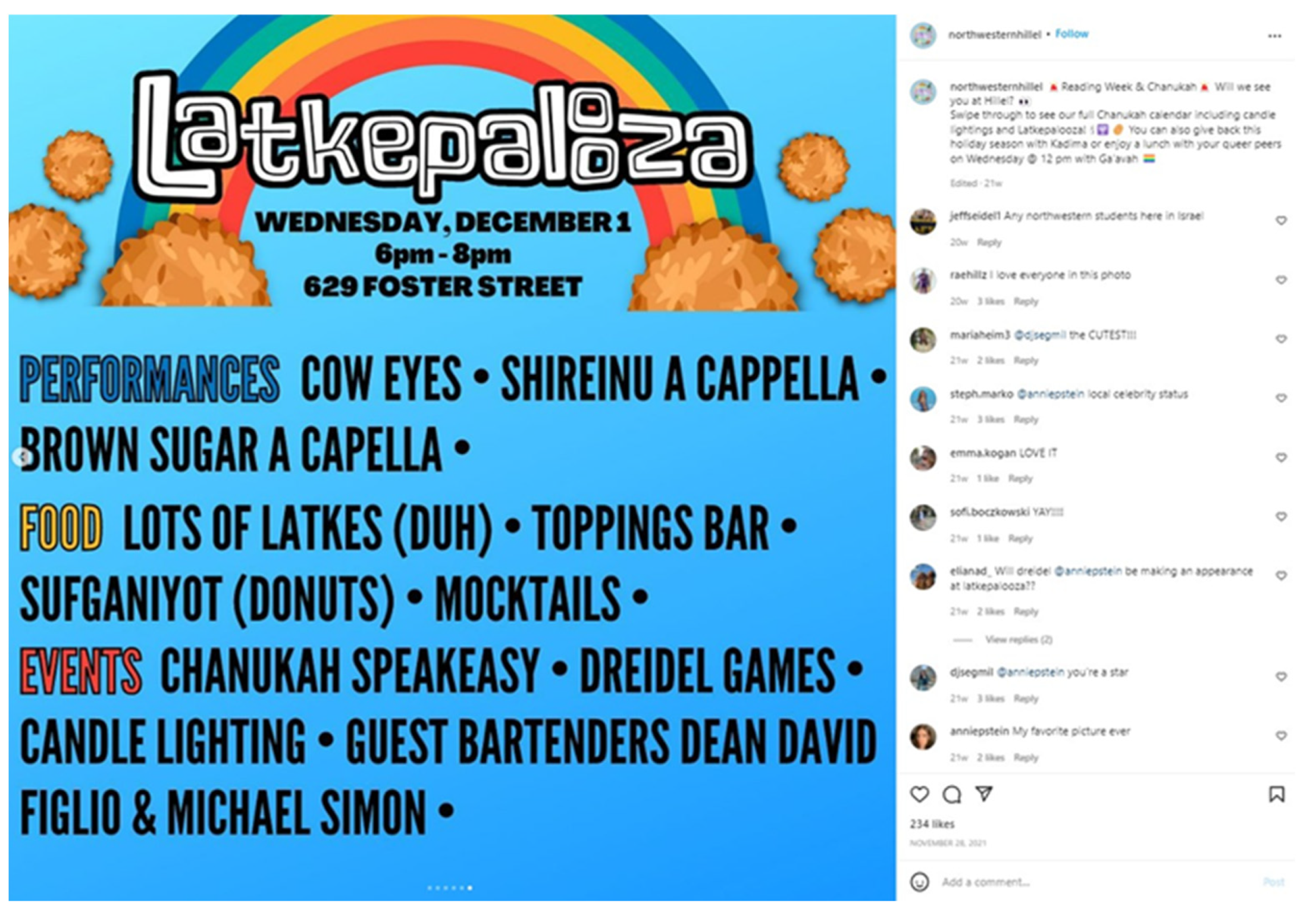
5.1. Celebrated Jewishness
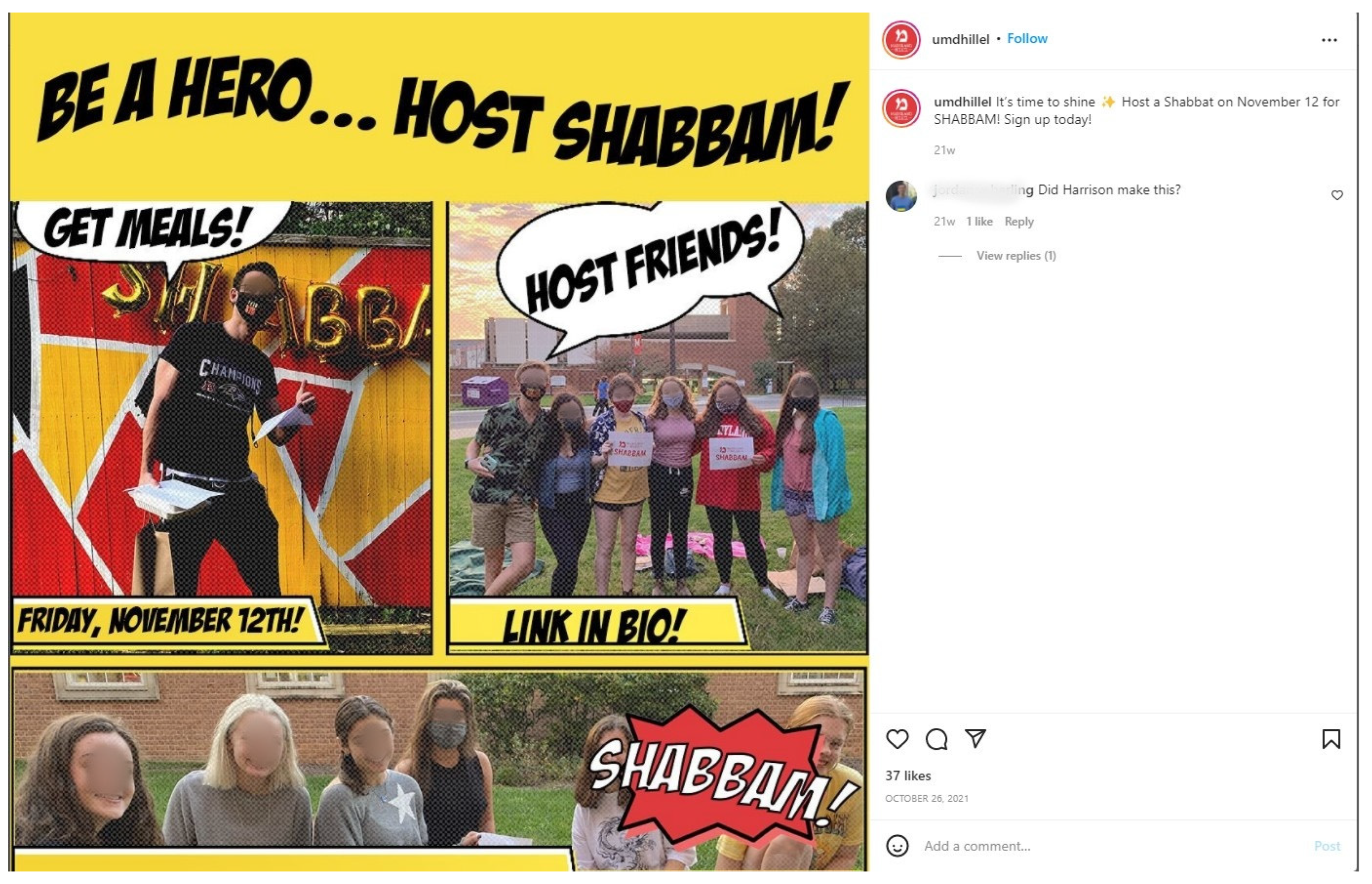
5.2. Youthful Identity
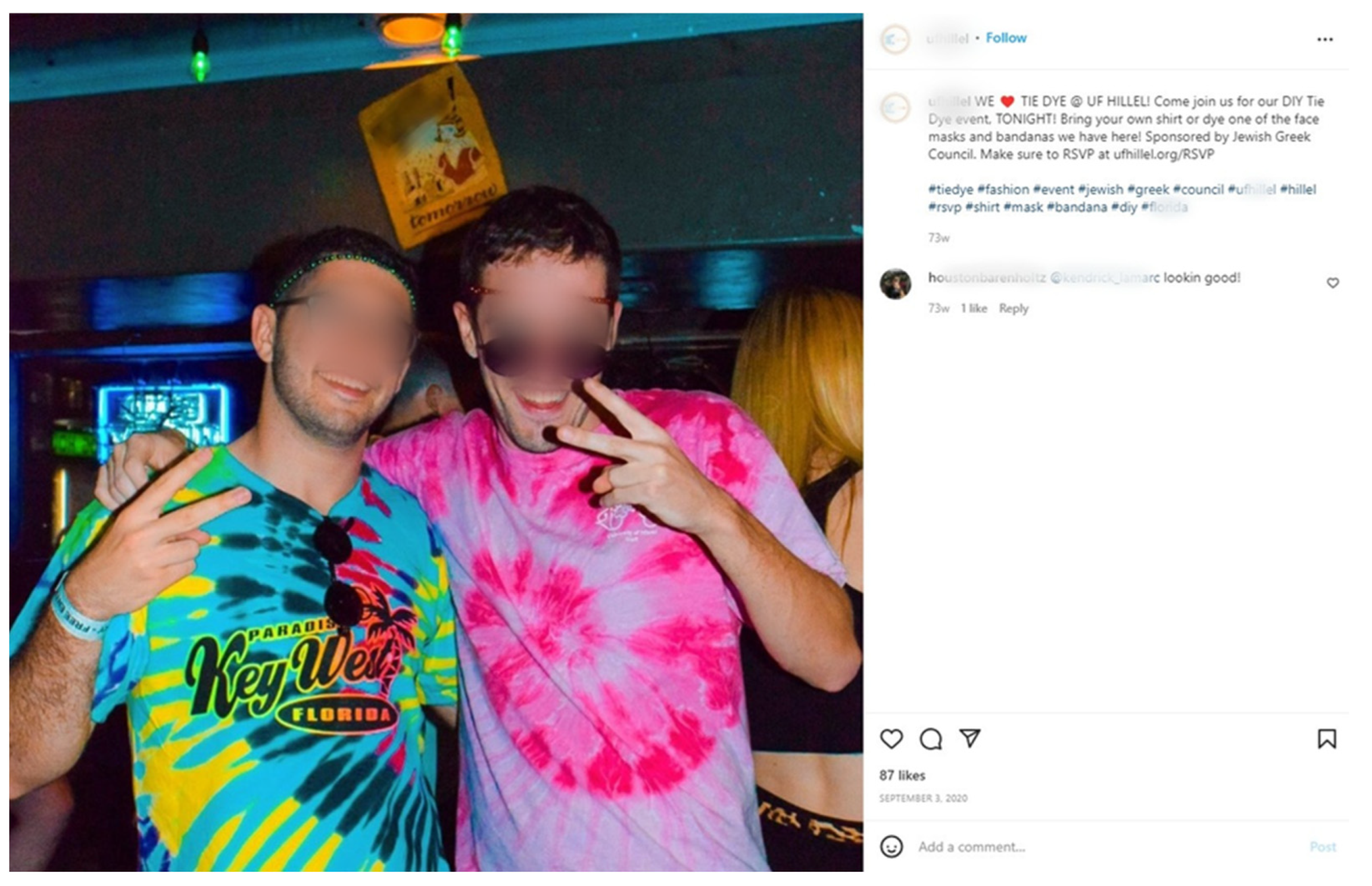
5.3. National Identity: Pan-Americanism Versus Jewish Particularism
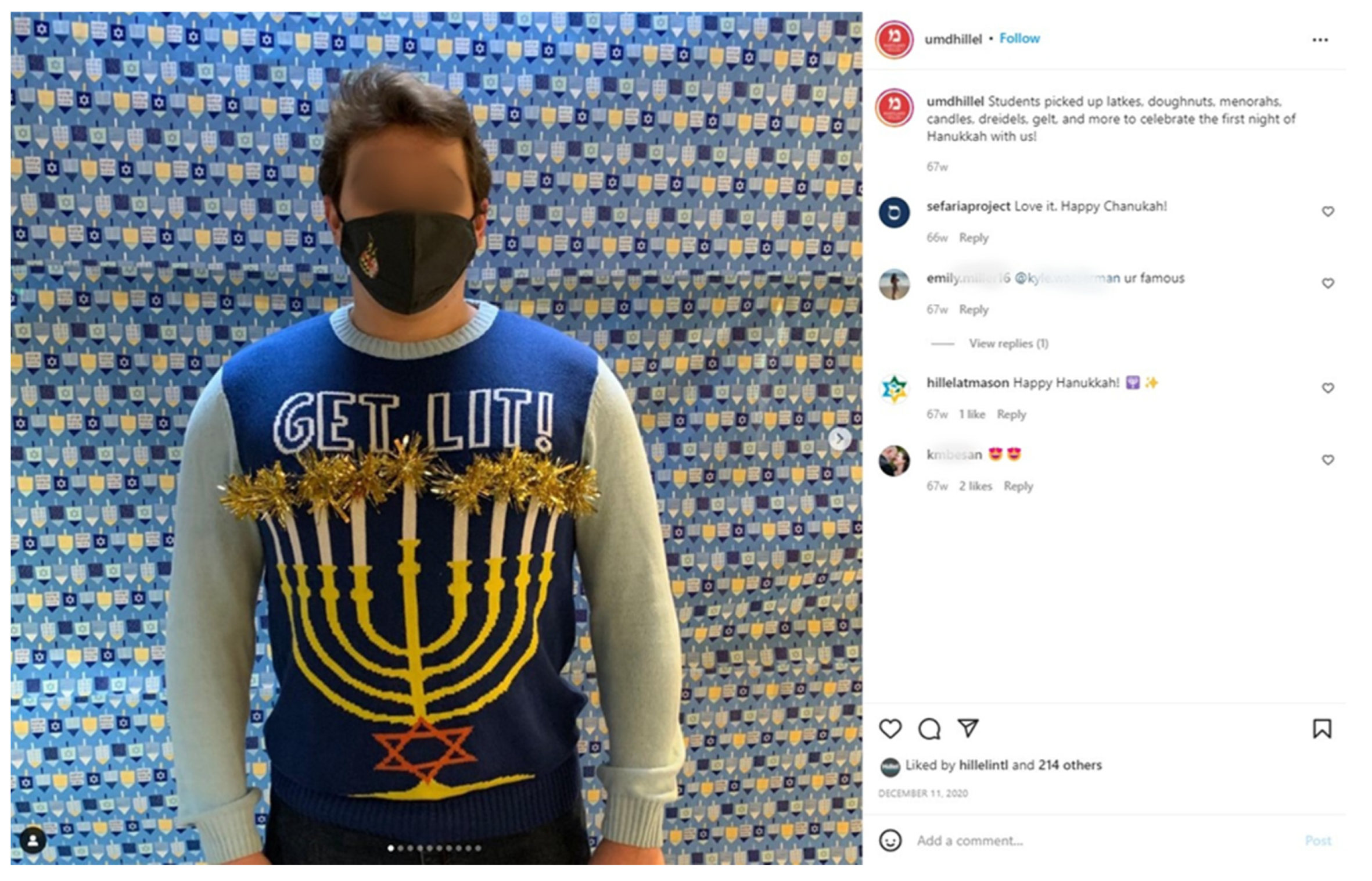
5.4. Institutional Student Identity
6. Discussion
Author Contributions
Funding
Institutional Review Board Statement
Informed Consent Statement
Data Availability Statement
Conflicts of Interest
References
- Abes, Elisa S., Susan R. Jones, and Marylu K. McEwen. 2007. Reconceptualizing the Model of Multiple Dimensions of Identity: The Role of Meaning-Making Capacity in the Construction of Multiple Identities. Journal of College Student Development 48: 1–22. [Google Scholar] [CrossRef]
- Adler, Chaim. 1974. The Student Revolt: A Special Case of a Youth Culture. Teachers College Record 75: 123–39. [Google Scholar]
- Barak-Gorodetsky, David. 2022. Religion and State in Israel-Diaspora Relations—A Social-Covenant Approach. Israel Studies 27: 92–104. [Google Scholar] [CrossRef]
- Bauman, Zygmunt. 2013. Liquid Modernity. New York: John Wiley & Sons. [Google Scholar]
- Ben-Ze’ev, Aaron. 2004. Love Online: Emotions on the Internet. Cambridge: Cambridge University Press. [Google Scholar]
- Berger, Akiva, and Oren Golan. 2024. Online religious learning: Digital epistemic authority and self-socialization in religious communities. Learning, Media and Technology 49: 274–89. [Google Scholar]
- Boellstorff, Tom. 2015. Coming of Age in Second Life: An Anthropologist Explores the Virtually Human. Princeton: Princeton University Press. [Google Scholar]
- boyd, danah. 2014. It’s Complicated: The Social Lives of Networked Teens. New Haven: Yale University Press. [Google Scholar]
- boyd, danah M., and Nicole B. Ellison. 2007. Social Network Sites: Definition, History, and Scholarship. Journal of Computer-Mediated Communication 13: 210–30. [Google Scholar] [CrossRef]
- Boyle, Mark. 1997. Civic Boosterism in the Politics of Local Economic Development: Institutional Positions and Strategic Orientations in the Consumption of Hallmark Events. Environment and Planning A 29: 1975–97. [Google Scholar]
- Bullingham, Liam, and Ana C. Vasconcelos. 2013. “The Presentation of Self in the Online World”: Goffman and the Study of Online Identities. Journal of Information Science 39: 101–12. [Google Scholar] [CrossRef]
- Butler, Judith. 2004. Performative Acts and Gender Constitution. In The Performance Studies Reader, 2nd ed. Edited by Henry Bial. London: Routledge, pp. 154–66. [Google Scholar]
- Calvert, Sandra L. 2002. Identity on the Internet. In Children in the Digital Age: Influences of Electronic Media on Development. Edited by Sandra L. Calvert, Amy B. Jordan and Rodney R. Cocking. Westport: Praeger/Greenwood, pp. 55–70. [Google Scholar]
- Chakim, Sulaiman. 2022. The Youth and the Internet: The Construction of Doctrine, Islam in Practice, and Political Identity in Indonesia. Journal of Social Studies Education Research 13: 217–36. [Google Scholar]
- Cook, Joanne, and Reza Hasmath. 2014. The Discursive Construction and Performance of Gendered Identity on Social Media. Current Sociology 62: 975–93. [Google Scholar] [CrossRef]
- Cousens, Barry. 2007. Hillel’s Journey: Distinctively Jewish, Universally Human. Available online: http://www.bjpa.org/Publications/details.cfm?PublicationID=4537 (accessed on 12 September 2025).
- Danet, Brenda. 2001. Cyberpl@y: Communicating Online. Oxford: Berg. [Google Scholar]
- Dávila, Arlene. 1997. Negotiating Culture and Dollars: The Politics of Corporate Sponsorship in Puerto Rico. Identities 4: 71–97. [Google Scholar] [CrossRef]
- De Bres, Karen, and James Davis. 2001. Celebrating Group and Place Identity: A Case Study of a New Regional Festival. Tourism Geographies 3: 326–37. [Google Scholar] [CrossRef]
- DellaPergola, Sergio. 2024. US Jews: Reflections on Identity and Demography. Cham: Springer. [Google Scholar]
- Demaria, Federica, Maria Pontillo, Cristina Di Vincenzo, Domenico Bellantoni, Ilaria Pretelli, and Stefano Vicari. 2024. Body, Image, and Digital Technology in Adolescence and Contemporary Youth Culture. Frontiers in Psychology 15: 1445098. [Google Scholar] [CrossRef]
- De Moya, Milagros, and Vivian Bravo. 2016. The Role of Public Relations in Ethnic Advocacy and Activism: A Proposed Research Agenda. Public Relations Inquiry 5: 233–51. [Google Scholar] [CrossRef]
- Drori, Gili, Giuseppe Delmestri, and Achim Oberg. 2013. Branding the university: Relational strategy of identity construction in a competitive field. Trust in Higher Education Institutions 86: 134–47. [Google Scholar]
- Echchaibi, Nabil, and Stewart M. Hoover. 2023. Media Theory and the Third Spaces of Digital Religion. In The Third Spaces of Digital Religion. Edited by Nabil Echchaibi and Stewart M. Hoover. London: Taylor & Francis, pp. 1–32. [Google Scholar]
- Eco, Umberto. 1976. A Theory of Semiotics. Bloomington: Indiana University Press. [Google Scholar]
- Einstein, Mara. 2024. Faith-Centric Tiktoks: Promoting Religion through Personalized Experience and Engagement. In Selling the Sacred. London: Routledge, pp. 139–53. [Google Scholar]
- Eisenstadt, Shmuel N. 2004. Change and Continuity in Israeli Society. In Explorations in Jewish Historical Experience. Leiden: Brill, pp. 122–38. [Google Scholar]
- Erikson, Erik. 1968. Identity: Youth and Crisis. New York: Norton & Co. [Google Scholar]
- Farquhar, Lee. 2013. Performing and Interpreting Identity through Facebook Imagery. Convergence 19: 446–71. [Google Scholar] [CrossRef]
- Fernández-de-Castro, Pablo, Daniel Aranda, Santiago Moyano, and Víctor Sampedro. 2023. Digital Youth Work: A Systematic Review with a Proposal. Social Work Education 42: 318–36. [Google Scholar] [CrossRef]
- Giddens, Anthony. 1992. Modernity and Self-Identity: Self and Society in the Late Modern Age. Cambridge: Polity Press. [Google Scholar]
- Glaser, Barney, and Anselm Strauss. 1967. Grounded Theory: The Discovery of Grounded Theory. Sociology 12: 27–49. [Google Scholar]
- Golan, Oren, and Michele Martini. 2022. Sacred Cyberspaces: Catholicism, New Media and the Religious Experience. Montreal: McGill-Queens University Press. [Google Scholar]
- Golan, Oren, and Nurit Stadler. 2016. Building the sacred community online: The dual use of the Internet by Chabad. Media, Culture & Society 38: 71–88. [Google Scholar]
- Greenfield, Patricia M., and Zheng Yan. 2006. Children, Adolescents, and the Internet: A New Field of Inquiry in Developmental Psychology. Developmental Psychology 42: 391–94. [Google Scholar] [CrossRef] [PubMed]
- Greenhow, Christine, and Beth Robelia. 2009. Informal Learning and Identity Formation in Online Social Networks. Learning, Media and Technology 34: 119–40. [Google Scholar] [CrossRef]
- Gremler, Franziska, and Nils B. Weidmann. 2024. Ethnic Politics via Digital Means: Introducing the Ethnic Organizations Online Dataset. Journal of Peace Research 62: 761–71. [Google Scholar] [CrossRef]
- Hebdige, Dick. 2013. Subculture. London: Routledge. [Google Scholar]
- Hillel International. 2020. College Guide. Washington, DC: Hillel International. [Google Scholar]
- Hillel International. 2025. About Hillel International. Available online: https://www.hillel.org/about (accessed on 8 December 2025).
- Illouz, Eva. 2023. Consuming the Romantic Utopia: Love and the Cultural Contradictions of Capitalism. Berkeley: University of California Press. [Google Scholar]
- John, Nicholas A. 2016. The Age of Sharing. Malden: Polity. [Google Scholar]
- Kahane, Reuven. 1968. Patterns of National Identity in Israel. In Education and Society in Israel. Edited by Shmuel N. Eisenstadt. Jerusalem: Akademon, pp. 39–55. (In Hebrew) [Google Scholar]
- Kahane, Reuven. 1982. Legitimation and Integration in Developing Societies: The Case of India. Boulder: Westview Press. [Google Scholar]
- Kahane, Reuven. 1997. The Origins of Postmodern Youth: Informal Youth Movements in a Comparative Perspective. Berlin: Walter de Gruyter. [Google Scholar]
- Katz, Ariel. 2020. Jewish Students in American Higher Education. Journal of Student Affairs at New York University XVI: 14–19. Available online: https://steinhardt.nyu.edu/sites/default/files/2020-05/JoSA%2016_5.29.2020.pdf (accessed on 9 October 2021).
- Kleine, Christoph, and Monika Wohlrab-Sahr. 2020. Preliminary Findings and Outlook of the CASHSS “Multiple Secularities—Beyond the West, Beyond Modernities”. Leipzig: Leipzig University. [Google Scholar] [CrossRef]
- Koren, Amy, Leonard Saxe, and Eric Fleisch. 2016. Jewish Life on Campus: From Backwater to Battleground. In American Jewish Year Book 2015: The Annual Record of the North American Jewish Communities. Edited by Arnold Dashefsky and Ira Sheskin. Cham: Springer, pp. 45–88. [Google Scholar]
- Kross, Sean, Eszter Hargittai, and Elissa M. Redmiles. 2021. Characterizing the Online Learning Landscape: What and How People Learn Online. Proceedings of the ACM on Human-Computer Interaction 5: 1–19. [Google Scholar] [CrossRef]
- Kushner, Karen. 2009. The Journey of Identity Development for Jewish Millennial College Students. Journal of Student Personnel Association at Indiana University, 29–42. [Google Scholar]
- Livingstone, Sonia. 2002. Young People and New Media: Childhood and the Changing Media Environment. London: Sage. [Google Scholar]
- Livingstone, Sonia. 2008. Taking risky opportunities in youthful content creation: Teenagers’ use of social networking sites for intimacy, privacy and self-expression. New Media & Society 10: 393–411. [Google Scholar] [CrossRef]
- Marler, Will, and Eszter Hargittai. 2023. Understanding the Evolving Online Learning Landscape: The Case of Science and Religion. Social Media + Society 9: 1–12. [Google Scholar] [CrossRef]
- Mesch, Gustavo S., and Ilan Talmud. 2020. Wired Youth: The Online World of Adolescence. London: Routledge. [Google Scholar]
- Meyer, Michael A. 1995. Response to Modernity: A History of the Reform Movement in Judaism. Detroit: Wayne State University Press. [Google Scholar]
- Mishol-Shauli, Nakhi, and Oren Golan. 2022. Smartphone religious networking: Negotiating contested identities within a pious community over WhatsApp. Religions 13: 1034. [Google Scholar] [CrossRef]
- Moody, Zoé, and Tom Stahel. 2025. School Bullying: Children and Adolescent Norms, Cultures and Identity Development. Frontiers in Education 10: 1497681. [Google Scholar] [CrossRef]
- Okun, Shira, and Galit Nimrod. 2017. Online Ultra-Orthodox Religious Communities as a Third Space: A Netnographic Study. International Journal of Communication 11: 2825–41. [Google Scholar]
- Peter, Jochen, Patti M. Valkenburg, and Cedric Fluckiger. 2009. Adolescents and Social Network Sites: Identity, Friendships and Privacy. In Kids Online: Opportunities and Risks for Children. Edited by Sonia Livingstone and Leslie Haddon. Bristol: Policy Press, pp. 83–95. [Google Scholar]
- Peterson, Kristin M. 2023. Queer Muslim Identity in the Third Space of Tumblr. In The Third Spaces of Digital Religion. Edited by Nabil Echchaibi and Stewart M. Hoover. London: Taylor & Francis, pp. 63–76. [Google Scholar]
- Pew Research Center. 2016. The Most and Least Educated U.S. Religious Groups. Available online: https://www.pewresearch.org/fact-tank/2016/11/04/the-most-and-least-educated-u-s-religious-groups (accessed on 8 September 2025).
- Rainie, Harrison, and Barry Wellman. 2012. Networked: The New Social Operating System. Cambridge: MIT Press. [Google Scholar]
- Rosana, Arif, and Ikhwan Fauzi. 2024. The Role of Digital Identity in the Age of Social Media: Literature Analysis on Self-Identity Construction and Online Social Interaction. Journal of Social Science 1: 477–89. [Google Scholar] [CrossRef]
- Saldaña, Johnny. 2021. The Coding Manual for Qualitative Researchers, 3rd ed. London: Sage Publications. [Google Scholar]
- Sales, Amy L., and Leonard Saxe. 2006. Particularism in the University: Realities and Opportunities for Jewish Life on Campus. New York: Avi Chai. [Google Scholar]
- Sarna, Jonathan D. 2004. American Judaism: A History. New Haven: Yale University Press. [Google Scholar]
- Sarna, Jonathan D. 2021. Coming to Terms with America: Essays on Jewish History, Religion, and Culture. Lincoln: University of Nebraska Press. [Google Scholar]
- Schmalzbauer, John. 2013. Campus Religious Life in America: Revitalization and Renewal. Society 50: 115–31. [Google Scholar] [CrossRef]
- Scott-Maxwell, Alyssa. 2015. Representing Indonesia in Australia through Performance Communities, Collaborations, Identities. In Performing Contemporary Indonesia: Celebrating Identity, Constructing Community. Edited by Barbara Hatley and Brett Hough. Leiden: Brill, pp. 182–202. [Google Scholar]
- Selznick, Benjamin S., Matthew J. Mayhew, Christa E. Winkler, Musbah Shaheen, and Alyssa N. Rockenbach. 2024. Developing college students’ Jewish appreciation: A four-year mixed-methods study. Innovative Higher Education 49: 1177–211. [Google Scholar] [CrossRef]
- Selznick, Brian S., and Shayna Greene. 2024. Jewish on Campus: Complexity and Tikkun. New Directions for Higher Education 206: 27–39. [Google Scholar] [CrossRef]
- Shifman, Limor. 2007. Humor in the Age of Digital Reproduction: Continuity and Change in Internet-Based Comic Texts. International Journal of Communication 1: 187–209. [Google Scholar]
- Singh, Gurpreet. 2024. The Social Construction of Gender: An Exploration of Judith Butler’s Ideas. International Research Journal of Education and Technology 6: 2587–7795. [Google Scholar]
- Slater, Don. 2002. Social Relationships and Identity Online and Offline. In Handbook of New Media: Social Shaping and Consequences of ICTs. Edited by Leah Lievrouw and Sonia Livingstone. London: Sage, pp. 533–46. [Google Scholar]
- Small, Jenny L., Pietro Sasso, and Danielle Lund. 2025. Jewish Fraternities and Sororities as Sites of Campus Belonging, Community, and Resistance to Antisemitism. Journal of Jewish Education 91: 275–97. [Google Scholar] [CrossRef]
- Smith, Kenneth E. I. 2008. Hybrid Identities: Theoretical Examinations. In Hybrid Identities: Theoretical and Empirical Examinations. Edited by Kenneth E. I. Smith and Patricia Leavy. Leiden: Brill, pp. 3–12. [Google Scholar]
- Teusner, Paul E. 2012. Networked Individualism, Constructions of Community and Religious Identity: The Case of Emerging Church Bloggers in Australia. In Networked Sociability and Individualism: Technology for Personal and Professional Relationships. Hershey: IGI Global, pp. 264–88. [Google Scholar]
- Tseng, Shin-Feng, and Ming-Hua Li. 2007. A Sense of Community or Networked Individualism? Conference paper. Available online: https://repository.arizona.edu/handle/10150/106381 (accessed on 12 September 2025).
- Tsuda, Takeyuki. 1993. The Psychosocial Functions of Liminality: The Japanese University Experience. Journal of Psychohistory 20: 305–30. [Google Scholar]
- Turkle, Sherry. 2005. The Second Self: Computers and the Human Spirit, 20th anniversary ed. Cambridge: MIT Press. [Google Scholar]
- Utekhin, Ilya. 2017. Small Data First: Pictures from Instagram as an Ethnographic Source. Russian Journal of Communication 9: 185–200. [Google Scholar] [CrossRef]
- Waite, Linda J. 2002. The American Jewish Family: What We Know, What We Need to Know. Contemporary Jewry 23: 35–63. [Google Scholar] [CrossRef]
- Weber, Max. 1978. Economy and Society: An Outline of Interpretive Sociology. Berkeley: University of California Press. [Google Scholar]
- Williams, Alex L., and Michael J. Merten. 2008. A Review of Online Social Networking Profiles by Adolescents: Implications for Future Research and Intervention. Adolescence 43: 253–74. [Google Scholar]
- Williams, J. Patrick. 2011. Subcultural Theory: Traditions and Concepts. Cambridge: Polity. [Google Scholar]
- Woocher, Jonathan. 2005. Sacred Survival Revisited: American Jewish Civil Religion in the New Millennium. In The Cambridge Companion to American Judaism. Edited by Dana Evan Kaplan. Cambridge: Cambridge University Press, pp. 283–97. [Google Scholar]
- Wu, Ying Qi, and Cecilia Yin Mei Cheong. 2024. Corporate branding of academic institutions: Semiotic communication of logos and names. Journal of Marketing for Higher Education 34: 321–43. [Google Scholar] [CrossRef]
- Yares, Amy. 2006. Jewish Identity on Campus: Research and Recommendations for the College Years. Journal of Jewish Education 65: 41–48. [Google Scholar] [CrossRef]


Disclaimer/Publisher’s Note: The statements, opinions and data contained in all publications are solely those of the individual author(s) and contributor(s) and not of MDPI and/or the editor(s). MDPI and/or the editor(s) disclaim responsibility for any injury to people or property resulting from any ideas, methods, instructions or products referred to in the content. |
© 2025 by the authors. Licensee MDPI, Basel, Switzerland. This article is an open access article distributed under the terms and conditions of the Creative Commons Attribution (CC BY) license.
Share and Cite
Udi, T.; Golan, O. Performing Identity on Social Media: Instagramming Jewishness on US University Campuses. Religions 2026, 17, 12. https://doi.org/10.3390/rel17010012
Udi T, Golan O. Performing Identity on Social Media: Instagramming Jewishness on US University Campuses. Religions. 2026; 17(1):12. https://doi.org/10.3390/rel17010012
Chicago/Turabian StyleUdi, Tomer, and Oren Golan. 2026. "Performing Identity on Social Media: Instagramming Jewishness on US University Campuses" Religions 17, no. 1: 12. https://doi.org/10.3390/rel17010012
APA StyleUdi, T., & Golan, O. (2026). Performing Identity on Social Media: Instagramming Jewishness on US University Campuses. Religions, 17(1), 12. https://doi.org/10.3390/rel17010012