Article

The Animation of Nature and the Nature of Animation—The Life of Made Objects from the “Record of Tool Specters” to the “Night Parade of Hundred Demons”

Department of Anthropology and Sociology, SOAS University of London, London WC1H 0XG, UK
Religions 2025, 16(12), 1534; https://doi.org/10.3390/rel16121534
Submission received: 10 May 2025 / Revised: 26 May 2025 / Accepted: 24 November 2025 / Published: 5 December 2025
(This article belongs to the Section Religions and Humanities/Philosophies)

Abstract

This article argues that animism in the Japanese context is more fruitfully understood as animation, a technique that imbues man-made things with life. Two forms of animation are at work in so-called animist beliefs: one is the docile animation of instruments when skillfully used by humans, in which case the instrument becomes part of the human body; the other is the sense of aliveness that one experiences when an object resists human use and intention. This latter sense is crucial for the narrative of the 14th century illustrated scroll “The Record of Tool Specters” and the painted genre of “Night Parade of Hundred Demons”, in which everyday objects, vessels and instruments appear as demons and threaten human life. These images show how the instruments come alive through animation strategies intrinsic to the illustrated scroll as a medium, activated by the performances of professional storytellers and shaped by the artists’ anthropomorphizing imagination. The tool specters, on the cusp of breaking free from human bondage, are recaptured in a different network of meaning, allusion and fecund cultural production. What animates the inanimate objects is a media infrastructure, a network of media platforms that stretches back in time and that allows these apparitions to be conjured in different forms and contexts.

1. Introduction

The claim that the opposition between nature and culture does not hold in Japan has been made repeatedly by Japanese and foreign scholars alike. Contrary to the vertical relationship of monotheism, with a transcendent deity above and nature to master below, the Japanese worldview holds that “all existential categories are coexisting on a horizontal plane and differing from one another only by degree and not by essence or value. [T]he categories of nature and man are not only contiguous but share common existential ground” (Kyburz 1997, p. 277). However, this does not exclude an antagonistic or exploitative attitude towards nature. As Lola Martinez (2005) has shown, the environmental degradation of the Japanese landscape goes hand in hand with its elevation to an aesthetic value which allows—through a focus on the detail, on the framed landscape, on the miniature—an idealized elite notion of nature to eclipse the lived-in environment. This ideal nature becomes a model of and, more importantly, a model for nature, shifting from a descriptive to a normative mode (Asquith and Kalland 1997, p. 18). In a similar vein, the distinction between the natural and the artificial, so crucial for Western critiques of the fake and fraudulent (Pietz 1987), is not seen as mutually exclusive in Japan: “nature” always emerges as the result of cultural artifice, while culture always contains and enhances nature. “It is understood that Japanese gods do not appreciate true things; they do not accept things that are not fabricated by means of a device […]. One must add something to that which already exists in order to present it to gods,” as Masao Yamaguchi (1991) points out in an influential if somewhat opaque essay (p. 64).
The blurring of both these distinctions makes the case of Japan confusing to an ontology that attributes life to nature, but not to the artificial. The concept of animism is usually invoked when an impasse is reached: it is meant to help explain a problem that in fact arises from the way in which we divide the world. This problematic notion of animism is usually linked to Shintō as a form of polytheistic and pantheistic view of the natural world. This view has it that kami 神, immanent spiritual entities, imbue the world of objects with life force. In an article on robots in Japan, Jennifer Robertson (2014) goes so far as to claim that “there is no ontological pressure to make distinctions between organic/inorganic, animate/inanimate, human/non- human forms. On the contrary, all of these forms are linked to form a continuous network of beings” (p. 576). If modern technology, human enhancement and an increased reliance of robots are not experienced as alienating and dystopian, it is because the Japanese are “religiously” well prepared for a fabricated world in which things themselves are inhabited by spirits.
This paper will critically examine this relationship between the fabricated nature of artefacts and a supposed indigenous Japanese animism. I shall argue that instead of relying on the loaded notion of animism as belief, it makes more sense to speak of animation as practice. In what follows, I focus on the historical modalities of animation as practice and sketch some of their broader implications. As an illustrative case, I draw on the Record of Tool Specters (Tsukumogami-ki 付喪神記), a fourteenth-century illustrated scroll that played a crucial role in the formation and transmission of these beliefs and a document that in current debates is frequently referred to as “evidence” of animism in Japan.1

2. Animism as Belief-Animation as Practice

“Animism” itself is not just a descriptive category, but a heavily loaded concept. Introduced by one of the founders of anthropology, E. B. Tylor (1871), to characterize “primitive religion” as “belief in spiritual beings,” animism is part of an evolutionistic understanding of human development. It implies that the attribution of life to inanimate objects is a category error immanent to the primitive mind rather than a legitimate “philosophy” of the world. This is often forgotten when the concept is taken out of context and when it is used in a purely descriptive manner.2 Tylor’s concept of animism was so successful because it allowed one to generalize a broad range of distinct phenomena from all over the world under the rubric of primitive religion (Harvey 2006). In a recent book chapter on why animism is not a useful category to think about anime, Jolyon Thomas (2019, p. 158) distinguishes this “pejorative” notion of animism from what he calls “recuperative animism”—the utopian use of animism as an antidote to human alienation from nature and environmental degradation—and “obscurantist animism”, in which Japanese animism is characterized as having a direct, unmediated access to nature and thus is put beyond rational criticism.
Some of this ambiguity also applies to the “new animism” that has been embraced by some anthropologists (for a critique see Willerslev 2013; and Wilkinson 2017). To describe an animist worldview in propositional terms, that is, as inner mental representations that people have of their environment, not only reinforces the inside/outside distinctions that animists have supposedly overcome, but is also based on a largely unexamined protestant understanding of belief. The beliefs under scrutiny here can be formulated in propositional form—“spirits living in things”—but that is not how they are encountered by those who come to believe in them. One could of course argue that even if these notions are never voiced directly, one can still infer the belief from practice. Scholars of Japanese religions have long argued that orthopraxy eclipses orthodoxy (Shields 2010); that is, it is more important to act in the ritually correct way that it is to believe in the correct dogma. The question, then, is whether belief is required at all in order to perform “religion” in the appropriate manner.
Abstracting belief from local practice leads to general statements like “kami dwell in trees, rivers, rocks and animals.” But while this may be true in an abstract sense, kami worship is always particular and localized: the result, furthermore, of a particular settlement between human immigrants and local nature. Take the myth of Matachi from the 8th century “Hitachi-no-kuni fūdoki” (“Gazetteer of Hitachi Province”) for example: Matachi cleared the reed plains to cultivate new rice fields. A great number of horned snakes (yato-no-kami) gathered to stop people from entering the fields. Matachi was enraged and chased them away with a spear and armor. At the foot of the mountain he put down a stick and said: “We shall give the land above this stick to you, as the domain of the kami, but the land below will be turned into rice fields for the people. I shall become a priest [hafuri] of the kami, and I shall revere and worship you in all eternity. I pray, do not strike us; do not bear a grudge against us!” (quoted in Breen and Teeuwen 2010, p. 25). Matachi thus emerged as both founder of a community and a lineage of priests in charge of keeping up the settlement between the human realm and the realm of the kami. Note that the “shrine” (yashiro) he worshipped at was a place rather than a building and that the kami are not yet thought to dwell there permanently: they were invited to the border of their world to partake in the offerings that aided in the maintenance of that boundary. In other words, it is the repetition of the act of worship that creates the entities as worthy of worship, that is, as benevolent tutelary deities. If anything, Shintō could be called a technology through which settlements between human and natural powers are transformed into belief, the content of belief being the endpoint, not the beginning of the process.
For this reason, rather than to understand animism as a belief about the nature of things, I will suggest to replace it with the notion of animation as a form of practice, or more specifically, as a strategy to deal with entities, natural and otherwise. I will argue that the popular distinction between animism and techno-animism becomes superfluous in the moment we realize that understanding animation as practice turns every form of animism into a technology. I follow Teri Silvio’s thought-provoking article on animation as a paradigm to replace and/or complement performance as master-metaphor in the social sciences and media studies. Although the concept of animation hails from the theoretical corpus of media studies, at its heart is the aspect of “breathing life” into something that is considered to be lifeless before. In cinema studies animation is everything that is not live-action (claymation, single cell or computerized animation), although Alan Cholodenko (2007) has argued that all cinema is animation because it creates the illusion of movement—and therefore “life”—from still single frames. Silvio broadly defines animation as
“the projection of qualities perceived as human—life, power, agency, will, personality, and so on—outside of the self, and into the sensory environment, through acts of creation, perception, and interaction. This projection, like any human expression, requires a medium, and we can take the comparative study of technēs of animation—in art, in religion, in everyday life—as the goal of an anthropology of animation.”
A focus on animation as practice instead of animism as belief provides the anthropologist with a number of advantages. Firstly, it puts the focus and the actual engagement of producers/creators, mediators and followers. If a “practical ontology” is at work, it is the technology of “ensouling matter” as Victoria Nelson (2003) puts it. To point to the made nature of animated entities does not mean to disavow or even debunk the “life” attributed to them (Latour 2010). Cases of animation can thus be framed as conjurations of life rather than self-sustaining apparitions.
Secondly, such a move allows a closer focus on the materiality of the media in which animation occurs. If belief in spirits in things is simply assumed as part of a local ontology or cosmology, the question as to how this belief is instantiated in practice and propagated remains secondary. A closer engagement with the material practices and events that create ensouled entities reveals that such beliefs are created through performances that animate the representation of animated objects.
Thirdly, a focus on the technē of animation makes possible a broader gradient of truth/doubt claims. One of the many problems with ontological approaches is that they only allow informants to speak in the register of truth (see Holbraad 2012). In spite of the radical alterity and the anti-universalizing attitude that the ontological turn advocates, it still theorizes from the assumption that the informants are as interested as the anthropologists are in the making of truth-claims. The imperative to take whatever the informant says at face level and to reinvent a world in which the utterance is made possible, makes it impossible for the informant to have any doubts regarding their own ontological premises, let alone deceive or even―God forbid―lie. Putting in plain view the processes and effects of animation, we can emancipate ourselves from such ontological earnestness and allow different gradients of truth-telling and believing, such as the notion of hanshin-hangi (half-belief half-doubt), so prevalent in dealing with ghostly apparitions in Japan for example (Foster 2009).
Last but not least, such a shift away from the tremendum et fascinosum vis-à-vis the numinous should lead to an appreciation of the playfulness of animation when dealing with toys, cute monsters and other playful matters. Ontologically inflected positions are sometimes comically blind to the dimensions of play, a legacy that goes far back in Japan (for a general overview see Hendry and Raveri 2002; for yōkai see Fujimoto 2008).

3. The Tsukumogami-Ki

The particular genre of “night parade of one hundred demons” (Hyakki Yagyō) is often used to claim an animist unconscious in Japan because it features among other monsters everyday objects that have become alive to haunt their former owners (Iwata 1993). I will illustrate the points made above by examining the narrative that is credited with “explaining” their existence, the Tsukumogami-ki3, or “Record of Tool Specters” in Noriko Reider’s charming translation.
Although the painted scroll is a Muromachi period artefact,4 the story is set in the Imperial capital Heian (present day Kyoto). These are the opening lines:
“According to the Miscellaneous Records of Yin and Yang, after a span of one hundred years, utsuwamono or kibutsu 器物 (containers, tools, and instruments) receive souls and trick people. They are called Tsukumogami. In view of that, every year people bring out the old tools from their houses and discard them in the alleys before the New Year. This event, called susuharai 煤払 (lit. “sweeping soot,” year-end house cleaning), is carried out to avoid misfortune caused by tsukumogami tool specters but a year short of a hundred.
This custom of renewing the hearth fire, drawing fresh water, and renewing everything from clothing to furniture at the New Year is thought to have started from the proud extravagance of the well-to-do, but now we understand the custom is meant to prevent the calamities caused by tsukumogami.”
(translated by Reider 2009b, p. 1)
When the spring cleaning happens again in the era Kōhō (964–968), the abandoned old tools get together and complain about having been thrown away after faithfully serving their human masters for a long time (Figure 1). They vow to become specters and exact vengeance, apart from Ichiren, the rosary, who argues that being disposed in this way is their karma. Ichiren is almost beaten to death by Aratarō, the angry club, but narrowly manages to escape. Professor Classics suggests that the Lunar New Year, when Yin and Yang change places, is the opportune moment to empty themselves and to become specters by intervention of the god of creation. When the moment arrives, the old tools are transformed into vengeful demons, taking the shape of men or women, goblins, foxes, and wolves.
They decide to live just behind Mt. Funaoka, from where they start to haunt the capital, killing animals and humans for food. The tool specters enjoy themselves with feasts and poetry. One day one of the tool specters says:
“Japan is a divine country where everyone believes in Shinto. While we have already received our forms from the creation god, we have not worshipped him, and this is as if we were nonsentient beings like trees and rocks. I propose that we make the creation god our patron and worship him. That way we will be sure to have a long life with abundant posterity.”
They build a shrine dedicated to the god of transformation and worship him in minute imitation of human custom, with priests, dance performances, and a festival with a portable shrine. It so happens that when the tool specters parade with the shrine eastwards along the first avenue, they encounter the prince regent’s party and scare his outriders and attendants. The regent, unafraid, glares back at the tool specters and suddenly a flame bursts from the amulet he carries. The tool specters flee in confusion.
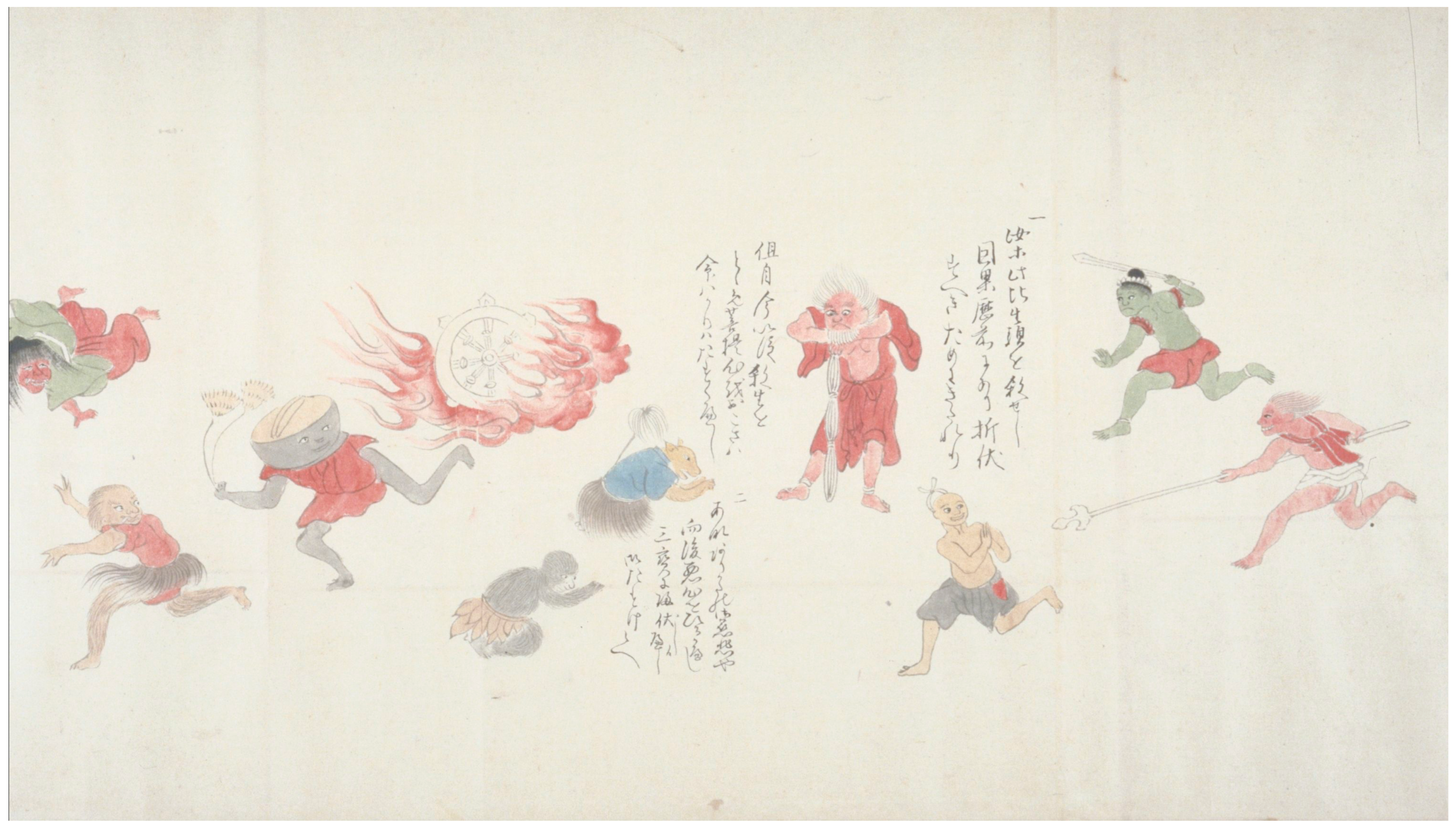
After his return, the regent reports what happened to the Emperor, who orders divination and subsequently offerings to various Shintō shrines and prayers at Buddhist temples of both the exoteric and esoteric schools. The diviner asks about the origin of the amulet, and it is revealed that a certain bishop has inscribed it with the powerful Sonshō darani, a sacred Sanskrit phrase with protective powers. The Emperor requests this bishop to perform a Great Sonshō darani rite. Upon its performance, the Emperor sees a group of armed divine boys appear in a burst of light above the palace. He thanks the bishop who is revealed to belong to the esoteric Shingon sect of Buddhism. In the meantime, the divine boys fly to the tool specters and conquer them with the use of fire-breathing wheels of Dharma (rinpō). But instead of killing them, they show compassion and ask them to foreswear evil and harm to human beings and to follow Buddhist precepts (Figure 2). The tool specters show penitence and vow to devote themselves to Buddhism. They seek out the rosary Ichiren they so callously expelled from their midst and find him in a small mountain hermitage. Ichiren, who has become a holy priest through his devotion, does at first not recognize the specters and thinks they are demons that have come to test his faith. When the tool specters explain their predicament, Ichiren takes pity on them and initiates them in Buddhist teachings. After a while they ask him to divulge the most profound of the teachings and the direct way to attain Buddhahood. Ichiren then expounds on the three mystic practices of Shingon teaching (mudra, mantra, and mandala) and how they enabled Kōbō Daishi to become one with the Mahāvairocana (Dainichi Nyorai) and thus to demonstrate the doctrine of non-duality of humans and Buddhas.
The tool specters, many of whom were vessels, absorb Ichiren’s teaching in its entirety and Ichiren attains salvation at the age of 108 in the paradise of Mahāvairocana. The tool specters decide to live as hermits and to cut their connection with the secular world. They persevere in their practice and attain the state of Samadhi in their very bodies.
The text then goes on to provide a kind of epilogue: although both Tendai and Kegon sects preach the enlightenment of plants (sōmoku jōbutsu), it is only Shingon that advocates the enlightenment of plants and non-sentient entities through religious practice (sōmoku hijō hosshin shugyō jōbutsu). There is nothing in the universe that does not share in the substance of the letter A. Having listened to the tale of the enlightenment of the tool specters, the audience is invited to believe even more in the three mysteries. The exoteric schools are criticized for believing that old tools transform into specters because they are possessed by deities or demons:
“How then, could the tools—also inanimate objects—need to borrow the nature of others to become themselves? If you wish to know the deepest meaning, quickly escape from the net of exoteric Buddhism and enter Shingon esoteric Buddhism.”

3.1. Interpretive Dimensions

This fascinating narrative carries several layers of meaning and I can only start to unravel some of the relevant threads here. It cleverly juxtaposes the genre of otogi-zōshi (medieval “companion tales”) with disputes about Buddhist doctrine. On a very basic level it works as a simple morality tale about thrift (“do not throw things away that you can still use”), using a supernatural threat to enforce its message that appeals to commoners not conversant with doctrinal disputes. But it also features a series of literary allusions and wordplay that suggest a parodic reading, either of Chinese predecessors of demon parades that did not feature animated objects (Tanaka 2002) or as a direct parody of the Shuten dōji scroll (Reider 2009a, p. 242). That it was created by someone affiliated to the Shingon school becomes increasingly clear, as the narrative parodies Shintō beliefs and institutions, but also the doctrine of rival Buddhist sects. The story can also be read as a Buddhist attempt to usurp and absorb Shintō beliefs about the animated nature of possessions into Buddhism, a reading that suggests that granting enlightenment to plants was a Buddhist strategy to incorporate native beliefs (Rambelli 2001). Two things undermine this interpretation however: first, the doctrine is already discussed in the Tendai and Shingon schools in China (Rambelli 2007) and second, the clearly Taoist slant of the belief itself that is attributed to a Taoist treatise (The lost “Miscellaneous record of Yin and Yang”). Note also that the transformation is achieved under the guidance of old master Classics (Kobun-sensei), by emptying themselves out on the night of the spring equinox, when yin and yang change place, clearly alluding to a Taoist cosmology.
What is at stake in terms of animism are two different notions of animation. The first relies on a possessive paradigm wherein a spirit occupies a thing (and therefore can be exorcised), a view that is attributed to the “inferior” exoteric schools of Buddhism and more implicitly to native possessive cults. Reider notes that there are cases in the “Konjaku-monogatari” that can be thought of as predecessors of Tsukumogami beliefs (2009, p. 251). The story of an evil spirit that possesses an oil container and kills a sick girl is clearly the result of an object becoming possessed, rather than the spirit of the object as such. Such spirits of things (mononoke) manifest themselves in diminutive human form and are generally thought to be harmless, like the buried copper decanter that discloses to humans its location (Shinpen Nihon Koten Bungaku zenshū 1994–2002, vol. 38, pp. 33–35). On this basis Reider argues that the animated objects of the “Record of Tool Specters” came into being as an amalgamation of different strands of belief: the notion that old beings, humans as well as animals, attain special powers of transformation; that things can become possessed and sometimes possess their own “spirit”; that impurities and evil can be expurgated by casting them into things that are subsequently discarded (Reider 2009a, p. 251). This is also the case when illness-causing kami (yakubyōgami) are exorcised from patients by first transferring them to a medium and then casting them into physical objects. It is a small step from there to imagine that these objects charged with human impurities and intentions can come to life. Note also that while the animation that occurs in these instances is an involuntary side-effect of purification rites, it is still the result of a ritual technique.
The second notion of animation that is taken to be superior in the “Record of Tool Specters” is that of the Shingon school. Here matter itself is alive because it is the emanation of the dharmakaya, the Buddha’s body. The superiority of this lies in the extended scope of compassion that grants enlightenment not only to plants, but also to inanimate objects (Rambelli 2001). Rather than a Manichean worldview in which matter is pitched against the spiritual realm, Shingon Buddhism advocates a monist view in which it is only human delusion that creates duality, hence the doctrine of “enlightenment in this body” (sokushin jōbutsu). In other words, no belief in animated beings is required because matter is inherently animated.5
What both these interpretations of animism/animation obfuscate is the ways in which relationships with actual material objects are shaped by the experience of practice, rather than just belief. If we think of the possible relationships one can enter with things as an animation continuum (Gygi 2018), then there are two ways we can conceive of the notion of a thing becoming alive. One is cathexis: that is, the notion that the thing becomes one with the individual, as is the case with an instrument that one uses as a bodily extension. In achieving a task, person and object become one: both in the sense that our own perception extends through the object but also in the sense that the object no longer has an independent life of itself. This is an example of animation through use, in which the person using the instrument imbues it with their own life. Person and thing, subject and object melt into each other and create a new emergent system (Malafouris and Renfrew 2013). In this case, the ontological difference between person and object is erased, if the object is used with skill. A transition occurs as soon as the instrument/object is put down. The moment the direct contact is interrupted the thing returns to objecthood, but it retains the possibility of blending. In the traditional Japanese arts, the instrument is greeted at the beginning and the end of the sequence of training, marking the moment of becoming one and acknowledging the autonomous existence of the thing.6
On the other hand, the object emerges as imbued with a life of its own the very moment it resists us. The moment the car we use unthinkingly everyday breaks down, the moment the shoelace snaps, we become aware that things can resist us and it is this resistance that appears to us as life in its recalcitrant form. Heidegger uses the difference between “Zuhandenheit” and “Vorhandenheit” (ready-to-hand vs. present-at-hand), to indicate two modes of relational being towards human agents: when lost, misplaced or not functioning properly things “light up,” they come to mind rather than come to hand (Heidegger 1962, p. 105). When the sword user thus greets the kamiza, the sword, and the master with the word “onegaishimasu” the possibility of non-compliance on the side of the thing is at least implicitly present.
Cathexis and Resistance are two extreme positions on either side of the spectrum of animation, in which things emerge as possessing “life.”7 In the case of cathexis, or “docile animation,” they bend themselves to our will and become agents of our agency; in the case of resistance their agency is opposed to our own and we experience the object all the more “alive” for that. The latter could be called “recalcitrant animation.” Both elements are paired in the “Record of Tool Specters”: the things are used for a long time, obediently do their owner’s bidding, and co-exist with them on intimate terms. Then they are suddenly thrown out. Interestingly, the text suggests two different interpretations: it both mentions the extravagance of the well-off who replace old things during spring cleaning, but then argues that it is the belief that old instruments will turn into tsukumogami that leads people to dispose of the items, paradoxically triggering what they were trying to avoid. This could even be read as a subtle critique of belief as self-fulfilling prophecy. A further implicit critique is added when the tool specters argue that without a shrine to worship at they would be no better than inanimate things, making “belief” a crucial distinction between the animate and the inanimate.
But apart from this, the tsukumogami phrase their plight in terms of industrial relations: it is the lack of gratitude and reward for their work that angers them and that leads them to vengeance. Obedience and servility turn into open revolt against the ignorance of their former owners, until they learn compassion under the guidance of the former rosary Ichiren. That they are able to do this is related to the fact that many of them are “containers,” both in the literal (water pitchers, rice pots, basins) and the figurative sense (fans that become heavy with human emotions, quite literally through the poems that were often inscribed on them). As great containers (taiki), they were able to hold great knowledge and compassion, an allusion to the Buddhist metaphor of the world as a container for Buddha’s wisdom, but also of the transmission of enlightenment: it is said that the essence of Shingon teaching was transmitted to Kōbō Daishi without spilling a single drop of its essence (Reider 2009a, p. 237). A further element of word play is added through the homophones “container” 器 and “demon” 鬼 (both read as ki), which allows the “night time parade of one hundred containers” to turn into the “night time parade of one hundred demons.”
To sum up: the “Record of Tool Specters” achieves to give tangible form to both vague beliefs in apparitions and to concrete experiences of recalcitrance by binding them together in a narrative in which the objects are animated by artistic means; as a conjuration through animation.

3.2. Visibility/Invisibility

Interestingly, there is a second, rather different account of the encounter between the “regent” and the night parade of the tool specters in the “Ōkagami” (“The Great Mirror”, ca. 1119), a historical tale about the golden age of Fujiwara rule. In it, it is Fujiwara no Morosuke, not the regent, his older brother (Fujiwara no Saneyori, who became regent in 968 under Emperor Reizei) who “saw” the parade:
“[…] Lord of Kujō (Morosuke) also met with the night-traversings of a hundred demons. I have not heard what the exact date was, but it was deep in the night when he left the Palace. Thereupon, passing in a southernly direction on Ōmiya Ōji, at the Awano four corners, he suddenly flung down the screens of his carriage, and said urgently, “Take off the ox and drop [the shafts] down! Drop [the shafts] down!” whereupon [his attendants], although they thought it was strange, did so at once. His official guards and his attendants who were clearing the way wondered what was happening and came close to the side of the carriage, whereupon they saw the inner blinds drawn tightly down, and their Lord bowing low with his flat wand grasped in his hand, as if he were paying deep obeisance to someone.
He gave the commands “Don’t rest [the yokes of the] carriage on the stand. You attendants, just stand as close as you can to the side of the yoke, to the right and left of the shafts, and clear the way in a loud voice. You and the bodyguards, keep shouting!”
He then read most solemnly the Snīsa-vijaya-dhāranī [Sonshō Darani]. As for the ox, he had it drawn up to the shady side of the carriage. Now, when an hour or so had passed, he raised the screens and commanded, “Now yoke the ox and move on!” but his attendants did not understand him at all. Although it seems that he later told secretly to those closest to him exactly what had occurred, it was such a strange happening that it naturally became known to the rest of society.”
If the “Record of Tool Specters” is a tale of the fantastic, then this is the nouveau roman version of it, sticking consistently to a “realist” perspective, in which only observable actions are described. The perspective is that of the attendants rather than Morosuke himself and no effort is made to explain what his interior experience is. The happening is indeed very strange, but the way it is written up suggests that the strangeness lies in Morosuke’s behavior rather than in the encounter with the demons (that only he had). Compare the reactions described with the account in the “Record of Tool Specters”: the attendants fall from their horses in fright; here they are merely puzzled. In the former, the “regent” is the only one who glares back at the demons while everybody cowers in fright; here he is the only one who bows deeply. In the “Record of Tool Specters” with its focus on the material, the talisman acts by bursting into flames attacking the demons, here Morosuke performs the Sonshō Darani as spell.
The disparity between these two accounts is somewhat resolved when one considers that Buddhist practice was believed to bestow supernatural powers on practitioners, chief among which is the ability to perceive beings in the other realms of the Buddhist universe (rokudō). The monk Mokuren famously learned to see hungry ghosts through intense practice and to his horror found his mother among them. Dealing with these otherworldly apparitions was the task of high-ranking Buddhist priests and the government, especially the bureau of divination in charge of supernatural defense. In other words, the “Record of Tool Specters” makes visible the invisible aspects of the world to the common people.8 It is not my place to cast doubt upon Fujiwara no Morosuke’s encounter with the parade of hundred demons, but it is apposite to point out that for a shrewd politician deeply enmeshed in the machinations of the Heian court and in direct rivalry with his brothers, having others believe that one possesses supernatural abilities denied to commoners presented a distinct advantage.
Taking a broader view, it is interesting to observe how the visibility of otherworldly phenomena changes over time: in medieval times, demons were ironically only visible to those who had attained supernatural power and knowledge, while four hundred years later, at the beginning of the Meiji period, educators like Enryō Inoue (2000, 2001) claimed that only the superstitious rural masses saw monsters and demons. If anything, this would undermine any hypothesis of a continuity of belief, not to mention the evolutionary trajectory of animism as described by Tylor.
Another twist to the dialectic of visible and invisible is added in the myth of origin for the famous Hyakki Yagyō scroll from the Shinjū-an.9 According to this story, a priest staying at an abandoned temple overnight was woken by an almighty commotion and discovered a party of demons entering the temple. He fled and told nearby villagers of his ordeal, and so the story reached the famous painter Tosa Mitsunobu:
“Mitsunobu, wishing to paint a convincing likeness of the demons, went straight to the haunted temple. But, though he sat up all night, he saw nothing unusual. In the morning, however, when Mitsunobu opened the shutters, he witnessed an amazing sight: the walls of the temple were covered with an intricate array of ghoulish images. He pulled out his sketchbook and began to copy the weird figures. As he was drawing, Mitsunobu realized that the images were caused by cracks in the damp walls filled with mildew and fungi in a variety of phosphorescent hues.”
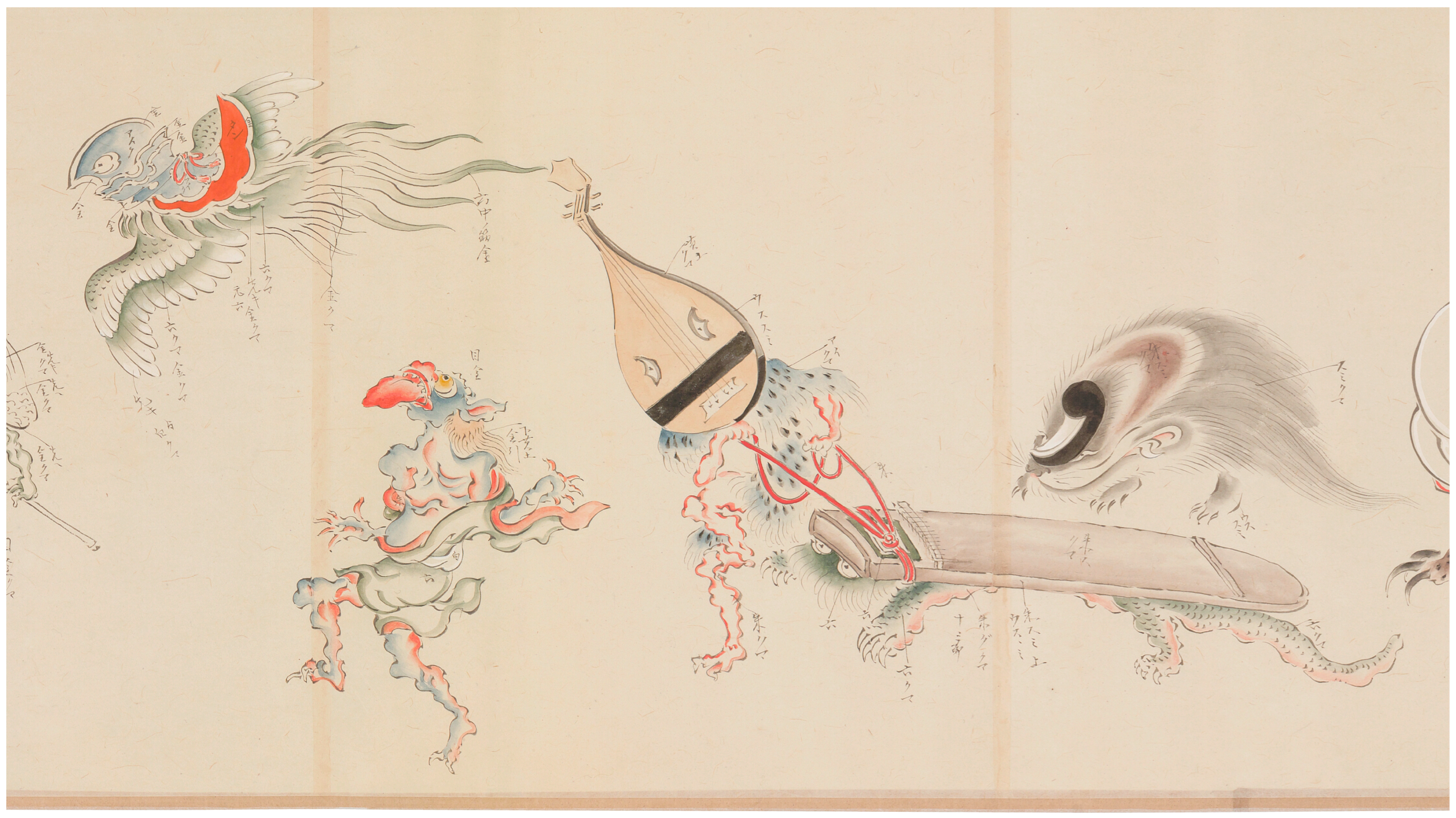
This apocryphal story brings in the artist as witness, as someone who creates “convincing likeness” when he comes face to face with (visible) reality. His curiosity is clearly stronger than his fear, suggesting that the fear of demons has considerably decreased over time. When dawn breaks he discovers the natural cause of the monk’s experience: phosphorescent fungi in random shapes must have fired the monk’s imagination that had been trained to believe in demons. Note how this shifts the locus of action from the external world into the realm of the imagination and gives the artists access to this new configuration of the invisible: the power of this-worldly observation starts to eclipse the magical ability to see into other realms of being (Figure 3).
While the original scroll was clearly written with a Shingon agenda in mind, literally as a guide to how such apparitions of the uncanny should be interpreted, this aspect has not survived well. The medieval scrolls depicting the “night parade of one hundred demons” quickly became a genre of its own that allowed artists to use their skills to animate the inanimate in different formats. Takako Tanaka argues that the origin of the night parade genre can be found in the festival scene of the “Record of Tool Specters” and that this depiction, once removed from its original narrative context, has become the model for the genre (2002). Noted yōkai researcher Kazuhiko Komatsu (2008, p. 215) further puts the night parade motive in a line with the genre of irui-mono, often satirical narratives in which animals behave like humans. The encyclopedic mold of mind that ascended with Neo-Confucian ideas of hakubutsu-gaku in the Edo period turned the tool specters into individual entities separated from their original context, a development that culminates in the yōkai collections of Sekien Toriyama in the 1780s (Foster 2009). Even post-war readings often do not bother with the doctrinal intricacies alluded to. In his essay, Tatsuhiko Shibuzawa simply dismisses this aspect by saying that the second part “reeks of religion” (shūkyō-kusai) and is therefore less interesting (Shibuzawa 1977, p. 94). Clearly the interest in the grotesque depictions has outlived the Buddhist message that originally inspired it.
Both Kiyoteru Hanada (1973) and Shibuzawa interpret the Tsukumogami-ki as an indication of two overlapping developments during the Muromachi period: while the material life of the commoners becomes richer and more objects appear on the scene, the dread of the “other world” diminishes. In Shibuzawa’s words, the invisible “metaphysics of hell” loses its grip and artists turn towards the visible and express their love of things. Comparing the Tsukumogami-ki to Bosch and Breughel’s depictions of objects, he argues that “the animated object is the result of the attachment of the painter to his objects,” and that through this “the dead objects have life running through them like electricity” (Shibuzawa 1977, p. 99).10 Before they become objects of fear for the spectator, they must have been objects of extreme love. In a slightly different vein, the art critic Yoshiaki Tōno (1973) has suggested that the depictions could be either read as a parody of the Buddhist clergy’s desire for material wealth, or that they may have been inspired by the view of people fleeing from the ravages of civil war, carrying as much of their possessions with them as possible. In either case, attachment to possessions is the main motivation.

4. Animation as Technē

To understand the ways in which man-made things come to be animated, it is not enough to consider interpretations of the narrative. We must also attend to the media that make their apparition possible; that is, the conditions of the possibility of presence and the complex network of artists, writers, itinerant monks and storytellers that are involved in the process of animation. The first condition is material: animation, belief and performance crystallize around the production and presence of material artefacts.
In the following, I will distinguish between three techniques of animation: one is the representation of movement, by which a static image, object or sculpture can appear caught in the act of moving. A second technique is to give an object features that human beings recognize as animated, from a crude face consisting of a few lines to zoomorphic or anthropomorphic bodies. To these two visual elements I would add the element of performance: a narrative can be brought to life by reading, chanting, or singing it. While the linear nature of text and writing forces me to treat these elements separately, it is important to bear in mind that they would appear to a spectator simultaneously, creating a synesthetic experience.

4.1. Movement

The condition of possibility of animation is the presence of a medium through which life is made present: a statue can mediate between the conditioned and the un-conditioned Buddha nature, a piece of folded paper can become a temporary body for a deity, and a two-dimensional sheet of paper can be animated through the image of a deity that looks back at you, as in the case of Hindu darshan (Pinney 2004). In the case at hand, it is the media innovation of the painted scroll that becomes the material basis for animation.
The “Record of Tool Specters” and the Hyakki-yagyō-zu discussed above are both painted scrolls (emaki) and the presence of the depicted depends on its mode of apparition, which in turn is determined by the function of the narrative painted scroll. Painted scrolls were introduced to Japan from China, but had become part of aristocratic culture by the late Heian period (roughly 1000–1081). In the “Tale of Genji”, court nobles are not only appreciating the scrolls as “dazzling to the eyes” (quoted in Okudaira 1973, p. 22), but are also involved in painting and commissioning them, some based on literary works, some on diaries, some on illustrations of ceremonies and annual rites. With the rise of the warrior class during the Kamakura period (1185–1333), the subject matter of the painted scrolls began to change along with the style. The emphasis on courtly love, rich decorations and static depictions, where the image just illustrates the text, is replaced by a more dynamic, line-drawn depiction of the plot itself: tales of heroic warriors, legends of the founding of temples and, increasingly, the lives and tribulations of commoners. The locus of production changes from the court to temples, where professional painter-monks start to illustrate hagiographies of the founders of the new Amidist faiths. The expressive range reached from humorous depictions of incidents to realistic portrayals of illness and deformity and panoramas of hell, a notion that is introduced to Japan through Genshin’s Ōjō yōshū 往生要集 (985), based on the Kanmuryōju-Sutra. Genshin was a monk of Enryakuji who found that proselytizing worked better if the threat of eternal damnation was handy (Horton 2004). He therefore included minute descriptions of the torments of hell as well as the pleasures of heaven, to be reached by firm faith in Amida (Gutiérrez 1967). Religious and secular themes remained popular as machi-eshi (town painters) started to produce illustrated folk tales (otogi zōshi emaki).
Ironically, the way scrolls are presented in museums in modern times (fully rolled out), misrepresents what the experience of a reader/spectator must have been. Made from paper and silk, the roll is closed to start with, presenting only a brocade surface. When stored they are usually kept in made-to-measure boxes. The painted scroll is ideally suited for narratives because unlike a painting, where everything is visible at once, the scroll guards its secret, and the plot unfolds only as the scroll is unrolled. Smaller scrolls are meant to be held in both hands and rolled in as the plot progresses, creating a moving plane. This sense of movement is further supported by pictorial techniques such as iji dōzu (different time, same illustration), where a sequence of actions is presented in the same space, or hanpuku byōsha, wherein the same character is repeatedly depicted in front of different backgrounds (Skord Waters 1997, p. 67). The dynamic character of depictions characteristic of the style of otoko-e (men’s pictures)11 was augmented by the depiction of movement. Diametrically opposed to the sedentary staid depictions of courtly life, people were shown in the process of arguing, running and fighting. As Isao Takahata (1999) controversially argues, some of the conventions of illustrating movement that are still used in manga nowadays go all the way back to the 1175 Shigi-san Engi scroll, where the constantly revolving wheels of Buddhist law is depicted in full motion (Shimizu 1985, p. 122). This is the same wheel of law that is thrown as a weapon by the divine boys to chastise the tool specters.

4.2. Anthropomorphization

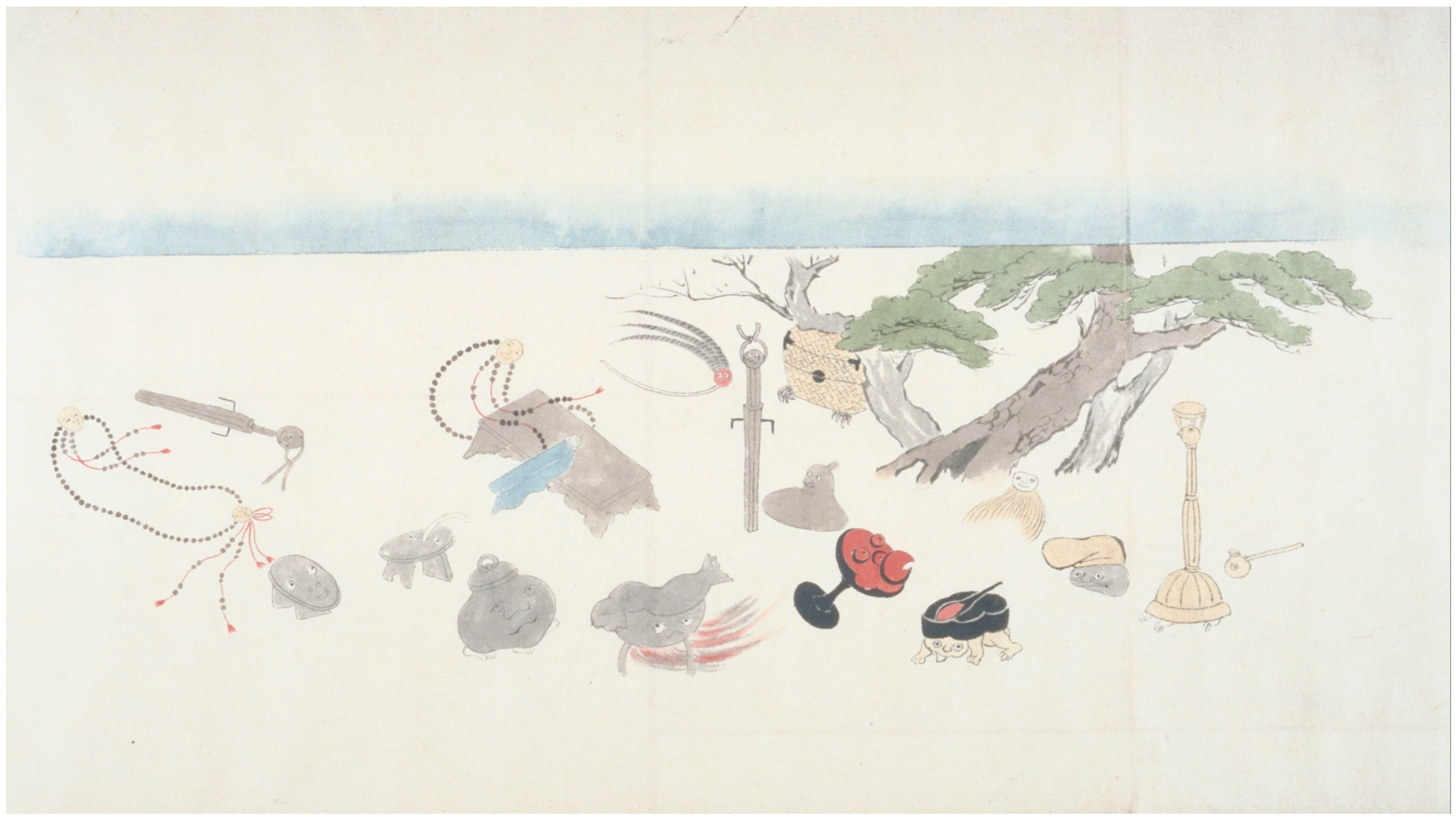
The second element of animation is anthropomorphization. When we follow the transformation of the tool specters they first appear as ordinary objects thrown by the wayside. They gather and are for the first time given rudimentary features, by simply drawing faces on to them (Figure 4). Kobun-sensei, for example is animated by simply drawing a face on to the surface of the text that lies open on the scholar’s desk. Giving them voices, serifu written directly over their heads, almost like speech bubbles, further confers subjectivity to them (see Mori 1984). Note how the objects become subjects through their resistance to human intention and the development of their own intentionality in response. Only after they are transformed and given more monstrous forms—some human, some animal, some objects who grow legs—there is a sense of menace. The narrated process of animation is imitated by the artist looking for solutions to make the objects appear more life-like. These depictions become more elaborate with the Hyakki yagyō scrolls of the Tosa school. A closeness to caricature and a pleasure in the depictions of invisible or unthinkable things is evident in these scrolls, as well as borrowings from earlier depictions of blue and red demons. Often the anthropomorphized figures are drawn with their original form visible somewhere. The tripod (gotoku) is a good example of the complex network of meanings and allusions that marks the shifting nature of things. The gotoku is a simple metal ring with three legs on which pots are put over the fire. Originally it was called kudoko (little stove) and used with the legs pointing down, but later the use was reversed, especially in the early forms of tea ceremony. The inversion of use lead to the inversion of the syllables of the name to form gotoku (literally “five virtues”). The association of the tripod with the five Confucian constants—benevolence, righteousness, propriety, wisdom, and fidelity12—is a result of wordplay that adds another semantic dimension to this humble artefact.13 The inversion is also significant in another context. As Noboru Miyata (1985) has argued for the cushion (makura), everyday objects had often secondary, more otherworldly uses, that could be invoked by simply turning them around. In the case of the gotoku it is the black sympathetic magic executed during the Hour of the Ox (ushi-no-koku mairi, between 1 and 3am), during which a straw doll is nailed to a sacred tree under the invocation of spells. For this rite, the gotoku is worn on the head like a crown and three candles are affixed to the three legs.
When the gotoku thus comes to life, the uncanniness of its form—often resembling a demon with three horns—resonates with this other uncanny life. Turning it on its head mirrors its turn from inanimate to animate and suggests that the “five virtues,” all of which in their Japanese formulation having to do with docility and obedience, are reversed and the object becomes recalcitrant and unruly. Objects coming to life therefore engage a broad range of meaning related to official and unofficial functioning, to word-play and visual allusion in which they stand in for other things (mitate).
In fact, most of the everyday objects that change into tool specters had secondary, more otherworldly functions: geta, wooden clogs, were used to predict the weather by kicking them off and seeing which side they landed on (Akita 2002); the kama used for cooking also produced an unearthly sound and released steam which rose up, thus connecting heaven and earth; the sound of the biwa lute was so beautiful it even bewitched demons and moved to tears the ghosts of the Taira family. The bamboo panpipe (shō) and the “bird helmet hat” (torikabuto) that its player wears often appear together as yōkai (Komine 2007, p. 16): as the name suggests, the hat appears as a bird, while the shō appears as a winged figure reminiscent of a practitioner of shugendō, a syncretic ascetic practice associated with hermits and their supernatural teachers, the tengu.
It is also noteworthy that a large number of the tool specters are Buddhist instruments that have implicit soteriological functions. Leading the procession is the hossu, the implement used by Buddhist priests to sweep away insects (largely ceremonial in Japanese Buddhism). It is followed by a fan and a ceremonial scepter called nyoi, both instruments used by monks to preach. Kazuaki Komine (2007, p. 14) has pointed that some tool specters have been misidentified as different instruments over the long reception history of the scrolls. The nyoi for example already appears in Sekien Toriyama’s 1784 encyclopedia of yōkai as backscratcher with a legend that likens the name with the wish to scratch exactly where one itches. In a more recent reproduction, the same yōkai is identified as a medicine spoon (saji). The nyoi, whose name can also be read as “going according to one’s wishes,” can therefore be described as tearing free of its ecclesiastical connotations. This is not to say, however, that these identifications are necessarily mistaken, but rather that with the passing of time and the change of the material context, one yōkai may have transformed (bakeru) into another.
This leads us back to the idea of animation as resistance against the uncaring human use of objects. The instrument is experienced as having a will of its own when it opposes human intention. But there is also a more general point to be made about the function of tools in society more widely. In a time and place in which tools become more sophisticated and specialized, in which many of them end up having one single purpose, even a slight deviation from this normative function can be experienced as “uncanny”. In other words, what animates objects is not their inherent ontological multiplicity (the possibility that one thing may manifest as several different things) but a cultural constraint: in a world in which things are strictly singular, their potential multiplicity can only be conceived of as otherworldly. But even in this otherworldly manifestation, the tool specter, on the cusp of breaking free from human bondage, is recaptured in a different network of meaning, allusion and fecund cultural production.

4.3. Performance

The third and final element of animation is performance: while the aristocratic practice of commissioning private scrolls continued, commoners experienced them performed by itinerant monks, so called etoki hōshi (絵解き法師), who were sometimes accompanied by a biwa player. Etoki here has three meanings: it refers to the image as an illustration of a topic, the act of explaining, and the person doing the explaining (Kaminishi 2006, p. 6). Barbara Ruch, in a dense piece on medieval literature, summarizes the effect of this particular form of performing texts as follows:
“Here we witness a radical and massive shift of focus from salon literature for reading aloud and for private reading to a new “media” literature where narratives become so closely allied to the emaki through the practice of etoki that the visual illustration of literature and its oral delivery came to equal if not surpass in importance the text itself. Painting, story, chanter, and even the sounding of musical instruments (often pure sound rather than music) combined to create a total audio-visual experience rare, if not unique, in the premodern history of world literature. The process can quite supportably be termed the cinematization of Japanese literature, and the product, “media literature.” […] Inherent in this shift was a clear separation between author-performer and audience. Literacy or the lack of it was not an issue.”
Although the etoki for the public were presumably performed with larger pictorial aids, there is some evidence that etoki were also organised individually or in small groups indoors in the houses of low-ranking aristocrats and warriors. Access to the cloistered quarters of upper-class women was granted to the Kumano bikuni nuns who used handscrolls to perform etoki. It is therefore not implausible to assume that the “Record of Tool Specters” reached a broader audience as animated performance rather than as written text, with the entertaining elements of the story eclipsing the edifying ones.

5. Conclusions

Rather than an expression of indigenous beliefs, I have argued that the portable media of the painted narrative scroll and its performances are likely to have transported tool specter beliefs over medieval Japan. This was part of the spread of literary products that in the Muromachi period created something akin to a national literature for the first time (Ruch 2001). As in the case of Europe during the reformation, new printing techniques for words and images lead to a faster spread of new ideas and doctrines, as well as new superstitions. It is these techniques that animated objects and people and created beliefs about things that were considered to be beyond the ken of commoners. With the rise of woodblock printing in the Edo Period, the increase in literacy and the affordability of print products, the locus of demons and specters changed again. Increasingly, they were understood as entertaining fictions in the Kibyōshi, cheap popular picture books that specialized in satire and parody. A fairly common depiction is that of the yōkai reading about how people have ceased believing in them and then trying to figure out how to become a fashionable apparition again (for example, in the work of Kiyonaga Torii; see Fujimoto 2008). Again, the notion of belief itself is problematized: while fear of the ghostly has waned considerably, the ghostly was alive and well in print media and allowed for an indirect critique of Edo society under the censorship-prone Tokugawa.
In sum, what animates the inanimate objects is a media infrastructure, a network of media platforms that stretches back in time and that allows these apparitions to keep appearing and to move from the painstakingly hand-drawn picture scrolls to the more rapidly produced and affordable woodblock print, to the post-war small screen (in the form of the animated series by Shigeru Mizuki for example) and from there into the online worlds of cyberspace. Research into yōkai, which has become a cottage industry in Japan, has contributed significantly to this boom.
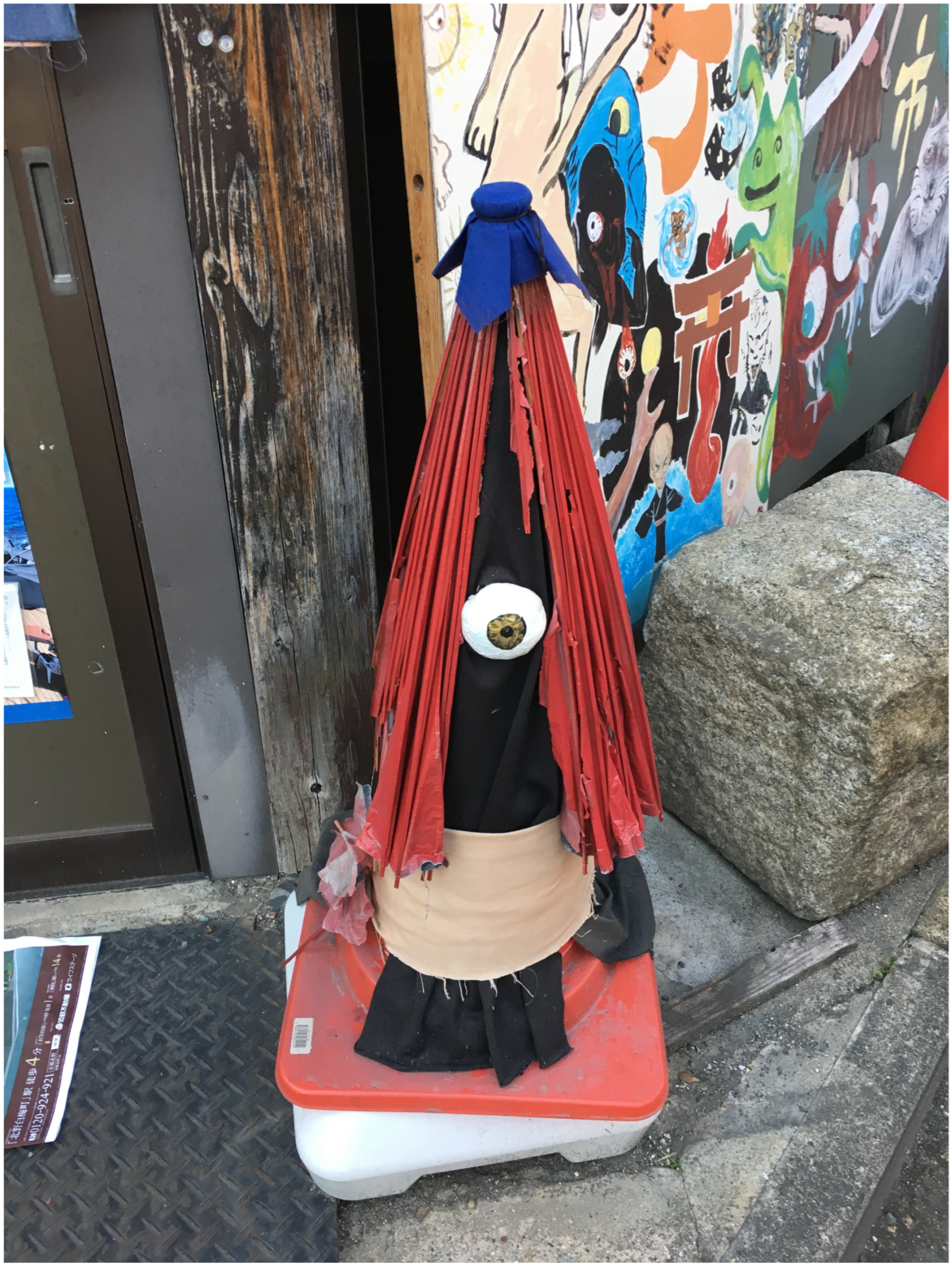
When one wanders down Ichijō-dōri these days, a narrow residential street in the west of Kyoto, one finds several reminders of the mischief that the tool specters have wreaked with their night time parades. The street is now called yōkai sutoriito and there is an occasional flea market/fair called Mononoke-ichi at the local shrine (Figure 5). A small, unmanned yōkai “museum” is tucked away on the second floor of a modern building. Every October there is carnivalesque parade where grown-ups and older children dress up as yōkai to frighten the little ones. Most of these projects are instigated by the local arts university as machi-okoshi, an attempt to reinvigorate local communities and economies by creating “cultural attractions.”
The most conspicuous sight on yōkai street, however, is the yōkai themselves. Almost every store has a monstrous mascot as part of their display. These range from papier-mâché dolls to more or less carefully dressed up traffic cones. In this literal age, the formerly invisible monsters have indeed experienced a Götterdämmerung. While their representations can still haunt the imagination, none of the mystique survives this final translation into reality. Ironically, most of them only appear during the day and are tucked inside at night. From once powerful forces, they have been downgraded to doing marketing’s bidding, mere ghosts of former ghosts.

Funding

This research received no external funding.

Institutional Review Board Statement

Not applicable.

Informed Consent Statement

Not applicable.

Data Availability Statement

The original contributions presented in this study are included in the article. Further inquiries can be directed to the corresponding author.

Conflicts of Interest

The author declares no conflict of interest.

Notes

1
The oldest extant version of the scroll, the A type, is kept at the Sōfuku temple 崇福寺 in Gifu prefecture. A version of the more widespread B type is available through the Kyoto University Digital archive https://rmda.kulib.kyoto-u.ac.jp (accessed on 15 May 2016).
2
See Keane (2016) for a recent glaring example.
3
The title in itself is a complex homonym that can be written as either 九十九髪 (‘ninety-nine hairs’) or as 付喪神 (‘becoming attached and loosing a deity’). The former first appears in the Ise-monogatari to describe old age: ninety-nine is hundred minus one, and if one takes one stroke away from the kanji for ‘hundred’, 百 turns into ’white’ 白, hence ‘white hair’, a sign of old age (Hanada 1973, p. 63). The title cleverly layers both meanings and can therefore be read as ‘becoming possessed by a deity when one reaches old age’.
4
For a history of the scroll and textual variations, see Kakehi (1989).
5
This position bears surprising similarities to Tim Ingold’s critique of materiality, in which he argues that because matter has been rendered lifeless by science, it has to be re-animated through what he polemically calls “mind dust”. Instead, anthropology should focus on the “active properties of materials”. Animism therefore would be “a matter not of adding to [things] a sprinkling of agency but of restoring them to the generative fluxes of the world of materials in which they came into being and continue to subsist.” (Ingold 2007, p. 12).
6
This does not only apply to Japanese art. The Austrian master pianist Alfred Brendel, when asked why he insists on test-playing the piano before a concert, famously said “Some pianist take the local piano as a challenge to show off their ability to master any instrument, but I need to know precisely what the piano does when I play it. If I don’t, the piano plays me.”
7
This chapter was originally written as a companion piece to “Robot companions: The animation of technology and the technology of animation in Japan” (Gygi 2018). They both share the same critical approach to the notion of animism, but the latter deals with the animation of technology rather than the animation of nature.
8
Commoners rarely get caught up in otherworldly business, but it occasionally happens, like it did to the hapless man who encounters the parade of demons by accident. He only hears what is happening, but the Oni see him and spit on him, which turns him invisible to others. Shinpen Nihon Koten Bungaku zenshū (1994–2002, vol. 36, pp. 271–76).
9
The attribution to Tosa Mitsunobu is contested nowadays and this myth of origin was probably added at a later date.
10
All translations from the Japanese except for those of the Tsukumogami-ki are my own.
11
“It should be noted that despite the label, women’s pictures were not by any means limited to female artists or to an exclusively female audience. Much like their corresponding designations (‘women’s hand’ and ‘men’s hand’) in calligraphy, the terms ‘women’s picture’ and ‘men’s picture’ (otoko-e) weren’t based on a simplistic gender dimorphism or practiced exclusively by one or the other sex. Rather, then gender adjectives were meant to invoke modes of representation that were deemed appropriate for different spaces of social life at court and consequently elicited different kinds of viewer interaction. Men’s pictures were better suited to illustrate satiric, miraculous, or historical narratives, whereas women’s pictures accompanied poetry-driven texts of courtly fiction.” (Lippit 2008, p. 64).
12
It is worth adding here that in the yōkai museum in Kyoto (百鬼夜行資料館) the five virtues are rendered in a Japanized fashion as gentleness (odayakasa), obedience (sunaosa), humility (tsutsumashisa), respect (uyauyashisa) and self-deprecation (herikudari).
13
In Aomori prefecture, this implement was called shitoku (four virtues). When the Buddhist Saint Kōbō Daishi was wandering through Northern Japan he encountered a dog who has lost one leg. Out of compassion he tore off the iron leg of a shitoku and gave it to the dog. Since that time, the iron stove has only three legs, but one virtue more and is thus called gotoku (Nichibunken yōkai database entry C0220096-000).

References

  1. Akita, Yūki. 2002. Geta—Kami no Hakimono [Geta: The Footwear of the Deities]. Tokyo: Hōsei-daigaku Shuppan-kyoku. [Google Scholar]
  2. Asquith, Pamela J., and Arne Kalland. 1997. Japanese Perceptions of Nature: Ideals and Illusions. In Japanese Images of Nature: Cultural Perspectives. Edited by Pamela J. Asquith and Arne Kalland. Richmond: Curzon, pp. 1–35. [Google Scholar]
  3. Breen, John, and Mark Teeuwen. 2010. A New History of Shinto. Malden: Wiley-Blackwell. [Google Scholar]
  4. Cholodenko, Alan. 2007. The Illusion of Life II: More Essays on Animation. Sydney and London: Power Publications. [Google Scholar]
  5. Foster, Michael Dylan. 2009. Pandemonium and Parade: Japanese Monsters and the Culture of Yokai. Berkeley: University of California Press. [Google Scholar]
  6. Fujimoto, Nicole. 2008. Yôkai und das Spiel mit Fiktion in der edozeitlichen Bildheftliteratur [Yōkai and the Play with Fiction in Edo-Period Illustrated Popular Literature]. NOAG 183–184: 93–104. [Google Scholar]
  7. Gutiérrez, Fernando G. 1967. Emakimono Depicting the Pains of the Damned. Monumenta Nipponica 22: 278–89. [Google Scholar] [CrossRef]
  8. Gygi, Fabio. 2018. Robot Companions: The Animation of technology and the Technology of Animation in Japan. In Rethinking Relations and Animism: Personhood and Materiality. Edited by Graham Harvey and Miguel Astor-Aguilera. London: Routledge, pp. 94–111. [Google Scholar]
  9. Hanada, Kiyoteru. 1973. Gajinden. In Muromachi Shōsetsu-Shū. Collection of Novellas from the Muromachi Period. Tokyo: Kōdansha, pp. 35–115. [Google Scholar]
  10. Harvey, Graham. 2006. Animism: Respecting the Living World. New York: Columbia University Press. [Google Scholar]
  11. Heidegger, Martin. 1962. Being and Time. New York: Harper and Row. [Google Scholar]
  12. Hendry, Joy, and Massimo Raveri, eds. 2002. Japan at Play. London: Routledge. [Google Scholar]
  13. Holbraad, Martin. 2012. Truth in Motion: The Recursive Anthropology of Cuban Divination. Chicago and London: University of Chicago Press. [Google Scholar]
  14. Horton, Sarah. 2004. The Influence of the Ōjōyōshū in Late Tenth- and Early Eleventh-Century Japan. Japanese Journal of Religious Studies 31: 29–54. [Google Scholar] [CrossRef]
  15. Ingold, Tim. 2007. Materials against Materiality. Archeological Dialogues 14: 1–16. [Google Scholar] [CrossRef]
  16. Inoue, Enryō. 2000. Meishin to Shūkyō [Supersptition and Religion]. Tokyo: Kashiwa Shobō. [Google Scholar]
  17. Inoue, Enryō. 2001. Yōkaigaku [Monsterology]. Tokyo: Kashiwa Shobō. [Google Scholar]
  18. Iwata, Keiji. 1993. Animizumu no Jidai [The Age of Animism]. Kyoto: Hōzōkan. [Google Scholar]
  19. Kakehi, Mariko. 1989. Tsukumogami Emaki no Shohon ni tsuite. Hakubutsukan Dayori 15: 5–7. [Google Scholar]
  20. Kaminishi, Ikumi. 2006. Explaining Pictures: Buddhist Propaganda and Etoki Storytelling in Japan. Honolulu: University of Hawai’i Press. [Google Scholar]
  21. Keane, John J. 2016. Cultural and Theological Reflections on the Japanese Quest for Divinity. Leiden and Boston: BRILL. [Google Scholar]
  22. Komatsu, Kazuhiko. 2008. Hyakki-yagyō no Nazo [Mysteries of the Night Parade of Hundred Demons Scrolls]. Tokyo: Shūeisha. [Google Scholar]
  23. Komine, Kazuaki. 2007. Hyakki-yagyō to Parodi [Night Parade of Hundred Demons Scrolls and Parody]. Ajia Bunka-kenkyū Bessatsu 16: 11–19. [Google Scholar]
  24. Kyburz, Josef A. 1997. Magical Thought at the Interface of Nature and Culture. In Japanese Images of Nature: Cultural Perspectives. Edited by Pamela J. Asquith and Arne Kalland. Richmond and Surrey: Curzon, pp. 257–79. [Google Scholar]
  25. Latour, Bruno. 2010. On the Modern Cult of the Factish Gods. Durham and London: Duke University Press. [Google Scholar]
  26. Lillehoj, Elizabeth. 1995. Transfiguration: Man-Made Objects as Demons in Japanese Scrolls. Asian Folklore Studies 54: 7–34. [Google Scholar] [CrossRef]
  27. Lippit, Yukio. 2008. Figure and Facture in the Genji Scrolls: Text, Calligraphy, Paper, and Painting. In Envisioning the Tale of Genji: Media, Gender, and Cultural Production. Edited by Haruo Shirane. New York: Columbia University Press, pp. 49–80. [Google Scholar]
  28. Malafouris, Lambros, and Colin Renfrew. 2013. How Things Shape the Mind: A Theory of Material Engagement. Cambridge: MIT Press. [Google Scholar]
  29. Martinez, Dolores P. 2005. On the ‘Nature’ of Japanese Culture, or, Is There a Japanese Sense of Nature? In A Companion to the Anthropology of Japan. Edited by Jennifer Robertson. London: Blackwell, pp. 185–200. [Google Scholar]
  30. Miyata, Noboru. 1985. Yōkai No Minzokugaku: Nihon No Mienai Kūkan [The Folklore of Yōkai: Japan’s Invisible Space]. Tokyo: Iwanami Shoten. [Google Scholar]
  31. Mori, Masato. 1984. Serifu to Etoki to Monogatari: Dōjōji Engi Emaki O Megutte [Lines of Speech, the Explanation of Pictures and Narrative: Concerning the Dōjōji Engi Illustrated Scroll]. Bungaku 52: 29–32. [Google Scholar]
  32. Nelson, Victoria. 2003. The Secret Life of Puppets. Cambridge and London: Harvard University Press. [Google Scholar]
  33. Okudaira, Hideo. 1973. Narrative Picture Scrolls. Tokyo: Kenkyūsha. [Google Scholar]
  34. Pietz, William. 1987. The Problem of the Fetish II: The Origin of the Fetish. RES: Anthropology and Aesthetics 13: 23–45. [Google Scholar] [CrossRef]
  35. Pinney, Christopher. 2004. Photos of the Gods: The Printed Image and Political Struggle in India. London: Reaktion Books. [Google Scholar]
  36. Rambelli, Fabio. 2001. Vegetal Buddhas: Ideological Effects of Japanese Buddhist Doctrines on The Salvation of Inanimate Beings. Kyoto: Cheng & Tsui. [Google Scholar]
  37. Rambelli, Fabio. 2007. Buddhist Materiality: A Cultural History of Objects in Japanese Buddhism. Stanford: Stanford University Press. [Google Scholar]
  38. Reider, Noriko T. 2009a. Animating Objects: Tsukumogami Ki and the Medieval Illustration of Shingon Truth. Japanese Journal of Religious Studies 36: 231–57. [Google Scholar] [CrossRef]
  39. Reider, Noriko T., trans. 2009b. The Record of Tool Specters (Tsukumogami-Ki). Japanese Journal of Religious Studies 36: 1–19. [Google Scholar]
  40. Robertson, Jennifer. 2014. Human Rights vs. Robot Rights: Forecasts from Japan. Critical Asian Studies 46: 571–98. [Google Scholar] [CrossRef]
  41. Ruch, Barbara. 2001. Medieval Jongleurs and the Making of a National Literature. In Japan in the Muromachi Age. Edited by John Whitney Hall and Toyoda Takeshi. Ithaca: Cornell University East Asia Program, pp. 279–309. [Google Scholar]
  42. Shibuzawa, Tatsuhiko. 1977. Tsukumogami. In Shikō No Monshōgaku [The Heraldry of Thought]. Tokyo: Kawade Shōbōshinsha, pp. 85–101. [Google Scholar]
  43. Shields, James Mark. 2010. Beyond Belief: Japanese Approaches to the Meaning of Religion. Studies in Religion/Sciences Religieuses 39: 133–49. [Google Scholar] [CrossRef]
  44. Shimizu, Yoshiaki. 1985. The Shigisan-Engi Scrolls, C. 1175. In Pictorial Narrative in Antiquity and the Middle Ages. Edited by Herbert L. Kessler and Marianna Shreve Simpson. Hanover and London: University Press of New England, pp. 115–29. [Google Scholar]
  45. Shinpen Nihon Koten Bungaku zenshū. 1994–2002. 88 vols. Tokyo: Shōgakukan.
  46. Silvio, Teri. 2010. Animation: The New Performance? Journal of Linguistic Anthropology 20: 422–38. [Google Scholar] [CrossRef]
  47. Skord Waters, Virginia. 1997. Sex, Lies, and the Illustrated Scroll: The Dōjōji Engi Emaki. Monumenta Nipponica 52: 59–84. [Google Scholar] [CrossRef]
  48. Takahata, Isao. 1999. Jūniseiki no Animēshon: Kokuhō Emakimono ni miru eigateki/animetekinaru mono [Animation from the 12th Century: Film and Anime Aspects in National Treasure Illustrated Scrolls]. Tokyo: Tokuma Shoten. [Google Scholar]
  49. Tanaka, Takako. 2002. Hyakki-yagyō no mieru Toshi [Seeing the Capital through the Night Parade of Hundred Demons]. Tokyo: Chikuma Gakugei Bunko. [Google Scholar]
  50. Thomas, Jolyon Baraka. 2019. Spirit/Medium: Critically Examining the Relationship between Animism and Animation. In Spirits and Animism in Contemporary Japan. Edited by Fabio Rambelli. London: Bloomsbury, pp. 157–70. [Google Scholar]
  51. Tōno, Yoshiaki. 1973. Gurotta No Gaka [The Painter in the Grotto]. Tokyo: Bijiutsu Shuppansha. [Google Scholar]
  52. Tylor, Edward Burnett. 1871. Primitive Culture: Researches into the Development of Mythology, Philosophy, Religion, Language, Art and Custom, Volume 1, 2nd ed. London: John Murray. [Google Scholar]
  53. Wilkinson, Darryl. 2017. Is There Such a Thing as Animism? Journal of the American Academy of Religion 85: 289–311. [Google Scholar] [CrossRef]
  54. Willerslev, Rane. 2013. Taking Animism Seriously, bu Perhaps Not Too Seriously? Religion and Society 4: 41–57. [Google Scholar] [CrossRef]
  55. Yamagiwa, Joseph K., trans. 1977. The Okagami: A Japanese Historical Tale. North Clarendon and Tokyo: Tuttle Publishing. [Google Scholar]
  56. Yamaguchi, Masao. 1991. The Poetics of Exhibition in Japanese Culture. In Exhibiting Cultures. Edited by Ivan Karp and Steven D. Lavine. Washington, DC and London: Smithsonian Institution, pp. 56–67. [Google Scholar]
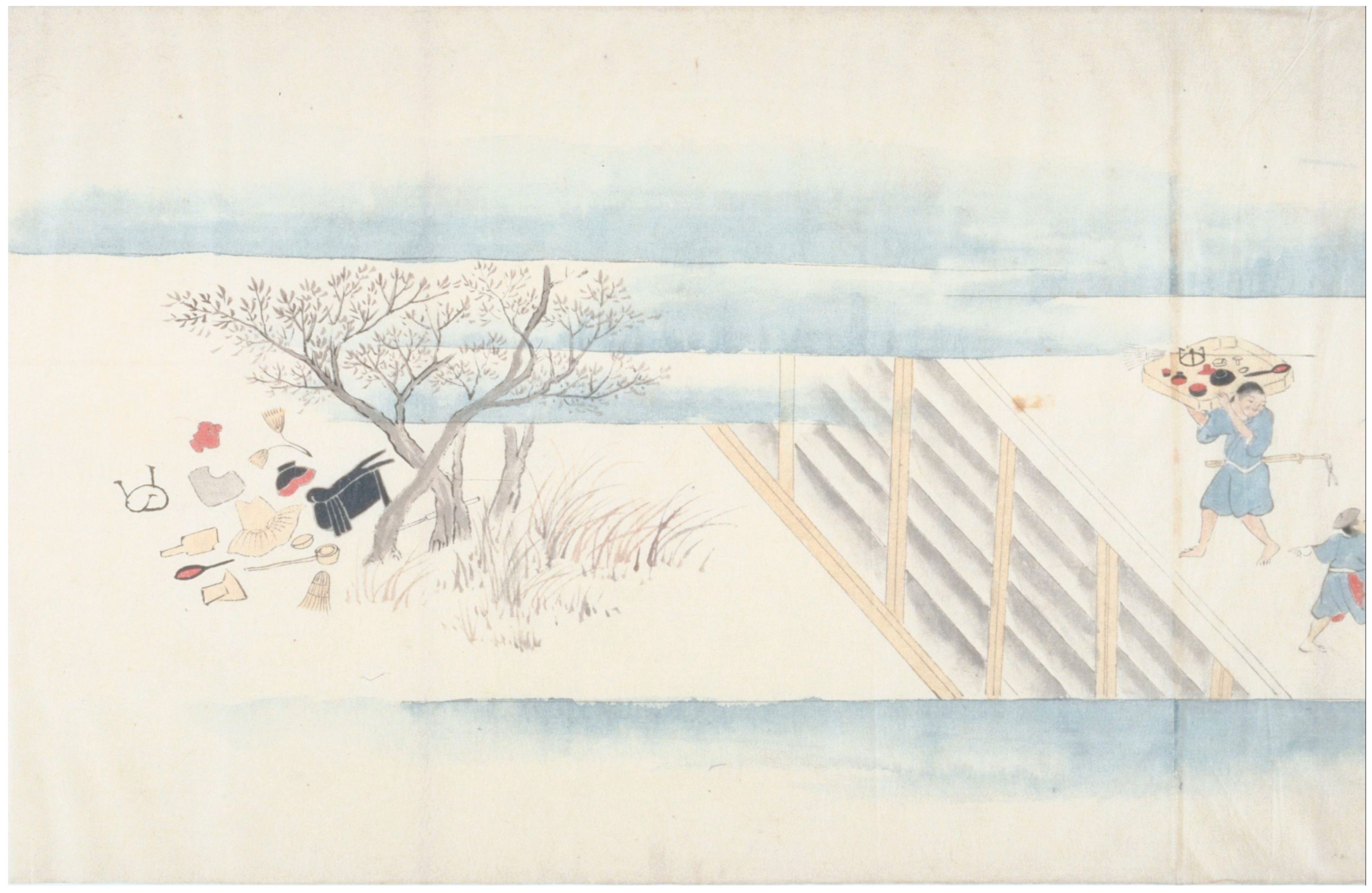
Figure 1. Old tools are thrown away: “We are abandoned in the alleys to be kicked by oxen and horses.” (translated by Noriko Reider 2009b, p. 2). Courtesy of Kyoto University Library https://rmda.kulib.kyoto-u.ac.jp/item/rb00013599 (accessed on 1 May 2025).
Religions 16 01534 g001
Figure 2. The divine boys attack the tool specters: “All of you, we know what you’ve done. We’ve come to punish you. But if you stop killing people and decide to embrace Buddhism, we will spare your lives.” “Thank you, thank you! From now on we will not have any evil thought and we will convert to Buddhism. Please spare us.” (translated by Noriko Reider 2009b, p. 9). Courtesy of Kyoto University Library (https://rmda.kulib.kyoto-u.ac.jp/item/rb00013599, accessed on 1 May 2025).
Religions 16 01534 g002
Figure 3. Excerpt from the “Tosa mitsuoki hyakki yagyō no zu”. A biwa lute, a koto zither and a kei gong (depicted flying) become alive to join the night time parade of a hundred demons. Courtesy of Nichibunken archive (https://da.nichibun.ac.jp/item/004218681, accessed on 1 May 2025).
Religions 16 01534 g003
Figure 4. The tool specters animate. Courtesy of Kyoto University Library (https://rmda.kulib.kyoto-u.ac.jp/item/rb00013599, accessed on 1 May 2025).
Religions 16 01534 g004
Figure 5. An umbrella transforming into a yōkai on Kyoto’s Ichijō street. Photo by the author, 3 December 2016.
Religions 16 01534 g005
Disclaimer/Publisher’s Note: The statements, opinions and data contained in all publications are solely those of the individual author(s) and contributor(s) and not of MDPI and/or the editor(s). MDPI and/or the editor(s) disclaim responsibility for any injury to people or property resulting from any ideas, methods, instructions or products referred to in the content.