How to Engage with Non-Human Others in Ecosystems from a Phenomenological and Interreligious Perspective
Abstract
1. Introduction
2. The Idea and Method of Interreligious Sympoiesis for Addressing Ecological Crises
2.1. The Basic Idea Redescribed
2.2. The Suggested Method
2.2.1. Philosophical Foundations of the Method
- (1)
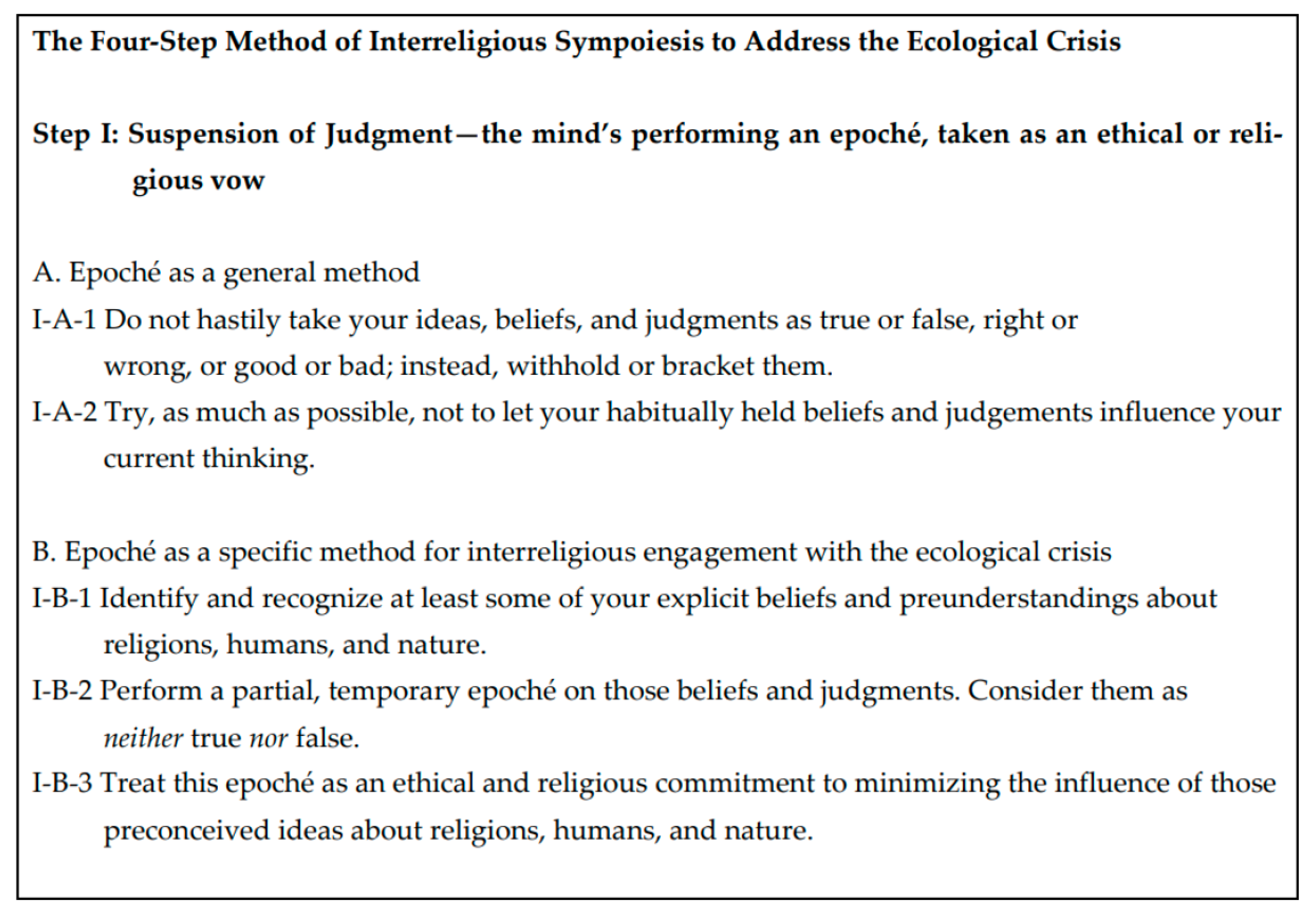
- The basic meaning of epoché is to withhold or suspend one’s judgment about the truth or falsity, rightness or wrongness, or goodness or badness of a particular idea or belief. Meanwhile, in phenomenology, the meaning of reduction is basically “a return” or “a leading back” (Moran and Cohen 2012, p. 273). It is also defined as “a change in attitude”, which signifies “returning to a certain standpoint” or “taking a certain attitude, perspective, or viewpoint”. Such attitudes or perspectives can be multiple. This means that there can be several distinct types of phenomenological reduction. As special subjective mental operations, epoché and reduction—unlike third-person scientific inquiry—consist of the subject’s first-person experience about an object or states of affairs along with the description, analysis, and interpretation of that experience.
- (2)
- In a relevant phenomenological investigation, epoché and reduction go hand in hand.12 Although epoché and reduction are distinct, they are closely interconnected (Bossert 1974, p. 244). Epoché is somewhat passive in that it focuses on halting the operation of existing beliefs. By contrast, reduction is more active than epoché, because it involves returning to a certain fundamental standpoint after epoché. Epoché is necessary not only before reduction but also during the transitional processes between different reductions.
- (3)
- Epoché can be either comprehensive and universal or temporary and partial (Lewis and Staehler 2010, p. 19).13 The former refers to suspending judgment on the entirety of our beliefs and understandings in a context that transcends specific domains. The latter refers to suspending judgment on individual beliefs or propositions in specific situations and contexts that are domain-relative. Of these two, the present study adopts and advocates for the latter concept, i.e., temporary and partial epoché.
- (4)
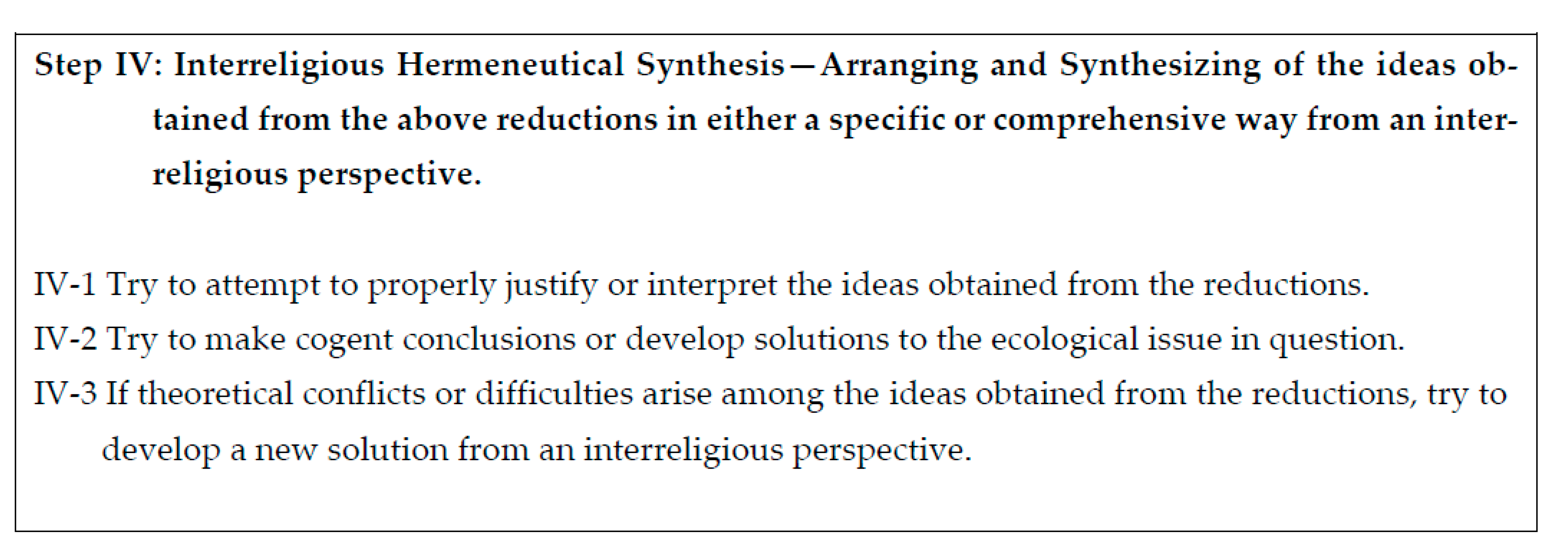
- The contents and meanings of reductions must be linguistically described, organized, and synthesized. This is a kind of fusion of horizons.14 In other words, the reduction performed from my religious perspective, the reductions carried out from other religious perspectives, and all the subsequent reductions achieved by both experts and non-experts must be organized in a way that aligns with addressing the primary problem, namely the ecological crisis. This constitutes a hermeneutical synthesis from an interreligious perspective to seek better understanding, thoughts, conclusions, and solutions.
2.2.2. Methodological Maxims
3. An Example of the Four-Step Method
4. A Final Remark
Funding
Data Availability Statement
Conflicts of Interest
| 1 | We need to differentiate between two types of ecological crises. First, there are crises occurring within nature itself (e.g., between natural elements). Second, there are crises arising from interactions between humans and nature, particularly those caused by human actions. Although there is not much that humans can do about the first type of ecological crisis, the second type of ecological crisis is beginning to be increasingly recognized. The debate over the so-called Anthropocene is one example of this recognition (cf. Lewis and Maslin 2018, Chapter 1). We must actively seek solutions to the second type of ecological crisis that appears to be caused by human interventions, i.e., human worldviews, values, lifestyles, and actions. |
| 2 | It is well known that the pioneering environmentalist Aldo Leopold (1887–1948) sought to inspire us to change the traditional human-centered view of land. What he calls the “land ethic” is a new way of seeing and understanding land as a complex, interconnected community of soils, plants, animals, and humans. (Cf. Leopold’s (1949) book A Sand Country Almanac). That idea is also supported by several classical ecological thinkers, including Arne Næss (1912–2009) and Thomas Berry (1914–2009). |
| 3 | It is noteworthy that Catherine Cornille emphasizes the role of empathy in interreligious studies, as highlighted in her 2020 article, “Interreligious Empathy”. |
| 4 | I borrow the term “sympoiesis” from contemporary Western philosophers, such as Donna Haraway, and extend it to the interreligious approaches that are currently being taken in response to the ecological crisis. Haraway writes that “sympoiesis is a simple word; it means “making-with”. Nothing makes itself; nothing is really autopoietic or self-organizing. (…) Sympoiesis is a word proper to complex, dynamic, responsive, situated, historical systems. It is a word for worlding-with, in company. Sympoiesis enfolds autopoiesis and generatively unfurls and extends it”. (Haraway 2016, p. 58) I will refer to all the activities and outcomes of interreligious engagement and exploration regarding the ecological crisis as “interreligious sympoiesis for ecological crises”. This term includes both theories and practices. It refers to co-production or co-constitution. |
| 5 | This dual role of religion in ecological matters was keenly examined by some seminal figures such as Lynn White (1907–1987). |
| 6 | This sort of constructive interreligious endeavor is not new. I believe that Thomas Berry had already undertaken this task and even went further by presenting a new grand narrative about the universe—a remarkable achievement. (See, for example, Berry’s 1988 book The Dream of the Earth, his 1992 book The Universe Story, and his 2009 book The Sacred Universe: Earth, Spirituality, Religion in the Twenty-First Century.) My intention is to undertake a similar task within the framework of rigorous philosophy. |
| 7 | Two great philosophical ideas—Edmund Husserl’s concepts of epoché and reduction as well as Hans-Georg Gadamer’s notion of the fusion of horizons—have influenced current methodological considerations regarding interreligious engagement with the ecological crisis. In this regard, in the present inquiry, I am engaging in a form of applied phenomenology. |
| 8 | In Husserl’s view, phenomena are understood as that which appear to consciousness. Thus, for Husserl, a phenomenon is characterized as a correlation between subject and object. This understanding of phenomena differs from the phenomenology of religion, where a religious phenomenon is regarded as a religious fact, state of affairs, event, or even a datum. In that respect, the phenomenology of religion leads to the morphology or typology of religion (Smart 2000, pp. 5, 17). There is, certainly, a conceptual and theoretical gap between philosophical phenomenology and phenomenology of religion although they remain interconnected (cf. Allen 2005). The methodological considerations presented in this paper are grounded in Husserlian philosophical phenomenology. |
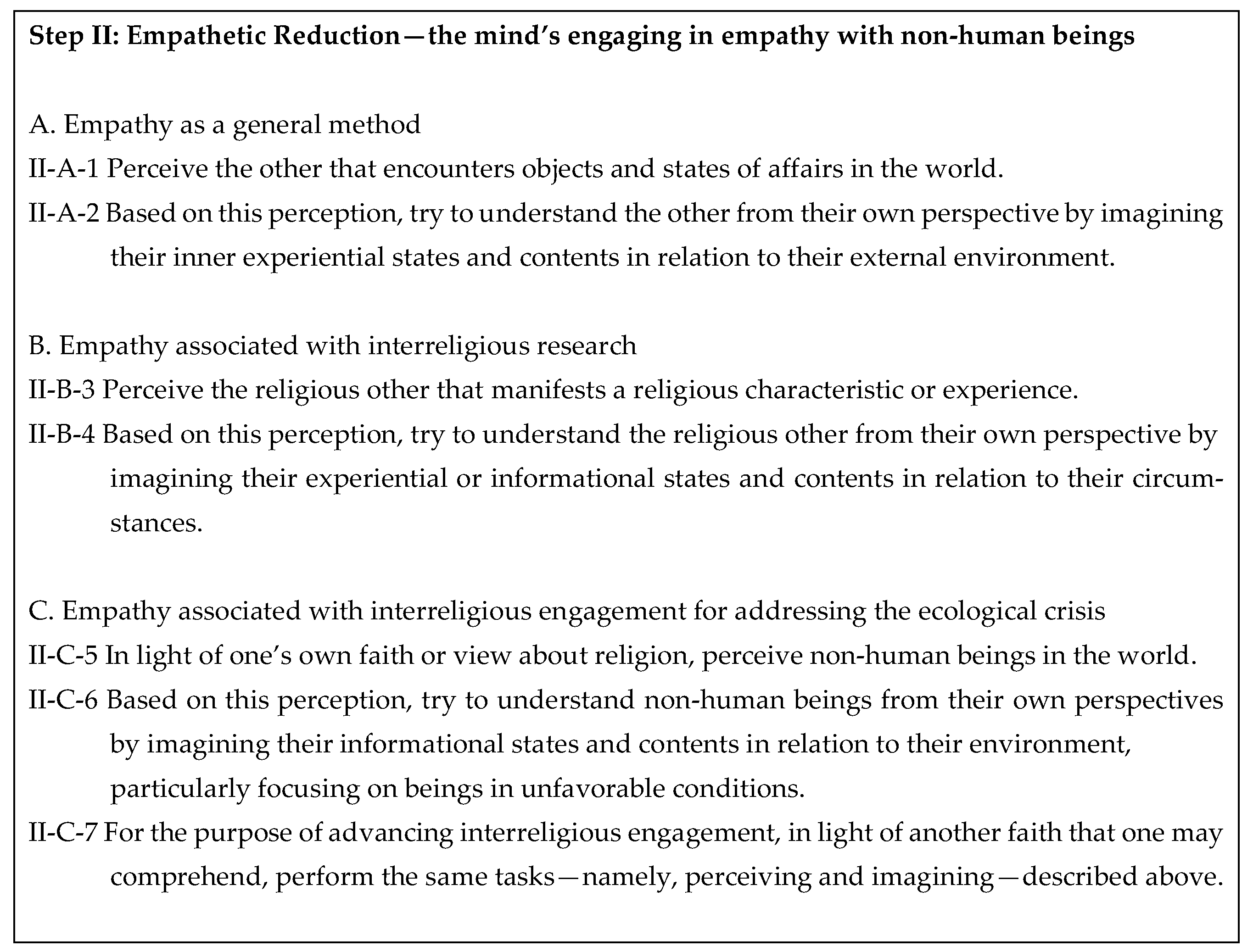
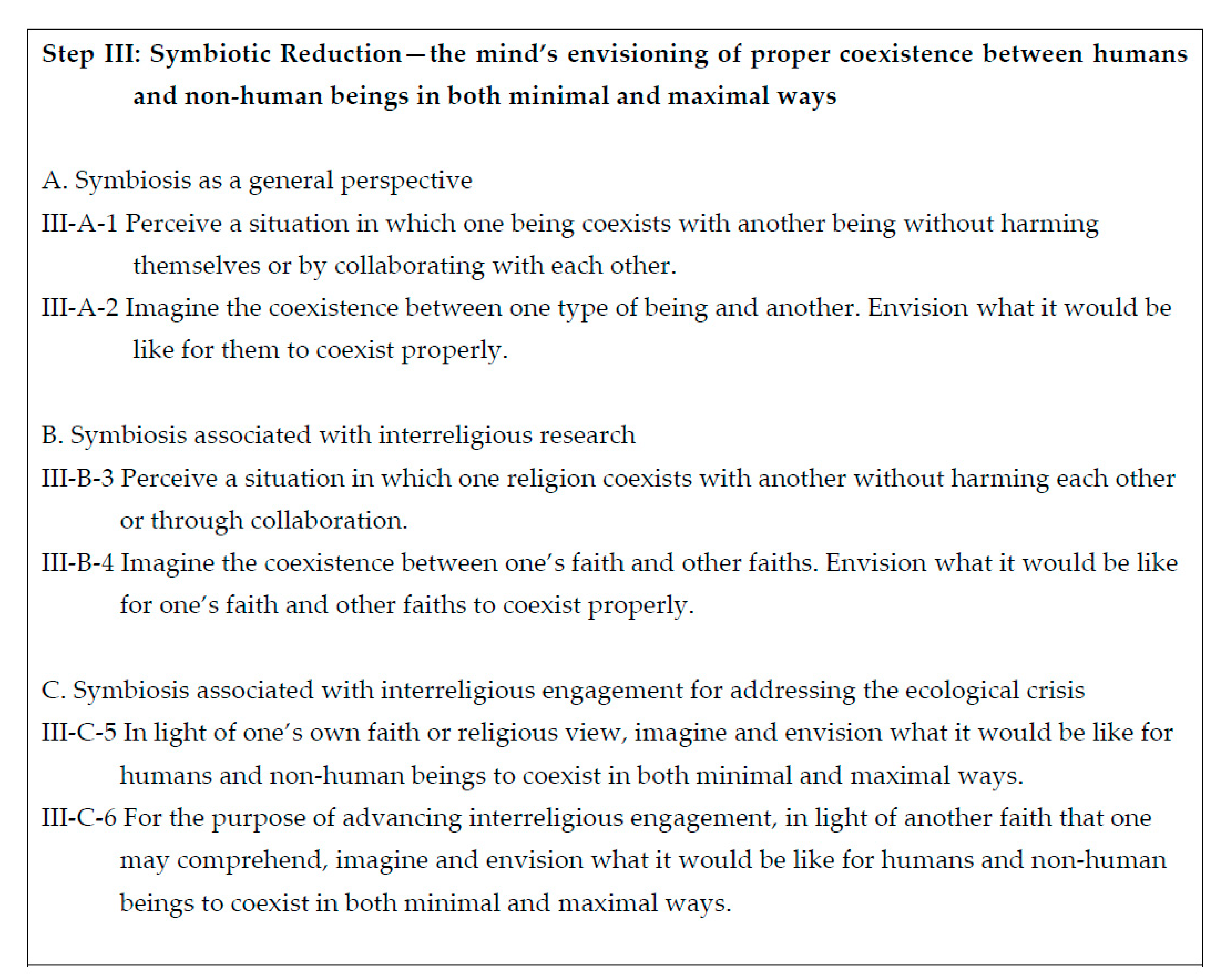
| 9 | In Husserlian phenomenology in particular, typical forms of reduction include eidetic reduction, transcendental reduction, and the life-world reduction (cf. Føllesdal 2006; Luft 2004). Eidetic reduction means to explore the content and meaning of one’s experience about things in the empirical world from the standpoint of the abstract essence or eidos. Transcendental reduction is concerned with viewing the things that appear to us from the perspective of the ultimate source of cognition (i.e., transcendental subjectivity or the fundamental epistemic conditions of the possibility of experience). Life-world reduction refers to seeking the origins and foundations of one’s experience in our pre-given, practical, and original lives. It seemingly has two irreconcilable yet uncanny aspects: on the one hand, in pursuing science, philosophy, and religion, the ordinary life-world is, on the one hand, the world we must transcend; on the other hand, it is the world we must retrieve. Life-world reduction focuses on and cherishes the latter—that is, the ordinary, everyday world regained and reclaimed. Through this attitudinal shift toward that experience, in phenomenology, reduction becomes a central methodological tool for obtaining new meanings and understandings about things (Husserl [1931] 1960). What I would like to propose in this inquiry is that, in coping with ecological crises, we need two distinct yet interconnected types of reduction: empathetic reduction and symbiotic reduction. |
| 10 | For example, Ninian Smart supports the idea of epoché in religious studies whereas Raimon Panikkar vehemently criticizes it. (See Smart’s (2000) book Worldviews, Introduction and also see Panikkar’s (1999) book The Intra-Religious Dialogue, Chapter 5). In relation to this issue, I wish to mention the classical Muslim theologian and philosopher Al-Ghazli (1058–1111). Surprisingly, we can find some conceptual and motivational affinities between the Husserlian idea of epoché and Al-Ghazali’s existential methodic skepticism, as presented in his book Deliverance from Error. In contemporary philosophical parlance, Al-Ghazali can be said to perform a personal suspension of preunderstandings across many of his cognitive capabilities and dimensions to reach the ultimate religious truth connected to God. Such suspension functions as a form of spiritual purification. |
| 11 | It is remarkable that, as a proper method for comparative religious research or worldview analysis, Smart emphasized the importance of epoché and what he calls the informed or structured empathy. I appreciate Smart’s view on this matter; however, it seems that he did not recognize that empathy can be a form of phenomenological reduction and that multiple forms of reduction can be designed for interreligious explorations. (Cf. Smart 2000, pp. 25–27.) |
| 12 | This issue concerns the theoretical relationship between epoché and reduction. Concerning this matter, the interpretation above has been supported by several scholars. For example, see Philip Bossert’s 1974 paper, “The Sense of ‘Epoché’ and ‘Reduction’ in Husserl’s Philosophy”. |
| 13 | The distinction between partial and total (or universal) epoché was originally made by Husserl. (Cf. Hua VIII Erste Philosophie (1923/24). Part II. Ed. Husserl and Boehm 1959, p. 165). |
| 14 | I adopt this idea from Gadamer’s hermeneutics (Gadamer [1960] 1982, pp. 272–74). |
| 15 | It seems that Husserl himself was not fully successful in establishing and systematizing the method of epoché and reduction. It is ironic that several distinguished phenomenologists, including Martin Heidegger and Merlau-Ponty, took critical stances toward the method. |
| 16 | As is well known, regarding the question of how one views their own religion and other religions, there are three main positions in interreligious engagement: exclusivism, inclusivism, and pluralism. In interreligious dialogue and exploration, exclusivism faces serious difficulties. Here, it seems to me that adopting at least a methodological and tentative pluralism would be appropriate. A partial epoché is helpful in this context. |
| 17 | It seems that some non-human animals exhibit primitive forms of empathy. For example, predators may anticipate and respond to the behavior of their prey through what we might call “perceiving” and “imagining” the prey’s informational states. This suggests that at least some types of animals, including humans, are equipped—either innately or empirically—with such perceptual and cognitive empathy abilities. As another extreme example, empathy can also be involved when sadistic individuals imagine and speculate about how to inflict more pain on others. This is why I believe that empathy is distinct from sympathy. See note 18. |
| 18 | Traditionally, empathy has primarily been regarded as a means of knowing and understanding the minds of other human beings. There are numerous philosophical and scientific theories about it. From a cognitive science perspective, two representative theories are “Theory-Theory” and “Simulation Theory”. The former posits that we know others’ minds by attributing internal mental states to them based on theories, such as folk psychology. The latter suggests that we project ourselves onto others and their situations, and estimate, imagine, and simulate their internal mental states. Although these two theories are partially plausible, they encounter a common issue: they tend to overlook the basic and direct perceptual dimension of empathy by defining it mainly through higher-level mental abilities, such as inference and simulation. Simulation Theory sometimes distinguishes between lower-level and higher-level empathy, based on the presence or absence of conscious imagination (Goldman 2011, pp. 33–38), yet the possibility and actuality of direct perceptual empathy remain unclear. Meanwhile, classical phenomenologists, such as Husserl, suggest that there are various levels or dimensions of empathy, and that at its most basic level, empathy is achieved through direct perception rather than inference or simulation (Zahavi 2014, pp. 136–37). Here, I adopt the view that a multidimensional theory of empathy—which encompasses both basic-level, direct empathy through perception and higher-level, simulative empathy through imagination—offers the most plausible representation of empathy. In conducting the present research on the nature of empathy, I was surprised to find that the phenomenological conception of empathy proposed by Husserl and Stein aligns closely with my own thinking. Consequently, I adopt and utilize that conception. I also find that James Jardine and Thomas Szanto have nicely clarified and formulated the phenomenological conception of empathy as follows: “[According to Husserl and Stein] (i) empathy is a sui generis mode of intentional experience, (ii) the basic form of empathy can nevertheless be characterised as perception-like, and (iii) that a higher-order form of empathy is a more imagination-like way of understanding other persons from their own personal perspective”. (Jardine and Szanto 2017, p. 86.) |
| 19 | The concept of symbiosis originates from biology (cf. Margulis 1998). The traditional interpretation of Darwinian theory of evolution tends to overemphasize, under the notion of natural selection, competition and the survival of the fittest. In contrast, modern perspectives on evolution highlight multiple modes of interaction among distinct species, including competition, cooperation, interconnectedness, and even interdependence. The notion of symbiosis has significantly contributed to shaping the modern view of evolution. Certainly, competition alone cannot sustain an organism’s existence. (Compare this point with certain extreme apologetic tendencies within religion.) Organisms thrive in various symbiotic ways. Meanwhile, symbiosis is not restricted to biology; it can be applied to all spheres and dimensions of being, including the religious. However, we need to be very careful when we connect the idea of symbiosis to religions. One challenge of the present era is determining whether and how mainstream materialistic and reductionistic sciences can incorporate such complex, emergent, and anomalous phenomena and ideas. Ultimately, this will be the matter of adopting a new paradigm. In this respect, the emergence of new views about the nature and methods of science must be regarded as a thrilling and challenging development in our age. An example of such a perspective is presented in Harald Walach’s 2019 book Beyond a Materialist Worldview: Towards an Expanded Science. |
| 20 | See Seo’s 2007 book Ecological Philosophy in Zen, Ch. 7–8 (Korean). Also see McFague 2008 book A New Climate for Theology, Ch. 4. It is interesting to note that Zen Buddhism, especially some schools of Japanese Zen, such as Soto Zen, has a pantheistic element, though it is not the traditional Western form of pantheism. Meanwhile, as is well known, McFague’s view is a form of panentheism, not pantheism. Regarding this matter, from the perspective of world philosophy, a comparative approach to the issue of pantheism and panentheism would be beneficial. In undertaking this task, the first candidates we should consult seem to be the Islamic thinker Ibn ‘Arabi (1165–1240) and the Dutch philosopher Baruch Spinoza (1632–1677). |
| 21 | Here, I emphasize the role of partial and temporary epoché rather than a total one. Misunderstandings may persist if this distinction is not properly understood. |
| 22 | In Buddhism, the concept of collective karma or shared karma is a matter of controversy. This type of karma refers to the collective actions that result in shared consequences for a group of beings. The concept of collective karma was implicit in early Buddhist teachings on karma. It emerged clearly during the period of sectarian Buddhism, for example, in Abhidharmakośabhāṣya (Volume 6), and Abhidharmahṛdaya Śāstra (Volume 2), and it also appeared in Mahayana Buddhist scriptures. Further investigations into collective karma from diverse interreligious perspectives are necessary. |
| 23 | In some future, even if humans cease killing animals to maintain their own lives, it appears that humans will still destroy many plants. However, in that case, it seems that plants would not harm humans. Does this perhaps reflect the Buddha-nature of plants? |
| 24 | See, for example, Genesis, 1, 26–28. On the basis of this idea, it is sometimes said that Christianity allows humans to freely utilize and reshape nature according to their interests and purposes. Some scholars call this “anthropocentrism”. They argue that Christianity advocates such anthropocentrism and that it is the main cause of the ecological crisis. A well-known example of this interpretation of Christianity was presented in Lynn White’s (1967) paper, “The Historical Roots of Our Ecological Crisis”. Meanwhile, it is relatively unknown that, as a proposed solution to this matter, White recommended the Christian mystical tradition championed by St. Fransis of Assisi. |
| 25 | In relation to exploring the problem of self-emptying, the comparative analysis between God in Christianity and Śūnyatā in Buddhism, despite some pioneering research on the subject, such as that of Abe Masao, remains a fascinating and urgent issue that demands continuous revisiting and reconsideration from interreligious perspectives. |
| 26 | In my opinion, one will not arrive at this sort of idea if they attempt to perform empathetic and symbiotic reductions solely from their own religious perspective. This conclusion arises from interreligious exploration. |
References
- Allen, Douglas. 2005. Major Contributions of Philosophical Phenomenology and Hermeneutics to the Study of Religion. In How to Do Comparative Religion? Edited by René Gothóni. Berlin: Walter de Gruyter, pp. 5–28. [Google Scholar]
- Barton, John. 2022. Better Religion: A Prime for Interreligious Peacebuilding. Waco: Baylor University Press. [Google Scholar]
- Bossert, Philip. 1974. The Sense of ‘Epoche’ and ‘Reduction’ in Husserl’s Philosophy. Journal of the British Society for Phenomenology 5: 243–55. [Google Scholar] [CrossRef] [Scilit]
- Bullard, Robert. 2000. Dumping in Dixie: Race, Class, and Environmental Quality, 3rd ed. Boulder: Westview Press. [Google Scholar]
- Cattoi, Thomas. 2020. Towards a New Ecological Vision: An Interreligious Reflection on Laudato Si’. In Deep Understanding for Divisive Times: Essays Marking a Decade of the Journal of Interreligious Studies. Edited by Luciana Mosher, Alex Takacs, Or Rose and Mary Elizabeth Moore. Newton Center: Interreligious Studies Press. [Google Scholar]
- Choi, Hyunmin. 2008. Buddhism and Christianity as Partners for Overcoming Eco-Crisis. Korean Journal of Religious Education 28: 161–91. (In Korean) [Google Scholar]
- Cornille, Catherine. 2020. Interreligious Empathy. In Interreligious Studies: Dispatches from an Emerging Field. Edited by Hans Gustafson. Waco: Baylor University Press. [Google Scholar]
- Føllesdal, Dagfinn. 2006. Husserl’s Reductions and the Role They Play in His Phenomenology. In A Companion to Phenomenology and Existentialism. Edited by Hubert Dreyfus and Mark Wrathall. Malden: Blackwell Publishing. [Google Scholar]
- Gadamer, Hans-Georg. 1982. Truth and Method. New York: The Crossroad Publishing Company. First published 1960. [Google Scholar]
- Goldman, Alvin. 2011. Two Routes to Empathy: Insights from Cognitive Neuroscience. In Empathy: Philosophical and Psychological Perspectives. Edited by Amy Coplan and Peter Goldie. Oxford: Oxford University Press. [Google Scholar]
- Haraway, Donna. 2016. Staying with Trouble: Making Kin in the Chthulucene. Durham: Duke University Press. [Google Scholar]
- Husserl, Edmund. 1960. Cartesian Meditations: An Introduction to Phenomenology. Translated by Dorris Cairns. The Hague: Martinus Nijhoff. First published 1931. [Google Scholar]
- Husserl, Edmund. 2014. Ideas for a Pure Phenomenology and Phenomenological Philosophy, First Book. Translated by Daniel Dahlstrom. Indianapolis: Hackett Publishing Company. First published 1913. [Google Scholar]
- Husserl, Edmund, and Rudolf Boehm. 1959. Erste Philosophie (1923/24): Zweiter teil: Theorie der phänomenologischen reduktion. Leiden: Nijhoff, vol. 8. [Google Scholar]
- Jardine, James, and Thomas Szanto. 2017. Empathy in the Phenomenological Tradition. In The Routledge Handbook of Philosophy of Empathy. Edited by Heidi Maibom. New York: Routledge. [Google Scholar]
- Kiem, Youngjin. 2023. Intentionality and the Diversity of Religion: A Prelude. Religions 14: 281. [Google Scholar] [CrossRef] [Scilit]
- Leopold, Aldo. 1949. A Sand County Almanac. Oxford: Oxford University Press, (Sierra Club/Ballantine edition). [Google Scholar]
- Lewis, Simon, and Mark Maslin. 2018. The Human Planet: How We Created the Anthropocene. New Heaven: Yale University Press. [Google Scholar]
- Lewis, Michael, and Tanja Staehler. 2010. Phenomenology. New York: Continuum. [Google Scholar]
- Luft, Sebastian. 2004. Husserl’s Theory of the Phenomenological Reduction: Between Life-World and Cartesianism. Research in Phenomenology 34: 198–234. [Google Scholar] [CrossRef] [Scilit]
- Margulis, Lynn. 1998. The Symbiotic Planet. London: Phoenix. [Google Scholar]
- McFague, Sallie. 2008. A New Climate for Theology: God, the World, and Global Warming. Minneapolis: Fortress Press. [Google Scholar]
- McFague, Sallie. 2021. A New Climate for Christology: Kenosis, Climate Change, and Befriending Nature. Minneapolis: Fortress Press. [Google Scholar]
- Mikva, Rachel. 2020. Does Interreligious Understanding Matter If the World Is Coming to an End?. In Deep Understanding for Divisive Times: Essays Marking a Decade of the Journal of Interreligious Studies. Edited by Luciana Mosher, Alex Takacs, Or Rose and Mary Elizabeth Moore. Newton Center: Interreligious Studies Press. [Google Scholar]
- Moran, Dermot, and Joseph Cohen. 2012. The Husserl Dictionary. New York: Continuum. [Google Scholar]
- Nixon, Rob. 2011. Sow Violence and the Environmentalism of the Poor. Cambridge: Harvard University Press. [Google Scholar]
- Panikkar, Raimon. 1999. The Intra-Religious Dialogue. Mahwah: Paulist Press. [Google Scholar]
- Seo, Jae-Young. 2007. Ecological Philosophy in Zen. Seoul: Dongguk University. (In Korean) [Google Scholar]
- Smart, Ninian. 2000. Worldviews: Crosscultural Explorations of Human Beliefs, 3rd ed. Upper Saddle River: Prentice Hall. [Google Scholar]
- Tucker, Mary, and John Grim, eds. 1994. Worldviews and Ecology: Religion, Philosophy and the Environment. Maryknoll: Orbis Books. [Google Scholar]
- White, Lynn. 1967. The Historical Roots of Our Ecological Crisis. Science 155: 1203–207. [Google Scholar] [CrossRef] [Scilit] [PubMed]
- Zahavi, Dan. 2014. Empathy and Other-Directed Intentionality. Topoi 33: 129–42. [Google Scholar] [CrossRef] [Scilit]


Disclaimer/Publisher’s Note: The statements, opinions and data contained in all publications are solely those of the individual author(s) and contributor(s) and not of MDPI and/or the editor(s). MDPI and/or the editor(s) disclaim responsibility for any injury to people or property resulting from any ideas, methods, instructions or products referred to in the content. |
© 2024 by the author. Licensee MDPI, Basel, Switzerland. This article is an open access article distributed under the terms and conditions of the Creative Commons Attribution (CC BY) license (https://creativecommons.org/licenses/by/4.0/).
Share and Cite
Kiem, Y. How to Engage with Non-Human Others in Ecosystems from a Phenomenological and Interreligious Perspective. Religions 2024, 15, 1539. https://doi.org/10.3390/rel15121539
Kiem Y. How to Engage with Non-Human Others in Ecosystems from a Phenomenological and Interreligious Perspective. Religions. 2024; 15(12):1539. https://doi.org/10.3390/rel15121539
Chicago/Turabian StyleKiem, Youngjin. 2024. "How to Engage with Non-Human Others in Ecosystems from a Phenomenological and Interreligious Perspective" Religions 15, no. 12: 1539. https://doi.org/10.3390/rel15121539
APA StyleKiem, Y. (2024). How to Engage with Non-Human Others in Ecosystems from a Phenomenological and Interreligious Perspective. Religions, 15(12), 1539. https://doi.org/10.3390/rel15121539