Next Article in Journal
BAARTR: Boundary-Aware Adaptive Regression for Kinematically Consistent Vessel Trajectory Reconstruction from Sparse AIS
Previous Article in Journal
Development of a Cost-Effective UUV Localisation System Integrable with Aquaculture Infrastructure
error_outline You can access the new MDPI.com website here. Explore and share your feedback with us.
 
 
Article

Coupled Responses and Performance Assessment of Mooring-Connection Systems for Floating Photovoltaic Arrays in Shallow Waters

1
College of Engineering, Ocean University of China, Qingdao 266404, China
2
State Key Laboratory of Coastal and Offshore Engineering, Ocean University of China, Qingdao 266100, China
3
Ropenet Group, Tai’an 271000, China
*
Authors to whom correspondence should be addressed.
J. Mar. Sci. Eng. 2026, 14(2), 117; https://doi.org/10.3390/jmse14020117
Submission received: 5 December 2025 / Revised: 30 December 2025 / Accepted: 6 January 2026 / Published: 7 January 2026
(This article belongs to the Special Issue Advanced Analysis of Ship and Offshore Structures)

Abstract

Offshore floating photovoltaic (FPV) platforms are usually deployed in shallow waters with large tidal variations, where the modules of FPV are connected with each other via the connectors to form an array and mounted to the seabed via the mooring system. Therefore, the mooring system and module connectors have significant influence on the dynamic response characteristics of FPV. In targeting such shallow waters with large tidal ranges, this paper proposes four integrated mooring-connection schemes based on configuration and parameter customization guided by adaptability optimization, including two kinds of mooring systems, named as horizontal mooring system and catenary mooring system with clumps, and two kinds of connection schemes, named as cross-cable connection and hybrid connection, are proposed. The feasibility of the mooring systems to adhere to the tidal range and the influence of the connection schemes on the dynamic response of the FPV are numerically investigated in detail. Results indicate the two mooring systems have comparable positioning performance; horizontal mooring offers slightly better tidal adaptability but much higher mooring tension, compromising system safety. Hybrid connection yields smaller surge amplitudes than cross-cable connection but generates excessively large connection forces, also posing safety risks. Comprehensive comparison indicates that catenary mooring with clumps combined with cross-cable connection imposes lower requirements on platform structural safety factors, while horizontal mooring with cross-cable connection exhibits stronger adaptability to water level and environmental load direction changes in shallow waters.

1. Introduction

The development of global economy and continuous growth in energy demands have highlighted the limitations of traditional fossil fuels and associated pollution problems, prompting accelerated development of renewable energy sources. As one kind of important renewable energy source, solar energy has the advantage of being pollution-free and sustainably utilizable. According to data from the International Energy Agency (IEA), global photovoltaic capacity reached 452 GW in 2024 [1]. Compared with onshore photovoltaics systems, offshore FPV systems can be deployed in sea areas with depths of over 5 m, thus expanding the available resources. Unlike the FPVs deployed in lakes, the offshore FPV systems are often subjected to significant impacts from ocean waves, wind, and currents, which makes the FPVs deployed in the marine environments face greater challenges. Currently, most offshore FPV systems use a modular array design, and the mooring systems are adopted to limit the horizontal motion responses of the FPV.
Offshore FPV is currently primarily installed in near-shore areas with shallow waters [2]; therefore, the design of mooring system in shallow waters is of great necessity. Xu et al. [3] proposed seven mooring concepts for shallow-water semi-submersible floating wind turbines and compared their static/dynamic performance and cost, concluding that full-chain catenary mooring is unsuitable for shallow waters. It should be mentioned that the tidal range is typically substantial in shallow waters. In some nearshore areas, the tidal range poses a significant challenge for mooring system design. Du et al. [4] conducted a time-domain analysis of an FPV moored in shallow waters with significant tidal range, and the effects of six different mooring systems on the maximum tension of the mooring system were investigated in detail. The results showed that the catenary mooring system exhibits superior tension stability compared to the taut mooring system in shallow waters with large tidal range. In summary, taut mooring and full-chain catenary mooring are not suitable for FPVs in shallow waters with large tidal range, whereas catenary mooring systems equipped with the clamps or buoys can be applied to FPV systems.
Flexible connectors are widely used in offshore multibody systems, and the structure design as well as the parameters of the connectors have significant influence on the safety of the system. Compared with other types of multibody systems, such as floating breakwaters, the offshore FPV platforms are more modular and easier to arrange. The forces acting on the connectors are more complex, which requires the connectors to have a high degree of flexibility and toughness. Currently, the flexible connectors employed in offshore multibody platforms mainly include hinged connector, cable and spring connector, vertical-free connector, and other types. The hinged connector initially used in multibody systems was simple horizontal bolt hinges [5]. Later, spherical hinges and pin hinges were added, and components such as rubber cones and sliding sleeves were integrated to reduce impact and wear, thereby better withstanding various loads [6]. Cable and spring connectors link floating bodies through cables, elastomers, and rubber connectors, allowing large relative motions and facilitate disassembly and maintenance [7]. Vertical-free connectors achieve coupling by permitting free sliding between floating bodies in certain directions while restricting motion in others [8], enhancing inter-module stability but being prone to large torsional forces [9]. Hybrid connectors integrate the above-mentioned types of flexible connectors to improve connection performance [10,11,12]. Amouzadrad et al. [13] conducted a review on multibody floating systems, arguing that uncertainties in connectors significantly affect the behavior of multi-module systems. They also pointed out that existing studies lack sensitivity analysis of different connection types for multi-module floating structures and have not focused on scenarios of shallow waters with large tidal ranges. Considering that excessive stress may cause structural damage to FPV platforms as lightweight platforms, connectors with high flexibility such as cables and springs can be selected to ensure the safety of the connection system. In addition, an attempt can be made to equip FPV array with spherical hinges and cables to form a hybrid connection scheme, which can further constrain the platform’s motion.
Research on the coupling effect between floating bodies and mooring systems has been relatively mature. Ormberg and Larsen [14] developed a fully coupled time-domain method that accurately captures floating body-mooring system interactions. Their computational results gave a good agreement with experimental results. The fully coupled time-domain method has been widely applied in the coupled analysis of moored floating bodies. In multibody systems, especially in arrays with scalability in both longitudinal and lateral directions, the coupled analysis of floating bodies and mooring systems becomes complex [15]. Scholars have proposed a rigid module and flexible connector (RMFC) method, which treats each module as a rigid body, with the flexibility of the multibody system primarily manifested in the flexible connectors. This method is widely used in the hydrodynamic analysis of modular multibody systems. Kim et al. [16] analyzed the main connection loads in chain system and array systems under different wave incident directions. Zhao et al. [17] established an optimization process for the stiffness design of connectors by combining the linear weighted sum method and genetic algorithm. Liu et al. [12] investigated the influence mechanisms of wave directions, connectors, and longitudinal expansion on the hydrodynamic performance of multibody systems under typical sea conditions. Ren et al. [18] verified the sensitivity of a series connection system composed of seven modules to connector types, wave phases, and mooring line pre-tension. Regarding the research progress of offshore FPV, Wang et al. [19] focused on star-type FPV systems, finding that flexible connector length significantly impacts its tension, while mooring systems are more sensitive to wave parameters than connector parameters. Wang et al. [20] conducted targeted studies on a 4 × 4 lattice-type FPV array, examining the effects of wave height, wave period and direction as well as diameter of polyester cables on connection mooring line tension. Their findings directly inform environmental adaptability design of FPV connection systems in shallow waters. Wang et al. [21] compared FPV array dynamic responses, flexible connector loads, and mooring tensions under operational, design, and extreme environmental conditions.
However, for modular FPV arrays in shallow waters with large tidal ranges, existing studies suffer from three key limitations: (1) Most studies focus on either mooring systems or connection schemes in isolation, lacking integrated analysis of their coupled dynamic effects, particularly how the interaction between the two affects the array’s positioning accuracy and structural safety [22]. (2) Few studies consider the combined influence of large tidal variations and multi-directional environmental loads, resulting in insufficient environmental adaptability of proposed schemes. (3) Quantitative comparisons of different mooring-connection integrated schemes are lacking, and there is a lack of systematic evaluation criteria covering motion responses, mooring tension, and connection forces, making it difficult to provide direct guidance for engineering design.
Overall, current research mainly focuses on the coupled motion analysis of floating structures under wave action based on potential flow theory, and there is a lack of mooring coupling analysis considering the connection of FPV modules, especially the mooring coupling analysis of modular connected floating structures in shallow waters with large tidal ranges. Taking an FPV array with six modules as the research object, this study conducts coupled dynamic response analysis to compare the motion responses, mooring tensions and connection forces of the array under different mooring systems and connection schemes, as well as their variations with water level and the direction of environmental loads, so as to evaluate the feasibility of these mooring and connection schemes. Mooring systems and connection schemes suitable for FPV in shallow waters are finally determined. This study fills the gap in the field of mooring-connection coupling analysis for modular FPV arrays in shallow waters with large tidal ranges, and the research results can provide a reference for the design of mooring and connection systems for offshore FPV array.

2. Preliminaries of the Coupling Dynamics Analysis of the FPV

2.1. Three-Dimensional Potential Flow Theory

Assuming the incompressible and inviscid surrounding fluid with irrotational motion. The velocity potential [23,24] can be decomposed into
ψ ( X , t ) = Re [ η 0 φ 0 ( X ) e i ω 0 t ] + Re m = 1 6 j = 1 N [ η j m φ j m ( X ) e i ω 0 t ] + Re [ η D φ D ( X ) e i ω 0 t ]
where Re ( ) denotes the real part of the argument; N is the total number of floating bodies; ω 0 is the incident wave frequency; φ 0 is the unit incident potential and η 0 = η D is the incident wave amplitude; φ j m ( m = 1 , 2 , , 6 ,   j = 1 , 2 , , N ) is the unit radiated wave potential in 6 degrees of freedom (DoF) and η j m ( m = 1 , 2 , , 6 ,   j = 1 , 2 , , N ) is the corresponding oscillation amplitude; φ D is the unit diffracted wave potential.
The linearized incident wave velocity potential φ 0 is described as
φ 0 = i g η 0 ω 0 cosh k ( z + d ) cosh k d e i [ k ( x cos β + y sin β ) ]
where d is the depth of water; β is the angle of wave heading; and k is the wave number that satisfies the dispersion relation
k tanh k d = ω 0 2 / g
The governing equation and linearized boundary conditions used to solve the perturbation velocity potential φ D and φ j m ( j = 1 , 2 , , N ) are summarized as follows.
Diffraction wave potential:
2 φ D = 0   in   the   fluid   domain ;
g φ D z ω 0 2 φ D = 0   on   the   undisturbed   free   surface   S f ;
φ D n = φ 0 n S j   on   the   mean   wetted   body   surface   S j ;
φ D z = 0   on   the   seabed .
Radiation wave potential:
2 φ j m = 0 ,   m = 1 , 2 , , 6   in   the   fluid   domain ;
g φ j m z ω 0 2 φ j m = 0 ,   m = 1 , 2 , , 6   on   the   undisturbed   free   surface   S f ;
φ j m n = i ω 0 n m S j 0 S o t h e r s , m = 1 , 2 , , 6   on   the   mean   wetted   body   surface   S j ;
φ j m z = 0   on   the   seabed .
The generalized normal vectors n m are expressed as
n m = n ,   m = 1 ,   2 ,   3 x × n ,   m = 4 ,   5 ,   6
where n = ( n 1 , n 2 , n 3 ) is the unit normal vector directed inward on body surface S j ; x = ( x , y , z ) is the position vector on S j .

2.2. Environmental Loads

The wind load acting on the FPV panel can be calculated by the following formula according to DNV-RPC205:
F w = β Z μ S μ Z w 0
where F w is the standard value of the wind load; β Z is the wind vibration coefficient at height z ; μ S is the whole shape coefficient of the wind load; μ Z is the height variation coefficient of wind pressure; w 0 is the basic wind pressure. In this study, the wind vibration coefficient β Z at the height z is taken as 1.0, and the load shape coefficient μ S is taken as 0.82. The variation coefficient of wind pressure with height μ Z is taken as 1.0, and the basic wind pressure w 0 is taken as 0.3 kN/m2.
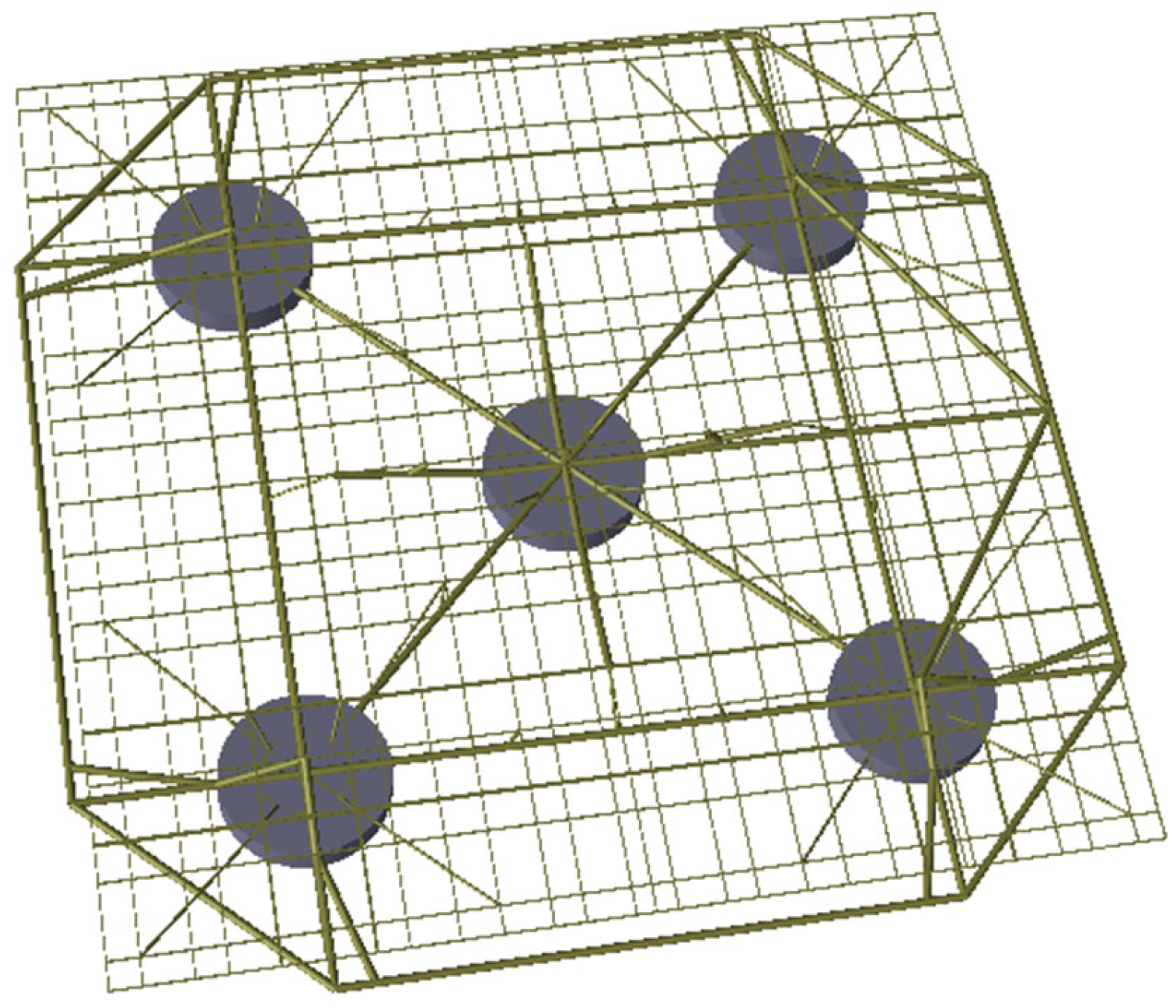
The FPV structure demonstrated in this study is a double-layer frame structure (as illustrated in Figure 1), and the buoyancy unit of the FPV is the cylindrical buoy. According to DNV-RPC205, the current load acting on the buoyancy unit of FPV can be determined with the following formula:
F c = 1 2 ρ w D U c n 2
where F c is the current load acting on the cylindrical buoy; ρ w is the density of seawater; D is the diameter of the buoy; U c n is the current velocity perpendicular to the axis of the buoy.
The pressure on the wetted surface p can be derived by combining Bernoulli’s equation, and then the wave force F is obtained through integration. The specific expressions are as follows:
p = ρ ( ψ t + g z + 1 2 ψ 2 )
F = S 0 p n d S 0
where ρ is the seawater density, g is the gravitational acceleration, z is the vertical depth of the wetted surface element from the waterline, S 0 is the wetted surface of the floating body, and n is the normal vector of the wetted surface.
The random wave processes can be represented as sums of large numbers of periodic wavelets with different directions, amplitudes, and frequencies. Their energy distribution over frequency can be depicted by the wave spectrum S η η ( ω ) . In this paper, the Joint North Sea Wave Project (JONSWAP) spectrum is adopted [25] and it is defined by the following formula:
S η η ( ω ) = α 5 16 H S 2 ω p 4 ω 5 e 5 4 ( ω ω p ) 4 γ e ( ω ω p ) 2 2 σ 2 ω p 2
where ω p is the peak angular frequency of spectrum and ω p = 2 π / T p ; H s and T z are significant wave height and mean up-crossing period of the sea state; g is the acceleration of gravity; γ is the peak enhancement factor of the JONSWAP spectrum compared with the Pierson-Moskowitz (P-M) spectrum.
σ represents the narrowness of the peaks and it has different values for frequencies lower or higher than the peak, as expressed in Equation (18)
ω ω p σ = 0.07 ω > ω p σ = 0.09

2.3. Connector Coupled Mechanical Model

Multibody floating structures are composed of modules interconnected by connectors. The modules are not only subjected to wave forces but also to connector forces due to the relative motion between modules. Therefore, it is necessary to establish a mechanical model of the connectors. Based on the RMFC model, assuming that the floating modules are rigid bodies, the structural deformation of the multi-module floating structure mainly occurs in the flexible connectors. The connector can be regarded as a linear spring with three linear displacement directions, and its rotational displacement stiffness is zero [26]. The stiffness matrix k of a single connector is expressed as
k = k x 0 0 0 0 0 0 k y 0 0 0 0 0 0 k z 0 0 0 0 0 0 0 0 0 0 0 0 0 0 0 0 0 0 0 0 0
where k x , k y and k z are the stiffness of the connector along the x, y, and z directions, respectively.
Assuming that there are N c connectors arranged between the ith floating body and the jth floating body, the displacements of the qth connector at the connection points on the ith module and the jth module in the global coordinate system can be expressed as
u i q = T i q X i ,   u j q = T j q X j
where X i = x i , y i , z i , α i , β i , γ i and X j = x j , y j , z j , α j , β j , γ j are the generalized displacement vectors of the centers of mass of the ith module and the jth module in the global coordinate system, respectively; T i q denotes the displacement transformation matrix of the connection point of the qth connector on the ith module relative to its center of mass; similarly, T j q denotes the displacement transformation matrix of the connection point of the qth connector on the jth module relative to its center of mass, which has the following general form
T s m = 1 0 0 0 ξ s m η s m 0 1 0 ξ s m 0 ζ s m 0 0 1 η s m ζ s m 0 0 0 0 1 0 0 0 0 0 0 1 0 0 0 0 0 0 1
where ζ s m , η s m , ξ s m is the position of the connection point of the mth connector in the local coordinate system of the sth floating body.
Therefore, the relative displacement of the qth connector between adjacent floating bodies can be written as
Δ u i j q = u j q u i q
According to Hooke’s Law, the force acting on the qth connector can be expressed as
f i j q = k Δ u i j q
Using the transformation matrix, the force (moment) exerted by the qth connector on the center of mass of the ith module can be obtained, which is expressed as
F i j q = T i q T f i j q = T i q T k Δ u i j q
As mentioned earlier, the ith module and the jth module are connected by connectors, so the total load exerted by these connectors on the center of mass of the ith module is
F i j , c = q = 1 N c F i j q = q = 1 N c T i q T k Δ u i j q

2.4. Multibody Motion Equation in Time Domain

The dynamic governing equation of a multibody floating system composed of N modules can be expressed as
M i x ¨ i + j = 1 N ( A i j x ¨ i + B i j x ˙ i ) + C i x ˙ i + ( S i + K i ) x i = F ¯ i , W e i ω t + F i j , c + F c + F w , i = 1 , , N
where the subscript i and j denote the module number; M i is the mass matrix of the ith module, A i j is the added mass matrix which is induced by the oscillation motion of the jth module, and B i j is the radiation damping matrix. C i represents the damping matrix. Taking the simplest linear mooring model as an example, K i is the stiffness matrix of the mooring. S i is the hydrostatic stiffness matrix. F ¯ i , W represents the wave exciting force, and F i j , c refers to all the connector forces acting on the center of mass of module i . F c is the current load. F w is the wind load.
In a floating body array, the radiation potential is the source of hydrodynamic interference; therefore, the hydrodynamic interference between modules is reflected in added mass A i j and radiation damping B i j .
A i j = m = 1 6 n = 1 6 μ i j m n
B i j = m = 1 6 n = 1 6 λ i j m n
where μ i j m n and λ i j m n are the added mass coefficients and damping coefficients of the ith module in the mth mode which is induced by the oscillation motion of the jth module in the nth mode [27]. The added mass and damping coefficients can be written as
μ i j m n = ρ ω 0 S j φ I j n n m d S ,   m , n = 1 , 2 , , 6 ;   i , j = 1 , 2 , , N
λ i j m n = ρ S j φ R j n n m d S ,   m , n = 1 , 2 , , 6 ;   i , j = 1 , 2 , , N
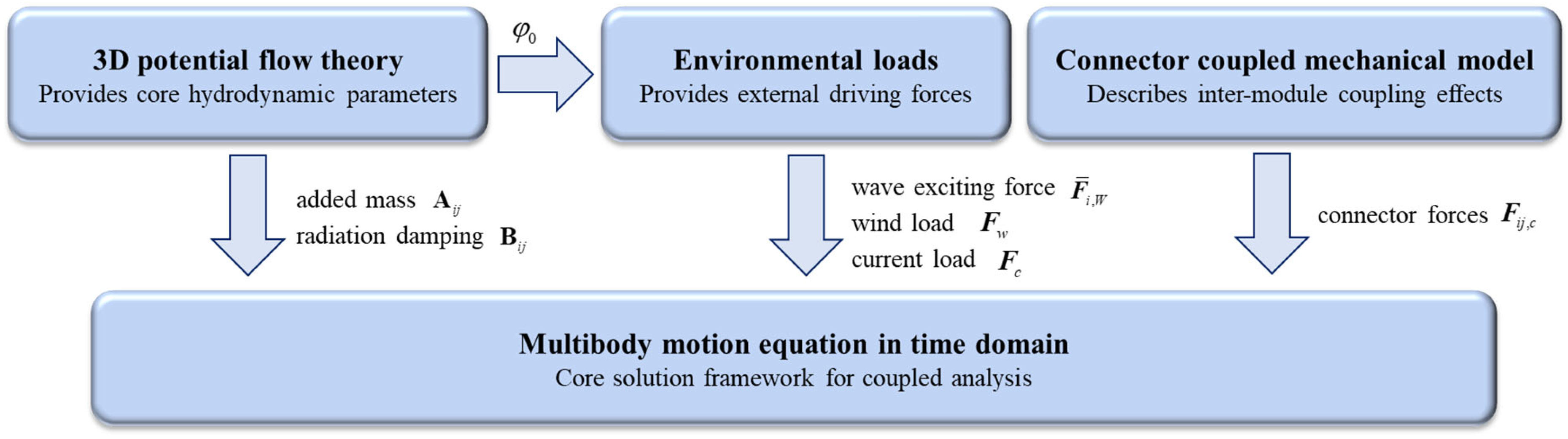
where φ I n donates the imaginary part of nth radiation potential, and φ R n is the real part. The coupled dynamic response analysis flowchart is illustrated in Figure 1.

3. Numerical Model and Parameters of FPV Array

3.1. Structure of FPV

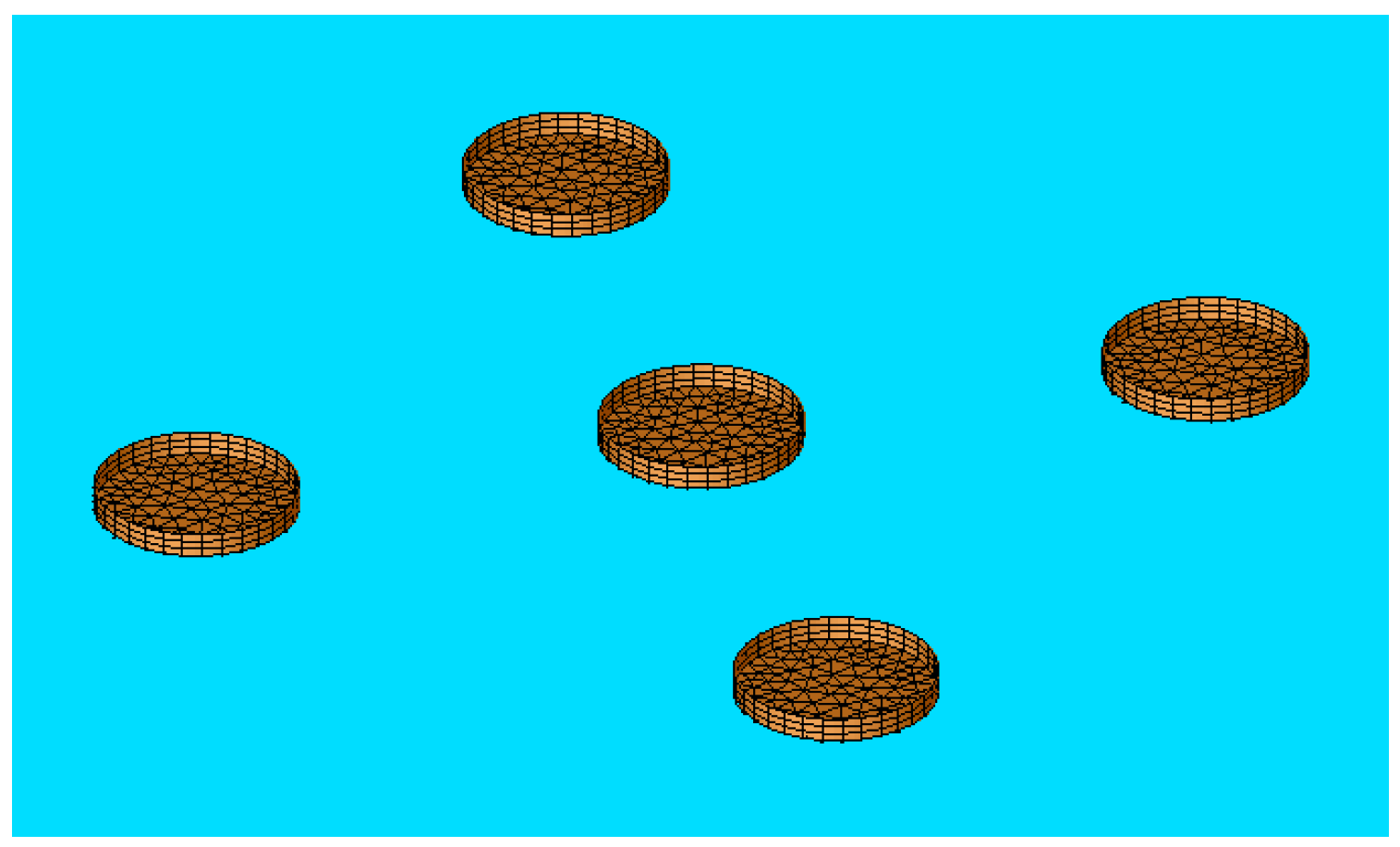
The offshore FPV platform [28] consists of a support sub-structure, a main frame sub-structure, and buoys, as shown in Figure 2. The main particulars, including the height, displacement, center of gravity, etc., are listed in Table 1. The planar grid-shaped support sub-structure on the top layer of the platform is used to support the installation of PV modules. The middle part is the main frame sub-structure, which is the primary load-bearing structure of the FPV platform and also a key sub-structure for installing mooring lines and connectors. There are five buoys under the bottom of the structure to provide the buoyancy for the whole structure. The diameter of the buoy is 5.0 m and the height of the buoy is 1.0 m. The draft of platform is 0.60 m, and the hydrodynamic numerical model is shown in Figure 3. The numerical software used in this study is ANSYS AQWA 18.0, a numerical simulation software for hydrodynamic and coupled dynamic behaviors of floating structures.

3.2. Environmental Condition

The environmental loads acting on FPV platform include wind load, current load, and wave load. The environmental parameters used for the analysis of FPV platform are determined based on the operating conditions and presented in Table 2. It is assumed that the wind, waves and currents act in co-direction, and the loads incident from 0, 45 and 90 degrees, respectively. In addition, the depth of seawater varies with the tidal, and three water depths of 6 m, 8 m, and 10 m are selected, corresponding to low water level, medium water level, and high water level, respectively. In the following context, the loads induced by the combined action of co-directional wind, waves, and currents are referred to as environmental loads.

3.3. Mooring System and Connection Scheme

3.3.1. Mooring System

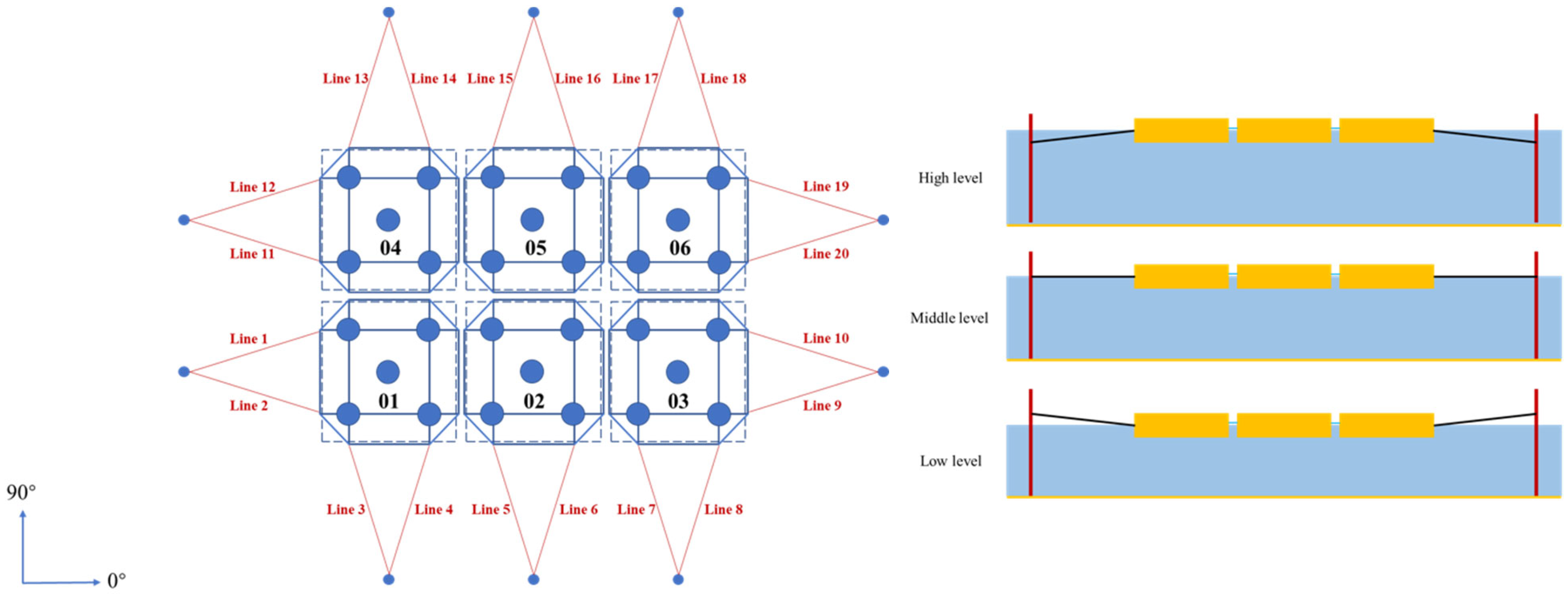
In this study, two different mooring systems are proposed. The first one is horizontal mooring system. Horizontal mooring cables are made of lightweight and high-strength polyester cables, with an initial length of 41.5 m. One end of the mooring line is connected to the main frame sub- structure of the FPV, and the other end is connected to the vertical pile foundation with the fixed constrained. The mooring line remains horizontal in the case of average water level. Therefore, the anchoring points of the system move from the seabed to the average water level. This improves the mooring system’s feasibility to withstand water level fluctuations to alleviate the influence of the tidal variation on the tension of mooring lines. The module number and mooring system are shown in Figure 4.
The main particulars of the polyester cable are listed in Table 3.
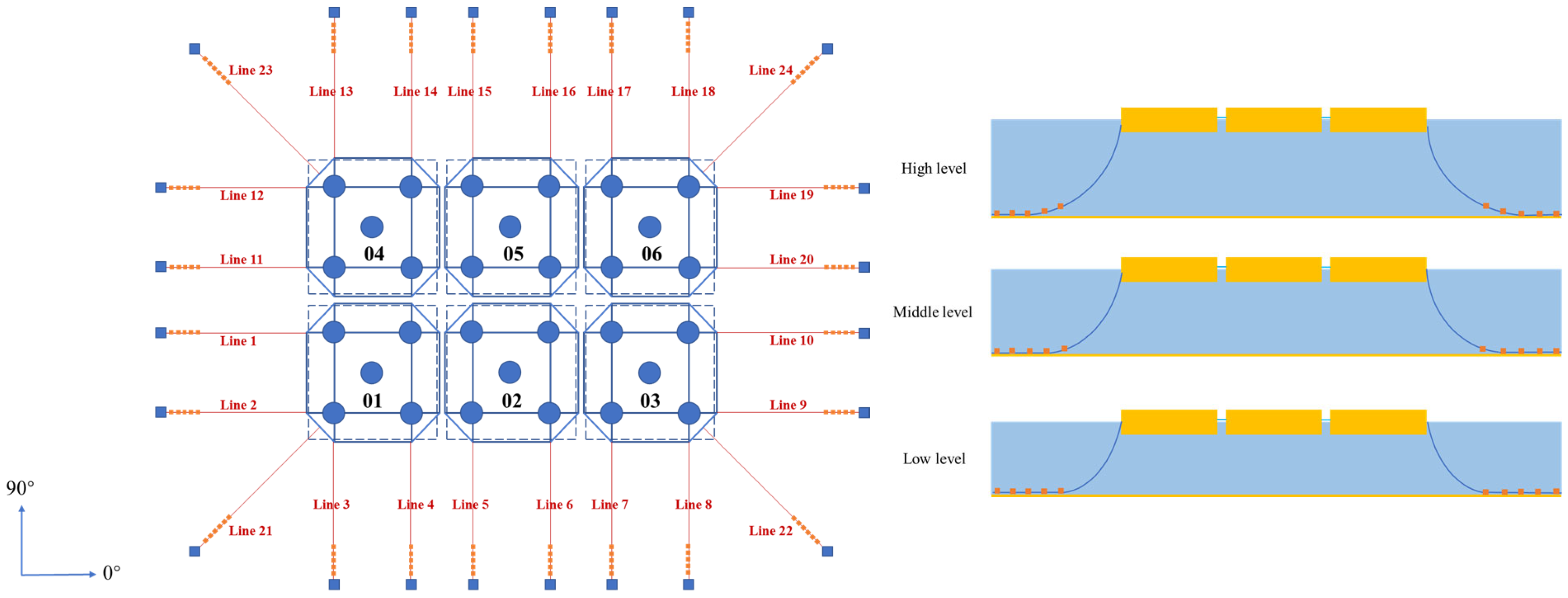
The second one is catenary mooring system with the clumps. The clumps are mounted on catenary mooring lines at appropriate positions to change the spatial configuration of the mooring lines in water. This ensures the mooring system has similar horizontal restoring characteristics in different water depths, and achieves similar positioning capabilities at different tidal levels.
To ensure that the mooring system can adapt more effectively to wind, wave, and current loads from different directions, it is equipped with chains of various length arranged in different directions. The main particulars of the chain are presented in Table 4 and Table 5, respectively. To ensure the mooring system with clumps can accommodate changes in tidal level, a series of clumps with intervals of 5.0 m are deployed in the middle and end of the catenary chain. The weight of a single clump is 1.0 ton. Six clumps are attached to the mooring lines deployed at the diagonal positions of the array, while five clumps are placed on the other mooring lines. It is worth noting that this study has previously analyzed mooring systems with different numbers of clumps (e.g., 4, 6, and 8 clumps). The current clump configuration is the outcome of optimization analysis, incorporating comprehensive considerations of mooring restraint effectiveness, water depth adaptability, and other relevant factors. Compared with arrangements with more or fewer clumps, the current clumps arrangement achieves stronger water depth adaptability. The mooring system and its layout are shown in Figure 5; the orange blocks represent clumps.

3.3.2. Connection Schemes

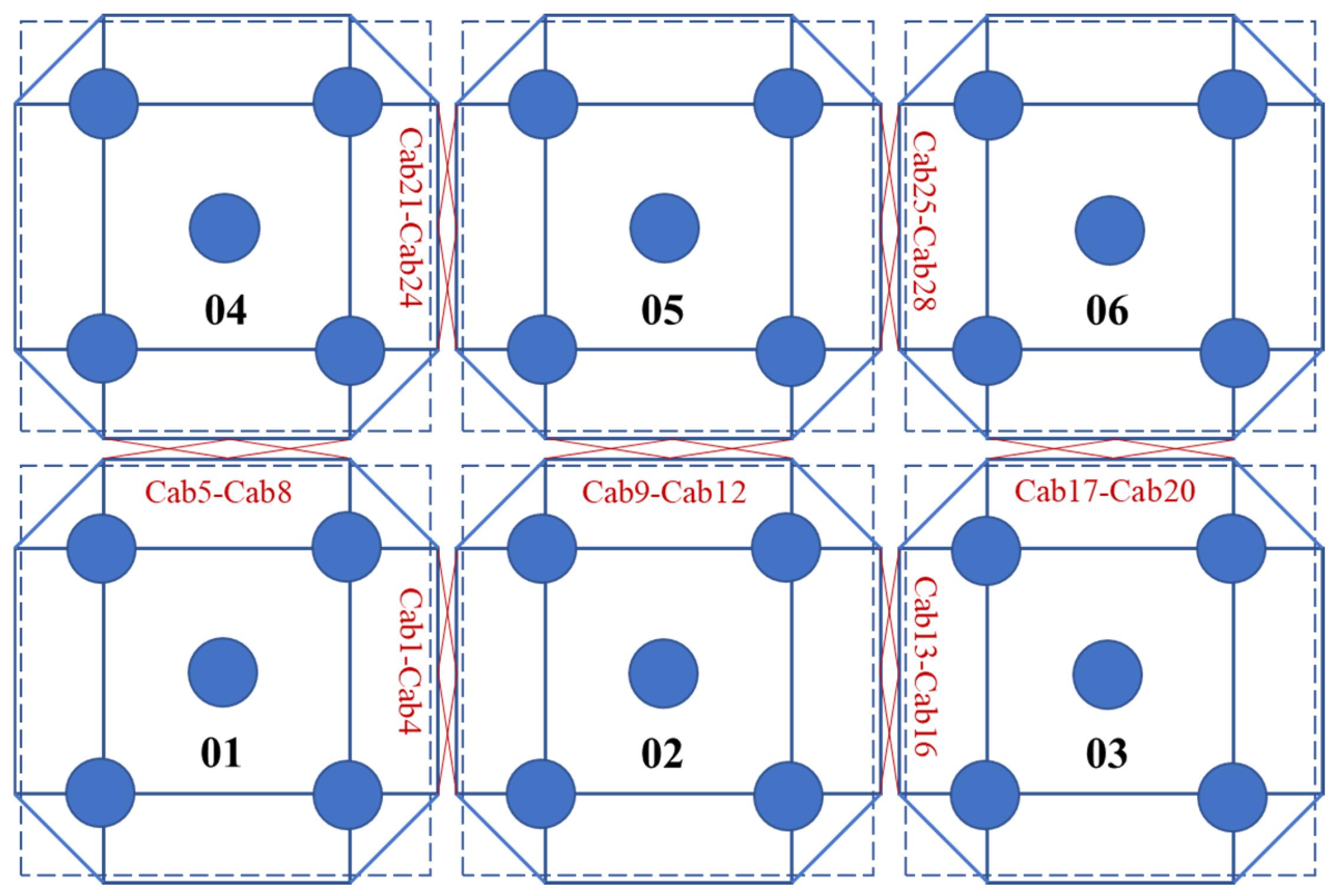
In this study, two different connection schemes are provided. The first one is the cross-cable connection scheme, as illustrated in Figure 6. It is referred to as cable connection scheme in the following text. In this scheme, two pairs of cables are deployed in the cross form for the two adjacent modules, where the initial length of the connection cables is much longer and can mitigate the abrupt tension of the connection. Furthermore, this configuration can restrict the yaw motion of the individual module and misalignment between adjacent modules effectively.
The connection cables are also the polyester rope with the original length of 8.80 m, and all of them remain in tensioned state for the static equilibrium conditions. The main particulars of the polyester cables are listed in Table 6.
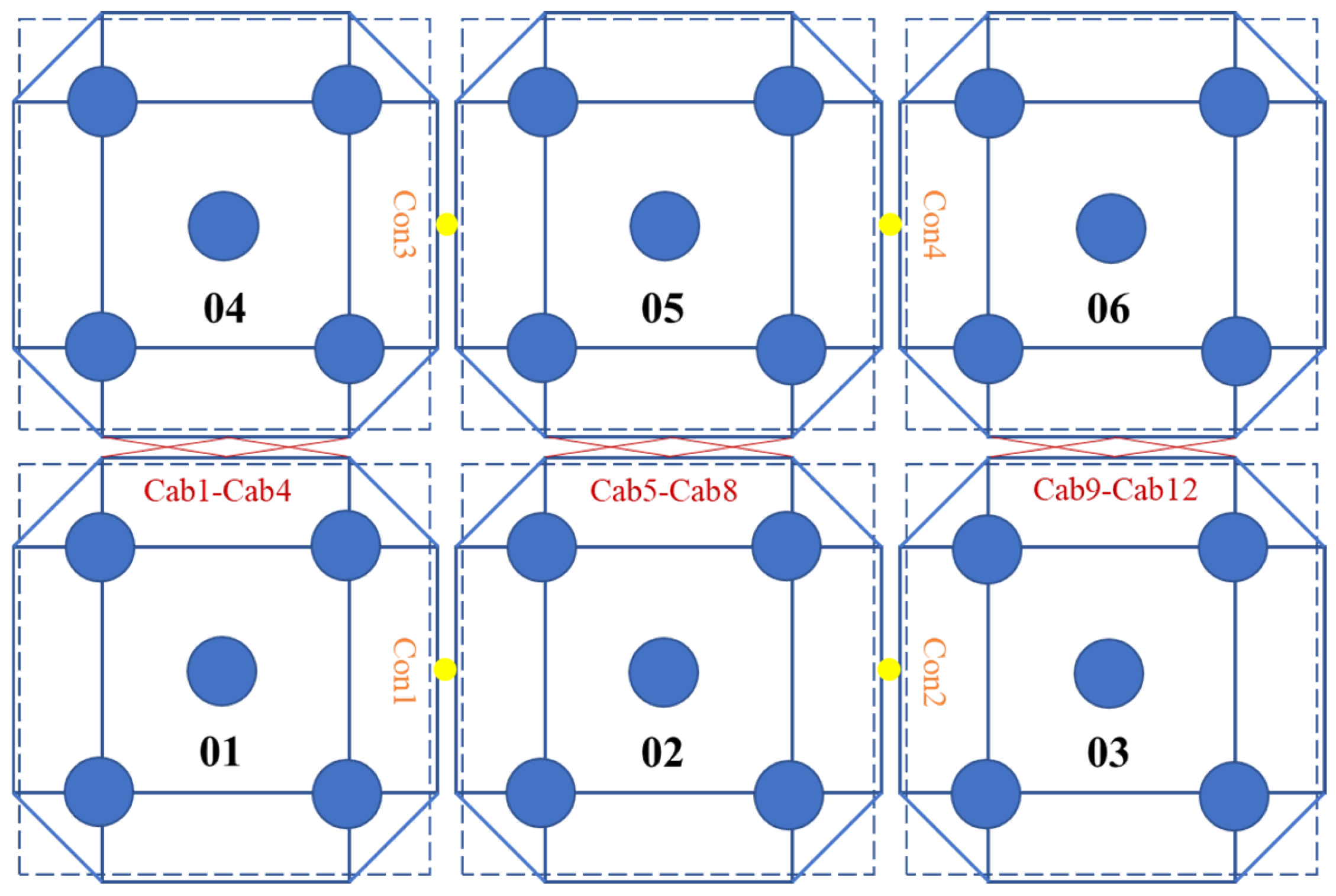
The second one is hybrid connection scheme. In the scheme, the connection cables are replaced with the ball joint, and the relative rotation between two modules connected by spherical hinges is released, while the relative translational movement is restricted. The spherical hinges are represented by yellow circles as shown in Figure 7. In the hybrid connection scheme, the cross-cables are adopted to restrict the yaw motion of the adjacent modules, and the spherical hinges are then added to reduce the misalignment response of these modules even further.
Assume that the ith module and the jth module are connected via a spherical joint. Let the coordinates of the joint point in the local coordinate system of the ith module be ( x c i , y c i , z c i ) , and in the local coordinate system of the jth module be ( x c j , y c j , z c j ) . The core constraint of a spherical joint is that the absolute translational displacements of the two floats at the joint point are equal (restricting 3 translational DoF):
ξ t i + R i ( x c i , y c i , z c i ) T = ξ t j + R j ( x c j , y c j , z c j ) T
where ξ t i = [ η 1 i , η 2 i , η 3 i ] T and ξ t j = [ η 1 j , η 2 j , η 3 j ] T are translational displacement vector of the ith module and the jth module. R i and R j are rotation matrix.

4. Results and Discussions

4.1. Analysis of Motion Response of FPV

This section systematically analyzes the influences of water levels, load cases, mooring systems, and connection schemes on the motion response of the FPV array. The three water depths for low, middle, and high water levels are 6 m, 8 m, and 10 m. The three load cases correspond to environmental loads with incident directions of 0°, 45°, and 90°, respectively.

4.1.1. The Influence of Different Water Levels on the Motion Response of FPV

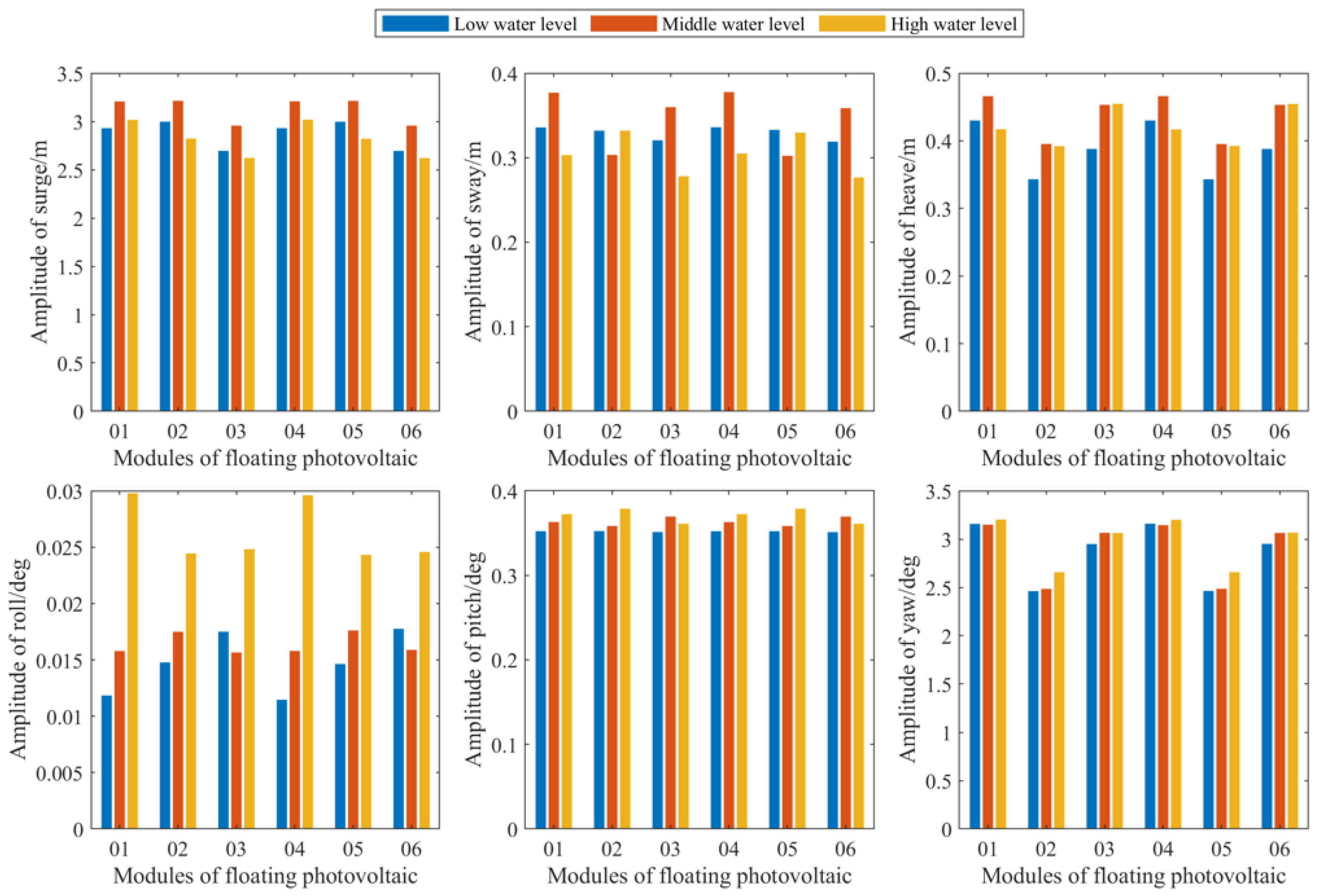
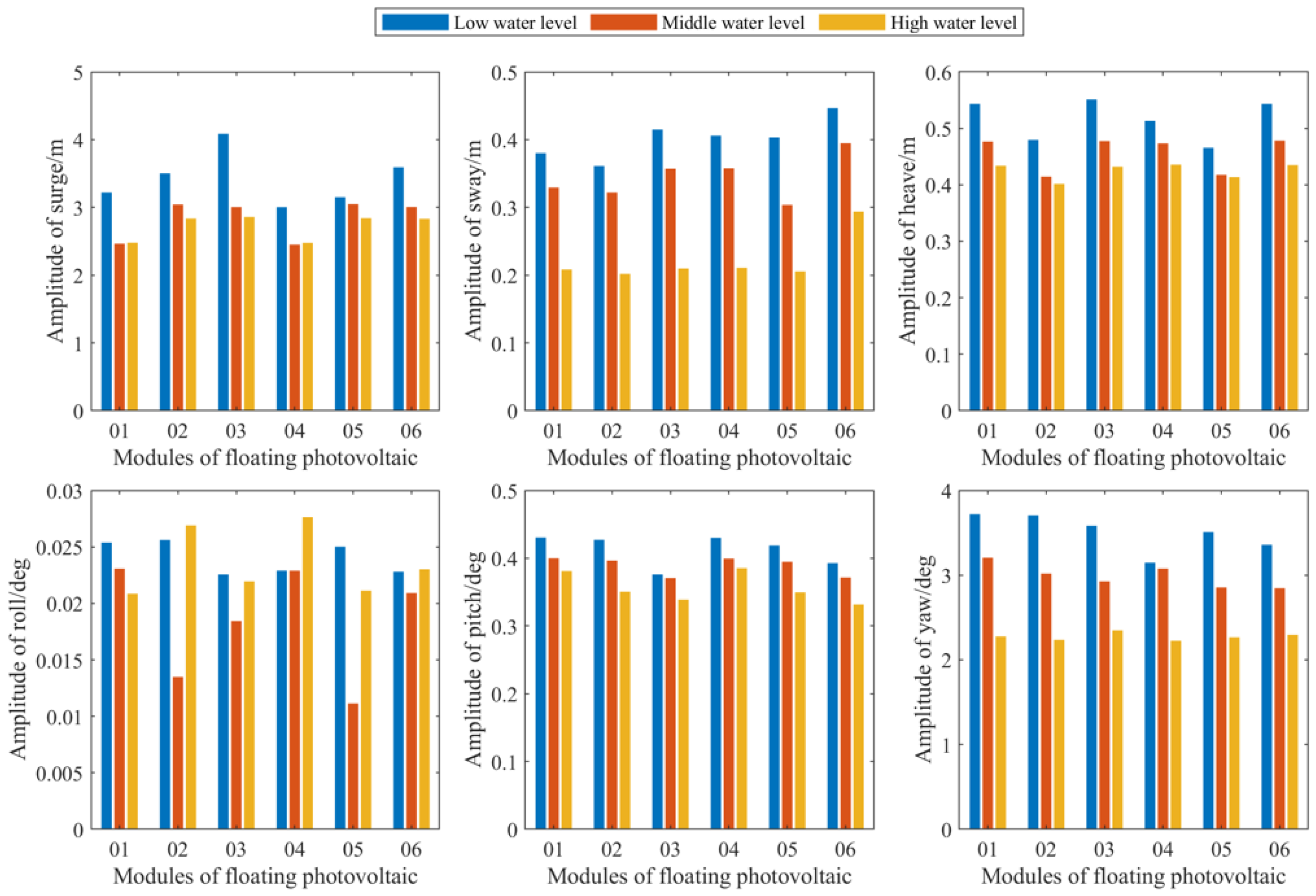
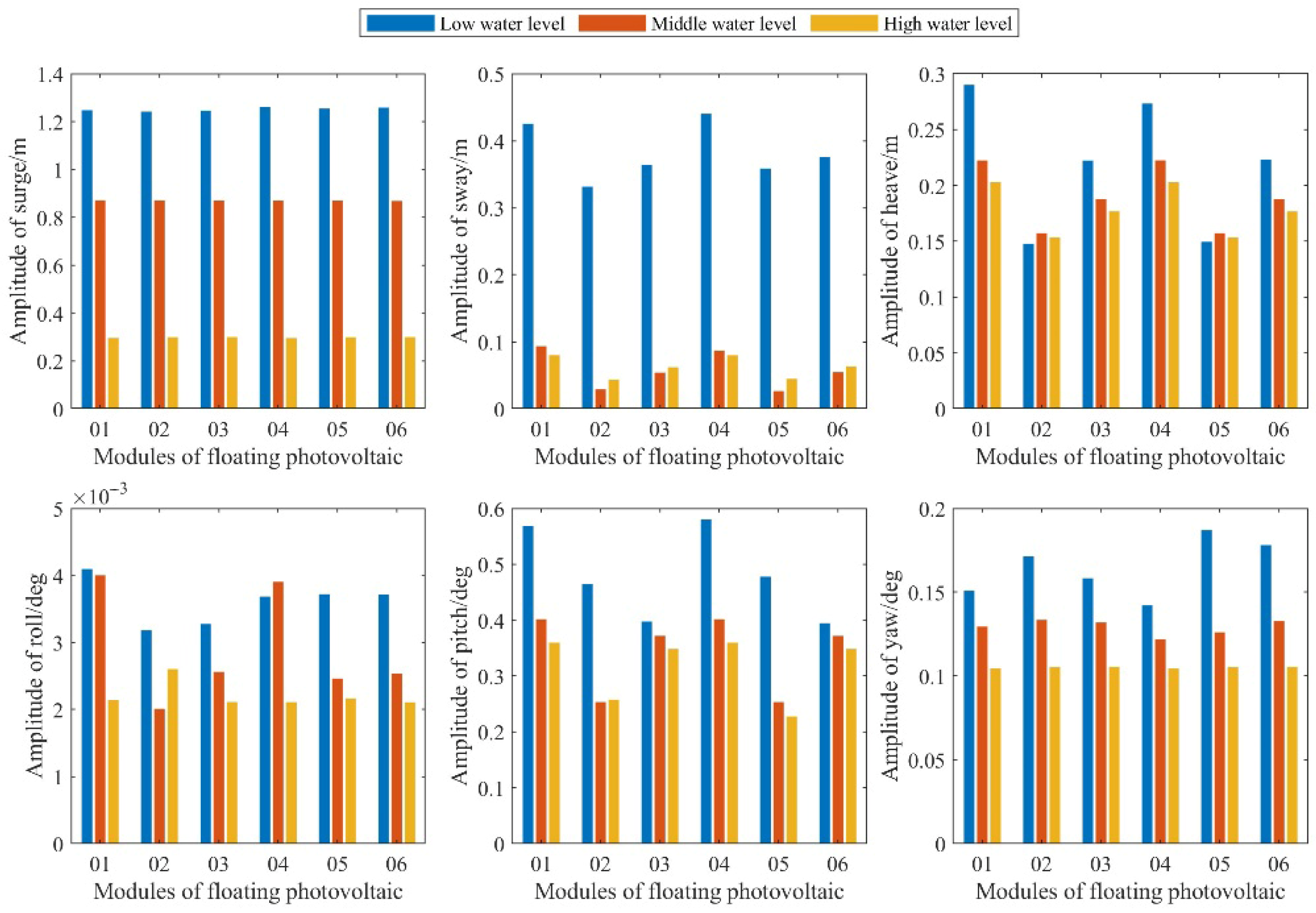
This subsection investigates the influence of different water levels on the motion responses of the array. A comparative analysis is conducted on the array’s motion amplitudes under the three mooring-connection schemes for the 0° load case, and the results are presented in Figure 8, Figure 9 and Figure 10. The water depths for low, middle, and high water levels are 6 m, 8 m, and 10 m, respectively, with the environmental conditions as shown in Table 2 above.
For the horizontal mooring–cable connection scheme, the surge, sway, and heave responses of the platform under the 0° load case exhibit a consistent pattern across different water levels: the motion amplitude at the middle water level is larger than those at the low and high water levels, as illustrated in Figure 8. Among these responses, the surge response is significantly greater than the sway and heave responses and is most prominently affected by water level changes. The surge amplitude at the high water level is 0.45 m smaller than that at the middle water level, representing a 14% reduction. This is because, when compared with the high and low water level conditions, the horizontal mooring lines have the shortest elongation and the lowest mooring stiffness at the middle water level. The roll, pitch, and yaw motions are minimally affected by water level variations. Specifically, the yaw amplitude at the high water level is 0.2° smaller than that at the middle water level, with an 8% reduction. Since the modules at the middle positions of the array (Module 02 and Module 05) are less constrained by the mooring cables, their heave and yaw motion amplitudes are smaller than those of other modules.
For the catenary mooring-cable connection scheme, the surge, sway, and heave response amplitudes of the platform under the 0° load case follow a similar trend across different water levels: the motion amplitude at the low water level is larger than that at the middle water level, which in turn is larger than that at the high water level, as shown in Figure 9. Among these responses, the surge response is significantly greater than the sway and heave responses and is most notably affected by water level changes. The surge amplitude at the high water level is 1.2 m smaller than that at the low water level, a 29% reduction. This is attributed to the constant mooring radius adopted in this study; as the water level rises, the pre-tension and mooring stiffness of the mooring system increase, resulting in stronger constraints on module motion. For the roll, pitch, and yaw motions, the platform’s motion response amplitudes decrease with increasing water level. The yaw response is the largest, with its amplitude at the high water level being 1.6° smaller than that at the low water level, a 42% reduction.
For the catenary mooring-hybrid connection scheme, the surge, sway, and heave response amplitudes of the platform under the 0° load case basically follow a consistent pattern across different water levels: the motion amplitude at the low water level is larger than that at the middle water level, which is larger than that at the high water level, as shown in Figure 10. Among these responses, the surge response is significantly greater than the sway and heave responses and is most obviously affected by water level changes. The surge amplitude at the high water level is 0.95 m smaller than that at the low water level, representing a 76% reduction. For the roll, pitch, and yaw motions, the platform’s motion response amplitudes decrease as the water level rises. The yaw response is the largest, with its amplitude at the high water level being 0.2° smaller than that at the low water level, a 36% reduction. Additionally, it can be observed that the sway amplitudes of the middle modules (Module 02 and Module 05) are significantly smaller than those of other modules. This is because the middle modules are connected to other modules via spherical hinges, which provide stronger constraints in the y-direction under the 0° load case.

4.1.2. The Influence of Different Load Cases on the Motion Response of FPV

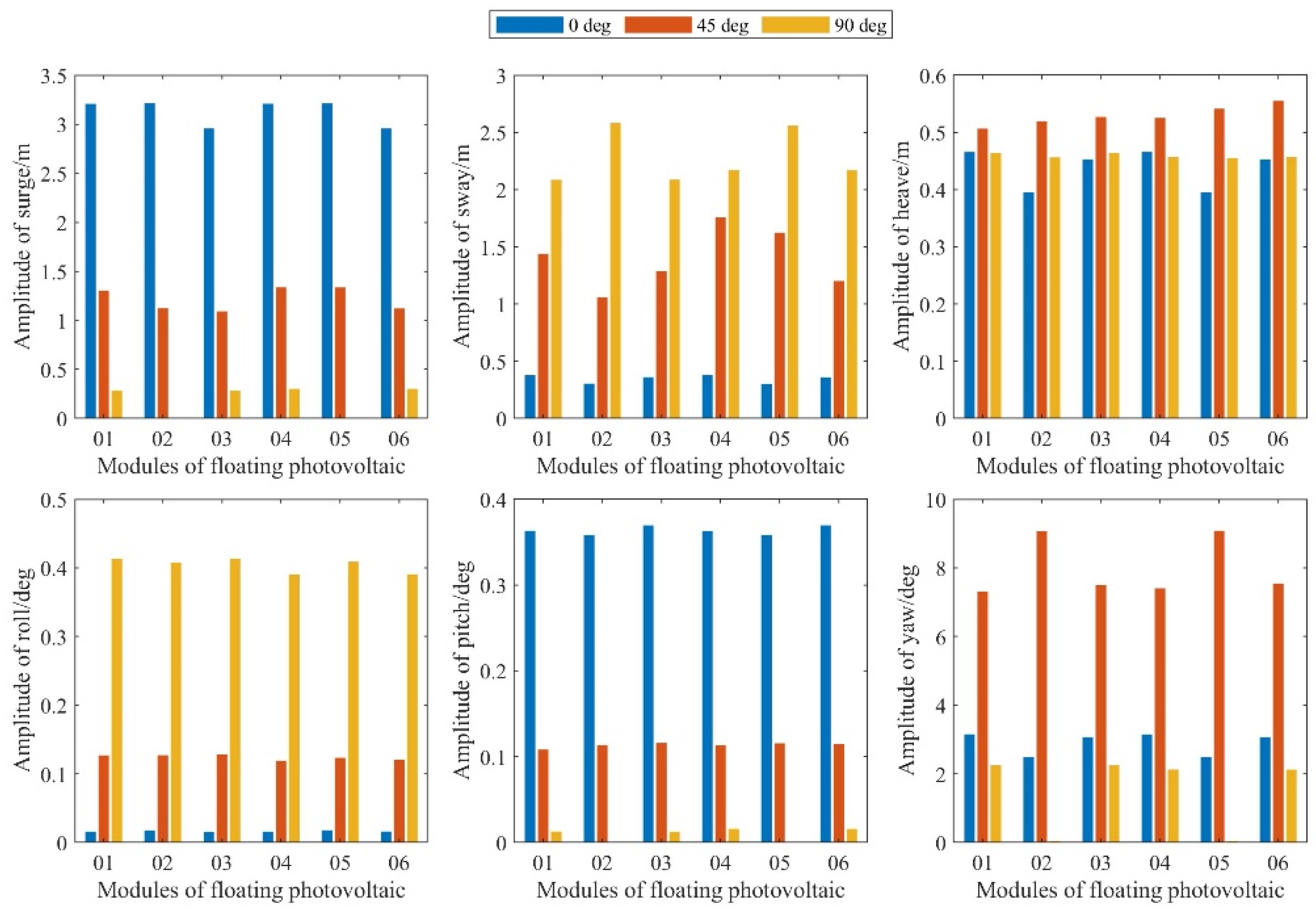
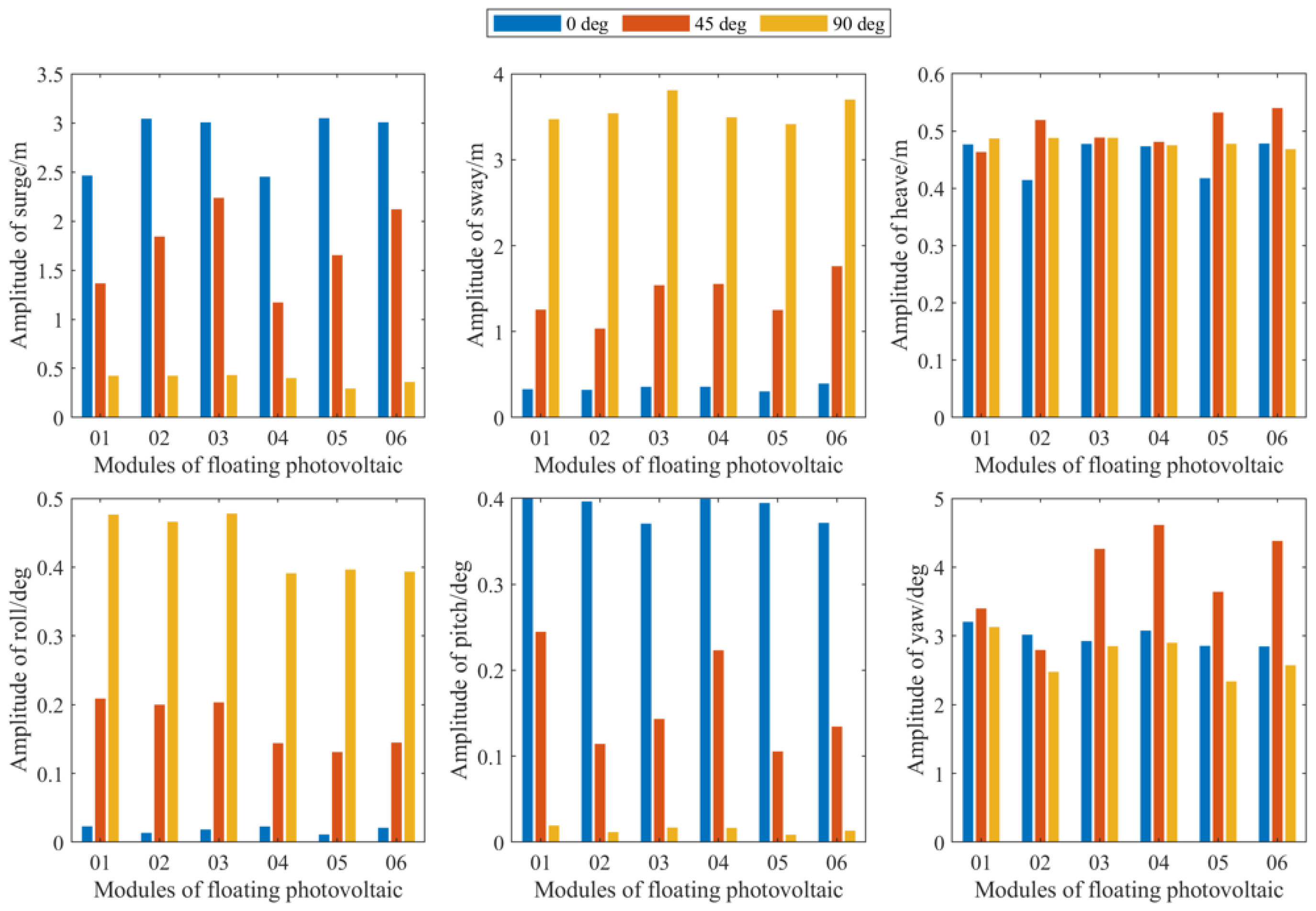
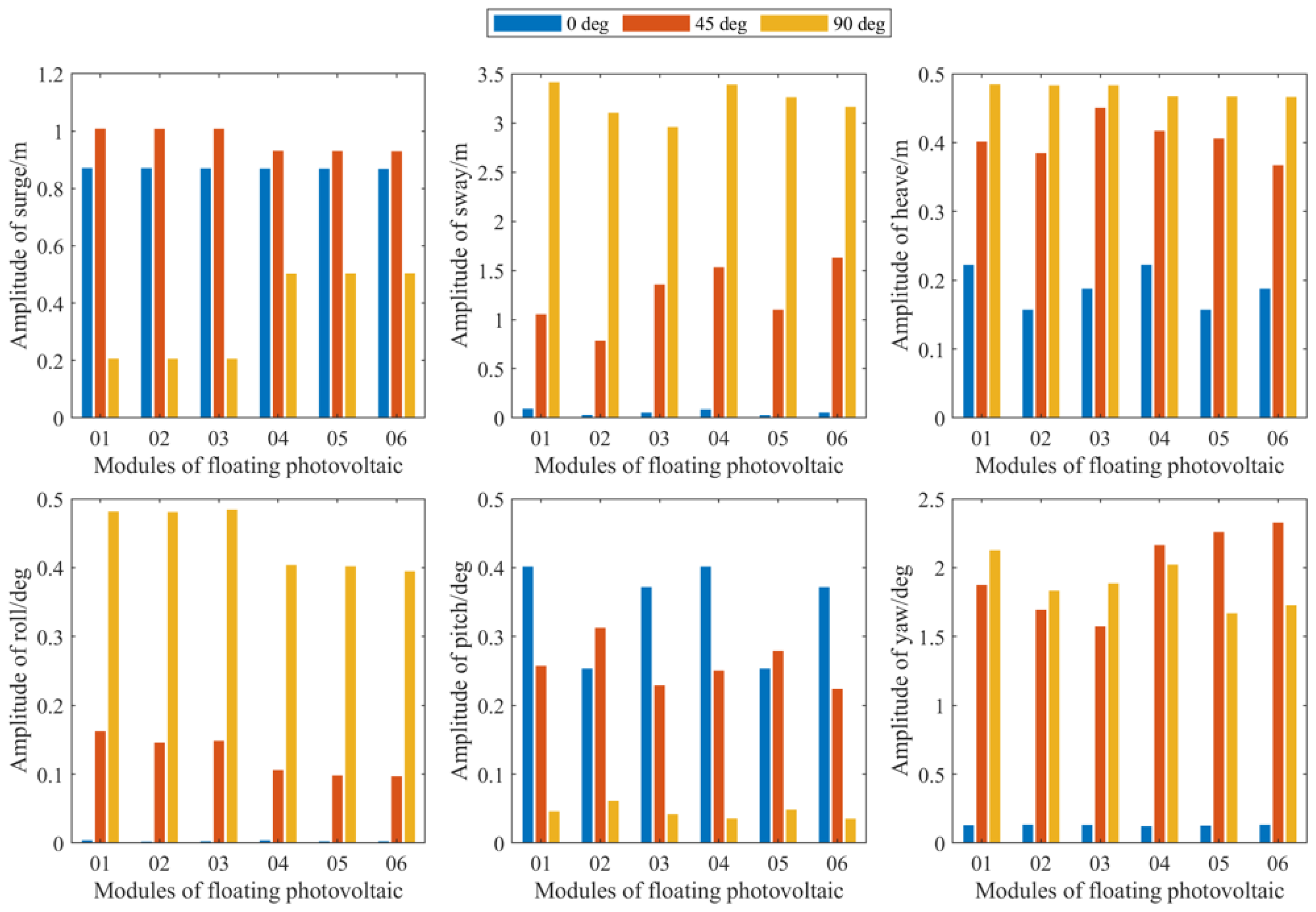
This subsection investigates the influence of different load cases on the motion responses of the array. A comparative analysis is conducted on the array’s motion amplitudes under the three mooring-connection schemes at the middle water level, and the results are presented in Figure 11, Figure 12 and Figure 13. The water depth is 8 m, the three load cases correspond to incident directions of 0°, 45°, and 90°, and the environmental conditions are as shown in Table 2 above.
The statistical results of the module motion responses for the horizontal mooring–cable connection scheme are shown in Figure 11. It can be observed from the figure that as the load case changes from 0° to 90°, the surge amplitude decreases gradually. The surge amplitude under the 90° load case is 3.18 m smaller than that under the 0° load case, representing a 98% reduction. In contrast, the sway amplitude increases gradually: the sway amplitude under the 0° load case is 2.3 m smaller than that under the 90° load case, an 88% reduction. This is because as the incident direction of environmental loads changes from 0° to 90°, the longitudinal component of the combined wind, wave, and current loads decreases gradually, while the transverse component increases gradually. The heave and yaw motion amplitudes are the largest when environmental loads act in the 45° direction. The heave amplitude under the 0° load case is 0.15 m smaller than that under the 45° load case, with a 27% reduction. The yaw amplitude under the 90° load case is 8.8° smaller than that under the 45° load case, a 98% reduction. The roll and pitch amplitudes are minimally affected by changes in load cases in terms of numerical values.
The statistical results of the module motion responses for the catenary mooring-cable connection scheme are shown in Figure 12. As the incident direction of environmental loads changes from 0° to 90°, the longitudinal component of the combined wind, wave, and current loads decreases gradually, while the transverse component increases gradually. Consequently, the surge amplitude decreases gradually; the surge amplitude under the 90° load case is 2.75 m smaller than that under the 0° load case, signifying a 92% reduction. In contrast, the sway amplitude increases gradually: the sway amplitude under the 0° load case is 3.5 m smaller than that under the 90° load case, signifying a 92% reduction. Heave is minimally affected by changes in load cases; the heave amplitude under the 0° load case is 0.05 m smaller than that under the 45° load case, representing a 9% reduction. The yaw motion amplitude is the largest when environmental loads act in the 45° direction: the yaw amplitude under the 90° load case is 4.4° smaller than that under the 45° load case, representing a 94% reduction.
The statistical values of the module motion response amplitudes for the catenary mooring-hybrid connection scheme are shown in Figure 13. As the incident direction of the combined wind, wave, and current loads changes from 0° to 90°, the surge motion amplitude first increases and then decreases. The surge amplitude under the 90° load case is 0.8 m smaller than that under the 45° load case, representing an 80% reduction. This is because under the 0° load case, the connectors exert the maximum constraint on the surge motion of the modules, while under the 90° load case, environmental loads have no component in the surge direction. Therefore, the array’s surge amplitude is the largest under the 45° load case. The sway and heave motion amplitudes increase gradually. The sway amplitude under the 0° load case is 3.3 m smaller than that under the 90° load case, signifying a 97% reduction. The heave amplitude under the 0° load case is 0.34 m smaller than that under the 90° load case, representing a 69% reduction. The roll and yaw amplitudes show little numerical difference. Yaw does not follow an obvious trend with changes in load cases: the yaw amplitude under the 0° load case is 1.8° smaller than that under the 45° load case, representing a 39% reduction.

4.1.3. The Influence of Mooring Systems and Connection Schemes on the Motion Response of FPV

This subsection compares the horizontal mooring-cable connection scheme with the catenary mooring-cable connection scheme, and the catenary mooring-cable connection scheme with the catenary mooring-hybrid connection scheme, respectively. From the perspective of the platform’s motion responses, it analyzes the feasibility of different mooring systems and connection schemes to changes in water level and load cases, so as to determine the suitable mooring system and connection scheme for the FPV array. It is worth noting that feasibility is evaluated through relative comparison rather than based on absolute design limits.
Comparison of mooring systems: Under the same water level and load case conditions, the sway amplitude of the horizontal mooring system is 32% smaller than that of the catenary mooring system, while its yaw amplitude is twice that of the catenary mooring system. The differences in motion amplitudes between the two systems in other degrees of freedom are relatively small. Regarding the influence of water level, compared with the horizontal mooring system, the response amplitude of the catenary mooring system is more sensitive to water level changes. The variation in the surge amplitude of the catenary mooring system caused by different water levels can reach 29%, while that of the horizontal mooring system is only 14%. The variation in the yaw amplitude of the catenary mooring system under different water levels reaches 42%, which is also larger than the 8% variation in the horizontal mooring system. From the perspective of load case changes, as the load case changes from 0° to 90°, both mooring systems exhibit a trend of decreasing surge amplitude and increasing sway amplitude, with the yaw amplitude being the largest under the 45° load case. The variations in surge and sway amplitudes of the two mooring systems with load case changes are similar, but the yaw amplitude of the horizontal mooring system changes by 98% with load cases, which is significantly larger than the 39% variation in the catenary mooring system. In addition, the variation in the heave amplitude of the horizontal mooring system caused by load case changes can reach 27%, while that of the catenary mooring system is only 9%.
Comparison of connection schemes: Under the same water level and load case conditions, the surge and yaw amplitudes of the cable connection scheme are 2.8 times and 1.9 times those of the hybrid connection scheme, respectively. The differences in motion amplitudes between the two schemes in other degrees of freedom are relatively small. Regarding the influence of water level, the surge, sway, and heave amplitudes of both connection schemes follow the trend of “low water level > middle water level > high water level”. However, the variation in the surge amplitude of the hybrid connection scheme affected by water level changes reaches 76%, which is significantly larger than the 29% variation in the cable connection scheme. The variation in the yaw amplitude of the hybrid connection scheme under different water levels is 36%, slightly smaller than the 42% variation in the cable connection scheme. From the perspective of load case changes, the surge amplitude of the hybrid connection scheme varies by 80% with load case changes, slightly smaller than the 92% variation in the cable connection scheme; the heave amplitude of the hybrid connection scheme differs by 69% under different load cases, while that of the cable connection scheme is only 9%. The differences in motion amplitudes of other degrees of freedom under different load cases are relatively small.
Overall, in terms of motion responses, neither of the two mooring systems shows obvious advantages in reducing motion amplitude. The percentage variation in motion amplitude of the horizontal mooring system under different water levels is smaller, while that of the catenary mooring system under different load cases is smaller. This indicates that the horizontal mooring system has stronger feasibility to water level changes, and the catenary mooring system has stronger feasibility to changes in the direction of environmental loads. The overall motion amplitude of the hybrid connection scheme is smaller than that of the cable connection scheme, but the percentage variations under different water levels and load cases are slightly larger than those of the cable connection scheme. This shows that the hybrid connection scheme can reduce the overall motion amplitude of the array, while the cable connection scheme has stronger feasibility to changes in water level and the direction of environmental loads.

4.2. Analysis of Mooring Tension of FPV

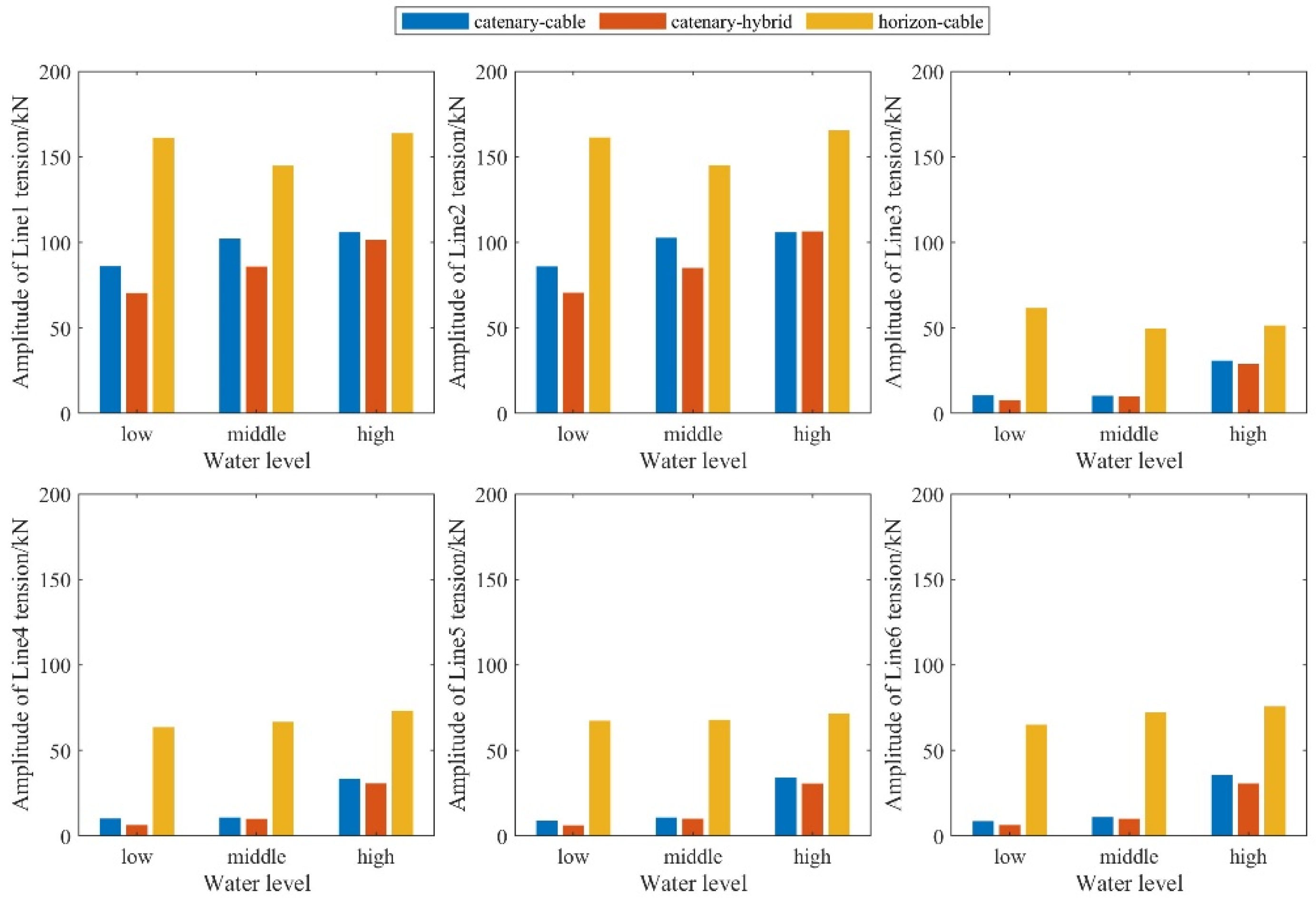
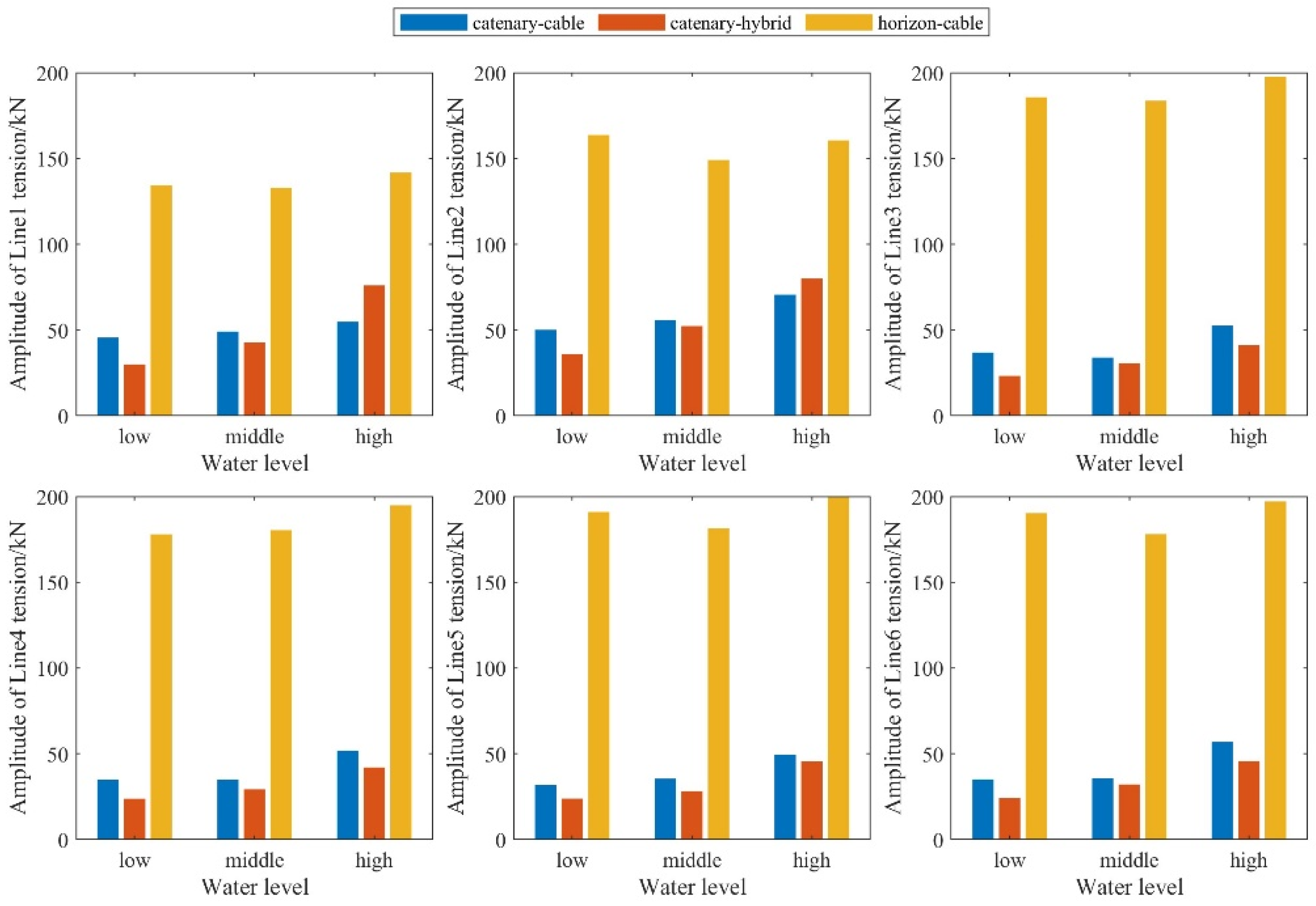
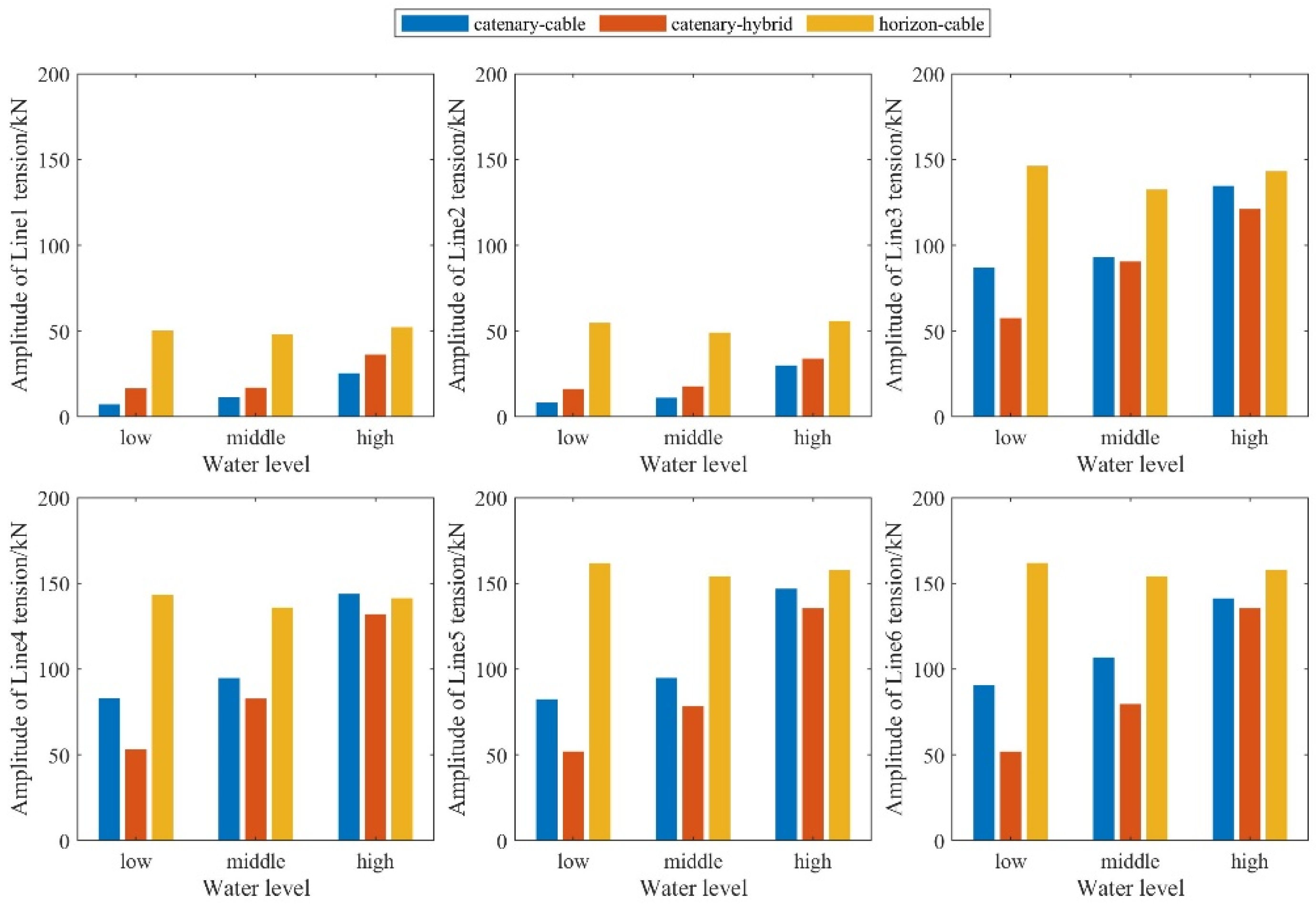
Section 4.1 analyzes the influences of water levels, load cases, mooring systems, and connection schemes on the array from the perspective of motion amplitude. To systematically investigate the influence of water levels, environmental load directions, mooring systems and connection schemes on the mooring tensions of FPV, this section extracts representative mooring tension results from three mooring-connection schemes for comparative analysis. Line 1-Line 6 from different mooring-connection schemes are selected as representative for analysis, as shown in Figure 14, Figure 15 and Figure 16.

4.2.1. The Influence of Different Water Levels on the Mooring Tension of FPV

This subsection investigates the influence of different water levels on the mooring tensions of the array and conducts a comparative analysis of the maximum mooring tensions of the three mooring-connection schemes under the 0° load case. The water depths for low, middle, and high water levels are 6 m, 8 m, and 10 m, respectively, with the environmental conditions as shown in Table 2 above.
For the horizontal mooring-cable connection scheme, the mooring tension is the smallest at the middle water level. For the mooring lines of the horizontal mooring system, the elongation is the smallest at the middle water level, resulting in the minimum pre-tension and mooring stiffness. Under the 0° load case, the maximum mooring tension at the middle water level is 32 kN smaller than that at the high water level, representing an 18% reduction. Under the 45° load case, the maximum mooring tension at the middle water level is 26 kN smaller than that at the high water level, with a 13% reduction. Under the 90° load case, the maximum mooring tension at the middle water level is 9 kN smaller than that at the low water level, representing a 6% reduction.
For the catenary mooring-cable connection scheme, the mooring tension increases significantly as the water level rises, with the smallest mooring tension observed at the low water level. This is because, for the catenary mooring system, the suspended segment of the mooring line is longer at higher water levels, leading to the maximum mooring pre-tension and mooring stiffness; thus, the mooring tension is more sensitive to changes in module motion. Under the 0° load case, the maximum mooring tension at the low water level is 19 kN smaller than that at the high water level, representing an 18% reduction. Under the 45° load case, the maximum mooring tension at the low water level is 23 kN smaller than that at the high water level, with a 29% reduction. Under the 90° load case, the maximum mooring tension at the low water level is 72 kN smaller than that at the high water level, showing a 47% reduction.
For the catenary mooring-hybrid connection scheme, the mooring tension increases significantly as the water level rises, and the mooring tension is the smallest at the low water level. Under the 0° load case, the maximum mooring tension at the low water level is 31 kN smaller than that at the high water level, representing a 29% reduction. Under the 45° load case, the maximum mooring tension at the low water level is 45 kN smaller than that at the high water level, with a 60% reduction. Under the 90° load case, the maximum mooring tension at the low water level is 82 kN smaller than that at the high water level, showing a 62% reduction.

4.2.2. The Influence of Different Load Cases on the Mooring Tension of FPV

This subsection investigates the influence of different load cases on the mooring tensions of the array and conducts a comparative analysis of the maximum mooring tensions of the three mooring-connection schemes at the middle water level. The water depth is 8 m, the three load cases correspond to incident directions of 0°, 45°, and 90°, and the environmental conditions are as shown in Table 2 above.
For the horizontal mooring-cable connection scheme, as the load case changes from 0° to 90°, the maximum mooring tension exhibits a trend of first increasing and then decreasing. At the low water level, the maximum mooring tension under the 0° load case is 31 kN smaller than that under the 45° load case, representing an 18% reduction. At the middle water level, the maximum mooring tension under the 0° load case is 33 kN smaller than that under the 45° load case, with a 19% reduction. At the high water level, the maximum mooring tension under the 90° load case is 50 kN smaller than that under the 45° load case, showing a 25% reduction.
For the catenary mooring-cable connection scheme, the mooring tension is the smallest under the 45° load case. At the low water level, the maximum mooring tension under the 45° load case is 36 kN smaller than that under the 0° load case, representing a 44% reduction. At the middle water level, the maximum mooring tension under the 45° load case is 55 kN smaller than that under the 0° load case, with a 50% reduction. At the high water level, the maximum mooring tension under the 45° load case is 74 kN smaller than that under the 90° load case, showing a 47% reduction.
For the catenary mooring-hybrid connection scheme, the mooring tension is the smallest under the 45° load case. At the low water level, the maximum mooring tension under the 45° load case is 45 kN smaller than that under the 0° load case, representing a 60% reduction. At the middle water level, the maximum mooring tension under the 45° load case is 37 kN smaller than that under the 90° load case, with a 44% reduction. At the high water level, the maximum mooring tension under the 45° load case is 54 kN smaller than that under the 90° load case, representing a 42% reduction.

4.2.3. The Influence of Mooring Systems and Connection Schemes on the Mooring Tension of FPV

This subsection compares the horizontal mooring-cable connection scheme with the catenary mooring-cable connection scheme, and the catenary mooring-cable connection scheme with the catenary mooring-hybrid connection scheme, respectively. From the perspective of mooring tension, it analyzes the feasibility of different mooring systems and connection schemes to changes in water level and load cases.
Comparison of mooring systems: The maximum mooring tension of the horizontal mooring system is approximately 2 to 4 times that of the catenary mooring system, varying with water level and load case. Regarding the influence of water level, the average variation in mooring tension of the horizontal mooring system under different water levels is 12%, which is significantly smaller than the 31% variation in the catenary mooring system. From the perspective of load case changes, the average variation in mooring tension of the horizontal mooring system under different load cases is 25%, which is significantly smaller than the 47% variation in the catenary mooring system.
Comparison of connection schemes: In most cases, the maximum mooring tension of the cable connection scheme is greater than that of the hybrid connection scheme, but does not exceed 1.6 times that of the hybrid connection scheme. Regarding the influence of water level, the average variation in mooring tension of the cable connection scheme under different water levels is 31%, which is significantly smaller than the 50% variation in the hybrid connection scheme. From the perspective of load case changes, the average variation in mooring tension of the cable connection scheme under different load cases is 47%, slightly smaller than the 49% variation in the hybrid connection scheme.
Overall, in terms of mooring tension, the mooring tension of the horizontal mooring system is generally greater than that of the catenary mooring system, while the percentage variation in mooring tension under different water levels and load cases is smaller than that of the catenary mooring system. This indicates that the horizontal mooring system has stronger feasibility to changes in water level and the direction of environmental loads, but also imposes greater structural forces on the platform. The mooring tension of the cable connection scheme is greater than that of the hybrid connection scheme, while the percentage variation in mooring tension under different water levels and load cases is slightly smaller than that of the hybrid connection scheme. This shows that the cable connection scheme has stronger feasibility to changes in water level and the direction of environmental loads.

4.3. Analysis of Connection Force of FPV

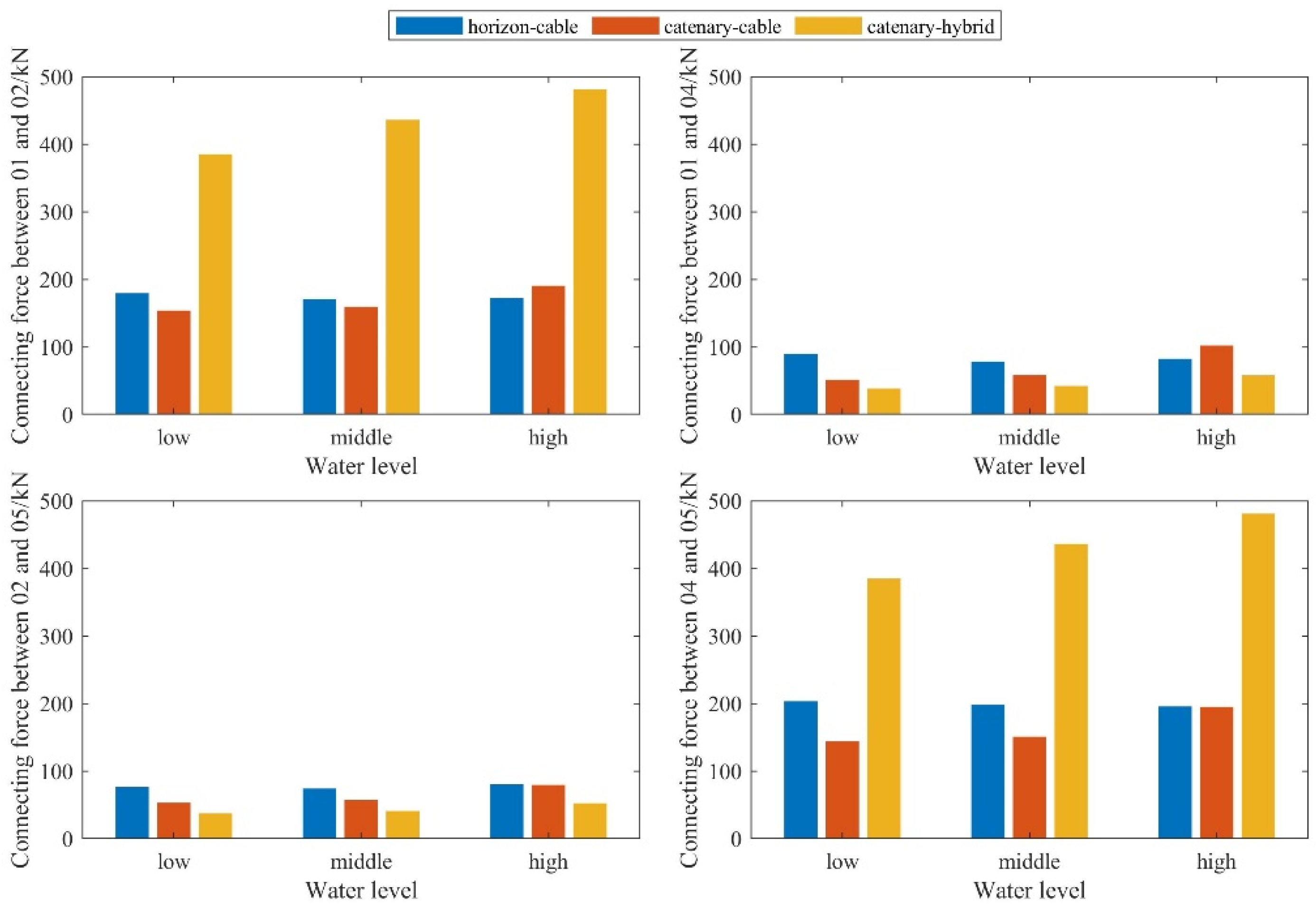
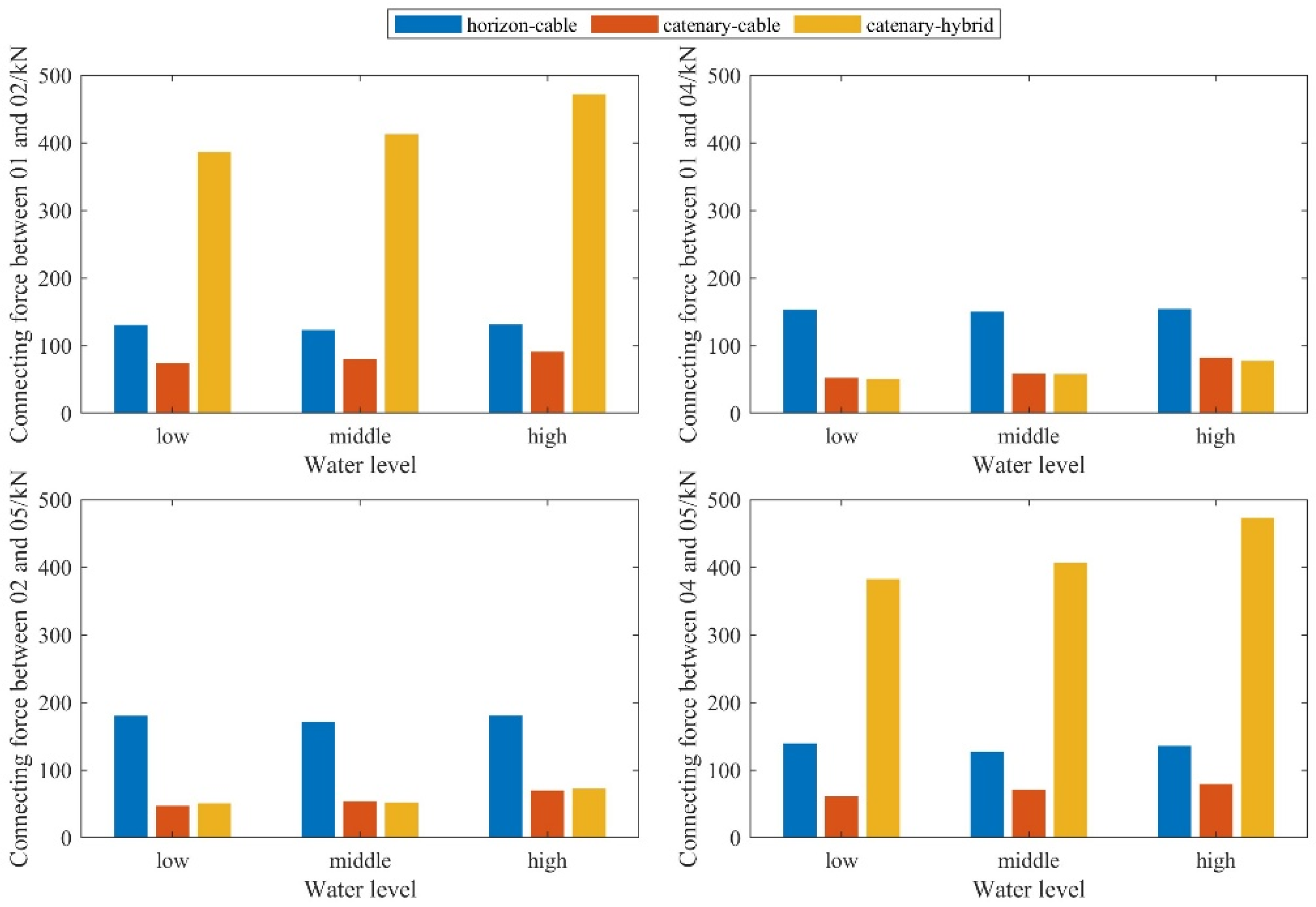
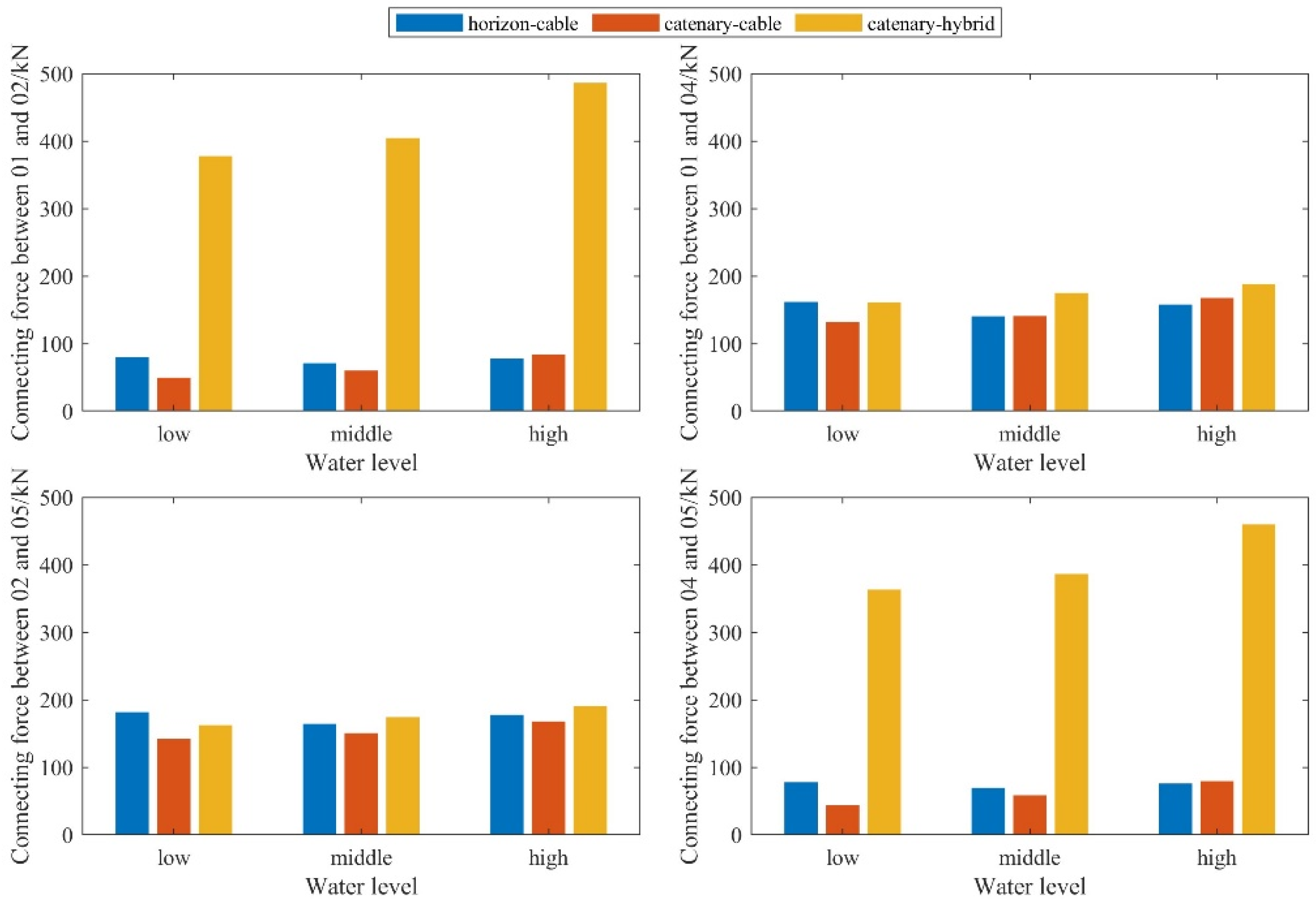
This section systematically analyzes the influence of water levels, environmental load directions, mooring systems and connection schemes on the connection forces of FPV. Connection forces at several selected positions are analyzed as representatives, including the connection cable or spherical hinge connector between Module 01 and Module 02, the connection cable between Module 01 and Module 04, the connection cable between Module 02 and Module 05, and the connection cable or spherical hinge connector between Module 04 and Module 05. Comparisons of the maximum connection forces at each position are shown in Figure 17, Figure 18 and Figure 19.

4.3.1. The Influence of Different Water Levels on the Connection Force of FPV

This subsection investigates the influence of different water levels on the connection forces of the array and conducts a comparative analysis of the maximum connection forces of the three mooring-connection schemes under the 0° load case. The water depths for low, middle, and high water levels are 6 m, 8 m, and 10 m, respectively, with the environmental conditions as shown in Table 2 above.
For the horizontal mooring-cable connection scheme, water level changes do not cause significant variations in the connection forces. Under the 0° load case, the maximum tension of the connection cables at the middle water level is 2 kN smaller than that at the high water level, with a 1% reduction. Under the 45° load case, the maximum tension of the connection cables at the middle water level is 8 kN smaller than that at the high water level, with a 5% reduction. Under the 90° load case, the maximum tension of the connection cables at the middle water level is 17 kN smaller than that at the low water level, with an 8% reduction.
For the catenary mooring-cable connection scheme, the tension of the connection cables increases slightly as the water level rises, with the smallest tension observed at the low water level. Under the 0° load case, the maximum tension of the connection cables at the low water level is 71 kN smaller than that at the high water level, with a 35% reduction. Under the 45° load case, the maximum tension of the connection cables at the low water level is 26 kN smaller than that at the high water level, with a 25% reduction. Under the 90° load case, the maximum tension of the connection cables at the low water level is 51 kN smaller than that at the high water level, with a 30% reduction.
For the catenary mooring-hybrid connection scheme, the spherical hinge connection forces increase significantly as the water level rises, and the tension of the connection cables also increases, and both are smallest at the low water level. Under the 0° load case, the maximum spherical hinge connection force at the low water level is 107 kN smaller than that at the high water level, with a 21% reduction; the maximum tension of the connection cables at the low water level is 24 kN smaller than that at the high water level, with a 50% reduction. Under the 45° load case, the maximum spherical hinge connection force at the low water level is 76 kN smaller than that at the high water level, with a 16% reduction; the maximum tension of the connection cables at the low water level is 38 kN smaller than that at the high water level, with a 47% reduction. Under the 90° load case, the maximum spherical hinge connection force at the low water level is 106 kN smaller than that at the high water level, with a 21% reduction; the maximum tension of the connection cables at the low water level is 23 kN smaller than that at the high water level, with an 11% reduction.

4.3.2. The Influence of Different Load Cases on the Connection Force of FPV

This subsection investigates the influence of different load cases on the connection forces of the array and conducts a comparative analysis of the maximum connection forces of the three mooring-connection schemes at the middle water level. The water depth is 8 m, the three load cases correspond to incident directions of 0°, 45°, and 90°, and the environmental conditions are as shown in Table 2 above.
For the horizontal mooring-cable connection scheme, the tension of the connection cables is the smallest under the 90° load case. At the low water level, the maximum tension of the connection cables under the 90° load case is 20 kN smaller than that under the 0° load case, with a 10% reduction. At the middle water level, the maximum tension of the connection cables under the 90° load case is 39 kN smaller than that under the 0° load case, with a 21% reduction. At the high water level, the maximum tension of the connection cables under the 90° load case is 22 kN smaller than that under the 45° load case, with a 12% reduction.
For the catenary mooring-cable connection scheme, as the load case changes from 0° to 90°, the tension of the connection cables exhibits a trend of first decreasing and then increasing, with the smallest value observed under the 45° load case. At the low water level, the maximum tension of the connection cables under the 45° load case is 104 kN smaller than that under the 0° load case, with a 60% reduction. At the middle water level, the maximum tension of the connection cables under the 45° load case is 92 kN smaller than that under the 0° load case, with a 53% reduction. At the high water level, the maximum tension of the connection cables under the 45° load case is 109 kN smaller than that under the 0° load case, with a 55% reduction.
For the catenary mooring-hybrid connection scheme, the spherical hinge connection force is the smallest under the 45° load case, while the tension of the connection cables increases gradually as the load case changes from 0° to 90°. This is because the positional relationship between the modules connected by the connection cables is aligned with the incident direction of the 90° load case. At the low water level, the maximum spherical hinge connection force under the 45° load case is 20 kN smaller than that under the 0° load case, with a 5% reduction; the maximum tension of the connection cables under the 0° load case is 134 kN smaller than that under the 90° load case, with an 80% reduction. At the middle water level, the maximum spherical hinge connection force under the 45° load case is 31 kN smaller than that under the 0° load case, with a 7% reduction; the maximum tension of the connection cables under the 0° load case is 146 kN smaller than that under the 90° load case, with a 78% reduction. At the high water level, the maximum spherical hinge connection force under the 45° load case is 19 kN smaller than that under the 90° load case, with a 4% reduction; the maximum tension of the connection cables under the 0° load case is 150 kN smaller than that under the 90° load case, with a 75% reduction.

4.3.3. The Influence of Mooring Systems and Connection Schemes on the Connection Force of FPV

This subsection compares the horizontal mooring-cable connection scheme with the catenary mooring-cable connection scheme, and the catenary mooring-cable connection scheme with the catenary mooring-hybrid connection scheme, respectively. From the perspective of connection forces, it analyzes the feasibility of different mooring systems and connection schemes to changes in water level and load cases.
Comparison of mooring systems: In most cases, the connection cable tension of the horizontal mooring system is greater than that of the catenary mooring system, but does not exceed 2.3 times that of the catenary mooring system, varying with water level and load case. Regarding the influence of water level, the average variation in connection cable tension of the horizontal mooring system under different water levels is 4.7%, which is significantly smaller than the 30% variation in the catenary mooring system. From the perspective of load case changes, the average variation in connection cable tension of the horizontal mooring system under different load cases is 14%, which is significantly smaller than the 56% variation in the catenary mooring system.
Comparison of connection schemes: The connection cable tension of the cable connection scheme is numerically similar to that of the hybrid connection scheme, but the spherical hinge connection force of the hybrid connection scheme is approximately 500 kN—about 300 kN higher than the maximum tension of all connection cables. Regarding the influence of water level, the average variation in connection cable tension of the cable connection scheme under different water levels is 30%; for the hybrid connection scheme, the variation in spherical hinge connection force is 19% and the variation in connection cable tension is 36%. From the perspective of load case changes, the average variation in connection cable tension of the cable connection scheme under different load cases is 56%; for the hybrid connection scheme, the variation in spherical hinge connection force is 5.3% and the variation in connection cable tension is 78%.
Overall, in terms of connection forces, the connection forces of the horizontal mooring system are generally greater than those of the catenary mooring system, while the percentage variation in connection forces under different water levels and load cases is smaller than that of the catenary mooring system. This indicates that the horizontal mooring system has stronger feasibility to changes in water level and the direction of environmental loads, but also imposes greater structural forces on the platform. The percentage variation in connection cable tension of the cable connection scheme under different water levels and load cases is smaller than that of the hybrid connection scheme, which shows that the cable connection scheme has stronger feasibility to changes in water level and the direction of environmental loads. Meanwhile, the spherical hinge connection force in the hybrid connection scheme is much greater than the connection cable tension in the cable connection scheme, which poses a significant threat to the structural safety of the platform.
By consolidating the dynamic response results of all mooring systems and connection schemes under different water levels and load cases, the comparison of mooring systems and connection schemes is presented in Table 7.

5. Conclusions

This paper designs two mooring systems and two connection schemes for FPV arrays operating in shallow waters with large tidal range variations, and analyzes the performance of different mooring systems and connection schemes through time-domain analysis. Considering that FPV modules are typically lightweight structures and cannot withstand excessive mooring forces and connection forces, and that excessive motion amplitudes of modules in the array may lead to green water on the platform surface, resulting in damage to components, this study adopts the maximum mooring tension, maximum connection force, and module motion responses as comparative parameters. Conclusions are drawn as follows:
(1)
The platform motion amplitudes of the horizontal mooring system and the catenary mooring system are comparable. The catenary mooring system is characterized by smaller mooring forces and connection forces, imposing lower requirements on the safety factor of the platform structure; while the horizontal mooring system exhibits stronger feasibility to changes in water level and the direction of environmental loads.
(2)
The heave, roll, and pitch amplitudes of the cable connection scheme and the hybrid connection scheme are similar and relatively small in magnitude. The hybrid connection scheme has smaller mooring forces but generates extremely large connection forces, which are prone to causing significant stress concentration issues on the platform; the cable connection scheme demonstrates stronger feasibility to changes in water level and the direction of environmental loads, and also imposes lower requirements on the safety factor of the platform structure.
(3)
Based on a comprehensive comparison of the dynamic responses of FPV arrays under different mooring-connection schemes, it is found that the catenary mooring-cable connection scheme imposes lower requirements on the safety factor of the platform structure, while the horizontal mooring-cable connection scheme exhibits stronger feasibility to changes in water level and the direction of environmental loads. If the horizontal mooring system is adopted, local reinforcement of the platform structure should be implemented, or parameters such as mooring radius, mooring stiffness, and pre-tension should be optimized to reduce the structural forces acting on the platform.
This study also has some limitations. FPV platforms in shallow waters may be affected by nonlinear wave effects, viscous damping, and shallow–water interaction, which have not been taken into account in the coupled dynamic response analysis based on the three-dimensional potential flow theory. Meanwhile, the scheme optimization is insufficient, as the joint optimization of key parameters such as the quantity, mass, and spacing of clumps has not been considered. Furthermore, the engineering practicality of the scheme lacks an absolute quantitative basis. In addition, for FPV arrays with large horizontal spans, the wave fields where they are located may be inhomogeneous. In future research, we will focus on the effects of waves, viscosity, and other factors in shallow waters as well as the influence of inhomogeneous wave fields, and conduct further research on the dynamic response of FPV arrays to improve the accuracy of the study. Furthermore, multi-objective optimization of the mooring and connection systems will be carried out, with emphasis on conducting computational analysis based on absolute design limits.

Author Contributions

All authors contributed to the study conception and design. Material preparation, data collection, and analysis were performed by X.W. The draft of the manuscript was written by X.W. and S.W., with the core ideas and overall framework of the paper determined by S.W. All authors commented on previous versions of the manuscript. All authors have read and agreed to the published version of the manuscript.

Funding

This research is funded by the Key R&D Program of Shandong Province, China (Competitive Innovation Platform) (2025CXPT202), the National Natural Science Foundation of China (52088102, 52301351), the Taishan Industrial Experts Programme (tsls20231208), and the State Key Laboratory Fund for Coastal and Ocean Engineering (SL 2510).

Data Availability Statement

All data generated and analyzed during this study are included in this published article and its additional files.

Conflicts of Interest

Author Bingtao Song was employed by the company Ropenet Group. The remaining authors declare that the research was conducted in the absence of any commercial or financial relationships that could be construed as a potential conflict of interest.

References

  1. IRENA. Renewable Energy Statistics 2025. Available online: https://www.irena.org/ (accessed on 3 November 2025).
  2. Vo, T.T.E.; Ko, H.; Huh, J.; Park, N. Overview of Possibilities of Solar Floating Photovoltaic Systems in the OffShore Industry. Energies 2021, 14, 6988. [Google Scholar] [CrossRef]
  3. Xu, K.; Larsen, K.; Shao, Y.; Zhang, M. Design and Comparative Analysis of Alternative Mooring Systems for Floating Wind Turbines in Shallow Waters with Emphasis on Ultimate Limit State Design. Ocean Eng. 2021, 219, 108377. [Google Scholar] [CrossRef]
  4. Du, J.; Zhang, D.; Zhang, Y.; Xu, K. Design and Comparative Analysis of Alternative Mooring Systems for Offshore Floating Photovoltaics Arrays in Ultra-shallow Water with Significant Tidal Range. Ocean. Eng. 2024, 302, 117649. [Google Scholar] [CrossRef]
  5. Yu, L.; Li, R.; Shu, Z. Recent Research and Development of the Connector Design for Mobile Offshore Bases. Ocean. Eng. 2003, 21, 60–66. [Google Scholar]
  6. Lu, Y.; Teng, B.; Wang, Y.; Zhou, Y. Structural Design of Hinge Connector for Very Large Floating Structures. In Practical Design of Ships and Other Floating Structures; Springer: Singapore, 2021; pp. 197–208. [Google Scholar]
  7. Xia, S.; Xu, D.; Zhang, H.; Qi, E. On Retaining a Multi-module Floating Structure in an Amplitude Death State. Ocean Eng. 2016, 121, 134–142. [Google Scholar] [CrossRef]
  8. Jiang, D.; Tan, K.H.; Wang, C.M.; Dai, J. Research and Development in Connector Systems for Very Large Floating Structures. Ocean Eng. 2021, 232, 109150. [Google Scholar] [CrossRef]
  9. Wang, S.; Gu, X.; Chen, Y.; Geng, Y. Numerical and Experimental Studies on a 2-module VLFS with Hinged Connector. Ocean Eng. 2024, 310, 118552. [Google Scholar] [CrossRef]
  10. Lu, Y.; Zhang, H.; Chen, Y.; Shi, Q. A New Type Connection with Optimum Stiffness Configuration for Very Large Floating Platforms. Proc. Inst. Mech. Eng. Part M J. Eng. Marit. Environ. 2022, 236, 764–778. [Google Scholar] [CrossRef]
  11. Xia, S.; Yu, W.; Xu, D.; Zhang, H. Vibration Control of Multi-Modular VLFS in Random Sea Based on Stiffness-Adjustable Connectors. Appl. Sci. 2022, 12, 1117. [Google Scholar] [CrossRef]
  12. Liu, Y.; Ren, N.; Ou, J. Hydrodynamic Analysis of a Hybrid Modular Floating Structure System under Different Wave Directions. Appl. Ocean. Res. 2022, 126, 103264. [Google Scholar] [CrossRef]
  13. Amouzadrad, P.; Mohapatra, S.C.; Guedes Soares, C. Review on Sensitivity and Uncertainty Analysis of Hydrodynamic and Hydroelastic Responses of Floating Offshore Structures. J. Mar. Sci. Eng. 2025, 13, 1015. [Google Scholar] [CrossRef]
  14. Ormberg Hand Larsen, K. Coupled Analysis of Floater Motion and Mooring Dynamics for a Rurret-moored Ship. Appl. Ocean Res. 1998, 20, 55–67. [Google Scholar] [CrossRef]
  15. Ohmatsu, S. Overview: Research on Wave Loading and Responses of VLFS. Mar. Struct. 2005, 18, 149–168. [Google Scholar] [CrossRef]
  16. Kim, B.W.; Sung, H.G.; Hong, S.Y.; Jung, H.J. Finite Element Nonlinear Analysis for Catenary Structure Considering Elastic Deformation. Comput. Model. Eng. Sci. 2010, 63, 29–45. [Google Scholar]
  17. Zhao, H.; Xu, D.; Zhang, H.; Xia, S. An Optimization Method for Stiffness Configuration of Flexible Connectors for Multi-modular Floating Systems. Ocean Eng. 2019, 181, 134–144. [Google Scholar] [CrossRef]
  18. Ren, N.; Zhang, C.; Magee, A.R.; Hellan, O. Hydrodynamic Analysis of a Modular Multi-purpose Floating Structure System with Different Outermost Connector Types. Ocean Eng. 2019, 176, 158–168. [Google Scholar] [CrossRef]
  19. Wang, B.; Li, Y.; Huang, L.; Yao, Y. Dynamic Analysis of a Novel Star-type Floating Photovoltaic System with Flexible Connectors. Ocean Eng. 2024, 304, 117854. [Google Scholar] [CrossRef]
  20. Wang, B.; Lian, J.; Gao, X.; Liu, L. Coupled Dynamic Analysis of Polyester Flexible Connector for a Novel Lattice-type Floating Photovoltaic Array. Ocean Eng. 2025, 320, 120354. [Google Scholar] [CrossRef]
  21. Wang, W.; Wang, B.; Ke, S.; Zhang, T. Research on Wind-wave Induced Dynamic Responses and Energy Dissipation Mechanism of the Offshore New Floating Tube Platform with Flexible Photovoltaic Array. Ocean Eng. 2025, 318, 120077. [Google Scholar] [CrossRef]
  22. Amouzadrad, P.; Mohapatra, S.C.; Guedes Soares, C. Review of recent developments on the hydroelastic response and gap resonance of multi-body floating structures. Ocean Eng. 2024, 313, 119398. [Google Scholar] [CrossRef]
  23. Zhang, D.; Du, J.; Wang, J.; Chang, A. Probability Distribution of the Hull Motion and Mooring tension of Two Floating Systems. J. Ocean Univ. China 2020, 19, 281–297. [Google Scholar] [CrossRef]
  24. Zhang, D.; Du, J.; Yuan, Z.-M.; Yu, S. Motion Characteristics of Large Arrays of Modularized Floating Bodies with Hinge Connections. Phys. Fluids 2023, 35, 077107. [Google Scholar] [CrossRef]
  25. Song, X.; Wang, S. A Novel Spectral Moments Equivalence Based Lumping Block Method for Efficient Estimation of Offshore Structural Fatigue Damage. Int. J. Fatigue 2019, 118, 162–175. [Google Scholar] [CrossRef]
  26. Ding, R. The Study of Dynamic Characteristics for Chain-Type and Array-Type Floating Structures. Ph.D. Thesis, Hunan University, Changsha, China, 2021. (In Chinese). [Google Scholar]
  27. Zhang, D.; Yuan, Z.M.; Du, J. Hydrodynamic Modelling of Large Arrays of Modularized Floating Structures with Independent Oscillations. Appl. Ocean. Res. 2022, 129, 103371. [Google Scholar] [CrossRef]
  28. Zhou, Y.; Wang, S.Q.; Song, X.C. Experimental and numerical investigation on a novel lightweight offshore floating photovoltaic system with flexible inter-module connection. Ocean Eng. 2026, 343, 123568. [Google Scholar] [CrossRef]
Figure 1. Flowchart for coupled dynamic response analysis.
Jmse 14 00117 g001
Figure 2. FPV structure diagram.
Jmse 14 00117 g002
Figure 3. Illustration of FPV hydrodynamic analysis model.
Jmse 14 00117 g003
Figure 4. Diagram of horizontal mooring system.
Jmse 14 00117 g004
Figure 5. Diagram of catenary mooring system.
Jmse 14 00117 g005
Figure 6. Diagram of cable connection scheme.
Jmse 14 00117 g006
Figure 7. Diagram of hybrid connection scheme.
Jmse 14 00117 g007
Figure 8. Statistics of 6-DOF motion response amplitude of modules in array with horizonal mooring–cable connection scheme under different water levels.
Jmse 14 00117 g008
Figure 9. Statistics of 6-DOF motion response amplitude of modules in array with catenary mooring–cable connection scheme under different water levels.
Jmse 14 00117 g009
Figure 10. Statistics of 6-DOF motion response amplitude of modules in array with catenary mooring–hybrid connection scheme under different water levels.
Jmse 14 00117 g010
Figure 11. Statistics of 6-DOF motion response amplitude of modules in array with horizonal mooring–cable connection scheme under different load cases.
Jmse 14 00117 g011
Figure 12. Statistics of 6-DOF motion response amplitude of modules in array with catenary mooring–cable connection scheme under different load cases.
Jmse 14 00117 g012
Figure 13. Statistics of 6-DOF motion response amplitude of modules in array with catenary mooring–hybrid connection scheme under different load cases.
Jmse 14 00117 g013
Figure 14. Statistical chart of maximum mooring tension under 0° load case.
Jmse 14 00117 g014
Figure 15. Statistical chart of maximum mooring tension under 45° load case.
Jmse 14 00117 g015
Figure 16. Statistical chart of maximum mooring tension under 90° load case.
Jmse 14 00117 g016
Figure 17. Statistical chart of maximum connector forces under 0° load case.
Jmse 14 00117 g017
Figure 18. Statistical chart of maximum connector forces under 45° load case.
Jmse 14 00117 g018
Figure 19. Statistical chart of maximum connector forces under 90° load case.
Jmse 14 00117 g019
Table 1. Main particulars of the FPV platform.
ItemLength
(m)
Width
(m)
Height
(m)
Displacement
(ton)
VCG
(m)
Moment of Roll Inertia (m4)Moment of Yaw Inertia (m4)
Value30.030.03.0060.271.193.93 × 1068.48 × 106
Table 2. Environmental parameters.
Significant Wave Height
H s (m)
Spectral Peak Period
T p (s)
Wind Speed
C w (m/s)
Current Speed
C c (m/s)
1.213.86932.61.0
Table 3. The main particulars of the polyester cable.
ItemDiameter
(m)
Mass per Unit Length
(kg/m)
Axial Stiffness (kN/m)Cable Length
(m)
MBL
(kN)
Value0.0431.99272541.51430
Table 4. Main particulars of the chain.
ItemDiameter
(m)
Mass per Unit Length
(kg/m)
Axial Stiffness
(kN)
MBL
(kN)
Value0.09859.0273,0002110
Table 5. Length of the chain.
No.Length/mNo.Length/mNo.Length/mNo.Length/m
Line 0148.5Line 0748.5Line 1348.5Line 1948.5
Line 0248.5Line 0848.5Line 1448.5Line 2048.5
Line 0348.5Line 0948.5Line 1548.5Line 2161.0
Line 0448.5Line 1048.5Line 1648.5Line 2261.0
Line 0548.5Line 1148.5Line 1748.5Line 2361.0
Line 0648.5Line 1248.5Line 1848.5Line 2461.0
Table 6. Main particulars of the connection cables.
ItemDiameter
(m)
Mass per Unit Length
(kg/m)
Axial Stiffness (kN/m)Cable Length
(m)
MBL
(kN)
Value0.0431.9927258.801430
Table 7. Comparison summary of mooring systems and connection schemes.
Comparison of Mooring SystemsComparison of Connection Schemes
Motion AmplitudesSway: Horizontal < Catenary
Yaw: Horizontal > Catenary
Surge/yaw: Cross-cable > Hybrid
TensionMooring tension: Horizontal > Catenary
(2–4 times that of catenary mooring)
Connection tension: Cross-cable ≈ Hybrid
Impact of
water levels
Motion sensitivity: Catenary > Horizontal
Tension variation: Horizontal (12%) < Catenary (31%)
Motion sensitivity:
The two schemes exhibit different performances across different DoFs.
Tension variation: Cross-cable (30%) < Hybrid (36%)
Impact of
load cases
Motion sensitivity:
Horizontal > Catenary
Tension variation: Horizontal (25%) < Catenary (47%)
Motion sensitivity:
The two schemes exhibit different performances across different DoFs.
Tension variation: Cross-cable (56%) < Hybrid (78%)
Structural saftyCatenary > HorizontalCross-cable > Hybrid
Environmental adaptabilityHorizontal > CatenaryCross-cable > Hybrid
Disclaimer/Publisher’s Note: The statements, opinions and data contained in all publications are solely those of the individual author(s) and contributor(s) and not of MDPI and/or the editor(s). MDPI and/or the editor(s) disclaim responsibility for any injury to people or property resulting from any ideas, methods, instructions or products referred to in the content.