Article

Diversity and Distribution of Deep-Sea Fishes off the Emperor Seamounts, Northwestern Pacific Ocean, with DNA Barcodes, Phylogenetic, and Biogeographic Considerations


by
Artem M. Prokofiev
1,2,*,
Olga R. Emelianova
3,4,
Svetlana Y. Saveleva
3,4 and
Alexei M. Orlov
2,5,6,*
1
Laboratory of Ecology of Aquatic Communities and Invasions, Severtsov Institute of Ecology and Evolution, Russian Academy of Sciences, 119071 Moscow, Russia
2
Laboratory of Oceanic Ichthyofauna, Shirshov Institute of Oceanology, Russian Academy of Sciences, 117218 Moscow, Russia
3
Laboratory of Genetic Basis of Identification, Vavilov Institute of General Genetics, Russian Academy of Sciences, 119333 Moscow, Russia
4
Department of Genetics and Genomic Selection, Russian Federal Research Institute of Fisheries and Oceanography, 123007 Moscow, Russia
5
Department of Ichthyology and Hydrobiology, Tomsk State University, 634050 Tomsk, Russia
6
Laboratory of Behavior of Lower Vertebrates, Severtsov Institute of Ecology and Evolution, Russian Academy of Sciences, 119071 Moscow, Russia
*
Authors to whom correspondence should be addressed.
J. Mar. Sci. Eng. 2026, 14(1), 63; https://doi.org/10.3390/jmse14010063 (registering DOI)
Submission received: 11 November 2025 / Revised: 9 December 2025 / Accepted: 15 December 2025 / Published: 29 December 2025
(This article belongs to the Section Marine Biology)

Abstract

The results of the trawl survey of the research vessel Professor Kaganovsky over four seamounts (Annei, Jingu, Ojin, and Koko) of the Emperor Seamount Chain in 2019 are presented. Seventy-three species of pelagic and bottom-dwelling cartilaginous and bony fishes from 40 families were collected. Morphological diagnoses are presented for each species, with taxonomic comments for the poorly known taxa. The obtained collection includes 11 species new to science or of uncertain taxonomic position, 9 species newly reported for the Emperor Seamounts, and one new record Linophryne arborifera for the Pacific Ocean. For individual seamounts, 27 fish species were recorded for the first time at Annei, 12 species at Ojin, 4 species at Koko, and 2 species at Jingu Seamounts. Cytochrome c oxidase subunit I (COI) or cytochrome b (Cyt b) sequences were obtained for 36 species belonging to 22 families, including 13 species for which the barcode was flagged for the first time and the sequences made available. Cryptic diversity was revealed within the genera Cyclothone, Argyropelecus, and Chauliodus. According to our data, a boundary between the boreal and subtropical fish communities was found between Nintoku and Jingu Seamounts, with a transitional zone over Jingu and Ojin Seamounts at 37–39° N. However, the distribution of the subtropical species to the north may be limited by the increasing of summit depths in the northern subsection of the chain rather than any oceanographic or climatic barriers.

1. Introduction

The Emperor Seamount Chain is one of the largest submarine uplifts in the North Pacific Ocean. This area has a long history of commercial demersal fishery resource exploitation. The Soviet fishery-research vessel Astronom made the first discovery of dense concentrations of slender armorhead Pentaceros wheeleri in 1967. Since then, large-scale bottom trawling has been conducted in the area, first by Soviet and then by Japanese vessels since 1969 [1,2,3,4,5]. Currently, the target species of the commercial fishery on the Emperor Seamounts are the splendid alfonsino Beryx splendens and the skilfish Erilepis zonifer, although about 20 other species including crabs may be of economic interest [6]. On the other hand, the Emperor Seamounts are a classic example of the negative impact of trawl fishing on the ecosystems of the submerged seamounts and guyots: stocks of slender armorhead have not recovered from past exploitation levels [6,7,8].
The benthic megafauna is very diverse, represented by at least 21 classes of 10 phyla. Ophiuroidea, Anomura, Echinoidea, Gorgonians, Scleractinia, Asteroidea, and Prosobranchia are the most frequently encountered [9]. Among these, 78 unique coral taxa were identified, while many species of sponges (Porifera), sea fans (gorgonians), soft corals (Alcyonacea, excluding gorgonians), black corals (Antipatharia), stony corals (Scleractinia), and hydrocorals (Stylasterina) are considered as indicators of VMEs (Vulnerable Marine Ecosystems) [10].
Given the past negative impact of targeted harvesting of corals and fish in the waters of the Emperor Seamounts and Hawaiian Chain [8,11], this high diversity of benthic megafauna should receive special conservation attention. This area has therefore been recognized by the Conference of the Parties to the Convention on Biological Diversity as an Ecologically or Biologically Significant Area (EBSA) and as one of the most important areas globally beyond national jurisdiction to be protected [12]. Despite this protective status and a long history of studying the pelagic and demersal ichthyofauna of the Emperor Seamounts, our knowledge of the biodiversity remains poorly understood. In particular, knowledge and connections remain poor in the following areas: (1) the composition of the fish communities of individual seamounts, (2) the distribution of individual species within the study area, and (3) the genetic diversity of the fish inhabiting it. Such is required for the effective conservation of the biological and genetic diversity in this unique area, as well as for the managed use of its biological resources.
The first publications devoted to the species composition of the fish fauna of the Emperor Seamounts were published in the 1970–80s [13,14,15]. The first checklist of the Emperor Seamounts’ fishes [15] was largely incomplete, with several misidentifications and a number of taxa not identified to the species level. Five years later, Borets [16] published a paper on the composition and biogeographic relations of the ichthyofauna of the Emperor and Hawaiian submarine ridges, which remains the sole comprehensive study for the area until now. Some information about certain fish species inhabiting the southern parts of the Emperor Ridge is presented by Mundy in his annotated checklist of the fishes of the Hawaiian Archipelago [17], and a list of pelagic species (including those known by larval stages) collected over the Emperor and Hawaiian Ridges was presented by [18]. Recently, a list of the by-catch species sampled by Japanese bottom fisheries off the Emperor Seamounts was prepared [19], with further emendations [20]. Finally, a field guide to the bottom fishes of the Emperor Seamounts containing 128 species has been published [21]. Unfortunately, these recent Japanese lists do not contain information about the distribution of particular species across individual seamounts, contrary to the earlier Soviet publications.
In April 2019, a small collection of pelagic and bottom fishes was obtained on four seamounts of the Emperor Chain by the research vessel (R/V) Professor Kaganovsky. In total, 73 species from 40 families of cartilaginous and bony fishes were identified, including 11 species new to science or of uncertain taxonomic position (Refs. [22,23,24,25,26] and present study). Many records extend the known distribution of some species across individual seamounts; nine species are recorded from the Emperor Seamounts for the first time and one species is reported for the first time for the Pacific Ocean. Tissue samples were taken from the majority of the sampled specimens for DNA barcoding and taxonomic analysis, although in some cases sequencing was unsuccessful.
The aim of this paper is to provide an overview of the cartilaginous and bony fishes collected during the 2019 expedition, to report the extension of the known ranges, and to provide data on the morphological characters and intraspecific genetic diversity of the individual species. This information will allow a deeper understanding of the composition of the ichthyofauna on individual seamounts of the Emperor Chain, species distribution within the study area, and the intraspecies morphological and genetic variability of the studied species. Together, this will aid the formulation of certain biogeographic conclusions with the support of mtDNA sequences (CO1, Cyt b) in public databases (NCBI, BOLD Systems) and present phylogenetic relationships of congeners, allowing the identification of cryptic diversity.

2. Materials and Methods

2.1. Geographic Coverage

The Emperor Seamounts consist of a linearly oriented and longitudinally extended chain of flat-topped underwater mountains (tablemounts) in the northwestern Pacific Ocean between 169° and 172° E longitudes and 50° to 30° N latitudes (Figure 1). The northernmost flanges are close to the Obruchev Rise at the junction of the Aleutian and Kuril-Kamchatka Trenches, while the southernmost flanges (Milwaukee Group) form an angle of about 120° with the northwestern part of the Hawaiian Ridge. It is separated from the Hawaiian Ridge by a 30-nautical-mile-wide bend with depths of 5000–5400 m. The seamounts belong to ancient and heavily eroded shield volcanoes that have long since subsided below sea level, often presenting as similar steep-sided, block-shaped guyots [27]. The length of the Emperor Seamounts is 1150 nautical miles and its width in some areas is up to 140 miles, mostly 50–80 miles. The depth of the ocean floor between seamounts is 5500 to 6500 m, whereas the minimum depths of the seamounts in the northern part of the ridge are 949–2000 m, 891–1445 m in the central part, and 220–1300 m in the southern part [18,28]. The main seamounts in the chain are depicted on Figure 1.
The fish collection described in this paper was sampled on four seamounts: Jingu and Ojin (Figure 1B) in the central subsection, and Annei and Koko in the southern subsection of the chain.

2.2. Sampling Conditions

Research trawls were undertaken (Table 1) with the R/V Professor Kaganovsky, during the vessel’s return from Nanaimo (BC, Canada) to Vladivostok (Russia) [29,30]. During the period from 9 April to 12 April 2019, six bottom trawl hauls were conducted on Koko Seamount, two on Annei Seamount, and one each on Jingu Seamount and Ojin Seamount (Figure 1B–D). The trawls were conducted with a DT 27.1/24.4 bottom trawl with a horizontal opening of 14–16 m, a vertical opening of 4–6 m, and 10 mm mesh size in the codend. Trawl depths ranged from 291 to 1030 m at a trawling speed of 2.3 to 3.3 knots (average 2.83 knots). The duration of the trawl hauls depended on the characteristics of the bottom topography and the sea condition, but ranged from 0.1 to 0.5 h (on average 0.33 h).
The entire catch of each trawl was analyzed. Hauls were sorted by species, individuals per group counted and weighed, and then identified to the lowest possible taxonomic level using available guides [31,32,33]. Voucher specimens were retained, photographed, and frozen for further morphological and genetic analyses in onshore laboratories. All voucher specimens were added to the fish collection of the Shirshov Institute of Oceanology, Russian Academy of Sciences, Moscow (IO RAS). For each lot of voucher specimens of the species listed below, the following information is provided: catalogue number, number of specimens in lot, minimum and maximum standard (SL) or total (TL) length, and trawl station. TL is indicated for sharks, eels, and macrourids (families Etmopteridae, Pentanchidae, Congridae, Nettastomatidae, Synaphobranchidae, Nemichthyidae, and Macrouridae); for all other families, the length of the voucher specimens is expressed as SL. Information on all trawl stations is summarized in Table 1.

2.3. Morphology

Morphological analysis follows established ichthyological practice [33,34,35], with emendations proposed for particular taxonomic groups [33,34,35,36,37,38,39]. Photophore terminology of the stomiiform fishes follows [40]. Photophore terminology of the swallowerfishes follows [41]. Diagnoses provided for each species are based on the voucher specimens examined and the data present in the literature concerning known limits of variations, which are provided in the section “Identification sources”. If the specimens examined show variations exceeding previously known limits, it is discussed in the section “Remarks”. Diagnoses are constructed to be as short as possible, but include the set of characters sufficient for identification at the family level or, for monotypic families, the order level. Species are accompanied by photographs of fresh specimens to support species identification. Nine species (Sigmops elongatus, S. gracilis, Argyropelecus sladeni, Eustomias securicula, Melanostomias valdiviae, Idiacanthus antrostomus, Bathygadus antrodes, Squalogadus modificatus, and Scopeloberyx malayanus) are not figured, as they are represented in our collection solely by badly damaged or strongly twisted specimens, not allowing for usable illustrations; however, all these species belong to characteristic families and genera. We use the abbreviation gr. (for grex, a Latin word meaning group) before the species name to indicate a putative species complex. The information about the general and bathymetric distribution was taken from the identification sources if not specially remarked on.

2.4. Faunistic Analysis

To compare the faunal similarity between the individual seamounts of the Emperor Chain, a “seamount × species” matrix was created based on the presence/absence data of fish species. All recorded species were taken into account for each seamount, regardless of the method of fishing and the year of survey. The data were then transformed to a binary form (1—presence; 0—absence). The Sørensen–Czekanowsky index was used to estimate the similarity of the species composition between pairs of seamounts [42] implemented in PRIMER as an S8 measure (for P/A data) [43]. For each pair of seamounts j and k, the index was defined as
S j k = 100 · 2 a 2 a + b + c ,
where
a is the number of species present on both seamounts;
b is the number of species present only on the seamount j;
c is the number of species present only on the seamount k.
The resulting matrix was used for hierarchical clustering via the complete linkage method. The SIMPROF test was used to verify the statistical validity of the detected clusters. This test evaluates whether the internal structure of the cluster differs in similarity from a random pattern expected with random mixing of samples. The number of simulations to obtain the distribution of π-statistics was 999. Clusters with p < 0.05 were considered statistically significant. The matrix for comparing the species composition on individual seamounts was based on the analysis of published information [16,44,45,46,47,48,49,50,51,52,53,54,55,56,57,58,59,60,61,62,63,64,65,66,67,68,69,70], as well as our own data.

2.5. Molecular Analysis

Tissue samples were fixed in a sufficient volume of 96% ethanol. Preserved samples were stored at 20 °C and ethanol was changed approximately one month after collection, and again after one year. DNA was extracted using the Wizard SV 96 Genomic DNA Purification System (Promega Corporation, Madison, WI, USA) according to the manufacturer’s manual. DNA extraction, polymerase chain reaction (PCR), PCR product purification, and nucleotide sequencing were performed using standard molecular genetic techniques [71]. Cytochrome oxidase subunit I (COI) fragment was amplified with a primer complex of VF2_t1, FishF2_t1, FishR2_t1, and FR1d_t1 [71,72]. Amplification was conducted in a volume of 15 μL with 3–5 μL of total DNA, 1x buffer, 2.5 mM MgCl2, 0.2 mM dNTP, 0.5 mM of each primer, and 0.75 U μL−1 Color Taq polymerase. We encountered difficulty in obtaining amplicons, so we performed a series of PCR reactions at three primer annealing temperatures: 52, 50, and 48 °C. Cycling consisted of 5 min at 95 °C, followed by thirty-five cycles of 30 s each at 95 °C, 45 s at 48–52 °C, and 60 s at 72 °C, and a final extension for 12 min at 72 °C. Additionally, an attempt was made to amplify Cytochrome b (Cyt b) fragments with a primer complex of SaiCytb-F and SaiCytb-R [73,74] and the same protocols and cycling program. All resulting amplicons were purified by ethanol precipitation [75]. Purified fragments were sequenced from the forward strand by the Applied Biosystems BigDye Terminator v3.1. kit (Applied Biosystems, Foster City, CA, USA) with capillary electrophoresis on an ABI3500 Genetic Analyzer (Thermo Fisher Scientific, Waltham, MA, USA). Molecular analysis was carried out on the basis of the Core Shared Research Facility “Fisheries Genomics” in the VNIRO Department of Genetics and Genomic Selection (Moscow, Russia).
We used all samples available in the NCBI (https://www.ncbi.nlm.nih.gov/, accessed on 27 February 2025) and BOLD Systems (https://www.boldsystems.org/, accessed on 27 February 2025) databases to audit the available data. This served three purposes: (1) detect any possible similarity to our sequences (including environmental samples); (2) prove the novelty of our sequences; (3) demonstrate the potential for further barcoding of the genera sequenced and refining their systematics based on molecular methods. The resulting sequences were aligned in Geneious 10.0.5 (Biomatters, Auckland, New Zealand) [76]. We selected fragments for constructing the haplotype networks, balancing between retaining the largest number of samples and the value of the resulting fragment. Sequences that did not match the selected fragment were removed from the analysis, as were sequences containing ambiguous bases that were polymorphic sites in the resulting alignment (if the site was not polymorphic for a species or genus, we reconstructed the ambiguous base according to the consensus sequence for the species or genus). Sequences were merged into haplotypes using the FaBox 1.41 converter [77]. Haplotype networks were constructed in PopArt v. 1.7 (Allan Wilson Centre Imaging Evolution Initiative, Otago, New Zealand) [78] using the Minimum Spanning Network algorithm. Haplotypes belonging to incorrectly defined genera were removed from the networks.
MrBayes 3.2 [79] was used to perform Bayesian inference analyses (GTR + G model, 1 million generations, three heated chains (temperature value = 0.2), sampling frequency—every 1000 generations, the first 25% of trees was discarded as burnin, and other parameters were default). The consensus trees obtained from MrBayes are presented here, with specimens barcoded as part of this study listed in Table 2.

3. Results

3.1. Family Etmopteridae

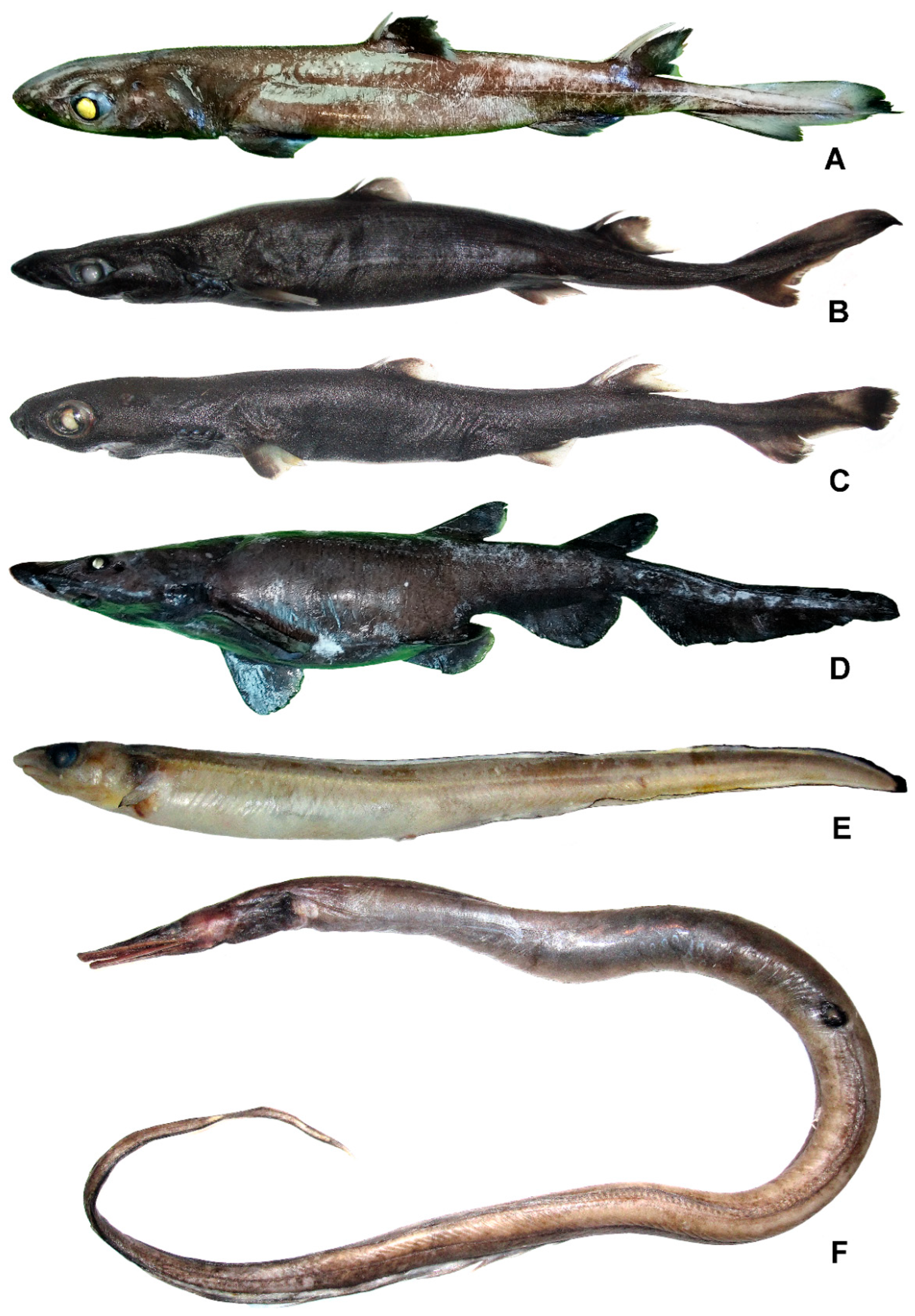
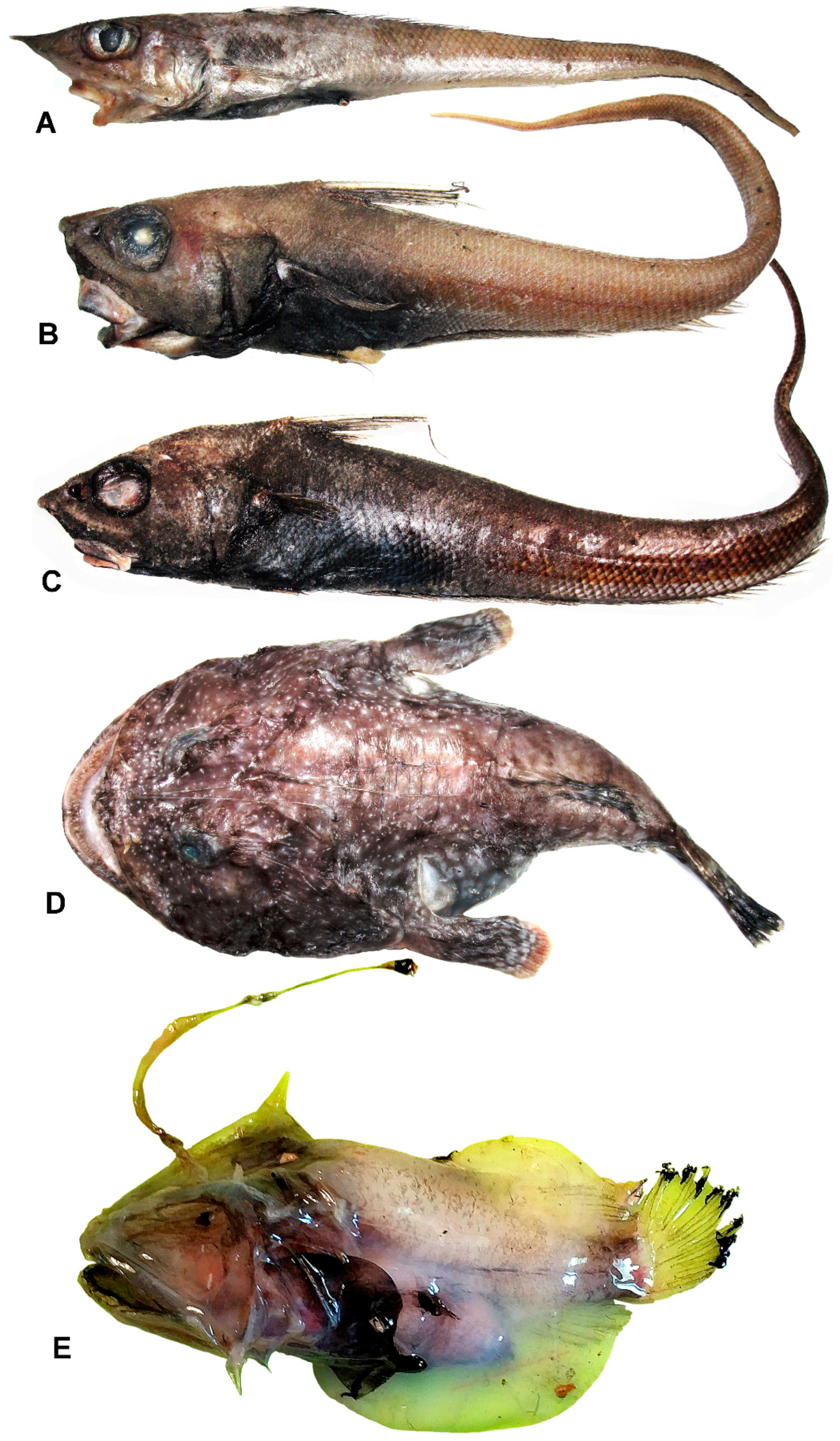
3.1.1. Centroscyllium excelsum Shirai et Nakaya, 1990 (Figure 2A)
Voucher specimens: None. Identified from an adult female specimen ca. 430 mm TL (station 108) and several unmeasured specimens from stations 107 and 108 photographed aboard but not retained.
Figure 2. Fish species collected during 2019 cruise of R/V Professor Kaganovsky over Emperor Seamounts. All specimens were photographed in fresh condition. (A) Centroscyllium excelsum, ca.430 mm TL, not preserved; (B) Etmopterus cf. lailae, 295 mm TL, IORAS P.04998; (C) Etmopterus pusillus, 216 mm TL, IORAS P.05024; (D) Apristurus fedorovi, 610 mm TL, IORAS P.05055; (E) Gnathophis johnsoni, 312 mm TL, IORAS P.04999; (F) Nettastoma parviceps, 751 mm TL, IORAS P.05046. Not to scale.
Jmse 14 00063 g002
Diagnosis: Upper- and lower-jaw teeth similar in shape and arrangement. Dermal denticles with blunt tips, expressed only on dorsal surface of head and trunk. First dorsal fin high, semicircular-shaped.
Identification sources: [21] (p. 19); Hatooka in [33] (p. 144); [80] (p. 392).
Local distribution: Annei Seamount (first confirmed record). Type series said to be collected between 38°37′ and 49°59′ N, 171°06′ and 170°00′ E [80], i.e., between Detroit and Nintoku Seamounts in the northern subsection of the Emperor Chain. Reported from Kimmei Seamount [52].
General distribution: Endemic to the Emperor Seamounts. Bathymetric distribution: 410–1000 m.

3.1.2. Etmopterus cf. lailae Ebert, Papastamatiou, Kajiura et Wetherbee, 2017 (Figure 2B)

Voucher specimens. IORAS P.04998, 5 (280–339), DNA nos. 63–67, trawl 101; IORAS P.05023, 1 (235), trawl 105; IORAS P.05030, 1 (155), DNA no. 19, trawl 107.
Diagnosis (revised): Dermal denticles pointed, arranged into rows and forming striations. Anterior branch of suprapelvic mark longer relative to its posterior branch; skin on ventral surface of snout between nostrils and above upper lip devoid of dermal denticles; 26–40 lower jaw teeth; spiral valve count 14–16.
Identification sources: [70] (p. 372); [21] (p. 20).
Remarks: Hoshino et al. [21] reported five specimens identified as Etmopterus sp. and noted that it is different from E. lailae in having more lower-jaw teeth (38–40 vs. 26–28), a shorter first dorsal fin spine (1.3–1.7% vs. 3.0–3.4% TL), and “other characters”. Our specimens, except the smallest one, are also characterized by a high lower-jaw teeth count (33–40), but show an intermediate size of first dorsal fin spine (1.8–3.0%, but 3.8% TL in the largest 354-mm specimen). The smallest juvenile (155 mm TL, scar of yolk sac retained) better fits to the original description of E. lailae in the lower-jaw teeth count (26 vs. 26–28 in the type series), although it has a much longer first dorsal fin spine (4.9% TL) than was reported for 265–303-mm type specimens (3.0–3.4% TL). The differences in the first dorsal fin spine length may reflect ontogenetic changes, although the same decision is not warranted for the differences in the lower-jaw teeth count between the 155-mm and 235–339 mm TL specimens. Molecular data inferred from the COI gene fragment confirms the conspecificity of all studied specimens with maximum one nucleotide change between specimens (0.19% of genetic variation). Further study is required for elucidation of the range of morphological variation and ontogenetic changes in E. lailae. As we cannot be sure that the lower-jaw teeth count might not be a subject of ontogenetic change, currently we only tentatively refer our specimens to the named species.
Local distribution: Annei, Koko, and Kammu Seamounts. First described from Koko and Kammu [70]; new record for Annei Seamount.
General distribution: Endemic to the Emperor Seamounts. Formerly reported at depths of 314–590 m [21,70], but obtained from 643 to 649 m on Annei Seamount.

3.1.3. Etmopterus pusillus (Lowe, 1839) (Figure 2C)

Voucher specimens: IORAS P.05024, 3 (216–340), DNA nos. 119–121, station 105.
Diagnosis: Dermal denticles truncated, irregularly arranged, not forming striations; posterior branch of suprapelvic mark absent; distance from pectoral fin insertion to first dorsal fin base less than three times in interdorsal space (2.0–2.5 in our specimens); upper teeth rows 22–31; 10 to 13 turns to the intestinal valve.
Identification sources: [35] (p. 82); [81] (p. 483); Hatooka in [33] (p. 145); [21] (p. 20); [82] (p. 83).
Local distribution: Annei, Koko, Milwaukee, and Colahan Seamounts [16,64].
General distribution: Patchily distributed in warm waters of Atlantic and Indo-West Pacific. Bathymetric range: 340–1200 m.

3.2. Family Pentanchidae

Apristurus fedorovi Dolganov, 1983 (Figure 2D)

Voucher specimens: IORAS P.05055, 2 (560–610 mm TL), station 110.
Diagnosis: Distance between tip of snout and pectoral fin origin shorter than distance between origins of pectoral and pelvic fins, pectoral fin length about 2 times in the latter; outer margin of pectoral fin more than twice length of inner margin; anal fin short-based and deep, with convex distal margin. Spiral valve count 9–12.
Identification sources: [83] (p. 19); [49] (p. 64); Yoshino and Aonuma in [33] (p. 131); [21] (p. 18).
Remarks: The name “Apristurus fedorovi” first appeared in the key of species published without indication of the authorship, novelty, and specimens [83]. Then A. fedorovi was described as a new species [49] based on two type specimens (holotype and paratype) and 35 unnumbered non-type specimens from an unknown depository. However, the morphological description was based solely on the holotype and paratype, and no data other than general place of capture and range of TL were presented for the non-types. The publication of 1983 fulfilled the requirements of the ICZN (International Code of Zoological Nomenclature) for the species described before 1999 [84]. However, it is not clear whether the holotype created by Dolganov [49] (collected on 7 December 1982) was included to the material used for construction of the key or not [83]. Dolganov [83] wrote that he used specimens sampled between 1976 and 1982 including those housed in the Zoological Institute, but the time gap between the capture of the holotype of A. fedorovi Dolganov, 1985 and the publication date is too short to be sure that this holotype was included to the publication [83]. As a consequence, it is not clear if A. fedorovi Dolganov, 1985 should be treated as a junior objective or subjective synonym of A. fedorovi Dolganov, 1983.
Local distribution: Ojin, Jingu, and Yomei Seamounts. Reported for Jingu Seamount [16,49] and for Yomei Seamount in [15] (as A. platyrhynchus) and [16]. New record for Ojin Seamount.
General distribution: Northwest Pacific: Pacific coast of Japan and southern Kuril Islands, seamounts of the Emperor and Marcus–Necker Ridges. Bathymetric range: 790–1400 m.

3.3. Family Congridae

Gnathophis johnsoni Prokofiev, Frable, Emelianova, Orlova (Saveleva) et Orlov, 2025 (Figure 2E)

Voucher specimens: IORAS P.03671, 1 (321) and P.04999, 4 (285–331), DNA nos. 70–74, station 101.
Diagnosis: Elevated pores in anterior lateral line present; 6 suborbital, 3 preopercular, and 31–35 preanal pores, median fins black-margined, caudal fin black in distal half, stomach black, swimbladder extending far beyond anus; 130–134 vertebrae (present study).
Remarks: This is a recently described species [24] formerly misidentified as Rhynchocymba nystromi nystromi (Jordan and Snyder, 1901) which is a synonym of G. heterognathos (Bleeker, 1858). It is actually most similar to G. cinctus (Garman, 1899) (eastern Pacific from California to Chile) and G. smithi Karmovskaya, 1990 (Nazca and Sala-y-Gomez Ridges).
Identification sources: [24] (p. 15).
Local distribution: Koko Seamount (new record). Reported for Colahan, Milwaukee, and NW and SE Hancock Seamounts [16] (as Rhynchocymba nystromi nystromi).
General distribution: Distributed throughout the Emperor–Hawaiian Seamount Chain from Koko and Yuryaku Guyots southeastward to Oahu [24]. Bathymetric range: 280–430 m [21,24].

3.4. Family Nettastomatidae

Nettastoma parviceps Günther, 1877 (Figure 2F)

Voucher specimens: IORAS P.05046, 1 (751), station 108.
Diagnosis: Pterygoids toothless; median vomerine teeth not enlarged; snout lacking fleshy protrusion; posterior nostrils located above posterior margin of eye; preanal lateral line pores 49–58.
Identification sources: [85] (p. 540); Hatooka in [33] (p. 259); [21] (p. 23).
Local distribution: Annei Seamount (new record). Reported for Milwaukee Seamounts [64].
General distribution: South Africa to Japan, Emperor Seamounts and Hawaiian Archipelago, eastern Australia, and Tasmania. Bathymetric range: 60–1300 m.

3.5. Family Synaphobranchidae

3.5.1. Meadia abyssalis (Kamohara, 1938) (Figure 3A)
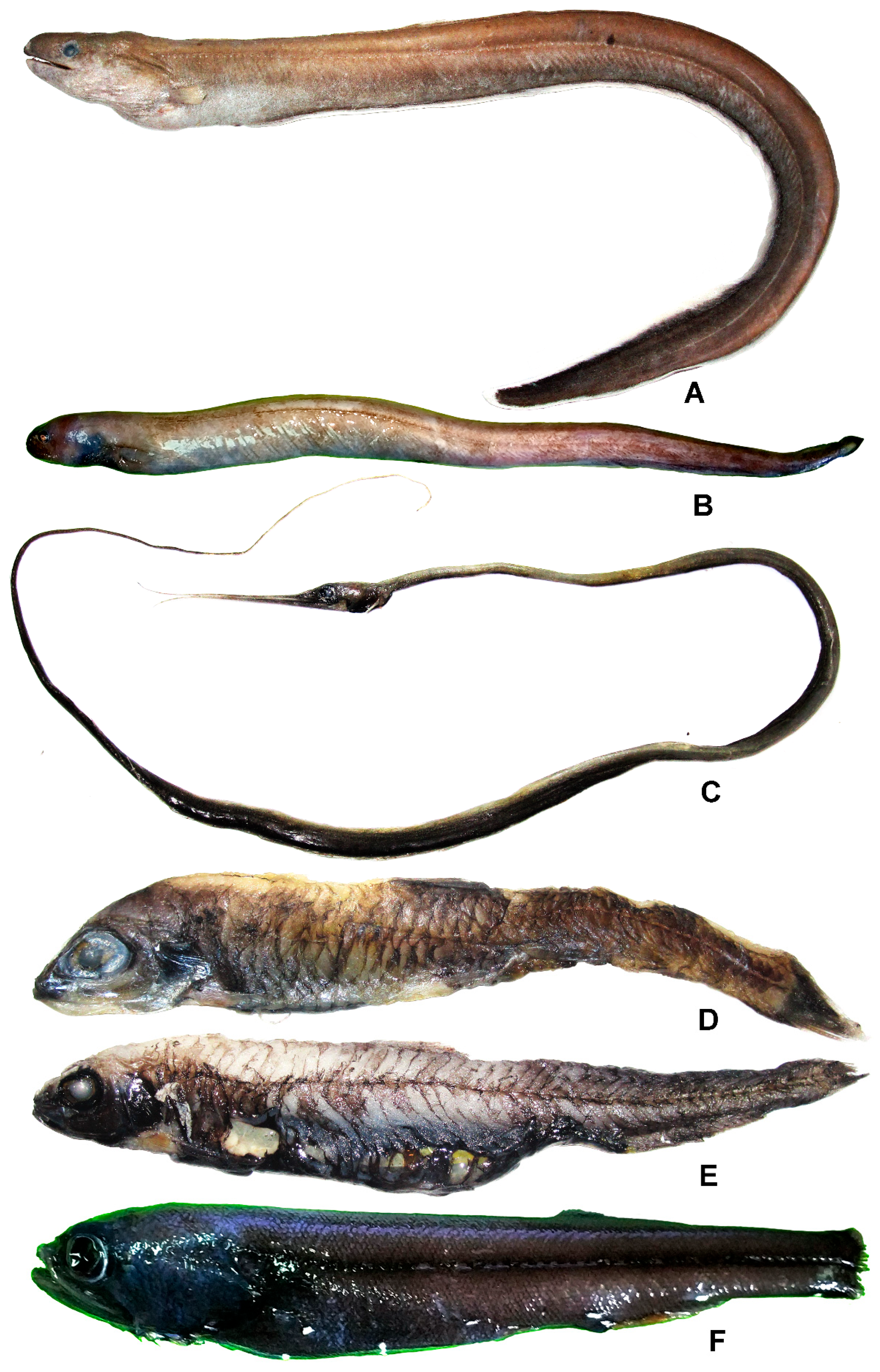
Voucher specimens: IORAS P.05019, 2 (495–667), station 104.
Figure 3. Fish species collected during 2019 cruise of R/V Professor Kaganovsky over Emperor Seamounts. All specimens were photographed in fresh condition. (A) Meadia abyssalis, 667 mm TL, IORAS P.05019; (B) Simenchelys parasitica, ca.280 mm TL, not preserved; (C) Nemichthys scolopaceus, 528 mm TL, IORAS P.05057; (D) Lipolagus ochotensis, 106 mm SL, IORAS P.05032; (E) Melanolagus bericoides, 153 mm SL, IORAS P.05059; (F) Sagamichthys abei, 172 mm SL, IORAS P.05066. Not to scale.
Jmse 14 00063 g003
Diagnosis: Gill openings well separated from each other; vomerine teeth in two rows, distinctly larger than jaw teeth; eye large, located above posterior part of mouth; anus positioned anteriorly, preanal distance 12.4–18.2% TL; scales absent; vertebrae 165–179 (173 and 178 in the studied specimens).
Identification sources: [86] (p. 69); Hatooka in [33] (p. 213); [87] (p. 185); [21] (p. 22).
Local distribution: Koko Seamount. Formerly reported for the Emperor Seamounts without more precise data [19,21].
General distribution: Tropical Indo-Pacific eastwards to Hawaiian and Society Islands. Bathymetric range: 260–800 m.

3.5.2. Simenchelys parasitica Gill, 1879 (Figure 3B)

Voucher specimens: Not retained (ca. 280 mm TL, station 108). Identified by photographs taken aboard.
Diagnosis: Head thick, blunt, cylindrical; mouth very small, terminal, gape falling well short of orbit, lips strongly plicate; jaw teeth uniserial, less than 20 in each jaw; gill openings widely separated; body scaled in grouped, right-angle basket-weave pattern, head and thorax naked; vertebrae 117–125.
Identification sources: [88] (p. 1161); Hatooka in [33] (p. 212).
Local distribution: Annei Seamount. Formerly reported for the Emperor Seamounts without more precise data [19,21].
General distribution: Circumglobal, bi-temperate, but absent from the northeastern Pacific. Bathymetric range: 136–2620 m.

3.6. Family Nemichthyidae

Nemichthys scolopaceus Richardson, 1848 (Figure 3C)

Voucher specimens: IORAS P.05031, 2 (521–653), station 107; IORAS P.05047, 3 (505–610), station 108; IORAS P.05057, 2 (470+–528), station 109.
Diagnosis: Caudal filament present; five pores per segment forming square or rectangle longer than high; no sensory ridges on head; postorbital pores 3–20, preopercular pores 2–18; teeth small; body more or less pigmented.
Identification sources: [89] (p. 38); [90] (p. 454); [91] (p. 36); Hatooka in [33] (p. 237).
Local distribution: Annei and Ojin Seamounts. Reported for Kimmei and Milwaukee Seamounts [15].
General distribution: Worldwide, 55° N–45° S; 0–4337 m, usually at 100–1000 m [17,92].

3.7. Family Bathylagidae

3.7.1. Lipolagus ochotensis (Schmidt, 1938) (Figure 3D)

Voucher specimens: IORAS P.05032, 1 (106), DNA no. A74, station 107; IORAS P.05058, 1 (105), DNA no. 45, station 109.
Diagnosis: Body elongate; head moderate, less than 4.5 times in SL. Snout rounded, shorter than eye. Dorsal margin of opercle deeply concave. Upper end of gill opening above midlateral axis. Anal fin base equal to or shorter than dorsal fin base; dorsal and anal fin rays 10–11 and 13–16, respectively. Body moderately pigmented; scale pockets dark-brownish.
Identification sources: [93] (p. 215); [94] (p. 59); [95] (p. 47); Aizawa and Hatooka in [33] (p. 285).
Local distribution: Annei and Ojin Seamounts (new records). Reported for Suiko, Showa, and Yomei Seamounts [15].
General distribution: North Pacific. Mesopelagic, collected by non-closed gears from a fishing depth of 0–6100 m [92]; Mundy [17] indicated a depth range of 500–1100 m.

3.7.2. Melanolagus bericoides (Borodin, 1929) (Figure 3E)

Voucher specimens: IORAS P.05033, 1 (158), DNA no. 108, station 107; IORAS P.05059, 1 (153), station 109.
Diagnosis: Body elongate; head small, more than 5 times in SL. Snout rounded, shorter than eye. Dorsal margin of opercle not concave. Upper end of gill opening below midlateral axis. Origin of pelvic fins behind dorsal fin origin. Adipose fin inserted above anal fin base. Anal fin base longer than dorsal fin base; dorsal and anal fin rays 9–11 and 18–21, respectively. Body black, intensively pigmented; scale pockets usually well-preserved in trawled specimens.
Identification sources: [96] (p. 46); [95] (p. 45); Aizawa and Hatooka in [33] (p. 286).
Local distribution: Annei and Ojin Seamounts. New record for the area. Reported for Hancock Seamounts in the northwestern part of the Hawaiian Ridge [14].
General distribution: Panoceanic on periphery of central gyres. Meso- and bathypelagic, collected by non-closed gears from a fishing depth of 0–3065 m [92]; Mundy [17] indicated a depth range of 1–1700 m, probably with diel migrations; larvae at 0–200 m.

3.8. Family Platytroctidae

Sagamichthys abei Parr, 1953 (Figure 3F)

Voucher specimens: IORAS P.05066, 1 (172), station 110.
Diagnosis: Scale pockets anterior to shoulder tube reversed. Premaxillary tusks absent. Second infraorbital reaching preopercle. Gill rakers on first arch 24–26. Opercular opening level to mideye. Photophores present.
Identification sources: [97] (p. 44); [98] (p. 69); [99] (p. 44).
Local distribution: Jingu Seamount (new record). Reported for Suiko and Yomei Seamounts [15], for Suiko, Yomei, and Nintoku Seamounts [16], and for Nintoku, Yomei, Annei, and Koko Seamounts [99]. Also recorded for Hancock Seamounts in the northwestern Hawaiian Ridge [17,97].
General distribution: North Pacific between 61° N and equator; south-eastern Pacific between 16 and 40° S. Mesopelagic, but frequently collected over slope and seamounts; 130–1500 m.

3.9. Family Gonostomatidae

3.9.1. Diplophos orientalis Matsubara, 1940 (Figure 4A)
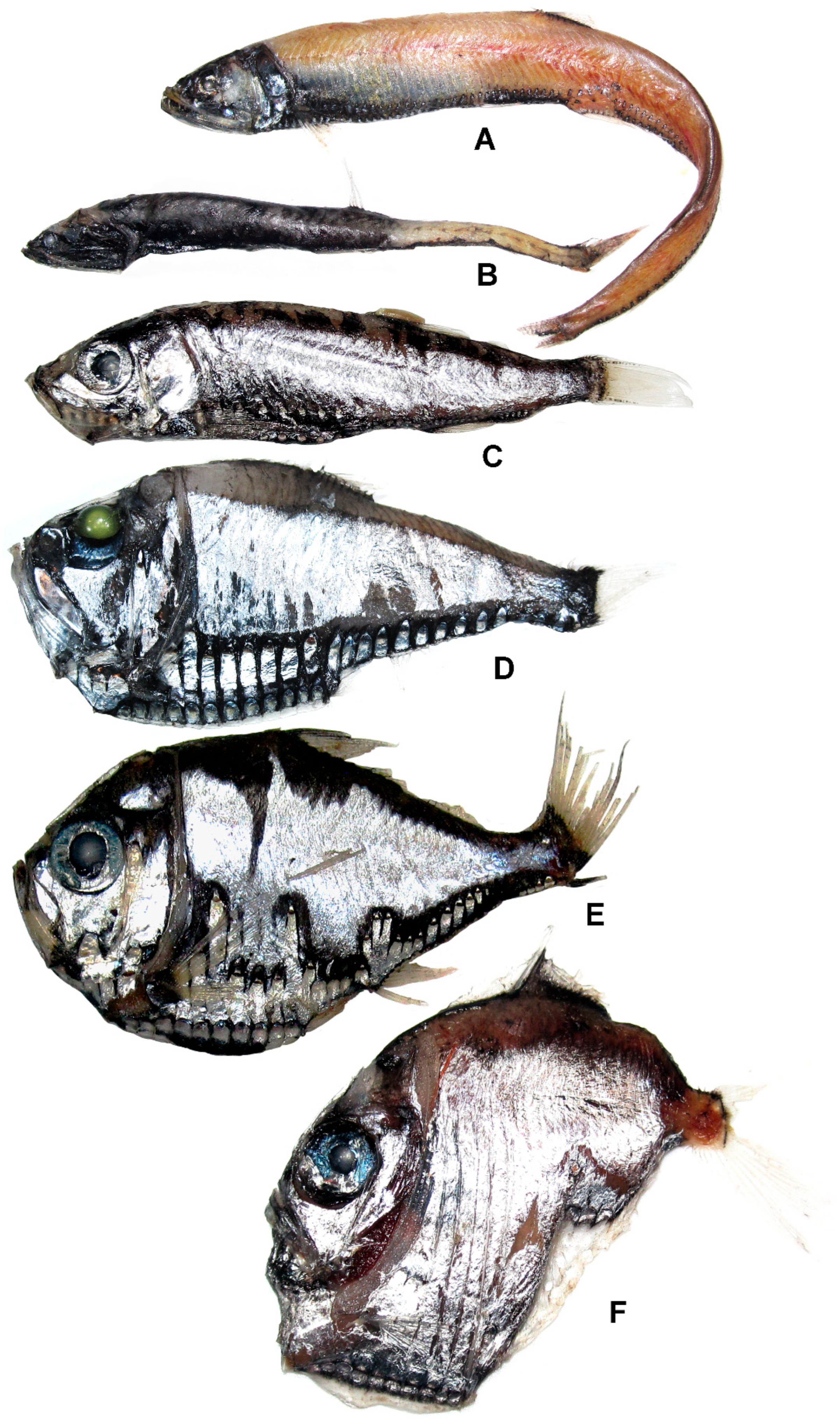
Voucher specimens: IORAS P.05034, 1 (172), station 107.
Figure 4. Fish species collected during 2019 cruise of R/V Professor Kaganovsky over Emperor Seamounts. All specimens were photographed in fresh condition. (A) Diplophos orientalis, 172 mm SL, IORAS P.05034; (B) Cyclothone atraria, 41 mm SL, IORAS P.05035; (C) Maurolicus imperatorius, 60 mm SL, IORAS P.05020; (D) Argyropelecus affinis, 68.5 mm SL, IORAS P.05036; (E) Polyipnus matsubarai, 65 mm SL, IORAS P.05015; (F) Sternoptyx diaphana, 40 mm SL, IORAS P.05038. Not to scale.
Jmse 14 00063 g004
Diagnosis: Body much elongated, vertebrae 31–36 + 47–53 = 83–86. Eye larger than interorbital width. Gill rakers on first arch 12. Anal fin rays 53–63 (usually around 60). Last two AC photophores grouped. Photophores in series: SO 2, BR 11–13, IP 15–18, PV 23–25, VAV 13–15, AC 39–44, IC 92–99, OA 78–86.
Identification sources: [100] (p. 102); Aizawa in [33] (p. 307).
Local distribution: Annei Seamount. Formerly reported for the Emperor Seamounts without more precise data [17]. Larvae of this species occur at the Hancock Seamounts, but only in winter [17].
General distribution: Northwestern and central North Pacific in temperate and subtropical waters. Mesopelagic, depth range uncertain [17]. Our specimen was caught at a depth of 643–649 m.

3.9.2. Sigmops elongatus (Günther, 1878)

Voucher specimens: IORAS P.03668, 1 (104), DNA no. 44, station 109; IORAS P.05067, 1 (67), station 110.
Diagnosis: Caudal part of body longer than head plus abdominal part. Anus close to anal fin origin. Adipose fin present. Gill rakers on first arch 19–21. Anal fin rays 28–30. Photophores well-developed. First 4–5 IV arched. OA straight. Photophores in series: SO 1, BR 8–9, IV 15–16, VAV 4–6, AC 20–23, IC 41–43, OA 13–14.
Identification sources: [101] (p. 214); Aizawa in [33] (p. 308).
Local distribution: Ojin (new record), Yomei and Jingu Seamounts [15].
General distribution: Worldwide in tropical and temperate waters, but absent in the eastern Pacific and in the Mediterranean Sea. Mesopelagic at 25–1500 m [17].

3.9.3. Sigmops gracilis (Günther, 1878)

Voucher specimens: IORAS P.03669, 3 (63–107), DNA nos. A77 and A79, station 107; IORAS uncatalogued (damaged), 1 (105), station 108.
Diagnosis: Caudal part of body longer than head plus abdominal part. Anus far from anal fin origin. Adipose fin absent. Gill rakers on first arch 19–22. Anal fin rays 27–30. First 4–5 IV in ascending line. Photophores in series: SO 1, BR 9, IV 15–16, VAV 3–5, AC 17–19, IC 37–38, OA 11–14.
Identification sources: [101] (p. 225); Aizawa in [33] (p. 308).
Local distribution: Annei Seamount (new record). Reported for Papanin (Jimmu) and Suiko Seamounts [15] and for Hancock Seamounts [17,101].
General distribution: Northwestern Pacific from the Bering Sea to the South China Sea, eastwards to about 143° W. Meso- and upper bathypelagic species (maximum depth uncertain), adults probably below 500 m during the day.

3.9.4. Cyclothone atraria Gilbert, 1905 (Figure 4B)

Voucher specimens: IORAS P.05035, 1 (41), DNA no. A80, station 107.
Diagnosis: Body black. Anus midway between pelvic and anal fins. Photophores present. Supra- and infracaudal luminous glands of equal size. Photophores in series: SO 0, BR 8–10, IV 13, VAV 5, AC 14–16, IC 32–34, OA 9–10.
Identification sources: [102] (p. 114); [103] (p. 192); Aizawa in [33] (p. 310).
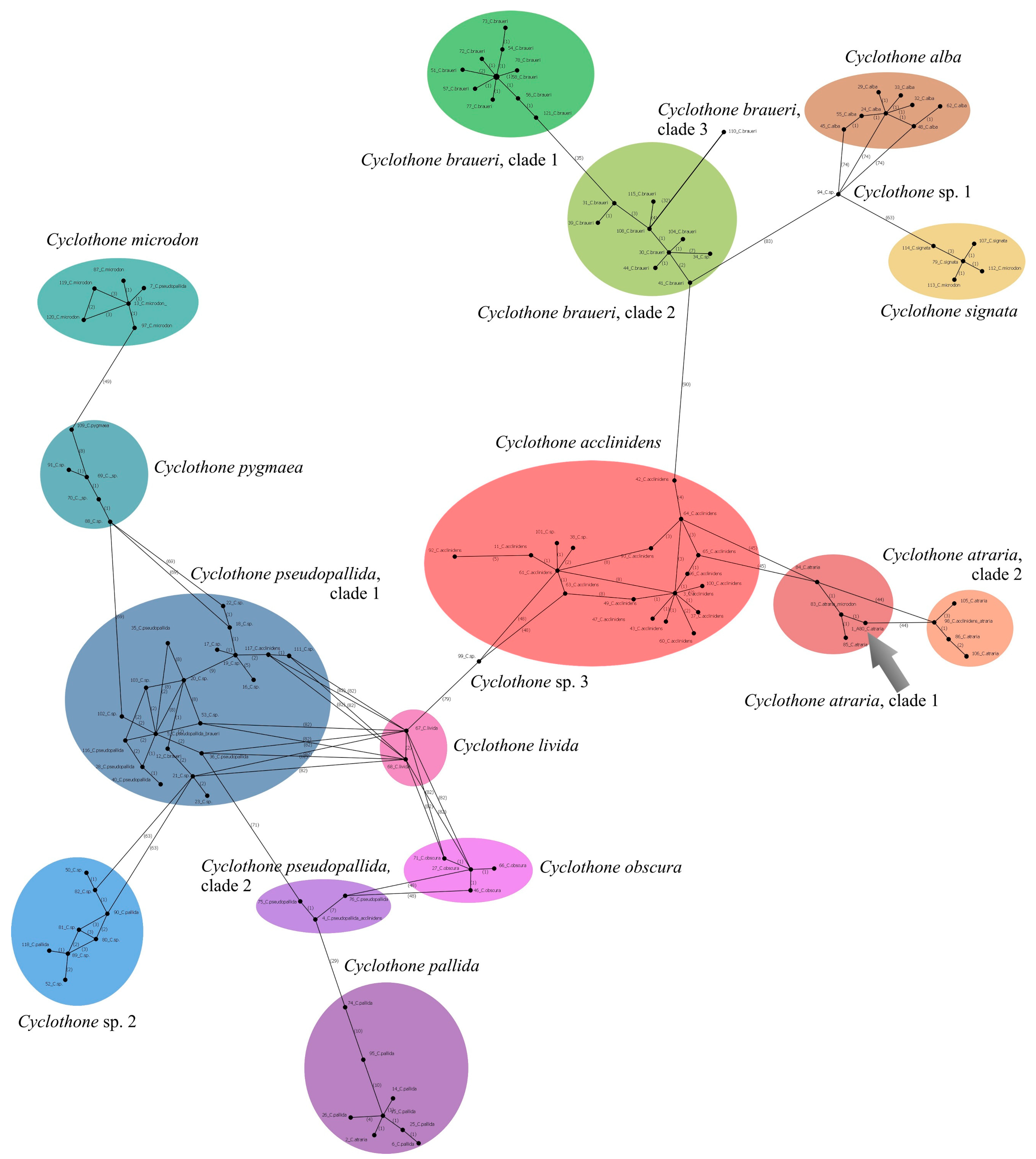
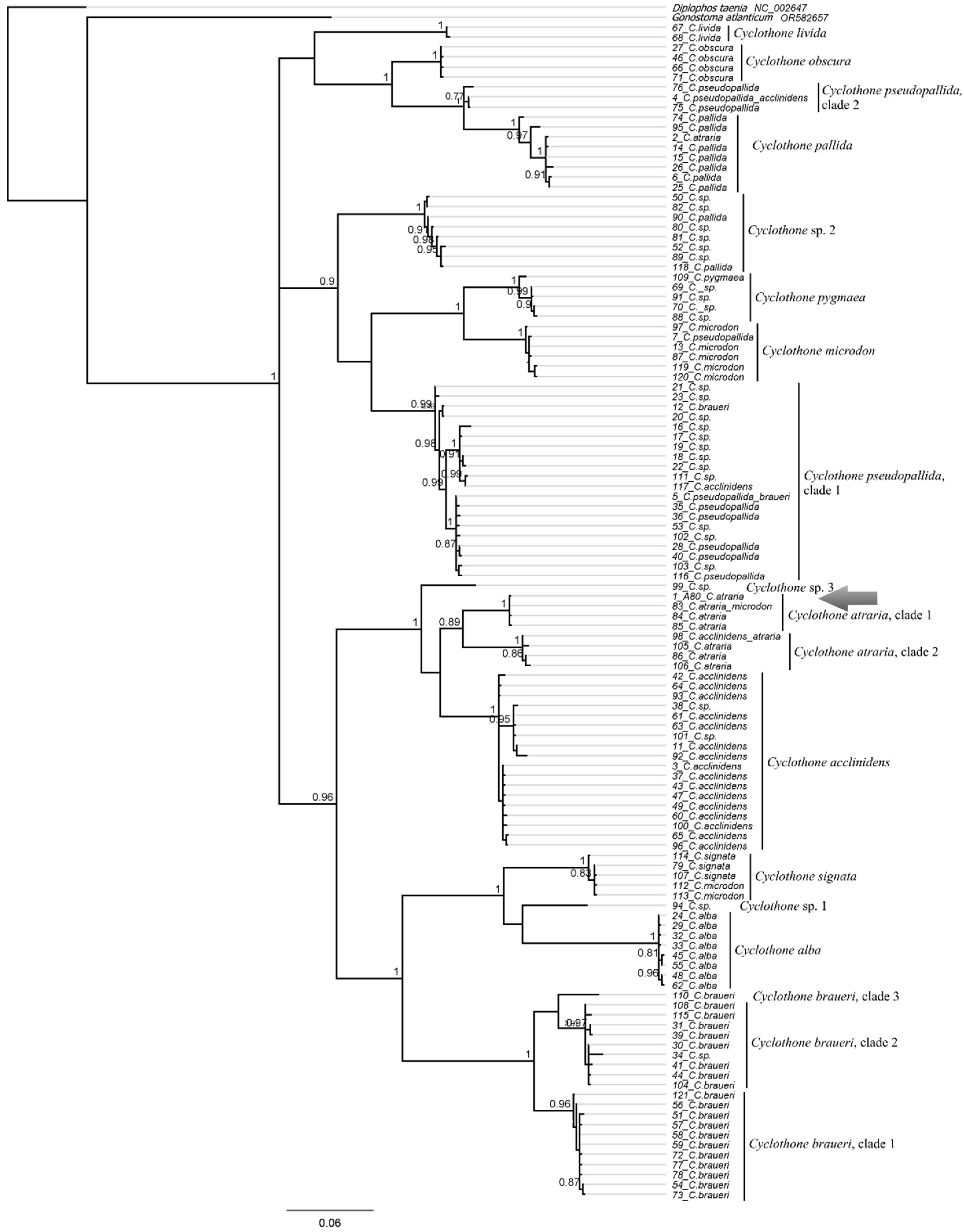
Remarks: Our analysis found cryptic diversity within the genus Cyclothone and C. atraria in particular. Our C. atraria sample (A80) has the same haplotype on the haplotype network (526 bp) as the sample FJ164515/TZFPB864-08 from British Columbia, Canada. This haplotype and some other samples, predominantly identified as Cyclothone atraria, form a single lineage. However, a set of other samples also identified as Cyclothone atraria form a distinct lineage at a distance of 44 nucleotide substitutions (8.4%). The presence of three genetically distinct but close lineages is also observed in Cyclothone braueri, and two independent lineages are formed by samples identified as Cyclothone pseudopallida. We also found three unidentified species forming independent lineages: Cyclothone sp. 1, sp. 2, and sp. 3 (Figure 5 and Figure 6; Supplementary Table S1).
Local distribution: Annei Seamount (new record). Reported for Yomei and Milwaukee Seamounts [15].
General distribution: Endemic to the temperate and subtropical North Pacific. Meso- to bathypelagic; depth range of 298–4938 m, with maximum abundance at 2100–2200 m [17].

3.10. Family Sternoptychidae

3.10.1. Maurolicus imperatorius Parin et Kobyliansky, 1993 (Figure 4C)

Voucher specimens: IORAS P.05020, 15 (42–64), DNA nos. A9, A11, and A12, station 104.
Diagnosis: Head length 29–33% SL; eye diameter 9.5–11% SL; upper jaw 15.5–19% SL; greatest depth of body 21–24% SL. Gill rakers on first arch 27–31, usually 28–30; AC photophores 23–26, usually 24; vertebrae 32–34, usually 32 or 33. Stomach weakly pigmented (grayish or brownish); posterior portion of intestine not pigmented.
Identification sources: [104] (p. 94).
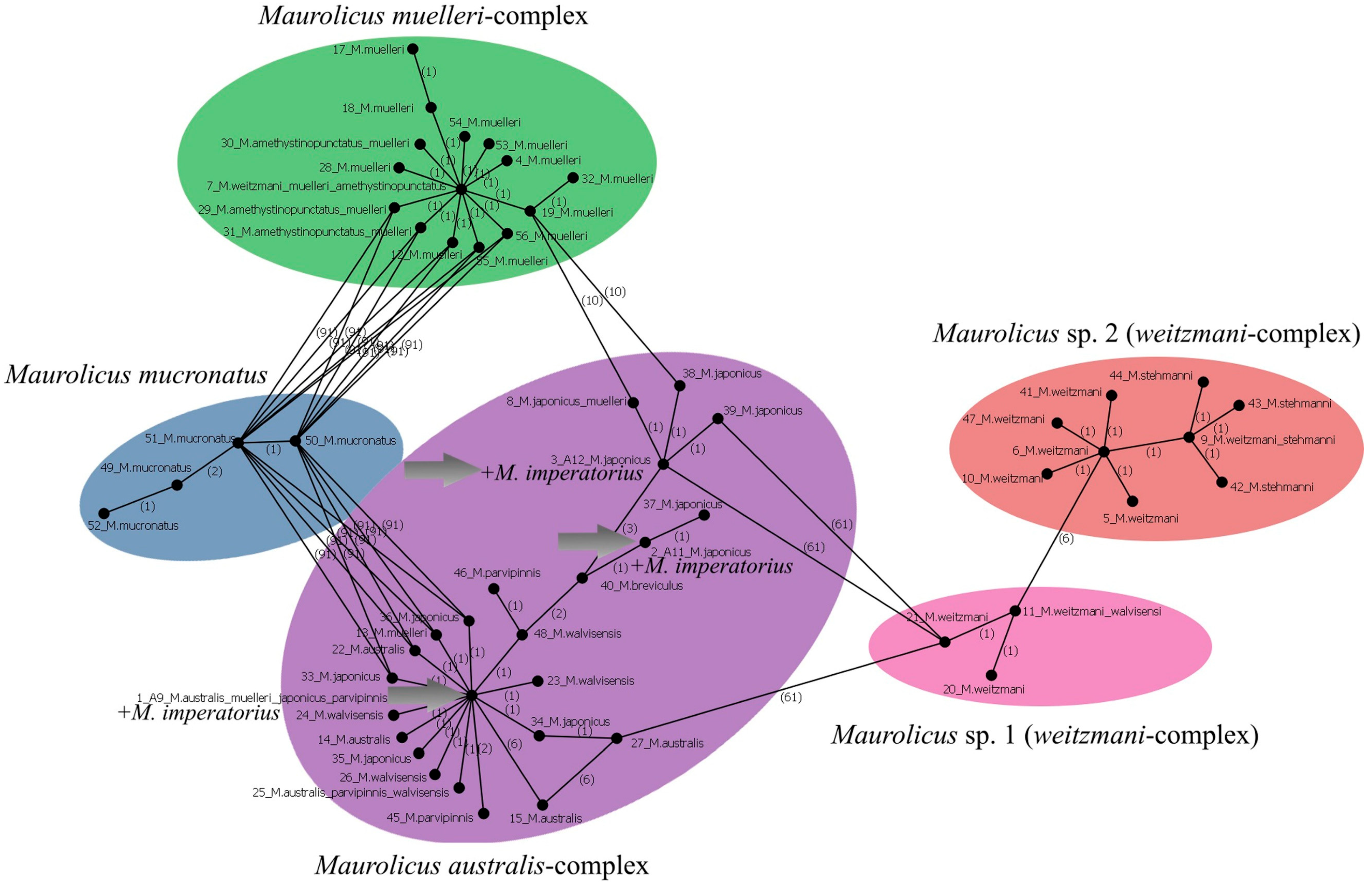
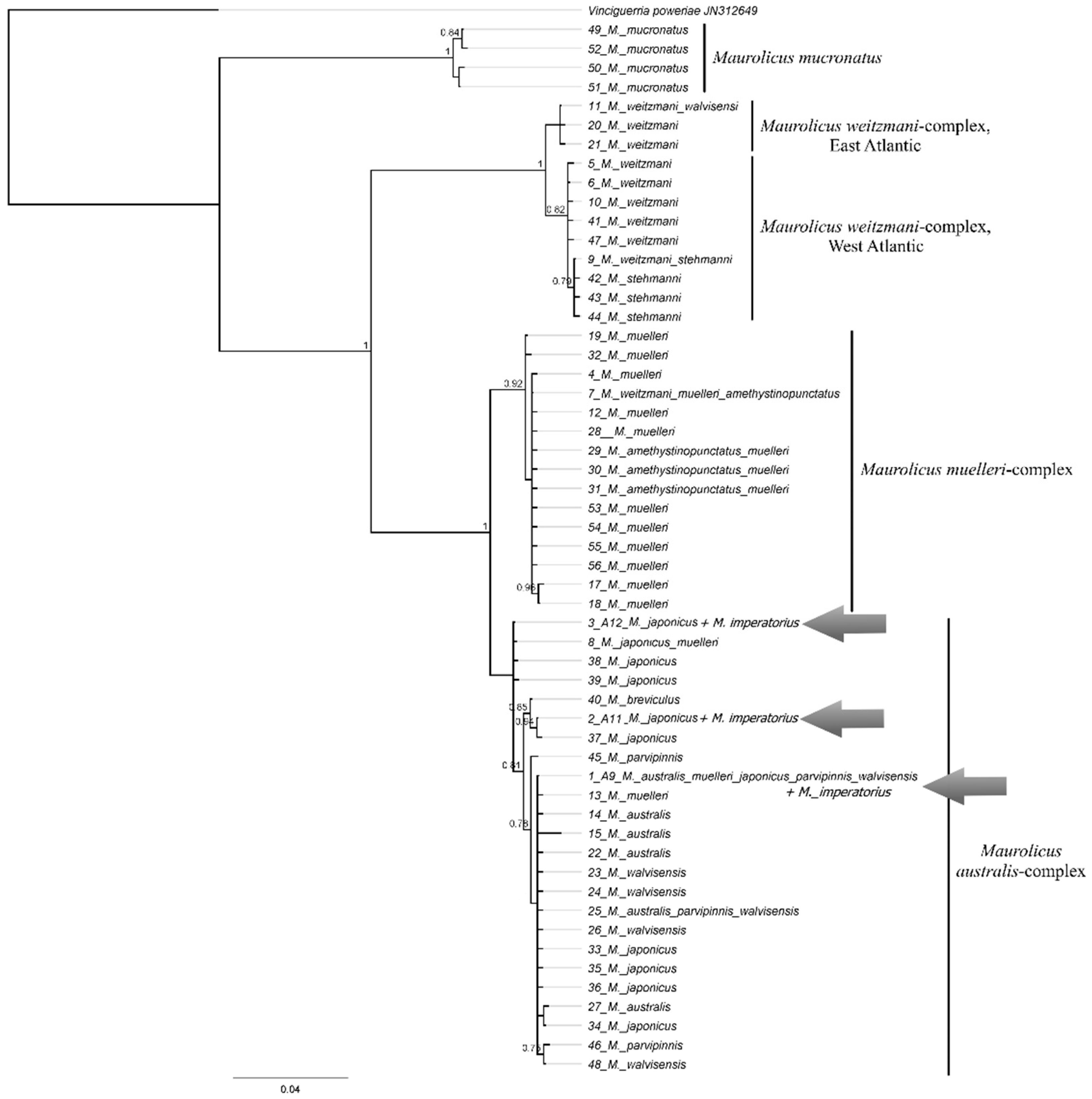
Remarks: The morphological [104] and molecular [105] taxonomy of Maurolicus is not congruent, with several morphospecies not confirmed by molecular data. However, a cryptic species was identified by mitochondrial COI and nuclear ITS-2 markers [105]. Maurolicus imperatorius was not studied in [105], but our molecular analysis inferred from the COI gene fragment shows no separate lineage for the Emperor Seamounts population (no genetic divergence) (Figure 7 and Figure 8; Supplementary Table S2). The Emperor Seamount Maurolicus forms the same lineage with M. australis Hector, 1875, M. breviculus Parin et Kobyliansky, 1993, M. japonicus Ishikawa, 1915, M. parvipinnis Vaillant, 1888, and M. walvisensis Parin et Kobyliansky, 1993, with a few nucleotide substitutions in haplotypes or even the same haplotypes in the different morphospecies (Figure 7). Maurolicus japonicus was described off Japan; the other nominal taxa of this lineage inhabit the Southern Hemisphere and (M. breviculus) in the eastern tropical Pacific (Figure 8). However, the number of gill rakers on the first arch in our specimens (28–30) is higher than in M. japonicus (23–27, usually 24 or 25) but fits well to the type specimens of M. imperatorius [33,104]. As the Emperor Seamounts population of Maurolicus represent a diagnosable unit, we retain this species as valid pending more comprehensive integrative revision of this genus. The absence of molecular divergence may indicate a very recent origin of the Emperor Seamount species or a COI gene fragment that may not be suitable for species delimitation in Maurolicus.
Surprisingly, we discovered that the western (type locality) and eastern Atlantic populations of the M. weitzmani complex are genetically distinct and form separate, though closely related, lineages (Figure 7 and Figure 8). Parin and Kobyliansky [104] mentioned only slight differences between the western and eastern Atlantic populations (in average smaller pectoral–pelvic distance and lower gill raker count in the latter), insufficient for separation of species, but further study is required.
Local distribution: Reported for Jingu, Yomei, Annei, Koko, Kimmei, Milwaukee, Colahan, C-H, and NW Hancock Seamounts (as Maurolicus muelleri) [15,16]. Type specimens of M. imperatorius were obtained from the Milwaukee Seamounts [104].
General distribution: Endemic to the Emperor and northwestern Hawaiian Ridges; benthopelagic at depths of 10–880 m [104,106].

3.10.2. Argyropelecus affinis Garman, 1899 (Figure 4D)

Voucher specimens: IORAS P.05036, 1 (68.5), DNA no. A81, station 107.
Diagnosis: Dorsal blade low, plate-like, forming by several spines. Abdominal photophores 12. Supraabdominal, preanal, anal and subcaudal photophores in continuous line; anal and subcaudal photophores not tightly spaced. Anal fin not subdivided.
Identification sources: [107] (p. 34); [108] (p. 33); Aizawa in [33] (p. 315).
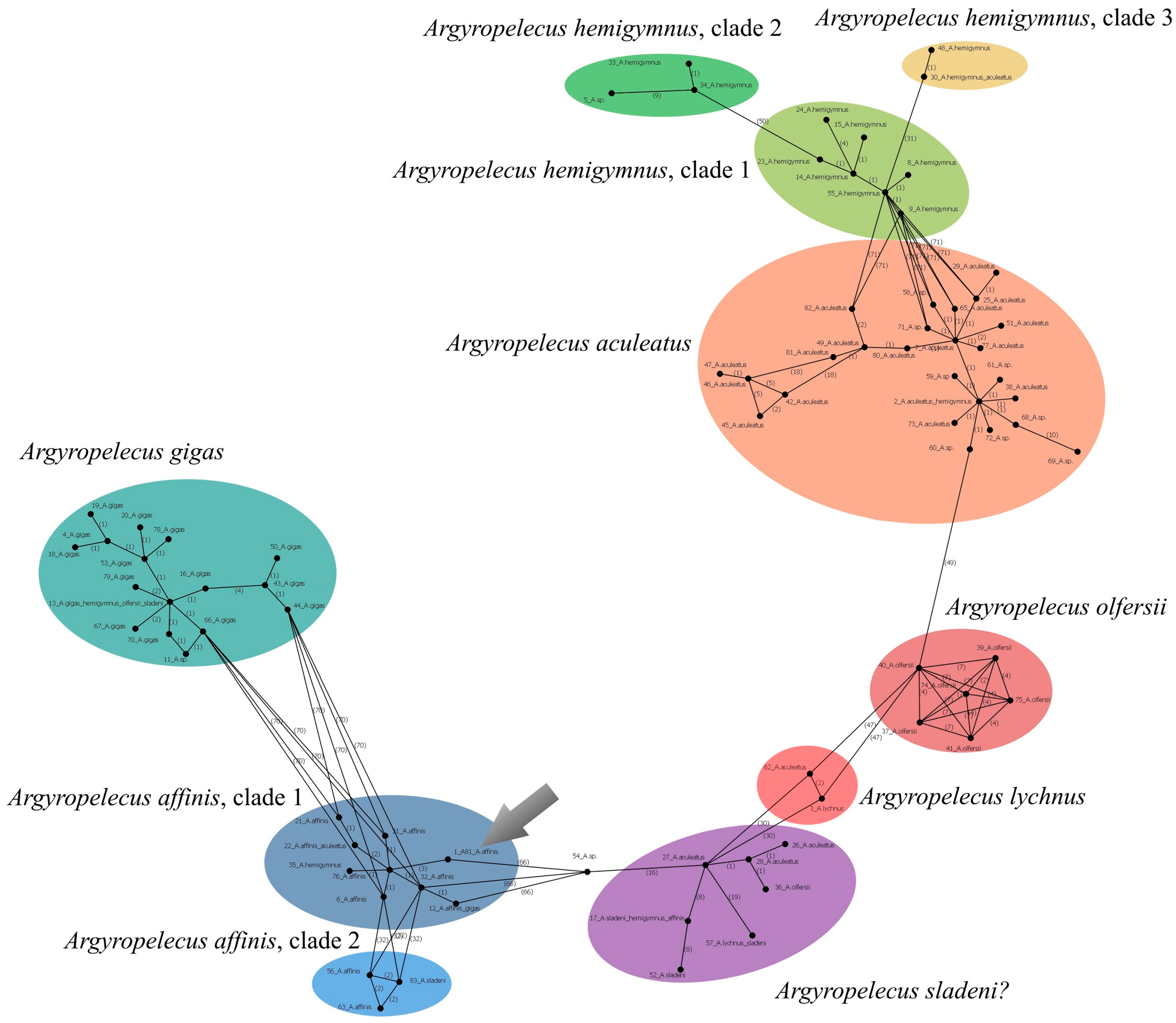
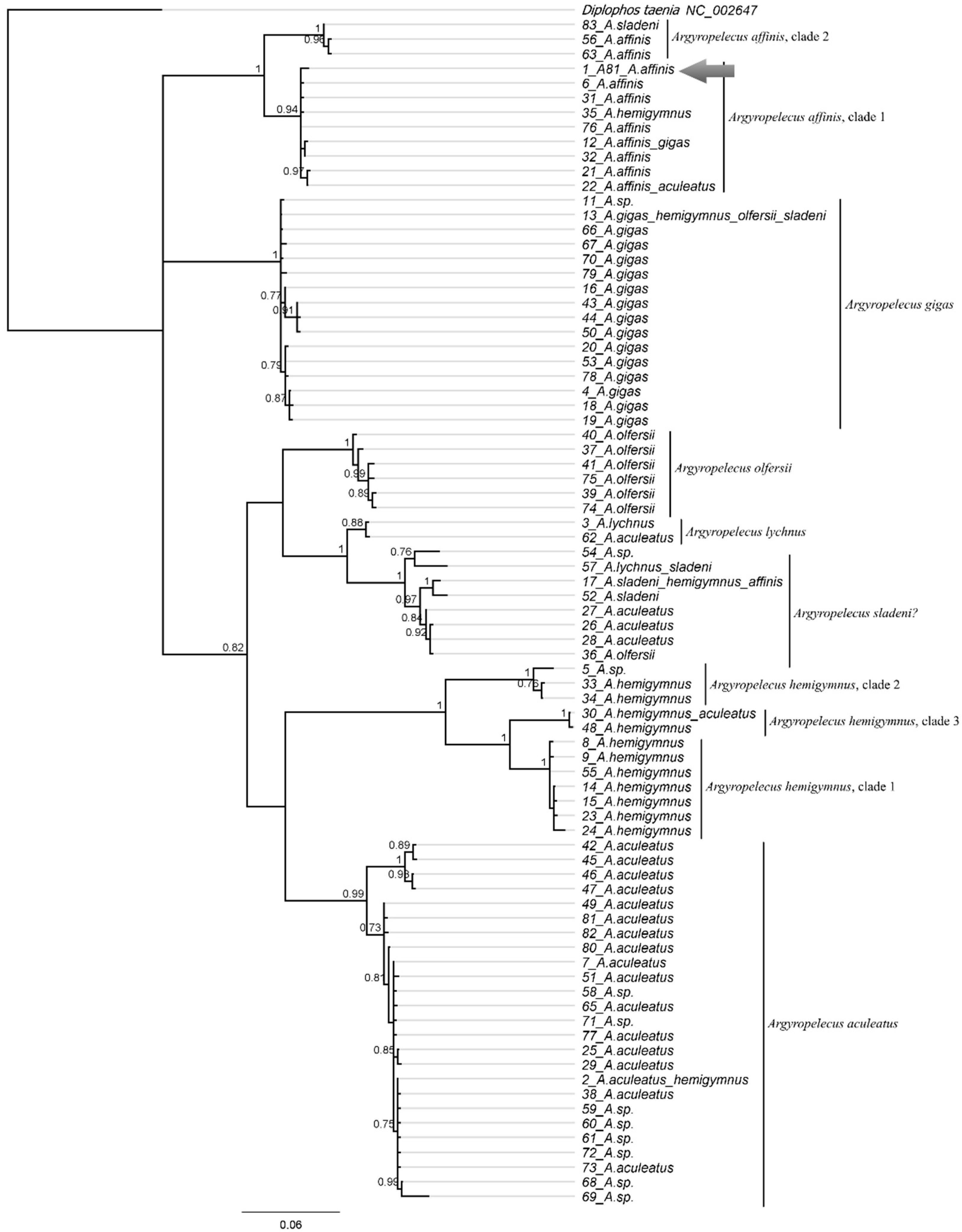
Remarks: Our sample (A81) forms a unique haplotype on the haplotype network (484 bp), but a part of a lineage of A. affinis. However, other samples of A. affinis form another lineage, which differs from the lineage in 32 nucleotide substitutions (6.6% of genetic divergence). The network (Figure 9 and Figure 10; Supplementary Table S3) also contains three independent lineages of A. hemigymnus Cocco, 1829 and a lineage formed by samples identified as different species in relatively equal proportions. We speculate that the latter lineage represents A. sladeni Regan, 1908, since no more lineages with a significant presence of this species are observed on the network. We identified ten separate lineages on the network (Figure 9), although only seven valid species are currently accepted in Argyropelecus.
Local distribution: Annei Seamount. New record for the area.
General distribution: Worldwide between 40° N and 40° S. Mesopelagic, 170–875 m [17], usually at depth of 350–600 m during the day and 170–400 m at night [107], rarely above 200 m and below 500 m [108].

3.10.3. Argyropelecus sladeni Regan, 1908

Voucher specimens: IORAS P.05048, 1 (46), station 108.
Diagnosis: Dorsal blade plate-like, forming by several spines. Abdominal photophores 12. Supraabdominal, preanal, anal, and subcaudal photophores in groups; anal and subcaudal photophores tightly spaced. Two postabdominal spines. Anal fin subdivided into two parts, interspace between them as well as lower margin of subcaudal photophores smooth.
Identification sources: [107] (p. 56); [108] (p. 45); Aizawa in [33] (p. 315).
Local distribution: Annei Seamount (new record). Reported for Kimmei and Milwaukee Seamounts [15].
General distribution: Worldwide in tropical and temperate waters. Mesopelagic, usually at depth of 350–600 m during the day and 100–375 m at night [107].

3.10.4. Polyipnus matsubarai Schultz, 1961 (Figure 4E)

Voucher specimens: IORAS P.05000, 1 (66), station 101; IORAS P.05015, 7 (53–65), DNA no. 16, station 103; IORAS P.05037, 1 (61), station 107.
Diagnosis: Dorsal blade spine-like, reduced. Posttemporal spine small, simple. Gill rakers on first arch 22–24. Abdominal photophores 10; anal photophores 8–9. No large transparent membrane above anal fin. Ventral keel smooth. Predorsal marking acute, reaching below midline of body.
Identification sources: [107] (p. 101); [109] (p. 477); Aizawa in [33] (p. 317).
Remarks: Our COI sequence is identical to those from Japan (ON398667) and the northeastern part of the South China Sea (MF415252) and identified as P. matsubarai and Polyipnus sp., respectively [110,111]. P. matsubarai is very close to P. ruggeri from the Tasman Sea with 1.3% of genetic divergence according to COI barcoding. These species may represent a vicariant pair with antitropical distribution, like some other representatives of the related families (e.g., Ichthyococcus elongatus/australis, Polymetme illustris/surugaensis).
Local distribution: Annei, Koko, Kimmei, and Milwaukee Seamounts [15,16].
General distribution: Pacific coast of Japan southwards to the Philippine Sea and eastwards to the Hawaiian–Emperor Seamounts. Mesopelagic over slopes and seamounts, 20–500 m depth [17].

3.10.5. Sternoptyx diaphana Hermann, 1781 (Figure 4F)

Voucher specimens: IORAS P.05038, 2 (21–40), DNA no. A75, station 107; IORAS P.05049, 2 (30–33), station 108.
Diagnosis: Dorsal blade as a large spine with anterior serrate extension. Abdominal photophores 10; anal photophores 3. Supranal photophore low, less than one-half distance from ventral body margin to midline. Posterior margin of anal photophores forming narrow V shape with ventral body margin. Body depth beyond dorsal fin less than 3 times in SL. First anal pterygiophore greatly enlarged, supported triangular transparent membrane above anal fin. Body silvery.
Identification sources: [107] (p. 75); [108] (p. 55); [112] (p. 810); Aizawa in [33] (p. 314).
Local distribution: Annei Seamount (new record). Reported for Yomei, Kimmei, and Milwaukee Seamounts [15]. Mundy [17] noted distribution in the area from Hawai’i Island to Koko Seamount.
General distribution: Worldwide in tropical and temperate waters; 400–1500 m, with a few captures above 200–500 m.

3.11. Family Phosichthyidae

Ichthyococcus elongatus Imai, 1941 (Figure 11A)
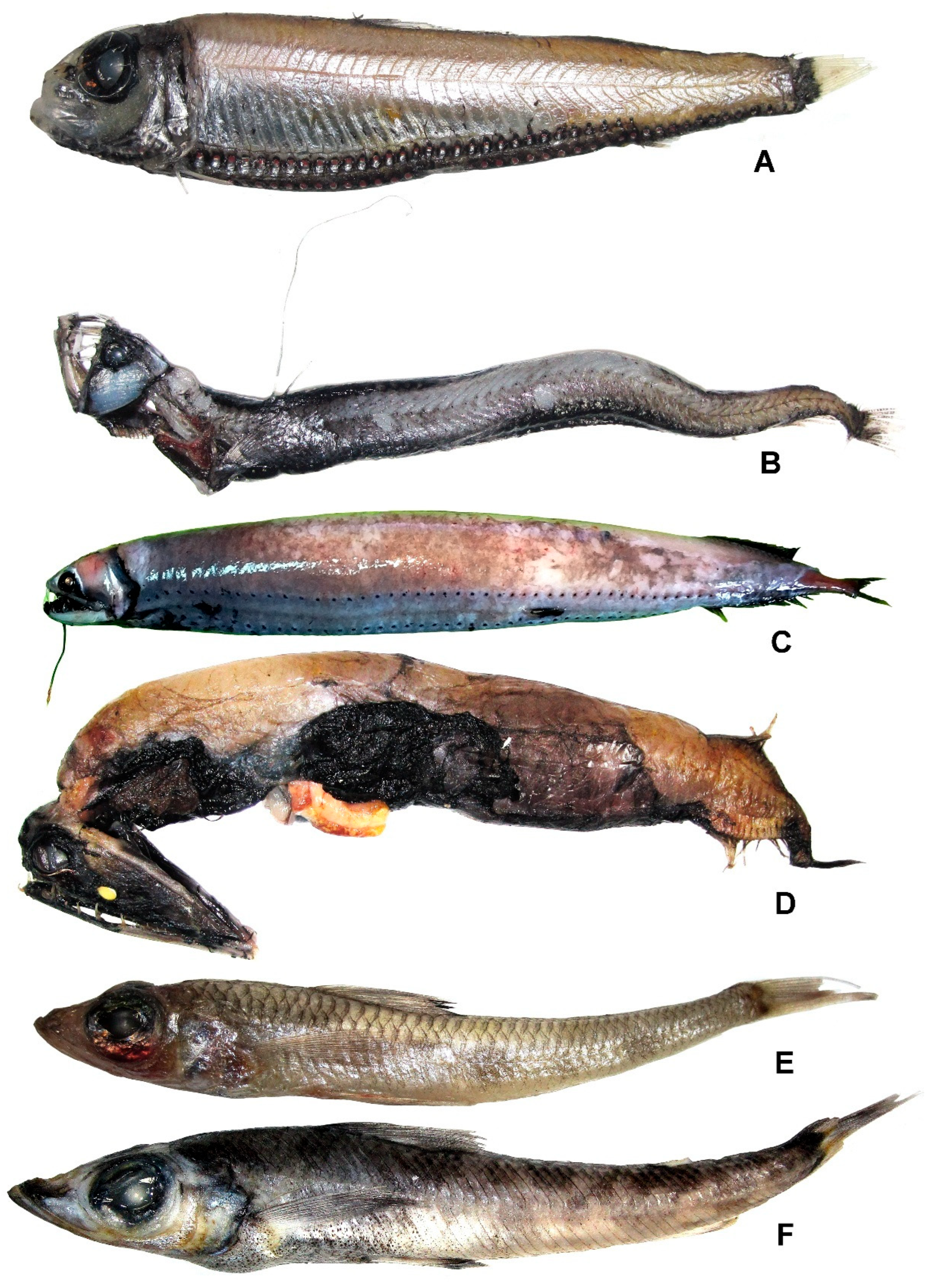
Voucher specimens: IORAS P.05039, 1 (119), station 107; IORAS P.05050, 1 (125), station 108.
Diagnosis: Snout short, blunt; eye large, telescopic; mouth small, maxilla covered lower jaw; jaw teeth very small, uniform in size, uniserial. Body depth 19.7–25.6% SL, pelvic-anal distance 20.9–26.0% SL. Ventral adipose fin absent. SO present. IV linear, except 8th. Photophores in series: SO 1, BR 12–13, IV 27, VAV 13–15, AC 13–15, OA 30–32.
Identification sources: [113] (p. 780).
Local distribution: Annei Seamount (new record). This species has been reported for Suiko, Yomei, and Milwaukee Seamounts [15].
General distribution: Subtropical and temperate North Pacific. Mesopelagic, known from a fishing depth of 1125–0 m.
Figure 11. Fish species collected during 2019 cruise of R/V Professor Kaganovsky over Emperor Seamounts. All specimens were photographed in fresh condition. (A) Ichthyococcus elongatus, 125 mm SL, IORAS P.05050; (B) Chauliodus gr. sloani, 170 mm SL, IORAS P.05060; (C) Opostomias mitsuii, 328 mm SL, IORAS P.05069; (D) Malacosteus niger, 225 mm SL, IORAS P.05040; (E) Paraulopus filamentosus, 120 mm SL, IORAS P.05017; (F) Chlorophthalmus imperator, 145 mm SL, IORAS P.05011; (D). Not to scale.
Jmse 14 00063 g011

3.12. Family Stomiidae

3.12.1. Chauliodus gr. sloani Bloch et Schneider, 1801 (Figure 11B)

Voucher specimens: IORAS P.05016, 1 (165), station 103; IORAS P.03670, 3 (125–270), station 107; IORAS P.05060, 3 (134–170), DNA no. 43, station 109; IORAS P.05068, 2 (155–175), DNA nos. A51 and A52, station 110.
Diagnosis: Postorbital photophore circular; third premaxillary tooth shorter than (rarely equal to) fourth; mental barbel disappear at 100–140 mm SL. Dorsal fin originating over 4–10th photophore OV. Photophores in lateral and ventral rows 42–49 and 62–72, respectively.
Identification sources: [114] (p. 281); [115] (p. 275); Aizawa in [33] (p. 322).
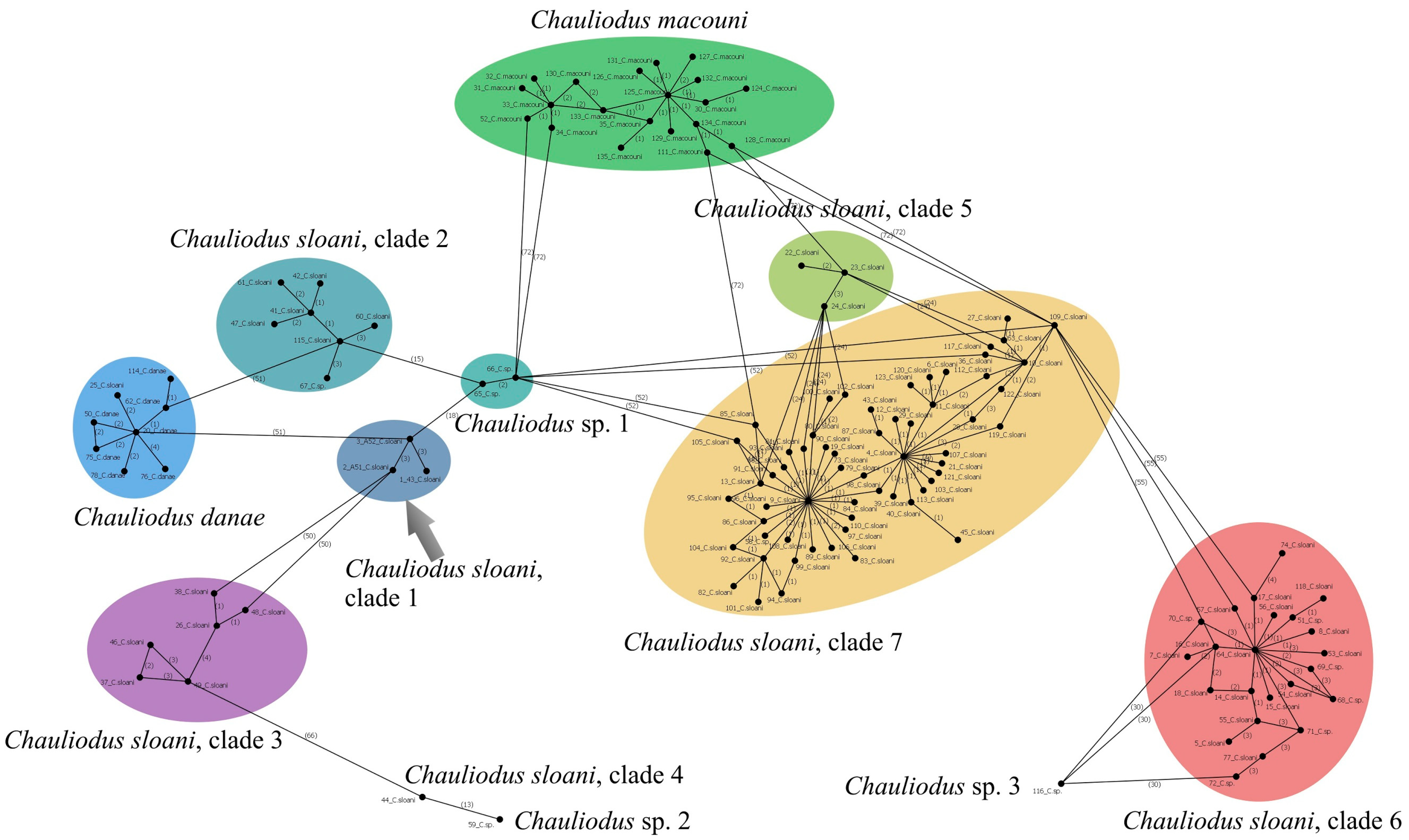
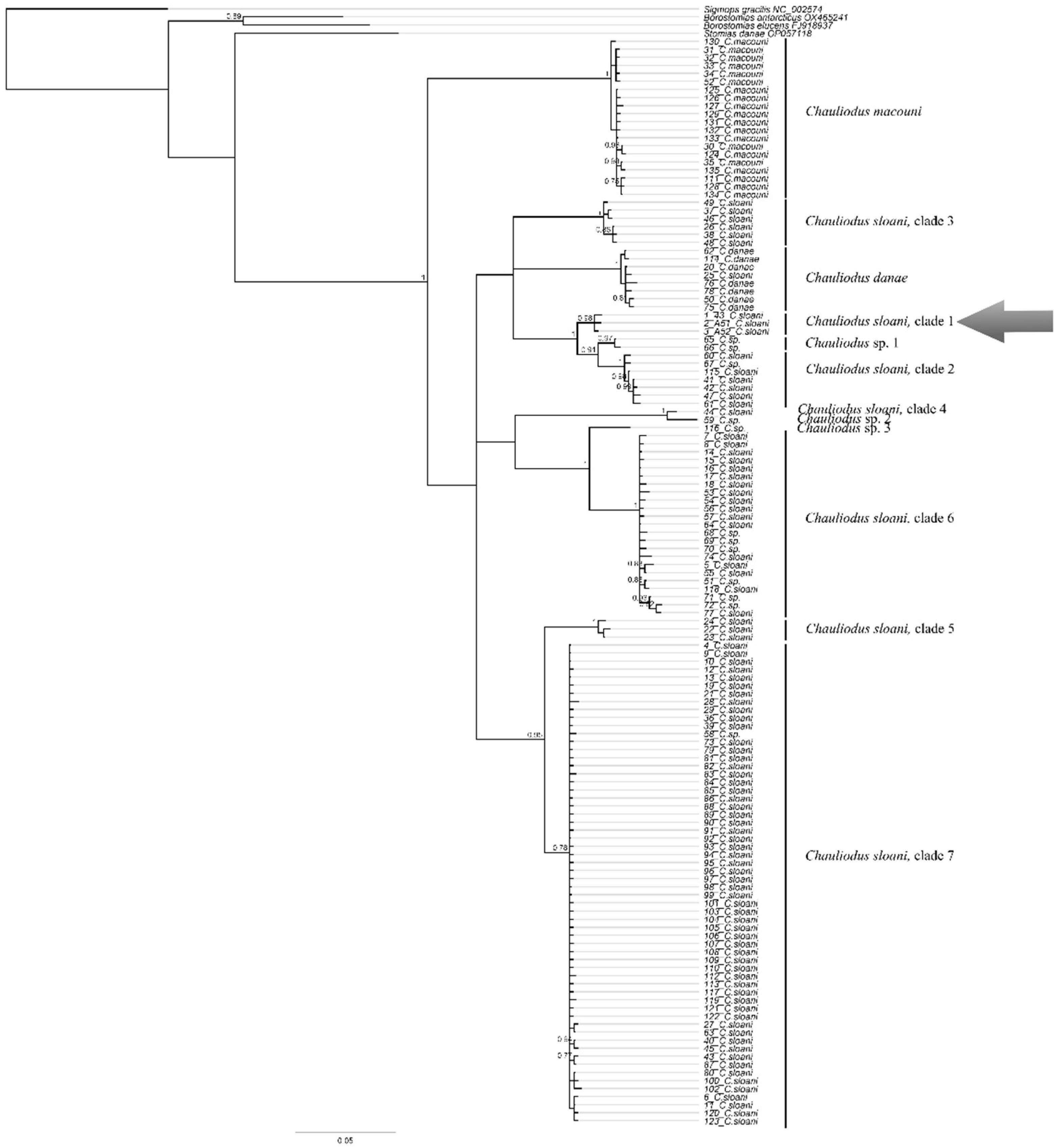
Remarks: Molecular data reveal cryptic diversity within C. sloani complex. Our sequences form a separate lineage, with one of seven clades formed by samples identified as C. sloani (Figure 12 and Figure 13; Supplementary Table S4). Within the other lineages, clade 7 contains a large number of samples throughout the range of C. sloani, including all available samples from the Mediterranean Sea (type locality of C. sloani). Thus, clade 7 represents C. sloani in an strict sense. Clade 6 is restricted in distribution to the northwestern Atlantic Ocean and the Caribbean Sea, being sympatric or parapatric with clade 7. The name C. atlantis Barbour, 1942 is referable either to clade 6 or 7. Clades 3 and 5 are known from the Southern Hemisphere (probably circumglobally). The name C. dannevigi McCulloch, 1916 may belong either to clades 3, 5, or 7. Clade 2 includes the samples from off Taiwan, Mozambique, and Australia. The names C. dentatus Garman, 1899 (type locality: Society Islands) and C. sloanei secundus Ege, 1948 (type locality: northwards of Samoa) are referable either to clade 2 or 7. However, the morphological differences between all these lineages are uncertain, and the original definitions of the aforementioned nominal species are unsatisfactory.
Furthermore, Chauliodus danae Regan et Trewavas, 1929 and C. macouni Bean, 1890 form independent and unambiguously defined clades, and several samples not identified to the species level in the NCBI and BOLD Systems databases are also genetically distinct and are defined herein as Chauliodus sp. 1 (South China Sea), sp. 2 (East China Sea off Taiwan), and sp. 3 (southwestern Indian Ocean off Mozambique) (Figure 12). By geographical localities, none of these unidentified species can be assigned to the species not represented in the databases: C. barbatus Garman, 1899 (eastern Pacific), C. minimus Parin et Novikova, 1974 and C. schmidti Ege, 1948 (Atlantic), C. pammelas Alcock, 1892 (Arabian Sea and Bay of Bengal, confined to the Red Sea Intermediate Water Mass), and C. vasnetsovi Novikova, 1972 (southeastern Pacific). Most likely, these unidentified species also belong to the C. sloani complex. The Bayesian analysis indicates that the C. sloani complex is not monophyletic if C. danae is included (Figure 13).
Local distribution: Reported for Yomei, Kimmei, and Milwaukee Seamounts [15]. Mundy [17] indicated species range in the area from O‘ahu to Koko Seamount. New records for Ojin and Jingu Seamounts.
General distribution: Panoceanic, but absent from the least productive and poorly oxygenated areas. Presumably mesopelagic, but reported from near surface to 4700 m [17,92].

3.12.2. Eustomias (Biradiostomias) securicula Prokofiev et Orlov, 2022

Voucher specimens: IORAS P.03636, 1 (130), station 109.
Diagnosis: Two pectoral fin rays. Terminal expansion of mental barbel leaf-like, with a single bulb in distal third of its length; bulb with a small nipple-like terminal appendage having a pigmented patch at the base; ventral margin of bulb sharp. No defined dorsal pigment spots. Vertebrae 68.
Identification sources: [25] (p. 239).
Local distribution: Ojin Seamount.
General distribution: Known only by holotype at fishing depths of 1300–0 m.

3.12.3. Melanostomias valdiviae Brauer, 1902

Voucher specimens: IORAS P.05051, 1 (195), DNA no. 86, station 108.
Diagnosis: No isolated pectoral fin rays. Terminal expansion of mental barbel leaf-like, unpigmented, with three large ovoid luminous bodies inside.
Identification sources: [116] (p. 82); Aizawa in [33] p. 337).
Local distribution: Annei Seamount (new record). Mundy [17] reported a specimen collected northeast of the Hawaiian Islands (31°40′ N, 152°13′ W) at a fishing depths of 1–3274 m.
General distribution: Worldwide in tropical and subtropical waters. Meso- or bathypelagic at 40–1600 m [17].

3.12.4. Opostomias mitsuii Imai, 1941 (Figure 11C)

Voucher specimens: IORAS P.05069, 1 (328), DNA no. 13, station 110.
Diagnosis: Pectoral fin with a long, isolated ray bearing a luminous body at the tip. First tooth of lower jaw piercing the upper jaw. Barbel ending into luminous bulbs with filaments arising from bulbs and stem.
Identification sources: Aizawa in [33] (p. 334).
Remarks: COI sequences from our specimen show 2.16% genetic divergence from barcoded specimen obtained at 43°57′ N, 125°50′ W (SIO 11-154; NCBI Accession Numbers NC_082548/OR482452). This is much higher than established within the only other member of the genus, O. micripnus Günther, 1887 (0.2–1.1%), and may indicate the existence of independent populations within O. mitsuii.
Local distribution: Jingu Seamount (new record). Reported for Suiko and Yomei Seamounts [15] and for Hancock Seamounts [17].
General distribution: Trans-Pacific from Japan to the Gulf of Alaska and California. Mesopelagic, with depth range unspecified [17]. Our record occurred at 820 m depth.

3.12.5. Idiacanthus antrostomus Gilbert, 1890

Voucher specimens: IORAS, uncatalogued (badly damaged): 1 (330), station 107; 1 (370), station 108; 2 (290–350), station 109.
Diagnosis: Dorsal fin rays 53–68, anal fin rays 28–43 (usually 34–39). Pelvic fins inserted below 3 to 9 (usually 5–7) dorsal fin ray; pelvic-anal distance longer than anal fin base length (females). Photophores in series: IV 34–40, VAV 20–24, AC 16–20, OV 23–27, VAL 31–38, OA 58–62.
Identification sources: [117] (p. 178); Aizawa in [33] (p. 346).
Local distribution: Annei and Ojin Seamounts. Reported for Yomei, Kimmei, and an unnamed seamount at 43°18′ N, 170°00′ E [15]. Mundy [17] indicated the southernmost record of I. antrostomus as Jingu Seamount, but noted that it can be expected at the Hancock Seamounts (in winter) and Johnston Atoll.
General distribution: North Pacific southwards to equatorial waters [117], 500–2000 m.

3.12.6. Malacosteus niger Ayres, 1848 (Figure 11D)

Voucher specimens: IORAS P.05040, 1 (225), station 109.
Diagnosis: Jaws enormous, much longer than skull, with no membrane between lower-jaw rami; mental barbel absent. Suborbital photophore very large. Pectoral fin present. Serial photophores absent.
Identification sources: [118] (p. 889).
Local distribution: Ojin Seamount (new record). Reported for Milwaukee Seamounts [15]. Mundy [17] indicates species range in the area between O‘ahu and Milwaukee Seamounts.
General distribution: Cosmopolitan from Arctic latitudes southwards to approximately 30° S [118]. Meso- and bathypelagic, 0–3886 m [14], usually 890–1450 m [92,119,120].

3.13. Family Paraulopidae

Paraulopus filamentosus (Okamura, 1982) (Figure 11E)

Voucher specimens: IORAS P.05017, 2 (117–120), station 103.
Diagnosis: Scales above lateral line 2.5 (rarely 3.5), scales below 2.5. Supraocular ridges absent. Dorsal fin rays 11, second and third rays filamentous. Caudal fin with black posterior margin on upper lobe. Vertebrae 42–44.
Identification sources: [121] (p. 167); [21] (p. 24)
Local distribution: Koko and Milwaukee Seamounts [16]. Reported for the Emperor Seamounts without specified localities [21,121].
General distribution: Kyushu-Palau and Emperor Seamounts at depths of 270–450 m.

3.14. Family Chlorophthalmidae

Chlorophthalmus imperator Fujiwara, Wada et Motomura, 2019 (Figure 11F)

Voucher specimens: IORAS P.05011, 3 (145–175), DNA nos. 48 and 50, station 102; IORAS P.05025, 1 (113), station 105.
Diagnosis: Outermost lower-jaw tooth patches extend beyond the lower-jaw profile, possessing large thorn-shaped teeth. Lower-jaw symphysis with two blunt projections. Lateral line scales 49–51, 6 scale rows above lateral line, 22–25 (modally 22) gill rakers on first arch. No teeth on tongue. Head length 26.7–28.9%, predorsal length 34.2–36.6%, snout length 6.9–7.7%, eye diameter 11.9–12.9%, anus to anal fin origin 27.3–29.9% SL. Dorsal fin unpigmented.
Identification sources: [122] (p. 397); [21] (p. 24).
Local distribution: Koko, Daikakuji, and Kammu Seamounts [122].
General distribution: Endemic to the Emperor Seamounts; depth range 349–605 m.

3.15. Family Scopelarchidae

Benthalbella infans Zugmayer, 1911 (Figure 14A)
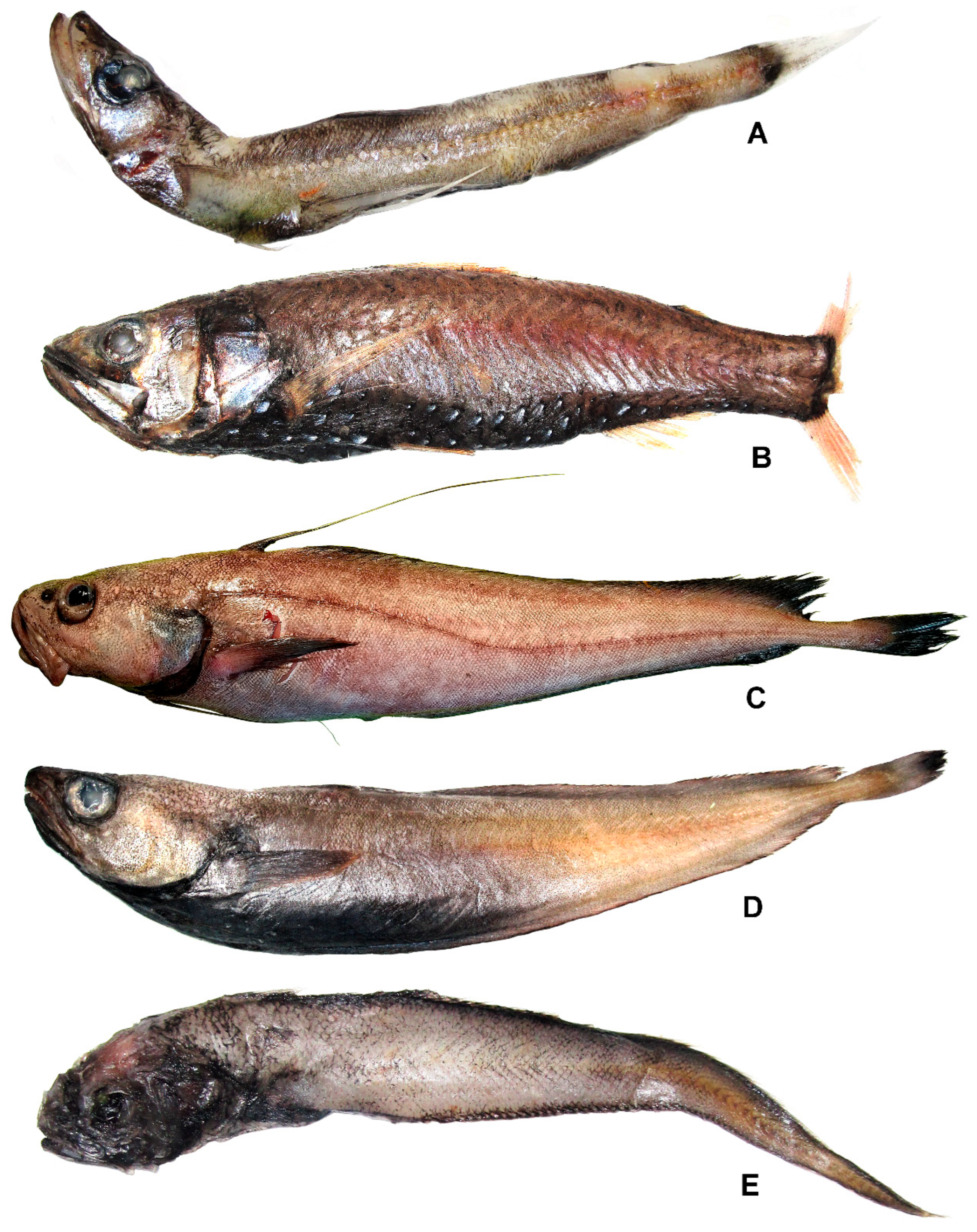
Voucher specimens: IORAS P.05041, 3 (95–150), station 107; IORAS P.05052, 1 (124), station 108.
Diagnosis: Lingual teeth restricted to basihyal. Pectoral fins shorter than pelvic fins, with 25–28 rays. Pelvic fins inserted in advance of dorsal fin origin. Adipose fin inserted before posterior end of anal fin base. Anal fin rays 20–25. Lateral line scales 55–59. Longitudinal pigment stripes absent.
Figure 14. Fish species collected during 2019 cruise of R/V Professor Kaganovsky over Emperor Seamounts. All specimens were photographed in fresh condition. (A) Benthalbella infans, 124 mm SL, IORAS P.05052; (B) Neoscopelus gr. macrolepidotus, 210 mm SL, IORAS S.0114; (C) Lepidion inosimae, 470 mm SL, IORAS P.05042; (D) Physiculus cynodon, 210 mm SL, IORAS P.05026; (E) Melanonus zugmayeri, 124 mm SL, IORAS M.00111. Not to scale.
Jmse 14 00063 g014
Identification sources: [123] (p. 76); [33] (p. 375).
Local distribution: Annei Seamount (new record). Mundy [17] indicates species range in the area from O‘ahu to the Hancock Seamounts.
General distribution: Circumglobal in tropical and subtropical waters. Mesopelagic, 200–1800 m [17].

3.16. Family Neoscopelidae

Neoscopelus cf. macrolepidotus Johnson, 1863 (Figure 14B)

Voucher specimens: IORAS S.0114, 6 (162–210), DNA nos. 127 and 128, station 108.
Diagnosis: Lateral series of photophores single, not extending beyond anal fin origin.
Identification sources: [124] (p. 6); [33] (p. 377).
Remarks: The systematics of Neoscopelus need revision. Differences between the Atlantic, Japanese, and Hawaiian populations were already discussed [124,125]. If N. macrolepidotus represents a complex of species, the available name for the North Pacific populations should be N. alcocki Jordan et Starks, 1904 (type locality: Suruga Bay), but relationships between fishes from Japan and the Emperor and Hawaiian Ridges require further study.
Local distribution: Annei Seamount (new record). Reported for Milwaukee Seamounts [64,126]. In the Hawaiian Ridge, known from Hawai‘i Island to the Hancock Seamounts [17].
General distribution: Atlantic and Indo-West Pacific eastwards to the Nazca and Sala-y-Gomez Seamounts. Occurs over continental and insular slopes and seamounts at depths of 300–1120 m [17].

3.17. Family Myctophidae

Remarks: The lanternfishes are mostly pelagic inhabitants and are outside of the target species of the conducted trawl survey. Belyaev and Darnitskiy [18] listed 58 species of lanternfishes for the Hawaiian and Emperor Ridges, although some of the listed names are currently invalid and some others are undoubtedly misidentifications. Twelve species were collected over the Emperor Seamounts in 2019: Diaphus balanovi Prokofiev et al., 2022; D. kuroshio Kawaguchi et Nafpaktitis, 1978; D. metopoclampus (Cocco, 1829); Electrona risso (Cocco, 1829); Lampadena urophaos Paxton, 1963; Lampanyctus fernae Wisner, 1971; L. jordani Gilbert, 1913 and an unidentified (possibly new) species of L. tenuiformis-festivus complex; Myctophum sp.; Notoscopelus resplendens (Richardson, 1845); Symbolophorus californiensis (Eigenmann et Eigenmann, 1889); and four badly damaged specimens probably belonging to the Ceratoscopelus warmingii complex [127]. Of these species, only D. balanovi (described by specimens collected during the 2019 cruise) is an apparently obligatory benthopelagic species and endemic to the Emperor Seamounts [23]. All other species are mesopelagic (but uncertain for an unidentified Lampanyctus as no biological data are known for it). However, at least the members of Diaphus, E. risso, and L. urophaos may facultatively be incorporated into the benthopelagic community [128]. Diaphus kuroshio, L. fernae, L. jordani, and S. californiensis have a restricted North Pacific distribution, while the other collected species are known from the all oceans [128]. At least N. resplendens and S. californiensis may represent the species complex (Prokofiev, unpublished). A detailed account for the family Myctophidae is outside the scope of the current paper, as this study requires a wide comparative analysis of the extralimital materials and will be published elsewhere.

3.18. Family Moridae

3.18.1. Lepidion inosimae (Günther, 1887) (Figure 14C)

Voucher specimens: IORAS P.05042, 1 (470), DNA no. 53, station 107.
Diagnosis: Vomerine tooth patch rounded. Gill rakers on first arch 3–5 + 8–12 = 11–17. Second dorsal, anal, and pectoral fin rays 55–60, 48–55 and 21–23, respectively. First dorsal and outer two pelvic fin rays filamentous; pelvic fin rays 7. Vertical scale rows 250–260. Vertebrae 57–59. Head length 23.4–24.1%, eye diameter 5.0–5.3% SL. Light organ absent.
Identification sources: [129] (p. 42); [130] (p. 59); [33] (p. 409); [131] (p. 576); [21] (p. 36).
Local distribution: Annei Seamount (new record). Reported for Jingu and Koko Seamounts [15,129].
General distribution: Pacific coast of Japan (Sagami and Suruga Bays, southern Goto Is., Ramapo Bank), Emperor Seamounts, Hawaii, Tasman Sea, Indian Ocean at depths of 580–1100 m.

3.18.2. Physiculus cynodon Sazonov, 1986 (Figure 14D)

Voucher specimens: IORAS P.05001, 1 (110), station 101; IORAS P.05026, 6 (210–268), station 105.
Diagnosis: Upper jaw with an outer series of large canines and an inner series of 3–4 rows of villiform teeth, lower jaw with a single series of large canine teeth. Scales in longitudinal series about 200. Vertebrae 54–59. Light organ present, placed closer to anus than interventral line.
Identification sources: [66] (p. 305); [39] (p. 108); [21] (p. 36).
Local distribution: Collected at Koko, Annei and Ojin Seamounts in 2019 (voucher specimens from Annei and Ojin Seamounts were not retained). Described from Colahan and Milwaukee Seamounts [66]. Reported for Kimmei and Milwaukee Seamounts [15] (as P. maximowiczi). According to [16] (listed as P. japonicus), the distribution occurs from Annei Seamount southwards to Akademik Berg Seamount (28°50′ N, 178°53′ W, northwestern Hawaiian Ridge), and has been confirmed recently [58].
General distribution: Endemic to the Emperor Seamounts and Hawaiian Ridge at depths of 350–530 m [17,21].

3.19. Family Melanonidae

Melanonus zugmayeri Norman, 1930 (Figure 14E)

Voucher specimens: IORAS M.00111, 1 (124 mm SL), station 107.
Diagnosis: Body tapered to a very narrow caudal peduncle. Head with parallel ridges bearing neuromasts. Mouth large, terminal; jaw teeth needle-like. Dorsal and anal fins long, anterior-most portion of dorsal fin forming separate lobe. Body uniformly brownish.
Identification sources: [33] (p. 412).
Local distribution: Annei Seamount. New record for the area. Reported from Pearl and Hermes Reef to the Hancock Seamounts in the Hawaiian Islands [17].
General distribution: Worldwide in the tropical and subtropical waters. Meso- and bathypelagic, 100–3000 m [17].

3.20. Family Macrouridae

3.20.1. Bathygadus antrodes (Jordan et Gilbert, 1904)

Voucher specimens: IORAS M.00109, 1 (163), DNA no. A7, station 109.
Diagnosis: Barbel absent. Cranial bones thin, fragile. Interorbital space broad, 28–40, usually more than 30% of head length. Pectoral fin rays 12–16; second ray in first dorsal and pectoral fin and first ray in pelvic fin filamentous. Gill rakers on first arch 26–31. Pyloric caeca 10–18.
Identification sources: [132] (p. 191); [67] (p. 150).
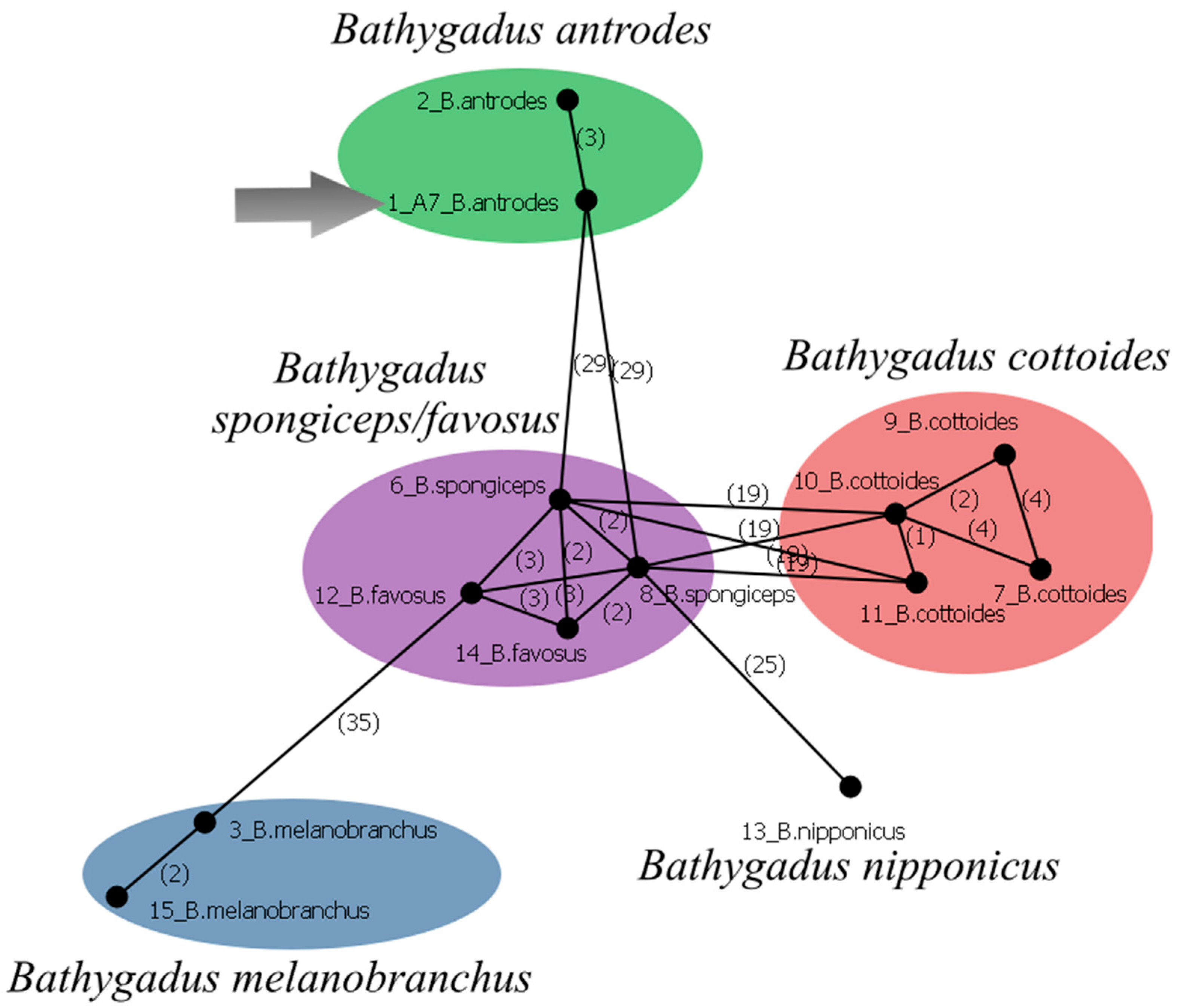
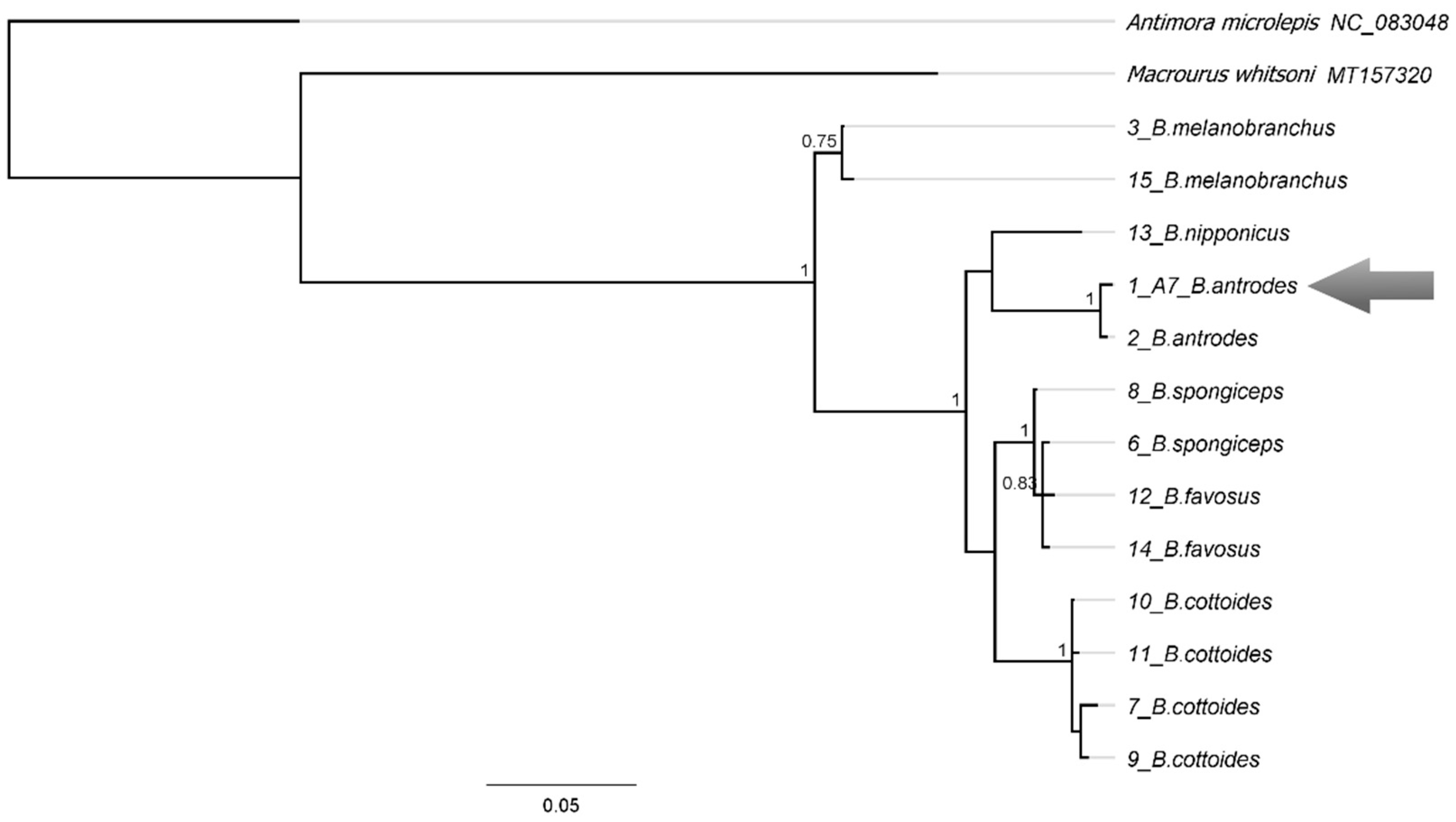
Remarks: Differences of this species from the Hawaiian endemic B. bowersi (Gilbert, 1905) are uncertain, both could be conspecific. Hoshino et al. [21] listed the latter species for the Emperor Seamounts without explanation. Within the characteristics mentioned by various authors [132,133,134] to distinguish B. bowersi from B. antrodes, perhaps one is reliable: the lack of filamentous extension of the fin rays in B. bowersi in contrast to B. antrodes. Our specimen, although badly damaged, possesses the greatly extended second pectoral fin ray, agreeing with B. antrodes. It has a unique haplotype close to a previously known haplotype only referred to B. antrodes (AP008988/NC_008222, no locality data) (0.5% of genetic divergence) on the 552 bp network (Figure 15 and Figure 16; Supplementary Table S5).
Local distribution: Ojin Seamount (new record). Formerly reported for Nintoku Seamount [67].
General distribution: Pacific coast of southern Japan and the Emperor Seamounts at depths of 792–1200 m.

3.20.2. Coelorinchus matsubarai Okamura, 1982 (Figure 17A)
Voucher specimens: IORAS M.00109-001–005, 5 (270–280+), DNA nos. 7–11, station 101.
Diagnosis: Head with coarse spinulated ridges, snout ending in a pointed diamond-shaped scute. Luminous organ long, extending from throat to anus. Second dorsal fin as high as anal fin. Isolated suprapectoral spot present. Snout incompletely supported by bone, 2.1–2.7 times in head length; upper jaw as long as eye; mouth cavity grayish.
Identification sources: [135] (p. 67); [136] (p. 135); [137] (p. 105); [138] (p. 132).
Figure 17. Fish species collected during 2019 cruise of R/V Professor Kaganovsky over Emperor Seamounts. All specimens were photographed in fresh condition. (A) Coelorinchus matsubarai, 270+ mm TL, IORAS M.00109-001; (B) Nezumia obliquata, 345+ mm TL, IORAS M.00107-002; (C) Nezumia cf. proxima, 340+ mm TL, IORAS M.107-001; (D) Lophiodes bruchius, 235 mm SL, IORAS P.05002; (E) Bertella idiomorpha, 60 mm SL, IORAS P.05043. Not to scale.
Jmse 14 00063 g017
Local distribution: Reported from Koko, Kimmei, Milwaukee, and Colahan Seamounts [17,67,135]. Mundy [17] anticipated record of this species at the Hancock Seamounts. A specimen housed in the IORAS collection (M.00141) originates from the “Hawaiian area”. However, without more precise data, it most likely was obtained from the northwestern Hawaiian Ridge in the 1970–80s.
General distribution: Endemic to the Kyushu-Palau, southern Emperor, and northwestern Hawaiian Ridges; depth range: 280–600 m.

3.20.3. Nezumia obliquata (Gilbert, 1905) (Figure 17B)

Voucher specimens: IORAS M.00107-002–003, 2 (340–345+ mm TL), DNA nos. 23 and 24, station 107.
Diagnosis: Light organ lens-like, situated immediately behind pelvic fin bases. Pelvic fin rays 11–13. Scales between first dorsal fin origin and lateral line 8–9. Spinules on flank scales narrowly lanceolate. Underside of snout scaleless. Terminal snout scute blunt, spinulose. Jaw teeth in narrow bands, outermost teeth enlarged.
Identification sources: [136] (p. 260); [67] (p. 152); [21] (p. 32).
Local distribution: Annei Seamount (new record). Reported from Jingu Seamount [67]. Type locality: Kaua’i in Hawaiian Islands [133].
General distribution: Endemic to the Emperor–Hawaiian Seamount Chain. Bathymetric range: 799–1400 m [17,67].

3.20.4. Nezumia cf. proxima (Smith et Radcliffe, 1912) (Figure 17C)

Voucher specimens: IORAS M.00107-001, 1 (340+ mm TL), DNA no. 25, station 107.
Diagnosis: Light organ lens-like, situated immediately behind pelvic fin bases. Pelvic fin rays 8–10. Scales between first dorsal fin origin and lateral line 7.5–10. Spinules on flank scales lanceolate to shield-shaped. Underside of snout largely scaleless. Terminal snout scute blunt, spinulose. Jaw teeth in broad tapered bands, outermost teeth enlarged.
Identification sources: [136] (p. 258); [137] (p. 250).
Remarks: In most features, our specimen agrees well with characteristics of this species provided by [137]; however, it is different in the pronounced sensory pores in the infraorbital and mandibular canals. Nakayama [137] also noted an untypical specimen from Japanese waters. On these grounds, we only tentatively identify our specimen. Hoshino et al. [21] listed N. spinosa (Gilbert et Hubbs, 1916) for the Emperor Seamounts. A brief description and a photograph (not of adequate resolution) provided by [137] coincide with characteristics of both N. proxima and N. spinosa; thus, the presence of the latter species across the Emperor Seamounts requires confirmation. Nezumia spinosa differs from N. proxima primarily by its needle-like (vs. broad) spinules on the body scales [139].
Local distribution: Annei Seamount. First record for the area.
General distribution: Japan and the Philippines; depth range: 507–1010 m.

3.20.5. Squalogadus modificatus Gilbert et Hubbs, 1916

Voucher specimens: Not retained. A piece of flesh from station 109, identified by DNA barcoding, DNA no. A18.
Diagnosis: Body tadpole-shaped, head greatly inflated. One continuous dorsal fin, anterior portion not elevated. Pelvic fin with 5 rays.
Identification sources: At 552 bp, this sequence is identical to the sequences AP008989/NC_008223 (no locality data), CBPM168-11 (Mexico), and FMVIC060-07 (Australia) obtained from the NCBI and BOLD Systems databases.
Local distribution: Ojin Seamount. First record for the area.
General distribution: Worldwide in tropical to subtropical waters, depth about 800–2110 m [140].

3.21. Family Lophiidae

Lophiodes bruchius Caruso, 1981 (Figure 17D)

Voucher specimens: IORAS P.05002, 1 (235), DNA no. 56, station 101.
Diagnosis: Head and body depressed. Anterior end of gill slit extending dorsally over origin of pectoral fin. Third dorsal fin spine very long, 43.7–59.2% SL. Esca at tip of illicium leaf-like, distally dark; illicium pale.
Identification sources: [141] (p. 539); [21] (p. 63).
Local distribution: Koko Seamount. First reported for the Emperor Seamounts by [19], and later by [21], both without more precise data. According to [17], this species co-occurs with L. miacanthus (Gilbert, 1905) in the southern Emperor Seamounts (from Koko to Hawai’i), but Hoshino and Sawada [20] doubted the correct identification of specimens. Lophiodes miacanthus was reported by [16] for Milwaukee, Colahan, C-H, and NW Hancock Seamounts and by [64] for Milwaukee Seamounts. At least some of these records might belong to L. bruchius. The type locality of L. bruchius is off Maui Island, Hawaiian Islands [141].
General distribution: Hawaiian Islands, Emperor and Kyushu-Palau Ridges, Marquesas Islands, and Indonesia. Bathymetric range: 274–410 m.

3.22. Family Oneirodidae

Bertella idiomorpha Pietsch, 1973 (Figure 17E)

Voucher specimens: IORAS P.05043, 1 (60), DNA no. 100, station 107.
Diagnosis: Dorsal contour of frontal bones convex. Sphenotic spines present. Subopercle long and narrow. Hyomandibula with a single head. Pectoral fin lobe short. Esca with a single short unpigmented posterior appendage.
Identification sources: [142] (p. 193); [143] (p. 786); [144] (p. 611).
Local distribution: Annei Seamount. New record for the area.
General distribution: North Pacific (northwards to 55° N) and eastern tropical Pacific [143,144]. Meso- and bathypelagic at a fishing depth of 0–3475 m [92].

3.23. Family Linophrynidae

Linophryne arborifera Regan, 1925 (Figure 18)
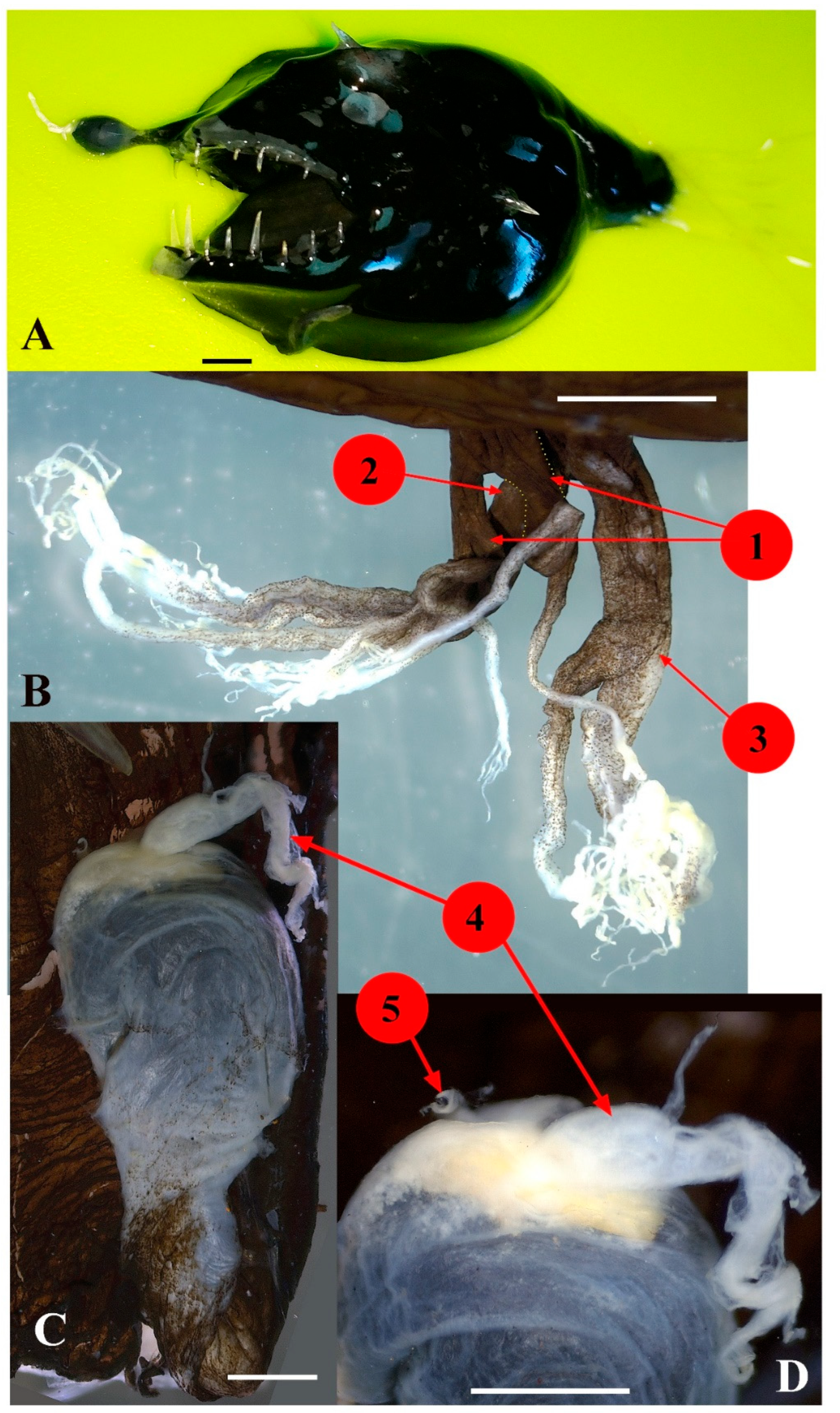
Voucher specimens: IORAS P.05053, 1 (42), station 108 (Figure 18A).
Diagnosis: Hyoid barbel divided at base into four main branches, with no median main branch between anterior pair (Figure 18B). Esca with a single slender distal appendage pointed at the tip; lateral appendages absent (Figure 18C,D). Symphysial spine on lower jaw absent.
Figure 18. Linophryne arborifera, IORAS P.05053, 42 mm SL. (A) fresh specimen; (B) hyoid barbel; (C) esca; (D) appendages of esca. Captions: (1) anterior main branches (left and right); (2) intermediary main branch; (3) posterior main branch; (4) distal appendage; (5) posterior appendage. Scale bars: (A) 4 mm; (B) 1.5 mm; (C) and (D) 1 mm.
Jmse 14 00063 g018
Identification sources: [37] (p. 50); [143] (p. 974).
Local distribution: Annei Seamount. New record for the area.
General distribution: This species was formerly known only from the Atlantic Ocean between 40° N and 20° S [37,143]. Our specimen is a first record of that species outside the Atlantic. This species may therefore have a panoceanic distribution common for many bathypelagic fishes. Meso- and bathypelagic at depths of 200–1000 m [143].

3.24. Family Centriscidae

Macroramphosus gracilis (Lowe, 1839) (Figure 19A)
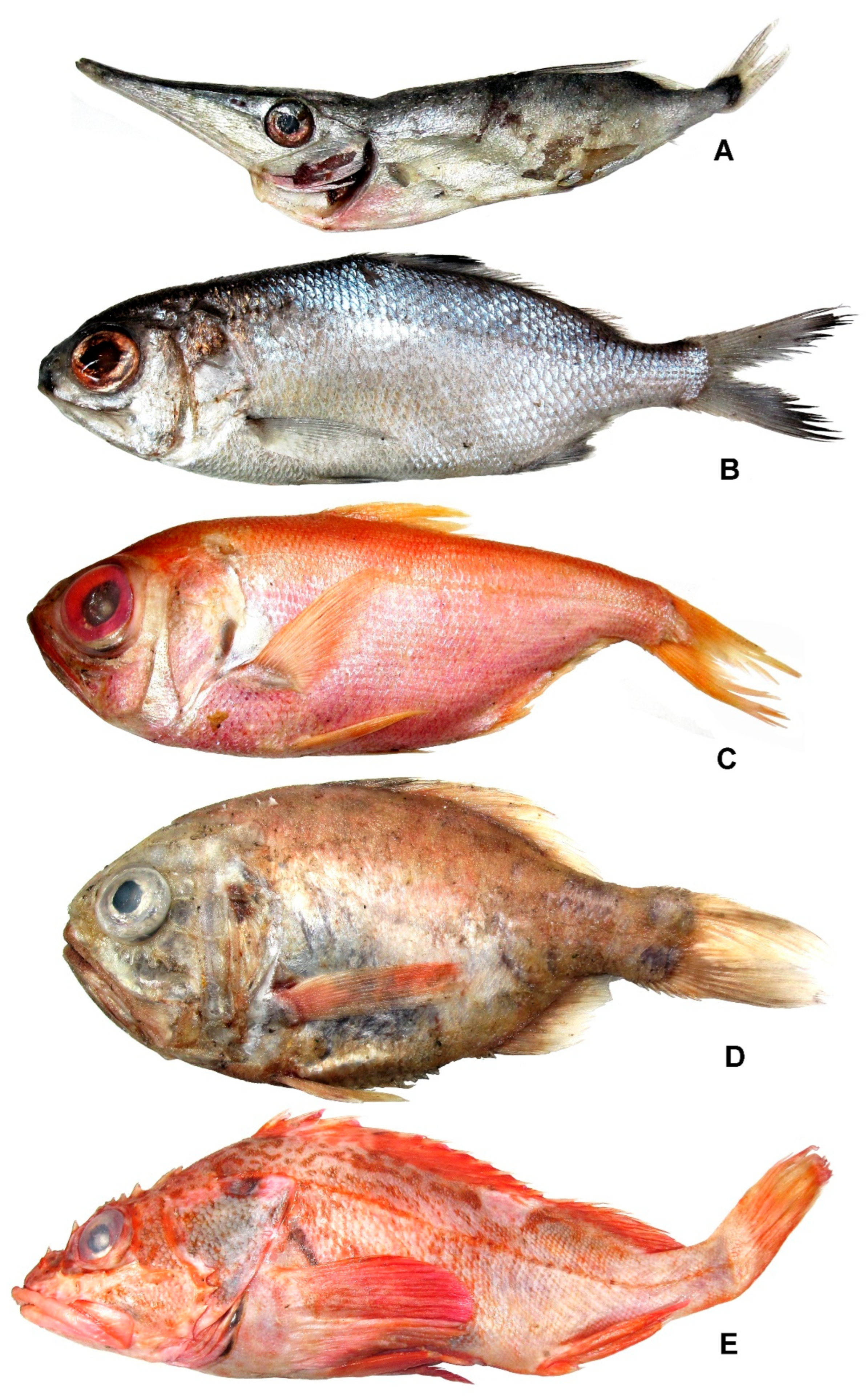
Voucher specimens: IORAS P.05021, 1 (73), DNA no. 5, station 104.
Figure 19. Fish species collected during 2019 cruise of R/V Professor Kaganovsky over Emperor Seamounts. All specimens were photographed in fresh condition. (A) Macroramphosus gracilis, 73 mm SL, IORAS P.05021; (B) Polymyxia sp., 132 mm SL, IORAS P.05027; (C) Beryx splendens, 190 mm SL, IORAS P.05012; (D) Hoplostethus crassispinus, 190 mm SL, IORAS P.05004; (E) Adelosebastes latens, 250 mm SL, IORAS P.05055. Not to scale.
Jmse 14 00063 g019
Diagnosis: Body of characteristic shape (Figure 19A). Body depth 4.5–5.4 times in SL (5.0 in the studied specimen). Second spine of dorsal fin not reaching caudal fin base when depressed. Ventral body profile almost straight, with no scutes between pelvic and anal fins.
Identification sources: [145] (p. 58); [21] (p. 42).
Local distribution: Koko Seamount (first confirmed record). Probably M. gracilis was not separated from M. scolopax (Linnaeus, 1758) by [16], who reported the latter species for the Kimmei and Colahan Seamounts and northwestern Hawaiian Ridge. Mundy [17] provided the Hawaiian records of M. gracilis from Hawai’i Island to Laysan only. Hoshino et al. [21] indicated this species for the Emperor Seamounts without specified localities.
General distribution: Worldwide in temperate to tropical waters at depths of 50–620 m [17,21].

3.25. Family Polymixiidae

Polymixia sp. (Figure 19B)

Voucher specimens: IORAS P.05003, 5 (117–172), station 101; IORAS P.05027, 4 (113–132), station 105.
Remarks: Our specimens belong to the same species as Polymixia cf. berndti Gilbert, 1905 mentioned by [21]. They are most similar to P. berndti as defined by [146,147,148], but differ considerably in having higher counts of soft dorsal fin rays (34–36 vs. 28–32), pectoral fin rays (17–18 vs. 15–17, rarely 17 in P. berndti), and developed rakers on the lower half of the first arch (usually 9 or 10, 8 in 1 of 9 specimens vs. 7–8, angular raker excluded). Although [146,147,148] did not study specimens from the type locality (Hawaiian Islands), his data are more similar to those of the type specimens provided by [107] (dorsal fin soft rays 30, pectoral fin rays 16 or 17; gill rakers 4 + 9, i.e., 4 + 1 + 8) than to our specimens. Kotlyar [146,147,148] paid much more attention to the arrangement of the spinules on the exposed surface of the flank scales, but in our specimens, it shows a great variation from specimen to specimen and between the different areas on the flank of the same specimen. In addition, two fishes from station 101 are somewhat different from the rest of the specimens in their darker pigmentation of the body and more harsh spinulation of the scales. Most probably this is an undescribed species, but further research is required.
Identification sources: [146] (p. 701); [148] (p. 75); [21] (p. 26).
Local distribution: Koko Seamount.
General distribution: Probably endemic (if distinct); depth range: 320–460 m [21].

3.26. Family Melamphaidae

Scopeloberyx malayanus (Weber, 1913)

Voucher specimens: IORAS P.05054, 1 (67), station 108.
Diagnosis: Crests on head smooth, ethmoidal spine absent. Dorsal fin rays ii–iii + 10–12. Gill rakers on first arch 16–18 (rarely 16, 17 in the studied specimen). Scales in lateral series 29–33, predorsal scales 8–10. Pectoral–pelvic distance 0.5–5.9% SL.
Identification sources: [149] (p. 725).
Local distribution: Annei Seamount. New record for the area.
General distribution: Tropical and subtropical Indo-West Pacific. Meso- and bathypelagic at 150–3500 m fishing depths.

3.27. Family Berycidae

Beryx splendens Lowe, 1834 (Figure 19C)

Voucher specimens: IORAS P.05012, 1 (190), station 102; IORAS P.05028, 2 (160–215), station 105.
Diagnosis: Body depth 2.5–3.5 times in SL. A single (preorbital) spine on head. A pad on inner free margin of scale present, posterior edge of each scale on dorsal side of body smooth. Dorsal fin rays III–IV,12–15; anal fin rays IV,25–30; pelvic fin rays I,10–13 (usually 11); pyloric caeca 23–34 (mean 27).
Identification sources: [148] (p. 100); Hayashi in [33] (p. 486); [21] (p. 38).
Local distribution: Reported from Koko Seamount to the northwestern Hawaiian Ridge [15,16,17,64].
General distribution: Cosmopolitan in tropical and temperate waters except for the eastern North Pacific; 10–1240 m, usually below 160 m [17,21].

3.28. Family Trachichthyidae

Hoplostethus crassispinus Kotlyar, 1980 (Figure 19D)

Voucher specimens: IORAS P.05004, 1 (190), station 101.
Diagnosis: Eye diameter 3.0–3.5 times in head length. Gill rakers on first arch 18–20. Dorsal fin rays VI–VII,12–13. Anal fin rays III–IV,8–9. Pectoral fin reaching beyond abdominal keel, with 15–17 rays. Abdominal keel with 10–15 scutes. Lateral line scales enlarged, lacking medial spine, 28–30 in number. Predorsal scales 21–23. Anus close to anal fin origin. Pyloric caeca 40–50. Body light in preservative (pale reddish-brownish with silvery reflection in life); membranes between dorsal fin spines blackish.
Identification sources: [150] (p. 1054); [148] (p. 152); [21] (p. 37).
Local distribution: Reported from Koko Seamount to “Bank 11” Seamount (28°55′ N, 178°36′ W, northwestern Hawaiian Ridge) [17,150].
General distribution: Seamounts in tropical and subtropical North Pacific, including Kyushu-Palau, Emperor, and Hawaiian Ridges at 160–600 m depths [16,17,21].

3.29. Family Sebastidae

3.29.1. Adelosebastes latens Eschmeyer, Abe et Nakano, 1979 (Figure 19E)

Voucher specimens: IORAS P.05055, 2 (143–250), DNA nos. 134 and 135, station 108.
Diagnosis: Suborbital ridge with spines weak or absent. Dorsal fin rays XII,13; unscaled area adjacent to dorsal fin, tiny scales on back grading into normal scales nearer lateral line; anal fin rays III,5. Pectoral fin slightly bilobed, with 20–22 rays. Body red.
Identification sources: [151] (pp. 78, 80); [47] (p. 538); [152] (p. 97); [21] (p. 54).
Local distribution: Reported for Suiko, Yomei, Nintoku, Jingu, Ojin, Annei, and Koko Seamounts [16,47,62].
General distribution: Emperor Seamounts and Aleutian Islands; depths range: 352–1320 m [16,153,154].

3.29.2. Helicolenus avius Abe et Eschmeyer, 1972 (Figure 20A)
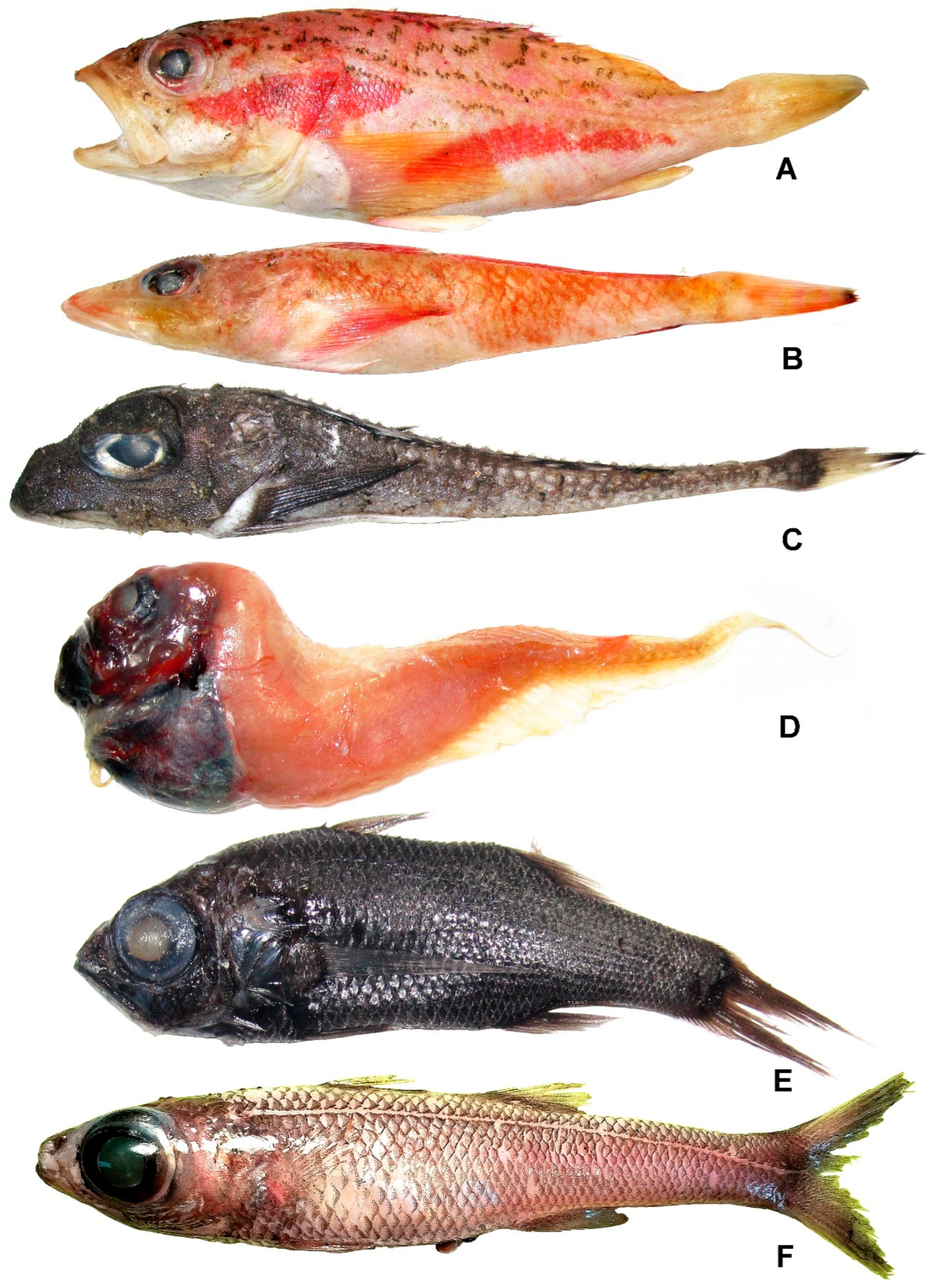
Voucher specimens: IORAS P.05005, 5 (66–190), DNA nos. 137–140, station 101.
Diagnosis: Pair of tooth blocks protruding from anterior tip of upper jaw. Dorsal fin rays XII,13–14; anal fin rays III,6; pectoral fin rays 18–20. Upper half of pectoral fin and caudal fin shallowly emarginated. Pectoral fin axil with dermal flap. Lateral line scales 50–55. Reddish with narrow longitudinal dark lines on dorsal half of body.
Identification sources: [155] (p. 49); [33] (p. 584); [156] (p. 13); [21] (p. 55).
Figure 20. Fish species collected during 2019 cruise of R/V Professor Kaganovsky over Emperor Seamounts. All specimens were photographed in fresh condition. (A) Helicolenus avius, 190 mm SL, IORAS P.05005; (B) Bembradium roseum, 85 mm SL, IORAS P.05013; (C) Marukawichthys pacificus, 170 mm SL, IORAS P.05007; (D) Psednos kaganovskii, 62 mm SL, IORAS P.05062; (E) Howella parini, 95 mm SL, IORAS P.05063; (F) Epigonus denticulatus, 165 mm SL, IORAS P.05008. Not to scale.
Jmse 14 00063 g020
Remarks: According to the haplotype network (548 bp), most samples of the genus Helicolenus, including our specimens, form a single lineage with haplotypes being different from the neighboring ones by a maximum of 7 nucleotide substitutions (1.3% genetic divergence) (Figure 21 and Figure 22; Supplementary Table S6). Thus, this fragment of the COI gene does not allow species identification within Helicolenus.
Local distribution: Annei, Koko, Kimmei, and Milwaukee Seamounts [15,16,17,44,55,157].
General distribution: Endemic to the Emperor Seamounts; depth range 290–1200 m.

3.30. Family Plectrogeniidae

Bembradium roseum Gilbert, 1905 (Figure 20B)

Voucher specimens: IORAS P.05006, 1 (105), station 101; IORAS P.05013, 1 (85), DNA no. 26, station 102; IORAS P.05022, 1 (134), DNA no. 6, station 104; IORAS P.05061, 1 (108), station 109.
Diagnosis: Body slender, cylindrical; head depressed. Infraorbital ridge serrated with many small spines. Dorsal fin rays VIII–IX,12, no spines in second dorsal fin; anal fin rays 10–11; pectoral fin rays 24–27. Reddish dorsally, white ventrally, anal fin with bright-red margin in life.
Identification sources: [33] (p. 614); [21] (p. 58).
Local distribution: Ojin Seamount (new record). Reported for Koko, Milwaukee, and Colahan Seamounts [16]. Mundy [17] reported this species from Hawai‘i Island to Koko Seamount.
General distribution: From southern Japan to Hawaii, Nazca, and Salas-y-Gomez submarine ridges. Bathymetric range: 210–1020 m.

3.31. Family Rhamphocottidae

Marukawichthys pacificus Yabe, 1983 (Figure 20C)

Voucher specimens: IORAS P.05007, 1 (170), station 101.
Diagnosis: Four lowermost pectoral fin rays unbranched and separated from each other. Pelvic fin rays I,4. Interorbital width 3.3–3.8 in snout length. Gill rakers on first arch 15–16. Five preopercular spines. Six rows of spiny scales on body. Chin covered with smooth skin. Body uniformly dark.
Identification sources: [158] (p. 18); [21] (p. 60).
Local distribution: Koko Seamount (Ref. [158] and present study).
General distribution: Endemic to the Emperor Seamounts; depth range: 350–530 m.

3.32. Family Liparidae

Psednos kaganovskii Prokofiev et Orlov, 2025 (Figure 20D)

Voucher specimens: IORAS P.05062, 1 (62), station 109.
Diagnosis: Dorsal fin rays 39, anal fin rays 35, pectoral fin rays 15, notch ray single; vertebrae 47; eye diameter 2.8 in head; gular area keeled; gastrointestinal duct heavily pigmented; three round pectoral radials lacking interradial fenestra, small foramen piercing basal plate in front of scapula. Sole snailfish in the area with hump-backed body (vertebral column strongly flexed anteriorly) and small gill opening.
Identification sources: [26] (p. 273).
Remarks: This is the only known member of the genus in the western and central North Pacific. Interestingly, although Psednos is a rather species-rich lineage of snailfish, its diversity in the subarctic to subtropical western and central Pacific is surprisingly low. Together with the other two diminutive, likely mesopelagic liparid genera, Aetheliparis Stein, 2012 and Menziesichthys Nalbant et Mayer, 1971, this group includes some of 38 described and several undescribed species known circumglobally but being very unevenly distributed. Only M. alaid Prokofiev et Iftime, 2020 was previously described from the western North Pacific from two specimens taken in the Sea of Okhotsk off North Kuriles [159]. The known species of the aforementioned genera are mainly associated with the large frontal currents, viz. Gulf Stream and North Atlantic Drift (14 North Atlantic species), California Current (five northeastern Pacific species), Humboldt Current (two southeastern Pacific species), and Agulhas Current (one species from off southern Africa) [160,161,162]. Most of the Southern Hemisphere species are restricted to the Australian–New Zealand region (12 described and at least 3 unidentified species), all but P. micrurus Barnard, 1927 (off southern Africa), P. carolinae Stein, 2005, P. microps Chernova, 2001, and P. steini Chernova, 2001 (the latter three species are known solely by the holotypes from the southwestern Indian Ocean between ~30 and 35° S and 60–65° E). Almost all southwestern Pacific species are associated with the Subtropical Convergence of waters with a few records northward (to 33° S) or southward (to 54° S). Perhaps the diminutive mesopelagic snailfishes are absent in the high Antarctic latitudes as no collections were made in the rather well-sampled Weddell and Ross Seas [163,164,165]. A single unidentified species was reported from the equatorial Eastern Pacific (Gulf of Panama), which stands out from the general pattern [161]. The new species fits to this distribution pattern well, being associated with the North Pacific Drift. The absence of Psednos records in some areas can be explained by collection bias, as 28 of 38 described species and all unidentified species listed by [161,162,165,166] are each known by a single specimen. However, the mesopelagic ichthyofauna has been rather well-sampled in the western limb of the North Pacific Gyre by the numerous Soviet, Japanese, and other research studies for many decades, and the paucity of Psednos specimens reported from the area may reflect a really low diversity of this group here. The reasons for such an imbalance in the distribution of species are unclear, as the other species-rich liparid genera share a high diversity throughout the North Pacific [167].
Local distribution: Ojin Seamount. New record for the area.
General distribution: Uncertain (probably confined to the North Pacific Gyre). Mesopelagic, fishing depth 1030–0 m.

3.33. Family Howellidae

Howella parini Fedoryako, 1976 (Figure 20E)

Voucher specimens: IORAS P.05044, 7 (85–105), DNA nos. 147, 148, and 150, station 107; IORAS P.05063, 1 (95), DNA no. 36, station 109.
Diagnosis: Lower opercular spine complex. Preopercle spinulose. Single long spine on subopercle, usually surrounded by several short spinules. Vomer and palatines toothless. Scales not deciduous, about 50–55 in lateral series, scales considerably decreasing in size in caudal half. Spinules arranged along posterior margin of scale.
Identification sources: [168] (p. 177); Hatooka in [33] (p. 688).
Local distribution: Annei and Ojin Seamounts (new records). Reported for the Hancock Seamount [168].
General distribution: From Kuril Islands and northern Hokkaido (Japan) to the northern Hawaiian Ridge (Hancock Seamount). Probably benthopelagic; depth range 320–430 m [13,17,169].

3.34. Family Epigonidae

Epigonus denticulatus Dieuzeide, 1950 (Figure 20F)

Voucher specimens: IORAS P.05008, 5 (158–165), DNA no. A100, station 101.
Diagnosis: Opercular spine absent. Gill rakers on first arch 26–34. Dorsal fin rays VII + I,10. Body depth 16–24%, caudal peduncle length 26–32% SL (20–22 and 29–30%, respectively, in the studied specimens). Lateral line scales 49–51 (48–50 in the studied specimens). Pyloric caeca 10–14.
Identification sources: [170] (p. 21); Hayashi in [33] (p. 780); [21] (p. 50).
General distribution: Atlantic (Gulf of Mexico and Caribbean Sea; Mediterranean Sea to South Africa) and Pacific (Japan, Emperor Seamounts, South Australia, and New Zealand) Oceans; 100–830 m.
Local distribution: Koko Seamount [6,29]; Kimmei, Milwaukee, Colahan, and C-H Seamounts [15,16,171]. According to [17], it could occur at the Hancock Seamounts in the northwestern Hawaiian Ridge.

3.35. Family Pentacerotidae

Pentaceros wheeleri (Hardy, 1983) (Figure 23A)
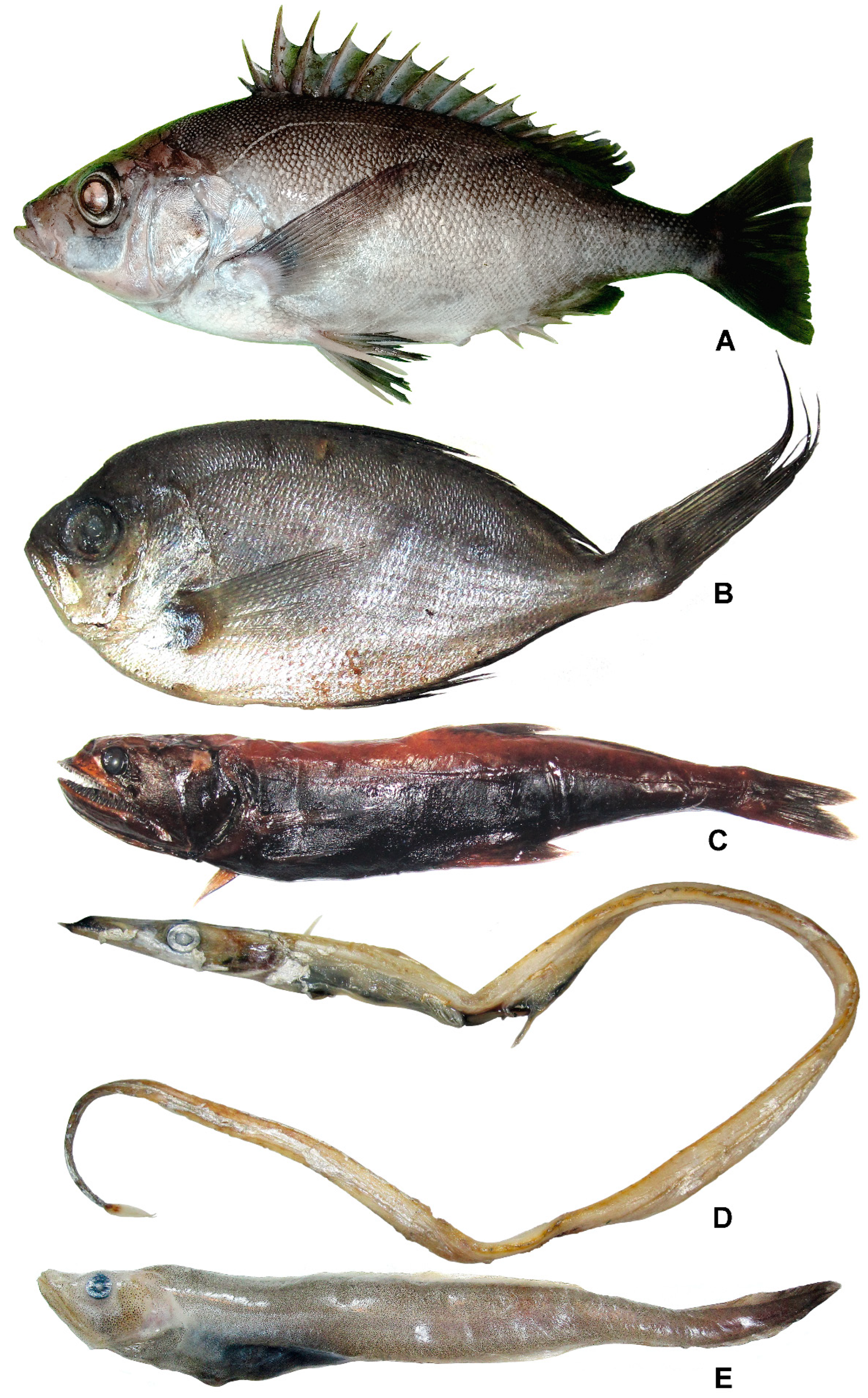
Voucher specimens: Not retained. Identified from a specimen ca. 350 mm SL photographed aboard (station 105).
Figure 23. Fish species collected during 2019 cruise of R/V Professor Kaganovsky over Emperor Seamounts. All specimens were photographed in fresh condition. (A) Pentaceros wheeleri, ca.350 mm SL, not preserved; (B) Brama japonica, 65 mm SL, IORAS P.05009; (C) Pseudoscopelus altipinnis, 117 mm SL, IORAS P.05045; (D) Benthodesmus pacificus, 386 mm SL, IORAS P.05018; (E) Lycodapus imperatorius, 140 mm SL, IORAS P.03641. Not to scale.
Jmse 14 00063 g023
Diagnosis: Vomer toothed. Dorsal fin rays XIII–VIV,8–9. Lateral line scales 65–78. Scales on midline from throat to level of pelvic fin base 22–29.
Identification sources: [172] (p. 209); [21] (p. 512).
Remarks: Formerly it was separated in the genus Pseudopentaceros Smith, 1844, synonymized with Pentaceros Cuvier, 1829 by [173]. Pseudopentaceros pectoralis Hardy, 1983 is a synonym [17].
Local distribution: Koko, Kimmei, Milwaukee, Colahan, and C-H Seamounts, throughout northwestern Hawaiian Ridge to Necker Seamount [15,16,17,172]. Misidentified as P. richardsoni Smith, 1844 by [15,16].
General distribution: Across the North Pacific from Japan to California, northwards to the Aleutian Islands, southwards to the Hawaiian Islands; depth range: 146–500 m; juveniles epipelagic near surface [17,174].

3.36. Family Bramidae

Brama japonica Hilgendorf, 1878 (Figure 23B)

Voucher specimens: IORAS P.05009, 1 (65), DNA no. 52, station 101.
Diagnosis: Dorsal contour of head distinctly convex. Dorsal and anal fins not depressible, covered with small scales; dorsal fin originating behind head. Left and right pelvic fins close to each other. Distance between lower end of pectoral fin base and origin of pelvic fin less than 12% SL and 42% head length. Scales in lateral series 65–75. Vertebrae 39–41.
Identification sources: [175] (p. 55); Hatooka in [33] (p. 815).
Remarks: Hoshino et al. [21] listed B. orcini Cuvier, 1831 and not B. japonica for the Emperor Seamounts. Both species are widespread in the tropical and subtropical North Pacific. Although a single juvenile was collected, our specimen differs from B. orcini by the smaller distance between the lower end of pectoral fin base and origin of pelvic fin (6.2% SL and 21.1% head length vs. more than 12 and 42%, respectively) and higher scale count (about 65 vs. 52–56 in lateral series) [Hatooka in [33]].
Local distribution: Koko Seamount. Reported for Milwaukee Seamount [15] and from Maro Reef (Hawaiian Islands) to the Hancock and Koko Seamounts [17].
General distribution: Subtropical to subarctic waters of the North Pacific between 15° and 60° N at depths of 1–620 m [17,176].

3.37. Family Chiasmodontidae

Pseudoscopelus altipinnis Parr, 1933 (Figure 23C)

Voucher specimens: IORAS P.05045, 1 (117), DNA no. 107, station 107.
Diagnosis: Serial photophores present; mxf linear, connected with patch-like apf, ppf strongly reduced to absent; vf absent, trf reduced to a few organs in a row; prvf and ptvf irregularly in one to two rows of organs. Premaxillary teeth in 4–6 rows arranged in three series separated by spaces (1–(1–2)–(2–3) rows per series). Mouth cavity darkly pigmented.
Identification sources: [41] (p. 36); [177] (p. 36).
Remarks: Our specimen is somewhat distant (6 vs. 1–3 nucleotide substitutions) from the remaining barcoded specimens of that species. However, a similar range of genetic diversity is found within P. scriptus Lütken, 1892 (Figure 24 and Figure 25; Supplementary Table S7).
Local distribution: Annei Seamount (new record). Reported by [15] for Yomei Seamount as Pseudoscopelus sp.
General distribution: Circumglobally between 40° N and S, with an extirpation area in the Gulf Stream zone in the North Atlantic to 55° N [41]. Meso- and bathypelagic at a fishing depth of 50–1870 m [177].

3.38. Family Trichiuridae

Benthodesmus pacificus Parin et Becker, 1970 (Figure 23D)

Voucher specimens: IORAS P.05010, 1 (470), DNA no. 68, station 101; IORAS P.05018, 1 (386), DNA no. 12, station 103.
Diagnosis: Body extremely elongated; pelvic fins diminutive, composed of scale-like spine and rudimentary soft ray, inserted behind pectoral fin base; caudal fin present. Dorsal fin rays XLIV–XLVI,99–104 (total elements 142–148), anal fin rays II,90–94; vertebrae 145–153.
Identification sources: [178] (p. 355); [179] (p. 187); [180] (p. 76); [21] (p. 45).
Remarks: Our specimens show a slightly lower vertebral count (145 and 151) than previously reported for this species (149–153) [180]. The sequences obtained from our specimens form a single haplotype with samples identified as B. simonyi (Steindachner, 1891): GU805059/DSFSF394-09 (South Africa) and KF489506/DSFSG511-11 (South Africa: Tugela Deep). Although both of these species are very close to each other, B. simonyi is said to be restricted to the North Atlantic [180]. The South African samples are therefore likely misidentified. The only Indo-Pacific species showing similar fin ray and vertebral count is B. papua Parin, 1978 known by a single juvenile from the Coral Sea southeast of the Gulf of Papua [180]. It is not clear whether B. pacificus is a part of the widely distributed Indo-Pacific species with an uncertain valid name, or this fragment of the COI gene does not allow species identification like in Maurolicus or Helicolenus.
Local distribution: Koko Seamount (new record). Reported for Yomei and Milwaukee Seamounts [15].
General distribution: North Pacific from Japan to California, but might have a wide Indo-Pacific distribution (see Remarks); bethopelagic at 305–1100 m depths, sometimes migrates to surface; juveniles are mesopelagic from 100 to 500 (1100) m [17,180].

3.39. Family Zoarcidae

Lycodapus imperatorius Prokofiev, Balanov, Emelianova, Orlov et Orlova, 2022 (Figure 23E)

Voucher specimens: IORAS P.03641, 1 (140), DNA no. 89, station 107; MIMB 43527, 1 (128), Jingu Seamount [22].
Diagnosis: Head and body laterally compressed; mouth gape large, oblique; snout 32.1–35.2% of head length. Pelvic fins absent. Gill slit extending forward to vertical of posterior third of eye. Gill rakers stout (gill raker ratio 58–66%), single interorbital, four preopercular and four mandibular pores, 16 vomerine and 24–29 palatine teeth in females (male unknown), 95 to 99 vertebrae.
Identification sources: [22] (p. 7).
Local distribution: Jingu Seamount.
General distribution: Probably endemic; 643–822 m.

3.40. Family Pleuronectidae

3.40.1. Microstomus bathybius (Gilbert, 1890) (Figure 26A)
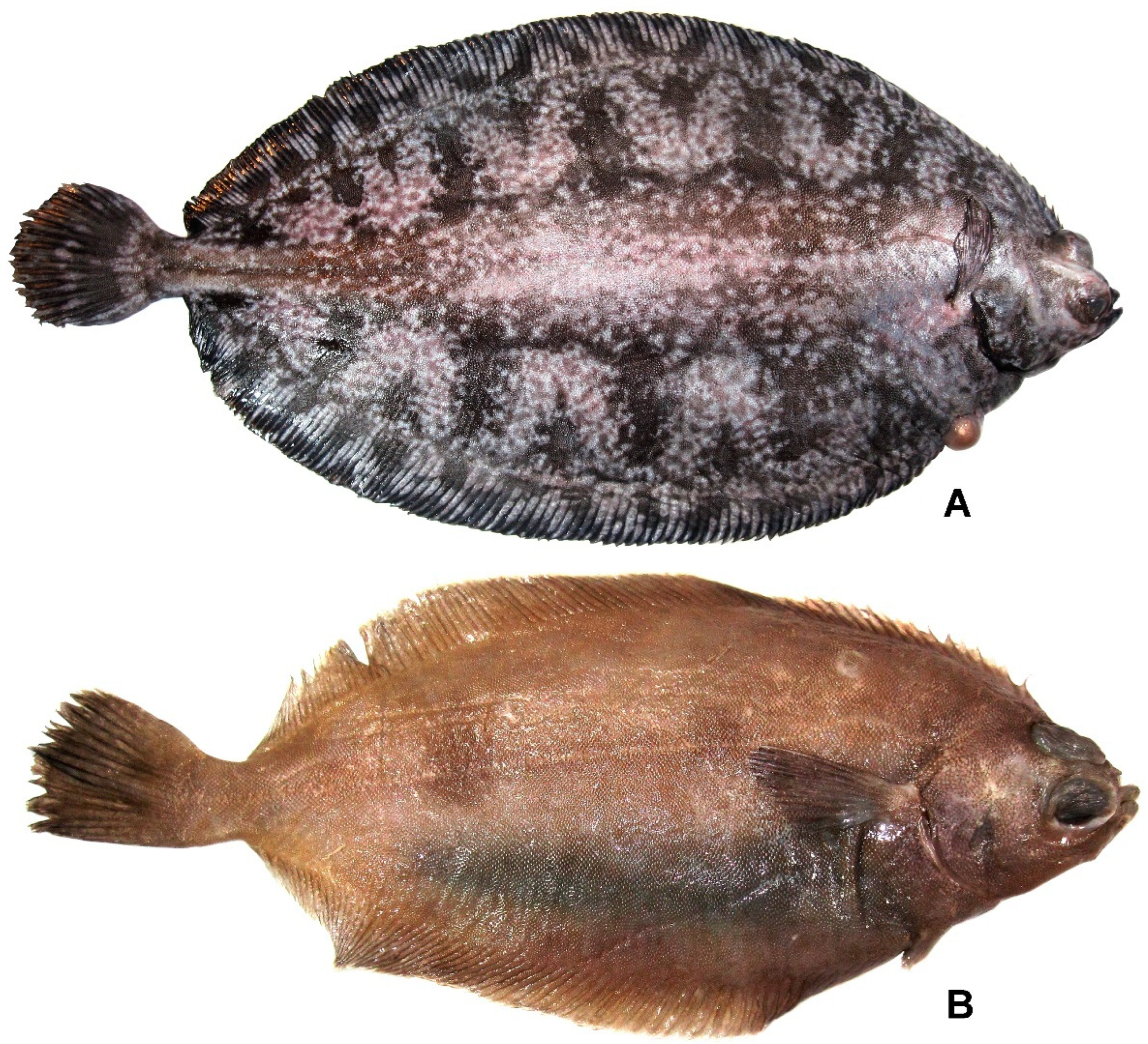
Voucher specimens: IORAS P.05056, 1 (270), station 108; IORAS P.05064, 1 (325), station 109.
Figure 26. Fish species collected during 2019 cruise of R/V Professor Kaganovsky over Emperor Seamounts. All specimens were photographed in fresh condition. (A) Microstomus bathybius, 325 mm SL, IORAS P.05064; (B) Microstomus shuntovi, 211 mm SL, IORAS P.05014. Not to scale.
Jmse 14 00063 g026
Diagnosis: Eyes on right side. Dorsal fin originates over upper eye. Upper surface of eyeball scaled. Pectoral fins well-developed on both sides. Mouth small. Jaws asymmetric, teeth better developed on blind side. Both sides scaled, lacking thorns or bucklers. Dorsal fin rays 108–120; anal fin rays 93–102. Ocular side dark brown with dense patches of white to blue spots forming several transverse bands; blind side brown, darker at margin.
Identification sources: [33] (p. 1372); [21] (p. 40).
Remarks: Formerly it was separated in the monotypic genus Embassichthys Jordan et Evermann, 1896, synonymized with Microstomus Gottsche, 1835 by [181].
Local distribution: Annei and Ojin Seamounts (new records). Reported for Suiko, Yomei, and Kimmei Seamounts [15] and for Milwaukee Seamounts [64].
General distribution: Bering Sea to central Honshu and US/Mexico border, Emperor Seamounts, and Hawaii; 41–1800 m [21,92,182].

3.40.2. Microstomus shuntovi Borets, 1983 (Figure 26B)

Voucher specimens: IORAS P.05014, 1 (211), station 102; IORAS P.05029, 1 (180), DNA no. 69, station 106.
Diagnosis: Eyes on right side. Dorsal fin originates over upper eye. Upper surface of eyeball naked. Pectoral fins well-developed on both sides. Mouth small. Jaws asymmetric, teeth better developed on blind side, present on both jaws. Both sides scaled, lacking thorns or bucklers. Dorsal fin rays 83–92; anal fin rays 63–76. Lateral line scales 180–190. Caudal peduncle depth not exceeding its length. Ocular side uniformly brownish, blind side white, medial fins light brown.
Identification sources: [183] (p. 718); [21] (p. 41).
Local distribution: Known from Koko, Milwaukee, and Colahan Seamounts [16,64,183].
General distribution: Endemic to the Emperor Seamounts and northern part of the Hawaiian Ridge, with a depth range of 270–940 m [17,21].

4. Discussion

Information on the distribution of benthic and pelagic fishes on individual seamounts of the Emperor Chain is very limited and is actually contained within two papers [15,16], not counting specific publications on certain taxa, new species descriptions, and records, i.e., [184,185,186,187,188,189,190,191]. The results of the 2019 cruise contribute significantly towards the completion of faunal lists for the four surveyed seamounts, especially for Annei (Lira) Seamount, from which only 11 species of demersal fishes have been reported so far [16], with no data on the pelagic ichthyofauna. According to the 2019 cruise data, 27 fish species were recorded at Annei for the first time, 12 species at Ojin, 4 species at Koko, and 2 species at Jingu Seamounts (Table 3). Of these, nine species are recorded for the entire Emperor Seamount Chain for the first time, and one species (Linophryne arborifera) was recorded for the first time in the Pacific Ocean. Five other species (Diaphus balanovi, Eustomias securicula, Lycodapus imperatorius, Gnathophis johnsoni, and Psednos kaganovskii) were previously described as new to science from the collection taken during this cruise off Annei, Ojin, Koko, and Jingu Seamounts [22,23,24,25,26].
Previously published lists of fish species for individual seamounts of the Emperor Chain are inconsistent because many identifications made in [15] were given only at the generic level, especially for the bottom fishes. The later paper by [16] did not take the pelagic component of the ichthyofauna into account. Our data on meso- and bathypelagic fishes are generally in agreement with those of [15], according to which the species composition of meso- and bathypelagic fishes in the northern and southern parts of the Emperor Seamounts does not differ in principle. At the same time, both references [15,16] noted significant differences in the composition of the benthic and benthopelagic ichthyofauna between the northern and southern parts of the Emperor Chain.
The data we have obtained allow us to correct some of the previously stated views on the boundaries of the ranges of the zoogeographical groupings of benthic and benthopelagic fishes provided by [16]. According to [16], the “boreal ichthyocene” (viz., characteristic species composition) inhabits the area from the northern edge of the Emperor Seamount Chain to Jingu Seamount. The “subtropical ichthyocene” extends from Koko Seamount (“Kimmey” in [16]) to the Hawaiian Ridge, while Annei (Lira) Seamount occupies an intermediate position in terms of ichthyofaunal composition. According to our data, the composition of the ichthyofauna at Ojin, Jingu, Annei, and Koko Seamounts does not differ significantly from those at the more southerly seamounts. Thus, they all encompass a subtropical ichthyocene as defined by [16]. Of the 13 demersal fish species we first collected at Ojin and Annei Seamounts, only 2 species can be assigned to the boreal ichthyocene of [16], i.e., Apristurus fedorovi and Microstomus bathybius. Another species (Centroscyllium excelsum) is endemic to the Emperor Seamounts and is known from both the northern and southern parts of the chain, while the remaining species (Table 3) were previously known only from more southerly areas.
In our opinion, it is more correct to draw the boundary between the boreal and subtropical ichthyocenes between Nintoku and Jingu Seamounts (see Figure 1), as the subtropical component only disperses north of Jingu. There appears to be a mixture of boreal and subtropical ichthyocenes off Jingu, as the northern species Coryphaenoides acrolepis, C. cinereus, C. longifilis, Antimora microlepis, Halargyreus johnsoni, and Alepocephalus tenebrosus, which do not occur further south, are also reported for Jingu Seamount [16]. However, Coryphaenoides pectoralis, a characteristic species of the boreal North Pacific [192,193,194], is already dispersed here, while the subtropical Talismania antillarum, Maurolicus imperatorius, Lepidion inosimae, and Hozukius guyotensis are present [16]. The above-mentioned boreal members of the families Macrouridae, Moridae, and Alepocephalidae are completely absent from Annei Seamount [16]. The results of cluster analysis using the Sørensen–Czekanowsky index (Table 4) also demonstrate the proximity of Annei to the southern seamounts, rather than to the northern ones (Figure 27). At the same time, it should be emphasized that the past studies of different seamounts have been extremely heterogeneous, and therefore any comparison of their ichthyofauna could be highly preliminary. In the period from 1969 to 2010, TINRO research vessels carried out 31 cruises to the Emperor Seamounts, of which only 5 studied the seamounts of the northern and central parts of the chain (from Jimmu and Suiko to Annei), while 29 cruises accounted for the southern seamounts (Koko, Colahan, Milwaukee) [6]. This was partly due to the characters of bottom relief, depth of summits, and the size of areas suitable for bottom trawling. However, the main reason was associated with the fact that the major bottom trawl fishery occurred over the southern seamounts (Koko, Colahan, and Milwaukee) [6,8]. Nevertheless, according to the data available, the attribution of the fish fauna from off the Annei Seamount as “subtropical ichthyocene” is quite justified.
Our ichthyofaunal data are consistent with previously published data on the fauna of deep-sea corals and other benthic invertebrates [195], according to which the Ojin and Jingu Seamounts are considered a transition zone with mixed fauna of “boreal” and “western Pacific” zoogeographic regions (being equal to boreal and subtropical ichthyocenes of [16], and the boundary between them should be in the area of 37–39° N, i.e., across Ojin and Jingu Seamounts and north of Annei Seamount.
It is possible that the distribution of ichthyocene fauna on the seamounts varies over time. The longitudinal shift of cold and warm water distribution runs along a longitudinal zone between 50 and 31° N, following annual and seasonal fluctuations of the Subarctic Frontal Zone [28]. Thermohaline analysis of the water masses correlated both subtropical and subarctic waters over the Emperor–Hawaiian Ridge with season and year [196]. However, to assess these effects on ichthyofauna, regular investigation of the species composition along the western and eastern slopes of seamounts is required. Plankton surveys conducted in the 1970s [197,198] showed considerable seasonal and annual fluctuations in the species composition of calanoid copepods, suggesting a periodical shift in subtropical and subarctic waters over the Emperor–Hawaiian Seamounts. This may suggest that the species composition of the pelagic ichthyofauna can also change drastically per season and year, and that the pelagic juveniles of the “boreal” demersal fish species may also occur over the more southern seamounts during the appropriate seasons and years.
It is likely that the distribution of subtropical ichthyofauna to the north is significantly influenced by the fact that the minimum depths in the northern part of the range (Ojin and northwards) (786–1244 m) considerably exceed those of the seamounts in the southern part of the chain (Annei and southwards) (220–500 m), so that a significant number of the subtropical fish species simply cannot find suitable habitat depths in more northerly areas. Many species belonging to the “subtropical ichthyocene” were trawled between 160 and 600 m and never deeper 880 m [16]; thus, they appear to spend all of their life cycle at the sublittoral to upper bathyal depths that are not present north of Ojin Seamount. Synoptical surveys over the Emperor–Hawaiian Seamounts showed frequent alternation of the intermediate waters enriched by oxygen and nutrients under the influence of counter-rotating eddies [18]. Eddy intensity is strongest in layers where flows interact with the seamount summits. As a result, the intensity of upwelling differs depending on the depth and size of the seamount tops, with summits at depths of 300–500 m characterized by significantly higher bioproductivity and ecological niche partition than summits at depths of 800–1200 m.
Unfortunately, the available data do not allow any comparative analysis of the bathymetric distribution with the distribution of fish on individual seamounts. Boreal ichthyocene species listed by [16] (Alepocephalus, Rouleina, Antimora, Halargyreus, and Coryphaenoides spp.) are generally found in deeper waters than most of the subtropical ichthyocene species. Perhaps it is not surprising that the more eurybathic squaloid sharks and Apristurus (Pentanchidae), inhabiting both the upper and lower bathyal zone, are much more widespread along the Emperor Seamounts, occurring in both northern and southern parts. However, we have no data on bottom trawl catches from the bases of seamounts in the southern part of the chain at depths comparable to those in the northern part. The kind of fishing gear used, frequency, and bathymetric amplitude of fish samples per seamount may also significantly affect the picture of fish diversity. No such information is available for analysis. Despite the length of commercial exploitation, our knowledge on fish distribution across the Emperor Seamounts remains at an early stage, and every new expedition may sufficiently change the existing conceptions.

5. Conclusions

During the trawl survey over four seamounts (Annei, Jingu, Ojin, and Koko) of the Emperor Chain by R/V Professor Kaganovsky in 2019, 73 species from 40 families of pelagic and bottom-dwelling cartilaginous and bony fishes were collected. This included 11 species new to science or of uncertain taxonomic position, 9 species newly reported for the Emperor Seamounts, and 1 new record (Linophryne arborifera) for the Pacific Ocean. For individual seamounts, 27 fish species at Annei, 12 species at Ojin, 4 species at Koko, and 2 species at Jingu Seamounts were recorded for the first time. COI sequences were obtained for 35 species including the first barcode-flagged and publicly available sequences for 13 species; the first publicly Cyt b sequence was obtained for M. bericoides. Morphological diagnoses are presented for all species collected. Cryptic diversity was recorded within the genera Cyclothone, Argyropelecus, and Chauliodus. Newly obtained data on the distribution of the demersal fishes over Annei, Jingu, and Ojin Seamounts showed a boundary between the boreal and subtropical fish communities between Nintoku and Jingu Seamounts with a transitional zone over Jingu and Ojin Seamounts at 37–39° N. However, the distribution of the subtropical species to the north may be limited by the greater minimal depths in the northern subsection of the chain rather than any oceanological or climatic barriers.

Supplementary Materials

The following supporting information can be downloaded at https://www.mdpi.com/article/10.3390/jmse14010063/s1, Table S1: The list of samples used to construct the haplotype network (526 bp) of the genus Cyclothone; Table S2: The list of samples used to construct the haplotype network (571 bp) of the genus Maurolicus; Table S3: The list of samples used to construct the haplotype network (484 bp) of the genus Argyropelecus; Table S4: The list of samples used to construct the haplotype network (539 bp) of the genus Chauliodus; Table S5: The list of samples used to construct the haplotype network (552 bp) of the genus Bathygadus; Table S6: The list of samples used to construct the haplotype network (548 bp) of the genus Helicolenus; Table S7: The list of samples used to construct the haplotype network (595 bp) of the genus Pseudoscopelus.

Author Contributions

Conceptualization, A.M.P. and A.M.O.; methodology, A.M.P., O.R.E. and S.Y.S.; software, O.R.E., A.M.O. and S.Y.S.; validation, A.M.P., O.R.E., A.M.O. and S.Y.S.; formal analysis, A.M.P., O.R.E. and S.Y.S.; investigation, A.M.P., O.R.E., A.M.O. and S.Y.S.; resources, A.M.P., O.R.E., A.M.O. and S.Y.S.; data curation, A.M.P., O.R.E., A.M.O. and S.Y.S.; writing–original draft preparation, A.M.P., O.R.E. and A.M.O.; writing–review and editing, A.M.P., A.M.O. and O.R.E.; supervision, A.M.O. All authors have read and agreed to the published version of the manuscript.

Funding

This research was carried out within the state assignments of the Ministry of Science and Higher Education of the Russian Federation for the Severtsov Institute of Ecology and Evolution No. FFER-2024-0017 (A.M.P.), Shirshov Institute of Oceanology No. FMWE-2024-0022 (A.M.O. and A.M.P.), and Vavilov Institute of General Genetics of the Russian Academy of Sciences No. 122022600162-0 “Genetic technologies in biology, medicine, and agriculture” (S.Y.S. and O.R.E.).

Data Availability Statement

The data presented in this study are available on request from the corresponding author.

Acknowledgments

We are grateful to our colleagues from the Pacific Branch of VNIRO (TINRO, Vladivostok, Russia) who took part in the processing of catches from the cruise of the R/V Professor Kaganovsky in 2019, storing samples in TINRO, and transporting them to Moscow. A.M.O. and S.Y.S. thank Kirill Kolonchin (VNIRO) and Aleksey Baytalyuk (TINRO), who approved their participation in the cruise. Special thanks to Maria Ruzina (VNIRO) for assistance in genetic work, and to Aleksej Mishin (IORAS) for assistance with calculation of similarity indexes and cluster analysis. We also acknowledge the help of Gento Shinohara (National Museum of Nature and Science, Tokyo, Japan), Ryo Misawa (Japan Fisheries Research and Education Agency, Yokohama, Japan), Kota Sawada (Oceanic Ecosystem Group, National Research Institute of Far Seas Fisheries, Japan Fisheries Research and Education Agency, Japan), Alexander Zavolokin (North Pacific Fisheries Commission, Tokyo, Japan), and Yuri Kurbanov (KamchatNIRO, Petropavlovsk-Kamchatsky, Russia) for help with some rare literary sources. This study is a contribution of the last author (A.M.O.) to the activities of PICES WG47 (Working Group on the Ecology of Seamounts of the North Pacific Marine Science Organization, https://meetings.pices.int/members/working-groups/wg47, accessed on 24 October 2025). We are sincerely indebted to three anonymous reviewers for their valuable comments. Special thanks to the International Fisheries Section of the American Fisheries Society and personally to Robert Mussgnug (Wageningen University & Research, Wageningen, The Netherlands) for the editorial assistance with the English language.

Conflicts of Interest

The authors declare no conflicts of interest.

References

  1. Takahashi, Y.; Sasaki, T. Trawl Fishery in the Central North Pacific Seamounts; Division of Northern Waters Groundfish Resources, Far Seas Fisheries Research Laboratory: Shizuoka, Japan, 1977; pp. 1–45.
  2. Humphreys, R.L., Jr.; Tagami, D.T.; Seki, M.P. Seamount fishery resources within the southern Emperor-Northern Hawaiian Ridge. In Proceedings of Second Symposium on Resources Investigations in the Northwestern Hawaiian Islands; Honolulu, HI, USA, 25–27 May 1983, University of Hawaii Seagrant: Honolulu, HI, USA, 1984; Volume 1, pp. 283–327. [Google Scholar]
  3. Snytko, V.A.; Tuponogov, V.N.; Kolpakov, N.V. The contribution of the scientists of TINRO-Center to study of bottom and near-bottom fishes. Izv. TINRO 2005, 141, 173–208. [Google Scholar]
  4. Bensch, A.; Gianni, M.; Gréboval, D.; Sanders, J.; Hjort, A. Worldwide Review of Bottom Fisheries in the High Seas; FAO Fisheries and Aquaculture Technical Paper; FAO: Rome, Italy, 2009; Volume 522, pp. 1–145. [Google Scholar]
  5. Darnitsky, V.B. Oceanological Processes Near Seamounts and Ridges of the Open Ocean; TINRO-Center: Vladivostok, Russia, 2010; pp. 1–119. [Google Scholar]
  6. Baitalyuk, A.A.; Karyakin, K.A.; Orlov, A.M. Thalassobathyal resources of the Emperor Seamounts: Fishery, stock status and possibility for distant fishery. Probl. Fish. 2010, 11, 801–816. [Google Scholar]
  7. Victorero, L.; Watling, L.; Deng Palomares, M.L.; Nouvian, C. Out of sight, but within reach: A global history of bottom-trawled deep-sea fisheries from >400 m depth. Front. Mar. Sci. 2018, 5, 98. [Google Scholar] [CrossRef]
  8. Orlov, A.M.; Tuponogov, V.N. Past and present ichthyological and fisheries research at the Emperor Seamounts: Lessons from the Soviet/Russian experience in the Central North Pacific. Rev. Fish. Sci. Aquac. 2025. [Google Scholar] [CrossRef]
  9. Delgado, J.P.; Brennan, M.L.; Stokes, E.; Wagner, D. A forgotten maritime highway: Maritime cultural heritage of the Emperor Seamounts with implications for high seas conservation. J. Marit. Archaeol. 2024, 19, 41–80. [Google Scholar] [CrossRef]
  10. Miyamoto, M.; Kiyota, M.; Hayashibara, T.; Nonaka, M.; Imahara, Y.; Tachikawa, H. Megafaunal composition of cold-water corals and other deep-sea benthos in the southern Emperor Seamounts area, North Pacific Ocean. Galaxea J. Coral Reef Stud. 2017, 19, 19–30. [Google Scholar] [CrossRef] [PubMed]
  11. Miyamoto, M.; Kiyota, M. Application of association analysis for identifing indicator taxa of vulnerable marine ecosystems in the Emperor Seamounts area, North Pacific Ocean. Ecol. Indic. 2017, 78, 301–310. [Google Scholar] [CrossRef]
  12. Baco, A.R.; Morgan, N.B.; Roark, E.B.; Biede, V. Bottom-contact fisheries disturbance and signs of recovery of precious corals in the Northwestern Hawaiian Islands and Emperor Seamount Chain. Ecol. Indic. 2023, 148, 110010. [Google Scholar] [CrossRef]
  13. Borets, L.A.; Sokolovsky, A.S. Species composition of ichthyoplankton of the Hawaiian submarine ridge and Emperor Seamounts. Izv. TINRO 1978, 102, 43–50. [Google Scholar]
  14. Kodolov, L.S.; Gavrilov, G.M.; Kokareva, L.N. Species composition of the Melanostomiatidae (Osteichthyes) family in the area of the Emperor Seamounts. Izv. TINRO 1980, 104, 163–167. [Google Scholar]
  15. Novikov, N.P.; Kodolov, L.S.; Gavrilov, G.M. Preliminary list of fishes of the Emperor Underwater Ridge. In Fishes of the Open Ocean; Institute of Oceanology of the USSR Academy of Sciences: Moscow, Russia, 1981; pp. 32–35. [Google Scholar]
  16. Borets, L.A. Ichthyofauna of the Northwestern and Hawaiian underwater ridges. J. Ichthyol. 1986, 26, 1–13. [Google Scholar]
  17. Mundy, B.C. Checklist of the Fishes of the Hawaiian Archipelago (Bishop Museum Bulletin in Zoology); Bishop Museum: Honolulu, HI, USA, 2005; Volume 6, pp. 1–704. [Google Scholar]
  18. Belyaev, V.A.; Darniskiy, V.B. Features of oceanography and ichthyofauna composition on the Emperor Ridge. In Deep Sea 2003: Conference of the Governance and Management of Deep-Sea Fisheries. Part 1: Conference Reports; Shotton, R., Ed.; FAO: Rome, Italy, 2005; pp. 107–124. [Google Scholar]
  19. Sawada, K.; Okamoto, M.; Hoshino, K.; Yonezaki, S. Bycatch Species by Japanese Bottom Fisheries in the Emperor Seamounts; NPFC-2019-SSC BF02-WP03; North Pacific Fisheries Commission: Tokyo, Japan, 2019; pp. 1–23.
  20. Hoshino, K.; Sawada, K. Comments on Compiled Bycatch Species List for the Emperor Seamounts (ESM); NPFC-2020-SSC BFME01-IP01; North Pacific Fisheries Commission: Tokyo, Japan, 2020; pp. 1–25.
  21. Hoshino, K.; Okamoto, M.; Sawada, K. The Field Guide for Identifications of Fishes of the Emperor Seamount Chain Captured by Bottom Fisheries; North Pacific Fisheries Commission: Tokyo, Japan, 2024; pp. 1–92.
  22. Prokofiev, A.M.; Balanov, A.A.; Emelianova, O.R.; Orlov, A.M.; Orlova, S.Y. A new species of Lycodapus from the Emperor Seamount Chain, northwestern Pacific Ocean (Teleostei: Zoarcidae). Diversity 2022, 14, 972. [Google Scholar] [CrossRef]
  23. Prokofiev, A.M.; Emelyanova, O.R.; Orlov, A.M.; Orlova, S.Y. A new species of Diaphus associated with seamounts of the Emperor Chain, north-western Pacific Ocean (Teleostei: Myctophiformes: Myctophidae). J. Mar. Sci. Eng. 2022, 10, 65. [Google Scholar] [CrossRef]
  24. Prokofiev, A.M.; Frable, B.W.; Emelianova, O.R.; Saveleva, S.Y.; Orlov, A.M. A new species of the eel genus Gnathophis (Congridae, Anguilliformes) from the seamounts of the Emperor–Hawaiian Chain, Western and Central North Pacific. J. Mar. Sci. Eng. 2025, 13, 772. [Google Scholar] [CrossRef]
  25. Prokofiev, A.M.; Orlov, A.M. Eustomias securicula sp. nov.—The second representative of the subgenus Biradiostomias (Melanostomiidae) in the Pacific Ocean. J. Ichthyol. 2022, 62, 316–319. [Google Scholar] [CrossRef]
  26. Prokofiev, A.M.; Orlov, A.M. A new species of the genus Psednos (Teleostei: Liparidae) from the Emperor Seamount Chain and the first record of this genus from the northwestern Pacific Ocean. Zoosyst. Ross. 2025, 34, 272–278. [Google Scholar] [CrossRef]
  27. Lomakin, I.E.; Kochelab, V.V. Geology of the Emperor mountains and some questions of tectonics of the north-west Pacific. Geol. Miner. World Ocean. 2019, 15, 57–72. [Google Scholar] [CrossRef]
  28. Bystrov, Y.N.; Mikhailovsky, A.P. (Eds.) Description of Seamounts and Underwater Elevations of the World Oceans Fishing Grounds (High Seas); Ministry of Defense of the USSR: Moscow, Russia; Ministry of Fisheries of the USSR: Moscow, Russia, 1989; Volume 2, pp. 1–386. [Google Scholar]
  29. Somov, A.A.; Kanzeparova, A.N.; Vazhova, A.S.; Khleborodov, A.S.; Zuev, M.A.; Slabinsky, A.M.; Orlova, S.Y.; Kurnosov, D.S.; Belyaev, V.A.; Orlov, A.M. Some preliminary results of research on Emperor Seamounts in April, 2019. Tr. VNIRO 2019, 175, 208–2019. [Google Scholar] [CrossRef]
  30. Kurnosova, A.S.; Somov, A.A.; Kanzeparova, A.N.; Zuev, M.A.; Orlova, S.Y.; Kurnosov, D.S.; Orlov, A.M. Mesopelagic micronekton and macroplankton and the conditions of its habitat in the northeastern Pacific Ocean. Oceanology 2022, 62, 68–79. [Google Scholar] [CrossRef]
  31. Masuda, H.; Amaoka, K.; Araga, C.; Uyeno, T.; Yoshino, T. (Eds.) The Fishes of the Japanese Archipelago: Two Volumes; Tokai University Press: Tokyo, Japan, 1984; pp. 1–838. [Google Scholar]
  32. Amaoka, K.; Nakaya, K.; Yabe, M. The Fishes of Northern Japan; Kita-Nihon Kayo Center Co. Ltd.: Sapporo, Japan, 1995; pp. 1–390. [Google Scholar]
  33. Nakabo, T. (Ed.) Fishes of Japan with Pictorial Keys to the Species; Tokai University Press: Tokyo, Japan, 2002; pp. 1–1749. [Google Scholar]
  34. Hubbs, C.L.; Lagler, K.F. Fishes of the Great Lakes Region; University of Michigan Press: Ann Arbor, MI, USA, 1958; pp. xvii + 276. [Google Scholar]
  35. Compagno, L.J.V. Sharks of the World: An Annotated and Illustrated Catalogue of Shark Species Known to Date; FAO Fisheries Synopses; FAO: Rome, Italy, 1984; Volume 125, pp. 251–655. [Google Scholar]
  36. Eschmeyer, W.N. A systematic review of the scorpionfishes of the Atlantic Ocean (Pisces: Scorpaenidae). Occas. Pap. Calif. Acad. Sci. 1969, 79, 1–143. [Google Scholar]
  37. Bertelsen, E. Notes on Linophrynidae V: A revision of the deepsea anglerfishes of the Linophryne arborifera-group (Pisces, Ceratioidei). Steenstrupia 1980, 6, 29–70. [Google Scholar]
  38. Böhlke, E.B. Methods and terminology. In Fishes of the Western North Atlantic; Memoir of the Sears Foundation for Marine Research; Sears Foundation: New Haven, CT, USA, 1989; Volume 1, pp. 1–7. [Google Scholar]
  39. Paulin, C.D. Review of the morid genera Gadella, Physiculus, and Salilota (Teleostei: Gadiformes) with descriptions of seven new species. N. Z. J. Zool 1989, 16, 93–133. [Google Scholar] [CrossRef]
  40. Morrow, J.E.; Gibbs, R.H., Jr. Melanostomiatidae. In Fishes of the Western North Atlantic Part 4; Bigelow, H.B., Cohen, D.M., Dick, M.M., Gibbs, R.H., Jr., Grey, M., Morrow, J.E., Jr., Schultz, L.P., Walters, V., Eds.; Sears Foundation: New Haven, CT, USA, 1964; Volume 1, pp. 351–522. [Google Scholar]
  41. Prokofiev, A.M.; Kukuev, E.I. Systematics and Distribution of the Swallowerfishes of the Genus Pseudoscopelus (Chiasmodontidae); KMK Scientific Press Ltd.: Moscow, Russia, 2007; pp. 1–162. [Google Scholar]
  42. Odum, E. Ecology. 2 Vols; Mir: Moscow, Russia, 1986; pp. 1–328–1–376. [Google Scholar]
  43. Clarke, K.R.; Gorley, R.N. PRIMER: User Manual/Tutorial; PRIMER-E Ltd.: Plymouth, UK, 2006; pp. 1–192. [Google Scholar]
  44. Barsukov, V.V. The species composition of the genus Helicolenus (Sebastinae, Scorpaenidae, Pisces) and a description of a new species. J. Ichthyol. 1973, 13, 161–167. [Google Scholar]
  45. Barsukov, V.V.; Borets, L.A. New data on the kinmei rosefish, Helicolenus fedorovi (Sebastinae, Scorpaenidae). Vop. Ikhtiol 1983, 23, 179–185. [Google Scholar]
  46. Barsukov, V.V.; Fedorov, V.V. Species of the genus Hozukius (Scorpaenidae, Sebastinae) from the guyots of the Hawaiian Submarine Ridge. J. Ichthyol. 1975, 15, 869–876. [Google Scholar]
  47. Barsukov, V.V.; Borets, L.A.; Kodolov, L.S.; Snytko, V.A. New data on Adelosebastes latens Eschmeyer, Abe et Nakano, 1979 (Scorpaenidae). Vopr. Ikhtiol 1983, 23, 538–543. [Google Scholar]
  48. Borets, L.A. Anthias rubromaculatus sp. n., a new species of fishes (Serranidae) from submarine mountains of the Hawaii Ridge. Biol. Morya 1982, 8, 68–70. [Google Scholar]
  49. Dolganov, V.N. A new species of shark from the north-west Pacific Ocean. Biol. Morya 1985, 3, 64–65. [Google Scholar]
  50. Dolganov, V.N. Squalus boretzi sp. n. (Squalidae), a new squalid shark species from the Emperor Seamount Chain, Pacific Ocean. Biol. Morya 2019, 45, 279–285. [Google Scholar] [CrossRef]
  51. Dolganov, V.N. On the little-known sharks Etmopterus villosus (Etmopteridae) and Scymnodalatias sherwoodi (Somniosidae) from the Pacific Ocean. J. Ichthyol. 2019, 59, 275–279. [Google Scholar] [CrossRef]
  52. Dolganov, V.N. Formation of the fauna of cartilaginous fishes of the Emperor Seamount Chain. Biol. Morya 2023, 49, 361–366. [Google Scholar] [CrossRef]
  53. Dolganov, V.N. On finding a rare species of chimera Chimaera owstoni Tanaka (Holocephali, Chimaeridae) in the area of the Northwestern underwater ridge. Vopr. Ikhtiol. 1982, 22, 1039. [Google Scholar]
  54. Dolganov, V.N. On catch of deep-sea shark Chlamydoselachus anguineus (Chlamydoselachidae) on Emperor Seamounts. Izv. TINRO 2018, 194, 68–69. [Google Scholar] [CrossRef]
  55. Fedorov, V.V.; Snytko, V.A.; Matiushin, V.M. Morphological characteristics and some data on the biology of Helicolenus avius Abe et Eschmeyer, 1972 (Pisces, Scorpaenidae) from the area of the southern part of the Emperor Seamounts. Investig. Biol. Fish Fish. Oceanogr. 1975, 6, 56–63. [Google Scholar]
  56. Korostelev, N.B.; Baytalyuk, A.A.; Maltsev, I.V.; Orlov, A.M. First data on the age and growth in Pacific flatnose Antimora microlepis (Moridae) from the waters of the underwater Emperor Mountain Range (Northwestern Pacific). J. Ichthyol. 2020, 60, 891–899. [Google Scholar] [CrossRef]
  57. Korostelev, N.B.; Maltsev, I.V.; Orlov, A.M. First data on the age and growth of Schmidt’s cod Lepidion schmidti (Moridae) from waters of the Emperor Seamounts (Northwestern Pacific). J. Mar. Sci. Eng. 2023, 11, 1212. [Google Scholar] [CrossRef]
  58. Korostelev, N.B.; Volvenko, I.V.; Belyakov, V.V.; Baytaliuk, A.A.; Bush, A.G.; Kanzeparova, A.N.; Orlov, A.M. “Firefly” of the submarine mountains: New data on Physiculus cynodon (Moridae, Teleostei) from Emperor Seamounts and Northwestern Hawaiian Ridge. J. Mar. Sci. Eng. 2023, 11, 2355. [Google Scholar] [CrossRef]
  59. Korostelev, N.B.; Volvenko, N.B.; Maltsev, I.V.; Orlov, A.M. Brought to the surface from obscurity: The first data on the distribution and biology of Coelorhinchus gilberti (Macrouridae, Gadiformes, Teleostei) off the Emperor Seamounts (Northwestern Pacific). Deep-Sea Res. Pt. II 2025, 220, 105461. [Google Scholar] [CrossRef]
  60. Kurbanov, Y.K.; Michalutin, E.A. Data on Pacific grenadier Coryphaenoides acrolepis (Macrouridae) from the area of underwater uplifts of Emperor Seamount Chain (northern part of the Pacific Ocean). In Proceedings of the National (All-Russian) Scientific and Practical Conference “Natural Resources, Their Current State, Protection, Commercial and Technical Use” Vol. 1. No. XII; Kamchatka State Technical University: Petropavlovsk-Kamchatsky, Russia, 2021; pp. 44–48. [Google Scholar]
  61. Kurbanov, Y.K.; Michalutin, E.A. New finds of chimaeras (Holocephali: Chimaeriformes) in the region of the Emperor Seamount Chain (Northern Pacific Ocean). J. Ichthyol. 2022, 62, 1307–1311. [Google Scholar] [CrossRef]
  62. Kurbanov, Y.K.; Michalutin, E.A. New data on Adelosebastes latens (Sebastidae) from the region of the underwater elevations of the Hawaiian-Emperor Seamount Chain (Northern Pacific Ocean). J. Ichthyol. 2022, 62, 79–88. [Google Scholar] [CrossRef]
  63. Kurbanov, Y.K.; Michalutin, E.A. Distribution and some aspects of biology of Hozukius guyotensis (Sebastidae) in the area of the Emperor Seamount Chain. J. Ichthyol. 2023, 63, 280–287. [Google Scholar] [CrossRef]
  64. Pakhorukov, N.P. Behavior and distribution of bottom and near-bottom fish on the Emperor Seamount Chain (the Pacific Ocean). J. Ichthyol. 2005, 45, 103–110. [Google Scholar]
  65. Sazonov, Y.I. Two new macrourid species (Gadiformes) from northern Pacific seamounts. J. Ichthyol. 1985, 25, 13–21. [Google Scholar]
  66. Sazonov, Y.I. Physiculus cynodon sp. n. (Gadiformes, Moridae) from submarine mountains in the northern part of Pacific Ocean. Zool. Zhur 1986, 65, 305–308. [Google Scholar]
  67. Sazonov, Y.I. Additions to the list of macrourids (Gadiformes, Bathygadidae and Macrouridae) from the Northwest Pacific Ridge. J. Ichthyol. 1994, 34, 98–115. [Google Scholar]
  68. Snytko, V.A. Rockfishes of the Northern Part of the Pacific Ocean; TINRO: Vladivostok, Russia, 2001; pp. 1–468.
  69. Zolotov, O.G.; Spirin, I.Y.; Zudina, S.M. New data on the range, biology, and abundance of skilfish Erilepis zonifer (Anoplopomatidae). J. Ichthyol. 2014, 54, 251–265. [Google Scholar] [CrossRef]
  70. Ebert, D.A.; Papastamatiou, Y.P.; Kajiura, S.M.; Wetherbee, B.M. Etmopterus lailae sp. nov., a new lanternshark (Squaliformes: Etmopteridae) from the Northwestern Hawaiian Islands. Zootaxa 2017, 4237, 371–382. [Google Scholar] [CrossRef]
  71. Ivanova, N.V.; Zemlak, T.S.; Hanner, R.H.; Hebert, P. Universal primer cocktails for fish DNA barcoding. Mol. Ecol. Notes 2007, 7, 544–548. [Google Scholar] [CrossRef]
  72. Ward, R.D.; Zemlak, T.S.; Innes, B.H.; Last, P.R.; Hebert, P.D. DNA barcoding Australia’s fish species. Phil. Trans. Roy. Soc. B Biol. Sci. 2005, 360, 1847–1857. [Google Scholar] [CrossRef]
  73. Emelianova, O.R.; Bulatov, O.A.; Grigorov, I.V.; Orlov, A.M.; Orlova, S.Y. Polymorphism of mtDNA gene Cyt b of walleye pollock, Gadus chalcogrammus (Gadidae), in the Chukchi Sea, western Bering Sea, and Sea of Okhotsk. Deep Sea Res. II 2022, 206, 105216. [Google Scholar] [CrossRef]
  74. Emelianova, O.R.; Grigorov, I.V.; Orlov, A.M.; Orlova, S.Y. Polymorphism of mtDNA gene Cyt b of the Chukchi Sea polar cod, Boreogadus saida (Gadidae, Gadiformes). Deep Sea Res. II 2022, 206, 105212. [Google Scholar] [CrossRef]
  75. Silva, W.A., Jr.; Costa, M.C.; Valente, V.; Sousa, J.F.; Paçó-Larson, M.L.; Espreafico, E.M.; Camargo, S.S.; Monteiro, E.; Holanda, A.J.; Zago, M.A.; et al. PCR template preparation for capillary DNA sequencing. Biotechniques 2001, 30, 537–542. [Google Scholar] [CrossRef]
  76. Drummond, A.J.; Ashton, B.; Buxton, S.; Cheung, M.; Cooper, A.; Duran, C.; Field, M.; Heled, J.; Kearse, M.; Markowitz, S.; et al. Geneious v5.4. 2011. Available online: http://www.geneious.com (accessed on 24 October 2025).
  77. Villesen, P. FaBox: An online toolbox for fasta sequences. Mol. Ecol. Notes 2007, 7, 965–968. [Google Scholar] [CrossRef]
  78. Leigh, J.W.; Bryant, D. Popart: Full-feature software for haplotype network construction. Methods Ecol. Evol. 2015, 6, 1110–1116. [Google Scholar] [CrossRef]
  79. Ronquist, F.; Teslenko, M.; van der Mark, P.; Ayres, D.; Darling, A.; Hohna, S.; Larget, B.; Liu, L.; Suchard, M.; Huelsenbeck, J. MrBayes 3.2: Efficient Bayesian Phylogenetic Inference and Model Choice across a Large Model Space. Syst. Biol. 2012, 61, 539–542. [Google Scholar] [CrossRef] [PubMed]
  80. Shirai, S.; Nakaya, K. A new squalid species of the genus Centroscyllium from the Emperor Seamount Chain. Jpn. J. Ichthyol. 1990, 36, 391–398. [Google Scholar] [CrossRef]
  81. Shirai, S.; Tachikawa, H. Taxonomic resolution of the Etmopterus pusillus species group (Elasmobranchii, Etmopteridae), with description of E. bigelowi, n. sp. Copeia 1993, 2, 483–495. [Google Scholar] [CrossRef]
  82. Ebert, D.A. Deep-Sea Cartilaginous Fishes of the Indian Ocean. Vol. 1. Sharks; FAO Species Catalogue for Fishery Purposes; FAO: Rome, Italy, 2013; Volume 8, pp. 1–256. [Google Scholar]
  83. Dolganov, V.N. Manual for Identification of Cartilaginous Fishes of Far East Seas of USSR and Adjacent Waters; TINRO: Vladivostok, Russia, 1983; pp. 1–92.
  84. ICZN. International Code of Zoological Nomenclature; International Trust for Zoological Nomenclature: London, UK; The Natural History Museum: London, UK, 1999; pp. 1–106. [Google Scholar]
  85. Smith, D.G.; Böhlke, J.E.; Castle, P.H.J. A revision of the nettastomatid eel genera Nettastoma and Nettenchelys (Pisces: Anguilliformes), with descriptions of six new species. Proc. Biol. Soc. Wash 1981, 94, 535–560. [Google Scholar]
  86. Quero, J.C.; Saldanha, L. Poissons anguilliformes de l’Ile de la Réunion (Océan Indien): Description d’une nouvelle espèce. Cybium 1995, 19, 61–88. [Google Scholar]
  87. Vo, V.Q.; Ho, H.C.; Dao, H.V.; Tran, H.H.T. A new arrowtooth eel of genus Meadia (Synaphobranchidae: Ilyophinae) from Vietnam, South China Sea. Zootaxa 2021, 4952, 181–191. [Google Scholar] [CrossRef]
  88. Sulak, K.J.; Shcherbachev, Y.N. Zoogeography and systematics of six deep-living genera of synaphobranchid eels, with a key to taxa and description of two new species of Ilyophis. Bull. Mar. Sci. 1997, 60, 1158–1194. [Google Scholar]
  89. Nielsen, J.G.; Smith, D.G. The Eel Family Nemichthyidae (Pisces, Anguilliformes); Dana-report; Scandinavian Science Press: Copenhagen, Denmark, 1978; Volume 88, pp. 1–71. [Google Scholar]
  90. Smith, D.G.; Nielsen, J.G. Family Nemichthyidae. In Fishes of the Western North Atlantic; Böhlke, E.B., Ed.; Sears Foundation of Marine Research: New Haven, CT, USA, 1989; pp. 441–459. [Google Scholar]
  91. Robertson, D.R.; Angulo, A.; Baldwin, C.C.; Pitassy, D.E.; Driskell, A.; Weigt, L.A.; Navarro, I.J. Deep-water bony fishes collected by the B/O Miguel Oliver on the shelf edge of Pacific Central America: An annotated, illustrated and DNA-barcoded checklist. Zootaxa 2017, 4348, 1–125. [Google Scholar] [CrossRef]
  92. Orlov, A.M.; Tokranov, A.M. Checklist of deep-sea fishes of the Russian northwestern Pacific Ocean found at depths below 1000 m. Prog. Oceanogr. 2019, 176, 102143. [Google Scholar] [CrossRef]
  93. Rass, T.S.; Kashkina, A.A. Bathylagid fishes (Pisces, Bathylagidae) of the northern Pacific. Tr. Inst. Okeanol. AN SSSR 1967, 84, 209–221. [Google Scholar]
  94. Kobyliansky, S.G. Materials for the revision of the genus Bathylagus Günther (Bathylagidae): The group of “light” deep-sea smelts. J. Ichthyol. 1985, 25, 1–17. [Google Scholar]
  95. Kobyliansky, S.G. Materials for a revision of the family Bathylagidae (Teleostei, Salmoniformes). Tr. Inst. Okeanol. AN SSSR 1986, 121, 6–50. [Google Scholar]
  96. Cohen, D.M. Suborder Argentinoidea. In Fishes of the Western North Atlantic. Pt. 4; Memoir of the Sears Foundation for Marine Research; Sears Foundation: New Haven, CT, USA, 1964; Volume 1, pp. 1–70. [Google Scholar]
  97. Sazonov, Y.I. Materials on the systematics and distribution of fishes of the family Searsiidae (Salmoniformes, Alepocephaloidei). Tr. Inst. Okeanol. Akad. Nauk SSSR 1976, 104, 26–72. [Google Scholar]
  98. Matsui, T.; Rosenblatt, R.H. Review of the deep-sea fish family Platytroctidae (Pisces: Salmoniformes). Bull. Scripps Inst. Oceanogr. 1987, 26, 1–159. [Google Scholar]
  99. Sazonov, Y.I.; Balanov, A.A.; Fedorov, V.V. Alepocephaloid fishes (Alepocephaloidei) from the western North Pacific Ocean. Tr. Inst. Okeanol. RAS 1993, 128, 40–68. [Google Scholar]
  100. Ozawa, T.; Oda, K.; Ida, T. Systematics and distribution of the Diplophos taenia species complex (Gonostomatidae), with a description of a new species. Jpn. J. Ichthyol. 1990, 37, 98–115. [Google Scholar] [CrossRef]
  101. Mukhacheva, V.A. On systematics, distribution and biology of the Gonostoma species (Pisces, Gonostomatidae). Tr. Inst. Okeanol. Akad. Nauk SSSR 1972, 93, 203–249. [Google Scholar]
  102. Mukhacheva, V.A. The composition of species of the genus Cyclothone (Pisces, Gonostomatidae) in the Pacific Ocean. Tr. Inst. Okeanol. Akad. Nauk SSSR 1964, 73, 93–138. [Google Scholar]
  103. Mukhacheva, V.A. Cyclothones (gen. Cyclothone, fam. Gonostomatidae) of the world and their distributions. Tr. Inst. Okeanol. Akad. Nauk SSSR 1974, 96, 205–249. [Google Scholar]
  104. Parin, N.V.; Kobyliansky, S.G. Review of the genus Maurolicus (Sternoptychidae, Stomiiformes), with re-establishing validity of five species considered junior synonyms of M. muelleri and descriptions of nine new species. Tr. Inst. Okeanol. RAS 1993, 128, 69–107. [Google Scholar]
  105. Rees, D.J.; Poulsen, J.Y.; Sutton, T.T.; Costa, P.A.; Landaeta, M.F. Global phylogeography suggests extensive eucosmopolitanism in Mesopelagic Fishes (Maurolicus: Sternoptychidae). Sci. Rep. 2020, 10, 20544. [Google Scholar] [CrossRef]
  106. Savinykh, V.F.; Baytalyuk, A.A. New data on biology of the pearlfish Maurolicus imperatorius (Sternopthychidae) from the Emperor Seamount Chain. J. Ichthyol. 2010, 50, 148–158. [Google Scholar] [CrossRef]
  107. Baird, R.C. The systematics, distribution, and zoogeography of the marine hatchetfishes (family Sternoptychidae). Bull. Mus. Comp. Zool. Harvard Coll. 1971, 142, 1–128. [Google Scholar]
  108. Borodulina, O.D. Materials on the systematics and distribution of the oceanic hatchetfishes, genera Argyropelecus and Sternoptyx (Sternoptychidae, Osteichthyes). Tr. Inst. Okeanol. Akad. Nauk SSSR 1978, 111, 27–59. [Google Scholar]
  109. Harold, A.S. A taxonomic revision of the sternoptychid genus Polyipnus (Teleostei: Stomiiformes) with an analysis of phylogenetic relationships. Bull. Mar. Sci. 1994, 54, 428–534. [Google Scholar]
  110. Huang, D.; Zhang, X.; Jiang, Z.; Zhang, J.; Arbi, I.; Jiang, X.; Huang, X.; Zhang, W. Seasonal fluctuations of ichthyoplankton assemblage in the northeastern South China sea influenced by the Kuroshio intrusion. J. Geophys. Res. Oceans 2017, 122, 7253–7266. [Google Scholar] [CrossRef]
  111. Teramura, A.; Koeda, K.; Matsuo, A.; Sato, M.P.; Senou, H.; Ho, H.-C.; Suyama, Y.; Kikuchi, K.; Hirase, S. Assessing the effectiveness of DNA barcoding for exploring hidden genetic diversity in deep-sea fishes. Mar. Ecol. Prog. Ser. 2022, 701, 83–98. [Google Scholar] [CrossRef]
  112. Badcock, J.; Baird, R.C. Remarks on systematics, development, and distribution of the hatchetfish genus Sternoptyx (Pisces, Stomiatoidei). Fish. Bull. 1980, 77, 803–820. [Google Scholar]
  113. Mukhacheva, V.A. Review of the genus Ichthyococcus Bonaparte (Photichthyidae). Vopr. Ikhtiol 1980, 20, 771–786. [Google Scholar]
  114. Morrow, J.E. Taxonomy of the deep sea fishes of the genus Chauliodus. Bull. Mus. Comp. Zool 1961, 125, 247–294. [Google Scholar]
  115. Parin, N.V.; Novikova, N.S. Systematics of viperfishes (Chauliodontidae, Osteichthyes) and their distribution in the World Ocean. Tr. Inst. Okeanol. Akad. Nauk SSSR 1974, 96, 255–315. [Google Scholar]
  116. Parin, N.V.; Pokhilskaya, G.N. On the taxonomy and distribution of the mesopelagic fish genus Melanostomias Brauer (Melanostomiatidae, Osteichthyes). Tr. Inst. Okeanol. Akad. Nauk SSSR 1978, 111, 61–86. [Google Scholar]
  117. Novikova, N.S. Idiacanthids of the Indian and Pacific Oceans. Tr. Inst. Okeanol. Akad. Nauk SSSR 1967, 84, 159–208. [Google Scholar]
  118. Kenaley, C.P. Revision of the stoplight loosejaw genus Malacosteus (Teleostei: Stomiidae: Malacosteinae), with description of a new species from the temperate southern hemisphere and Indian Ocean. Copeia 2007, 4, 886–900. [Google Scholar] [CrossRef]
  119. Clarke, T.A. Some aspects of the ecology of stomiatoid fishes in the Pacific Ocean near Hawaii. Fish. Bull. 1974, 72, 337–351. [Google Scholar]
  120. Sutton, T.T.; Hopkins, T.L. Trophic ecology of the stomiid (Pisces: Stomiidae) fish assemblage of the eastern Gulf of Mexico: Strategies, selectivity and impact of a top mesopelagic predator group. Mar. Biol. 1996, 127, 179–192. [Google Scholar] [CrossRef]
  121. Sato, T.; Nakabo, T. A revision of the Paraulopus oblongus group (Aulopiformes: Paraulopidae) with description of a new species. Ichthyol. Res. 2003, 50, 164–177. [Google Scholar] [CrossRef]
  122. Fujiwara, K.; Wada, H.; Motomura, H. A new species of the greeneye genus Chlorophthalmus (Teleostei: Chlorophthalmidae) from the central North Pacific. Zootaxa 2019, 4555, 396–406. [Google Scholar] [CrossRef]
  123. Johnson, R.K. A revision of the alepisauroid family Scopelarchidae (Pisces: Myctophiformes). Field. Zool 1974, 66, 1–249. [Google Scholar]
  124. Nafpaktitis, B.G. Family Neoscopelidae. In Fishes of the Western North Atlantic. Part 7; Sears Foundation for Marine Research: New Haven, CT, USA, 1977; pp. 1–11. [Google Scholar]
  125. Bañón, R.; Barros-García, D.; Arronte, J.C.; Rábade, S.; Del Rio, J.L.; Baldó, F.; De Carlos, A. Diving deeper into the taxonomy of the Neoscopelus species complex (Myctophiformes: Neoscopelidae) with the description of Neoscopelus serranoi sp. nov. Zootaxa 2024, 5529, 487–510. [Google Scholar] [CrossRef]
  126. Savinykh, V.F.; Balanov, A.A. New findings of bathypelagic fishes in Pacific Ocean. J. Ichthyol. 1999, 39, 415–418. [Google Scholar]
  127. Badcock, J.; Araujo, T.M. On the significance of variation in a warm water cosmopolitan species, nominally Ceratoscopelus warmingii (Pisces, Myctophidae). Bull. Mar. Sci. 1988, 42, 16–43. [Google Scholar]
  128. Becker, V.E. Myctophid Fishes of the World Ocean; Nauka: Moscow, Russia, 1983; pp. 1–248. [Google Scholar]
  129. Nakaya, K.; Amaoka, K.; Abe, K. A review of the genus Lepidion (Gadiformes, Moridae) from the Northwestern Pacific. Jpn. J. Ichthyol. 1980, 27, 41–47. [Google Scholar]
  130. Paulin, C.D. First record of Lepidion inosimae (Günther) and L. schmidti Svetovidov (Pisces: Moridae) from New Zealand. N. Z. J. Zool 1984, 11, 59–62. [Google Scholar] [CrossRef]
  131. Vinu, J.; Rajeesh Kumar, M.P.; Sumod, K.S.; Deepa, K.P.; Hashim, M.; Sanjeevan, V.N.; Sudhakar, M. Occurrence of a rare gigantic sized deep-sea cod Lepidion inosimae (Günther, 1887) in the Northwestern Indian Ocean. Mar. Biodivers. 2017, 47, 575–578. [Google Scholar] [CrossRef]
  132. Howes, G.J.; Crimmen, O.A. A review of the Bathygadidae (Teleostei: Gadiformes). Bull. Brit. Mus. Nat. Hist. (Zool.) 1990, 56, 155–203. [Google Scholar]
  133. Gilbert, C.H. The deep-sea fishes of the Hawaiian Islands. Bull. U.S. Fish. Comm. 1905, 23, 577–713. [Google Scholar]
  134. Gilbert, C.H.; Hubbs, C.L. Contributions to the biology of the Philippine Archipelago and adjacent regions, Vol. 1. Papers on collections gathered by the Albatross, Philippine Expedition, 1907–1910. Pt. 7: The macrouroid fishes of the Philippine Islands and the East Indies. Bull. United States Natl. Mus. 1920, 100, 369–588. [Google Scholar]
  135. Okamura, O. Macrouridae. In Fishes of the Kyushu-Palau Ridge and Tosa Bay; Okamura, O., Amaoka, K., Mitani, F., Eds.; Japan Fisheries Resource Conservation Association: Tokyo, Japan, 1982; pp. 140–181, 345–354. [Google Scholar]
  136. Iwamoto, T. Family Macrouridae. In Gadiform Fishes of the World (Order Gadiformes). An Annotated and Illustrated Catalogue of Cods, Hakes, Grenadiers and Other Gadiform Fishes Known to Date; Cohen, D.M., Inada, T., Iwamoto, T., Scialabba, N., Eds.; FAO Species Catalogue; Vol. 10. FAO Fisheries Synopsis no. 125; FAO: Rome, Italy, 1990; pp. 90–317. [Google Scholar]
  137. Nakayama, N. Grenadiers (Teleostei: Gadiformes: Macrouridae) of Japan and adjacent waters, a taxonomic monograph. Megataxa 2020, 3, 1–383. [Google Scholar] [CrossRef]
  138. Prokofiev, A.M. New grenadier Coelorinchus ganymedes sp. nova from the waters of Polynesia (Macrouridae). J. Ichthyol. 2021, 61, 175–181. [Google Scholar] [CrossRef]
  139. Nakayama, N.; Endo, H. Redescription of Nezumia infranudis (Gilbert & Hubbs, 1920), with the first record of the species from the Eastern Indian Ocean (Actinopterygii: Gadiformes: Macrouridae). Mar. Biol. Res. 2015, 11, 1108–1115. [Google Scholar] [CrossRef]
  140. Iwamoto, T.; Merrett, N.R. Pisces Gadiformes: Taxonomy of grenadiers of the New Caledonian region, southwest Pacific. Mem. Mus. Nat. Hist. Natur. Ser. A Zool 1997, 176, 473–570. [Google Scholar]
  141. Caruso, J.H. The systematics and distribution of the lophiid anglerfishes: I. A revision of the genus Lophiodes with the description of two new species. Copeia 1981, 3, 522–549. [Google Scholar] [CrossRef]
  142. Pietsch, T.W. A new genus and species of deep-sea anglerfish (Pisces: Oneirodidae) from the northern Pacific Ocean. Copeia 1973, 2, 193–199. [Google Scholar] [CrossRef]
  143. Pietsch, T.W. Oceanic Anglerfishes: Extraordinary Diversity in the Deep Sea; University of California Press: Oakland, CA, USA, 2009; pp. 1–576. [Google Scholar] [CrossRef]
  144. Prokofiev, A.M. New species and new records of deepsea anglerfish of the family Oneirodidae. J. Ichthyol. 2014, 54, 602–607. [Google Scholar] [CrossRef]
  145. Bilecenoglu, M. Status of the genus Macroramphosus (Syngnathiformes: Centriscidae) in the eastern Mediterranean Sea. Zootaxa 2006, 1273, 55–64. [Google Scholar] [CrossRef]
  146. Kotlyar, A.N. Systematics and the distribution of fishes of the family Polymixidae (Polymixioidei, Beryciformes). J. Ichthyol. 1984, 24, 1–20. [Google Scholar]
  147. Kotlyar, A.N. A new species of the genus Polymixia from the submarine Kyushu-Palau Ridge, and notes on other representatives of the genus (Polymixiidae, Beryciformes). Vopr. Ikhtiol 1992, 32, 11–26. [Google Scholar]
  148. Kotlyar, A.N. Beryciform Fishes of the World Ocean; VNIRO Publishing: Moscow, Russia, 1996; pp. 1–368. [Google Scholar]
  149. Kotlyar, A.N. Revision of the genus Scopeloberyx (Melamphaidae). Part 2. Oligorakered species of the group S. robustus. J. Ichthyol. 2004, 44, 677–689. [Google Scholar]
  150. Kotlyar, A.N. Systematics and distribution of trachichthyid fishes (Trachichthyidae, Beryciformes) of the Indian Ocean. Tr. Inst. Okeanol. Akad. Nauk SSSR 1980, 110, 177–224. [Google Scholar]
  151. Eschmeyer, W.N.; Abe, T.; Nakano, S. Adelosebastes latens, a new genus and species of scorpionfish from the North Pacific Ocean (Pisces, Scorpaenidae). Uo 1979, 30, 77–84. [Google Scholar]
  152. Orr, J.W.; Baker, D.C. New North American records of the northeast Pacific scorpaenids Adelosebastes latens and Sebastes glaucus. Alaska Fish. Res. Bull. 1996, 3, 94–102. [Google Scholar]
  153. Orr, J.W.; Brown, M.A.; Baker, D.C. Guide to Rockfishes (Scorpaenidae) of the Genera Sebastes, Sebastolobus, and Adelosebastes of the Northeast Pacific Ocean; NOAA Tech. Memo. NMFS-SWFC.; U.S. Department of Commerce: Seattle, WA, USA; National Oceanic and Atmospheric Administration: Seattle, WA, USA; National Marine Fisheries Service: Seattle, WA, USA; Alaska Fisheries Science Center: Seattle, WA, USA, 2000; Volume 117, pp. 1–47.
  154. Maslenikov, K.P.; Orr, J.W.; Stevenson, D.E. Range extensions and significant distributional records for eighty-two species of fishes in Alaskan marine waters. Northw. Natur. 2013, 94, 1–21. [Google Scholar] [CrossRef]
  155. Abe, T.; Eschmeyer, W.N. A new species of the scorpionfish genus Helicolenus from the north Pacific Ocean. Proc. Calif. Acad. Sci. (Ser. 4) 1972, 39, 47–53. [Google Scholar]
  156. Barsukov, V.V. Annotated and Illustrated Catalog of Rockfishes of the World Ocean. Proc. Zool. Inst. Russ. Acad. Sci. 2003, 295, 1–320. [Google Scholar]
  157. Kanayama, T. Scorpaenid fishes from the Emperor Seamount Chain. Res. Inst. Nor. Pac. Fish. Fac. Fish. Hokkaido Univ 1981, Spec. Vol., 119–129. [Google Scholar]
  158. Yabe, M. A new cottoid fish of the family Ereuniidae, Marukawichthys pacificus, from the central North Pacific. Jpn. J. Ichthyol. 1983, 30, 18–26. [Google Scholar]
  159. Prokofiev, A.M.; Iftime, A. A revision of the abandoned snailfish genus Menziesichthys with description of a new species (Teleostei, Scorpaeniformes, Liparidae). Trav. Mus. D’histoire Nat. Grigore Antipa 2020, 63, 93–115. [Google Scholar] [CrossRef]
  160. Chernova, N.V. A review of the genus Psednos (Pisces, Liparidae) with description of ten new species from the north Atlantic and southwestern Indian Ocean. Bull. Mus. Compar. Zool 2001, 155, 477–507. [Google Scholar]
  161. Chernova, N.V.; Stein, D.L. Ten new species of Psednos (Pisces, Scorpaeniformes: Liparidae) from the Pacific and North Atlantic Oceans. Copeia 2002, 3, 755–778. [Google Scholar] [CrossRef]
  162. Stein, D.L. A review of the snailfishes (Liparidae, Scorpaeniformes) of New Zealand, including descriptions of a new genus and sixteen new species. Zootaxa 2012, 3588, 1–54. [Google Scholar] [CrossRef]
  163. Duhamel, G. Description d’especes nouvelles de Careproctus et Paraliparis et donnees nouvelles sur ces genres et le genre Edentoliparis de l’ocean Austral (Cyclopteridae, Liparinae). Cybium 1992, 16, 183–207. [Google Scholar]
  164. Andriashev, A.P. Liparid fishes (Liparidae, Scorpaeniformes) of the Southern Ocean and adjacent waters. In Explorations of the Fauna of the Seas; Zoological Institute of Russian Academy of Science: St. Petersburg, Russia, 2003; Volume 53, p. 10021215645. [Google Scholar]
  165. Stein, D.L. Snailfishes (Family Liparidae) of the Ross Sea, Antarctica, and closely adjacent waters. Zootaxa 2012, 3285, 1–120. [Google Scholar] [CrossRef]
  166. Stein, D.L.; Chernova, N.V.; Andriashev, A.P. Snailfishes (Pisces: Liparidae) of Australia, including descriptions of thirty new species. Rec. Austral. Mus. 2001, 53, 341–406. [Google Scholar] [CrossRef]
  167. Orr, J.W.; Spies, I.; Stevenson, D.E.; Longo, G.C.; Kai, Y.; Ghods, S.; Hollowed, M. Molecular phylogenetics of snailfishes (Cottoidei: Liparidae) based on MtDNA and RADseq genomic analyses, with comments on selected morphological characters. Zootaxa 2019, 4642, 1–79. [Google Scholar] [CrossRef]
  168. Fedoryako, B.I. Materials on the systematics and distribution of the “oceanic Cheilodipteridae”. Tr. Inst. Okeanol. Akad. Nauk SSSR 1976, 104, 156–190. [Google Scholar]
  169. Amaoka, K.; Nakaya, K.; Abe, K. First record of the percichthyid fish Howella parini from Japan. Jpn. J. Ichthyol. 1978, 25, 149–152. [Google Scholar]
  170. Abramov, A.A. Species composition and distribution of Epigonus (Epigonidae) in the world ocean. J. Ichthyol. 1992, 32, 94–108. [Google Scholar]
  171. Kamysheva, T.P. Cmparative morphometric characters of Epigonus denticulatus Dieuzeide (Perciformes, Apogonidae) from the Gerakl and Hawaiian ranges. J. Ichthyol. 1985, 25, 36–43. [Google Scholar]
  172. Hardy, G.S. A revision of the fishes of the family Pentacerotidae (Perciformes). N. Z. J. Zool 1983, 10, 177–220. [Google Scholar] [CrossRef]
  173. Kim, S.Y. Phylogenetic systematics of the family Pentacerotidae (Actinopterygii: Order Perciformes). Zootaxa 2012, 3366, 1–111. [Google Scholar] [CrossRef]
  174. Orlov, A.M.; Rabazanov, N.I.; Nikiforov, A.I. Transoceanic Migrations of Fishlike Animals and Fish: Norm or Exclusion? J. Ichthyol. 2020, 60, 242–262. [Google Scholar] [CrossRef]
  175. Mead, G.W. Bramidae; Dana-report; AF Høst Publisher: Copenhagen, Denmark, 1972; Volume 81, pp. 1–166. [Google Scholar]
  176. Orlov, A.M.; Volvenko, I.V. Distribution and abundance of large pelagic predatory bony fishes in the northwestern Pacific over a half-century. Wat. Biol. Secur. 2025, 4, 100373. [Google Scholar] [CrossRef]
  177. Prokofiev, A.M. Swallowerfishes (Chiasmodontidae) of the East Pacific. J. Ichthyol. 2014, 54, 631–641. [Google Scholar] [CrossRef]
  178. Parin, N.V.; Becker, V.E. Materials for a revision of the trichiuroid fishes of the genus Benthodesmus, with the description of four new species and one new subspecies. Proc. Biol. Soc. Wash 1970, 83, 351–364. [Google Scholar]
  179. Parin, N.V.; Becker, V.E. Materials on taxonomy and distribution of some trichiuroid fishes (Pisces, Trichiuroidae: Scombrolabracidae, Gempylidae, Trichiuridae). Tr. Inst. Okeanol. Akad. Nauk SSSR 1972, 93, 110–204. [Google Scholar]
  180. Nakamura, I.; Parin, N.V. Snake Mackerels and Cutlassfishes of the World (Families Gempylidae and Trichiuridae); FAO Fisheries Synopis; FAO: Rome, Italy, 1993; Volume 125, pp. 1–136. [Google Scholar]
  181. Cooper, J.A.; Chapleau, F. Monophyly and intrarelationships of the family Pleuronectidae (Pleuronectiformes), with a revised classification. Fish. Bull. 1998, 96, 686–726. [Google Scholar]
  182. Orlov, A.M.; Tokranov, A.M. Distribution and some biological features of four poorly studied deep benthic flatfishes (Pleuronectiformes: Pleuronectidae) in the northwestern Pacific Ocean. Raffles Bull. Zool. Suppl. 2007, 14, 221–235. [Google Scholar]
  183. Borets, L.A. A new species of flounder, Microstomus shuntovi sp. n. (Pleuronectidae), and two rare flounder species (Bothidae) from seamounts of the northwestern and Hawaiian ridges. J. Ichthyol. 1983, 23, 10011024541. [Google Scholar]
  184. Parin, N.V.; Borodulina, O.D. Preliminary review of the bathypelagic fish genus Antigonia Lowe (Zeiformes, Caproidae). Tr. Inst. Okeanol. Akad. Nauk SSSR 1986, 121, 141–172. [Google Scholar]
  185. Parin, N.V. Three new species and new records of black scabbardfishes of genus Aphanopus (Trichiuridae). Vopr. Ikhtiol 1994, 34, 740–746. [Google Scholar]
  186. Orlov, A.M. New northwest Pacific record of the Pacific black scabbardfish Aphanopus arigato (Trichiuridae, Perciformes) in the vicinity of southeastern Kamchatka. Acta Ichthyol. Piscat. 1999, 29, 3–11. [Google Scholar] [CrossRef]
  187. Okamoto, M.; Motomura, H.; Hoshino, K.; Yanagimoto, T.; Hayashibara, T. New records of the no line scorpionfish, Phenacoscorpius megalops (Actinopterygii: Scorpaeniformes: Scorpaenidae), from the Emperor Seamounts, central North Pacific. Biogeography 2012, 14, 77–81. [Google Scholar]
  188. Iwamoto, T.; Okamoto, M. A new grenadier fish of the genus Lucigadus (Macrouridae, Gadiformes, Teleostei) from the Emperor Seamounts, northwestern Pacific. Proc. Calif. Acad. Sci. 2015, 62, 369–380. [Google Scholar]
  189. Prokofiev, A.M. Grammatonotus ambiortus sp. nova: A new species of callanthiids (Perciformes) from the western tropical Pacific. J. Ichthyol. 2006, 46, 13–17. [Google Scholar] [CrossRef]
  190. Prokofiev, A.M. A new species of the grenadier genus Coelorinchus from the Hawaiian-Emperor Seamount Chain (the Pacific Ocean) (Teleostei, Gadiformes, Macrouridae). Amur. Zool. J. 2020, 12, 299–310. [Google Scholar] [CrossRef]
  191. Møller, P.R.; Schwarzhans, W.W.; Lauridsen, H.; Nielsen, J.G. Bidenichthys okamotoi, a new species of the Bythitidae (Ophidiiformes, Teleostei) from the Koko Seamount, Central North Pacific. J. Mar. Sci. Eng. 2021, 9, 1399. [Google Scholar] [CrossRef]
  192. Orlov, A.M.; Tokranov, A.M. Some ecological and biological features of giant and popeye grenadiers in the Pacific waters off the northern Kuril Islands and southeastern Kamchatka. Am. Fish. Soc. Symp. 2008, 63, 225–260. [Google Scholar] [CrossRef]
  193. Tuponogov, V.N.; Orlov, A.M.; Kodolov, L.S. The most abundant grenadiers of the Russian Far East EEZ: Distribution and basic biological patterns. Am. Fish. Soc. Symp. 2008, 63, 285–316. [Google Scholar] [CrossRef]
  194. Alferof, A.I.; Kurnosov, D.S. Life Cycle Characteristics and Distribution of Giant Grenadier Coryphaenoides pectoralis (Macrouridae) in Northwest Bering Sea. J. Ichthyol. 2024, 64, 304–316. [Google Scholar] [CrossRef]
  195. Dautova, T.N.; Galkin, S.V.; Tabachnik, K.R.; Minin, K.V.; Kireev, P.A.; Moskovtseva, A.V.; Adrianov, A.V. First data on the structure of vulnerable marine ecosystems of the Emperor Chain seamounts: Indicator taxa, landscapes, biogeography. Russ. J. Mar. Biol. 2019, 45, 408–417. [Google Scholar] [CrossRef]
  196. Darnitskiy, V.B. On the history of seamounts studies in the Pacific Ocean (oceanographic processes). Izv. TINRO 2005, 141, 255–283. [Google Scholar]
  197. Fedosova, R.A. Distribution of mesoplankton biomass in the area of the Hawaiian underwater ridge. Izv. TINRO 1974, 92, 38–42. [Google Scholar]
  198. Fedosova, R.A. Some data on the feeding of the boarfish Pentaceros richardsoni Smith on the banks of the Hawaiian Ridge. Issled. Biol. Ryb. Prom. Okeanogr. 1976, 7, 29–36. [Google Scholar]
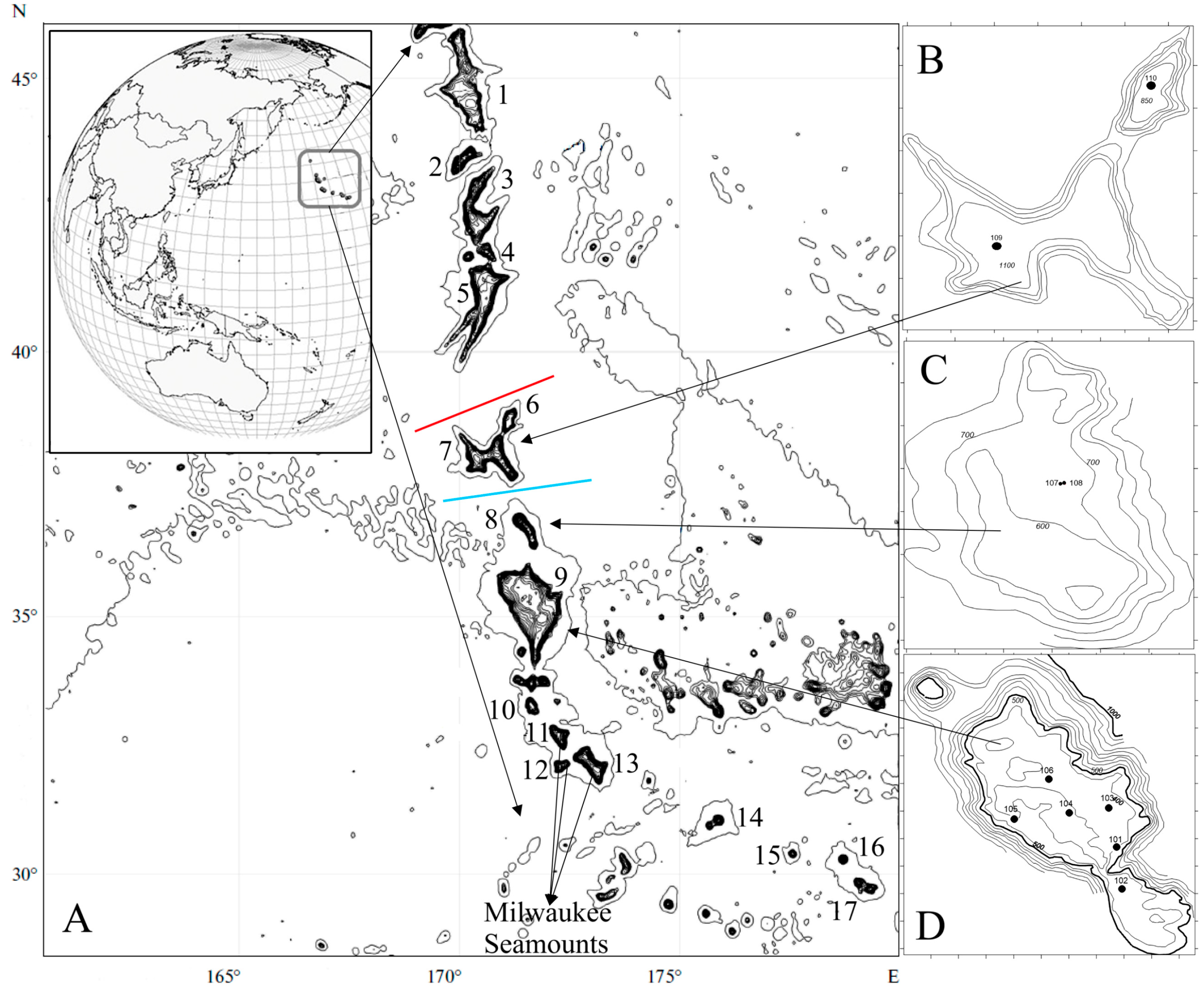
Figure 1. Map of the Emperor Seamounts and northwestern Hawaiian Ridge (A) and positions of bottom trawl stations on Ojin and Jingu (B), Annei (C), and Koko (D) seamounts. Numbers on panels B-D are numbers of stations (in ordinary font) and isobaths (in Italic font). Numbers on panel A are seamounts: 1—Suiko, 2—Showa, 3—Yomei (Multipeak), 4—Godaigo, 5—Nintoku, 6—Jingu, 7—Ojin, 8—Annei (Lira), 9—Koko, 10—Kimmei, 11—Yuryaku, 12—Kammu, 13—Colahan, 14—C-H (Karandash), 15—NW Hancock (Pedestal), 16—SE Hancock, 17—Equator. Red and blue lines indicate boundaries of the transition zone between subtropical and tropical (red line indicates northernmost records of the species belonging to “subtropical ichthyocene” in terms of [16]; blue line marks the southernmost records of Coryphaenoides spp., see Section 4).
Jmse 14 00063 g001
Figure 5. The haplotype network (526 bp) of the genus Cyclothone. The list of samples used is presented in Supplementary Table S1. Numbers indicate haplotypes; numbers of substitutions are given in brackets. The haplotypes obtained in this study are marked with an arrow.
Jmse 14 00063 g005
Figure 6. The Bayesian consensus tree (526 bp) of the genus Cyclothone. The list of samples used is presented in Supplementary Table S1. The haplotypes obtained in this study are marked with an arrow. Sequences of Diplophos taenia (NC_002647) and Gonostoma atlanticum (OR582657) were used as the outgroup.
Jmse 14 00063 g006
Figure 7. The haplotype network (571 bp) of the genus Maurolicus. The list of samples used is presented in Supplementary Table S2. Numbers indicate haplotypes; numbers of substitutions are given in brackets. The haplotypes obtained in this study are marked with an arrow.
Jmse 14 00063 g007
Figure 8. The Bayesian tree (571 bp) of the genus Maurolicus. The list of samples used is presented in Supplementary Table S2. The haplotypes obtained in this study are marked with an arrow. Sequence of Vinciguerria poweriae (JN312649) was used as the outgroup.
Jmse 14 00063 g008
Figure 9. The haplotype network (484 bp) of the genus Argyropelecus. The list of samples used is presented in Supplementary Table S3. Numbers indicate haplotypes; numbers of substitutions are given in brackets. The haplotypes obtained in this study are marked with an arrow.
Jmse 14 00063 g009
Figure 10. The Bayesian tree (484 bp) of the genus Argyropelecus. The list of samples used is presented in Supplementary Table S3. The haplotypes obtained in this study are marked with an arrow. Sequence of Diplophos taenia (NC_002647) was used as the outgroup.
Jmse 14 00063 g010
Figure 12. The haplotype network (539 bp) of the genus Chauliodus. The list of samples used is presented in Supplementary Table S4. Numbers indicate haplotypes; numbers of substitutions are given in brackets. The haplotypes obtained in this study are marked with an arrow.
Jmse 14 00063 g012
Figure 13. The Bayesian tree (596 bp) of the genus Chauliodus. The list of samples used is presented in Supplementary Table S4. The haplotypes obtained in this study are marked with an arrow. Sequences of Sigmops gracilis (NC_002574), Borostomias antarcticus (OX465241), Borostomias elucens (FJ918937), and Stomias danae (OP057118) were used as the outgroup.
Jmse 14 00063 g013
Figure 15. The haplotype network (552 bp) of the genus Bathygadus. The list of samples used is presented in Supplementary Table S5. Numbers indicate haplotypes; numbers of substitutions are given in brackets. The haplotypes obtained in this study are marked with an arrow.
Jmse 14 00063 g015
Figure 16. The Bayesian tree (552 bp) of the genus Bathygadus. The list of samples used is presented in Supplementary Table S5. The haplotypes obtained in this study are marked with an arrow. Sequences of Antimora microlepis (NC_083048) and Macrourus whitsoni (MT157320) were used as the outgroup.
Jmse 14 00063 g016
Figure 21. The haplotype network (548 bp) of the genus Helicolenus. The list of samples used is presented in Supplementary Table S6. Numbers indicate haplotypes; numbers of substitutions are given in brackets. The haplotypes obtained in this study are marked with an arrow.
Jmse 14 00063 g021
Figure 22. The Bayesian tree (548 bp) of the genus Helicolenus. The list of samples used is presented in Supplementary Table S6. The haplotypes obtained in this study are marked with an arrow. Sequence of Sebastes norvegicus (NC_056783) was used as the outgroup.
Jmse 14 00063 g022
Figure 24. The haplotype network (595 bp) of the genus Pseudoscopelus. The list of samples used is presented in Supplementary Table S7. Numbers indicate haplotypes; numbers of substitutions are given in brackets. The haplotypes obtained in this study are marked with an arrow.
Jmse 14 00063 g024
Figure 25. The Bayesian tree (595 bp) of the genus Pseudoscopelus. The list of samples used is presented in Supplementary Table S7. The haplotypes obtained in this study are marked with an arrow. Sequences of Scomber colias (NC_013724) and Chiasmodon niger (NC_070071) were used as the outgroup.
Jmse 14 00063 g025
Figure 27. Results of cluster analysis of the similarity of the demersal species compositions of the main seamounts of the Emperor Chain (dashed lines showed statistically insignificant relationships).
Jmse 14 00063 g027
Table 1. Data on bottom trawl stations made during 2019 cruise of R/V Professor Kaganovsky in Emperor Seamounts area.
Station No.SeamountDateLatitude, NLongitude, EDepth, mBottom Temperature, °C
101Koko9 April 201935°10′171°46′383–38710.4
10235°01′171°47′353–35810.6
10335°19′171°44′347–35910.8
10435°17′30″171°35′29111.7
10510 April 201935°16′171°23′30″353–35710.7
10635°24′30″171°31′30″344–33610.6
107Annei (Lira)11 April 201936°47′30″171°23′643–6494.9
10836°47′30″171°23′642–6534.7
109Ojin12 April 201937°57′170°24′10303.35
110Jingu14 April 201938°42′171°07′8203.8
Table 2. Specimens barcoded as part of this study.
SpeciesLaboratory DNA Sample Number (IORAS Voucher Specimen Number)GenBank Accession NumberSequence Length (bp)Comments
Etmopteridae
Etmopterus cf. lailae19 (P.05030)PX647299717First barcode-flagged and public sequences for this species
63 (P.04998)PX647313717
64 (P.04998)PX647314717
65 (P.04998)PX647315717
66 (P.04998)PX647316717
67 (P.04998)PX647317717
Etmopterus pusillus119 (P.05024)PX647323721
120 (P.05024)PX647324721
121 (P.05024)PX647325721
Congridae
Gnatophis johnsoni70 (P.04999)PV455848618[24]
71 (P.04999)PV455851618
72 (P.04999)PV455850618
73 (P.04999)PV455849618
74 (P.04999)PV455847618
Bathylagidae
Lipolagus ochotensis45 (P.05058)PX647307678
A74 (P.05032)PX647344468
Melanolagus bericoides108 (P.05033)PX660574463We could not receive a good COI sequence from this sample, but we obtained the first public sequence of the Cyt b gene fragment
Gonostomatidae
Sigmops elongatus44 (P.03668)PX647306677
Sigmops gracilisA77 (P.03669)PX647346614
A79 (P.03669)PX647347430
Cyclothone atrariaA80 (P.05035)PX647348622
Sternoptychidae
Maurolicus imperatoriusA9 (P.05020)PX647338717First barcode-flagged and public sequence for this species
A11 (P.05020)PX647339717
A12 (P.05020)PX647340717
Argyropelecus affinisA81 (P.05036)PX647349619
Polyipnus matsubarai16 (P.05015)PX647298608
Sternoptyx diaphanaA75 (P.05038)PX647345614
Stomiidae
Chauliodus sloani43 (P.05060)PX647305539These sequences represent a separate lineage (possible cryptic species) within the C. sloani complex
A51 (P.05068)PX647342539
A52 (P.05068)PX647343539
Melanostomias valdiviae86 (P.05051)PX647320610
Opostomias mitsui13 (P.05069)PX647297539
Chlorophthalmidae
Chlorophthalmus imperator48 (P.05011)PX647308611First barcode-flagged and public sequence for this species
50 (P.05011)PX647309613
Neoscopelidae
Neoscopelus cf. macrolepidotus127 (S.0114)PX647326613
128 (S.0114)PX647327613
Moridae
Lepidion inosimae53 (P.05042)PX647311659
Macrouridae
Bathygadus antrodesA7 (M.00109)PX647337726
Coelorinchus matsubarae7 (M.00109-001)PX647291722First barcode-flagged and public sequence for this species
8 (M.00109-003)PX647292722
9 (M.00109-004)PX647293722
10 (M.00109-002)PX647294722
11 (M.00109-005)PX647295722
Nezumia obliquata23 (M.00107-003)PX647300703First barcode-flagged and public sequence for this species
24 (M.00107-002)PX647301703
Nezumia cf. proxima25 (M.00107-001)PX647302474
Squalogadus modificatusA18 (not catalogued)PX647341601
Lophiidae
Lophioides bruchius56 (P.05002)PX647312679First barcode-flagged and public sequence for this species
Oneirodidae
Bertella idiomorpha100 (P.05043)PX647321662
Macroramphosidae
Macroramphosus gracilis5 (P.05021)PX647289680
Sebastidae
Adelosebastes latens134 (P.05055)PX647328452First barcode-flagged and public sequence for this genus and species
135 (P.05055)PX647329421
Helicolenus avius137 (P.05005)PX647330675
138 (P.05005)PX647331675
139 (P.05005)PX647332675
140 (P.05005)PX647333675
Plectrogeniidae
Bembradium roseum6 (P.05022)PX647290620
26 (P.05013)PX647303620
Howellidae
Howella parini36 (P.05063)PX647304666Although it is the first barcode-flagged sequence for this species, it forms a single unique lineage with “Bathysphyraenops simplex” (likely misidentification; OR582658, no locality data)
147 (P.05044)PX647334590
148 (P.05044)PX647335590
150 (P.05044)PX647336616
Epigonidae
Epigonus denticulatusA100 (P.05008)PX647350664
Bramidae
Brama japonica52 (P.05009)PX647310677
Chiasmodontidae
Pseudoscopelus altipinnis107 (P.05045)PX647322684First barcode-flagged and public sequence for this species
Trichiuridae
Benthodesmus pacificus12 (P.05018)PX647296614Although it is the first barcode-flagged sequence for this species, it is identical to the samples GU805059/DSFSF394-09 and KF489506/DSFSG511-11 from South Africa identified as B. simonyi
68 (P.05010)PX647318640
Zoarcidae
Lycodapus imperatorius89 (P. 03641)OP759467582[26]
Pleuronectidae
Microstomus shuntovi69 (P.05029)PX647319590
Table 3. Fish species recorded for the first time across four seamounts of the Emperor Chain (+). Abbreviations: B, bottom or benthopelagic; P, meso- or bathypelagic.
SpeciesAnneiKokoOjinJinguRemarks
Centroscyllium excelsum (B)+
Etmopterus cf. lailae (B)+
Apristurus fedorovi (B) +
Gnathophis johnsoni (B) + Newly described species
Nettastoma parviceps (B)+
Meadia abyssalis (B) +
Simenchelys parasitica (B)+
Nemichthys scolopaceus (P) +
Lipolagus ochotensis (P)+ +
Melanolagus bericoides (P)+ + First record for the area
Sagamichthys abei (B) +
Diplophos orientalis (P)+
Sigmops elogatus (P) +
Sigmops gracilis (P)+
Cyclothone atraria (P)+
Argyropelecus affinis (P)+ First record for the area
Argyropelecus sladeni (P)+
Sternoptyx diaphana (P)+
Ichthyococcus elongatus (P)+
Eustomias securicula (P) + Newly described species
Melanostomias valdiviae (P)+
Opostomias mitsuii (P) +
Idiacanthus antrostomus (P)+
Malacosteus niger (P) +
Benthalbella infans (P)+
Diaphus balanovi (B)+ + Newly described species
Neoscopelus cf. macrolepidotus (B)+
Lepidion inosimae (B)+
Melanonus zugmayeri (P)+ First record for the area
Bathygadus antrodes (B) +
Nezumia obliquata (B)+
Nezumia cf. proxima (B)+ First record for the area
Squalogadus modificatus (B, P) + First record for the area
Bertella idiomorpha (P)+ First record for the area
Linophryne arborifera (P)+ First record for the Pacific Ocean
Macroramphosus gracilis (P) +
Scopeloberyx malayanus (P)+ First record for the area
Bembradium roseum (B) +
Psednos kaganovskii (P) + Newly described species
Howella parini (B, P)+ +
Pseudoscopelus altipinnis (P)+
Benthodesmus pacificus (B, P) +
Lycodapus imperatorius (P)+ +Newly described species
Microstomus bathybius (B)+ +
Table 4. The matrix of the similarity of the demersal species compositions of the main seamounts of the Emperor Chain based on the Sørensen–Czekanowsky index.
SeamountsNintokuJinguOjinKokoMilwaukee
Nintoku
Jingu68.57
Ojin57.1463.16
Koko17.9125.7128.57
Milwaukee11.7616.9022.5467.96
Annei35.9042.8652.3840.5437.33
Disclaimer/Publisher’s Note: The statements, opinions and data contained in all publications are solely those of the individual author(s) and contributor(s) and not of MDPI and/or the editor(s). MDPI and/or the editor(s) disclaim responsibility for any injury to people or property resulting from any ideas, methods, instructions or products referred to in the content.