Article

Characteristics of Coastal Trapped Waves Generated by Typhoon ‘Soudelor’ in the Northwestern South China Sea

1
State Environmental Protection Key Laboratory of Coastal Ecosystem, National Marine Environmental Monitoring Center, Ministry of Ecology and Environment, Dalian 116023, China
2
National Marine Environmental Forecasting Center, Ministry of Natural Resources, Beijing 100081, China
3
College of Oceanic and Atmospheric Sciences, Ocean University of China, Qingdao 266100, China
*
Author to whom correspondence should be addressed.
J. Mar. Sci. Eng. 2026, 14(1), 4; https://doi.org/10.3390/jmse14010004
Submission received: 27 November 2025 / Revised: 17 December 2025 / Accepted: 17 December 2025 / Published: 19 December 2025
(This article belongs to the Section Physical Oceanography)

Abstract

Coastal Trapped Waves (CTWs) represent an important class of mesoscale fluctuations in nearshore shelf regions and play a crucial role in modulating coastal circulation. The South China Sea (SCS), the largest semi-enclosed marginal sea in the western Pacific Ocean, features a continental shelf approximately 200 km wide. During summer, the SCS is frequently impacted by typhoons, which often trigger significant CTWs. This study investigates the characteristics of CTWs generated by Typhoon ‘Soudelor’ (No. 1513) in the northwestern SCS, based on current observations and numerical model simulations. Under the influence of Soudelor, CTWs characterized by elevated water levels nearshore and depressed water levels offshore were initially generated by wind-induced Ekman transport in the Taiwan Strait. These waves subsequently propagated southwestward along the coastline with phase velocities ranging from 7.2 to 18.3 m/s. Model results indicate that the CTW influenced current fields up to 160 km offshore, with a maximum CTW-induced current velocity exceeding 0.7 m/s. The vertical structure of the CTW-induced current field exhibited a barotropic characteristic. The influence of CTWs on current fields diminished with propagation distance, accompanied by a reduction in the induced current velocity. This attenuation was particularly pronounced between Xiamen (XM) and Shanwei (SW). Sensitivity experiments further revealed that the slowed propagation phase velocity of CTWs between XM and SW was attributable to strong reflection, scattering, and nonlinear effects caused by the abrupt topographic changes of the Taiwan Bank.

1. Introduction

Coastal Trapped Waves (CTWs) are sub-inertial fluctuations, strongly influenced by Earth’s rotation, with energy confined to continental shelf regions. Typically exhibiting amplitudes of approximately 10 cm and wavelengths of several thousand kilometers [1], CTWs have periods ranging between 2 and 20 days. In the Northern (Southern) Hemisphere, their propagation direction is with the coast on their right (left) [2]. As key mesoscale fluctuations in shelf and slope regions, CTWs play a vital role in modulating coastal circulation, upwelling, water exchange, and mixing processes [3,4,5,6].
Typhoons represent one of the most intense atmospheric forcing events in tropical oceans. Their passage can induce substantial sea level fluctuations and significantly intensify oceanic currents. Numerous studies have employed observational data and numerical models to investigate and document such ocean responses to tropical cyclones. Among these responses, CTWs constitute an important category. The earliest identification of CTWs was made by Hamon [7], who detected 5–9 days period waves propagating northward from Sydney to Coffs Harbour using daily mean water level records off eastern Australia. Le [8] utilized a three-dimensional, nonlinear, primitive equation ocean general circulation model to simulate the ocean’s response to Hurricane ‘Frederic’ in the Gulf of Mexico, revealing a westward propagating surge consistent with CTW dynamics. Further evidence was provided by Eliot and Pattiaratchi [9], who demonstrated that tropical cyclones can generate significant CTWs, with the most pronounced response occurring when the cyclone track runs parallel to the coastline, as observed off the west coast of Australia. In a study of the East China Sea, Yin et al. [10] analyzed data from five coastal buoys deployed during winter 2006, identifying three distinct types of low-frequency fluctuations with periods of 2–10 days.
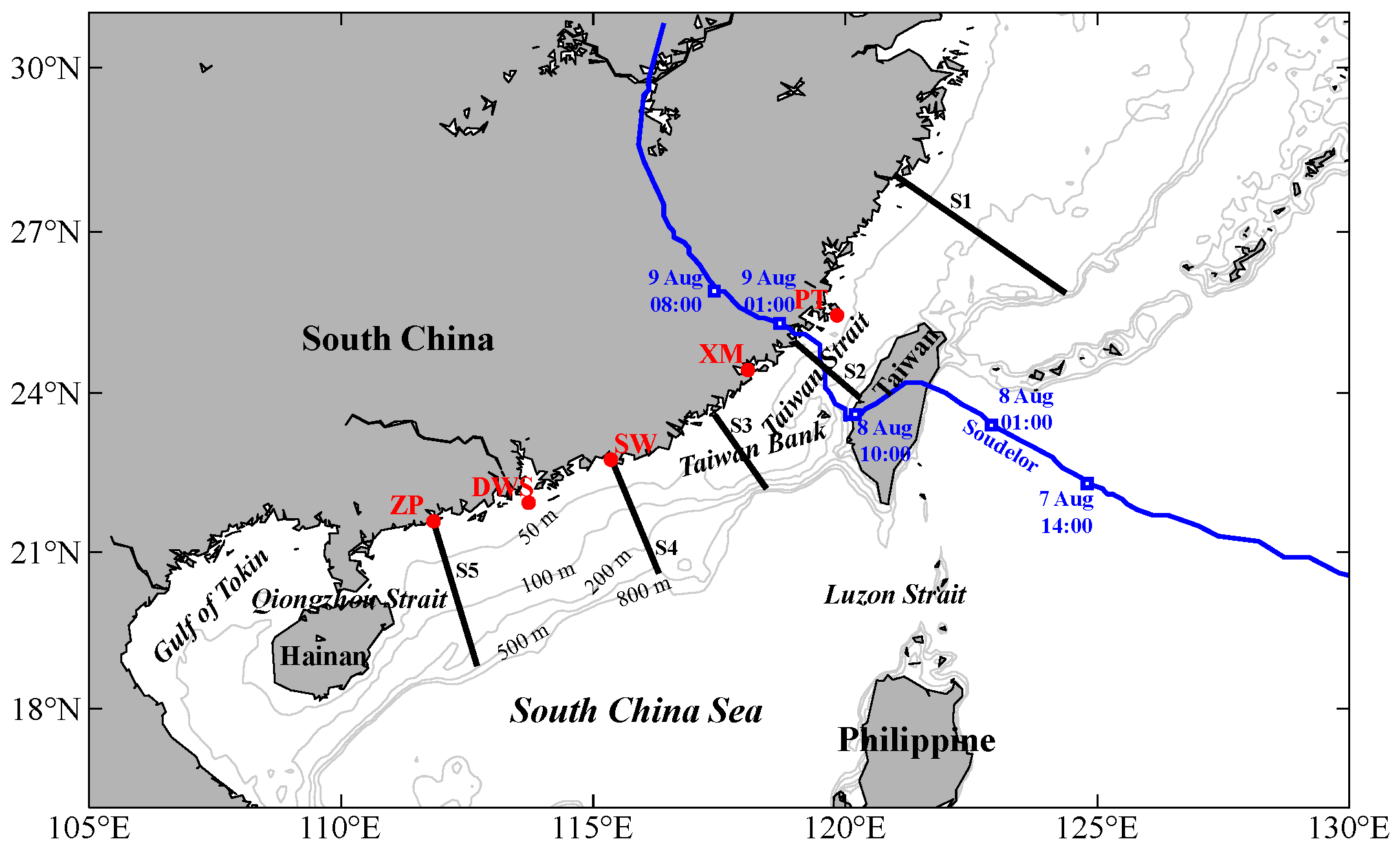
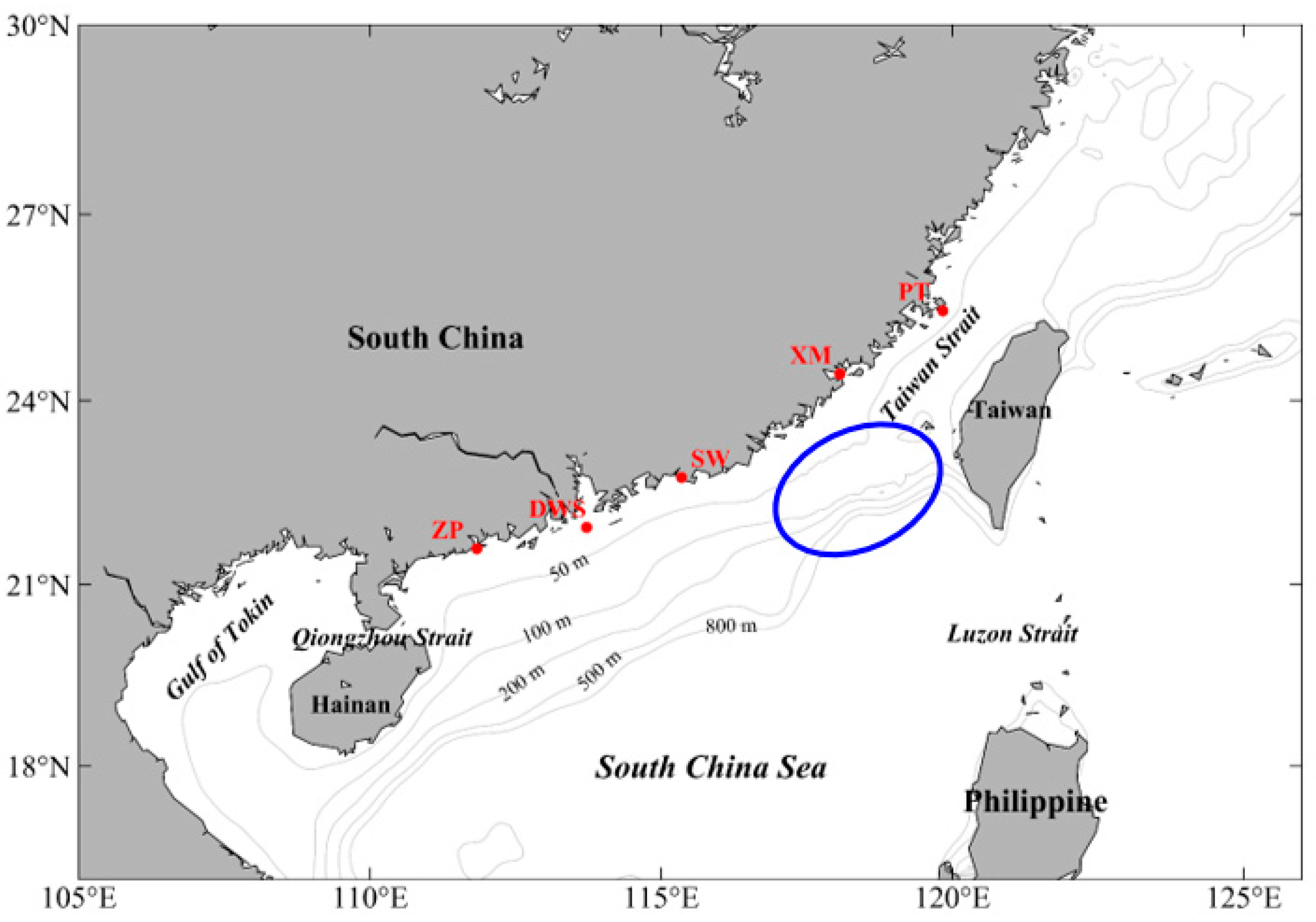
The South China Sea (SCS), a major marginal sea in the western Pacific Ocean, connects to the East China Sea via the Taiwan Strait and to the open Pacific through the Luzon Strait [11]. Its northern sector features a broad continental shelf approximately 200 km wide, with a gentle slope of about 0.5°. The isobaths on this shelf run largely parallel to the coastline, except near the southern mouth of the Taiwan Strait, where the topography is interrupted by the Taiwan Bank (TWBK) (Figure 1). As one of the world’s most typhoon-prone regions, the SCS experiences approximately ten tropical cyclones annually, primarily during the summer [12,13]. While the prevailing southwesterly summer monsoon is generally ineffective at generating CTWs, tropical cyclones with northerly or northeasterly wind components are their primary trigger [14,15]. These southwestward propagating CTWs can subsequently be modulated by interactions with the opposing southwesterly monsoon. As synoptic-scale fluctuations, CTWs represent crucial mesoscale dynamic processes that significantly influence circulation patterns and material transport across the entire northern SCS shelf. Numerous studies have investigated CTWs in this region. Ding et al. [16] analyzed their structure and propagation processing using hourly sea level records and a realistic FVCOM simulation. Li et al. [17] examined propagation characteristics during winter 2008 using coastal meteorological and tide-gauge data from the East China Sea and SCS. Focusing on specific typhoon cases (No. 8709 and No. 8908), Cao et al. [18] compared CTW characteristics between north and south of the Qiongzhou Strait using long time series tide gauge data and model results. More recently, Li et al. [19] combined data from four tide gauge stations (Kanmen, Xiamen, Shanwei, and Zhapo) with satellite altimetry to study CTW properties, while Hu et al. [20] investigated their seasonal characteristics, emphasizing the dominant role of wind forcing in CTW generation.
This study investigates the characteristics of CTW generated by Typhoon ‘Soudelor’ (No. 1513) in the northwestern SCS based on a combination of tide-gauge/current measurements and the FVCOM numerical model. Section 2 describes the observational data, the data analysis method, and the numerical model. Section 3 presents the observed current velocity structure during the typhoon and the spatial characteristics of the CTW, along with a comprehensive evaluation of model performance through spatiotemporal comparison with observations. The primary factors controlling the observed slowdown in CTW phase velocity between Xiamen (XM) and Shanwei (SW) are discussed in Section 4. Finally, a summary of the study is provided in Section 5.
Figure 1. Bathymetry and observational configuration in the northern South China Sea. The blue line indicates the track of Typhoon ‘Soudelor’. Red circles mark the five tide gauge stations: Pingtan (PT), Xiamen (XM), Shanwei (SW), Dawanshan (DWS), and Zhapo (ZP). Black lines (S1–S5) denote the cross-shore sections for model analysis.
Jmse 14 00004 g001

2. Methods

2.1. Observations

Field observations of currents, sea level and wind velocity, typhoon path track data were collected for displaying the spatiotemporal variations of the key hydrographical conditions related to CTWs.
Sea level data with an hourly resolution were obtained from five long-term tide gauge stations (Figure 1). To account for the influence of surface atmospheric pressure, the observed sea levels were adjusted using the method of Schumann and Brink [21]. The correction was applied as follows:
η = 0.99 p a + η 0
where p a is the sea surface atmospheric pressure variation (in millibars), η 0 is the observed sea level (in centimeters), and η is the corrected sea level elevation (in centimeters) used in this study. Due to the higher density of seawater compared to freshwater, the inverse barometer correction coefficient was set to 0.99. The required atmospheric pressure data were sourced from the NCEP reanalysis dataset, which has a spatial resolution of 2.5° × 2.5° and a temporal resolution of 6 h [22].
A bottom-mounted Acoustic Doppler Current Profiler (LinQuest, San Diego, CA, USA) was deployed at the SW station, where the water depth is 17 m, to collect current data. The instrument was configured with a sampling interval of 10 min and a vertical bin size of 1 m. Current measurements from 16 July to 13 August 2015, were employed in this study. To ensure data quality by avoiding the transducer blanking distance and side-lobe interference near the sea surface, the analysis was restricted to the water layers between 3 and 14 m.
Hourly 10 m wind data were obtained from the NCEP Climate Forecast System Version 2 (CFSv2) [23]. This dataset features a relatively high horizontal spatial resolution of approximately 0.205° in both longitude and latitude directions, enabling it to effectively capture the structure and evolution of tropical cyclones. The hourly time series from this product was used for subsequent analysis.
Typhoon track data were acquired from the Joint Typhoon Warning Center (JTWC, https://www.metoc.navy.mil/jtwc/jtwc.html, accessed on 22 March 2023). Typhoon ‘Soudelor’ originated as a tropical depression near Pohnpei Island on 29 July 2015. After traversing the western Pacific, it approached Taiwan Island by 7 August 2015, attaining a maximum sustained wind speed of 52 m/s and a minimum central pressure of 930 hPa. The typhoon made its first landfall in Hualien, eastern Taiwan, at 04:40 on 7 August, with a wind speed of 48 m/s and a central pressure of 940 hPa. It subsequently made a second landfall in Fujian Province at 22:10 on the same day, with weakened intensity (38 m/s wind speed and 970 hPa central pressure). Soudelor eventually decayed to a tropical depression by 10 August 2015. The spatiotemporal evolution of the associated wind field during this period is illustrated in Figure 2.

2.2. Sea Level, Current and Wind DATA Processing

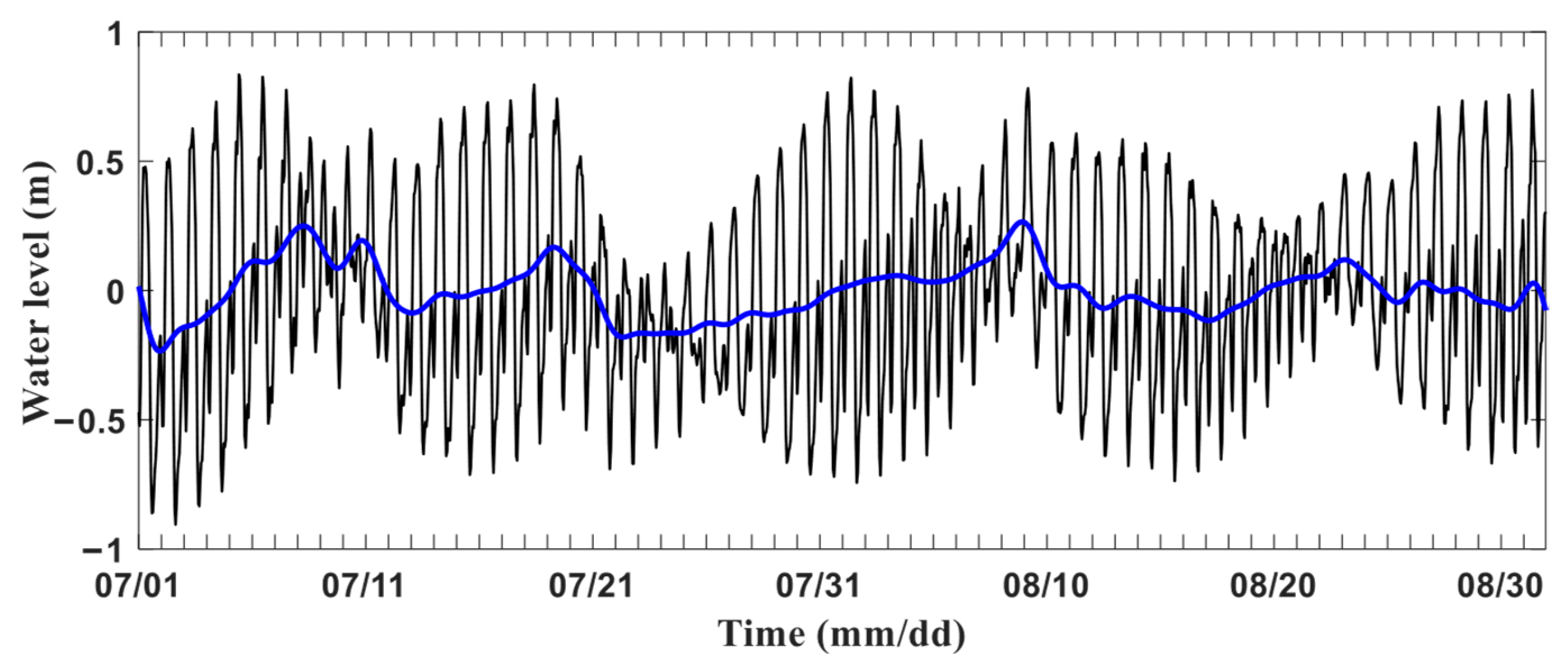
To isolate the CTW signals, which typically exhibit periods of several days, tidal constituents were first removed from the sea level and current data using the T_TIDE package developed by Pawlowicz et al. [24]. Subsequently, a Lanczos [25] low-pass filter with a cut-off frequency of 0.6 cpd (cycles per day) was applied to extract the low-frequency components of sea level, current, and wind. This filtering effectively removes tidal (predominantly at ~1 and ~2 cpd) and inertial (ranging from 0.74 to 0.86 cpd) fluctuations from the observations. The processed data are hereafter referred to as low-pass filtered sea level, current, and wind. Figure 3 demonstrates the efficacy of this processing procedure, showing a comparison of original data with de-tided, and low-pass filtered sea level data at the SW station during July–August 2015. The results confirm the appropriate selection of the 0.6 cpd cut-off frequency (corresponding to a period of 40 h), which effectively retains the sub-tidal variability of interest. Unless otherwise stated, all subsequent analyses used data processed with this 0.6 cpd low-pass filter.

2.3. Model Configuration

The Finite Volume Community Ocean Model (FVCOM, version 5.0.1) [26] was employed in this study. FVCOM is a three-dimensional primitive equation model that adopts an unstructured triangular grid and a finite-volume numerical framework. It was jointly developed by the University of Massachusetts Dartmouth and the Woods Hole Oceanographic Institution. The model solves the momentum, continuity, temperature, salinity, and density equations, incorporating the Mellor and Yamada 2.5 turbulence closure scheme for vertical mixing [27] and the Smagorinsky scheme for parameterizing horizontal mixing [28]. The use of triangular grids enables accurate fitting of complex coastlines and multi-island regions, making FVCOM particularly suitable for simulating regional oceanic processes across domains with intricate geometries [29,30].
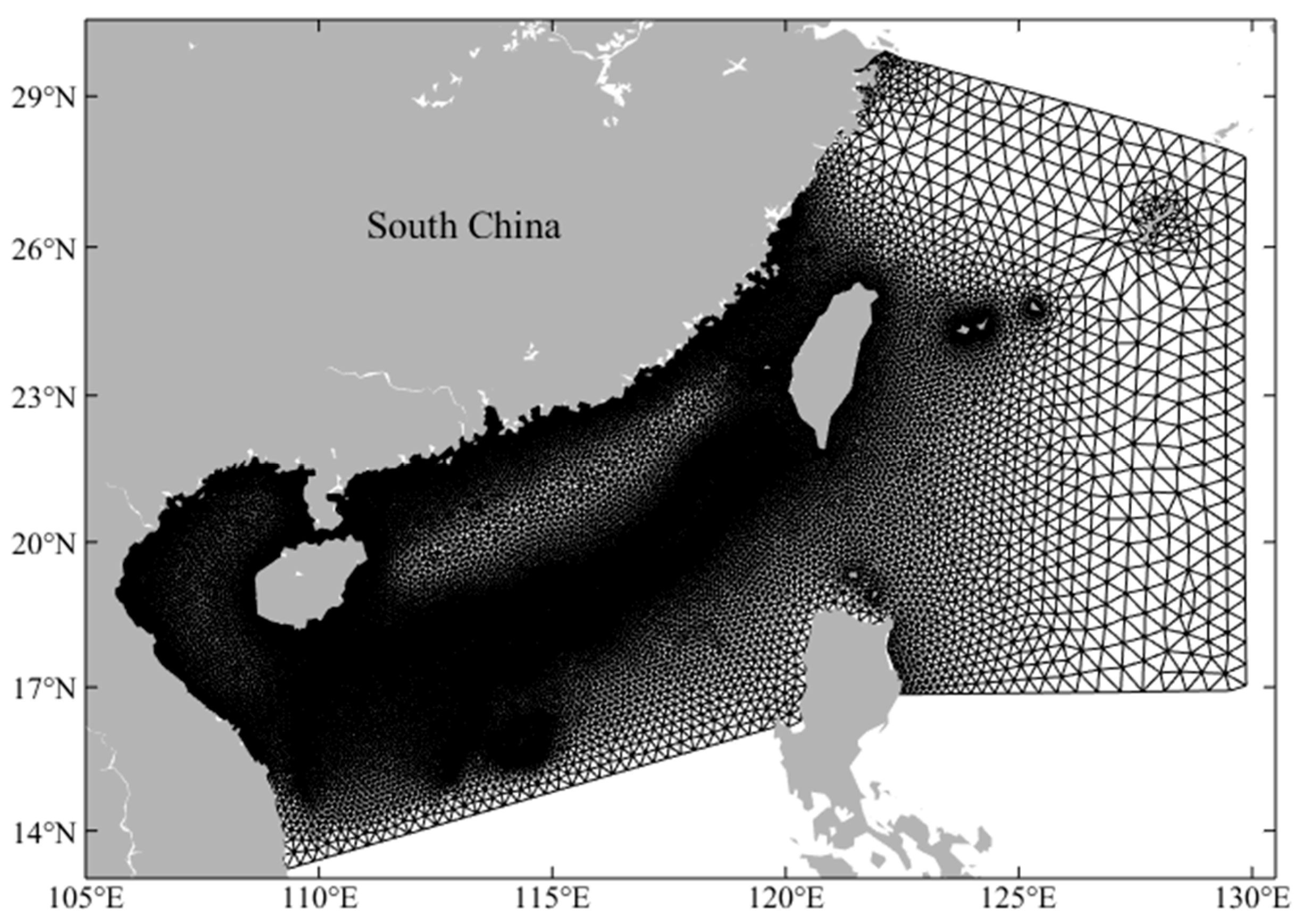
To minimize uncertainties arising from open boundary conditions, the model domain was designed with its open boundary situated sufficiently far from the area of primary interest. The computational grid (Figure 4) employs a spatially variable resolution, ranging from approximately 5 km in coastal regions to 50 km near the open boundary. In the horizontal direction, the computational mesh consists of 19,620 nodes and 37,316 triangular elements, while the water column is discretized into 25 sigma levels in the vertical.
The model bathymetry was constructed by integrating high-resolution data from the China coastal sea chart database with the broader-scale DBDB5 global topography dataset (US Naval Oceanographic Office, 1983). Radiation conditions were applied at the open boundaries, while solid boundaries were treated with a no-slip condition. To minimize energy accumulation and enhance numerical stability, sponge layers were implemented along the open boundaries [31].
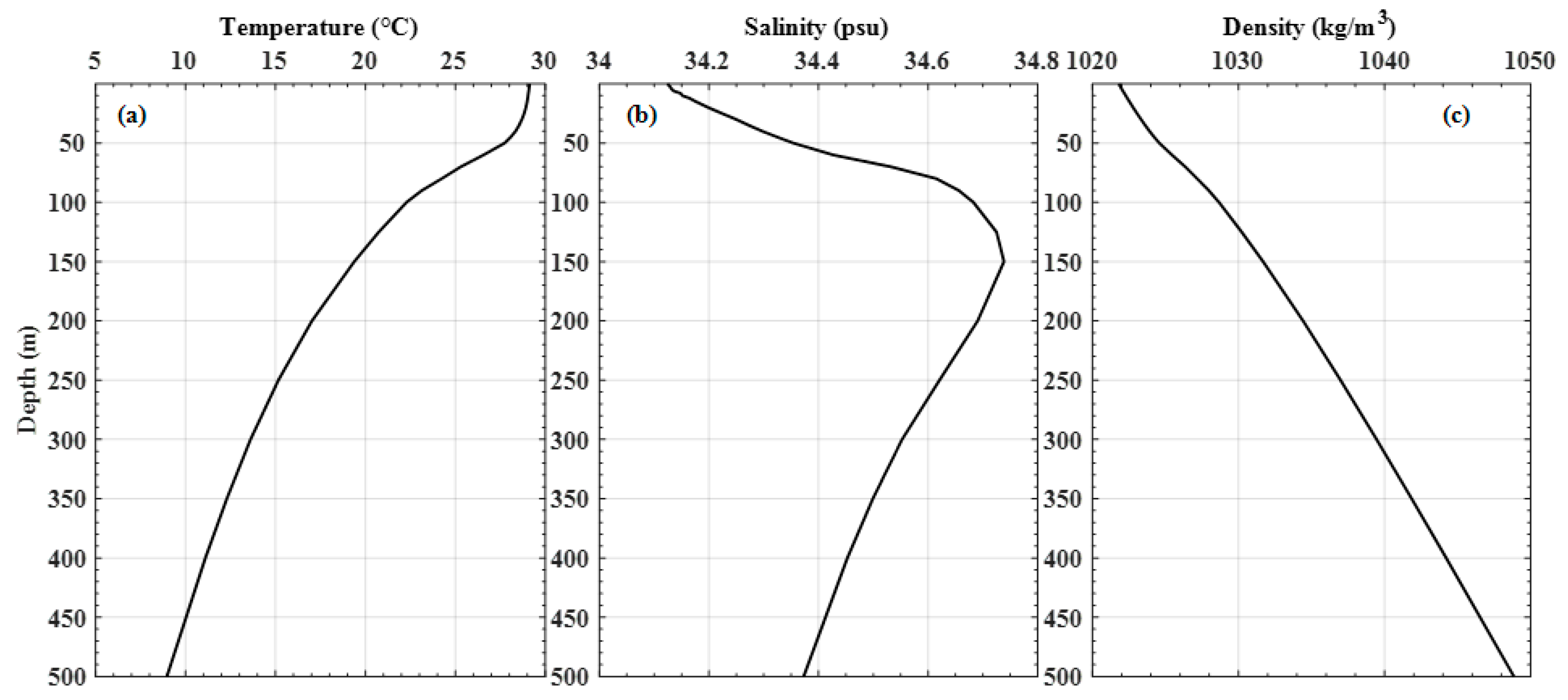
The model was initialized with three-dimensional temperature and salinity fields derived from the July 2015 monthly mean climatology of the HYCOM global reanalysis dataset. To isolate the specific contribution of wind forcing and exclude pre-existing density-driven flows, the initial thermohaline fields were configured to be horizontally homogeneous. This was achieved by taking the horizontal average of HYCOM vertical profiles (0–500 m) and applying the resulting uniform profiles across the entire model domain (Figure 5). Surface forcing was provided by the CFSv2 wind product with hourly reanalysis. Brink proposed that CTWs are primarily induced by alongshore winds [32], other forcings, such as surface atmospheric pressure, heat fluxes, tides, rivers, or background currents, were intentionally excluded from the model framework. To satisfy numerical stability criteria, the external and internal time steps were set to 6 s and 60 s, respectively. Starting from a state of rest (zero initial velocity), the model was iterated from 1 July to 31 August 2015. Hourly outputs of water level and current velocity during this period were subsequently used for the analysis of CTW characteristics.

3. Results

3.1. Correlation Analysis Between Sea Level and Wind

To quantify the contribution of wind forcing to the shoreward surge, the wind vector was decomposed into cross-shore and alongshore components. The cross-shore direction was defined as the direction perpendicular to the coastline, with positive values pointing seaward. The alongshore direction was aligned with the southwestward propagation path of CTWs along the SCS coast, with positive values indicating the downwelling-favorable direction. Winds from this direction promote onshore Ekman transport, leading to a local sea level rise. Theoretically, in the absence of remotely generated CTWs and under purely local wind forcing, the correlation coefficient between wind velocity and sea level variations would approach 1. In practice, however, the observed correlation is less than 1 due to the influence of remotely generated CTWs and nonlinear wind-surge interactions. Thus, this correlation coefficient can be interpreted as an indicator of the extent to which the total surge is dominated by local wind forcing rather than being influenced by CTWs propagating from remote areas.
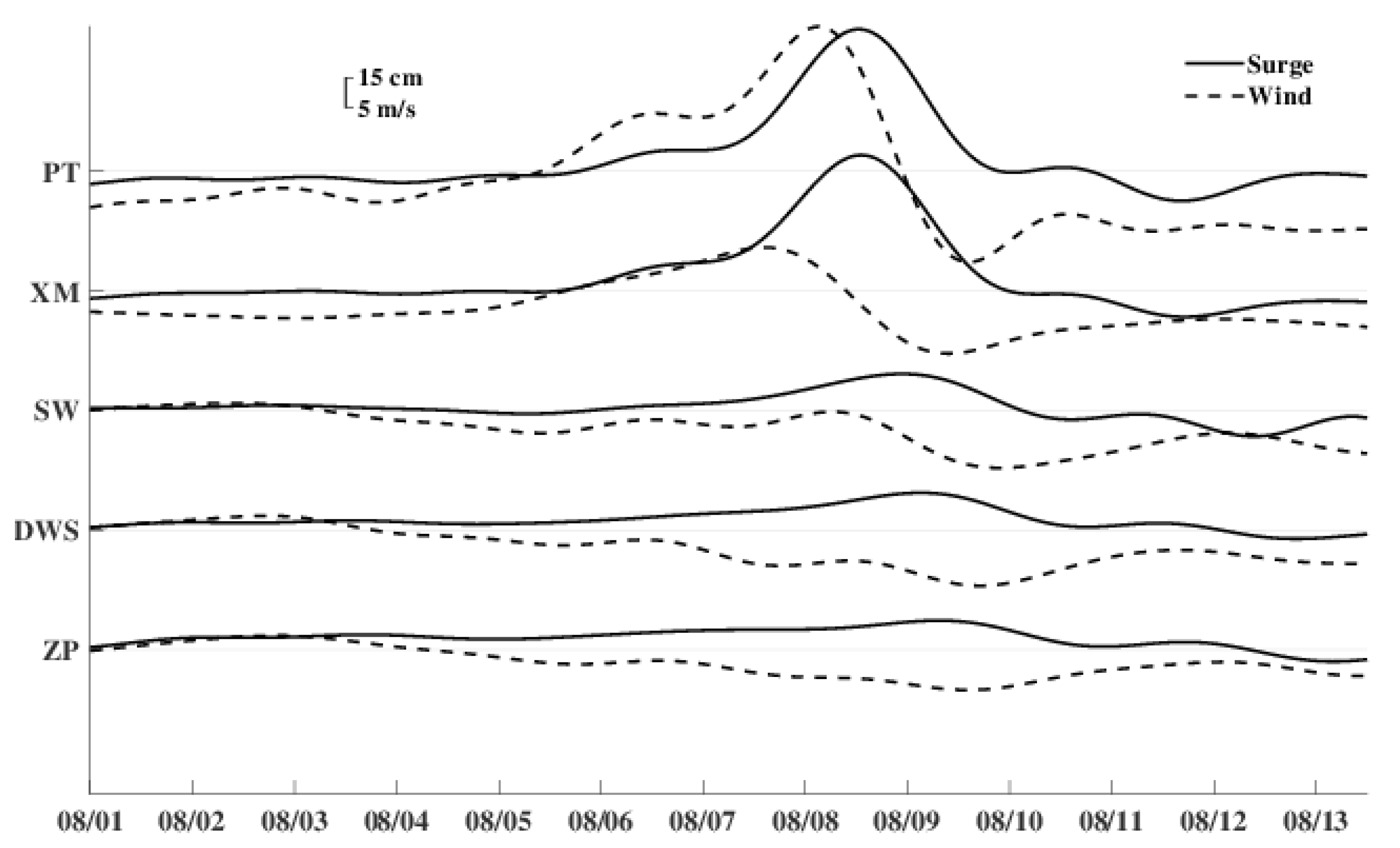
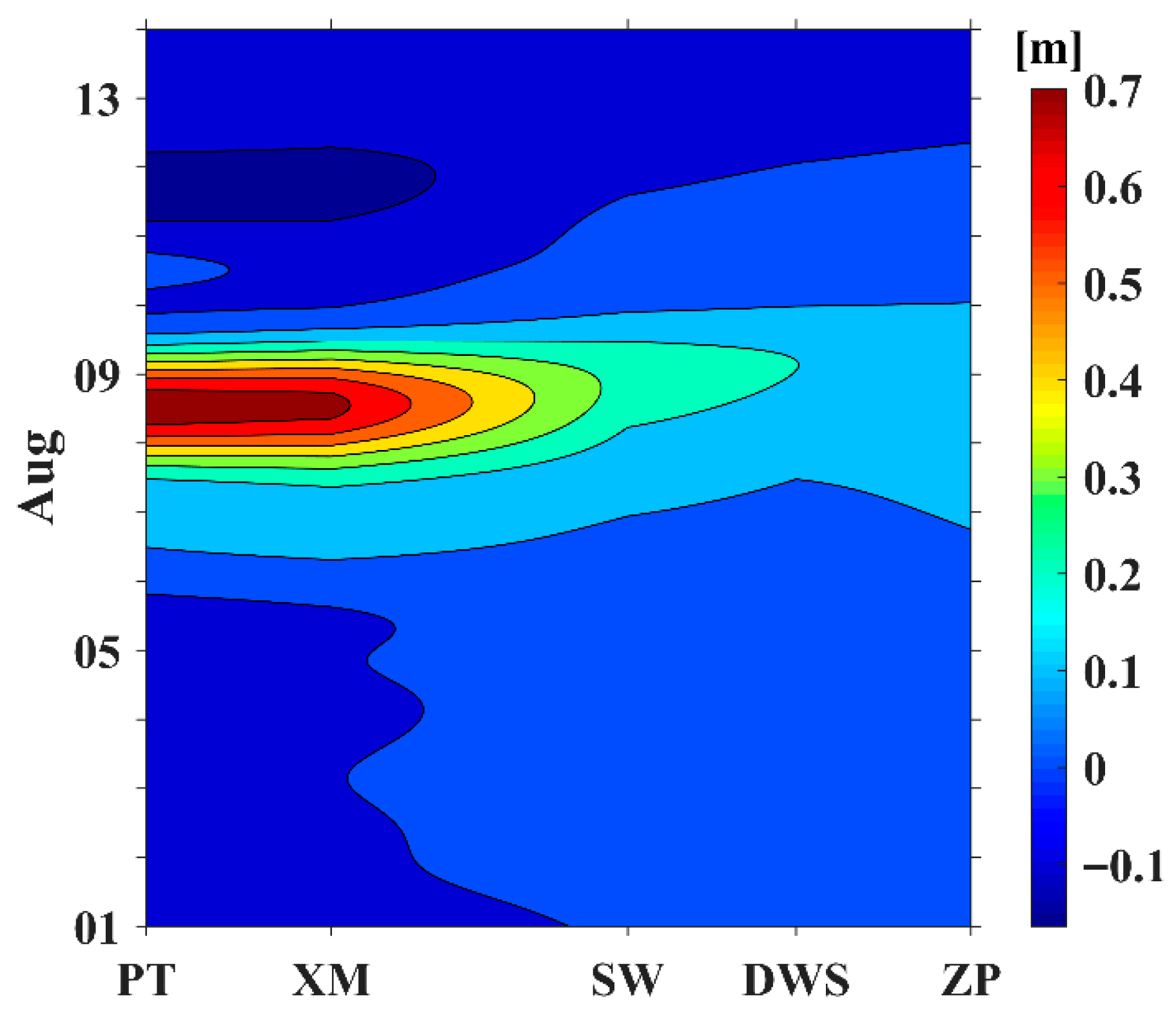
Figure 6 illustrates the spatiotemporal evolution of low-pass filtered sea level oscillations at the five tide gauge stations in August 2015. The signal induced by Soudelor during 7–9 August propagated southwestward from the Pingtan (PT) station toward the Zhaopo (ZP) station. Time series of low-pass filtered sea level and alongshore wind at the five stations from 1 to 13 August are presented in Figure 7, while the corresponding lag correlation coefficients and lag times between these two variables during 2–12 August are summarized in Table 1. As shown in Figure 7, sea level and alongshore wind during Soudelor’s passage were highly correlated at PT and XM, with correlation coefficients of 0.89 and 0.85, respectively. In contrast, no statistically significant correlation was observed at the other stations. These results indicate that storm surges generated at PT and XM by Soudelor propagated southwestward along the coastline in the form of a CTW, successively reaching the SW, Dawanshan (DWS), and ZP stations. This propagating signal constituted the dominant component of the sea level fluctuations observed at those downstream stations.

3.2. Phase Propagation Velocity of the CTW
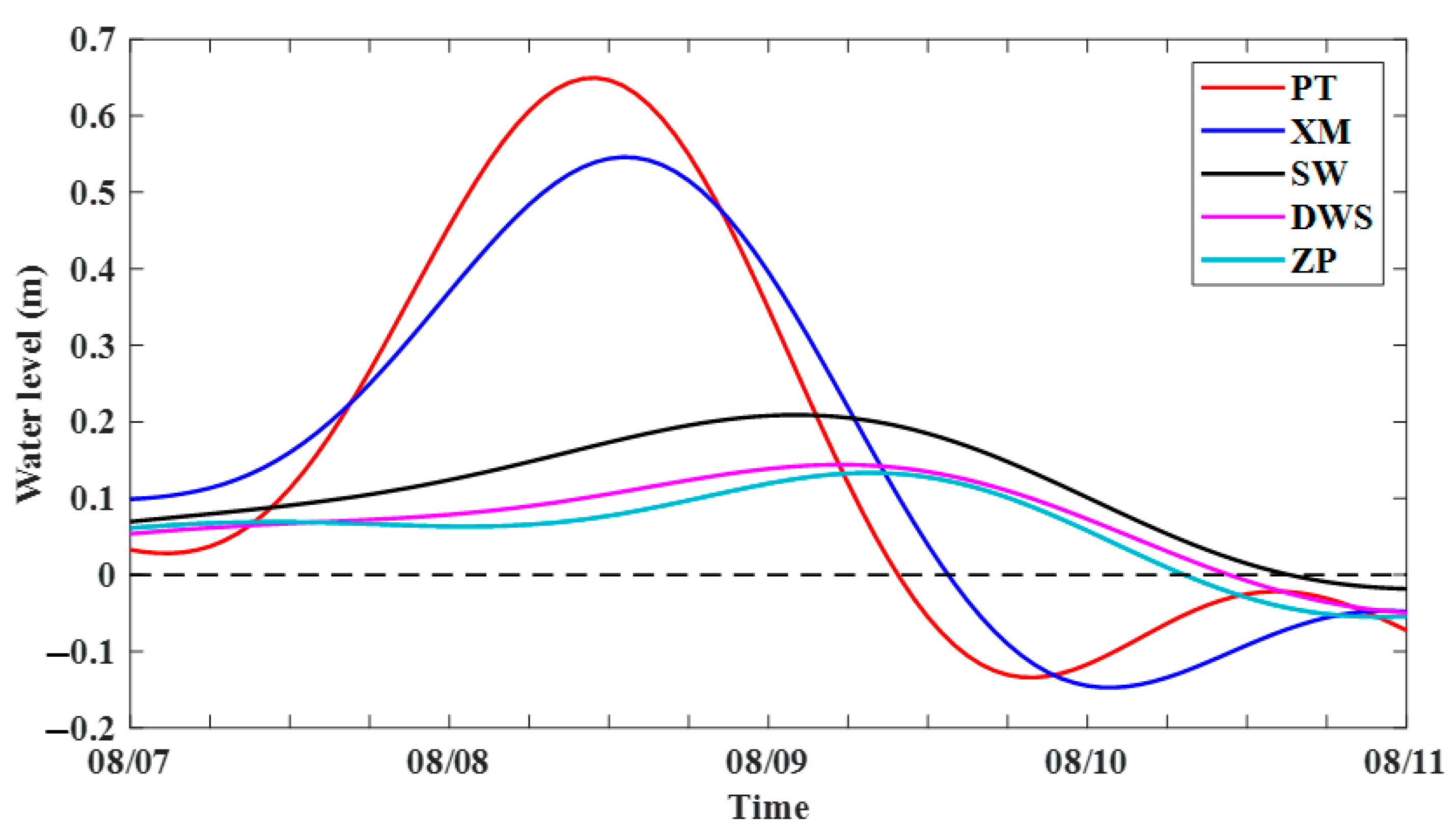
The temporal variations of low-pass filtered sea levels at the five tide-gauge stations are presented in Figure 8. The propagation velocity of the variation signals, calculated from the lag time of sea level crests and the alongshore distance between adjacent stations [8,21], is shown in Table 2. Estimated traveling speeds between stations were 29.2 m/s (PT-XM), 7.2 m/s (XM-SW), 17.7 m/s (SW-DWS), and 18.3 m/s (DWS-ZP). Notably, the propagation speed between PT and XM was the highest among these station. This exceptionally high value is likely attributable to the strong coupling between the coastal trapped wave (CTW) and local wind forcing near XM, as the center of Typhoon Soudelor passed directly through the Taiwan Strait (Figure 2). As described in Section 3.1, storm surges generated at PT and XM by Soudelor propagated southwestward along the coastline as a CTW, successively reaching the SW, DWS, and ZP stations. Consequently, the propagation velocities ranging from 7.2 to 18.3 m/s between XM and ZP represent the phase velocity of the CTW.
Moreover, the phase velocity between XM and SW fell within a notably low value of 7.2 m/s, significantly slower than that observed between other adjacent stations. This result is consistent with previous estimates: Ding et al. [16] reported phase velocities of 5.5–12.4 m/s between XM and SW, and Li et al. [17] obtained values of 5.6–10.4 m/s for the same segment. The consistently slower propagation in this region is likely influenced by the abrupt topographic variations of the TWBK between XM and SW, which may induce enhanced energy dissipation through reflection, scattering, and nonlinear processes [33].
Figure 8. Temporal variations of low-pass filtered sea levels at the five tide-gauge stations. The times of sea level crests at stations PT, XM, SW, DWS, and ZP were 11:00 on 8 August, 13:00 on 8 August, 02:00 on 9 August, 05:00 on 9 August and 08:00 on 9 August 2015, respectively.
Jmse 14 00004 g008
Table 2. Lag times (Lags) and corresponding phase velocities (Vel) of the CTW between adjacent stations.
StationsDistance (km)Lags (h)Vel (m/s)
PT-XM210229.2
XM-SW335137.2
SW-DWS191317.7
DWS-ZP198318.3

3.3. Current Characteristics at SW Station

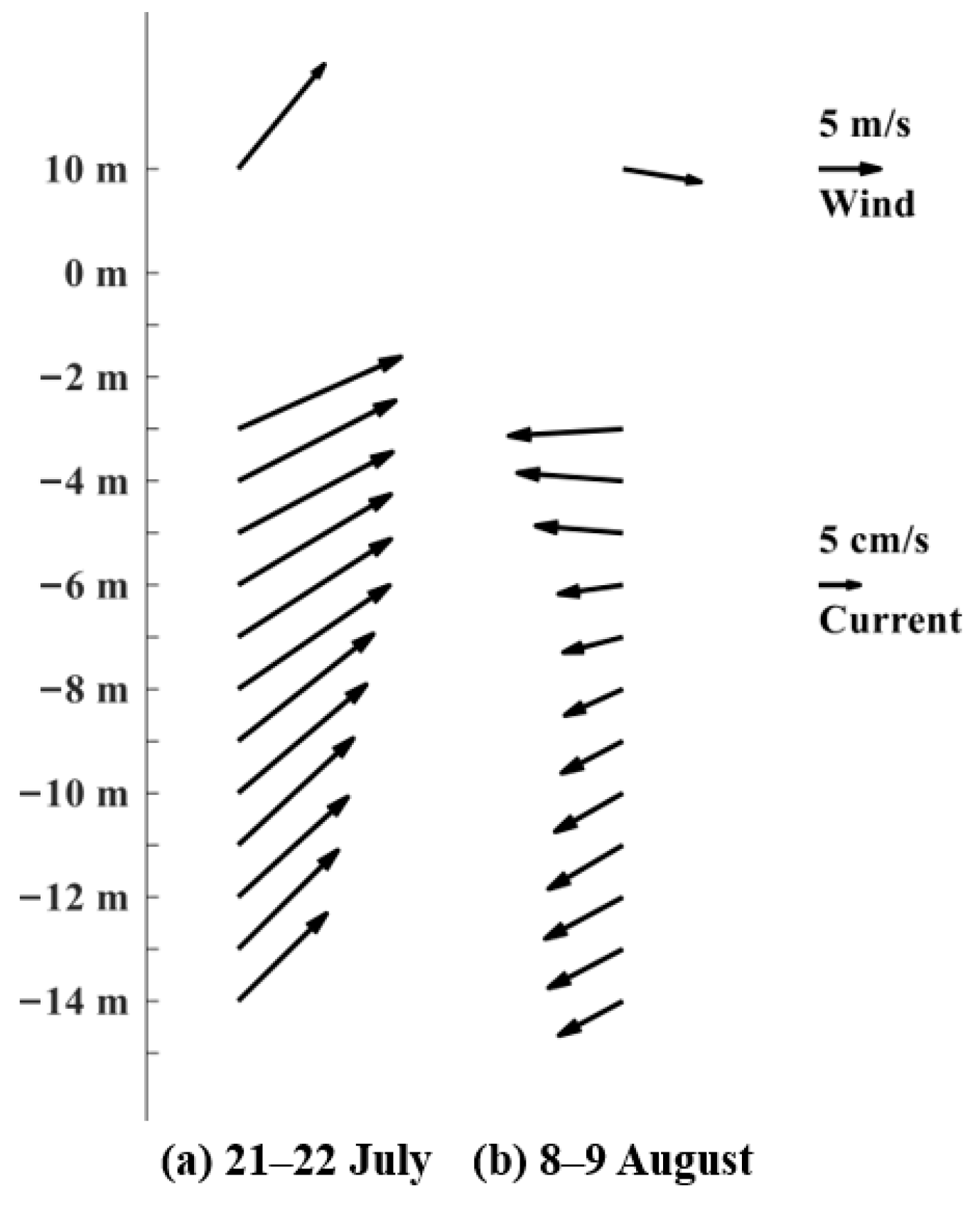
The periods from 12:00 on 21 July to 12:00 on 22 July 2015 and from 12:00 on 8 August to 12:00 on 9 August 2015 were defined as representative of non-typhoon and typhoon conditions, respectively. The daily averaged wind vector was derived by averaging the 25 hourly wind data points within each period. Similarly, the residual current vectors were obtained by averaging the corresponding 25 hourly observed current data. Figure 9 illustrates the daily averaged wind vectors and residual current vectors at different depths at the SW station during both Typhoon ‘Soudelor’ and non-typhoon periods. The results reveal a clear decoupling between wind direction and residual current direction from 8 to 9 August 2015, during the peak influence of Soudelor. Throughout this period, even when the local winds were westerly, the residual currents maintained a consistent southwestward direction at approximately 10 cm/s from the surface to the bottom. This observation aligns with the earlier analysis of low-frequency sea level and wind patterns that Soudelor initially induced a pronounced sea level rise between the PT and XM regions. As the resulting CTW propagated southwestward along the shelf in subsequent days, the sea level fluctuations and current variations observed at the downstream stations (SW, DWS, and ZP) were primarily governed by remote wave dynamics rather than local wind forcing.

3.4. Model Validation

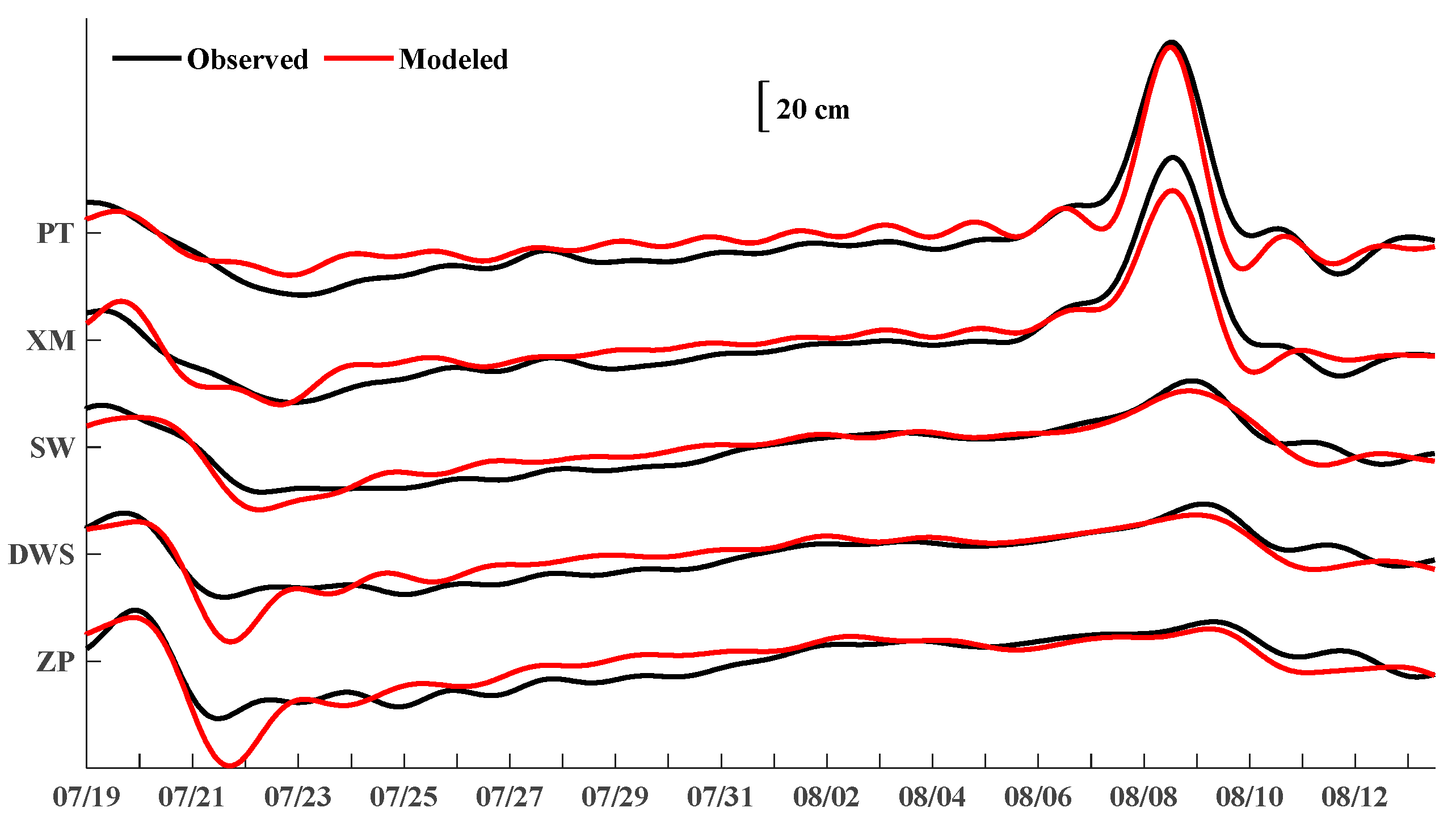
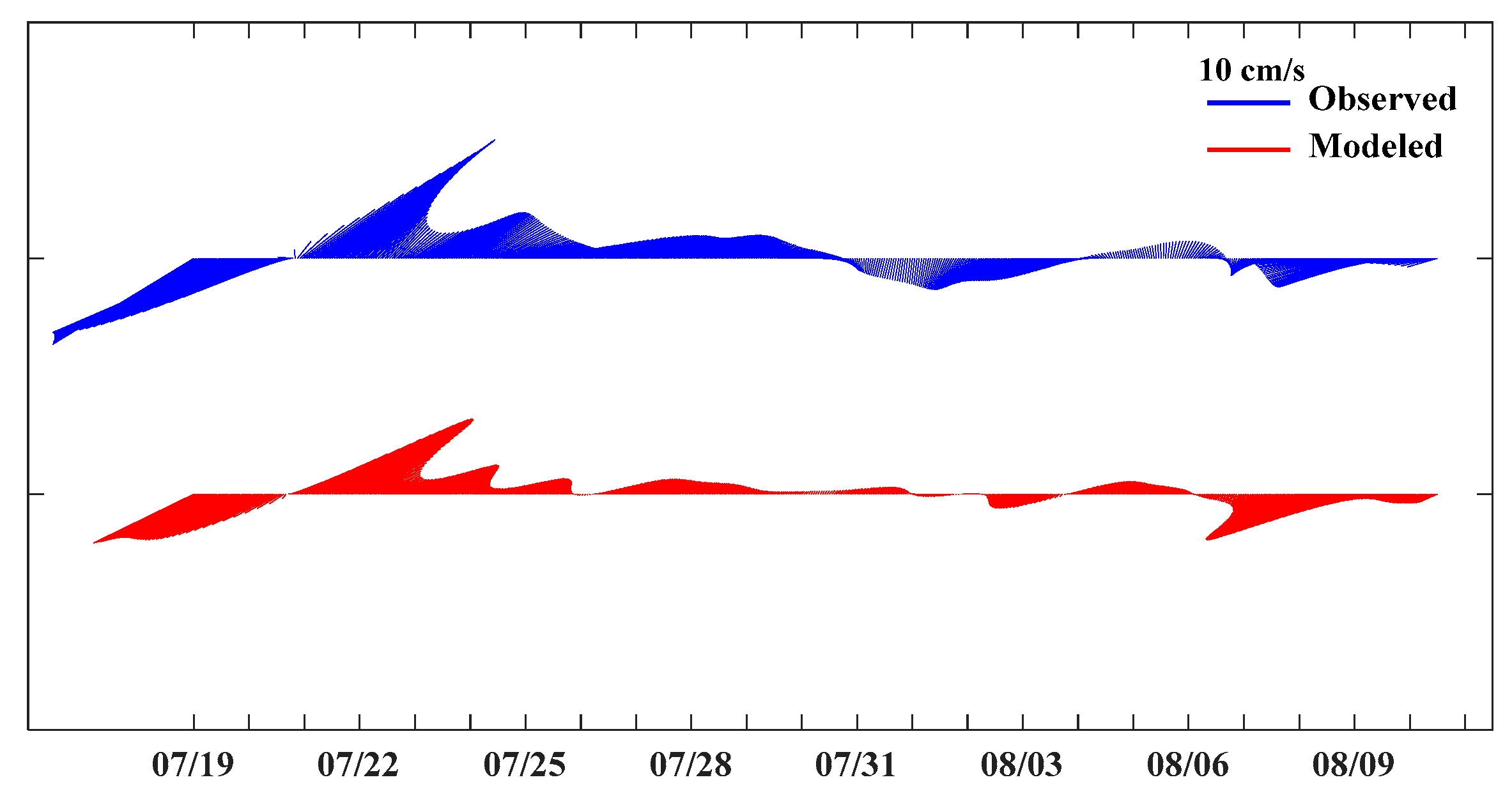
Sea level and current observations were used to validate the model performance. Consistent with the observational data processing procedure, the simulated hourly sea level and current outputs were processed with a low-pass filter to isolate low-frequency components. Figure 10 compares the modeled and observed low-pass filtered sea levels, showing good agreement and demonstrating the model’s ability to accurately simulate the storm surge induced by Soudelor. Similarly, Figure 11 presents a comparison of the vertically averaged low-frequency currents from both model results and observations.
The model successfully reproduced the observed low-pass filtered sea levels across all five stations, with correlation coefficients ranging from 0.87 to 0.96 and root mean square errors (RMSE) between 0.04 and 0.06 m. Simulated and observed sea level time series were generally consistent. In detail, the correlation coefficients between observed and simulated low-pass filtered sea levels at stations PT, XM, SW, DWS, and ZP were 0.95, 0.96, 0.94, 0.87, and 0.88, respectively. The RMSE between observed and simulated low-pass filtered sea levels at stations PT, XM, SW, DWS, and ZP were 0.06 m, 0.06 m, 0.04 m, 0.05 m, 0.06 m, respectively. To quantify the accuracy of the simulated vertically averaged low-frequency currents, we employed the vector correlation coefficient which was described in detail by Crosby [34] as the criterion: a value greater than 0.6 is typically considered significant. The vector correlation coefficient between observed and simulated vertically averaged low-frequency currents at Station SW was 0.99. These results demonstrate that the numerical model developed in this study reliably simulates hydrodynamic processes in the northwestern SCS. The model successfully represented the current variations during the typhoon period, highlighting its capability to reproduce the spatiotemporal response of the current field to the CTW propagation.

4. Discussions

4.1. Propagation Process of the CTW Generated by Soudelor

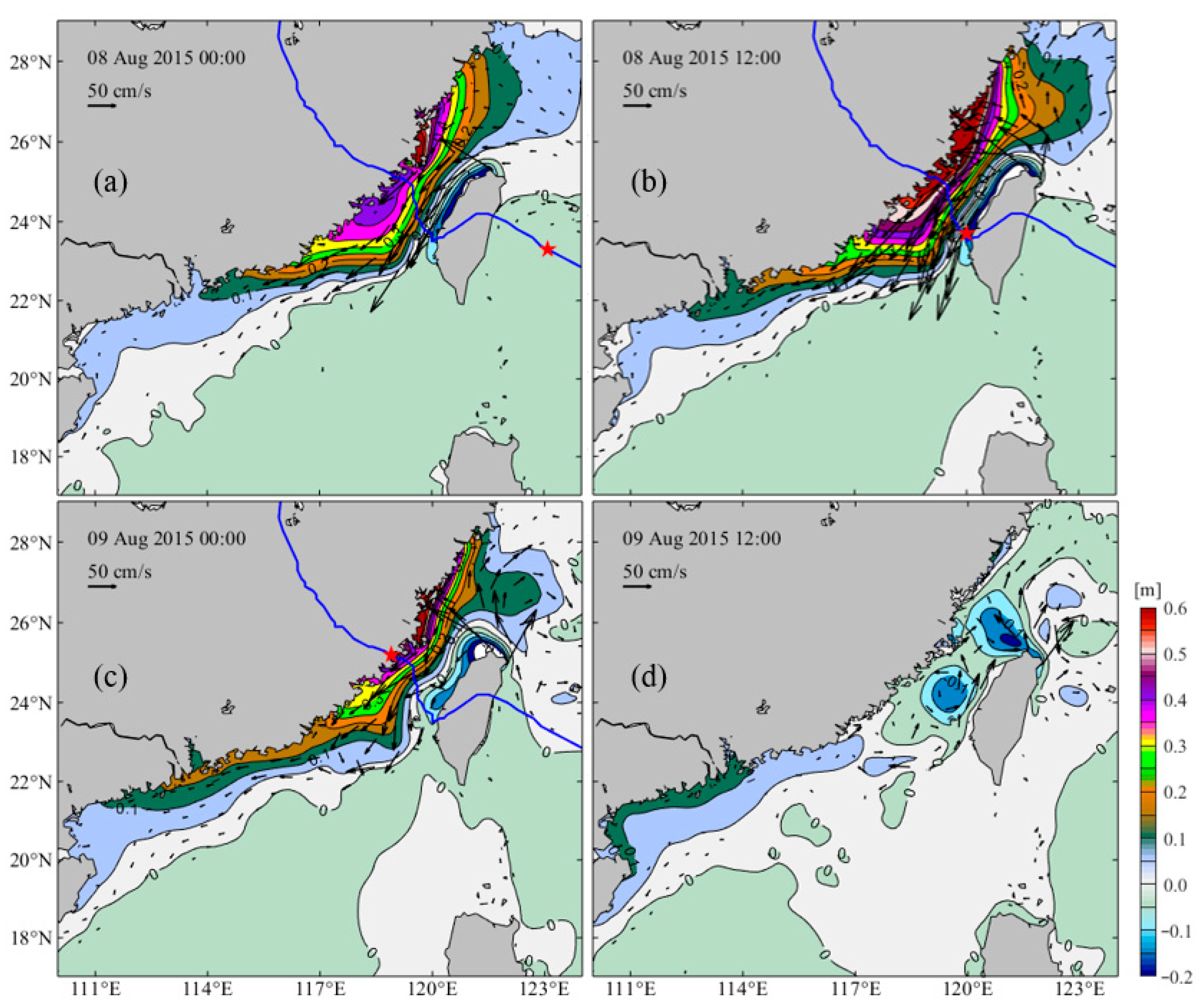
Figure 12 illustrates the spatiotemporal evolution of low-pass filtered sea levels and vertically averaged currents during the passage of Soudelor. Prior to the typhoon’s landfall on Taiwan Island, northeasterly winds drove onshore Ekman transport along the coast, resulting in elevated sea levels of up to 0.5 m in the Taiwan Strait, accompanied by current velocities of 0.2–0.3 m/s. As the typhoon center traversed Taiwan and advanced toward the Taiwan Strait, sea levels in the strait further increased, exceeding 0.6 m, while current velocities strengthened to 0.6–0.7 m/s. The sea level fluctuations initially generated in the Taiwan Strait propagated southwestward along the coastline in the form of a CTW. Although the amplitude of the fluctuation gradually attenuated with propagation distance, the signal remained detectable near the Qiongzhou Strait. Following the typhoon’s landfall on the mainland, the remote forcing diminished, and the coastal current field reverted to being dominated by local wind forcing. In summary, Soudelor generated a pronounced southwestward propagating CTW, inducing maximum residual current velocities between 0.2 and 0.7 m/s across the area of interest.

4.2. Spatiotemporal Variations of Current Structure at S3

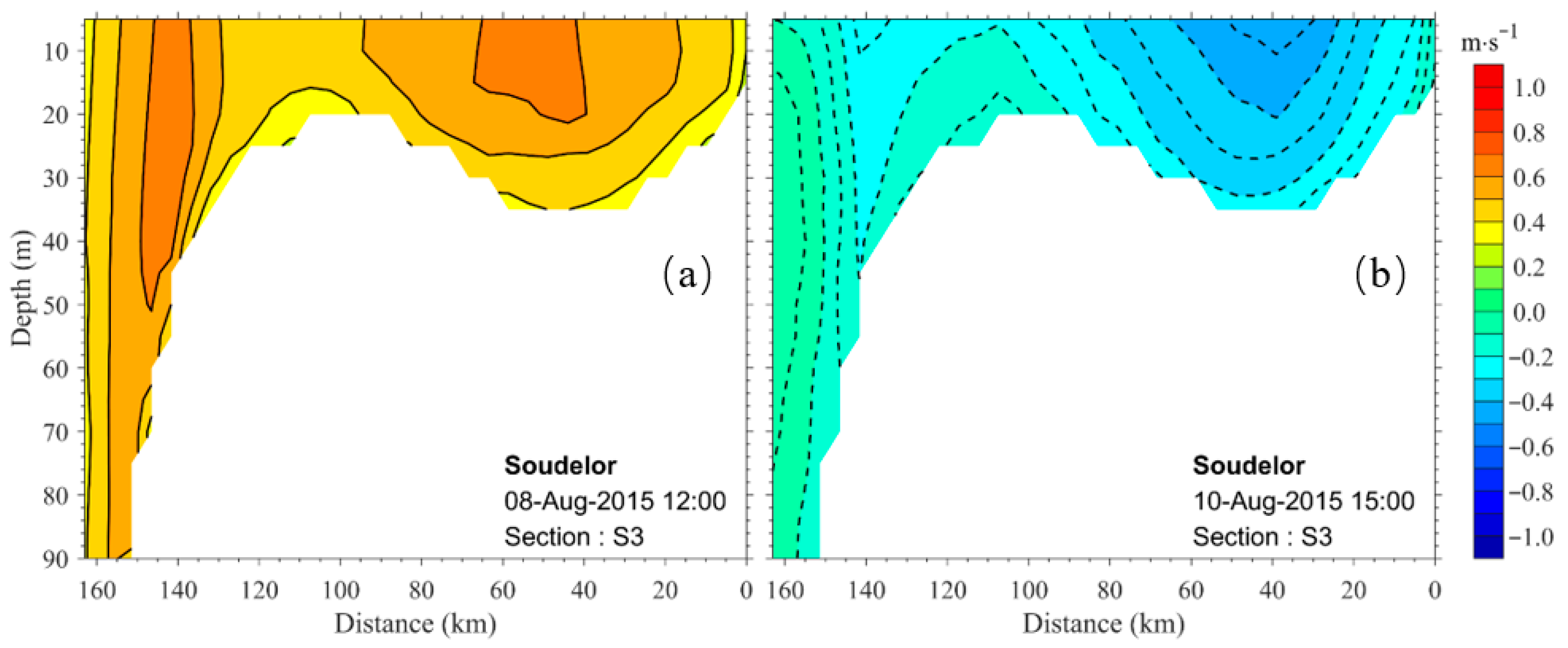
To characterize the vertical structure of currents during Soudelor, several cross-shelf sections were selected (Figure 1). Figure 13 shows the spatiotemporal evolution of the low-pass filtered modeled current velocity at section S3, in which the positive values pointed southwestward. At 12:00 on 8 August, during the peak of Soudelor’s influence, the southwestward flow at S3 reached its maximum intensity, displaying two distinct velocity cores on the western and eastern flanks of the shallow shoal. Current speeds in the upper and middle layers reached approximately 0.7 m/s, while those in the lower layer decreased to about 0.2 m/s. By 15:00 on 10 August, after Soudelor’s passage, the current regime at S3 had reversed entirely, with northeastward flow prevailing throughout the water column. A velocity core was present in the upper layer on the western side of the shoal, with a maximum speed of approximately 0.5 m/s. This pattern indicates that the current field had reverted to being dominated by the prevailing southwesterly monsoon.

4.3. EOF Analysis of the S3 and S4

Empirical Orthogonal Function (EOF) analysis, known in statistics also as Principal Component Analysis, is a method for decomposing spatiotemporal data into orthogonal basis functions derived directly from the dataset itself. In physical oceanography, EOF analysis is widely used to extract dominant modes of variability, identifying coherent spatial patterns and their temporal evolution [35,36,37]. Typically, the EOFs are found by computing the eigenvalues and eigenvectors of an anomaly covariance matrix of a spatially weighted field. The derived eigenvalues provide a measure of the percent variance explained by each mode. EOF was described in detail by Emery and Thomson [25]. Given the significant spatiotemporal variability inherent in hydrographic conditions, objective and quantitative methods are essential for analyzing their variations and interrelationships.
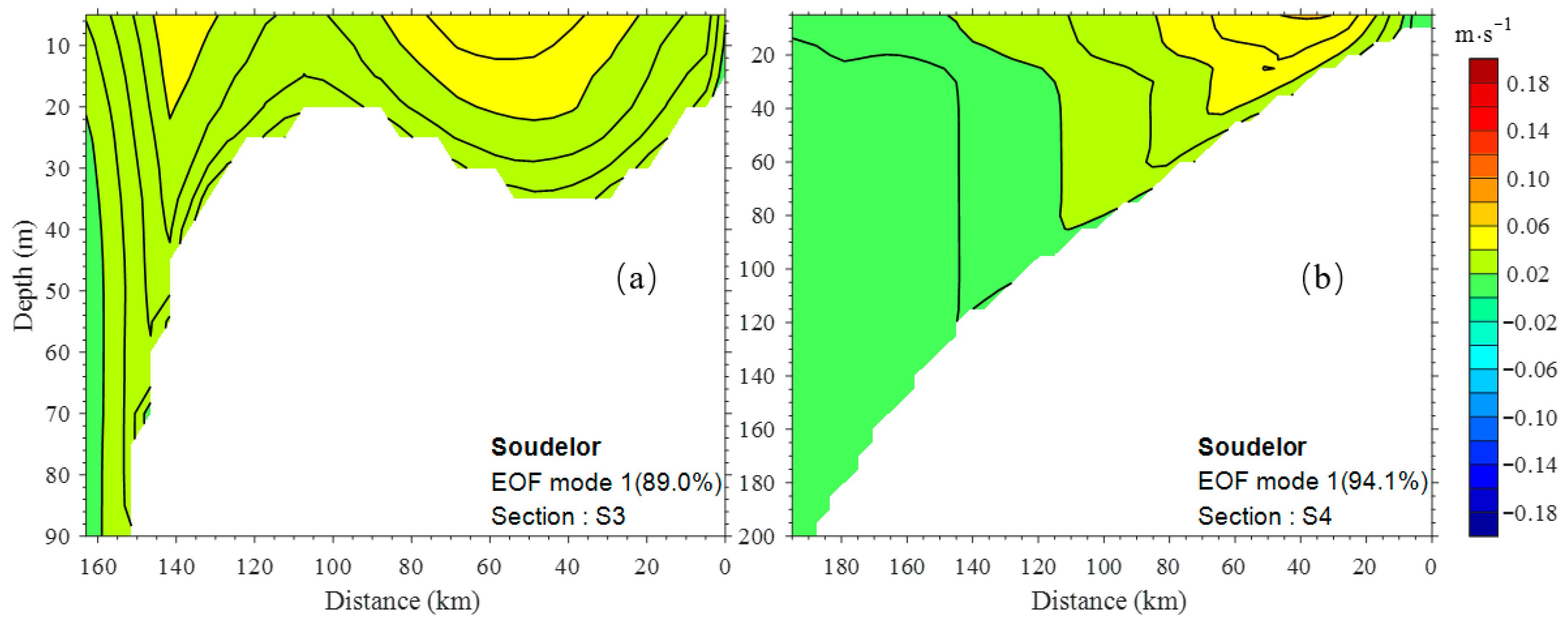
In this study, we applied EOF analysis to the cross-sectional modeled current velocity profiles across different transects (Figure 1) during Soudelor with the positive values pointing southwestward. This approach enables an objective and quantitative examination of the fundamental structural variations in the current field. The first two sections traversed by the southwestward propagating CTW were S3 (over the TWBK) and S4 (near SW). EOF analysis was applied to the modeled current velocity structure during Soudelor (Figure 14). The first EOF mode accounted for 87.5% of the variance at S3 and 94.1% at S4, indicating a predominantly positive current response in both sections. At S3 (across TWBK), the southwestward current field extended up to 160 km offshore, with velocity cores present in the upper and middle layers on both sides of the shoal. The flow exhibited a typical vertical shear structure, with velocities decreasing from the surface to the bottom. As the CTW propagated further southwestward to S4, the offshore extent of the intensified flow narrowed with the stronger surface currents area extended 148 km offshore and the stronger bottom currents area 112 km offshore, accompanied by an overall reduction in current velocity compared to S3. The EOF analysis further revealed that the current response to Soudelor was primarily barotropic in structure, consistent with the findings of Ding et al. [16], who also reported a dominantly barotropic alongshore velocity response to CTW under summer conditions. These results collectively indicate that with increasing propagation distance, the cross-shore scale of the typhoon influenced current field contracted, and the induced current velocities attenuated.

4.4. Impacts of the TWBK on the Phase Velocity of CTW

The observed slowdown in CTW phase velocity between the XM and SW regions was hypothesized to result from abrupt topographic variations associated with the TWBK. To investigate the specific impact of TWBK on CTW propagation, a numerical sensitivity experiment was designed in which the natural bathymetry around TWBK was artificially modified. The original water depth in the TWBK area is approximately 23 m (Figure 1). To conduct the sensitivity experiment, the bathymetry was modified by aligning the isobaths to run parallel with the coastline. This smoothing procedure was applied to the region within 116.804–119.968° E and 21.351–24.099° N. After the modification, depths at the selected region increased from around 23 m to approximately 100–200 m. The modified bathymetry is presented in Figure 15, where the blue ellipse highlights the region after isobath smoothing. Two model configurations were compared: a control run with realistic bathymetry, and a sensitivity run (referred to as No-TWBK) with the smoothed artificial topography. The differences in simulated CTW phase velocities between the control and No-TWBK runs were used to isolate and quantify the specific effects of TWBK topography on wave propagation.
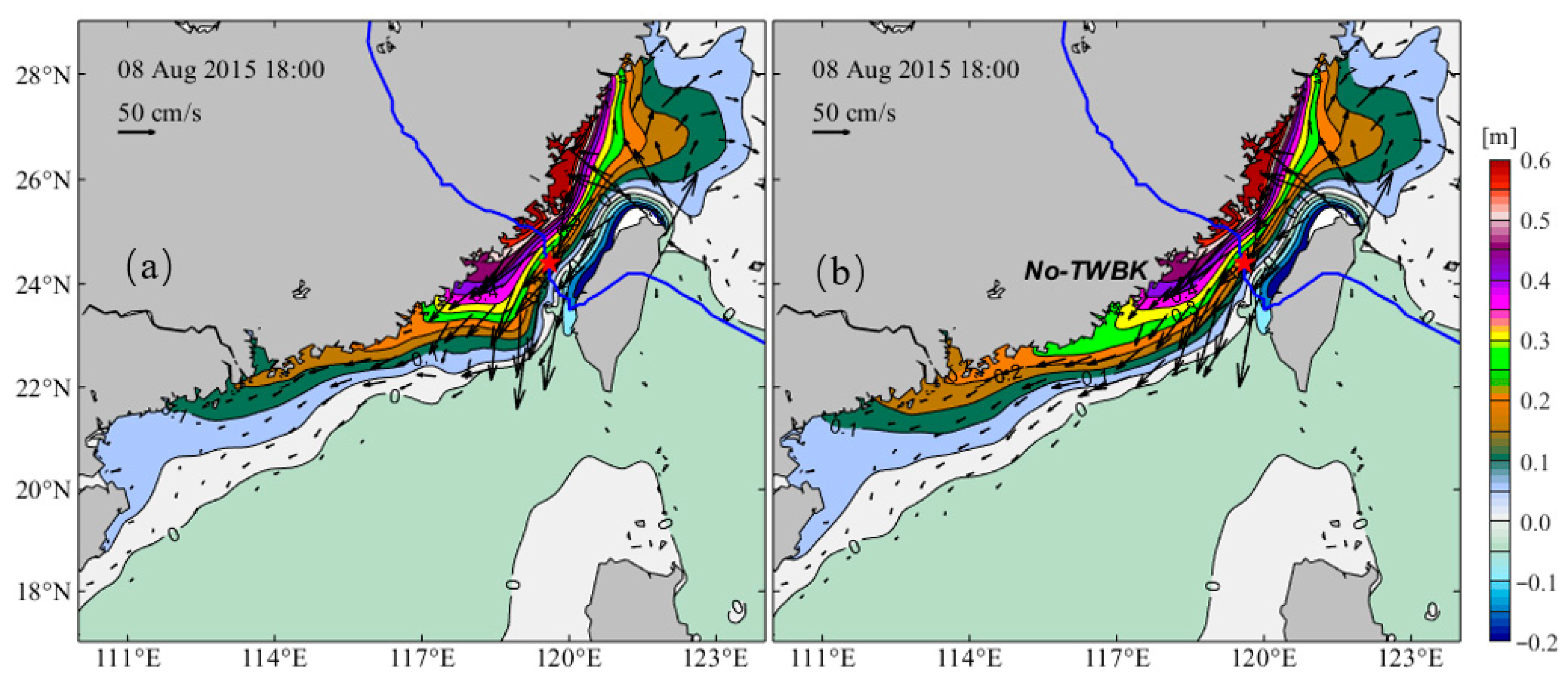
Due to constraints of mass and momentum conservation, significant coastal topographic variations can induce substantial scattering of CTW energy from lower to higher modes [33,38,39]. Since higher-mode CTW propagate more slowly and experience stronger frictional dissipation than lower modes [40,41], such mode scattering can profoundly alter the overall propagation characteristics of CTWs [33]. Figure 16 compares the distribution of low-pass filtered sea levels and vertically averaged currents between the control run (realistic bathymetry) and the No-TWBK run (smoothed topography) at the selected time. In the control run, sea level gradients around the TWBK closely followed the local isobaths, forming a distinct offshore directed bulge. This pattern, resulting from reflection, scattering, and nonlinear interactions at the TWBK, led to southward-intensified currents. In contrast, the No-TWBK case, devoid of abrupt topographic features, exhibited faster CTW propagation, coast-parallel sea level gradients, and a more uniform southwestward current direction.
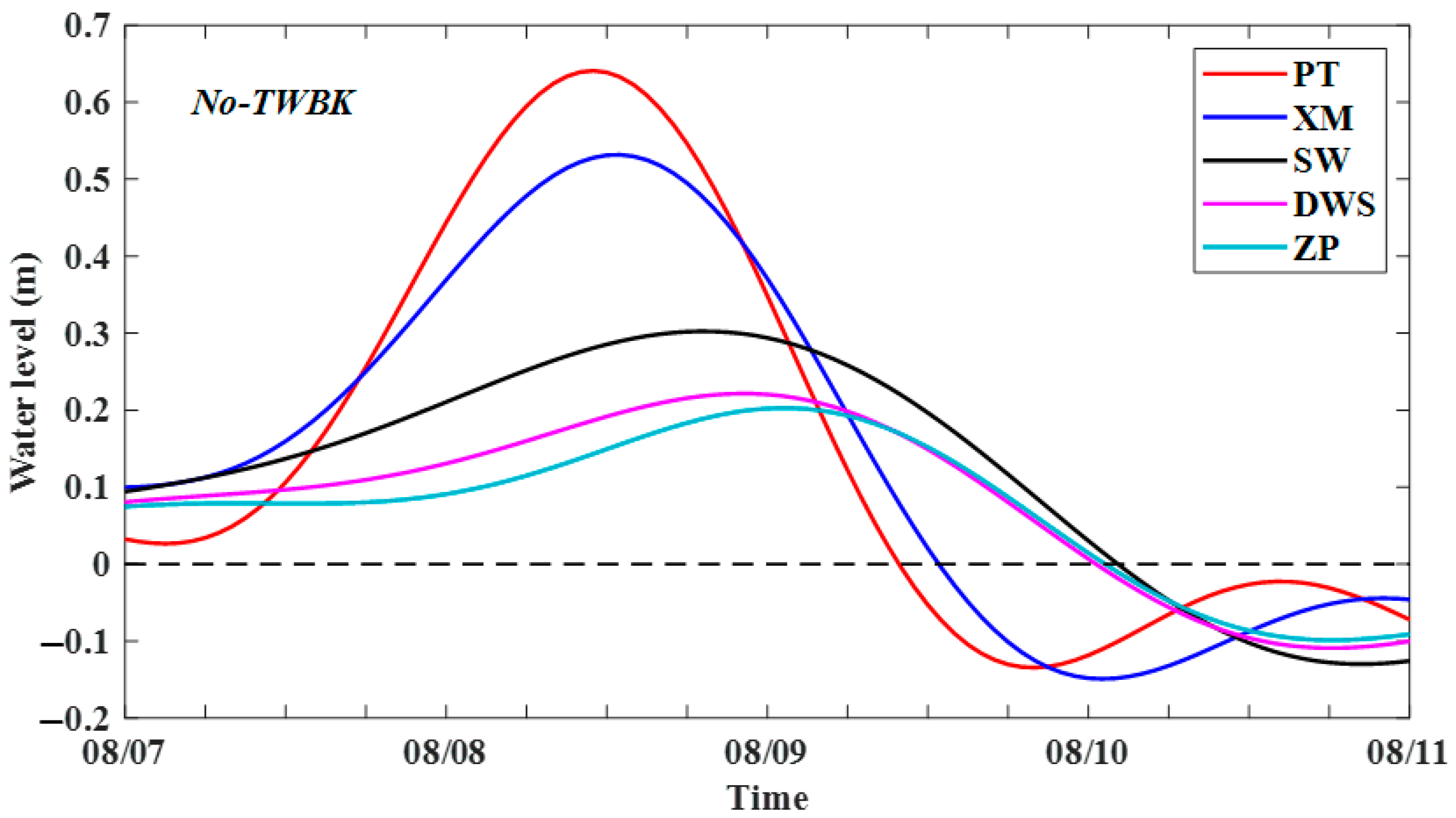
Figure 17 shows the temporal variations of low-pass filtered sea levels at the coastal stations in the TWBK and No-TWBK cases. Compared to the control run (Figure 8), the removal of the TWBK topography led to three notable changes at the SW station, that sea level increased by approximately 10 cm, the lag time of the CTW arrival decreased from 13 to 6 h, and the corresponding phase propagation velocity increased from 7.2 to 15.5 m/s.

5. Conclusions

This study investigated the characteristics of CTW generated by Typhoon Soudelor in the northwestern SCS using a combination of field observations and FVCOM numerical simulations. Analysis of lag correlation coefficients and lag times between low-pass filtered sea level and alongshore wind components at five tide gauge stations revealed that Soudelor initially induced a strong sea level surge between the PT and XM stations. The resulting CTW then propagated southwestward along the coastline, causing sea level fluctuations and current variations at the downstream stations (SW, DWS, and ZP) that were clearly decoupled from local wind forcing.
The propagation velocity of sea level variations was calculated using the lag time of sea level crests and alongshore distance between adjacent stations during Soudelor, enabling the study of their distinct propagation characteristics. The FVCOM model was used to simulate the spatiotemporal evolution of the current velocity structure across key sections, while EOF analysis helped identify the dominant spatial response patterns along the coastline. Finally, a sensitivity experiment examining the role of the TWBK bathymetry was conducted to elucidate the mechanisms responsible for the observed phase velocity slowdown of CTW between the XM and SW regions.
During its initial stage, the CTW was generated through wind-induced Ekman transport driven by the cyclone. This process established a cross-shore sea level gradient in the Taiwan Strait, characterized by elevated water levels near the coast and depressed levels offshore. The resulting CTW propagated southwestward along the coastline with phase velocities ranging from 7.2 to 18.3 m/s. Model simulations further indicated that the CTW-induced current fields up to 160 km offshore, with maximum current velocities exceeding 0.7 m/s. The vertical structure of the CTW-induced currents exhibited a predominantly barotropic character. Both the cross-shore extent of the current field and the magnitude of the induced velocities attenuated with increasing propagation distance.
The propagation of CTW was significantly modulated by the TWBK through reflection, scattering, and nonlinear effects. The presence of the TWBK reduced the phase velocity of the CTW. The artificial removal of the TWBK also resulted in sea level gradients aligning parallel to the coastline, enhancing the southwestward current intensity. As a result, the phase propagation velocity of the CTW between XM and SW increased markedly from 7.2 to 15.5 m/s.

Author Contributions

Conceptualization, X.C., L.W. and C.X.; Methodology, X.C., L.W. and M.S.; Software, X.C. and L.W.; Validation, X.C., L.W. and P.G.; Formal analysis, C.X. and M.S.; Investigation, X.C., L.W., M.S. and P.G.; Resources, L.W. and P.G.; Data curation, X.C., M.S. and P.G.; Writing—original draft, X.C. and C.X.; Writing—review & editing, X.C. and C.X. All authors have read and agreed to the published version of the manuscript.

Funding

This work was supported by the State Environmental Protection Key Laboratory of Coastal Ecosystem (Grant No. 202314).

Data Availability Statement

The original contributions presented in this study are included in the article. Further inquiries can be directed to the corresponding author.

Acknowledgments

The authors gratefully acknowledge the National Oceanic and Atmospheric Administration’s (NOAA) National Centers for Environmental Prediction (NCEP), the Joint Typhoon Warning Center, and the Simple Ocean Data Assimilation/TAMU Research Group for providing the data used in this study.

Conflicts of Interest

The authors declare no conflict of interest.

References

  1. Mysak, L.A. Recent advances in shelf wave dynamics. Rev. Geophys. Space Phys. 1980, 18, 211–241. [Google Scholar] [CrossRef]
  2. Yankovsky, A.E. Large-scale edge waves generated by hurricane landfall. J. Geophys. Res. Ocean. 2009, 114, C03014. [Google Scholar] [CrossRef]
  3. Huthnance, J.M. On trapped waves over a continental shelf. J. Fluid Mech. 1975, 69, 689–704. [Google Scholar] [CrossRef]
  4. Huthnance, J.M. On coastal trapped waves: Analysis and numerical calculation by inverse iteration. J. Phys. Oceanogr. 1978, 8, 74–92. [Google Scholar] [CrossRef]
  5. Kelly, S.M.; Ogbuka, S. Coastal trapped waves: Normal modes, evolution equations, and topographic generation. J. Phys. Oceanogr. 2022, 52, 1835–1848. [Google Scholar] [CrossRef]
  6. Musgrave, R.; Pollmann, F.; Kelly, S.; Nikurashin, M. The lifecycle of topographically-generated internal waves. In Ocean Mixing: Drivers, Mechanisms and Impacts; Garabato, A.N., Meredith, M., Eds.; Elsevier: Amsterdam, The Netherlands, 2022; pp. 117–144. [Google Scholar]
  7. Hamon, B.V. The spectrums of mean sea level at Sydney, Coff’s Harbour, and Lord Howe Island. J. Geophys. Res. 1962, 67, 5147–5155. [Google Scholar] [CrossRef]
  8. Le, L.N. A numerical study of sea level and current responses to Hurricane Frederic using a coastal ocean model for the Gulf of Mexico. J. Oceanogr. 1994, 50, 599–616. [Google Scholar] [CrossRef]
  9. Eliot, M.; Pattiaratchi, C. Remote forcing of water levels by tropical cyclones in southwest Australia. Cont. Shelf Res. 2010, 30, 1549–1561. [Google Scholar] [CrossRef]
  10. Yin, L.P.; Qiao, F.L.; Zheng, Q.A. Coastal-trapped waves in the East China Sea observed by a mooring array in winter 2006. J. Oceanogr. 2013, 44, 576–590. [Google Scholar] [CrossRef]
  11. Hu, J.Y.; Pan, J.Y.; Guo, X.Y.; Zheng, Q.A. Introduction to the special section on regional environmental oceanography in the South China Sea and its adjacent areas (REO-SCS). J. Oceanogr. 2011, 67, 359–363. [Google Scholar] [CrossRef]
  12. He, J.Y.; Lau, T.K.; Chan, Y.W.; Cheung, P.; Lam, C.C.; Choy, C.W.; Chan, P.W. An observational analysis of Super Typhoon Yagi (2024) over the South China Sea. Meteorol. Atmos. Phys. 2025, 137, 21. [Google Scholar] [CrossRef]
  13. Zhang, S.; Dai, Y.F.; Chan, P.W.; Cheung, P.; Tang, J. Dual-aircraft joint observation of cloud microphysics of Typhoon Trami (2024) over the South China Sea. J. Meteorol. Res. 2025, 39, 1–6. [Google Scholar]
  14. Ko, D.S.; Chao, S.Y.; Wu, C.C.; Lin, I.I. Impacts of Typhoon Megi (2010) on the South China Sea. J. Geophys. Res. 2014, 119, 4474–4489. [Google Scholar] [CrossRef]
  15. Chang, Y.C.; Tseng, R.S.; Centurioni, L.R. Typhoon-induced strong surface flows in the Taiwan Strait and Pacific. J. Oceanogr. 2010, 66, 175–182. [Google Scholar] [CrossRef]
  16. Ding, Y.; Bao, X.W.; Shi, M.C. Characteristics of coastal trapped waves along the northern coast of the South China Sea during year 1990. Ocean Dyn. 2012, 62, 1259–1285. [Google Scholar] [CrossRef]
  17. Li, J.Y.; Zheng, Q.A.; Hu, J.Y.; Fan, Z.H.; Zhu, J.; Chen, T.; Zhu, B.L.; Xu, Y. Wavelet analysis of coastal trapped waves along the China coast generated by winter storms in 2008. Acta Oceanol. Sin. 2015, 34, 22–31. [Google Scholar] [CrossRef]
  18. Cao, X.F.; Shi, H.Y.; Shi, M.C.; Guo, P.F.; Wu, L.Y.; Ding, Y.; Wang, L. Model-simulated coastal trapped waves stimulated by typhoon in northwestern South China Sea. J. Ocean. Univ. China 2017, 16, 965–977. [Google Scholar] [CrossRef]
  19. Li, J.Y.; He, T.; Zheng, Q.A.; Xu, Y.; Xie, L.L. Statistical analysis of dynamic behavior of continental shelf wave motions in the northern South China Sea. Ocean Sci. 2023, 19, 1545–1559. [Google Scholar] [CrossRef]
  20. Hu, S.; Li, Y.N.; Yu, X.L.; Gong, W.P. Seasonal variations of coastal trapped waves (CTWs)’ propagation in the south China sea. Estuar. Coast. Shelf Sci. 2024, 302, 108780. [Google Scholar] [CrossRef]
  21. Schumann, E.H.; Brink, K.H. Coastal-trapped waves off the coast of South Africa: Generation, propagation and current structures. J. Phys. Oceanogr. 1990, 20, 1206–1218. [Google Scholar] [CrossRef]
  22. Kalnay, E.; Kanamitsu, M.; Kistler, R.; Collins, W.; Deaven, D.; Gandin, L.; Iredell, M.; Saha, S.; White, G.; Woollen, J.; et al. The NCEP/NCAR 40-year reanalysis project. Bull. Amer. Meteor. Soc. 1996, 77, 437–471. [Google Scholar] [CrossRef]
  23. Saha, S.; Moorthi, S.; Wu, X.R.; Wang, J.D.; Nadiga, S.; Tripp, P.; Behringer, D.; Hou, Y.T.; Chuang, H.Y.; Iredell, M.; et al. The NCEP Climate Forecast System Version 2. J. Clim. 2014, 27, 2185–2208. [Google Scholar] [CrossRef]
  24. Pawlowicz, R.; Beardsley, R.; Lentz, S. Classical tidal harmonic analysis including error estimates in MATLAB using T_TIDE. Comput. Geosci. 2002, 28, 929–937. [Google Scholar] [CrossRef]
  25. Emery, W.J.; Thomson, R.E. Data Analysis Methods in Physical Oceanography; Second and Revised Version; Elsevier: Amsterdam, The Netherlands, 2001. [Google Scholar]
  26. Chen, C.; Liu, H.; Beardsley, R.C. An unstructured, finite-volume, three-dimensional, primitive equation ocean model: Application to coastal ocean and estuaries. J. Atmos. Ocean. Technol. 2003, 20, 159–186. [Google Scholar] [CrossRef]
  27. Mellor, G.L.; Yamada, T. Development of a turbulence closure model for geophysical fluid problem. Rev. Geophys. 1982, 20, 851–875. [Google Scholar] [CrossRef]
  28. Smagorinsky, J. General circulation experiments with the primitive equations: I. The basic experiment. Mon. Weather Rev. 1963, 91, 99–164. [Google Scholar] [CrossRef]
  29. Wang, J.H.; Shen, Y.M.; Guo, Y.K. Seasonal circulation and influence factors of the Bohai Sea: A numerical study based on Lagrangian particle tracking method. Ocean Dyn. 2010, 60, 1581–1596. [Google Scholar] [CrossRef]
  30. Wang, J.H.; Shen, Y.M. Development of an integrated model system to simulate transport and fate of oil spills in seas. Sci. China Technol. Sci. 2010, 53, 2423–2434. [Google Scholar] [CrossRef]
  31. Marchesiello, P.; McWilliams, J.C.; Shchepetkin, A. Open boundary conditions for long-term integration of regional oceanic models. Ocean Model. 2001, 3, 1–20. [Google Scholar] [CrossRef]
  32. Brink, K.H. Coastal-trapped waves and wind-driven currents over the continental shelf. Annu. Rev. Fluid Mech. 1991, 23, 389–412. [Google Scholar] [CrossRef]
  33. Wilkin, J.L.; Chapman, D.C. Scattering of continental shelf waves at a discontinuity in shelf width. J. Phys. Oceanogr. 1987, 17, 713–724. [Google Scholar] [CrossRef]
  34. Crosby, D.S.; Breaker, L.C.; Gemmill, W.H. A Proposed Definition for Vector Correlation in Geophysics: Theory and Application. J. Atmos. Ocean. Technol. 1993, 10, 355–367. [Google Scholar] [CrossRef]
  35. Denbo, D.W.; Allen, J.S. Rotary empirical orthogonal function analysis of currents near the Oregon coast. J. Phys. Oceanogr. 1984, 14, 35–46. [Google Scholar] [CrossRef]
  36. Monahan, A.H.; Fyfe, J.C.; Ambaum, M.H.P.; Stephenson, D.B.; North, G.R. Empirical orthogonal functions: The medium is the message. J. Clim. 2009, 22, 6501–6514. [Google Scholar] [CrossRef]
  37. Fajardo-Urbina, J.M.; Arts, G.; Gräwe, U.; Clercx, H.J.H.; Gerkema, T.; Duran-Matute, M. Atmospherically driven seasonal and interannual variability in the Lagrangian transport time scales of a multiple-inlet coastal system. J. Geophys. Res. Ocean. 2023, 128, e2022JC019522. [Google Scholar] [CrossRef]
  38. Allen, J.S. Continental shelf waves and alongshore variations in bottom topography and coastline. J. Phys. Oceanogr. 1976, 6, 864–878. [Google Scholar] [CrossRef]
  39. Middleton, J.F. Coastal-trapped wave scattering into and out of straits and bays. J. Phys. Oceanogr. 1991, 21, 681–694. [Google Scholar] [CrossRef]
  40. Merrifield, M.A. A comparison of long coastal-trapped wave theory with remote storm generated wave events in the Gulf of California. J. Phys. Oceanogr. 1992, 22, 5–18. [Google Scholar] [CrossRef]
  41. Pizarro, O.; Shaffer, G. Wind-driven, coastal-trapped waves off the Island of Gotland, Baltic Sea. J. Phys. Oceanogr. 1998, 28, 2117–2129. [Google Scholar] [CrossRef]
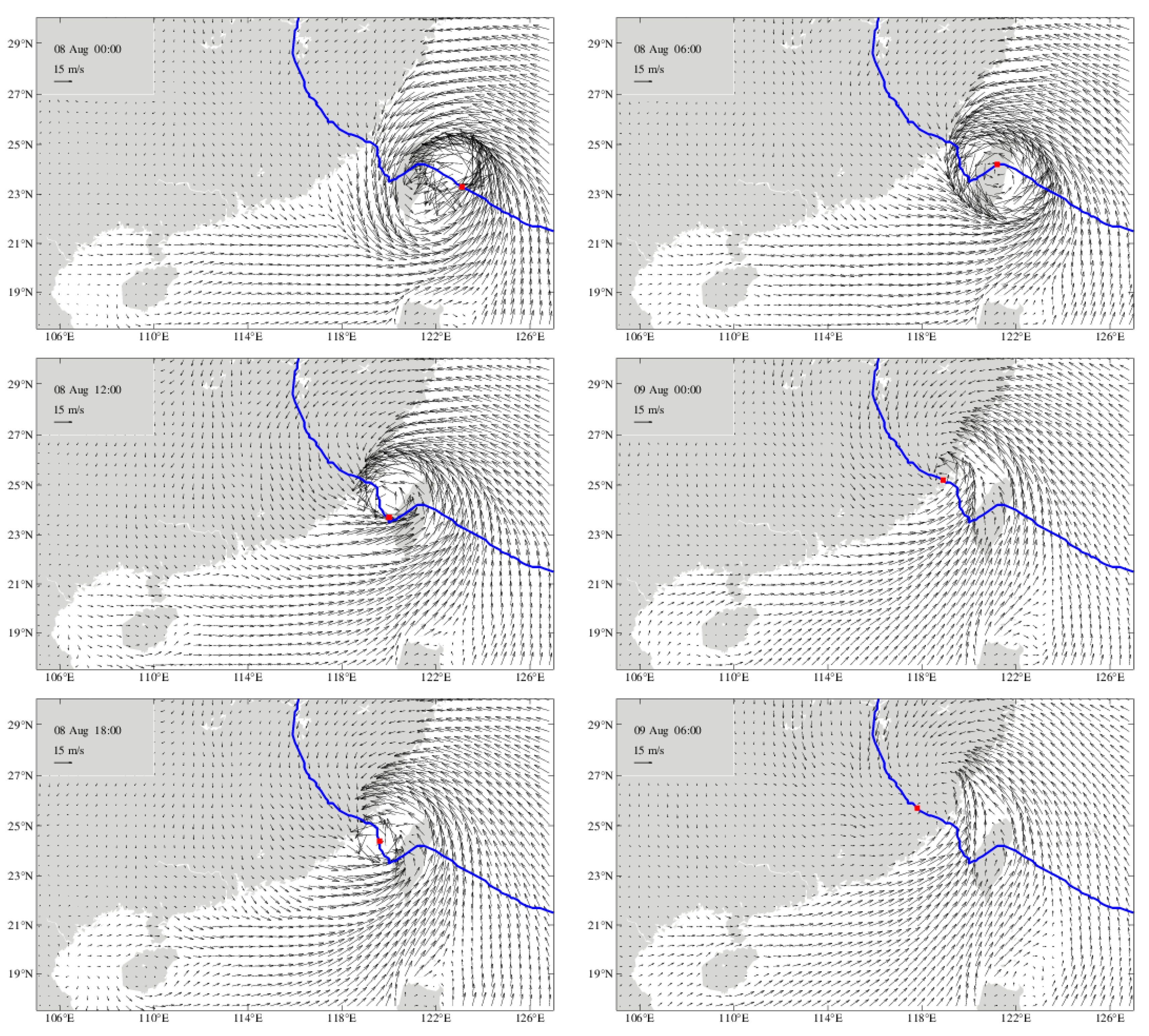
Figure 2. Spatiotemporal evolution of the wind field during Typhoon ‘Soudelor’. The blue line indicates the typhoon track, with red squares marking the instantaneous positions of the typhoon center at selected times, and the arrows indicate the wind vectors.
Jmse 14 00004 g002
Figure 3. Comparison of sea level variations at the SW station: original observations in black lines, after tidal removal and low-pass filtering (cut-off frequency: 0.6 cpd) in blue lines.
Jmse 14 00004 g003
Figure 4. Model domain and unstructured computational grid of the northern South China Sea.
Jmse 14 00004 g004
Figure 5. Horizontally averaged vertical profiles of (a) temperature, (b) salinity and (c) density used as the initial conditions for the model.
Jmse 14 00004 g005
Figure 6. Hovmöller diagram of low-pass filtered sea level oscillations at the five tide gauge stations in August 2015.
Jmse 14 00004 g006
Figure 7. Temporal variations of low-pass filtered sea level fluctuations and alongshore wind components at the five tide gauge stations from 1 to 13 August 2015.
Jmse 14 00004 g007
Figure 9. Daily averaged sea surface wind vectors and vertical profiles of residual currents during (a) non-typhoon conditions (21–22 July) and (b) Typhoon Soudelor conditions (8–9 August).
Jmse 14 00004 g009
Figure 10. Comparison of modeled (red) and observed (black) low-pass filtered sea levels from 19 July to 13 August 2015.
Jmse 14 00004 g010
Figure 11. Comparison of modeled (red) and observed (blue) low-pass filtered vertically averaged currents at the SW station during Soudelor from 19 July to 10 August 2015.
Jmse 14 00004 g011
Figure 12. Simulated spatiotemporal evolution of low-pass filtered sea level (contours) and vertically averaged current fields (arrows) during Soudelor. (a) 00:00 8 August 2015; (b) 12:00 8 August 2015; (c) 00:00 9 August 2015; (d) 12:00 9 August 2015. The arrows depict the vertically averaged current vectors, while the contours represent the sea level gradients. The typhoon track is shown as a blue line, along which red pentagrams mark the instantaneous positions of the storm center at selected times.
Jmse 14 00004 g012
Figure 13. Spatiotemporal evolution of the low-pass filtered modeled current velocity structure at section S3 during Soudelor, showing vertical distribution of alongshore velocity at the time of (a) 8 August 2015 and (b) 10 August 2015.
Jmse 14 00004 g013
Figure 14. Spatial structure of the first Empirical Orthogonal Function (EOF) mode for the vertical modeled current profile at sections (a) S3 and (b) S4 during Soudelor, showing the dominant mode of cross-shore variability in longshore current.
Jmse 14 00004 g014
Figure 15. Model domain and bathymetry in the No-TWBK case, showing the artificially smoothed topography in the area of blue ellipse.
Jmse 14 00004 g015
Figure 16. Comparison of low-pass filtered sea level (shading) and vertically averaged currents (vectors) between the (a) control run (realistic bathymetry) and (b) No-TWBK case (smoothed topography) during Soudelor. The arrows depict the vertically averaged current vectors, while the contours represent the sea level gradients. The typhoon track is shown as a blue line, along which red pentagrams mark the instantaneous positions of the storm center at selected times.
Jmse 14 00004 g016
Figure 17. Temporal variations of low-pass filtered sea levels at the coastal stations in the No-TWBK case. The times of sea level crests at stations PT, XM, SW, DWS, and ZP were 11:00 on 8 August, 13:00 on 8 August, 19:00 on 8 August, 22:00 on 8 August and 01:00 on 9 August 2015, respectively.
Jmse 14 00004 g017
Table 1. Lag correlation coefficients and lag times between low-pass filtered sea level and alongshore wind components at the five tide gauge stations during 2–12 August 2015.
Station2 to 12 August 2015
CorrelationLags (h)
PT0.8913
XM0.8519
SW−0.85−38
DWS−0.84−21
ZP−0.68−26
Disclaimer/Publisher’s Note: The statements, opinions and data contained in all publications are solely those of the individual author(s) and contributor(s) and not of MDPI and/or the editor(s). MDPI and/or the editor(s) disclaim responsibility for any injury to people or property resulting from any ideas, methods, instructions or products referred to in the content.