Article

Assessing the Impact of Port Emissions on Urban PM2.5 Levels at an Eastern Mediterranean Island (Chios, Greece)


by
Anna Maria Kotrikla
1,*,
Kyriaki Maria Fameli
1,
Amalia Polydoropoulou
1,
Georgios Grivas
2,
Panayiotis Kalkavouras
3,2 and
Nikolaos Mihalopoulos
2,4
1
Department of Shipping, Trade and Transport, University of the Aegean, 82100 Chios, Greece
2
Institute for Environmental Research and Sustainable Development, National Observatory of Athens (NOA), 11810 Athens, Greece
3
Centre for Climate and Air Pollution Studies (C-CAPS), School of Physics, National University of Ireland Galway, University Road, H91 CF50 Galway, Ireland
4
Environmental Chemical Processes Laboratory (ECPL), Department of Chemistry, University of Crete, 70013 Heraklion, Greece
*
Author to whom correspondence should be addressed.
J. Mar. Sci. Eng. 2026, 14(1), 35; https://doi.org/10.3390/jmse14010035
Submission received: 12 November 2025 / Revised: 15 December 2025 / Accepted: 16 December 2025 / Published: 24 December 2025
(This article belongs to the Section Marine Environmental Science)

Abstract

Air pollution from ship operations can pose a significant challenge for coastal cities, particularly where ports are closely integrated into the urban fabric. This study examines the influence of ship docking on PM2.5 concentrations in Chios, Greece, a medium size island city where the port directly borders densely populated neighbourhoods. Calibrated PurpleAir sensors were installed at urban and suburban sites to measure PM2.5, with data analysed alongside ship call records and meteorological observations. An event-based concentration enhancement metric (%ΔC) was estimated to compare PM2.5 during docking with the preceding 3 h background for 170 ship arrivals in February and August 2022. The results showed that under prevailing northerly winds in August, PM2.5 at the downwind urban site increased on average by 5.0 µg m−3 (48%), whereas winter increments were smaller (6.1%) due to higher background variability. When both seasons and all wind directions were pooled, the urban site exhibited a mean enhancement of 1.7 µg m−3 (19%), while impacts at the suburban site remained minor (3%). Median-based uncertainty analysis confirmed robust enhancements under northerly winds only. Wind direction and wind speed were the primary controls on %ΔC, whereas ship engine power and time at berth had limited influence. The results suggest that ship-related PM2.5 impacts are detectable but remain spatially and temporally limited in coastal urban environments, including medium-sized islands characterised by relatively low shipping activity.

1. Introduction

Maritime transport is an essential component of global trade, yet it represents a significant and growing source of atmospheric pollution in coastal environments. It is estimated that about 50% of global trade by value is transported by sea, with low-income countries and small island nations depending on ports 1.5 to 2 times more than the global average [1]. This highlights the importance of ports as essential infrastructure that supports supply chains. For island economies, ports are even more critical due to their geographic isolation, limited local resources, and fewer available transport options compared with the mainland. In these contexts, island ports are of vital importance not only for handling cargo but also as entry points for people, medical supplies, tourists, and essential services [2].
Despite their socio-economic significance, ports generate significant externalities arising from their continued heavy reliance on fossil-fuel-based operations [3] that generate substantial emissions originating from ships, cargo-handling machinery, drayage, heavy-duty trucks, and terminal operations [4,5]. The impacts are exacerbated when ports are located within urban areas, where limited buffer zones increase the exposure risks for nearby populations. Substantial emission reductions can be achieved through the adoption of cleaner energy systems and intelligent energy-management strategies [3].
IMO’s MARPOL Annex VI aims to reduce air pollution from ships by regulating both nitrogen oxide (NOx) emissions and the sulphur content of marine fuels, which also influences particulate matter formation. Tobarra et al. [6] in a 5-year study at the Port of Alicante, Spain, report the decrease in the shipping source of PM10 that coincides with the IMO 2020 sulphur regulations. However, while switching to low-sulphur marine fuels reduces aerosol sulphate formation, substantial soot and organic aerosol emissions persist [7,8].
A substantial body of research has examined air pollution in port environments. It was found that pollution comes not only from marine fuel combustion but also from passenger cars, diesel trucks, cranes, and ancillary port equipment. Ship emissions, from auxiliary engines operating at berth, and the main engines during manoeuvring, release substantial amounts of fine particulate matter (PM2.5), nitrogen oxides (NOx), sulphur oxides (SOx), and volatile organic compounds (VOCs), which can adversely affect urban air quality and human health [9,10,11,12]. Port activities contribute disproportionately to coastal pollution episodes due to their proximity to densely populated zones and the continuous operation of ship engines during loading, unloading, and hoteling periods [13].
More specifically, existing studies have primarily focused on long-term observational analyses [5,6], top-down statistical assessments and pollution datasets compiled from multiple sources [9,14], photochemical, dispersion, and receptor modelling approaches [11,15,16,17,18], as well as detailed emission inventories [12]. Measurement campaigns have been conducted either within the port area [10,19,20,21] or across both port facilities and adjacent urban surroundings [5,15,16,17]. Notably, most of this work has focused on large urban ports [5,15,17,18]. Several studies across the Mediterranean [10,18,19,20] have shown that port traffic is associated with increases in urban PM2.5 and that the magnitude and spatial footprint of these impacts are strongly modulated by local meteorology, particularly wind direction and speed.
However, quantifying these effects remains challenging due to complex coastal atmospheric dynamics, topographical variability, and the limited availability of high-resolution emission and meteorological data. Specifically, there is comparatively little evidence on the short-term, event-scale behaviour of ship plumes, the magnitude of PM2.5 enhancements during individual docking events, and the extent to which meteorological factors—especially wind direction and seasonal regimes—govern these enhancements.
Chios Island, located in the eastern Aegean Sea, Greece, represents a characteristic example of a port city where substantial ship traffic occurs near residential areas. The port of Chios plays a pivotal role in sustaining the island’s economy, tourism and social connectivity. However, its proximity to densely populated neighbourhoods raises concerns about potential air-quality degradation.
Considering the above knowledge and framework, the main objective of the study is to quantify short-term PM2.5 concentration changes associated with individual ship docking events at the port of Chios and to determine how these changes vary across seasons, local meteorology and ship’s characteristics. To address this objective, the study pursues the following specific aims:
  • Quantify ship-related PM2.5 increments during docking events.
  • Characterize seasonal and spatial variations between urban and suburban monitoring sites.
  • Determine the key meteorological and ship related factors that influence plume transport.
  • Build a data-driven, scientific understanding of ship plume impacts in insular environments to guide effective mitigation.
The novelty of this study lies in introducing a framework that effectively detects short-term port-related PM2.5 concentration enhancements in port cities. The framework applies an event-based analysis of urban PM2.5 changes in conjunction with detailed meteorological information and vessel’s operational and technological characteristics.
The remainder of the manuscript is organised as follows: Section 2 describes the study area, the PM2.5 monitoring setup, the ship traffic and meteorological datasets, and the event-based analytical framework applied to quantify ship-related concentration enhancements. Section 3 presents the results, including the spatial and seasonal patterns of PM2.5 changes, uncertainty analysis by wind sector, and correlations with meteorological and ship-related variables. Section 4 discusses the findings in the context of existing literature and underlying physical mechanisms. Finally, Section 5 summarizes the main conclusions of the study and discusses its limitations and future research perspectives.

2. Materials and Methods

2.1. Study Area

Chios is the fifth largest island of Greece, located in the northeastern Aegean Sea (Figure 1). The island’s capital, Chios City, is located by the eastern coast, near the centre of the island. According to the 2021 national census, the population of the island exceeds 50,000, with almost 27,000 residents in Chios City.
Chios has a Mediterranean climate, characterized by hot, dry summers and mild, wet winters. Persistent northerly winds that prevail over the eastern Mediterranean (the Etesians) flow during the summer [22]. They originate as northeasterlies over the northern Aegean and become northerly over the central and southern Aegean [23].
The island has a strong and long-standing maritime tradition and shipping-related employment remains significant, particularly in Chios City, Vrontados, Kardamyla and the nearby island of Oinousses [24]. Agriculture is also important, especially with the cultivation of mastic trees in the southern region supporting 5000 producers [25]. Tourism, centred on cultural heritage, agrotourism and marine activities, also contributes substantially to the local economy.
The Port of Chios (38.3724° N, 26.1382° E) (Figure 1) serves as the island’s main maritime gateway. Like many island ports, it is located adjacent to the urban centre, which results in traffic congestion and increased pollution levels, especially during the scheduled arrival and departure of large Ro-Pax vessels connecting Chios with the major Mediterranean port of Piraeus. These operations typically occur twice daily, between 04:00 and 06:00 (arrival from Piraeus and departure to Mytilene) and 21:00 and 23:00 (arrival from Mytilene and departure to Piraeus), with vessels usually staying at dock for about 45 min.
The port can simultaneously accommodate two 20,000-ton passenger/cargo vessels and one 700-ton passenger ship. Its southern sector includes a marina for fishing boats, sailboats and private yachts. Chios is connected by ferry to mainland ports (Piraeus, Thessaloniki and Kavala) and to several Aegean islands (Lesvos, Ikaria, Samos, Limnos, Mykonos, Patmos and Syros). Smaller vessels provide daily service to the nearby islands of Oinousses and Psara, as well as to Çeşme on the Turkish coast—an important tourist destination. The port handles approximately 3830 vessel calls, 502,500 passengers and 104,500 tonnes of cargo annually [26], underlying its importance for mobility, trade, and tourism given the island’s limited alternative transport options.
Table 1 summarizes the main characteristics of the vessels. The vessels differ substantially in size, engine power, age and time spent at port, which together determine their PM2.5 emission capacity. All vessels are of Ro-Pax type, except for Ship F, which operates as a Ro-Ro vessel. In terms of age, vessels D and E are 18 years old, vessels A, B, and C range between 35–38 years, and vessel F is 47 years old.
Ro-Pax ships are generally among the older ship categories in the European flagged fleet with an average of 27–28 years [27]. Newer vessels typically achieve higher energy efficiency due to more advanced engine designs and improved combustion technologies [27]. However, age alone is not a definitive indicator of performance or emissions, as a well-structured and properly implemented maintenance programme can ensure compliance with safety and pollution-prevention standards as required by the ISM Code [28].
Table 1. Specifications and operational parameters of the ships examined in this study.
CharacteristicShip AShip BShip CShip DShip EShip F
Gross tonnage (GT)30,69429,42215,362812681265466
Deadweight (DWT) (tons)762261483348196019608661
Length overall (m)192.91192.50141.54141141154
Beam (m)29.4027.2823.00212121.67
Year built198819871990200720071978
Passengers2213221014621715171512
Cars~750~748274418418-
Lane meters (m)24002105~900--1650
Total engine power (MW)17.5~17.2~9.831.731.711.6
Max speed (kt)~20.5~22~21---
Number of calls at port (August and February 2022)574430121413
Average time at port per call (min)474637202160
Sources: [29,30].

2.2. Materials

For the monitoring of PM2.5 concentrations, PurpleAir Classic Plus monitors equipped with dual PMS-5003 laser particle counters were used (PurpleAir, Draper, UT, USA). Data were transmitted to the cloud via Wi-Fi. A reference-equivalent analyser (Thermo Fisher Scientific Model 5014i, Thermo Fisher Scientific, Waltham, MA, USA) was used to evaluate and correct sensors’ measurement response [31].

2.3. Data Collection and Analysis

Initially, a set of eight PA-II devices were co-located at the suburban site in Chios, between 27 October and 12 November 2021, to assess their repeatability (precision). The inter-comparison of paired-sensor measurements demonstrated excellent repeatability, with coefficients of determination (R2) and slopes close to unity and intercepts near zero in the linear regression analyses.
Subsequently, to evaluate the accuracy of the monitors, one of these devices was co-located with a reference-equivalent analyser (Thermo Fisher Scientific Model 5014i), at the National Observatory of Athens Thissio supersite monitoring station in Athens from 23 December 2021 to 28 February 2022. The intercomparison produced the following calibration equation for PM2.5, developed with the inclusion of relative humidity (RH) as an explanatory variable (Equation (1)).
ycor_PM2.5 = 11.051 + 0.423 × Xsens_PM2.5 − 0.117 × RH, R2 = 0.810
Accordingly, the readings from the urban and suburban PurpleAir sensors used in this study were corrected using this calibration relationship.
Two PM2.5 monitors were deployed to continuously monitor hourly PM2.5 concentrations [32] (Figure 1). An urban site (38.3657° N, 26.1367° E) was located approximately 0.8 km south of the port within the Chios residential area. A suburban site (38.3895° N, 26.1297° E) was located approximately 2.2 km NNW of the port in a less densely built environment.
Meteorological data (barometric pressure, temperature, dew point, wind speed and wind direction) were obtained from the Hellenic National Meteorological Service (HNMS) station at Omiros Chios Airport (2.7 km straight distance South of the port).
Ship arrival and departure data for vessels with a gross tonnage (GT) of at least 5000 was obtained from the Chios Port Authority for February and August 2022.
For each ship docking event, the mean PM2.5 concentration during the docking period (C1) was compared with the average concentration during the preceding 3 h (C2) in order to determine the short-term impact of port activity (Equations (2) and (3)).
C = C 1 C 2
% C = ( C 1 C 2 ) C 2 × 100
These indicators represent the short-term absolute and relative increases in PM2.5 concentrations during the ship’s manoeuvring and docking at the port. They are driven by emissions from main and auxiliary ship engines for onboard electric power generation, and from the associated road traffic within the port area (trucks and cars waiting to load or unload to the ship). As it is not possible to separate the ship and truck components from ambient measurements, ΔC represents the combined port-related enhancement at each receptor site.

2.3.1. Wind Direction

Wind direction values (θ in degrees, converted to radians) were transformed into sine and cosine components. This approach transforms directional information into continuous orthogonal variables that represent the east–west and north–south flow components, avoiding discontinuities at 0°/360° [33] and enabling correlation with PM2.5 changes (Equations (4) and (5)):
wd_cos = cos ( θ × π 180 )
wd_sin = sin ( θ × π 180 )
where wd_cos corresponds to the north–south flow component and wid_sin to the east–west component.

2.3.2. Statistical Analysis

Before applying statistical analyses, the normality of the dependent variables was evaluated using both the Kolmogorov–Smirnov (K–S) and Shapiro–Wilk tests. Both tests indicated significant departures from normality (p < 0.001) for the absolute and relative PM2.5 concentration differences (ΔC and %ΔC) at the urban site.
Given the presence of right-skewed distributions, with outliers typical of episodic emission events and meteorological variability, the study proceeded with resistant non-parametric analyses. Specifically, to explore the relationships between ship-related and meteorological parameters and the observed short-term PM2.5 variations at the two monitoring stations, the non-parametric Spearman’s rank correlation coefficient (ρ) was used.
Spearman correlations were calculated between the percentage change in average PM2.5 during ship docking (%ΔC) and a set of potential explanatory variables. Ship-related factors included main engine power (kW) and time at port (minutes). Meteorological variables comprised wind speed (kt), the sine and cosine components of wind direction (wd_sin and wd_cos), air temperature (°C), dew point (°C), and atmospheric pressure (hPa).
Because %ΔC was non-normally distributed, uncertainty was quantified using the median, interquartile range (IQR), and bias-corrected accelerated bootstrapped 95% confidence intervals across northerly, southerly, and other wind sectors.
All the analyses were carried out with IBM SPSS vers. 28.0.1.0 (142).

3. Results

3.1. Assessment of the Influence of Ship Docking Events on PM2.5 Levels in Chios City

This study aims to assess the extent to which ship dockings and associated vehicle traffic at the Chios port contribute to the city’s fine aerosol pollution of PM2.5. The study period (February and August 2022) was selected to represent contrasting meteorological conditions, port traffic and emission activity.
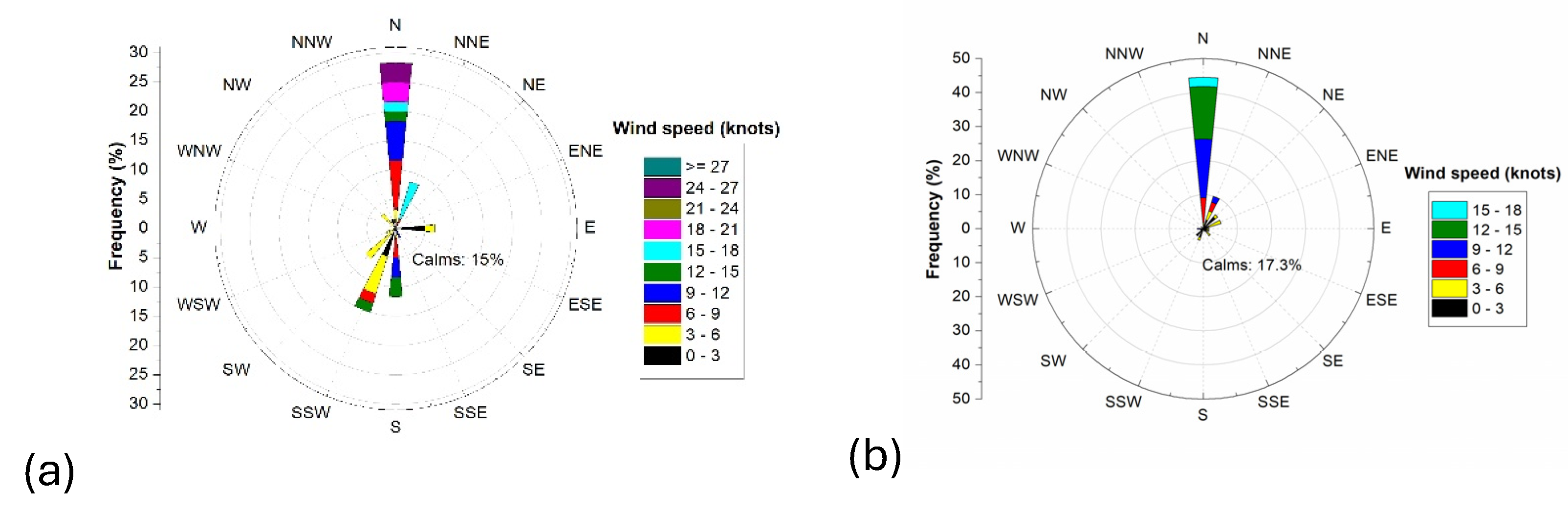
February in Chios is dominated by domestic heating emissions [32] and a more dispersed distribution of wind directions compared to August (Figure 2). August is characterized by persistent northerly winds and minimal precipitation, which limits wet removal processes and significantly promotes elevated PM2.5 levels [34]. Enhanced photochemical production rate of fine particle aerosols such as sulphate and nitrate further contributes to fine particle formation [35]. In August, ship calls nearly doubled, and vehicle flows considerably increased compared to February, reflecting the summer tourism peak.
The study focuses on the impacts of PM2.5 levels associated with the operation of six large (≥5000 GT) Ro-Pax and Ro-Ro vessels calling at the port of Chios (Table 1). Emissions associated with these large vessels are expected to be detectable above typical emissions from other local sources. A total of 170 ship docking events were documented over the study period: 60 in February 2022 and 110 in August 2022.
In February, ferry activity typically consists of two itineraries per day. The first departs from Mytilene (Lesvos) and arrives in Chios at around 21:00, before departing for Piraeus approximately 45 min later. The second, covering the reverse route, departs from Piraeus and arrives in Chios between 05:00 and 7:00 before continuing to Mytilene after a similar stop. In August, increased tourist flows from the Greek mainland to the islands result in continuous circular itineraries, nearly doubling the number of daily dockings and sometimes altering the usual schedule. During the summer period, ship occupancy for passengers, cars and trucks approaches 100% due to both tourism and the higher quantities of food, fuel, and manufactured goods transported to meet seasonal demand. In contrast, occupancy in February is much lower, particularly for passengers and passenger vehicles.
Ships A and B, as the largest (≈30,000 GT, 17.2–17.5 MW) and the most frequent visitors (59% of the calls, 66% of the total time at port), are expected to be major contributors to port-related emissions. Ships D and E, although newer (built 2007) and probably equipped with more efficient engines, have a high engine power (≈31.7 MW), and they are still expected to produce considerable emissions.
The fuel type is determined by the regulations of the International Maritime Organization and the European Union, which Greece fully implements. In 2022 the ferries in the Greek seas should comply both with the EU Sulphur Directive 2016/802 and the IMO’s MARPOL Annex VI (2020 sulphur limit). This means that they used Marine Gas Oil (MGO, containing ≤ 0.1% sulphur) while docked and Very Low Sulphur Fuel Oil (VLSFO, containing ≤ 0.5% sulphur) while at sea.
The wind roses for February and August reveal distinct seasonal differences in both wind direction and speed over Chios Island (Figure 2). Winds in February exhibit a more dispersed directional pattern, with significant contributions from N, NNE, E, as well as S–SSW sectors. Although northerly winds remain dominant, southerly flows appear frequently, indicating different synoptic scale weather patterns typical of the winter in Mediterranean [36]. Wind speeds span a broader range and include a relatively large proportion of fresh to strong breezes (8–15 kt) and occasional northerly winds of ≥15 kt. In August, N and NNE winds dominate, characteristic of the summer Etesian winds in the North Aegean. Wind speeds are also persistently high in this period, with most winds falling within the 10–15 kt range and frequent occurrences above 12 kt.
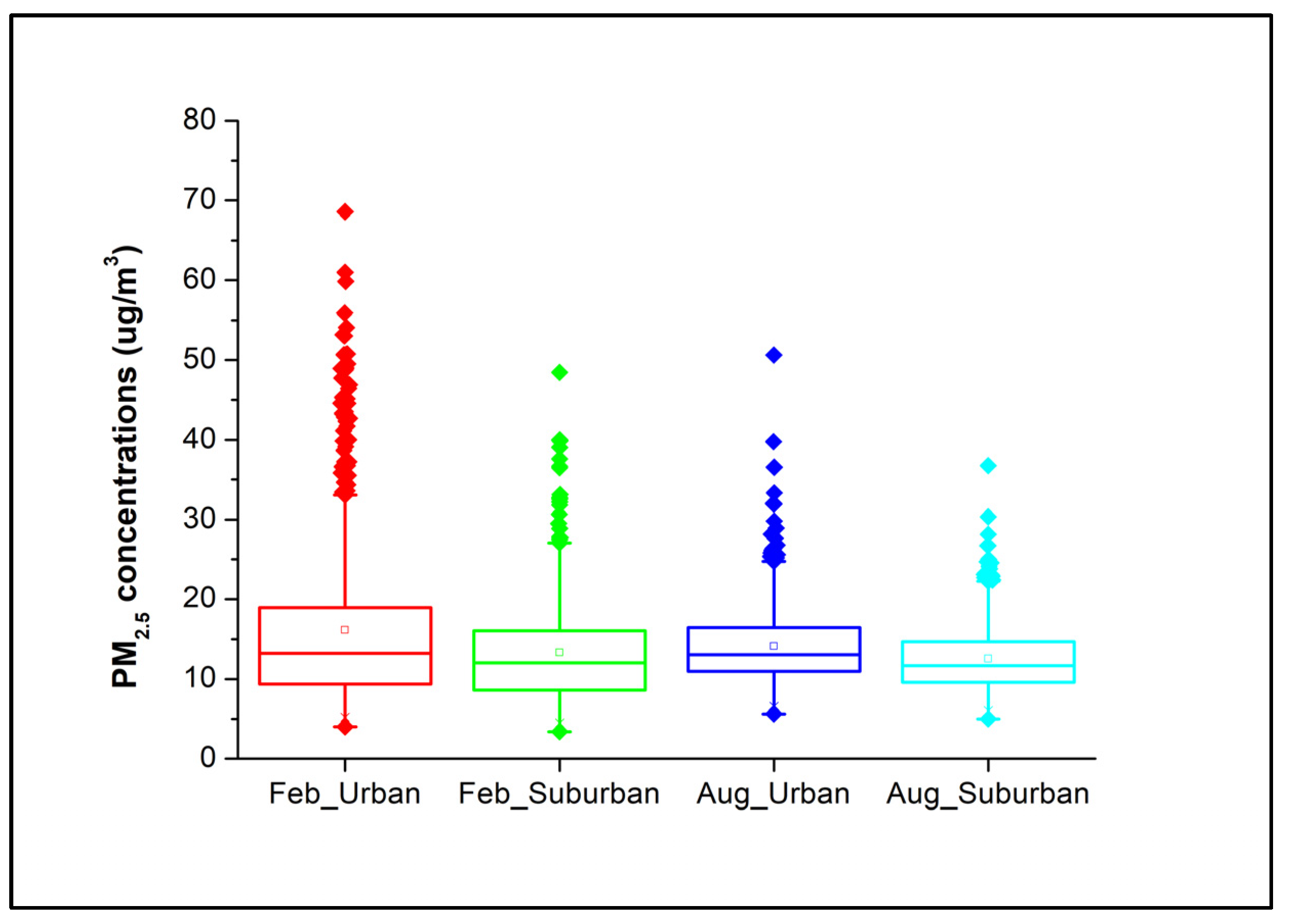
Regarding the measured PM2.5 concentrations, in February 2022 the urban site averaged 16 μg/m3, exceeding the suburban mean of 13 μg/m3; however, a Mann–Whitney U test showed no statistically significant seasonal difference in overall PM2.5 levels between February and August, as the rank distributions were nearly identical (p = 0.865). In August 2022, means declined to 14 μg/m3 (urban) and remained at 13 μg/m3 (suburban). The boxplots in Figure 3 illustrate hourly PM2.5 concentrations measured at urban and suburban sites during February and August. A seasonal pattern is visible, with February showing slightly higher medians and greater variability than August at both stations.
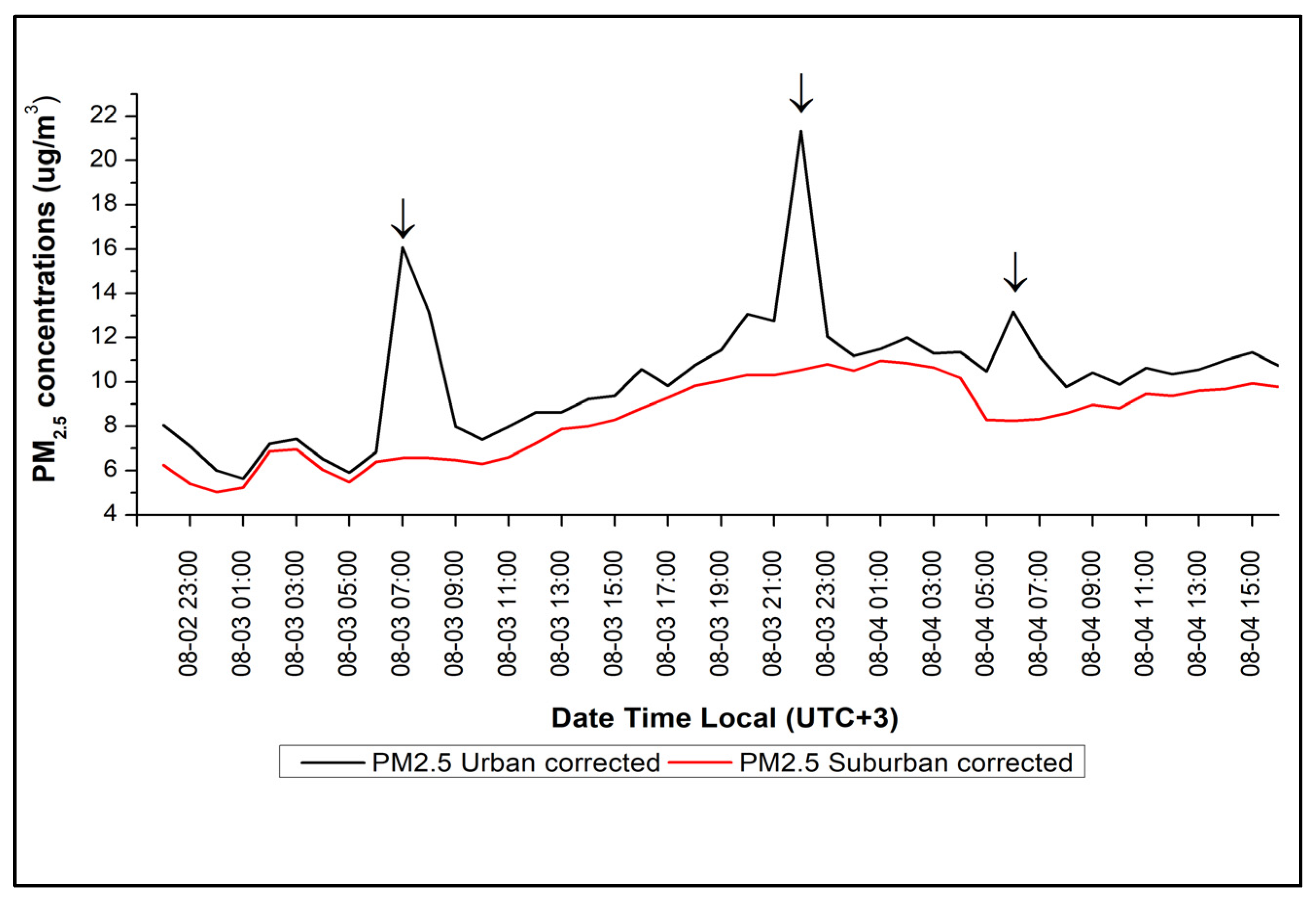
The potential influence of ship dockings on the urban and suburban pollution profiles was initially examined by plotting PM2.5 concentration time series and comparing them with the temporal distribution of ship calls. A recurring pattern was evident in the urban station time series in August: sharp, short-lived increases in PM2.5 coinciding with the presence of a ship at the port under northerly winds, followed by a rapid return to background levels once the ship departed (Figure 4). Given this recurring behaviour, subsequent quantitative analyses used the percentage change in PM2.5 during docking (%ΔC), relative to the three-hour pre-arrival average, as the dependent variable (Equations (2) and (3)). This metric helps subtract the background pollution load and provides an estimate of the ship-related increments.
Figure 4 displays a representative PM2.5 time series from 3–4 August covering a period with three ship docking events: one on the morning (07:10–08:10) (Ship B) and one in the evening of 3 August (21:40–22:35) (Ship B), and a third the following morning (06:05–07:10 of 4 August) (Ship A). The corresponding ΔC values were +8.2, +6.4, and +2.1 μg/m3, reflecting %ΔC increases of 127%, 59%, and 19%, respectively. During this period, the wind direction ranged from 360° to 20°, with speeds decreasing from 16 to 11 kt. As expected, the suburban site, located upwind of the port, did not register any impact. This pattern shown in Figure 4 is a recurrent feature in August, not an isolated event. Of the 110 dockings that month, 58 occurred under northerly winds, when the urban station was downwind. In 56 of these 58 cases (97%), %ΔC was positive, confirming repeated PM2.5 increases during the ship’s stay. This behaviour was observed across all six vessels included in the study, indicating that the pattern is not ship-specific.
Quantitative analysis (Table 2) confirmed the seasonal differences. When averaged over all wind conditions, port-related PM2.5 increments (ΔC) in February were negligible at both monitoring sites (urban: −0.3 μg/m3, −1.7%; suburban: −0.2 μg/m3, −1.7%), as winter background variability due to domestic heating and synoptic-scale circulation masked ship signals. By contrast, in August, distinct urban enhancements were observed (mean ΔC = +2.8 μg/m3, +28%), while the suburban site recorded minor changes (+0.3 μg/m3, +3.4%).
When the data are stratified by wind direction, a directional dependence becomes apparent. Under northerly winds, which are aligned with the port-to-urban station axis, the urban station consistently records the highest increases (February: +0.8 μg/m3, +6.1%; August: +5.0 μg/m3, +48%), whereas the suburban site, typically upwind of ship emissions, shows much smaller responses (in February, +0.3 μg/m3, +2.3%; in August, +0.4 μg/m3, +4.5%). Under southerly winds, however, the pattern reversed; in February, the suburban site showed a higher mean increase (+2.4 μg/m3, +27%) compared to the urban station site (+0.7 μg/m3, +4.7%), though this result was primarily driven by one high-pollution episode and a small number of southerly cases (N = 10). In August, only a single southerly event was recorded (urban −0.7 μg/m3, −5.1%), providing too little information for a reliable interpretation.
Finally, when the data from both months and all wind directions are combined, a consistent spatial pattern emerges. The urban site records an average ΔC of +1.7 μg/m3 (+19%), while the suburban area exhibits a negligible mean increase of +0.1 μg/m3 (+3%).

3.2. Uncertainty Analysis of PM2.5 Enhancements by Wind Sector

The uncertainty analysis confirmed a strong dependence of short-term PM2.5 enhancements on wind direction at the urban station (Table 3). Under northerly winds, the median %ΔC reached 25.5%, with substantial event-to-event variability (IQR = 35.6), but a relatively narrow bootstrapped 95% confidence interval (18.4–31.5%), reflecting the large number of observations (n = 81) and a well-constrained estimate of the central tendency. In contrast, southerly winds showed a median %ΔC close to zero (−0.8%) with moderate dispersion (IQR = 23.2), but a much wider confidence interval (−7.0 to 19.4%), indicating high uncertainty and limited statistical power due to the small sample size (n = 10). Other wind sectors also exhibited median values near zero with confidence intervals spanning zero. When all wind directions were combined, the median %ΔC was 9.7%, while exclusion of the low-frequency southerly sector yielded a similar median (10.7%) with overlapping confidence intervals, confirming the robustness of the directional conclusions.

3.3. Correlation of Concentration Change with Ship’s Particulars and Meteorology

The next step was to quantify the relationship between %ΔC in the urban and suburban stations and a set of predictors reflecting ship characteristics (main engine power), operational activity (time at port) and meteorological conditions (wind speed and direction, temperature, dew point and relative humidity) (Table 4).
Spearman’s rank correlation analysis revealed several statistically significant, moderate associations between %ΔC at the urban site and key meteorological parameters. The correlations point to a transport dominated process in the near field of the port. The north–south wind flow component (wd_cos) exhibited a moderate, positive correlation with %ΔC (ρ = 0.34). The east–west (wd_sin) component is uninformative because changes along this axis do not determine plume–receptor alignment. These results align with the findings of Section 3.1. Wind speed also correlates positively with %ΔC (ρ = 0.33) at the urban site which is 0.8 km downwind. Temperature correlates positively (ρ = 0.34, p < 0.001), likely reflecting seasonal clustering, as warmer conditions coincide with August—when northerly winds and increased port activity amplify pollution episodes. Pressure shows a weak negative correlation (ρ = −0.16, p = 0.04), though this effect is minor and mainly reflects its covariance with temperature and seasonal conditions.
Main engine power and time at port, which are parameters that characterise ship technology and operations, showed negligible, non-significant correlations with %ΔC (ρ = 0.02).
At the suburban site, correlations are notably weaker. Only temperature (ρ = 0.17, p = 0.03) and dew point (ρ = 0.17, p = 0.03) show small but significant associations, while all wind-related variables are non-significant. This reflects the greater distance (~2 km) and less favourable alignment between the port and the suburban site: the plume reaches this receptor far less consistently, and only under specific (and relatively uncommon) southerly flow conditions. As a result, meteorology does not exert the same directional control, and the PM2.5 increments are smaller, more diffuse, and more influenced by background environmental conditions rather than ship activity.

4. Discussion

Regarding the levels of PM2.5 pollution measured in this study, elevated winter values likely result from increased emissions due to residential heating, reduced atmospheric mixing, and inversion conditions [17,32,37]. In contrast, the lower and more stable concentrations in August reflect enhanced dispersion and dilution under warmer, more turbulent conditions. Urban-site levels were consistently higher than at the suburban site attributable to higher traffic and population density. Numerous outliers, particularly in February, indicate episodic pollution events associated with unfavourable weather conditions or localized emission spikes typical in air quality datasets [32,38].
The results of PM2.5 enhancements associated with ship manoeuvring and hoteling are detectable, spatially coherent, and strongly governed by wind direction (Table 2). The urban monitoring site located 0.8 km downwind of the port, under prevailing northerlies, which were the most favourable conditions, exhibited the clearest signal with average increases of 5 μg/m3 (48%) in August and 0.8 μg/m3 (6.1%) in February. When observations from both seasons and all wind directions were pooled, the mean enhancement reached 1.7 μg/m3 (19%). By contrast, the suburban site, typically upwind or crosswind relative to the port, showed negligible mean increases (average 0.1 μg/m3; 3.0%), except in a few cases of southerly winds.
To characterize uncertainty and event-scale variability median %ΔC, IQR, and bootstrapped confidence intervals were estimated (Table 3). Northerly winds show a median %ΔC of 25.5% with high variability but a well-constrained confidence interval due to the large sample size. Southerly and other wind sectors exhibit median values near zero with wide confidence intervals reflecting limited statistical power. Excluding southerly winds yields similar median %ΔC values, confirming the robustness of the directional conclusions.
The average 19% increase observed at the Chios urban station under all conditions (both months and all wind directions) falls well within the range reported internationally. Daily average PM2.5 studies have consistently reported non-negligible port-related contributions, ranging from 5–10% (up to 17% including secondary aerosol formation) in the Bay of Algeciras [13], to 11–15% in Barcelona [15], and up to ~26% in harbour/industrial areas of Xiamen, with lower contributions at urban background sites [16].
To better resolve short-term ship-related PM2.5 enhancements, several studies have adopted event-based approaches using high-temporal-resolution measurements, which are conceptually aligned with the event-based enhancement method applied in the present study. Contini et al. [19] used 1 min-resolution PM2.5 data at three sites in the Port of Venice, comparing downwind concentrations during ship passages with downwind concentrations in the absence of ship passages, normalised by the overall mean PM2.5 concentration, and estimated PM2.5 enhancements of approximately 1–8% attributable to ship traffic. Applying the same methodology, Donateo et al. [20] analysed 30 min-resolution PM2.5 measurements at a site located about 50 m from a ferry dock in the Port of Brindisi, estimating an average contribution of 9.3% from ship emissions and associated port traffic activities. Using the same approach at the Port of Shanghai, Wang et al. [21] reported PM2.5 increases of 27.6% under downwind conditions, decreasing to 5.9% when all wind directions were considered.
In this study Spearman correlations confirmed that plume transport variables, particularly the north–south component of wind direction, and wind speed, were the dominant predictors of PM2.5 increments (Table 4).
At the urban site, %ΔC shows statistically significant moderate correlation with the north–south wind component (wd_cos, ρ = 0.34), while correlations with the east–west component are negligible. This pattern is consistent with the geometry of the port–city axis and indicates that plume alignment and advection efficiency are the primary controls on short-term concentration changes. Merico et al. [10] reported for the port of Brindisi that shipping contributions to pollutant concentrations, including downwind increases of PM2.5, have a plume-like behaviour with relatively short and intense peaks modulated by port activities (arrival, departure, and hoteling of ships) and local meteorology. Perez et al. [15] showed that shipping contributions to PM2.5 at monitoring sites depend strongly on wind sector and source–receptor geometry, with highest contributions when the site is downwind of the port. Xu et al. [16] found that ship-emission tracers were significantly elevated at the port-industrial site compared to the urban site, but that under certain wind sectors, those tracer signals also appeared at the urban site, showing transport from port to city.
The wind speed shows statistically significant moderate correlation with %ΔC (ρ = 0.33). Although higher wind speeds generally promote dilution [5,39], the findings of this study suggest that at ~0.8 km downwind, the increased advection and more consistent transport of the plumes toward the receptor likely outweigh dispersive losses: Stronger, steady northerlies decrease travel time, reduce meandering, and maintain the plume at receptor height via building/ship downwash [40]. Thus, the positive sign of the correlation is appropriate near the source, while at greater distances it would likely switch.
According to the standardized EMEP/EEA [41] methodology ship emissions are estimated based on engine power, load factor, activity duration, and emission factors that depend on fuel type, engine type, and the operational phase of the voyage (cruise, manoeuvring, and hoteling). In this study, ship’s technological and operational parameters (main engine power and time at port) showed negligible, non-significant correlations with PM2.5 levels. This does not imply they are irrelevant; rather, their effects are conditional on wind alignment and load. Main engine power is probably a poor proxy for instantaneous auxiliary/ manoeuvring load (which is the real driver of emissions).
Mitigation strategies of air pollution from ports include integrating renewable energy sources, smart-grid management, and electrified equipment that can markedly reduce pollution and improve environmental performance [42]. Measures to reduce the impact include shore-power (cold ironing) for vessels with high frequency of use, stricter control of idling trucks during docking periods, optimized ramp logistics and improved scheduling to prevent emission peaks occurring at the same time. Given the dominance of two vessels in the call statistics (ships A and B, Table 1), ship-specific interventions may yield disproportionately large benefits.
The study highlights the suitability of island ports as natural laboratories for studying the impact of ship plumes and demonstrates the practical value of combining calibrated, low-cost sensors with meteorological decomposition and event-based analysis. The methodology is transferable to similar port–city environments and provides a robust foundation for developing effective air-quality management strategies that balance maritime connectivity with public health protection.

5. Conclusions and Recommendations

This study quantified short-term PM2.5 concentration changes associated with 170 ship docking events at the Port of Chios during February and August 2022, using calibrated low-cost sensors deployed at an urban site (0.8 km south of the port) and a suburban site (2.2 km NNW). An event-based concentration enhancement metric (%ΔC), referenced to a three-hour pre-arrival background, was applied to isolate port-related impacts.
The results demonstrate that ship-related PM2.5 enhancements at the urban site were strongly dependent on wind direction and season. Under northerly winds, which align the port with the urban receptor, mean PM2.5 increases reached 5.0 μg m−3 (48%) in August and 0.8 μg m−3 (6.1%) in February. When both months were combined across all wind directions, the urban site exhibited an average increase of 1.7 μg m−3 (19%), whereas the suburban site showed negligible changes (0.1 μg m−3, 3%). These spatial contrasts indicate that ship-related PM2.5 impacts were confined to the near-field, downwind urban area.
Uncertainty analysis based on median statistics further confirmed the dominant role of wind direction. For northerly winds, the median %ΔC at the urban site was 25.5%, with a well-constrained bootstrapped 95% confidence interval (18.4–31.5%), supported by a large sample size (n = 81). In contrast, southerly and other wind sectors exhibited median %ΔC values close to zero with wide confidence intervals, reflecting limited statistical power. Excluding the poorly sampled southerly sector yielded similar median %ΔC values, indicating that the directional conclusions are robust.
Correlation analysis showed that %ΔC at the urban site was moderately and significantly associated with wind speed and the north–south wind component, while no statistically significant relationships were found with ship main engine power or time at port. At the suburban site, correlations with meteorological and operational variables were weak and largely non-significant, consistent with its greater distance from the port and less frequent downwind alignment.
Despite these clear directional and seasonal patterns, several limitations should be acknowledged. Meteorological data were obtained from the Hellenic National Meteorological Service station at Omiros Airport, located 2.7 km south of the port. Although of high quality, these data may not fully capture fine-scale coastal flows, including sea–land breeze transitions and wind channelling within the complex urban waterfront environment.
In addition, the analysis relied on hourly mean PM2.5 concentrations, which can mask short-lived, high-intensity peaks occurring over a few-minute timescale during ship docking and manoeuvring. As most docking events lasted less than one hour, PM2.5 concentrations during these periods were often represented by a single hourly value, precluding a statistically meaningful estimation of intra-event variability. Consequently, the derived %ΔC values should be interpreted as conservative estimates of port-related enhancements. Higher temporal resolution measurements would better capture transient peaks and improve source attribution.
Operational variables such as total installed engine power and time at port were also simplified proxies for real-time emissions. These metrics do not account for auxiliary engine load, manoeuvring intensity, maintenance practices, or distinct operational phases (approach, berthing, hoteling, vehicle loading), all of which influence PM2.5 emissions. Moreover, port-related emissions are affected by associated passenger car and truck traffic, which varies substantially between winter and summer. The limited number of observations under southerly winds, particularly in August, further restricts the reliability of results for these conditions and highlights the need for longer datasets.
Finally, although the PurpleAir sensors were carefully calibrated and validated, low-cost optical particle counters can exhibit reduced performance under high humidity, rapidly changing aerosol composition, or near strong exhaust plumes. While correction equations were applied, residual uncertainties relative to reference-grade instruments remain.
Future research should prioritize in situ meteorological measurements to better resolve local flow structures. High-temporal-resolution measurements of PM2.5, black carbon, and ultrafine particles would allow individual ship plumes to be identified with greater accuracy. In parallel, ship-specific emission estimates derived from AIS-based power modelling or direct plume sampling would enable differentiation between vessels and operational modes. The application of dispersion modelling is recommended to quantify plume behaviour within the complex coastal setting and to assess the effectiveness of mitigation measures such as shore power. Finally, multi-year monitoring would help characterize interannual variability, track fleet evolution, and evaluate the impacts of forthcoming regulatory measures (e.g., FuelEU Maritime within the Fit-for-55 framework).
Collectively, these advances would strengthen causal inference, improve quantification of ship-related PM2.5 contributions, and support evidence-based mitigation strategies for island port cities.

Author Contributions

Conceptualization, A.M.K. and K.M.F.; methodology, A.M.K.; validation, G.G., P.K., A.M.K. and N.M.; resources, A.M.K. and A.P.; data curation, A.M.K.; writing—original draft preparation, A.M.K.; writing—review and editing, K.M.F., G.G., P.K., N.M. and A.P.; visualization, K.M.F.; funding acquisition, A.P. All authors have read and agreed to the published version of the manuscript.

Funding

This research was funded (A) by the Research Infrastructure EN.I.R.I.S.S.T.+ (MIS 5047041), implemented under the Action “Reinforcement of the Research and Innovation Infrastructure”, funded by the Operational Programme “Competitiveness, Entrepreneurship and Innovation” (NSRF 2014–2020) and co-financed by Greece and the European Union (European Regional Development Fund) and (B) by the NAVGREEN project, implemented within the framework of the Action “Flagship actions in interdisciplinary scientific fields with a special focus on the productive fabric” (ID: TAEDR-0534767) of the Recovery and Resilience Facility (RRF).

Data Availability Statement

The raw data supporting the conclusions of this article will be made available by the authors on request.

Acknowledgments

The authors are grateful to the Hellenic National Meteorological Service (HNMS) for providing meteorological data and Chios Port Authority for providing ship arrival and departure data used in the present study.

Conflicts of Interest

The authors declare no conflicts of interest.

Abbreviations

The following abbreviations are used in this manuscript:
AISAutomatic Identification System
DWTDeadweight Tonnage
ΔC and % ΔCAbsolute and Relative PM2.5 Concentration Change During Docking
ECAEmission Control Area
EMSAEuropean Maritime Safety Agency
GTGross Tonnage
HNMSHellenic National Meteorological Service
ISM CodeInternational Safety Management Code
MGOMarine Gas Oil
PM2.5Particulate Matter with Aerodynamic Diameter ≤ 2.5 µm
PM10Particulate Matter with Aerodynamic Diameter ≤ 10 µm
RHRelative Humidity
Ro-PaxRoll-on/Roll-off Passenger Ship
Ro–RoRoll-on/Roll-off Cargo Ship
VLSFOVery Low Sulphur Fuel Oil
VOCVolatile Organic Compound

References

  1. Verschuur, J.; Koks, E.E.; Hall, J.W. Ports’ Criticality in International Trade and Global Supply-Chains. Nat. Commun. 2022, 13, 4351. [Google Scholar] [CrossRef]
  2. Boile, M.; Theofanis, S.; Perra, V.-M.; Kitsios, X. Coastal Shipping during the Pandemic: Spatial Assessment of the Demand for Passenger Maritime Transport. Front. Future Transp. 2023, 4, 1025078. [Google Scholar] [CrossRef]
  3. Issa Zadeh, S.B.; López Gutiérrez, J.S.; Esteban, M.D.; Fernández-Sánchez, G.; Garay-Rondero, C.L. Scope of the Literature on Efforts to Reduce the Carbon Footprint of Seaports. Sustainability 2023, 15, 8558. [Google Scholar] [CrossRef]
  4. Roberts, T.; Williams, I.; Preston, J.; Clarke, N.; Odum, M.; O’Gorman, S. Ports in a Storm: Port-City Environmental Challenges and Solutions. Sustainability 2023, 15, 9722. [Google Scholar] [CrossRef]
  5. Owusu-Mfum, S.; Hudson, M.D.; Osborne, P.E.; Roberts, T.J.; Zapata-Restrepo, L.M.; Williams, I.D. Atmospheric Pollution in Port Cities. Atmosphere 2023, 14, 1135. [Google Scholar] [CrossRef]
  6. Tobarra, D.; Yubero, E.; Carratala, A. Trends of Anthropogenic Sources in a Southeastern Mediterranean Coastal Site over Five Years. Atmos. Environ. 2025, 355, 121279. [Google Scholar] [CrossRef]
  7. Bauer, M.; Czech, H.; Anders, L.; Passig, J.; Etzien, U.; Bendl, J.; Streibel, T.; Adam, T.W.; Buchholz, B.; Zimmermann, R. Impact of Fuel Sulfur Regulations on Carbonaceous Particle Emission from a Marine Engine. npj Clim. Atmos. Sci. 2024, 7, 288. [Google Scholar] [CrossRef]
  8. Anastasopolos, A.T.; Hopke, P.K.; Sofowote, U.M.; Mooibroek, D.; Zhang, J.J.Y.; Rouleau, M.; Peng, H.; Sundar, N. Evaluating the Effectiveness of Low-Sulphur Marine Fuel Regulations at Improving Urban Ambient PM2.5 Air Quality: Source Apportionment of PM2.5 at Canadian Atlantic and Pacific Coast Cities with Implementation of the North American Emissions Control Area. Sci. Total Environ. 2023, 904, 166965. [Google Scholar] [CrossRef]
  9. Viana, M.; Hammingh, P.; Colette, A.; Querol, X.; Degraeuwe, B.; Vlieger, I.D.; Van Aardenne, J. Impact of Maritime Transport Emissions on Coastal Air Quality in Europe. Atmos. Environ. 2014, 90, 96–105. [Google Scholar] [CrossRef]
  10. Merico, E.; Donateo, A.; Gambaro, A.; Cesari, D.; Gregoris, E.; Barbaro, E.; Dinoi, A.; Giovanelli, G.; Masieri, S.; Contini, D. Influence of In-Port Ships Emissions to Gaseous Atmospheric Pollutants and to Particulate Matter of Different Sizes in a Mediterranean Harbour in Italy. Atmos. Environ. 2016, 139, 1–10. [Google Scholar] [CrossRef]
  11. Monteiro, A.; Russo, M.; Gama, C.; Borrego, C. How Important Are Maritime Emissions for the Air Quality: At European and National Scale. Environ. Pollut. 2018, 242, 565–575. [Google Scholar] [CrossRef]
  12. Fameli, K.M.; Kotrikla, A.M.; Psanis, C.; Biskos, G.; Polydoropoulou, A. Estimation of the Emissions by Transport in Two Port Cities of the Northeastern Mediterranean, Greece. Environ. Pollut. 2020, 257, 113598. [Google Scholar] [CrossRef] [PubMed]
  13. Pandolfi, M.; Gonzalez-Castanedo, Y.; Alastuey, A.; De La Rosa, J.D.; Mantilla, E.; De La Campa, A.S.; Querol, X.; Pey, J.; Amato, F.; Moreno, T. Source Apportionment of PM10 and PM2.5 at Multiple Sites in the Strait of Gibraltar by PMF: Impact of Shipping Emissions. Environ. Sci. Pollut. Res. 2011, 18, 260–269. [Google Scholar] [CrossRef] [PubMed]
  14. Ducruet, C.; Polo Martin, B.; Sene, M.A.; Lo Prete, M.; Sun, L.; Itoh, H.; Pigné, Y. Ports and Their Influence on Local Air Pollution and Public Health: A Global Analysis. Sci. Total Environ. 2024, 915, 170099. [Google Scholar] [CrossRef] [PubMed]
  15. Pérez, N.; Pey, J.; Reche, C.; Cortés, J.; Alastuey, A.; Querol, X. Impact of Harbour Emissions on Ambient PM10 and PM2.5 in Barcelona (Spain): Evidences of Secondary Aerosol Formation within the Urban Area. Sci. Total Environ. 2016, 571, 237–250. [Google Scholar] [CrossRef]
  16. Xu, L.; Jiao, L.; Hong, Z.; Zhang, Y.; Du, W.; Wu, X.; Chen, Y.; Deng, J.; Hong, Y.; Chen, J. Source Identification of PM2.5 at a Port and an Adjacent Urban Site in a Coastal City of China: Impact of Ship Emissions and Port Activities. Sci. Total Environ. 2018, 634, 1205–1213. [Google Scholar] [CrossRef]
  17. Stavroulas, I.; Grivas, G.; Liakakou, E.; Kalkavouras, P.; Bougiatioti, A.; Kaskaoutis, D.G.; Lianou, M.; Papoutsidaki, K.; Tsagkaraki, M.; Zarmpas, P.; et al. Online Chemical Characterization and Sources of Submicron Aerosol in the Major Mediterranean Port City of Piraeus, Greece. Atmosphere 2021, 12, 1686. [Google Scholar] [CrossRef]
  18. Toscano, D. The Impact of Shipping on Air Quality in the Port Cities of the Mediterranean Area: A Review. Atmosphere 2023, 14, 1180. [Google Scholar] [CrossRef]
  19. Contini, D.; Gambaro, A.; Belosi, F.; De Pieri, S.; Cairns, W.R.L.; Donateo, A.; Zanotto, E.; Citron, M. The Direct Influence of Ship Traffic on Atmospheric PM2.5, PM10 and PAH in Venice. J. Environ. Manag. 2011, 92, 2119–2129. [Google Scholar] [CrossRef]
  20. Donateo, A.; Gregoris, E.; Gambaro, A.; Merico, E.; Giua, R.; Nocioni, A.; Contini, D. Contribution of Harbour Activities and Ship Traffic to PM2.5, Particle Number Concentrations and PAHs in a Port City of the Mediterranean Sea (Italy). Environ. Sci. Pollut. Res. 2014, 21, 9415–9429. [Google Scholar] [CrossRef]
  21. Wang, X.; Shen, Y.; Lin, Y.; Pan, J.; Zhang, Y.; Louie, P.K.K.; Li, M.; Fu, Q. Atmospheric Pollution from Ships and Its Impact on Local Air Quality at a Port Site in Shanghai. Atmos. Chem. Phys. 2019, 19, 6315–6330. [Google Scholar] [CrossRef]
  22. Kalkavouras, P.; Bougiatioti, A.; Grivas, G.; Stavroulas, I.; Kalivitis, N.; Liakakou, E.; Gerasopoulos, E.; Pilinis, C.; Mihalopoulos, N. On the Regional Aspects of New Particle Formation in the Eastern Mediterranean: A Comparative Study between a Background and an Urban Site Based on Long Term Observations. Atmos. Res. 2020, 239, 104911. [Google Scholar] [CrossRef]
  23. Tyrlis, E.; Lelieveld, J. Climatology and Dynamics of the Summer Etesian Winds over the Eastern Mediterranean. J. Atmos. Sci. 2013, 70, 3374–3396. [Google Scholar] [CrossRef]
  24. Los, M. Chian Shipping: The Merchant Marine of Chios Through the Ages; Private Edition: Chios, Greece, 2014. [Google Scholar]
  25. Gkoltsiou, A.; Athanasiadou, E.; Paraskevopoulou, A.T. Agricultural Heritage Landscapes of Greece: Three Case Studies and Strategic Steps towards Their Acknowledgement, Conservation and Management. Sustainability 2021, 13, 5955. [Google Scholar] [CrossRef]
  26. ShipNext Ports. Available online: https://shipnext.com/port/chios-grjkh-grc (accessed on 25 October 2025).
  27. EMSA. The EU Maritime Profile. Available online: https://www.emsa.europa.eu/eumaritimeprofile/section-2-the-eu-maritime-cluster.html#ownership (accessed on 25 October 2025).
  28. IACS. A Guide to Managing Maintenance in Accordance with the Requirements of the ISM Code. Available online: https://safety4sea.com/wp-content/uploads/ISM-Code/REC74%202008%20%28Managing%20Maintenance%29.pdf (accessed on 23 October 2025).
  29. Marine Traffic Vessels. Available online: https://www.marinetraffic.com/ (accessed on 25 October 2025).
  30. Vessel Finder Vessels. Available online: https://www.vesselfinder.com/ (accessed on 22 October 2025).
  31. Stavroulas, I.; Grivas, G.; Michalopoulos, P.; Liakakou, E.; Bougiatioti, A.; Kalkavouras, P.; Fameli, K.; Hatzianastassiou, N.; Mihalopoulos, N.; Gerasopoulos, E. Field Evaluation of Low-Cost PM Sensors (Purple Air PA-II) Under Variable Urban Air Quality Conditions, in Greece. Atmosphere 2020, 11, 926. [Google Scholar] [CrossRef]
  32. Fameli, K.-M.; Kotrikla, A.-M.; Kalkavouras, P.; Polydoropoulou, A. The Influence of Meteorological Parameters on PM2.5 Concentrations on the Aegean Islands. Environ. Sci. Proc. 2023, 26, 125. [Google Scholar] [CrossRef]
  33. AlSalehy, A.S.; Bailey, M. Environmental Data Analytics for Smart Cities: A Machine Learning and Statistical Approach. Smart Cities 2025, 8, 90. [Google Scholar] [CrossRef]
  34. Megaritis, A.G.; Fountoukis, C.; Charalampidis, P.E.; Denier Van Der Gon, H.A.C.; Pilinis, C.; Pandis, S.N. Linking Climate and Air Quality over Europe: Effects of Meteorology on PM2.5 Concentrations. Atmos. Chem. Phys. 2014, 14, 10283–10298. [Google Scholar] [CrossRef]
  35. Wang, D.; Zhou, B.; Fu, Q.; Zhao, Q.; Zhang, Q.; Chen, J.; Yang, X.; Duan, Y.; Li, J. Intense Secondary Aerosol Formation Due to Strong Atmospheric Photochemical Reactions in Summer: Observations at a Rural Site in Eastern Yangtze River Delta of China. Sci. Total Environ. 2016, 571, 1454–1466. [Google Scholar] [CrossRef]
  36. Dimitriou, K.; Grivas, G.; Liakakou, E.; Gerasopoulos, E.; Mihalopoulos, N. Assessing the Contribution of Regional Sources to Urban Air Pollution by Applying 3D-PSCF Modeling. Atmos. Res. 2021, 248, 105187. [Google Scholar] [CrossRef]
  37. Dimitriou, K.; Stavroulas, I.; Grivas, G.; Chatzidiakos, C.; Kosmopoulos, G.; Kazantzidis, A.; Kourtidis, K.; Karagioras, A.; Hatzianastassiou, N.; Pandis, S.Ν.; et al. Intra- and Inter-City Variability of PM2.5 Concentrations in Greece as Determined with a Low-Cost Sensor Network. Atmos. Environ. 2023, 301, 119713. [Google Scholar] [CrossRef]
  38. Zheng, X.; Ma, Z.; Yuang, Z. Urban Design and Pollution Using AI: Implications for Urban Development in China. Heliyon 2024, 10, e37735. [Google Scholar] [CrossRef]
  39. Kgabi, N.A.; Mokgwetsi, T. Dilution and Dispersion of Inhalable Particulate Matter. WIT Trans. Ecol. Environ. 2009, 127, 229–238. [Google Scholar] [CrossRef]
  40. Badeke, R.; Matthias, V.; Grawe, D. Parameterizing the Vertical Downward Dispersion of Ship Exhaust Gas in the near Field. Atmos. Chem. Phys. 2021, 21, 5935–5951. [Google Scholar] [CrossRef]
  41. EMEP/EEA. EMEP/EEA Air Pollutant Emission Inventory Guidebook 2023. 1.A.3.d Navigation. 2023. Available online: https://www.eea.europa.eu/en/analysis/publications/emep-eea-guidebook-2023 (accessed on 15 December 2025).
  42. Issa Zadeh, S.B. Environmental Benefits of Reducing Greenhouse Gas Emissions from Smart Ports via Implementation of Smart Energy Infrastructure. GMSARN Int. J. 2024, 18, 431–439. [Google Scholar]
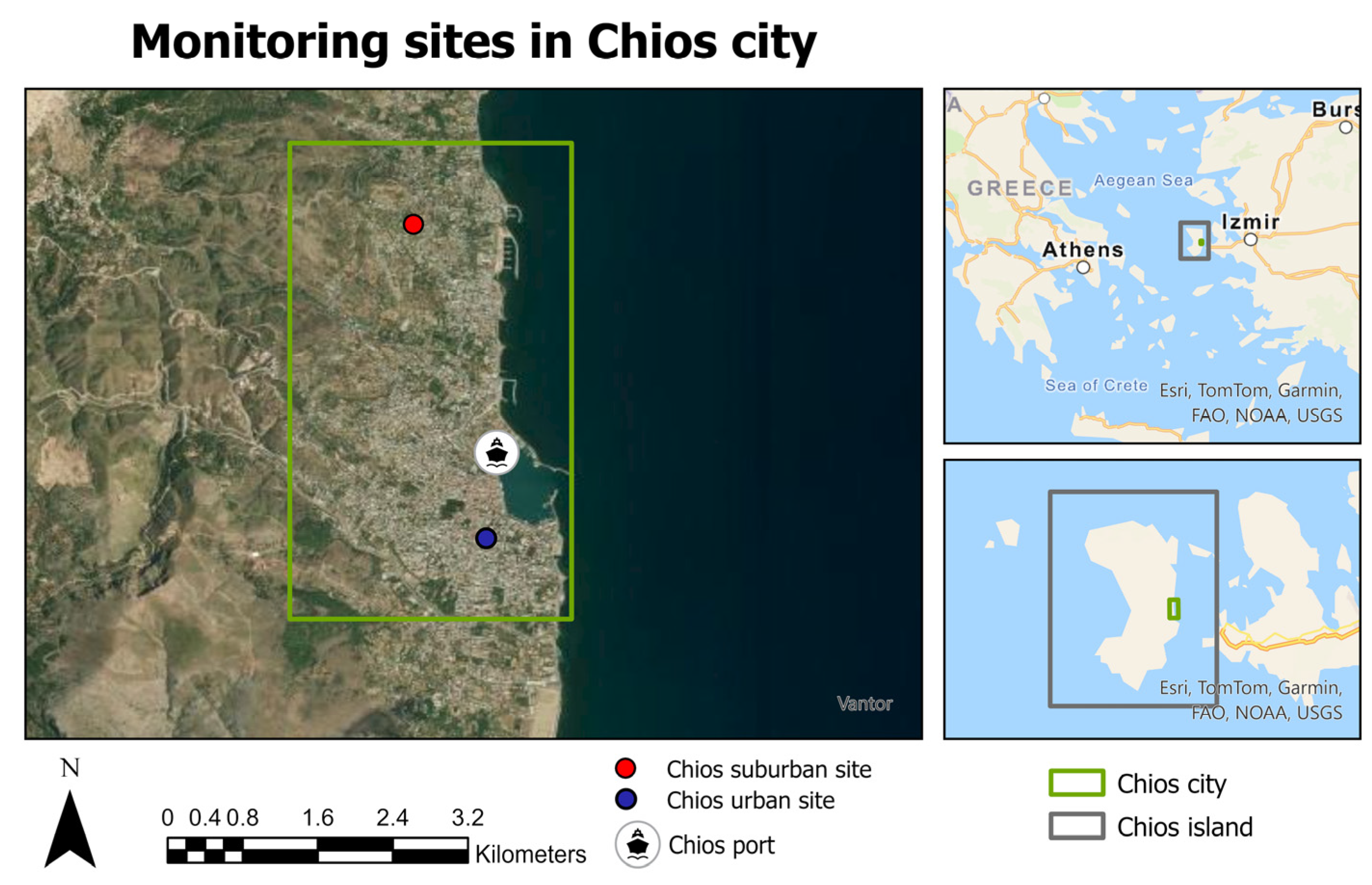
Figure 1. Map of Chios Island at the Northeastern Aegean Sea and Chios city with the port and the 2 monitoring sites (Urban and Suburban).
Jmse 14 00035 g001
Figure 2. Wind roses in Chios for (a) February 2022, (b) August 2022.
Jmse 14 00035 g002
Figure 3. Boxplots of PM2.5 concentrations at the urban and suburban monitoring sites of Chios during February and August 2022.
Jmse 14 00035 g003
Figure 4. Time series of PM2.5 concentrations (in μg/m3) at the urban and suburban monitoring stations in Chios during 2 August–4 August 2022 (docking hours are marked with black arrows).
Jmse 14 00035 g004
Table 2. Average change (ΔC) and per cent change (%ΔC) in PM2.5 concentrations during ship docking events at the urban and suburban stations of Chios for different wind sectors and months (February and August 2022).
MonthSiteΔC (μg/m3)% ΔCWind Direction
February 2022Urban−0.3−1.7All directions (60 obs.)
Suburban−0.2−1.7
August 2022Urban2.828All directions (110 obs.)
Suburban0.33.4
February 2022Urban0.86.1Northern (23 obs.)
Suburban0.32.3
August 2022Urban5.048Northern (58 obs.)
Suburban0.44.5
February 2022Urban0.74.7Southern (10 obs.)
Suburban2.427
August 2022Urban−0.7−5.1Southern (1 obs.)
Suburban0.0−0.3
February & August 2022 combined Urban1.719All directions (170 obs.)
Suburban0.13.0
Table 3. Median, IQR, and bootstrapped confidence intervals for %ΔC at the urban site by wind sector.
Wind SectorNMedian %ΔCIQR %ΔC95% CI %ΔC (Bootstrap)
Northerly8125.535.6[18.4, 31.5]
Southerly10−0.823.2[−7.0, 19.4]
Other790.319.1[−2.5, 4.8]
All sectors1709.734.0[5.2, 14.3]
All sectors, excluding southerly16010.734.0[5.8, 14.9]
Table 4. Spearman’s rho correlation coefficient (ρ) (and its significance level) of the urban and suburban PM2.5 concentrations with various predictors.
Urban StationSuburban Station
Correlation Coef.SignificanceCorrelation Coef.Significance
Power (kW)0.020.76−0.020.84
Time at port (min)0.020.77−0.100.22
Weed speed (kt)0.33 **<0.0010.030.74
wd_sin0.050.540.030.68
wd_cos0.34 **<0.0010.110.14
Temperature (°C)0.34 **<0.0010.17 *0.03
Dew Point (°C)0.140.070.17 *0.03
Pressure (hPa)−0.16 *0.040.001.00
** Significant correlation 0.01 level (2 tailed). * Significant correlation 0.05 level (2 tailed).
Disclaimer/Publisher’s Note: The statements, opinions and data contained in all publications are solely those of the individual author(s) and contributor(s) and not of MDPI and/or the editor(s). MDPI and/or the editor(s) disclaim responsibility for any injury to people or property resulting from any ideas, methods, instructions or products referred to in the content.