Article

Investigating the Genesis and Migration Mechanisms of Subsea Shallow Gas Using Carbon Isotopic and Lithological Constraints: A Case Study from Hangzhou Bay, China


1
Laboratory of Engineering Oceanography, Second Institute of Oceanography, Ministry of Natural Resources, Hangzhou 310012, China
2
Key Laboratory of Ocean Space Resource Management Technology, Ministry of Natural Resources, Hangzhou 310012, China
*
Author to whom correspondence should be addressed.
J. Mar. Sci. Eng. 2025, 13(12), 2372; https://doi.org/10.3390/jmse13122372 (registering DOI)
Submission received: 16 September 2025 / Revised: 1 December 2025 / Accepted: 2 December 2025 / Published: 14 December 2025
(This article belongs to the Section Geological Oceanography)

Abstract

This study addresses the challenge of data scarcity in research on the migration patterns of shallow gas in submarine sediments. Taking the northern Hangzhou Bay area of the East China Sea as an example, we integrate borehole core geophysical surveys and geochemical data to elucidate the migration and fractionation mechanisms of shallow biogenic gas. A three-zone conceptual model—“disturbed zone–active zone–residual zone”—dominated by lithology-controlled migration is established, revealing the dominant roles of gas escape, mixing-homogenization, and adsorption fractionation in heterogeneous sedimentary systems. The results show that high-permeability sand layers can act as adsorption-fractionation windows, causing significant enrichment in δ13C-CH4 (–57.4‰). We propose an analytical framework of “zonal verification–mechanism tracing”, which overcomes the limitations of traditional Rayleigh fractionation models and enables accurate interpretation of gas migration patterns in heterogeneous systems using limited data such as δ13C-CH4 and CH4 concentration. This provides a new paradigm for engineering surveys and risk assessment in low-data-density contexts. The findings indicate that the shallow seepage zone poses low engineering risks, while the residual zone serves as an indicator of depleted gas reservoirs. The proposed analytical approach can be extended to preliminary submarine engineering surveys and hazard assessments in other regions.

1. Introduction

Subsea shallow gas (hereinafter referred to as “shallow gas”) refers to organic gases accumulated within 1000 m below the seabed [1]. It is widely distributed in offshore regions globally, with the highest prevalence in estuarine delta areas [2,3]. A seminal global overview by Fleischer et al. confirmed that free gas, predominantly biogenic methane, is a ubiquitous phenomenon in organic-rich, shallow marine sediments worldwide, with its presence often inferred from diagnostic seismo-acoustic anomalies like acoustic turbidity [3]. Shallow gas is primarily formed when fine-grained sediments rich in organic matter are buried to certain depths beneath the seafloor and continuously generate methane and other gases through microbial processes [4]. It poses potential hazards to submarine engineering, such as formation compaction and deformation, and gas blowout risks [5]. The significance of shallow gas extends beyond local engineering concerns, as it is recognized as a critical marine geohazard that can threaten seabed infrastructure and trigger submarine slope instability, thereby posing a hidden threat to the burgeoning Blue Economy [6].
In recent years, the academic community worldwide has conducted extensive research on the accumulation mechanisms, occurrence distribution, and migration patterns of shallow gas in Quaternary sediments. Pioneering work by Hovland and Judd systematically linked gas-related acoustic features, such as acoustic blanking and enhanced reflections, to the formation of seabed pockmarks and seepages, establishing a fundamental framework for understanding fluid flow systems [7]. Subsequent high-resolution seismic studies have significantly refined the mapping and characterization of shallow gas. For instance, Missiaen et al., utilizing very high-resolution seismic data from the Belgian coastal zone, detailed various gas-related features like acoustic turbidity and blanking, attributing them to biogenic gas whose migration is strongly influenced by the lithology of interbedded sand-mud sequences [8]. Similarly, Aiello and Caccavale identified extensive shallow gas pockets and acoustically transparent units in Holocene sediments offshore the Cilento Promontory, Italy, highlighting that gas distribution is controlled by stratigraphic architecture and lithology and is not always manifested as seafloor features like pockmarks [9]. Furthermore, research in tectonically active regions, such as the Gulf of Pozzuoli, Italy, by Aiello demonstrates that fluid migration pathways, including shallow gas, can be structurally controlled by folds and faults, with significant implications for geohazard assessment in such settings [10].
A significant amount of shallow gas is distributed beneath the seabed of Hangzhou Bay in China. During preliminary geological surveys for the Hangzhou Bay Sea-Crossing Highway Bridge in 2001, abundant shallow gas was identified in the shallow-water areas of the region. When gas-bearing layers were penetrated during drilling, gas erupted violently, carrying sediments and severely impeding exploration efforts [11]. Advances in research on shallow gas engineering hazards indicate that shallow gas in sea-crossing project areas mostly occurs in Quaternary sandy soils or interlayers of muddy clay and silt, is predominantly biogenic in origin, and requires specialized mitigation measures [12,13]. Gas invasion can lead to drilling fluid pressure loss and trigger high-velocity blowouts, with risks increasing at shallower burial depths [14]. The role of shallow gas in triggering submarine instability is increasingly recognized. Aiello identified shallow gas pockets as a key predisposing factor for slope instability and creeping phenomena offshore Campania, Italy, emphasizing their potential to initiate failure on continental slopes [15]. In terms of detection technologies, 3D seismic imaging, deep neural network-based integration, and joint validation using core data and high-resolution seismic data have improved early-warning accuracy for shallow and deep gas hazards, respectively [16,17]. Global cases confirm that shallow marine biogenic gas commonly exhibits acoustic blanking characteristics, and its generation and migration mechanisms follow a dynamic process of “adsorption-dissolution, pocket accumulation, and seal formation by mud layers” [3,18]. Complex pockmarks with massive methane-derived authigenic carbonate ridges, as described by Hovland et al. off mid-Norway, provide compelling evidence for focused methane fluid flow and its subsequent diagenetic products, further illustrating the dynamic nature of gas seepage systems [19]. Fault systems serve a dual function as both reservoirs and conduits, further increasing the complexity of engineering risks [17].
The geochemical identification of shallow gas origins relies on well-established criteria. Among these, the methods proposed by Bernard [20] and Whiticar [21] are widely used internationally for distinguishing biogenic from thermogenic gas and elucidating formation pathways. In China, the criteria established by Dai Jinxing et al. are particularly foundational and widely applied [22]. The Dai Jinxing criteria for primary biogenic gas include (1) δ13C1 < −55‰; (2) heavy hydrocarbon gases (C2+) are either absent or present in minimal amounts (typically < 0.5%); and (3) a specific pattern in isotopic differences between hydrocarbon components (δ13C3δ13C2 < −10‰). These geochemical tools are essential for accurately determining gas genesis.
The migration mechanism of subsea shallow biogenic gas is a core issue in the assessment of marine geohazards and the exploration of gas reservoirs. In the Yangtze subaqueous delta and Hangzhou Bay, shallow gas occurrence is controlled by sediment thickness and water depth, with active seepage exacerbating coastal hazard risks [23]. Subsea gas migration primarily occurs as capillary-driven invasion in coarse-grained sediments and fracture-driven invasion in fine-grained sediments. For engineering detection, marine seismic-resistivity methods have become mainstream for in situ monitoring, while hydrocarbon and isotope dual-indicator tracing can effectively verify gas migration [24,25]. Conventional geochemical methods for interpreting migration patterns rely on the coordinated constraints of full-composition isotopic spectra (C1~C7) and light/heavy hydrocarbon ratios, enabling coupled multi-parameter analysis of gas migration pathways [20,21]. However, such methods often face challenges due to missing key data during preliminary investigations or engineering-oriented projects, especially in mud-rich depositional environments. Systematic analytical approaches for coupled migration–fractionation processes of biogenic gas in low-permeability formations are still lacking, limiting the predictive accuracy of dynamic models for shallow gas behavior.
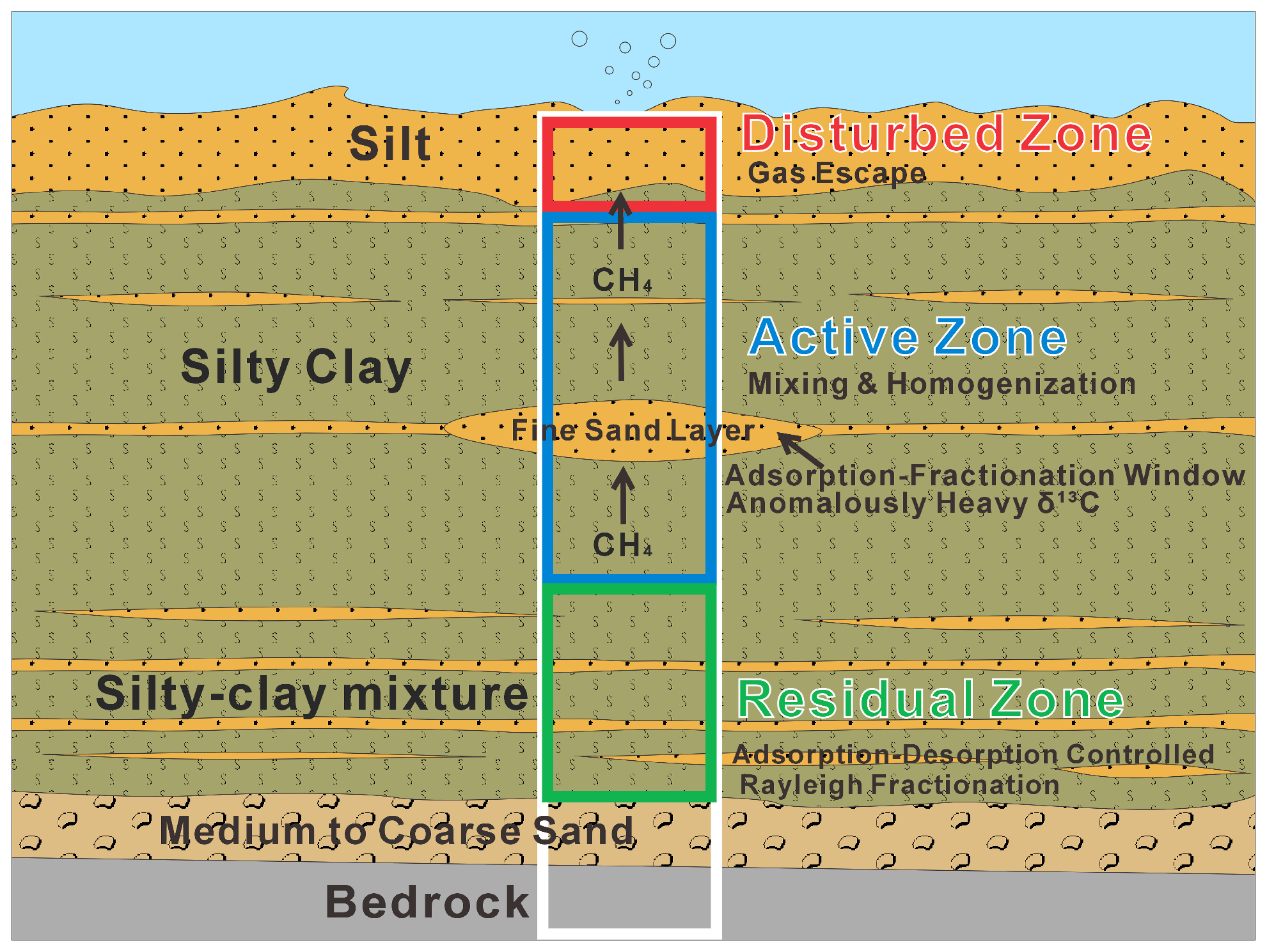
Overall, current research on shallow gas in the Hangzhou Bay area remains limited, and there is a notable lack of analytical frameworks for interpreting gas migration in low-data scenarios, highlighting an urgent need for in-depth study. This paper utilizes data from the Hangzhou Bay area in the East China Sea to examine the patterns and characteristics of sedimentary facies within their geological historical context, combined with geochemical analyses to investigate the genetic types of shallow gas in the study area. Analysis of stratigraphic columnar sections is applied to assess source-reservoir-seal conditions; however, due to sampling cost or analytical limitations, only single-isotope indices such as methane carbon isotope (δ13C-CH4) are available, leading to methodological challenges in interpreting migration mechanisms—where high theoretical demand meets low data density. This study proposes an innovative solution: based on in situ measurements from a 130.4 m core vertical profile in the northern Hangzhou Bay, a tri-zonal framework is established, as shown in Figure 1.
Using a lithology-isotope coupling diagnostic technique—incorporating three mechanisms: sand layer adsorption-fractionation windows, clay sealing-induced homogenization, and Rayleigh fractionation in the residual zone—spatial variations in δ13C-CH4 and CH4 concentration are used exclusively to reconstruct migration pathways. The findings reveal that fine-grained clay-dominated transport causes mixing-homogenization, sand layer desorption-fractionation windows lead to anomalous enrichment of δ13C, and adsorption fractionation in the deep residual zone dominates the apparent fitting artifact across the system. This approach overcomes the limitations of traditional Rayleigh fractionation models in heterogeneous sediments and enables mechanistic analysis of subsea shallow gas migration using singular and limited datasets. It provides a new lithology-constrained paradigm for migration interpretation in low-data engineering survey contexts, supplying a scientific basis for hazard risk assessment in major marine projects such as sea-crossing bridges and subsea tunnels (e.g., early warning of seal failure in disturbed zones and identification of permeability anomalies in sand layers). Furthermore, it establishes criteria for identifying depleted zones in shallow biogenic gas exploration.

2. Study Area

The study area is located in the central part of Hangzhou Bay, adjacent to the under-construction Tongsu-Jiayong Sea-Crossing High-Speed Railway Bridge. The bay is approximately 26 km wide, bounded by the Sanbei Plain to the north and the Hangjiahu Plain to the south, both of which have undergone large-scale reclamation activities over extended historical periods [12]. The paleo-depositional environment of Hangzhou Bay was primarily climate-controlled: the Early Pleistocene was dominated by fluvial and fluviolacustrine facies, the Middle Pleistocene by fluvial, lacustrine, and fluviolacustrine facies, and the Late Pleistocene by tidal flat, estuarine, and shallow marine facies. The modern depositional environment is influenced by multiple factors including tides, riverine input, marine dynamics, and anthropogenic activities. The sediments are predominantly composed of fine-grained materials such as silt and clay, with a relatively low sedimentation rate, as shown in Figure 2.
Since the Last Glacial Period, the incised valleys in the Hangzhou Bay area have undergone a three-stage evolution of deep cutting, rapid infilling, and burial in response to sea-level changes. Under these specific geological conditions, several cycles of marine transgression and regression during the Quaternary resulted in the alternating deposition of multiple sets of organic-rich mud layers and sand layers. Organic matter within the mud layers was converted into biogenic gas via biochemical processes of anaerobic bacteria. This gas subsequently migrated, accumulated, and was stored in nearby sand lenses or at the top of sand layers, forming numerous ultra-shallow gas reservoirs [26]. Based on the analysis of geological data and integrated geophysical detection methods, shallow gas is widely distributed along the longitudinal direction of Hangzhou Bay. Two gas-bearing layers are identified vertically at the regional scale: the first occurs within the Holocene fine-grained soil layer (typically at 5–11 m depth), and the second is located in the Upper Pleistocene series, occurring in interbeds or lenses of silty and fine sand (at depths around 40 m). While this regional framework is well-established, constructing a continuous and precise regional sedimentary profile remains challenging due to the discontinuous nature of available shallow seismic data. Therefore, this study focuses on a high-resolution, mechanistic analysis of the continuous and well-constrained 130.4 m Core D5 to establish a vertical zonation model for gas migration. The findings from this core are interpreted within the established regional context but are intended to provide a process-based understanding that can be applied to similar settings.
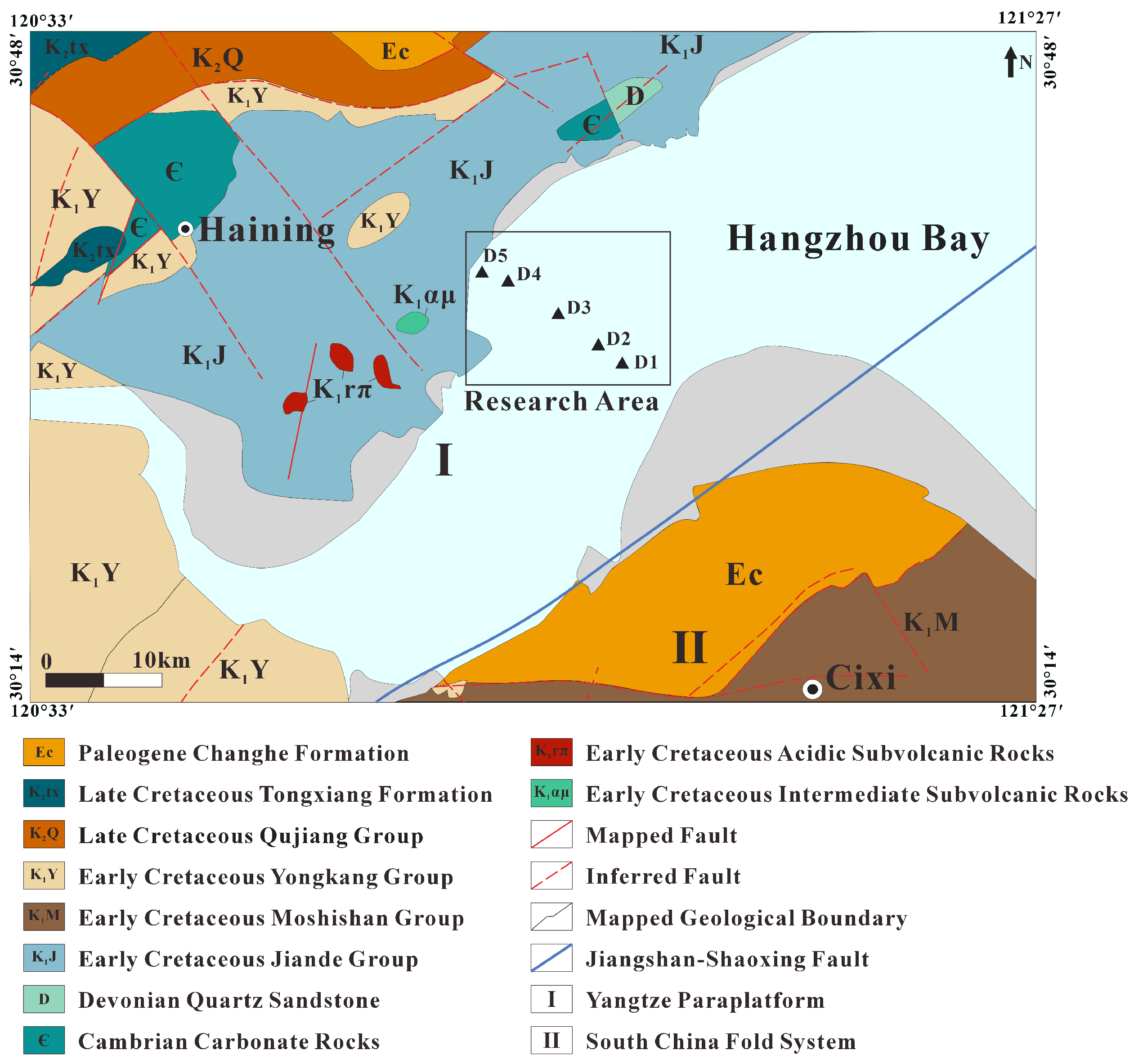
In terms of tectonic units, the Hangzhou Bay area straddles two first-order tectonic units, bounded by the Jiangshan-Shaoxing Fault. The area north of this fault belongs to the Yangtze Paraplatform, while the southeastern area pertains to the South China Fold System. The bridge site is located in the junction zone of these two major tectonic units, with the majority lying within the Yangtze Paraplatform, as shown in Figure 3.
The second-order tectonic unit within the bridge area on the Yangtze Paraplatform is the Qiantang Tectonic Zone, while the area south of the bridge site lies within the second-order tectonic unit of the South China Fold System—the Southeastern Zhejiang Fold Belt. The region is characterized by stable geological structure and weak seismic activity, classifying it as a relatively stable block. Faults near the study area have been inactive since the Late Pleistocene.

3. Materials and Methods

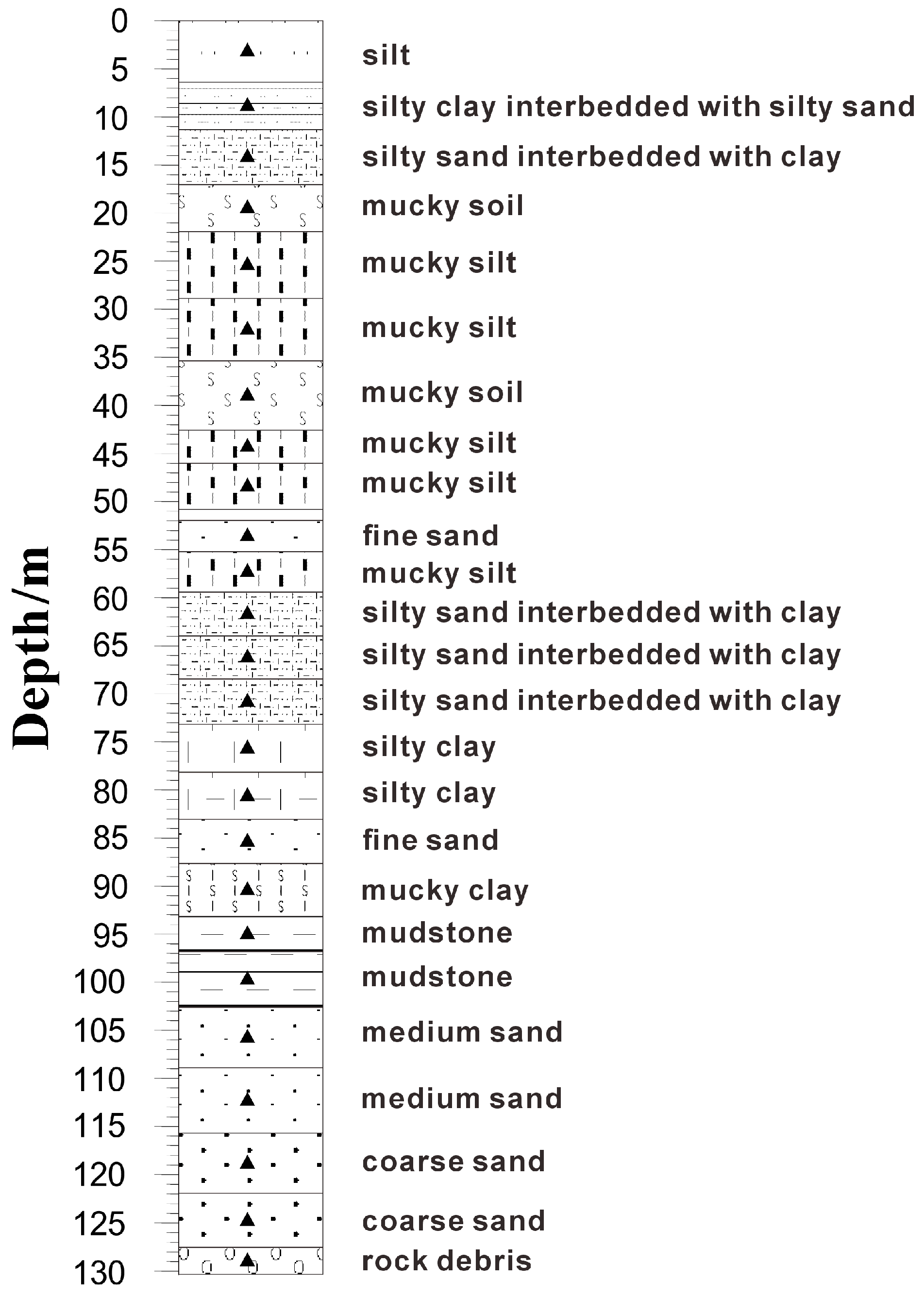
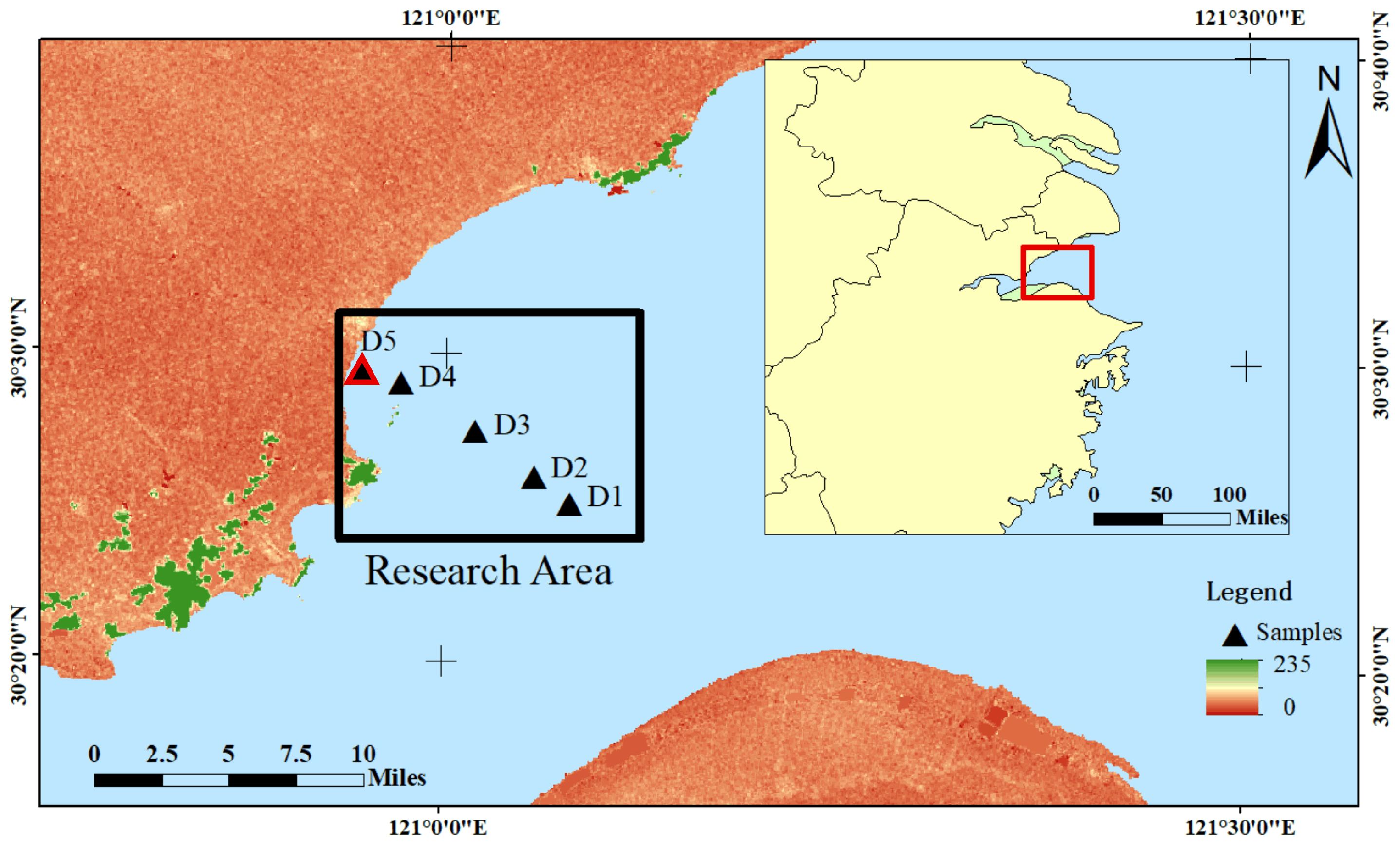
This study utilized five vertically drilled sediment cores (D1, D2, D3, D4, D5) obtained from the northern Hangzhou Bay as the subjects for investigating the origin of shallow gas. Among these, the 130.4 m-long core D5 served as the primary subject for studying shallow gas migration patterns. Upon retrieval of the sediment cores, sediment and gas samples were promptly collected on-site. Using D5 as an example, after coring was completed, the core was divided into 25 independent lithological units. The sedimentological profile of Core D5, illustrating these 25 lithological units and the sampling strategy, is presented in Figure 4. For each lithological unit, sediment and gas samples were collected from the central part of the unit to ensure representativeness, targeting a standard volume of sediment for headspace gas analysis.
Gas from sediment samples was extracted using the headspace gas chromatography method for analyzing sediment porosity, total organic carbon (TOC), CH4, CO2, and δ13C-CH4. Sediment porosity was measured using the saturated drying method. TOC was detected using an Elementar Flash 2000 elemental analyzer (Thermo, Waltham, MA, USA). CH4 concentration was analyzed using an Agilent 6850 instrument (Agilent Technologies, Santa Clara, CA, USA) equipped with an FID detector and a Porapak Q column. CO2 concentration was analyzed using a Thermo Trace GC ULTRA system (Thermo Fisher Scientific, Waltham, MA, USA) with a TCD detector and a Porapak Q column (Waters Corporation, Milford, MA, USA). δ13C-CH4 analysis was conducted using Gas Chromatography-Combustion-Isotope Ratio Mass Spectrometry (GC-C-IRMS). Hydrocarbon gas compounds were separated via gas chromatography, after which CH4 was oxidized to CO2 in a combustion furnace, and the resulting CO2 was introduced into the isotope ratio mass spectrometer for carbon isotope analysis.
The geochemical analysis targeted a suite of parameters crucial for determining the genetic origin and migration history of the shallow gas. The measured indices included the molecular composition (methane, ethane, and propane concentrations: C1, C2, C3 in ppm), the gas wetness ratio [C1/(C2 + C3)], and the carbon isotopic composition of methane and carbon dioxide (δ13C-CH4 and δ13C-CO2). δ13C-CH4 values are reported relative to the Vienna PeeDee Belemnite (VPDB) standard and were calculated using the following formula:
δ 13 C = R C 13 C s a m p l e 12 R C 13 C V P D B 12 1 × 1000
where R(13C/12CVPDB) represents the carbon isotopic abundance ratio. The analytical precision for δ13C-CH4 is ±0.5‰. These indices form the basis for applying established genetic identification criteria, such as those proposed by Bernard [20], Whiticar [21], and Dai Jinxing et al. [22].
The interpretation of gas migration and fractionation mechanisms in this study is grounded in the principles of isotopic fractionation during adsorption–desorption and migration in porous media. The underlying physical mechanism is the difference in intermolecular interactions, whereby 13CH4 exhibits a higher binding energy to clay minerals and organic matter than 12CH4. This results in the preferential enrichment of 13C in the adsorbed phase, while the free phase (pore gas) becomes relatively enriched in 12C [27,28]. The measured δ13C-CH4 values represent a mixed signal from both the free phase and the gas released from the adsorbed phase during sampling, with the free phase typically constituting the dominant contribution [29].
A classical model for describing such processes is the Rayleigh fractionation equation [30]:
δ 13 C = δ 13 C 0 + ε · l n 1 f
where
δ13C: Carbon isotopic value of the current methane (‰);
δ13C0: Carbon isotopic value of the initial substrate (‰);
ε: Fractionation factor (unit: ‰), reflecting the intensity of isotopic fractionation between 13C and 12C during the reaction (ε = δproductδsubstrate; a larger absolute value indicates more significant fractionation);
f: Proportion of remaining substrate (f = 1 indicates no reaction; f = 0 indicates complete reaction).
However, the complex lithology of our study area necessitates an approach that moves beyond the single-mechanism assumption of the classical Rayleigh model. Therefore, we utilize the spatial variations in δ13C-CH4 and CH4 concentration, critically constrained by lithological context, to reconstruct migration pathways and identify the dominant fractionation mechanisms operative within different intervals.
Spatial data processing and map creation were conducted using ArcGIS (ArcMap version 10.8, Environmental Systems Research Institute, Redlands, CA, USA). Data plotting, graphical analysis, and the generation of coordinate axis figures were performed using Origin (Version 2024, OriginLab, Northampton, MA, USA) and Grapher (legacy version, Golden Software, Golden, CO, USA). All schematic diagrams were prepared using CorelDRAW Graphics Suite (Version 2024, Corel Corporation, Ottawa, ON, Canada).

4. Results

4.1. Isotopic and Chemical Composition of Shallow Gas

A significant number of non-detected or missing values are present in the shallow gas measurements from the study area (Table 1). Gas concentrations below the detection limit are marked as “na” (considered as 0 ppm in practice), whereas missing isotopic values resulted from insufficient gas concentration for reliable analysis.
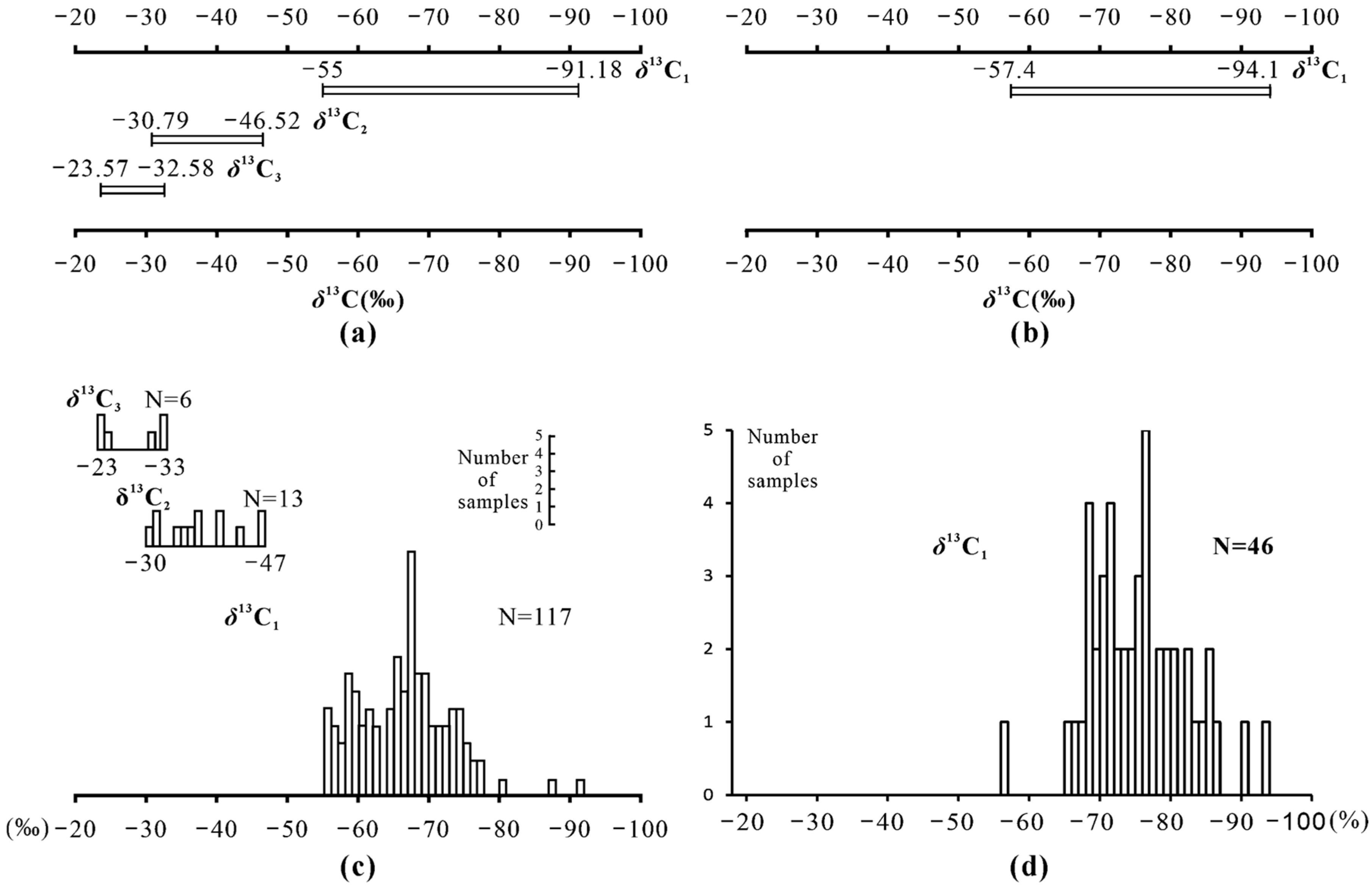
Geochemical analysis results indicate that the maximum detected value of heavy hydrocarbon gases (specifically propane, C3) in this area is 8.86 ppm. The shallow gas is characterized by high methane (C1) content, with negligible or trace amounts of hydrocarbons heavier than ethane (C2), identifying it as typical dry gas. The δ13C-CH4 values (δ13C1) in the study area exhibit a wide distribution, ranging from −94.1‰ to −57.4‰, with the primary frequency distribution between −80‰ and −70‰ (See Section 5.1 for genetic interpretation). The C1/(C2 + C3) ratios are mostly above 150. The mean value of δ13C-CH4 was −78.5‰, while δ13C-CO2 values ranged from −20.6‰ to −6.1‰.

4.2. Vertical Distribution of Methane and Isotopes

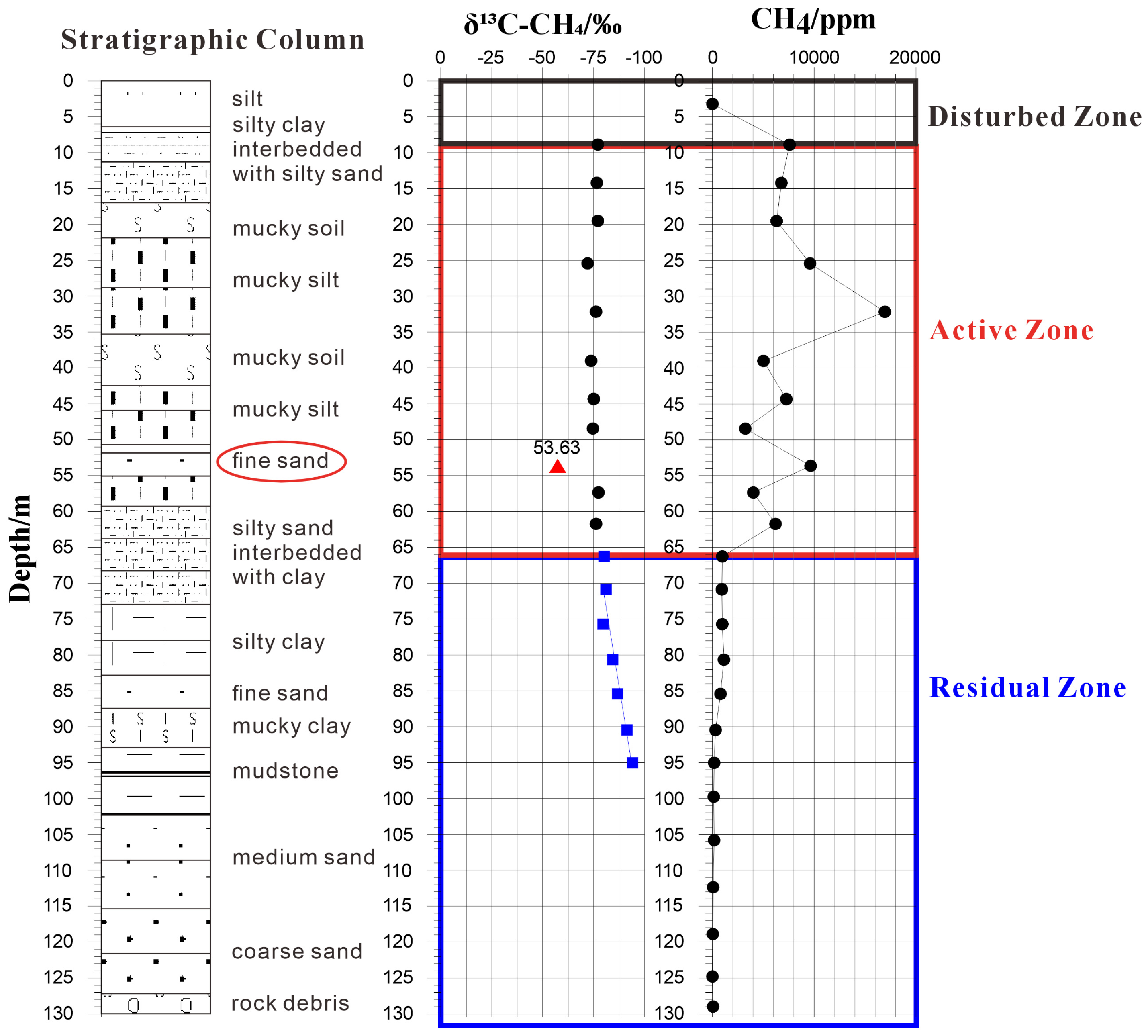
Core D5 was subdivided into 25 consecutive units based on drilling and geochemical data, with an average length of approximately 5.2 m. Using the mid-point depth of each unit, parameters including δ13C-CH4 and CH4 concentration were integrated with the stratigraphic column of Core D5 to delineate their vertical distribution patterns, as shown in Figure 5.
The vertical profiles reveal several key intervals:
From 6.40 to 64.00 m, δ13C-CH4 values remained stable, with a mean of −75.6‰ and a standard deviation of ±1.8‰. From 64.00 to 96.85 m, δ13C-CH4 exhibited a strong linear correlation with depth (R2 = 0.92), becoming progressively more negative from −76.1‰ to −94.3‰. At 52.00–55.25 m, within a fine sand layer, an anomalously enriched δ13C-CH4 value of −57.4‰ was recorded. No reliable δ13C-CH4 signals were detected at depths < 6.40 m or >96.85 m due to low CH4 concentrations.
CH4 concentration (Figure 5) showed a distinct peak between 28.90 and 35.40 m and was highly variable between 6.40 and 64.00 m, dropping sharply in the shallow (0–6.40 m) and deep (64.00–130.40 m) strata.
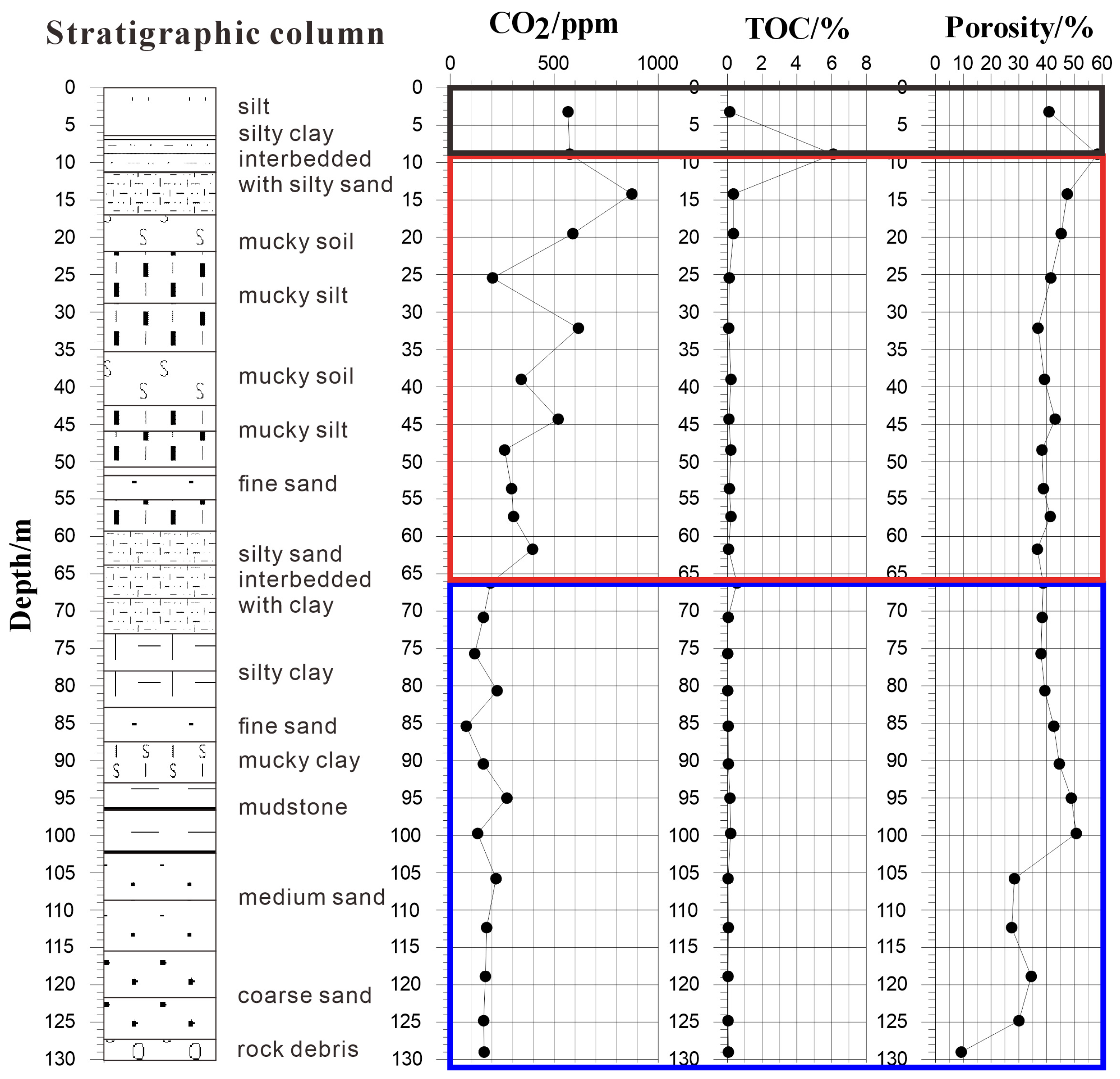
The integrated plot of CO2 concentration, total organic carbon (TOC), and porosity (Figure 6) reveals concurrent peaks of TOC and porosity between 6.40- and 11.35 m depth. In contrast, CO2 concentration peaked at a shallower interval of 11.35–17.05 m and remained relatively low in the deep strata (64.00–130.40 m).

4.3. Regression Analysis of Isotopes and Concentration

The distinct vertical patterns of δ13C-CH4 described in Section 4.2—namely, the remarkable stability through a thick interval (6.40–64.00 m), the strong linear trend at depth (64.00–96.85 m), and the isolated anomalous value in the sand layer—suggest that the relationship between methane concentration and its carbon isotope composition may vary significantly with depth and lithology. To quantitatively assess these potential differences and to evaluate the applicability of the classical Rayleigh fractionation model, which assumes a single, continuous process, we performed linear regression of δ13C-CH4 against ln(CH4) across different depth intervals.
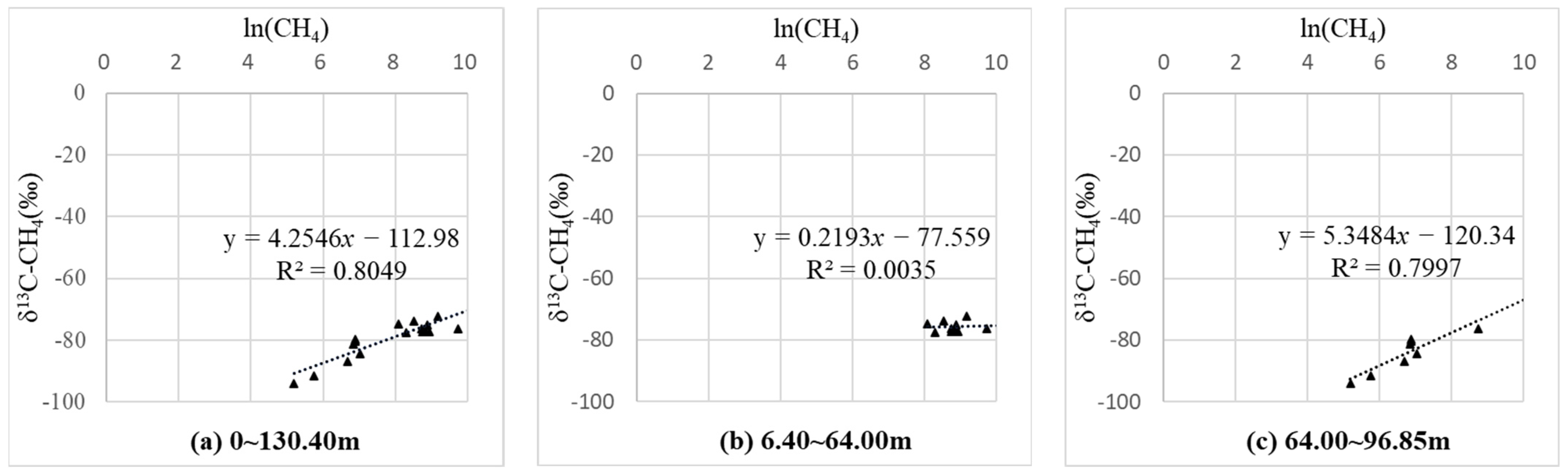
The regression was conducted on three datasets: (1) the entire profile (0–130.40 m) to obtain a global trend; (2) the interval characterized by stable isotope values (6.40–64.00 m); and (3) the interval exhibiting the strong linear isotopic gradient with depth (64.00–96.85 m). The anomalously enriched δ13C-CH4 value (−57.4‰) from the sand layer (52.00–55.25 m) was excluded from all regression analyses to prevent this localized extreme value from skewing the trends of the broader intervals. The results are presented in Figure 7 and Table 2.
The quality of the fits, summarized in Table 2, shows profound differences between the intervals. The high coefficient of determination (R2 = 0.8049) for the entire profile indicates an apparent overall correlation. However, this global trend masks critical internal heterogeneity. The middle interval (6.40–64.00 m) exhibits an extremely low R2 value (0.0035), demonstrating no clear linear relationship between δ13C-CH4 and ln(CH4). In stark contrast, the deep interval (64.00–96.85 m) maintains a strong linear correlation (R2 = 0.7997). These results quantitatively confirm that the coupling between methane carbon isotopic composition and concentration follows distinctly different patterns in different parts of the sediment column.

5. Discussion

Building upon the vertical geochemical profiles detailed in Section 4, this discussion interprets the origin of the shallow gas and proposes a three-zone conceptual model to explain the depth-dependent migration and fractionation processes.

5.1. Identification of Biogenic Gas Origin

Geochemical analysis confirms the biogenic origin of the shallow gas in the study area. First, the data satisfy the key criteria established by Dai Jinxing et al. [22] for primary biogenic gas: δ13C1 values are consistently lower than −55‰, and heavy hydrocarbon (C2+) content is negligible (meeting the <0.5% threshold). Although the third criterion (δ13C3δ13C2 < −10‰) could not be assessed due to absent measured data, the fulfillment of the first two criteria provides strong evidence for a biogenic origin. Moreover, the distribution range and frequency of δ13C1 values in our study show a strong congruence with those of established biogenic alkane gases in China, as compiled by Dai Jinxing et al. [22] (Figure 8).
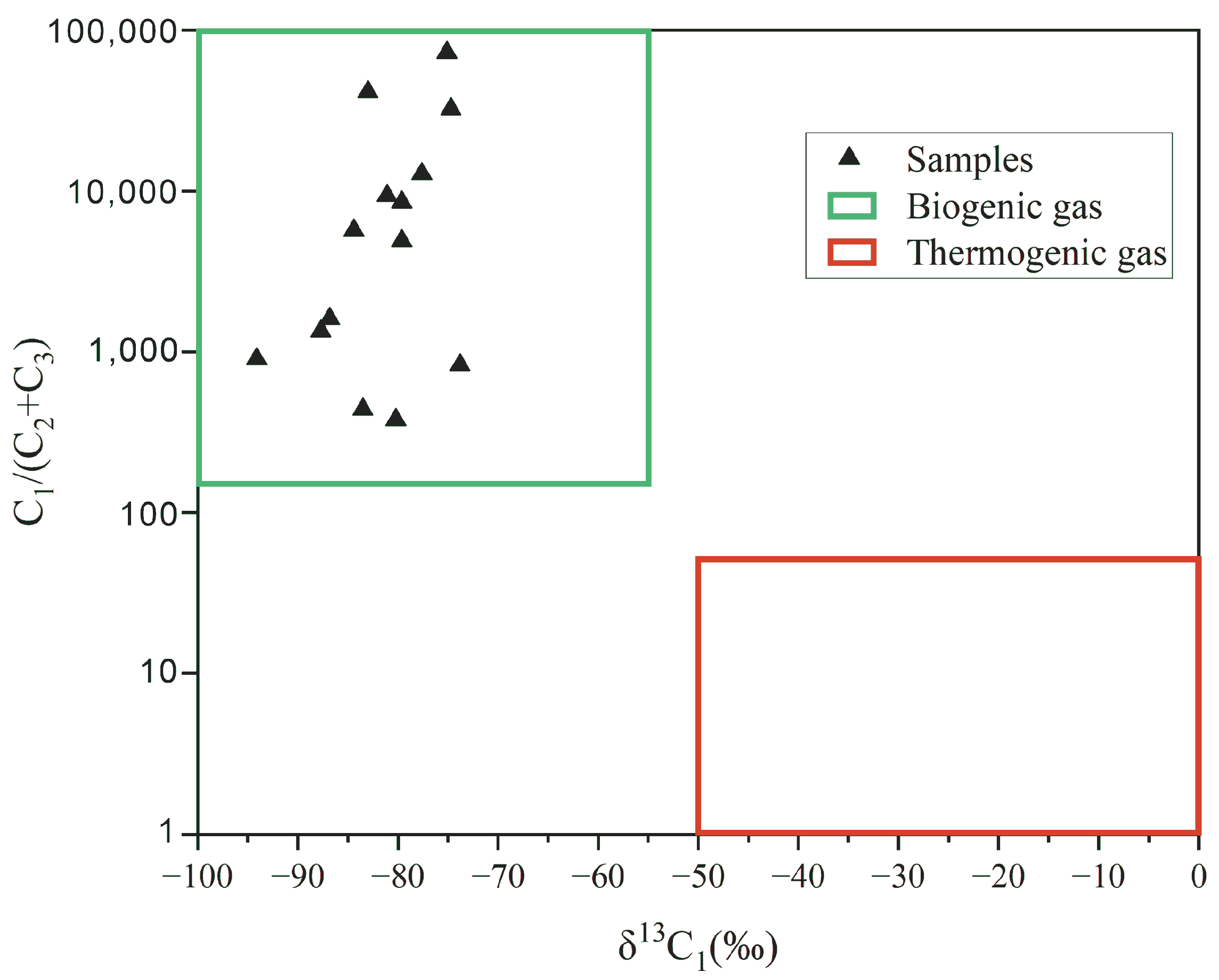
Furthermore, the origin of the shallow gas was classified using plots of isotopic ratios versus chemical composition. The widely adopted Bernard diagram for natural gas classification was applied for this purpose [20]. As shown in Figure 9., all data points for the gas samples plot within the biogenic gas field, characterized by δ13C1 values lighter than −55‰ and C1/(C2 + C3) ratios mostly above 150. This result, together with the Dai Jinxing identification criteria, collectively confirms that the shallow gas in the study area is of biogenic origin.
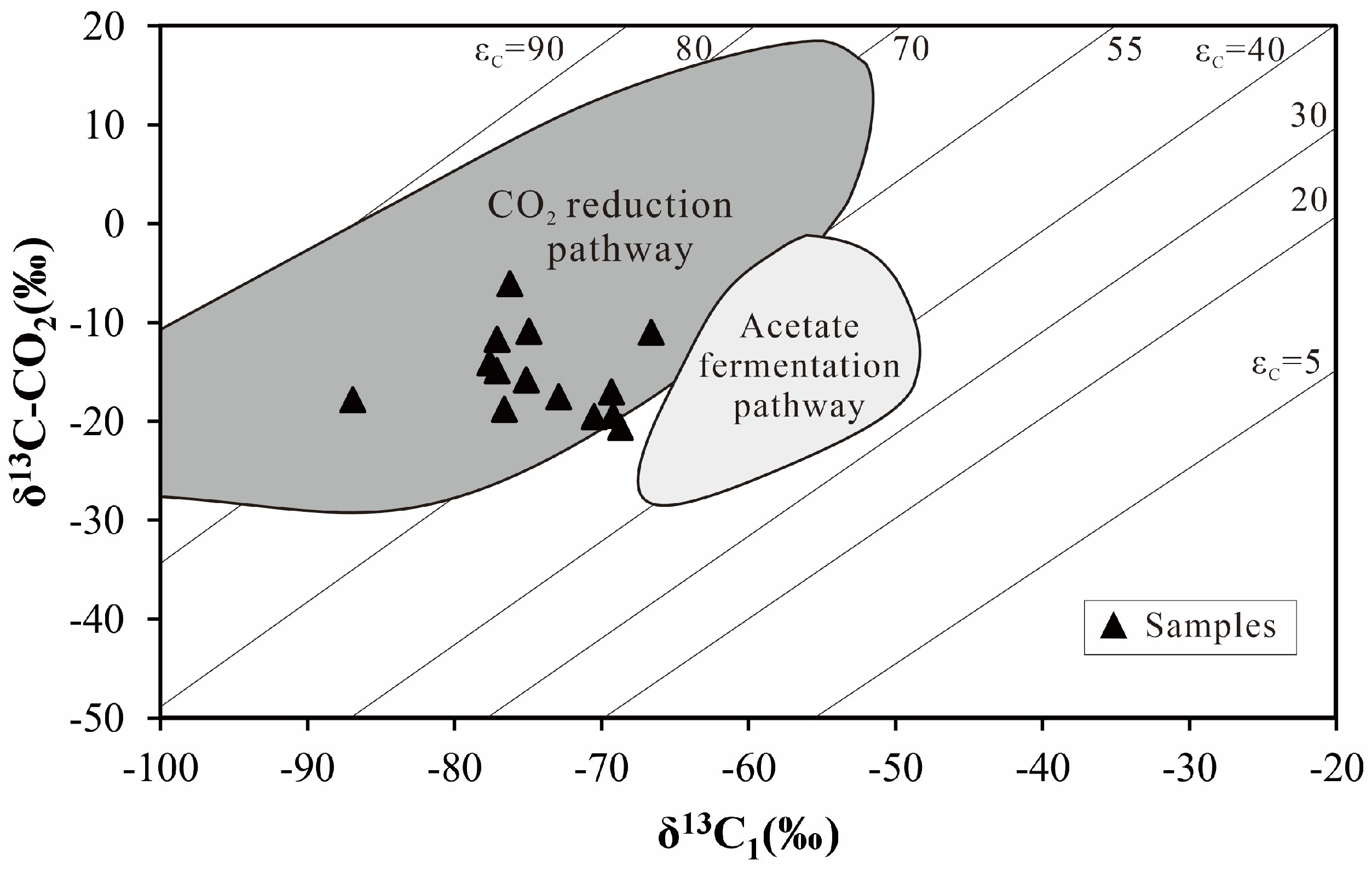
Building upon this foundation, the formation pathways of the subsea biogenic gas were further investigated. The primary pathways for biogenic gas formation are acetate fermentation and CO2 reduction. Acetate fermentation occurs predominantly in terrestrial freshwater environments, producing gas characterized by a relatively depleted hydrogen isotope composition and a relatively enriched carbon isotope signature. In contrast, CO2 reduction takes place mainly in marine and saline lacustrine settings, yielding gas with an enriched hydrogen isotope composition and a depleted carbon isotope signature [31]. Whiticar et al. [21] proposed δ13C1 values to distinguish between these two pathways. The Whiticar genetic diagram for biogenic gas classification was employed (Figure 10). On this diagram, data points from gas samples in the study area predominantly fall within the CO2 reduction field. This indicates that the subsea shallow gas was primarily formed via CO2 reduction, which is consistent with the saline depositional environment of the marine–terrestrial transition facies in Hangzhou Bay.
The analytical results indicate that the subsea shallow gas in the study area is characterized primarily by high methane content, with absent or only trace amounts of ethane and heavier hydrocarbons (C2+). This composition is typical of primary methane-rich biogenic gas formed via CO2 reduction.

5.2. Interpretation of Vertical Zonation and Migration Mechanisms

The systematic correlation between lithology and geochemical parameters, summarized in Table 3, provides the foundational evidence for subdividing the D5 profile into three distinct functional zones. Based on this, we interpret the profile as comprising: a Disturbed Zone (0–6.40 m), an Active Zone (6.40–64.00 m), and a Residual Zone (64.00–96.85 m). This conceptual zonation offers a clear framework for analyzing the dominant gas migration and fractionation mechanisms within each interval.
Following the framework established in Table 3, the mechanisms for each zone are discussed in detail below.

5.2.1. Disturbed Zone (0–6.40 m): Near-Surface Gas Dissipation

The silt layer at 0–6.40 m exhibits significantly low CH4 concentration (10.3 ppm), in sharp contrast to the underlying unit (6.40–11.35 m) of silty clay with silt interbeds, in which TOC content and porosity simultaneously reach their vertical peaks, and CH4 concentration increases sharply to 7589.2 ppm, indicating high gas-generation potential at this depth (Figure 6). Further downward, the silt with clay interbeds at 11.35–17.05 m shows a peak CO2 concentration (873.3 ppm), forming a vertical sequence of “low CH4 → high CH4 → high CO2”. This vertical pattern confirms the role of the highly permeable near-surface silt layer as a dissipative pathway: its high permeability prevents it from forming an effective seal, leading to rapid effusive loss of biogenic gas via pore-space diffusion during upward migration [32]. Furthermore, the oxidative near-seafloor environment promotes the microbial oxidation of methane by aerobic methanotrophs, converting a significant portion of upwardly migrating CH4 to CO2 [33]. While the available data cannot quantitatively partition the contributions of physical escape versus microbial oxidation, both mechanisms are highly effective in preventing methane accumulation. The CO2 peak observed directly beneath the disturbed zone (11.35–17.05 m) is consistent with the latter process. Critically, regardless of the dominant removal mechanism, the outcome is unequivocal: the Disturbed Zone presents a persistently low gas concentration. This is the fundamental reason why it poses a low engineering risk, as significant gas accumulation—a prerequisite for hazards like blowouts—is effectively prevented.

5.2.2. Active Zone (6.40–64.00 m): Mixing-Homogenization and Fractionation Windows

In the Active Zone of the study area, CH4 concentrations are highly active and scattered, yet δ13C-CH4 remains stable (−75.6 ± 1.8‰). This homogenization is interpreted to be controlled by the inherently low-permeability barrier formed by clayey soils, which significantly inhibits the vertical migration rate of methane [21]. Additionally, the diffusion-equilibrium effect within fine-grained sedimentary layers is identified as a key mechanism erasing primary isotopic fractionation signals [34].
The homogenization of δ13C-CH4 in this zone results from the mixing of multi-source biogenic gas and deeper residual gas. When shallow gas sources initiate preferential fractionation, the resulting 12C-enriched CH4 mixes with more 13C-enriched residual gas migrating upward from deeper intervals within the active zone, leading to the homogenization of δ13C-CH4 at around −75.6 ± 1.8‰. The high goodness of fit shown in Figure 7a macroscopically reflects this superposition of fractionation and mixing dominated by multiple units and mechanisms. Ma et al. [35], in a study of muddy sediments in the Bohai Bay, found that clay sealing layers (with smectite content > 30%) exhibit very low permeability (<10−12 m2), reducing the vertical methane migration rate to 0.01–0.1 m/kyr. Over geological timescales (>103 years), the diffusion-dominated migration mechanism homogenized δ13C-CH4 values from an original fractionation range of −82‰ to −70‰ to a value of −75.5 ± 1.2‰, which is nearly identical to the value observed in this study (−75.6 ± 1.8‰). The high specific surface area of clay minerals (>800 m2/g) further promotes isotopic mixing through adsorption–desorption equilibrium.
At the fine sand layer between 52.00 and 55.25 m, a sharp increase in δ13C-CH4 to −57.4‰ was detected. This anomalously enriched isotopic signal reveals an isotope fractionation mechanism dominated by phase partitioning in high-permeability formations. The fundamental driver of this partitioning is the differential behavior of methane isotopologues between the free and adsorbed phases. Excellent pore connectivity allows preferential and rapid migration of 12CH4 in the free phase, while the residual gas remains primarily in the adsorbed phase, with its 13C-enriched components adsorbed onto minor clay and organic matter within the sand layer [27]. The delayed desorption of this residual gas leads to significantly enriched isotopic values in the measured gas. This phase-partitioning process can be explained by the critical pressure theory for CH4 isotope fractionation in porous media [28]: during early gas generation, when pressure is above the critical value, 12CH4—due to its higher diffusivity and slip flow capacity—preferentially enters the free phase and migrates, resulting in significant fractionation. As pressure declines, substantial 13CH4 desorbs from the adsorbed phase into the free phase, resulting in an overall enrichment in 13C of the gas and a weakening of the fractionation trend.
The physical basis for this adsorptive fractionation lies in the differential intermolecular interactions between methane isotopologues and sediment surfaces. The 13CH4 molecule, due to its greater atomic mass, has a lower zero-point energy and thus a higher binding energy to adsorbents such as clay minerals and organic matter compared to 12CH4. This fundamental thermodynamic preference causes the adsorbed phase to become enriched in 13C, while the free phase migrating through the pore network is concurrently enriched in 12C. It is critical to distinguish this mechanism from other potential fractionation processes. For instance, microbial oxidation would preferentially consume 12CH4, also leading to 13C enrichment in the residual pool; however, this process is inconsistent with the high CH4 concentration (9655.7 ppm) observed in this sand layer. Similarly, dissolution fractionation can be ruled out as a dominant process. While aqueous dissolution can fractionate isotopes, its effect typically opposes our observations. For instance, Qin et al. demonstrated that flowing groundwater preferentially dissolves and removes the heavier isotopologue (13CH4), leading to a residual gas pool enriched in 12CH4—meaning dissolution fractionation typically results in negative δ13C-CH4 shifts [36]. This is in direct contradiction to the significant positive shift (Δδ = +18.2‰) observed in our study, allowing us to exclude dissolution as the primary mechanism for the isotopic enrichment. Therefore, the phase partitioning driven by adsorption–desorption equilibria is unambiguously identified as the governing fractionation mechanism.
Thus, the CH4 detected in the silt-fine sand layer within the study interval (52.00–55.25 m) can be interpreted as adsorbed–desorbed residual gas that has been left behind and isotopically enriched following the migration of the lighter free-phase gas. This mechanism is supported by numerous empirical studies. For instance, desorption experiments on coal rocks from the Ordos Basin by Zhang et al. (2025) [29] demonstrated that in high-permeability media, 12C-enriched free gas escapes preferentially, leaving an adsorbed phase enriched in 13C that increased δ13C-CH4 by 12.6‰ to 22.5‰. In this study, the δ13C-CH4 in the silt-fine sand layer is enriched by Δδ = +18.2‰ compared to that in the overlying clayey layer, which closely matches the range reported in the aforementioned literature. This strongly confirms that phase partitioning (escape of free phase and retention of adsorbed phase) is the key process leading to the anomalously heavy isotopic values in this interval.

5.2.3. Residual Zone (64.00–96.85 m): Adsorptive Fractionation and Reservoir Depletion

Although the interval between 64.00 and 96.85 m currently exhibits gas-poor characteristics, the excellent linear fractionation trend of δ13C-CH4 with depth (−75‰ → −94‰, R2 = 0.92) strongly suggests that this zone experienced fractionation dominated by a single mechanism rather than being primarily gas-poor. Biogenic gas production is nearly dormant at this depth, and the CH4 present is mainly derived from the continuous slow desorption of previously stored adsorbed methane. This gradient feature is closely associated with the highly effective sealing conditions dominated by low-permeability clayey soils. Due to the strong formation sealing and the low pressure in the depleted reservoir, the preferentially desorbed 12C-enriched CH4 is unable to migrate significantly. Consequently, with increasing depth (i.e., in strata that entered the depletion stage earlier), the early-desorbed 12C-enriched components are more effectively preserved within this confined system, resulting in a systematic trend toward lighter isotopic composition and producing the observed vertical gradient of increasingly negative δ13C values with depth. This provides a key mechanistic explanation for identifying gas reservoir depletion in the residual zone.
The enriched anomaly in the silt-fine sand layer within the active zone (52.00–55.25 m) and the systematically depleted gradient in the residual zone collectively reveal the deeply coupled effects of formation permeability (which controls free-phase migration efficiency) and adsorption–desorption fractionation (which regulates carbon isotopic partitioning). These characteristic isotopic signals provide crucial isotopic geochemical constraints for deciphering the migration pathways, occurrence states, and evolutionary stages of CH4 in sedimentary systems.
The significant linear relationship between δ13C-CH4 and ln(CH4) provides direct evidence that the variation of δ13C-CH4 in the Residual Zone is controlled by a single dominant isotopic fractionation mechanism, rather than by multiple coexisting fractionation processes, thus confirming the dominance of the adsorption–desorption mechanism. The high R2 value (0.7997) in the Residual Zone indicates that Rayleigh fractionation effectively describes this process, offering quantitative constraints for the adsorption–desorption evolution of the depleted gas reservoir. In contrast, the very low R2 value (0.0035) in the Migration Zone reflects disturbances from mixing and escape processes, which obscure the primary fractionation signal. These results demonstrate that the positive slope of the Rayleigh fractionation trend during adsorption–desorption is a characteristic response resulting from the coupling of cumulative escape phase and residual phase retention.
Based on the mechanistic understanding above, we propose a diagnostic framework for identifying depleted biogenic gas reservoirs. This framework relies on the conjunction of two quantitative characteristics observed in this study: ① Drastically reduced gas potential, indicated by CH4 concentrations consistently below a threshold of ~1000 ppm. ② A strong, systematic isotopic gradient, evidenced by a significant linear correlation (e.g., R2 > 0.7) between δ13C-CH4 and depth or ln(CH4), where δ13C-CH4 becomes progressively more negative with depth. The co-occurrence of these two signals is critical. Low gas concentration alone could result from poor initial gas potential. However, when coupled with the distinct adsorption–desorption isotopic gradient, it provides a robust identifier for a post-generative, depletion stage of a former gas reservoir.
This pattern is distinct from the classical model associated with gas generation and, when observed concurrently with low gas concentrations, can serve as a reliable isotopic diagnostic indicator for depleted gas reservoirs in similar clay-rich, heterogeneous systems.

5.3. Rethinking the Classical Rayleigh Fractionation Model and Methodological Innovation

In studies of isotopic fractionation in shallow biogenic gas, the classical Rayleigh fractionation model is often used to identify the dominant fractionation process based on a linear relationship between CH4 concentration and δ13C-CH4. Its core assumption is the presence of a single, continuous isotopic fractionation mechanism within the system, without mixing of external gas or interference from multiple processes [21,31]. Through systematic analysis, this study found that although a certain linear relationship exists between δ13C-CH4 and ln(CH4) across the entire depth of Core D5 (0–130.40 m) (R2 = 0.8049, Figure 7a)—suggesting an apparent Rayleigh fractionation signature—the decoupling between CH4 concentration and isotope values within the Active Zone (6.40–64.00 m) (R2 = 0.0035, Figure 7b) violates the core principle of classical Rayleigh fractionation, which requires that the extent of fractionation vary monotonically with gas consumption/generation. This decoupling is a direct manifestation of mixing processes obscuring the fractionation signal [31,32]. Further analysis indicates that the relatively high goodness-of-fit across the entire profile is likely a mathematical artifact resulting from the superposition of the adsorption–desorption fractionation in the Residual Zone, which closely follows a Rayleigh model (R2 = 0.7997, Figure 7c), and mixing-homogenization effects in the Active Zone. It does not imply that the entire profile conforms to the classical Rayleigh fractionation mechanism. The mathematical superposition of these two distinct processes at the full-scale level ultimately produces an apparently linear relationship mimicking Rayleigh fractionation, yet this fitting outcome lacks diagnostic value for a single fractionation mechanism.
In summary, this study proposes an innovative analytical methodology for interpreting isotopic fractionation of shallow gas in heterogeneous submarine sediments: First, transcending the single-mechanism assumption of traditional models by establishing a “zonal verification–mechanism tracing” framework—that is, first defining functional zones (e.g., seepage zone, active zone, residual zone) based on homogeneity in CH4 concentration and δ13C-CH4 as well as lithological characteristics, and then independently examining the relationship between δ13C-CH4 and ln(CH4) within each zone to avoid misinterpretation caused by the superposition of signals from different processes. Second, emphasizing “two-way verification between goodness-of-fit and geological mechanisms”—if a high goodness-of-fit is found in a certain interval but is inconsistent with lithological or geochemical evidence supporting single-process fractionation, further investigation is needed to account for contributions from non-fractionation processes such as mixing or diffusion [37]. This approach provides a more rigorous technical pathway for deciphering isotopic fractionation mechanisms under multi-process coupling in shallow gas systems.

6. Conclusions

Based on a systematic analysis of five borehole cores from the northern Hangzhou Bay area in the East China Sea, this study reveals the origin, migration patterns, and fractionation mechanisms of subsea shallow biogenic gas. The main conclusions are as follows:
(1)
This study confirms that the shallow gas in the study area is typical primary biogenic gas generated via CO2 reduction, consistent with the saline depositional environment of the marine–continental transition facies in Hangzhou Bay. Its vertical distribution exhibits a clear tripartite zonation controlled by lithology: a Disturbed Zone (0–6.40 m), an Active Zone (6.40–64.00 m), and a Residual Zone (64.00–96.85 m). The gas occurrence and fractionation mechanisms differ significantly among these zones: the Disturbed Zone is dominated by high-permeability silt where the absence of a seal leads to gas escape; the Active Zone is characterized by clayey soils that cause multi-source mixing and homogenization (δ13C-CH4 ≈ −75.6‰), with significant adsorptive fractionation in high-permeability sand layers increasing δ13C-CH4 to −57.4‰; and the Residual Zone follows adsorption–desorption-controlled Rayleigh fractionation (δ13C-CH4 decreasing from −75‰ to −94‰), indicating gas reservoir depletion. This demonstrates that lithology-controlled migration is a more fundamental governing factor than traditional Rayleigh fractionation in heterogeneous clay-rich sedimentary systems.
(2)
This study overcomes the limitations of the traditional Rayleigh fractionation model in heterogeneous systems by proposing a “zonal verification–mechanism tracing” analytical framework. A key innovation of this method is that, relying solely on δ13C-CH4 and CH4 concentration data, it accurately deciphers complex migration–fractionation mechanisms by identifying the mathematical artifact of high overall goodness-of-fit (R2 = 0.8049)—i.e., the statistical superposition of mixing-homogenization in the Active Zone and adsorption–desorption controlled Rayleigh fractionation in the Residual Zone. This provides a new lithology-constrained paradigm for interpreting gas migration in data-sparse engineering survey contexts, significantly reducing reliance on multi-parameter and high-density data.
(3)
In practical terms, this study provides direct support for shallow gas hazard assessment and resource exploration: ① The shallow Disturbed Zone poses a low engineering risk level due to persistent gas escape caused by the lack of an effective seal, preventing significant gas accumulation and making it non-threatening to submarine engineering construction; ② A diagnostic framework for identifying depleted biogenic gas reservoirs is established, based on the co-occurrence of low CH4 concentrations (<~1000 ppm) and a strong negative linear δ13C-CH4 gradient (R2 > 0.7) in the Residual Zone, optimizing the selection of exploration targets; ③ The proposed “zonal verification–mechanism tracing” framework can be extended to other low-data-density regions, enabling high-resolution mechanistic interpretation with limited data.
(4)
Future research should build on the lithology–isotope coupling analysis and tripartite zonation framework proposed in this study by integrating more diverse data—such as porewater geochemical indices, high-resolution seismic profiles, and microbial community data—to further validate and refine the universality and accuracy of this methodology. Its application can be expanded to preliminary submarine engineering investigations and risk assessments in other regions, offering a reliable reference for engineering decision-making under data-scarce conditions.

Author Contributions

Conceptualization, L.J. and X.L.; methodology, L.J.; validation, Z.C., S.S. and T.H.; formal analysis, L.J.; investigation, L.J., Z.C. and S.S.; resources, T.H.; data curation, X.L.; writing—original draft preparation, L.J.; writing—review and editing, Z.C. and X.L.; visualization, T.H.; supervision, X.L.; project administration, Z.C.; funding acquisition, X.L. All authors have read and agreed to the published version of the manuscript.

Funding

This research was funded by Second Institute of Oceanography, Ministry of Natural Resources, China, grant number SZ2411, entitled “A study on the evolution mechanism of the phenomenon of pockmark soil strength zoning”. The APC was funded by Xianghua Lai.

Data Availability Statement

The data supporting the findings of this study (specifically, the curated dataset used to generate all figures and conclusions) are available within the article (in Table 1). Further inquiries or requests for specific data points can be directed to the corresponding author. However, the complete raw dataset is subject to confidentiality agreements with the project funding client and is not publicly available.

Conflicts of Interest

The authors declare no conflicts of interest.

Abbreviations

The following abbreviations are used in this manuscript:
VPDBVienna PeeDee Belemnite
TOCTotal Organic Carbon

References

  1. Ye, Y.C.; Chen, J.R.; Pan, G.F.; Liu, K. A Study of Formation Cause, Existing Characteristics of the Shallow Gas and Its Danger to Engineering. Donghai Mar. Sci. 2003, 21, 27–36. [Google Scholar]
  2. Duan, X.Y. Methane in Offshore Sediments. Earth 2023, 28–31. [Google Scholar]
  3. Fleischer, P.; Orsi, T.; Richardson, M.; Anderson, A. Distribution of free gas in marine sediments: A global overview. Geo-Mar. Lett. 2001, 21, 103–122. [Google Scholar]
  4. Duan, X.Y.; Yin, P.; Xie, Y.Q.; Cao, K.; Chou, J.D.; Li, M.N.; Li, X. Advancements in the Study of Shallow Gas in the Coastal Waters of China. Mar. Geol. Quat. Geol. 2024, 44, 183–196. [Google Scholar]
  5. Xing, L.; Jiao, J.J.; Liu, X.Q.; Liu, H.S.; Yin, Y.X. Distribution and Seismic Reflection Characteristics of Shallow Gas in Bohai Sea. Period. Ocean Univ. China (Nat. Sci. Ed.) 2017, 47, 70–78. [Google Scholar]
  6. Kopp, H.; Chiocci, F.L.; Berndt, C.; Çağatay, M.N.; Ferreira, T.; Fortes, C.J.E.M.; Gràcia, E.; González Vega, A.; Kopf, A.J.; Sørensen, M.B.; et al. Marine Geohazards: Safeguarding Society and the Blue Economy from a Hidden Threat; European Marine Board: Ostend, Belgium, 2021. [Google Scholar]
  7. Hovland, M.; Judd, A.G. Seabed Pockmarks and Seepages: Impact on Geology, Biology and the Marine Environment; Graham & Trotman: London, UK, 1988. [Google Scholar]
  8. Missiaen, T.; Murphy, S.; Loncke, L.; Henriet, J.-P. Very high-resolution seismic mapping of shallow gas in the Belgian coastal zone. Cont. Shelf Res. 2002, 22, 2291–2301. [Google Scholar] [CrossRef]
  9. Aiello, G.; Caccavale, M. New seismoacoustic data on shallow gas in Holocene marine shelf sediments, offshore from the Cilento Promontory (Southern Tyrrhenian Sea, Italy). J. Mar. Sci. Eng. 2022, 10, 1992. [Google Scholar] [CrossRef]
  10. Aiello, G. Seismo-stratigraphic data of the Gulf of Pozzuoli (Southern Tyrrhenian Sea, Italy): A review and their relationships with the new bradyseismic crisis. GeoHazards 2025, 6, 46. [Google Scholar] [CrossRef]
  11. Zhu, Y.H.; Huang, Y.Q.; Zeng, H.X.; Kong, L.W. Engineering Geological Features and Shallow Gas Distribution in South Bank of Hangzhou Bay Bridge. Rock Soil Mech. 2002, 23 (Suppl. S1), 215–219. [Google Scholar]
  12. Li, H.Q.; Wang, Y.; Lei, X.W.; Lai, X.H.; Chen, K.W. Engineering Geological Conditions and Shallow Gas Hazard Analysis of Jiayong Cross-sea High-speed Railway Bridge. J. Disaster Prev. Mitig. Eng. 2022, 42, 216–223. [Google Scholar]
  13. Guo, P.P.; Wang, Y.; Song, S.; Cheng, C.; Jia, P.F. Geological Occurrence Characteristics of Shallow Gas in Yangtze River Delta and Their Effect on Cross-river Tunnel. China Sci. 2024, 19, 14–22. [Google Scholar]
  14. Jiao, J.G.; Zhang, T.W.; Pang, Z.Y. Study on the Simulation of Shallow Gas Invasion and Blowout in Deep Water Drilling. Petrochem. Ind. Appl. 2023, 42, 20–27. [Google Scholar]
  15. Aiello, G. Submarine instability processes on the continental slope offshore of Campania (Southern Italy). GeoHazards 2025, 6, 20. [Google Scholar] [CrossRef]
  16. Cao, B.; Yin, Q.; Guo, Y.; Yang, J.; Zhang, L.; Wang, Z.; Tyagi, M.; Sun, T.; Zhou, X. Field Data Analysis and Risk Assessment of Shallow Gas Hazards Based on Neural Networks During Industrial Deep-water Drilling. Reliab. Eng. Syst. Saf. 2023, 232, 109079. [Google Scholar] [CrossRef]
  17. Simonetti, A.; Knapp, J.H.; Sleeper, K.; Lutken, C.B.; Macelloni, L.; Knapp, C.C. Spatial Distribution of Gas Hydrates from High-resolution Seismic and Core Data, Woolsey Mound, Northern Gulf of Mexico. Mar. Pet. Geol. 2013, 44, 21–33. [Google Scholar] [CrossRef]
  18. Gong, Y.J. Internal Structure Features and Simulation of Gas Migration Process of Gas-bearing Soil in the Chongming-Taicang River-Crossing Area. Master’s Thesis, China University of Mining and Technology, Beijing, China, 2023. [Google Scholar]
  19. Hovland, M.; Svensen, H.; Forsberg, C.F.; Johansen, H.; Fichler, C.; Fosså, J.H.; Jonsson, R.; Rueslåtten, H. Complex pockmarks with carbonate-ridges off mid-Norway: Products of sediment degassing. Mar. Geol. 2005, 218, 191–206. [Google Scholar] [CrossRef]
  20. Bernard, B.B.; Brooks, J.M.; Sackett, W.M. A Geochemical Model for Characterization of Hydrocarbon Gas Sources in Marine Sediments. In Proceedings of the Ninth Annual Offshore Technology Conference, Houston, TX, USA, 2–5 May 1977; pp. 435–438. [Google Scholar]
  21. Whiticar, M.J. Carbon and Hydrogen Isotope Systematics of Bacterial Formation and Oxidation of Methane. Chem. Geol. 1999, 161, 291–314. [Google Scholar] [CrossRef]
  22. Dai, J.X.; Chen, Y. Carbon Isotopic Characteristics and Identification Marks of Alkane Components in Biogas of China. Sci. China (Ser. B Chem. Life Sci. Earth Sci.) 1993, 23, 303–310. [Google Scholar]
  23. Song, L.; Fan, D.; Su, J.; Guo, X. Controls on shallow gas distribution, migration, and associated geohazards in the Yangtze subaqueous delta and the Hangzhou Bay. Front. Mar. Sci. 2023, 10, 1107530. [Google Scholar] [CrossRef]
  24. Sun, H.; Guo, X.J.; Wu, J.X. Progress in analysis and monitoring technology for gas migration in submarine sediments. Prog. Geophys. 2022, 37, 869–881. [Google Scholar]
  25. Anderson, S.J.; Romanak, D.K.; Meckel, A.T. Assessment of shallow subsea hydrocarbons as a proxy for leakage at offshore geologic CO2 storage sites. Int. J. Greenh. Gas Control 2018, 74, 19–27. [Google Scholar] [CrossRef]
  26. Yong, Z.M.; Jin, B.F.; Wang, X.D.; Lin, Y.S. The Development and Management of Quaternary Extra shallow Gas Reservoirs in Hangzhou Bay. Nat. Gas Ind. 1997, 17, 36–38. [Google Scholar]
  27. Zhao, S.X.; Yang, X.F.; Liu, Y.Y.; Lu, S.F.; Liu, W.P.; Li, B.; Zhang, J.; Li, W.B.; Zhang, X.T.; Zhang, W.T.; et al. Characteristics and geological implications of carbon isotope fractionation during deep shale gas production: A case study of the Ordovician Wufeng Formation-Silurian Longmaxi Formation in the Luzhou Block of Southern Sichuan Basin. Nat. Gas Ind. 2024, 44, 72–84. [Google Scholar]
  28. Zhang, W.J. Study on Non-Linear Diffusion Mechanism and Flow Characteristics of Methane Isotope Gas in Porous Media. Master’s Thesis, Soochow University, Soochow, China, 2022. [Google Scholar]
  29. Zhang, D.F.; Meng, K.; Huang, Y.G.; Wang, H.; Zheng, X.P.; Hu, W.W.; Liu, Y.; Liu, B.X.; He, M.Q.; Wang, B. Characteristics and geological significance of methane carbon isotope of released gas from Carboniferous Benxi coal rock in Ordos Basin. Nat. Gas Geosci. 2025, 36, 1728–1740. [Google Scholar]
  30. Lord Rayleigh, O.M.F.R.S. On the Distillation of Binary Mixtures. Philos. Mag. 1902, 4, 521–537. [Google Scholar] [CrossRef]
  31. Zhang, Y.C. Biogas Generation Conditions in Weihe Basin. Fault-Block Oil Gas Field 2021, 28, 614–619+630. [Google Scholar]
  32. Gu, Z.F.; Zhang, Z.X.; Liu, H.S. Contrast Between Traps at the Shallow Sub bottom Depth and the Seismic Reflection Features of Shallow Gas. Mar. Geol. Quat. Geol. 2009, 29, 115–122. [Google Scholar]
  33. Niu, M.Y.; Liang, W.Y.; Wang, F.P. Methane Biotransformation in the Ocean and Its Effects on Climate Change. Sci. China Earth Sci. 2018, 48, 1568–1588. [Google Scholar] [CrossRef]
  34. Shi, J.A.; Sun, X.J.; Wang, J.P.; Wang, Q.; Wang, L. Physical Simulating Experiment of Natural Gas Migration and Its Characteristics of Composition Differentiation and Carbon Isotope Fractionation. Pet. Geol. Exp. 2005, 27, 293–298. [Google Scholar]
  35. Ma, G.; Zhan, L.; Lu, H.; Hou, G. Structures in Shallow Marine Sediments Associated with Gas and Fluid Migration. J. Mar. Sci. Eng. 2021, 9, 396. [Google Scholar] [CrossRef]
  36. Qin, S.F.; Tang, X.Y.; Song, Y.; Wang, H.Y. Distribution characteristics and fractionation mechanism of carbon isotope of coalbed methane. Sci. China Ser. D Earth Sci. 2006, 49, 1252–1258. [Google Scholar] [CrossRef]
  37. Li, W.B.; Lu, S.F.; Li, J.Q.; Zhang, P.F.; Wang, S.Y.; Feng, W.J.; Wei, Y.B. Carbon isotope fractionation during shale gas transport: Mechanism, characterization and significance. Sci. China Earth Sci. 2020, 50, 553–569. [Google Scholar] [CrossRef]
Figure 1. Conceptual Model of the Three-Zone Shallow Gas Migration and Fractionation. This schematic illustrates the proposed framework, comprising the Disturbed Zone (gas escape, shown in red), the Active Zone (mixing-homogenization with adsorption-fractionation windows in sand layers, shown in blue), and the Residual Zone (adsorption–desorption controlled Rayleigh fractionation, shown in green). The upward arrows indicate the vertical migration direction of methane.
Jmse 13 02372 g001
Figure 2. Location map of the study area. Labels D1–D5 denote the five drill cores within the study area, with D5 being the key focus of this study. The plus symbols (+) represent the intersections of latitude and longitude grid lines.
Jmse 13 02372 g002
Figure 3. Geological and Structural Map of the Study Area. The grey area represents the land reclamation zone. Labels D1–D5 indicate the locations of the five drill cores.
Jmse 13 02372 g003
Figure 4. Sedimentological profile and sampling locations of Core D5. The triangular symbols denote the central sampling points within each lithological unit.
Jmse 13 02372 g004
Figure 5. Vertical distribution of geochemical parameters in Core D5: Lithostratigraphy, δ13C-CH4, and CH4 Concentration with Depth. In the δ13C-CH4 plot, different symbols denote data clusters with distinct distribution patterns: black circles represent relatively stable values; blue squares mark values exhibiting a strong linear correlation with depth; and the red triangle indicates an anomalously enriched outlier within a sand layer. The red circle highlights the triangle symbol corresponding to the fine sand layer at 52.00–55.25 m.
Jmse 13 02372 g005
Figure 6. D5 Core: Vertical Distribution of CO2 Content, TOC Content, and Porosity. The colored backgrounds mark intervals relevant to the later discussion on zonal differentiation.
Jmse 13 02372 g006
Figure 7. The linear fitting relationship between δ13C-CH4 and ln(CH4) at different burial depths in Core D5: (a) Global fitting (0~130.40 m); (b) 6.40~64.00 m interval; (c) 64.00~96.85 m interval. The triangular symbols represent individual sampling data points. The dashed line indicates the linear regression fit.
Jmse 13 02372 g007
Figure 8. Geochemical evidence for the biogenic origin of shallow gas in the study area. Comparison of (a,c) the distribution range and frequency of δ13C-CH4 values from established biogenic alkane gases in China (modified from [22]) with (b,d) those from the shallow gas in this study. The strong congruence between our data (b,d) and the known biogenic gas fields (a,c) provides compelling evidence for a biogenic origin.
Jmse 13 02372 g008
Figure 9. Diagram of shallow gas types in the study area based on Bernard classification (base map modified from reference [20]). All data points fall within the biogenic gas field.
Jmse 13 02372 g009
Figure 10. Diagram of shallow gas types in the study area based on Whiticar classification (base map modified from reference [21]). The majority of data points plot within the CO2 reduction field, indicating the dominant formation pathway.
Jmse 13 02372 g010
Table 1. Chemical data of shallow gas samples in the study area.
Num.C1/ppmC2/ppmC3/ppmC1/(C2 + C3)δ13C1 (‰)δ13C-CO2 (‰)
D1-26.1nanana−72.9−17.5
D1-55744.1nanana−74.9−10.9
D1-62914.2nanana−68.7−20.6
D2-23237.70.10.288520.26−79.6na
D2-32556.40.2na12,782.00−77.6−14.1
D2-47425.7nanana−66.6−11.0
D2-51791.8nanana−69.3−17.0
D3-16205.10.87.86716.52−85.3na
D3-23273.6nanana−80.2na
D3-34133.20.1na41,332.00−83.0na
D3-72330.3nanana−70.5−19.5
D3-10215.0nanana−86.9−17.8
D4-1134.80.1na1348.00−87.7na
D4-2175.50.4na438.75−83.5na
D4-56442.1nanana−69.2na
D5-110.3nananana−16.4
D5-27589.2nanana−77.1−14.9
D5-36780.3nanana−76.6−18.8
D5-46314.1nanana−77.1−11.7
D5-616,940.0nanana−76.2−6.1
D5-75020.00.15.97827.02−73.8na
D5-87267.20.1na72,672.00−75.1−15.8
D5-93235.50.1na32,355.00−74.7na
D5-109655.7nanana−57.4na
D5-114022.6nanana−77.4na
D5-126205.7nanana−76.2na
D5-13975.3nanana−80.2na
D5-14935.40.1na9354.00−81.1na
D5-15978.00.2na4890.00−79.6na
D5-161136.40.2na5682.00−84.4na
D5-17801.60.5na1603.20−86.8na
D5-18315.4nanana−91.4na
D5-19180.20.2na901.00−94.1na
D5-20131.4nanananana
D5-21173.9nanananana
D5-2278.71.0nananana
D5-2343.5nanananana
D5-249.0nanananana
D5-2572.60.4na181.5nana
“na”: Not applicable or below detection limit.
Table 2. Zonal fitting quality of δ13C-CH4 vs. ln(CH4).
Data RangeFitting RegionLinear Fitting EquationR2Fractionation Type Determination
0~130.40 mEntire profiley = 4.2546x − 112.980.8049Apparent overall correlation
6.40~64.00 mActive zoney = 0.2193x − 77.5590.0035No significant linear relationship
64.00~96.85 mDeep gas-poor zoney = 5.3484x − 120.340.7997Strong linear correlation
Table 3. Lithology-controlled three-zone model: Correlation between depth, lithology, geochemical phenomena, and proposed migration/fractionation mechanisms.
Zone and DepthDominant LithologyKey Geochemical PhenomenonProposed Migration/Fractionation Mechanism
Disturbed Zone
0~6.40 m
SiltSharp decrease in CH4 concentration.
δ13C-CH4 not detected.
Gas escape due to high permeability and missing seal.
Potential near-surface oxidation.
Active Zone
6.40~64.00 m
Silty clay
(with a fine sand layer at 52.00–55.25 m)
δ13C-CH4 homogenization (~−75.6‰).
Highly variable CH4 concentration.
Anomalous enrichment (δ13C-CH4 = −57.4‰) within the fine sand layer.
Mixing-homogenization dominated by low-permeability clay.
Anomaly Mechanism: Adsorption-fractionation window in the high-permeability sand layer.
Residual Zone
64.00~96.85 m
Silty-clay mixtureStrong linear δ13C-CH4 trend with depth (R2 = 0.92).
Low CH4 concentration.
Rayleigh-type fractionation controlled by adsorption–desorption in a depleted, sealed reservoir.
Note: The underlying medium to coarse sand layer (96.85–130.40 m) exhibits very low gas content, consistent with a gas-poor unit not actively involved in the current migration system.
Disclaimer/Publisher’s Note: The statements, opinions and data contained in all publications are solely those of the individual author(s) and contributor(s) and not of MDPI and/or the editor(s). MDPI and/or the editor(s) disclaim responsibility for any injury to people or property resulting from any ideas, methods, instructions or products referred to in the content.