1. Introduction
In 2020, at the 75th UN General Assembly, China committed to peak carbon emissions by 2030 and achieve carbon neutrality by 2060. However, China’s agricultural sector faces significant challenges in meeting these goals. As agricultural modernization advances, the increased reliance on chemical fertilizers and pesticides has led to higher carbon emissions [
1]. The China Agricultural Outlook Report (2021–2030) reveals that the farm sector’s annual net greenhouse gas uptake reached 590 million tonnes in 2020–2023, with 230 million tonnes classified as non-desired output [
2]. Agricultural production now accounts for over 11–12% of global carbon emissions [
3]. Grain production, the primary source of agricultural emissions, is particularly concerning. The Food and Agriculture Organization reports that China’s grain production activities generate 25-33% of global greenhouse gas emissions in this sector [
4]. Overusing pesticides and fertilizers has led to surface pollution, while groundwater over-exploitation has created “funnel zones” [
5]. These issues, along with declining soil fertility from over-cultivation of arable land, threaten both the quantity and quality of China’s grain production.
China’s grain production sector lacks a mature, systemic model that integrates production techniques, policy instruments, and management practices to achieve both high yield and low carbon emissions. There is insufficient synergy between low-carbon planting practices (e.g., conservation tillage, precision fertilization, integrated pest management, and water-saving irrigation) and efforts to improve grain production quality. The sector also lacks transformative technologies to simultaneously increase production and reduce emissions. In contrast, international experiences offer diverse, yet informative, approaches to reconciling productivity and emissions: The United States and Russia reduced emissions through intensive, large-scale development and increased grain yields, achieving CO
2 output reductions of 320,567 ktCO
2-e and 138,527 ktCO
2-e, respectively, from 2000 to 2014 [
6]. Zealand has set a statutory target to reduce agricultural methane emissions by 14-24% below 2017 levels by 2050, backed by an investment of over NZ
$400 million in methane-reduction technologies [
7]. Brazil and India shifted carbon-intensive industries abroad, contributing to a reduction of 64.1% of global carbon emission reductions in recent years. While these pathways differ, they underscore the importance of foundational drivers, such as infrastructure and market mechanisms.
A common thread across many successful international approaches is significant investment in agricultural infrastructure. In recent years, China has prioritized agricultural infrastructure development. The 2016 initiative emphasized large-scale farmland water conservancy construction, while the 2023 policy expanded to include arable land protection and high-standard farmland construction. The 2024 directive further stressed modernizing key water sources, irrigation areas, and flood control zones. Therefore, agricultural infrastructure emerges as a fundamental factor worthy of focused study in the Chinese context. As a crucial prerequisite, agricultural infrastructure promotes large-scale operations and enhances technical capabilities in global grain production. Recent studies indicate that this infrastructure reduces the intensity of productive inputs like chemicals and machinery, thereby lowering carbon emissions while boosting production [
8]. Major agricultural nations such as the United States, Australia, and France have actively promoted agricultural infrastructure development. This approach has not only strengthened their grain supply security but also achieved comparative advantages in input rates and cost-effectiveness [
9]. Influenced by these global trends, China has also prioritized agricultural infrastructure development.
However, existing literature has separately examined the yield effects of agricultural infrastructure and the sources of agricultural carbon emissions. A critical conceptual gap remains in systematically linking the two and elucidating the specific theoretical pathways-such as scale expansion, efficiency enhancement, and risk mitigation-through which different types of infrastructure influence carbon emissions intensity. This study addresses two key questions: Can agricultural infrastructure contribute to carbon mitigation in grain production, and what are the mechanisms by which it affects carbon emission reduction? This study employs panel data from 30 Chinese provinces during the 2009–2023 period, constructing two-way fixed-effects models and mediation-effect models to examine the impact of agricultural infrastructure on grain production increase and its underlying mechanisms. The research aims to provide recommendations for reducing carbon emissions from grain production in China. To this end, this study conducts a rigorous empirical analysis using panel data and econometric models. The study makes several key contributions:
First, it examines the impact of agricultural infrastructure on carbon emission reduction in grain production, demonstrating its role in enhancing production sustainability.
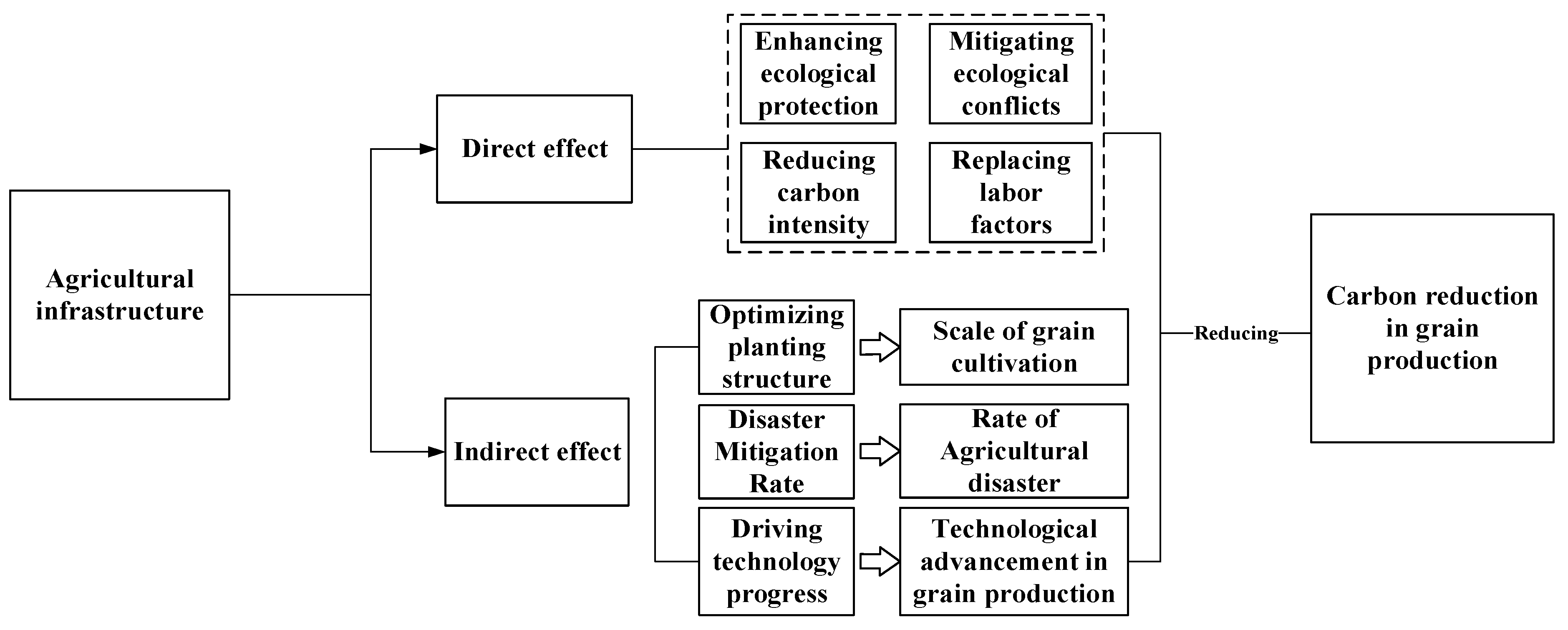
Second, it confirms the scale expansion effect, efficiency enhancement effect, and risk mitigation effect of agricultural infrastructure on carbon emission reduction.
Third, it clarifies different infrastructure types, finding that agricultural water infrastructure has the largest impact, followed by digital infrastructure, with significant contributions from agricultural power infrastructure and rural transportation infrastructure. This ranking can guide prioritization in infrastructure investment.
Fourth, it reveals significant heterogeneity in infrastructure impacts, suggesting that effects vary across regions, functional zones, and crop types, demonstrating the need for tailored infrastructure development to optimize carbon reduction strategies.
The whole study is structured as follows:
Section 2 reviews existing literature and identifies research gaps.
Section 3 shares theoretical analysis and formulates hypotheses.
Section 4 describes the material, method and data used in this study.
Section 5 presents and discusses the empirical results. Finally,
Section 6 concludes with key findings and policy recommendations.
6. Conclusions and Policy Implications
6.1. Conclusions
This study aimed to assess the impact of agricultural infrastructure on carbon reduction in grain production across 30 Chinese provinces from 2009 to 2023. Using two-way fixed-effects model and mediation-effect model, the study evaluated different types of agricultural infrastructure and their effects on carbon reduction in grain production. The main conclusions are as follows:
- (1)
Agricultural infrastructure construction significantly inhibits carbon emissions from grain production. Overall, it markedly reduces the carbon emissions intensity of grain production. However, the magnitude of this negative effect varies by infrastructure type, in the following order: agricultural water infrastructure, digital infrastructure, agricultural power infrastructure, and rural transportation infrastructure. This conclusion remains robust after a series of rigorous tests.
- (2)
Agricultural infrastructure facilitates carbon emission reduction in China’s grain production through three mechanisms: optimizing the planting structure, promoting technological progress, and reducing the disaster incidence rate. Specifically, agricultural water infrastructure and digital infrastructure lower carbon emissions intensity by improving the planting structure and advancing technology, while agricultural water infrastructure and rural transportation infrastructure contribute to emission reduction mainly by lowering the disaster incidence rate.
- (3)
The inhibitory effect of agricultural infrastructure on carbon emissions exhibits significant heterogeneity. In terms of the north–south grain production pattern, agricultural water infrastructure and rural transportation infrastructure play a more prominent role in reducing emissions in the northern region, whereas agricultural water infrastructure and digital infrastructure have stronger inhibitory effects in the southern region. From the perspective of functional zoning, agricultural water infrastructure and agricultural power infrastructure show significant emission reduction effects in major grain-producing areas, while agricultural water infrastructure and digital infrastructure are more effective in non-major grain-producing areas. Regarding crop-specific heterogeneity, compared to corn, agricultural infrastructure construction demonstrates greater effects in rice and wheat.
6.2. Limitations and Future Perspectives
This study contributes to the literature by establishing and empirically testing a unified framework that links agricultural water, rural transportation, agricultural power and digital infrastructure to carbon intensity reduction through the specific, hypothesized channels of scale expansion, efficiency enhancement, and risk mitigation. Furthermore, it provides comprehensive evidence on the differential effects of these infrastructure types across northern/southern regions, grain production zones, and major crop varieties, offering a nuanced basis for policy. However, several limitations qualify the findings. The mediation analysis remains susceptible to endogeneity, and the use of proxy variables for concepts like digital infrastructure and agricultural power, for example, total rural electricity consumption, which may capture non-agricultural use and also directly constitute an emission source, along with the exclusion of emissions from manure management, reflects inherent data constraints. The explanation for regional heterogeneity, while provided, could be further deepened. Building on this, promising research directions include: employing more robust causal identification strategies to validate the mechanisms; utilizing higher-resolution data to improve measurement accuracy; and extending the analysis to assess long-term outcomes and potential rebound effects at the micro level.
6.3. Policy Implications
Based on these findings, this research has found agricultural infrastructure in China must be adapted to local circumstances. Several policy implications emerge:
First, policies for agricultural water infrastructure must be regionally tailored. In northern China and major grain-producing areas, the focus should be on expanding water-saving irrigation systems, such as drip and sprinkler irrigation, supported by modernized canals and smart water-allocation mechanisms. In southern regions and non-major production zones, development should prioritize smart irrigation districts and integrated drainage-irrigation facilities, utilizing automated controls for pumps and sluice gates to enhance resilience against floods and droughts.
Second, a differentiated strategy is needed for deploying digital infrastructure. In southern regions and non-major grain-producing areas, investment should target agricultural IoT networks and intelligent decision-support systems, deploying field sensors and smart irrigation devices for precise resource management. Conversely, in core grain-producing areas, efforts should center on establishing comprehensive big-data platforms for production while scaling up smart agricultural equipment like UAV-based plant-protection systems to optimize inputs and reduce field operations.
Third, the modernization of agricultural power infrastructure should be strategically focused. In major grain-producing areas, priorities include upgrading in-field power grids and promoting photovoltaic-agriculture projects to supply clean energy for farming. In other regions, the emphasis should shift to deploying agricultural clean-energy micro-grids and refining grid-integration protocols for photovoltaic systems, thereby accelerating the national transition to sustainable agricultural power.
Fourth, policies governing rural transportation infrastructure must reflect regional variations in impact. In the north and major grain belts, development should strengthen grain-storage facilities, logistics hubs, and field road networks, alongside integrated cleaning, drying, and storage facilities at production sites. Nationally, integrating existing logistics resources—such as postal and supply chain networks—can reduce energy consumption across the grain circulation system, supporting its low-carbon transformation through optimized logistics and coordinated resource use.