

Next Article in Journal
ACDNet: Adaptive Citrus Detection Network Based on Improved YOLOv8 for Robotic Harvesting
Previous Article in Journal
Revisiting Environmental Sustainability in Ruminants: A Comprehensive Review
Previous Article in Special Issue
Investigating the Impact of Tillering on Yield and Yield-Related Traits in European Rice Cultivars
error_outline You can access the new MDPI.com website here. Explore and share your feedback with us.
 
 
Article

GGE Biplot Analysis for the Assessment and Selection of Bread Wheat Genotypes Under Organic and Low-Input Stress Environments

by
Evangelos Korpetis
1,
Elissavet Ninou
2,
Ioannis Mylonas
1,*,
Dimitrios Katsantonis
1,
Nektaria Tsivelika
1,
Ioannis N. Xynias
3,
Alexios N. Polidoros
4,
Dimitrios Roupakias
4 and
Athanasios G. Mavromatis
4
1
Institute of Plant Breeding and Genetic Resources, Hellenic Agricultural Organization—“Demeter”, 57001 Thessaloniki, Greece
2
Department of Agriculture, International Hellenic University, Sindos, 57400 Thessaloniki, Greece
3
Department of Agriculture, University of Western Macedonia, 53100 Florina, Greece
4
Laboratory of Genetics and Plant Breeding, School of Agriculture, Aristotle University of Thessaloniki, 54124 Thessaloniki, Greece
*
Author to whom correspondence should be addressed.
Agriculture 2026, 16(2), 146; https://doi.org/10.3390/agriculture16020146
Submission received: 8 December 2025 / Revised: 4 January 2026 / Accepted: 5 January 2026 / Published: 7 January 2026

Abstract

Bread wheat variety development suited to organic farming conditions remains a major challenge mainly because of the high breeding costs involved and the few cultivars adapted to low-input systems. The present work explores whether early generation selection needs to take place under organic conditions for subsequent adaptation or whether conventional testing at an early stage could be adequate. A diverse set of crosses involving Greek landraces and commercial cultivars were developed and advanced by honeycomb pedigree selection under both organic and conventional environments. Subsequently, F4 progenies and an upgraded landrace were evaluated over two years in neighboring organic and conventional trials. Both statistical and GGE biplot analyses revealed significant genotype × environment interactions. The results clearly indicate that early selection under organic conditions did not provide a consistent advantage for subsequent performance under organic management compared with conventional early selection. Genotypes derived from the Africa × Atheras cross consistently showed the highest and most stable yields across the two environments, irrespective of the early selection environment. These results indicate that genetic background and landrace-derived diversity are more important than the early selection environment for the expression of performance. A staged breeding strategy involving initial selection in conventional management followed by multi-environment testing in organic conditions can provide a cost-effective approach to developing resilient, high-yielding wheat cultivars suitable for organic farming systems, which are typically characterized by low-input management practices, and in tune with the EU targets for expanded organic farming.

1. Introduction

Bread wheat (Triticum aestivum L.) is one of the most important crops worldwide, as it feeds around 40% of the global population [1]. It is characterized by high nutritional value, with starch and protein levels being superior to those of other cereals, such as maize or rice [2]. Bread wheat represents the vast majority of wheat production (about 95%), whereas durum wheat comprises only about 5% [3,4]. Despite its importance, global wheat production is expected to decrease, due to climate change and abiotic stresses [2]. To address these challenges, many researchers have turned their attention to targeted breeding programs for organic and/or low-input farming systems. In Europe, wheat has been subjected to such programs for more than 20 years, allowing the evaluation and comparison of genotypes under organic and/or low-input versus conventional management [5].
In recent decades, there has been a substantial expansion of organic agriculture worldwide. Within the European Union, a target has been set to cultivate 25% of agricultural land under organic management by 2030; however, as of 2021, organically managed land accounted for less than 10% of total agricultural area [6]. The long-term viability of organic farming systems depends largely on their productivity, economic sustainability and ability to meet consumer expectations for environmentally friendly and health-conscious food production.
Currently, more than 95% of the varieties—including wheat—grown in organic farming systems were originally developed for conventional, high-input agriculture [7]. Only a limited number of varieties have been specifically evaluated or selected under organic or low-input conditions and their breeding was conducted, either exclusively in organic environments, or for economic reasons the early selection steps were conducted under conventional conditions [8]. Generally, the lack of wheat varieties suitable for organic cultivation is recognized as one of the main obstacles for successful organic production. Many researchers propose the implementation of breeding strategies specifically designed for organic agriculture from the first steps of selection [9], aiming to develop new types of varieties better adapted to the unique conditions of organic farming systems, which typically operate under low-input conditions.
At the same time, wheat breeding faces today the challenge of genetic erosion, caused by decades of selection within a relatively narrow genetic base [10]. Wheat landraces and traditional germplasm collections represent valuable reservoirs of genetic diversity, offering traits associated with stress tolerance, yield stability and local adaptation. The incorporation of landrace-derived diversity into breeding programs has therefore gained increasing attention, particularly in the context of sustainable and low-input agricultural systems [11,12,13,14].
Breeding for organic agriculture aims to develop varieties specifically adapted to organic farming systems [15]. However, the performance of such systems is strongly influenced by soil fertility and climatic conditions, to a much greater extent than in conventional farming systems [12]. Consequently, varieties derived from breeding programs for organic agriculture may not perform uniformly across all organic environments. Proper utilization of genotype-by-environment interaction (G × E) analysis can lead to significant progress in crop improvement [16]. The G × E interaction affects how genotypes respond to environmental variation, making it challenging to identify superior genotypes. This phenomenon, referred to as the crossover concept, complicates the selection process. Therefore, the main goal is to identify a genotype that consistently yields high and stable results across diverse environments, which can then be recommended as a superior and highly adaptable choice [17,18].
Numerous statistical tools have been developed to address the challenges of crop stability and G × E interactions. Among these, the GGE biplot method graphically illustrates both the average yield performance and the stability parameters so that detailed evaluations of the G × E interactions can be conducted. This approach places great emphasis on two aspects: the genotype effects, G, and G × E, and it does so in a manner that effectively filters out the noise created by the main E effect. Through the use of scores from the principal component analysis, the GGE biplot graphically displays the performance of the genotypes. A genotype that is closer to the performance line is considered more stable than one that is farther away from the line. The distance of a genotype from the so-called “ideal genotype”—the genotype which occupies the center in the biplot—is also estimated by the model [19,20].
Organic agriculture is based on the concept of working with nature and not against it [21]. However, compared to conventional farming, organic farming generally achieves lower productivity. Today, varieties adapted to high-input conditions are frequently grown in organic farming systems [22], resulting in suboptimal performance under organic or low-input management. Although wheat breeding objectives—like yield, resistance to biotic and abiotic stresses and breadmaking ability—overlap between conventional and organic farming, programs for organic agriculture should also target traits such as efficient nutrient uptake, competitive root system, weed suppression, and pest/disease resilience. Integrating such traits into high-yielding varieties, will enable organic agriculture to reach its full potential as a sustainable alternative to conventional agriculture [7,8,22].
Thus, the fundamental question arises whether bread wheat varieties developed under conventional management are suitable for organic farming conditions, or whether the environment used during early-generation selection affects the subsequent performance and adaptability of advanced progenies under organic and conventional management systems. The purpose of this study is to address this question and to clarify the role of early-generation selection environments in developing bread wheat varieties with high productivity, adaptability and resilience for organic farming and/or low-input systems. By combining landrace-derived diversity with commercial cultivars and applying multi-environment field testing and GGE biplot analysis, this study aims to provide insights into effective and cost-efficient breeding strategies for organic and/or low input wheat production systems.

2. Materials and Methods

2.1. Genetic Material

2.1.1. Starting Genetic Material

To develop new bread wheat varieties, combining high yield potential with superior quality traits, specifically adapted to organic and/or low-input farming systems, a diverse genetic base was used. Local landraces and commercial cultivars served as primary sources of genetic variability. The commercial cultivars were genetically fixed varieties. Landraces are a mixture of pure lines with many commons morphological characteristics, shaped by long-term farmer selection and local adaptation, since wheat is a predominantly autogamous species, with a self-pollination rate exceeding 99%. Ten local landraces originating from various regions of Greece were evaluated to broaden the genetic base and enhance the possibility of introducing novel allelic combinations (Table 1).

2.1.2. Parent Evaluation

An evaluation trial was established using a Randomized Complete Block Design (RCBD) during the 2013–2014 growing season at two locations. Parent selection followed a classical approach, based on phenotypic complementarity for key agronomic and grain quality traits, as well as eco-geographical diversity to maximize genetic variability. Four local Greek landraces were selected: “Atheras Kerkiras 185,” “Zoulitsa Arkadias,” “Mavragani Aetoloakarnanias,” and “Xilokastro Lamias” [23].
These landraces, together with four commercial bread wheat cultivars (“Yecora E”, “Accor”, “Panifor”, and “Africa”), constituted the genetic material for subsequent experimentation during the 2014–2015 growing season. To evaluate their performance under different cropping systems (conventional, organic, low-input), an RCBD experiment was established [23].

2.1.3. Crosses

Crosses between landraces and commercial cultivars were conducted in spring 2015. Ten random vigorous parent plants exhibiting desirable traits at flowering stage were selected from each commercial cultivar as pollen donors (male), while ten plants from each landrace with similar criteria (growth, biomass, tiller number, spike size and number) were designated as female. Reciprocal crosses were also performed, with landraces serving as pollen donors and commercial cultivars as female parents. No crosses were made within the same group (landrace × landrace or cultivar × cultivar). All possible combinations between the two groups were conducted (Table 2).

2.1.4. Advancement and Early Evaluation of Segregating Generations (F1–F3)

From the 32 crosses, 11 produced sufficient seed quantities for further evaluation. The F1 genotypes from these crosses were evaluated in a complete randomized design under both conventional and organic environments (2015–2016).
Seven F2 segregating populations—derived from the most promising F1 genotypes—showing optimal yield and agronomic performance—along with five upgraded landraces, were evaluated in an R-13 honeycomb design, as described by Fasoulas and Fasoula [24], under conventional and organic conditions (2016–2017). The upgraded landraces were previously selected using a honeycomb pedigree method within and between local bread wheat landraces during 2014–2015 [25].
Based on yield and agronomic performance, five F3 populations and one upgraded landrace were selected and evaluated in an R-7 honeycomb design, as described by Fasoulas and Fasoula [24], under both conventional and organic management systems (2017–2018).
During the multi-year evaluation and selection process, seeds harvested from organic plots were consistently sown in organic environment and likewise seeds from conventional plots, were sown in conventional environments, ensuring system-specific adaptation.

2.1.5. Advanced Generation Evaluation (F4–F5) and Development of Upgraded Landraces

For the continuation of the breeding program, three superior for yield and agronomic performance F4 populations—derived from the crosses “Africa × Atheras”, “Atheras × Africa” and “Atheras × Accor” were selected. In parallel, one upgraded bread wheat landrace was included.
Selection for both F4 populations and upgraded landrace was conducted under either organic (O) or conventional (C) growing conditions, as described in the earlier experimental stages. Upgraded landraces represent a mixture of high productivity pure lines improved through selection under honeycomb design in previous experimentation, whereas F4 progenies represent partially inbred lines; these materials were evaluated together to compare responses of different genetic entities under contrasting management systems. These selected materials were used for evaluation in the present study. Also, the commercial cultivar ‘Yecora E’ was included as a genetically fixed control variety.

2.2. Evaluated Traits and Environmental Conditions

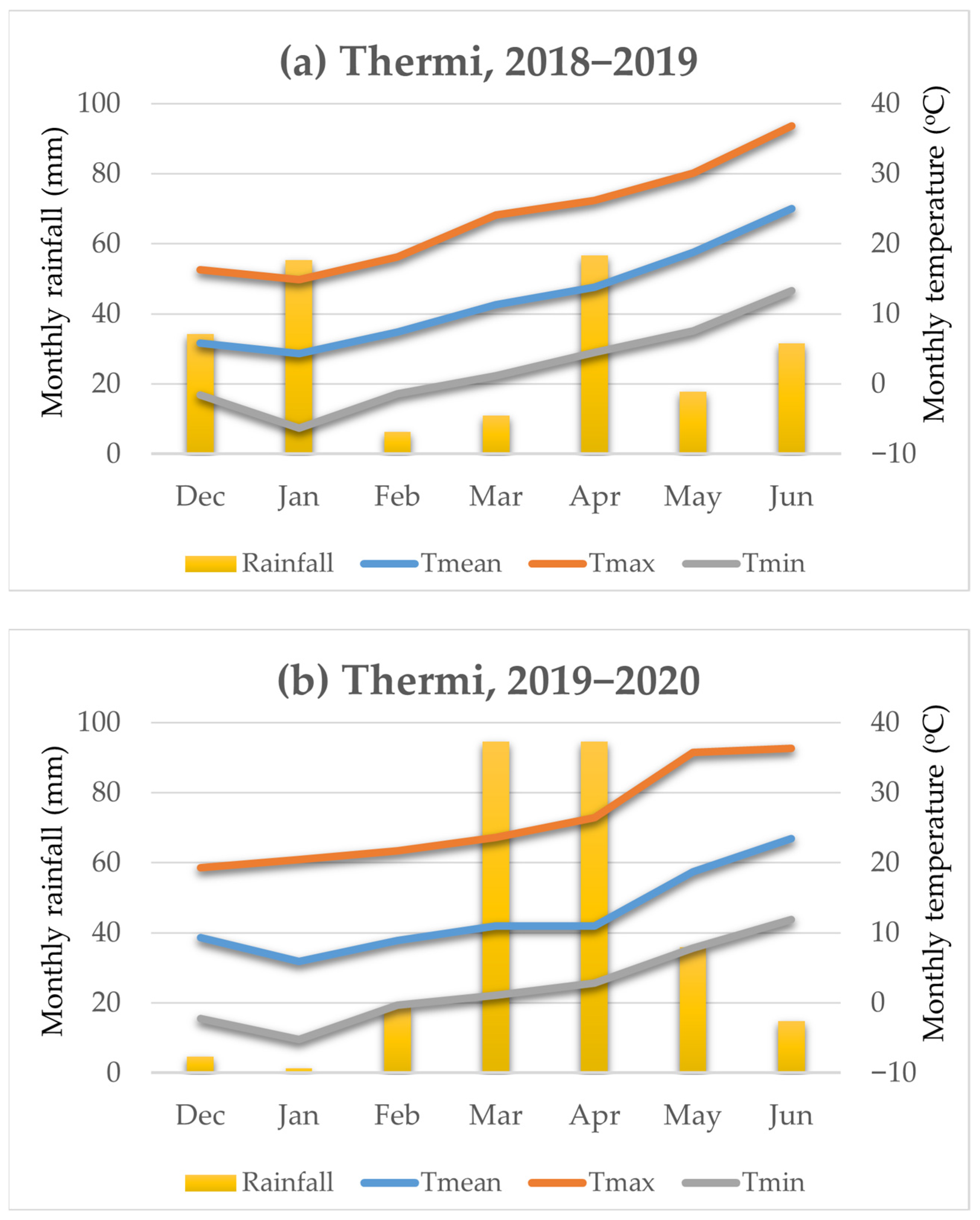
Field trials were conducted during the 2018–2019 and 2019–2020 growing seasons under organic and conventional management using a randomized complete block design with four replications. Each experimental plot consisted of six rows, each 2 m long, with a row spacing of 0.25 m, resulting in a total plot area of 3 m2. The experiments took place at the Institute of Plant Breeding and Genetic Resources (IPBGR) farm in the area of Thermi Thessaloniki (40°54′ N, 23°00′ E) in two environments, conventional and organic (Table 3 and Table 4, Figure 1). All experiments were sown in mid-November, and the harvest took place at the end of June. Grain yield was evaluated and expressed in tons per hectare (t ha−1).
In order to evaluate the behavior of the selected genotypes under different cropping systems (conventional, organic), the experimental fields were established in neighboring areas with similar soil fertility status [26], while the management inputs were different (Table 3 and Table 4, Figure 1).

2.3. Statistical Analysis

SPSS software package (ver. 18. SPSS Inc., Chicago, IL, USA) was used to perform one factor analysis of variance (ANOVA), with genotype as the fixed factor, of the experiments conducted: (1) during the 2018–2019 cultivation period and (2) during the 2019–2020 cultivation period. Similarly, SPSS software package (ver. 18. SPSS Inc., Chicago, IL, USA) was used for the over-location one-factor (Genotypes) analysis of variance (ANOVA) of the experiments. The normality of the variables was assessed using the Shapiro–Wilk test, while Levene’s test was applied to verify the homogeneity of variances prior to ANOVA. The significance level of all hypotheses tested was pre-set at p ≤ 0.05, using Tukey’s test.
To determine mean performance in combination with stability across environments, a genotype and genotype × environment (GGE) biplot analysis [19,20] was done, with normalized data using Genstat (13) [27]. This model measures the distance of each genotype from the “ideal genotype”, i.e., the virtual genotype that has the best combination of mean performance and stability.

3. Results

The analysis of variance (ANOVA) for grain yield revealed statistically significant differences among genotypes (p ≤ 0.01) in both growing seasons in the conventional environment, while in the organic environment significant differences were observed only in the first growing season (2018–2019) (Table 5).
In the first season for conventional environment, the genotype X2 produced the highest grain yield, differing statistically significantly from the genotypes X3, X4 and the commercial control cultivar X9. In the second growing season, X9 yielded the highest, with X2 and X3 not differing statistically significantly from it. In the organic environment, no significant differences were detected among the selected genotypes for both growing seasons (Table 5).
The analysis for grain yield showed statistically significant differences between genotypes (p ≤ 0.01) and between cultivation environments (p ≤ 0.01), as well as a significant G × E interaction for both growing seasons (Table 6).
In the 2018–2019 growing season, genotype X5—grown and selected in a conventional environment in the early-stages of selection—had the highest grain yield, outperforming significantly genotype X3—grown and selected in an organic environment in the early-stages of selection—and genotype X9. The rest genotypes did not differ statistically significantly from each other. In 2019–2020, genotype X3 ranked first, differing statistically significantly only from the local landrace Zoulitsa, whether it came from cultivation in a conventional (X8) or in an organic environment (X4) in the early-stages of selection. The change in the ranking of the genotypes in grain yield reflects differences in environmental conditions between years. Thus, the local landrace Zoulitsa (X4, X8) had excellent behavior in the first growing season, when it had more time to fill its grains, while the early commercial variety Yecora E (X9) behaved in the opposite way, filling the grains better in the second growing season and yielding higher in grain. The rest genotypes show stability in grain yield, not statistically significantly different from those with the highest grain yield. Variations in the ranking of genotypes in the two environments, conventional and organic, for each growing season are caused by the dynamic nature of the genotype × environment interaction.
Additionally, the grain yield analysis demonstrated significant differences only in the genotype × year interaction in the conventional environment and between growing seasons in the organic environment (Table 6). The genotype X2 derived from an organic environment was first in the Tukey ranking for grain yield in the conventional environment and it was statistically significantly different from the genotype X1 and the local landrace Zoulitsa (X4, X8). In the organic environment, the genotype X1 excelled in grain yield and differed statistically significantly from the genotype X2 and the landrace Zoulitsa (X4, X8). According to ANOVA, any significant differences observed between genotypes are due to the effect of each year’s weather conditions on the cultivation of the genotypes.
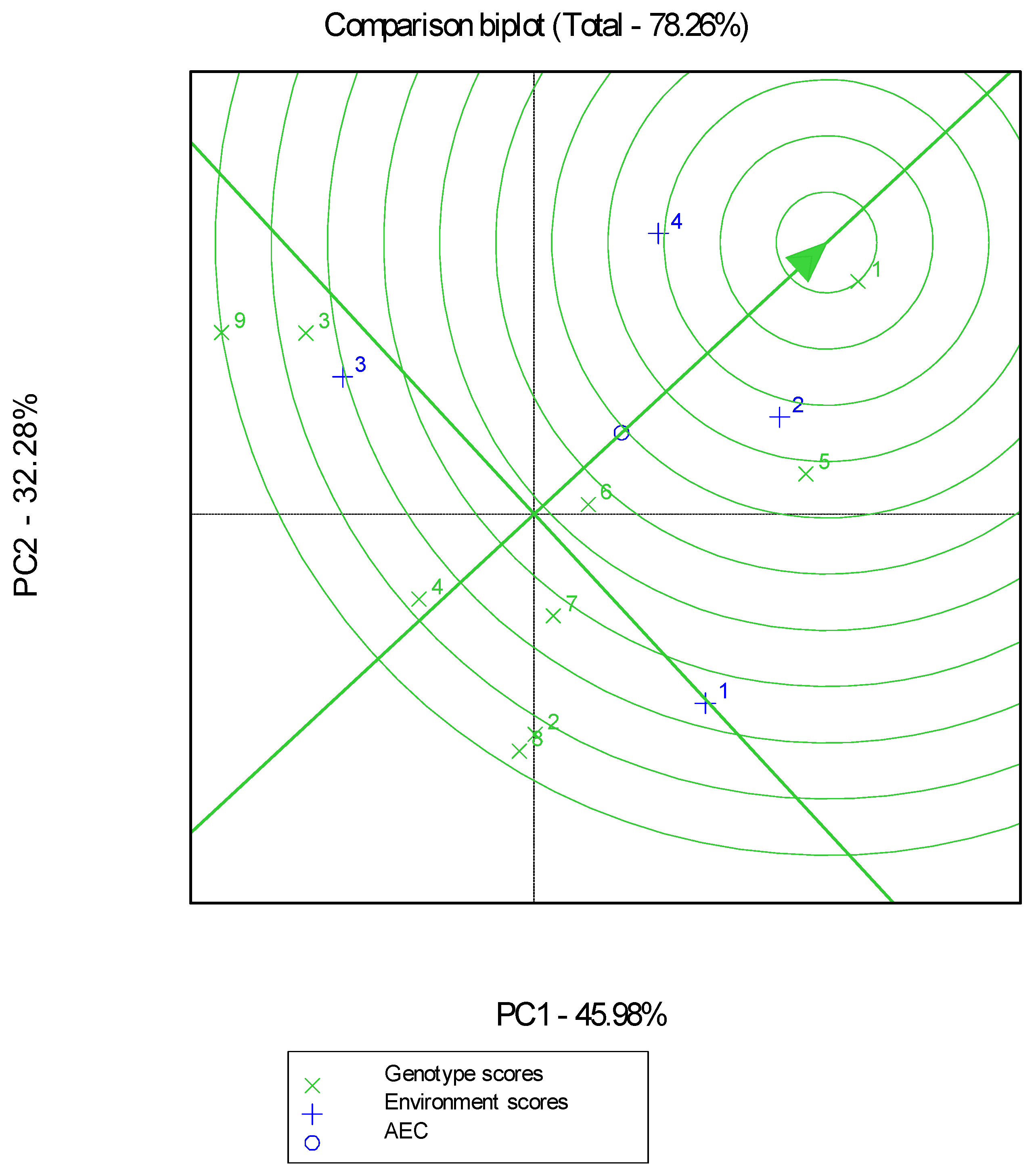
In a GGE biplot, the ideal genotype is usually shown near the center of the concentric circles. It represents a hypothetical genotype that combines the highest average performance with strong stability across environments. The analysis evaluates how far each genotype lies from this ideal point. Genotypes closer to the center are regarded as more desirable due to their balanced performance and stability. The genotype X1 was found to be closest to the “ideal genotype” point in terms of performance and stability across all environment, as demonstrated by the GGE biplot analysis, which also explained 78.26% of the total variability (Figure 2). Despite being selected in an organic environment during the early-stages of selection, genotype X1 exhibits excellent behavior in both environments during the first growing season (2.5 t ha−1 in the conventional and 2.3 t ha−1 in the organic), and in the second growing season, it yields the highest amount in the organic environment (4.2 t ha−1) (Table 5).
The genotype X1 was followed by genotype X5 (Figure 2)—which comes from the same cross as genotype X1 but was selected in a conventional setting until the F4 generation—based on the GGE biplot analysis for yield and stability. In terms of performance and stability across all environments, it seems that the Africa × Atheras cross selections, either the initial generations picked in an organic environment (X1) or a conventional environment (X5), are closer to the “ideal genotype” point.
The genotypes X6 and X7—selected in a conventional environment during the early-stages of selection—performed very well in the conventional environment during the first growing season and in the organic for both seasons follow the ranking according to GGE biplot analysis.
It is observed that it does not matter in which environment the first three generations were selected, since genotypes selected either in an organic environment (X1) or in a conventional one (X5) behave excellently in both environments.

4. Discussion

Plant breeding programs aim at clearly defining the objectives, creating and exploiting genetic variability, and eventually identifying superior genotypes for commercial use [28,29,30,31]. The present study directly addressed whether early selection of segregating material under organic versus conventional management constrains the subsequent performance and adaptability of advanced lines in both systems. Our results indicate that this is not the case, as several progenies—particularly those derived from the Africa × Atheras cross—expressed satisfactory productivity and stability in both organic and conventional environments, regardless of the environment in which the first generations were selected. These findings suggest that genetic background and parental choice exert a stronger influence on adaptability and performance than the management system applied during the initial selection.
Although the Green Revolution significantly increased wheat productivity, it relied on a relatively narrow genetic base [9,10,32], which has been associated with reduced adaptive capacity to environmental stresses and climate change [33,34]. In this context, traditional wheat landraces constitute a valuable reservoir of genetic diversity, providing traits related to stress tolerance, yield stability and local adaptation [23,35,36,37,38,39]. The favorable and stable performance of genotypes derived from landrace-cultivar crosses in the present study supports previous reports emphasizing the importance of landrace-derived diversity for breeding resilient cultivars under organic and low-input systems [23,40,41].
Parental choice is a decisive factor for generating useful segregation in subsequent generations [28]. Accordingly, the starting material used in this study was selected based on previously documented yield and grain quality characteristics. In line with earlier observations that historical breeding for yield frequently resulted in reduced protein concentration and altered quality profiles [42], crosses between high-yielding and high-protein parents are particularly attractive [43]. We assembled commercial cultivars from Western Europe and Greece along with bread wheat landraces of different Greek regions to ensure a broad genetic background. The landraces contributed local adaptation and stress tolerance, whereas the commercial cultivars provided high yield potential and acceptable quality. Through two-way crosses between these groups, the F1 genotypes were generated. We used the honeycomb pedigree method to advance and select our genotypes in both conventional and organic conditions. This approach aligns with recent trends toward participatory and evolutionary breeding strategies, including farmer-led selection, population mixtures, and heterogeneous materials, aimed at enhancing genetic diversity and resilience as described by Baresel et al. [44] and Vindras-Fouillet et al. [45].
Three F4 progenies from the crosses “Africa × Atheras”, “Atheras × Africa” and “Atheras × Accor”, along with an upgraded version of the landrace “Zoulitsa”, each represented by lines previously selected either in conventional or organic conditions, were evaluated during the present evaluation phase. This design allowed us to examine separately the effects of genetic background and selection environment on subsequent performance.
In the organic environment, no statistically significant differences among genotypes were detected in either growing season, although the high coefficient of variation in the second year suggests limited power to separate genotypes despite numerical differences. In the conventional environment, significant genotypic differences for grain yield were detected in both seasons. Over environments, evaluation ranked genotype Χ5 first in the first year, whereas Χ3 ranked first in the second year. The shifts in genotype ranking are consistent with the significant genotype × year interaction and the pronounced differences in seasonal rainfall patterns between years. During the first growing season, higher rainfall during winter and reduced precipitation during the later developmental stages favored late-maturing genotypes with longer grain-filling periods, such as the local landrace “Zoulitsa”. In contrast, increased spring rainfall during the second growing season benefitted early-maturing cultivars such as “Yecora E”, leading to higher grain yield. This response pattern illustrates how rainfall timing, rather than total precipitation alone, plays a decisive role in shaping genotype performance under both organic and conventional management. Similar multi-environment trials have revealed substantial G × E interactions in wheat or other cereals for yield, protein content and disease resistance, underscoring the need for diverse testing environments in both organic and conventional systems [17,46,47,48,49].
While multi-environment testing is essential when the aim is to select genotypes combining high mean yield with stability, given the well-documented importance of G × E interactions for wheat productivity [50], the dynamic nature of G × E interactions implies that the relative performance of the genotypes changes across environments, complicating the identification of broadly superior materials [51]. In this study, combined analyses over environments and years revealed significant G × E effects and, under conventional management, genotype × year interactions. GGE biplot analysis, which captures genotype main effects plus G × E interaction in a single display [17,46,47,52,53], provided additional insight. The biplots clearly highlighted the progenies of the “Africa × Atheras” cross (X1 and X5) as exhibiting a favourable combination of high mean yield and stability across both organic and conventional trials, placing them close to the hypothetical “ideal genotype” point. Importantly, this pattern was observed irrespective of whether these lines had been selected in earlier generations under organic (X1) or conventional (X5) conditions, indicating that early selection environment did not restrict subsequent adaptability.
The behavior of the other crosses corroborates this conclusion. Within each pair of lines derived from the same cross but selected in different environments (X2 vs. X6, X3 vs. X7, X4 vs. X8), differences in grain yield were modest and rarely consistent across environments, and they were often not statistically significant in the combined analyses. Although some lines showed particular strengths in specific environments, there was no general pattern indicating that early selection under organic conditions systematically improves later performance in organic trials, nor that selection under conventional conditions compromises adaptation to organic management or other low-input production systems.
These findings are particularly relevant in light of current agricultural policy and market trends. The European Union has pledged that at least 25% of agricultural land will be under organic farming by 2030 [54], while consumer demand for environmentally friendly and health-oriented production systems continues to increase. Despite this, the availability of varieties specifically bred for organic systems remains limited, and organic farmers frequently rely on cultivars developed under conventional high-input conditions. Strategies that improve nitrogen-use efficiency and focus on cultivars with improved protein composition rather than just higher protein concentration can meet organic standards with less reliance on fertilizers [55]. Breeding programs exploiting local landraces and diverse germplasm and using efficient selection schemes, as described above, and genomic tools can help this transition by providing cultivars combining yield stability, quality, and environmental resilience [23,41,56].
Beyond the specific genotypes identified, the present study has methodological implications for breeding strategies targeting organic systems, typically characterized by low-input management practices. Breeding for organic agriculture is substantially more expensive and logistically demanding than breeding for conventional agriculture, partly due to the limited availability of organically managed fields and the challenges of weed management without the use of herbicides. Our results support a staged breeding strategy in which the early generations are first evaluated under conventional management, using low seeding densities and potentially interspersed weed competition to mimic key aspects of organic cropping, before advancing the most promising genotypes to strictly organic evaluations. Because the performance of advanced lines did not depend on whether early selection took place under organic or conventional management, this approach can reduce breeding costs without compromising the identification of genotypes well adapted to organic systems. This aligns with recent proposals for participatory, decentralised selection schemes that combine farmer involvement with modern genomic tools to accelerate wheat breeding for organic agriculture while maintaining broad adaptation [57,58].
The present study also has limitations that should be acknowledged. The experimental evaluation covered two growing seasons and a limited set of environments within a single region. While this was adequate to catch major G × E patterns and to identify genotypes of particular promise, a wider test across more locations, soil types and climate zones would be preferable before the recommendation of cultivars for general release. In addition, our study focused principally on grain yield; other characteristics of relevance to organic or other low-input systems—such as weed suppressive ability, disease resistance profiles, nutrient-use efficiency and end-use quality attributes—merit further examination in the most promising lines [23,35,36,37,38,39,42,43], preferably within participatory networks that engage farmers directly in the evaluation process [44,45].
Overall, the integration of traditional landraces and modern cultivars in a specific crossing and selection plan gave rise to wheat progenies that were able to perform well under both organic and conventional managements. The results indicate that, under the conditions studied, early selection environment does not impose a major constraint on the later adaptability of advanced lines. Instead, the choice of parental combinations, the exploitation of landrace diversity and the careful management of G × E interactions appear to be the primary drivers of performance and stability [28,33,34,36,37,38,39,46,47,50,51,52,53,54]. These findings support the development of flexible, cost-effective breeding pipelines that use conventional environments for early selection while reserving scarce organic resources for advanced multi-environment testing, in line with emerging evidence from landrace-based, participatory and genomic-assisted breeding programs [40,56,59,60].

5. Conclusions

This study evaluated whether the environment used during early-generation selection influences the subsequent performance of bread wheat progenies under organic and conventional management. The results showed that progenies derived from the same crosses performed similarly across environments, regardless of whether early selection occurred under organic or conventional conditions.
In addition, G × E interactions proved essential for understanding the genotype performance in field environment, under different input systems. Such multi-environment trials under organic conditions are indispensable at advanced stages of selection, enabling the identification of wheat genotypes that combine high yield with stability across environments.
It should be acknowledged that the present study was conducted over two growing seasons within a single agroecological region. While the observed patterns were consistent across years and management systems, the proposed breeding strategy should be further validated across additional locations, years and agroecological zones before broader generalization or cultivar release recommendations.
Overall, this study demonstrates that combined selection strategy—utilizing conventional environments for early generation selection and organic systems for advanced multi-environment evaluation—represents a robust and cost-effective pathway for the development of resilient, high-performing bread wheat varieties suitable for organic agricultural systems. Further validation across additional environments is required before broader generalization.

Author Contributions

Conceptualization, E.K., E.N., I.M., D.R. and A.G.M.; methodology, E.K., E.N., I.M., N.T., A.N.P. and A.G.M.; validation, E.K. and I.M.; investigation, E.K., E.N. and A.G.M.; resources, E.K. and A.G.M.; data curation, E.K., E.N., I.M., D.K., I.N.X., A.N.P., D.R. and A.G.M.; writing—original draft preparation, E.K., E.N., I.M., D.K., N.T., I.N.X., A.N.P., D.R. and A.G.M.; writing—review and editing, E.K., E.N., I.M., D.K., N.T., I.N.X., A.N.P., D.R. and A.G.M.; supervision, E.K., I.M., A.N.P., D.R. and A.G.M.; project administration, E.K., E.N., I.M. and A.G.M. All authors have read and agreed to the published version of the manuscript.

Funding

This research received no external funding.

Data Availability Statement

Data is contained within the article. The data presented in this study are available in the article.

Conflicts of Interest

The authors declare no conflicts of interest.

References

  1. Zhao, L.; Zheng, Y.; Wang, Y.; Wang, S.; Wang, T.; Wang, C.; Chen, Y.; Zhang, K.; Zhang, N.; Dong, Z.; et al. A HST1-like Gene Controls Tiller Angle through Regulating Endogenous Auxin in Common Wheat. Plant Biotechnol. J. 2023, 21, 122–135. [Google Scholar] [CrossRef]
  2. Christian, M.M.; Shimelis, H.; Laing, M.D.; Tsilo, T.J.; Mathew, I. Breeding for Silicon-Use Efficiency, Protein Content and Drought Tolerance in Bread Wheat (Triticum aestivum L.): A Review. Acta Agric. Scand. Sect. B—Soil Plant Sci. 2022, 72, 17–29. [Google Scholar] [CrossRef]
  3. Peng, J.H.; Sun, D.; Nevo, E. Domestication Evolution, Genetics and Genomics in Wheat. Mol. Breed. 2011, 28, 281–301. [Google Scholar] [CrossRef]
  4. Beres, B.L.; Rahmani, E.; Clarke, J.M.; Grassini, P.; Pozniak, C.J.; Geddes, C.M.; Porker, K.D.; May, W.E.; Ransom, J.K. A Systematic Review of Durum Wheat: Enhancing Production Systems by Exploring Genotype, Environment, and Management (G × E × M) Synergies. Front. Plant Sci. 2020, 11, 568657. [Google Scholar] [CrossRef]
  5. Rempelos, L.; Wang, J.; Sufar, E.K.; Almuayrifi, M.S.B.; Knutt, D.; Leifert, H.; Leifert, A.; Wilkinson, A.; Shotton, P.; Hasanaliyeva, G.; et al. Breeding Bread-Making Wheat Varieties for Organic Farming Systems: The Need to Target Productivity, Robustness, Resource Use Efficiency and Grain Quality Traits. Foods 2023, 12, 1209. [Google Scholar] [CrossRef]
  6. OECD-FAO. OECD-FAO Agricultural Outlook 2022–2031; OECD Publishing: Paris, France; FAO: Rome, Italy, 2022. [Google Scholar] [CrossRef]
  7. Lammerts van Bueren, E.T.; Jones, S.S.; Tamm, L.; Murphy, K.M.; Myers, J.R.; Leifert, C.; Messmer, M.M. The Need to Breed Crop Varieties Suitable for Organic Farming, Using Wheat, Tomato and Broccoli as Examples: A Review. NJAS—Wagening. J. Life Sci. 2011, 58, 193–205. [Google Scholar] [CrossRef]
  8. Wolfe, M.S.; Baresel, J.P.; Desclaux, D.; Goldringer, I.; Hoad, S.; Kovacs, G.; Löschenberger, F.; Miedaner, T.; Østergård, H.; Lammerts van Bueren, E.T. Developments in Breeding Cereals for Organic Agriculture. Euphytica 2008, 163, 323–346. [Google Scholar] [CrossRef]
  9. Asif, M.; Yang, R.-C.; Navabi, A.; Iqbal, M.; Kamran, A.; Lara, E.P.; Randhawa, H.; Pozniak, C.; Spaner, D. Mapping QTL, Selection Differentials, and the Effect of Rht-B1 under Organic and Conventionally Managed Systems in the Attila × CDC Go Spring Wheat Mapping Population. Crop Sci. 2015, 55, 1129–1142. [Google Scholar] [CrossRef]
  10. Newton, A.C.; Akar, T.; Baresel, J.P.; Bebeli, P.J.; Bettencourt, E.; Bladenopoulos, K.V.; Czembor, J.H.; Fasoula, D.A.; Katsiotis, A.; Koutis, K.; et al. Cereal Landraces for Sustainable Agriculture. A Review. Agron. Sustain. Dev. 2010, 30, 237–269. [Google Scholar] [CrossRef]
  11. Bladenopoulos, K.V.; Ninou, E.G.; Tsochatzis, E.D.; Mylonas, I.G. Organic Breeding and Cultivation of Barley. Effects on Physical and Chemical Properties. In Barley; Nova Science Publishers, Inc.: Hauppauge, NY, USA, 2014; pp. 1–20. ISBN 978-1-62948-904-9. [Google Scholar]
  12. Lopes, M.S.; El-Basyoni, I.; Baenziger, P.S.; Singh, S.; Royo, C.; Ozbek, K.; Aktas, H.; Ozer, E.; Ozdemir, F.; Manickavelu, A.; et al. Exploiting Genetic Diversity from Landraces in Wheat Breeding for Adaptation to Climate Change. J. Exp. Bot. 2015, 66, 3477–3486. [Google Scholar] [CrossRef]
  13. Zuev, E.V.; Lebedeva, T.V.; Yakovleva, O.V.; Kolesova, M.A.; Brykova, A.N.; Lysenko, N.S.; Tyryshkin, L.G. Genetic Diversity for Effective Resistance in Wheat Landraces from Ethiopia and Eritrea to Fungal Diseases and Toxic Aluminum Ions. Plants 2024, 13, 1166. [Google Scholar] [CrossRef]
  14. Kokhmetova, A.; Bolatbekova, A.; Zeleneva, Y.; Malysheva, A.; Bastaubayeva, S.; Bakhytuly, K.; Dutbayev, Y.; Tsygankov, V. Identification of Wheat Septoria tritici Resistance Genes in Wheat Germplasm Using Molecular Markers. Plants 2024, 13, 1113. [Google Scholar] [CrossRef]
  15. IFOAM. The IFOAM Norms. Available online: https://www.ifoam.bio/our-work/how/standards-certification/organic-guarantee-system/ifoam-norms (accessed on 20 May 2024).
  16. Crespo-Herrera, L.A.; Garkava-Gustavsson, L.; Åhman, I. A Systematic Review of Rye (Secale cereale L.) as a Source of Resistance to Pathogens and Pests in Wheat (Triticum aestivum L.). Hereditas 2017, 154, 14. [Google Scholar] [CrossRef]
  17. Ninou, E.; Tsivelika, N.; Sistanis, I.; Katsenios, N.; Korpetis, E.; Vazaneli, E.; Papathanasiou, F.; Didos, S.; Argiriou, A.; Mylonas, I. Assessment of Durum Wheat Cultivars’ Adaptability to Mediterranean Environments Using G × E Interaction Analysis. Agronomy 2024, 14, 102. [Google Scholar] [CrossRef]
  18. Li, W.; Yan, Z.-H.; Wei, Y.-M.; Lan, X.-J.; Zheng, Y.-L. Evaluation of Genotype × Environment Interactions in Chinese Spring Wheat by the AMMI Model, Correlation and Path Analysis. J. Agron. Crop Sci. 2006, 192, 221–227. [Google Scholar] [CrossRef]
  19. Yan, W. GGEbiplot—A Windows Application for Graphical Analysis of Multienvironment Trial Data and Other Types of Two-Way Data. Agron. J. 2001, 93, 1111–1118. [Google Scholar] [CrossRef]
  20. Yan, W. Singular-Value Partitioning in Biplot Analysis of Multienvironment Trial Data. Agron. J. 2002, 94, 990–996. [Google Scholar] [CrossRef]
  21. Andersen, M.M.; Landes, X.; Xiang, W.; Anyshchenko, A.; Falhof, J.; Østerberg, J.T.; Olsen, L.I.; Edenbrandt, A.K.; Vedel, S.E.; Thorsen, B.J.; et al. Feasibility of New Breeding Techniques for Organic Farming. Trends Plant Sci. 2015, 20, 426–434. [Google Scholar] [CrossRef]
  22. Murphy, K.M.; Campbell, K.G.; Lyon, S.R.; Jones, S.S. Evidence of Varietal Adaptation to Organic Farming Systems. Field Crop. Res. 2007, 102, 172–177. [Google Scholar] [CrossRef]
  23. Korpetis, E.; Ninou, E.; Mylonas, I.; Ouzounidou, G.; Xynias, I.N.; Mavromatis, A.G. Bread Wheat Landraces Adaptability to Low-Input Agriculture. Plants 2023, 12, 2561. [Google Scholar] [CrossRef]
  24. Fasoulas, A.C.; Fasoula, V.A. Honeycomb selection designs. Plant Breed. Rev. 1995, 13, 87–139. [Google Scholar]
  25. Ninou, E.; Korpetis, E.; Cook, K.M. Evaluation of the phytodiversity of local landraces of the genus Triticum using morphological indicators based on the Regulation of the Community Plant Variety Office (CPVO). In Proceedings of the 14th Panhellenic Scientific Conference of the Hellenic Botanical Society; Hellenic Botanical Society: Patras, Greece, 2016; p. 16. (In Greek) [Google Scholar]
  26. Kirchmann, H.; Kätterer, T.; Bergström, L.; Börjesson, G.; Bolinder, M. Flaws and Criteria for Design and Evaluation of Comparative Organic and Conventional Cropping Systems. Field Crop. Res. 2016, 186, 99–106. [Google Scholar] [CrossRef]
  27. Payne, R. GenStat. WIREs Comput. Stat. 2009, 1, 255–258. [Google Scholar] [CrossRef]
  28. Baenziger, P.S.; Russell, W.K.; Graef, G.L.; Campbell, B.T. Improving Lives: 50 Years of Crop Breeding, Genetics, and Cytology (C-1). Crop Sci. 2006, 46, 2230–2244. [Google Scholar] [CrossRef]
  29. Chalbi, A.; Chikh-Rouhou, H.; Mezghani, N.; Slim, A.; Fayos, O.; Bel-Kadhi, M.S.; Garcés-Claver, A. Genetic Diversity Analysis of Onion (Allium cepa L.) from the Arid Region of Tunisia Using Phenotypic Traits and SSR Markers. Horticulturae 2023, 9, 1098. [Google Scholar] [CrossRef]
  30. Chikh-Rouhou, H.; Kienbaum, L.; Gharib, A.H.A.M.; Fayos, O.; Garcés-Claver, A. Combining Ability and Hybrid Breeding in Tunisian Melon (Cucumis melo L.) for Fruit Traits. Horticulturae 2024, 10, 724. [Google Scholar] [CrossRef]
  31. Shehab El Deen, M.T.; Darwish, M.A.H.; Ahmed, S.M.; Yassin, M.M.M. Genetic Analysis and Heritability of Some Agronomic Traits in Some Bread Wheat: Insights for Breeding Improvement. J. Plant Prod. 2025, 16, 457–464. [Google Scholar] [CrossRef]
  32. Dwivedi, S.L.; Ceccarelli, S.; Blair, M.W.; Upadhyaya, H.D.; Are, A.K.; Ortiz, R. Landrace Germplasm for Improving Yield and Abiotic Stress Adaptation. Trends Plant Sci. 2016, 21, 31–42. [Google Scholar] [CrossRef] [PubMed]
  33. Mylonas, I.; Stavrakoudis, D.; Katsantonis, D.; Korpetis, E. Chapter 1—Better Farming Practices to Combat Climate Change. In Climate Change and Food Security with Emphasis on Wheat; Ozturk, M., Gul, A., Eds.; Academic Press: St. Louis, MO, USA, 2020; pp. 1–29. ISBN 978-0-12-819527-7. [Google Scholar]
  34. Jaradat, A.A. Wheat Landraces: A Mini Review. Emir. J. Food Agric. 2013, 25, 20–29. [Google Scholar] [CrossRef]
  35. Casañas, F.; Simó, J.; Casals, J.; Prohens, J. Toward an Evolved Concept of Landrace. Front. Plant Sci. 2017, 8, 145. [Google Scholar] [CrossRef]
  36. Martínez-Moreno, F.; Solís, I.; Noguero, D.; Blanco, A.; Özberk, İ.; Nsarellah, N.; Elias, E.; Mylonas, I.; Soriano, J.M. Durum Wheat in the Mediterranean Rim: Historical Evolution and Genetic Resources. Genet. Resour. Crop Evol. 2020, 67, 1415–1436. [Google Scholar] [CrossRef]
  37. Zeven, A.C. Landraces: A Review of Definitions and Classifications. Euphytica 1998, 104, 127–139. [Google Scholar] [CrossRef]
  38. Xynias, I.N.; Mylonas, I.; Korpetis, E.G.; Ninou, E.; Tsaballa, A.; Avdikos, I.D.; Mavromatis, A.G. Durum Wheat Breeding in the Mediterranean Region: Current Status and Future Prospects. Agronomy 2020, 10, 432. [Google Scholar] [CrossRef]
  39. Zencirci, N.; Baloch, F.S.; Habyarimana, E.; Chung, G. Wheat Landraces; Springer Nature: London, UK, 2021; ISBN 978-3-030-77388-5. [Google Scholar]
  40. Cheng, S.; Feng, C.; Wingen, L.U.; Cheng, H.; Riche, A.B.; Jiang, M.; Leverington-Waite, M.; Huang, Z.; Collier, S.; Orford, S.; et al. Harnessing Landrace Diversity Empowers Wheat Breeding. Nature 2024, 632, 823–831. [Google Scholar] [CrossRef]
  41. Marone, D.; Russo, M.A.; Mores, A.; Ficco, D.B.M.; Laidò, G.; Mastrangelo, A.M.; Borrelli, G.M. Importance of Landraces in Cereal Breeding for Stress Tolerance. Plants 2021, 10, 1267. [Google Scholar] [CrossRef]
  42. Yannam, V.R.R.; Lopes, M.; Guzman, C.; Soriano, J.M. Uncovering the Genetic Basis for Quality Traits in the Mediterranean Old Wheat Germplasm and Phenotypic and Genomic Prediction Assessment by Cross-Validation Test. Front. Plant Sci. 2023, 14, 1127357. [Google Scholar] [CrossRef]
  43. Royo, C.; Soriano, J.M.; Rufo, R.; Guzmán, C. Are the Agronomic Performance and Grain Quality Characteristics of Bread Wheat Mediterranean Landraces Related to the Climate Prevalent in Their Area of Origin? J. Cereal Sci. 2022, 105, 103478. [Google Scholar] [CrossRef]
  44. Baresel, J.P.; Bülow, L.; Finckh, M.R.; Frese, L.; Knapp, S.; Schmidhalter, U.; Weedon, O. Performance and Evolutionary Adaptation of Heterogeneous Wheat Populations. Euphytica 2022, 218, 137. [Google Scholar] [CrossRef]
  45. Vindras-Fouillet, C.; Goldringer, I.; van Frank, G.; Dewalque, M.; Colin, A.; Montaz, H.; Berthellot, J.-F.; Baltassat, R.; Dalmasso, C. Sensory Analyses and Nutritional Qualities of Wheat Population Varieties Developed by Participatory Breeding. Agronomy 2021, 11, 2117. [Google Scholar] [CrossRef]
  46. Smutná, P.; Mylonas, I.; Tokatlidis, I.S. The Use of Stability Statistics to Analyze Genotype × Environments Interaction in Rainfed Wheat Under Diverse Agroecosystems. Int. J. Plant Prod. 2021, 15, 261–271. [Google Scholar] [CrossRef]
  47. Mylonas, I.; Sinapidou, E.; Remoundakis, E.; Sistanis, I.; Pankou, C.; Ninou, E.; Papadopoulos, I.; Papathanasiou, F.; Lithourgidis, A.; Gekas, F.; et al. Improved Plant Yield Efficiency Alleviates the Erratic Optimum Density in Maize. Agron. J. 2020, 112, 1690–1701. [Google Scholar] [CrossRef]
  48. El Baouchi, A.; Ibriz, M.; Dreisigacker, S.; Lopes, M.S.; Sanchez-Garcia, M. Dissection of the Genetic Basis of Genotype by Environment Interactions for Morphological Traits and Protein Content in Winter Wheat Panel Grown in Morocco and Spain. Plants 2024, 13, 1477. [Google Scholar] [CrossRef] [PubMed]
  49. Mehta, A.; Basandrai, D.; Kaur, H.; Kaur, J.; Basandrai, A.K.; Basu, U.; Singh, S.; Alsakkaf, W.A.A.; Ali, H.M. Genotype by Environment Interaction Analysis for Resistance against Powdery Mildew and Yellow Rust in Some Promising Exotic Wheats. BMC Plant Biol. 2025, 25, 786. [Google Scholar] [CrossRef] [PubMed]
  50. Simmonds, N.W. Genotype (G), Environment (E) and GE Components of Crop Yields 1981. Available online: https://typeset.io/papers/genotype-g-environment-e-and-ge-components-of-crop-yields-16fxf6i72q (accessed on 20 May 2024).
  51. Baker, R.J. Tests for Crossover Genotype-Environmental Interactions. Can. J. Plant Sci. 1988, 68, 405–410. [Google Scholar] [CrossRef]
  52. Koutis, K.; Mavromatis, A.; Baxevanos, D.; Koutsika, M. Multienvironmental Evaluation of Wheat Landraces by GGE Biplot Analysis for Organic Breeding. Agric. Sci. 2012, 3, 66–74. [Google Scholar] [CrossRef]
  53. Sinapidou, E.; Pankou, C.; Gekas, F.; Sistanis, I.; Tzantarmas, C.; Tokamani, M.; Mylonas, I.; Papadopoulos, I.; Kargiotidou, A.; Ninou, E.; et al. Plant Yield Efficiency by Homeostasis as Selection Tool at Ultra-Low Density. A Comparative Study with Common Stability Measures in Maize. Agronomy 2020, 10, 1203. [Google Scholar] [CrossRef]
  54. European Commission. Organic Action Plan. Available online: https://agriculture.ec.europa.eu/farming/organic-farming/organic-action-plan_en (accessed on 21 May 2024).
  55. Zörb, C.; Ludewig, U.; Hawkesford, M.J. Perspective on Wheat Yield and Quality with Reduced Nitrogen Supply. Trends Plant Sci. 2018, 23, 1029–1037. [Google Scholar] [CrossRef]
  56. Marzario, S.; Sica, R.; Taranto, F.; Fania, F.; Esposito, S.; De Vita, P.; Gioia, T.; Logozzo, G. Phenotypic Evolution in Durum Wheat (Triticum durum Desf.) Based on SNPs, Morphological Traits, UPOV Descriptors and Kernel-Related Traits. Front. Plant Sci. 2023, 14, 1206560. [Google Scholar] [CrossRef]
  57. Sandro, P.; Kucek, L.K.; Sorrells, M.E.; Dawson, J.C.; Gutierrez, L. Developing High-Quality Value-Added Cereals for Organic Systems in the US Upper Midwest: Hard Red Winter Wheat (Triticum aestivum L.) Breeding. Theor. Appl. Genet. 2022, 135, 4005–4027. [Google Scholar] [CrossRef]
  58. Singh, C.; Yadav, S.; Khare, V.; Gupta, V.; Patial, M.; Kumar, S.; Mishra, C.N.; Tyagi, B.S.; Gupta, A.; Sharma, A.K.; et al. Wheat Drought Tolerance: Unveiling a Synergistic Future with Conventional and Molecular Breeding Strategies. Plants 2025, 14, 1053. [Google Scholar] [CrossRef]
  59. Herrera, J.M.; Levy Häner, L.; Mascher, F.; Hiltbrunner, J.; Fossati, D.; Brabant, C.; Charles, R.; Pellet, D. Lessons From 20 Years of Studies of Wheat Genotypes in Multiple Environments and Under Contrasting Production Systems. Front. Plant Sci. 2020, 10, 1745. [Google Scholar] [CrossRef] [PubMed]
  60. Sandhu, K.S.; Mihalyov, P.D.; Lewien, M.J.; Pumphrey, M.O.; Carter, A.H. Genomic Selection and Genome-Wide Association Studies for Grain Protein Content Stability in a Nested Association Mapping Population of Wheat. Agronomy 2021, 11, 2528. [Google Scholar] [CrossRef]
Figure 1. Basic weather data (mean, maximum, and minimum monthly temperature in °C and rainfall in mm) based on daily records, at Thermi (IPBGR farm), for years: (a) 2018–2019; (b) 2019–2020.
Agriculture 16 00146 g001
Figure 2. Genotype and genotype by environment (GGE) biplot for GY production of the genotypes evaluated in 2 environments for two years (“×” code corresponds to genotypes and “+” code to environments). GGE biplot for grain yield based on the first two principal components. PC1 explains 45.98% of the total G + GE variation and is mainly associated with mean grain yield performance across environments, while PC2 explains 32.28% of the variation and reflects genotype × environment interaction and yield stability. Together, PC1 and PC2 account for (78.26)% of the total variation. Abbreviations: Environments: Organic 2018–2019 (+1), Organic 2019–2020 (+2), Conventional 2018–2019 (+3), Conventional 2019–2020 (+4); Genotypes: “Africa × Atheras (O)” (X1), “Atheras × Africa (O)” (X2), “Atheras × Accor (O)” (X3), “Zoulitsa (O)” (X4); Cultivars: “Africa × Atheras (C)” (X5), “Atheras × Africa (C)” (X6), “Atheras × Accor (C)” (X7), “Zoulitsa (C)” (X8), “Yecora E” (X9).
Agriculture 16 00146 g002
Table 1. List of bread commercial cultivars and wheat landraces used as starting genetic material in the study, along with their regions of origin.
LandracesOriginCommercial Cultivars
Atheras Kerkyras 185CorfuAccor
Zoulitsa ArkadiasArkadiaAfrica
18 Kontopouli 16LimnosPanifor
4 KontopouliLimnosYecora E’
Tsipoura SamouSamos
Mavragani AetoloakarnaniasAetoloakarnania
Mavragani ArgolidasArgolida
Hasiko KritisCrete
Asprostaro LarisasLarisa
Xilokastro LamiasLamia
Table 2. Crosses between landraces and commercial cultivars.
Male Plants (Pollen Donors)
LandracesCommercial
Cultivars
AtherasZoulitsaMavraganiXilokastroYecora EAccorAfricaPanifor
Female plantsLandracesAtheras----x *xxx
Zoulitsa----xxxx
Mavragani----xxxx
Xilokastro----xxxx
Commercial
cultivars
Yecora E’xxxx----
Accorxxxx----
Africaxxxx----
Paniforxxxx----
* Crosses that were made successfully.
Table 3. Details of field operations regarding planting rate, seed treatment, tillage, fertilization, weed control, and plant disease control practices for bread wheat genotypes in conventional and organic cropping systems in 2018–2019 and 2019–2020 growing seasons.
DescriptorConventionalOrganic
Planting rate (seeds/m2)~400~400
Seed TreatmentNoneNone
TillageYesYes
Starter Fertilizer (source)250 Kg.ha−1 (20-10-0)None
Green manureNoneIncorporation of vetch in the previous year
Weed ControlIodosulfuron-methyl-sodium + mesosulfuron-methyl + thiencarbazone-methylWeeding by hand
Plant Disease ControlNoneNone
Table 4. Soil characteristics of the farms where the experiments were conducted in 2018–2019 and 2019–2020 cropping seasons.
ConventionalOrganic
Soil Characteristics2018–20192019–20202018–20192019–2020
Textural ClassLLLL
Sand (%)40384842
Clay (%)22221822
Silt (%)38403436
pH7.917.967.857.91
EC (mS/cm)0.5130.4220.7920.568
Organic matter (%)1.681.512.152.59
CaCO3 (%)2.53.55.34.4
NO3 (ppm)57.948.0132.8111
Nitrogen nitrate13.0810.8329.9920.11
P (ppm)12.4418.7835.2938.19
K (ppm)2792671128779
Mg2+ exchangeable (ppm)254493290268
Ca2+ exchangeable (ppm)>2000>2000>2000>2000
Fe (ppm)3.545.903.753.25
Zn (ppm)0.451.061.270.97
Mn (ppm)5.625.057.167.85
Cu (ppm)1.492.022.482.48
B (ppm)0.120.120.300.42
Table 5. ANOVA and means of new bread wheat genotypes in each of the two evaluation environments (conventional and organic), during the two cultivation seasons (2018–2019 and 2019–2020) for grain yield (t ha−1).
ConventionalOrganic
2018–20192019–20202018–20192019–2020
Source of Variationdf
Genotype8** ** ** NS
Blocks3** NS NS NS
Error24
Genotypes
X1. Africa × Atheras (O) 2.5 abcv2.6de2.3a4.2a
X2. Atheras × Africa (O) 3.2a3.7abc1.7ab1.8a
X3. Atheras × Accor (O) 2.0c4.5ab1.5ab3.0a
X4. Zoulitsa (O) 2.1bc2.7cde1.5ab2.1a
X5. Africa × Atheras (C) 2.9abc2.6de2.1ab3.4a
X6. Atheras × Africa (C) 2.4abc3.3cd2.0ab2.4a
X7. Atheras × Accor (C) 3.1ab3.4bcd1.5ab2.8a
X8. Zoulitsa (C) 2.6abc2.1e1.4ab2.0a
X9. Yecora E’ 1.9c4.6a1.3b3.0a
LSD 0.57 0.58 0.50 1.38
CV% 17.39 13.54 22.69 38.91
Mean 2.50 3.26 1.7 2.71
F-probability values: ** p ≤ 0.01; NS = not significant. Means followed by the same letter in a column are not significantly different (Tukey’s test, p ≤ 0.05). Abbreviations: (O) and (C) indicate progenies selected under organic and conventional growing conditions, respectively. X1–X9 denote the evaluated genotypes; Yecora E’ is the commercial control cultivar.
Table 6. ANOVA and means of new bread wheat genotypes over environments (conventional and organic) and over years (2018–2019 and 2019–2020) for grain yield.
Over Environments Over Years
2018–20192019–2020 ConventionalOrganic
Source of Variationdf Source of Variationdf
Genotype8** ** Genotype8NS NS
Environment1** ** Year1NS **
Blocks3NS NS Blocks3NS NS
Genotype × Environment8* ** Genotype × Year8** NS
Error51 Error51
Genotypes
X1. Africa × Atheras (O) 2.4 ab3.4ab 2.6bc3.2a
X2. Atheras × Africa (O) 2.4ab2.7abc 3.4a1.7b
X3. Atheras × Accor (O) 1.7bc3.7a 3.2ab2.2ab
X4. Zoulitsa (O) 1.8abc2.4bc 2.4c1.8b
X5. Africa × Atheras (C) 2.5a3.0abc 2.7abc2.7ab
X6. Atheras × Africa (C) 2.2abc2.8abc 2.8abc2.2ab
X7. Atheras × Accor (C) 2.3abc3.1abc 3.2ab2.1ab
X8. Zoulitsa (C) 2.0abc2.0c 2.3c1.7b
X9. Yecora E’ 1.6c3.8a 3.2ab2.1ab
LSD 0.58 1.02 0.60 0.99
CV% 21.9 26.81 16.47 35.42
Mean 2.10 2.99 2.88 2.20
F-probability values: * p ≤ 0.05; ** p ≤ 0.01; NS = not significant. Means followed by the same letter in a column are not significantly different (Tukey’s test, p ≤ 0.05). Abbreviations: (O) and (C) indicate progenies selected under organic and conventional growing conditions, respectively. X1–X9 denote the evaluated genotypes; Yecora E’ is the commercial control cultivar.
Disclaimer/Publisher’s Note: The statements, opinions and data contained in all publications are solely those of the individual author(s) and contributor(s) and not of MDPI and/or the editor(s). MDPI and/or the editor(s) disclaim responsibility for any injury to people or property resulting from any ideas, methods, instructions or products referred to in the content.