The Impact of the Integration of Digital and Real Economies on Agricultural New Quality Productive Forces: Empirical Evidence from China’s Major Grain-Producing Areas


Abstract
1. Introduction
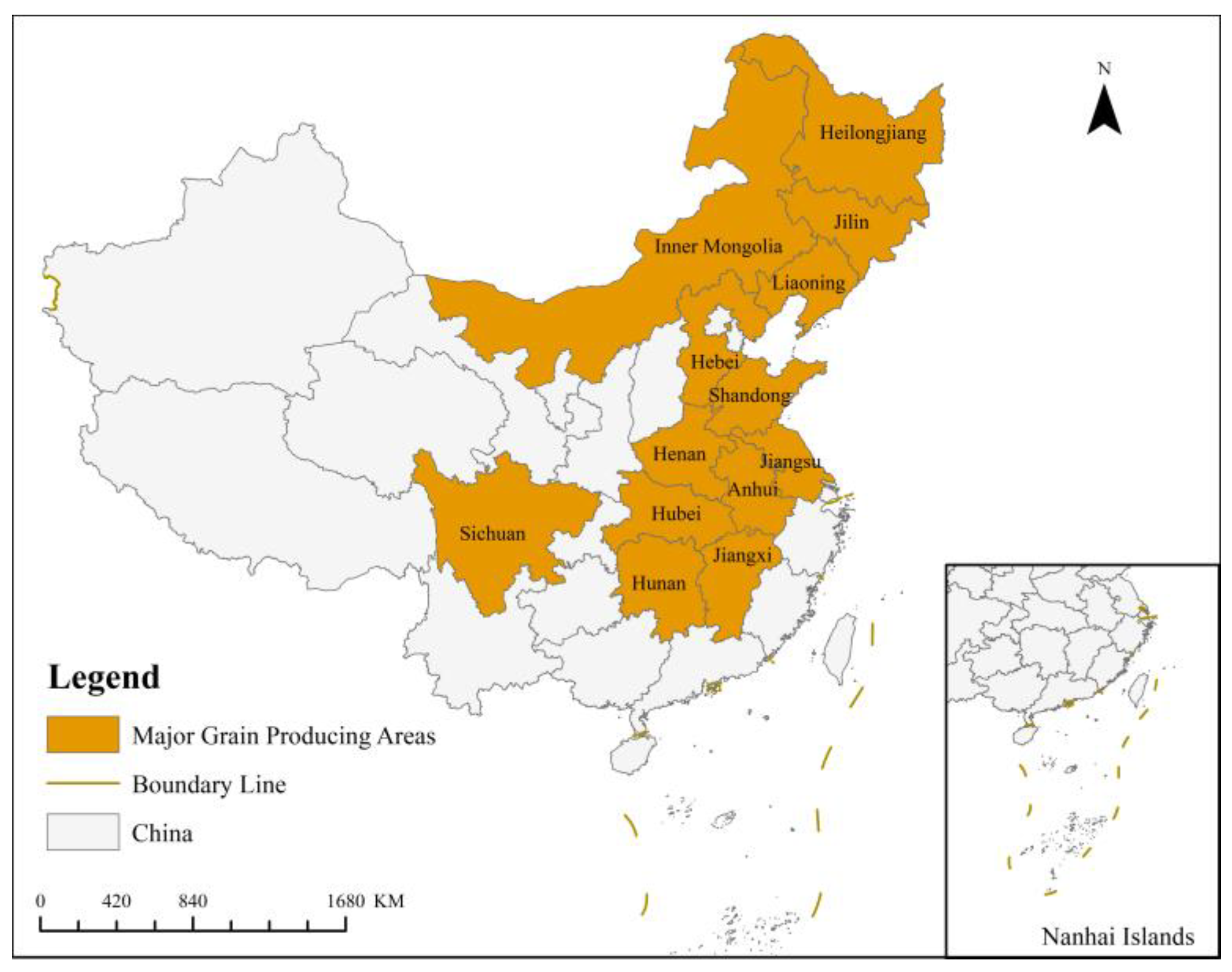
2. Study Site Overview
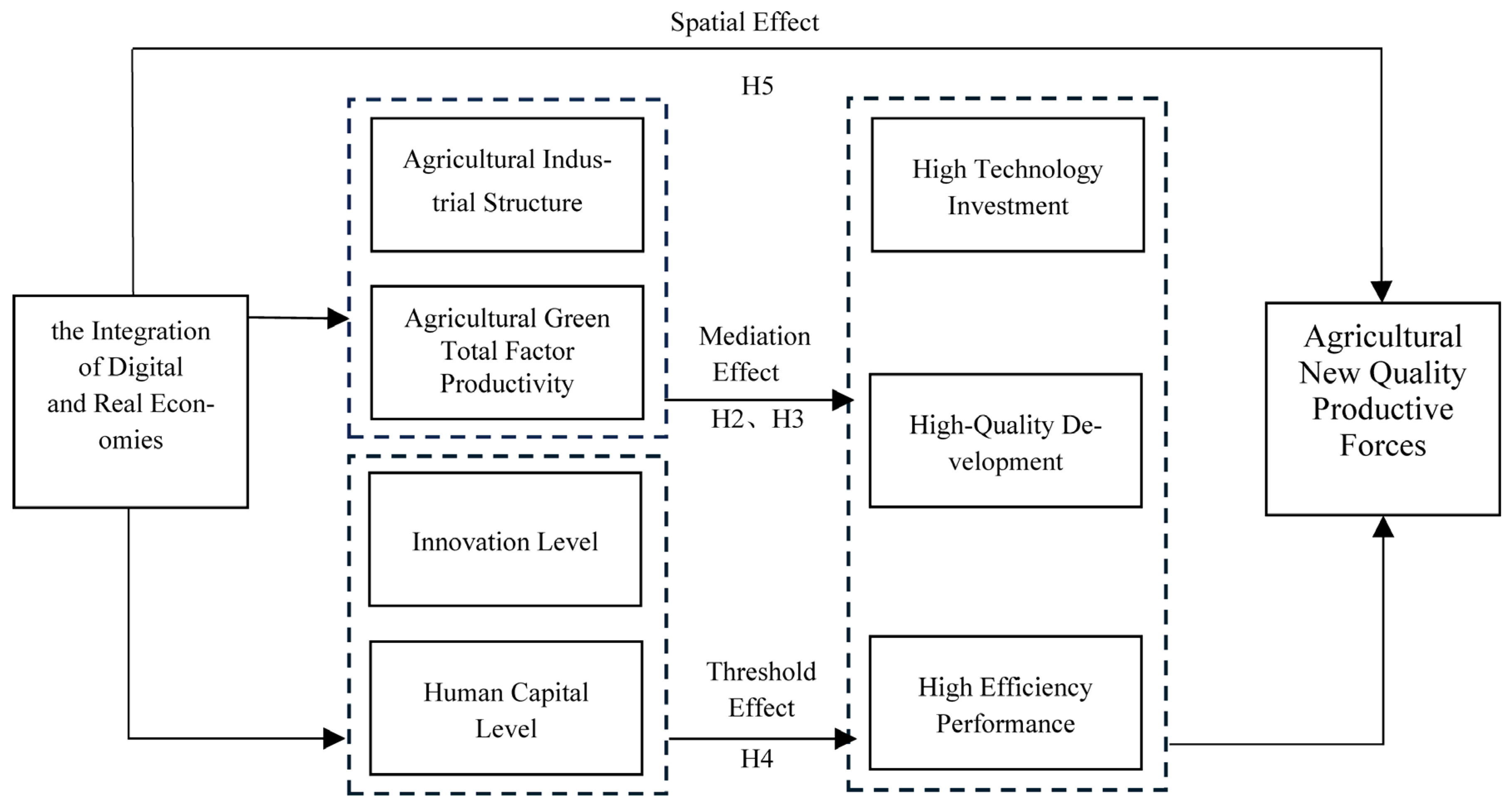
3. Theoretical Analysis and Research Hypotheses
3.1. Direct Impact of Digital–Real Integration on Agricultural New Quality Productive Forces
3.2. Indirect Impact of Digital–Real Integration on Agricultural New Quality Productive Forces
3.2.1. Digital–Real Integration, Agricultural Industrial Structure Upgrading, and Agricultural New Quality Productive Forces
3.2.2. Digital–Real Integration, Agricultural Green Total Factor Productivity, and Agricultural New Quality Productive Forces
3.3. Spatial Effect Analysis of Digital–Real Integration on Agricultural New Quality Productive Forces
3.4. Threshold Effect Analysis Based on Innovation Level and Human Capital Level
4. Model Construction and Variable Selection
4.1. Model Construction
- (1)
- Benchmark Regression Model
- (2)
- Mediation Effect Model
- (3)
- Spatial Effect Model
- (4)
- Threshold Effect Model
4.2. Variable Selection
4.2.1. Core Explanatory Variable
4.2.2. Explained Variable
4.2.3. Mediating Variable
4.2.4. Control Variable
4.3. Data Sources and Descriptive Statistics
4.4. Multicollinearity Test
5. Results
5.1. Baseline Regression Results
5.2. Robustness and Endogeneity Tests
5.2.1. Robustness Test
- (1)
- Shortening the Sample Period
- (2)
- Trimming Outliers
- (3)
- Replacing the Explained Variable
5.2.2. Endogeneity Test
5.3. Test of the Mechanism
5.3.1. Mediating Effect Test of Agricultural Industrial Structure Upgrading
5.3.2. Mediating Effect Test of Agricultural Green Total Factor Productivity
5.4. Spatial Effects Analysis
5.5. Further Analysis
5.5.1. Heterogeneity Analysis
- (1)
- Regional Heterogeneity Analysis
- (2)
- Industrial Structure Level Heterogeneity Analysis
- (3)
- Government Fiscal Decentralization Level Heterogeneity Analysis
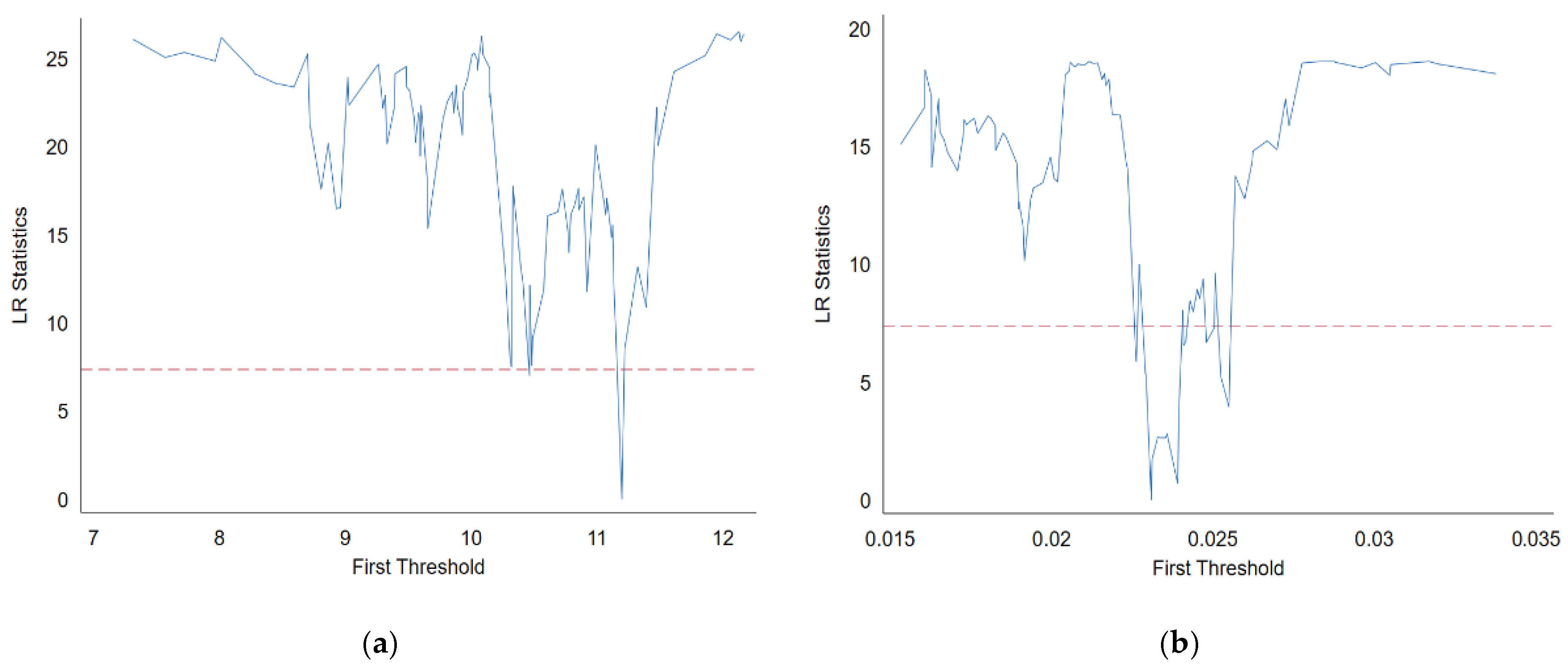
5.5.2. Threshold Effect Analysis
6. Conclusions and Recommendations
- Digital–real integration in major grain-producing regions significantly promotes agricultural new quality productive forces. Specifically, a one-unit increase in digital–real integration corresponds to an average improvement of 0.573 units in agricultural new quality productive forces. This finding remains robust across multiple sensitivity tests, including endogeneity corrections, shortened sample periods, winsorization, and alternative dependent variable specifications.
- Both agricultural industrial structure upgrading and agricultural green total factor productivity serve as significant transmission channels through which digital–real integration enhances agricultural new quality productive forces. These two pathways constitute the core mediation effect linking digital–real integration to productivity gains.
- The relationship between digital–real integration and agricultural new quality productive forces displays notable heterogeneity across three dimensions. Regional heterogeneity follows a “stronger in the north, weaker in the south” pattern. Industrial structure heterogeneity exhibits a “high-level reinforcement, low-level inhibition” characteristic, reflecting threshold effects. Fiscal decentralization heterogeneity demonstrates a “high decentralization strengthens, low decentralization weakens” tendency.
- The promotional effect of digital–real integration on agricultural new quality productive forces generates significant positive spatial spillover effects, facilitating coordinated productivity improvements in neighboring regions.
- Digital–real integration in major grain-producing regions exhibits a notable threshold effect on agricultural new quality productive forces. When innovation level and human capital level exceed specific thresholds, their promotional impact on developing agricultural new quality productive forces intensifies significantly.
- Implement a differentiated digital infrastructure construction strategy to narrow the development gap between the northern and southern regions in terms of the integration of digital and real elements. Given the regional heterogeneity of “weaker in the south, stronger in the north,” for northern grain-producing regions, more investment should be made in new digital infrastructure such as 5G networks, the Internet of Things (IoT), and cloud computing. This should focus on bridging the digital technology gap and developing more adaptable digital agricultural technologies, such as cold-resistant smart agricultural machinery and drought warning systems, to ensure that digital technology aligns with local agricultural production needs. At the same time, establish a digital technology collaboration mechanism between the North and South, encouraging digital technology enterprises from the developed southern regions to expand into the northern regions. Through technology transfer and talent mobility, regional digital technology development can be balanced.
- Create a layered and categorized industrial structure upgrading guidance system to release the potential of the integration of digital and real elements in regions at different industrial levels. Based on the industrial structure heterogeneity of “high level reinforces, low level fails,” for regions with a high level of industrial structure, efforts should focus on driving their ascent to the high-end of the value chain, developing technology-intensive industries such as smart agriculture, precision agriculture, and digital agriculture, and strengthening the productivity transformation effect of digital–real integration. For regions with a low level of industrial structure, priority should be given to improving agricultural infrastructure, enhancing mechanization, standardization, and scale, solidifying the industrial foundation for the integration of digital and real elements, and gradually improving the efficiency of transforming digital–real integration into productivity, avoiding low-level regions from falling into development traps.
- Optimize the fiscal decentralization system to improve resource allocation efficiency and enhance local support for the integration of digital and real elements. In light of the heterogeneity of fiscal decentralization, which shows the characteristic of “high decentralization strengthens, low decentralization weakens,” it is necessary to establish and improve the division of fiscal responsibilities and expenditure between central and local governments, appropriately increasing local governments’ fiscal autonomy in the development of digital–real integration. At the same time, the transfer payment system should be improved, increasing support for regions with lower fiscal decentralization. Establish a special fund for the development of digital–real integration, using fiscal subsidies, tax incentives, and government procurement to guide and leverage social capital to form a diversified investment pattern.
- Strengthen the intermediary guiding role of agricultural industrial structure upgrading and the improvement of green total factor productivity. In terms of industrial structure upgrading, efforts should be made to extend agriculture to the high-end of the value chain, developing new industries such as deep processing of agricultural products and agricultural services. Digital technologies should be used to achieve the digital transformation of the industrial chain. In terms of improving green total factor productivity, green production technologies should be promoted, an agricultural production environmental monitoring system should be established, and digital technologies should be used for precise fertilization, water-saving irrigation, and other green production methods. At the same time, an evaluation and assessment system for industrial structure upgrading and green development should be established and incorporated into local government performance evaluations to ensure the effective functioning of intermediary roles.
- Improve regional coordination and benefit compensation mechanisms to effectively transform spatial spillover effects into collaborative development momentum. In response to the significant spatial dependence of digital–real integration impacts, administrative boundaries should be broken down to promote the establishment of a normalized digital agriculture collaborative development alliance between major grain-producing regions and surrounding areas. Through systematically promoting the beneficial flow of knowledge, technology, and production factors via means such as jointly building regional agricultural data-sharing platforms, collaboratively conducting smart agriculture technology demonstration and promotion, and creating cross-regional digital agricultural industry chains, positive spillover effects can be fostered. Simultaneously, explore the establishment of horizontal ecological compensation or benefit-sharing mechanisms based on spillover effects, providing policy preferences or financial compensation to core regions that generate significant positive spillovers, thereby incentivizing their enthusiasm to play a radiating and driving role. This approach internalizes spatial externalities and achieves coordinated enhancement of regional agricultural new quality productive forces as a whole.
- Build a gradient development mechanism to break through the constraints of development thresholds. In terms of improving innovation capabilities, agricultural R&D investment should be increased, high-level agricultural research institutes and innovation platforms should be established, and efforts should be made to overcome key agricultural technologies and accelerate the transformation of research outcomes. A sound incentive mechanism for agricultural technological innovation should be established, intellectual property protection systems should be improved, and a good innovation ecosystem should be created. In terms of enhancing human capital, a multi-level and multi-form farmer education and training system should be established, cultivating a new type of professional farmer. At the same time, talent introduction and training mechanisms should be improved. By offering attractive benefits, entrepreneurial support, and other measures, more high-quality talent can be attracted, providing strong intellectual support and talent assurance for breaking through threshold limits and fully realizing the effects of the integration of digital and real elements.
7. Discussion
Author Contributions
Funding
Data Availability Statement
Conflicts of Interest
References
- Gao, J.; Zhu, J.; Li, Y.; Gong, Y.; Shen, M. Spatiotemporal Patterns and Strong Agricultural Effects of China’s New Agricultural Productivity. Geogr. J. 2025, 80, 1386–1404. [Google Scholar] [CrossRef]
- Yang, S.; Bai, H.; Li, Z. Political Economy Analysis of Digital-real Integration in Promoting the Formation of New Productivity. Jianghai J. 2025, 14–20+255. [Google Scholar]
- Wang, J.; Fan, X. Deep Integration of Digital and Real Elements, Disruptive Technological Innovation, and Agricultural New Quality Productive Forces. Bus. Res. 2024, 91–99. [Google Scholar] [CrossRef]
- Jiang, Y. Agricultural New Quality Productive Forces in major grain-producing areas: Level Measurement, Regional Differences, and Barrier Diagnosis. Hubei Soc. Sci. 2024, 80, 97–106. [Google Scholar] [CrossRef]
- Gu, J. New Quality Productive Forces and Rural China’s Clean Cooking Transition: A Spatial Analysis. Energy Policy 2026, 208, 114908. [Google Scholar] [CrossRef] [Scilit]
- Zhu, T.; Zhu, T.; Zhao, L. The Impact of New Quality Productive Forces on the Resilience of Industrial Chains: The Moderating Role of Digital Finance. Int. Rev. Econ. Financ. 2025, 102, 104333. [Google Scholar] [CrossRef] [Scilit]
- Cui, J.; Du, D. New Quality Productive Forces, Urban-Rural Integration and Industrial Chain Resilience. Int. Rev. Econ. Financ. 2025, 102, 104245. [Google Scholar] [CrossRef] [Scilit]
- Hong, Y.; Ren, B. The Connotation and Pathways of Deep Integration Between Digital Economy and Real Economy. China Ind. Econ. 2023, 5–16. [Google Scholar] [CrossRef]
- Zhong, K.; Lei, Y.; Zhao, J.; Jiang, Y. How to Enhance China’s Total-Factor Energy Efficiency via Digital-Real Economy Integration: New Evidence from Dynamic QCA Analysis. Energy Econ. 2025, 148, 108689. [Google Scholar] [CrossRef] [Scilit]
- Guo, D.; Li, L.; Pang, G. Does the Integration of Digital and Real Economies Promote Urban Green Total Factor Productivity? Evidence from China. J. Environ. Manag. 2024, 370, 122934. [Google Scholar] [CrossRef] [Scilit]
- Huo, X.; Dong, Y. From Market Segmentation to Consumption Growth: How Does Digital-Real Integration Strengthen the Consumption Stimulation Effect in a Unified National Market? Int. Rev. Econ. Financ. 2025, 103, 104497. [Google Scholar] [CrossRef] [Scilit]
- Wang, Y.; Shi, M.; Liu, J.; Huang, H.; Yu, K. Environmental Pollution Management Effects of Technological Convergence Between Digital and Real Economy Industries: A Perspective of Tripartite Co-Governance by Company, Government, and Public. J. Clean. Prod. 2025, 501, 145201. [Google Scholar] [CrossRef] [Scilit]
- He, D.; Zhang, H.; Liu, Y. New Type of Real Enterprises Promoting the Integration of Digital and Real Elements to Enhance Development Quality. China Ind. Econ. 2024, 5–21. [Google Scholar] [CrossRef]
- Gao, H. Deep Integration of Real Economy and Digital Economy: Level Measurement and Spatiotemporal Evolution. Enterp. Econ. 2025, 44, 102–112. [Google Scholar] [CrossRef]
- Xia, J. Driving Digital-Real Integration with New Productivity. Soc. Sci. 2024, 38–44. [Google Scholar] [CrossRef]
- Xia, J.; Su, M. Driving the Construction of Modern Industrial System through Digital-Real Integration. Reform 2024, 12–23. [Google Scholar]
- An, Q.; Wang, Y.; Liu, F.; Wang, R. Does the integration of digital and real economies enhance corporate supply chain resilience? Evidence from China’s listed firms. Financ. Res. Lett. 2025, 85, 107953. [Google Scholar] [CrossRef] [Scilit]
- Verhoef, P.C.; Broekhuizen, T.; Bart, Y.; Bhattacharya, A.; Dong, J.Q.; Fabian, N.; Haenlein, M. Digital transformation: A multidisciplinary reflection and research agenda. J. Bus. Res. 2021, 122, 889–901. [Google Scholar] [CrossRef] [Scilit]
- You, L.; Tian, X. Agricultural New Quality Productive Forces: Realistic Logic, Connotation Analysis, and Generation Mechanism. Econ. Issues 2024, 27–35. [Google Scholar] [CrossRef]
- Gao, Y.; Ma, J. Agricultural New Quality Productive Forces: A Political Economy Perspective. Agric. Econ. Issues 2024, 81–94. [Google Scholar] [CrossRef]
- Xu, Z.; Xu, W.; Xin, D. Digital–Real Economy Integration and Urban Low-Carbon Development in China. Econ. Anal. Policy 2025, 86, 606–621. [Google Scholar] [CrossRef] [Scilit]
- Zhu, D.; Ye, L. China’s Agricultural New Quality Productive Forces: Level Measurement and Dynamic Evolution. Stat. Decis. 2024, 40, 24–30. [Google Scholar] [CrossRef]
- Zhang, J.; Li, H.; Li, H. The Impact of Digital–Green Synergy on Agricultural New Quality Productive Forces in China. Agriculture 2025, 15, 2403. [Google Scholar] [CrossRef] [Scilit]
- Lin, L.; Gu, T.; Shi, Y. The influence of new quality productive forces on high-quality agricultural development in China: Mechanisms and empirical testing. Agriculture 2024, 14, 1022. [Google Scholar] [CrossRef] [Scilit]
- Ma, Y.; Zhou, Y. Empirical Study on the Promotion of Agricultural New Quality Productive Forces by Digital Technology. East China Econ. Manag. 2024, 38, 1–8. [Google Scholar] [CrossRef]
- Zheng, D.; Wang, L.; Wang, J. Energy Green Transition Promotes the Development of Agricultural New Quality Productive Forces—From the Perspective of Structural Change and Efficiency Transformation. Rural Econ. 2025, 96–105. [Google Scholar] [CrossRef]
- Huang, Q.; Guo, W.; Wang, Y. A study of the impact of new quality productive forces on agricultural modernization: Empirical evidence from China. Agriculture 2024, 14, 1935. [Google Scholar] [CrossRef] [Scilit]
- Cheng, S.; Feng, Z. The Impact of Digital-Real Integration on New Productivity. J. Beijing Inst. Technol. (Soc. Sci.) 2024, 26, 15–27. [Google Scholar] [CrossRef]
- Liang, H.; Shi, C. Research on the Impact Mechanism of Digital-Real Integration on New Productivity: Theoretical Framework and Empirical Test. J. Nanchang Univ. (Humanit. Soc. Sci.) 2025, 56, 68–77. [Google Scholar] [CrossRef]
- Guo, N.; Chen, D.; Hu, L. Enterprise Digital-Real Integration and the Development of New Productivity: Empirical Evidence from Enterprise Patent Information. East China Econ. Manag. 2025, 39, 1–9. [Google Scholar] [CrossRef]
- Bharadwaj, A.; El Sawy, O.A.; Pavlou, P.A.; Venkatraman, N. Digital Business Strategy: Toward a Next Generation of Insights. MIS Q. 2013, 37, 471–482. [Google Scholar] [CrossRef] [Scilit]
- An, H. The Impact and Mechanism of digital-real Integration on agricultural new quality productive forces. Jiangsu Agric. Sci. 2025, 53, 277–284. [Google Scholar] [CrossRef]
- Yin, M.; Xie, Y. Research on the Development of Yantai’s Agricultural New Quality Productive Forces Driven by Digital-Real Integration. Grain Feed. Sci. Technol. 2025, 16–18. [Google Scholar]
- Wang, J.; Wang, R. New Quality Productivity: Index Construction and Spatiotemporal Evolution. J. Xi’an Univ. Financ. Econ. 2024, 1, 31–47. [Google Scholar] [CrossRef]
- Zhang, Z.; Li, J.; Tangnur, H. Measurement and Spatiotemporal Evolution of the Development Level of China’s New Quality Productive Forces. Stat. Decis. 2024, 9, 18–23. [Google Scholar] [CrossRef]
- Liu, Y.; He, Z. Synergistic Industrial Agglomeration, New Quality Productive Forces and High-Quality Development of the Manufacturing Industry. Int. Rev. Econ. Financ. 2024, 94, 103373. [Google Scholar] [CrossRef] [Scilit]
- Zhang, L. New Quality Productivity and the Driving Force of Chinese-Style Modernization. Economist 2024, 3, 15–24. [Google Scholar] [CrossRef]
- Hou, M.L.; Hao, X.Z. How Digital Technology Drives the High-Quality Development of Agriculture—Based on the Mediating Effect of Factor Flow and the Moderating Effect of Industrial Structure Transformation. J. Henan Norm. Univ. (Philos. Soc. Sci. Ed.) 2023, 50, 21–28. [Google Scholar] [CrossRef]
- Hu, S.; Wang, H.G.; Xiao, L.X. Digital Technology Empowering Agricultural Green Development: Internal Mechanism and Typical Practice. China Eng. Sci. 2024, 26, 150–159. [Google Scholar] [CrossRef] [Scilit]
- Zhu, Q.F.; Min, J.D.; Guo, P.Y. Digital Economy, Industrial Resilience and High-Quality Development of Rural Industry. J. China Agric. Resour. Reg. 2024, 45, 125–138. [Google Scholar]
- Liu, H.; Gao, J. Digital-Real Integration Promotes New Productivity’s Multi-Dimensional Advantages, Motives, and Layout Improvement. Contemp. Econ. Manag. 2025, 47, 35–45. [Google Scholar] [CrossRef]
- Chen, J.; Wang, G. Promotion Strategies for Agricultural New Quality Productive Forces Development in China’s New Development Pattern. Theor. Explor. 2025, 102–111. [Google Scholar]
- Yuan, Y.; Sun, Y. Practices, Challenges, and Future of Digital Transformation in Smallholder Agriculture: Insights from a Literature Review. Agriculture 2024, 14, 2193. [Google Scholar] [CrossRef] [Scilit]
- Hu, Y.; Yu, H.; Chen, Q. Digitalization Driving High-Quality Converged Development of Rural Primary, Secondary, and Tertiary Industries: Mechanisms, Effects, and Paths. Sustainability 2023, 15, 11708. [Google Scholar] [CrossRef] [Scilit]
- Zhou, X.; Chen, T.; Zhang, B. Research on the Impact of Digital Agriculture Development on Agricultural Green Total Factor Productivity. Land 2023, 12, 195. [Google Scholar] [CrossRef] [Scilit]
- Gao, M.; Huang, Z. Accelerating the Development of Agricultural New Quality Productive Forces: Promotion Strategies. Econ. Horiz. 2024, 46–54. [Google Scholar] [CrossRef]
- Lv, T.G.; Huang, X.Z.; Yuan, M.H.; Fu, S.F. Mechanism and Spatial Effect of Digital Economy Empowering Agricultural New Quality Productive Forces in Major Grain-Producing Areas in the Middle Reaches of the Yangtze River. J. Agric. For. Econ. Manag. 2025, 24, 818–829. [Google Scholar] [CrossRef]
- Xu, A.; Chen, J. Enhancing New Productivity: Synergistic Assistance from Digital Economy and Technological Innovation. Shanxi Univ. Financ. Econ. J. 2024, 46, 1–15. [Google Scholar] [CrossRef]
- Yuan, Y.; Sun, L.; She, Z.; Chen, S. Influence of Digital Literacy on Farmers’ Adoption Behavior of Low-Carbon Agricultural Technology: Chain Intermediary Role Based on Capital Endowment and Adoption Willingness. Sustainability 2025, 17, 2187. [Google Scholar] [CrossRef] [Scilit]
- Mu, J.; Ma, L. Measurement of China’s Agricultural and Rural Digital Economy Development Index and Regional Differences. J. South China Agric. Univ. (Soc. Sci. Ed.) 2021, 20, 90–98. [Google Scholar]
- Wang, X.; Shi, Y.; Liu, D. The Impact of Market-Based Data Allocation on Digital-Real Integration: Based on a Quasi-Natural Experiment of Data Trading Platform Establishment. J. Guangdong Univ. Financ. 2024, 39, 44–58. [Google Scholar] [CrossRef]
- Gao, P. Statistical Measurement of the Coordinated Development Level of Digital Economy and Real Economy. Stat. Decis. 2024, 40, 28–32. [Google Scholar] [CrossRef]
- Guo, H.; Han, W. How Agricultural New Quality Productive Forces Promotes the Leap of Agricultural Green Total Factor Productivity. Southwest Univ. J. (Soc. Sci. Ed.) 2024, 50, 182–196. [Google Scholar] [CrossRef]
- Cao, X.; Liu, X.; Chen, Y.; Zhu, Z. Establishing an Evaluation Index System for Forest and Grassland New Productivity Based on Connotation and Characteristics. For. Grassl. Policy Res. 2024, 4, 17–22. [Google Scholar] [CrossRef]
- Fu, L. Empirical Study on the Relationship Between the Advancement of Industrial Structure and Economic Growth in China. Stat. Res. 2010, 27, 79–81. [Google Scholar] [CrossRef]
- Shi, C. Impact of land transfer on high-quality agricultural development: Analysis based on the green TFP perspective. J. Nat. Resour. 2024, 39, 1418–1433. [Google Scholar] [CrossRef] [Scilit]
- Jiang, T. Mediating Effects and Moderating Effects in Causal Inference Research. China Ind. Econ. 2022, 40, 100–120. [Google Scholar] [CrossRef]
- Wang, W.; Zhang, S. Empirical Test on Digital Economy Driving Modernization of Agricultural Industry Chain. Stat. Decis. 2024, 40, 22–27. [Google Scholar] [CrossRef]
- Wan, J.; Zhang, Q.; Lu, Y. Research on the Mechanism of Green Technology Innovation Promoting Agricultural New Quality Productive Forces. J. Cent. Univ. Natl. (Philos. Soc. Sci. Ed.) 2025, 52, 85–98. [Google Scholar] [CrossRef]



| First-Level Indicators | Second-Level Indicators | Third-Level Indicators | Indicator Description | Attributes |
|---|---|---|---|---|
| Digital Economy | Digital Infrastructure | Rural Internet Penetration Rate (%) | Rural Broadband Access Users | + |
| Agricultural Meteorological Observation Stations (Number) | Agricultural Meteorological Observation Services | + | ||
| Agricultural Digitalization | Digital Trading of Agricultural Products (Hundred Million RMB) | E-commerce Sales of Agricultural Products | + | |
| Investment Intensity in Agricultural Production (%) | Fixed Asset Investment in Agriculture, Forestry, Animal Husbandry, and Fishery/Total Social Fixed Asset Investment | + | ||
| Digital Industrialization | Rural Information Technology Application (Number of People) | Average Population Served per Postal Service Outlet | − | |
| Agricultural and Rural Entrepreneurship and Innovation Bases (Number) | Number of Taobao Villages | + | ||
| Real Economy | Agricultural Scale | Total Output Value of Agriculture, Forestry, Animal Husbandry, and Fishery (Hundred Million RMB) | Direct Access | + |
| Total Import and Export Value of Agricultural Products (Hundred Million RMB) | Direct Access | + | ||
| Agricultural Development Potential | Added Value of Agriculture, Forestry, Animal Husbandry, and Fishery (Hundred Million RMB) | Direct Access | + | |
| Level of Agricultural Modernization | Total Power of Agricultural Machinery (Ten Thousand kW) | Direct Access | + | |
| Irrigation Conditions of Farmland (Hectare-Meters, hm2) | Effective Irrigated Area | + |
| First-Level Indicators | Second-Level Indicators | Third-Level Indicators | Indicator Description | Attribute |
|---|---|---|---|---|
| High Technology Investment | Innovative Capability | Agricultural Science and Technology Practitioners (Persons) | R&D Personnel × (Total Agricultural, Forestry, Animal Husbandry, and Fishery Output/Regional GDP) | + |
| Agricultural Science and Technology Activity Funds (Ten Thousand RMB) | R&D Activity Funds × (Total Agricultural, Forestry, Animal Husbandry, and Fishery Output/Regional GDP) | + | ||
| Technological Level | Degree of Agricultural Mechanization (%) | Area of Mechanized Tillage/Arable Land Area | + | |
| Advanced Technology Support (Items) | Number of Patents Granted to Digital Agriculture Enterprises | + | ||
| High-Quality Development | Green Environmental Protection | Forest Coverage Rate (%) | Direct Acquisition | + |
| Fiscal Environmental Expenditure (%) | Environmental Protection Fiscal Expenditure/Government Public Fiscal Expenditure | + | ||
| Environmental Pollution | Agricultural COD Emission Intensity (Tons/Hundred Million RMB) | Agricultural COD Emissions/Total Agricultural, Forestry, Animal Husbandry, and Fishery Output | − | |
| Agricultural Ammonia Nitrogen Emission Intensity (Tons/Hundred Million RMB) | Agricultural Ammonia Nitrogen Emissions/Total Agricultural, Forestry, Animal Husbandry, and Fishery Output | − | ||
| Green Management | Green Operations (Items) | Number of Green Agricultural Cooperatives | + | |
| Green Sales (Items) | Number of Certified Green Foods | + | ||
| High Efficiency Performance | Industry Integration | Primary and Secondary Industry Integration (%) | Output of Agricultural, Forestry, Animal Husbandry, and Fishery Processing Industry/Total Agricultural, Forestry, Animal Husbandry, and Fishery Output | + |
| Primary and Tertiary Industry Integration (%) | Output of Agricultural, Forestry, Animal Husbandry, and Fishery Service Industry/Total Agricultural, Forestry, Animal Husbandry, and Fishery Output | + | ||
| Agriculture-Tourism Integration (%) | Leisure Agriculture Revenue/Total Agricultural, Forestry, Animal Husbandry, and Fishery Output | + | ||
| Production Efficiency | Labor Productivity (%) | Output of Primary Industry/Primary Industry Workforce | + | |
| Land Productivity (%) | Total Agricultural Output/Arable Land Area | + | ||
| Agricultural Value-Added Rate (%) | Value Added of Agricultural, Forestry, Animal Husbandry, and Fishery Industry/Total Agricultural, Forestry, Animal Husbandry, and Fishery Output | + |
| Variable | Sample Size | Mean | Standard Deviation | Minimum | Maximum |
|---|---|---|---|---|---|
| NPA | 156 | 0.234 | 0.115 | 0.089 | 0.619 |
| DRI | 156 | 0.446 | 0.152 | 0.176 | 0.935 |
| PRO | 156 | 1.306 | 0.076 | 1.061 | 1.386 |
| ATFP | 156 | 0.410 | 0.196 | 0.190 | 1.030 |
| pgdp | 156 | 1.024 | 0.293 | 0.671 | 1.929 |
| gov | 156 | 0.216 | 0.058 | 0.118 | 0.398 |
| urb | 156 | 0.593 | 0.074 | 0.420 | 0.750 |
| open | 156 | 0.179 | 0.118 | 0.056 | 0.644 |
| ad | 156 | 0.132 | 0.107 | 0.001 | 0.590 |
| Variable | VIF | 1/VIF |
|---|---|---|
| DRI | 2.100 | 0.476 |
| pgdp | 6.650 | 0.150 |
| gov | 3.660 | 0.273 |
| urb | 2.710 | 0.369 |
| open | 3.870 | 0.259 |
| ad | 1.380 | 0.726 |
| Mean VIF | 3.390 |
| Variable | (1) | (2) | (3) |
|---|---|---|---|
| DRI | 0.504 *** | 0.253 *** | 0.573 *** |
| (0.046) | (0.060) | (0.068) | |
| pgdp | −0.168 *** | 0.104 ** | |
| (0.055) | (0.041) | ||
| gov | −1.086 *** | −0.186 | |
| (0.207) | (0.124) | ||
| urb | 0.547 *** | 0.141 | |
| (0.140) | (0.366) | ||
| open | 0.159 | 0.299 *** | |
| (0.105) | (0.109) | ||
| ad | −0.097 | 0.033 | |
| (0.069) | (0.031) | ||
| _cons | 0.009 | 0.188 *** | −0.229 |
| (0.021) | (0.067) | (0.182) | |
| N | 156.000 | 156.000 | 156.000 |
| Controls | YES | YES | YES |
| ID | NO | NO | YES |
| YEAR | NO | NO | YES |
| R2 | 0.438 | 0.534 | 0.936 |
| Variable | (1) | (2) | (3) | (4) |
|---|---|---|---|---|
| NPA | NPA | Replacing NPA | NPA | |
| DRI | 0.587 *** | 0.562 *** | 0.445 *** | 0.711 *** |
| (0.073) | (0.067) | (0.060) | (0.070) | |
| _cons | −0.160 | −0.248 | −0.223 | −0.021 |
| (0.207) | (0.178) | (0.159) | (0.181) | |
| N | 143.000 | 156.000 | 156.000 | 143.000 |
| Controls | YES | YES | YES | YES |
| ID | YES | YES | YES | YES |
| YEAR | YES | YES | YES | YES |
| R2 | 0.951 | 0.950 | 0.956 | 0.951 |
| Variable | (1) | (2) | (3) |
|---|---|---|---|
| NPA | PRO | ATFP | |
| DRI | 0.573 *** | 0.243 *** | 0.904 *** |
| (0.068) | (0.064) | (0.158) | |
| _cons | −0.229 | 0.779 *** | −2.128 *** |
| (0.182) | (0.135) | (0.336) | |
| N | 156.000 | 156.000 | 156.000 |
| Controls | YES | YES | YES |
| ID | YES | YES | YES |
| YEAR | YES | YES | YES |
| R2 | 0.936 | 0.897 | 0.906 |
| Year | Global Moran’s I | Z | p-Value |
|---|---|---|---|
| 2012 | 0.368 | 2.865 | 0.002 |
| 2013 | 0.514 | 3.528 | 0.000 |
| 2014 | 0.488 | 3.421 | 0.000 |
| 2015 | 0.525 | 3.544 | 0.000 |
| 2016 | 0.629 | 3.905 | 0.000 |
| 2017 | 0.640 | 3.857 | 0.000 |
| 2018 | 0.663 | 3.977 | 0.000 |
| 2019 | 0.631 | 3.838 | 0.000 |
| 2020 | 0.618 | 3.725 | 0.000 |
| 2021 | 0.634 | 3.809 | 0.000 |
| 2022 | 0.529 | 3.275 | 0.001 |
| 2023 | 0.791 | 4.590 | 0.000 |
| Variable | Spatial Contiguity Matrix | |||
|---|---|---|---|---|
| Direct Regression Coefficients | Direct Effects | Indirect Effects | Total Effects | |
| DRI | 0.383 *** | 0.436 *** | 0.545 *** | 0.982 *** |
| (6.23) | (7.76) | (3.10) | (5.58) | |
| W × DRI | 0.259 ** | |||
| (2.02) | ||||
| ρ | 0.382 *** (4.27), p < 0.001 | |||
| N | 156.000 | |||
| Controls | YES | |||
| ID | YES | |||
| YEAR | YES | |||
| R2 | 0.159 | |||
| Variable | Regional Group Regression | Industrial Structure Upgrading Level Group Regression | Government Fiscal Decentralization Level Group Regression | |||
|---|---|---|---|---|---|---|
| (1) | (2) | (3) | (4) | (5) | (6) | |
| Southern Region | Northern Region | Low Level | High Level | Low Level | High Level | |
| DRI | 0.254 ** | 0.663 *** | −0.029 | 0.599 *** | 0.433 | 0.648 *** |
| (0.106) | (0.087) | (0.107) | (0.107) | (0.271) | (0.089) | |
| _cons | 0.677 * | −0.038 | −0.488 *** | −0.699 ** | −0.905 *** | 0.350 |
| (0.359) | (0.177) | (0.167) | (0.262) | (0.307) | (0.214) | |
| N | 72.000 | 84.000 | 78.000 | 78.000 | 78.000 | 78.000 |
| Controls | YES | YES | YES | YES | YES | YES |
| ID | YES | YES | YES | YES | YES | YES |
| YEAR | YES | YES | YES | YES | YES | YES |
| R2 | 0.982 | 0.930 | 0.953 | 0.970 | 0.954 | 0.970 |
| Threshold Variable | Number of Thresholds | F Statistic | p-Value | 10% Critical Value | 5% Critical Value | 1% Critical Value | Threshold Value | Confidence Interval |
|---|---|---|---|---|---|---|---|---|
| Innovation Level | Single Threshold | 30.10 | 0.002 | 14.034 | 16.291 | 30.10 | 11.1950 | [10.4617~11.2175] |
| Human Capital Level | Single Threshold | 21.10 | 0.016 | 13.227 | 14.990 | 22.070 | 0.0229 | [0.0226~0.0229] |
| Variable | Model 1 | Model 2 |
|---|---|---|
| PAT ≤ 11.1950 | 0.397 ** | |
| (0.151) | ||
| PAT > 11.1950 | 0.499 *** | |
| (0.122) | ||
| HR ≤ 0.0229 | 0.497 *** | |
| (0.107) | ||
| HR > 0.0229 | 0.562 *** | |
| (0.098) | ||
| _cons | −0.388 | −0.303 |
| (0.296) | (0.267) | |
| N | 156.000 | 156.000 |
| Controls | YES | YES |
| ID | YES | YES |
| YEAR | YES | YES |
| R2 | 0.890 | 0.884 |
Disclaimer/Publisher’s Note: The statements, opinions and data contained in all publications are solely those of the individual author(s) and contributor(s) and not of MDPI and/or the editor(s). MDPI and/or the editor(s) disclaim responsibility for any injury to people or property resulting from any ideas, methods, instructions or products referred to in the content. |
© 2026 by the authors. Licensee MDPI, Basel, Switzerland. This article is an open access article distributed under the terms and conditions of the Creative Commons Attribution (CC BY) license.
Share and Cite
Li, W.; Li, L.; Li, W.; Sheng, C.; Li, X. The Impact of the Integration of Digital and Real Economies on Agricultural New Quality Productive Forces: Empirical Evidence from China’s Major Grain-Producing Areas. Agriculture 2026, 16, 141. https://doi.org/10.3390/agriculture16020141
Li W, Li L, Li W, Sheng C, Li X. The Impact of the Integration of Digital and Real Economies on Agricultural New Quality Productive Forces: Empirical Evidence from China’s Major Grain-Producing Areas. Agriculture. 2026; 16(2):141. https://doi.org/10.3390/agriculture16020141
Chicago/Turabian StyleLi, Wei, Linlu Li, Wenxi Li, Chunguang Sheng, and Xinyi Li. 2026. "The Impact of the Integration of Digital and Real Economies on Agricultural New Quality Productive Forces: Empirical Evidence from China’s Major Grain-Producing Areas" Agriculture 16, no. 2: 141. https://doi.org/10.3390/agriculture16020141
APA StyleLi, W., Li, L., Li, W., Sheng, C., & Li, X. (2026). The Impact of the Integration of Digital and Real Economies on Agricultural New Quality Productive Forces: Empirical Evidence from China’s Major Grain-Producing Areas. Agriculture, 16(2), 141. https://doi.org/10.3390/agriculture16020141