Levomethadone Selectively Reduces Emotional Impulsivity in ASRS-Positive ADHD–OUD Patients, Independent of Dose Escalation

 ,
,  ,
,  ,
,  and
and 
Abstract
1. Introduction
2. Materials and Methods
2.1. Study Design and Participants
2.2. Measures
- -
- The Adult ADHD Self-Report Screening Scale for DSM-5 (ASRS-5) is a six-item self-report scale assessing the frequency of core ADHD symptoms. Each item is rated on a 5-point Likert scale (0 = “never” to 4 = “very often”). A simple additive scoring (range: 0–24) was used, with higher scores indicating greater symptom burden. A score ≥ 14 was adopted as the cut-off for a positive ADHD screening [30].
- -
- The Reactivity, Intensity, Polarity, and Stability Questionnaire (RIPoSt-40) is a 40-item self-report questionnaire designed to assess emotional dysregulation across four domains affective instability, negative emotionality, emotional impulsivity, and positive emotionality. In the present study, only the first three domains were included in the analyses, as the positive emotionality subscale was excluded because it is not directly related to the construct of emotional dysregulation, which was the focus of the investigation. The subscale scores were used to quantify the intensity and variability of emotional responses [31].
- -
- The Clinical Global Impressions scale (CGI) is a clinician-rated instrument assessing the global severity of illness, taking into account symptoms, functioning, and psychosocial impairment [32].
2.3. Statistical Analyses
3. Results
3.1. Baseline Sample Characteristics
3.1.1. Baseline Demographics and Clinical Features
3.1.2. Descriptive Statistics of Doses and Substance Use
3.2. Linear Mixed Model Results
3.2.1. RIPOST Emotional Dysregulation
3.2.2. Clinical Global Impression (CGI)
3.2.3. Substance Use Frequency
3.3. Additional and Exploratory Analyses
4. Discussion
5. Conclusions
Author Contributions
Funding
Institutional Review Board Statement
Informed Consent Statement
Data Availability Statement
Acknowledgments
Conflicts of Interest
Abbreviations
| ADHD | Attention-Deficit/Hyperactivity Disorder |
| OUD | Opioid Use Disorder |
| ASRS-5 | Adult ADHD Self-Report Scale for DSM-5 |
| RIPOST | Reactivity, Intensity, Polarity and Stability Questionnaire |
| CGI | Clinical Global Impression |
| LMM | Linear Mixed Model |
References
- Johnson, S.; Lim, E.; Jacoby, P.; Faraone, S.V.; Su, B.M.; Solmi, M.; Forrest, B.; Furfaro, B.; von Klier, K.; Downs, J.; et al. Prevalence of attention deficit hyperactivity disorder/hyperkinetic disorder of pediatric and adult populations in clinical settings: A systematic review, meta-analysis and meta-regression. Mol. Psychiatry 2025, 31, 576–586. [Google Scholar] [CrossRef]
- Rohner, H.; Gaspar, N.; Philipsen, A.; Schulze, M. Prevalence of Attention Deficit Hyperactivity Disorder (ADHD) among Substance Use Disorder (SUD) Populations: Meta-Analysis. Int. J. Environ. Res. Public Health 2023, 20, 1275. [Google Scholar] [CrossRef]
- Abel, K.F.; Ravndal, E.; Clausen, T.; Bramness, J.G. Attention Deficit Hyperactivity Disorder Symptoms are Common in Patients in Opioid Maintenance Treatment. Eur. Addict. Res. 2017, 23, 298–305. [Google Scholar] [CrossRef]
- Song, P.; Zha, M.; Yang, Q.; Zhang, Y.; Li, X.; Rudan, I. The prevalence of adult attention-deficit hyperactivity disorder: A global systematic review and meta-analysis. J. Glob. Health 2021, 11, 4009. [Google Scholar] [CrossRef]
- Kaye, S.; Darke, S.; Torok, M. Attention deficit hyperactivity disorder (ADHD) among illicit psychostimulant users: A hidden disorder? Addiction 2013, 108, 923–931. [Google Scholar] [CrossRef]
- Lee, S.S.; Humphreys, K.L.; Flory, K.; Liu, R.; Glass, K. Prospective association of childhood attention-deficit/hyperactivity disorder (ADHD) and substance use and abuse/dependence: A meta-analytic review. Clin. Psychol. Rev. 2011, 31, 328–341. [Google Scholar] [CrossRef]
- Molina, B.S.G.; Pelham, W.E. Childhood predictors of adolescent substance use in a longitudinal study of children with ADHD. J. Abnorm. Psychol. 2003, 112, 497–507. [Google Scholar] [CrossRef]
- Charach, A.; Yeung, E.; Climans, T.; Lillie, E. Childhood attention-deficit/hyperactivity disorder and future substance use disorders: Comparative meta-analyses. J. Am. Acad. Child Adolesc. Psychiatry 2011, 50, 9–21. [Google Scholar] [CrossRef]
- Barkley, R.A. Treating ADHD in Children and Adolescents-What Every Clinician Needs to Know; Guilford Publications: New York, NY, USA, 2022. [Google Scholar]
- Adisetiyo, V.; Gray, K.M. Neuroimaging the neural correlates of increased risk for substance use disorders in attention-deficit/hyperactivity disorder-A systematic review. Am. J. Addict. 2017, 26, 99–111. [Google Scholar] [CrossRef] [PubMed]
- Beslot, A.; Grall-Bronnec, M.; Balem, M.; Schreck, B.; Laforgue, E.-J.; Victorri-Vigneau, C.; Guillou-Landreat, M.; Leboucher, J.; OPAL-Group; Bodenez, P.; et al. ADHD: Prevalence and effect on opioid use disorder treatment outcome in a French sample of patients receiving medication for opioid use disorder—The influence of impulsivity as a mediating factor. Harm Reduct. J. 2024, 21, 165. [Google Scholar] [CrossRef]
- Martz, E.; Weiner, L.; Weibel, S. Identifying different patterns of emotion dysregulation in adult ADHD. Borderline Pers. Disord. Emot. Dysregulation 2023, 10, 28. [Google Scholar] [CrossRef]
- Verdejo-García, A.; Lawrence, A.J.; Clark, L. Impulsivity as a vulnerability marker for substance-use disorders: Review of findings from high-risk research, problem gamblers and genetic association studies. Neurosci. Biobehav. Rev. 2008, 32, 777–810. [Google Scholar] [CrossRef] [PubMed]
- Pallucchini, A.; Carli, M.; Maremmani, A.G.I.; Scarselli, M.; Perugi, G.; Maremmani, I. Influence of Substance Use Disorder on Treatment Retention of Adult-Attention-Deficit/Hyperactive Disorder Patients. A 5-Year Follow-Up Study. J. Clin. Med. 2021, 10, 1984. [Google Scholar] [CrossRef]
- Cai, N.-S.; Quiroz, C.; Bonaventura, J.; Bonifazi, A.; Cole, T.O.; Purks, J.; Billing, A.S.; Massey, E.; Wagner, M.; Wish, E.D.; et al. Opioid–galanin receptor heteromers mediate the dopaminergic effects of opioids. J. Clin. Investig. 2019, 129, 2730–2744. [Google Scholar] [CrossRef] [PubMed]
- Raehal, K.M.; Schmid, C.L.; Groer, C.E.; Bohn, L.M. Functional selectivity at the μ-opioid receptor: Implications for understanding opioid analgesia and tolerance. Pharmacol. Rev. 2011, 63, 1001–1019. [Google Scholar] [CrossRef]
- Connor, M.; Christie, M.J. Opioid receptor signalling mechanisms. Clin. Exp. Pharmacol. Physiol. 1999, 26, 493–499. [Google Scholar] [CrossRef]
- Koob, G.F. Neurobiology of Opioid Addiction: Opponent Process, Hyperkatifeia, and Negative Reinforcement. Biol. Psychiatry 2020, 87, 44–53. [Google Scholar] [CrossRef]
- Levinstein, M.R.; De Oliveira, P.A.; Casajuana-Martin, N.; Quiroz, C.; Budinich, R.C.; Rais, R.; Rea, W.; Ventriglia, E.N.; Llopart, N.; Casadó-Anguera, V.; et al. Reply to “Letter to the Editor regarding ‘Unique pharmacodynamic properties and low abuse liability of the μ-opioid receptor ligand (S)-methadone’”. Mol. Psychiatry 2025, 30, 1708–1709. [Google Scholar] [CrossRef]
- MacDonald, H.J.; Kleppe, R.; Szigetvari, P.D.; Haavik, J. The dopamine hypothesis for ADHD: An evaluation of evidence accumulated from human studies and animal models. Front. Psychiatry 2024, 15, 1492126. [Google Scholar] [CrossRef]
- da Silva, B.S.; Grevet, E.H.; Silva, L.C.F.; Ramos, J.K.N.; Rovaris, D.L.; Bau, C.H.D. An overview on neurobiology and therapeutics of attention-deficit/hyperactivity disorder. Discov. Ment. Health 2023, 3, 2. [Google Scholar] [CrossRef] [PubMed]
- Koirala, S.; Grimsrud, G.; Mooney, M.A.; Larsen, B.; Feczko, E.; Elison, J.T.; Nelson, S.M.; Nigg, J.T.; Tervo-Clemmens, B.; Fair, D.A. Neurobiology of attention-deficit hyperactivity disorder: Historical challenges and emerging frontiers. Nat. Rev. Neurosci. 2024, 25, 759–775. [Google Scholar] [CrossRef]
- Shaw, P.; Stringaris, A.; Nigg, J.; Leibenluft, E. Emotion dysregulation in attention deficit hyperactivity disorder. Am. J. Psychiatry 2014, 171, 276–293. [Google Scholar] [CrossRef]
- Shi, J.; Zhao, L.-Y.; Copersino, M.L.; Fang, Y.-X.; Chen, Y.; Tian, J.; Deng, Y.; Shuai, Y.; Jin, J.; Lu, L. PET imaging of dopamine transporter and drug craving during methadone maintenance treatment and after prolonged abstinence in heroin users. Eur. J. Pharmacol. 2008, 579, 160–166. [Google Scholar] [CrossRef]
- Jakubczyk, A.; Trucco, E.M.; Kopera, M.; Kobyliński, P.; Suszek, H.; Fudalej, S.; Brower, K.J.; Wojnar, M. The association between impulsivity, emotion regulation, and symptoms of alcohol use disorder. J. Subst. Abus. Treat. 2018, 91, 49–56. [Google Scholar] [CrossRef]
- Hand, L.J.; Paterson, L.M.; Lingford-Hughes, A.R. Re-evaluating our focus in addiction: Emotional dysregulation is a critical driver of relapse to drug use. Transl. Psychiatry 2024, 14, 467. [Google Scholar] [CrossRef]
- Stellern, J.; Bin Xiao, K.; Grennell, E.; Sanches, M.; Gowin, J.L.; Sloan, M.E. Emotion regulation in substance use disorders: A systematic review and meta-analysis. Addiction 2023, 118, 30–47. [Google Scholar] [CrossRef]
- Klimas, J.; Hamilton, M.-A.; Gorfinkel, L.; Adam, A.; Cullen, W.; Wood, E. Retention in opioid agonist treatment: A rapid review and meta-analysis comparing observational studies and randomized controlled trials. Syst. Rev. 2021, 10, 216. [Google Scholar] [CrossRef]
- O’Connor, A.M.; Cousins, G.; Durand, L.; Barry, J.; Boland, F. Retention of patients in opioid substitution treatment: A systematic review. PLoS ONE 2020, 15, e0232086. [Google Scholar] [CrossRef]
- Christensen, K.S.; Storebø, O.J.; Bach, B. Assessing the Construct Validity of the Adult ADHD Self-report Scale for DSM-5 and Prevalence of ADHD in a Danish Population Sample. J. Atten. Disord. 2025, 29, 437–444. [Google Scholar] [CrossRef]
- Brancati, G.E.; Barbuti, M.; Pallucchini, A.; Cotugno, B.; Schiavi, E.; Hantouche, E.G.; Perugi, G. Reactivity, Intensity, Polarity and Stability questionnaire (RIPoSt-40) assessing emotional dysregulation: Development, reliability and validity. J. Affect. Disord. 2019, 257, 187–194. [Google Scholar] [CrossRef]
- Busner, J.; Targum, S.D. The clinical global impressions scale: Applying a research tool in clinical practice. Psychiatry 2007, 4, 28–37. [Google Scholar]
- Monsalves, M.J.; Bangdiwala, A.S.; Thabane, A.; Bangdiwala, S.I. LEVEL (Logical Explanations & Visualizations of Estimates in Linear mixed models): Recommendations for reporting multilevel data and analyses. BMC Med. Res. Methodol. 2020, 20, 3. [Google Scholar] [CrossRef]
- Wang, G.; Liu, L.; Li, Y.; Aschenbrenner, A.J.; Bateman, R.J.; Delmar, P.; Schneider, L.S.; Kennedy, R.E.; Cutter, G.R.; Xiong, C. Proportional constrained longitudinal data analysis models for clinical trials in sporadic Alzheimer’s disease. Alzheimer’s Dement. 2022, 8, e12286. [Google Scholar] [CrossRef]
- Levinstein, M.R.; De Oliveira, P.A.; Casajuana-Martin, N.; Quiroz, C.; Budinich, R.C.; Rais, R.; Rea, W.; Ventriglia, E.N.; Llopart, N.; Casadó-Anguera, V.; et al. Unique pharmacodynamic properties and low abuse liability of the µ-opioid receptor ligand (S)-methadone. Mol. Psychiatry 2023, 29, 624–632. [Google Scholar] [CrossRef]
- Johnson, S.; North, R. Opioids excite dopamine neurons by hyperpolarization of local interneurons. J. Neurosci. 1992, 12, 483–488. [Google Scholar] [CrossRef]
- Ersche, K.D.; Clark, L.; London, M.; Robbins, T.W.; Sahakian, B.J. Profile of executive and memory function associated with amphetamine and opiate dependence. Neuropsychopharmacology 2006, 31, 1036–1047. [Google Scholar] [CrossRef]
- Verthein, U.; Ullmann, R.; Lachmann, A.; Düring, A.; Koch, B.; Meyer-Thompson, H.-G.; Schmidt, R.; Reimer, J.; Haasen, C. The effects of racemic d,l-methadone and l-methadone in substituted patients—A randomized controlled study. Drug Alcohol Depend. 2005, 80, 267–271. [Google Scholar] [CrossRef]
- Gutwinski, S.; Schoofs, N.; Stuke, H.; Riemer, T.G.; Wiers, C.E.; Bermpohl, F. Opioid tolerance in methadone maintenance treatment: Comparison of methadone and levomethadone in long-term treatment. Harm Reduct. J. 2016, 13, 7. [Google Scholar] [CrossRef]
- Sher, K.J.; Bartholow, B.D.; Peuser, K.; Erickson, D.J.; Wood, M.D. Stress-response-dampening effects of alcohol: Attention as a mediator and moderator. J. Abnorm. Psychol. 2007, 116, 362–377. [Google Scholar] [CrossRef]
- Sayette, M.A. The effects of alcohol on emotion in social drinkers. Behav. Res. Ther. 2017, 88, 76–89. [Google Scholar] [CrossRef]
- Cooper, M.L.; Frone, M.R.; Russell, M.; Mudar, P. Drinking to regulate positive and negative emotions: A motivational model of alcohol use. J. Pers. Soc. Psychol. 1995, 69, 990–1005. [Google Scholar] [CrossRef] [PubMed]
- Mollaahmetoglu, O.M.; Palmer, E.; Maschauer, E.; Nolan, M.C.; Stevens, T.; Carlyle, M.; Hardy, L.; Watkins, E.R.; Morgan, C.J.A. The acute effects of alcohol on state rumination in the laboratory. Psychopharmacology 2021, 238, 1671–1686. [Google Scholar] [CrossRef]
- Dhamija, D.; Bello, A.O.; Khan, A.A.; Gutlapalli, S.D.; Sohail, M.; Patel, P.A.; Midha, S.; Shukla, S.; Mohammed, L. Cannabis Use in Patients with Attention Deficit Hyperactivity Disorder: A Systematic Review. Cureus 2023, 15, e40969. [Google Scholar] [CrossRef]
- Francisco, A.P.; Lethbridge, G.; Patterson, B.; Bergmann, C.G.; Van Ameringen, M. Cannabis use in Attention—Deficit/Hyperactivity Disorder (ADHD): A scoping review. J. Psychiatr. Res. 2023, 157, 239–256. [Google Scholar] [CrossRef]
- Preedy, V. Handbook of Cannabis and Related Pathologies: Biology, Pharmacology, Diagnosis, and Treatment; Elsevier: Amsterdam, The Netherlands, 2017. [Google Scholar]
- Witkiewitz, K.; Hallgren, K.A.; Kranzler, H.R.; Mann, K.F.; Hasin, D.S.; Falk, D.E.; Litten, R.Z.; O’MAlley, S.S.; Anton, R.F. Clinical Validation of Reduced Alcohol Consumption After Treatment for Alcohol Dependence Using the World Health Organization Risk Drinking Levels. Alcohol. Clin. Exp. Res. 2017, 41, 179–186. [Google Scholar] [CrossRef] [PubMed]
- Roos, C.R.; Nich, C.; Mun, C.J.; Babuscio, T.A.; Mendonca, J.; Miguel, A.Q.; DeVito, E.E.; Yip, S.W.; Witkiewitz, K.; Carroll, K.M.; et al. Clinical validation of reduction in cocaine frequency level as an endpoint in clinical trials for cocaine use disorder. Drug Alcohol Depend. 2019, 205, 107648. [Google Scholar] [CrossRef] [PubMed]


| Scale/Substance | ASRS Group | N Included | ↑Levo n (%) | Mean Δmg (Max Increase) | Baseline Levomethadone (mg, Mean ± SD) | p-Value (Baseline Dose) |
|---|---|---|---|---|---|---|
| Alcohol/Sedatives | <14 | 16 | 5 (31.3%) | 6.50 | 37.81 ± 16.30 | 0.545 |
| Alcohol/Sedatives | ≥14 | 12 | 7 (58.3%) | 9.57 | 41.91 ± 19.03 | |
| CGI | <14 | 50 | 24 (48.0%) | 9.90 | 38.70 ± 18.55 | 0.840 |
| CGI | ≥14 | 21 | 10 (47.6%) | 11.45 | 38.95 ± 17.50 | |
| Opioids | <14 | 20 | 13 (65.0%) | 10.00 | 35.50 ± 14.06 | 0.864 |
| Opioids | ≥14 | 5 | 2 (40.0%) | 8.75 | 35.00 ± 12.86 | |
| RIPOST | <14 | 50 | 24 (48.0%) | 9.90 | 38.70 ± 18.55 | 0.840 |
| RIPOST | ≥14 | 21 | 10 (47.6%) | 11.45 | 38.95 ± 17.50 | |
| Stimulants | <14 | 19 | 11 (57.9%) | 9.09 | 38.94 ± 17.76 | 0.939 |
| Stimulants | ≥14 | 13 | 6 (46.2%) | 13.75 | 38.07 ± 20.15 | |
| THC | <14 | 13 | 5 (38.5%) | 10.50 | 35.19 ± 14.80 | 0.779 |
| THC | ≥14 | 10 | 5 (50.0%) | 10.50 | 32.50 ± 13.22 |
| Variable | ASRS < 14 (N = 59) N (%) | ASRS ≥ 14 (N = 24) N (%) | χ2 | p Value |
|---|---|---|---|---|
| Employed | 40 (67.8%) | 8 (33.3%) | 8.309 | 0.004 ** |
| Gender: female | 6 (10.2%) | 6 (25%) | Fisher’s Exact | 0.096 |
| Current opioid use | 23 (39%) | 7 (29.2%) | 0.712 | 0.399 |
| Current stimulant use | 23 (39%) | 15 (62.5%) | 3.801 | 0.051 |
| Current alcohol/sedative use | 20 (33.9%) | 14 (58.3%) | 4.212 | 0.040 * |
| Current THC use | 15 (25.4%) | 11 (45.8%) | 3.303 | 0.069 |
| Psychiatric comorbidities | 24 (40.7%) | 21 (87.5%) | 15.068 | <0.001 *** |
| Organic/metabolic comorbidities | 35 (59.3%) | 17 (70.8%) | 0.966 | 0.326 |
| Family psychiatric history | 16 (27.1%) | 16 (66.7%) | 11.263 | <0.001 *** |
| Family history of suicide | 5 (8.5%) | 6 (25%) | Fisher’s Exact | 0.070 |
| Family history of suicide attempt | 3 (5.1%) | 9 (37.5%) | Fisher’s Exact | <0.001 *** |
| Current pharmacological treatment | 35 (59.3%) | 18 (75%) | 1.817 | 0.178 |
| Variable | Median (IQR) | Median (IQR) | z | p |
| Age (years) | 50 (12) | 43.50 (22.25) | −2.217 | 0.027 * |
| Baseline methadone dose (mg) | 70 (50) | 80 (37.50) | −0.363 | 0.717 |
| Years on methadone | 7 (10) | 10 (10) | −0.524 | 0.600 |
| RIPOST affective instability | 29 (15) | 51 (15.25) | −5.944 | 0.000 *** |
| RIPOST negative emotionality | 30 (15) | 43 (11.75) | −3.679 | 0.000 *** |
| RIPOST emotional impulsivity | 21 (9) | 36 (13.75) | −5.374 | 0.000 *** |
| CGI baseline | 4 (2) | 5 (1) | −2.25 | 0.024 * |
| Effect (LMM) | Emotional Impulsivity | Negative Emotionality | Affective Instability |
|---|---|---|---|
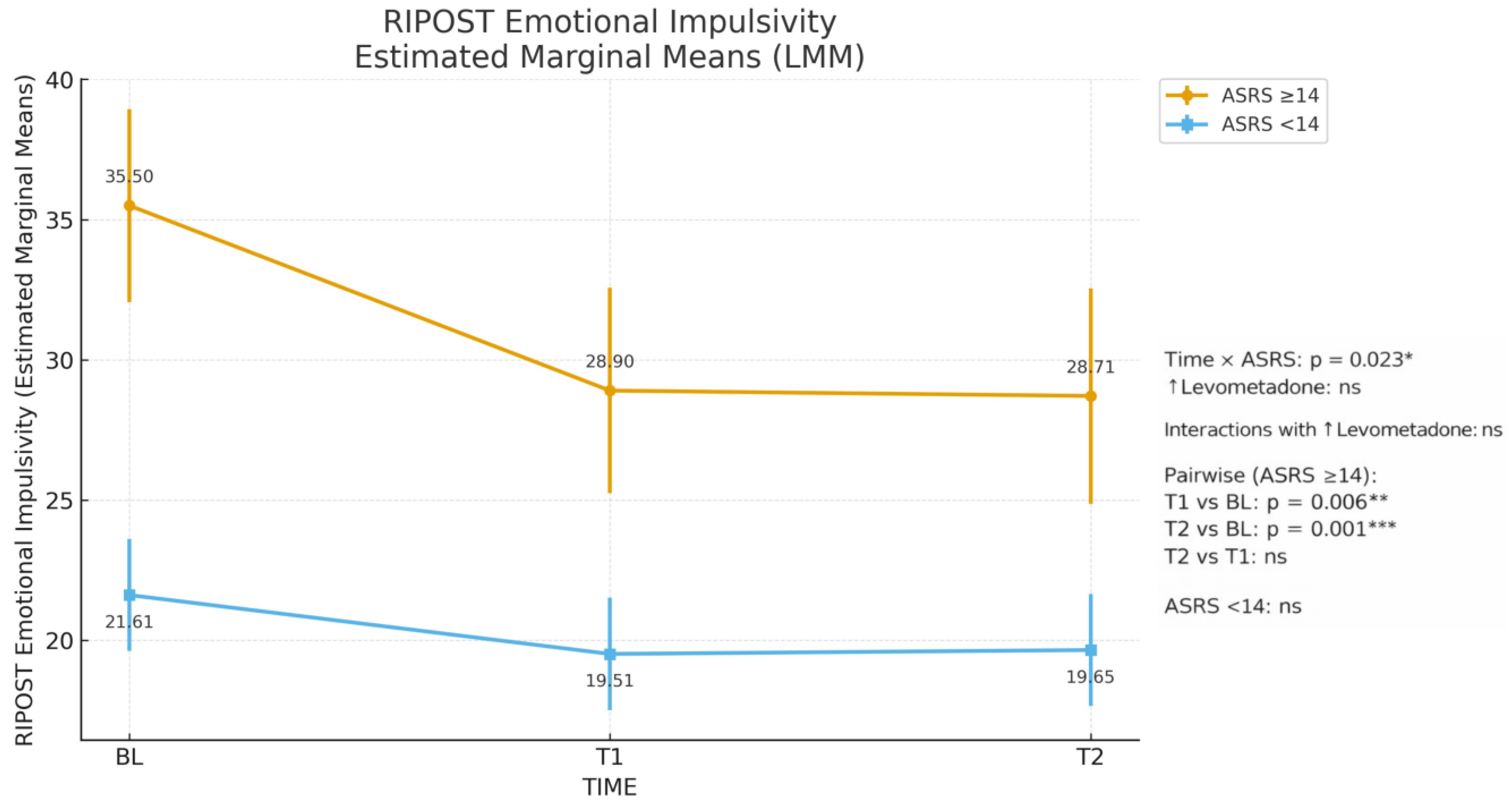
| Time | p < 0.001 *** T1–BL = −4.35 ** T2–BL = −4.37 *** T2–T1 = −0.02 | p = 0.064 | p = 0.005 ** T1–BL = −2.60 * T2–BL = −3.65 * T2–T1 = −1.05 |
| ASRS ≥ 14 vs. <14 | p < 0.001 *** Δ = +10.78 *** | p = 0.002 ** Δ = +8.10 ** | p < 0.001 *** Δ = +17.85 *** |
| ASRS × Time | p = 0.023 * ≥14: T1–BL = −6.59 ** ≥14: T2–BL = −6.78 *** ≥14: T2–T1 = −0.18 | p = 0.860 | p = 0.249 |
| ↑Levo. | p = 0.552 | p = 0.718 | p = 0.630 |
| ↑Levo. × Time | p = 0.719 | p = 0.780 | p = 0.416 |
| ASRS × ↑Levo. | p = 0.497 | p = 0.840 | p = 0.988 |
| ASRS × ↑Levo. × Time | p = 0.623 | p = 0.445 | p = 0.968 |
| Time | Group | Estimated Mean | 95% CI | Pairwise (p) |
|---|---|---|---|---|
| BL | ASRS ≥ 14 | 35.50 | [32.06–38.93] | - |
| T1 | ASRS ≥ 14 | 28.90 | [25.24–32.56] | T1–BL p = 0.006 ** |
| T2 | ASRS ≥ 14 | 28.71 | [24.87–32.56] | T2–BL p < 0.001 ***; T2–T1 p = 1.000 |
| Effect (LMM) | CGI-Severity |
|---|---|
| Time | p < 0.001 *** T1–BL = −0.55 *** T2–BL = −0.70 *** T2–T1 = −0.15 |
| ASRS ≥ 14 vs. <14 | p = 0.025 * Δ = +0.57 * |
| ASRS × Time | p = 0.846 |
| ↑Levo. | p = 0.087 |
| ↑Levo. × Time | p = 0.553 |
| ASRS × ↑Levo. | p = 0.819 |
| ASRS × ↑Levo. × Time | p = 0.713 |
| Effect (LMM) | Opioids | Stimulants | THC | Alcohol/ Sedatives |
|---|---|---|---|---|
| Time | p = 0.035 * T1–BL = −4.57 T2–BL = −5.31 T2–T1 = −0.74 | p = 0.599 | p = 0.454 | p = 0.007 ** T1–BL = −2.24 * T2–BL = −3.68 * T2–T1 = −1.43 |
| ASRS ≥ 14 vs. <14 | p = 0.195 | p = 0.213 | p = 0.641 | p = 0.582 |
| ASRS × Time | p = 0.860 | p = 0.812 | p = 0.993 | p = 0.065 |
| ↑Levo. | p = 0.851 | p = 0.028 * Δ = +6.50 * | p = 0.187 | p = 0.425 |
| ↑Levo. × Time | p = 0.578 | p = 0.463 | p = 0.083 | p = 0.650 |
| ASRS × ↑Levo. | p = 0.077 | p = 0.297 | p = 0.846 | p = 0.212 |
| ASRS × ↑Levo. × Time | p = 0.058 | p = 0.299 | p = 0.550 | p = 0.889 |
| Variable | Baseline N = 14 Median (IQR) | T2 N = 14 Median (IQR) | z | p |
|---|---|---|---|---|
| ASRS TOT (ASRS ≥ 14) | 16.5 (4.5) | 14 (5.5) | −2.3 | 0.019 * |
Disclaimer/Publisher’s Note: The statements, opinions and data contained in all publications are solely those of the individual author(s) and contributor(s) and not of MDPI and/or the editor(s). MDPI and/or the editor(s) disclaim responsibility for any injury to people or property resulting from any ideas, methods, instructions or products referred to in the content. |
© 2025 by the authors. Licensee MDPI, Basel, Switzerland. This article is an open access article distributed under the terms and conditions of the Creative Commons Attribution (CC BY) license.
Share and Cite
Pallucchini, A.; Varese, M.; Pergentini, I.; Cerrai, E.; Gemignani, S.; Parapetto, E.; Simonetti, F.; Maremmani, I.; Maremmani, A.G.I. Levomethadone Selectively Reduces Emotional Impulsivity in ASRS-Positive ADHD–OUD Patients, Independent of Dose Escalation. J. Clin. Med. 2026, 15, 89. https://doi.org/10.3390/jcm15010089
Pallucchini A, Varese M, Pergentini I, Cerrai E, Gemignani S, Parapetto E, Simonetti F, Maremmani I, Maremmani AGI. Levomethadone Selectively Reduces Emotional Impulsivity in ASRS-Positive ADHD–OUD Patients, Independent of Dose Escalation. Journal of Clinical Medicine. 2026; 15(1):89. https://doi.org/10.3390/jcm15010089
Chicago/Turabian StylePallucchini, Alessandro, Maurizio Varese, Irene Pergentini, Elisa Cerrai, Samuele Gemignani, Elisa Parapetto, Francesco Simonetti, Icro Maremmani, and Angelo G. I. Maremmani. 2026. "Levomethadone Selectively Reduces Emotional Impulsivity in ASRS-Positive ADHD–OUD Patients, Independent of Dose Escalation" Journal of Clinical Medicine 15, no. 1: 89. https://doi.org/10.3390/jcm15010089
APA StylePallucchini, A., Varese, M., Pergentini, I., Cerrai, E., Gemignani, S., Parapetto, E., Simonetti, F., Maremmani, I., & Maremmani, A. G. I. (2026). Levomethadone Selectively Reduces Emotional Impulsivity in ASRS-Positive ADHD–OUD Patients, Independent of Dose Escalation. Journal of Clinical Medicine, 15(1), 89. https://doi.org/10.3390/jcm15010089