

Prothrombotic Rebound After Discontinuation of Direct Oral Anticoagulants Therapy: A Systematic Review
 ,
,  , ,
, ,  ,
,  and
and
Abstract
1. Introduction
2. Methods
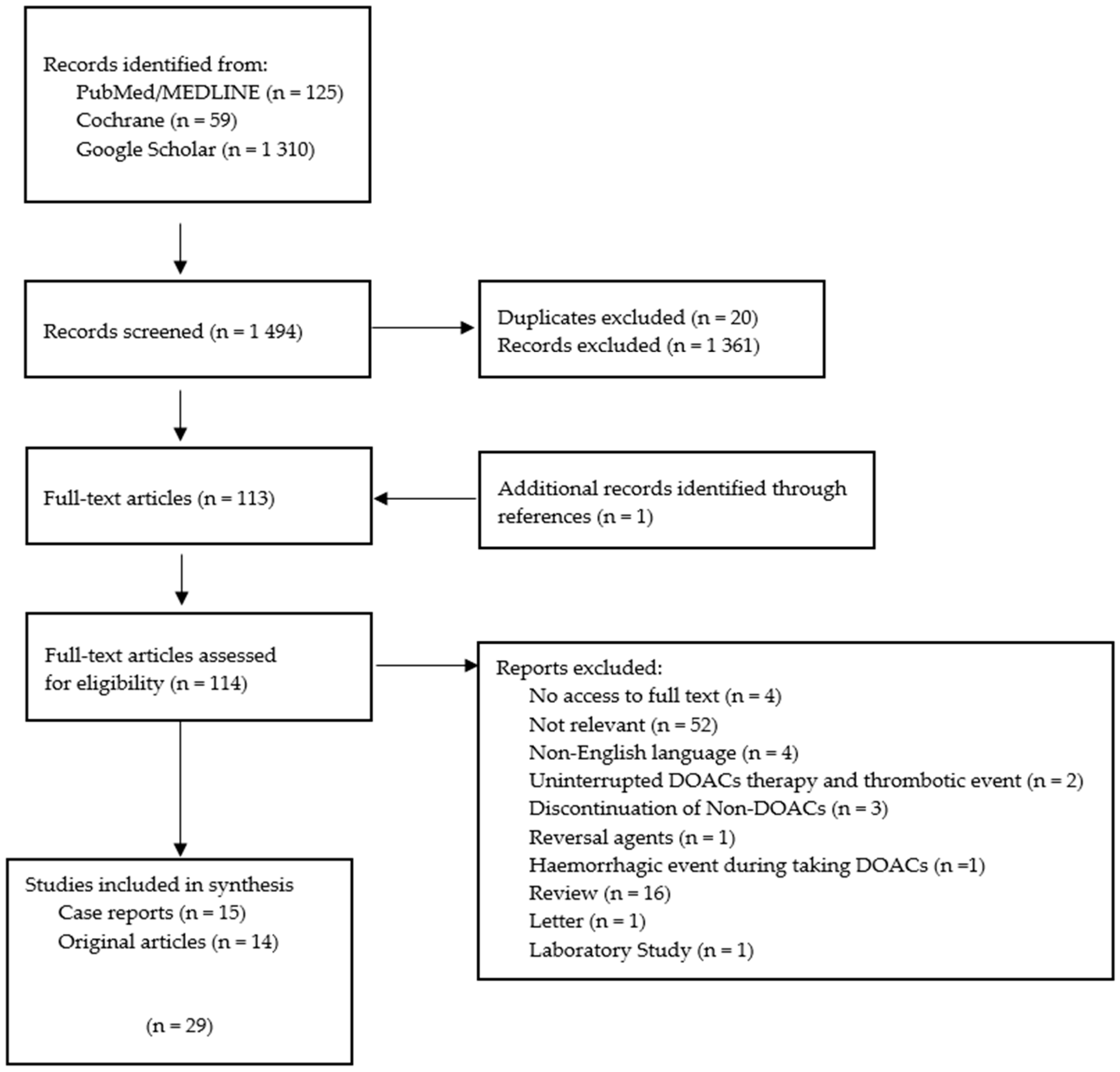
2.1. Search and Study Identification
2.2. Selection Criteria
2.3. Data Extraction
3. Results
4. Discussion
Limitations of This Study
5. Conclusions
Author Contributions
Funding
Institutional Review Board Statement
Informed Consent Statement
Data Availability Statement
Conflicts of Interest
Correction Statement
Abbreviations
| AF | Atrial Fibrillation |
| aPTT | Activated Partial Thromboplastin Time |
| DOACs | Direct Oral Anticoagulants |
| dTT | Dilute Thrombin Time |
| ECA | Ecarin Chromogenic Assay |
| ECT | Ecarin Clotting Time |
| eGFR | Estimated Glomerular Filtration Rate |
| F1 + 2 | Prothrombin Fragment 1 + 2 |
| INR | International Normalized Ratio |
| NOACs | New Oral Anticoagulants |
| PRISMA | Preferred Reporting Items for Systematic Reviews and Meta-Analysis |
| PT | Prothrombin Time |
| TAT | Thrombin–Antithrombin Complex |
| TIA | Transient Ischemic Attack |
| TSOACs | Target-Specific Oral Anticoagulants |
| TT | Thrombin Time |
References
- Almarshad, F.; Alaklabi, A.; Bakhsh, E.; Pathan, A.; Almegren, M. Use of Direct Oral Anticoagulants in Daily Practice. Am. J. Blood Res. 2018, 8, 57. [Google Scholar] [PubMed]
- Haynes, L.M.; Orfeo, T.; Mann, K.G. Rivaroxaban Delivery and Reversal at a Venous Flow Rate. Arter. Thromb. Vasc. Biol. 2012, 32, 2877. [Google Scholar] [CrossRef] [PubMed]
- Kim, J.; Jang, H.J.; Schellingerhout, D.; Lee, S.K.; Kim, H.; Kim, Y.D.; Lee, K.Y.; Choi, H.Y.; Cho, H.J.; Jang, S.S.; et al. Short-Term Cessation of Dabigatran Causes a Paradoxical Prothrombotic State. Ann. Neurol. 2021, 89, 444–458. [Google Scholar] [CrossRef] [PubMed]
- Kebernik, J.; Borlich, M.; Tölg, R.; El-Mawardy, M.; Abdel-Wahab, M.; Richardt, G. Dual Antithrombotic Therapy with Clopidogrel and Novel Oral Anticoagulants in Patients with Atrial Fibrillation Undergoing Percutaneous Coronary Intervention: A Real-World Study. Cardiol. Ther. 2018, 7, 79–87. [Google Scholar] [CrossRef]
- Moher, D.; Liberati, A.; Tetzlaff, J.; Altman, D.G.; Antes, G.; Atkins, D.; Barbour, V.; Barrowman, N.; Berlin, J.A.; Clark, J.; et al. Preferred Reporting Items for Systematic Reviews and Meta-Analyses: The PRISMA Statement. PLoS Med. 2009, 6, 264–269. [Google Scholar] [CrossRef]
- Khan, O.; Egbe, A.; Abbasi, D. “The Failing Watchman”: Recurrent Left Atrial Appendage Occlusion Device (LAAOD) Thrombus After Successful Initial Implantation. Cureus 2024, 16, e61368. [Google Scholar] [CrossRef]
- Huang, T.; Liu, Y.; Jiang, X.; Zhang, W.; Zhou, H.; Hu, Q. Favourable Outcome of Multisystem Venous Thrombosis Associated with Novel SERPINC1 Mutation after Treated with Dabigatran: A Case Report with 7-Year Follow-Up. Thromb. J. 2022, 20, 81. [Google Scholar] [CrossRef]
- Płatkowska-Adamska, B.; Kal, M.; Krupińska, J.; Biskup, M.; Odrobina, D. Central Retinal Vein Occlusion After Discontinuation of Rivaroxaban Therapy in a Young Patient with COVID-19 Pulmonary Embolism: A Case Report. Am. J. Case Rep. 2022, 23, e937739-1. [Google Scholar] [CrossRef]
- Niazi, M.; Khan, D.; Mustafa, A.; Munir, A.B.; Karam, B.; Snyder, S.T.; Lafferty, J. Left Atrial Thrombus Mimicking Myxoma Secondary to Rebound Hypercoagulable State. J. Med. Cases 2021, 12, 243–247. [Google Scholar] [CrossRef]
- Shang, F.; Ding, Q.; Qi, M.; Wang, N.; Qu, X. Successful Treatment of a Massive Sinus Thrombosis in a Chinese Woman with Antithrombin III Deficiency: A Case Report and Review of the Literature. Blood Coagul. Fibrinolysis 2020, 31, 410–415. [Google Scholar] [CrossRef]
- Storey, C.; Lebovitz, J.; Sweid, A.; Tjoumakaris, S.; Gooch, R.; Rosenwasser, R.H.; Jabbour, P. Bilateral Mechanical Thrombectomies for Simultaneous MCA Occlusions. World Neurosurg. 2019, 132, 165–168. [Google Scholar] [CrossRef] [PubMed]
- Göndör, G.; Stöllberger, C. Pulmonary Embolism Four Days after Interruption of Therapy with Rivaroxaban. Hamostaseologie 2017, 37, 302–306. [Google Scholar] [CrossRef] [PubMed]
- Nagasayi, S.; Varman, S.; Ting, Y.Y.; Ang, W. Rivaroxaban Withdrawal and Rebound Hypercoagulability Leading to Upper Extremity Deep Vein Thrombosis: A Case Report. Age Ageing 2017, 46, 870–871. [Google Scholar] [CrossRef] [PubMed]
- Undas, A.; Goralczyk, T. Non-Vitamin K Antagonist Oral Anticoagulants in Patients with Severe Inherited Thrombophilia: A Series of 33 Patients. Blood Coagul. Fibrinolysis 2017, 28, 438–442. [Google Scholar] [CrossRef]
- Bakhit, A.; Selim, A.; Fatima, U.; Dahhan, A. Rebound Thrombosis within 24hours after Interruption of Therapy with Rivaroxaban. Int. J. Cardiol. 2016, 212, 235–236. [Google Scholar] [CrossRef]
- Turner, M.; Solarz, D. Left Atrial Thrombus Formation after Brief Interruption of Rivaroxaban. Am. J. Emerg. Med. 2016, 34, 116.e3–116.e4. [Google Scholar] [CrossRef]
- Weiler, B.; Marciniak, E.T.; Reed, R.M.; McCurdy, M.T. Myocardial Infarction Complicated by Left Ventricular Thrombus and Fatal Thromboembolism Following Abrupt Cessation of Dabigatran. BMJ Case Rep. 2014, 2014, bcr2014203910. [Google Scholar] [CrossRef]
- Agarwal, A.; Patel, A.; Mufti, O.; Jbara, Y.; Jabbar, A.A. Rivaroxaban Rebound Acute Coronary Event: A Post Marketing Experience. Cardiol. Res. 2013, 4, 207. [Google Scholar] [CrossRef][Green Version]
- Finsterer, J.; Stöllberger, C.; Paul, G.; Bastovansky, A. Ischemic Stroke and Intestinal Bleeding under Dabigatran in Metabolic Myopathy. Cardiovasc. Ther. 2013, 31, e111–e114. [Google Scholar] [CrossRef]
- Stöllberger, C.; Finsterer, J. Stroke and Urosepsis after Discontinuation of Rivaroxaban. Int. J. Cardiol. 2013, 169, e77–e78. [Google Scholar] [CrossRef]
- Álvaro Thomsen, T.; Mesa Guadalupe, J.; Huerta, C.; de Burgos, A.; Cea Soriano, L. Risk of Ischemic Stroke Associated with Direct Oral Anticoagulants Discontinuation on Patients with Non-Valvular Atrial Fibrillation. Pharmacoepidemiol. Drug Saf. 2024, 33, e5733. [Google Scholar] [CrossRef] [PubMed]
- Mulholland, R.J.; Manca, F.; Ciminata, G.; Quinn, T.J.; Trotter, R.; Pollock, K.G.; Lister, S.; Geue, C. Evaluating the Effect of Inequalities in Oral Anti-Coagulant Prescribing on Outcomes in People with Atrial Fibrillation. Eur. Heart J. Open 2024, 4, oeae016. [Google Scholar] [CrossRef] [PubMed]
- Cools, F.; Johnson, D.; Camm, A.J.; Bassand, J.P.; Verheugt, F.W.A.; Yang, S.; Tsiatis, A.; Fitzmaurice, D.A.; Goldhaber, S.Z.; Kayani, G.; et al. Risks Associated with Discontinuation of Oral Anticoagulation in Newly Diagnosed Patients with Atrial Fibrillation: Results from the GARFIELD-AF Registry. J. Thromb. Haemost. 2021, 19, 2322. [Google Scholar] [CrossRef] [PubMed]
- Campello, E.; Spiezia, L.; Simion, C.; Tormene, D.; Camporese, G.; Valle, F.D.; Poretto, A.; Bulato, C.; Gavasso, S.; Radu, C.M.; et al. Direct Oral Anticoagulants in Patients With Inherited Thrombophilia and Venous Thromboembolism: A Prospective Cohort Study. J. Am. Heart Assoc. 2020, 9, e018917. [Google Scholar] [CrossRef]
- Ando, M.; Inden, Y.; Yoshida, Y.; Sairaku, A.; Yanagisawa, S.; Suzuki, H.; Watanabe, R.; Takenaka, M.; Maeda, M.; Murohara, T. Differences in Prothrombotic Response between the Uninterrupted and Interrupted Apixaban Therapies in Patients Undergoing Cryoballoon Ablation for Paroxysmal Atrial Fibrillation: A Randomized Controlled Study. Heart Vessel. 2019, 34, 1533–1541. [Google Scholar] [CrossRef]
- Park, J.H.; Han, S.W.; Lee, K.Y.; Choi, H.Y.; Cheon, K.; Cho, H.J.; Jung, Y.H.; Park, H.J.; Nam, H.S.; Heo, J.H.; et al. Impact of Non-Vitamin K Antagonist Oral Anticoagulant Withdrawal on Stroke Outcomes. Front. Neurol. 2018, 9, 1095. [Google Scholar] [CrossRef]
- Wagner, M.L.; Khoury, J.C.; Alwell, K.; Rademacher, E.; Woo, D.; Flaherty, M.L.; Anderson, A.M.; Adeoye, O.; Ferioli, S.; Kissela, B.M.; et al. Withdrawal of Antithrombotic Agents and the Risk of Stroke. J. Stroke Cerebrovasc. Dis. 2016, 25, 902. [Google Scholar] [CrossRef][Green Version]
- Yao, X.; Abraham, N.S.; Caleb Alexander, G.; Crown, W.; Montori, V.M.; Sangaralingham, L.R.; Gersh, B.J.; Shah, N.D.; Noseworthy, P.A. Effect of Adherence to Oral Anticoagulants on Risk of Stroke and Major Bleeding Among Patients With Atrial Fibrillation. J. Am. Heart Assoc. 2016, 5, e003074. [Google Scholar] [CrossRef]
- Vanga, S.R.; Satti, S.R.; Williams, J.; Weintraub, W.; Doorey, A. Discontinuation of Oral Anticoagulation Preceding Acute Ischemic Stroke--Prevalence and Outcomes: Comprehensive Chart Review. Postgrad. Med. 2015, 127, 791–795. [Google Scholar] [CrossRef][Green Version]
- Sherwood, M.W.; Douketis, J.D.; Patel, M.R.; Piccini, J.P.; Hellkamp, A.S.; Lokhnygina, Y.; Spyropoulos, A.C.; Hankey, G.J.; Singer, D.E.; Nessel, C.C.; et al. Outcomes of Temporary Interruption of Rivaroxaban Compared with Warfarin in Patients with Nonvalvular Atrial Fibrillation: Results from the Rivaroxaban Once Daily, Oral, Direct Factor Xa Inhibition Compared with Vitamin K Antagonism for Prevention of Stroke and Embolism Trial in Atrial Fibrillation (ROCKET AF). Circulation 2014, 129, 1850. [Google Scholar] [CrossRef]
- Giugliano, R.P.; Ruff, C.T.; Braunwald, E.; Murphy, S.A.; Wiviott, S.D.; Halperin, J.L.; Waldo, A.L.; Ezekowitz, M.D.; Weitz, J.I.; Špinar, J.; et al. Edoxaban versus Warfarin in Patients with Atrial Fibrillation. N. Engl. J. Med. 2013, 369, 2093–2104. [Google Scholar] [CrossRef] [PubMed]
- Patel, M.R.; Hellkamp, A.S.; Lokhnygina, Y.; Piccini, J.P.; Zhang, Z.; Mohanty, S.; Singer, D.E.; Hacke, W.; Breithardt, G.; Halperin, J.L.; et al. Outcomes of Discontinuing Rivaroxaban Compared with Warfarin in Patients with Nonvalvular Atrial Fibrillation: Analysis from the ROCKET AF Trial (Rivaroxaban Once-Daily, Oral, Direct Factor Xa Inhibition Compared with Vitamin K Antagonism for Prevention of Stroke and Embolism Trial in Atrial Fibrillation). J. Am. Coll. Cardiol. 2013, 61, 651–658. [Google Scholar] [CrossRef] [PubMed]
- Sairaku, A.; Yoshida, Y.; Ando, M.; Hirayama, H.; Nakano, Y.; Kihara, Y. A Head-to-Head Comparison of Periprocedural Coagulability under Anticoagulation with Rivaroxaban versus Dabigatran in Patients Undergoing Ablation of Atrial Fibrillation. Clin. Drug Investig. 2013, 33, 847–853. [Google Scholar] [CrossRef] [PubMed]
- Hindley, B.; Lip, G.Y.H.; McCloskey, A.P.; Penson, P.E. Pharmacokinetics and Pharmacodynamics of Direct Oral Anticoagulants. Expert. Opin. Drug Metab. Toxicol. 2023, 19, 911–923. [Google Scholar] [CrossRef]
- Chen, A.; Stecker, E.; Warden, B.A. Direct Oral Anticoagulant Use: A Practical Guide to Common Clinical Challenges. J. Am. Heart Assoc. 2020, 9, e017559. [Google Scholar] [CrossRef]
- Voukalis, C.; Lip, G.Y.H.; Shantsila, E. Drug-Drug Interactions of Non-Vitamin K Oral Anticoagulants. Expert. Opin. Drug Metab. Toxicol. 2016, 12, 1445–1461. [Google Scholar] [CrossRef]
- Yao, X.; Noseworthy, P. NOAC Dosing and Monitoring: Really as Simple as It Seems? Heart 2020, 106, 321–322. [Google Scholar] [CrossRef]
- Beyer-Westendorf, J.; Köhler, C. Direct Oral Anticoagulants: Laboratory Challenges and Antidotes. Hamostaseologie 2023, 43, 37–43. [Google Scholar] [CrossRef]
- Samuelson, B.T.; Cuker, A. Measurement and Reversal of the Direct Oral Anticoagulants. Blood Rev. 2017, 31, 77–84. [Google Scholar] [CrossRef]
- Douxfils, J.; Mullier, F.; Robert, S.; Chatelain, C.; Chatelain, B.; Dogné, J.M. Impact of Dabigatran on a Large Panel of Routine or Specific Coagulation Assays. Laboratory Recommendations for Monitoring of Dabigatran Etexilate. Thromb. Haemost. 2012, 107, 985–997. [Google Scholar] [CrossRef]
- Breeding, E.; Trainor, M.; Kabir, I.; Martyak, M. Utility of Thromboelastography in Detecting NOAC-Related Coagulopathy in Traumatic Brain Injury. J. Surg. Res. 2023, 283, 423–427. [Google Scholar] [CrossRef] [PubMed]
- Van Der Linden, L.; Hias, J.; Vanassche, T. The Value and Limitations of New Oral Anticoagulant Plasma Level Assessments. Eur. Heart J. Suppl. 2022, 24, A32–A41. [Google Scholar] [CrossRef] [PubMed]
- Scarlatescu, E.; Iba, T.; Maier, C.L.; Moore, H.; Othman, M.; Connors, J.M.; Levy, J.H. Deranged Balance of Hemostasis and Fibrinolysis in Disseminated Intravascular Coagulation: Assessment and Relevance in Different Clinical Settings. Anesthesiology 2024, 141, 10–1097. [Google Scholar] [CrossRef] [PubMed]
- Yamashita, A.; Nagae, C.; Umezawa, Y.; Mori, M.; Ashikaga, T.; Akita, M.; Suzuki, N.; Yamazaki, S.; Takayama, S.; Taki, M. Hemostatic Balance between Pro- and Anticoagulant Is Maintained during Glucocorticoid Treatment. Pediatr. Blood Cancer 2024, 71, e30812. [Google Scholar] [CrossRef]
- Girolami, A.; De Marinis, G.B.; Bonamigo, E.; Treleani, M.; Vettore, S. Arterial and Venous Thromboses in Patients with Idiopathic (Immunological) Thrombocytopenia: A Possible Contributing Role of Cortisone-Induced Hypercoagulable State. Clin. Appl. Thromb. Hemost. 2013, 19, 613–618. [Google Scholar] [CrossRef]
- Poller, L.; Thomson, J. Evidence for “rebound” hypercoagulability after stopping anticoagulants. Lancet 1964, 2, 62–64. [Google Scholar] [CrossRef]
- Konstantatos, A. Anticoagulation and Cataract Surgery: A Review of the Current Literature. Anaesth. Intensive Care 2001, 29, 11–18. [Google Scholar] [CrossRef]
- Anette Fiedler, K.; Mehilli, J.; Kufner, S.; Schlichting, A.; Ibrahim, T.; Sibbing, D.; Ott, I.; Schunkert, H.; Laugwitz, K.L.; Kastrati, A.; et al. Randomised, Double-Blind Trial on the Value of Tapered Discontinuation of Clopidogrel Maintenance Therapy after Drug-Eluting Stent Implantation. Intracoronary Stenting and Antithrombotic Regimen: CAUTION in Discontinuing Clopidogrel Therapy--ISAR-CAUTION. Thromb. Haemost. 2014, 111, 1041–1049. [Google Scholar] [CrossRef]
- Djukanovic, N.; Todorovic, Z.; Obradovic, S.; Njegomirovic, S.; Zamaklar-Trifunovic, D.; Protić, D.; Ostojic, M. Clopidogrel Cessation Triggers Aspirin Rebound in Patients with Coronary Stent. J. Clin. Pharm. Ther. 2014, 39, 69–72. [Google Scholar] [CrossRef]
- Rizelio, V.; Macuco, A.L.B.; Sato, H.K.; Nascimento, M.T.d.M.S.; de Souza, R.K.M.; Kowacs, P.A. Stroke and Transient Ischemic Attacks Related to Antiplatelet or Warfarin Interruption. Arq. Neuropsiquiatr. 2019, 77, 456–459. [Google Scholar] [CrossRef]
- Kottke-Marchant, K.; Bahit, M.C.; Granger, C.B.; Zoldhelyi, P.; Ardissino, D.; Brooks, L.; Griffin, J.H.; Potthoff, R.F.; Van De Werf, F.; Califf, R.M.; et al. Effect of Hirudin vs Heparin on Haemostatic Activity in Patients with Acute Coronary Syndromes; the GUSTO-IIb Haemostasis Substudy. Eur. Heart J. 2002, 23, 1202–1212. [Google Scholar] [CrossRef] [PubMed][Green Version]
- Van Aken, H.; Bode, C.; Darius, H.; Diehm, C.; Encke, A.; Gulba, D.C.; Haas, S.; Hacke, W.; Puhl, W.; Quante, M.; et al. Anticoagulation: The Present and Future. Clin. Appl. Thromb. Hemost. 2001, 7, 195–204. [Google Scholar] [CrossRef] [PubMed]
- Bijsterveld, N.R.; Moons, A.H.; Meijers, J.C.M.; Tijssen, J.G.P.; Büller, H.R.; Levi, M.; Peters, R.J.G. Rebound Thrombin Generation after Heparin Therapy in Unstable Angina: A Randomized Comparison between Unfractionated and Low-Molecular-Weight Heparin. J. Am. Coll. Cardiol. 2002, 39, 811–817. [Google Scholar] [CrossRef]
- Tripodi, A.; Braham, S.; Scimeca, B.; Moia, M.; Peyvandi, F. How and When to Measure Anticoagulant Effects of Direct Oral Anticoagulants? Practical Issues. Pol. Arch. Intern. Med. 2018, 128, 379–385. [Google Scholar] [CrossRef]
- Dale, B.; Eikelboom, J.W.; Weitz, J.I.; Young, E.; Paikin, J.S.; Coppens, M.; Whitlock, R.P.; Connolly, S.J.; Ginsberg, J.S.; Hirsh, J. Dabigatran Attenuates Thrombin Generation to a Lesser Extent than Warfarin: Could This Explain Their Differential Effects on Intracranial Hemorrhage and Myocardial Infarction? J. Thromb. Thrombolysis 2013, 35, 295–301. [Google Scholar] [CrossRef]
- Furugohri, T.; Sugiyama, N.; Morishima, Y.; Shibano, T. Antithrombin-Independent Thrombin Inhibitors, but Not Direct Factor Xa Inhibitors, Enhance Thrombin Generation in Plasma through Inhibition of Thrombin-Thrombomodulin-Protein C System. Thromb. Haemost. 2011, 106, 1076–1083. [Google Scholar] [CrossRef]
- Song, P.; Xie, J.; Li, W.; Zhang, X.; Sun, Z.; You, C. Effect of Plasma Thrombin-Antithrombin Complex on Ischemic Stroke: A Systematic Review and Meta-Analysis. Syst. Rev. 2023, 12, 17. [Google Scholar] [CrossRef]
- Merlini, P.A.; Ardissino, D. Laboratory Measurement of Thrombin Activity--What Every Clinician Scientist Needs to Know. J. Thromb. Thrombolysis 1995, 2, 85–92. [Google Scholar] [CrossRef]
- Beyer-Westendorf, J.; Gehrisch, S.; Stange, T.; Tittl, L.; Siegert, G.; Weiss, N. Coagulation Activation after Discontinuation of VTE Treatment with Different Oral Anticoagulants and Impact on 12-Month Clinical Outcomes. Thromb. Res. 2015, 136, 261–266. [Google Scholar] [CrossRef]
- Li-Saw-Hee, F.L.; Blann, A.D.; Edmunds, E.; Gibbs, C.R.; Lip, G.Y.H. Effect of Acute Exercise on the Raised Plasma Fibrinogen, Soluble P-Selectin and von Willebrand Factor Levels in Chronic Atrial Fibrillation. Clin. Cardiol. 2001, 24, 409–414. [Google Scholar] [CrossRef]
- Tafur, A.; Douketis, J. Perioperative Management of Anticoagulant and Antiplatelet Therapy. Heart 2018, 104, 1461–1467. [Google Scholar] [CrossRef] [PubMed]
- Halvorsen, S.; Mehilli, J.; Cassese, S.; Hall, T.S.; Abdelhamid, M.; Barbato, E.; De Hert, S.; de Laval, I.; Geisler, T.; Hinterbuchner, L.; et al. 2022 ESC Guidelines on Cardiovascular Assessment and Management of Patients Undergoing Non-Cardiac Surgery: Developed by the Task Force for Cardiovascular Assessment and Management of Patients Undergoing Non-Cardiac Surgery of the European Society of Cardiology (ESC) Endorsed by the European Society of Anaesthesiology and Intensive Care (ESAIC). Eur. Heart J. 2022, 43, 3826–3924. [Google Scholar] [CrossRef] [PubMed]
- Rali, P.; Gangemi, A.; Moores, A.; Mohrien, K.; Moores, L. Direct-Acting Oral Anticoagulants in Critically Ill Patients. Chest 2019, 156, 604–618. [Google Scholar] [CrossRef] [PubMed]
- Dubois, V.; Dincq, A.S.; Douxfils, J.; Ickx, B.; Samama, C.M.; Dogné, J.M.; Gourdin, M.; Chatelain, B.; Mullier, F.; Lessire, S. Perioperative Management of Patients on Direct Oral Anticoagulants. Thromb. J. 2017, 15, 14. [Google Scholar] [CrossRef]
- Simon, A.; Domanovits, H.; Ay, C.; Sengoelge, G.; Levy, J.H.; Spiel, A.O. The Recommended Dose of Idarucizumab May Not Always Be Sufficient for Sustained Reversal of Dabigatran. J. Thromb. Haemost. 2017, 15, 1317–1321. [Google Scholar] [CrossRef]


| Authors & Year | Age & Sex | Comorbidities | Medications | Indication for DOAC Therapy | CHA2DS2 VASC Score | HAS-BLED Score | DOAC | Cessation Reasons | Cessation Duration (Days) | Bridging Therapy | Complications | Treatment | Results/Conclusions |
|---|---|---|---|---|---|---|---|---|---|---|---|---|---|
| Khan et al., 2024 [6] | 79, F | Hypertension, hypothyroidism, state post sigmoidectomy | N/A | Chronic AF | N/A | N/A | Dabigatran | LGIB, LAAOD insertion | N/A | - | 49 days after reintroduction of dabigatran LAAOD thrombus | Warfarin bridged with UFH, later apixaban for recurrent DAT | DAT despite dabigatran reintroduction |
| Huang et al., 2022 [7] | 61, M | Over past 7 years: mesenteric vascular obstruction, cerebral venous sinus thrombosis, DVT and PE | N/A | Recurrent VTE | N/A | N/A | Dabigatran | Voluntary | N/A | - | Bilateral frontal hemorrhagic infarction with multiple cerebral thrombosis | LMWH for 14 days, then long-term dabigatran, no recurrence over 5 years | Novel SERPINC1 mutation |
| Płatkowska-Adamska et al., 2022 [8] | 38, M | None | None | Continuation of COVID-19 PE treatment | N/A | N/A | Rivaroxaban | End of treatment | 3 | - | Nonischemic CRVO with CMO | Intravitreal ranibizumab injection, enoxaparin | Hypercoagulable state |
| Niazi et al., 2021 [9] | 60, M | Hypertension, history of PE | N/A | AF | N/A | N/A | Apixaban | Error | N/A | - | Ischemic stroke | t-PA | Hypercoagulable state |
| Later that day brachial artery thrombosis | Embolectomy, heparin infusion | ||||||||||||
| TEE: Left atrial thrombus | Bridged to warfarin with heparin infusion | ||||||||||||
| Shang et al., 2020 [10] | 31, F | History of PE, congenital AT III deficiency | N/A | VTE | N/A | N/A | Rivaroxaban | Giving birth | Ca. 122 | - | Intracranial venous sinus thrombosis | Urokinase thrombolysis, mechanical thrombectomy, LMWH | AT III deficiency requiring long-term OAC |
| Storey et al., 2019 [11] | 64, F | N/A | N/A | AF | N/A | N/A | Apixaban | Coronary angiogram | 5 | - | Bilateral MCA occlusions | Mechanical thrombectomy | Hypercoagulable state |
| Göndör et al., 2017 [12] | 58, M | PAD, FLD, prostatic hyperplasia, status post TIA, cholecystectomy, parotidectomy, thyroidectomy, appendectomy | Amlodipine, Valsartan, Hydrochlorothiazide, Bisoprolol, Levothyroxine | Paroxysmal AF | 4 | 2 | Rivaroxaban | Surgery | 4 | Enoxaparin | PE | Enoxaparin, after 7 days phenoprocoumon | Hypercoagulable state |
| Nagasayi et al., 2017 [13] | 88, F | Permanent pacemaker for SSS | N/A | AF | N/A | N/A | Rivaroxaban | Subdural hematoma after a fall | 14 | - | Upper extremity DVT | Reintroduction of rivaroxaban | Hypercoagulable state |
| Undas et al., 2017 [14] | 32, F | Inherited thrombophilia | N/A | VTE | N/A | N/A | Rivaroxaban | HMB | 2 | - | 3 days after end of menstruation DVT following the ankle injury | Enoxaparin, and later apixaban with reduction of HMB | Increased risk of VTE following irregular intake or withdrawal |
| 56, F | Inherited thrombophilia, hypertension, type 2 DM, COPD, obesity | N/A | VTE | N/A | N/A | Rivaroxaban | Pneumonia | 7 | Dalteparin | DVT | Enoxaparin, and later rivaroxaban | ||
| Bakhit et al., 2016 [15] | 65, F | Obesity, DM, hypertension, hypothyroidism, permanent pacemaker for TBS, stage 2 infiltrative ductal carcinoma of right breast 17 years ago | N/A | Paroxysmal AF | 2 | N/A | Rivaroxaban | RF catheter ablation | 1 | Heparin | Mobile septal aneurysm with thrombus | Aspiration of thrombus, UFH with warfarin | Hypercoagulable state |
| Turner et al., 2016 [16] | 66, M | Hypertension, status post pericariocentesis | N/A | AF | N/A | N/A | Rivaroxaban | Pacemaker placement | 1 | - | Left MCA infarct | Transcatheter thrombectomy | Hypercoagulable state |
| 10 | - | Worsening left MCA infarct, cerebral edema | Levetiracetam, dexamethasone ASA | ||||||||||
| 11 | - | TTE: Left atrial thrombus | Left atrial thrombectomy, later ASA and apixaban | ||||||||||
| Weiler et al., 2014 [17] | 84, M | State post abdominal surgery | N/A | AF | N/A | N/A | Dabigatran | Small bowel obstruction | 2 | - | UGIB, MI complicated by LVT with fatal embolization to the SMA | Exploratory laparotomy | Hypercoagulable state |
| Agarwal et al., 2013 [18] | 65, M | Hypertension, hyperlipidemia | N/A | Left knee replacement surgery | N/A | N/A | Rivaroxaban | End of treatment | Ca. 2 | - | MI with apical clot | PCI | Hypercoagulable state |
| Next day SCA–PEA followed by VF | CPR | ||||||||||||
| TTE: Pericardial effusion, LV wall rapture | |||||||||||||
| Finsterer et al. 2013 [19] | 89, F | Hypertension, osteoporosis, osteochondrosis, spondylosis, anterolisthesis recurrent herpes genitalis, history of PE, MI, CI, status post vertebroplasty, aortocoronary bypass grafting, thyroidectomy, knee replacement, surgery for a rectocele | Levothyroxine, dronedarone, nicorandil, furosemide, pantoprazole, atorvastatin, lornoxicam, zolpidem, macrogol, isosorbide mononitrate, alprazolam | AF and status post TIA | N/A | N/A | Dabigatran | GFR < 30% | 2 | - | LGIB | 2 blood transfusion | Prolonged anticoagulant effect, comedication |
| 5 | - | Ischemic stroke | - | Hypercoagulable state | |||||||||
| Stöllberger et al., 2013 [20] | 80, M | Hypertension, hyperlipidemia, state post TURP | Furosemide, enalapril, allopurinol, hydrochlorothiazide, bisoprolol, simvastatin, amlodipine | AF | N/A | N/A | Rivaroxaban | Voluntary due to diarrhoea | 5 | - | Left MCA infarct | Physiotherapy, reintroduction of rivaroxaban after 4 weeks | Hypercoagulable state, dehydration |
| Authors and Year | Objective | Study Design | DOAC | Outcome | Intervention/Comparison | Key Findings |
|---|---|---|---|---|---|---|
| Álvaro Thomsen et al., 2024 [21] | To estimate association between DOACs discontinuation and risk of stroke among patients with NVAF | Retrospective cohort study | Apixaban, Rivaroxaban, Dabigatran, Edoxaban | Stroke | Discontinuation of DOACs; discontinuation 3 to 2 months vs. 6 to 3 months | DOACs cessation is associated with higher risk of stroke. Risk is the highest in the second and third months after cessation. |
| Mulholland et al., 2024 [22] | To evaluate the effect of inequalities in OAC prescribing by assessing SSE risk in people with AF | Retrospective cohort study | Apixaban, Rivaroxaban, Dabigatran, Edoxaban | SSE | OAC exposure: never started vs. continuous vs. discontinuous vs. cessation | SSE risk was significantly greater in those with discontinuous OAC compared with continuous. Cessation was associated with greater stroke risk than individuals that never started anti-coagulation and lower than individuals in the discontinuous OAC therapy cohort. |
| Cools et al., 2021 [23] | To investigate outcomes of patients with AF who discontinued OAC GARFIELD-AF | Prospective cohort study | N/A | SSE | Predictors of discontinuation; permanent vs. no discontinuation | Discontinuation for more than 7 days is associated with higher SSE, MI, and death risk. |
| Kim et al., 2021 [3] | To determine if stopping treatment induces a paradoxical rebound prothrombotic state | Observational | Dabigatran | Stroke | Short-term (1–3 days) vs. longer-term cessation | Short-term (3 day) cessation tended to be associated with relatively severity upon admission, compared with longer-term (>5 day) cessation. |
| Campello et al., 2020 [24] | To evaluate the VTE recurrence after anticoagulant discontinuation | Prospective cohort study | Rivaroxaban, Apixaban, Edoxaban, Dabigatran | VTE | DOACs vs. heparin/VKA discontinuation | DOACs associated with lower 2-year VTE recurrence risk than traditional anticoagulants after discontinuation. |
| Ando et al., 2019 [25] | To compare prothrombotic responses between the interrupted and uninterrupted therapies in patients undergoing cryoballoon ablation for paroxysmal AF | RCT | Apixaban | SSE | Uninterrupted vs. interrupted therapy | The uninterrupted therapy may decrease risk of hypercoagulability during the periprocedural period. |
| Park et al., 2018 [26] | To compare stroke outcomes between DOACs withdrawal in patient with NVAF | Retrospective cohort study | Rivaroxaban, Apixaban, Dabigatran | Stroke | Discontinuation of DOAC | Stroke that occurred after DOACs withdrawal was more severe at presentation and associated with poorer outcomes. The median interval between NOAC withdrawal and stroke was 7 days, which may indicate the occurrence of a rebound phenomenon. |
| Wagner et al., 2016 [27] | To ascertain the frequency of antithrombotic withdrawal and the risk of stroke | Survey Study | N/A | Stroke | Discontinuation of antithrombotic treatment | Survey did not investigate whether any strokes were a consequence of the discontinuation of antithrombotic treatment. |
| Yao et al., 2016 [28] | To evaluate how adherence to OACs affects the risk of stroke in patient with AF | Retrospective cohort study | Dabigatran, Rivaroxaban, Apixaban | Stroke | Adherence to OAC | Not observe excess risk shortly after treatment interruption. |
| Vanga et al., 2015 [29] | To study prevalence OAC discontinuation in patients with acute ischemic stroke | Retrospective cross-sectional cohort study | Dabigatran | Stroke | Discontinuation of OAC | About 2.6% or 1 in every 38 of all ischemic strokes occurred after OAC discontinuation. Strokes occurring after OAC discontinuation have higher mortality and morbidity. |
| Sherwood et al., 2014 [30] | To assess outcomes of temporary interruption in patients with AF ROCKET AF | RCT | Rivaroxaban | Stroke | Temporary interruptions of DOAC with LMWH bridging vs. no bridging | The data do not provide evidence to support or disprove the existence of rebound effect. |
| Systemic embolism | ||||||
| MI | ||||||
| Giugliano et al., 2013 [31] | ENGAGE AF-TIMI | RCT | Edoxaban | SSE | High-dose vs. low-dose | It is unlikely that there is a rebound activation of coagulation after edoxaban cessation. |
| Patel et al., 2013 [32] | To understand the possible risk of discontinuation inpatients with AF ROCKET AF | RCT | Rivaroxaban | SSE | Temporary interruptions vs. early permanent discontinuation vs. end of study transition | An increased risk of SSE after end of the study, importance of therapeutic anticoagulation coverage during a transition period. |
| Sairaku et al., 2013 [33] | To compare anticoagulant effects and safety during the AF ablation periprocedural period | RCT | Rivaroxaban, Dabigatran | D-dimer change | Rivaroxaban vs. Dabigatran | In comparison to dabigatran, rivaroxaban may potentially elevate the risk of hypercoagulability, a potential rebound effect, or a mismatch between half-life and dose. |
Disclaimer/Publisher’s Note: The statements, opinions and data contained in all publications are solely those of the individual author(s) and contributor(s) and not of MDPI and/or the editor(s). MDPI and/or the editor(s) disclaim responsibility for any injury to people or property resulting from any ideas, methods, instructions or products referred to in the content. |
© 2024 by the authors. Licensee MDPI, Basel, Switzerland. This article is an open access article distributed under the terms and conditions of the Creative Commons Attribution (CC BY) license (https://creativecommons.org/licenses/by/4.0/).
Share and Cite
Frydrych, M.; Janeczek, M.; Małyszek, A.; Nelke, K.; Dobrzyński, M.; Lukaszewski, M. Prothrombotic Rebound After Discontinuation of Direct Oral Anticoagulants Therapy: A Systematic Review. J. Clin. Med. 2024, 13, 6606. https://doi.org/10.3390/jcm13216606
Frydrych M, Janeczek M, Małyszek A, Nelke K, Dobrzyński M, Lukaszewski M. Prothrombotic Rebound After Discontinuation of Direct Oral Anticoagulants Therapy: A Systematic Review. Journal of Clinical Medicine. 2024; 13(21):6606. https://doi.org/10.3390/jcm13216606
Chicago/Turabian StyleFrydrych, Marta, Maciej Janeczek, Agata Małyszek, Kamil Nelke, Maciej Dobrzyński, and Marceli Lukaszewski. 2024. "Prothrombotic Rebound After Discontinuation of Direct Oral Anticoagulants Therapy: A Systematic Review" Journal of Clinical Medicine 13, no. 21: 6606. https://doi.org/10.3390/jcm13216606
APA StyleFrydrych, M., Janeczek, M., Małyszek, A., Nelke, K., Dobrzyński, M., & Lukaszewski, M. (2024). Prothrombotic Rebound After Discontinuation of Direct Oral Anticoagulants Therapy: A Systematic Review. Journal of Clinical Medicine, 13(21), 6606. https://doi.org/10.3390/jcm13216606