


Unlocking the Potential of the Superficial Cervical Plexus Block in Chronic Pain Management: A Narrative Review and Single-Center, Retrospective Case Series


Abstract
1. Introduction
1.1. Pain in the Face, Head, and Neck
1.2. Anesthetic Blocks for Chronic Pain Management
1.3. Purpose of This Study
2. Materials and Methods
2.1. Literature Review
2.2. Case Series
2.2.1. Patient Population and Data Collection
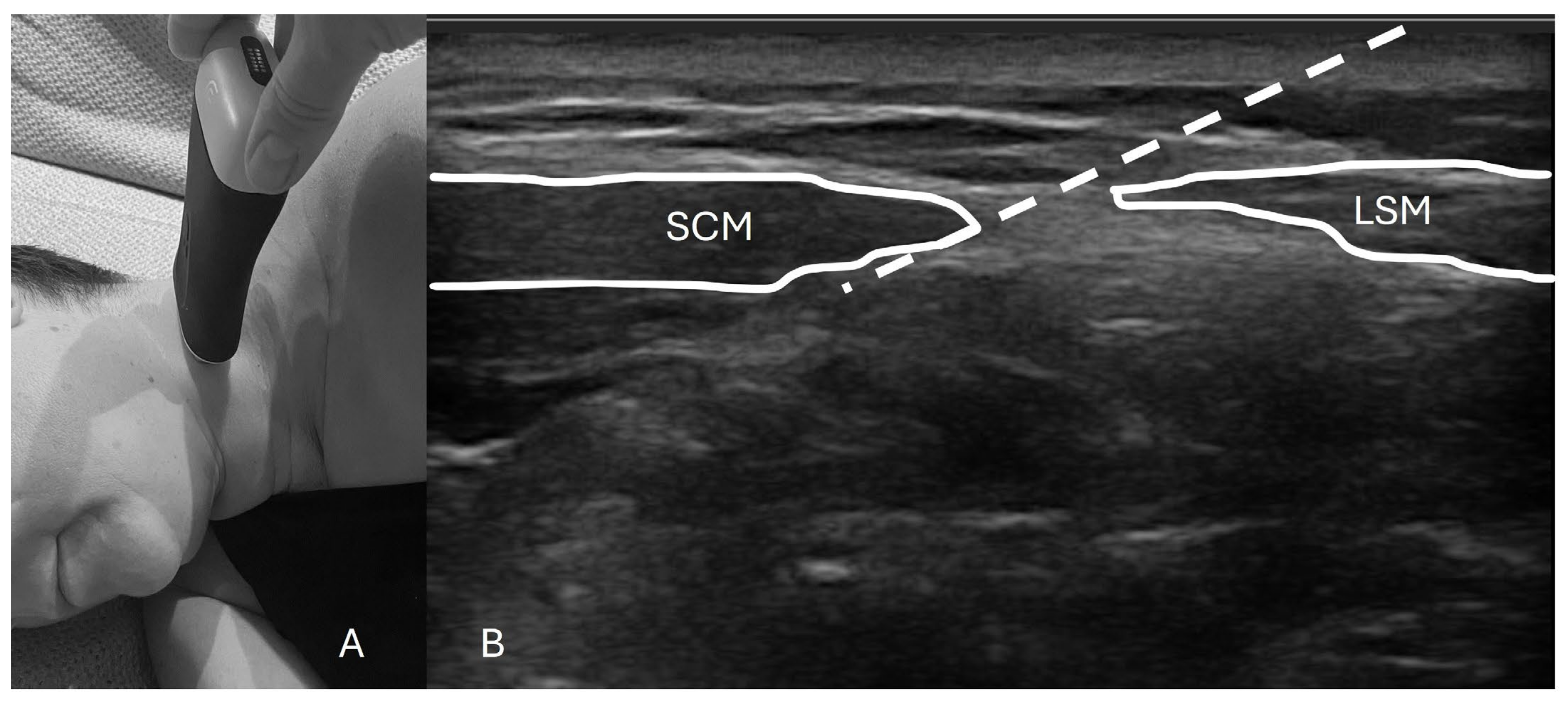
2.2.2. Superficial Cervical Plexus Block Technique
3. Brief Narrative Literature Review
3.1. Anatomical Description
3.2. Indications for SCPB for Acute and Chronic Pain
3.3. Technical Description
3.4. Contraindications, Side Effects, and Potential Complications
3.5. Outcomes
- A case series of patients receiving this block in the emergency department reported that it seemed to be slightly less effective in the alleviation of rotator cuff pain; they hypothesized that this was due to the hybrid innervation of the shoulder area by both the superficial cervical plexus and the brachial plexus, in addition to a certain degree of anatomical variation in nerve distribution and location [10].
- A prospective double-blind clinical trial found that preoperative SCPB for patients undergoing tympano-mastoidectomy was successful in significantly reducing post-operative pain as well as opioid consumption when compared with the control group [28].
- A case of a patient with facial herpes zoster receiving an SCPB reported success in the management of the acute pain yet failure to prevent onset of post-herpetic neuralgia in the same way deeper epidural or paravertebral blocks would [15]. However, an anatomical study by J J Pandit et al. shows that superficial cervical plexus injections tend to spread to the deep space through the porous prevertebral fascia [29]; therefore, there remains the theoretical possibility that the SCPB could be useful in preventing post-herpetic neuralgia, especially with larger quantities of injectate (which come with a slightly increased risk of developing the complications listed above).
4. Clinical Results
4.1. Overview
4.2. Case Characteristics
4.2.1. Pain Distribution and Intensity
4.2.2. Procedure Specifics
4.2.3. Clinical Outcomes
5. Discussion
Author Contributions
Funding
Institutional Review Board Statement
Informed Consent Statement
Data Availability Statement
Acknowledgments
Conflicts of Interest
References
- Cooper, B.C.; Cooper, D.L. Multidisciplinary approach to the differential diagnosis of facial, head and neck pain. J. Prosthet. Dent. 1991, 66, 72–78. [Google Scholar] [CrossRef] [PubMed]
- Dydyk, A.M.; Conermann, T. Chronic Pain. In StatPearls; StatPearls Publishing: Treasure Island, FL, USA, 2024. [Google Scholar]
- The Lancet Regional Health–Americas. Opioid crisis: Addiction, overprescription, and insufficient primary prevention. Lancet Reg. Health Am. 2023, 23, 100557. [Google Scholar] [CrossRef]
- Mehio, A.K.; Shah, S.K. Alleviating head and neck pain. Otolaryngol. Clin. N. Am. 2009, 42, 143–159. [Google Scholar] [CrossRef] [PubMed]
- Sarkar, A.K.; O’Connor, C.M.; Goldstein, R.B. Superficial Cervical Plexus Nerve Block. In Bedside Pain. Management Interventions. In Bedside Pain. Management Interventions; Springer Publishing: New York City, NY, USA, 2022; Chapter 29; pp. 271–279. [Google Scholar]
- Glenesk, N.L.; Kortz, M.W.; Lopez, P.P. Anatomy, Head and Neck, Posterior Cervical Nerve Plexus. In StatPearls; StatPearls Publishing: Treasure Island, FL, USA, 2023. [Google Scholar]
- Hipskind, J.E.; Ahmed, A.A. Cervical Plexus Block. In StatPearls; StatPearls Publishing: Treasure Island, FL, USA, 2023. [Google Scholar]
- Woldegerima, Y.B.; Hailekiros, A.G.; Fitiwi, G.L. The analgesic efficacy of bilateral superficial cervical plexus block for thyroid surgery under general anesthesia: A prospective cohort study. BMC Res. Notes 2020, 13, 42. [Google Scholar] [CrossRef]
- Baran, O.; Kir, B.; Ates, I.; Sahin, A.; Uzturk, A. Combined supraclavicular and superficial cervical plexus block for clavicle surgery. Korean J. Anesthesiol. 2020, 73, 67–70. [Google Scholar] [CrossRef]
- Ho, B.; De Paoli, M. Use of Ultrasound-Guided Superficial Cervical Plexus Block for Pain Management in the Emergency Department. J. Emerg. Med. 2018, 55, 87–95. [Google Scholar] [CrossRef]
- Herring, A.A.; Stone, M.B.; Frenkel, O.; Chipman, A.; Nagdev, A.D. The ultrasound-guided superficial cervical plexus block for anesthesia and analgesia in emergency care settings. Am. J. Emerg. Med. 2012, 30, 1263–1267. [Google Scholar] [CrossRef]
- Flores, S.; Riguzzi, C.; Herring, A.A.; Nagdev, A. Horner’s Syndrome after Superficial Cervical Plexus Block. West. J. Emerg. Med. 2015, 16, 428–431. [Google Scholar] [CrossRef]
- Shin, H.Y.; Kim, D.S.; Kim, S.S. Superficial cervical plexus block for management of herpes zoster neuralgia in the C3 dermatome: A case report. J. Med. Case Rep. 2014, 8, 59. [Google Scholar] [CrossRef]
- Lee, H.; Jeon, Y. Treatment of herpes zoster with ultrasound-guided superficial cervical plexus block. J. Dent. Anesth. Pain. Med. 2015, 15, 247–249. [Google Scholar] [CrossRef][Green Version]
- Park, K.B. Superficial Cervical Plexus Block for Acute Herpes Zoster at C3-4 Dermatome. Keimyung Med. J. 2015, 34, 152–156. [Google Scholar]
- James, A.; Niraj, G. Intermediate Cervical Plexus Block: A Novel Intervention in the Management of Refractory Chronic Neck and Upper Back Pain Following Whiplash Injury: A Case Report. A A Pract. 2020, 14, e01197. [Google Scholar] [CrossRef] [PubMed]
- Thapa, D.; Ahuja, V.; Dhiman, D. Role of superficial cervical plexus block in somatic referred cervical spine pain. Indian. J. Anaesth. 2017, 61, 1012–1014. [Google Scholar] [CrossRef]
- Roelands, S.; Lebrun, C.; Soetens, F. Ultrasound-guided superficial cervical plexus block in the treatment of post-herpetic neuralgia. Pain Pract. 2022, 22, 414–415. [Google Scholar] [CrossRef]
- Niraj, G. Intermediate cervical plexus block in the management of treatment resistant chronic cluster headache following whiplash trauma in three patients: A case series. Scand. J. Pain 2023, 23, 208–212. [Google Scholar] [CrossRef]
- Rawner, E.; Irwin, D.M.; Trescot, A.M. Lesser Occipital Nerve Entrapment. In Peripheral Nerve Entrapments; Springer Publishing: New York City, NY, USA, 2016; Chapter 18; pp. 149–158. [Google Scholar]
- Benton, L.; Trescot, A.M. Great Auricular/Posterior Auricular Nerve Entrapment. In Peripheral Nerve Entrapments; Springer Publishing: New York City, NY, USA, 2016; Chapter 18; pp. 117–126. [Google Scholar]
- Yao, Y.; Lin, C.; He, Q.; Gao, H.; Jin, L.; Zheng, X. Ultrasound-guided bilateral superficial cervical plexus blocks enhance the quality of recovery in patients undergoing thyroid cancer surgery: A randomized controlled trial. J. Clin. Anesth. 2020, 61, 109651. [Google Scholar] [CrossRef]
- Cho, A.R.; Kim, H.K.; Lee, E.A.; Lee, D.H. Airway management in a patient with severe tracheal stenosis: Bilateral superficial cervical plexus block with dexmedetomidine sedation. J. Anesth. 2015, 29, 292–294. [Google Scholar] [CrossRef] [PubMed]
- Li, N.L.; Yu, B.L.; Hung, C.F. Paravertebral Block Plus Thoracic Wall Block versus Paravertebral Block Alone for Analgesia of Modified Radical Mastectomy: A Retrospective Cohort Study. PLoS ONE 2016, 11, e0166227. [Google Scholar] [CrossRef] [PubMed]
- Kim, H.H.; Kim, Y.C.; Park, Y.H.; Park, J.W.; Kim, J.H.; Park, S.Y.; Lee, S.C. Cervicogenic headache arising from hidden metastasis to cervical lymph node adjacent to the superficial cervical plexus—A case report. Korean J. Anesthesiol. 2011, 60, 134–137. [Google Scholar] [CrossRef]
- Nasir, K.S.; Hafeez, H.; Jamshed, A.; Hussain, R.T. Effectiveness of Nerve Blocks for the Management of Head and Neck Cancer Associated Neuropathic Pain Disorders; a Retrospective Study. J. Cancer Allied Spec. 2020, 6, e367. [Google Scholar] [CrossRef]
- Tran, D.Q.; Dugani, S.; Finlayson, R.J. A randomized comparison between ultrasound-guided and landmark-based superficial cervical plexus block. Reg. Anesth. Pain Med. 2010, 35, 539–543. [Google Scholar] [CrossRef] [PubMed]
- Nader Ali Nazemian, Y.; Seyed Khalil, P.; Mehdi, S. Effect of Ultrasound-Guided Superficial Cervical Plexus Block on Severity of Pain After Tympano-Mastoidectomy. Acta Med. Iran. 2022, 60, 418–421. [Google Scholar] [CrossRef]
- Pandit, J.J.; Dutta, D.; Morris, J.F. Spread of injectate with superficial cervical plexus block in humans: An anatomical study. Br. J. Anaesth. 2003, 91, 733–735. [Google Scholar] [CrossRef] [PubMed]
- Zylla, D.; Steele, G.; Gupta, P. A systematic review of the impact of pain on overall survival in patients with cancer. Support. Care Cancer 2017, 25, 1687–1698. [Google Scholar] [CrossRef]
- Andreae, M.H.; Andreae, D.A. Regional anaesthesia to prevent chronic pain after surgery: A Cochrane systematic review and meta-analysis. Br. J. Anaesth. 2013, 111, 711–720. [Google Scholar] [CrossRef]
- Gracely, R.H.; Lynch, S.A.; Bennett, G.J. Painful neuropathy: Altered central processing maintained dynamically by peripheral input. Pain 1992, 51, 175–194. [Google Scholar] [CrossRef]
- Curatolo, M. Regional anesthesia in pain management. Curr. Opin. Anaesthesiol. 2016, 29, 614–619. [Google Scholar] [CrossRef]

| Patient #, Sex, and Age | Pain Diagnosis | Pain Location (Nerve Area) | Initial Severity | Initial Treatment | ||
|---|---|---|---|---|---|---|
| Cancer-Related? | If Cancer-Related | |||||
| Treated? | Treatment-Related? | |||||
| 1—Male, 58 | Yes (non-Hodgkin’s lymphoma) | Yes | Yes | TCN + SCN | Moderate to severe | Topical NSAIDs |
| 2—Female, 56 | No (chronic cervicogenic headaches) | LON | Moderate to severe | Unknown | ||
| 3—Female, 70 | Yes (SCC mandible) | Yes | Yes | GAN + TCN | Unknown | APAP, GBP |
| 4—Female, 67 | Yes (SCC gingival) | Yes | Yes | GAN + TCN + SCN | Moderate to severe | Opioids, GBP |
| 5—Female, 44 | No (post-herpetic neuralgia) | GAN + TCN | Severe | TCA, GBP, SNRIs, NSAIDs, APAP | ||
| 6—Male, 63 | No (first-bite syndrome, parotid pain, treated oropharyngeal tumor) | GAN | Severe | Opioids, NSAIDs, TCA, GBP | ||
| 7—Female, 30 | No (great auricular neuralgia) | GAN | Moderate | Unknown | ||
| 8—Male, 44 | Yes (SCC lateral tongue) | Yes | Yes | GAN | Moderate | NSAIDs, opioids, APAP, GBP |
| 9—Female, 75 | No (post-cyst removal pain behind the ear) | LON | Severe | Opioids, BZD, NSAIDs | ||
| 10—Female, 29 | No (cervical spinal stenosis, spine surgery, SCM tension) | TCN | Severe | Interventional, physiotherapy, SNRIs, GBP, TCA, opioids | ||
| 11—Male, 45 | No (post-frostbite great auricular neuralgia) | GAN | Moderate | GBP, NSAIDs, interventional | ||
| 12—Male, 80 | Yes (SCC gingival) | Yes | Yes | TCN | Severe | GBP, TCA |
| 13—Female, 64 | Yes (SCC tonsil) | Yes | Yes | TCN | Severe | Opioids |
| 14—Female, 44 | No (post-thyroidectomy) | TCN | Severe | GBP | ||
| Patient #, Sex, and Age | Block Specifics | Complications | Post-Block | Post-Block Pharmacological Treatment | Repeat Blocks | ||
|---|---|---|---|---|---|---|---|
| Follow-Up Time | Satisfactory Pain Relief | Needed? | How Many? | ||||
| 1—Male, 58 | Right, bupivacaine, 3 mL | None | 4 months | Yes | Unchanged | No | |
| 2—Female, 56 | Right, lidocaine, 5 mL | None | 6 months | Yes | Unchanged | No | |
| 3—Female, 70 | Left, lidocaine, 5 mL | None | 1 month | Yes | Increased | Yes | 3 |
| 4—Female, 67 | Right, lidocaine, 5 mL | None | 1 month | Yes | Decreased | Yes | 2 |
| 5—Female, 44 | Left, bupivacaine, 5 mL | None | Loss of FU | Loss of FU | Loss of FU | N/A | |
| 6—Male, 63 | Left, bupivacaine, 5 mL | None | Loss of FU | Loss of FU | Loss of FU | N/A | |
| 7—Female, 30 | Left, bupivacaine, 4 mL | None | 7 months | Yes | Unchanged | Yes | 3 |
| 8—Male, 44 | Right, bupivacaine, 5 mL | None | 2 months | Yes | Increased | No | |
| 9—Female, 75 | Right, bupivacaine, 5 mL | None | 1 month | Yes | Increased | Yes | 1 |
| 10—Female, 29 | Right, lidocaine, 3 mL | None | 5 months | Yes | Unchanged | No | |
| 11—Male, 45 | Left, bupivacaine, 5 mL | None | 2 months | Yes | Decreased | No | |
| 12—Male, 80 | Left, bupivacaine, 5 mL | None | 1 month | No | Unchanged | No | |
| 13—Female, 64 | Right, bupivacaine, 5 mL | None | 1 month | Yes | Decreased | No | |
| 14—Female, 44 | Right, bupivacaine, 5 mL | None | 3 months | No | Unchanged | No | |
Disclaimer/Publisher’s Note: The statements, opinions and data contained in all publications are solely those of the individual author(s) and contributor(s) and not of MDPI and/or the editor(s). MDPI and/or the editor(s) disclaim responsibility for any injury to people or property resulting from any ideas, methods, instructions or products referred to in the content. |
© 2024 by the authors. Licensee MDPI, Basel, Switzerland. This article is an open access article distributed under the terms and conditions of the Creative Commons Attribution (CC BY) license (https://creativecommons.org/licenses/by/4.0/).
Share and Cite
Zako, J.; Perez, J. Unlocking the Potential of the Superficial Cervical Plexus Block in Chronic Pain Management: A Narrative Review and Single-Center, Retrospective Case Series. J. Clin. Med. 2024, 13, 6310. https://doi.org/10.3390/jcm13216310
Zako J, Perez J. Unlocking the Potential of the Superficial Cervical Plexus Block in Chronic Pain Management: A Narrative Review and Single-Center, Retrospective Case Series. Journal of Clinical Medicine. 2024; 13(21):6310. https://doi.org/10.3390/jcm13216310
Chicago/Turabian StyleZako, Joe, and Jordi Perez. 2024. "Unlocking the Potential of the Superficial Cervical Plexus Block in Chronic Pain Management: A Narrative Review and Single-Center, Retrospective Case Series" Journal of Clinical Medicine 13, no. 21: 6310. https://doi.org/10.3390/jcm13216310
APA StyleZako, J., & Perez, J. (2024). Unlocking the Potential of the Superficial Cervical Plexus Block in Chronic Pain Management: A Narrative Review and Single-Center, Retrospective Case Series. Journal of Clinical Medicine, 13(21), 6310. https://doi.org/10.3390/jcm13216310

