


Performance of Hybrid Photocatalytic-Ceramic Membrane System for the Treatment of Secondary Effluent


Abstract
1. Introduction
2. Materials and Methods
2.1. Materials
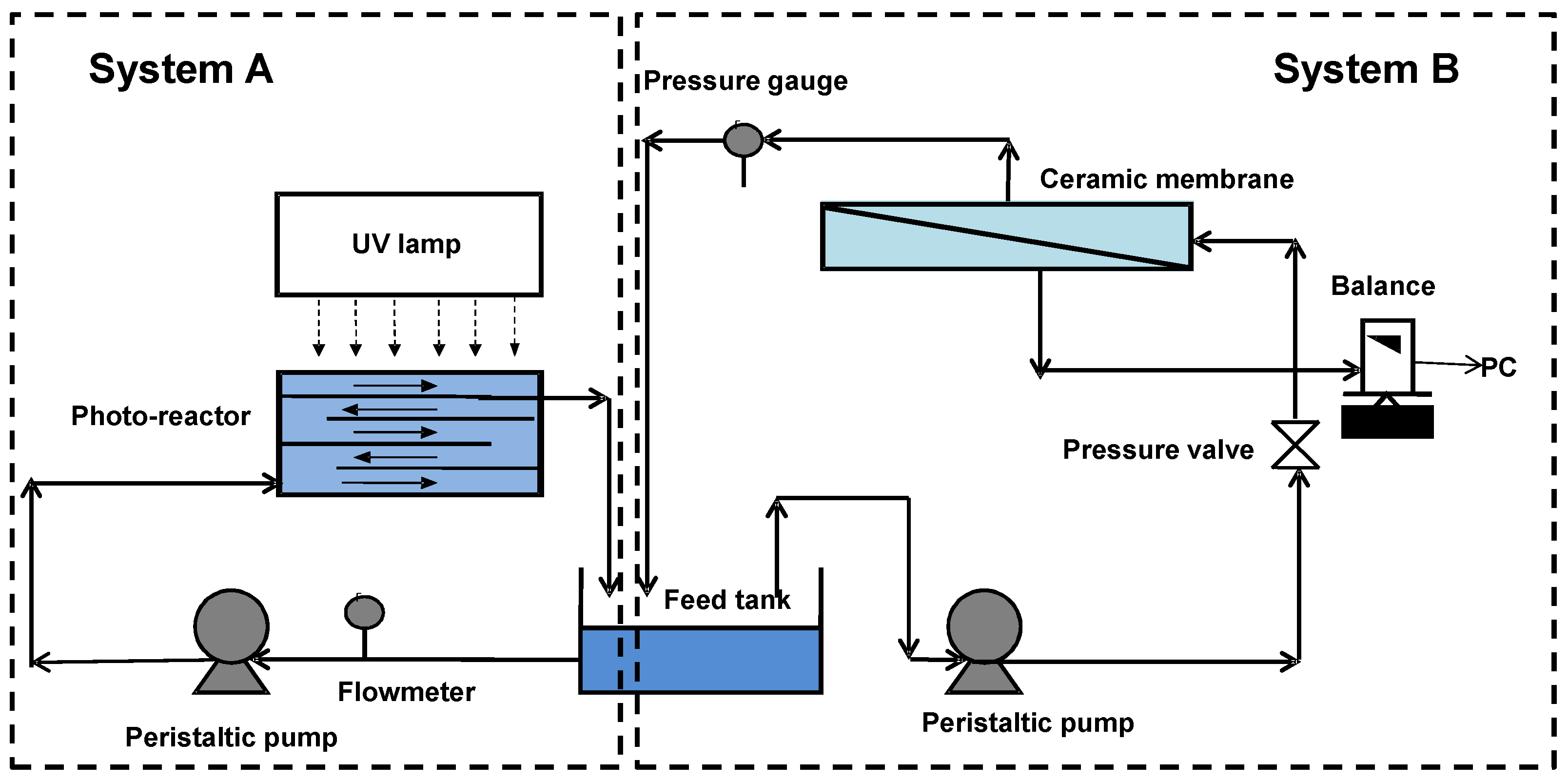
2.2. Apparatus
2.3. Experimental Procedures
2.4. Analyses
2.4.1. DOC and UV254 Measurements
2.4.2. LC-OCD Analysis
3. Results and Discussion
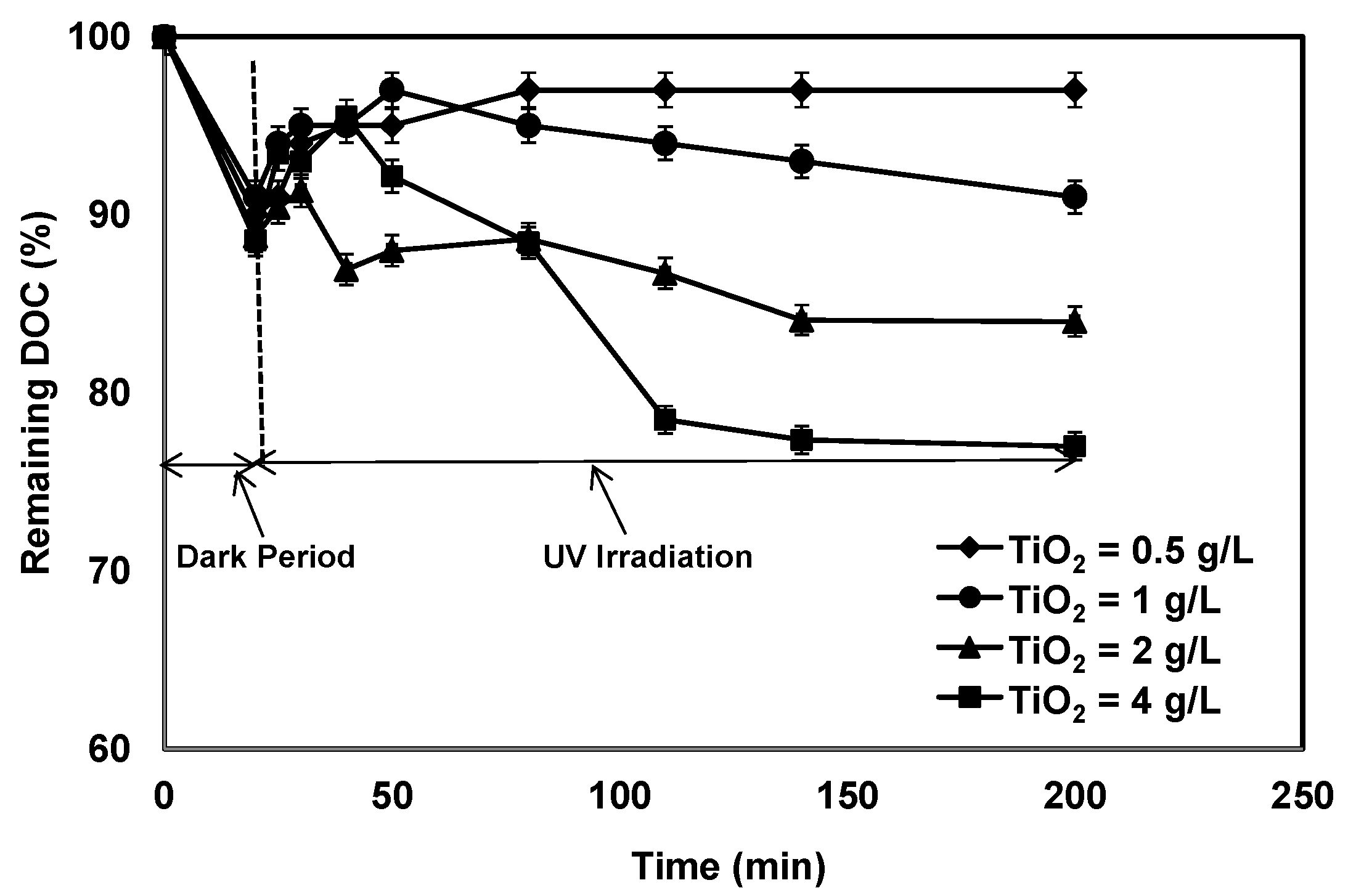
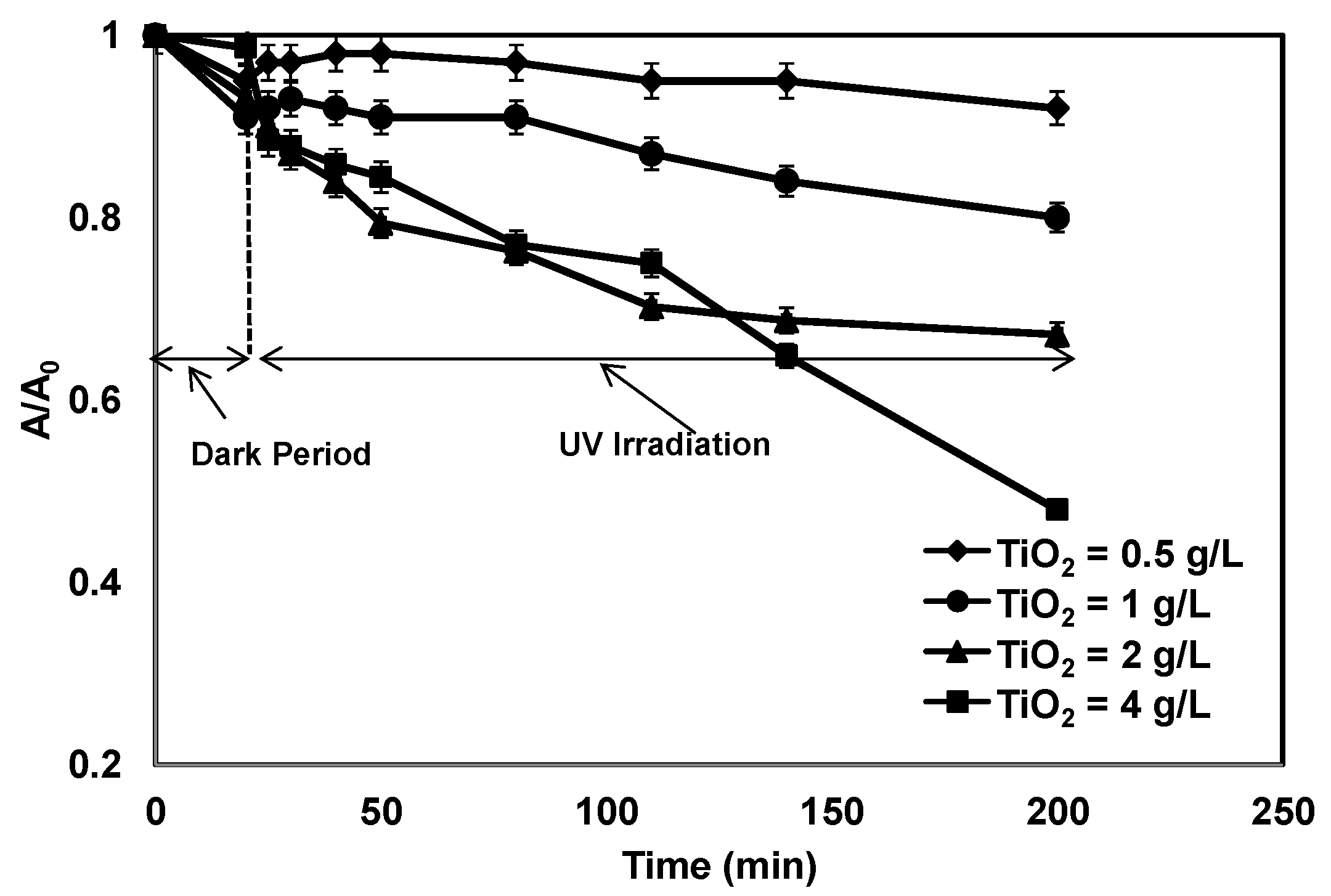
3.1. Effect of TiO2 Concentration on Photocatalytic Treatment
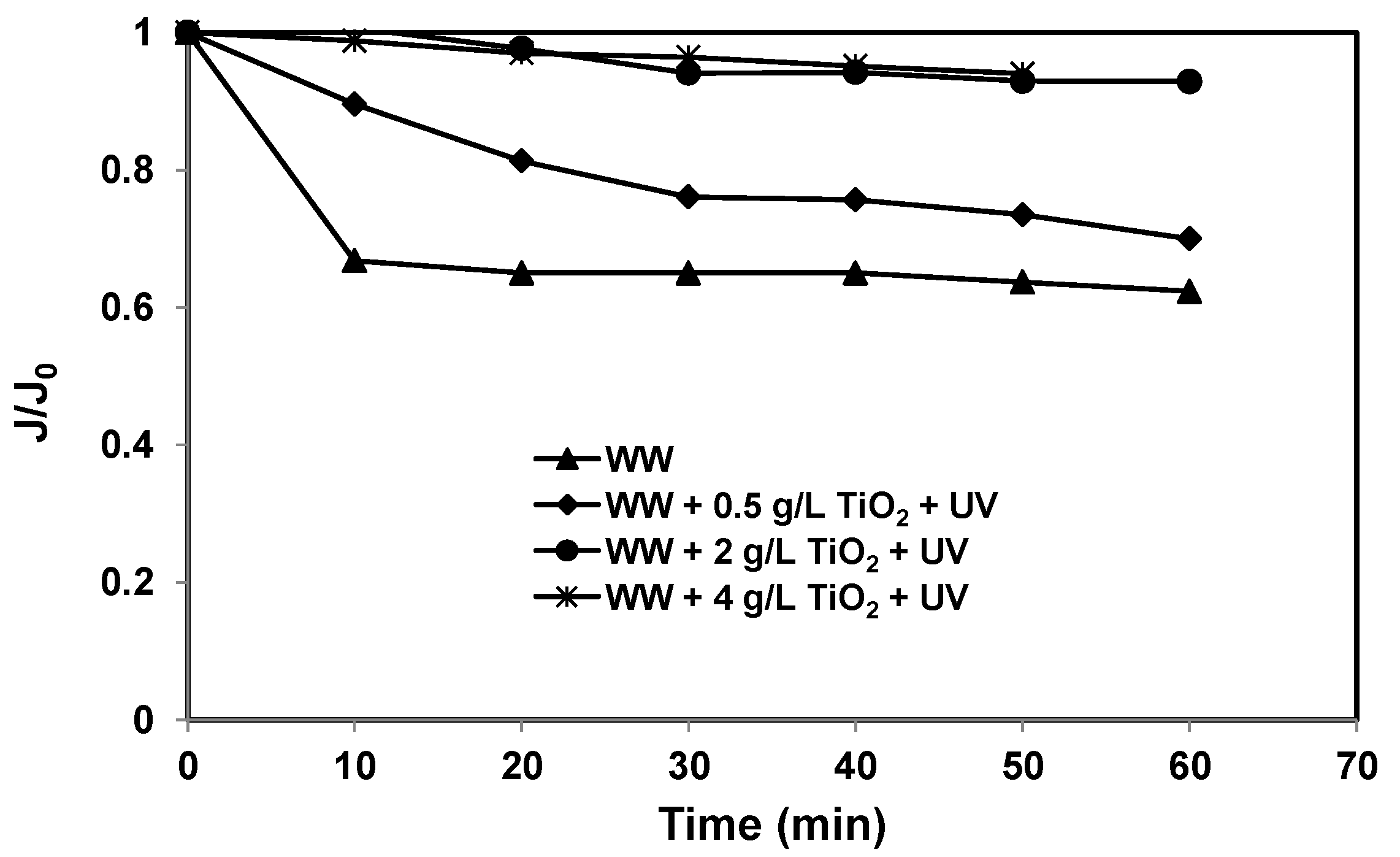
3.2. Effects of TiO2 Slurry Concentration on Membrane Flux and DOC and UV254 Removal
3.3. LC-OCD Analysis
4. Conclusions
Acknowledgments
Author Contributions
Conflicts of Interest
References
- Puspita, P.; Roddick, F.A.; Porter, N.A. Decolourisation of secondary effluent by UV-mediated processes. Chem. Eng. J. 2011, 171, 464–473. [Google Scholar] [CrossRef] [Scilit]
- Mills., A.; Lee., S.-K. A web-based overview of semiconductor photochemistry-based current commercial applications. J. Photochem. Photobiol. A: Chem. 2002, 152, 233–247. [Google Scholar] [CrossRef] [Scilit]
- Patsios, S.I.; Sarasidis, V.C.; Karabelas, A.J. A hybrid photocatalysis–ultrafiltration continuous process for humic acids degradation. Sep. Purif. Technol. 2013, 104, 333–341. [Google Scholar] [CrossRef] [Scilit]
- Shon, H.K.; Vigneswaran, S.; Ngo, H.H.; Kim, J.H. Chemical coupling of photocatalysis with flocculation and adsorption in the removal of organic matter. Water Res. 2005, 39, 2549–2558. [Google Scholar] [CrossRef] [Scilit] [PubMed]
- Shon, H.K.; Phuntsho, S.; Vigneswaran, S. Effect of photocatalysis on the membrane hybrid system for wastewater treatment. Desalination 2008, 225, 235–248. [Google Scholar] [CrossRef] [Scilit]
- Ho, D.P.; Vigneswaran, S.; Ngo, H.H. Photocatalysis-membrane hybrid system for organic removal from biologically treated sewage effluent. Sep. Purif. Technol. 2009, 68, 145–152. [Google Scholar] [CrossRef] [Scilit]
- Mozia, S.; Morawski, A.W. Hybridization of photocatalysis and membrane distillation for purification of wastewater. Catal. Today 2006, 118, 181–188. [Google Scholar] [CrossRef] [Scilit]
- Muthukumaran, S.; Song, L.; Zhu, B.; Myat, D.; Chen, J.-Y.; Gray, S.; Duke, M. UV/TiO2 photocatalytic oxidation of recalcitrant organic matter: Effect of salinity and pH. Water Sci. Technol. 2014, 70, 437–443. [Google Scholar] [CrossRef] [Scilit] [PubMed]
- Lee, S.-A.; Choo, K.-H.; Lee, C.-H.; Lee, H.-I. Use of ultrafiltration membranes for the separation of TiO2 photocatalysts in drinking water treatment. Ind. Eng. Chem. Res. 2001, 40, 1712–1719. [Google Scholar] [CrossRef] [Scilit]
- Lin, C.; Lin, K.S. Photocatalytic oxidation of toxic organohalides with TiO2/UV: The effects of humic substances and organic mixtures. Chemosphere 2007, 66, 1872–1877. [Google Scholar] [CrossRef] [Scilit] [PubMed]
- Le-Clech, P.; Lee, E.K.; Chen, V. Hybrid photocatalysis/membrane treatment for surface waters containing low concentrations of natural organic matters. Water Res. 2006, 40, 323–330. [Google Scholar] [CrossRef] [Scilit] [PubMed]
- Kim, M.-J.; Choo, K.-H.; Park, H.-S. Photocatalytic degradation of seawater organic matter using a submerged membrane reactor. J. Photochem. Photobiol. A: Chem. 2010, 216, 215–220. [Google Scholar] [CrossRef] [Scilit]
- Pidou, M.; Parsons, S.A.; Raymond, G.; Jeffrey, P.; Stephenson, T.; Jefferson, B. Fouling control of a membrane coupled photocatalytic process treating greywater. Water Res. 2009, 43, 3932–3939. [Google Scholar] [CrossRef] [Scilit] [PubMed]
- Muthukumaran, S.; Nguyen, D.A.; Baskaran, K. Performance evaluation of different ultrafiltration membranes for the reclamation and reuse of secondary effluent. Desalination 2011, 279, 383–389. [Google Scholar] [CrossRef] [Scilit]
- Lehman, S.G.; Liu, L. Application of ceramic membranes with pre-ozonation for treatment of secondary wastewater effluent. Water Res. 2009, 43, 2020–2028. [Google Scholar] [CrossRef] [Scilit] [PubMed]
- Benotti, M.J.; Stanford, B.D.; Wert, E.C.; Snyder, S.A. Evaluation of a photocatalytic reactor membrane pilot system for the removal of pharmaceuticals and endocrine disrupting compounds from water. Water Res. 2009, 43, 1513–1522. [Google Scholar] [CrossRef] [Scilit] [PubMed]
- Konstantinou, I.K.; Albanis, T.A. TiO2-assisted photocatalytic degradation of azo dyes in aqueous solution: Kinetic and mechanistic investigations. Appl. Catal. B: Environ. 2004, 49, 1–14. [Google Scholar] [CrossRef] [Scilit]
- Kormann, C.; Bahnemann, D.W.; Hoffmann, M.R. Photolysis of chloroform and other organic molecules in aqueous suspensions. Environ. Sci. Technol. 1991, 25. [Google Scholar] [CrossRef] [Scilit]
- Butler, E.C.; Davis, A.P. Photocatalytic oxidation in aqueous titanium dioxide suspensions: The influence of dissolved transition metals. J. Photochem. Photobiol. A: Chem. 1993, 70, 273–283. [Google Scholar] [CrossRef] [Scilit]
- Yawalkar, A.A.; Bhatkhande, D.S.; Pangarkar, V.G.; Beenackers, A.A.C.M. Solar assisted photochemical and photocatalytic degradation of phenol. J. Chem.Technol. Biotechnol 2001, 76, 363–370. [Google Scholar] [CrossRef] [Scilit]
- Xi, W.; Geissen, S.U. Separation of titanium dioxide from photo catalytically treated water by cross-flow microfiltration. Water Res. 2001, 35, 1256–1262. [Google Scholar] [CrossRef] [Scilit]
- Abdullah, M.; Low., G.K.-C.; Matthews, R.W. Effects of common inorganic anions on rates of photocatalytic oxidation of organic carbon over illuminated titanium dioxide. J. Phys. Chem. 1990, 94, 6820–6825. [Google Scholar] [CrossRef] [Scilit]
- Wang, C.; Zhu, L.; Wei, M.; Chen, P.; Shan, G. Photolytic reaction mechanism and impacts of coexisting substances on photodegradation of bisphenol a by Bi2WO6 in water. Water Res. 2012, 46, 845–853. [Google Scholar] [CrossRef] [Scilit] [PubMed]
- Song, L.; Zhu, B.; Gray, S.; Duke, M.; Muthukumaran, S. Hybrid processes combining photocatalysis and ceramic membrane filtration for degradation of humic acids in saline water. Membranes 2016, 6, 18. [Google Scholar] [CrossRef] [Scilit] [PubMed]
- Huang, X.; Leal, M.; Li, Q. Degradation of natural organic matter by TiO2 photocatalytic oxidation and its effect on fouling of low-pressure membranes. Water Res. 2008, 42, 1142–1150. [Google Scholar] [CrossRef] [Scilit] [PubMed]
- Kaneco, S.; Rahman, M.A.; Suzuki, T.; Katsumata, H.; Ohta, K. Optimization of solar photocatalytic degradation conditions of bisphenol a in water using titanium dioxide. J. Photochem. Photobiol. A: Chem. 2004, 163, 419–424. [Google Scholar] [CrossRef] [Scilit]
- Ates, N.; Kitis, M.; Yetis, U. Formation of chlorination by-products in waters with low SUVA—correlations with SUVA and differential UV spectroscopy. Water Res. 2007, 41, 4139–4148. [Google Scholar] [CrossRef] [Scilit] [PubMed]
- González, O.; Justo, A.; Bacardit, J.; Ferrero, E.; Malfeito, J.J.; Sans, C. Characterization and fate of effluent organic matter treated with UV/H2O2 and ozonation. Chem. Eng. J. 2013, 226, 402–408. [Google Scholar] [CrossRef] [Scilit]
- Liu, S.; Lim, M.; Fabris, R.; Chow, C.W.; Drikas, M.; Korshin, G.; Amal, R. Multi-wavelength spectroscopic and chromatography study on the photocatalytic oxidation of natural organic matter. Water Res. 2010, 44, 2525–2532. [Google Scholar] [CrossRef] [Scilit] [PubMed]
- Laabs, C.; Amy, G.; Jekel, M. Understanding the size and character of fouling-causing substances from effluent organic matter (EfOM) in low-pressure membrane filtration. Environ. Sci. Technol. 2006, 40, 4495–4499. [Google Scholar] [CrossRef] [Scilit] [PubMed]
- Wang, K.-H.; Hsieh, Y.-H.; Chen, L.-J. The heterogeneous photocatalytic degradation, intermediates and mineralization for the aqueous solution of cresols and nitrophenols. J. Hazard. Mater. 1998, 59, 251–260. [Google Scholar] [CrossRef] [Scilit]

| Parameters | Disinfected Secondary Effluent |
|---|---|
| pH | 7.5–7.6 |
| Conductivity (µS/cm) | 1700–1800 |
| Dissolved Organic Carbon (DOC) mg/L | 9–10 |
| Total Dissolved Solids (TDS) (mg/L) | 1000–1100 |
| UV 254 (cm−1) | 0.16–0.17 |
| True Colour (Pt-Co) | 25–27 |
| Turbidity (NTU) | 1.9–2.0 |
| Alkalinity (Bicarbonate Alkalinity (mg CaCO3/L)) | 120 * |
| Sulphate (mg/L) | 94 * |
| Calcium (mg/L) | 31 * |
| Magnesium (mg/L) | 26 * |
| Potassium (mg/L) | 27 * |
| Sodium (mg/L) | 271 * |
| Chloride (mg/L) | 420 * |
| Ammonia (mg/L) | 0.2 * |
| Total Nitrogen (mg/) | 11 * |
| Total Phosphorus (mg/L) | 9 * |
| Experimental Conditions | After Photocatalysis | After Hybrid System | ||
|---|---|---|---|---|
| DOC Removal (%) | UV 254 Removal (%) | DOC Removal (%) | UV 254 Removal (%) | |
| 0.5 g/L TiO2 | 3 | 2 | 18 | 10 |
| 2 g/L TiO2 | 16 | 33 | 36 | 52 |
| 4 g/L TiO2 | 23 | 52 | 60 | 54 |
© 2017 by the authors. Licensee MDPI, Basel, Switzerland. This article is an open access article distributed under the terms and conditions of the Creative Commons Attribution (CC BY) license (http://creativecommons.org/licenses/by/4.0/).
Share and Cite
Song, L.; Zhu, B.; Gray, S.; Duke, M.; Muthukumaran, S. Performance of Hybrid Photocatalytic-Ceramic Membrane System for the Treatment of Secondary Effluent. Membranes 2017, 7, 20. https://doi.org/10.3390/membranes7020020
Song L, Zhu B, Gray S, Duke M, Muthukumaran S. Performance of Hybrid Photocatalytic-Ceramic Membrane System for the Treatment of Secondary Effluent. Membranes. 2017; 7(2):20. https://doi.org/10.3390/membranes7020020
Chicago/Turabian StyleSong, Lili, Bo Zhu, Stephen Gray, Mikel Duke, and Shobha Muthukumaran. 2017. "Performance of Hybrid Photocatalytic-Ceramic Membrane System for the Treatment of Secondary Effluent" Membranes 7, no. 2: 20. https://doi.org/10.3390/membranes7020020
APA StyleSong, L., Zhu, B., Gray, S., Duke, M., & Muthukumaran, S. (2017). Performance of Hybrid Photocatalytic-Ceramic Membrane System for the Treatment of Secondary Effluent. Membranes, 7(2), 20. https://doi.org/10.3390/membranes7020020

