Perspective

Hypoxia as a Central Regulator of Plasma Membrane Phosphohydrolase Enzymes: Possible Roles in Extracellular Phosphate Generation and Adenosine Metabolism

by
Pedro Henrique Silva de Oliveira
1,2,
Beatriz Bereda Silva-Freitas
1,2,
José Roberto Meyer-Fernandes
1,* and
Marco Antonio Lacerda-Abreu
1,2,*
1
Instituto de Bioquímica Médica Leopoldo de Meis, Centro de Ciências da Saúde, Universidade Federal do Rio de Janeiro, Rio de Janeiro 21941-590, RJ, Brazil
2
Departamento de Bioquímica, Instituto de Biologia Roberto Alcantara Gomes (IBRAG), Universidade Do Estado Do Rio de Janeiro, Rio de Janeiro 20550-013, RJ, Brazil
*
Authors to whom correspondence should be addressed.
Membranes 2025, 15(12), 381; https://doi.org/10.3390/membranes15120381
Submission received: 24 October 2025 / Revised: 9 December 2025 / Accepted: 12 December 2025 / Published: 15 December 2025

Abstract

This article presents a conceptual perspective proposing that hypoxia acts as a unifying regulator of plasma membrane phosphohydrolases. We propose that oxygen sensing at the cell surface integrates adenosine and phosphate metabolism to sustain tumour adaptation. Within the oxygen- and nutrient-deprived tumour microenvironment, inorganic phosphate (Pi) and adenosine function as metabolic substrates and signalling mediators that promote cell proliferation, survival, and immune evasion. Stabilisation of hypoxia-inducible factor-1α (HIF-1α) enhances the expression and catalytic activity of specific phosphohydrolases, notably the ectonucleotidases CD39 (NTPDase1) and CD73 (ecto-5′-nucleotidase), which drive adenosine accumulation and immunosuppression. Conversely, the activity of transmembrane prostatic acid phosphatase (TM-PAP), responsible for hydrolysing phosphate esters such as p-nitrophenylphosphate (pNPP) and AMP, is inhibited under hypoxia through oxidative and kinase-dependent mechanisms. Collectively, these mechanisms characterise the plasma membrane as a dynamic metabolic interface, where oxygen sensing coordinates adenosine and phosphate turnover, thereby promoting tumour adaptation across hypoxic environments. We propose that hypoxia orchestrates a dual regulatory loop connecting adenosine accumulation and phosphate turnover at the tumour cell surface, providing a conceptual basis for future mechanistic studies.

1. Introduction

Hypoxia frequently develops within solid tumours as a consequence of uncontrolled cell proliferation and inadequate vascular perfusion [1]. It represents a defining characteristic of the tumour microenvironment and has been associated with metabolic reprogramming, angiogenesis, invasion, and therapeutic resistance [2,3]. Persistent hypoxic signalling enables tumour cells to withstand metabolic stress and to acquire more aggressive phenotypes [2]. Despite extensive progress in the field, the complex nature of these signalling networks still limits a comprehensive understanding of their molecular mechanisms and hinders the development of effective therapeutic strategies [1]. As oxygen availability decreases, extracellular nucleotide metabolism is markedly affected, altering the catalytic activity of plasma membrane-associated enzymes responsible for the regulation of purinergic signalling within the tumour microenvironment. In this context, HIF-1α stabilisation may also occur through ROS-dependent mechanisms associated with enhanced oxidative metabolism, contributing to pseudo-hypoxic signalling and variability in tumour responses [4].
The tumour microenvironment (TME) constitutes a decisive component in cancer development and progression [5]. In hypoxic regions, it represents a dynamic interface where tumour, stromal, and immune cells interact under continuous metabolic and mechanical constraints. In this context, purinergic signalling assumes a regulatory role largely mediated by extracellular adenosine triphosphate (ATP), which is released by virtually all cell types in response to both physiological and pathological stimuli [6]. Under normal physiological conditions, extracellular ATP levels remain within the nanomolar range [7]; however, within the TME, these concentrations may reach several hundred micromolar, reflecting substantial metabolic and structural remodelling during tumour progression [6,7].
The homeostasis of extracellular ATP is strictly controlled by plasma membrane-bound ectonucleotidases and ectophosphatases, collectively designated ectophosphohydrolases, which display distinct substrate specificities [5]. These enzymes include (a) ectonucleoside triphosphate diphosphohydrolases (ENTPDases), responsible for the hydrolysis of nucleotide triphosphates (NTPs) and diphosphates (NDPs); (b) ectonucleotide pyrophosphatase/phosphodiesterases (E-NPPs), which catalyse NTP hydrolysis and, in the case of NPP2, dephosphorylate ATP, ADP, AMP, and PPi; (c) ecto-5′-nucleotidase (E-5NT), which converts nucleotide monophosphates (NMPs) into nucleosides; (d) alkaline phosphatases (ALPs), which act on a wide range of phosphorylated substrates, including NTPs, NDPs, NMPs, and PPi; and (e) acid ectophosphatases, which hydrolyse organic phosphomonoesters and phosphoproteins [5,8,9].
Although the roles of purinergic signalling and hypoxia-driven metabolic adaptation have been extensively examined, the molecular interconnection between oxygen deprivation and the regulation of surface phosphohydrolases remains poorly elucidated. These enzymes operate as metabolic sensors that couple extracellular phosphate and nucleotide turnover to the cellular response under hypoxic stress, thereby promoting tumour adaptation and immune modulation. Here, we advance a unifying hypothesis proposing that hypoxia-driven modulation of plasma membrane phosphohydrolases establishes a regulatory loop linking extracellular phosphate release to adenosine accumulation. This mechanistic interpretation provides insight into how oxygen availability influences extracellular metabolism and tumour adaptation. We acknowledge that baseline ectoenzyme expression, tissue-specific phosphate metabolism, stromal composition, immune infiltrate, and hypoxia kinetics differ substantially across tumour types. To illustrate this conceptual model, we summarise evidence from different cancer types in which hypoxia-driven phosphohydrolase activity contributes to adenosine accumulation and phosphate dynamics.

2. Non-Small Lung Cancer

Lung tumours represent one of the most hypoxic types of human malignancies, where oxygen deprivation profoundly reprogrammes both metabolic and immune dynamics. In non-small cell lung cancer (NSCLC), hypoxia activates adaptive molecular pathways that promote cell survival, stemness, and resistance to therapeutic interventions [10]. These effects are mainly orchestrated by the transcription factor HIF-1α, which regulates a broad set of genes involved in angiogenesis, metabolic reorganisation, and immune evasion [10].
In this context, it has been demonstrated that hypoxia significantly enhances the immunosuppressive properties of myeloid-derived suppressor cells (MDSCs) through HIF-1α-dependent upregulation of the ectonucleotidases CD39 and CD73 [11]. By employing peripheral blood and tumour specimens from patients with NSCLC, in parallel with in vitro assays using MDSCs and A549 lung adenocarcinoma cells, the authors observed that both chemical (CoCl2) and physiological (1.5% O2) hypoxia strongly induced CD39 and CD73 expression (Figure 1) [11]. Pharmacological inhibition of HIF-1α with MeoE2 suppressed this effect (Table 1).
Complementing these immunological observations, another study provided additional evidence for the metabolic component of adenosinergic regulation in NSCLC [12]. Exposure of A549 and H1299 cells to 1% O2 for 48 h resulted in a marked increase in CD73 mRNA and protein expression, particularly in A549 cells, which was accompanied by the upregulation of lactate dehydrogenase A (LDHA), a key enzyme driving anaerobic glycolysis (Table 1) [12]. Activation of LDHA enhanced glycolytic ATP production, part of which was released into the extracellular milieu, serving as a substrate for CD73-mediated AMP hydrolysis and subsequent adenosine generation [12].
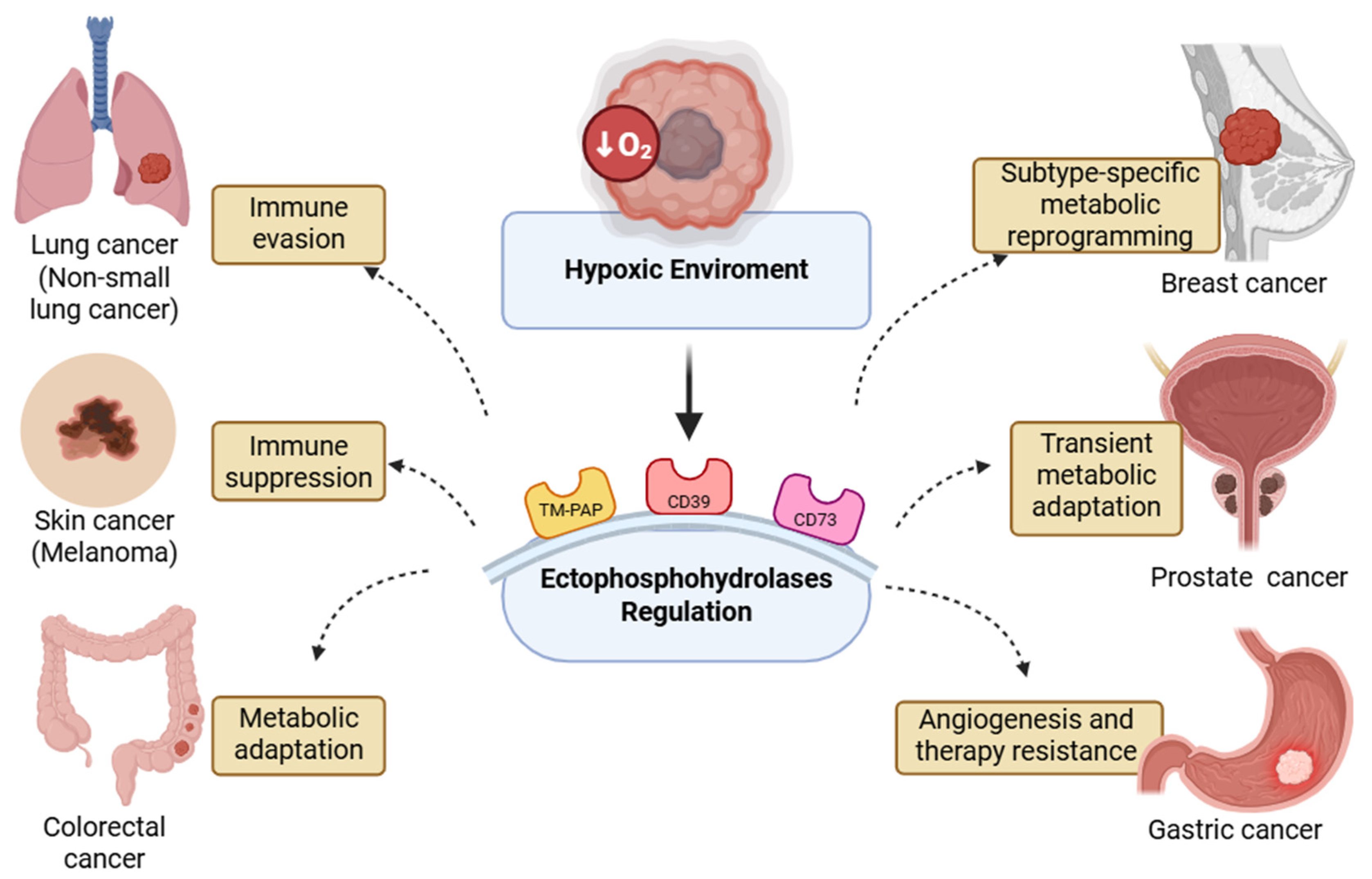
Taken together, these results support the perspective that HIF-1α-driven induction of ectonucleotidases and LDHA-mediated glycolytic adaptation may represent interlinked processes within a hypoxia-regulated circuit. Such coordination between adenosine metabolism and energy reprogramming could underlie the establishment of an immunosuppressive, therapy-resistant tumour microenvironment (Figure 2).

3. Colorectal Cancer

Colorectal cancer represents one of the most common and lethal malignancies worldwide and is distinguished by pronounced tumour heterogeneity and remarkable metabolic adaptability. Within its microenvironment, hypoxia constitutes a major determinant of malignant progression, promoting epithelial-to-mesenchymal transition, angiogenesis, and immune evasion [20,21]. In metastatic colorectal cancer (mCRC), the hypoxic milieu profoundly alters adenosine metabolism, thereby influencing disease progression and modulating therapeutic responsiveness (Figure 2) [13].
Accumulating molecular evidence indicates that HIF-1α transcriptionally regulates a subset of plasma membrane ectophosphohydrolases, including CD39 and CD73, which catalyse the sequential hydrolysis of extracellular ATP into adenosine, concomitantly releasing Pi [13] (Figure 1). The resultant accumulation of adenosine exerts dual effects: it suppresses cytotoxic lymphocyte activity and promotes endothelial proliferation, collectively favouring a pro-angiogenic and immunosuppressive microenvironment (Table 1) [13].
In addition to these mechanistic insights, a pharmacogenomic analysis encompassing 451 patients with mCRC enrolled in the FIRE-3 and TRIBE clinical trials revealed that single-nucleotide polymorphisms (SNPs) in genes associated with adenosine metabolism correlate with treatment outcome [13]. The CD39 rs11188513 C allele was linked to reduced overall and progression-free survival among patients receiving bevacizumab, implicating enhanced adenosinergic activity in resistance to VEGF blockade. Conversely, the CD73 rs2229523 A allele and the A2BR rs2015353 T/T genotype were associated with improved prognosis, suggesting that genetic variation within this pathway modulates vascular and immune responses [13]. Interestingly, the prognostic trend was inverted in cohorts treated with cetuximab, indicating that adenosine-related polymorphisms may influence therapeutic efficacy according to the predominant signalling axis engaged [13].

4. Breast Cancer

In aggressive breast tumours, such as triple-negative breast cancer (TNBC), oxygen deprivation amplifies adenosinergic signalling, thereby sustaining proliferation, motility, and immune evasion through the coordinated activity of CD39, CD73, and additional phosphohydrolases [14]. Within this heterogeneous disease, hypoxia induces subtype-specific metabolic and enzymatic adaptations that modulate extracellular nucleotide turnover and reconfigure immune escape mechanisms [14,22].
Under hypoxic conditions (1–5% O2), a significant upregulation of CD73 expression has been observed in both murine (4T1) and human (MDA-MB-231) cells, concomitant with increased HIF-1α transcriptional activity, suggesting a cooperative regulatory interaction [14]. Enhanced CD73 expression under hypoxia is associated with increased cell viability, whereas pharmacological inhibition with APCP or gene silencing attenuates this effect (Table 1) [14]. Although hypoxia alone does not substantially modify basal migratory capacity, inhibition of CD73 significantly reduces motility under both normoxic and hypoxic conditions. Furthermore, orthotopic implantation of 4T1 cells confirmed that CD73 silencing diminishes tumour growth, expression of EMT markers, and pulmonary metastasis [14].
Consistent with these findings, further evidence indicates that hypoxia preferentially amplifies adenosinergic signalling in more aggressive phenotypes [15]. When non-metastatic BT-474 (luminal A) and highly metastatic MDA-MB-231 (triple-negative) cells were exposed to 25 µM CoCl2 for 24 h, expression of CD39 and CD73 increased markedly, exhibiting a more pronounced induction in MDA-MB-231 cells (1.93-fold and 13.37-fold, respectively) compared with BT-474 cells (1.66-fold and 1.60-fold, respectively) (Table 1) [15]. This coordinated upregulation is associated with accelerated ATP hydrolysis and extracellular adenosine accumulation, contributing to immunosuppressive features within the tumour microenvironment [15].
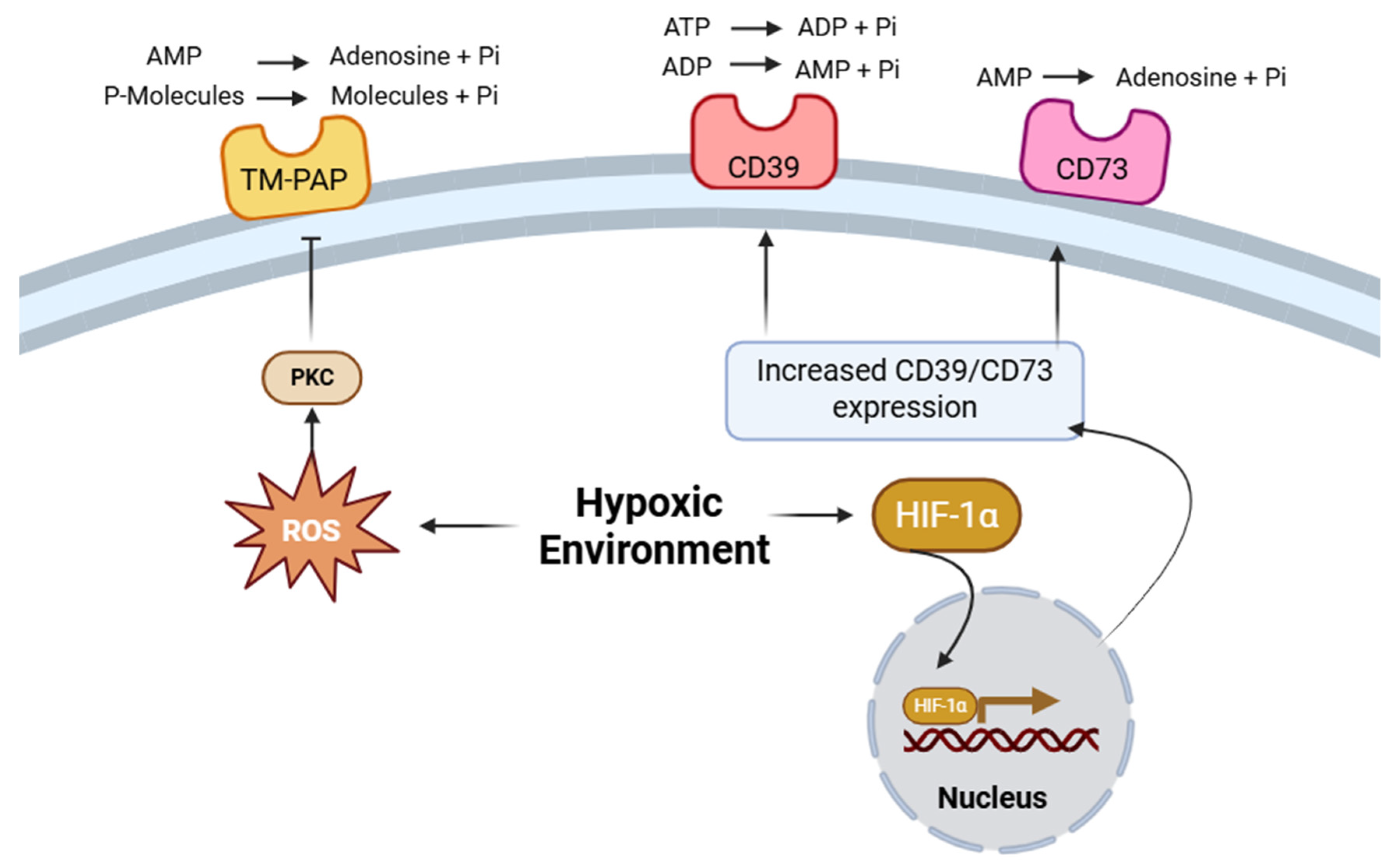
Beyond the regulation of ectonucleotidases, hypoxia also affects the catalytic activity of surface phosphohydrolases involved in the control of extracellular phosphate homeostasis [16]. In luminal A breast cancer cells (MCF-7), short-term hypoxia (5% O2 for 1 h) results in a marked reduction in transmembrane prostatic acid phosphatase (TM-PAP) activity (Table 1) [16]. This enzyme catalyses the hydrolysis of phosphate esters, such as p-nitrophenylphosphate (pNPP) and AMP, thereby regulating phosphate and adenosine availability within the tumour microenvironment. Under hypoxic stress, ectophosphatase activity decreases significantly without impairing cell viability. This effect has been attributed to hydrogen peroxide (H2O2) accumulation, which oxidises and inhibits TM-PAP. The use of reactive oxygen species (ROS) scavengers restores enzyme activity, confirming oxidative inhibition as the primary regulatory mechanism. Moreover, activation of protein kinase C (PKC) further modulates TM-PAP through phosphorylation-dependent suppression (Figure 1) [16].
Collectively, these findings can be interpreted as evidence that hypoxia orchestrates the complementary regulation of ectonucleotidases and ectophosphatases in breast cancer, aligning adenosine and phosphate metabolism with the adaptive demands of tumour cells. Reduced oxygen availability appears to enhance adenosine production via CD39 and CD73 in aggressive subtypes, while transiently suppressing TM-PAP activity in luminal cells. This coordinated regulation exemplifies the proposed model in which hypoxia acts as a central determinant linking metabolic plasticity, immune modulation, and signalling reprogramming across breast cancer subtypes.

5. Prostate Cancer

Prostate tumours arise within fluctuating oxygen gradients that exert a profound influence on their purine metabolism and enzymatic profile [17,23]. Under hypoxic conditions, stabilisation of hypoxia-inducible factors triggers compensatory pathways that tightly regulate extracellular nucleotide turnover, prominently involving the ectonucleotidase CD73 (Figure 1). This enzyme establishes a functional association between oxygen sensing and increased extracellular adenosine availability [17,23].
Consistent with findings reported in breast tumours, hypoxia also modulates purinergic enzyme activity in prostate carcinoma, supporting its role as a universal regulator of surface phosphohydrolases [17]. In PC3 prostate cancer cells, acute hypoxia (1% O2 for 24 h) markedly enhances both the expression and catalytic activity of CD73, the enzyme responsible for the hydrolysis of extracellular AMP to adenosine. This regulatory effect appears to be selective, as other ectoenzymes involved in nucleotide metabolism, including NPP1 and adenosine deaminase (ADA), remain unaffected. Upon reoxygenation, CD73 expression and activity return to basal levels, revealing a reversible and oxygen-dependent regulatory mechanism that dynamically adjusts extracellular adenosine availability (Table 1 and Figure 2) [17].
In xenograft models, hypoxia-induced adenosine accumulation predominantly contributes to the early adaptive phase of tumour establishment, with minimal influence on subsequent tumour expansion. This transient response highlights the association between CD73-mediated modulation of extracellular metabolism and early hypoxic adaptation [17].

6. Melanoma

Among cutaneous malignancies, melanoma displays an extraordinary ability to adapt to hypoxic stress [24]. Oxygen deprivation sustains angiogenic and metabolic reprogramming while simultaneously remodelling the immune microenvironment through enhanced adenosine generation mediated by the ectonucleotidases CD39 and CD73. The accumulation of adenosine establishes an immunosuppressive niche that favours tumour persistence and progression (Figure 2) [18].
Recent findings indicate that hypoxia not only regulates ectoenzyme expression in tumour cells but also profoundly modulates their expression within immune compartments. In CD8+ T lymphocytes, exposure to low oxygen tension (~1.5% O2) markedly increases CD39 expression via HIF-1α-dependent transcriptional activation (Table 1) [18]. Deletion of HIF-1α completely abolishes this induction, confirming its direct regulatory role (Figure 1), whereas pharmacological alleviation of hypoxia reduces CD39 expression and restores T-cell effector activity. The subsequent reactivation of antitumour immunity enhances responsiveness to immunotherapeutic intervention [18]. It should be noted that, in melanoma, this evidence is currently supported by a single experimental study.

7. Gastric Cancer

The hypoxic microenvironment characteristic of gastric tumours serves as a potent inducer of metabolic and transcriptional adaptation [25]. Exposure of gastric cancer cell lines (BGC-823, HGC-27, and SGC-7901) to hypoxia (1% O2) or chemical hypoxia induced by CoCl2 markedly increases CD73 (ecto-5′-nucleotidase) expression through HIF-1α-dependent transcriptional activation (Table 1) [19]. Chromatin immunoprecipitation assays have demonstrated that HIF-1α directly binds to the promoter region of the CD73 gene, establishing a mechanistic link between oxygen sensing and adenosine metabolism [19] (Figure 1).
Functionally, CD73 activity sustains the Warburg phenotype by promoting glycolytic ATP release and extracellular adenosine formation, two complementary mechanisms that collectively enhance angiogenesis, immune evasion, and metabolic plasticity in oxygen-limited conditions. This coordinated response defines HIF-1α-driven CD73 induction as a pivotal mechanism underlying hypoxic adaptation and therapeutic resistance in gastric cancer [19]. At present, this conclusion is based on a single experimental study.

8. Conclusions

In this perspective, we propose that hypoxia orchestrates a dual regulatory axis controlling adenosine and phosphate metabolism through the modulation of plasma membrane phosphohydrolases. This integrated mechanism delineates a regulatory loop that sustains tumour cell adaptation under oxygen limitation. Across solid tumours, hypoxia emerges as a central determinant of extracellular metabolic reprogramming, modulating the activity of plasma membrane-associated phosphohydrolases that maintain adenosine and phosphate homeostasis. Under low oxygen tension, HIF-1α-driven upregulation of the ectonucleotidases CD39 and CD73 promotes adenosine accumulation, establishing an immunosuppressive and pro-survival microenvironment, while oxidative inhibition of transmembrane prostatic acid phosphatase (TM-PAP) alters phosphate dynamics at the cell surface.
Collectively, these observations support a conceptual model in which this response is empirically linked to hypoxia, whereas phosphatase-dependent modulation of extracellular phosphate remains a partially supported and still speculative dimension. This conceptual framework positions ectophosphohydrolases as candidate mediators of hypoxic adaptation and as potential metabolic biomarkers and therapeutic targets in cancer. Future investigations should explore the temporal coordination between CD39/CD73 induction and TM-PAP inhibition during hypoxic–reoxygenation cycles, considering tumour-specific differences in baseline ectoenzyme expression, phosphate handling, immune composition, and hypoxia dynamics.

Author Contributions

Conceptualization, P.H.S.d.O., B.B.S.-F., J.R.M.-F. and M.A.L.-A.; investigation, P.H.S.d.O., B.B.S.-F., J.R.M.-F. and M.A.L.-A.; resources, J.R.M.-F. and M.A.L.-A.; data curation, P.H.S.d.O., B.B.S.-F., J.R.M.-F. and M.A.L.-A.; writing—original draft preparation, P.H.S.d.O., B.B.S.-F., J.R.M.-F. and M.A.L.-A.; writing—review and editing, P.H.S.d.O., B.B.S.-F., J.R.M.-F. and M.A.L.-A.; visualization, P.H.S.d.O. and B.B.S.-F.; supervision, J.R.M.-F. and M.A.L.-A.; project administration, J.R.M.-F. and M.A.L.-A.; funding acquisition, J.R.M.-F. and M.A.L.-A. All authors have read and agreed to the published version of the manuscript.

Funding

This work was supported by grants from the Brazilian agencies Conselho Nacional de Desenvolvimento Científico e Tecnológico (CNPq—Grant Number: 304763/2021-7), Coordenação de Aperfeiçoamento de Pessoal de Nível Superior (CAPES—Grant Number: 0012017) and Fundação Carlos Chagas Filho de Amparo à Pesquisa do Estado do Rio de Janeiro (FAPERJ—Grant Number: e-26/150.042/2023 to JRM-F; e-26/210.516/2025—SEI—60003/004592/2025 to M.A.L.-A.).

Institutional Review Board Statement

Not applicable.

Informed Consent Statement

Not applicable.

Data Availability Statement

No new data were generated or analysed in this study. All data discussed are available within the cited literature.

Conflicts of Interest

The authors declare no conflicts of interest.

Abbreviations

The following abbreviations are used in this manuscript:
ADAAdenosine deaminase
ADPAdenosine diphosphate
ALPAlkaline phosphatase
AMPAdenosine monophosphate
APCPAminophenylmethyl diphosphonate (CD73 inhibitor)
ATPAdenosine triphosphate
BALB/cMouse strain used for orthotopic transplantation
BT-474Human luminal A breast cancer cell line
BGC-823Human gastric carcinoma cell line
CDCluster of differentiation
CD39Ectonucleoside triphosphate diphosphohydrolase 1 (ENTPD1)
CD73Ecto-5′-nucleotidase (E-5NT; NT5E)
CoCl2Cobalt(II) chloride (chemical hypoxia inducer)
EMTEpithelial–mesenchymal transition
ENTPDaseEctonucleoside triphosphate diphosphohydrolase
E-NPPEctonucleotide pyrophosphatase/phosphodiesterase
E-5NTEcto-5′-nucleotidase
H2O2Hydrogen peroxide
HCCHepatocellular carcinoma
HGC-27Human gastric carcinoma cell line
HIF-1αHypoxia-inducible factor-1α
LDHALactate dehydrogenase A
MCF-7Human luminal A breast cancer cell line
MDA-MB-231Human triple-negative breast cancer cell line
MDSCMyeloid-derived suppressor cell
mCRCMetastatic colorectal cancer
MeoE22-Methoxyestradiol (HIF-1α inhibitor)
NDPNucleoside diphosphate
NMPNucleoside monophosphate
NPP1Ectonucleotide pyrophosphatase/phosphodiesterase 1
NSCLCNon-small cell lung cancer
NTPNucleoside triphosphate
O2Molecular oxygen
pNPPp-Nitrophenylphosphate
PiInorganic phosphate
PKCProtein kinase C
PPiInorganic pyrophosphate
ROSReactive oxygen species
SGC-7901Human gastric carcinoma cell line
SNPSingle-nucleotide polymorphism
TMETumour microenvironment
TM-PAPTransmembrane prostatic acid phosphatase
TNBCTriple-negative breast cancer
VEGFVascular endothelial growth factor
4T1Murine mammary carcinoma cell line

References

  1. Chen, Z.; Han, F.; Du, Y.; Shi, H.; Zhou, W. Hypoxic microenvironment in cancer: Molecular mechanisms and therapeutic interventions. Signal Transduct. Target. Ther. 2023, 8, 70. [Google Scholar] [CrossRef]
  2. Muz, B.; de la Puente, P.; Azab, F.; Azab, A.K. The role of hypoxia in cancer progression, angiogenesis, metastasis, and resistance to therapy. Hypoxia 2015, 3, 83–92. [Google Scholar] [CrossRef]
  3. Gilkes, D.M.; Semenza, G.L.; Wirtz, D. Hypoxia and the extracellular matrix: Drivers of tumour metastasis. Nat. Rev. Cancer 2014, 14, 430–439. [Google Scholar] [CrossRef]
  4. Castelli, S.; Ciccarone, F.; Tavian, D.; Ciriolo, M.R. ROS-dependent HIF-1α activation under forced lipid catabolism entails glycolysis and mitophagy as mediators of higher proliferation rate in cervical cancer cells. J. Exp. Clin. Cancer Res. 2021, 40, 94. [Google Scholar] [CrossRef] [PubMed]
  5. Lacerda-Abreu, M.A.; Meyer-Fernandes, J.R. Inorganic phosphate (Pi) in the breast cancer microenvironment: Production, transport and signal transduction as potential targets for anticancer strategies. Curr. Cancer Drug Targets 2023, 23, 187–198. [Google Scholar] [CrossRef]
  6. Falzoni, S.; Donvito, G.; Di Virgilio, F. Detecting adenosine triphosphate in the pericellular space. Interface Focus 2013, 3, 20120101. [Google Scholar] [CrossRef] [PubMed]
  7. Trabanelli, S.; Ocadlíková, D.; Gulinelli, S.; Curti, A.; Salvestrini, V.; Vieira, R.P.; Idzko, M.; Di Virgilio, F.; Ferrari, D.; Lemoli, R.M. Extracellular ATP exerts opposite effects on activated and regulatory CD4+ T cells via purinergic P2 receptor activation. J. Immunol. 2012, 189, 1303–1310. [Google Scholar] [CrossRef] [PubMed]
  8. Zimmermann, H. Prostatic acid phosphatase, a neglected ectonucleotidase. Purinergic Signal. 2009, 5, 273–275. [Google Scholar] [CrossRef]
  9. Zimmermann, H. Extracellular ATP and other nucleotides—Ubiquitous triggers of intercellular messenger release. Purinergic Signal. 2016, 12, 25–57. [Google Scholar] [CrossRef]
  10. Yan, F.; Teng, Y.; Li, X.; Zhong, Y.; Li, C.; Yan, F.; He, X. Hypoxia promotes non-small cell lung cancer cell stemness, migration, and invasion via promoting glycolysis by lactylation of SOX9. Cancer Biol. Ther. 2024, 25, 2304161. [Google Scholar] [CrossRef]
  11. Li, J.; Wang, L.; Chen, X.; Li, L.; Li, Y.; Ping, Y.; Huang, L.; Yue, D.; Zhang, Z.; Wang, F.; et al. CD39/CD73 upregulation on myeloid-derived suppressor cells via TGF-β-mTOR-HIF-1 signaling in patients with non-small cell lung cancer. Oncoimmunology 2017, 6, e1320011. [Google Scholar] [CrossRef]
  12. Giatromanolaki, A.; Kouroupi, M.; Pouliliou, S.; Mitrakas, A.; Hasan, F.; Pappa, A.; Koukourakis, M.I. Ectonucleotidase CD73 and CD39 expression in non-small cell lung cancer relates to hypoxia and immunosuppressive pathways. Life Sci. 2020, 259, 118389. [Google Scholar] [CrossRef]
  13. Tokunaga, R.; Cao, S.; Naseem, M.; Lo, J.H.; Battaglin, F.; Puccini, A.; Berger, M.D.; Soni, S.; Millstein, J.; Zhang, W.; et al. Prognostic effect of adenosine-related genetic variants in metastatic colorectal cancer treated with bevacizumab-based chemotherapy. Clin. Color. Cancer 2019, 18, e8–e19. [Google Scholar] [CrossRef]
  14. Petruk, N.; Tuominen, S.; Åkerfelt, M.; Mattsson, J.; Sandholm, J.; Nees, M.; Yegutkin, G.G.; Jukkola, A.; Tuomela, J.; Selander, K.S. CD73 facilitates EMT progression and promotes lung metastases in triple-negative breast cancer. Sci. Rep. 2021, 11, 6035. [Google Scholar] [CrossRef]
  15. Maralbashi, S.; Aslan, C.; Kahroba, H.; Asadi, M.; Soltani-Zangbar, M.S.; Haghnavaz, N.; Jadidi, F.; Salari, F.; Kazemi, T. Docosahexaenoic acid (DHA) impairs hypoxia-induced cellular and exosomal overexpression of immune checkpoints and immunomodulatory molecules in different subtypes of breast cancer cells. BMC Nutr. 2024, 10, 41. [Google Scholar] [CrossRef]
  16. Lacerda-Abreu, M.A.; Carvalho-Kelly, L.F.; Meyer-Fernandes, J.R. Hypoxia modulates transmembrane prostatic acid phosphatase (TM-PAP) in MCF-7 breast cancer cells. Int. J. Mol. Sci. 2025, 26, 1918. [Google Scholar] [CrossRef] [PubMed]
  17. Losenkova, K.; Zuccarini, M.; Karikoski, M.; Laurila, J.; Boison, D.; Jalkanen, S.; Yegutkin, G.G. Compartmentalization of adenosine metabolism in cancer cells and its modulation during acute hypoxia. J. Cell Sci. 2020, 133, jcs241463. [Google Scholar] [CrossRef]
  18. Vignali, P.D.A.; DePeaux, K.; Watson, M.J.; Ye, C.; Ford, B.R.; Lontos, K.; McGaa, N.K.; Scharping, N.E.; Menk, A.V.; Robson, S.C.; et al. Hypoxia drives CD39-dependent suppressor function in exhausted T cells to limit antitumor immunity. Nat. Immunol. 2023, 24, 267–279. [Google Scholar] [CrossRef]
  19. Cao, X.; Zhu, Z.; Cao, Y.; Hu, J.; Min, M. CD73 is a hypoxia-responsive gene and promotes the Warburg effect of human gastric cancer cells dependent on its enzyme activity. J. Cancer 2021, 12, 6372–6382. [Google Scholar] [CrossRef] [PubMed]
  20. Tanaka, A.; Ogawa, M.; Zhou, Y.; Namba, K.; Hendrickson, R.C.; Miele, M.M.; Li, Z.; Klimstra, D.S.; Buckley, P.G.; Gulcher, J.; et al. Proteogenomic characterization of primary colorectal cancer and metastatic progression identifies proteome-based subtypes and signatures. Cell Rep. 2024, 43, 113810. [Google Scholar] [CrossRef] [PubMed]
  21. Huang, A.; Sun, Z.; Hong, H.; Yang, Y.; Chen, J.; Gao, Z.; Gu, J. Novel hypoxia- and lactate metabolism-related molecular subtyping and prognostic signature for colorectal cancer. J. Transl. Med. 2024, 22, 587. [Google Scholar] [CrossRef] [PubMed]
  22. Zhi, S.; Chen, C.; Huang, H.; Zhang, Z.; Zeng, F.; Zhang, S. Hypoxia-inducible factor in breast cancer: Role and target for breast cancer treatment. Front. Immunol. 2024, 15, 1370800. [Google Scholar] [CrossRef] [PubMed]
  23. Mohamed, O.A.A.; Tesen, H.S.; Hany, M.; Sherif, A.; Abdelwahab, M.M.; Elnaggar, M.H. The role of hypoxia on prostate cancer progression and metastasis. Mol. Biol. Rep. 2023, 50, 3873–3884. [Google Scholar] [CrossRef] [PubMed]
  24. Jeon, S.; Jeon, M.; Choi, S.; Yoo, S.; Park, S.; Lee, M.; Kim, I. Hypoxia in skin cancer: Molecular basis and clinical implications. Int. J. Mol. Sci. 2023, 24, 4430. [Google Scholar] [CrossRef]
  25. Wei, Z.; Li, J.; Zhong, L.; Yang, D.; Li, W.; Chen, W.; Zhou, H.; He, Y.; Song, W.; Wang, B.; et al. DDR1 drives malignant progression of gastric cancer by suppressing HIF-1α ubiquitination and degradation. Adv. Sci. 2024, 11, e2308395. [Google Scholar] [CrossRef]
Figure 1. Schematic representation of the proposed hypoxia-driven regulatory loop integrating adenosine and phosphate metabolism at the tumour cell surface. Hypoxia stabilises HIF-1α, which enhances CD39/CD73 expression and adenosine generation, while reactive oxygen species (ROS) and PKC-dependent signalling inhibit TM-PAP, thereby modulating phosphate turnover. This integrated regulation exemplifies the proposed model in which oxygen sensing coordinates extracellular metabolism and supports tumour adaptation.
Membranes 15 00381 g001
Figure 2. Conceptual overview of the proposed hypoxia-driven regulatory loop across tumour types. This integrative model links HIF-1α activation to adenosine accumulation and phosphate modulation, illustrating a unifying mechanism of tumour adaptation.
Membranes 15 00381 g002
Table 1. Hypoxia-induced regulation of ectophosphohydrolases across cancer types.
Cancer TypeModelEctoenzymeHypoxia ConditionsMain FindingsReference
Non-small cell lung cancer (NSCLC)Patient blood and tumour samples; MDSCs and A549 cellsCD39, CD73CoCl2; 1.5% O2HIF-1α activation upregulated CD39/CD73 on MDSCs, enhancing immunosuppression and chemoresistance independently of mTOR.[11]
A549 and H1299 cellsCD731% O2, 48 hHypoxia increased CD73 and LDHA, reinforcing adenosine production and immune evasion.[12]
Colorectal cancerFIRE-3 and TRIBE clinical trials (n = 451 patients)CD39, CD73Not experimentally inducedCD39/CD73 polymorphisms correlated with survival under bevacizumab; the HIF-1α–adenosine pathway is linked to VEGF-blockade resistance.[13]
Breast cancer4T1 and MDA-MB-231 cells; BALB/c miceCD731–5% O2Hypoxia elevated CD73 expression and EMT; CD73 inhibition reduced migration, viability, and lung metastases.[14]
BT-474 and MDA-MB-231 cellsCD39, CD73CoCl2 (25 µM, 24 h)Hypoxia upregulated CD39/CD73, predominantly in TNBC, promoting immune evasion.[15]
MCF-7 cellsTM-PAP5% O2, 1 hHypoxia reduced ectophosphatase activity (pNPP and AMP hydrolysis) via H2O2 generation and PKC activation.[16]
Prostate cancerPC3 cells; xenografts in SCID miceCD731% O2 (≤24 h); reoxygenation 1 hHypoxia doubled CD73 activity and AMP hydrolysis; NPP1 and ADA were unchanged; high ecto5′nucleotidase activity occurred in hypoxic xenografts.[17]
MelanomaB16-F10 murine model; T cells in vitroCD391.5% O2HIF-1α-dependent CD39 expression on exhausted CD8+ T cells enhanced immunosuppression; hypoxia relief restored immunity.[18]
Gastric cancerBGC-823, HGC-27, SGC-7901 cells; xenograftsCD731% O2 or CoCl2HIF-1α-mediated CD73 induction promoted adenosine production and the Warburg effect, enhancing tumour growth.[19]
Notes: HIF-1α = hypoxia-inducible factor-1α; MDSCs = myeloid-derived suppressor cells; ADA = adenosine deaminase; NPP1 = ectonucleotide pyrophosphatase/phosphodiesterase 1; TM-PAP = transmembrane prostatic acid phosphatase; PKC = protein kinase C; TNBC = triple-negative breast cancer.
Disclaimer/Publisher’s Note: The statements, opinions and data contained in all publications are solely those of the individual author(s) and contributor(s) and not of MDPI and/or the editor(s). MDPI and/or the editor(s) disclaim responsibility for any injury to people or property resulting from any ideas, methods, instructions or products referred to in the content.