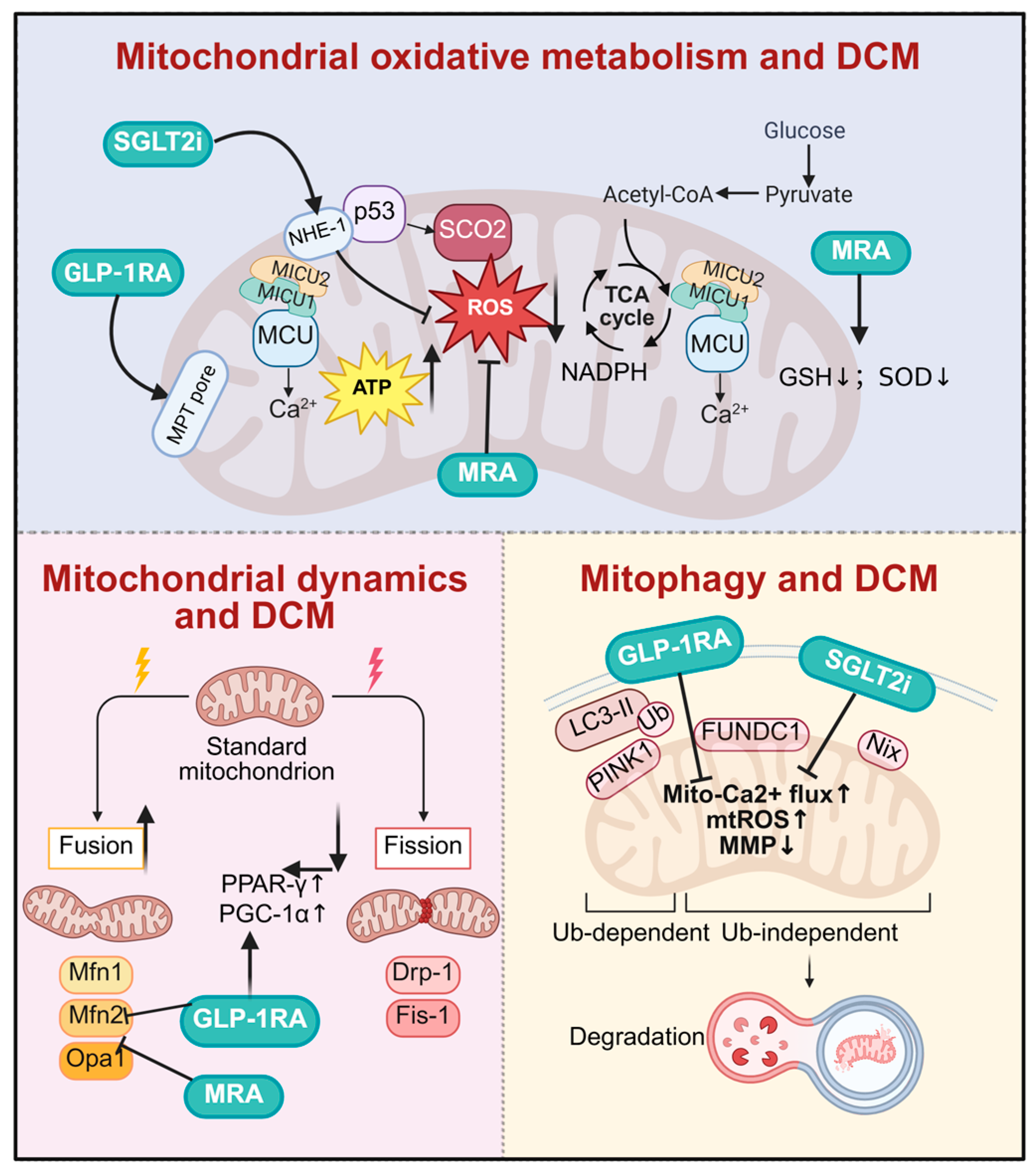
Mitochondrial Homeostasis in Diabetic Cardiomyopathy: From Dysfunction to Therapeutic Strategies
Abstract
1. Introduction
2. Mitochondrial Homeostasis
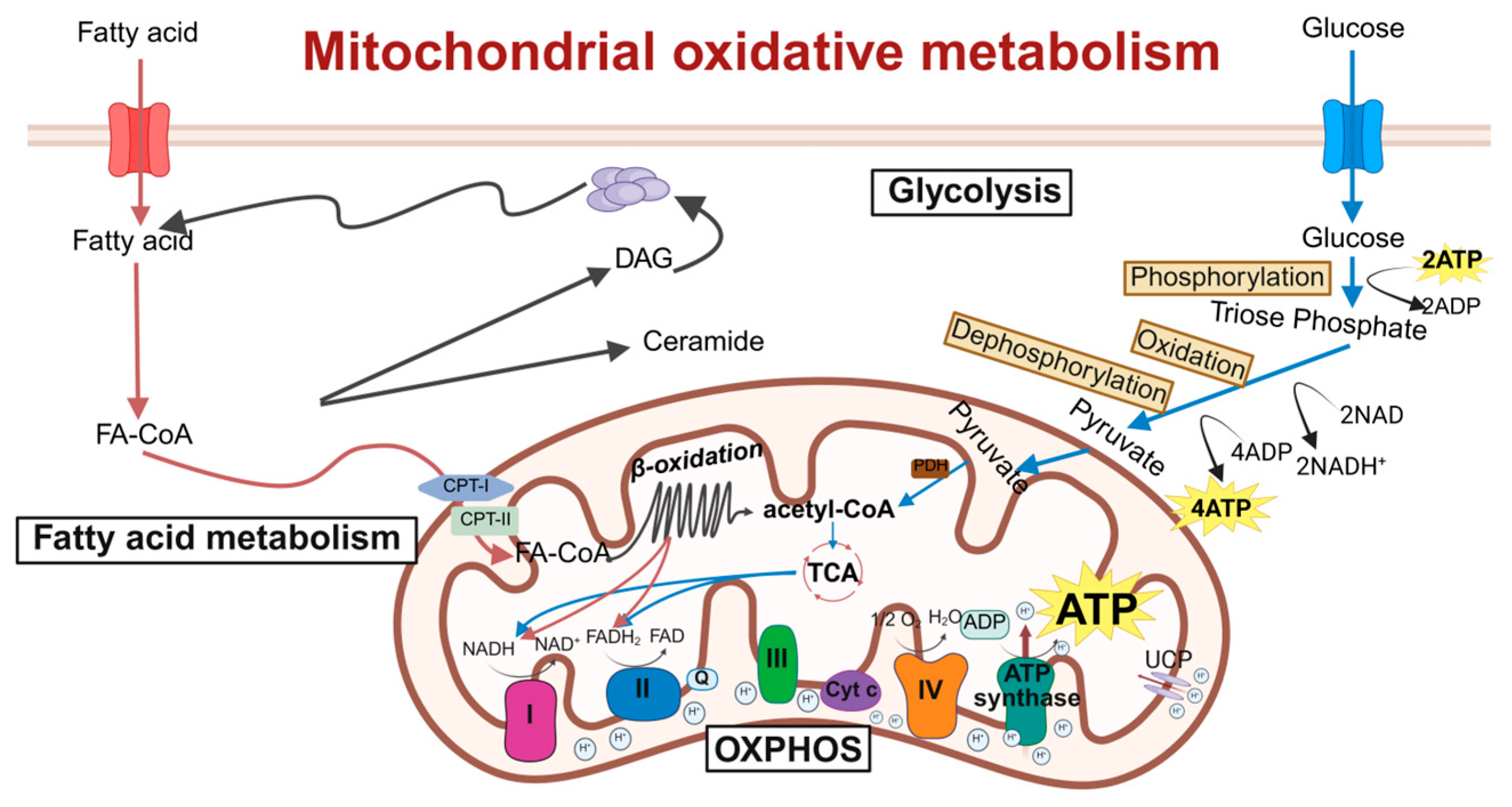
2.1. Mitochondrial Oxidative Metabolism
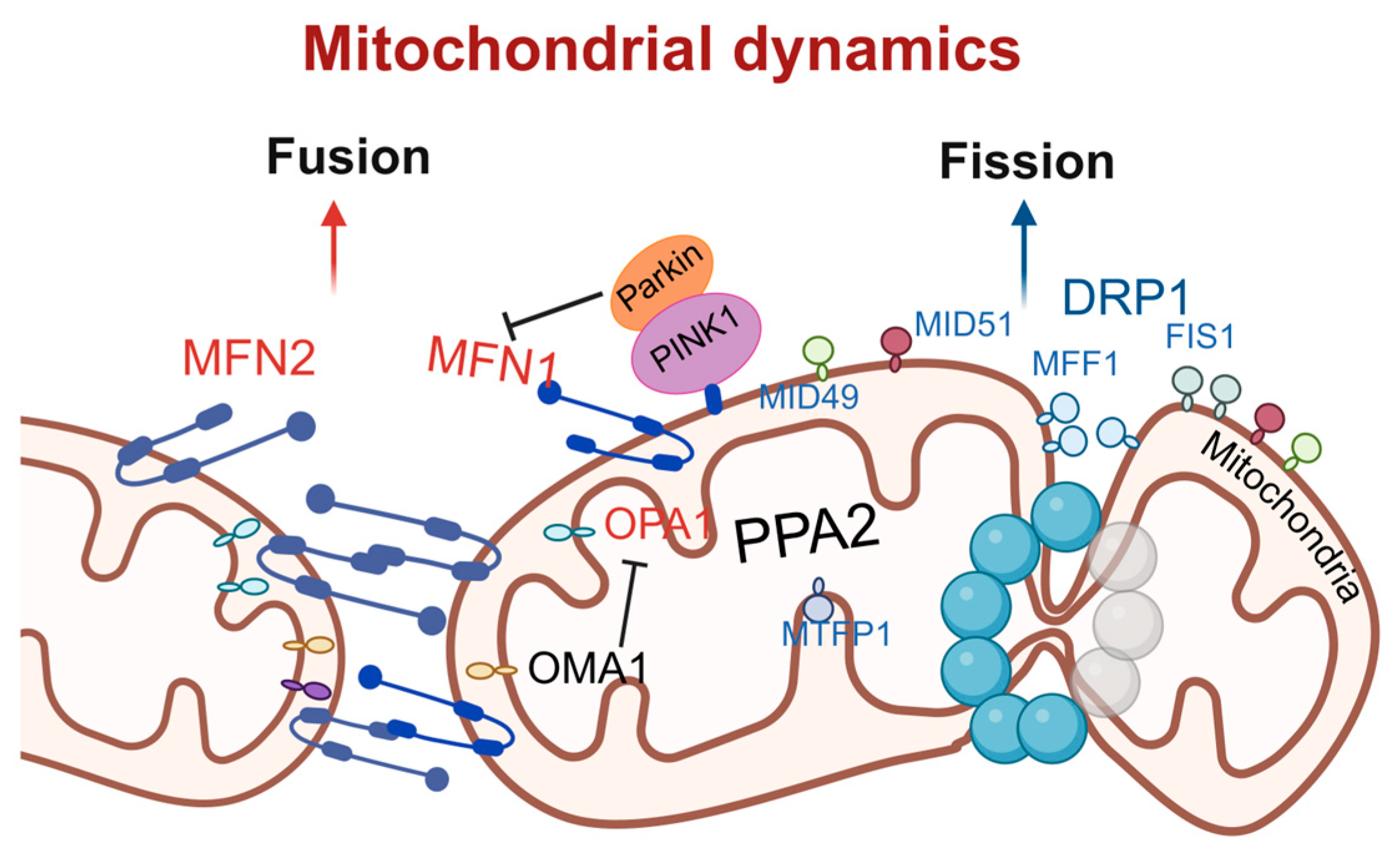
2.2. Mitochondrial Dynamics
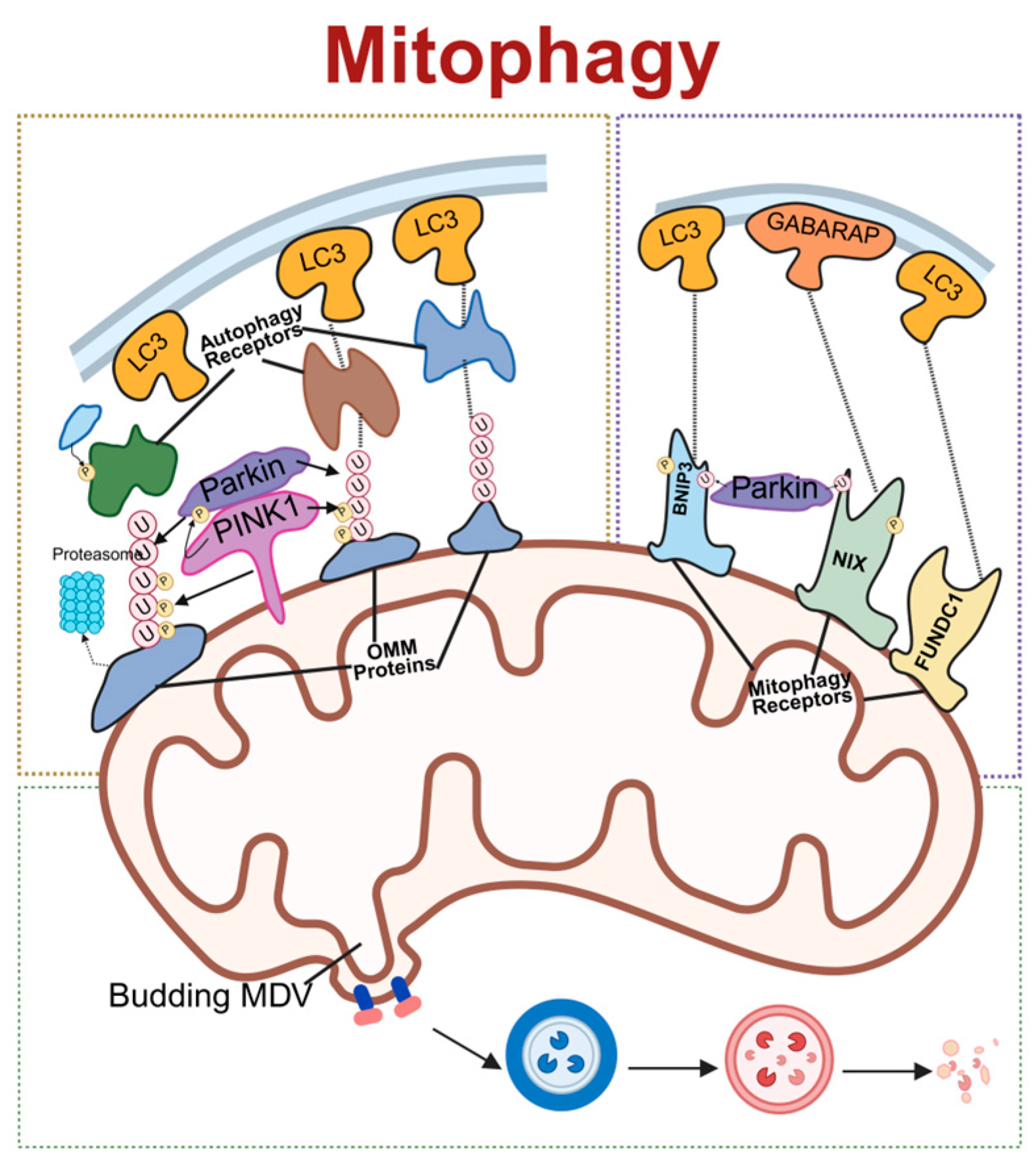
2.3. Mitophagy
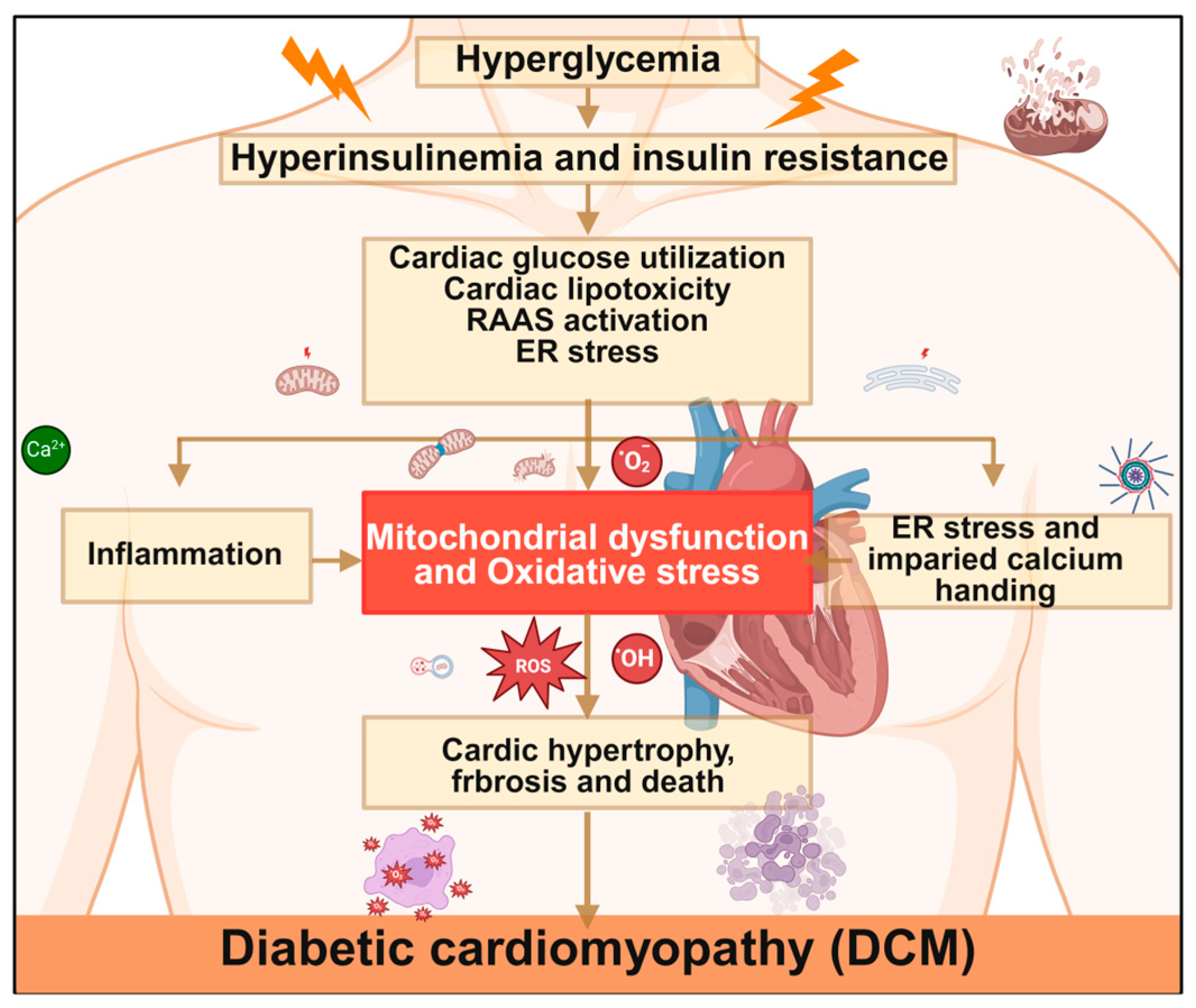
3. Mitochondrial Homeostasis and DCM
3.1. Mitochondrial Oxidative Metabolism and DCM
3.2. Mitochondrial Dynamics and DCM
3.3. Mitophagy and DCM
4. Pharmacological Treatment
4.1. Sodium–Glucose Co-Transporter 2 (SGLT2) Inhibitors
4.2. Glucagon-like Peptide-1 (GLP-1) Receptor Agonists
4.3. Mineralocorticoid Receptor Antagonist (MRA)
5. Conclusions
Author Contributions
Funding
Institutional Review Board Statement
Informed Consent Statement
Data Availability Statement
Acknowledgments
Conflicts of Interest
Abbreviations
| AMPK | AMP-activated protein kinase |
| AGO2 | Argonaute2 |
| ADMA | Asymmetric Dimethylarginine |
| AKAP121 | A-kinase anchor protein 121 |
| ATP | Adenosine triphosphate |
| ATP5A1 | ATP synthase F1 subunit alpha |
| ADP | Adenosine diphosphate |
| AKT | Protein kinase B |
| BNIP3 | BCL2/adenovirus E1B 19 kDa interacting protein 3 |
| BDH1 | 3-hydroxybutyrate dehydrogenase 1 |
| BRD4 | Bromodomain protein 4 |
| CVD | Cardiovascular disease |
| COX5b | Cytochrome C oxidase subunit 5B |
| CD36 | Cluster of differentiation 36 |
| CDK1 | Cyclin-dependent kinases |
| CYTB | Cytochrome b |
| DCM | Diabetic cardiomyopathy |
| Drp1 | Dynamin-related protein 1 |
| ERα | Estrogen receptor α |
| EndMT | Endothelial-to-mesenchymal transition |
| Empa | Empagliflozin |
| eNOS | Endothelial nitric oxide synthase |
| ETC | Electron transport chain |
| FIS1 | Fission1 |
| FGF21 | Fibroblast growth factor 21 |
| FUNDC1 | FUN14 domain containing 1 |
| FOXO3 | Forkhead box O3 |
| GTPase | GTP hydrolysis |
| GCLC | Glutamate–cysteine ligase catalytic subunit |
| GABARAP | Gamma–aminobutyric acid receptor-associated protein |
| GPX4 | Glutathione Peroxidase 4 |
| GRP78 | Glucose-regulated protein78kD |
| GSH | Glutathione |
| GLP-1RAs | GLP-1 receptor agonists |
| GTP | Guanosine triphosphate |
| HF | Heart failure |
| HFpEF | Heart failure and preserved ejection fraction |
| HFrEF | Heart failure and reduced ejection fraction |
| HO-1 | Heme oxygenase-1 |
| IMM | Inner mitochondrial membrane |
| IDH2 | Isocitrate dehydrogenase |
| LCAD | Long-chain acyl-CoA dehydrogenase deficiency |
| LC3 | Microtubule-associated protein 1 light chain 3 |
| LIR | LC3 interaction region |
| mTOR | Mammalian target of rapamycin |
| MACE | Major adverse cardiovascular events |
| MDA | Malondialdehyde |
| MICU1 | Mitochondrial calcium uptake 1 |
| MCU | Mitochondrial calcium uniporter |
| MR | Mineralocorticoid receptor |
| MRA | Mineralocorticoid receptor antagonists |
| MMP | Mitochondrial membrane potential |
| MFN1 | Mitofusin 1 |
| MFF | Mitochondrial fission factor |
| MiD51 | Mitochondrial dynamics proteins of 51 kDa |
| MiD49 | Mitochondrial dynamics proteins of 49 kDa |
| MTFP1 | Mitochondrial fission process 1 |
| MFN2 | Mitofusin 2 |
| MDVs | Mitochondria-derived vesicles |
| MnSOD | Mn superoxide dismutase |
| NHE-1 | Sodium–hydrogen exchanger 1 |
| NLRP3 | NOD-like receptor family pyrin domain containing |
| NIX | NIP3-like protein X |
| NO | Nitric oxide |
| NMCMs | Neonatal Mouse Cardiac Myocytes |
| NRCMs | Neonatal Rat Cardiomyocytes |
| NRVCs | Neonatal Rat Ventricular Cardiomyocytes |
| NADPH | Nicotinamide adenine dinucleotide phosphate |
| NRF-1 | Nuclear Respiratory Factor 1 |
| NRF-2 | Nuclear Factor erythroid-derived 2-like 2 |
| NF-κB | Nuclear Factor kappa-light-chain-enhancer of activated B cells |
| Nox4 | NADPH oxidase 4 |
| NGR1 | Notoginsenoside R1 |
| OPA1 | Optic Atrophy 1 |
| OMM | Outer mitochondrial membrane |
| OMA1 | Overlapping with the M-AAA protease 1 homolog |
| OXCT1 | 3-Oxoacid CoA-Transferase 1 |
| PPA2 | Pyrophosphatase phosphatase 2A |
| PD | Parkinson’s disease |
| PINK1 | PTEN-induced putative kinase 1 |
| Parkin | E3 ubiquitin–protein ligase parkin |
| PGC-1α | Peroxisome proliferator-activated receptor gamma coactivator 1-alpha |
| PPAR-γ | Peroxisome proliferator-activated receptor gamma |
| ROS | Reactive oxygen species |
| SLMAP | Sarcolemma-associated protein |
| SIRT1 | Sirtuin 1 |
| SMEM | Small MTFP1-enriched mitochondria |
| SGLT2 | Sodium–glucose co-transporter 2 |
| SGLT2i | Sodium–glucose cotransporter-2 inhibitors |
| SP1 | Specificity Protein 1 |
| SIRT3 | Sirtuin 3 |
| SOD | Super Oxide Dimutese |
| TZD | Thiazolidinedione |
| TFAM | Mitochondrial transcription factor A |
| TCA | Tricarboxylic acid |
| T2DM | Type 2 diabetes mellitus |
| T1DM | Type 1 diabetes mellitus |
| TRPV1 | Transient receptor potential vanilloid 1 |
| UCP2 | Uncoupling Protein 2 |
| XBP1s | X-box binding protein-1 |
References
- Liu, L.; Zhang, J.; Cheng, Y.; Zhu, M.; Xiao, Z.; Ruan, G.; Wei, Y. Gut microbiota: A new target for T2DM prevention and treatment. Front. Endocrinol. 2022, 13, 958218. [Google Scholar] [CrossRef] [PubMed]
- Jaacks, L.M.; Siegel, K.R.; Gujral, U.P.; Narayan, K.M. Type 2 diabetes: A 21st century epidemic. Best Pract. Res. Clin. Endocrinol. Metab. 2016, 30, 331–343. [Google Scholar] [CrossRef] [PubMed]
- American Diabetes Association. Diagnosis and classification of diabetes mellitus. Diabetes Care 2014, 37, S81–S90. [Google Scholar] [CrossRef] [PubMed]
- Sung, K.C.; Lee, M.Y.; Kim, Y.H.; Huh, J.H.; Kim, J.Y.; Wild, S.H.; Byrne, C.D. Obesity and incidence of diabetes: Effect of absence of metabolic syndrome, insulin resistance, inflammation and fatty liver. Atherosclerosis 2018, 275, 50–57. [Google Scholar] [CrossRef]
- Ong, K.L.; Stafford, L.K.; McLaughlin, S.A.; Boyko, E.J.; Vollset, S.E.; Smith, A.E.; Dalton, B.E.; Duprey, J.; Cruz, J.A.; Hagins, H.; et al. Global, regional, and national burden of diabetes from 1990 to 2021, with projections of prevalence to 2050: A systematic analysis for the Global Burden of Disease Study 2021. Lancet 2023, 402, 203–234, Erratum in Lancet 2023, 402, 1132. Erratum in Lancet 2025, 405, 202. [Google Scholar] [CrossRef]
- Zimmet, P.; Alberti, K.G.; Shaw, J. Global and societal implications of the diabetes epidemic. Nature 2001, 414, 782–787. [Google Scholar] [CrossRef]
- Deshpande, A.D.; Harris-Hayes, M.; Schootman, M. Epidemiology of diabetes and diabetes-related complications. Phys. Ther. 2008, 88, 1254–1264. [Google Scholar] [CrossRef]
- Farmaki, P.; Damaskos, C.; Garmpis, N.; Garmpi, A.; Savvanis, S.; Diamantis, E. Complications of the Type 2 Diabetes Mellitus. Curr. Cardiol. Rev. 2020, 16, 249–251. [Google Scholar] [CrossRef]
- Jaacks, L.M.; Vandevijvere, S.; Pan, A.; McGowan, C.J.; Wallace, C.; Imamura, F.; Mozaffarian, D.; Swinburn, B.; Ezzati, M. The obesity transition: Stages of the global epidemic. Lancet Diabetes Endocrinol. 2019, 7, 231–240. [Google Scholar] [CrossRef]
- Younossi, Z.M.; Koenig, A.B.; Abdelatif, D.; Fazel, Y.; Henry, L.; Wymer, M. Global epidemiology of nonalcoholic fatty liver disease-Meta-analytic assessment of prevalence, incidence, and outcomes. Hepatology 2016, 64, 73–84. [Google Scholar] [CrossRef] [PubMed]
- Tomic, D.; Shaw, J.E.; Magliano, D.J. The burden and risks of emerging complications of diabetes mellitus. Nat. Rev. Endocrinol. 2022, 18, 525–539. [Google Scholar] [CrossRef] [PubMed]
- Lu, Y.; Lu, Y.; Meng, J.; Wang, Z. Pyroptosis and Its Regulation in Diabetic Cardiomyopathy. Front. Physiol. 2021, 12, 791848. [Google Scholar] [CrossRef] [PubMed]
- Paolillo, S.; Marsico, F.; Prastaro, M.; Renga, F.; Esposito, L.; De Martino, F.; Di Napoli, P.; Esposito, I.; Ambrosio, A.; Ianniruberto, M.; et al. Diabetic Cardiomyopathy: Definition, Diagnosis, and Therapeutic Implications. Heart Fail. Clin. 2019, 15, 341–347. [Google Scholar] [CrossRef]
- Jia, G.; Hill, M.A.; Sowers, J.R. Diabetic Cardiomyopathy: An Update of Mechanisms Contributing to This Clinical Entity. Circ. Res. 2018, 122, 624–638. [Google Scholar] [CrossRef]
- Yilmaz, S.; Canpolat, U.; Aydogdu, S.; Abboud, H.E. Diabetic Cardiomyopathy; Summary of 41 Years. Korean Circ. J. 2015, 45, 266–272. [Google Scholar] [CrossRef]
- Dannenberg, L.; Weske, S.; Kelm, M.; Levkau, B.; Polzin, A. Cellular mechanisms and recommended drug-based therapeutic options in diabetic cardiomyopathy. Pharmacol. Ther. 2021, 228, 107920. [Google Scholar] [CrossRef]
- Donath, M.Y.; Dinarello, C.A.; Mandrup-Poulsen, T. Targeting innate immune mediators in type 1 and type 2 diabetes. Nat. Rev. Immunol. 2019, 19, 734–746. [Google Scholar] [CrossRef]
- Kenny, H.C.; Abel, E.D. Heart Failure in Type 2 Diabetes Mellitus. Circ. Res. 2019, 124, 121–141. [Google Scholar] [CrossRef]
- Shi, X.; Liu, C.; Chen, J.; Zhou, S.; Li, Y.; Zhao, X.; Xing, J.; Xue, J.; Liu, F.; Li, F. Endothelial MICU1 alleviates diabetic cardiomyopathy by attenuating nitrative stress-mediated cardiac microvascular injury. Cardiovasc. Diabetol. 2023, 22, 216. [Google Scholar] [CrossRef]
- Batista, J.P.T.; Faria, A.O.V.; Ribeiro, T.F.S.; Simões, E.S.A.C. The Role of Renin-Angiotensin System in Diabetic Cardiomyopathy: A Narrative Review. Life 2023, 13, 1598. [Google Scholar] [CrossRef] [PubMed]
- Salvatore, T.; Galiero, R.; Caturano, A.; Vetrano, E.; Rinaldi, L.; Coviello, F.; Di Martino, A.; Albanese, G.; Colantuoni, S.; Medicamento, G.; et al. Dysregulated Epicardial Adipose Tissue as a Risk Factor and Potential Therapeutic Target of Heart Failure with Preserved Ejection Fraction in Diabetes. Biomolecules 2022, 12, 176. [Google Scholar] [CrossRef] [PubMed]
- Vasileiou, P.V.S.; Evangelou, K.; Vlasis, K.; Fildisis, G.; Panayiotidis, M.I.; Chronopoulos, E.; Passias, P.G.; Kouloukoussa, M.; Gorgoulis, V.G.; Havaki, S. Mitochondrial Homeostasis and Cellular Senescence. Cells 2019, 8, 686. [Google Scholar] [CrossRef] [PubMed]
- Li, X.; Jiang, O.; Chen, M.; Wang, S. Mitochondrial homeostasis: Shaping health and disease. Curr. Med. 2024, 3, 5. [Google Scholar] [CrossRef]
- Nowinski, S.M.; Solmonson, A.; Rusin, S.F.; Maschek, J.A.; Bensard, C.L.; Fogarty, S.; Jeong, M.Y.; Lettlova, S.; Berg, J.A.; Morgan, J.T.; et al. Mitochondrial fatty acid synthesis coordinates oxidative metabolism in mammalian mitochondria. eLife 2020, 9, e58041. [Google Scholar] [CrossRef]
- Martínez-Reyes, I.; Chandel, N.S. Mitochondrial TCA cycle metabolites control physiology and disease. Nat. Commun. 2020, 11, 102. [Google Scholar] [CrossRef]
- Nolfi-Donegan, D.; Braganza, A.; Shiva, S. Mitochondrial electron transport chain: Oxidative phosphorylation, oxidant production, and methods of measurement. Redox Biol. 2020, 37, 101674. [Google Scholar] [CrossRef]
- Zhao, R.Z.; Jiang, S.; Zhang, L.; Yu, Z.B. Mitochondrial electron transport chain, ROS generation and uncoupling (Review). Int. J. Mol. Med. 2019, 44, 3–15. [Google Scholar] [CrossRef]
- Bhat, A.H.; Dar, K.B.; Anees, S.; Zargar, M.A.; Masood, A.; Sofi, M.A.; Ganie, S.A. Oxidative stress, mitochondrial dysfunction and neurodegenerative diseases; a mechanistic insight. Biomed. Pharmacother. 2015, 74, 101–110. [Google Scholar] [CrossRef]
- Zong, Y.; Li, H.; Liao, P.; Chen, L.; Pan, Y.; Zheng, Y.; Zhang, C.; Liu, D.; Zheng, M.; Gao, J. Mitochondrial dysfunction: Mechanisms and advances in therapy. Signal Transduct. Target. Ther. 2024, 9, 124. [Google Scholar] [CrossRef]
- Quirós, P.M.; Langer, T.; López-Otín, C. New roles for mitochondrial proteases in health, ageing and disease. Nat. Rev. Mol. Cell Biol. 2015, 16, 345–359. [Google Scholar] [CrossRef] [PubMed]
- Chen, W.; Zhao, H.; Li, Y. Mitochondrial dynamics in health and disease: Mechanisms and potential targets. Signal Transduct. Target. Ther. 2023, 8, 333. [Google Scholar] [CrossRef] [PubMed]
- Adebayo, M.; Singh, S.; Singh, A.P.; Dasgupta, S. Mitochondrial fusion and fission: The fine-tune balance for cellular homeostasis. FASEB J. 2021, 35, e21620. [Google Scholar] [CrossRef] [PubMed]
- Bleazard, W.; McCaffery, J.M.; King, E.J.; Bale, S.; Mozdy, A.; Tieu, Q.; Nunnari, J.; Shaw, J.M. The dynamin-related GTPase Dnm1 regulates mitochondrial fission in yeast. Nat. Cell Biol. 1999, 1, 298–304. [Google Scholar] [CrossRef]
- Ji, W.K.; Hatch, A.L.; Merrill, R.A.; Strack, S.; Higgs, H.N. Actin filaments target the oligomeric maturation of the dynamin GTPase Drp1 to mitochondrial fission sites. eLife 2015, 4, e11553. [Google Scholar] [CrossRef]
- Losón, O.C.; Song, Z.; Chen, H.; Chan, D.C. Fis1, Mff, MiD49, and MiD51 mediate Drp1 recruitment in mitochondrial fission. Mol. Biol. Cell 2013, 24, 659–667. [Google Scholar] [CrossRef]
- Otera, H.; Wang, C.; Cleland, M.M.; Setoguchi, K.; Yokota, S.; Youle, R.J.; Mihara, K. Mff is an essential factor for mitochondrial recruitment of Drp1 during mitochondrial fission in mammalian cells. J. Cell Biol. 2010, 191, 1141–1158. [Google Scholar] [CrossRef]
- Mishra, S.R.; Mishra, P.; Mahapatra, K.K.; Behera, B.P.; Kendre, G.; Alotaibi, M.R.; Pandey, V.; Patro, B.S.; Klionsky, D.J.; Bhutia, S.K. PPA2 activates MTFP1-DNM1L fission signaling to govern mitochondrial proliferation and mitophagy. Autophagy 2026, 22, 121–144. [Google Scholar] [CrossRef]
- Tábara, L.C.; Burr, S.P.; Frison, M.; Chowdhury, S.R.; Paupe, V.; Nie, Y.; Johnson, M.; Villar-Azpillaga, J.; Viegas, F.; Segawa, M.; et al. MTFP1 controls mitochondrial fusion to regulate inner membrane quality control and maintain mtDNA levels. Cell 2024, 187, 3619–3637.e27. [Google Scholar] [CrossRef]
- Tilokani, L.; Nagashima, S.; Paupe, V.; Prudent, J. Mitochondrial dynamics: Overview of molecular mechanisms. Essays Biochem. 2018, 62, 341–360. [Google Scholar] [CrossRef]
- Chan, D.C. Mitochondria: Dynamic organelles in disease, aging, and development. Cell 2006, 125, 1241–1252. [Google Scholar] [CrossRef] [PubMed]
- Koshiba, T.; Detmer, S.A.; Kaiser, J.T.; Chen, H.; McCaffery, J.M.; Chan, D.C. Structural basis of mitochondrial tethering by mitofusin complexes. Science 2004, 305, 858–862. [Google Scholar] [CrossRef] [PubMed]
- Cao, Y.L.; Meng, S.; Chen, Y.; Feng, J.X.; Gu, D.D.; Yu, B.; Li, Y.J.; Yang, J.Y.; Liao, S.; Chan, D.C.; et al. MFN1 structures reveal nucleotide-triggered dimerization critical for mitochondrial fusion. Nature 2017, 542, 372–376. [Google Scholar] [CrossRef] [PubMed]
- Griparic, L.; van der Wel, N.N.; Orozco, I.J.; Peters, P.J.; van der Bliek, A.M. Loss of the intermembrane space protein Mgm1/OPA1 induces swelling and localized constrictions along the lengths of mitochondria. J. Biol. Chem. 2004, 279, 18792–18798. [Google Scholar] [CrossRef]
- Yamada, T.; Ikeda, A.; Murata, D.; Wang, H.; Zhang, C.; Khare, P.; Adachi, Y.; Ito, F.; Quirós, P.M.; Blackshaw, S.; et al. Dual regulation of mitochondrial fusion by Parkin-PINK1 and OMA1. Nature 2025, 639, 776–783. [Google Scholar] [CrossRef]
- Villa, E.; Proïcs, E.; Rubio-Patiño, C.; Obba, S.; Zunino, B.; Bossowski, J.P.; Rozier, R.M.; Chiche, J.; Mondragón, L.; Riley, J.S.; et al. Parkin-Independent Mitophagy Controls Chemotherapeutic Response in Cancer Cells. Cell Rep. 2017, 20, 2846–2859. [Google Scholar] [CrossRef]
- Matsuda, N.; Sato, S.; Shiba, K.; Okatsu, K.; Saisho, K.; Gautier, C.A.; Sou, Y.S.; Saiki, S.; Kawajiri, S.; Sato, F.; et al. PINK1 stabilized by mitochondrial depolarization recruits Parkin to damaged mitochondria and activates latent Parkin for mitophagy. J. Cell Biol. 2010, 189, 211–221. [Google Scholar] [CrossRef]
- Koyano, F.; Okatsu, K.; Kosako, H.; Tamura, Y.; Go, E.; Kimura, M.; Kimura, Y.; Tsuchiya, H.; Yoshihara, H.; Hirokawa, T.; et al. Ubiquitin is phosphorylated by PINK1 to activate parkin. Nature 2014, 510, 162–166. [Google Scholar] [CrossRef]
- Geisler, S.; Holmström, K.M.; Skujat, D.; Fiesel, F.C.; Rothfuss, O.C.; Kahle, P.J.; Springer, W. PINK1/Parkin-mediated mitophagy is dependent on VDAC1 and p62/SQSTM1. Nat. Cell Biol. 2010, 12, 119–131. [Google Scholar] [CrossRef]
- McLelland, G.L.; Soubannier, V.; Chen, C.X.; McBride, H.M.; Fon, E.A. Parkin and PINK1 function in a vesicular trafficking pathway regulating mitochondrial quality control. EMBO J. 2014, 33, 282–295. [Google Scholar] [CrossRef]
- Schweers, R.L.; Zhang, J.; Randall, M.S.; Loyd, M.R.; Li, W.; Dorsey, F.C.; Kundu, M.; Opferman, J.T.; Cleveland, J.L.; Miller, J.L.; et al. NIX is required for programmed mitochondrial clearance during reticulocyte maturation. Proc. Natl. Acad. Sci. USA 2007, 104, 19500–19505. [Google Scholar] [CrossRef]
- Liu, K.; Zhao, Q.; Sun, H.; Liu, L.; Wang, C.; Li, Z.; Xu, Y.; Wang, L.; Zhang, L.; Zhang, H.; et al. BNIP3 (BCL2 interacting protein 3) regulates pluripotency by modulating mitochondrial homeostasis via mitophagy. Cell Death Dis. 2022, 13, 334. [Google Scholar] [CrossRef] [PubMed]
- Novak, I.; Dikic, I. Autophagy receptors in developmental clearance of mitochondria. Autophagy 2011, 7, 301–303. [Google Scholar] [CrossRef] [PubMed]
- Chen, G.; Han, Z.; Feng, D.; Chen, Y.; Chen, L.; Wu, H.; Huang, L.; Zhou, C.; Cai, X.; Fu, C.; et al. A regulatory signaling loop comprising the PGAM5 phosphatase and CK2 controls receptor-mediated mitophagy. Mol. Cell 2014, 54, 362–377. [Google Scholar] [CrossRef] [PubMed]
- Liu, L.; Li, Y.; Chen, Q. The Emerging Role of FUNDC1-Mediated Mitophagy in Cardiovascular Diseases. Front. Physiol. 2021, 12, 807654. [Google Scholar] [CrossRef]
- Chen, Z.; Liu, L.; Cheng, Q.; Li, Y.; Wu, H.; Zhang, W.; Wang, Y.; Sehgal, S.A.; Siraj, S.; Wang, X.; et al. Mitochondrial E3 ligase MARCH5 regulates FUNDC1 to fine-tune hypoxic mitophagy. EMBO Rep. 2017, 18, 495–509. [Google Scholar] [CrossRef]
- Ferrucci, L.; Guerra, F.; Bucci, C.; Marzetti, E.; Picca, A. Mitochondria break free: Mitochondria-derived vesicles in aging and associated conditions. Ageing Res. Rev. 2024, 102, 102549. [Google Scholar] [CrossRef]
- König, T.; Nolte, H.; Aaltonen, M.J.; Tatsuta, T.; Krols, M.; Stroh, T.; Langer, T.; McBride, H.M. MIROs and DRP1 drive mitochondrial-derived vesicle biogenesis and promote quality control. Nat. Cell Biol. 2021, 23, 1271–1286. [Google Scholar] [CrossRef]
- König, T.; McBride, H.M. Mitochondrial-derived vesicles in metabolism, disease, and aging. Cell Metab. 2024, 36, 21–35. [Google Scholar] [CrossRef]
- Ryan, T.A.; Phillips, E.O.; Collier, C.L.; Robinson, A.J.; Routledge, D.; Wood, R.E.; Assar, E.A.; Tumbarello, D.A. Tollip coordinates Parkin-dependent trafficking of mitochondrial-derived vesicles. EMBO J. 2020, 39, e102539. [Google Scholar] [CrossRef]
- Peng, T.; Xie, Y.; Sheng, H.; Wang, C.; Lian, Y.; Xie, N. Mitochondrial-derived vesicles: Gatekeepers of mitochondrial response to oxidative stress. Free Radic. Biol. Med. 2022, 188, 185–193. [Google Scholar] [CrossRef] [PubMed]
- Boudina, S.; Sena, S.; Theobald, H.; Sheng, X.; Wright, J.J.; Hu, X.X.; Aziz, S.; Johnson, J.I.; Bugger, H.; Zaha, V.G.; et al. Mitochondrial energetics in the heart in obesity-related diabetes: Direct evidence for increased uncoupled respiration and activation of uncoupling proteins. Diabetes 2007, 56, 2457–2466. [Google Scholar] [CrossRef]
- Ji, L.; Liu, F.; Jing, Z.; Huang, Q.; Zhao, Y.; Cao, H.; Li, J.; Yin, C.; Xing, J.; Li, F. MICU1 Alleviates Diabetic Cardiomyopathy Through Mitochondrial Ca(2+)-Dependent Antioxidant Response. Diabetes 2017, 66, 1586–1600. [Google Scholar] [CrossRef] [PubMed]
- Diaz-Juarez, J.; Suarez, J.; Cividini, F.; Scott, B.T.; Diemer, T.; Dai, A.; Dillmann, W.H. Expression of the mitochondrial calcium uniporter in cardiac myocytes improves impaired mitochondrial calcium handling and metabolism in simulated hyperglycemia. Am. J. Physiol. Cell Physiol. 2016, 311, C1005–C1013. [Google Scholar] [CrossRef]
- Parker, A.M.; Tate, M.; Prakoso, D.; Deo, M.; Willis, A.M.; Nash, D.M.; Donner, D.G.; Crawford, S.; Kiriazis, H.; Granata, C.; et al. Characterisation of the Myocardial Mitochondria Structural and Functional Phenotype in a Murine Model of Diabetic Cardiomyopathy. Front. Physiol. 2021, 12, 672252. [Google Scholar] [CrossRef]
- Lou, P.H.; Lucchinetti, E.; Scott, K.Y.; Huang, Y.; Gandhi, M.; Hersberger, M.; Clanachan, A.S.; Lemieux, H.; Zaugg, M. Alterations in fatty acid metabolism and sirtuin signaling characterize early type-2 diabetic hearts of fructose-fed rats. Physiol. Rep. 2017, 5, e13388. [Google Scholar] [CrossRef]
- Wende, A.R.; Schell, J.C.; Ha, C.M.; Pepin, M.E.; Khalimonchuk, O.; Schwertz, H.; Pereira, R.O.; Brahma, M.K.; Tuinei, J.; Contreras-Ferrat, A.; et al. Maintaining Myocardial Glucose Utilization in Diabetic Cardiomyopathy Accelerates Mitochondrial Dysfunction. Diabetes 2020, 69, 2094–2111. [Google Scholar] [CrossRef]
- Rukavina-Mikusic, I.A.; Rey, M.; Martinefski, M.; Tripodi, V.; Valdez, L.B. Temporal evolution of cardiac mitochondrial dysfunction in a type 1 diabetes model. Mitochondrial complex I impairment, and H(2)O(2) and NO productions as early subcellular events. Free Radic. Biol. Med. 2021, 162, 129–140. [Google Scholar] [CrossRef]
- Xiong, Y.; He, Y.L.; Li, X.M.; Nie, F.; Zhou, X.K. Endogenous asymmetric dimethylarginine accumulation precipitates the cardiac and mitochondrial dysfunctions in type 1 diabetic rats. Eur. J. Pharmacol. 2021, 902, 174081. [Google Scholar] [CrossRef]
- Hu, L.; Ding, M.; Tang, D.; Gao, E.; Li, C.; Wang, K.; Qi, B.; Qiu, J.; Zhao, H.; Chang, P.; et al. Targeting mitochondrial dynamics by regulating Mfn2 for therapeutic intervention in diabetic cardiomyopathy. Theranostics 2019, 9, 3687–3706. [Google Scholar] [CrossRef] [PubMed]
- Wu, Q.R.; Zheng, D.L.; Liu, P.M.; Yang, H.; Li, L.A.; Kuang, S.J.; Lai, Y.Y.; Rao, F.; Xue, Y.M.; Lin, J.J.; et al. High glucose induces Drp1-mediated mitochondrial fission via the Orai1 calcium channel to participate in diabetic cardiomyocyte hypertrophy. Cell Death Dis. 2021, 12, 216. [Google Scholar] [CrossRef] [PubMed]
- Feng, X.; Wang, S.; Yang, X.; Lin, J.; Man, W.; Dong, Y.; Zhang, Y.; Zhao, Z.; Wang, H.; Sun, D. Mst1 Knockout Alleviates Mitochondrial Fission and Mitigates Left Ventricular Remodeling in the Development of Diabetic Cardiomyopathy. Front. Cell Dev. Biol. 2020, 8, 628842. [Google Scholar] [CrossRef] [PubMed]
- Tsushima, K.; Bugger, H.; Wende, A.R.; Soto, J.; Jenson, G.A.; Tor, A.R.; McGlauflin, R.; Kenny, H.C.; Zhang, Y.; Souvenir, R.; et al. Mitochondrial Reactive Oxygen Species in Lipotoxic Hearts Induce Post-Translational Modifications of AKAP121, DRP1, and OPA1 That Promote Mitochondrial Fission. Circ. Res. 2018, 122, 58–73. [Google Scholar] [CrossRef] [PubMed]
- Wang, S.; Zhao, Z.; Fan, Y.; Zhang, M.; Feng, X.; Lin, J.; Hu, J.; Cheng, Z.; Sun, C.; Liu, T.; et al. Mst1 inhibits Sirt3 expression and contributes to diabetic cardiomyopathy through inhibiting Parkin-dependent mitophagy. Biochim. Biophys. Acta Mol. Basis Dis. 2019, 1865, 1905–1914. [Google Scholar] [CrossRef]
- Yu, W.; Gao, B.; Li, N.; Wang, J.; Qiu, C.; Zhang, G.; Liu, M.; Zhang, R.; Li, C.; Ji, G.; et al. Sirt3 deficiency exacerbates diabetic cardiac dysfunction: Role of Foxo3A-Parkin-mediated mitophagy. Biochim. Biophys. Acta Mol. Basis Dis. 2017, 1863, 1973–1983. [Google Scholar] [CrossRef]
- Tong, M.; Saito, T.; Zhai, P.; Oka, S.I.; Mizushima, W.; Nakamura, M.; Ikeda, S.; Shirakabe, A.; Sadoshima, J. Mitophagy Is Essential for Maintaining Cardiac Function During High Fat Diet-Induced Diabetic Cardiomyopathy. Circ. Res. 2019, 124, 1360–1371. [Google Scholar] [CrossRef] [PubMed]
- Mu, J.; Zhang, D.; Tian, Y.; Xie, Z.; Zou, M.H. BRD4 inhibition by JQ1 prevents high-fat diet-induced diabetic cardiomyopathy by activating PINK1/Parkin-mediated mitophagy in vivo. J. Mol. Cell. Cardiol. 2020, 149, 1–14. [Google Scholar] [CrossRef]
- Nguyen, B.Y.; Ruiz-Velasco, A.; Bui, T.; Collins, L.; Wang, X.; Liu, W. Mitochondrial function in the heart: The insight into mechanisms and therapeutic potentials. Br. J. Pharmacol. 2019, 176, 4302–4318. [Google Scholar] [CrossRef] [PubMed]
- Dia, M.; Gomez, L.; Thibault, H.; Tessier, N.; Leon, C.; Chouabe, C.; Ducreux, S.; Gallo-Bona, N.; Tubbs, E.; Bendridi, N.; et al. Reduced reticulum-mitochondria Ca(2+) transfer is an early and reversible trigger of mitochondrial dysfunctions in diabetic cardiomyopathy. Basic Res. Cardiol. 2020, 115, 74. [Google Scholar] [CrossRef]
- Jaquenod De Giusti, C.; Palomeque, J.; Mattiazzi, A. Ca(2+) mishandling and mitochondrial dysfunction: A converging road to prediabetic and diabetic cardiomyopathy. Pflug. Arch. 2022, 474, 33–61. [Google Scholar] [CrossRef]
- Li, X.; Hou, J.; Du, J.; Feng, J.; Yang, Y.; Shen, Y.; Chen, S.; Feng, J.; Yang, D.; Li, D.; et al. Potential Protective Mechanism in the Cardiac Microvascular Injury. Hypertension 2018, 72, 116–127. [Google Scholar] [CrossRef]
- Nakamura, H.; Matoba, S.; Iwai-Kanai, E.; Kimata, M.; Hoshino, A.; Nakaoka, M.; Katamura, M.; Okawa, Y.; Ariyoshi, M.; Mita, Y.; et al. p53 promotes cardiac dysfunction in diabetic mellitus caused by excessive mitochondrial respiration-mediated reactive oxygen species generation and lipid accumulation. Circ. Heart Fail. 2012, 5, 106–115, Erratum in Circ. Heart Fail. 2014, 7, 383. [Google Scholar] [CrossRef]
- Berthiaume, J.M.; Kurdys, J.G.; Muntean, D.M.; Rosca, M.G. Mitochondrial NAD(+)/NADH Redox State and Diabetic Cardiomyopathy. Antioxid. Redox Signal. 2019, 30, 375–398. [Google Scholar] [CrossRef]
- Lopaschuk, G.D.; Karwi, Q.G.; Tian, R.; Wende, A.R.; Dale, E. Cardiac Energy Metabolism in Heart Failure. Circ. Res. 2021, 128, 1487–1513. [Google Scholar] [CrossRef]
- Qi, B.; He, L.; Zhao, Y.; Zhang, L.; He, Y.; Li, J.; Li, C.; Zhang, B.; Huang, Q.; Xing, J.; et al. Akap1 deficiency exacerbates diabetic cardiomyopathy in mice by NDUFS1-mediated mitochondrial dysfunction and apoptosis. Diabetologia 2020, 63, 1072–1087. [Google Scholar] [CrossRef]
- Sciarretta, S.; Maejima, Y.; Zablocki, D.; Sadoshima, J. The Role of Autophagy in the Heart. Annu. Rev. Physiol. 2018, 80, 1–26. [Google Scholar] [CrossRef] [PubMed]
- Zhang, H.; Muhetarijiang, M.; Chen, R.J.; Hu, X.; Han, J.; Zheng, L.; Chen, T. Mitochondrial Dysfunction: A Roadmap for Understanding and Tackling Cardiovascular Aging. Aging Dis. 2024, 16, 2575–2614. [Google Scholar] [CrossRef] [PubMed]
- Hao, Y.; Liu, W. Metabolic Changes in Cardiac Aging. Rev. Cardiovasc. Med. 2023, 24, 82. [Google Scholar] [CrossRef] [PubMed]
- Patyal, P.; Azhar, G.; Verma, A.; Sharma, S.; Shrivastava, J.; Abdi, S.A.H.; Zhang, X.; Wei, J.Y. Mitochondrial Dynamics in Aging Heart. Biomedicines 2025, 13, 2603. [Google Scholar] [CrossRef]
- Rudokas, M.W.; McKay, M.; Toksoy, Z.; Eisen, J.N.; Bögner, M.; Young, L.H.; Akar, F.G. Mitochondrial network remodeling of the diabetic heart: Implications to ischemia related cardiac dysfunction. Cardiovasc. Diabetol. 2024, 23, 261. [Google Scholar] [CrossRef]
- Peng, C.; Zhang, Y.; Lang, X.; Zhang, Y. Role of mitochondrial metabolic disorder and immune infiltration in diabetic cardiomyopathy: New insights from bioinformatics analysis. J. Transl. Med. 2023, 21, 66. [Google Scholar] [CrossRef]
- Werbner, B.; Tavakoli-Rouzbehani, O.M.; Fatahian, A.N.; Boudina, S. The dynamic interplay between cardiac mitochondrial health and myocardial structural remodeling in metabolic heart disease, aging, and heart failure. J. Cardiovasc. Aging 2023, 3, 9. [Google Scholar] [CrossRef]
- Whitley, B.N.; Engelhart, E.A.; Hoppins, S. Mitochondrial dynamics and their potential as a therapeutic target. Mitochondrion 2019, 49, 269–283. [Google Scholar] [CrossRef]
- Dai, W.; Jiang, L. Dysregulated Mitochondrial Dynamics and Metabolism in Obesity, Diabetes, and Cancer. Front. Endocrinol. 2019, 10, 570. [Google Scholar] [CrossRef]
- Lin, J.; Duan, J.; Wang, Q.; Xu, S.; Zhou, S.; Yao, K. Mitochondrial Dynamics and Mitophagy in Cardiometabolic Disease. Front. Cardiovasc. Med. 2022, 9, 917135. [Google Scholar] [CrossRef]
- Ding, M.; Feng, N.; Tang, D.; Feng, J.; Li, Z.; Jia, M.; Liu, Z.; Gu, X.; Wang, Y.; Fu, F.; et al. Melatonin prevents Drp1-mediated mitochondrial fission in diabetic hearts through SIRT1-PGC1α pathway. J. Pineal Res. 2018, 65, e12491. [Google Scholar] [CrossRef] [PubMed]
- Li, W.; Ji, L.; Tian, J.; Tang, W.; Shan, X.; Zhao, P.; Chen, H.; Zhang, C.; Xu, M.; Lu, R.; et al. Ophiopogonin D alleviates diabetic myocardial injuries by regulating mitochondrial dynamics. J. Ethnopharmacol. 2021, 271, 113853. [Google Scholar] [CrossRef] [PubMed]
- Zhang, T.; Li, Z.; Xu, Y.; Xu, C.; Wang, H.; Rui, T. Regulation of mitochondrial dynamics in cardiomyocytes: Implications for cardiac health and disease. Front. Cell Dev. Biol. 2025, 13, 1652683. [Google Scholar] [CrossRef]
- Muthu, S.; Tran, Z.; Thilagavathi, J.; Bolarum, T.; Azzam, E.I.; Suzuki, C.K.; Sundararajan, V. Aging triggers mitochondrial, endoplasmic reticulum, and metabolic stress responses in the heart. J. Cardiovasc. Aging 2025, 5, 4. [Google Scholar] [CrossRef]
- Zhi, F.; Pu, X.; Wei, W.; Liu, L.; Liu, C.; Chen, Y.; Chang, X.; Xu, H. Modulating mitochondrial dynamics ameliorates left ventricular dysfunction by suppressing diverse cell death pathways after diabetic cardiomyopathy. Int. J. Med. Sci. 2024, 21, 2324–2333. [Google Scholar] [CrossRef]
- Zhao, G.J.; Zhao, C.L.; Ouyang, S.; Deng, K.Q.; Zhu, L.; Montezano, A.C.; Zhang, C.; Hu, F.; Zhu, X.Y.; Tian, S.; et al. Ca2+-Dependent NOX5 (NADPH Oxidase 5) Exaggerates Cardiac Hypertrophy Through Reactive Oxygen Species Production. Hypertension 2020, 76, 827–838. [Google Scholar] [CrossRef]
- Zheng, H.; Zhu, H.; Liu, X.; Huang, X.; Huang, A.; Huang, Y. Mitophagy in Diabetic Cardiomyopathy: Roles and Mechanisms. Front. Cell Dev. Biol. 2021, 9, 750382. [Google Scholar] [CrossRef]
- Yang, F.; Qin, Y.; Wang, Y.; Meng, S.; Xian, H.; Che, H.; Lv, J.; Li, Y.; Yu, Y.; Bai, Y.; et al. Metformin Inhibits the NLRP3 Inflammasome via AMPK/mTOR-Dependent Effects in Diabetic Cardiomyopathy. Int. J. Biol. Sci. 2019, 15, 1010–1019. [Google Scholar] [CrossRef]
- Bharath, L.P.; Agrawal, M.; McCambridge, G.; Nicholas, D.A.; Hasturk, H.; Liu, J.; Jiang, K.; Liu, R.; Guo, Z.; Deeney, J.; et al. Metformin Enhances Autophagy and Normalizes Mitochondrial Function to Alleviate Aging-Associated Inflammation. Cell Metab. 2020, 32, 44–55.e46. [Google Scholar] [CrossRef] [PubMed]
- Bai, J.; Liu, C.; Zhu, P.; Li, Y. Novel Insights Into Molecular Mechanism of Mitochondria in Diabetic Cardiomyopathy. Front. Physiol. 2020, 11, 609157. [Google Scholar] [CrossRef]
- Tahrir, F.G.; Langford, D.; Amini, S.; Mohseni Ahooyi, T.; Khalili, K. Mitochondrial quality control in cardiac cells: Mechanisms and role in cardiac cell injury and disease. J. Cell. Physiol. 2019, 234, 8122–8133. [Google Scholar] [CrossRef] [PubMed]
- Chen, Y.; Xin, Y.; Cheng, Y.; Liu, X. Mitochondria-Endoplasmic Reticulum Contacts: The Promising Regulators in Diabetic Cardiomyopathy. Oxidative Med. Cell. Longev. 2022, 2022, 2531458. [Google Scholar] [CrossRef]
- Morales, P.E.; Arias-Durán, C.; Ávalos-Guajardo, Y.; Aedo, G.; Verdejo, H.E.; Parra, V.; Lavandero, S. Emerging role of mitophagy in cardiovascular physiology and pathology. Mol. Asp. Med. 2020, 71, 100822. [Google Scholar] [CrossRef]
- Titus, A.S.; Sung, E.A.; Zablocki, D.; Sadoshima, J. Mitophagy for cardioprotection. Basic. Res. Cardiol. 2023, 118, 42. [Google Scholar] [CrossRef]
- Zhou, R.; Zhang, Z.; Li, X.; Duan, Q.; Miao, Y.; Zhang, T.; Wang, M.; Li, J.; Zhang, W.; Wang, L.; et al. Autophagy in High-Fat Diet and Streptozotocin-Induced Metabolic Cardiomyopathy: Mechanisms and Therapeutic Implications. Int. J. Mol. Sci. 2025, 26, 1668. [Google Scholar] [CrossRef]
- Cai, W.; Chong, K.; Huang, Y.; Huang, C.; Yin, L. Empagliflozin improves mitochondrial dysfunction in diabetic cardiomyopathy by modulating ketone body metabolism and oxidative stress. Redox Biol. 2024, 69, 103010. [Google Scholar] [CrossRef]
- Tian, J.; Zhang, M.; Suo, M.; Liu, D.; Wang, X.; Liu, M.; Pan, J.; Jin, T.; An, F. Dapagliflozin alleviates cardiac fibrosis through suppressing EndMT and fibroblast activation via AMPKα/TGF-β/Smad signalling in type 2 diabetic rats. J. Cell. Mol. Med. 2021, 25, 7642–7659. [Google Scholar] [CrossRef]
- Yang, C.; Xiao, C.; Ding, Z.; Zhai, X.; Liu, J.; Yu, M. Canagliflozin Mitigates Diabetic Cardiomyopathy Through Enhanced PINK1-Parkin Mitophagy. Int. J. Mol. Sci. 2024, 25, 7008. [Google Scholar] [CrossRef]
- Zhang, Z.; Zhang, X.; Meng, L.; Gong, M.; Li, J.; Shi, W.; Qiu, J.; Yang, Y.; Zhao, J.; Suo, Y.; et al. Pioglitazone Inhibits Diabetes-Induced Atrial Mitochondrial Oxidative Stress and Improves Mitochondrial Biogenesis, Dynamics, and Function Through the PPAR-γ/PGC-1α Signaling Pathway. Front. Pharmacol. 2021, 12, 658362. [Google Scholar] [CrossRef] [PubMed]
- Chen, X.; Wang, T.; Gao, Y.; Wang, G.A.; Guan, J.; Dai, H. Liraglutide suppresses ferroptosis by upregulation NRF2 in type 2 diabetic cardiomyopathy. Peptides 2025, 192, 171429. [Google Scholar] [CrossRef] [PubMed]
- Fang, P.; Ye, Z.; Li, R.; She, D.; Zong, G.; Zhang, L.; Xue, Y.; Zhang, K. Glucagon-Like Peptide-1 Receptor Agonist Protects Against Diabetic Cardiomyopathy by Modulating microRNA-29b-3p/SLMAP. Drug Des. Dev. Ther. 2023, 17, 791–806. [Google Scholar] [CrossRef] [PubMed]
- Cai, Y.Y.; Zou, S.Z.; Fan, C.X.; Wu, C.Y.; Fang, S.; Li, P.; Xue, Y.M.; Guan, M.P. [Exendin-4 alleviates diabetic cardiomyopathy in mice by regulating Sirt1/PGC1α]. Nan Fang Yi Ke Da Xue Xue Bao 2018, 38, 520–526. [Google Scholar] [CrossRef] [PubMed]
- Jin, T.; Fu, X.; Liu, M.; An, F. Finerenone attenuates myocardial apoptosis, metabolic disturbance and myocardial fibrosis in type 2 diabetes mellitus. Diabetol. Metab. Syndr. 2023, 15, 87. [Google Scholar] [CrossRef] [PubMed]
- Yaghooti, H.; Mohyadini, M.; Bathaie, S.Z.; Dinarvand, N.; Mohammadtaghvaei, N. Eplerenone alleviates diabetic cardiomyopathy by modulating ER stress, oxidative stress, and NLRP3 inflammasome activation. J. Diabetes Metab. Disord. 2025, 24, 169. [Google Scholar] [CrossRef] [PubMed]
- Liu, W.; Gong, W.; He, M.; Liu, Y.; Yang, Y.; Wang, M.; Wu, M.; Guo, S.; Yu, Y.; Wang, X.; et al. Spironolactone Protects against Diabetic Cardiomyopathy in Streptozotocin-Induced Diabetic Rats. J. Diabetes Res. 2018, 2018, 9232065. [Google Scholar] [CrossRef] [PubMed]
- Parichatikanond, W.; Pandey, S.; Mangmool, S. Exendin-4 exhibits cardioprotective effects against high glucose-induced mitochondrial abnormalities: Potential role of GLP-1 receptor and mTOR signaling. Biochem. Pharmacol. 2024, 229, 116552. [Google Scholar] [CrossRef]
- Pollard, C.M.; Suster, M.S.; Cora, N.; Carbone, A.M.; Lymperopoulos, A. GRK5 is an essential co-repressor of the cardiac mineralocorticoid receptor and is selectively induced by finerenone. World J. Cardiol. 2022, 14, 220–230. [Google Scholar] [CrossRef]
- Liu, Y.; An, C.; Liu, P.; Yang, F.; Zhao, Q. Comparative safety of sodium-glucose co-transporter 2 inhibitors in elderly patients with type 2 diabetes mellitus and diabetic kidney disease: A systematic review and meta-analysis. Ren. Fail. 2023, 45, 2217287. [Google Scholar] [CrossRef]
- Ravindran, S.; Munusamy, S. Renoprotective mechanisms of sodium-glucose co-transporter 2 (SGLT2) inhibitors against the progression of diabetic kidney disease. J. Cell. Physiol. 2022, 237, 1182–1205. [Google Scholar] [CrossRef]
- Solomon, J.; Festa, M.C.; Chatzizisis, Y.S.; Samanta, R.; Suri, R.S.; Mavrakanas, T.A. Sodium-glucose co-transporter 2 inhibitors in patients with chronic kidney disease. Pharmacol. Ther. 2023, 242, 108330. [Google Scholar] [CrossRef] [PubMed]
- Preda, A.; Montecucco, F.; Carbone, F.; Camici, G.G.; Lüscher, T.F.; Kraler, S.; Liberale, L. SGLT2 inhibitors: From glucose-lowering to cardiovascular benefits. Cardiovasc. Res. 2024, 120, 443–460. [Google Scholar] [CrossRef] [PubMed]
- Silva Dos Santos, D.; Polidoro, J.Z.; Borges-Júnior, F.A.; Girardi, A.C.C. Cardioprotection conferred by sodium-glucose cotransporter 2 inhibitors: A renal proximal tubule perspective. Am. J. Physiol. Cell Physiol. 2020, 318, C328–C336. [Google Scholar] [CrossRef] [PubMed]
- Jaiswal, A.; Yadav, P.; Rawat, P.S.; Kaur, M.; Babu, S.S.; Khurana, A.; Bhatti, J.S.; Navik, U. Empagliflozin in diabetic cardiomyopathy: Elucidating mechanisms, therapeutic potentials, and future directions. Mol. Biol. Rep. 2025, 52, 158. [Google Scholar] [CrossRef]
- Li, C.; Zhang, J.; Xue, M.; Li, X.; Han, F.; Liu, X.; Xu, L.; Lu, Y.; Cheng, Y.; Li, T.; et al. SGLT2 inhibition with empagliflozin attenuates myocardial oxidative stress and fibrosis in diabetic mice heart. Cardiovasc. Diabetol. 2019, 18, 15. [Google Scholar] [CrossRef]
- Trang, N.N.; Chung, C.C.; Lee, T.W.; Cheng, W.L.; Kao, Y.H.; Huang, S.Y.; Lee, T.I.; Chen, Y.J. Empagliflozin and Liraglutide Differentially Modulate Cardiac Metabolism in Diabetic Cardiomyopathy in Rats. Int. J. Mol. Sci. 2021, 22, 1177. [Google Scholar] [CrossRef]
- Chen, X.; Wang, T.; Gao, Y.; Wang, G.; Zhuang, L.; Liu, X.; Gong, L.; Wang, M.; Dai, H.; Guan, J. Dapagliflozin attenuates diabetic cardiomyopathy via NRF2 protein upregulation-driven glutathione synthesis to inhibit myocardial ferroptosis. Life Sci. 2025, 378, 123819. [Google Scholar] [CrossRef]
- Takasu, T. The Role of SGLT2 Inhibitor Ipragliflozin on Cardiac Hypertrophy and microRNA Expression Profiles in a Non-diabetic Rat Model of Cardiomyopathy. Biol. Pharm. Bull. 2022, 45, 1321–1331. [Google Scholar] [CrossRef] [PubMed]
- Zhao, Y.; Lu, Z.; Zhang, H.; Wang, L.; Sun, F.; Li, Q.; Cao, T.; Wang, B.; Ma, H.; You, M.; et al. Sodium-glucose exchanger 2 inhibitor canagliflozin promotes mitochondrial metabolism and alleviates salt-induced cardiac hypertrophy via preserving SIRT3 expression. J. Adv. Res. 2025, 70, 255–269. [Google Scholar] [CrossRef] [PubMed]
- Hopkins, S.; Baqai, F.; Gajagowni, S.; Hickey, G. Direct Cardiac Mechanisms of the Sodium Glucose Co-Transporter 2 Inhibitor Class. J. Cardiovasc. Pharmacol. Ther. 2025, 30, 10742484251323428. [Google Scholar] [CrossRef]
- Brown, E.; Wilding, J.P.H.; Alam, U.; Barber, T.M.; Karalliedde, J.; Cuthbertson, D.J. The expanding role of SGLT2 inhibitors beyond glucose-lowering to cardiorenal protection. Ann. Med. 2021, 53, 2072–2089. [Google Scholar] [CrossRef]
- Chambers, J.M.; Croteau, D.; Pimentel, D.R.; Gower, A.C.; Panagia, M.; Baka, T.; Qin, F.; Luptak, I.; Colucci, W.S. SGLT2 inhibitor upregulates myocardial genes for oxidative phosphorylation and fatty acid metabolism in Gαq-mice. J. Mol. Cell. Cardiol. Plus 2025, 12, 100296. [Google Scholar] [CrossRef] [PubMed]
- Dabravolski, S.A.; Zhuravlev, A.D.; Kartuesov, A.G.; Borisov, E.E.; Sukhorukov, V.N.; Orekhov, A.N. Mitochondria-Mediated Cardiovascular Benefits of Sodium-Glucose Co-Transporter 2 Inhibitors. Int. J. Mol. Sci. 2022, 23, 5371. [Google Scholar] [CrossRef] [PubMed]
- Zhao, Z.; Pu, Y. Lixisenatide enhances mitochondrial biogenesis and function through regulating the CREB/PGC-1α pathway. Biochem. Biophys. Res. Commun. 2019, 508, 1120–1125. [Google Scholar] [CrossRef]
- Chen, S.; Wang, Q.; Bakker, D.; Hu, X.; Zhang, L.; van der Made, I.; Tebbens, A.M.; Kovácsházi, C.; Giricz, Z.; Brenner, G.B.; et al. Empagliflozin prevents heart failure through inhibition of the NHE1-NO pathway, independent of SGLT2. Basic Res. Cardiol. 2024, 119, 751–772. [Google Scholar] [CrossRef]
- Scheen, A.J. Cardiovascular Effects of New Oral Glucose-Lowering Agents: DPP-4 and SGLT-2 Inhibitors. Circ. Res. 2018, 122, 1439–1459. [Google Scholar] [CrossRef]
- Zinman, B.; Wanner, C.; Lachin, J.M.; Fitchett, D.; Bluhmki, E.; Hantel, S.; Mattheus, M.; Devins, T.; Johansen, O.E.; Woerle, H.J.; et al. Empagliflozin, Cardiovascular Outcomes, and Mortality in Type 2 Diabetes. N. Engl. J. Med. 2015, 373, 2117–2128. [Google Scholar] [CrossRef]
- Verma, S.; Mazer, C.D.; Yan, A.T.; Mason, T.; Garg, V.; Teoh, H.; Zuo, F.; Quan, A.; Farkouh, M.E.; Fitchett, D.H.; et al. Effect of Empagliflozin on Left Ventricular Mass in Patients with Type 2 Diabetes Mellitus and Coronary Artery Disease: The EMPA-HEART CardioLink-6 Randomized Clinical Trial. Circulation 2019, 140, 1693–1702. [Google Scholar] [CrossRef]
- Bhm, M.; Anker, S.; Mahfoud, F.; Lauder, L.; Filippatos, G.; Ferreira, J.P.; Pocock, S.J.; Brueckmann, M.; Saloustros, I.; Schler, E.; et al. Empagliflozin, irrespective of blood pressure, improves outcomes in heart failure with preserved ejection fraction: The EMPEROR-Preserved trial. Eur. Heart J. 2023, 44, 396–407. [Google Scholar] [CrossRef]
- Solomon, S.D.; McMurray, J.J.V.; Claggett, B.; de Boer, R.A.; DeMets, D.; Hernandez, A.F.; Inzucchi, S.E.; Kosiborod, M.N.; Lam, C.S.P.; Martinez, F.; et al. Dapagliflozin in Heart Failure with Mildly Reduced or Preserved Ejection Fraction. N. Engl. J. Med. 2022, 387, 1089–1098. [Google Scholar] [CrossRef]
- Montero-Pérez-Barquero, M.; Escobar-Cervantes, C.; Arévalo-Lorido, J.C.; Conde-Martel, A.; Salamanca-Bautista, P.; Manzano-Espinosa, L.; Formiga, F.; Díez-Manglano, J.; Cepeda, J.M.; González-Franco, A.; et al. Projected effectiveness of dapagliflozin in heart failure with reduced ejection fraction in clinical practice. Future Cardiol. 2023, 19, 343–351. [Google Scholar] [CrossRef]
- Zelniker, T.A.; Wiviott, S.D.; Raz, I.; Im, K.; Goodrich, E.L.; Furtado, R.H.M.; Bonaca, M.P.; Mosenzon, O.; Kato, E.T.; Cahn, A.; et al. Comparison of the Effects of Glucagon-Like Peptide Receptor Agonists and Sodium-Glucose Cotransporter 2 Inhibitors for Prevention of Major Adverse Cardiovascular and Renal Outcomes in Type 2 Diabetes Mellitus. Circulation 2019, 139, 2022–2031. [Google Scholar] [CrossRef]
- Boshchenko, A.A.; Maslov, L.N.; Mukhomedzyanov, A.V.; Zhuravleva, O.A.; Slidnevskaya, A.S.; Naryzhnaya, N.V.; Zinovieva, A.S.; Ilinykh, P.A. Peptides Are Cardioprotective Drugs of the Future: The Receptor and Signaling Mechanisms of the Cardioprotective Effect of Glucagon-like Peptide-1 Receptor Agonists. Int. J. Mol. Sci. 2024, 25, 4900. [Google Scholar] [CrossRef]
- Xie, S.; Zhang, M.; Shi, W.; Xing, Y.; Huang, Y.; Fang, W.X.; Liu, S.Q.; Chen, M.Y.; Zhang, T.; Chen, S.; et al. Long-Term Activation of Glucagon-like peptide-1 receptor by Dulaglutide Prevents Diabetic Heart Failure and Metabolic Remodeling in Type 2 Diabetes. J. Am. Heart Assoc. 2022, 11, e026728. [Google Scholar] [CrossRef]
- Pandey, S.; Mangmool, S.; Parichatikanond, W. Multifaceted Roles of GLP-1 and Its Analogs: A Review on Molecular Mechanisms with a Cardiotherapeutic Perspective. Pharmaceuticals 2023, 16, 836. [Google Scholar] [CrossRef]
- Fu, Z.; Mui, D.; Zhu, H.; Zhang, Y. Exenatide inhibits NF-κB and attenuates ER stress in diabetic cardiomyocyte models. Aging 2020, 12, 8640–8651. [Google Scholar] [CrossRef]
- Kobara, M.; Toba, H.; Nakata, T. A Glucagon-like Peptide 1 Analog Protects Mitochondria and Attenuates Hypoxia-Reoxygenation Injury in Cultured Cardiomyocytes. J. Cardiovasc. Pharmacol. 2022, 79, 568–576. [Google Scholar] [CrossRef]
- Naruse, G.; Kanamori, H.; Yoshida, A.; Minatoguchi, S.; Kawaguchi, T.; Iwasa, M.; Yamada, Y.; Mikami, A.; Kawasaki, M.; Nishigaki, K.; et al. The intestine responds to heart failure by enhanced mitochondrial fusion through glucagon-like peptide-1 signalling. Cardiovasc. Res. 2019, 115, 1873–1885. [Google Scholar] [CrossRef]
- Xiong, L.; Hu, H.; Zhu, F.; Shi, H.; Fan, X.; Pan, S.; Zhu, F.; Zhang, J.; Yu, Z.; Shi, Y. New insight for SS-31 in treating diabetic cardiomyopathy: Activation of mitoGPX4 and alleviation of mitochondria-dependent ferroptosis. Int. J. Mol. Med. 2024, 54, 1–13. [Google Scholar] [CrossRef]
- Cai, Y.F.; Hu, W.; Wan, Y.G.; Tu, Y.; Liu, S.Y.; Liu, W.J.; Pan, L.Y.; Wu, K.J. [Fucoidan sulfate regulates Hmox1-mediated ferroptosis to ameliorate myocardial injury in diabetic cardiomyopathy]. Zhongguo Zhong Yao Za Zhi 2025, 50, 2461–2471. [Google Scholar] [CrossRef]
- Chen, P.; Huang, X.; Wen, W.; Cao, Y.; Li, W.; Huang, G.; Huang, Y.; Hu, Y.; Ma, T. MiR214-3p Ameliorates Diabetic Cardiomyopathy by Inhibiting Ferroptosis. Cardiovasc. Toxicol. 2025, 25, 884–897. [Google Scholar] [CrossRef]
- Wang, X.; Chen, X.; Zhou, W.; Men, H.; Bao, T.; Sun, Y.; Wang, Q.; Tan, Y.; Keller, B.B.; Tong, Q.; et al. Ferroptosis is essential for diabetic cardiomyopathy and is prevented by sulforaphane via AMPK/NRF2 pathways. Acta Pharm. Sin. B 2022, 12, 708–722. [Google Scholar] [CrossRef]
- Wu, S.; Zhu, J.; Wu, G.; Hu, Z.; Ying, P.; Bao, Z.; Ding, Z.; Tan, X. 6-Gingerol Alleviates Ferroptosis and Inflammation of Diabetic Cardiomyopathy via the Nrf2/HO-1 Pathway. Oxidative Med. Cell. Longev. 2022, 2022, 3027514. [Google Scholar] [CrossRef] [PubMed]
- Xie, L.; Yu, Z.Q.; Zhang, R.; Zhang, Z.P.; Zhang, Y.; Jin, M.Y.; Ju, Y.; Zhao, X.H.; Guo, J.P. Phloridzin prevents diabetic cardiomyopathy by reducing inflammation and oxidative stress. Eur. J. Pharmacol. 2024, 984, 177032. [Google Scholar] [CrossRef] [PubMed]
- Wang, C.; Shen, S.; Kang, J.; Sugai-Munson, A.; Xiao, X.; Zhang, Y.; Zhu, J.; Liu, Z.; McKay, T.B.; Akeju, O.; et al. METTL3 Is Essential for Exercise Benefits in Diabetic Cardiomyopathy. Circulation 2025, 152, 327–345. [Google Scholar] [CrossRef] [PubMed]
- Zhan, J.; Jin, K.; Xie, R.; Fan, J.; Tang, Y.; Chen, C.; Li, H.; Wang, D.W. AGO2 Protects Against Diabetic Cardiomyopathy by Activating Mitochondrial Gene Translation. Circulation 2024, 149, 1102–1120. [Google Scholar] [CrossRef]
- Jin, L.; Geng, L.; Ying, L.; Shu, L.; Ye, K.; Yang, R.; Liu, Y.; Wang, Y.; Cai, Y.; Jiang, X.; et al. FGF21-Sirtuin 3 Axis Confers the Protective Effects of Exercise Against Diabetic Cardiomyopathy by Governing Mitochondrial Integrity. Circulation 2022, 146, 1537–1557. [Google Scholar] [CrossRef]
- Diao, J.; Wei, J.; Yan, R.; Fan, G.; Lin, L.; Chen, M. Effects of resveratrol on regulation on UCP2 and cardiac function in diabetic rats. J. Physiol. Biochem. 2019, 75, 39–51. [Google Scholar] [CrossRef]
- Saini, A.S.; Taliyan, R.; Sharma, P.L. Protective effect and mechanism of Ginkgo biloba extract-EGb 761 on STZ-induced diabetic cardiomyopathy in rats. Pharmacogn. Mag. 2014, 10, 172–178. [Google Scholar] [CrossRef]
- Zhang, X.; Zhang, Z.; Yang, Y.; Suo, Y.; Liu, R.; Qiu, J.; Zhao, Y.; Jiang, N.; Liu, C.; Tse, G.; et al. Alogliptin prevents diastolic dysfunction and preserves left ventricular mitochondrial function in diabetic rabbits. Cardiovasc. Diabetol. 2018, 17, 160. [Google Scholar] [CrossRef]
- Dugbartey, G.J.; Wonje, Q.L.; Alornyo, K.K.; Adams, I.; Diaba, D.E. Alpha-lipoic acid treatment improves adverse cardiac remodelling in the diabetic heart—The role of cardiac hydrogen sulfide-synthesizing enzymes. Biochem. Pharmacol. 2022, 203, 115179. [Google Scholar] [CrossRef]
- Zhang, B.; Zhang, J.; Zhang, C.; Zhang, X.; Ye, J.; Kuang, S.; Sun, G.; Sun, X. Notoginsenoside R1 Protects Against Diabetic Cardiomyopathy Through Activating Estrogen Receptor α and Its Downstream Signaling. Front. Pharmacol. 2018, 9, 1227, Erratum in Front. Pharmacol. 2025, 15, 1488083. [Google Scholar] [CrossRef]
- Sadraei, S.; Aarabi, A.; Rajai Firouzabadi, S.; Alinejadfard, M.; Mohammadi, I.; Jolfayi, A.G. Cardiovascular benefits of semaglutide: A systematic review and meta-analysis of randomized controlled trials. BMC Cardiovasc. Disord. 2025, 25, 881. [Google Scholar] [CrossRef] [PubMed]
- Lenharo, M. Anti-obesity drug also protects against heart disease-what happens next? Nature 2023, 620, 480. [Google Scholar] [CrossRef]
- Perkovic, V.; Tuttle, K.R.; Rossing, P.; Mahaffey, K.W.; Mann, J.F.E.; Bakris, G.; Baeres, F.M.M.; Idorn, T.; Bosch-Traberg, H.; Lausvig, N.L.; et al. Effects of Semaglutide on Chronic Kidney Disease in Patients with Type 2 Diabetes. N. Engl. J. Med. 2024, 391, 109–121. [Google Scholar] [CrossRef]
- Kolkhof, P.; Lawatscheck, R.; Filippatos, G.; Bakris, G.L. Nonsteroidal Mineralocorticoid Receptor Antagonism by Finerenone-Translational Aspects and Clinical Perspectives Across Multiple Organ Systems. Int. J. Mol. Sci. 2022, 23, 9243. [Google Scholar] [CrossRef]
- Lin, K.; Wang, A.; Zhai, C.; Zhao, Y.; Hu, H.; Huang, D.; Zhai, Q.; Yan, Y.; Ge, J. Semaglutide protects against diabetes-associated cardiac inflammation via Sirt3-dependent RKIP pathway. Br. J. Pharmacol. 2025, 182, 1561–1581. [Google Scholar] [CrossRef]
- Zhang, L.; Ding, W.Y.; Wang, Z.H.; Tang, M.X.; Wang, F.; Li, Y.; Zhong, M.; Zhang, Y.; Zhang, W. Early administration of trimetazidine attenuates diabetic cardiomyopathy in rats by alleviating fibrosis, reducing apoptosis and enhancing autophagy. J. Transl. Med. 2016, 14, 109, Erratum in J. Transl. Med. 2016, 14, 309. [Google Scholar] [CrossRef]
- Wang, J.; Xue, H.; He, J.; Deng, L.; Tian, J.; Jiang, Y.; Feng, J. Therapeutic potential of finerenone for diabetic cardiomyopathy: Focus on the mechanisms. Diabetol. Metab. Syndr. 2024, 16, 232. [Google Scholar] [CrossRef]
- Jia, G.; Jia, Y.; Sowers, J.R. Role of mineralocorticoid receptor activation in cardiac diastolic dysfunction. Biochim. Biophys. Acta Mol. Basis Dis. 2017, 1863, 2012–2018. [Google Scholar] [CrossRef]
- Batista, J.L.; Liu, Y.; Butler, J.; Del Prato, S.; Ezekowitz, J.A.; Lam, C.S.P.; Marwick, T.H.; Rosenstock, J.; Tang, W.H.W.; Perfetti, R.; et al. Racial Differences in Diabetic Cardiomyopathy: The ARISE-HF Trial. J. Am. Coll. Cardiol. 2024, 84, 233–243. [Google Scholar] [CrossRef]



| Mitochondrial Dysfunction | Potential Mechanisms and Related Pathways | Models | Refs. |
|---|---|---|---|
| Mitochondrial oxidative metabolism | Decreased equivalent input, decreased oxidative phosphorylation capacity, increased reactive oxygen species, increased lipid peroxidation | db/db mice | [61] |
| Mitochondrial oxidative metabolism | Mouse cardiomyocytes under hyperglycemic conditions reduce [Ca2+]m and MCU protein levels and induce cardiomyocyte apoptosis | mice; NMCM | [62,63] |
| Mitochondrial oxidative metabolism | DCM mice exhibit a range of left ventricular mitochondrial changes, including reduced mitochondrial area, increased levels of mitochondrial complex-III and complex-V protein abundance, and reduced oxygen consumption in complex II | mice | [64] |
| Mitochondrial oxidative metabolism | Increased cellular and mitochondrial fatty acid uptake, increased fatty acid oxidation, decreased LCAD activity and mitochondrial mass | rat | [65] |
| Mitochondrial oxidative metabolism | Increased O-GlcNAcylation of the transcription factor SP1, many electron transport chain subunits, and other mitochondrial proteins in diabetic mice leads to exacerbated mitochondrial oxidative dysfunction | mice; C2C12 | [66] |
| Mitochondrial oxidative metabolism | Reduced complex 1 activity, increased H2O2 and NO production, and decreased ATP production | rat | [67] |
| Mitochondrial oxidative metabolism | Myocardial ADMA accumulation promotes cardiac and mitochondrial dysfunction in T1DM rats. The underlying mechanism may be related to NOS uncoupling, leading to decreased NO and increased oxidative stress, and ultimately PGC-1α downregulation and UCP2 upregulation. | rat | [68] |
| Mitochondrial dynamics | Excessive cardiac mitochondrial fission rate in diabetic mice leads to reduced mean mitochondrial size and a reduction in the number of mitochondria per μm2; downregulation of MFN2-induced imbalance in mitochondrial dynamics promotes mitochondrial dysfunction and DCM. | db/db mice; NRCM | [69] |
| Mitochondrial dynamics | High glucose induces DRP1-mediated mitochondrial fission via orai1 calcium channels involved in diabetic cardiomyocyte hypertrophy. | NRCM; rat | [70] |
| Mitochondrial dynamics | MST1 exacerbates mitochondrial fission, impairs mitochondrial energy metabolism and function, and exacerbates cardiac dysfunction in DCM. | mice; NMCM | [71] |
| Mitochondrial dynamics | Mitochondrial reactive oxygen species in lipotoxic hearts induce post-translational modifications of AKAP121, DRP1, and OPA1 to promote mitochondrial fission. | NRVC | [72] |
| Mitophagy | MST1 inhibits mitochondrial autophagy in a SIRT3-Parkin-dependent manner. | mice; NMCM | [73] |
| Mitophagy | Inhibition of SIRT3-FOXO3A-Parkin signaling-mediated downregulation of mitochondrial autophagy. | mice; NMCM | [74] |
| Mitophagy | In high-fat-diet-induced DCM, deletion of ATG7 and Parkin leads to impaired mitochondrial autophagy, increased lipid accumulation, exacerbated diastolic dysfunction, and induced systolic dysfunction. | mice | [75] |
| Mitophagy | Cardiac BRD4 is upregulated in high-fat-diet-induced DCM and inhibits PINK1/Parkin-mediated mitochondrial autophagy, thereby impairing mitochondrial and cardiac structure and function. | mice; NMCM | [76] |
| Protective Drugs | Target | Therapeutic Mechanisms | Models | Dose | Intervention Duration | Number | Author, Year | Refs. |
|---|---|---|---|---|---|---|---|---|
| Empagliflozin | ROS | Suppressing mitochondrial ROS generation, activating the NRF2/antioxidant enzyme axis, and reducing oxidative damage markers. | db/db mice (oral) | 10 mg/kg/day | 8 w | 10 | Weijuan Cai et al., 2024 | [110] |
| Dapagliflozin | Fibrosis | Left ventricular remodeling reversal → improved cardiac diastolic/systolic function → reduced myocardial collagen deposition. | SD rat (oral) | 1 mg/kg/day | 8 w | 15 | Jingjing Tian et al., 2021 | [111] |
| Canagliflozin | Mitophagy | PINK1-Parkin ↑ → mitochondrial autophagy ↑ → restoration of mitochondrial structure and function → improved cardiac function. | Mice (oral) | 30 mg/kg/d | 12 w | 12 | Chunru Yang et al., 2024 | [112] |
| Pioglitazone | Mitochondrial oxidative metabolism; Mitochondrial dynamics | Activate the PPAR-γ/PGC-1α pathway to restore mitochondrial biogenesis (NRF1/TFAM) and fusion-fission homeostasis (OPA1/MFN1/DRP1), thereby improving mitochondrial structure and function, alleviating oxidative stress and inflammation, reversing diabetes-induced atrial structural and electrical remodeling, and preventing atrial fibrillation. | Rabbit | 4 mg/kg/d | 8 w | 8 | Zhiwei Zhang et al., 2021 | [113] |
| Liraglutide | Ferroptosis | Activation of the NRF2 pathway upregulates ferroptosis-inhibiting proteins such as GPX4 and FTH-1, reducing myocardial iron deposition and lipid peroxidation (MDA ↓, GSH ↑). This inhibits ferroptosis, improves mitochondrial morphology and function, and alleviates cardiac remodeling and dysfunction in DCM. | The spontaneously diabetic Goto-Kakizaki rat (subcutaneous injections) | 200 μg/kg/d | 8 w | 15 | Xuepin Chen et al., 2025 | [114] |
| Exenatide | Fibrosis | Lipid deposition ↓; myocardial fibrosis ↓; BNP ↓; SLMAP ↓ | Mice (intraperitoneal injection) | 10 mg/kg/w | 12 w | 12 | Ping Fang et al., 2023 | [115] |
| Exendin-4 | Mitochondrial oxidative metabolism | SIRT1-PGC-1α-NRF-1 axis: SIRT1 deacetylation activates PGC-1α, promoting mitochondrial biogenesis and improving energy metabolism. | Mice (intraperitoneal injection) | 1 nmol/kg | 8 w | 8 | Yingying Cai et al., 2018 | [116] |
| Finerenone | ROS; Ferroptosis | ROS ↓; ATP ↑; improved left ventricular systolic pressure and diastolic dysfunction; reduced myocardial fibrosis and apoptosis. | Rat (intraperitoneal injection) | 1 mg/kg/day | 8 w | 6 | Tao Jin et al., 2023 | [117] |
| Eplerenone | Mitochondrial oxidative metabolism | Improved oxidative stress (↑ GSH/SOD, ↓ MDA); alleviated endoplasmic reticulum stress (↓ GRP78, ↓ XBP1s); reduced inflammation (↓ NLRP3, ↓ IL-1β); improved myocardial injury (↓ Troponin I). | Rat (intraperitoneal injection) | 100 mg/kg/day | 8 w | 8 | Hamid Yaghooti et al., 2025 | [118] |
| Spironolactone | Mitochondrial oxidative metabolism; ROS | ATP5A1/COX5b/SIRT1 ↑; activate the NRF-1/GCLC antioxidant pathway and inhibit NOX4; suppress inflammation and fibrosis. | SD Rat (gavage) | 20 mg/kg/day | 12 w | 8 | Wenjuan Liu et al., 2018 | [119] |
| Empagliflozin | ROS | Restore mitochondrial ketone metabolism → activate NRF2 antioxidant defense → upregulate BCL-2 to maintain membrane integrity. | H9c2 | 5 μM | 48 h | / | Weijuan Cai et al., 2024 | [110] |
| Dapagliflozin | Fibrotic | Suppressing EndMT and fibroblast activation via AMPKα/TGF-β/Smad signaling. | HUVEC | 1 μM | 48 h | / | Jingjing Tian et al., 2021 | [111] |
| Canagliflozin | Mitophagy | AMPK ↑ → PINK1-Parkin ↑ → mitochondrial autophagy ↑ → mitochondrial function restoration. | H9c2 | 20 μM | 48 h | / | Chunru Yang et al., 2024 | [112] |
| Pioglitazone | ROS | ROS ↓; MMP ↑; PPAR-γ/PGC-1α ↑. | HL-1 | 10 μM | 1 h | / | Zhiwei Zhang et al., 2021 | [113] |
| Liraglutide | Ferroptosis | Antioxidant and anti-ferroptotic proteins (GPX4, FTH-1), reduction in ferroptotic markers (PTGS2, Fe2+, lipid peroxides). | H9c2 | 200 nM | 24 h | / | Xuepin Chen et al., 2025 | [114] |
| Exendin-4 | Mitophagy | GLP-1, AMPK-autophagy ↑, mTOR signaling ↓, mitochondrial fusion ↑, excessive fission ↓, antioxidant ↑, mitochondrial autophagy ↑, myocardial oxidative stress ↓, mitochondrial dysfunction ↓. | H9c2 | 5–100 nM | / | Warisara Parichatikanond et al., 2024 | [120] | |
| Finerenone | ROS; Ferroptosis | GRK5 ↑; aldosterone ↓; apoptosis ↓; oxidative stress ↓; fibrosis ↓. | H9c2 | 10 mM | 24 h | / | Pollard CM et al., 2022 | [121] |
| Spironolactone | ROS | ROS ↓ | H9c2 | 0.1 μM | 72 h | / | Wenjuan Liu et al., 2018 | [119] |
Disclaimer/Publisher’s Note: The statements, opinions and data contained in all publications are solely those of the individual author(s) and contributor(s) and not of MDPI and/or the editor(s). MDPI and/or the editor(s) disclaim responsibility for any injury to people or property resulting from any ideas, methods, instructions or products referred to in the content. |
© 2026 by the authors. Licensee MDPI, Basel, Switzerland. This article is an open access article distributed under the terms and conditions of the Creative Commons Attribution (CC BY) license.
Share and Cite
Huang, Y.; Zou, W.; Jiang, X.; Cheng, J.; Zheng, J. Mitochondrial Homeostasis in Diabetic Cardiomyopathy: From Dysfunction to Therapeutic Strategies. Antioxidants 2026, 15, 399. https://doi.org/10.3390/antiox15030399
Huang Y, Zou W, Jiang X, Cheng J, Zheng J. Mitochondrial Homeostasis in Diabetic Cardiomyopathy: From Dysfunction to Therapeutic Strategies. Antioxidants. 2026; 15(3):399. https://doi.org/10.3390/antiox15030399
Chicago/Turabian StyleHuang, Yafei, Wenyu Zou, Xindi Jiang, Jing Cheng, and Jia Zheng. 2026. "Mitochondrial Homeostasis in Diabetic Cardiomyopathy: From Dysfunction to Therapeutic Strategies" Antioxidants 15, no. 3: 399. https://doi.org/10.3390/antiox15030399
APA StyleHuang, Y., Zou, W., Jiang, X., Cheng, J., & Zheng, J. (2026). Mitochondrial Homeostasis in Diabetic Cardiomyopathy: From Dysfunction to Therapeutic Strategies. Antioxidants, 15(3), 399. https://doi.org/10.3390/antiox15030399