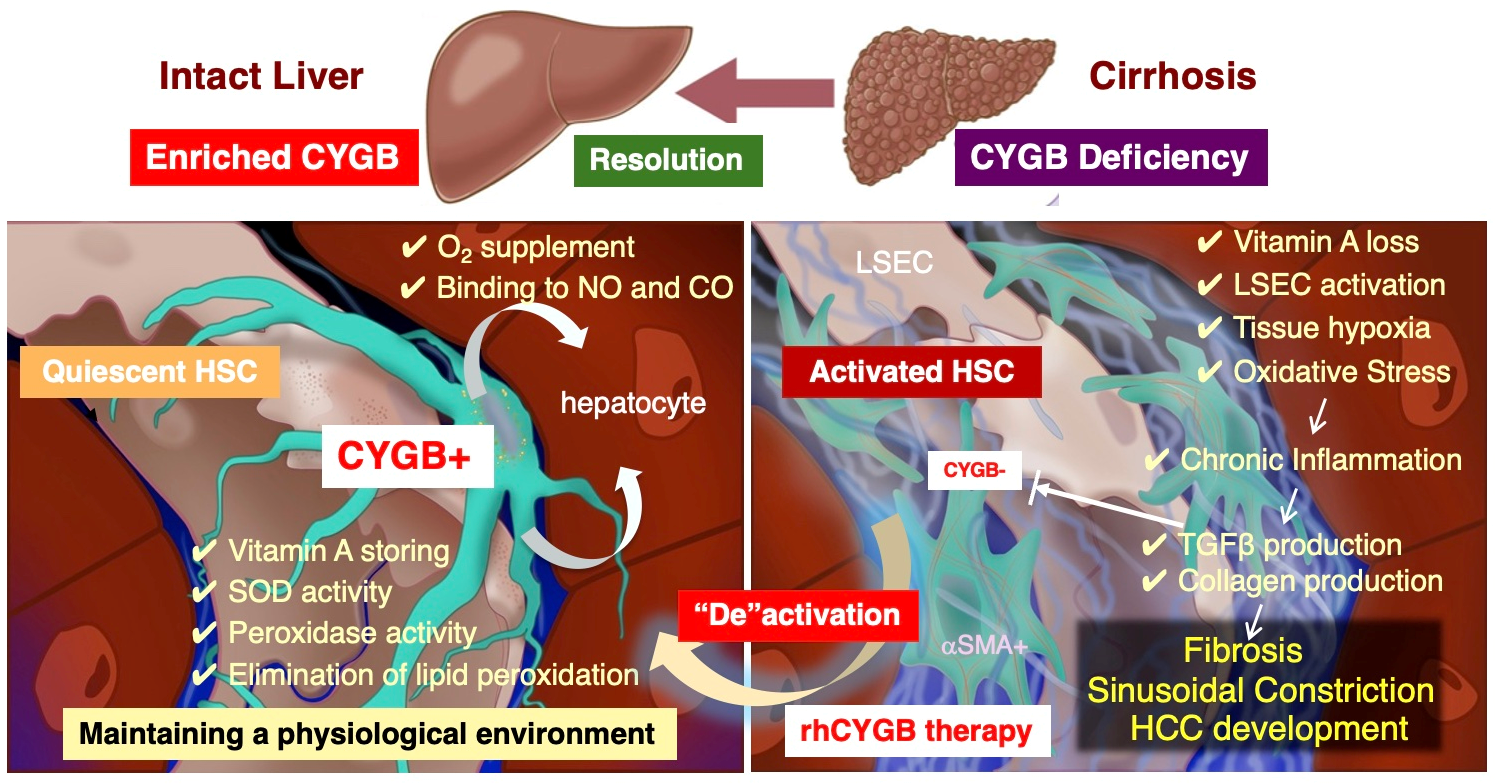
Cytoglobin in Hepatic Stellate Cells Plays Anti-Fibrotic Role in Chronic Liver Injury

Abstract
1. Introduction
2. Anatomy of the Liver
3. Involvement of HSCs in Fibrotic Process of the Liver
4. Discovery of Cytoglobin from Rat HSCs
5. Role of Cytoglobin in Liver Injury, Fibrosis and Carcinogenesis
5.1. Oxidative Stress and Liver Injury
5.2. Role of Cygb in Liver Trauma
6. Cytoglobin Gene Expression Regulation
6.1. Transcriptional Regulation
- •
- Hypoxia-Inducible Factor 1 (HIF-1): Although its responsiveness is less pronounced than that of erythropoietin, the CYGB promoter contains Hypoxia Response Elements. Under hypoxic conditions, HIF-1 binds to these sites to upregulate expression, potentially protecting cells from hypoxia-induced ROS [58].
- •
- TLR2-SAPK/JNK Pathway: Recent reports have demonstrated the induction of CYGB through the Toll-like receptor (TLR) 2-mediated stress-activated protein kinase/Jun-terminal kinase (SAPK/JNK) pathway in human HSCs [59].
6.2. Epigenetic Regulation
- •
- CpG Island Methylation: The CYGB promoter features a dense CpG island. In various malignancies, including lung, esophageal, and head and neck cancers, this region often becomes hypermethylated, effectively silencing the gene. This loss of expression is thought to promote tumor growth by impairing the cell’s capacity to manage oxidative DNA damage [60,61].
6.3. Response to Oxidative Stress and Fibrosis
- •
- •
6.4. Regulation Comparison: CYGB vs. Hb/Mb

| Feature | Hemoglobin (Hb) | Myoglobin (Mb) | Cytoglobin (CYGB) |
|---|---|---|---|
| Tissue Specificity | Erythrocytes only | Striated muscle (Heart/Skeletal) | Ubiquitous (esp. Fibroblasts/Neurons) |
| Key Regulator | Erythropoietin (EPO) and Iron | Locomotor activity and Calcium | Oxidative Stress and Fibrosis |
| Promoter Control | Lineage-specific enhancers | MEF2, NFAT (Muscle-specific) | HIF-1, AP-1, Sp1 (Stress-responsive) |
| Binding State | Pentacoordinate (Easy O2 swap) | Pentacoordinate (Storage) | Hexacoordinate (Likely signaling) |
6.5. Regulation of CYGB Expression by Fibroblast Growth Factor 2 (FGF2) and Lawson
7. Potential for Recombinant Human Cytoglobin as a Protein Therapy

7.1. Attenuation of Liver Injury and Fibrosis by rhCYGB Administration
7.2. Direct Deactivation of HSCs
7.3. Induction of Interferon-Beta (IFN-β)
8. The Role of CYGB in Human Carcinogenesis
8.1. Hepatocellular Carcinoma (HCC)
8.2. Extrahepatic Malignancies
- •
- Esophageal Cancer: The CYGB gene, located on chromosome 17q25, undergoes promoter methylation very early during the malignant transformation of esophageal cells [77].
- •
- Head and Neck Squamous Cell Carcinoma: In clinical samples, CYGB mRNA expression levels show a significant positive correlation with hypoxia markers (e.g., HIF-1A) and a marked negative correlation with promoter methylation, suggesting its role in the hypoxic tumor microenvironment [61].
- •
- Non-Small-Cell Lung Cancer: Frequent silencing by hypermethylation has positioned CYGB as a potential biomarker for early detection in sputum samples [78].
- •
- Pancreatic Ductal Adenocarcinoma (PDAC): Interestingly, elevated CYGB expression is primarily localized within the carcinoma cells themselves [79] [. Low CYGB expression is significantly associated with shorter disease-free and disease-specific survival. Furthermore, CYGB expression inversely correlates with several pro-oncogenic factors, including Phosphoinositide 3-kinase, p-AKT, IL-6, and vascular endothelial growth factor. Multivariate analysis has confirmed that CYGB expression serves as an independent prognostic factor alongside clinical stage in PDAC. These clinical findings are supported by in vivo data, where Cygb overexpression was shown to suppress 7,12-dimethylbenzanthracene-induced pancreatic tumorigenesis in mouse models [78]. The fact that Cytoglobin-expressing cells in the pancreas are pancreatic stellate cells is highly intriguing, given their functional parallels with those in the liver [80,81].
9. Future Perspectives
Funding
Institutional Review Board Statement
Informed Consent Statement
Data Availability Statement
Acknowledgments
Conflicts of Interest
Abbreviations
| αSMA | α-smooth muscle actin |
| BDL | bile duct ligation |
| CCl4 | carbon tetrachloride |
| CDAA | choline-deficient L-amino acid-defined diet |
| Cygb | cytoglobin |
| DEN | diethylnitrosamine |
| ECM | extracellular matrix |
| FGF2 | fibroblast growth factor 2 |
| Hb | hemoglobin |
| HSCs | hepatic stellate cells |
| HCC | hepatocellular carcinoma |
| HIF-1 | hypoxia-inducible factor 1 |
| IFN-β | interferon-beta |
| ILs | interleukins |
| JNK | c-Jun N-terminal kinase |
| KO | knockout |
| LSEC | liver sinusoidal endothelial cells |
| MAFLD | metabolic dysfunction-associated fatty liver disease |
| Mb | myoglobin |
| Ngb | neuroglobin |
| NO | nitric oxide |
| NOD | nitric oxide dioxygenase |
| O2 | oxygen |
| PDAC | pancreatic ductal adenocarcinoma |
| ROS | reactive oxygen species |
| Rh | recombinant human |
| SASP | senescence-associated secretory phenotype |
| SAPK/JNK | stress-activated protein kinase/jun-terminal kinase |
| O2− | superoxide |
| TLR2 | toll-like receptor |
| TBK1 | TANK-binding kinase 1 |
| TAA | thioacetamide |
| TGF-β | transforming growth factor-beta |
| Tg | transgenic |
| TNF-α | tumor necrosis factor-alpha |
| WT | wild-type |
References
- Rumgay, H.; Arnold, M.; Ferlay, J.; Lesi, O.; Cabasag, C.J.; Vignat, J.; Laversanne, M.; McGlynn, K.A.; Soerjomataram, I. Global burden of primary liver cancer in 2020 and predictions to 2040. J. Hepatol. 2022, 77, 1598–1606. [Google Scholar] [CrossRef] [PubMed]
- Llovet, J.M.; Kelley, R.K.; Villanueva, A.; Singal, A.G.; Pikarsky, E.; Roayaie, S.; Lencioni, R.; Koike, K.; Zucman-Rossi, J.; Finn, R.S. Hepatocellular carcinoma. Nat. Rev. Dis. Primers 2021, 7, 6. [Google Scholar] [CrossRef]
- Li, W.; Alazawi, W.; Loomba, R. Current and emerging therapeutic landscape for metabolic dysfunction-associated steatohepatitis. Lancet Gastroenterol. Hepatol. 2026, 11, 150–162. [Google Scholar] [CrossRef] [PubMed]
- Younossi, Z.M.; Kalligeros, M.; Henry, L. Epidemiology of metabolic dysfunction-associated steatotic liver disease. Clin. Mol. Hepatol. 2025, 31, S32–S50. [Google Scholar] [CrossRef]
- Anton, A.; Friedman, S.L.; Cogliati, B. Hepatic Fibrosis and Liver Cancer. Semin. Liver Dis. 2026, in press. [Google Scholar] [CrossRef]
- Rebouissou, S.; Nault, J.C. Advances in molecular classification and precision oncology in hepatocellular carcinoma. J. Hepatol. 2020, 72, 215–229. [Google Scholar] [CrossRef]
- Putatunda, V.; Jusakul, A.; Roberts, L.; Wang, X.W. Genetic, Epigenetic, and Microenvironmental Drivers of Cholangiocarcinoma. Am. J. Pathol. 2025, 195, 362–377. [Google Scholar] [CrossRef]
- Selicean, S.; Wang, C.; Guixé-Muntet, S.; Stefanescu, H.; Kawada, N.; Gracia-Sancho, J. Regression of portal hypertension: Underlying mechanisms and therapeutic strategies. Hepatol. Int. 2021, 15, 36–50. [Google Scholar] [CrossRef] [PubMed]
- Guixé-Muntet, S.; Quesada-Vázquez, S.; Gracia-Sancho, J. Pathophysiology and therapeutic options for cirrhotic portal hypertension. Lancet Gastroenterol. Hepatol. 2024, 9, 646–663. [Google Scholar] [CrossRef]
- McConnell, M.J.; Kostallari, E.; Ibrahim, S.H.; Iwakiri, Y. The evolving role of liver sinusoidal endothelial cells in liver health and disease. Hepatology 2023, 78, 649–669. [Google Scholar] [CrossRef]
- Ito, T.; Nemoto, M. Kupfer’s cells and fat storing cells in the capillary wall of human liver. Okajimas Folia Anat. Jpn. 1952, 24, 243–258. [Google Scholar] [CrossRef]
- Wake, K. Perisinusoidal stellate cells (fat-storing cells, interstitial cells, lipocytes), their related structure in and around the liver sinusoids, and vitamin A-storing cells in extrahepatic organs. Int. Rev. Cytol. 1980, 66, 303–353. [Google Scholar] [CrossRef]
- Wake, K. “Sternzellen” in the liver: Perisinusoidal cells with special reference to storage of vitamin A. Am. J. Anat. 1971, 132, 429–462. [Google Scholar] [CrossRef]
- Kent, G.; Gay, S.; Inouye, T.; Bahu, R.; Minick, O.T.; Popper, H. Vitamin A-containing lipocytes and formation of type III collagen in liver injury. Proc. Natl. Acad. Sci. USA 1976, 73, 3719–3722. [Google Scholar] [CrossRef] [PubMed]
- Ahern, M. Hepatic stellate cell nomenclature. Hepatology 1996, 23, 193. [Google Scholar]
- Friedman, S.L.; Roll, F.J.; Boyles, J.; Bissell, D.M. Hepatic lipocytes: The principal collagen-producing cells of normal rat liver. Proc. Natl. Acad. Sci. USA 1985, 82, 8681–8685. [Google Scholar] [CrossRef]
- Knook, D.L.; Seffelaar, A.M.; de Leeuw, A.M. Fat-storing cells of the rat liver. Their isolation and purification. Exp. Cell Res. 1982, 139, 468–471. [Google Scholar] [CrossRef] [PubMed]
- Weiner, F.R.; Giambrone, M.A.; Czaja, M.J.; Shah, A.; Annoni, G.; Takahashi, S.; Eghbali, M.; Zern, M.A. Ito-cell gene expression and collagen regulation. Hepatology 1990, 11, 111–117. [Google Scholar] [CrossRef] [PubMed]
- Pinzani, M.; Gesualdo, L.; Sabbah, G.M.; Abboud, H.E. Effects of platelet-derived growth factor and other polypeptide mitogens on DNA synthesis and growth of cultured rat liver fat-storing cells. J. Clin. Investig. 1989, 84, 1786–1793. [Google Scholar] [CrossRef] [PubMed]
- Housset, C.; Rockey, D.C.; Bissell, D.M. Endothelin receptors in rat liver: Lipocytes as a contractile target for endothelin 1. Proc. Natl. Acad. Sci. USA 1993, 90, 9266–9270. [Google Scholar] [CrossRef]
- Greenwel, P.; Schwartz, M.; Rosas, M.; Peyrol, S.; Grimaud, J.A.; Rojkind, M. Characterization of fat-storing cell lines derived from normal and CCl4-cirrhotic livers. Differences in the production of interleukin-6. Lab. Investig. 1991, 65, 644–653. [Google Scholar] [PubMed]
- Yang, J.D.; Nakamura, I.; Roberts, L.R. The tumor microenvironment in hepatocellular carcinoma: Current status and therapeutic targets. Semin. Cancer Biol. 2011, 21, 35–43. [Google Scholar] [CrossRef] [PubMed]
- Yoshimoto, S.; Loo, T.M.; Atarashi, K.; Kanda, H.; Sato, S.; Oyadomari, S.; Iwakura, Y.; Oshima, K.; Morita, H.; Hattori, M.; et al. Obesity-induced gut microbial metabolite promotes liver cancer through senescence secretome. Nature 2013, 499, 97–101. [Google Scholar] [CrossRef] [PubMed]
- Schwabe, R.F.; Brenner, D.A. Hepatic stellate cells: Balancing homeostasis, hepatoprotection and fibrogenesis in health and disease. Nat. Rev. Gastroenterol. Hepatol. 2025, 22, 481–499. [Google Scholar] [CrossRef]
- Kisseleva, T.; Ganguly, S.; Murad, R.; Wang, A.; Brenner, D.A. Regulation of Hepatic Stellate Cell Phenotypes in Metabolic Dysfunction-Associated Steatohepatitis. Gastroenterology 2025, 169, 797–812. [Google Scholar] [CrossRef]
- Tacke, F.; Puengel, T.; Loomba, R.; Friedman, S.L. An integrated view of anti-inflammatory and antifibrotic targets for the treatment of NASH. J. Hepatol. 2023, 79, 552–566. [Google Scholar] [CrossRef]
- Kristensen, D.B.; Kawada, N.; Imamura, K.; Miyamoto, Y.; Tateno, C.; Seki, S.; Kuroki, T.; Yoshizato, K. Proteome analysis of rat hepatic stellate cells. Hepatology 2000, 32, 268–277. [Google Scholar] [CrossRef]
- Kawada, N.; Kristensen, D.B.; Asahina, K.; Nakatani, K.; Minamiyama, Y.; Seki, S.; Yoshizato, K. Characterization of a stellate cell activation-associated protein (STAP) with peroxidase activity found in rat hepatic stellate cells. J. Biol. Chem. 2001, 276, 25318–25323. [Google Scholar] [CrossRef]
- Asahina, K.; Kawada, N.; Kristensen, D.B.; Nakatani, K.; Seki, S.; Shiokawa, M.; Tateno, C.; Obara, M.; Yoshizato, K. Characterization of human stellate cell activation-associated protein and its expression in human liver. Biochim. Biophys. Acta 2002, 1577, 471–475. [Google Scholar] [CrossRef]
- Trent, J.T., 3rd; Hargrove, M.S. A ubiquitously expressed human hexacoordinate hemoglobin. J. Biol. Chem. 2002, 277, 19538–19545. [Google Scholar] [CrossRef]
- Burmester, T.; Ebner, B.; Weich, B.; Hankeln, T. Cytoglobin: A novel globin type ubiquitously expressed in vertebrate tissues. Mol. Biol. Evol. 2002, 19, 416–421. [Google Scholar] [CrossRef] [PubMed]
- Sugimoto, H.; Makino, M.; Sawai, H.; Kawada, N.; Yoshizato, K.; Shiro, Y. Structural basis of human cytoglobin for ligand binding. J. Mol. Biol. 2004, 339, 873–885. [Google Scholar] [CrossRef] [PubMed]
- de Sanctis, D.; Dewilde, S.; Pesce, A.; Moens, L.; Ascenzi, P.; Hankeln, T.; Burmester, T.; Bolognesi, M. Crystal structure of cytoglobin: The fourth globin type discovered in man displays heme hexa-coordination. J. Mol. Biol. 2004, 336, 917–927. [Google Scholar] [CrossRef] [PubMed]
- Mathai, C.; Jourd’heuil, F.L.; Lopez-Soler, R.I.; Jourd’heuil, D. Emerging perspectives on cytoglobin, beyond NO dioxygenase and peroxidase. Redox Biol. 2020, 32, 101468. [Google Scholar] [CrossRef]
- Reeder, B.J.; Svistunenko, D.A.; Wilson, M.T. Lipid binding to cytoglobin leads to a change in haem co-ordination: A role for cytoglobin in lipid signalling of oxidative stress. Biochem. J. 2011, 434, 483–492. [Google Scholar] [CrossRef]
- Burmester, T.; Weich, B.; Reinhardt, S.; Hankeln, T. A vertebrate globin expressed in the brain. Nature 2000, 407, 520–523. [Google Scholar] [CrossRef]
- Trent, J.T., 3rd; Watts, R.A.; Hargrove, M.S. Human neuroglobin, a hexacoordinate hemoglobin that reversibly binds oxygen. J. Biol. Chem. 2001, 276, 30106–30110. [Google Scholar] [CrossRef]
- Dewilde, S.; Kiger, L.; Burmester, T.; Hankeln, T.; Baudin-Creuza, V.; Aerts, T.; Marden, M.C.; Caubergs, R.; Moens, L. Biochemical characterization and ligand binding properties of neuroglobin, a novel member of the globin family. J. Biol. Chem. 2001, 276, 38949–38955. [Google Scholar] [CrossRef]
- Reuss, S. Neuroglobin and Cytoglobin in Mammalian Nervous Systems: About Distribution, Regulation, Function, and Some Open Questions. Brain Sci. 2025, 15, 784. [Google Scholar] [CrossRef]
- Ascenzi, P.; di Masi, A.; Leboffe, L.; Fiocchetti, M.; Nuzzo, M.T.; Brunori, M.; Marino, M. Neuroglobin: From structure to function in health and disease. Mol. Asp. Med. 2016, 52, 1–48. [Google Scholar] [CrossRef]
- Mansouri, A.; Gattolliat, C.H.; Asselah, T. Mitochondrial Dysfunction and Signaling in Chronic Liver Diseases. Gastroenterology 2018, 155, 629–647. [Google Scholar] [CrossRef]
- Banerjee, P.; Gaddam, N.; Chandler, V.; Chakraborty, S. Oxidative Stress-Induced Liver Damage and Remodeling of the Liver Vasculature. Am. J. Pathol. 2023, 193, 1400–1414. [Google Scholar] [CrossRef] [PubMed]
- George, J.; Lu, Y.; Tsuchishima, M.; Tsutsumi, M. Cellular and molecular mechanisms of hepatic ischemia-reperfusion injury: The role of oxidative stress and therapeutic approaches. Redox Biol. 2024, 75, 103258. [Google Scholar] [CrossRef]
- Brenner, C.; Galluzzi, L.; Kepp, O.; Kroemer, G. Decoding cell death signals in liver inflammation. J. Hepatol. 2013, 59, 583–594. [Google Scholar] [CrossRef] [PubMed]
- Tacke, F. Targeting hepatic macrophages to treat liver diseases. J. Hepatol. 2017, 66, 1300–1312. [Google Scholar] [CrossRef] [PubMed]
- Tsuchida, T.; Friedman, S.L. Mechanisms of hepatic stellate cell activation. Nat. Rev. Gastroenterol. Hepatol. 2017, 14, 397–411. [Google Scholar] [CrossRef]
- Kisseleva, T.; Brenner, D. Molecular and cellular mechanisms of liver fibrosis and its regression. Nat. Rev. Gastroenterol. Hepatol. 2021, 18, 151–166. [Google Scholar] [CrossRef]
- Xu, R.; Harrison, P.M.; Chen, M.; Li, L.; Tsui, T.Y.; Fung, P.C.; Cheung, P.T.; Wang, G.; Li, H.; Diao, Y.; et al. Cytoglobin overexpression protects against damage-induced fibrosis. Mol. Ther. 2006, 13, 1093–1100. [Google Scholar] [CrossRef]
- Thuy, L.T.T.; Van Thuy, T.T.; Matsumoto, Y.; Hai, H.; Ikura, Y.; Yoshizato, K.; Kawada, N. Absence of cytoglobin promotes multiple organ abnormalities in aged mice. Sci. Rep. 2016, 6, 24990. [Google Scholar] [CrossRef]
- Thuy, L.T.T.; Morita, T.; Yoshida, K.; Wakasa, K.; Iizuka, M.; Ogawa, T.; Mori, M.; Sekiya, Y.; Momen, S.; Motoyama, H.; et al. Promotion of liver and lung tumorigenesis in DEN-treated cytoglobin-deficient mice. Am. J. Pathol. 2011, 179, 1050–1060. [Google Scholar] [CrossRef]
- Thuy, L.T.T.; Matsumoto, Y.; Thuy, T.T.; Hai, H.; Suoh, M.; Urahara, Y.; Motoyama, H.; Fujii, H.; Tamori, A.; Kubo, S.; et al. Cytoglobin deficiency promotes liver cancer development from hepatosteatosis through activation of the oxidative stress pathway. Am. J. Pathol. 2015, 185, 1045–1060. [Google Scholar] [CrossRef]
- Van Thuy, T.T.; Thuy, L.T.; Yoshizato, K.; Kawada, N. Possible Involvement of Nitric Oxide in Enhanced Liver Injury and Fibrogenesis during Cholestasis in Cytoglobin-deficient Mice. Sci. Rep. 2017, 7, 41888. [Google Scholar] [CrossRef]
- Thi Thanh Hai, N.; Thuy, L.T.T.; Shiota, A.; Kadono, C.; Daikoku, A.; Hoang, D.V.; Dat, N.Q.; Sato-Matsubara, M.; Yoshizato, K.; Kawada, N. Selective overexpression of cytoglobin in stellate cells attenuates thioacetamide-induced liver fibrosis in mice. Sci. Rep. 2018, 8, 17860. [Google Scholar] [CrossRef]
- Ukeri, J.; Wilson, M.T.; Reeder, B.J. Modulating Nitric Oxide Dioxygenase and Nitrite Reductase of Cytoglobin through Point Mutations. Antioxidants 2022, 11, 1816. [Google Scholar] [CrossRef]
- Oleksiewicz, U.; Liloglou, T.; Field, J.K.; Xinarianos, G. Cytoglobin: Biochemical, functional and clinical perspective of the newest member of the globin family. Cell Mol. Life Sci. 2011, 68, 3869–3883. [Google Scholar] [CrossRef] [PubMed]
- Okina, Y.; Sato-Matsubara, M.; Kido, Y.; Urushima, H.; Daikoku, A.; Kadono, C.; Nakagama, Y.; Nitahara, Y.; Hoang, T.H.; Thuy, L.T.T.; et al. Nitric Oxide Derived from Cytoglobin-Deficient Hepatic Stellate Cells Causes Suppression of Cytochrome c Oxidase Activity in Hepatocytes. Antioxid. Redox Signal. 2023, 38, 463–479. [Google Scholar] [CrossRef] [PubMed]
- McRonald, F.E.; Risk, J.M.; Hodges, N.J. Protection from intracellular oxidative stress by cytoglobin in normal and cancerous oesophageal cells. PLoS ONE 2012, 7, e30587. [Google Scholar] [CrossRef]
- Singh, S.; Manda, S.M.; Sikder, D.; Birrer, M.J.; Rothermel, B.A.; Garry, D.J.; Mammen, P.P. Calcineurin activates cytoglobin transcription in hypoxic myocytes. J. Biol. Chem. 2009, 284, 10409–10421. [Google Scholar] [CrossRef] [PubMed]
- Urushima, H.; Matsubara, T.; Qiongya, G.; Daikoku, A.; Takayama, M.; Kadono, C.; Nakai, H.; Ikeya, Y.; Yuasa, H.; Ikeda, K. AHCC inhibited hepatic stellate cells activation by regulation of cytoglobin induction via TLR2-SAPK/JNK pathway and collagen production via TLR4-NF-kappabeta pathway. Am. J. Physiol. Gastrointest. Liver Physiol. 2024, 327, G741–G753. [Google Scholar] [CrossRef] [PubMed]
- Shivapurkar, N.; Stastny, V.; Okumura, N.; Girard, L.; Xie, Y.; Prinsen, C.; Thunnissen, F.B.; Wistuba, I.I.; Czerniak, B.; Frenkel, E.; et al. Cytoglobin, the newest member of the globin family, functions as a tumor suppressor gene. Cancer Res. 2008, 68, 7448–7456. [Google Scholar] [CrossRef]
- Shaw, R.J.; Omar, M.M.; Rokadiya, S.; Kogera, F.A.; Lowe, D.; Hall, G.L.; Woolgar, J.A.; Homer, J.; Liloglou, T.; Field, J.K.; et al. Cytoglobin is upregulated by tumour hypoxia and silenced by promoter hypermethylation in head and neck cancer. Br. J. Cancer 2009, 101, 139–144. [Google Scholar] [CrossRef] [PubMed]
- Zweier, J.L.; Hemann, C.; Kundu, T.; Ewees, M.G.; Khaleel, S.A.; Samouilov, A.; Ilangovan, G.; El-Mahdy, M.A. Cytoglobin has potent superoxide dismutase function. Proc. Natl. Acad. Sci. USA 2021, 118, e2105053118. [Google Scholar] [CrossRef]
- Jourd’heuil, F.; Mathai, C.; Cat Pham, L.G.; Gilliard, K.; Balnis, J.; Overmyer, K.A.; Coon, J.J.; Jaitovich, A.; Boivin, B.; Jourd’heuil, D. Cytoglobin scavenges intracellular hydrogen peroxide and regulates redox signals in the vasculature. Redox Biol. 2025, 83, 103633. [Google Scholar] [CrossRef]
- Zweier, J.L.; Ilangovan, G. Regulation of Nitric Oxide Metabolism and Vascular Tone by Cytoglobin. Antioxid. Redox Signal. 2020, 32, 1172–1187. [Google Scholar] [CrossRef]
- Zheng, Y.; Deng, W.; Liu, D.; Li, Y.; Peng, K.; Lorimer, G.H.; Wang, J. Redox and spectroscopic properties of mammalian nitrite reductase-like hemoproteins. J. Inorg. Biochem. 2022, 237, 111982. [Google Scholar] [CrossRef]
- Hieu, V.N.; Thuy, L.T.T.; Hai, H.; Dat, N.Q.; Hoang, D.V.; Hanh, N.V.; Phuong, D.M.; Hoang, T.H.; Sawai, H.; Shiro, Y.; et al. Capacity of extracellular globins to reduce liver fibrosis via scavenging reactive oxygen species and promoting MMP-1 secretion. Redox Biol. 2022, 52, 102286. [Google Scholar] [CrossRef]
- Reeder, B.J. Redox and Peroxidase Activities of the Hemoglobin Superfamily: Relevance to Health and Disease. Antioxid Redox Signal. 2017, 26, 763–776. [Google Scholar] [CrossRef] [PubMed]
- Sato-Matsubara, M.; Matsubara, T.; Daikoku, A.; Okina, Y.; Longato, L.; Rombouts, K.; Thuy, L.T.T.; Adachi, J.; Tomonaga, T.; Ikeda, K.; et al. Fibroblast growth factor 2 (FGF2) regulates cytoglobin expression and activation of human hepatic stellate cells via JNK signaling. J. Biol. Chem. 2017, 292, 18961–18972. [Google Scholar] [CrossRef] [PubMed]
- Daikoku, A.; Matsubara, T.; Sato-Matsubara, M.; Ando, M.; Kadono, C.; Takada, S.; Odagiri, N.; Yuasa, H.; Urushima, H.; Yoshizato, K.; et al. Lawsone can suppress liver fibrosis by inhibition of YAP signaling and induction of CYGB expression in hepatic stellate cells. Biomed. Pharmacother. 2025, 191, 118520. [Google Scholar] [CrossRef]
- Li, Z.; Wei, W.; Chen, B.; Cai, G.; Li, X.; Wang, P.; Tang, J.; Dong, W. The Effect of rhCygb on CCl4-Induced Hepatic Fibrogenesis in Rat. Sci. Rep. 2016, 6, 23508. [Google Scholar] [CrossRef]
- Wen, J.; Wu, Y.; Wei, W.; Li, Z.; Wang, P.; Zhu, S.; Dong, W. Protective effects of recombinant human cytoglobin against chronic alcohol-induced liver disease in vivo and In Vitro. Sci. Rep. 2017, 7, 41647. [Google Scholar] [CrossRef]
- Zhang, Z.R.; Yang, Z.G.; Xu, Y.M.; Wang, Z.Y.; Wen, J.; Chen, B.H.; Wang, P.; Wei, W.; Li, Z.; Dong, W.Q. Bioinformatics analysis of differentially expressed proteins in alcoholic fatty liver disease treated with recombinant human cytoglobin. Mol. Med. Rep. 2021, 23, 289. [Google Scholar] [CrossRef]
- Cai, G.; Chen, B.; Li, Z.; Wei, W.; Wang, P.; Dong, W. The different expressed serum proteins in rhCygb treated rat model of liver fibrosis by the optimized two-dimensional gel electrophoresis. PLoS ONE 2017, 12, e0177968. [Google Scholar] [CrossRef]
- Dat, N.Q.; Thuy, L.T.T.; Hieu, V.N.; Hai, H.; Hoang, D.V.; Thi Thanh Hai, N.; Thuy, T.T.V.; Komiya, T.; Rombouts, K.; Dong, M.P.; et al. Hexa Histidine-Tagged Recombinant Human Cytoglobin Deactivates Hepatic Stellate Cells and Inhibits Liver Fibrosis by Scavenging Reactive Oxygen Species. Hepatology 2021, 73, 2527–2545. [Google Scholar] [CrossRef]
- Song, Q.; Fan, Y.; Zhang, H.; Wang, N. Z-DNA binding protein 1 orchestrates innate immunity and inflammatory cell death. Cytokine Growth Factor Rev. 2024, 77, 15–29. [Google Scholar] [CrossRef]
- Yang, S.; Cai, M.; Yang, Y.; Huang, Y.; Hou, T.; Zhang, J. Cytoglobin suppresses oxidative damage and compensatory proliferation via inhibiting AKT/ERK1/2/CyclinD1 axis in hepatocellular carcinoma. Am. J. Cancer Res. 2025, 15, 4010–4028. [Google Scholar] [CrossRef]
- Shahabi, M.; Noori Daloii, M.R.; Langan, J.E.; Rowbottom, L.; Jahanzad, E.; Khoshbin, E.; Taghikhani, M.; Field, J.K.; Risk, J.M. An investigation of the tylosis with oesophageal cancer (TOC) locus in Iranian patients with oesophageal squamous cell carcinoma. Int. J. Oncol. 2004, 25, 389–395. [Google Scholar] [CrossRef] [PubMed]
- Hubers, A.J.; Brinkman, P.; Boksem, R.J.; Rhodius, R.J.; Witte, B.I.; Zwinderman, A.H.; Heideman, D.A.; Duin, S.; Koning, R.; Steenbergen, R.D.; et al. Combined sputum hypermethylation and eNose analysis for lung cancer diagnosis. J. Clin. Pathol. 2014, 67, 707–711. [Google Scholar] [CrossRef]
- Rowland, L.K.; Campbell, P.S.; Mavingire, N.; Wooten, J.V.; McLean, L.; Zylstra, D.; Thorne, G.; Daly, D.; Boyle, K.; Whang, S.; et al. Putative tumor suppressor cytoglobin promotes aryl hydrocarbon receptor ligand-mediated triple negative breast cancer cell death. J. Cell Biochem. 2019, 120, 6004–6014. [Google Scholar] [CrossRef] [PubMed]
- Hoang, D.V.; Thuy, L.T.T.; Hai, H.; Hieu, V.N.; Kimura, K.; Oikawa, D.; Ikura, Y.; Dat, N.Q.; Hoang, T.H.; Sato-Matsubara, M.; et al. Cytoglobin attenuates pancreatic cancer growth via scavenging reactive oxygen species. Oncogenesis 2022, 11, 23. [Google Scholar] [CrossRef] [PubMed]
- Nielsen, M.F.B.; Mortensen, M.B.; Detlefsen, S. Identification of markers for quiescent pancreatic stellate cells in the normal human pancreas. Histochem. Cell Biol. 2017, 148, 359–380. [Google Scholar] [CrossRef] [PubMed]
Disclaimer/Publisher’s Note: The statements, opinions and data contained in all publications are solely those of the individual author(s) and contributor(s) and not of MDPI and/or the editor(s). MDPI and/or the editor(s) disclaim responsibility for any injury to people or property resulting from any ideas, methods, instructions or products referred to in the content. |
© 2026 by the author. Licensee MDPI, Basel, Switzerland. This article is an open access article distributed under the terms and conditions of the Creative Commons Attribution (CC BY) license.
Share and Cite
Kawada, N. Cytoglobin in Hepatic Stellate Cells Plays Anti-Fibrotic Role in Chronic Liver Injury. Antioxidants 2026, 15, 383. https://doi.org/10.3390/antiox15030383
Kawada N. Cytoglobin in Hepatic Stellate Cells Plays Anti-Fibrotic Role in Chronic Liver Injury. Antioxidants. 2026; 15(3):383. https://doi.org/10.3390/antiox15030383
Chicago/Turabian StyleKawada, Norifumi. 2026. "Cytoglobin in Hepatic Stellate Cells Plays Anti-Fibrotic Role in Chronic Liver Injury" Antioxidants 15, no. 3: 383. https://doi.org/10.3390/antiox15030383
APA StyleKawada, N. (2026). Cytoglobin in Hepatic Stellate Cells Plays Anti-Fibrotic Role in Chronic Liver Injury. Antioxidants, 15(3), 383. https://doi.org/10.3390/antiox15030383