Article

Dietary Encapsulation of a Novel Lysinibacillus sp. PWR01 Probiotic Modulates Growth, Antioxidant, Immune Gene Expression, and Gut Health in Nile tilapia (Oreochromis niloticus) Against Aeromonas hydrophila Infection


by
Nguyen Vu Linh
1,
Luu Tang Phuc Khang
1,
Suwanna Wisetkaeo
1,
Nguyen Dinh-Hung
2,
Papungkorn Sangsawad
3,
Waraphorn Sihamok
4,
Orathai Dangsawat
5,
Kritsada Phetduang
6,
Phatthanaphong Therdtatha
6,
Mintra Seel-audom
1 and
Patima Permpoonpattana
4,*
1
Department of Animal and Aquatic Sciences, Faculty of Agriculture, Chiang Mai University, Chiang Mai 50200, Thailand
2
Aquaculture Pathology Laboratory, School of Animal & Comparative Biomedical Sciences, The University of Arizona, 1117 E Lowell St., Tucson, AZ 85721, USA
3
School of Animal Technology and Innovation, Institute of Agricultural Technology, Suranaree University of Technology, Nakhon Ratchasima 30000, Thailand
4
Department of Agricultural Science and Technology, Faculty of Innovative Agriculture, Fisheries and Food, Prince of Songkla University, Surat Thani Campus, Surat Thani 84000, Thailand
5
Scientific Laboratory and Equipment Center, Office of Surat Thani Campus, Prince of Songkla University, Surat Thani Campus, Surat Thani 84000, Thailand
6
Specialized Research in Microbiome and Metabolome for Health Laboratory, Division of Biotechnology, Faculty of Agro-Industry, Chiang Mai University, Chiang Mai 50200, Thailand
*
Author to whom correspondence should be addressed.
Antioxidants 2026, 15(3), 373; https://doi.org/10.3390/antiox15030373
Submission received: 4 February 2026 / Revised: 7 March 2026 / Accepted: 11 March 2026 / Published: 16 March 2026

Abstract

Encapsulated probiotics, which are promising approaches for improving aquaculture species’ performance and health, have incompletely characterized dose-dependent physiological and immunological effects. This study represents the first report evaluating the probiotic efficacy of a novel encapsulated Lysinibacillus sp. PWR01, originally isolated from rubber latex nodules, in Nile tilapia (Oreochromis niloticus). A total of 300 Nile tilapia (10.80 ± 0.07 g) was allocated to four experimental groups receiving 0, 104, 105, and 106 CFU/g of encapsulated Lysinibacillus sp. PWR01 in their diet. At 8 weeks of the feeding trial, growth performance, feed utilization, serum antioxidant status, intestinal bacterial counts and immune-related gene expression were analyzed. Results demonstrated that fish fed 106 CFU/g achieved a final weight of 51.48 g, representing a 9.88% increase compared with the control (46.85 g), while weight gain (WG) improved by 12.82% and specific growth rate (SGR) by 6.34%. Feed conversion ratio (FCR) was reduced by up to 18.42% at 105 CFU/g relative to the control. Encapsulated groups enhanced serum superoxide dismutase activity without altering malondialdehyde levels, increased total intestinal bacterial and lactic acid bacteria counts, and selectively upregulated TLR2 and MHC II mRNA transcript levels. Histological analysis further revealed increased intestinal villus height and width in encapsulated-fed groups, while liver architecture remained normal across treatments. Multivariate analyses demonstrated strong positive associations among growth performance, gut microbiota enrichment, and immune gene expression. Resistance to Aeromonas hydrophila infection was significantly improved at higher dietary doses, with post-challenge survival reaching 61.67–75% in supplemented groups versus 45.00% in controls. These findings demonstrate that latex-derived Lysinibacillus sp. PWR01 acts as a strain-specific immunomodulatory probiotic that enhances growth, antioxidant capacity, microbial community balance, and disease resistance to Nile tilapia. Future studies should investigate the role of the Nrf2 antioxidant pathway, clarify TLR2-mediated immune signaling, and assess gut microbiota–immune system interactions within commercial-scale production systems.

1. Introduction

Aquaculture is the world’s fastest-growing food production sector, now providing over half of all fish for human consumption [1]. Nile tilapia (Oreochromis niloticus) is one of the most widely farmed freshwater fish globally, valued for its rapid growth and hardiness, and its production has reached record highs in recent years [2,3,4]. Intensive farming practices needed to meet rising demand often lead to high stocking densities and degraded water quality, which increase fish stress and susceptibility to diseases [5,6]. Bacterial outbreaks in tilapia culture cause severe economic losses; for example, Aeromonas hydrophila (A. hydrophila), the causative agent of motile Aeromonas septicemia, is a prevalent pathogen that can induce high mortality in tilapia populations [7,8]. Therefore, ensuring fish health and disease resistance in such intensive systems has become a paramount challenge in aquaculture.
Historically, disease control in aquaculture has relied on antibiotics. However, the overuse of antibiotics has led to the emergence of antibiotic-resistant bacteria and residual drug accumulation in the environment [9,10]. These issues pose risks to animal and human health, prompting many countries to restrict antibiotic use in farmed fish. In response, there is growing interest in sustainable, eco-friendly disease management strategies. Probiotics have emerged as a viable alternative to antibiotics in aquaculture, offering a means to prevent infections through modulation of the host microbiota and immunity rather than chemical therapeutics [11,12,13]. The use of probiotics in fish farming has expanded significantly in the past decade [14], reflecting their promise in improving fish health and reducing dependence on antimicrobial drugs.
Probiotics are defined as viable beneficial microorganisms that, when delivered to the host in sufficient quantities, confer measurable health benefits [15,16]. In aquaculture, dietary probiotic supplementation has been extensively reported to enhance growth performance, feed utilization efficiency, and immunological responses of fish [16,17,18]. Previous studies have shown that probiotic supplementation can increase weight gain (WG), improve feed conversion ratio (FCR), and stimulate the fish immune system, thereby improving survival rate against bacterial infections [19,20,21,22]. Among the diverse available candidates for aquaculture application, Bacillus species are especially popular in aquaculture due to their spore-forming ability, which confers high stability in feed and the gastrointestinal tract [23]. Numerous studies on Nile tilapia have demonstrated the benefits of Bacillus-based probiotics. Dietary inclusion of Bacillus (e.g., B. subtilis, B. licheniformis or their combinations) has been shown to significantly promote growth performance, enhance innate immune parameters, and elevate resistance to bacterial pathogens [24,25,26]. These beneficial outcomes are mechanistically attributed to improved nutrient digestibility, favorable modulation of gut microbiota composition toward health-promoting communities, and production of bioactive compounds that inhibit pathogens [27,28]. As a consequence, Bacillus-based probiotics have firmly become an effective and widely adopted feed additive in tilapia culture to sustain productivity and host health. Parallel to this well-established literature, contemporary research is increasingly directing attention toward novel bacterial genera with underexplored probiotic potential. Lysinibacillus, a spore-forming genus phylogenetically closed to Bacillus has emerged as a candidate of particular interest. Recent investigations have demonstrated that select Lysinibacillus strains exhibit broad-spectrum antibacterial activity against major aquatic pathogens, including A. hydrophila, Vibrio spp., and Streptococcus spp. [29,30,31], suggesting functional diversity same as typically documented for conventional Bacillus probiotics. In addition, Lysinibacillus species have shown promising probiotic properties in preliminary studies. Yao, et al. [31] isolated a Lysinibacillus strain from the gut of yellow croaker (Larimichthys crocea) that exhibited strong antimicrobial activity against several fish pathogens, including A. hydrophila. These findings indicate that Lysinibacillus could serve as a beneficial probiotic in aquaculture. Notably, Lysinibacillus shares the advantages of spore formation and environmental resilience with Bacillus [32], but its use in fish diets has not been as extensively studied. To date, most evidence for Lysinibacillus efficacy comes from in vitro assays or trials in species like zebrafish (Danio rerio) [30], whiteleg shrimp (Litopenaeus vannamei) [29] or common carp (Cyprinus carpio) [33] rather than in major culture species like tilapia. Those results underscore the probiotic potential of Lysinibacillus; however, there remains a clear knowledge gap regarding its in vivo effects in economically important fish like tilapia, especially under practical farming conditions.
Another major determinant of probiotic efficacy in aquafeeds is delivery performance and viability at the intestinal target site. To exert beneficial effects, probiotic cells must successfully withstand feed processing, storage, immersion/leaching in water, and the acidic and bile-rich conditions of the gastrointestinal tract [34,35]. Even in spore-forming bacteria, viability losses and suboptimal intestinal colonization can occur, which may reduce functional dosing and compromise consistency of outcomes, particularly in intensive systems where stressors are frequent [36]. Although Lysinibacillus species possess endospores, there is limited empirical evidence regarding their survival efficiency in tilapia gastrointestinal conditions when administered in non-encapsulated form. Potential reductions in viable cell delivery to the intestine may therefore constrain probiotic efficacy and justify the exploration of protective delivery systems [36]. To address these limitations, encapsulation technologies (e.g., alginate-based microcapsules and related biopolymer matrices) have increasingly been adopted to protect probiotics from processing stress and gastrointestinal degradation, reduce premature leaching in water, and enable controlled release within the intestine [37,38]. Recent aquaculture studies have demonstrated that encapsulation can significantly enhance probiotic survival during feed processing and improve intestinal recovery rates compared with free-cell formulations [39,40,41], leading to more consistent physiological and immunological outcomes.
Critically, no peer-reviewed investigation has thus far examined the efficacy of an encapsulated Lysinibacillus strain in Nile tilapia subjected to A. hydrophila challenge, leaving a critical translational gap in both delivery strategy and host–pathogen context. Although preliminary trials in model species suggest probiotic potential, direct evidence in Nile tilapia remains lacking. This gap limits assessment of whether Lysinibacillus can provide comparable or complementary benefits to established Bacillus-based probiotics in tilapia aquaculture. Therefore, the current study aims to investigate dietary encapsulated Lysinibacillus sp. PWR01 in Nile tilapia, with emphasis on growth performance, antioxidant status, intestinal bacterial counts, immune-related gene expression, and resistance to A. hydrophila infection. By integrating an emerging probiotic with a protective delivery technology and evaluating its efficacy under pathogen challenge in a major aquaculture species, this study addresses a clearly defined research gap and contributes to the translational development of Lysinibacillus-based probiotics for tilapia culture.

2. Materials and Methods

2.1. Bacterial Culture and Experimental Fish

Lysinibacillus sp. PWR01 was isolated, characterized, and identified from our previous study [37]. The 16S rRNA sequencing data has been uploaded to the National Center for Biotechnology Information (NCBI) database under accession number PX415241.1. The strain was originally isolated from rubber latex nodules collected from a rubber plantation in Surat Thani Province, Thailand. The isolate was cultured on nutrient agar (NA; HiMedia, Thane, India).
The bacterial pathogen A. hydrophila used for the challenge experiment was isolated from diseased fish during an outbreak at a local aquaculture farm and was obtained from the Centex Shrimp Center, Faculty of Science, Mahidol University, Thailand.
A total of 300 one-month-old Nile tilapia were obtained from a local fish farm in Chiang Mai Province, Thailand. At the start of the experiment, fish had a mean body weight of 10.80 ± 0.07 g. Fish were acclimated under laboratory conditions prior to the feeding trial and challenge test. Before the experiment commenced, 10 randomly selected fish were screened to confirm the absence of bacterial and viral infections.

2.2. Diet Preparation

The experimental diets followed a protocol from a previous study [38]. Briefly, polysaccharides were extracted from dried Gracilaria fisheri seaweed collected from Thung Sai Chai, Chaiya District, Surat Thani Province, Thailand. Dried seaweed (20 g) was soaked in a 6% (w/v) sodium hydroxide (NaOH) solution at 28 °C for 5 h. Rinsed with distilled water, the seaweed was cut into 1.0–1.5 cm segments and hot-water extracted. Distilled water was added to the mixture, and the pH was adjusted to 6.2–6.8. The mixture was boiled for 1.5 h, stirred occasionally, and then filtered through two layers of fine cloth. The filtrate was frozen at −20 °C for 24 h, dried in a hot-air oven at 60 °C until constant weight, ground into a fine powder, and stored at room temperature for feed formulation.
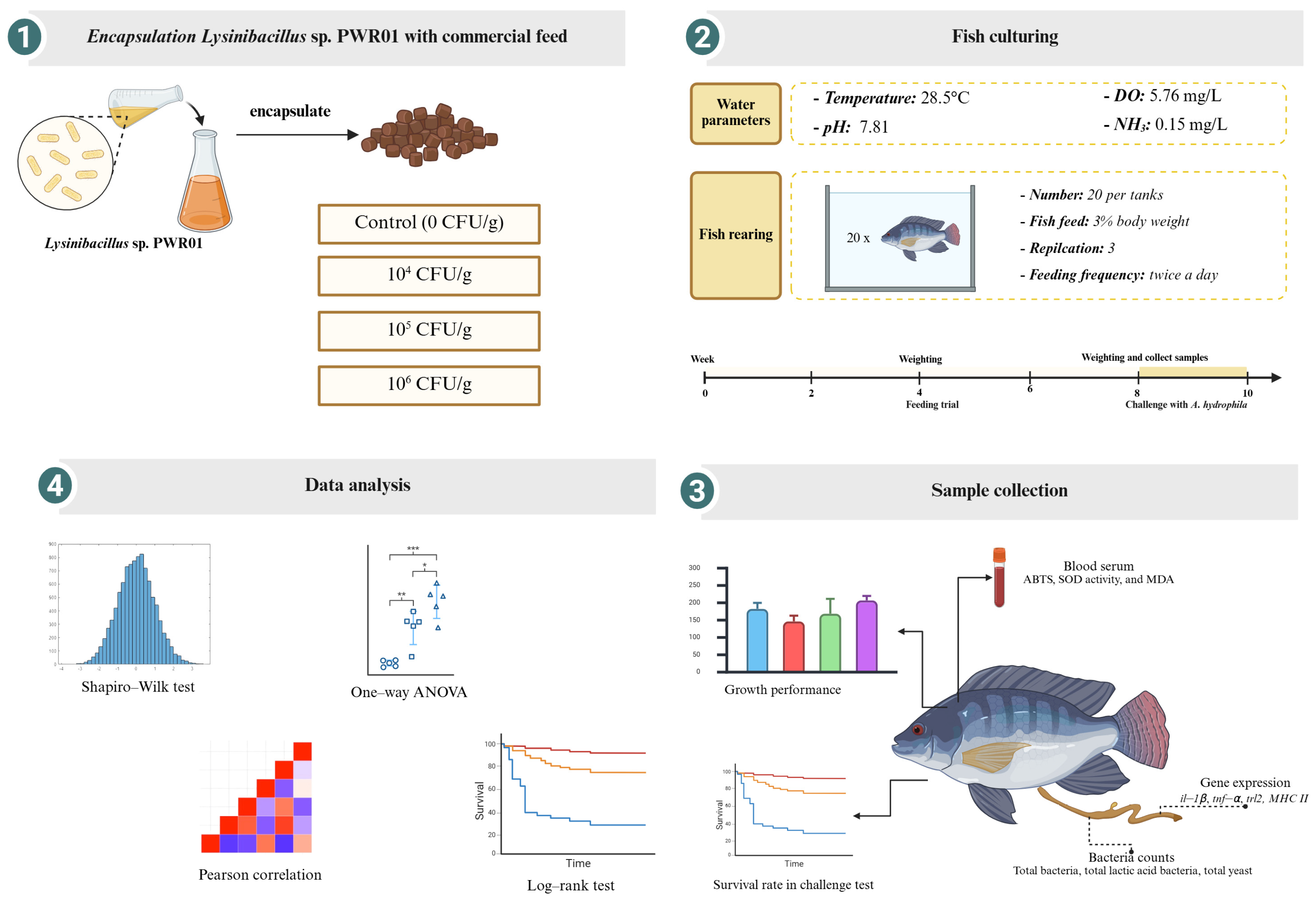
Probiotic diets were formulated by incorporating Lysinibacillus sp. PWR01 spores. Spore production was accomplished through nutrient depletion in Difco Sporulation Medium. Subsequently, the purified spores were enumerated and purified according to the methodology outlined by Goncalves, et al. [42]. The purified spores were incorporated into the experimental diets at concentrations of 0 (control), 104, 105, and 1 × 10⁶ CFU/g of feed (Figure 1).
For encapsulation, purified spores were suspended in a sterile sodium alginate at a final concentration of 2% (w/v). Encapsulation was performed by the dropwise addition of this mixture into a 0.45 M CaCl2 solution under continuous gentle stirring, allowing bead solidification to proceed for 45 min at room temperature. The resultant gel beads, with a mean particle diameter of approximate [4–5 mm], were collected through filtration using filter paper, rinsed three times with sterile distilled water to remove residual calcium ions, and subsequently dried using hot air drying at 50–70 °C for 4–5 h. The encapsulation spore preparations were stored at 4 °C for further experiments.

2.3. Rearing Conditions

Three replicate tanks were assigned to each dietary treatment, with 20 fish stocked per tank. Experimental diets were administered twice daily at 09:00 and 16:00 during a eight-week feeding trial (from October to December 2025). Fish were observed for 30 min after each feeding to ensure the absence of uneaten feed. Any remaining feed was collected and weighed at the end of each day to estimate feed requirements for the subsequent day. The average feed intake for juvenile Nile tilapia was approximately 4% of body weight throughout the experimental period.
Water quality parameters were monitored and maintained within optimal ranges for Nile tilapia throughout the experiment [43]. These parameters included temperature (28.5 °C), pH (7.8), dissolved oxygen (5.76 mg/L), and NH3 (0.15 mg/L).

2.4. Sample Collection

Fish were weighed at two-week intervals to assess growth performance. Mortality was recorded daily, and dead fish were promptly removed from the tanks. Survival rate was calculated at weeks 2 and 4 to determine cumulative survival.
At the end of the 8-week feeding trial, three fish per replicate tank were randomly selected and anesthetized with clove oil [44]. Briefly, the stock solution was diluted in tank water to achieve a working concentration of 100 mg/L. Individual fish were immersed in the anesthetic solution until complete sedation was conformed. Blood and tissue samples were then collected for subsequent analyses. Blood was drawn from the caudal vein using a 1 mL syringe, allowed to clot at 4 °C for 4 h, and centrifuged at 1000× g for 10 min at 4 °C to obtain serum for antioxidant analysis [45].
Mid-intestinal tissue samples (approximately 50 mg) were collected, placed into sterile tubes containing 200 µL of TRIzol™ reagent (Invitrogen™, Life Technologies, Carlsbad, CA, USA), and stored at −80 °C for gene expression analysis. In addition, midgut and liver tissues were fixed in 10% neutral buffered formalin for histological examination. The distal intestine was collected for total bacterial count analysis and stored in sterile 0.85% (w/v) NaCl solution until processing.

2.5. Growth Performance Indices

Fish growth performance was assessed using the following indices according to previously described methods [45,46]:
-
Weight gain (WG, %) = [(Final body weight − Initial weight)/Initial weight] × 100.
-
Specific growth rate (SGR, %) = [ln (Final weight) − ln (Initial weight)]/days × 100.
-
Feed conversion ratio (FCR) = [Feed consumed (g)/Weight gain (g)].
-
Daily weight gain (DWG, g/day) = (Final body weight − Initial body weight)/days.
-
Periodic growth rate (PWG, g/day) = [(Final weight of period − Initial weight of the period)/period day].

2.6. Blood Biochemical Analysis

2.6.1. ABTS Radical Scavenging Activity

Antioxidant activity was determined using the ABTS radical scavenging assay following the method described by Boonkong, et al. [47] with minor modification. Briefly, 20 µL of serum sample was mixed with 200 µL of 2,2′-Azino-bis(3-ethylbenzothiazoline-6-sulphonic acid) (ABTS) solution. The mixture was gently vortexed and incubated in the dark at room temperature for 10 min. Absorbance was measured at 734 nm using a microplate reader. Antioxidant activity was quantified by comparison with a Trolox standard curve ranging from 0 to 2.5 mg/mL.

2.6.2. Superoxide Dismutase Activity

Superoxide dismutase (SOD) activity was measured using a commercial assay kit (CheKine™ Micro Superoxide Dismutase Activity Assay Kit, KTB1030; Sigma-Aldrich, St. Louis, MO, USA) according to the manufacturer’s instructions. Serum samples were incubated with the provided reagents, and absorbance was recorded at 450 nm using a Varioskan LUX microplate reader (Thermo Scientific, Vantaa, Finland) [48].

2.6.3. Malondialdehyde Assay

Lipid peroxidation was assessed by measuring malondialdehyde (MDA) levels following the method of Karatas and EM [49]. Briefly, 50 µL of serum was mixed with 100 µL of thiobarbituric acid (TBA) reagent consisting of 0.375% TBA and 0.25 N HCl in 15% trichloroacetic acid (TCA). The mixture was incubated at room temperature for 5 min and then heated at 95 °C for 5 min. After cooling on ice, absorbance was measured at 532 nm. MDA concentration was calculated using a standard curve ranging from 0 to 300 µmol/L.

2.7. Histological Analysis

For each treatment group, anterior intestinal and liver tissues (n = 5) were collected and subjected to histological processing. The samples were first fixed and then dehydrated through a sequential ethanol gradient consisting of 10%, 20%, 30%, 50%, 70%, and 100% ethanol. Following dehydration, the tissues were clarified by two immersions in xylene, each lasting 60 min.
Subsequently, the specimens were infiltrated with a transitional mixture of xylene and paraffin (1:2, v/v) prior to paraffin processing. This was followed by two successive paraffin infiltration steps, after which the tissues were maintained in molten paraffin overnight before being embedded into paraffin blocks.
Paraffin-embedded samples were sectioned at a thickness of 5 μm using a rotary microtome (Leica 2025, Wetzlar, Germany). The sections were stained with hematoxylin and eosin (H&E; Solarbio, G1120, Beijing, China) to evaluate tissue architecture and cellular characteristics. Microscopic examination was carried out using a CX43 light microscope (Olympus, Hachioji-shi, Tokyo, Japan) fitted with an E620 digital imaging system. Morphometric measurements were performed according to the methodological framework described by previous studies [45,50].

2.8. Intestinal Bacterial and Yeast Counts

The intestine was thoroughly washed with sterile saline solution (0.85% NaCl) and homogenized for the determination of total bacterial count, total lactic acid bacteria (LAB), and total yeast count using the tenfold serial dilution method. Approximately 1 g of intestinal tissue was homogenized in 9 mL of sterile saline to obtain an initial 10−1 dilution. Tenfold serial dilutions were subsequently prepared up to 10−6. For each appropriate dilution, 0.1 mL aliquots were spread-plated in triplicate onto selective media. Plate count agar (PCA; HiMedia Laboratories, Mumbai, India) was used for enumeration of total bacteria, De Man, Rogosa and Sharpe (MRS) agar (HiMedia Laboratories, India) for total LAB, and potato dextrose agar (PDA; HiMedia Laboratories, India) for total yeast. PCA and MRS plates were incubated at 37 °C for 24–48 h under aerobic conditions, whereas PDA plates were incubated at 28 °C for 72 h. Plates containing 30–300 colonies were selected for counting. Colony-forming units were calculated by multiplying the colony number by the corresponding dilution factor and expressed as log10 CFU/g of intestinal tissue.

2.9. Gene Expression by Quantitative PCR (qPCR)

Total RNA was extracted from mid-intestinal tissue samples using TRIzol™ reagent following homogenization with a Bullet Blender® homogenizer (Next Advance, New York, NY, USA) based on previous studies [51]. Homogenized samples were incubated at room temperature for 2–3 min, after which 100 µL of chloroform was added. The mixtures were vortexed briefly, incubated for 2 min, and centrifuged at 12,000 rpm for 15 min at 4 °C. The aqueous phase containing RNA was collected and further purified using a Total RNA extraction kit (Omega Bio-tek, Norcross, GA, USA) according to the manufacturer’s instructions. RNA concentration and purity were assessed using a NanoDrop™ One/OneC spectrophotometer (Thermo Fisher Scientific, Waltham, MA, USA) [52].
Complementary DNA (cDNA) was synthesized from 1 µg of total RNA using a reverse transcription kit (BIO-RAD, Hercules, CA, USA). Quantitative real-time PCR (qPCR) was conducted in a 20 µL reaction volume containing 100 ng of cDNA, 0.4 µL of each primer (10 µM), and 10 µL of 2× iTaq Universal SYBR Green Supermix (BIO-RAD, USA). Amplification was performed using a CFX Connect™ Real-Time PCR Detection System (BIO-RAD, USA) under the following conditions: initial denaturation at 95 °C for 30 s, followed by 40 cycles of 95 °C for 15 s and 60 °C for 30 s [45]. A melt curve analysis was included to confirm amplification specificity. Relative gene expression levels were calculated using the 2−ΔΔCt method [53], with β-actin used as the reference gene. All the primers were adopted from Sheng, et al. [54] study. Primer sequences are provided in Table 1.

2.10. Aeromonas hydrophila Challenge Test

Aeromonas hydrophila used in the present study was cultured in tryptic soy broth (HiMedia, India) at 28 °C for 16 h. Bacterial cells were harvested by centrifugation at 12,000 × g for 15 min at 4 °C, washed three times with sterile phosphate-buffered saline (PBS), and resuspended in sterile PBS. Bacterial concentration was determined by tenfold serial dilution and plate counting on tryptic soy agar plates.
Fish in the negative control group were injected intraperitoneally with sterile PBS, whereas fish in the remaining treatments were injected with A. hydrophila. All challenged fish were intraperitoneally injected with A. hydrophila at a dose of 2.5 × 10⁶ CFU/g body weight, following a previously described protocol [55]. After challenge, fish were monitored daily, and cumulative mortality was recorded over a 14-day period.
After the challenge trial, surviving and moribund Nile tilapia were managed under strict biosecurity and hygienic disposal procedures to prevent environmental release of the pathogen. All remaining fish were humanely euthanized using an overdose of tricaine methanesulfonate (MS-222; 300 mg/L) for the euthanasia of experimental fish [56]. Death was confirmed by cessation of opercular movement and absence of reflex responses before further handling. All dead and euthanized fish were collected in sealed, leakproof biosecure containers and transported to a licensed facility for high-temperature incineration, consistent with aquatic animal health and biosafety recommendations [57]. In addition, tanks, equipment, and effluent water were disinfected with sodium hypochlorite before disposal, in accordance with established aquaculture biosecurity protocols.

2.11. Statistical Analysis

Prior to statistical analysis, microbial count data were log-transformed to satisfy assumptions of normality and homoscedasticity. Data normality was assessed using the Shapiro–Wilk test [58]. Differences among treatments were analyzed by one-way analysis of variance (ANOVA), followed by Duncan’s multiple range test using SPSS software (version 29.0.2.0; IBM Corp., Armonk, NY, USA). In addition, fish survival during the 14-day post-challenge period following A. hydrophila injection was analyzed using Kaplan–Meier survival curves, and differences among treatments were evaluated with the log-rank test. Pearson correlation analysis and principal component analysis (PCA) were conducted using standardized (z-score transformed) datasets including all quantitative indicators measured in this study (growth performance indices, antioxidant parameters, intestinal microbial counts, histological parameters and immune-related gene expression levels). Variables included in PCA were screened to ensure complete datasets (no missing values) and adequate variance (variance > 1 after scaling). PCA suitability was verified using the Kaiser–Meyer–Olkin (KMO) measure of sampling adequacy and Bartlett’s test of sphericity prior to dimensionality reduction. Principal components with eigenvalues > 1 were retained for interpretation. All statistical analyses and graphical visualizations were conducted using R software (version 4.3.1; R Foundation for Statistical Computing, Vienna, Austria). The following R packages were used as stats for correlation analysis, FactoMineR and factoextra for PCA, survival and survminer for survival analysis, and ggplot2 for data visualization. Results are expressed as mean ± standard deviation. Statistical significance was accepted at p < 0.05.

3. Results

3.1. Growth Performance Analysis

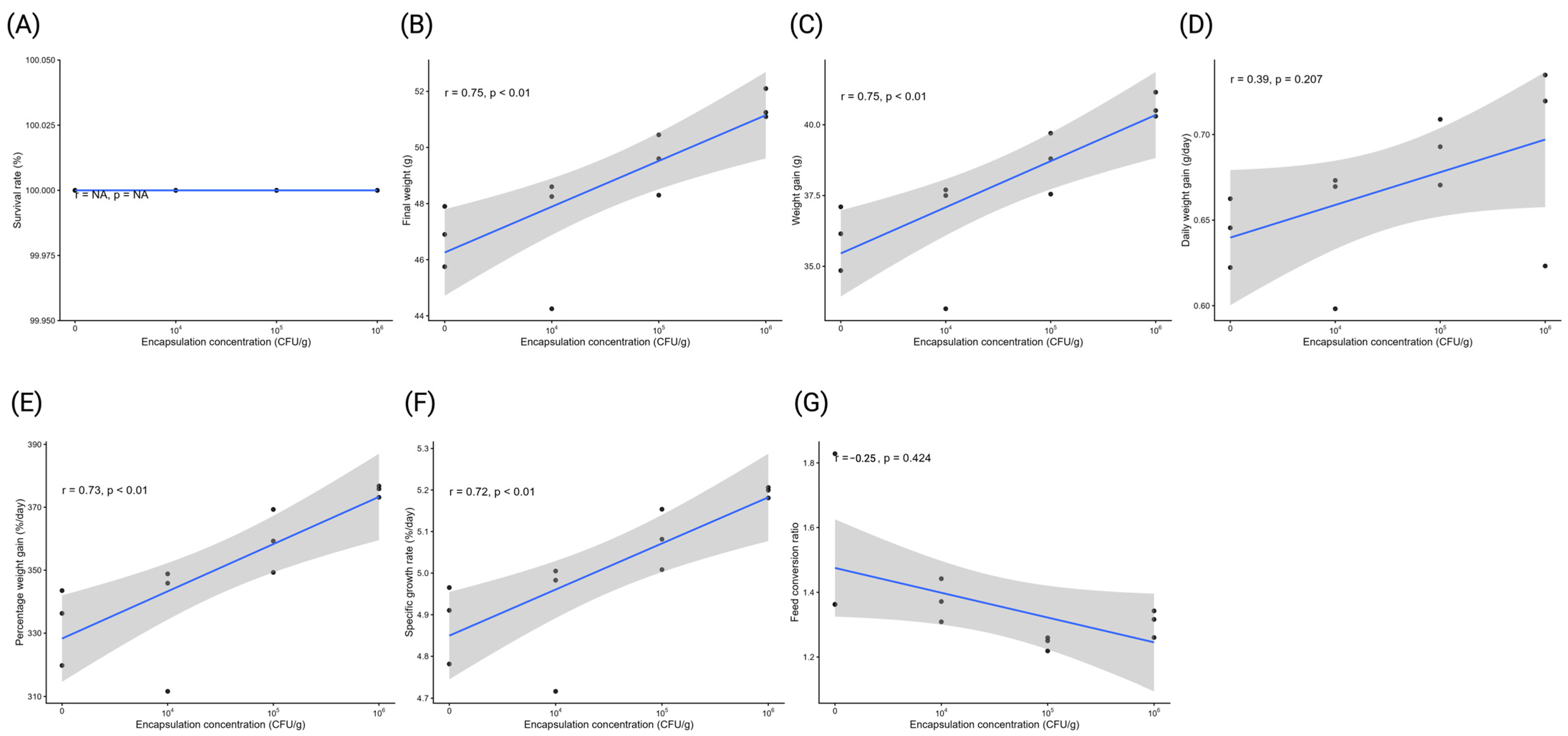
Lysinibacillus sp. PWR01 encapsulation concentration affected growth performance from week 4 onward, while survival remained unchanged throughout the experiment (Table 2). At week 4, FW ranged from 26.00 g in the control to 27.63 g at 105 CFU/g. WG (15.18–16.87 g), PWG (137.83–156.66%), SGR (2.92–3.14%/day), and DWG (0.54–0.60 g/day) showed higher mean values at 105–106 CFU/g than in the control. FCR at week 4 was similar among treatments (0.83–0.84). However, these parameters have no different significant among treatments.
At week 8, FW increased significantly with encapsulation concentration (r = 0.75, p < 0.01) (Figure 2), reaching 51.48 g at 106 CFU/g compared with 46.85 g in the control, representing a 9.88% increase relative to the control. WG was also positively correlated with concentration (r = 0.75, p < 0.01), increasing from 36.03 g in the control to 40.65 g at 106 CFU/g, corresponding to a 12.82% improvement. PWG showed a strong positive correlation (r = 0.73, p < 0.01), ranging from 333.17% to 375.23% across the same treatments (+12.62% compared with control). SGR increased with encapsulation concentration (r = 0.72, p < 0.01), with the highest value observed at 106 CFU/g (5.20%/day), 6.34% higher than the control (4.89%/day). DWG exhibited a positive but non-significant association with concentration (r = 0.39, p = 0.21), reaching 0.73 g/day at 106 CFU/g, which was 14.06% greater than the control (0.64 g/day). FCR showed a negative, non-significant correlation with encapsulation concentration (r = −0.25, p = 0.42), with lower values at 105–106 CFU/g (1.24–1.31) than in the control (1.52), indicating an improvement in feed efficiency of up to 18.42% at 105 CFU/g.

3.2. Antioxidant and Lipid Peroxidation Analysis

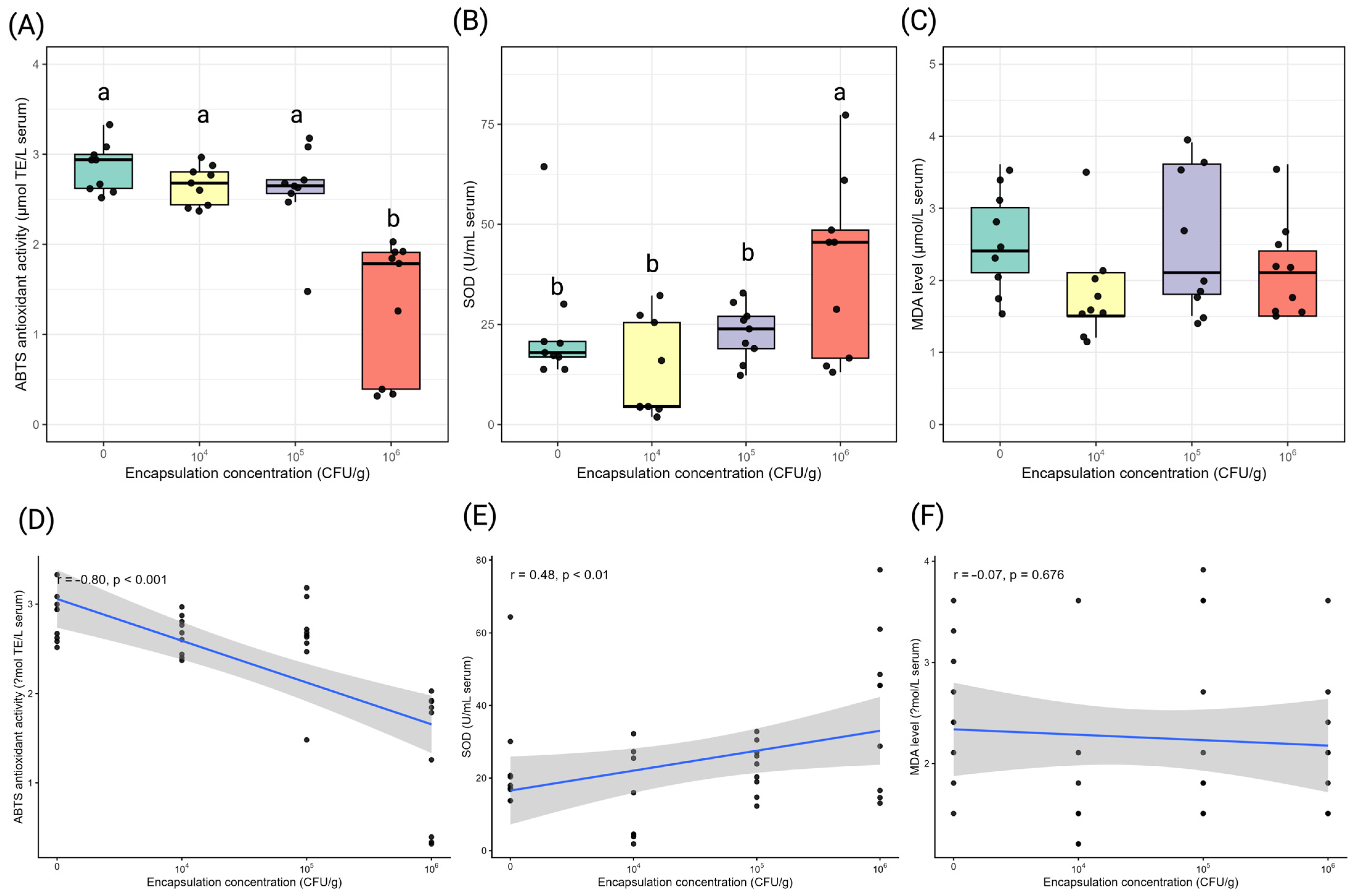
Encapsulation concentration significantly altered antioxidant enzyme activity and radical scavenging capacity, while lipid peroxidation remained unchanged (Figure 3).
Relative to the control, serum ABTS activity declined at the highest encapsulation level. ABTS activity was comparable among the control, 104 CFU/g, and 105 CFU/g groups (2.61–2.85 μmol TE/L), but was significantly lower at 106 CFU/g (1.31 μmol TE/L; p < 0.05). Specifically, ABTS activity at 106 CFU/g was approximately 2.0-fold lower than the control. A strong negative correlation was observed between encapsulation concentration and ABTS activity (r = −0.80, p < 0.001).
Serum SOD activity increased with encapsulation concentration. Mean SOD activity ranged from 13.34 U/mL at 104 CFU/g to 38.99 U/mL at 106 CFU/g. At 106 CFU/g, SOD activity was approximately 2.9-fold higher than the lowest-dose group (104 CFU/g) and markedly elevated relative to the control (p < 0.05). SOD activity showed a significant positive correlation with encapsulation concentration (r = 0.48, p < 0.01).
MDA levels did not differ significantly among treatments, ranging from 1.84 to 2.54 μmol/L. No significant correlation was detected between encapsulation concentration and MDA level (r = −0.07, p = 0.68).

3.3. Microbial Counts Analysis

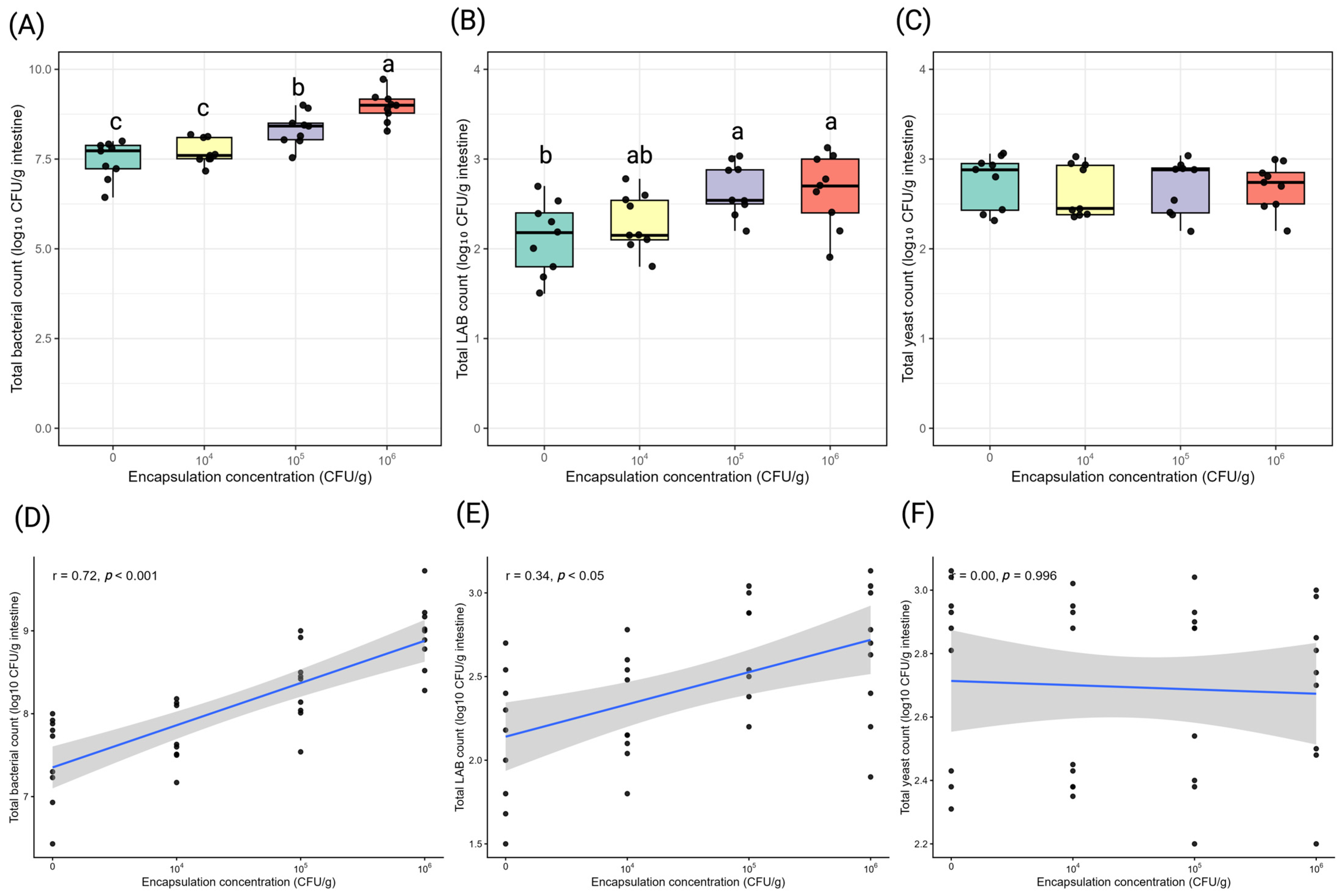
Encapsulation concentration significantly influenced total intestinal bacterial and LAB counts, whereas yeast counts were unaffected (Figure 4).
Total intestinal bacterial count increased progressively with encapsulation concentration. Mean bacterial counts rose from 7.47 log10 CFU/g intestine in the control group to 7.70 log10 CFU/g at 104 CFU/g, 8.34 log10 CFU/g at 105 CFU/g, and 8.96 log10 CFU/g at 106 CFU/g (p < 0.05). Compared with the control, total bacterial abundance increased by 0.87, and 1.49 log units at 105, and 106 CFU/g, respectively. Encapsulation concentration showed a strong positive correlation with total bacterial count (r = 0.72, p < 0.001).
Total LAB count also differed significantly among treatments. LAB counts increased from 2.12 log10 CFU/g intestine in the control to 2.29 log10 CFU/g at 104 CFU/g and peaked at 2.66 log10 CFU/g at 105 CFU/g, with a similar value at 106 CFU/g (2.64 log10 CFU/g; p < 0.05). Relative to the control, LAB abundance increased by 0.54, and 0.52 log units at 105, and 106 CFU/g, respectively. A positive correlation was observed between encapsulation concentration and LAB count (r = 0.34, p < 0.05).
Total intestinal yeast count remained stable across treatments, ranging from 2.64 to 2.75 log10 CFU/g intestine, with no significant differences among encapsulation concentrations. In addition, no significant correlation was detected between encapsulation concentration and yeast count.

3.4. Histological Characteristics

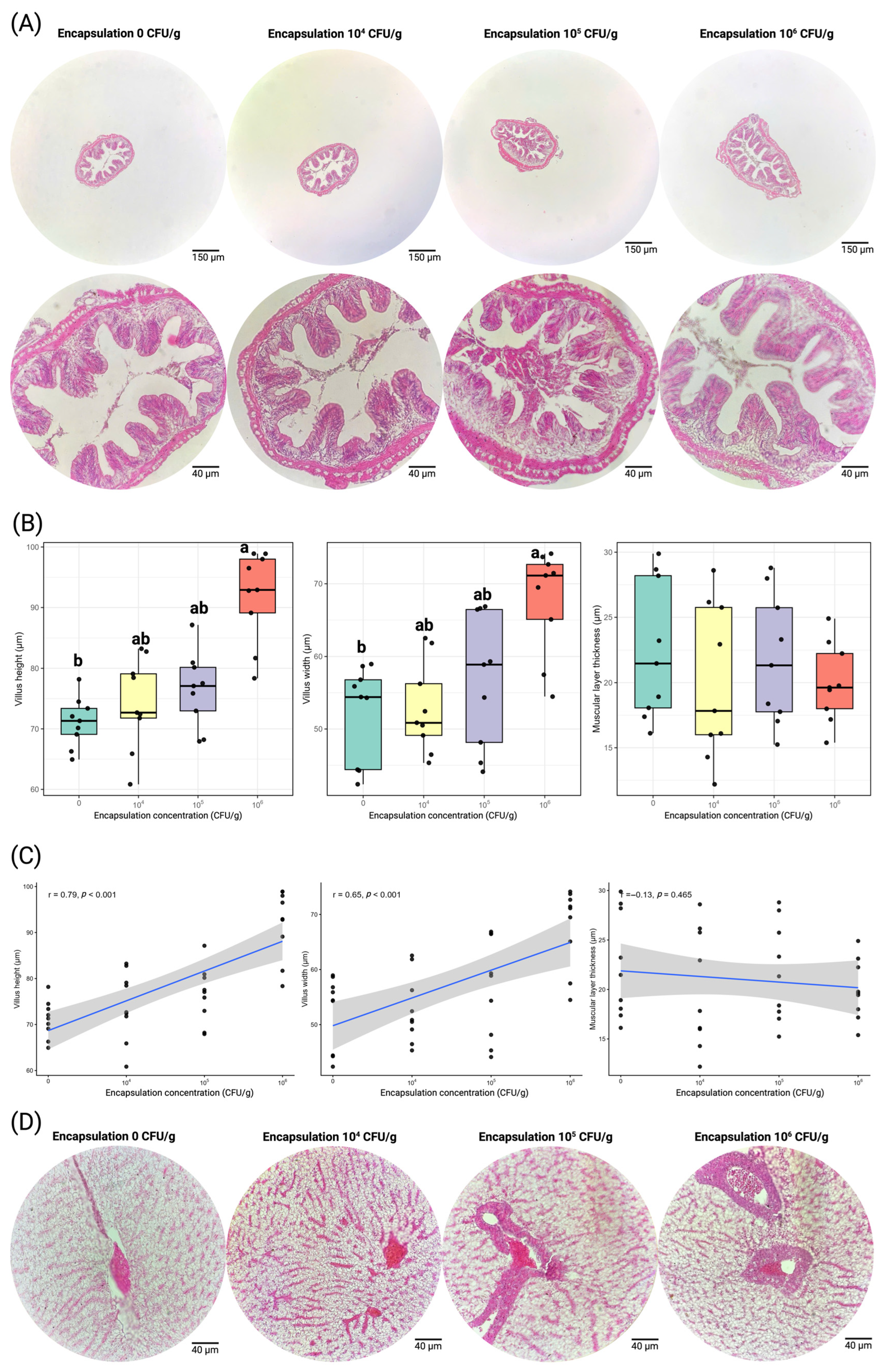
Encapsulation supplementation significantly increased villus height and villus width, while muscular layer thickness remained unchanged and liver histology exhibited normal structural organization across all treatments (Figure 5).
Mean villus height increased progressively with encapsulation concentration, ranging from 71.10 µm in the control group to 91.90 µm in the 106 CFU/g treatment (Figure 5B). The highest supplementation level produced significantly greater villus height than the control (p < 0.05), whereas the 104 and 105 CFU/g treatments showed intermediate values without significant differences from adjacent groups (Figure 5B). Correlation analysis indicated a strong positive association between encapsulation concentration and villus height (r = 0.79, p < 0.001) (Figure 5C).
Villus width showed a similar trend. Mean values increased from 52.22 µm in the control group to 67.74 µm at 106 CFU/g (Figure 5B). The 106 CFU/g treatment exhibited significantly greater villus width compared with the control (p < 0.05), while the 104 and 105 CFU/g treatments displayed intermediate measurements without significant differences (Figure 5B). A significant positive correlation was detected between encapsulation concentration and villus width (r = 0.65, p < 0.001) (Figure 5C).
Muscular layer thickness varied within a narrow range among treatments, from 19.96 µm to 22.44 µm (Figure 5B). No statistically significant differences were detected among groups (p > 0.05). The correlation between encapsulation concentration and muscular thickness was not significant (r = −0.13, p = 0.465) (Figure 5C).
Histological examination of the liver revealed well-preserved hepatic architecture in all treatments (Figure 5D). Hepatocytes were arranged in typical cords radiating from the central vein and separated by clearly visible sinusoidal spaces. Hepatocyte cytoplasm appeared homogeneous with centrally located nuclei, and no cellular degeneration, vacuolation, or structural disruption was observed across treatments. Sinusoidal structures remained regular and continuous, and the central vein maintained normal morphology without dilation or congestion. No necrotic areas, inflammatory cell infiltration, or tissue disorganization were detected in any group (Figure 5D). The structural integrity of hepatocytes and sinusoidal networks was comparable among all encapsulation concentrations.

3.5. Gene Expression

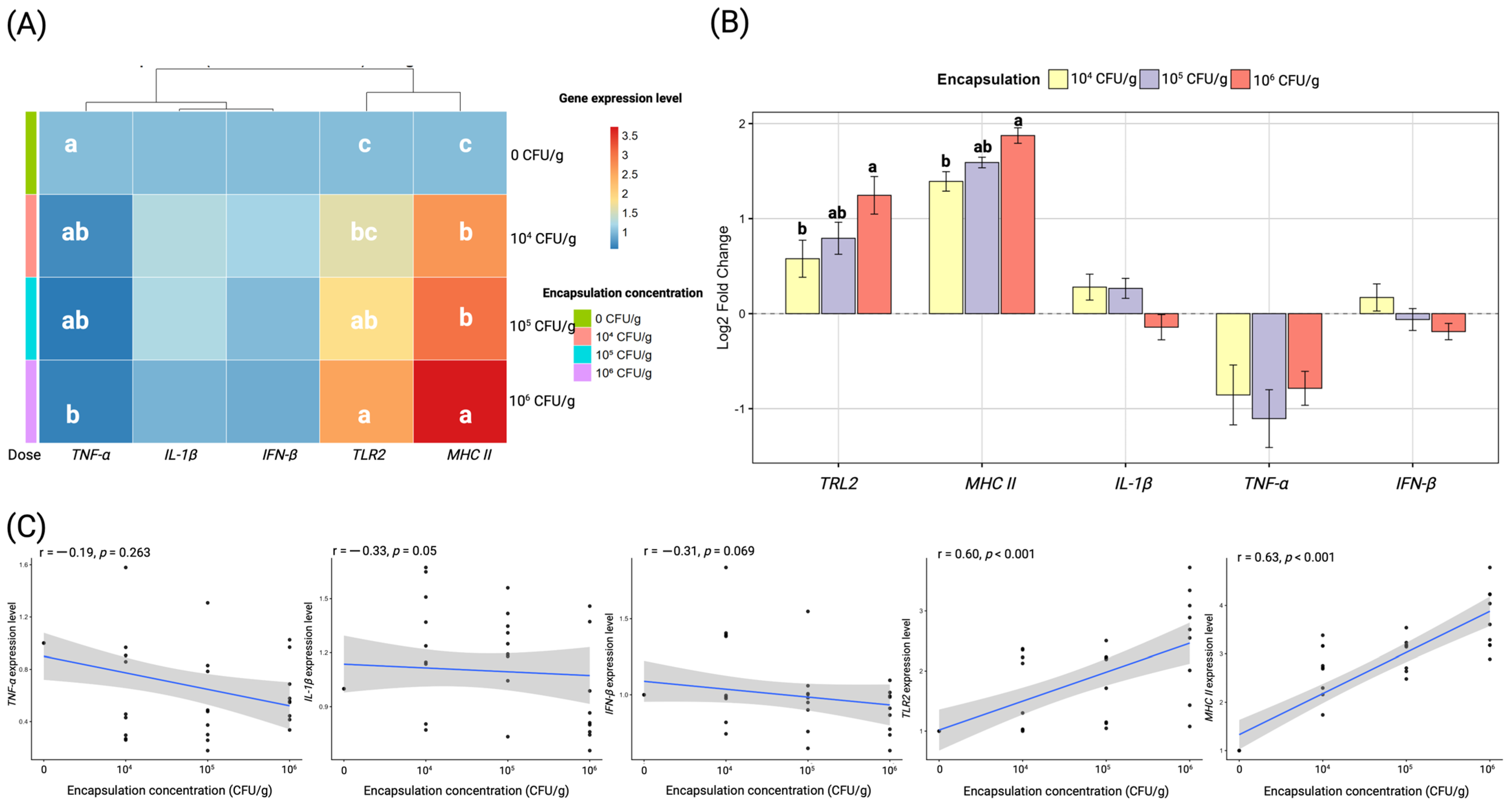
Encapsulation increased the transcript levels of TLR2 and MHC II, while IL-1β, TNF-α, and IFN-β showed no consistent upregulation across doses (Figure 6). At 104–106 CFU/g, TLR2 transcripts significantly increased from the control (1.00) to 1.61–2.53, respectively, corresponding to log2 fold changes of 0.58–1.25. MHC II transcripts significantly rose from 1.00 in the control to 2.67–3.71 at 104–106 CFU/g, with log2 fold changes of 1.39–1.87, respectively. In contrast, IL-1β transcript levels were 1.26–0.94 at 104–106 CFU/g, yielding log2 fold changes of 0.28–−0.14. TNF-α transcripts decreased relative to the control to 0.67, 0.56 and 0.62 at 104–106 CFU/g, corresponding to log2 fold changes of −0.86, −1.10, and −0.79. IFN-β transcript levels were 1.17, 0.98, and 0.89 at 104–106 CFU/g, with log2 fold changes of 0.17, −0.06, and −0.19.
Pearson correlation analysis showed positive associations between encapsulation concentration and TLR2 (r = 0.60, p < 0.001) and MHC II expression (r = 0.63, p < 0.001), whereas correlations with IL-1β, TNF-α, and IFN-β were not significant (p ≥ 0.05).

3.6. Pearson Correlation and PCA

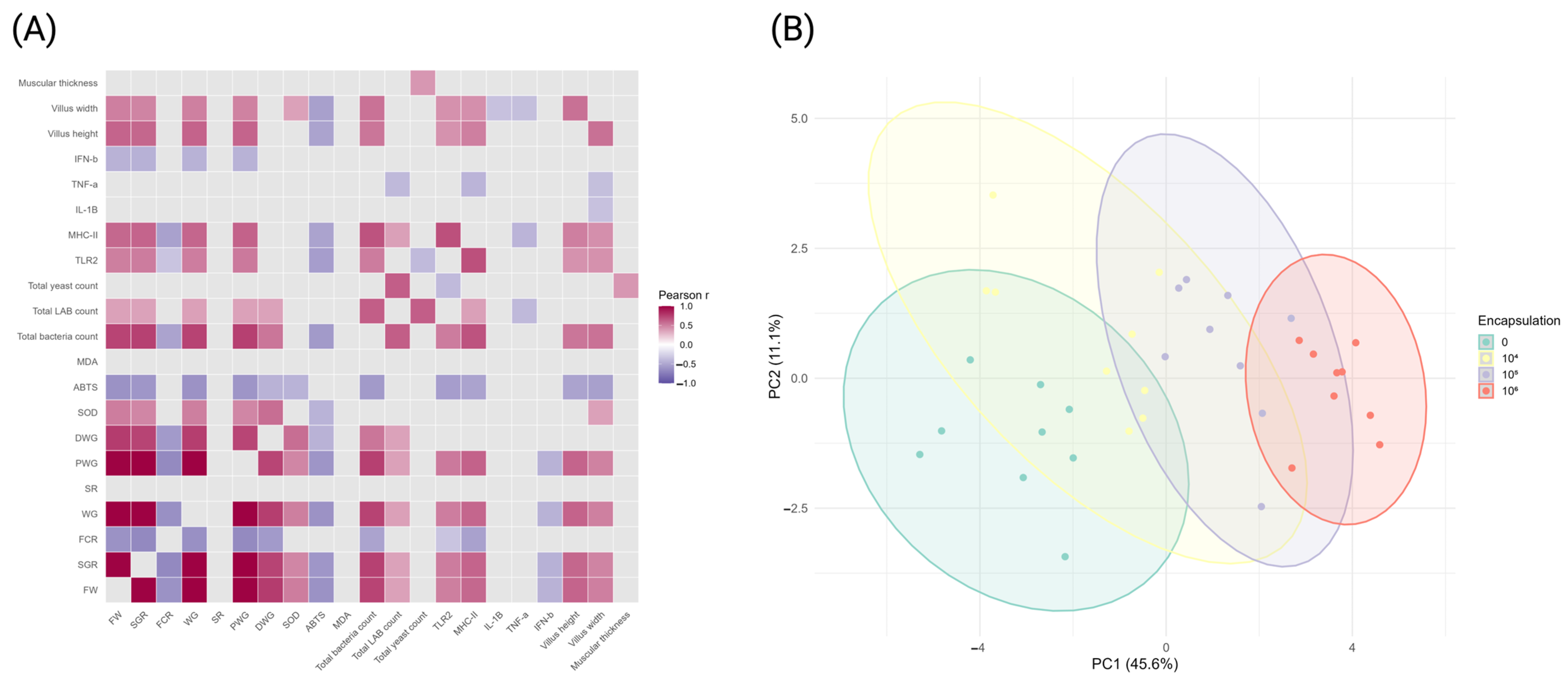
Multivariate analysis showed significant associations among growth, antioxidant, microbiota, and immune variables and a clear separation of samples by encapsulation level (Figure 7). The Pearson correlation heatmap identified significant positive and negative correlations (p < 0.05) among multiple parameters, while self-correlations were excluded and non-significant relationships were masked. Positive correlations (r > 0.50, p < 0.05) were observed between growth-related indices (FW, WG, DWG, and PWG) and immune markers TLR2 and MHC II, whereas negative correlations (r < −0.50, p < 0.05) were detected between FCR and these growth indices. Microbiota variables (total bacteria, total LAB, and total yeast) showed significant positive correlations with TLR2 and MHC II (r = 0.48–0.67, p < 0.05), while TNF-α was negatively correlated with several growth and microbiota parameters (r = −0.41 to −0.60, p < 0.05). Principal component analysis explained 56.7% of the total variance on the first two axes, with PC1 accounting for 45.6% and PC2 for 11.1%. Samples were separated along PC1 according to encapsulation levels, with minimal overlap between 0 CFU/g and 106 CFU/g groups, whereas intermediate overlap was observed between 104 and 105 CFU/g groups.

3.7. Post-Challenge Survival Following A. hydrophila Infection

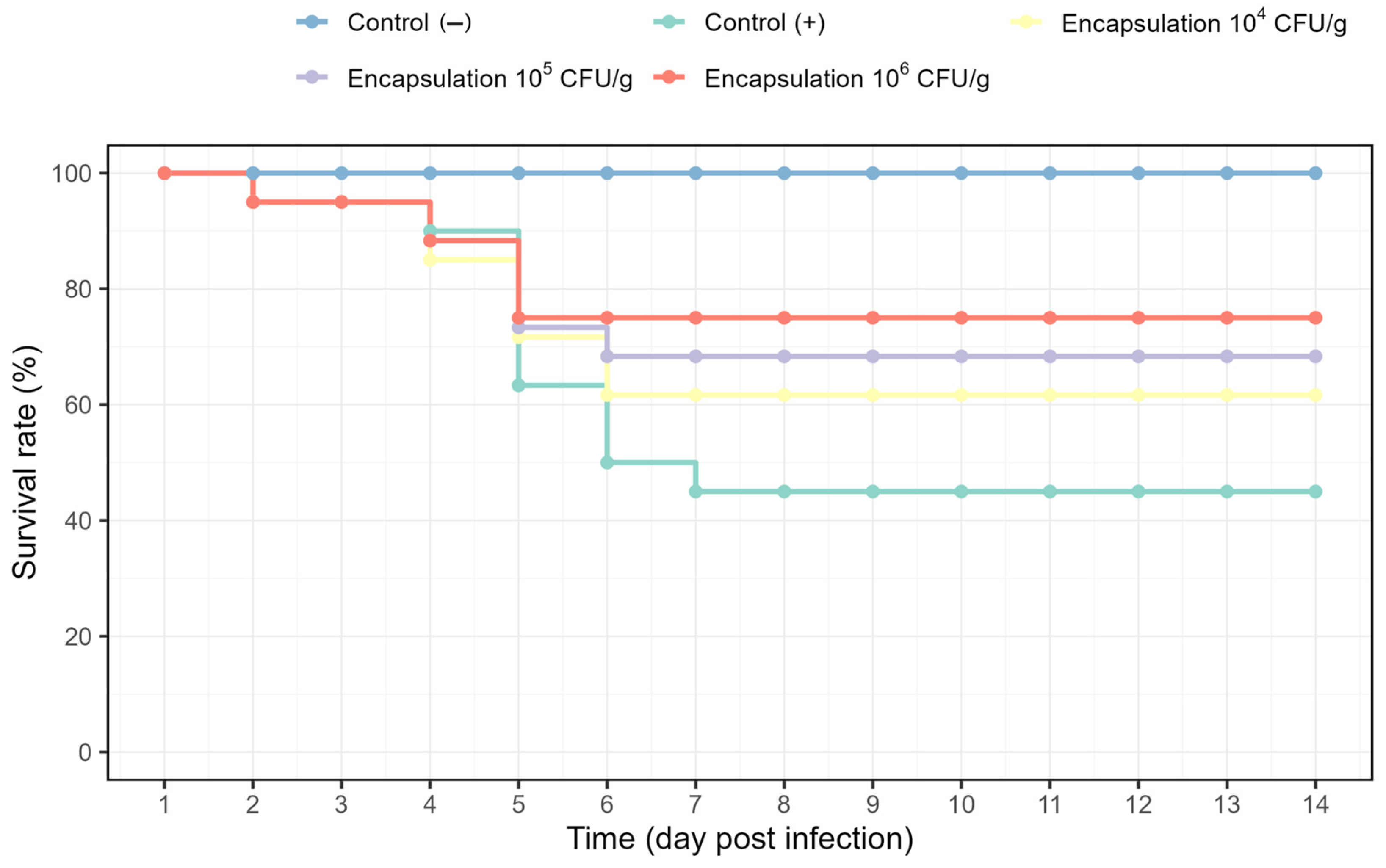
Encapsulation concentration significantly affected survival following A. hydrophila challenge (Figure 8). Survival in the negative control remained at 100% throughout the 14-day post-challenge period. In contrast, survival in the positive control declined rapidly after day 4, reaching 63.33% on day 5 and stabilizing at 45.00% from day 7 to day 14. Fish receiving encapsulated Lysinibacillus treatments showed a delayed and attenuated mortality pattern compared with the positive control. In the 106 CFU/g group, mortality increased modestly around days 4–5 but stabilized earlier (by day 6), reaching a final survival rate of 75.00%. Notably, the mortality peak in the 106 CFU/g group occurred within the same early window (days 4–5) but ended more rapidly and at a lower magnitude than in the positive control, suggesting improved early-phase resistance to bacterial proliferation. Similarly, final survival rates were 68.33% and 61.67% for the 105 and 104 CFU/g groups, respectively, all exceeding that of the positive control (45.00%). The progressive improvement in survival from 104 to 106 CFU/g demonstrates a dose-dependent protective effect, although the survival curves converged after day 6, indicating that the principal benefit was exerted during the acute infection phase.
In addition, Chi-square analysis showed a significant difference in survival between the positive and negative controls (χ2 = 50.132, p < 0.001; Table 3). Survival in the 105 CFU/g (χ2 = 4.226, p = 0.040) and 106 CFU/g (χ2 = 5.719, p = 0.017) groups differed significantly from the positive control, whereas the 104 CFU/g group did not (χ2 = 1.454, p = 0.228; Table 3). No significant differences were detected among the encapsulation treatments (χ2 ≤ 1.398, p ≥ 0.237).

4. Discussion

4.1. Growth Performance and Feed Utilization

The present findings demonstrate that encapsulated Lysinibacillus sp. PWR01 can significantly enhance fish growth performance, particularly over an extended feeding duration. By week 8, fish fed diets with higher probiotic encapsulation (105–106 CFU/g) showed greater FW, WG, PWG, and SGR compared to the control, with a clear dose-dependent trend (correlations r ≈ 0.75, p < 0.01). Notably, improvements were modest and statistically non-significant at week 4, suggesting that the probiotic’s benefits manifest more strongly after sustained administration. This time-lag may reflect the period required for the probiotic to colonize the gut or modulate host physiology. Similar delayed growth enhancements have been observed in other studies. For example, feeding L. sphaericus to zebrafish over 33 days led to increasing WG and SGR with rising dose [30]. Notably, even at the highest tested concentration (107 CFU/mL), growth parameters did not differ statistically from controls. By contrast, the present study achieved statistically significant growth enhancement at 106 CFU/g, indicating that effective dose thresholds may be reduced through encapsulation, likely due to improved gastrointestinal stability and delivery efficiency. Similarly, Mani, et al. [33] reported that dietary supplementation with L. macroides at 107–108 CFU/mL significantly improved growth and feed conversion ratio in Cyprinus carpio fingerlings. However, the probiotic was administered in pelletized form without protective encapsulation, and relatively higher microbial loads were required to achieve statistical significance. When contrasted with these findings, the current encapsulated 106 CFU/g treatment achieved comparable improvements in FW and SGR at a lower concentration range. In Nile tilapia, diets supplemented related spore-formers (Bacillus spp.) over 8–10 weeks have consistently improved WG and feed conversion efficiency. For instance, Bacillus subtilis at 1010 CFU/g halved the FCR and boosted WG by approximately 40% relative to un-supplemented fish [59]. In the current study, FCR likewise tended to decrease, although this drop was not statistically significant. The overall improvement in growth metrics without adverse effects on survival or body condition aligns with a broad literature reporting that probiotics enhance nutrient utilization and growth in diverse aquaculture species [14,60]. The mechanisms likely involve probiotics contributing exogenous digestive enzymes and vitamins, as well as stimulating the host’s digestive capacity [61]. Indeed, encapsulated probiotics have been shown to increase intestinal villi height and digestive enzyme activity, thereby increasing nutrient absorption in species like tilapia [62,63]. Enhanced feed intake or appetite regulation may also play a role; one study on encapsulated Lactobacillus noted upregulation of appetite-related genes (e.g., ghrelin) in fish fed the probiotic [64]. Collectively, the growth promotion seen with Lysinibacillus sp. PWR01 treatment is consistent with these reports. The lack of significant differences at early time points and the convergence of growth curves by week 8 in the high-dose groups further suggest that while low doses may be insufficient for measurable impact, an adequate concentration sustained over several weeks is required to realize probiotic growth benefits in aquaculture.

4.2. Antioxidant Status and Lipid Peroxidation of Blood Serum

Dietary Lysinibacillus encapsulation elicited notable changes in the antioxidant defense parameters of the fish. Serum SOD activity was markedly elevated in probiotic-fed groups, reaching nearly 3-fold higher levels at 106 CFU/g compared to controls. This positive correlation between dose and SOD activity (r = 0.48, p < 0.01) indicates an enhanced enzymatic capacity to neutralize superoxide radicals. Concomitantly, MDA concentration remained unchanged across treatments, suggesting that higher probiotic levels prevented any rise in oxidative stress (and may have helped maintain MDA at baseline levels). These outcomes align with recent probiotic studies reporting bolstered antioxidant defenses in fish. For instance, zebrafish receiving L. sphaericus exhibited significantly increased SOD and catalase activities coupled with a linear decrease in MDA content as the probiotic dose rose [30]. Likewise, tilapia fed high-dose B. subtilis showed elevated SOD, catalase, and glutathione peroxidase activities and significantly lower MDA than controls [59]. The general interpretation is that probiotics can induce the host’s antioxidant enzyme systems, thereby limiting lipid peroxidation and cellular damage under physiological or stress conditions [65,66]. Interestingly, in the present study the total radical scavenging capacity (ABTS assay) of serum was lower in the high-dose group. This inverse relationship with probiotic dose (r ≈ −0.80) is somewhat counterintuitive, as one might expect overall antioxidant capacity to increase. A possible explanation is that the heightened SOD activity rapidly neutralized free radicals [67,68,69], thus leaving fewer circulating antioxidant compounds detectable by the ABTS assay. Regardless, the fish did not show elevated MDA, implying no net increase in oxidative damage despite the ABTS reduction. Previous work has noted that probiotic-fed fish often experience less oxidative stress during challenges or high metabolic demand. For example, probiotic-driven activation of the Nrf2 antioxidant pathway has been suggested as a mechanism in carp and trout, leading to strengthened endogenous antioxidant responses [70]. The present results support the view that Lysinibacillus supplementation can fortify antioxidant defenses (notably SOD), potentially conferring greater cellular protection. This antioxidant boost is beneficial for overall health and may contribute to the improved growth and disease resistance observed, since oxidative stress is known to impair growth and immune function in fish.

4.3. Intestinal Microbial Counts

Encapsulation of Lysinibacillus sp. PWR01 had a pronounced impact on the gut microbiota, as reflected by increased counts of total cultivable bacteria and LAB in the intestine. Total bacterial counts rose steadily with probiotic dose, which was nearly an order of magnitude higher at 106 CFU/g than in the control. In addition, LAB counts also increased significantly. These shifts suggest that the probiotic either directly contributed to these populations (as Lysinibacillus itself is a Gram-positive fermentative bacterium) or created gut conditions favorable to indigenous beneficial microbes. No changes were seen in intestinal yeast counts, indicating the effect was specific to the bacterial microbiota. The enrichment of LAB is particularly noteworthy, as lactic acid bacteria are often associated with improved gut health and pathogen resistance in fish [71]. A number of studies have likewise reported that probiotic supplements can modulate the gut microbial community toward a more favorable profile. Qiu, et al. [30] found that zebrafish fed L. sphaericus exhibited higher abundances of beneficial genera (e.g., Cetobacterium, Lactobacillus) and a significant reduction in the relative abundance of the pathogenic genus Aeromonas. In our challenge experiment, fish receiving Lysinibacillus had improved survival to Aeromonas infection, and it is tempting to link this to potential suppression of Aeromonas in the gut microbiome as seen in Qiu, et al. [30] work. The likely mechanisms for these microbiota changes include competitive exclusion and antimicrobial production. Probiotic Lysinibacillus are known to inhibit pathogens by secreting antagonistic compounds and by outcompeting harmful bacteria for nutrients and adhesion sites on the intestinal mucosa. A recent isolation study in marine fish showed a Lysinibacillus strain could strongly inhibit Vibrio pathogens and co-aggregate with pathogenic bacteria, thereby preventing their colonization [31]. In the present context, Lysinibacillus sp. PWR01 may have directly suppressed opportunistic gut pathogens, allowing total bacterial counts to rise and beneficial commensals (like LAB) to flourish.

4.4. Histological Characteristics

Histological observations demonstrated that dietary encapsulated Lysinibacillus influenced intestinal morphology while maintaining normal hepatic structure. It can be seen that in the anterior intestine, fish receiving higher encapsulation levels exhibited increased villus height and width, particularly in the 106 CFU/g treatment. These structural modifications indicate an expansion of the absorptive surface area, which is widely recognized as a key determinant of nutrient uptake efficiency in fish [72,73,74]. Enlarged villi increase the contact interface between digested nutrients and the intestinal epithelium, thereby facilitating more efficient absorption and assimilation [72,75]. Similar morphological responses have been reported in several probiotic studies in aquaculture. For example, dietary supplementation with Bacillus subtilis in Nile tilapia significantly increased villus height and intestinal fold development, resulting in improved digestive efficiency and growth performance [59,76]. Likewise, probiotics based on Lactobacillus or Bacillus species have been shown to enhance intestinal villus architecture in carp and tilapia, which was associated with improved feed utilization and growth outcomes [59,76,77,78]. The positive correlations observed between encapsulation concentration and villus dimensions in the present study therefore align with the improved growth performance recorded during the feeding trial. Interestingly, muscular layer thickness did not differ significantly among treatments. This indicates that the probiotic primarily affected mucosal and absorptive structures rather than deeper muscular tissues. The mechanisms underlying these morphological improvements may involve several probiotic-mediated processes. Beneficial bacteria can stimulate epithelial cell proliferation, enhance mucosal integrity, and modulate gut-associated immune responses [79,80,81]. In particular, spore-forming bacteria such as Lysinibacillus and Bacillus are known to produce extracellular enzymes and bioactive metabolites that promote digestive activity and intestinal health [32,82]. Additionally, probiotics may regulate gut microbiota composition, leading to increased populations of beneficial bacteria such as lactic acid bacteria, which in turn produce short-chain fatty acids and other metabolites that support intestinal epithelial development [83,84,85]. The increase in LAB counts observed in the present study is therefore consistent with these morphological findings and suggests that microbial modulation may have contributed to the enhanced intestinal structure.
In addition to intestinal effects, liver histology revealed well-preserved hepatic architecture across all treatments. Hepatocytes were arranged in typical radial cords surrounding the central vein, and sinusoidal spaces were clearly defined. No signs of hepatocellular degeneration, necrosis, inflammatory infiltration, or lipid accumulation were observed. These findings indicate that dietary encapsulated Lysinibacillus did not exert hepatotoxic effects even at the highest supplementation level. The preservation of liver integrity may also be linked to the enhanced antioxidant status observed in probiotic-fed fish. Increased SOD activity suggests improved protection against oxidative stress [86], which is known to contribute to hepatocellular damage in fish exposed to environmental or metabolic stressors. By strengthening antioxidant defenses, probiotics may help maintain cellular stability and prevent oxidative injury to hepatic tissues [86,87]. The stable MDA levels observed in the present study further support the absence of oxidative damage in hepatic cells. Another possible explanation for the preserved liver morphology is the indirect effect of improved intestinal health. A well-developed intestinal barrier reduces the translocation of harmful bacteria and endotoxins into the bloodstream, thereby lowering hepatic inflammatory burden. Probiotics that stabilize gut microbiota and enhance mucosal integrity are therefore often associated with improved liver condition in fish [81,84]. In the present study, the increase in beneficial bacterial populations and the improved intestinal structure likely contributed to maintaining hepatic homeostasis.

4.5. Gene Expression Analysis

Dietary Lysinibacillus significantly influenced the expression of immune-related genes in the intestine, indicating an immunomodulatory role. Transcript levels of TLR2 and MHC II increased progressively with higher probiotic doses. TLR2 is a pattern-recognition receptor that detects Gram-positive bacterial ligands [88], so its upregulation likely reflects the immune system’s recognition of Lysinibacillus cell wall components and a resultant priming of innate immunity. Elevated MHC II suggests enhanced antigen presentation capacity, potentially improving the host’s ability to activate specific immune responses (e.g., priming T cells against pathogens) [89,90,91]. In contrast, proinflammatory cytokine genes (IL-1β, TNF-α, IFN-β) were not induced by a probiotic diet and TNF-α was slightly downregulated at the highest dose. The increase in pathogen-recognition and antigen presentation markers, without a surge in inflammatory cytokines, implies that Lysinibacillus sp. PWR01 triggered a measured, non-pathological immune stimulation. This immunomodulation is desirable as it suggests the probiotic can bolster immune readiness while avoiding chronic inflammation that could harm growth [14,92]. These findings mirror observations in other probiotic studies. Rwezawula, et al. [93] reported that tilapia fed L. fusiformis showed modulation of immune gene expression; for example, proinflammatory markers (IL-1β, IL-6, CXCL8) were moderated and the complement gene C3 was upregulated, indicative of enhanced mucosal immunity coupled with reduced systemic inflammation. Similarly, in our study the lack of IL-1β/TNF surge and the improvement in survival post-infection point to an immune system that is both activated and balanced. It is noteworthy that not all probiotics behave identically in this regard. For example, a recent trial in common carp using a halophilic Bacillaceae probiotic (Virgibacillus salarius) found significant upregulation of IL-1β and TNF-α in probiotic-fed fish, which the authors associated with an acute immune activation contributing to pathogen defense [94]. By contrast, the Lysinibacillus in our study appears to have achieved protective effects without eliciting a strong inflammatory cytokine response. This difference could be due to species-specific immune dynamics or varying properties of the probiotic strains (e.g., differences in cell wall components such as lipoteichoic acids that drive cytokine responses). Mechanistically, probiotics are thought to act as immune modulators by interacting with gut-associated lymphoid tissue as they can stimulate toll-like receptors on intestinal immune cells, leading to enhanced phagocytic activity, local antibody production, and release of regulatory cytokines [95,96,97]. Many spore-forming bacilli also produce metabolites like short-chain fatty acids, peptidoglycans that have systemic immunological effects, including anti-inflammatory properties [98]. In practical terms, the upregulation of TLR2 and MHC II observed here may translate to faster recognition of invading bacteria and more robust activation of adaptive immunity during infection, thereby improving disease outcomes. Indeed, the positive correlations noted between these immune genes and growth performance metrics in our multivariate analysis suggest a linkage between immune competency and overall vigor of the fish.

4.6. Disease Resistance Against A. hydrophila

The ultimate test of the probiotic’s efficacy was the challenge with the pathogen A. hydrophila. Fish that had been fed Lysinibacillus-supplemented diets showed markedly higher survival following infection compared to the positive control (infected but no probiotic). By day 14 post-challenge, the highest dose yielded the highest survival, and both 105 and 106 groups had significantly better survival than the control. These results provide strong evidence that encapsulated Lysinibacillus enhanced the fish’s resistance to bacterial infection. This finding is in agreement with multiple recent studies documenting probiotic-mediated disease protection in aquaculture. Qiu, et al. [30] similarly observed that zebrafish fed L. sphaericus (particularly at 107 CFU/mL) had significantly improved survival when challenged with A. hydrophila, attributable to the probiotic’s immune-boosting effects. In Nile tilapia, Bacillus and Lysinibacillus supplementation has conferred protection against various pathogens; for instance, probiotic-fed tilapia challenged with Providencia experienced higher survival and reduced infection signs relative to controls [93]. Mechanistically, the enhanced survival can be explained by a combination of the probiotic’s direct antagonism of the pathogen and the primed host immunity discussed above. Lysinibacillus sp. PWR01 may produce antimicrobial compounds or bacteriocins that inhibit A. hydrophila either in the gut or systemically. Additionally, an improved gut microbiota (with more LAB and overall bacteria) could outcompete or inhibit A. hydrophila colonization. The significant positive correlations we observed between the abundance of gut microbiota and immune markers (TLR2, MHC II) suggest that a probiotic-enriched microbiome was associated with an immune status that is better prepared to fight infections. This is supported by other work showing that probiotics can suppress pathogen virulence factors and reduce pathogen load in hosts [28,99,100]. Furthermore, immune-enhancing effects such as higher lysozyme activity, complement activity, and Ig levels have been documented in probiotic-treated fish, contributing to more effective clearance of invading bacteria [101]. It is also worth noting that the survival curves in our study plateaued after day 6–7 in all probiotic groups, indicating the acute phase of infection was better managed in those fish, after which mortality ceased. In contrast, the positive control continued to suffer losses up to day 7 and ended at a much lower survival. This pattern is emblematic of an effective immunoprophylactic intervention, where the probiotic-treated hosts quickly control the infection. The outcome is highly relevant for aquaculture, as Aeromonas species cause septicemia and ulcers in many freshwater fish, and a 30% improvement in survival as seen with the high-dose Lysinibacillus could translate to significantly reduced economic losses. It also underscores that Lysinibacillus sp. PWR01 is a promising candidate for a biotherapeutic feed additive aimed at disease prevention.

4.7. Limitations and Future Directions

Beyond the applied outcomes, the study contributes novelty at both the strain-discovery and delivery-technology levels. Lysinibacillus sp. PWR01 was isolated from rubber latex nodules with evidence of chemically defended, enzyme and secondary metabolites. This rich microhabitat is increasingly recognized to harbor specialized endophytic communities [102]. Such latex-associated niches are plausibly selective for stress-tolerant, resilient bacteria, including endospore formers, because successful persistence requires coping with fluctuating osmotic pressure, oxidative stress, and antimicrobial plant compounds [103]. This ecological provenance therefore provides a biologically grounded rationale for the observed robustness of PWR01 during feed processing and gastrointestinal transit when combined with encapsulation. In parallel, recent aquaculture literature has begun to highlight Lysinibacillus spp. as emerging probiotics with measurable effects on host metabolism, intestinal function, and disease resistance [29,30,31], supporting the relevance of exploring non-traditional reservoirs for candidate strains.
Another innovation lies in positioning latex-derived Lysinibacillus as a complementary biocontrol option relative to conventional Bacillus-based probiotics. Although Bacillus probiotics remain effective and widely deployed, their antagonistic profiles can be strain-specific and sometimes targeted to a narrower set of pathogens. Recent studies demonstrate that individual Bacillus isolates may show broad-spectrum activity against A. hydrophila and other aquatic pathogens, but these effects are not universal across all commercial strains [104]. In this context, the present work provides academic value by demonstrating that an encapsulated Lysinibacillus isolate can confer meaningful protection against A. hydrophila in vivo while also improving performance traits under a practical feeding duration. Moreover, the results complement recent findings in zebrafish showing that L. sphaericus supplementation can modulate gut physiology and improve resistance to A. hydrophila [30], reinforcing the plausibility of Lysinibacillus as a disease-mitigating genus in aquatic hosts.
Despite these promising outcomes, several limitations should be acknowledged. First, the current study did not identify the fate of the encapsulated Lysinibacillus in the gut like levels of probiotic recovery from intestine or whether it became a persistent colonizer. Future work could use molecular tracing or selective plating to confirm that Lysinibacillus sp. PWR01 successfully colonizes or at least transiently proliferates in the fish gut at effective levels. Second, while key immune transcripts were measured, we did not assess protein-level or functional immune parameters such as phagocytic activity, lysozyme, or specific antibody levels. Including those in future studies would provide a more comprehensive picture of immunological changes. Third, the antioxidant findings (discrepancy between SOD and ABTS results) warrant deeper investigation into oxidative stress pathways; additional markers like catalase, glutathione, or expression of antioxidant genes could clarify how the probiotic influences redox homeostasis. Another limitation is that our trial was conducted in controlled laboratory conditions; performance and health benefits might differ in commercial pond or cage environments where fish are exposed to a more complex array of stressors and pathogens. Field trials will be important to validate the consistency of these benefits in real-world farming scenarios. We also note that the optimal dose observed here was in the 105–106 CFU/g range for feed which remains to be tested whether even higher doses (107–109) yield further gains or simply plateau, as some evidence suggests a saturation effect beyond a certain probiotic level. Additionally, while Lysinibacillus sp. PWR01 was effective alone, combining it with other beneficial microbes or prebiotics (synbiotic approaches) could be explored to amplify effects. There is growing interest in multi-strain probiotic formulations that target different aspects of host physiology. For instance, a mix of Lysinibacillus for immunity and a yeast or Lactobacillus for gut health. Finally, long-term safety and any potential trade-offs should be assessed. Thus far, no adverse effects were observed, consistent with other studies where Lysinibacillus strains have been deemed safe at high doses in fish, but thorough evaluations will strengthen the case for regulatory approval and industry adoption.

5. Conclusions

Dietary supplementation with encapsulated Lysinibacillus sp. PWR01 improved growth performance, antioxidant capacity, intestinal microbiota composition, immune gene expression, and disease resistance in a dose-dependent manner. Among the tested concentrations, 105–106 CFU/g emerged as the optimal supplementation range, achieving maximal growth enhancement and feed efficiency while significantly strengthening host antioxidant defense and immune responsiveness. Histological examination indicated that fish in encapsulated groups improved intestinal morphology by increasing villus height and width while maintaining normal muscular layer thickness and liver architecture, supporting enhanced intestinal structural integrity without observable tissue damage. Multivariate analyses showed strong positive associations between growth indices, beneficial microbiota, and immune activation, and clearly discriminated encapsulation treatments. These enhancements significantly improved survival rates following an A. hydrophila challenge, particularly at concentrations of 105–106 CFU/g. This finding underscores the practical application of encapsulated Lysinibacillus sp. PWR01 as a functional feed additive to enhance disease resistance in aquaculture. Collectively, this study provides the first evidence that encapsulated Lysinibacillus sp. PWR01 can serve as an effective probiotic in Nile tilapia, offering a practical strategy for optimizing probiotic dosage and delivery technology in aquaculture systems. The findings contribute mechanistic insight into microbiota-immune-growth interactions and support the application of encapsulated spore-forming probiotics as sustainable alternatives to antibiotic use in intensive fish farming.

Author Contributions

Conceptualization, P.P. and N.V.L.; methodology, L.T.P.K., S.W., P.S., W.S., O.D., K.P., P.T., M.S.-a., P.P. and N.V.L.; formal analysis, L.T.P.K., N.D.-H. and N.V.L.; investigation, L.T.P.K., S.W., P.S., W.S., O.D., K.P., P.T., M.S.-a., P.P. and N.V.L.; resources, P.P. and N.V.L.; data curation, L.T.P.K. and N.V.L.; writing—original draft preparation, L.T.P.K., P.S., K.P., M.S.-a., P.P., N.D.-H. and N.V.L.; writing—review and editing, L.T.P.K., P.S. and N.V.L.; supervision, P.P. and N.V.L.; project administration, N.V.L.; funding acquisition, N.V.L. All authors have read and agreed to the published version of the manuscript.

Funding

This research was funded by Targeted Research Fund, Chiang Mai University, Chiang Mai, Thailand. This research was financially supported by Prince of Songkla University, Surat Thani Campus, Thailand.

Institutional Review Board Statement

All procedures performed in studies involving animals were in strict accordance with the institutional and national guidelines for the care and use of laboratory animals. The experimental protocol was reviewed and approved by the Prince of Songkla University (Ref: Ref.AQ098/2025).

Data Availability Statement

The original contributions presented in this study are included in the article. The original RNA sequencing data presented in the study are openly available in the National Center for Biotechnology Information (NCBI) database (Accession No. PX415241.1). Further inquiries can be directed to the corresponding author(s).

Acknowledgments

This research was partially supported by Chiang Mai University. The authors also acknowledge the Scientific Laboratory and Equipment Center, Office of the Surat Thani Campus, and the Department of Agricultural Science and Technology, Faculty of Innovative Agriculture, Fisheries and Food, Prince of Songkla University, Surat Thani Campus, for their technical support and assistance.

Conflicts of Interest

The authors declare no conflicts of interest.

References

  1. Dewali, S.; Sharma, N.; Melkani, D.; Arya, M.; Kathayat, N.; Panda, A.K.; Bisht, S.S. Aquaculture: Contributions to global food security. In Emerging Solutions in Sustainable Food and Nutrition Security; Springer: Berlin/Heidelberg, Germany, 2023; pp. 123–139. [Google Scholar]
  2. Xiong, W.; Guo, C.; Gozlan, R.E.; Liu, J. Tilapia introduction in China: Economic boom in aquaculture versus ecological threats to ecosystems. Rev. Aquac. 2023, 15, 179–197. [Google Scholar] [CrossRef]
  3. Abwao, J.; Jung’a, J.; Barasa, J.E.; Kyule, D.; Opiyo, M.; Awuor, J.F.; Ogello, E.; Munguti, J.M.; Keya, G.A. Selective breeding of Nile tilapia, Oreochromis niloticus: A strategy for increased genetic diversity and sustainable development of aquaculture in Kenya. J. Appl. Aquac. 2023, 35, 237–256. [Google Scholar] [CrossRef]
  4. El-Sayed, A.F.M.; Fitzsimmons, K. From Africa to the world—The journey of Nile tilapia. Rev. Aquac. 2023, 15, 6–21. [Google Scholar] [CrossRef]
  5. Mugwanya, M.; Dawood, M.A.; Kimera, F.; Sewilam, H. A review on recirculating aquaculture system: Influence of stocking density on fish and crustacean behavior, growth performance, and immunity. Ann. Anim. Sci. 2022, 22, 873. [Google Scholar] [CrossRef]
  6. Kumar, S.; Paul, T.; Sarkar, P.; Kumar, K. Environmental Factors Affecting Aquatic Animal Health. In Management of Fish Diseases; Springer: Berlin/Heidelberg, Germany, 2025; pp. 171–188. [Google Scholar]
  7. Haenen, O.L.; Dong, H.T.; Hoai, T.D.; Crumlish, M.; Karunasagar, I.; Barkham, T.; Chen, S.L.; Zadoks, R.; Kiermeier, A.; Wang, B. Bacterial diseases of tilapia, their zoonotic potential and risk of antimicrobial resistance. Rev. Aquac. 2023, 15, 154–185. [Google Scholar] [CrossRef]
  8. Semwal, A.; Kumar, A.; Kumar, N. A review on pathogenicity of Aeromonas hydrophila and their mitigation through medicinal herbs in aquaculture. Heliyon 2023, 9, e14088. [Google Scholar] [CrossRef]
  9. Yuan, X.; Lv, Z.; Zhang, Z.; Han, Y.; Liu, Z.; Zhang, H. A review of antibiotics, antibiotic resistant bacteria, and resistance genes in aquaculture: Occurrence, contamination, and transmission. Toxics 2023, 11, 420. [Google Scholar] [CrossRef]
  10. Hossain, A.; Habibullah-Al-Mamun, M.; Nagano, I.; Masunaga, S.; Kitazawa, D.; Matsuda, H. Antibiotics, antibiotic-resistant bacteria, and resistance genes in aquaculture: Risks, current concern, and future thinking. Environ. Sci. Pollut. Res. 2022, 29, 11054–11075. [Google Scholar] [CrossRef] [PubMed]
  11. Gadhiya, A.; Katariya, S.; Khapandi, K.; Chhatrodiya, D. Probiotics as a sustainable alternative to antibiotics in aquaculture: A review of the current state of knowledge. Microbe 2025, 8, 100426. [Google Scholar] [CrossRef]
  12. Yousuf, S.; Tyagi, A.; Singh, R. Probiotic supplementation as an emerging alternative to chemical therapeutics in finfish aquaculture: A review. Probiotics Antimicrob. Proteins 2023, 15, 1151–1168. [Google Scholar] [CrossRef]
  13. Pereira, W.A.; Mendonça, C.M.N.; Urquiza, A.V.; Marteinsson, V.Þ.; LeBlanc, J.G.; Cotter, P.D.; Villalobos, E.F.; Romero, J.; Oliveira, R.P. Use of probiotic bacteria and bacteriocins as an alternative to antibiotics in aquaculture. Microorganisms 2022, 10, 1705. [Google Scholar] [CrossRef] [PubMed]
  14. Fachri, M.; Amoah, K.; Huang, Y.; Cai, J.; Alfatat, A.; Ndandala, C.B.; Shija, V.M.; Jin, X.; Bissih, F.; Chen, H. Probiotics and paraprobiotics in aquaculture: A sustainable strategy for enhancing fish growth, health and disease prevention-a review. Front. Mar. Sci. 2024, 11, 1499228. [Google Scholar] [CrossRef]
  15. Hasan, K.N.; Banerjee, G. Recent studies on probiotics as beneficial mediator in aquaculture: A review. J. Basic Appl. Zool. 2020, 81, 53. [Google Scholar] [CrossRef]
  16. Amenyogbe, E.; Chen, G.; Wang, Z.; Huang, J.; Huang, B.; Li, H. The exploitation of probiotics, prebiotics and synbiotics in aquaculture: Present study, limitations and future directions: A review. Aquac. Int. 2020, 28, 1017–1041. [Google Scholar] [CrossRef]
  17. Zhang, J.J.; Yang, H.L.; Yan, Y.Y.; Zhang, C.X.; Ye, J.d.; Sun, Y.Z. Effects of fish origin probiotics on growth performance, immune response and intestinal health of shrimp (Litopenaeus vannamei) fed diets with fish meal partially replaced by soybean meal. Aquac. Nutr. 2020, 26, 1255–1265. [Google Scholar] [CrossRef]
  18. Kuebutornye, F.K.; Abarike, E.D.; Sakyi, M.E.; Lu, Y.; Wang, Z. Modulation of nutrient utilization, growth, and immunity of Nile tilapia, Oreochromis niloticus: The role of probiotics. Aquac. Int. 2020, 28, 277–291. [Google Scholar] [CrossRef]
  19. Cavalcante, R.B.; Telli, G.S.; Tachibana, L.; de Carla Dias, D.; Oshiro, E.; Natori, M.M.; da Silva, W.F.; Ranzani-Paiva, M.J. Probiotics, Prebiotics and Synbiotics for Nile tilapia: Growth performance and protection against Aeromonas hydrophila infection. Aquac. Rep. 2020, 17, 100343. [Google Scholar] [CrossRef]
  20. Hardi, E.H.; Nugroho, R.A.; Rostika, R.; Mardliyaha, C.M.; Sukarti, K.; Rahayu, W.; Supriansyah, A.; Saptiani, G. Synbiotic application to enhance growth, immune system, and disease resistance toward bacterial infection in catfish (Clarias gariepinus). Aquaculture 2022, 549, 737794. [Google Scholar] [CrossRef]
  21. Ghaly, F.; Hussein, S.H.; Awad, S.M.; El-Makhzangy, A.A. Growth promoter, immune response, and histopathological change of prebiotic, probiotic and synbiotic bacteria on Nile tilapia. Saudi J. Biol. Sci. 2023, 30, 103539. [Google Scholar] [CrossRef]
  22. Xia, Y.; Wang, M.; Gao, F.; Lu, M.; Chen, G. Effects of dietary probiotic supplementation on the growth, gut health and disease resistance of juvenile Nile tilapia (Oreochromis niloticus). Anim. Nutr. 2020, 6, 69–79. [Google Scholar] [CrossRef]
  23. Nayak, S.K. Multifaceted applications of probiotic Bacillus species in aquaculture with special reference to Bacillus subtilis. Rev. Aquac. 2021, 13, 862–906. [Google Scholar] [CrossRef]
  24. Tachibana, L.; Telli, G.S.; Dias, D.d.C.; Goncalves, G.S.; Guimaraes, M.C.; Ishikawa, C.M.; Cavalcante, R.B.; Natori, M.M.; Fernandez Alarcon, M.F.; Tapia-Paniagua, S. Bacillus subtilis and Bacillus licheniformis in diets for Nile tilapia (Oreochromis niloticus): Effects on growth performance, gut microbiota modulation and innate immunology. Aquac. Res. 2021, 52, 1630–1642. [Google Scholar] [CrossRef]
  25. Shija, V.M.; Amoah, K.; Cai, J. Effect of bacillus probiotics on the immunological responses of Nile tilapia (Oreochromis niloticus): A review. Fishes 2023, 8, 366. [Google Scholar] [CrossRef]
  26. Hassanin, M.E.; El-Murr, A.; El-Khattib, A.R.; Abdelwarith, A.A.; Younis, E.M.; Metwally, M.M.; Ismail, S.H.; Davies, S.J.; Rahman, A.N.A.; Ibrahim, R.E. Nano-Bacillus amyloliquefaciens as a dietary intervention in nile tilapia (Oreochromis niloticus): Effects on resistance to Aeromonas hydrophila challenge, immune-antioxidant responses, digestive/absorptive capacity, and growth. Heliyon 2024, 10, e40418. [Google Scholar] [CrossRef] [PubMed]
  27. James, G.; Das, B.C.; Jose, S.; VJ, R.K. Bacillus as an aquaculture friendly microbe. Aquac. Int. 2021, 29, 323–353. [Google Scholar] [CrossRef]
  28. Kuebutornye, F.K.; Abarike, E.D.; Lu, Y.; Hlordzi, V.; Sakyi, M.E.; Afriyie, G.; Wang, Z.; Li, Y.; Xie, C.X. Mechanisms and the role of probiotic Bacillus in mitigating fish pathogens in aquaculture. Fish Physiol. Biochem. 2020, 46, 819–841. [Google Scholar] [CrossRef]
  29. Liñan-Vidriales, M.A.; Peña-Rodríguez, A.; Tovar-Ramírez, D.; Elizondo-González, R.; Barajas-Sandoval, D.R.; Ponce-Gracía, E.I.; Rodríguez-Jaramillo, C.; Balcázar, J.L.; Quiroz-Guzmán, E. Effect of rice bran fermented with Bacillus and Lysinibacillus species on dynamic microbial activity of Pacific white shrimp (Penaeus vannamei). Aquaculture 2021, 531, 735958. [Google Scholar] [CrossRef]
  30. Qiu, H.; Zhu, Y.; Wang, H.; Tao, C.; Ran, Z.; Xu, J.; Wang, J.; Huang, S.; Wang, P. Effects of Lysinibacillus sphaericus HY3 on the gut microbiota, metabolism and resistance to Aeromonas hydrophila infection of adult zebrafish (Danio rerio). Aquac. Rep. 2025, 42, 102815. [Google Scholar] [CrossRef]
  31. Yao, Y.; Wang, X.; Lin, X.; Wu, J.; Wang, P.; Zhu, C.; Yan, Q. Isolation and characterization of probiotic Lysinibacillus species from the gastrointestinal tract of large yellow croaker (Larimichthys crocea). Front. Mar. Sci. 2024, 11, 1408979. [Google Scholar] [CrossRef]
  32. Ahsan, N.; Shimizu, M. Lysinibacillus species: Their potential as effective bioremediation, biostimulant, and biocontrol agents. Rev. Agric. Sci. 2021, 9, 103–116. [Google Scholar] [CrossRef]
  33. Mani, S.R.; Vijayan, K.; Jacob, J.P.; Vijayakumar, S.; Kandhasamy, S. Evaluation of probiotic properties of Lysinibacillus macroides under in vitro conditions and culture of Cyprinus carpio on growth parameters. Arch. Microbiol. 2021, 203, 4705–4714. [Google Scholar] [CrossRef]
  34. da Silva, M.N.; Tagliapietra, B.L.; do Amaral Flores, V.; dos Santos Richards, N.S.P. In vitro test to evaluate survival in the gastrointestinal tract of commercial probiotics. Curr. Res. Food Sci. 2021, 4, 320–325. [Google Scholar] [CrossRef]
  35. Kathiriya, M.R.; Vekariya, Y.V.; Hati, S. Understanding the probiotic bacterial responses against various stresses in food matrix and gastrointestinal tract: A review. Probiotics Antimicrob. Proteins 2023, 15, 1032–1048. [Google Scholar] [CrossRef]
  36. Terpou, A.; Papadaki, A.; Lappa, I.K.; Kachrimanidou, V.; Bosnea, L.A.; Kopsahelis, N. Probiotics in food systems: Significance and emerging strategies towards improved viability and delivery of enhanced beneficial value. Nutrients 2019, 11, 1591. [Google Scholar] [CrossRef]
  37. Sihamok, W.; Dangsawat, O.; Sukhawong, R.; Boonamee, W.; Thongpan, K.; Rattanawut, J.; Sowanpreecha, R.; Khang, L.T.P.; Sangsawad, P.; Linh, N.V. Encapsulated Bacillus sp. THPS1, a novel thermophilic probiotic, enhances productivity and metabolic health in laying hens. Poult. Sci. 2026, 105, 106675. [Google Scholar] [CrossRef]
  38. Appamano, W.; Dangsawat, O.; Onsanit, S.; Sowanpreecha, R.; Therdtatha, P.; Quan, T.H.T.; Ho, T.H.; Khang, L.T.P.; Sangsawad, P.; Dinh-Hung, N. Co-Encapsulated Probiotic Bacillus aryabhattai CKNJH11 with Algae-Derived Polysaccharides on Growth Performance and Immunity in Asian Seabass (Lates calcarifer). Int. J. Microbiol. 2025, 2025, 8862338. [Google Scholar] [CrossRef]
  39. Mičúchová, A.; Piačková, V.; Frébort, I.; Korytář, T. Molecular farming: Expanding the field of edible vaccines for sustainable fish aquaculture. Rev. Aquac. 2022, 14, 1978–2001. [Google Scholar] [CrossRef]
  40. Ahmed, J.; Vasagam, K.K.; Ramalingam, K. Nanoencapsulated aquafeeds and current uses in fisheries/shrimps: A review. Appl. Biochem. Biotechnol. 2023, 195, 7110–7131. [Google Scholar] [CrossRef] [PubMed]
  41. Zhu, Y.; Lv, L.; Du, B.; Zhao, M. Next-Generation Microencapsulation Technologies for Probiotic Protection and Precision Delivery. Microb. Biotechnol. 2026, 19, e70305. [Google Scholar] [CrossRef] [PubMed]
  42. Goncalves, G.; Santos, R.A.; Coutinho, F.; Pedrosa, N.; Curado, M.; Machado, M.; Costas, B.; Bonneville, L.; Serrano, M.; Carvalho, A.P. Oral vaccination of fish against vibriosis using spore-display technology. Front. Immunol. 2022, 13, 1012301. [Google Scholar] [CrossRef]
  43. Linh, N.V.; Van Nguyen, D.; Khongdee, N.; Wannavijit, S.; Outama, P.; Le Xuan, C.; Mahatheeranont, S.; Sookwong, P.; Le, T.D.; Hoseinifar, S.H. Influence of black rice (Oryza sativa L.) bran derived anthocyanin-extract on growth rate, immunological response, and immune-antioxidant gene expression in Nile tilapia (Oreochromis niloticus) cultivated in a biofloc system. Fish Shellfish Immunol. 2022, 128, 604–611. [Google Scholar] [CrossRef]
  44. Abdel-Ghany, H.M.; El-Sisy, D.M.; Salem, M.E.-S. A comparative study of effects of curcumin and its nanoparticles on the growth, immunity and heat stress resistance of Nile tilapia (Oreochromis niloticus). Sci. Rep. 2023, 13, 2523. [Google Scholar] [CrossRef]
  45. Tang Phuc Khang, L.; Linh, N.V.; Wisetkaeo, S.; Therdtatha, P.; Dinh-Hung, N.; Phimolsiripol, Y.; Seesuriyachan, P.; Sangsawad, P.; Permpoonpatana, P.; Van Doan, H. Fermented corn stover (Zea mays L.) enhances growth, immune response, histology, gut microbiome, and gene expression in Cyprinus carpio var. koi in biofloc system. Ital. J. Anim. Sci. 2025, 24, 2359–2375. [Google Scholar] [CrossRef]
  46. Linh, N.V.; Khang, L.T.P.; Dinh-Hung, N.; Wisetkaeo, S.; Wannavijit, S.; Phimolsiripol, Y.; Seesuriyachan, P.; Sangsawad, P.; Permpoonpattana, P.; Van Doan, H. Effect of fermented corn cob (Zea mays L.) on growth performance, immunological response, and expression of immune-antioxidant genes in koi carp (Cyprinus carpio var. koi) reared in a low water exchange rearing system. Vet. Res. Commun. 2025, 49, 355. [Google Scholar] [CrossRef] [PubMed]
  47. Boonkong, S.; Luasiri, P.; Pongsetkul, J.; Suwanandgul, S.; Chaipayang, S.; Molee, W.; Sangsawad, P. Exploring the utilization of bovine blood as a source of antioxidant peptide: Production, concentration, identification, and in silico gastrointestinal digestion. Food Sci. Anim. Resour. 2024, 44, 1283. [Google Scholar] [CrossRef]
  48. Li, J.; Huang, K.; Huang, L.; Hua, Y.; Yu, K.; Liu, T. Effects of dissolved oxygen on the growth performance, haematological parameters, antioxidant responses and apoptosis of juvenile GIFT (Oreochromis niloticus). Aquac. Res. 2020, 51, 3079–3090. [Google Scholar] [CrossRef]
  49. Karatas, T.; EM, K. Comparison of Paraoxonase activity, malondialdehyde and high-density lipoprotein levels in cultuvated normal and albino rainbow trout reared in the same conditions. Kafkas Üniversitesi Vet. Fakültesi Derg. 2012, 18, 87–90. [Google Scholar]
  50. Linh, N.V.; Khang, L.T.P.; Dinh-Hung, N.; Wisetkaeo, S.; Therdtatha, P.; Sangsawad, P.; Wannavijit, S.; Jitjumnong, J.; Permpoonpattana, P.; Van Doan, H. Effects of dietary corn silk (Zea mays L.) on growth, immune and antioxidant pathways, histological morphology, gut microbiome, and sensitivity to acute ammonia exposure in the koi carp (Cyprinus carpio var. koi). Comp. Biochem. Physiol. Part B Biochem. Mol. Biol. 2025, 279, 111127. [Google Scholar] [CrossRef]
  51. Nuntakad, N.; Khang, L.T.P.; Wisetkaew, S.; Dinh-Hung, N.; Thao, C.P.; Truong Anh, T.; Loi, L.P.; Sangsawad, P.; Tran, N.T.; Seel-audom, M. Dietary Rosa rubiginosa petal supplementation improves growth performance, skin pigmentation, immunity, antioxidant capacity, and intestinal microbiota in Carassius auratus. Ital. J. Anim. Sci. 2025, 24, 2720–2741. [Google Scholar] [CrossRef]
  52. Fleige, S.; Pfaffl, M.W. RNA integrity and the effect on the real-time qRT-PCR performance. Mol. Asp. Med. 2006, 27, 126–139. [Google Scholar] [CrossRef]
  53. Livak, K.J.; Schmittgen, T.D. Analysis of relative gene expression data using real-time quantitative PCR and the 2−ΔΔCT method. Methods 2001, 25, 402–408. [Google Scholar] [CrossRef]
  54. Sheng, J.-J.; Wei, X.-F.; Deng, Z.-Y.; Jiang, H.-F.; Zhu, B. Platycodin D: A promising anti tilapia lake virus natural compound from Platycodon grandiflorus. Aquaculture 2025, 595, 741618. [Google Scholar] [CrossRef]
  55. Xu, R.; Ding, F.-F.; Zhou, N.-N.; Wang, T.; Wu, H.-X.; Qiao, F.; Chen, L.-Q.; Du, Z.-Y.; Zhang, M.-L. Bacillus amyloliquefaciens protects Nile tilapia against Aeromonas hydrophila infection and alleviates liver inflammation induced by high-carbohydrate diet. Fish Shellfish Immunol. 2022, 127, 836–842. [Google Scholar] [CrossRef]
  56. American Veterinary Medical Association. AVMA Guidelines for the Euthanasia of Animals; American Veterinary Medical Association: Schaumburg, IL, USA, 2020. [Google Scholar]
  57. World Organisation for Animal Health. Aquatic Animal Health Code; World Organisation for Animal Health: Paris, France, 2019. [Google Scholar]
  58. Dawson, B.; Trapp, R. Basic and Clinical Biostatistics, 4th ed.; McGraw-Hill Professional: New York, NY, USA, 2004. [Google Scholar]
  59. Yu, H.; Nazir, S.; Ijaz, F.; Zahid, M.U.; Mushtaq, M.; Khan, M.; Rahman, A.; Rahman, M.A.U. Dietary supplementation of Bacillus subtilis as probiotic influenced the growth performance, hematological parameters, immune function, antioxidant status, and digestive enzyme activity of Nile tilapia fingerlings (Oreochromis niloticus). Animals 2025, 15, 1256. [Google Scholar] [CrossRef]
  60. Madhulika; Ngasotter, S.; Meitei, M.M.; Kara, T.; Meinam, M.; Sharma, S.; Rathod, S.K.; Singh, S.B.; Singh, S.K.; Bhat, R.A.H. Multifaceted Role of Probiotics in Enhancing Health and Growth of Aquatic Animals: Mechanisms, Benefits, and Applications in Sustainable Aquaculture—A Review and Bibliometric Analysis. Aquac. Nutr. 2025, 2025, 5746972. [Google Scholar] [CrossRef]
  61. Hu, P.; Tan, H.; Xu, W.; Liu, S.; Song, J.; Chen, X.; Suo, H. Probiotics enhance vitamin absorption in the intestine: Influencing factors and potential mechanisms. Food Funct. 2025, 16, 5665–5678. [Google Scholar] [CrossRef]
  62. de Moraes, A.V.; Owatari, M.S.; da Silva, E.; de Oliveira Pereira, M.; Piola, M.; Ramos, C.; Farias, D.R.; Schleder, D.D.; Jesus, G.F.A.; Jatobá, A. Effects of microencapsulated probiotics-supplemented diet on growth, non-specific immunity, intestinal health and resistance of juvenile Nile tilapia challenged with Aeromonas hydrophila. Anim. Feed. Sci. Technol. 2022, 287, 115286. [Google Scholar] [CrossRef]
  63. Pirarat, N.; Pinpimai, K.; Rodkhum, C.; Chansue, N.; Ooi, E.L.; Katagiri, T.; Maita, M. Viability and morphological evaluation of alginate-encapsulated Lactobacillus rhamnosus GG under simulated tilapia gastrointestinal conditions and its effect on growth performance, intestinal morphology and protection against Streptococcus agalactiae. Anim. Feed. Sci. Technol. 2015, 207, 93–103. [Google Scholar] [CrossRef]
  64. Giorgia, G.; Elia, C.; Andrea, P.; Cinzia, C.; Stefania, S.; Ana, R.; Daniel, M.L.; Ike, O.; Oliana, C. Effects of Lactogen 13, a new probiotic preparation, on gut microbiota and endocrine signals controlling growth and appetite of Oreochromis niloticus juveniles. Microb. Ecol. 2018, 76, 1063–1074. [Google Scholar] [CrossRef]
  65. Mishra, V.; Shah, C.; Mokashe, N.; Chavan, R.; Yadav, H.; Prajapati, J. Probiotics as potential antioxidants: A systematic review. J. Agric. Food Chem. 2015, 63, 3615–3626. [Google Scholar] [CrossRef]
  66. Wang, Y.; Wu, Y.; Wang, Y.; Xu, H.; Mei, X.; Yu, D.; Wang, Y.; Li, W. Antioxidant properties of probiotic bacteria. Nutrients 2017, 9, 521. [Google Scholar] [CrossRef]
  67. Anwar, S.; Sarwar, T.; Khan, A.A.; Rahmani, A.H. Therapeutic applications and mechanisms of superoxide dismutase (SOD) in different pathogenesis. Biomolecules 2025, 15, 1130. [Google Scholar] [CrossRef]
  68. Ighodaro, O.; Akinloye, O. First line defence antioxidants-superoxide dismutase (SOD), catalase (CAT) and glutathione peroxidase (GPX): Their fundamental role in the entire antioxidant defence grid. Alex. J. Med. 2018, 54, 287–293. [Google Scholar] [CrossRef]
  69. Jomova, K.; Alomar, S.Y.; Alwasel, S.H.; Nepovimova, E.; Kuca, K.; Valko, M. Several lines of antioxidant defense against oxidative stress: Antioxidant enzymes, nanomaterials with multiple enzyme-mimicking activities, and low-molecular-weight antioxidants. Arch. Toxicol. 2024, 98, 1323–1367. [Google Scholar] [CrossRef] [PubMed]
  70. Han, Y.; Ma, B.; Wangshao, M.; Wang, X.; Guo, J.; Su, X.; Guo, S.; Yang, G.; Pan, J.; Shi, H. Effects of dietary supplementation with fermented Astragalus membranaceus on growth performance, antioxidant capacity and intestinal barrier function of common carp (Cyprinus carpio). Front. Immunol. 2025, 16, 1658061. [Google Scholar] [CrossRef]
  71. Ringø, E.; Løvmo, L.; Kristiansen, M.; Bakken, Y.; Salinas, I.; Myklebust, R.; Olsen, R.E.; Mayhew, T.M. Lactic acid bacteria vs. pathogens in the gastrointestinal tract of fish: A review. Aquac. Res. 2010, 41, 451–467. [Google Scholar] [CrossRef]
  72. Wang, J.; Wu, Y.; Zhou, T.; Feng, Y.; Li, L.-A. Common factors and nutrients affecting intestinal villus height—A review. Anim. Biosci. 2025, 38, 1557. [Google Scholar] [CrossRef] [PubMed]
  73. Zhu, J.; Hu, N.-J.; Chi, Y.-J.; Lai, X.-H.; Song, Y.-F. Dietary phospholipid promotes growth, intestinal health, and muscle and ovarian development in largemouth bronze gudgeon (Coreius guichenoti). Aquac. Int. 2025, 33, 545. [Google Scholar] [CrossRef]
  74. Ge, J.; Bai, N.; Yu, Y.; Wang, H.; Qi, Z.; Zhang, Z.; Liu, S.; Gu, M. Effect of dietary protein/carbohydrate ratio on growth, digestion, and intestinal development in Apostichopus japonicus: Underlying molecular mechanisms. Aquac. Rep. 2026, 46, 103338. [Google Scholar] [CrossRef]
  75. Dawood, M.A. Nutritional immunity of fish intestines: Important insights for sustainable aquaculture. Rev. Aquac. 2021, 13, 642–663. [Google Scholar] [CrossRef]
  76. Eissa, E.-S.H.; Monier, M.N.; Abd El-Aziz, Y.M.; Saadony, S.; Abu Husein, M.S.; Abd El Megeed, O.H.; Alamoudi, M.O.; Aljarari, R.M.; Eissa, M.E.; Albaqami, N.M. The efficacy of dietary commercial probiotic (Bacillus subtilis) on growth performance, hemato-biochemical response, and histological status of red tilapia (Oreochromis sp.). J. Appl. Aquac. 2025, 37, 45–66. [Google Scholar] [CrossRef]
  77. Bhatnagar, A.; Mann, D. The synergic effect of gut-derived probiotic Bacillus cereus SL1 and Ocimum sanctum on growth, intestinal histopathology, innate immunity, and expression of enzymatic antioxidant genes in fish, Cirrhinus mrigala (Hamilton, 1822). Probiotics Antimicrob. Proteins 2025, 17, 271–291. [Google Scholar] [CrossRef]
  78. Mathew, R.T.; Alkhamis, Y.A.; Saud Alsaqufi, A.; Mansour, A.T.; Aldakhillalla, O.N.; El Sayed, M.S.; Almutairi, L.A.; Abdul Kari, Z.; Algammal, A.M.; Hetta, H.F. Effects of quadric probiotic blend supplementation on growth, biochemical markers, organ histology, immunity, antioxidant status, and gene expression in Nile tilapia (Oreochromis niloticus). Aquac. Int. 2025, 33, 649. [Google Scholar] [CrossRef]
  79. Wan, L.; Chen, Z.; Shah, N.; El-Nezami, H. Modulation of intestinal epithelial defense responses by probiotic bacteria. Crit. Rev. Food Sci. Nutr. 2016, 56, 2628–2641. [Google Scholar] [CrossRef]
  80. Yu, Y.Y.; Ding, L.G.; Huang, Z.Y.; Xu, H.Y.; Xu, Z. Commensal bacteria-immunity crosstalk shapes mucosal homeostasis in teleost fish. Rev. Aquac. 2021, 13, 2322–2343. [Google Scholar] [CrossRef]
  81. De Marco, G.; Cappello, T.; Maisano, M. Histomorphological changes in fish gut in response to prebiotics and probiotics treatment to improve their health status: A review. Animals 2023, 13, 2860. [Google Scholar] [CrossRef] [PubMed]
  82. Yi, W.; Liu, Y.; Fu, S.; Zhuo, J.; Wang, J.; Shan, T. Dietary novel alkaline protease from Bacillus licheniformis improves broiler meat nutritional value and modulates intestinal microbiota and metabolites. Anim. Microbiome 2024, 6, 1. [Google Scholar] [CrossRef]
  83. Asaduzzaman, M.; Iehata, S.; Akter, S.; Kader, M.A.; Ghosh, S.K.; Khan, M.N.A.; Abol-Munafi, A.B. Effects of host gut-derived probiotic bacteria on gut morphology, microbiota composition and volatile short chain fatty acids production of Malaysian Mahseer Tor tambroides. Aquac. Rep. 2018, 9, 53–61. [Google Scholar] [CrossRef]
  84. Ringø, E.; Harikrishnan, R.; Soltani, M.; Ghosh, K. The effect of gut microbiota and probiotics on metabolism in fish and shrimp. Animals 2022, 12, 3016. [Google Scholar] [CrossRef]
  85. Tran, N.T.; Li, Z.; Wang, S.; Zheng, H.; Aweya, J.J.; Wen, X.; Li, S. Progress and perspectives of short-chain fatty acids in aquaculture. Rev. Aquac. 2020, 12, 283–298. [Google Scholar] [CrossRef]
  86. Hoseinifar, S.H.; Yousefi, S.; Van Doan, H.; Ashouri, G.; Gioacchini, G.; Maradonna, F.; Carnevali, O. Oxidative stress and antioxidant defense in fish: The implications of probiotic, prebiotic, and synbiotics. Rev. Fish. Sci. Aquac. 2020, 29, 198–217. [Google Scholar] [CrossRef]
  87. Amenyogbe, E.; Droepenu, E.K.; Ayisi, C.L.; Boamah, G.A.; Duker, R.Q.; Abarike, E.D.; Huang, J.-S. Impact of probiotics, prebiotics, and synbiotics on digestive enzymes, oxidative stress, and antioxidant defense in fish farming: Current insights and future perspectives. Front. Mar. Sci. 2024, 11, 1368436. [Google Scholar] [CrossRef]
  88. Gordonb, T.A.S. Pattern recognition receptors and their role in innate immunity: Focus on microbial protein ligands. Trends Innate Immun. 2008, 15, 45–60. [Google Scholar]
  89. Unanue, E.R.; Turk, V.; Neefjes, J. Variations in MHC class II antigen processing and presentation in health and disease. Annu. Rev. Immunol. 2016, 34, 265–297. [Google Scholar] [CrossRef] [PubMed]
  90. Robinson, J.H.; Delvig, A.A. Diversity in MHC class II antigen presentation. Immunology 2002, 105, 252–262. [Google Scholar] [CrossRef] [PubMed]
  91. Jurewicz, M.M.; Stern, L.J. Class II MHC antigen processing in immune tolerance and inflammation. Immunogenetics 2019, 71, 171–187. [Google Scholar] [CrossRef] [PubMed]
  92. Wang, B.; Thompson, K.D.; Wangkahart, E.; Yamkasem, J.; Bondad-Reantaso, M.G.; Tattiyapong, P.; Jian, J.; Surachetpong, W. Strategies to enhance tilapia immunity to improve their health in aquaculture. Rev. Aquac. 2023, 15, 41–56. [Google Scholar] [CrossRef]
  93. Rwezawula, P.; Nakavuma, J.; Agoe, C.; Mwanja, W.W.; Namulawa, V.; Ajore, E.; Lota, B.; Norouzitallab, P.; Baruah, K.; Bossier, P. Local probiotic bacteria positively influence production parameters and resistance against Providencia infections in Nile tilapia (Oreochromis niloticus). Aquac. Rep. 2025, 45, 103259. [Google Scholar] [CrossRef]
  94. Babakarami, F.; Zolfaghari, M.R.; Amoozegar, M.A.; Hoseinifar, S.H.; Aghaei, S.S. Evaluation of a novel halophile probiotic, Virgibacillus salarius, for common carp aquaculture: Effects on growth performance, nonspecific immune responses, antioxidant defence and immune gene expression. Heliyon 2025, 11, e42960. [Google Scholar] [CrossRef]
  95. Raheem, A.; Liang, L.; Zhang, G.; Cui, S. Modulatory effects of probiotics during pathogenic infections with emphasis on immune regulation. Front. Immunol. 2021, 12, 616713. [Google Scholar] [CrossRef]
  96. Yousefi, B.; Eslami, M.; Ghasemian, A.; Kokhaei, P.; Salek Farrokhi, A.; Darabi, N. Probiotics importance and their immunomodulatory properties. J. Cell. Physiol. 2019, 234, 8008–8018. [Google Scholar] [CrossRef] [PubMed]
  97. Forchielli, M.L.; Walker, W.A. The role of gut-associated lymphoid tissues and mucosal defence. Br. J. Nutr. 2005, 93, S41–S48. [Google Scholar] [CrossRef] [PubMed]
  98. Jenab, A.; Roghanian, R.; Emtiazi, G. Bacterial natural compounds with anti-inflammatory and immunomodulatory properties (mini review). Drug Des. Dev. Ther. 2020, 14, 3787–3801. [Google Scholar] [CrossRef] [PubMed]
  99. Chattaraj, S.; Ganguly, A.; Mandal, A.; Das Mohapatra, P.K. A review of the role of probiotics for the control of viral diseases in aquaculture. Aquac. Int. 2022, 30, 2513–2539. [Google Scholar] [CrossRef]
  100. Simón, R.; Docando, F.; Nuñez-Ortiz, N.; Tafalla, C.; Díaz-Rosales, P. Mechanisms used by probiotics to confer pathogen resistance to teleost fish. Front. Immunol. 2021, 12, 653025. [Google Scholar] [CrossRef]
  101. Soltani, M.; Ghosh, K.; Dutta, D.; Ringø, E. Prebiotics and probiotics as effective immunomodulators in aquaculture. In Immunomodulators in Aquaculture and Fish Health; CRC Press: Boca Raton, FL, USA, 2023; pp. 136–168. [Google Scholar]
  102. Vishal, V.; Das, T.; Lal, S.; Rahaman, S. Endophytic bacterial diversity in the latex-bearing caulosphere of Hevea brasiliensis Müll. Arg. Braz. J. Microbiol. 2024, 55, 2473–2481. [Google Scholar]
  103. Abarca, L.F.S.; Klinkhamer, P.G.; Choi, Y.H. Plant latex, from ecological interests to bioactive chemical resources. Planta Medica 2019, 85, 856–868. [Google Scholar] [CrossRef]
  104. Khan, T.A.; Zhu, Z.; Alshaya, D.S.; Luo, P.; Attia, K.A.; Muhammad, U.; Rang, J.; Hu, S.; Xia, L. Bacillus methylotrophicus influences on the virulence of Aeromonas hydrophila and probiotic applications in Ctenopharyngodon idella. Aquac. Rep. 2024, 39, 102440. [Google Scholar] [CrossRef]
Figure 1. Schematic overview of the experimental design. Asterisks denote the level of statistical significance, where * indicates p < 0.05, ** indicates p < 0.01, and *** indicates p < 0.001.
Antioxidants 15 00373 g001
Figure 2. Correlations between encapsulation concentration (CFU/g) and growth-related parameters measured at week 8: (A) survival rate, (B) final weight, (C) weight gain, (D) daily weight gain, (E) percent weight gain, (F) specific growth rate, and (G) feed conversion ratio. Solid lines indicate good linear regression fit and shaded areas represent 95% confidence intervals. Pearson correlation coefficients (r) and p-values are shown in each panel.
Antioxidants 15 00373 g002
Figure 3. Effects of Lysinibacillus sp. PWR01 encapsulation concentration (CFU/g) on blood serum oxidative stress and antioxidant parameters of Nile tilapia (Oreochromis niloticus). (A) ABTS radical scavenging activity (μmol TE/L), (B) SOD activity (U/mL), and (C) MDA level (μmol/L). Different lowercase letters indicate significant differences among treatments (p < 0.05). Pearson correlation analyses between encapsulation concentration and (D) ABTS activity, (E) SOD activity, and (F) MDA level.
Antioxidants 15 00373 g003
Figure 4. Effects of Lysinibacillus sp. PWR01 encapsulation concentration (CFU/g) on Nile tilapia (Oreochromis niloticus) intestinal microbial populations. (A) Total bacterial count, (B) total LAB count, and (C) total yeast count. Different lowercase letters indicate significant differences among treatments (p < 0.05). Pearson correlation analyses between encapsulation concentration and (D) total bacterial count, (E) LAB count, and (F) yeast count. Dots represent individual data points.
Antioxidants 15 00373 g004
Figure 5. Histological structure and morphometric characteristics of Nile tilapia (Oreochromis niloticus) intestinal and hepatic tissues under different Lysinibacillus sp. PWR01 encapsulation concentrations (CFU/g). (A) Representative H&E-stained cross-sections of the anterior intestine at encapsulation levels of 0, 104, 105, and 106 CFU/g. (B) Boxplots showing villus height, villus width, and muscular layer thickness across treatments; different letters indicate significant differences (p < 0.05). (C) Correlation between encapsulation concentration and intestinal morphometric parameters. (D) Representative H&E-stained liver sections illustrating hepatocyte organization, sinusoidal spaces, and central vein structure across treatments. Scale bars: 150 µm (upper intestinal overview), 40 µm (intestinal and liver details). Dots represent individual data points.
Antioxidants 15 00373 g005
Figure 6. Dose-dependent effects of encapsulated Lysinibacillus sp. PWR01 on immune-related gene expression. (A) Heatmap of relative transcript levels (TNF-α, IL-1β, IFN-β, TLR2, and MHC II) across treatments (0, 104, 105, and 106 CFU/g). (B) Log2 fold changes (mean ± SE) relative to the control. (C) Pearson correlations between encapsulation concentration and gene expression levels. Different lowercase letters indicate significant differences among treatments (p < 0.05). Dots represent individual data points.
Antioxidants 15 00373 g006
Figure 7. Multivariate relationships among growth performance, antioxidant status, microbiota composition, and immune gene expression in response to encapsulation. (A) Pearson correlation heatmap showing significant pairwise correlations (p < 0.05) among growth indices, antioxidant parameters, intestinal microbiota, and immune-related genes; correlation coefficients (r) are color-coded from negative (blue) to positive (red). (B) Principal component analysis score plot based on all measured variables, showing sample distribution according to encapsulation levels (0, 104, 105, and 106 CFU/g); ellipses represent 95% confidence intervals for each group.
Antioxidants 15 00373 g007
Figure 8. Survival rate (%) of Nile tilapia (Oreochromis niloticus) over 14 days following Aeromonas hydrophila challenge under different treatments.
Antioxidants 15 00373 g008
Table 1. Primer sequences used for quantitative PCR analysis in this study.
GenePrimer DirectionSequence (5′→3′)Accession Number
β-actinForwardGGCATCACACCTTCTACAACGAKJ126772.1
ReverseACGCTCTGTCAGGATCTTCA
TNF-αForwardGAACACTGGCGACAAAACAGAAY428948
ReverseTTGAGTCGCTGCCTTCTAGA
IL-1βForwardAGCTCCATGCAGTGATGCTGXM_019365841.2
ReverseTGTTTTTATCCGTCACCTCCTCC
IFN-βForwardCCATGAGCAGGAGAAACTTCT
ReverseGTGAGCTCGCCTCTTCGTACA
TLR2ForwardAAAAGCATAGATGAGTTCCACATCCJQ809459.1
ReverseGTAAGACAAGGCATCACAAACACC
MHC IIForwardATCACTGACTGGGATCCCTCCTCNM_001279562.1
ReverseCTCGAGCCTTCCTCCTGTAGTAGAT
Table 2. Growth performance parameters of Nile tilapia (Oreochromis niloticus) fed diets containing different Lysinibacillus sp. PWR01 encapsulation concentrations (0, 104, 105, and 106 CFU/g) measured at weeks 4 and 8.
ParameterEncapsulation Concentration (CFU/g)
0 (Control)104105106
Initial weight (g)10.82 ± 0.0810.80 ± 0.0910.77 ± 0.0310.83 ± 0.10
Week 4
Survival rate (%)100.00 ± 0.00100.00 ± 0.00100.00 ± 0.00100.00 ± 0.00
Final weight (g)26.00 ± 1.0926.25 ± 0.6527.63 ± 0.5427.33 ± 0.73
Weight gain (g)15.18 ± 1.0815.45 ± 0.7316.87 ± 0.5516.50 ± 0.83
Percent weight gain (%)137.83 ± 9.81143.09 ± 7.74156.66 ± 5.31152.36 ± 9.04
Specific growth rate (%/day)2.92 ± 0.112.96 ± 0.113.14 ± 0.073.08 ± 0.12
Daily weight gain (g/day)0.54 ± 0.070.55 ± 0.030.60 ± 0.030.59 ± 0.03
FCR0.84 ± 0.050.83 ± 0.030.84 ± 0.020.83 ± 0.01
Week 8
Survival rate (%)100.00 ± 0.00100.00 ± 0.00100.00 ± 0.00100.00 ± 0.00
Final weight (g)46.85 ± 1.08 b47.03 ± 2.42 b49.45 ± 1.08 ab51.48 ± 0.54 a
Weight gain (g)36.03 ± 1.13 b36.23 ± 2.37 b38.68 ± 1.08 ab40.65 ± 0.44 a
Percent weight gain (%)333.17 ± 12.20 c335.45 ± 20.68 bc359.29 ± 10.00 ab375.23 ± 1.86 a
Percentage specific growth rate (%/day)4.89 ± 0.09 b4.90 ± 0.16 b5.08 ± 0.07 ab5.20 ± 0.01 a
Daily weight gain (g/day)0.64 ± 0.02 b0.65 ± 0.04 b0.69 ± 0.02 ab0.73 ± 0.01 a
FCR1.52 ± 0.17 b1.37 ± 0.07 b1.24 ± 0.02 a1.31 ± 0.04 a
Data are presented as the mean ± standard deviation (SD) (n = 3 per treatment). Within the same row and sampling time (week 4 or week 8), mean values followed by distinct superscript lowercase letters (a, b, c) indicate statistically significant differences among encapsulation concentrations. These differences were determined using one-way ANOVA followed by Duncan’s multiple range test (p < 0.05). Means sharing at least one common superscript letter are not significantly different (p > 0.05).
Table 3. Pairwise comparisons of post-challenge survival among treatments using the chi-square (χ2) test following A. hydrophila infection.
Treatment ATreatment Bχ2 (Chi-Square)p-Value
Control (+)Control (−)50.132<0.001
Control (+)Encapsulation 104 CFU/g1.4540.228
Control (+)Encapsulation 105 CFU/g4.2260.040
Control (+)Encapsulation 106 CFU/g5.7190.017
Control (−)Encapsulation 104 CFU/g34.907<0.001
Control (−)Encapsulation 105 CFU/g26.893<0.001
Control (−)Encapsulation 106 CFU/g23.929<0.001
Encapsulation 104 CFU/gEncapsulation 105 CFU/g0.7140.398
Encapsulation 104 CFU/gEncapsulation 106 CFU/g1.3980.237
Encapsulation 105 CFU/gEncapsulation 106 CFU/g0.1180.732
Disclaimer/Publisher’s Note: The statements, opinions and data contained in all publications are solely those of the individual author(s) and contributor(s) and not of MDPI and/or the editor(s). MDPI and/or the editor(s) disclaim responsibility for any injury to people or property resulting from any ideas, methods, instructions or products referred to in the content.