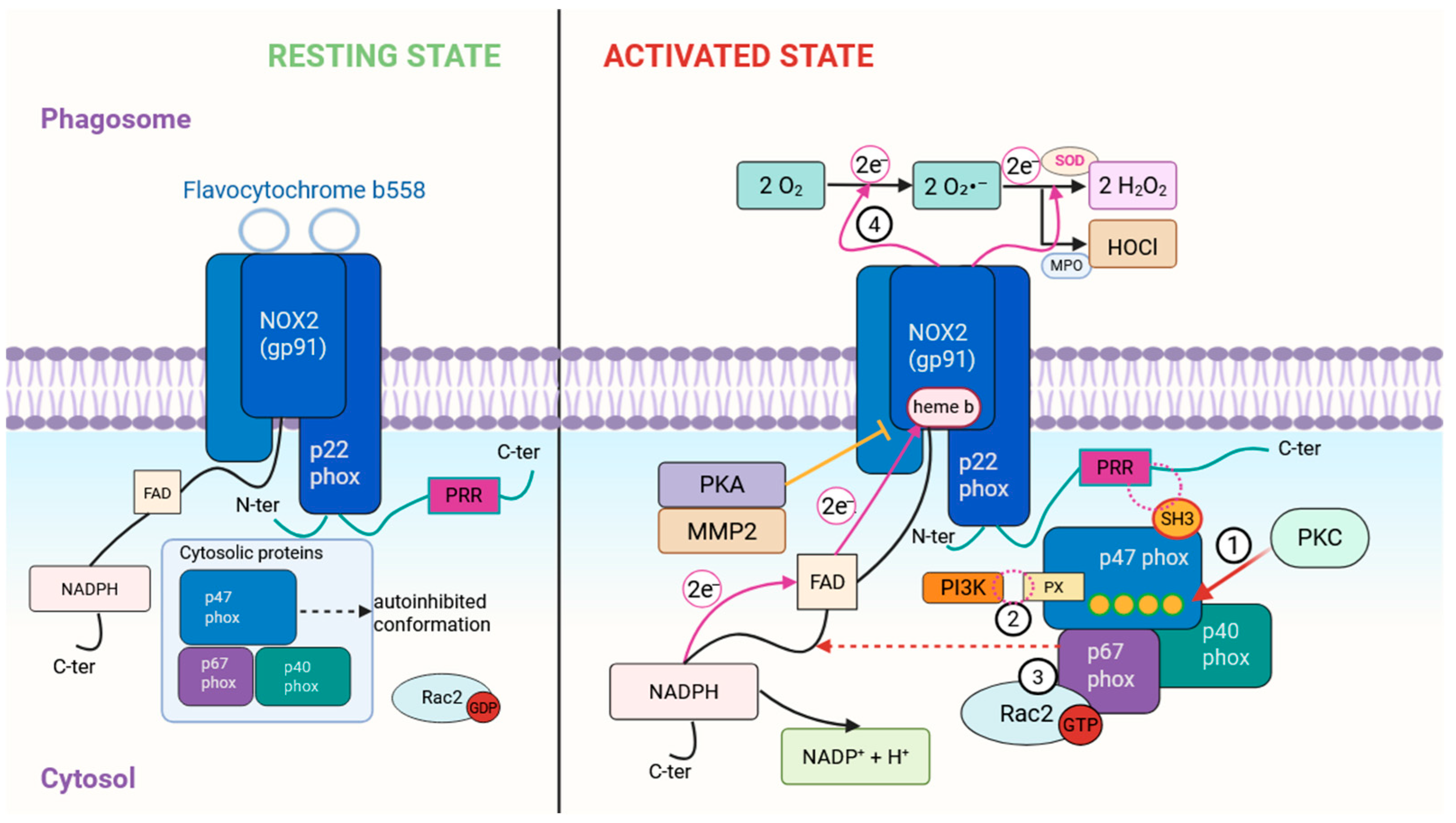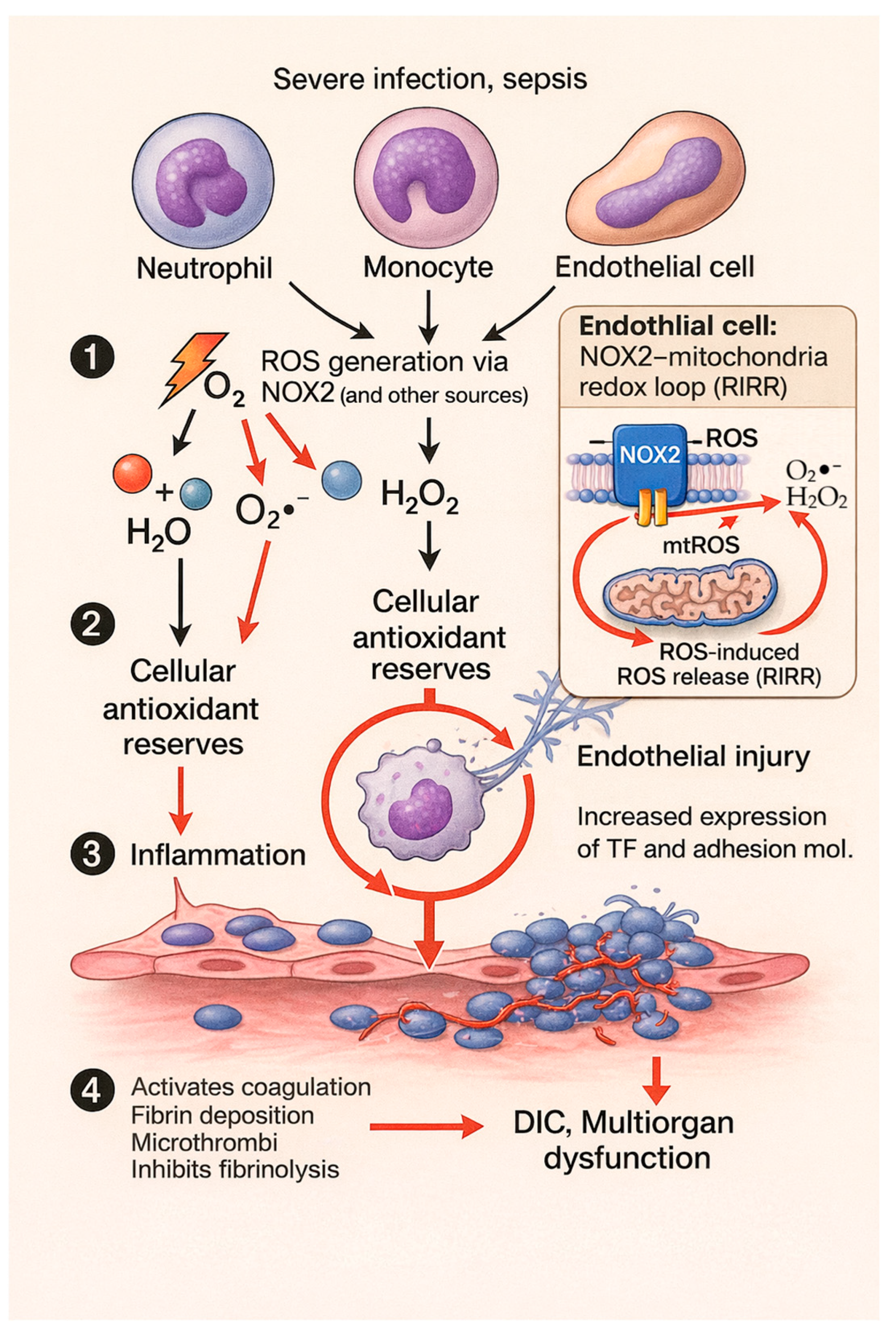

Phagocyte NADPH Oxidase NOX2-Derived Reactive Oxygen Species in Antimicrobial Defense: Mechanisms, Regulation, and Therapeutic Potential—A Narrative Review


Abstract
1. Introduction
2. Materials and Methods
2.1. Article Type and Methodological Guidance
2.2. Data Sources and Search Strategy
2.3. Inclusion and Exclusion Criteria
2.4. Study Selection and Data Extraction
2.5. Quality Assessment and Narrative Synthesis
3. NADPH Oxidase Family and Structure
4. Mechanisms of ROS Production in Host Defense
- Mitochondria. The mitochondrial electron transport chain generates ROS, primarily superoxide, as a byproduct of oxidative phosphorylation, and these represent an important source of ROS in eukaryotic cells [39]. Recent studies show that the production of mitochondrial ROS (mtROS) can be activated by immune signals, for example, through recognition of PAMPs (pathogen-associated molecular patterns) or exposure to proinflammatory cytokines, which suggests a direct role for mtROS in antimicrobial defense [33]. Such mitochondrial ROS can contribute to inflammasome activation and to the amplification of antipathogen immune signaling.
- Xanthine oxidase. The enzyme xanthine oxidase (XO), involved in purine catabolism, generates superoxide and H2O2 as byproducts of the oxidation of hypoxanthine and xanthine to uric acid. Therefore, XO constitutes an additional source of ROS in inflammatory contexts, and experimental models have shown that ROS derived from XO can activate the inflammasome and contribute to defense against certain infections, for example, in parasitic infections [40].
- Microbial enzymes and microbially derived ROS. Some microorganisms produce ROS themselves, influencing the ecology and pathogenesis of infection. For example, Streptococcus pneumoniae, which does not express catalase, generates millimolar amounts of H2O2 through the activity of a flavin oxidase, the pyruvate oxidase SpxB [41]. This endogenous H2O2 helps the pneumococcus inhibit other bacteria in the nasopharyngeal flora and exerts cytotoxic effects on host cells, for example, on respiratory epithelial cells and neutrophils [41]. Conversely, many pathogenic bacteria possess antioxidant enzymes, catalases, peroxidases, and superoxide dismutases, which protect them from host generated ROS. For instance, Staphylococcus aureus shows notable resistance to oxidative killing because it expresses both catalase and superoxide dismutase, which neutralize H2O2 and superoxide produced by neutrophils [42].
5. NOX2-Dependent Redox Regulation of Immune Signaling Pathways
5.1. Activation and Regulation of NOX2 in Phagocytes
5.2. ROS Impact on NF-κB and MAPK Signaling
5.3. Nrf2: Antioxidant Response and Feedback Regulation
5.4. Redox Regulation in Lymphocytes and Dendritic Cells
6. Clinical Relevance and Pathophysiological Dysregulation
6.1. NOX2 Deficiency: Chronic Granulomatous Disease and Susceptibility to Infections
6.2. Uncontrolled Excess of ROS in Sepsis
6.3. Redox Dysregulation in Chronic Inflammation and Autoimmunity
6.4. Redox Dysfunction in Viral Infections and COVID-19
7. Therapeutic Modulation of NADPH Oxidase and ROS
7.1. Selective NOX2 Inhibitors
7.2. Nrf2 Pathway Activators and Antioxidant Therapies
7.3. Redox-Modulating Peptides
7.4. Balancing ROS: Dosing Challenges and Future Directions
8. Challenges and Future Perspectives
9. Conclusions
Supplementary Materials
Author Contributions
Funding
Institutional Review Board Statement
Informed Consent Statement
Data Availability Statement
Conflicts of Interest
References
- Leiding, J.W.; Mathews, C.E.; Arnold, D.E.; Chen, J. The Role of NADPH Oxidase 2 in Leukocytes. Antioxidants 2025, 14, 309. [Google Scholar] [CrossRef]
- Nocella, C.; D’Amico, A.; Cammisotto, V.; Bartimoccia, S.; Castellani, V.; Loffredo, L.; Marini, L.; Ferrara, G.; Testa, M.; Motta, G.; et al. Structure, Activation, and Regulation of NOX2: At the Crossroad between the Innate Immunity and Oxidative Stress-Mediated Pathologies. Antioxidants 2023, 12, 429. [Google Scholar] [CrossRef]
- Paclet, M.-H.; Laurans, S.; Dupré-Crochet, S. Regulation of Neutrophil NADPH Oxidase, NOX2: A Crucial Effector in Neutrophil Phenotype and Function. Front. Cell Dev. Biol. 2022, 10, 945749. [Google Scholar] [CrossRef] [PubMed]
- Gamble, M.E.; Sureshkumar, S.; Carrera Espinoza, M.J.; Hakim, N.L.; Espitia, C.M.; Bi, F.; Kelly, K.R.; Wang, W.; Nawrocki, S.T.; Carew, J.S. p47phox: A Central Regulator of NADPH Oxidase Function and a Promising Therapeutic Target in Redox-Related Diseases. Cells 2025, 14, 1043. [Google Scholar] [CrossRef] [PubMed]
- Manoharan, R.R.; Prasad, A.; Pospíšil, P.; Kzhyshkowska, J. ROS Signaling in Innate Immunity via Oxidative Protein Modifications. Front. Immunol. 2024, 15, 1359600. [Google Scholar] [CrossRef] [PubMed]
- Braunstein, I.; Motohashi, H.; Dallenga, T.; Schaible, U.E.; Benhar, M. Redox Signaling in Innate Immunity and Inflammation: Focus on Macrophages and Neutrophils. Free Radic. Biol. Med. 2025, 237, 427–454. [Google Scholar] [CrossRef] [PubMed]
- Alfei, S.; Schito, G.C.; Schito, A.M.; Zuccari, G. Reactive Oxygen Species (ROS)-Mediated Antibacterial Oxidative Therapies: Available Methods to Generate ROS and a Novel Option Proposal. Int. J. Mol. Sci. 2024, 25, 7182. [Google Scholar] [CrossRef]
- Vaishampayan, A.; Grohmann, E. Antimicrobials Functioning through ROS-Mediated Mechanisms: Current Insights. Microorganisms 2022, 10, 61. [Google Scholar] [CrossRef]
- Elbehiry, A.; Abalkhail, A. Antimicrobial Nanoparticles Against Superbugs: Mechanistic Insights, Biomedical Applications, and Translational Frontiers. Pharmaceuticals 2025, 18, 1195. [Google Scholar] [CrossRef]
- Tao, Y.; Zhuang, W.; Fan, W.; Zhang, J.; Li, X.; Chen, Q.; Liu, Y.; Wang, H.; Zhou, Y.; Liu, J.; et al. Dual-Functional Silver Nanoparticle-Enhanced ZnO Nanorods for Improved Reactive Oxygen Species Generation and Cancer Treatment. iScience 2025, 28, 111858. [Google Scholar] [CrossRef]
- Mohammed, A.M.; Mohammed, M.; Oleiwi, J.K.; Ihmedee, F.H.; Adam, T.; Betar, B.O.; Gopinath, S.C.B. Comprehensive Review on Zinc Oxide Nanoparticle Production and the Associated Antibacterial Mechanisms and Therapeutic Potential. Nano Trends 2025, 11, 100145. [Google Scholar] [CrossRef]
- Silva, L.B.B.d.; Castilho, I.G.; Souza Silva, F.A.d.; Ghannoum, M.; Garcia, M.T.; Carmo, P.H.F.d. Antimicrobial Photodynamic Therapy for Superficial, Skin, and Mucosal Fungal Infections: An Update. Microorganisms 2025, 13, 1406. [Google Scholar] [CrossRef]
- Demidov, V.V.; Bond, M.C.; Demidova, N.; Gitajn, I.L.L.; Nadell, C.D.; Elliott, J.T. Assessment of Photodynamic Therapy Efficacy against Escherichia coli/Enterococcus faecalis Biofilms on Surfaces of Orthopedic Devices. J. Biomed. Opt. 2025, 30, 036003. [Google Scholar] [CrossRef] [PubMed]
- Tang, Y.; Chen, L.; Ran, X. Efficacy and Safety of Honey Dressings in the Management of Chronic Wounds: An Updated Systematic Review and Meta-Analysis. Nutrients 2024, 16, 2455. [Google Scholar] [CrossRef]
- Vermot, A.; Petit-Härtlein, I.; Smith, S.M.E.; Fieschi, F. NADPH Oxidases (NOX): An Overview from Discovery, Molecular Mechanisms to Physiology and Pathology. Antioxidants 2021, 10, 890. [Google Scholar] [CrossRef] [PubMed]
- Mansoori Moghadam, Z.; Henneke, P.; Kolter, J. From Flies to Men: ROS and the NADPH Oxidase in Phagocytes. Front. Cell Dev. Biol. 2021, 9, 628991. [Google Scholar] [CrossRef]
- Kim, J.; Moon, J.-S. Molecular Roles of NADPH Oxidase-Mediated Oxidative Stress in Alzheimer’s Disease: Isoform-Specific Contributions. Int. J. Mol. Sci. 2024, 25, 12299. [Google Scholar] [CrossRef] [PubMed]
- Dagah, O.M.A.; Silaa, B.B.; Zhu, M.; Pan, Q.; Qi, L.; Liu, X.; Liu, Y.; Peng, W.; Ullah, Z.; Yudas, A.F.; et al. Exploring Immune Redox Modulation in Bacterial Infections: Insights into Thioredoxin-Mediated Interactions and Implications for Understanding Host–Pathogen Dynamics. Antioxidants 2024, 13, 545. [Google Scholar] [CrossRef] [PubMed]
- Marzaioli, V.; Hurtado-Nedelec, M.; Pintard, C.; Tlili, A.; Marie, J.-C.; Monteiro, R.C.; Gougerot-Pocidalo, M.-A.; Dang, P.M.-C.; El-Benna, J. NOX5 and p22phox Are Two Novel Regulators of Human Monocytic Differentiation into Dendritic Cells. Blood 2017, 130, 1734–1745. [Google Scholar] [CrossRef]
- Noreng, S.; Ota, N.; Sun, Y.; Ho, H.; Johnson, M.; Arthur, C.P.; Schneider, K.; Lehoux, I.; Davies, C.W.; Mortara, K.; et al. Structure of the Core Human NADPH Oxidase NOX2. Nat. Commun. 2022, 13, 33711. [Google Scholar] [CrossRef]
- Zang, J.; Cambet, Y.; Jaquet, V.; Bach, A. Chemical Synthesis of a Reported p47phox/p22phox Inhibitor and Characterization of Its Instability and Irreproducible Activity. Front. Pharmacol. 2023, 13, 1075328. [Google Scholar] [CrossRef]
- Solbak, S.M.Ø.; Zang, J.; Narayanan, D.; Vassilev, A.; Agger, S.A.; Kjølhede, T.; Østergaard, H.; Kongsfelt, I.B.; Stougaard, M.; Kristensen, M.; et al. Developing Inhibitors of the p47phox–p22phox Protein–Protein Interaction by Fragment-Based Drug Discovery. J. Med. Chem. 2020, 63, 1156–1177. [Google Scholar] [CrossRef]
- Li, A.; Zhuang, Z.; Xia, Q.; Wu, Y.; Zhang, H.; Chen, J.; Lin, Y.; Zhao, L.; Liu, X.; Chen, Y.; et al. p67phox/NOX2 Inhibits Psoriasis by Regulating the HIF-1α-Glycolysis Axis via p53-AMPK in Keratinocytes. Free Radic. Biol. Med. 2025, 237, 503–514. [Google Scholar] [CrossRef] [PubMed]
- Magnani, F.; Mattevi, A. Structure and Mechanisms of ROS Generation by NADPH Oxidases. Curr. Opin. Struct. Biol. 2019, 59, 91–97. [Google Scholar] [CrossRef]
- Veras, F.P.; Pontelli, M.C.; Silva, C.M.; Toller-Kawahisa, J.E.; de Lima, M.; Nascimento, D.C.; Schneider, A.H.; Caetité, D.; Tavares, L.A.; Paiva, I.M.; et al. SARS-CoV-2-Triggered Neutrophil Extracellular Traps Mediate COVID-19 Pathology. J. Exp. Med. 2020, 217, e20201129. [Google Scholar] [CrossRef]
- Manevski, M.; Muthumalage, T.; Devadoss, D.; Sundar, I.K.; Wang, Q.; Singh, K.P.; Unwalla, H.J.; Lucas, R.; Rahman, I. Cellular Stress Responses and Dysfunctional Mitochondrial-Cellular Senescence, and Therapeutics in Chronic Respiratory Diseases. Redox Biol. 2020, 33, 101443. [Google Scholar] [CrossRef] [PubMed]
- Groemping, Y.; Rittinger, K. Activation and assembly of the NADPH oxidase: A structural perspective. Biochem. J. 2005, 386, 401–416. [Google Scholar] [CrossRef] [PubMed]
- Song, Z.; Huang, G.; Chiquetto Paracatu, L.; Grimes, D.; Gu, J.; Luke, C.J.; Mansour, M.K.; Vinh, D.C.; Lionakis, M.S.; Reeves, W.H. NADPH Oxidase Controls Pulmonary Neutrophil Infiltration in the Response to Fungal Cell Walls by Limiting LTB4. Blood 2020, 135, 891–903. [Google Scholar] [CrossRef] [PubMed]
- Trevelin, S.C.; Shah, A.M.; Lombardi, G. Beyond Bacterial Killing: NADPH Oxidase 2 Is an Immunomodulator. Immunol. Lett. 2020, 221, 39–48. [Google Scholar] [CrossRef] [PubMed]
- Segal, A.W. The NADPH oxidase and chronic granulomatous disease. Mol. Med. Today 1996, 2, 129–135. [Google Scholar] [CrossRef]
- Valenta, H.; Erard, M.; Dupré-Crochet, S.; Nüße, O. The NADPH Oxidase and the Phagosome. Adv. Exp. Med. Biol. 2020, 1246, 153–177. [Google Scholar] [CrossRef] [PubMed]
- Yoo, D.-G.; Paracatu, L.C.; Xu, E.; Lin, X.; Dinauer, M.C. NADPH Oxidase Limits Collaborative Pattern-Recognition Receptor Signaling to Regulate Neutrophil Cytokine Production in Response to Fungal Pathogen-Associated Molecular Patterns. J. Immunol. 2021, 207, 923–937. [Google Scholar] [CrossRef] [PubMed]
- Herb, M.; Schramm, M. Functions of ROS in Macrophages and Antimicrobial Immunity. Antioxidants 2021, 10, 313. [Google Scholar] [CrossRef] [PubMed]
- Beaumel, S.; Picciocchi, A.; Debeurme, F.; Vivès, C.; Hesse, A.-M.; Ferro, M.; Grunwald, D.; Stieglitz, H.; Thepchatri, P.; Smith, S.M.E.; et al. Down-regulation of NOX2 Activity in Phagocytes Mediated by ATM-Kinase Dependent Phosphorylation. Free Radic. Biol. Med. 2017, 113, 1–15. [Google Scholar] [CrossRef] [PubMed]
- Nguyen, G.T.; Green, E.R.; Mecsas, J. Neutrophils to the ROScue: Mechanisms of NADPH Oxidase Activation and Bacterial Resistance. Front. Cell. Infect. Microbiol. 2017, 7, 373. [Google Scholar] [CrossRef]
- Cipriano, A.; Viviano, M.; Feoli, A.; Marsano, I.; Pisano, F.; Porta, S.; Sturlese, M.; Pescitelli, G.; Amico, A.D.; Fieschi, F. NADPH Oxidases: From Molecular Mechanisms to Current Inhibitors. J. Med. Chem. 2023, 66, 11632–11655. [Google Scholar] [CrossRef] [PubMed]
- Lin, W.; Chen, H.; Chen, X.; Guo, C. The Roles of Neutrophil-Derived Myeloperoxidase (MPO) in Diseases: The New Progress. Antioxidants 2024, 13, 132. [Google Scholar] [CrossRef] [PubMed]
- Siraki, A.G. The Many Roles of Myeloperoxidase: From Inflammation and Immunity to Biomarkers, Drug Metabolism and Drug Discovery. Redox Biol. 2021, 46, 102109. [Google Scholar] [CrossRef]
- Profir, I.; Popescu, C.M.; Nechita, A. Fatal Influenza B–MRSA Coinfection in a Healthy Adolescent: Necrotizing Pneumonia, Cytokine Storm, and Multi-Organ Failure. Children 2025, 12, 766. [Google Scholar] [CrossRef]
- Hahn, J.; Euler, M.; Kilgus, E.; Kienhöfer, D.; Petzold, D.; Schabbauer, G.; Munoz, L.E.; Herrmann, M. NOX2 Mediates Quiescent Handling of Dead Cell Remnants in Phagocytes. Redox Biol. 2019, 26, 101279. [Google Scholar] [CrossRef]
- Bryant, J.C.; Dabbs, R.C.; Oswalt, K.L.; Brown, L.R.; Rosch, J.W.; Seo, K.S.; Donaldson, J.R.; McDaniel, L.S. Pyruvate Oxidase of Streptococcus pneumoniae Contributes to Pneumolysin Release. BMC Microbiol. 2016, 16, 271. [Google Scholar] [CrossRef] [PubMed]
- Cui, C.; Jiang, M.; Jain, N.; Liu, Y.; Zhang, L.; Yang, D.; Zhou, Q. Structural Basis of Human NOX5 Activation. Nat. Commun. 2024, 15, 3994. [Google Scholar] [CrossRef] [PubMed]
- Belambri, S.A.; Marzaioli, V.; Hurtado-Nedelec, M.; Pintard, C.; Liang, S.; Liu, Y.; Boussetta, T.; Gougerot-Pocidalo, M.-A.; Ye, R.D.; Dang, P.M.-C.; et al. Impaired p47phox Phosphorylation in Neutrophils from p67phox-Deficient Chronic Granulomatous Disease Patients. Blood 2022, 139, 2512–2522. [Google Scholar] [CrossRef] [PubMed]
- Cammarata, I.; Pinna, V.; Pacella, I.; Rotella, I.; Soresina, A.; Badolato, R.; Plebani, A.; Pignata, C.; Cirillo, E.; Zicari, A.M.; et al. In Adult X-CGD Patients, Regulatory T Cells Are Expanded While Activated T Cells Display a NOX2-Independent ROS Increase. Immunol. Lett. 2024, 266, 106839. [Google Scholar] [CrossRef] [PubMed]
- Bobeică, C.; Niculeț, E.; Tatu, A.L.; Crăescu, M.; Vătă, D.; Stătescu, L.; Iancu, A.V.; Mușat, C.L.; Drăgănescu, M.L.; Onișor, C.; et al. Old and New Therapeutic Strategies in Systemic Sclerosis (Review). Exp. Ther. Med. 2022, 23, 134. [Google Scholar] [CrossRef]
- He, C.; Luo, H.; Coelho, A.; Ye, L.; Xu, Z.; Lin, Y.; Wang, X.; Zhang, Y.; Sun, J.; Li, J.; et al. NCF4-Dependent Intracellular Reactive Oxygen Species Regulate Plasma Cell Formation. Redox Biol. 2022, 56, 102422. [Google Scholar] [CrossRef] [PubMed]
- Kotsafti, A.; Scarpa, M.; Castagliuolo, I.; Scarpa, M. Reactive Oxygen Species and Antitumor Immunity—From Surveillance to Evasion. Cancers 2020, 12, 1748. [Google Scholar] [CrossRef]
- Akhiani, A.A.; Hallner, A.; Kiffin, R.; Achour, A.; Mellqvist, U.-H.; Hansson, M.; Aurelius, J.; Brune, M.; Hellstrand, K.; Martner, A. Idelalisib Rescues Natural Killer Cells from Monocyte-Induced Immunosuppression by Inhibiting NOX2-Derived Reactive Oxygen Species. Cancer Immunol. Res. 2020, 8, 1532–1541. [Google Scholar] [CrossRef]
- Van de Geer, A.; Nieto-Patlán, A.; Kuhns, D.B.; Tool, A.T.J.; Arias, A.A.; Bouaziz, M.; de Boer, M.; Franco, J.L.; Gazendam, R.P.; van Hamme, J.L.; et al. Inherited p40^phox Deficiency Differs from Classic Chronic Granulomatous Disease. J. Clin. Investig. 2018, 128, 3957–3975. [Google Scholar] [CrossRef]
- Tian, L.; Tang, P.; Liu, J.; Wang, C.; Zhang, Y.; Huang, Q.; Li, X.; Chen, R.; Zhao, S.; Xu, J.; et al. Microglial gp91phox-Mediated Neuroinflammation and Ferroptosis Contributes to Learning and Memory Deficits in Rotenone-Treated Mice. Free Radic. Biol. Med. 2024, 220, 56–66. [Google Scholar] [CrossRef]
- Huang, X.; Xiaokaiti, Y.; Yang, J.; Liu, H.; Zhang, W.; Chen, H.; Xu, H.; Li, X.; Yang, J.; Wang, T.; et al. Inhibition of Phosphodiesterase 2 Reverses gp91phox Oxidase-Mediated Depression- and Anxiety-Like Behavior. Neuropharmacology 2018, 143, 176–185. [Google Scholar] [CrossRef]
- Morris, G.; Gevezova, M.; Sarafian, V.; Maes, M. Redox Regulation of the Immune Response. Cell. Mol. Immunol. 2022, 19, 1079–1101. [Google Scholar] [CrossRef] [PubMed]
- Schieven, G.L.; Kirihara, J.M.; Myers, D.E.; Ledbetter, J.A.; Uckun, F.M. Reactive oxygen intermediates activate NF-κB in a tyrosine kinase-dependent mechanism and, in combination with vanadate, activate the p56^lck and p59^fyn tyrosine kinases in human lymphocytes. Blood 1993, 82, 1212–1220. [Google Scholar] [CrossRef]
- Jalmi, S.K.; Sinha, A.K. ROS Mediated MAPK Signaling in Abiotic and Biotic Stress—Striking Similarities and Differences. Front. Plant Sci. 2015, 6, 769. [Google Scholar] [CrossRef] [PubMed]
- Saitoh, M.; Nishitoh, H.; Fujii, M.; Takeda, K.; Tobiume, K.; Sawada, Y.; Kawabata, M.; Miyazono, K.; Ichijo, H. Mammalian thioredoxin is a direct inhibitor of apoptosis signal-regulating kinase (ASK)1. EMBO J. 1998, 17, 2596–2606. [Google Scholar] [CrossRef]
- Kamata, H.; Honda, S.; Maeda, S.; Chang, L.; Hirata, H.; Karin, M. Reactive oxygen species promote TNFα-induced death and sustained JNK activation by inhibiting MAP kinase phosphatases. Cell 2005, 120, 649–661. [Google Scholar] [CrossRef]
- Ramos-Tovar, E.; Muriel, P. Molecular Mechanisms That Link Oxidative Stress, Inflammation, and Fibrosis in the Liver. Antioxidants 2020, 9, 1279. [Google Scholar] [CrossRef] [PubMed]
- Marshall, H.E.; Stamler, J.S. Inhibition of NF-κB by S-nitrosylation. Biochemistry 2001, 40, 1688–1693. [Google Scholar] [CrossRef] [PubMed]
- Profir, I.; Popescu, C.M.; Popa, G.V.; Nechita, A. Beyond Passive Immunity: Three Neonatal Influenza Cases Highlighting Impact of Missed Maternal Vaccination. Clin. Pract. 2025, 15, 124. [Google Scholar] [CrossRef]
- Gao, W.; Guo, L.; Yang, Y.; Wang, Y.; Xia, S.; Gong, H.; Zhang, B.-K.; Yan, M. Dissecting the Crosstalk Between Nrf2 and NF-κB Response Pathways in Drug-Induced Toxicity. Front. Cell Dev. Biol. 2022, 9, 809952. [Google Scholar] [CrossRef] [PubMed]
- Bellanti, F.; Coda, A.R.D.; Trecca, M.I.; Lo Buglio, A.; Serviddio, G.; Vendemiale, G. Redox Imbalance in Inflammation: The Interplay of Oxidative and Reductive Stress. Antioxidants 2025, 14, 656. [Google Scholar] [CrossRef] [PubMed]
- Tsubata, T. Involvement of Reactive Oxygen Species (ROS) in BCR Signaling as a Second Messenger. Adv. Exp. Med. Biol. 2020, 1254, 37–46. [Google Scholar] [CrossRef]
- Mattos, M.S.; Vandendriessche, S.; Waisman, A.; Marques, P.E. The Immunology of B-1 Cells: From Development to Aging. Immun. Ageing 2024, 21, 54. [Google Scholar] [CrossRef]
- Mihailov, R.; Beznea, A.; Popazu, C.; Voicu, D.; Toma, A.; Tudorașcu, I.; Rebegea, L.; Mihailov, O.M.; Luțenco, V.; Constantin, G.B.; et al. The Pathological and Immunohistochemical Profile of Tumor Angiogenesis in Perforated Sigmoid Carcinoma—Case Report and Short Literature Review. Electron. J. Gen. Med. 2024, 21, e600. [Google Scholar] [CrossRef] [PubMed]
- Muri, J.; Corak, B.; Matsushita, M.; Baes, M.; Kopf, M. Peroxisomes Are Critical for the Development and Maintenance of B1 and Marginal Zone B Cells but Dispensable for Follicular B Cells and T Cells. J. Immunol. 2022, 208, 839–850. [Google Scholar] [CrossRef] [PubMed]
- Gordon, R.A.; Cosgrove, H.A.; Marinov, A.; Gingras, S.; Tilstra, J.S.; Campbell, A.M.; Bastacky, S.I.; Kashgarian, M.; Perl, A.; Nickerson, K.M.; et al. NADPH Oxidase in B Cells and Macrophages Protects against Murine Lupus by Regulation of TLR7. JCI Insight 2024, 9, e178563. [Google Scholar] [CrossRef]
- Jurja, S.; Negreanu-Pirjol, T.; Vasile, M.; Hincu, M.M.; Coviltir, V.; Negreanu-Pirjol, B.S. Xanthophyll Pigments Dietary Supplements Administration and Retinal Health in the Context of Increasing Life Expectancy Trend. Front. Nutr. 2023, 10, 1226686. [Google Scholar] [CrossRef] [PubMed]
- Zorina, S.A.; Jurja, S.; Mehedinti, M.; Stoica, A.-M.; Chita, D.S.; Floris, S.A.; Axelerad, A. Infectious Microorganisms Seen as Etiologic Agents in Parkinson’s Disease. Life 2023, 13, 805. [Google Scholar] [CrossRef]
- Shai, N.; Yifrach, E.; van Roermund, C.W.T.; Cohen, N.; Bibi, C.; Lamosh, A.; Wijsmans, R.A.; Moulin, M.; van der Vlies, P.; Agrawal, A.; et al. Systematic Mapping of Contact Sites Reveals Tethers and a Function for the Peroxisome-Mitochondria Contact. Nat. Commun. 2018, 9, 1761. [Google Scholar] [CrossRef]
- Niculet, E.; Bobeica, C.; Craescu, M.; Nicolescu, A.C.; Tocu, G.; Onisor, C.; Arbune, M.; Tatu, A.L. Multimodal Considerations Concerning Basal Cell Carcinoma Clefting—Profile of Structural and Aggressive Traits—Perspectives. Clin. Cosmet. Investig. Dermatol. 2022, 15, 2087–2095. [Google Scholar] [CrossRef]
- Gao, W.; Xu, S.; Zhang, M.; Liu, S.; Siu, S.P.; Peng, H.; Ng, J.C.; Tsao, G.S.; Chan, A.W.; Chow, V.L.; et al. NADPH Oxidase 5α Promotes the Formation of CD271 Tumor-Initiating Cells in Oral Cancer. Am. J. Cancer Res. 2020, 10, 1710–1727. [Google Scholar]
- Zhang, S.; Chopin, M.; Nutt, S.L. Type 1 Conventional Dendritic Cells: Ontogeny, Function, and Emerging Roles in Cancer Immunotherapy. Trends Immunol. 2021, 42, 1113–1127. [Google Scholar] [CrossRef]
- Profir, I.; Popescu, C.M.; Moraru, I. Life-Threatening Anemia and Thrombocytopenia in a Toddler with Influenza B: Case Report and Literature Review. Children 2025, 12, 632. [Google Scholar] [CrossRef] [PubMed]
- Miranda, M.A.; Tsalatsanis, A.; Trotter, J.R.; Arnold, D.E.; Squire, J.D.; Kidd, S.; Parikh, S.; Marsh, R.A.; Griffith, L.M.; Mallhi, K.; et al. High Symptom Burden in Female X-Linked Chronic Granulomatous Disease Carriers. Clin. Immunol. 2024, 268, 110364. [Google Scholar] [CrossRef]
- Ambrose, L.; Dinu, C.A.; Gurau, G.; Maftei, N.-M.; Matei, M.N.; Hincu, M.-A.; Radu, M.; Mehedinți, M.-C. The Role of Probiotics in Healing Burns and Skin Wounds: An Integrative Approach in the Context of Regenerative Medicine. Life 2025, 15, 1434. [Google Scholar] [CrossRef]
- Țocu, G.; Ștefănescu, B.I.; Șerban, C.; Mihailov, R.; Niculeț, E.; Tutunaru, D.; Palivan, C.C.; Rebegea, L.F.; Dumitru, M.; Firescu, D. Correlation Between Serum Procalcitonin Levels and 28-Day Mortality in Patients with Surgical Sepsis and Septic Shock. Chirurgia 2023, 118, 161–169. [Google Scholar] [CrossRef] [PubMed]
- Bilski, R.; Kupczyk, D.; Woźniak, A. Oxidative Imbalance in Psoriasis with an Emphasis on Psoriatic Arthritis: Therapeutic Antioxidant Targets. Molecules 2024, 29, 5460. [Google Scholar] [CrossRef] [PubMed]
- Șerban, C.; Toma, A.; Voicu, D.C.; Popazu, C.; Firescu, D.; Țocu, G.; Mihailov, R.; Rebegea, L. A Surgical Challenge Generated by Colonic Malakoplakia in Disguise as a Locally Advanced Colonic Malignancy—A Case Report. Medicina 2023, 59, 156. [Google Scholar] [CrossRef] [PubMed]
- Kannan, K.P.; Girija, A.S.S. Exploring the ROS Reduction Strategies in Chronic Lupus Management. Front. Immunol. 2024, 15, 1346656. [Google Scholar] [CrossRef]
- Țocu, G.; Tutunaru, D.; Mihailov, R.; Șerban, C.; Dimofte, F.; Niculeț, E.; Tatu, A.L.; Firescu, D. Particularities of Diagnosis in an Elderly Patient with Neglected Peritonitis: A Case Report. J. Int. Med. Res. 2022, 50, 3000605221118705. [Google Scholar] [CrossRef] [PubMed]
- Țocu, G.; Mihailov, R.; Șerban, C.; Ștefănescu, B.I.; Tutunaru, D.; Firescu, D. The Contribution of Procalcitonin, C-Reactive Protein and Interleukin-6 in the Diagnostic and Prognostic of Surgical Sepsis: Observational and Statistical Study. J. Multidiscip. Healthc. 2023, 16, 2351–2359. [Google Scholar] [CrossRef]
- Lopes-Pires, M.E.; Frade-Guanaes, J.O.; Quinlan, G.J. Clotting Dysfunction in Sepsis: A Role for ROS and Potential for Therapeutic Intervention. Antioxidants 2022, 11, 88. [Google Scholar] [CrossRef] [PubMed]
- Chen, Y.; Jin, S.; Teng, X.; Hu, Z.; Zhang, Z.; Qiu, X.; Tian, D.; Wu, Y. Hydrogen Sulfide Attenuates LPS-Induced Acute Kidney Injury by Inhibiting Inflammation and Oxidative Stress. Oxid. Med. Cell. Longev. 2018, 2018, 6717212. [Google Scholar] [CrossRef] [PubMed]
- Ge, Q.M.; Huang, C.M.; Zhu, X.Y.; Bian, F.; Pan, S.M. Differentially Expressed miRNAs in Sepsis-Induced Acute Kidney Injury Target Oxidative Stress and Mitochondrial Dysfunction Pathways. PLoS ONE 2017, 12, e0173292. [Google Scholar] [CrossRef]
- Țocu, G.; Lisă, E.L.; Tutunaru, D.; Mihailov, R.; Șerban, C.; Luțenco, V.; Dimofte, F.; Guliciuc, M.; Chiscop, I.; Ștefănescu, B.I.; et al. The Potential of Artificial Intelligence in the Diagnosis and Prognosis of Sepsis: A Narrative Review. Diagnostics 2025, 15, 2169. [Google Scholar] [CrossRef] [PubMed]
- Joseph, L.C.; Kokkinaki, D.; Valenti, M.-C.; Kim, G.J.; Barca, E.; Tomar, D.; Hoffman, N.E.; Subramanyam, P.; Colecraft, H.M.; Hirano, M.; et al. Inhibition of NADPH oxidase 2 (NOX2) prevents sepsis-induced cardiomyopathy by improving calcium handling and mitochondrial function. JCI Insight 2017, 2, e94248. [Google Scholar] [CrossRef] [PubMed]
- Trevelin, S.C.; Sag, C.M.; Zhang, M.; Alves-Filho, J.C.; Cunha, T.M.; Santos, C.X.D.; Sawyer, G.; Murray, T.; Brewer, A.; Laurindo, F.R.M.; et al. Endothelial Nox2 Limits Systemic Inflammation and Hypotension in Endotoxemia by Controlling Expression of Toll-Like Receptor 4. Shock 2021, 56, 268–277. [Google Scholar] [CrossRef]
- Mortimer, P.M.; McIntyre, S.A.; Thomas, D.C. Beyond the Extra Respiration of Phagocytosis: NADPH Oxidase 2 in Adaptive Immunity and Inflammation. Front. Immunol. 2021, 12, 733918. [Google Scholar] [CrossRef]
- Kayesh, M.E.H.; Kohara, M.; Tsukiyama-Kohara, K. Effects of Oxidative Stress on Viral Infections: An Overview. npj Viruses 2025, 3, 27. [Google Scholar] [CrossRef]
- Stavar-Matei, L.; Mihailov, O.-M.; Nechita, A.; Crestez, A.M.; Ţocu, G. Impact of COVID-19 on Pneumococcal Acute Otitis Media, Antibiotic Resistance, and Vaccination in Children. Infect. Drug Resist. 2024, 17, 5567–5578. [Google Scholar] [CrossRef]
- Paul, O.; Akolia, I.K.; Tao, J.Q.; Jain, N.; Louneva, N.; Montone, K.T.; Fisher, A.B.; Rajapakse, C.S.; Bermudez, C.; Chatterjee, S. Reactive Oxygen Species in Endothelial Signaling in COVID-19: Protective Role of the Novel Peptide PIP-2. PLoS ONE 2024, 19, e0289854. [Google Scholar] [CrossRef] [PubMed]
- Osburn, W.O.; Smith, K.; Yanek, L.; Amat-Alcaron, N.; Thiemann, D.R.; Cox, A.L.; Leucker, T.M.; Lowenstein, C.J. Markers of Endothelial Cell Activation Are Associated with the Severity of Pulmonary Disease in COVID-19. PLoS ONE 2022, 17, e0268296. [Google Scholar] [CrossRef] [PubMed]
- Ștefănescu, B.I.; Ionescu, A.A.; Țocu, G.; Constantin, B.G.; Chiran, D.A.; Stan, C.I.; Mihalache, T.I. Evaluation of Anxiety for First and Second Trimester Pregnant Women Infected with COVID-19: A Clinical Study. Rev. Med. Chir. 2025, 129, 350–359. [Google Scholar] [CrossRef]
- Luțenco, V.; Beznea, A.; Mihailov, R.; Țocu, G.; Luțenco, V.; Mihailov, O.M.; Patriciu, M.; Pascaru, G.; Baroiu, L. Literature Review of Prognostic Factors in Secondary Generalized Peritonitis. Life 2025, 15, 880. [Google Scholar] [CrossRef] [PubMed]
- Iancu, A.-V.; Arbune, M.; Zaharia, E.-A.; Tutunaru, D.; Maftei, N.-M.; Peptine, L.-D.; Țocu, G.; Gurău, G. Prevalence and Antibiotic Resistance of Enterococcus spp.: A Retrospective Study in Hospitals of Southeast Romania. Appl. Sci. 2023, 13, 3866. [Google Scholar] [CrossRef]
- Schröder, K. NADPH Oxidase-Derived Reactive Oxygen Species: Dosis Facit Venenum. Exp. Physiol. 2019, 104, 447–452. [Google Scholar] [CrossRef]
- Boshtam, M.; Kouhpayeh, S.; Amini, F.; Azizi, Y.; Najaflu, M.; Shariati, L.; Khanahmad, H. Anti-inflammatory Effects of Apocynin: A Narrative Review of the Evidence. All Life 2021, 14, 997–1010. [Google Scholar] [CrossRef]
- Petrônio, M.S.; Zeraik, M.L.; Fonseca, L.M.d.; Ximenes, V.F. Apocynin: Chemical and Biophysical Properties of a NADPH Oxidase Inhibitor. Molecules 2013, 18, 2821–2839. [Google Scholar] [CrossRef]
- Hirano, K.; Chen, W.S.; Chueng, A.L.; Dunne, A.A.; Seredenina, T.; Filippova, A.; Ramachandran, S.; Bridges, A.; Chaudry, L.; Pettman, G.; et al. Discovery of GSK2795039, a Novel Small Molecule NADPH Oxidase 2 Inhibitor. Antioxid. Redox Signal. 2015, 23, 358–374. [Google Scholar] [CrossRef] [PubMed]
- Juric, M.; Rawat, V.; Amaradhi, R.; Zielonka, J.; Ganesh, T. Novel NADPH Oxidase-2 Inhibitors as Potential Anti-Inflammatory and Neuroprotective Agents. Antioxidants 2023, 12, 1660. [Google Scholar] [CrossRef] [PubMed]
- Chen, G.; Shen, L.; Hu, H.; Feng, Y.; Wen, D.; Liu, Y.; Zhai, H.; Sun, W.; Wang, M.; Lei, X.; et al. Sulforaphane Inhibits Oxidative Stress and May Exert Anti-Pyroptotic Effects by Modulating NRF2/NLRP3 Signaling Pathway in Mycobacterium tuberculosis-Infected Macrophages. Microorganisms 2024, 12, 1191. [Google Scholar] [CrossRef]
- Izumi, Y.; Koyama, Y. Nrf2-Independent Anti-Inflammatory Effects of Dimethyl Fumarate: Challenges and Prospects in Developing Electrophilic Nrf2 Activators for Neurodegenerative Diseases. Antioxidants 2024, 13, 1527. [Google Scholar] [CrossRef]
- Mihailov, O.M.; Stavar-Matei, L.; Țocu, G.; Ciubara, A.; Mihailov, R. Risk Factors for the Occurrence of Depressive Disorders in Pediatric Patients with Tuberculosis. Pediatr. Health Med. Ther. 2025, 16, 13–33. [Google Scholar] [CrossRef]
- Mihailov, O.M.; Ciubară, A.; Luțenco, V.; Țocu, G.; Stavar-Matei, L.; Mihailov, R. Clinical Strategies for Identifying Pediatric Patients with Tuberculosis at Risk of Developing Depressive Disorders. Clin. Pract. 2024, 14, 2385–2409. [Google Scholar] [CrossRef] [PubMed]
- Wakasugi-Onogi, S.; Ma, S.; Ruhee, R.T.; Tong, Y.; Seki, Y.; Suzuki, K. Sulforaphane Attenuates Neutrophil ROS Production, MPO Degranulation and Phagocytosis, but Does Not Affect NET Formation Ex Vivo and In Vitro. Int. J. Mol. Sci. 2023, 24, 8479. [Google Scholar] [CrossRef] [PubMed]
- Fisher, A.B.; Dodia, C.; Chatterjee, S.; Feinstein, S.I. A Peptide Inhibitor of NADPH Oxidase (NOX2) Activation Markedly Decreases Mouse Lung Injury and Mortality Following Administration of Lipopolysaccharide (LPS). Int. J. Mol. Sci. 2019, 20, 2395. [Google Scholar] [CrossRef] [PubMed]
- Fisher, A.B.; Zani, B.G.; Han, T.; Dodia, C.; Melidone, R.; Keller, S.P. Decreased LPS-Induced Lung Injury in Pigs Treated with a Lung Surfactant Protein A-Derived Nonapeptide That Inhibits Peroxiredoxin 6 Activity and Subsequent NOX1,2 Activation. Am. J. Physiol. Lung Cell. Mol. Physiol. 2024, 326, L458–L467. [Google Scholar] [CrossRef] [PubMed]
- Fisher, A.B.; Dodia, C.; Tao, J.-Q.; Feinstein, S.I.; Chatterjee, S. Inhibition of Peroxiredoxin 6 PLA2 Activity Decreases Oxidative Stress and the Severity of Acute Lung Injury in the Mouse Cecal Ligation and Puncture Model. Antioxidants 2021, 10, 1676. [Google Scholar] [CrossRef]
- Thannickal, V.J.; Jandeleit-Dahm, K.; Szyndralewiez, C.; Török, N.J. Pre-Clinical Evidence of a Dual NADPH Oxidase 1/4 Inhibitor (Setanaxib) in Liver, Kidney and Lung Fibrosis. J. Cell. Mol. Med. 2023, 27, 471–481. [Google Scholar] [CrossRef] [PubMed]
- Ștefănescu, B.I.; Mihalache, T.I.; Constantin, G.B.; Țocu, G.; Ștefănescu, M.M.; Bogdan-Goroftei, R.E. Fetal Acrania Diagnosed at 17 Weeks of Gestation by 2D/3D Ultrasound: A Case Report and Literature Review. Rom. J. Morphol. Embryol. 2024, 65, 125–129. [Google Scholar] [CrossRef] [PubMed]
- Kleinschnitz, C.; Grund, H.; Wingler, K.; Armitage, M.E.; Jones, E.; Mittal, M.; Barit, D.; Schwarz, T.; Geis, C.; Kraft, P.; et al. Post-Stroke Inhibition of Induced NADPH Oxidase Type 4 Prevents Oxidative Stress and Neurodegeneration. PLoS Biol. 2010, 8, e1000479. [Google Scholar] [CrossRef]
- Azzi, A. Oxidative Stress: Cannot Be Measured, Localized, Prevented, or Treated. Med. Res. Arch. 2024, 12, 5121. [Google Scholar] [CrossRef]
- Bedard, K.; Whitehouse, S.; Jaquet, V. Challenges, Progresses, and Promises for Developing Future NADPH Oxidase Therapeutics. Antioxid. Redox Signal. 2015, 23, 355–357. [Google Scholar] [CrossRef] [PubMed]
- Heumüller, S.; Wind, S.; Barbosa-Sicard, E.; Schmidt, H.H.; Busse, R.; Schröder, K.; Brandes, R.P. Apocynin is not an inhibitor of vascular NADPH oxidases but an antioxidant. Hypertension 2008, 51, 211–217. [Google Scholar] [CrossRef]
- Rey, F.E.; Cifuentes, M.E.; Kiarash, A.; Quinn, M.T.; Pagano, P.J. Novel competitive inhibitor of NAD(P)H oxidase assembly attenuates vascular O2− and systolic blood pressure in mice. Circ. Res. 2001, 89, 408–414. [Google Scholar] [CrossRef]
- Wind, S.; Beuerlein, K.; Armitage, M.E.; Taye, A.; Kumar, A.H.; Janowitz, D.; Neff, C.; Shah, A.M.; Wingler, K.; Schmidt, H.H. Oxidative stress and endothelial dysfunction in aortas of aged spontaneously hypertensive rats by NOX1/2 is reversed by NADPH oxidase inhibition. Hypertension 2010, 56, 490–497. [Google Scholar] [CrossRef] [PubMed]
- Townsend, B.E.; Johnson, R.W. Sulforaphane induces Nrf2 target genes and attenuates inflammatory gene expression in microglia from brain of young adult and aged mice. Exp. Gerontol. 2016, 73, 42–48. [Google Scholar] [CrossRef] [PubMed]
- Pollock, J.D.; Williams, D.A.; Gifford, M.A.; Li, L.L.; Du, X.; Fisherman, J.; Orkin, S.H.; Doerschuk, C.M.; Dinauer, M.C. Mouse model of X-linked chronic granulomatous disease, an inherited defect in phagocyte superoxide production. Nat. Genet. 1995, 9, 202–209. [Google Scholar] [CrossRef] [PubMed]


Disclaimer/Publisher’s Note: The statements, opinions and data contained in all publications are solely those of the individual author(s) and contributor(s) and not of MDPI and/or the editor(s). MDPI and/or the editor(s) disclaim responsibility for any injury to people or property resulting from any ideas, methods, instructions or products referred to in the content. |
© 2025 by the authors. Licensee MDPI, Basel, Switzerland. This article is an open access article distributed under the terms and conditions of the Creative Commons Attribution (CC BY) license.
Share and Cite
Țocu, G.; Ștefănescu, B.I.; Stavăr Matei, L.; Țocu, L. Phagocyte NADPH Oxidase NOX2-Derived Reactive Oxygen Species in Antimicrobial Defense: Mechanisms, Regulation, and Therapeutic Potential—A Narrative Review. Antioxidants 2026, 15, 55. https://doi.org/10.3390/antiox15010055
Țocu G, Ștefănescu BI, Stavăr Matei L, Țocu L. Phagocyte NADPH Oxidase NOX2-Derived Reactive Oxygen Species in Antimicrobial Defense: Mechanisms, Regulation, and Therapeutic Potential—A Narrative Review. Antioxidants. 2026; 15(1):55. https://doi.org/10.3390/antiox15010055
Chicago/Turabian StyleȚocu, George, Bogdan Ioan Ștefănescu, Loredana Stavăr Matei, and Lavinia Țocu. 2026. "Phagocyte NADPH Oxidase NOX2-Derived Reactive Oxygen Species in Antimicrobial Defense: Mechanisms, Regulation, and Therapeutic Potential—A Narrative Review" Antioxidants 15, no. 1: 55. https://doi.org/10.3390/antiox15010055
APA StyleȚocu, G., Ștefănescu, B. I., Stavăr Matei, L., & Țocu, L. (2026). Phagocyte NADPH Oxidase NOX2-Derived Reactive Oxygen Species in Antimicrobial Defense: Mechanisms, Regulation, and Therapeutic Potential—A Narrative Review. Antioxidants, 15(1), 55. https://doi.org/10.3390/antiox15010055