Review

Exploiting Oxidative Stress as Achilles’ Heel: From Redox Homeostasis to Ferroptosis in Prostate Cancer


1
Translational-Transdisciplinary Research Center, Clinical Research Institute, Kyung Hee University Hospital at Gangdong, Kyung Hee University College of Medicine, Seoul 05278, Republic of Korea
2
Department of Biomedical Science and Technology, Graduate School, Kyung Hee University, Seoul 02453, Republic of Korea
3
Division of Nephrology, Department of Internal Medicine, CHA Bundang Medical Center, CHA University, Seongnam 13496, Republic of Korea
4
Department of Urology, Kyung Hee University Hospital at Gangdong, College of Medicine, Kyung Hee University, Seoul 05278, Republic of Korea
5
Center for Space Biomedical Science, NEXUS Institute, Kyung Hee University, Yongin-si 17104, Republic of Korea
*
Author to whom correspondence should be addressed.
These authors contributed equally to this work.
Antioxidants 2025, 14(12), 1517; https://doi.org/10.3390/antiox14121517
Submission received: 10 November 2025 / Revised: 2 December 2025 / Accepted: 16 December 2025 / Published: 18 December 2025
(This article belongs to the Section Health Outcomes of Antioxidants and Oxidative Stress)

Abstract

Prostate cancer remains a leading cause of cancer-related mortality and castration-resistant prostate cancer (CRPC) is a critical therapeutic challenge. This review establishes a conceptual framework analyzing ferroptosis vulnerability through two principles: “robustness through redundancy” in defense systems and the “evolutionary arms race” between androgen receptor (AR) signaling and oxidative resistance. We traced the evolutionary trajectory of hormone-sensitive diseases, where the AR coordinates ferroptosis defenses via SLC7A11, MBOAT2, and PEX10 regulation through progressive adaptations: AR-V7 splice variants that maintain defense independently of androgens, AR amplification conferring hypersensitivity, and AR-independent JMJD6-ATF4 bypass in SPOP-mutated tumors. This transforms ferroptosis from a static vulnerability to a stage-specific strategy. Novel approaches include menadione-based VPS34 targeting, which induces triaptosis through an oxidative endosomal catastrophe. We categorized the rational combinations mechanistically as vertical inhibition (multi-step targeting of single pathways), horizontal inhibition (synthetic lethality across parallel defenses), and vulnerability induction (creating exploitable dependencies). Ferroptosis-induced immunogenic cell death enables synergy with checkpoint inhibitors, potentially transforming immunologically “cold” prostate tumors. This review establishes ferroptosis targeting as a precision medicine paradigm exploiting the tension between the oxidative requirements of cancer cells and their evolved, yet architecturally vulnerable, defense systems, providing a framework for stage-specific, biomarker-guided interventions.

1. Introduction

1.1. Prostate Cancer (PCa): Epidemiology and Therapeutic Challenges

PCa is the leading cause of cancer-related mortality in men worldwide. According to the Global Burden of Disease Study 2023, PCa continues to cause substantial morbidity across diverse geographic regions [1]. Current standard-of-care treatments rely primarily on androgen deprivation therapy (ADT), which targets the androgen receptor (AR) signaling axis. However, virtually all patients develop resistance within 18–24 months, which progresses to castration-resistant PCa (CRPC) [2]. Despite the use of novel AR-targeting agents (enzalutamide, apalutamide, and darolutamide) and taxane chemotherapies, the five-year survival rate for metastatic prostate cancer remains approximately 30% [3].
Therapeutic resistance arises from multiple interconnected factors: AR splice variants (particularly AR-V7) enable ligand-independent AR activity [4], metabolic reprogramming allows adaptation to therapeutic pressure [5], and the immunosuppressive tumor microenvironment facilitates treatment evasion [6]. These unmet clinical needs necessitate the development of novel therapeutic strategies that exploit previously untargeted vulnerabilities.

1.2. Redox Homeostasis: A Double-Edged Sword

Cancer cells maintain elevated basal reactive oxygen species (ROS) levels compared to normal cells due to mitochondrial dysfunction, increased metabolic activity, and oncogenic signaling [7]. This creates a fundamental “oxidative paradox”: at physiological concentrations, ROS function as essential signaling molecules regulating proliferation, survival, and metastasis [8]. However, excessive ROS accumulation triggers oxidative damage to proteins, lipids, and DNA, resulting in cell death [9].
Cancer cells navigate this balance through adaptive upregulation of antioxidant defenses, particularly the glutathione (GSH) system and NRF2 [10]. This elevated antioxidant capacity confers resistance to both endogenous oxidative stress and pro-oxidant therapies. Thus, the oxidative paradox presents both opportunities and challenges: cancer cells require elevated ROS for proliferation yet remain vulnerable to strategies that increase oxidative stress beyond tolerable thresholds or impair compensatory defenses.

1.3. Ferroptosis: Oxidative Stress-Driven Cell Death

Ferroptosis is a distinctive form of regulated cell death characterized by iron-dependent accumulation of lipid peroxides [11]. Unlike apoptosis, ferroptosis features mitochondrial shrinkage, increased membrane density, and the absence of caspase activation [12]. Cellular labile iron pools catalyze oxidation of polyunsaturated fatty acid (PUFA)-containing phospholipids, particularly those containing arachidonic or adrenic acid [13,14]. Ferroptosis is biochemically distinct from other cell death pathways including apoptosis and necroptosis through its unique dependence on iron-catalyzed lipid peroxidation (Table 1).
Glutathione peroxidase 4 (GPX4) functions as a master ferroptosis regulator by reducing phospholipid hydroperoxides using GSH as a cofactor [15]. GPX4 inactivation sensitizes cells to ferroptosis. Recent discoveries revealed parallel defense systems: ferroptosis suppressor protein 1 (FSP1) reduces coenzyme Q10 to trap lipid peroxyl radicals [16], while aldehyde dehydrogenase 7A1 (ALDH7A1) generates membrane NADH supporting FSP1 activity and detoxifies reactive aldehydes [17].
In PCa, ferroptosis has therapeutic potential: PCa cells depend on lipid metabolism, AR signaling regulates ferroptosis defense mechanisms (SLC7A11 and MBOAT2) [18], and novel ferroptosis inducers demonstrate marked preclinical efficacy [18,19]. Moreover, ferroptosis can circumvent apoptotic resistance and trigger immunogenic cell death, potentially synergizing with immunotherapy [20].

2. Cellular Sources and Regulation of Oxidative Stress

2.1. ROS Generation in Cancer Cells

Mitochondria represent the primary ROS source in cancer cells, generating superoxide radicals at Complexes I and III [21]. Cancer cells amplify ROS production through oncogene-driven metabolic reprogramming (RAS and MYC) and mitochondrial DNA mutations [22,23]. NADPH oxidases (NOX family), particularly NOX4, constitute secondary ROS sources in cancer cells, and NOX expression is frequently elevated in PCa [24]. Metabolic reprogramming further influences ROS homeostasis: the pentose phosphate pathway generates NADPH for antioxidant defense [25], while glutamine metabolism provides glutamate for GSH synthesis [26].

2.2. Antioxidant Defense Systems

2.2.1. The GSH System

The GSH system is the primary oxidative defense mechanism. GSH synthesis proceeds through glutamate–cysteine ligase (GCL) and GSH synthetase, with cysteine availability governed by system Xc (SLC7A11) [27]. In PCa, AR transcriptionally regulates SLC7A11, linking hormonal status to susceptibility to ferroptosis [19]. GPX4 occupies a unique position as the sole enzyme that reduces complex phospholipid hydroperoxides within the membrane. Its expression predicts ferroptosis sensitivity, with high GPX4 conferring resistance [28].
Beyond AR-mediated transcriptional control, SLC7A11 is regulated through multiple additional mechanisms in PCa. At the transcriptional level, the homeobox transcription factor (HOXA13), frequently overexpressed in metastatic PCa, directly binds to both SLC7A11 and SLC3A2 promoters to enhance System Xc activity [29]. Post-transcriptionally, SLC7A11 expression is modulated through alternative splicing; the circular RNA circCNOT6L acts as a miR-143-5p sponge to upregulate the splicing factor (SRSF2), which promotes mature SLC7A11 mRNA generation [30]. Similarly, circATP2C1 sponges miR-654-3p to relieve translational repression of SLC7A11, activating the SLC7A11/GPX4 axis [31]. At the post-translational level, the chimeric circular RNA CCDC719–13 encodes a novel protein CCDC7241aa that promotes TRIM21-mediated K48-linked ubiquitination and proteasomal degradation of SLC7A11 [32]. These multi-layered regulatory mechanisms highlight SLC7A11 as a convergent node for ferroptosis control in PCa.

2.2.2. FSP1-CoQ10 Axis

FSP1 (AIFM2) operates as a GPX4-independent ferroptosis suppressor by reducing coenzyme Q10 (CoQ10) to ubiquinol using NADH, thereby trapping lipid peroxyl radicals [16]. Unlike the GPX4-GSH system that directly reduces phospholipid hydroperoxides, FSP1 functions at the plasma membrane where it prevents lipid peroxidation through a distinct radical-trapping mechanism. FSP1 undergoes liquid–liquid phase separation to form membrane condensates that concentrate CoQ10 and enhance reduction efficiency [16]. Disruption of FSP1 phase separation abolishes ferroptosis protection, establishing this structural organization as a potential therapeutic target. The existence of parallel defense systems—GPX4-GSH, FSP1-CoQ10, ALDH7A1, and MBOAT1/2—exemplifies biological redundancy, suggesting that combined inhibition of multiple pathways may achieve synthetic lethality where single-pathway targeting fails.

2.2.3. ALDH7A1-Mediated Protection

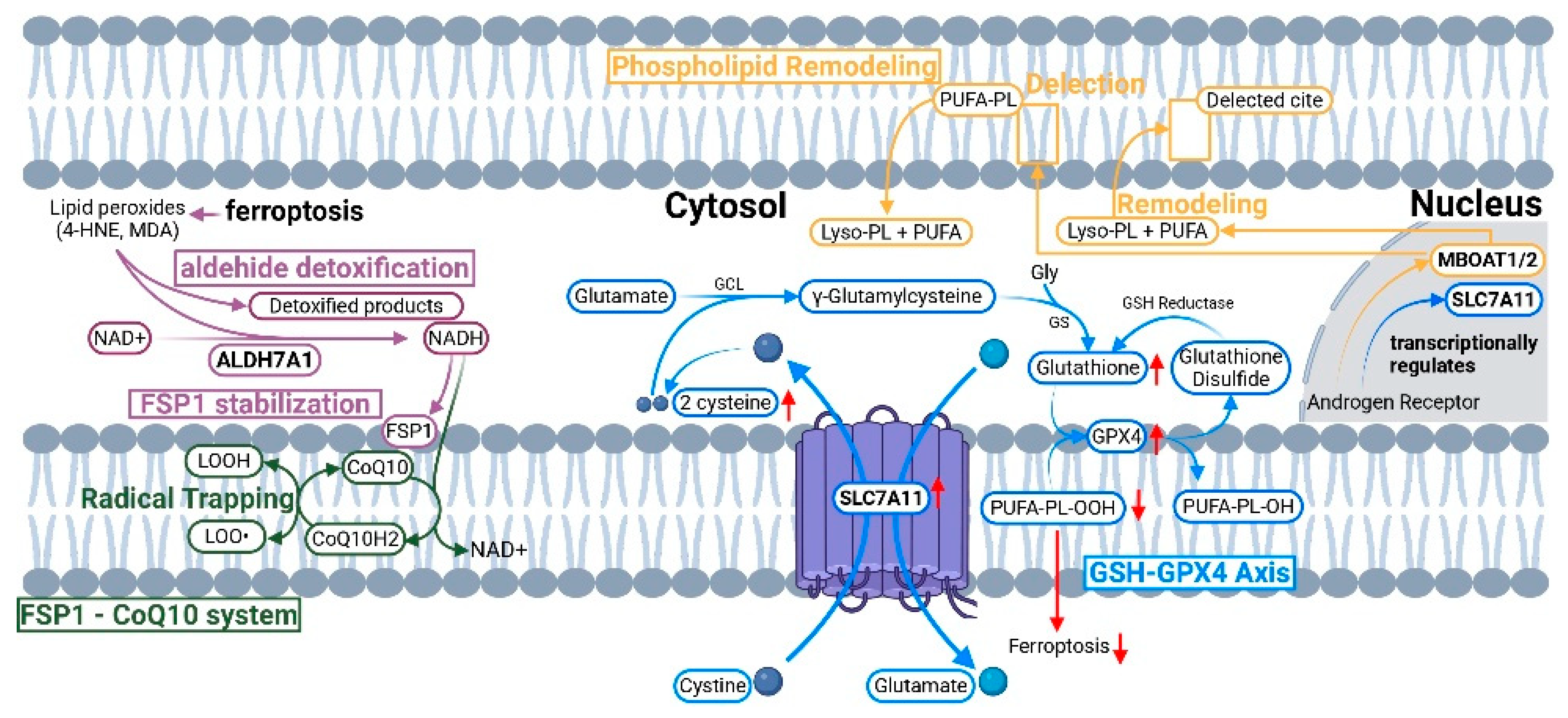
ALDH7A1 (aldehyde dehydrogenase 7A1) represents a recently discovered ferroptosis defense mechanism operating through membrane NADH generation and FSP1 stabilization (Figure 1) [28]. ALDH7A1 localizes to cellular membranes where it generates NADH from NAD+, supporting FSP1-mediated CoQ10 reduction and lipid peroxyl radical trapping. This NADH supply mechanism enhances FSP1 stability through phase separation, creating localized antioxidant microdomains.
The AMPK-ALDH7A1-FSP1 axis links metabolic stress sensing to ferroptosis defense [28]. Additionally, ALDH7A1 detoxifies reactive aldehydes (4-HNE, MDA) generated during lipid peroxidation, preventing protein modification. This dual function—supporting FSP1-CoQ10 activity while eliminating toxic byproducts—positions ALDH7A1 as a critical node integrating metabolic adaptation with ferroptosis resistance.

2.2.4. NRF2 and Additional Defenses

NRF2 coordinates transcriptional responses to oxidative stress by inducing GSH synthesis enzymes, SLC7A11, and detoxification proteins [10]. Cancer cells frequently exhibit constitutive NRF2 activation, contributing to therapy resistance. Additional ferroptosis suppressors include the thioredoxin system [33] and 7-dehydrocholesterol, which traps lipid peroxyl radicals through its conjugated diene structure [34].

2.3. Oxidative Damage: Molecular Consequences

Oxidative stress induces damage across multiple molecular targets. Cysteine residues undergo progressive oxidation to sulfenic, sulfinic, and sulfonic acids. Menadione preferentially oxidizes translation machinery components (eukaryotic initiation and elongation factors), disrupting protein synthesis and amplifying cellular dysfunction [35]. PUFA-containing phospholipids are particularly vulnerable due to bis-allylic methylene groups with low C-H bond dissociation energy [36]. In ferroptotic cells, high PUFA-PL content (from ACSL4/LPCAT3 activity), elevated iron, and impaired GPX4 function create optimal conditions for lipid peroxidation propagation [37], ultimately causing membrane rupture [12]. Oxidative DNA lesions, particularly 8-oxo-deoxyguanosine (8-oxo-dG), accumulate in PCa and correlate with disease stage [38,39]. Chronic oxidative stress overwhelms repair capacity, driving mutation accumulation and resistance development.
Beyond protein, lipid, and DNA damage, oxidative stress leads to cholesterol oxidation, generating oxysterols—biologically active cholesterol metabolites that play complex roles in prostate cancer progression. Oxysterols such as 27-hydroxycholesterol (27-HC) and 25-hydroxycholesterol (25-HC) function as endogenous ligands for liver X receptors (LXRs), which act as tumor suppressors in prostate cancer by inducing cell cycle arrest and limiting inflammation through inhibition of IL-6, COX-2, and iNOS expression [40]. Loss of the oxysterol-sulfating enzyme SULT2B1b in castration-resistant prostate cancer leads to enhanced proliferation, migration, and epithelial–mesenchymal transition, while oxysterol production normally limits invasiveness [41]. Notably, 27-HC downregulates DNA damage repair pathways and induces “BRCAness” in prostate cancer cells, with higher CYP27A1 expression correlating with favorable outcomes [42]. Furthermore, oxysterols influence ferroptosis susceptibility through membrane lipid remodeling: 25-HC suppresses GPX4 expression while upregulating lipid peroxidation-promoting enzymes CYB5R1 and POR [43]. Oxysterols also modulate the tumor immune microenvironment by dampening anti-tumor immune responses and promoting pro-inflammatory states [44], creating multiple therapeutic vulnerabilities at the intersection of oxidative stress, ferroptosis, and immune regulation.

3. Lipid Metabolism and Ferroptosis Execution

3.1. PUFA-Phospholipid Biosynthesis

ACSL4 exhibits unique selectivity for long-chain PUFAs (arachidonic and adrenic acid), converting them into acyl-CoA thioesters for phospholipid incorporation [14]. This substrate specificity enriches cellular membranes with highly oxidizable lipids, creating ferroptosis vulnerability. In PCa, ACSL4 expression correlates with metastatic potential, linking aggressive phenotypes to targetable metabolic dependencies [14]. LPCAT3 completes ferroptosis-susceptible phospholipid synthesis by incorporating ACSL4-activated PUFA-CoAs at the sn-2 position of lysophospholipids [45]. Phospholipids containing PUFAs at both sn-1 and sn-2 positions (di-PUFA species) exhibit several-fold higher peroxidation susceptibility [45]. Phosphatidylethanolamine species with two arachidonic or adrenic acid chains represent the most vulnerable membrane components, with concentrations strongly correlating with ferroptosis sensitivity.

3.2. Phospholipid Remodeling: Defense Mechanism

3.2.1. MBOAT1/2 Family

MBOAT1 and MBOAT2 (membrane-bound O-acyltransferase 1/2) represent a distinct ferroptosis defense mechanism operating through upstream phospholipid remodeling [19]. Unlike GPX4 and FSP1 that detoxify lipid peroxides after formation [15,16], MBOAT1/2 prevent accumulation of ferroptosis-susceptible phospholipids. These enzymes exhibit selectivity for monounsaturated fatty acids (MUFAs) and saturated fatty acids (SFAs) over polyunsaturated fatty acids (PUFAs) [19], contrasting with LPCAT3’s PUFA preference [45]. By incorporating MUFAs and SFAs into phospholipids, MBOAT1/2 remodel cellular membranes away from highly oxidizable PUFA-containing species, fundamentally decreasing ferroptosis susceptibility independent of antioxidant capacity [19].

3.2.2. Sex Hormone Regulation

Sex hormone regulation of MBOAT1/2 has critical implications for hormone-dependent cancers. MBOAT1 responds to estrogen receptor signaling, whereas MBOAT2 is transcriptionally regulated by androgen receptor [19]. In hormone-sensitive PCa, AR-driven MBOAT2 expression maintains a phospholipid profile enriched in MUFAs and SFAs, conferring ferroptosis resistance [19]. ADT suppresses MBOAT2 expression, increasing PUFA incorporation and creating a therapeutic vulnerability window for ferroptosis induction [19]. However, in CRPC where AR signaling persists through AR amplification or splice variants [46,47], MBOAT2 levels remain elevated, contributing to ferroptosis resistance through continued lipid remodeling [19].

3.3. Iron-Catalyzed Lipid Peroxidation

The labile iron pool comprises redox-active Fe2+/Fe3+ that provides iron for biological functions while driving ferroptosis when excessive [48]. Transferrin receptor 1 (TfR1) mediates iron import [49], and cancer cells frequently upregulate TfR1 to meet proliferative demands, inadvertently expanding the ferroptosis-vulnerable labile pool. Ferritin stores iron safely, while ferritinophagy (via NCOA4) mobilizes stored iron [50], creating a dynamic balance that determines ferroptosis susceptibility. Ferrous iron catalyzes lipid hydroperoxide decomposition through Fenton-like reactions, generating lipid alkoxyl and peroxyl radicals that abstract hydrogen from adjacent PUFAs, perpetuating chain reactions [51]. This catalytic cycle enables small amounts of iron to cause extensive peroxidation when GPX4 is inhibited. Uncontrolled lipid peroxidation severely disrupts membrane structure. Polar hydroperoxide groups distort the bilayer, creating permeability defects [38]. Advanced peroxidation causes pore formation, uncontrolled ion flux, and plasma membrane rupture. Unlike coordinated apoptosis, ferroptotic death is chaotic and inflammatory, releasing damage-associated molecular patterns that trigger immune responses [11].

3.4. Reactive Aldehydes: Secondary Messengers

Lipid peroxidation generates reactive aldehydes, such as 4-hydroxynonenal (4-HNE), malondialdehyde (MDA), and acrolein, which modify proteins, lipids, and DNA [52,53]. These electrophiles consume GSH through conjugation reactions, further depleting the antioxidant defenses and creating a vicious cycle. ALDH7A1 detoxifies these aldehydes through NAD+-dependent oxidation to less toxic carboxylic acids [17]. The balance between aldehyde generation and detoxification determines whether it contributes to signaling or toxicity. During ferroptosis, the overwhelming production exceeds the detoxification capacity, amplifies cellular damage, and accelerates death.

4. Pro-Oxidant Therapeutic Strategies

4.1. Menadione-Based Pro-Oxidant Therapy: A Novel Mechanistic Approach

4.1.1. VPS34 Targeting and Triaptosis

Menadione sodium bisulfite (MSB), a vitamin K3 precursor, demonstrates potent efficacy in preclinical PCa models through oxidative targeting of VPS34 (PIK3C3), a master regulator of endosomal function [54]. MSB-induced redox cycling generates ROS that selectively oxidize critical cysteine residues in VPS34, abolishing its kinase activity and disrupting endosomal phosphatidylinositol 3-phosphate (PI3P) generation [54]. Cancer cells’ heightened basal oxidative stress makes them preferentially susceptible compared to normal cells [54].
This VPS34 oxidation triggers ‘triaptosis,’ a distinct regulated cell death characterized by catastrophic endosomal dysfunction [55]. Unlike ferroptosis (lipid peroxidation) or apoptosis (caspase-mediated), triaptosis centers on PI3P depletion and progressive endosomal swelling without caspase activation [55]. Triaptosis circumvents common resistance mechanisms: cells resistant to apoptosis (BCL-2 overexpression, TP53 mutations) or ferroptosis (elevated GPX4/FSP1) remain vulnerable [55]. This VPS34-targeting strategy exploits orthogonal vulnerabilities, enabling rational combination approaches.

4.1.2. Proteome-Wide Oxidative Effects

Redox proteomics revealed that menadione preferentially oxidizes translation machinery, particularly eukaryotic initiation factors (EIF2, EIF6) and elongation factor 2 (EEF2) [36]. This selective oxidation disrupts protein synthesis and prevents antioxidant enzyme production, creating a positive feedback loop that amplifies oxidative damage [35,36]. The specificity for translation factors suggests pro-oxidants exert therapeutic effects through targeted protein network disruption rather than indiscriminate oxidation, potentially explaining MSB’s tumor selectivity.

4.2. Ferroptosis Induction Strategies

4.2.1. GPX4 Inhibition

RSL3 and ML162 covalently inhibit GPX4, abolishing lipid hydroperoxide reduction [56]. In PCa, enzalutamide-resistant CRPC cells demonstrate RSL3 susceptibility, with ferrostatin-1 reversal confirming ferroptosis as the death mechanism [57]. However, hypoxia induces resistance by suppressing ACSL4/LPCAT3 expression and promoting lipid droplet accumulation, sequestering PUFAs from membrane phospholipids [56]. Genetic alterations also determine GPX4-dependent ferroptosis sensitivity. PTEN loss, occurring in approximately 20% of primary PCa and 50% of CRPC, promotes GPX4 transcription independent of PI3K/AKT signaling, resulting in elevated GPX4 protein levels and reduced cellular ROS [58]. Consequently, PTEN-null PCa cells (PC3, LNCaP) exhibit marked resistance to erastin-induced ferroptosis compared to PTEN wild-type cells (DU145). Importantly, GPX4 knockdown restores ferroptosis sensitivity in PTEN-deficient cells, indicating that GPX4 inhibitors are essential therapeutic components for PTEN-loss tumors [58]. GPX4 inhibitor efficacy varies with cellular context, necessitating combination approaches targeting multiple pathways.

4.2.2. System Xc Blockade and Glutamine Metabolism

System Xc inhibitors (erastin, sulfasalazine, sorafenib) block SLC7A11-mediated cystine import, depleting GSH and compromising GPX4 activity. In PCa, AR regulates SLC7A11 expression, creating therapeutic opportunities: ADT suppresses SLC7A11, sensitizing cells to system Xc inhibitors during androgen deprivation [19,47].
Glutamine metabolism provides alternative GSH synthesis, conferring ferroptosis resistance. YAP1, elevated in CRPC, upregulates SLC1A5 (glutamine transporter) and GLS1 (glutaminase), driving glutamine-to-glutamate conversion for GSH synthesis [59]. This YAP1-glutamine-GSH axis suppresses RSL3-induced ferroptosis. Combined SLC1A5 (V-9302) or GLS1 (CB-839) inhibition with ferroptosis inducers overcomes this resistance.
However, multiple resistance mechanisms limit System Xc inhibitor efficacy. Circular RNAs confer ferroptosis resistance through SLC7A11 upregulation: circCNOT6L promotes SLC7A11 alternative splicing via the miR-143-5p/SRSF2 axis, driving both ferroptosis resistance and metastasis [30], while circATP2C1 upregulates SLC7A11 through miR-654-3p sequestration [31]. Transcription factor HOXA13 directly activates both System Xc subunits (SLC7A11 and SLC3A2), and HOXA13 knockdown combined with ferroptosis inducers significantly suppresses tumor growth in vivo [29]. These findings suggest that targeting upstream regulators of SLC7A11—including circRNAs and transcription factors—may overcome resistance to conventional System Xc inhibitors. Notably, combined circCNOT6L silencing with erastin effectively suppresses tumor growth in patient-derived organoid models [30], and circATP2C1 knockdown synergizes with erastin in xenograft models [31].

4.2.3. FSP1 Inhibition

FSP1 inhibitors (iFSP1) target the GPX4-independent CoQ10 pathway [16]. Combined GPX4-FSP1 inhibition achieves synthetic lethality: cells tolerate single-pathway loss but succumb to dual blockade. This approach demonstrated enhanced efficacy in preclinical models, suggesting clinical potential for CRPC with multiple coexisting resistance mechanisms.

4.3. Rational Combination Strategies: A Mechanistic Framework

Redundant ferroptosis defense systems necessitate rational combination strategies targeting multiple protective pathways. We categorize combinations into three mechanistic frameworks: (1) vertical inhibition targeting multiple steps within single pathways, (2) horizontal inhibition achieving synthetic lethality across parallel pathways, and (3) vulnerability induction creating exploitable dependencies through therapeutic perturbation. This framework enables rational selection of combination partners, dosing schedules, and treatment sequences based on tumor-specific defense configurations.

4.3.1. Vertical Inhibition: Multi-Step Targeting of Single Defense Pathways

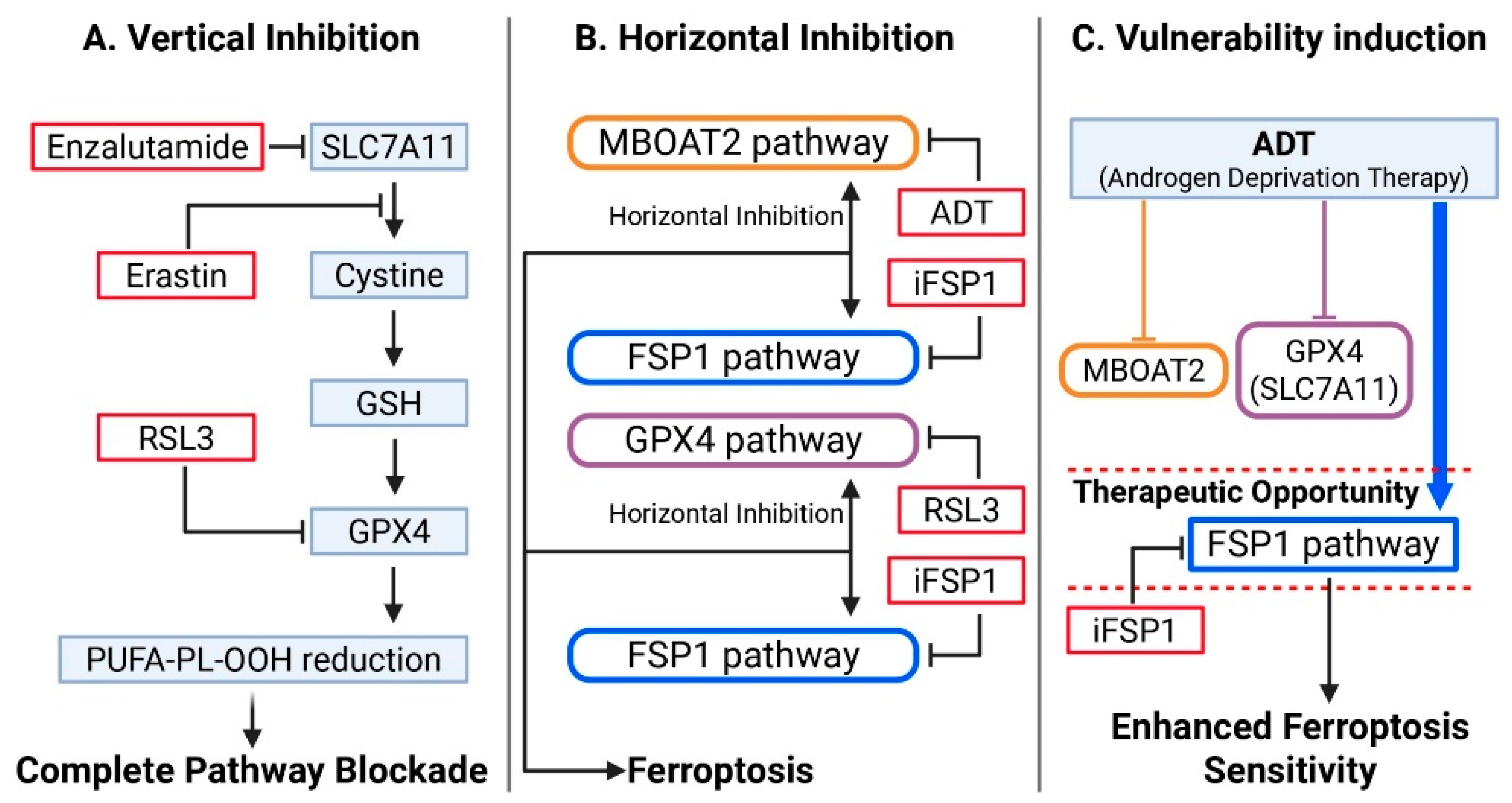
Vertical inhibition targets multiple dependent steps within single defense pathways, overwhelming pathway capacity through redundant blockade at serial checkpoints (Figure 2A). This strategy prevents compensation by attacking mechanistically distinct regulatory nodes (transcription, protein stability, catalytic function) within pathways.
The canonical example combines system Xc and GPX4 inhibition: erastin blocks cystine import via SLC7A11, depleting GSH substrate for GPX4, while RSL3 covalently inactivates GPX4’s catalytic selenocysteine [56]. This dual blockade achieves complete pathway shutdown unattainable by either agent alone.
The enzalutamide–erastin combination reveals how vertical inhibition circumvents adaptive resistance [60]. Enzalutamide suppresses AR-mediated SLC7A11 transcription, but cells compensate through post-translational stabilization by downregulating NEDD4L (E3 ubiquitin ligase) [60]. This transcriptional suppression offset by protein stabilization limits ferroptosis sensitization with enzalutamide monotherapy. Erastin circumvents this by directly blocking SLC7A11 transport function regardless of protein abundance, achieving pathway shutdown despite compensatory mechanisms [60]. This illustrates the critical principle: vertical inhibition succeeds by targeting distinct regulatory nodes, creating threshold effects where pathways catastrophically fail.

4.3.2. Horizontal Inhibition: Synthetic Lethality Across Parallel Defense Pathways

Horizontal inhibition exploits architectural redundancy by simultaneously targeting parallel, mechanistically independent defense systems, creating synthetic lethality where loss of either pathway alone is tolerable but combined loss is lethal (Figure 2B). This strategy circumvents compensatory resistance mechanisms that enable cells to survive single-pathway inhibition.
RSL3 + iFSP1 exemplifies this approach [15,16]. GPX4 reduces phospholipid hydroperoxides using GSH [15], while FSP1 reduces CoQ10 to trap lipid peroxyl radicals independently of GSH [16]. Cancer cells tolerate single-pathway loss through compensatory upregulation, but simultaneous dual inhibition creates catastrophic lipid peroxidation [16].
ADT + FSP1 inhibitors target upstream (MBOAT2) and downstream (FSP1) defenses [16,19]. ADT suppresses AR-driven MBOAT2, increasing PUFA-PL accumulation [19], while cells compensate through FSP1-mediated radical scavenging. FSP1 inhibition removes this parallel defense, rendering PUFA-enriched membranes vulnerable to peroxidation. This approach bypasses AR-V7-mediated constitutive SLC7A11 expression in CRPC [47], circumventing rather than confronting the GPX4-GSH axis resistance.

4.3.3. Vulnerability Induction: Creating Dependencies Through Therapeutic Perturbation

Vulnerability induction strategies differ fundamentally from direct inhibition by remodeling cellular metabolic state to enhance ferroptosis susceptibility through sequential therapeutic perturbation (Figure 2C). The initial therapy establishes a vulnerable state subsequently exploited by ferroptosis inducers, requiring temporal optimization rather than simultaneous administration.
ADT represents the most therapeutically relevant vulnerability induction for PCa [19,61]. AR target gene suppression reduces SLC7A11 (decreasing cystine import and GSH synthesis) and MBOAT2 (increasing PUFA-PL content), creating a ferroptosis-permissive state [19,47]. Additional metabolic rewiring—altered lipid droplet dynamics, iron regulatory protein expression changes, and mitochondrial perturbations—further sensitizes cells [61]. These changes establish a landscape where cells become extremely sensitive to ferroptosis inducers administered during this therapeutic window. Lipidomic profiling reveals ADT-induced lipid remodeling peaks at specific temporal windows, creating time-dependent vulnerability exploitable through sequential FSP1 inhibitor administration [61].

4.3.4. Clinical Translation: Framework-Guided Combination Design

This framework enables rational, biomarker-guided combination design tailored to tumor-specific resistance mechanisms. High GPX4/low FSP1 tumors: vertical inhibition (erastin + RSL3). Balanced GPX4/FSP1 co-expression: horizontal inhibition (RSL3 + iFSP1) [15,16]. Hormone-sensitive disease: vulnerability induction through ADT followed by sequential ferroptosis inducers, exploiting metabolic perturbation windows [19,61]. AR-V7-positive CRPC with constitutive SLC7A11: horizontal targeting bypassing GPX4-GSH axis (FSP1 inhibitors or MBOAT2-targeting strategies) [47].
This framework also informs clinical trial design. Vertical inhibition trials focus on dose optimization for complete pathway shutdown. Horizontal inhibition trials require biomarker stratification to identify active parallel defenses. Vulnerability induction trials incorporate pharmacodynamic monitoring (lipidomic profiling, GSH measurements) to identify optimal sequential dosing timing rather than assuming concurrent superiority.

4.3.5. Immunotherapy Integration: A Multi-Mechanism Combination

Ferroptosis induces immunogenic cell death characterized by DAMP release (HMGB1, ATP, calreticulin), priming anti-tumor immunity [62,63]. In immunologically “cold” PCa, ferroptosis transforms the tumor microenvironment (TME) from immune-excluded to immune-infiltrated through dendritic cell activation and M1 macrophage polarization [62,64]. Combined ferroptosis-checkpoint inhibitor therapy exploits this immune activation. Peptide-based GPX4-targeting approaches enable spatiotemporal control through light-activated ferroptosis induction coupled with cGAS-STING pathway activation [65].

5. Androgen Receptor-Mediated Redox Regulation

The relationship between androgen receptor signaling and ferroptosis susceptibility exemplifies cancer evolution under therapeutic pressure. This section traces AR’s evolutionary trajectory from hormone-sensitive disease, where AR coordinates proliferation and ferroptosis defenses, through castration-resistant adaptations preserving these defenses despite androgen deprivation. Understanding this progression reveals why single-agent therapies often fail and provides a framework for resistance stage-specific combination strategies.

5.1. AR Signaling in Prostate Cancer

5.1.1. AR Structure and Function

The AR, a ligand-activated transcription factor, governs PCa through genomic and non-genomic mechanisms [66]. Upon androgen binding, AR translocates to the nucleus, binds androgen response elements (AREs), and drives transcription of genes controlling proliferation, survival, and metabolism. This transcriptional program extends beyond classical proliferative targets to encompass redox balance pathways, including ferroptosis defense genes (SLC7A11, MBOAT2).
This AR-centered orchestration explains PCa treatment resistance evolution (Figure 1). In hormone-sensitive disease, AR links androgen availability to proliferation and ferroptosis defenses. ADT selective pressure drives adaptation through AR-V7 splice variants (ligand-independent transcription) [47], AR amplification (hypersensitivity to residual androgens), and AR-independent survival programs like SPOP-JMJD6 bypass [64]. Understanding this progression is essential for developing stage-specific therapeutic interventions that match combination strategies to the underlying resistance mechanisms.

5.1.2. AR and Metabolic Reprogramming

The AR coordinates metabolic reprogramming supporting both growth and redox homeostasis in PCa. AR-driven transcriptional programs regulate lipid synthesis, mitochondrial function, and redox balance, enabling PCa cells to tolerate elevated oxidative stress inherent to malignant transformation [66]. Consequently, ADT disrupts these interconnected metabolic pathways, creating exploitable vulnerabilities for pro-oxidant or ferroptosis-inducing therapies. This metabolic disruption represents a critical therapeutic window for combination strategies targeting cancer cell redox homeostasis.

5.2. AR-Regulated Ferroptosis Defense Mechanisms

5.2.1. Direct Transcriptional Targets

The AR directly regulates three ferroptosis defense genes in PCa (Table 2). MBOAT2-mediated phospholipid remodeling reduces PUFA-PL substrate availability [19]. SLC7A11 maintains cystine import and GSH synthesis, supporting GPX4 activity [47]. PEX10 contributes to peroxisomal integrity and lipid homeostasis [66]. Notably, enzalutamide paradoxically increases SLC7A11 protein levels by downregulating NEDD4L, an E3 ubiquitin ligase targeting SLC7A11 for degradation [60]. This post-translational stabilization mechanism explains limited ferroptosis sensitization with AR inhibitor monotherapy and provides rationale for combining AR antagonists with system Xc blockers like erastin.

5.2.2. Mechanism of Ferroptosis Resistance

The AR-regulated defense mechanisms converge on two fundamental strategies: reducing substrate availability and enhancing antioxidant capacity. Through MBOAT2-mediated phospholipid remodeling, AR signaling reduces PUFA-PL content, the primary ferroptosis substrate, thereby creating a lipid membrane composition inherently resistant to peroxidation [19]. This compositional shift toward saturated and monounsaturated phospholipids enhances membrane stability and reduces susceptibility to lipid peroxidation chain reactions. Simultaneously, AR-driven SLC7A11 expression maintains robust cystine import, GSH synthesis, and GPX4 activity, enabling efficient neutralization of lipid peroxides that do form [47]. This dual-pronged defense, combining substrate reduction with enhanced antioxidant capacity, explains the remarkable ferroptosis resistance observed in androgen-replete PCa cells and highlights why ADT disruption of these pathways creates therapeutic vulnerability windows.

5.3. ADT and Ferroptosis Sensitization

5.3.1. Metabolic Consequences of ADT

ADT disrupts multiple AR-controlled metabolic pathways, creating a transient window of ferroptosis vulnerability. MBOAT2 downregulation shifts phospholipid composition toward greater PUFA content, increasing the pool of oxidizable substrates [19]. Simultaneously, SLC7A11 suppression reduces cystine import and GSH synthesis, compromising GPX4-mediated lipid peroxide detoxification [47]. These coordinated metabolic perturbations converge to create oxidative stress that exceeds cellular compensatory capacity, rendering cells vulnerable to ferroptosis induction.

5.3.2. Therapeutic Window Creation

The loss of AR-mediated protection creates a critical therapeutic window for ferroptosis induction. Maximal sensitization likely occurs during the early ADT response, before adaptive resistance mechanisms engage. During this period, cells experience simultaneous depletion of multiple ferroptosis defenses while lacking compensatory survival pathways. Sequential or concurrent administration of ferroptosis inducers during this window may achieve optimal therapeutic efficacy, exploiting the metabolic vulnerability created by androgen deprivation. However, this window proves transient. CRPC emergence reflects successful adaptation through AR amplification, AR-V7 expression enabling ligand-independent signaling, or activation of alternative survival pathways [47,59]. AR-V7-mediated SLC7A11 upregulation restores GSH-GPX4 activity, while persistent MBOAT2 expression maintains lipid remodeling defenses. In SPOP-mutated subsets, JMJD6-driven ferroptosis resistance provides complete independence from AR signaling [67]. Effective therapeutic intervention requires matching treatment strategies to the specific resistance stage, transforming patient stratification from empirical biomarker testing to mechanistically rational selection based on the underlying resistance biology.

5.4. Combination Therapy Strategies

5.4.1. AR Antagonists + Ferroptosis Inducers

Several evidence-based combination strategies targeting the AR-ferroptosis crosstalk have shown promising preclinical results. The combination of enzalutamide with erastin addresses a paradoxical resistance mechanism wherein enzalutamide-induced NEDD4L downregulation stabilizes SLC7A11 protein [60]. Erastin blocks system Xc function, preventing cystine import despite elevated SLC7A11 levels, thereby restoring ferroptosis sensitivity [60]. Another rational approach combines AR-targeting proteolysis-targeting chimeras (PROTACs) with GPX4 inhibitors. PROTACs degrade both AR-FL and AR-V7, eliminating transcriptional support for ferroptosis defenses [46]. When combined with RSL3-mediated GPX4 inhibition, this strategy achieved synthetic lethality in AR-V7-expressing CRPC cells [48]. Additionally, combining ADT with FSP1 inhibitors targets parallel defense pathways: ADT suppresses the SLC7A11-GSH-GPX4 axis while FSP1 inhibition blocks CoQ10-mediated lipid peroxyl radical trapping, creating dual vulnerability [66]. Beyond conventional combination approaches, novel therapeutic modalities targeting SLC7A11 degradation have emerged. The recombinant CCDC7241aa protein, derived from the chimeric circular RNA CCDC719–13, promotes TRIM21-mediated SLC7A11 ubiquitination and demonstrates synergistic effects with both docetaxel and enzalutamide across AR-negative (PC3) and AR-positive (LNCaP, VCaP, 22RV1) PCa cell lines [32]. In patient-derived xenograft models of CRPC, CCDC7241aa effectively suppresses tumor growth without apparent toxicity, suggesting clinical translatability [32].

5.4.2. Novel Dual-Function Agents

Several compounds demonstrate simultaneous AR inhibition and ferroptosis induction, representing pharmacologically elegant single-agent approaches. Darolutamide, a second-generation AR antagonist approved for CRPC, may possess pro-ferroptotic properties beyond AR blockade [66]. Erastin exhibits dual activity by inhibiting both system Xc and displaying off-target effects on AR signaling. Structure–activity relationship studies exploring AR antagonist scaffolds with ferroptosis-inducing modifications may yield optimized dual-function molecules with improved therapeutic indices.

5.4.3. Overcoming CRPC

CRPC emergence through AR amplification, AR-V7 expression, or AR-independent pathways restores ferroptosis resistance despite initial ADT sensitization. AR-V7-positive CRPC maintains persistent SLC7A11 expression through constitutive transcriptional activation, necessitating FSP1 inhibition to bypass the GPX4-GSH axis [16,47]. SPOP-mutated tumors achieve complete AR independence through JMJD6-driven ferroptosis resistance mediated by ATF4-dependent enhancement of GSH metabolism [67]. These tumors require combined JMJD6 inhibition and ferroptosis induction [67]. This evolutionary framework transforms therapeutic selection from empirical approaches to mechanistically rational strategies matched to specific resistance stages. Effective CRPC treatment requires biomarker-guided identification of the dominant resistance mechanism, enabling precision targeting of the underlying ferroptosis defense pathway.

6. Clinical Translation and Future Perspectives

6.1. Redox Biomarkers for Patient Stratification

Effective clinical implementation requires predictive biomarkers. Oxidative stress markers (GSH/GSSG ratio, lipid peroxidation products [52,53], 8-oxo-dG [39]) provide complementary assessments of redox balance and oxidative damage. Molecular signatures guide therapeutic selection: ACSL4/LPCAT3 expression predicts ferroptosis susceptibility [14,45], GPX4/FSP1 ratios determine dominant defense pathways [16,28], AR-V7 status indicates constitutive SLC7A11 activity requiring FSP1-targeting approaches [47], and SPOP mutations signal JMJD6-driven resistance [67]. Lipidomic profiling quantifies PUFA-PL substrate pools [61], with ADT-induced remodeling creating temporal vulnerability windows for optimal ferroptosis inducer timing [61]. Integrating these molecular, metabolic, and genomic biomarkers enables patient stratification based on specific vulnerability profiles (Table 3). Clinical implementation of these biomarkers requires consideration of practical feasibility. Oxidative stress markers (GSH/GSSG ratio, 4-HNE, MDA) and serum iron parameters are readily accessible through standard clinical laboratories using spectrophotometry or ELISA-based assays. However, comprehensive PUFA-PL profiling necessitates specialized lipidomics platforms with liquid chromatography–tandem mass spectrometry (LC-MS/MS) capabilities, currently available only in research or tertiary care centers [61]. Molecular signatures (ACSL4, LPCAT3, GPX4, FSP1) require tissue biopsies for immunohistochemistry or quantitative PCR analysis, though emerging liquid biopsy technologies enable minimally invasive monitoring of AR-V7 status and genomic alterations through circulating tumor cells [47]. Recent studies have identified additional biomarkers for ferroptosis therapy stratification. PTEN status critically determines ferroptosis susceptibility: PTEN wild-type tumors respond to System Xc inhibitors alone, whereas PTEN-null tumors require GPX4 inhibitor combinations due to elevated GPX4 expression [58]. Circular RNA expression profiles offer prognostic value; high circATP2C1 expression correlates with poor overall survival, elevated Gleason score, and metastasis, potentially serving as a predictive biomarker for ferroptosis therapy resistance [31]. Similarly, low CCDC719–13 expression independently predicts poor prognosis in advanced and recurrent PCa and may identify patients who would benefit from SLC7A11-targeted therapies [32]. HOXA13 overexpression marks metastatic tumors with enhanced System Xc activity that may require HOXA13-targeted intervention combined with ferroptosis inducers [29]. A tiered diagnostic approach—combining readily available markers for initial screening with advanced lipidomic and genomic profiling for high-risk patients—may optimize cost-effectiveness while maintaining predictive accuracy for ferroptosis-based therapeutic stratification.

6.2. Challenges in Clinical Translation

Achieving cancer-selective toxicity while sparing normal tissues remains the fundamental challenge. Tumor-targeted delivery using PSMA-conjugated nanoparticles [64], prodrug approaches exploiting tumor-enriched enzymes, and temporal dosing during ADT-induced sensitization windows [19,47] can enhance selectivity. Resistance mechanisms include NRF2-mediated transcriptional upregulation of antioxidant programs [10], lipid droplet accumulation sequestering PUFAs [56], enhanced glutamine metabolism supporting GSH synthesis [59], and defense pathway redundancy [16,19,28]. Rational combinations targeting multiple mechanisms simultaneously can prevent adaptive escape. Many first-generation ferroptosis inducers exhibit suboptimal pharmacokinetics including poor solubility and limited tumor penetration [56]. Nanoparticle-based delivery systems address these challenges through enhanced solubility, prolonged circulation, and active PSMA-targeting [64]. However, clinical translation requires coordinated medicinal chemistry programs, biomarker validation, and adaptive trial designs incorporating pharmacodynamic endpoints [60,66].

6.3. Clinical Translation Pathway

Despite substantial preclinical advances, direct ferroptosis-inducing strategies remain absent from current PCa clinical trials, reflecting pharmacokinetic limitations of first-generation inducers and lack of validated biomarkers [56]. Pro-oxidant approaches including menadione sodium bisulfite (MSB) show promise through VPS34 oxidation and triaptosis induction [54,55]. Near-term clinical opportunities may arise from rational combinations integrating AR antagonists with ferroptosis inducers [60,66] or coupling oxidative stress induction with immunotherapy [62,65]. Early phase trials should incorporate comprehensive biomarker assessments to guide patient selection and subsequent development.

6.4. Future Research Directions

PCa molecular heterogeneity demands biomarker-guided therapeutic strategies [66,67]. Clinical integration requires validated algorithms integrating ACSL4/LPCAT3 expression, GPX4/FSP1 ratios, AR-V7 status, and lipidomic profiles [14,45,47,61] to generate quantitative ferroptosis sensitivity scores. Real-time monitoring through liquid biopsies should enable adaptive therapy adjustments. Novel modalities including photodynamic and sonodynamic therapies offer spatiotemporal ROS control, while CRISPR-based strategies targeting ferroptosis defense genes demonstrate preclinical potential. Ferroptosis-induced immunogenic cell death [62,63] enables synergy with checkpoint inhibitors, potentially transforming immunologically “cold” prostate tumors. Beyond PCa, ferroptosis-targeting strategies extend to hormone-dependent cancers (breast, ovarian) exhibiting estrogen receptor-mediated MBOAT1 regulation [19], melanoma with high ACSL4 expression [14], and lipid-rich clear cell renal carcinoma.

6.5. Conclusions

This review establishes ferroptosis targeting in prostate cancer as a precision medicine paradigm exploiting two fundamental principles. First, “robustness through redundancy”: cancer cells survive through multiple parallel defense pathways (GPX4-GSH, FSP1-CoQ10, ALDH7A1, MBOAT1/2) [16,19,28], necessitating multi-pathway targeting for synthetic lethality. Second, the “evolutionary arms race” between AR signaling and ferroptosis resistance: hormone-sensitive cells depend on AR-coordinated defenses (SLC7A11, MBOAT2) [19,47], ADT creates transient vulnerability windows, but CRPC emerges through progressive adaptations—AR-V7 constitutive activity [47], AR amplification, and JMJD6-ATF4 bypass [67]—that restore oxidative resistance. This framework establishes three rational combination strategies: vertical inhibition targeting multiple pathway steps, horizontal inhibition achieving synthetic lethality across parallel defenses, and vulnerability induction creating exploitable dependencies [19,47,61]. Successful therapy requires stage-specific matching: hormone-sensitive disease benefits from ADT–ferroptosis combinations exploiting SLC7A11/MBOAT2 suppression [19,47]; AR-V7-positive CRPC necessitates FSP1 inhibition bypassing the GPX4-GSH axis [16,47]; SPOP-mutated tumors require JMJD6 inhibitor integration [67]. Novel approaches including menadione-based VPS34 targeting induce triaptosis [54,55], while ferroptosis-induced immunogenic cell death enables checkpoint inhibitor synergy [62,63]. Clinical translation requires validated biomarkers (ACSL4/LPCAT3, GPX4/FSP1 ratios, AR-V7 status, lipidomic profiles) [14,45,47,61] for patient stratification, next-generation inducers with improved pharmacokinetics [56], tumor-targeted delivery [64], and rational combination trials [60,66]. Emerging evidence reveals additional layers of SLC7A11 regulation—including circular RNA-mediated post-transcriptional control [30,31], transcription factor HOXA13 [29], and TRIM21-mediated ubiquitination [32]—that expand therapeutic targeting opportunities. Furthermore, genetic context determines ferroptosis sensitivity, as PTEN-loss tumors exhibit GPX4-dependent resistance requiring tailored combination strategies [58].
This represents a fundamental reconceptualization: ferroptosis vulnerability as an evolutionary battleground shaped by redundant defenses and AR-mediated adaptations, providing a framework for stage-specific, biomarker-guided interventions that exploit the architectural fragility beneath cancer’s oxidative robustness.

Author Contributions

Conceptualization, M.S.K.; writing—original draft preparation, S.Y., J.B. and T.C.; writing—review and editing, S.Y., J.B., T.C. and M.S.K. All authors have read and agreed to the published version of the manuscript.

Funding

This study was supported by the Young Investigator Research Grant from the KOREAN NEPHROLOGY RESEARCH FOUNDATION 2024 (K-NRF-2024-017) and the Global—Learning & Academic research institution for Master’s/PhD students, and Postdocs (G-LAMP) Program of the National Research Foundation (NRF) grant funded by the Ministry of Education (No. RS-2025-25442355).

Institutional Review Board Statement

Not applicable.

Informed Consent Statement

Not applicable.

Data Availability Statement

No new data were created or analyzed in this study. Data sharing is not applicable to this article.

Conflicts of Interest

The authors declare no conflicts of interest.

Abbreviations

The following abbreviations are used in this manuscript:
4-HNE4-Hydroxynonenal
8-oxo-dG8-oxo-deoxyguanosine
ACSL4Acyl-CoA Synthetase Long-Chain Family Member 4
ADTAndrogen Deprivation Therapy
ALDH7A1Aldehyde Dehydrogenase 7A1
ARAndrogen Receptor
AR-V7Androgen Receptor Variant 7
CoQ10Coenzyme Q10
CRPCCastration-Resistant Prostate Cancer
DAMPDamage-Associated Molecular Pattern
FSP1Ferroptosis Suppressor Protein 1
GPX4Glutathione Peroxidase 4
GSHGlutathione
GSSGGlutathione Disulfide
LPCAT3Lysophosphatidylcholine Acyltransferase 3
MBOAT1/2Membrane-Bound O-Acyltransferase 1/2
MDAMalondialdehyde
MSBMenadione Sodium Bisulfite
MUFAMonounsaturated Fatty Acid
NRF2Nuclear Factor Erythroid 2-Related Factor 2
PCaProstate Cancer
PROTACProteolysis-Targeting Chimera
PUFAPolyunsaturated Fatty Acid
PUFA-PLPUFA-containing Phospholipids
ROSReactive Oxygen Species
SFASaturated Fatty Acid
SLC7A11Solute Carrier Family 7 Member 11
TMETumor Microenvironment
VPS34Vacuolar Protein Sorting 34

References

  1. GBD 2023 Diseases and Injuries Collaborators. Global burden of 292 causes of death in 204 countries and territories and 660 subnational locations, 1990–2023: A systematic analysis for the Global Burden of Disease Study 2023. Lancet 2025, 406, 1811–1872. [Google Scholar] [CrossRef]
  2. Sharifi, N.; Dahut, W.L.; Steinberg, S.M.; Figg, W.D.; Tarassoff, C.; Arlen, P.; Gulley, J.L. A retrospective study of the time to clinical endpoints for advanced prostate cancer. BJU Int. 2005, 96, 985–989. [Google Scholar] [CrossRef]
  3. Maluf, F.C.; Pereira, F.M.T.; Silva, A.G.; Dettino, A.L.A.; Cardoso, A.P.G.; Sasse, A.S.; Soares, A.; Kann, A.G.; Herchenhorn, D.; Jardim, D.L.F.; et al. Consensus on the Treatment and Follow-Up for Metastatic Castration-Resistant Prostate Cancer: A Report From the First Global Prostate Cancer Consensus Conference for Developing Countries (PCCCDC). JCO Glob. Oncol. 2021, 7, 559–571. [Google Scholar] [CrossRef]
  4. Wüstmann, N.; Reimann, J.; Vieler, J.; Humberg, V.; Schlack, K.; Bögemann, M.; Schrader, A.J.; Bernemann, C. Comprehensive analysis of androgen receptor splice variant target gene expression in prostate cancer. Biochim. Biophys. Acta Mol. Cell Res. 2025, 1873, 120062. [Google Scholar] [CrossRef]
  5. Lv, Y.; Mo, X.; Zhang, R.; Peng, Y.; Feng, T.; Zhang, Y.; Song, G.; Ge, L.; Liu, Y.; Yang, G.; et al. Prostate cancer exploits BRD9-driven metabolic reprogramming to shape the aggressive phenotype. Cell Death Dis. 2025, 16, 326. [Google Scholar] [CrossRef]
  6. Li, M.; Kwantwi, L.B.; Wang, C.; Xiao, Q. Tumor microenvironment-mediated immune evasion and resistance in prostate cancer: Mechanisms, cross-talk, and therapeutic opportunities. Clin. Exp. Med. 2025. [Google Scholar] [CrossRef]
  7. Nakamura, H.; Takada, K. Reactive oxygen species in cancer: Current findings and future directions. Cancer Sci. 2021, 112, 3945–3952. [Google Scholar] [CrossRef]
  8. Moloney, J.N.; Cotter, T.G. ROS signalling in the biology of cancer. Semin. Cell Dev. Biol. 2018, 80, 50–64. [Google Scholar] [CrossRef] [PubMed]
  9. Jomova, K.; Alomar, S.Y.; Alwasel, S.H.; Nepovimova, E.; Kuca, K.; Valko, M. Several lines of antioxidant defense against oxidative stress: Antioxidant enzymes, nanomaterials with multiple enzyme-mimicking activities, and low-molecular-weight antioxidants. Arch. Toxicol. 2024, 98, 1323–1367. [Google Scholar] [CrossRef] [PubMed]
  10. de la Vega, M.R.; Chapman, E.; Zhang, D.D. NRF2 and the Hallmarks of Cancer. Cancer Cell 2018, 34, 21–43. [Google Scholar] [CrossRef] [PubMed]
  11. Zhou, Q.; Meng, Y.; Le, J.; Sun, Y.; Dian, Y.; Yao, L.; Xiong, Y.; Zeng, F.; Chen, X.; Deng, G. Ferroptosis: Mechanisms and therapeutic targets. MedComm 2024, 5, e70010. [Google Scholar] [CrossRef]
  12. Chen, F.; Kang, R.; Tang, D.; Liu, J. Ferroptosis: Principles and significance in health and disease. J. Hematol. Oncol. 2024, 17, 41. [Google Scholar] [CrossRef] [PubMed]
  13. Kagan, V.E.; Mao, G.; Qu, F.; Angeli, J.P.F.; Doll, S.; Croix, C.S.; Dar, H.H.; Liu, B.; Tyurin, V.A.; Ritov, V.B.; et al. Oxidized arachidonic and adrenic PEs navigate cells to ferroptosis. Nat. Chem. Biol. 2017, 13, 81–90. [Google Scholar] [CrossRef]
  14. Wang, Y.; Hu, M.; Cao, J.; Wang, F.; Han, J.R.; Wu, T.W.; Li, L.; Yu, J.; Fan, Y.; Xie, G.; et al. ACSL4 and polyunsaturated lipids support metastatic extravasation and colonization. Cell 2025, 188, 412–429.e27. [Google Scholar] [CrossRef]
  15. Kong, Y.; Li, J.; Lin, R.; Lu, S.; Rong, L.; Xue, Y.; Fang, Y. Understanding the unique mechanism of ferroptosis: A promising therapeutic target. Front. Cell Dev. Biol. 2023, 11, 1329147. [Google Scholar] [CrossRef] [PubMed]
  16. Nakamura, T.; Hipp, C.; Mourão, A.S.D.; Borggräfe, J.; Aldrovandi, M.; Henkelmann, B.; Wanninger, J.; Mishima, E.; Lytton, E.; Emler, D.; et al. Phase separation of FSP1 promotes ferroptosis. Nature 2023, 619, 371–377. [Google Scholar] [CrossRef]
  17. Yang, J.-S.; Morris, A.J.; Kamizaki, K.; Chen, J.; Stark, J.; Oldham, W.M.; Nakamura, T.; Mishima, E.; Loscalzo, J.; Minami, Y.; et al. ALDH7A1 protects against ferroptosis by generating membrane NADH and regulating FSP1. Cell 2025, 188, 2569–2585.e20. [Google Scholar] [CrossRef] [PubMed]
  18. Liang, D.; Feng, Y.; Zandkarimi, F.; Wang, H.; Zhang, Z.; Kim, J.; Cai, Y.; Gu, W.; Stockwell, B.R.; Jiang, X. Ferroptosis surveillance independent of GPX4 and differentially regulated by sex hormones. Cell 2023, 186, 2748–2764.e22. [Google Scholar] [CrossRef]
  19. Swamynathan, M.M.; Kuang, S.; Watrud, K.E.; Doherty, M.R.; Gineste, C.; Mathew, G.; Gong, G.Q.; Cox, H.; Cheng, E.; Reiss, D.; et al. Dietary pro-oxidant therapy by a vitamin K precursor targets PI 3-kinase VPS34 function. Science 2024, 386, eadk9167. [Google Scholar] [CrossRef]
  20. Cui, K.; Wang, K.; Huang, Z. Ferroptosis and the tumor microenvironment. J. Exp. Clin. Cancer Res. 2024, 43, 322. [Google Scholar] [CrossRef]
  21. Lyu, X.; Yu, Y.; Jiang, Y.; Li, Z.; Qiao, Q. The role of mitochondria transfer in cancer biological behavior, the immune system and therapeutic resistance. J. Pharm. Anal. 2025, 15, 101141. [Google Scholar] [CrossRef]
  22. Vyas, S.; Zaganjor, E.; Haigis, M.C. Mitochondria and Cancer. Cell 2016, 166, 555–566. [Google Scholar] [CrossRef]
  23. Junco, M.; Ventura, C.; Valtierra, F.X.S.; Maldonado, E.N. Facts, Dogmas, and Unknowns About Mitochondrial Reactive Oxygen Species in Cancer. Antioxidants 2024, 13, 1563. [Google Scholar] [CrossRef]
  24. Sampson, N.; Brunner, E.; Weber, A.; Puhr, M.; Schäfer, G.; Szyndralewiez, C.; Klocker, H. Inhibition of Nox4-dependent ROS signaling attenuates prostate fibroblast activation and abrogates stromal-mediated protumorigenic interactions. Int. J. Cancer 2018, 143, 383–395. [Google Scholar] [CrossRef] [PubMed] [PubMed Central]
  25. Tsouko, E.; Khan, A.S.; White, M.A.; Han, J.J.; Shi, Y.; Merchant, F.A.; Sharpe, M.A.; Xin, L.; Frigo, D.E. Regulation of the pentose phosphate pathway by an androgen receptor–mTOR-mediated mechanism and its role in prostate cancer cell growth. Oncogenesis 2014, 3, e103. [Google Scholar] [CrossRef] [PubMed]
  26. Koochekpour, S.; Majumdar, S.; Azabdaftari, G.; Attwood, K.; Scioneaux, R.; Subramani, D.; Manhardt, C.; Lorusso, G.D.; Willard, S.S.; Thompson, H.; et al. Serum glutamate levels correlate with Gleason score and glutamate blockade decreases proliferation, migration, and invasion and induces apoptosis in prostate cancer cells. Clin. Cancer Res. 2012, 18, 5888–5901. [Google Scholar] [CrossRef] [PubMed]
  27. Koppula, P.; Zhuang, L.; Gan, B. Cystine transporter SLC7A11/xCT in cancer: Ferroptosis, nutrient dependency, and cancer therapy. Protein Cell 2021, 12, 599–620. [Google Scholar] [CrossRef]
  28. Tsuruta, K.; Matsuoka, M.; Harada, S.; Enomoto, A.; Kumagai, T.; Yasuda, S.; Koumura, T.; Yamada, K.-I.; Imai, H. Slowly progressive cell death induced by GPx4-deficiency occurs via MEK1/ERK2 activation as a downstream signal after iron-independent lipid peroxidation. J. Clin. Biochem. Nutr. 2024, 74, 97–107. [Google Scholar] [CrossRef]
  29. Ma, Y.; Liu, R.; Qi, P.; Wei, S.; Ren, Z.; Zhang, A.; Fan, B. HOXA13 promotes prostate cancer metastasis by inhibiting ferroptosis via upregulating SLC7A11 and SLC3A2. Cell. Signal. 2025, 136, 112168. [Google Scholar] [CrossRef] [PubMed]
  30. Liu, J.; Niraj, M.; Zhu, X.; Guo, Y.; Zhang, Z.; Kadier, A.; Gu, Z.; Wang, H.; Zou, L.; Guo, C.; et al. CircCNOT6L modulates alternative splicing of SLC7A11 via splicing factor SRSF2 to confer ferroptosis resistance and promote metastasis in prostate cancer. Exp. Mol. Med. 2025, 57, 2106–2120. [Google Scholar] [CrossRef]
  31. Deng, Z.; Shen, Q.; Deng, N.; Wu, J.; Cheng, X.; Wang, J.; Peng, H.; Zeng, W.; Song, Z.; Jiang, D.; et al. CircATP2C1 Drives Prostate Cancer Progression Through miR-654-3p-Mediated SLC7A11 Upregulation and Ferroptosis Suppression. Cancers 2025, 17, 3571. [Google Scholar] [CrossRef] [PubMed]
  32. Cheng, B.; Wang, Q.; Li, Z.; Luo, T.; Xie, J.; Singh, S.; Luo, Y.; Gao, X.; Li, H.; Wang, Z.; et al. Induction of ferroptosis in prostate cancer by CCDC719–13 via TRIM21-mediated ubiquitination of SLC7A11. Cell Death Differ. 2025, 1–21, Advance online publication. [Google Scholar] [CrossRef] [PubMed]
  33. Wang, L.; Sun, S.; Liu, H.; Zhang, Q.; Meng, Y.; Sun, F.; Zhang, J.; Liu, H.; Xu, W.; Ye, Z.; et al. Thioredoxin reductase inhibition and glutathione depletion mediated by glaucocalyxin A promote intracellular disulfide stress in gastric cancer cells. FEBS J. 2024, 291, 5276–5289. [Google Scholar] [CrossRef]
  34. Freitas, F.P.; Alborzinia, H.; dos Santos, A.F.; Nepachalovich, P.; Pedrera, L.; Zilka, O.; Inague, A.; Klein, C.; Aroua, N.; Kaushal, K.; et al. 7-Dehydrocholesterol is an endogenous suppressor of ferroptosis. Nature 2024, 626, 401–410. [Google Scholar] [CrossRef]
  35. Kobayashi, D.; Takami, T.; Matsumoto, M. Data-Independent Acquisition (DIA)-Based Label-Free Redox Proteomics (DIALRP) Identifies Prominent Cysteine Oxidations in Translation Machinery in Prostate Cancer Cells Under Oxidative Stress. J. Proteome Res. 2025, 24, 4597–4610. [Google Scholar] [CrossRef]
  36. Saito, Y.; Noguchi, N.; Niki, E. Cholesterol is more readily oxidized than phospholipid linoleates in cell membranes to produce cholesterol hydroperoxides. Free. Radic. Biol. Med. 2024, 211, 89–95. [Google Scholar] [CrossRef]
  37. Rodencal, J.; Kim, N.; He, A.; Li, V.L.; Lange, M.; He, J.; Tarangelo, A.; Schafer, Z.T.; Olzmann, J.A.; Long, J.Z.; et al. Sensitization of cancer cells to ferroptosis coincident with cell cycle arrest. Cell Chem. Biol. 2024, 31, 234–248.e13. [Google Scholar] [CrossRef]
  38. Chida, T.; Watanabe, S.; Ohta, K.; Noritake, H.; Ito, M.; Suzuki, T.; Suda, T.; Kawata, K. Impact of amino acid substitutions in hepatitis C virus core region on the severe oxidative stress. Free. Radic. Biol. Med. 2024, 212, 199–206. [Google Scholar] [CrossRef] [PubMed]
  39. Zarakowska, E.; Guz, J.; Mijewski, P.; Wasilow, A.; Wozniak, J.; Roszkowski, K.; Foksinski, M.; Gackowski, D.; Olinski, R. Intracellular ascorbate is a safe-guard and/or reservoir for plasma vitamin C in prostate cancer patients undergoing radiotherapy. Free. Radic. Biol. Med. 2024, 210, 230–236. [Google Scholar] [CrossRef]
  40. De Boussac, H.; Pommier, A.J.; Dufour, J.; Trousson, A.; Caira, F.; Volle, D.H.; Baron, S.; Lobaccaro, J.-M.A. LXR, prostate cancer and cholesterol: The good, the bad and the ugly. Am. J. Cancer Res. 2013, 3, 58–69. [Google Scholar]
  41. Park, S.; Song, C.-S.; Lin, C.-L.; Jiang, S.; Osmulski, P.A.; Wang, C.-M.; Marck, B.T.; Matsumoto, A.M.; Morrissey, C.; Gaczynska, M.E.; et al. Inhibitory interplay of SULT2B1b sulfotransferase with AKR1C3 aldo-keto reductase in prostate cancer. Endocrinology 2020, 161, bqz042. [Google Scholar] [CrossRef] [PubMed]
  42. Galvan, G.C.; Friedrich, N.A.; Das, S.; Daniels, J.P.; Pollan, S.; Dambal, S.; Suzuki, R.; Sanders, S.E.; You, S.; Tanaka, H.; et al. 27-hydroxycholesterol and DNA damage repair: Implication in prostate cancer. Front. Oncol. 2023, 13, 1251297. [Google Scholar] [CrossRef]
  43. Urano, Y.; Iwagaki, A.; Takeishi, A.; Uchiyama, N.; Noguchi, N. Downregulation of the SREBP pathways and disruption of redox status by 25-hydroxycholesterol predispose cells to ferroptosis. Free. Radic. Biol. Med. 2025, 228, 319–328. [Google Scholar] [CrossRef]
  44. Reinmuth, L.; Hsiao, C.-C.; Hamann, J.; Rosenkilde, M.; Mackrill, J. Multiple targets for oxysterols in their regulation of the immune system. Cells 2021, 10, 2078. [Google Scholar] [CrossRef]
  45. Qiu, B.; Zandkarimi, F.; Bezjian, C.T.; Reznik, E.; Soni, R.K.; Gu, W.; Jiang, X.; Stockwell, B.R. Phospholipids with two polyunsaturated fatty acyl tails promote ferroptosis. Cell 2024, 187, 1177–1190.e18. [Google Scholar] [CrossRef]
  46. Yang, F.-Y.; Zhang, N.-Y.; Yang, Y.; Chen, D.; Wu, L.-Y.; Wang, W.-K.; Wang, H.-X.; Wen, Z.; Cai, M.-Z.; Li, H.-Z.; et al. In vivo self-assembled nano-PROTAC for the dual degradation of AR and HSP90 to overcome castration-resistant prostate cancer resistance. Signal Transduct. Target. Ther. 2025, 10, 423. [Google Scholar] [CrossRef] [PubMed]
  47. Sun, R.; Yan, B.; Li, H.; Ding, D.; Wang, L.; Pang, J.; Ye, D.; Huang, H. Androgen Receptor Variants Confer Castration Resistance in Prostate Cancer by Counteracting Antiandrogen-Induced Ferroptosis. Cancer Res. 2023, 83, 3192–3204. [Google Scholar] [CrossRef]
  48. Torti, S.V.; Torti, F.M. Iron and cancer: 2020 vision. Cancer Res. 2020, 80, 5435–5448. [Google Scholar] [CrossRef] [PubMed]
  49. Vela, D. Iron Metabolism in Prostate Cancer; From Basic Science to New Therapeutic Strategies. Front. Oncol. 2018, 8, 547. [Google Scholar] [CrossRef]
  50. Mancias, J.D.; Wang, X.; Gygi, S.P.; Harper, J.W.; Kimmelman, A.C. Quantitative proteomics identifies NCOA4 as the cargo receptor mediating ferritinophagy. Nature 2014, 509, 105–109. [Google Scholar] [CrossRef]
  51. Yang, W.S.; Stockwell, B.R. Ferroptosis: Death by lipid peroxidation. Trends Cell Biol. 2016, 26, 165–176. [Google Scholar] [CrossRef] [PubMed]
  52. Lee, B.; Afshari, N.A.; Shaw, P.X. Oxidative stress and antioxidants in cataract development. Curr. Opin. Ophthalmol. 2024, 35, 57–63. [Google Scholar] [CrossRef]
  53. Huang, Y.; Sarkhel, S.; Roy, A.; Mohan, A. Interrelationship of lipid aldehydes (MDA, 4-HNE, and 4-ONE) mediated protein oxidation in muscle foods. Crit. Rev. Food Sci. Nutr. 2024, 64, 11809–11825. [Google Scholar] [CrossRef] [PubMed]
  54. Gaschler, M.M.; Stockwell, B.R. Lipid peroxidation in cell death. Biochem. Biophys. Res. Commun. 2017, 482, 419–425. [Google Scholar] [CrossRef] [PubMed]
  55. Li, Z.-Z.; Zhou, K.; Wu, J.; Cao, L.-M.; Wang, G.-R.; Luo, H.-Y.; Liu, B.; Bu, L.-L. Triaptosis and Cancer: Next Hope? Research 2025, 8, 0880. [Google Scholar] [CrossRef]
  56. Chauhan, S.S.; Vizzerra, A.D.; Liou, H.; Flores, C.E.; Snider, A.J.; Snider, J.M.; Warfel, N.A. Hypoxia induced lipid droplet accumulation promotes resistance to ferroptosis in prostate cancer. Oncotarget 2025, 16, 532–544. [Google Scholar] [CrossRef]
  57. Dike, P.E.; Hwang, B.-J.; Campbell, T.; Awolowo, M.; Elliott, B.; Odero-Marah, V. HMGA2 regulates GPX4 expression and ferroptosis in prostate cancer cells. Biochem. Biophys. Res. Commun. 2024, 736, 150859. [Google Scholar] [CrossRef]
  58. Jing, Y.; Xing, D.; Zhao, Z.; Wang, X. Ferroptotic resistance involved in PTEN-loss prostate cancer progression. Discov. Oncol. 2025, 16, 2166. [Google Scholar] [CrossRef]
  59. Fu, X.; Wu, H.; Li, C.; Deng, G.; Chen, C. YAP1 inhibits RSL3-induced castration-resistant prostate cancer cell ferroptosis by driving glutamine uptake and metabolism to GSH. Mol. Cell. Biochem. 2024, 479, 2415–2427. [Google Scholar] [CrossRef]
  60. Tang, M.; Xue, L.; Wang, B.; Jiang, Z.; Li, P.; Bu, H.; Zhao, C.; Zhang, Y.; Liu, S.; Chen, X.; et al. SLC7A11 upregulation via AR and NEDD4L ubiquitination contributes to ferroptosis inhibition and enzalutamide resistance in castration-resistant prostate cancer. Cell Death Dis. 2025, 16, 591. [Google Scholar] [CrossRef]
  61. Tousignant, K.D.; Rockstroh, A.; Poad, B.L.J.; Talebi, A.; Young, R.S.E.; Fard, A.T.; Gupta, R.; Zang, T.; Wang, C.; Lehman, M.L.; et al. Therapy-induced lipid uptake and remodeling underpin ferroptosis hypersensitivity in prostate cancer. Cancer Metab. 2020, 8, 11. [Google Scholar] [CrossRef] [PubMed]
  62. Li, X.; Yang, F.; Wang, M.; Huang, X.; Zeng, X.; Zhou, L.; Peng, S.; Zhang, J. Unleashing the power of peptides in prostate cancer immunotherapy: Mechanism, facts and perspectives. Front. Pharmacol. 2025, 16, 1478331. [Google Scholar] [CrossRef] [PubMed]
  63. Zhou, Z.; Zhao, Y.; Chen, S.; Cui, G.; Fu, W.; Li, S.; Lin, X.; Hu, H. Cisplatin Promotes the Efficacy of Immune Checkpoint Inhibitor Therapy by Inducing Ferroptosis and Activating Neutrophils. Front. Pharmacol. 2022, 13, 870178. [Google Scholar] [CrossRef]
  64. Deng, Z.; Li, B.; Yang, M.; Lu, L.; Shi, X.; Lovell, J.F.; Zeng, X.; Hu, W.; Jin, H. Irradiated microparticles suppress prostate cancer by tumor microenvironment reprogramming and ferroptosis. J. Nanobiotechnol. 2024, 22, 246. [Google Scholar] [CrossRef]
  65. Wang, H.; Jiao, D.; Feng, D.; Liu, Q.; Huang, Y.; Hou, J.; Ding, D.; Zhang, W. Transformable Supramolecular Self-Assembled Peptides for Cascade Self-Enhanced Ferroptosis Primed Cancer Immunotherapy. Adv. Mater. 2024, 36, e2311733. [Google Scholar] [CrossRef]
  66. Lv, D.; Shi, Y.; Kou, L.; Zhang, D.; Guo, Y.; Zhao, S. Precision targeting of androgen receptor–ferroptosis crosstalk in prostate cancer: From mechanisms to therapeutic strategies. Pharmacol. Res. 2025, 219, 107915. [Google Scholar] [CrossRef]
  67. Zhang, C.; Ding, J.; Lim, K.S.; Zhou, W.; Miao, W.; Wu, S.; Liu, H.; Huang, D.; Chen, C.; He, H.; et al. JMJD6 Rewires ATF4-Dependent Glutathione Metabolism to Confer Ferroptosis Resistance in SPOP-Mutated Prostate Cancer. Cancer Res. 2025, 85, 1496–1513. [Google Scholar] [CrossRef] [PubMed]
Figure 1. Molecular mechanisms of ferroptosis defense pathways in prostate cancer cells. The diagram illustrates three interconnected defense systems: the GSH-GPX4 axis (blue pathway, center), FSP1-CoQ10 system (green pathway, left), and phospholipid remodeling pathway (orange pathway, top right). The androgen receptor (AR) transcriptionally regulates SLC7A11 and MBOAT1/2 (shown in nucleus, right). Red arrows indicate pro-ferroptotic events (lipid peroxidation, PUFA-PL accumulation). Blue arrows indicate anti-ferroptotic protection (GSH synthesis, lipid peroxide reduction, radical trapping). ALDH7A11 supports FSP1 through membrane NADH generation and detoxifies reactive aldehydes (4-HNE, MDA). This integrated system exemplifies “robustness through redundancy” requiring multi-pathway targeting for effective ferroptosis induction.
Antioxidants 14 01517 g001
Figure 2. Strategic frameworks for ferroptosis-based combination therapy in prostate cancer. (A) Vertical inhibition: multi-step targeting of a single defense pathway (e.g., enzalutamide blocks AR-mediated SLC7A11 transcription, erastin inhibits SLC7A11 transport function, RSL3 inactivates GPX4), achieving complete pathway blockade. (B) Horizontal inhibition: simultaneous targeting of parallel, mechanistically independent defense systems (e.g., ADT suppresses MBOAT2 pathway, iFSP1 blocks FSP1-CoQ10 system, RSL3 inhibits GPX4 pathway), creating synthetic lethality. (C) Vulnerability induction: ADT suppresses AR-driven MBOAT2 and GPX4 (via SLC7A11) expression while cells maintain FSP1 pathway dependency, creating a therapeutic window for FSP1 inhibitor-mediated ferroptosis. This framework enables rational selection of combination partners based on tumor-specific defense configurations. Arrows indicate; solid lines represent direct inhibition/suppression, dashed lines represent indirect effects or pathway dependencies.
Antioxidants 14 01517 g002
Table 1. Distinguishing Features of Ferroptosis from Other Cell Death Pathways. Ferroptosis is uniquely characterized by iron-dependent lipid peroxidation of PUFA-containing phospholipids, distinguishing it from caspase-dependent apoptosis and RIPK-mediated necroptosis. PUFA-PL, polyunsaturated fatty acid-containing phospholipids.
FeatureFerroptosisApoptosisNecroptosisRefs.
Iron dependencyRequiredNoNo[11]
Lipid peroxidationEssentialNoNo[11,12]
Caspase activationNoYesNo[12]
Key regulatorsGPX4, FSP1, ACSL4Caspases, Bcl-2RIPK1/3, MLKL[13,15,16]
MitochondriaShrinkageSwellingSwelling[12]
PUFA-PL requirementYesNoNo[13,14]
Table 2. AR directly regulates ferroptosis defense genes in PCa. MBOAT2 reduces substrate availability through lipid remodeling. SLC7A11 maintains GPX4 function via GSH synthesis. PEX10 supports peroxisomal lipid metabolism. ADT suppression creates ferroptosis vulnerability, while AR-V7 maintains constitutive expression in CRPC, contributing to resistance.
GeneFunctionAR RegulationDefense MechanismADT ImpactCRPC ResistanceRefs.
MBOAT2Lysophospholipid acyltransferaseDirect transcriptional activationIncorporates MUFA/SFA into phospholipids, reducing PUFA-PL contentSuppression increases PUFA-PL and ferroptosis sensitivityAR-V7 maintains expression;
AR amplification restores activity
[19]
SLC7A11Cystine-glutamate antiporterDirect transcriptional activation via AREsMaintains cystine import for GSH synthesis and GPX4 activitySuppression depletes GSH, sensitizing to ferroptosisAR-V7 drives constitutive expression;
enzalutamide stabilizes protein via NEDD4L suppression
[47,60]
PEX10Peroxisomal biogenesis factorAR-regulated expressionSupports peroxisomal β-oxidation, prevents oxidation-prone lipid accumulationSuppression compromises peroxisomal functionRestoration through persistent AR activity[66]
Table 3. Integrated biomarker panel for precision ferroptosis therapy stratification. Oxidative stress markers establish baseline vulnerability. Molecular signatures (ACSL4/LPCAT3, GPX4/FSP1 ratio, AR-V7, SPOP) predict intrinsic sensitivity and resistance mechanisms. Lipidomic profiling quantifies substrate pools, enabling optimal timing during ADT-created vulnerability windows. Iron homeostasis reflects Fenton reaction capacity.
CategoryBiomarkerBiological MeaningClinical ApplicationRefs.
Oxidative StressGSH/GSSG ratioRedox balance, antioxidant capacityBaseline vulnerability[27]
4-HNE, MDALipid peroxidation productsOxidative damage status[52,53]
8-oxo-dGDNA oxidationDisease severity[39]
Sensitivity SignatureACSL4, LPCAT3PUFA-PL synthesisIntrinsic susceptibility[14,45]
GPX4/FSP1 ratioDefense pathway dominanceGuide inhibitor choice[16,28]
AR-V7Constitutive defenseFSP1 inhibitor need[47]
SPOP mutationsAR-independent resistanceJMJD6 inhibitor need[67]
MetabolicPUFA-PL abundanceSubstrate availabilityADT timing optimization[61]
Serum ironFenton reaction capacityIron status[48,49,50]
Disclaimer/Publisher’s Note: The statements, opinions and data contained in all publications are solely those of the individual author(s) and contributor(s) and not of MDPI and/or the editor(s). MDPI and/or the editor(s) disclaim responsibility for any injury to people or property resulting from any ideas, methods, instructions or products referred to in the content.