Article

Light-Induced Antioxidant Phenolic Changes among the Sprouts of Lentil Cultivar

1
Graduate School of Green-Bio Science, College of Life Sciences, Kyung Hee University, Yongin 17104, Republic of Korea
2
Advanced Radiation Technology Institute, Korea Atomic Energy Research Institute, Jeongeup 56212, Republic of Korea
3
Smart Farm Science, College of Life Sciences, Kyung Hee University, Yongin 17104, Republic of Korea
*
Author to whom correspondence should be addressed.
These authors contributed equally to this work.
Antioxidants 2024, 13(4), 399; https://doi.org/10.3390/antiox13040399

Submission received: 9 March 2024 / Revised: 22 March 2024 / Accepted: 26 March 2024 / Published: 27 March 2024

Abstract

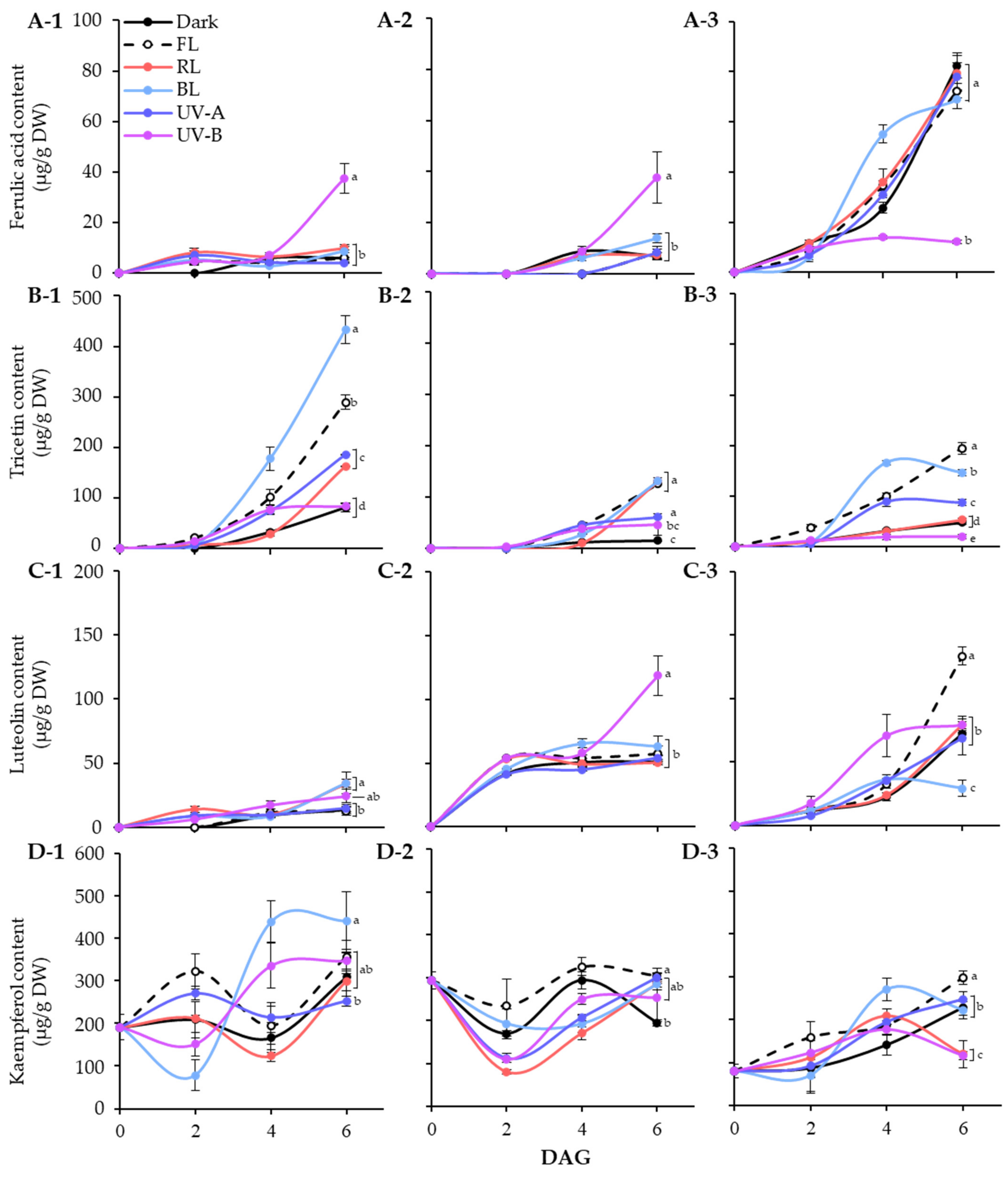
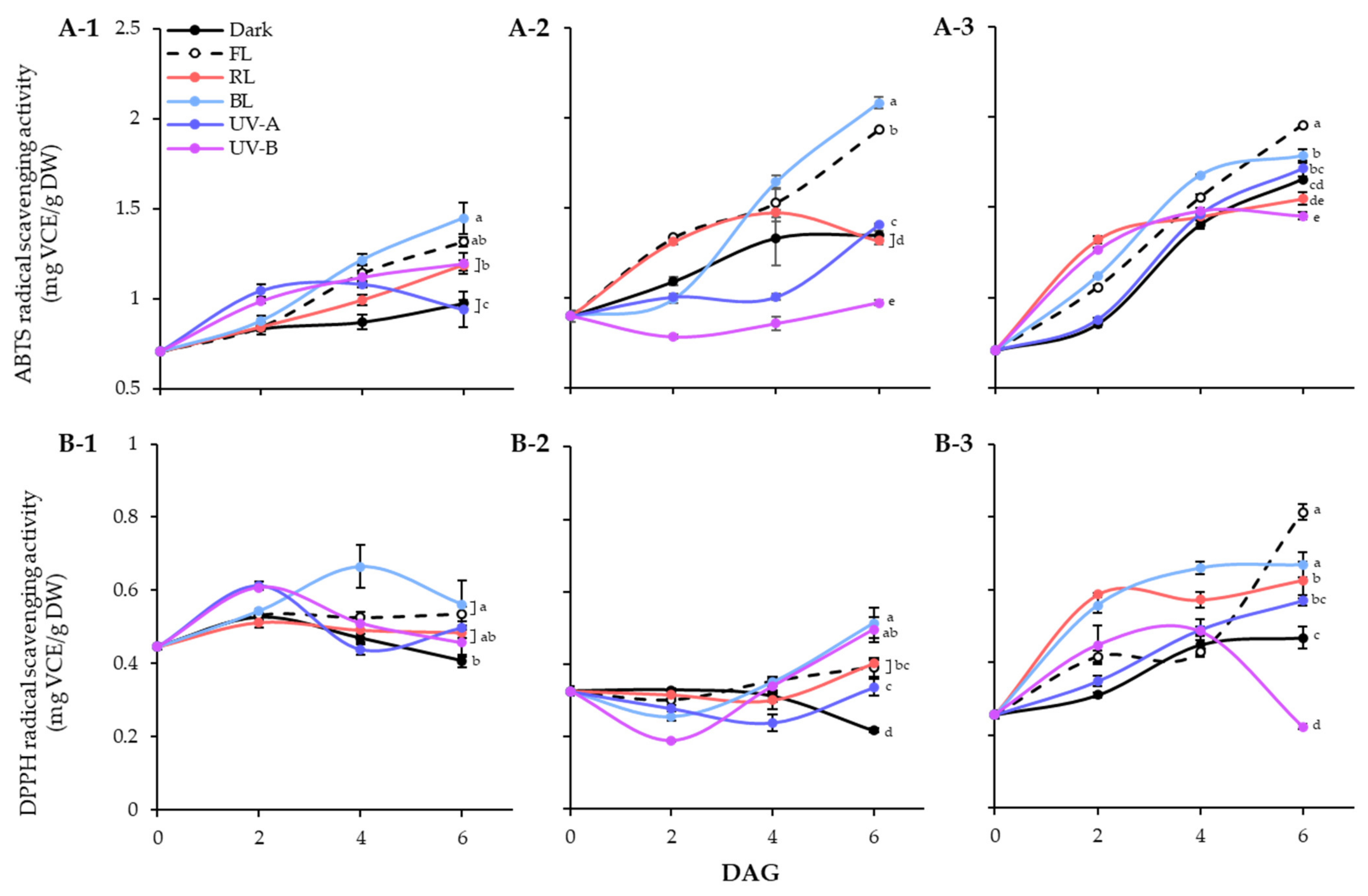
Lentil is a leguminous crop with a high content of health-beneficial polyphenols. Lentil sprouts are popularly consumed in fresh vegetable markets, although their phytochemical qualities are not well understood. In this study, we investigated the accumulation of phenolics in lentil sprouts in response to photosynthetic and stress light qualities, including fluorescent light (FL), red LED (RL), blue LED (BL), ultraviolet A (UV-A), and ultraviolet B (UV-B). Three lentil cultivars, Lentil Green (LG), French Green (FG), and Lentil Red (LR), were used to evaluate sprouts grown under each light condition. The adequate light intensities for enhancing the antioxidant activity of lentil sprouts were found to be 11 W/m2 under photosynthetic lights (FL, RL, BL), and 1 W/m2 under stress lights (UV-A, UV-B). Subsequently, HPLC-ESI/Q-TOF MS analysis was conducted for the quantitative analysis of the individual phenolics that were accumulated in response to light quality. Four main phenolic compounds were identified: ferulic acid, tricetin, luteolin, and kaempferol. Notably, tricetin accumulation was significantly enhanced under BL across all three lentil cultivars examined. Furthermore, the study revealed that the other phenolic compounds were highly dependent on FL, BL, or UV-B exposure, exhibiting cultivar-specific variations. Additionally, the antioxidant activities of lentil extracts indicated that BL was most effective for LG and FG cultivars, whereas FL was most effective for enhancing antioxidant activity of LR cultivars as the sprouts grew.
Keywords: lentil sprout; LED; UV; phenolic compounds; HPLC-ESI/Q-TOF MS; antioxidant activity lentil sprout; LED; UV; phenolic compounds; HPLC-ESI/Q-TOF MS; antioxidant activity