Surgical Versus Conservative Management for Carpal Tunnel Syndrome: An Updated Systematic Review of Randomised Trials
 , , and
Highlights
- Conservative treatments provide faster short-term symptom relief.
- Surgery yields a higher probability of long-term clinical recovery.
- Conservative care may be suitable for rapid symptom control.
- Surgery should be considered for durable functional recovery.
Abstract
1. Introduction
2. Methods
2.1. Study Design
2.2. Eligibility Criteria
2.3. Participants
2.4. Interventions
2.5. Outcomes
- Symptoms and function, preferably measured with the Boston Carpal Tunnel Questionnaire (BCTQ) or other validated instruments;
- Pain intensity, assessed using the Visual Analogue Scale (VAS), Numeric Pain Rating Scale (NPRS), or equivalent tools;
- Health-related quality of life, as measured by validated questionnaires;
- Need for surgery, particularly in participants initially assigned to conservative care or following surgical failure.
2.6. Exclusion Criteria
2.7. Search Strategy
2.8. Study Selection
2.9. Data Extraction
- General characteristics of the study (authors, year, country, design);
- Demographic and clinical features of participants;
- Details of interventions and comparators;
- Outcome measures and follow-up durations;
- Main findings and authors’ conclusions;
- Funding sources and conflicts of interest.
2.10. Risk of Bias Assessment
2.11. Data Synthesis and Statistical Approach
2.12. Certainty of Evidence
2.13. Protocol Amendments
3. Results
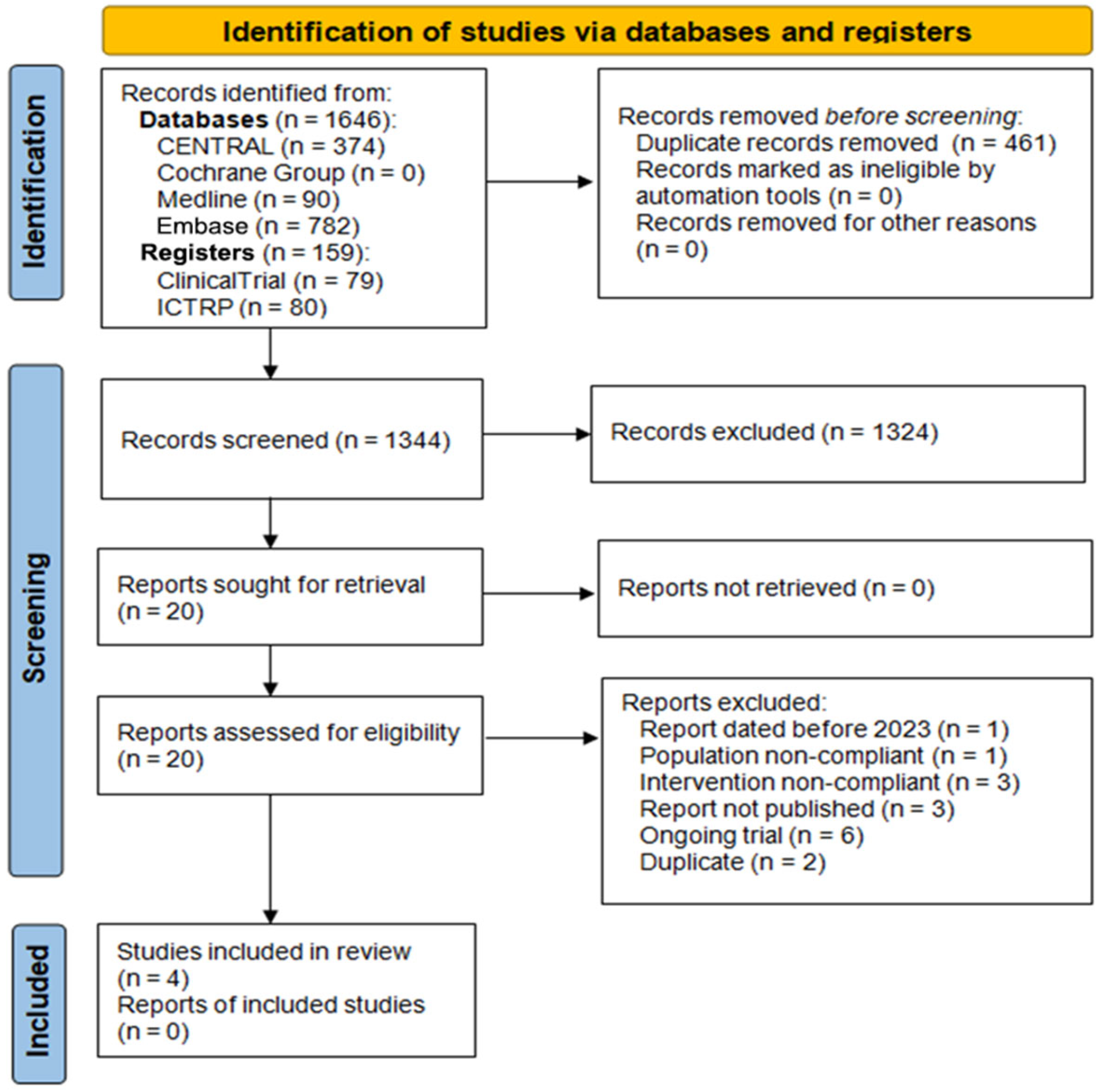
3.1. Study Selection
3.2. Characteristics of Included Studies

| Study Design | Setting, Participants (n) Mean Age (Years) Sex Mean Symptom Duration | Inclusion/Exclusion Criteria | Intervention | Control | Follow-Up | Primary Outcomes Secondary Outcomes | Main Results Conclusions |
|---|---|---|---|---|---|---|---|
| Shahab et al., 2023 RCT [35] | Department of Orthopaedics, Gomal Medical College, Pakistan 74 (37 surgery, 37 steroids) 39.6 ± 2.86 (steroids), 38.7 ± 3.28 (surgery) 56.8% F (steroids), 54% F (surgery) 9 ± 2.1 mo (steroids), 8 ± 1.8 mo (surgery) | ≥16 yrs, clinical + EMG diagnosis; excluded recurrences, fractures, diabetes, pregnancy, other neuropathies | Single injection: 20 mg methylprednisolone + 2 mL xylocaine | Open carpal tunnel release (local anaesthesia) | Baseline, 3, 6, 12 months | Pain (VAS), numbness (Michael-Griffin) | 3 mo: improvement in numbness 8% surgery vs. 19% steroids; pain 5% surgery vs. 19% steroids. 12 mo: pain-free 92% both groups; numbness-free 92% surgery vs. 86% steroids. Comparable results at 12 months. |
| Minoğlu et al., 2023 RCT [34] | Department of Neurosurgery, Atatürk Training and Research Hospital, İzmir, Turkey 80 (36 surgery, 44 steroids) 46.4 ± 9.7 71 F, 9 M 21.8 mo | 20–70 yrs, clinical + EMG CTS; excluded diabetes, pregnancy, trauma, other neuropathies, RA, fractures, deformities | Single injection: 6 mg betamethasone (3 + 3 mg) | Open CTR (curvilinear incision, local anaesthesia) | 1, 3, 6, 12 mo | Nocturnal paraesthesia (complete disappearance = success) BI-Q symptomatic + functional scales, Hi-Ob, VAS | 3 mo: success 59% steroids, 100% surgery; 12 mo: 32% steroids, 100% surgery. Surgery superior; steroids suitable for unilateral mild/moderate CTS. |
| Palmbergen et al., 2025 (DISTRICTS) RCT [36] | 31 hospitals, The Netherlands (neurology clinics) 934 (468 surgery, 466 steroids) 59.0 (51–69) steroids; 58.0 (48–71) surgery 59% F (steroids), 57% F (surgery) 9.0 (5–23 mo) steroids; 8.0 (4–24 mo) surgery | Clinical + EMG/ultrasound CTS; excluded prior surgery/injection < 1 yr, other neuropathies | Corticosteroid injection (protocols varied by centre) | CTR (open or endoscopic, varied by centre) | 6 wk, 3, 6, 9, 12, 15, 18 mo | Clinical recovery (CTS-6 < 8 at 18 mo) Time to recovery, QuickDASH, palmar pain, activity limitation, patient satisfaction (Likert items), additional treatments | 18 mo: Recovery in 61% surgery vs. 45% steroids (RR 1.36, 95% CI 1.19–1.56). Surgery yields higher long-term recovery probability. |
| Fernández-de-las-Peñas et al., 2023 RCT [37] | Regional Hospital of Madrid, Spain 70 (35 surgery, 35 PENS) 46 ± 10 (PENS), 47 ± 7 (surgery) 100% F 3.8 ± 0.6 (PENS), 3.7 ± 1.4 (surgery) | Women < 65 yrs; CTS clinical + EMG; excluded bilateral, men, trauma, other neuropathies, pregnancy, systemic disease, fibromyalgia | 3 weekly sessions of ultrasound-guided PENS of the median nerve (regional anaesthesia) | Endoscopic CTR | Baseline, 1, 3, 6, 12 mo | Pain (NPRS) Function + symptom severity (BCTQ), GROC | 3 mo: pain 2.6 surgery vs. 1.2 PENS; function 1.8 vs. 1.25. 12 mo: pain 1.25 vs. 1.2; function 1.35 vs. 1.2. PENS superior short-term; similar at 12 mo. |
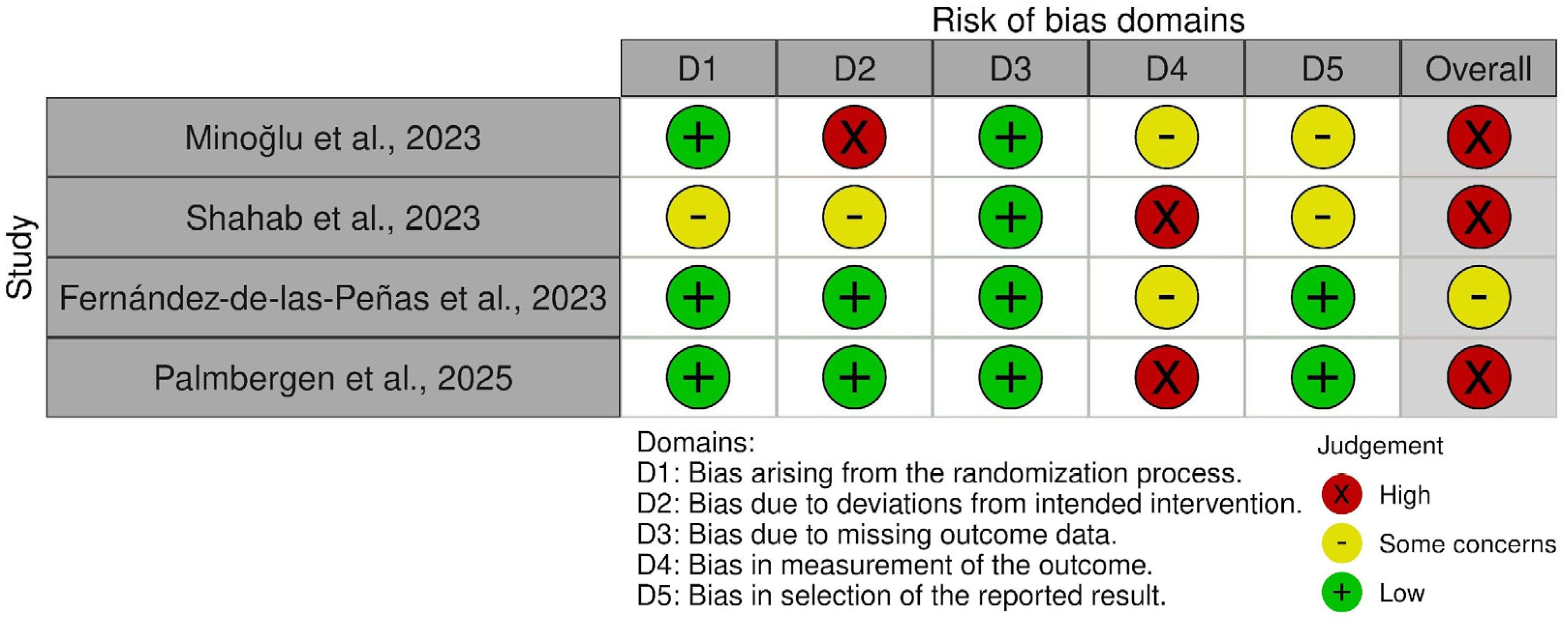
3.3. Risk of Bias
3.4. Synthesis of Results
3.4.1. Surgery Versus Corticosteroid Injection
Short-Term Outcomes (≤3 Months)
Mid-Term Outcomes (6–9 Months)
Long-Term Outcomes (≥12 Months)
3.4.2. Surgery Versus PENS
Short-Term Outcomes (≤3 Months)
Long-Term Outcomes (12 Months)
3.5. Rationale for Narrative Synthesis
- Short-term outcomes (pain and function): Certainty was low for both surgery vs. steroids and surgery vs. PENS due to the risk of bias (unblinded PROMs) and imprecision (small samples, wide confidence intervals).
- Long-term outcomes (clinical recovery): Certainty was moderate for surgery vs. steroids, supported by the large DISTRICTS trial and consistent directionality across studies, albeit downgraded for bias.
- Surgery vs. PENS (12 months): Certainty remained low owing to indirectness (female-only sample) and imprecision.
- Safety outcomes: Certainty was very low, downgraded for probable under-reporting, inconsistent AE definitions, and unsystematic surveillance.
- Short-term (<3 months): Corticosteroid injections and PENS offer faster symptomatic relief, likely through anti-inflammatory and neuromodulatory effects.
- Mid-term (6–9 months): Outcomes begin to converge, with both approaches showing a sustained benefit.
- Long-term (≥12 months): Surgical decompression provides the highest likelihood of durable clinical recovery, particularly in terms of functional restoration and symptom resolution.
4. Discussion
5. Conclusions
Supplementary Materials
Author Contributions
Funding
Institutional Review Board Statement
Informed Consent Statement
Data Availability Statement
Conflicts of Interest
References
- Padua, L.; Cuccagna, C.; Giovannini, S.; Coraci, D.; Pelosi, L.; Loreti, C.; Bernabei, R.; Hobson-Webb, L.D. Carpal Tunnel Syndrome: Updated Evidence and New Questions. Lancet Neurol. 2023, 22, 255–267. [Google Scholar] [CrossRef] [Scilit]
- Paget, J. The First Description of Carpal Tunnel Syndrome. J. Hand Surg. Eur. 2007, 32, 195–197. [Google Scholar] [CrossRef] [Scilit]
- Aboonq, M.S. Pathophysiology of Carpal Tunnel Syndrome. Neurosciences 2015, 20, 4–9. [Google Scholar]
- Dahlin, L.B.; Zimmerman, M.; Calcagni, M.; Hundepool, C.A.; van Alfen, N.; Chung, K.C. Carpal Tunnel Syndrome. Nat. Rev. Dis. Prim. 2024, 10, 37. [Google Scholar] [CrossRef] [Scilit] [PubMed]
- Tedeschi, R. Breaking the Cycle: Addressing the Drucebo Effect in Hand Rehabilitation. Hand Surg. Rehabil. 2025, 44, 102095. [Google Scholar] [CrossRef] [Scilit] [PubMed]
- Ashworth, N.L. Carpal Tunnel Syndrome. Am. Fam. Physician 2016, 94, 830–831. [Google Scholar]
- Padua, L.; Coraci, D.; Erra, C.; Pazzaglia, C.; Paolasso, I.; Loreti, C.; Caliandro, P.; Hobson-Webb, L.D. Carpal Tunnel Syndrome: Clinical Features, Diagnosis, and Management. Lancet Neurol. 2016, 15, 1273–1284. [Google Scholar] [CrossRef] [Scilit]
- Gebrye, T.; Jeans, E.; Yeowell, G.; Mbada, C.; Fatoye, F. Global and Regional Prevalence of Carpal Tunnel Syndrome: A Meta-Analysis Based on a Systematic Review. Musculoskelet. Care 2024, 22, e70024. [Google Scholar] [CrossRef] [Scilit]
- Eros, F.R.; Demers, P.A.; Sritharan, J. Sex-Differences in the Risk of Carpal Tunnel Syndrome: Results from a Large Ontario, Canada Worker Cohort. BMC Musculoskelet. Disord. 2024, 25, 1098. [Google Scholar] [CrossRef] [Scilit]
- Atroshi, I.; Gummesson, C.; Johnsson, R.; Ornstein, E.; Ranstam, J.; Rosén, I. Prevalence of Carpal Tunnel Syndrome in a General Population. JAMA 1999, 282, 153–158. [Google Scholar] [CrossRef] [Scilit]
- Gerger, H.; Macri, E.M.; Jackson, J.A.; Elbers, R.G.; van Rijn, R.; Søgaard, K.; Burdorf, A.; Koes, B.; Chiarotto, A. Physical and Psychosocial Work-Related Exposures and the Incidence of Carpal Tunnel Syndrome: A Systematic Review of Prospective Studies. Appl. Ergon. 2024, 117, 104211. [Google Scholar] [CrossRef] [Scilit]
- Hassan, A.; Beumer, A.; Kuijer, P.P.F.; van der Molen, H.F. Work-Relatedness of Carpal Tunnel Syndrome: Systematic Review Including Meta-Analysis and GRADE. Health Sci. Rep. 2022, 5, e888. [Google Scholar] [CrossRef] [Scilit] [PubMed]
- Miller, L.E.; Hammert, W.C.; Rekant, M.S.; Fowler, J.R. Diagnostic Accuracy of Neuromuscular Ultrasound vs. Electrodiagnostic Studies for Carpal Tunnel Syndrome: Systematic Review and Meta-Analysis of Paired Accuracy Studies. Hand 2025, 20, 1182–1189. [Google Scholar] [CrossRef] [Scilit] [PubMed]
- Bennett, O.M.; Sears, E.D. The Impact of Reference Standard on Diagnostic Testing Characteristics for Carpal Tunnel Syndrome: A Systematic Review. Plast. Reconstr. Surg.-Glob. Open 2023, 11, e5067. [Google Scholar] [CrossRef] [Scilit] [PubMed]
- Dabbagh, A.; MacDermid, J.C.; Yong, J.; Packham, T.L.; Grewal, R.; Boutsikari, E.C. Diagnostic Test Accuracy of Provocative Maneuvers for the Diagnosis of Carpal Tunnel Syndrome: A Systematic Review and Meta-Analysis. Phys. Ther. 2023, 103, pzad029. [Google Scholar] [CrossRef] [Scilit]
- Erickson, M.; Lawrence, M.; Jansen, C.W.S.; Coker, D.; Amadio, P.; Cleary, C. Hand Pain and Sensory Deficits: Carpal Tunnel Syndrome: Clinical Practice Guidelines Linked to the International Classification of Functioning, Disability and Health From the Academy of Hand and Upper Extremity Physical Therapy and the Academy of Orthopaedic Physical Therapy of the American Physical Therapy Association. J. Orthop. Sports Phys. Ther. 2019, 49, 289–361. [Google Scholar]
- Ozdag, Y.; Hu, Y.; Hayes, D.S.; Manzar, S.; Akoon, A.; Klena, J.C.; Grandizio, L.C. Sensitivity and Specificity of Examination Maneuvers for Carpal Tunnel Syndrome: A Meta-Analysis. Cureus 2023, 15, e42383. [Google Scholar] [CrossRef] [Scilit]
- Ellis, R.; Blyth, R.; Arnold, N.; Miner-Williams, W. Is There a Relationship between Impaired Median Nerve Excursion and Carpal Tunnel Syndrome? A Systematic Review. J. Hand Ther. 2017, 30, 3–12. [Google Scholar] [CrossRef] [Scilit]
- Lin, M.-T.; Liu, I.-C.; Chang, H.-P.; Wu, C.-H. Impaired Median Nerve Mobility in Patients with Carpal Tunnel Syndrome: A Systematic Review and Meta-Analysis. Eur. Radiol. 2023, 33, 2378–2385. [Google Scholar] [CrossRef] [Scilit]
- Malakootian, M.; Soveizi, M.; Gholipour, A.; Oveisee, M. Pathophysiology, Diagnosis, Treatment, and Genetics of Carpal Tunnel Syndrome: A Review. Cell Mol. Neurobiol. 2023, 43, 1817–1831. [Google Scholar] [CrossRef] [Scilit]
- Fernández-de-Las-Peñas, C.; Cleland, J.; Palacios-Ceña, M.; Fuensalida-Novo, S.; Pareja, J.A.; Alonso-Blanco, C. The Effectiveness of Manual Therapy Versus Surgery on Self-Reported Function, Cervical Range of Motion, and Pinch Grip Force in Carpal Tunnel Syndrome: A Randomized Clinical Trial. J. Orthop. Sports Phys. Ther. 2017, 47, 151–161. [Google Scholar] [CrossRef] [Scilit] [PubMed]
- Schuind, F. Canal Pressures before, during, and after Endoscopic Release for Idiopathic Carpal Tunnel Syndrome. J. Hand Surg. 2002, 27, 1019–1025. [Google Scholar] [CrossRef] [Scilit] [PubMed]
- American Academy of Orthopaedic Surgeons. Management of Carpal Tunnel Syndrome Evidence-Based Clinical Practice Guideline. 2024. Available online: https://www.aaos.org/globalassets/quality-and-practice-resources/carpal-tunnel/carpal-tunnel-2024/cts-cpg.pdf (accessed on 31 March 2026).
- Donati, D.; Boccolari, P.; Tedeschi, R. Manual Therapy vs. Surgery: Which Is Best for Carpal Tunnel Syndrome Relief? Life 2024, 14, 1286. [Google Scholar] [CrossRef] [Scilit] [PubMed]
- Omole, A.E.; Awosika, A.; Khan, A.; Adabanya, U.; Anand, N.; Patel, T.; Edmondson, C.K.; Fakoya, A.O.; Millis, R.M. An Integrated Review of Carpal Tunnel Syndrome: New Insights to an Old Problem. Cureus 2023, 15, e40145. [Google Scholar] [CrossRef] [Scilit]
- Lusa, V.; Karjalainen, T.V.; Paakkonen, M.; Rajamaki, T.J.; Jaatinen, K. Surgical versus Non-Surgical Treatment for Carpal Tunnel Syndrome. Cochrane Database Syst. Rev. 2024, 1, CD001552. [Google Scholar] [CrossRef] [Scilit]
- Page, M.J.; McKenzie, J.E.; Bossuyt, P.M.; Boutron, I.; Hoffmann, T.C.; Mulrow, C.D.; Shamseer, L.; Tetzlaff, J.M.; Akl, E.A.; Brennan, S.E.; et al. The PRISMA 2020 Statement: An Updated Guideline for Reporting Systematic Reviews. BMJ 2021, 372, n71. [Google Scholar] [CrossRef] [Scilit]
- Forbes, C.; Greenwood, H.; Carter, M.; Clark, J. Automation of Duplicate Record Detection for Systematic Reviews: Deduplicator. Syst. Rev. 2024, 13, 206. [Google Scholar] [CrossRef] [Scilit]
- Haddaway, N.R.; Page, M.J.; Pritchard, C.C.; McGuinness, L.A. PRISMA2020: An R Package and Shiny App for Producing PRISMA 2020-Compliant Flow Diagrams, with Interactivity for Optimised Digital Transparency and Open Synthesis. Campbell Syst. Rev. 2022, 18, e1230. [Google Scholar] [CrossRef] [Scilit]
- Sterne, J.A.C.; Savović, J.; Page, M.J.; Elbers, R.G.; Blencowe, N.S.; Boutron, I.; Cates, C.J.; Cheng, H.-Y.; Corbett, M.S.; Eldridge, S.M.; et al. RoB 2: A Revised Tool for Assessing Risk of Bias in Randomised Trials. BMJ 2019, 366, l4898. [Google Scholar] [CrossRef] [Scilit]
- McGuinness, L.A.; Higgins, J.P.T. Risk-of-Bias VISualization (Robvis): An R Package and Shiny Web App for Visualizing Risk-of-Bias Assessments. Res. Synth. Methods 2020, 12, 55–61. [Google Scholar] [CrossRef] [Scilit]
- McKenzie, J.E.; Brennan, S.E. Chapter 12: Synthesizing and Presenting Findings Using Other Methods [Last Updated October 2019]. In Cochrane Handbook for Systematic Reviews of Interventions Version 6.5; Higgins, J.P.T., Thomas, J., Chandler, J., Cumpston, M., Li, T., Page, M.J., Welch, V.A., Eds.; Cochrane: London, UK, 2024; Available online: https://www.cochrane.org/authors/handbooks-and-manuals/handbook (accessed on 31 March 2026).
- Rethlefsen, M.L.; Kirtley, S.; Waffenschmidt, S.; Ayala, A.P.; Moher, D.; Page, M.J.; Koffel, J.B.; Blunt, H.; Brigham, T.; Chang, S.; et al. PRISMA-S: An Extension to the PRISMA Statement for Reporting Literature Searches in Systematic Reviews. Syst. Rev. 2021, 10, 39. [Google Scholar] [CrossRef] [Scilit]
- Minoğlu, M.; Sucu, H.; Ozdemirkiran, T. Comparison of Surgery and Local Steroid Injections for the Treatment of Carpal Tunnel Syndrome: A Randomized Controlled Trial. Neurol. Sci. Neurophysiol. 2023, 40, 64–69. [Google Scholar] [CrossRef] [Scilit]
- Shahab, M.A.; Aamir, M.; Shafiq, M. The Efficacy of Single Dose Local Steroid Injection versus Standard Carpal Tunnel Release in the Treatment of Carpal Tunnel Syndrome in Population of D.I. Khan Division, Pakistan. J. Liaquat Univ. Med. Health Sci. 2023, 22, 198–202. [Google Scholar] [CrossRef] [Scilit]
- Palmbergen, W.A.; Beekman, R.; Heeren, A.M.; van Nuenen, B.F.; Alleman, T.W.; Verstraete, E.; Jellema, K.; Verhagen, W.I.M.; Visser, L.H.; de Ruiter, G.C.W.; et al. Surgery versus Corticosteroid Injection for Carpal Tunnel Syndrome (DISTRICTS): An Open-Label, Multicentre, Randomised Controlled Trial. Lancet 2025, 405, 2153–2163. [Google Scholar] [CrossRef] [Scilit]
- Fernández-de-Las-Peñas, C.; Ortega-Santiago, R.; De-la-Llave-Rincon, A.I.; Cleland, J.A.; Pareja, J.A.; Fahandezh-Saddi-Diaz, H.; Arias-Buria, J.L. Ultrasound-Guided Percutaneous Electrical Nerve Stimulation versus Surgery for Women with Unilateral Carpal Tunnel Syndrome: A Randomized Parallel-Group Trial. Eur. J. Pain 2023, 27, 860–870. [Google Scholar] [CrossRef] [Scilit]


| Study | Outcome | Total Participants | Comparison (ST/TOT ST—CH/TOT CH) | Follow-Up | RR (95% CI) | RD | Direction |
|---|---|---|---|---|---|---|---|
| Shahab et al., 2023 [35] | Numbness improvement | 74 | ST 7/37—CH 3/37 | Short | 0.43 (0.12–1.53) | −0.11 | ↓ Favours Steroids |
| Shahab et al., 2023 [35] | Pain improvement | 74 | ST 7/37—CH 2/37 | Short | 0.29 (0.06–1.29) | −0.14 | ↓ Favours Steroids |
| Minoğlu et al., 2023 [34] | Clinical success | 80 | ST 26/44—CH 35/36 | — | 1.65 (1.27–2.12) | +0.38 | ↑ Favours Surgery |
| Shahab et al., 2023 [35] | Numbness improvement | 74 | ST 31/37—CH 34/37 | Medium | 1.10 (0.92–1.30) | +0.08 | ↑ Favours Surgery |
| Shahab et al., 2023 [35] | Pain improvement | 74 | ST 23/37—CH 20/37 | Medium | 0.87 (0.59–1.28) | −0.08 | ↓ Favours Steroids |
| Minoğlu et al., 2023 [34] | Clinical success | 80 | ST 21/44—CH 36/36 | — | 2.10 (1.54–2.85) | +0.52 | ↑ Favours Surgery |
| Shahab et al., 2023 [35] | Numbness absence | 74 | ST 32/37—CH 34/37 | Long | 1.06 (0.91–1.25) | +0.05 | ↑ Favours Surgery |
| Shahab et al., 2023 [35] | Pain absence | 74 | ST 34/37—CH 34/37 | Long | 1.00 (0.87–1.14) | 0.00 | ↔ No difference |
| Minoğlu et al., 2023 [34] | Clinical success | 80 | ST 14/44—CH 36/36 | Long | 3.14 (2.04–4.84) | +0.68 | ↑ Favours Surgery |
| Palmbergen et al., 2025 (DISTRICTS) [36] | Clinical recovery (CTS-6) | 934 | ST 180/404—CH 243/401 | 18 mo | 1.36 (1.19–1.56) | +0.16 | ↑ Favours Surgery |
| Study | Outcome Measures | Follow-Up | Mean Difference (95% CI) | Direction | Participants (n) |
|---|---|---|---|---|---|
| Fernández-de-las-Peñas et al., 2023 [37] | Pain (NPRS) | 1 mo | 2.00 (1.10–2.90) | ↓ Favours PENS | 70 |
| Function (BCTQ) | 1 mo | 0.95 (0.80–1.10) | ↓ Favours PENS | 70 | |
| Symptom severity (BCTQ) | 1 mo | 0.30 (0.07–0.53) | ↓ Favours PENS | 70 | |
| Pain (NPRS) | 3 mo | 1.40 (0.50–2.30) | ↓ Favours PENS | 70 | |
| Function (BCTQ) | 3 mo | 0.55 (0.30–0.80) | ↓ Favours PENS | 70 | |
| Symptom severity (BCTQ) | 3 mo | 0.10 (−0.07–0.27) | ↓ Favours PENS | 70 | |
| Pain (NPRS) | 6 mo | 0.50 (−0.07–1.07) | ↓ Favours PENS | 69 | |
| Function (BCTQ) | 6 mo | 0.40 (0.22–0.58) | ↓ Favours PENS | 69 | |
| Symptom severity (BCTQ) | 6 mo | 0.20 (0.02–0.38) | ↓ Favours PENS | 69 | |
| Pain (NPRS) | 12 mo | 0.05 (−0.61–0.71) | ↔ No difference | 66 | |
| Function (BCTQ) | 12 mo | 0.15 (0.00–0.30) | ↔ No difference | 66 | |
| Symptom severity (BCTQ) | 12 mo | 0.10 (−0.06–0.26) | ↔ No difference | 66 |
| Comparison | Outcome Measures | Studies (n) | Evidence Summary | Effect (95% CI) | GRADE Certainty | Downgrading Reasons |
|---|---|---|---|---|---|---|
| Surgery vs. Steroids | Clinical recovery ≥ 12–18 mo | 2 RCTs (1014) | Favours surgery | DISTRICTS: RR 1.36 (1.19–1.56); Minoğlu [34]: RR 3.14 (2.04–4.84) | Moderate | −1 Risk of bias (open-label PROMs, crossover, non-ITT) |
| Pain ≤ 3 mo | 1 RCT (74) | Favours steroids | RR 0.29 (0.06–1.29); MD 0.40 (0.17–0.63) | Low | −1 Risk of bias (open-label PROMs); −1 Imprecision (small sample, wide CIs) | |
| Pain 12 mo | 1 RCT (74) | No difference | RR 1.00 (0.87–1.14); MD 0 (−0.13–0.13) | Low | −1 Risk of bias; −1 Imprecision | |
| Surgery vs. PENS | Pain/function ≤ 3 mo | 1 RCT (70) | Favours PENS | NPRS MD 1.40 (0.59–2.21); BCTQ MD 0.55 (0.31–0.79) | Low | −1 Risk of bias; −1 Imprecision (single RCT, female only) |
| Pain/function 12 mo | 1 RCT (70) | No difference | NPRS MD 0.05 (−0.61–0.71); BCTQ MD 0.15 (0–0.30) | Low | −1 Risk of bias; −1 Indirectness (female only) | |
| All comparisons | Safety (adverse events) | 2 RCTs (1004) + 2 NR | Poorly reported; 1 serious event (surgery) | — | Very low | −1 Reporting bias; −1 Imprecision (rare events); −1 Indirectness (single SAE reported) |
Disclaimer/Publisher’s Note: The statements, opinions and data contained in all publications are solely those of the individual author(s) and contributor(s) and not of MDPI and/or the editor(s). MDPI and/or the editor(s) disclaim responsibility for any injury to people or property resulting from any ideas, methods, instructions or products referred to in the content. |
© 2026 by the authors. Licensee MDPI, Basel, Switzerland. This article is an open access article distributed under the terms and conditions of the Creative Commons Attribution (CC BY) license.
Share and Cite
Masiero, S.; Arcuri, P.; Boccolari, P.; Zorzi, E.; Vio, A.; Fairplay, T.; Zanin, D.; Vita, F.; Donati, D.; Tedeschi, R. Surgical Versus Conservative Management for Carpal Tunnel Syndrome: An Updated Systematic Review of Randomised Trials. Brain Sci. 2026, 16, 399. https://doi.org/10.3390/brainsci16040399
Masiero S, Arcuri P, Boccolari P, Zorzi E, Vio A, Fairplay T, Zanin D, Vita F, Donati D, Tedeschi R. Surgical Versus Conservative Management for Carpal Tunnel Syndrome: An Updated Systematic Review of Randomised Trials. Brain Sciences. 2026; 16(4):399. https://doi.org/10.3390/brainsci16040399
Chicago/Turabian StyleMasiero, Sara, Pasquale Arcuri, Paolo Boccolari, Elena Zorzi, Alessandro Vio, Tracy Fairplay, Davide Zanin, Fabio Vita, Danilo Donati, and Roberto Tedeschi. 2026. "Surgical Versus Conservative Management for Carpal Tunnel Syndrome: An Updated Systematic Review of Randomised Trials" Brain Sciences 16, no. 4: 399. https://doi.org/10.3390/brainsci16040399
APA StyleMasiero, S., Arcuri, P., Boccolari, P., Zorzi, E., Vio, A., Fairplay, T., Zanin, D., Vita, F., Donati, D., & Tedeschi, R. (2026). Surgical Versus Conservative Management for Carpal Tunnel Syndrome: An Updated Systematic Review of Randomised Trials. Brain Sciences, 16(4), 399. https://doi.org/10.3390/brainsci16040399